2020's Most Popular Posts

The "Key Posts" link in navigation at the top of my blog lists all important posts through the end of 2016. Along with "2017's Most Popular Posts," “2018's Most Popular Posts” and “2019's Most Popular Posts,” this is intended as a complement to that list. (Also, my most popular storified Twitter discussions are here, and you can see other recent posts by clicking on the Archive link at the top of my blog.) Continuing this tradition, I give links to the most popular posts in the 2020 below into six groups: popular new posts in 2020 on diet and health, popular new posts in 2020 on political philosophy, popular new posts in 2020 on other topics, and popular older posts in those three categories. I provide the pageviews in 2020 for each post as counted when someone went specifically to that post.
I am pleased to be able to report 613,658 Google Analytics pageviews in 2020—over 50,000 pageviews per month. Of these, 31,480 were pageviews for my blog homepage. One other thing that stands out from the data is how well my back catalog does because of Google search.
New Posts in 2020 on Diet and Health
Getting More Vitamin D May Help You Fight Off the New Coronavirus 559
Don't Drink Sweet Drinks Between Meals—Whether Sugary or with Nonsugar Sweeteners 356
The Surprising Genetic Correlation Between Protein-Heavy Diets and Obesity 220
Fasting Tips 200
My Pillbox 123
Journal of the American College of Cardiology State-of-the-Art Review on Saturated Fats 118
An Inexpensive Cold Sore Treatment That Doubles as an Antiseptic Towelette 97
Potential Protective Mechanisms of Ketosis in Migraine Prevention 89
New Posts in 2020 on Political Philosophy
The Federalist Papers #14: A Republic Can Be Geographically Large—James Madison 109
The Federalist Papers #4 B: National Defense Will Be Stronger if the States are United 90
New Posts in 2020 on Other Topics
How Economists Can Enhance Their Scientific Creativity, Engagement and Impact 1,671
How Even Liberal Whites Make Themselves Out as Victims in Discussions of Racism 1,059
Logarithms and Cost-Benefit Analysis Applied to the Coronavirus Pandemic 995
100 Economics Blogs and 100 Economists Who Are Influential Online 795
Thinking about the 'Executive Order on Combating Race and Sex Stereotyping' 371
Responding to Negative Coverage of Negative Rates in the Financial Times 368
Seconding Paul Romer's Proposal of Universal, Frequent Testing as a Way Out 297
Narayana Kocherlakota Advocates Negative Interest Rates Now 283
Indoors is Very Dangerous for COVID-19 Transmission, Especially When Ventilation is Bad 262
Vicky Biggs Pradhan: How Crises Make Us Rethink Our Lives 255
Matt Adler's Critique of Methods Based on the Value of a Statistical Life 226
Brian Flaxman—Bern Notice: Why Bernie Sanders is the Best Candidate to Take on Donald Trump in 2020 216
The University of Colorado Boulder Deals with a Free Speech Issue 194
On Ex-Muslims 191
Michael Lind: College-Educated vs. Not is the New Class War 186
Dan Benjamin, Mark Fontana and Miles Kimball: Reconsidering Risk Aversion 179
The Mormon Church's Counterpart to a Sovereign Wealth Fund 176
Recognizing Opportunity: The Case of the Golden Raspberries—Taryn Laakso 166
Lumpers vs. Splitters: Economists as Lumpers; Psychologists as Splitters 162
On Policing: Roland Fryer, William Bratton, John Murad, Scott Thomson and the American People 161
Eric Lonergan and Megan Greene: Dual Interest Rates Give Central Banks Limitless Firepower 155
Marc Lipsitch: The New Coronavirus May Be Worse Than You Think (link post) 137
'Everything Happens for a Reason' for Nonsupernaturalists 108
Pressure on the Fed from the Market and Trump for Negative Rates 102
A Nonsupernaturalist Perspective on Meridians in Chinese Medicine 90
What Fraction of Participants in a Randomized Controlled Trial Should Be Treated? 90
Older Posts with Continuing Popularity on Diet and Health
Which Nonsugar Sweeteners are OK? An Insulin-Index Perspective 44,997
Forget Calorie Counting; It's the Insulin Index, Stupid 38,366
How Fasting Can Starve Cancer Cells, While Leaving Normal Cells Unharmed 18,025
Why a Low-Insulin-Index Diet Isn't Exactly a 'Lowcarb' Diet 16,636
Obesity Is Always and Everywhere an Insulin Phenomenon 4,347
Using the Glycemic Index as a Supplement to the Insulin Index 3,314
What Steven Gundry's Book 'The Plant Paradox' Adds to the Principles of a Low-Insulin-Index Diet 2,803
Jason Fung's Single Best Weight Loss Tip: Don't Eat All the Time 1,375
Jason Fung: Dietary Fat is Innocent of the Charges Leveled Against It 1,217
Meat Is Amazingly Nutritious—But Is It Amazingly Nutritious for Cancer Cells, Too? 1,201
The Keto Food Pyramid 1,069
The Case Against Sugar: Stephan Guyenet vs. Gary Taubes 1,004
Layne Norton Discusses the Stephan Guyenet vs. Gary Taubes Debate (a Debate on Joe Rogan’s Podcast) 940
David Ludwig: It Takes Time to Adapt to a Lowcarb, Highfat Diet 870
Don't Tar Fasting by those of Normal or High Weight with the Brush of Anorexia 751
My Giant Salad 717
Best Health Guide: 10 Surprising Changes When You Quit Sugar 665
Anthony Komaroff: The Microbiome and Risk for Obesity and Diabetes 498
A Low-Glycemic-Index Vegan Diet as a Moderately-Low-Insulin-Index Diet 478
After Gastric Bypass Surgery, Insulin Goes Down Before Weight Loss has Time to Happen 470
Mental Retirement: Use It or Lose It—Susann Rohwedder and Robert Willis 466
How Important is A1 Milk Protein as a Public Health Issue? 463
Kevin D. Hall and Juen Guo: Why it is So Hard to Lose Weight and So Hard to Keep it Off 451
Eggs May Be a Type of Food You Should Eat Sparingly, But Don't Blame Cholesterol Yet 312
Cancer Cells Love Sugar; That’s How PET Scans for Cancer Work 303
Is Milk OK? 231
The Case Against the Case Against Sugar: Seth Yoder vs. Gary Taubes 228
Is 10,000 Steps a Day More Than is Necessary for Health? 177
Carola Binder: The Obesity Code and Economists as General Practitioners 102
On the Epistemology of Diet and Health: Miles Refuses to `Stay in His Lane’ 98
Older Posts with Continuing Popularity on Political Philosophy
John Locke: Freedom is Life; Slavery Can Be Justified Only as a Reprieve from Deserved Death 3,901
John Locke on Punishment 2,877
John Locke: The Only Legitimate Power of Governments is to Articulate the Law of Nature 2,154
John Stuart Mill’s Vigorous Advocacy of Education Vouchers 1,297
Freedom Under Law Means All Are Subject to the Same Laws 1,107
John Locke: Defense against the Black Hats is the Origin of the State 961
John Locke: People Must Not Be Judges in Their Own Cases 913
On the Achilles Heel of John Locke's Second Treatise: Slavery and Land Ownership 764
John Locke's Smackdown of Robert Filmer: Being a Father Doesn't Make Any Man a King 691
John Locke: How to Resist Tyrants without Causing Anarchy 671
An Experiment with Equality of Outcome: The Case of Jamestown 566
John Stuart Mill on Balancing Christian Morality with the Wisdom of the Greeks and Romans 512
John Locke: The Right to Enforce the Law of Nature Does Not Depend on Any Social Contract 446
John Locke: By Natural Law, Husbands Have No Power Over Their Wives 410
Social Liberty 405
On Despotism 403
John Locke Off Base with His Assumption That There Was Plenty of Land at the Time of Acquisition 382
John Stuart Mill on the Protection of "Noble Lies" from Criticism 343
John Locke: If Rebellion is a Sin, It is a Sin Committed Most Often by Those in Power 330
John Stuart Mill on the Sources of Prejudice About What Other People Should Do 280
John Locke on Monarchs (Or Presidents) Who Destroy a Constitution 266
The Federalist Papers #2 A: John Jay on the Idea of America 246
John Stuart Mill on Being Offended at Other People's Opinions or Private Conduct 237
The Federalist Papers #1: Alexander Hamilton's Plea for Reasoned Debate 226
John Stuart Mill’s Brief for the Limits of the Authority of Society over the Individual 195
John Locke Looks for a Better Way than Believing in the Divine Right of Kings or Power to the Strong 189
John Locke: The Law of Nature Requires Maturity to Discern 182
John Locke: Law Is Only Legitimate When It Is Founded on the Law of Nature 171
If the Justice System Does Not Try to Deliver Justice, We Are in a State of War 131
John Stuart Mill's Argument Against Political Correctness 128
John Locke: Rivalry in Consumption Makes Private Property Unavoidable 115
John Stuart Mill—The Great Temptation: Telling Others What to Do 114
John Locke: An Unjust War Cannot Win Any True Right to Rule 109
John Stuart Mill on China's Technological Lost Centuries 102
John Stuart Mill on the Need to Make the Argument for Freedom of Speech 98
John Locke: Thinking of Mothers and Fathers On a Par Undercuts a Misleading Autocratic Metaphor 89
Older Posts with Continuing Popularity on Other Topics
What to Call the Very Rich: Millionaires, Vranaires, Okuaires, Billionaires and Lakhlakhaires 3,153
The Medium-Run Natural Interest Rate and the Short-Run Natural Interest Rate 2,687
Adding a Variable Measured with Error to a Regression Only Partially Controls for that Variable 2,662
Monetary vs. Fiscal Policy: Expansionary Monetary Policy Does Not Raise the Budget Deficit 2,550
How and Why to Eliminate the Zero Lower Bound: A Reader’s Guide 2,183
The Logarithmic Harmony of Percent Changes and Growth Rates 1,543
Why I Write 1,321
An Optical Illusion: Nativity Scene or Two T-Rex's Fighting over a Table Saw? 1,297
The Complete Guide to Getting into an Economics PhD Program 1198
Greg Shill: Does the Fed Have the Legal Authority to Buy Equities? 967
Supply and Demand for the Monetary Base: How the Fed Currently Determines Interest Rates 889
The Message of Mormonism for Atheists Who Want to Stay Atheists 825
There's One Key Difference Between Kids Who Excel at Math and Those Who Don't 772
The Deep Magic of Money and the Deeper Magic of the Supply Side 637
Returns to Scale and Imperfect Competition in Market Equilibrium 602
Netflix as an Example of Clay Christensen's 'Disruptive Innovation' 583
Reza Moghadam Flags 'Enabling Deep Negative Rates to Fight Recessions' in the Financial Times 534
The Most Effective Memory Methods are Difficult—and That's Why They Work 456
Co-Active Coaching as a Tool for Maximizing Utility—Getting Where You Want in Life 413
Even Central Bankers Need Lessons on the Transmission Mechanism for Negative Interest Rates 330
How Subordinating Paper Currency to Electronic Money Can End Recessions and End Inflation 324
Negative Interest Rate Policy as Conventional Monetary Policy: Full Text 298
Clay Christensen, Jerome Grossman and Jason Hwang on the Three Basic Types of Business Models 282
Rodney Stark on the Status of Women in Early Christianity 270
Ezra W. Zuckerman—On Genre: A Few More Tips to Academic Journal Article-Writers (link post to a pdf) 268
Marriage 101 265
When the Output Gap is Zero, But Inflation is Below Target 263
18 Misconceptions about Eliminating the Zero Lower Bound 258
Michael Weisbach: Posters on Finance Job Rumors Need to Clean Up Their Act, Too 250
The Shape of Production: Charles Cobb's and Paul Douglas's Boon to Economics 243
The Mormon Church Decides to Treat Gay Marriage as Rebellion on a Par with Polygamy 242
What is the Effective Lower Bound on Interest Rates Made Of? 234
Economics Needs to Tackle All of the Big Questions in the Social Sciences 232
Let's Set Half a Percent as the Standard for Statistical Significance 231
Markus Brunnermeier and Yann Koby's "Reversal Interest Rate" 213
Eric Weinstein: Genius Is Not the Same Thing as Excellence 184
Godless Religion 183
Roger Farmer and Miles Kimball on the Value of Sovereign Wealth Funds for Economic Stabilization 182
Silvio Gesell's Plan for Negative Nominal Interest Rates 170
The Coming Transformation of Education: Degrees Won’t Matter Anymore, Skills Will 162
How and Why to Expand the Nonprofit Sector as a Partial Alternative to Government: A Reader’s Guide 159
Robert Eisler—Stable Money: The Remedy for the Economic World Crisis 158
Sticky Prices vs. Sticky Wages: A Debate Between Miles Kimball and Matthew Rognlie 152
Marriage 102 130
Matthew Shapiro, Martha Bailey and Tilman Borgers on the Economics Job Market Rumors Website 121
Why I am a Macroeconomist: Increasing Returns and Unemployment 115
Miles's April 9, 2006 Unitarian Universalist Sermon: ‘UU Visions’ 113
Ruchir Agarwal and Miles Kimball—Enabling Deep Negative Rates to Fight Recessions: A Guide 109
Leveling Up: Making the Transition from Poor Country to Rich Country 108
Noah Smith: Why Do Americans Like Jews and Dislike Mormons? 108
Bruce Bartlett on Careers in Economics and Related Fields 98
‘The Hunger Games’ Is Hardly Our Future--It's Already Here 98
How Conservative Mormon America Avoided the Fate of Conservative White America 97
Ryan Silverman—$15 Federal Minimum Wage: Positive Intentions, Negative Results 91
Wallace Neutrality Roundup: QE May Work in Practice, But Can It Work in Theory? 91
So What If We Don't Change at All…and Something Magical Just Happens? 91
My Dad 90
Annie Atherton: I Tried 7 Different Morning Routines — Here’s What Made Me Happiest (linkpost) 90
The Logarithmic Harmony of Percent Changes and Growth Rates 89
How Mormon Scripture Declares the US Constitution to be the Work of God 87
How Many Thousands of Americans Will the Sugar Lobby's Latest Victory Kill?

Here is the news from Andrea Petersen’s December 29, 2020 Wall Street Journal article “New U.S. Dietary Guidelines Reject Recommendation to Cut Sugar, Alcohol Intake Limit”:
The federal government on Tuesday issued new dietary guidelines that keep current allowances for sugar and alcohol consumption unchanged, rejecting recommendations by its scientific advisory committee to make significant cuts.
The scientific committee, which was composed of 20 academics and doctors, had recommended cutting the limit for added sugars in the diet to 6% of daily calories from 10% in the current guidelines, citing rising rates of obesity and the link between obesity and health problems like Type 2 diabetes, heart disease and cancer. The committee also recommended lowering the limit for alcoholic beverages for men to one drink per day from two, matching the guidance for women. It pointed to research linking greater alcohol consumption to a higher risk of death.
Many of my readers are already convinced of the toll that sugar takes on our bodies, but may think that moderate drinking is harmless. If that is you, take a look at “Data on Asian Genes that Discourage Alcohol Consumption Explode the Myth that a Little Alcohol is Good for your Health” to have all the relevant information at your disposal. For some, the benefits of moderate drinking in other dimensions may make up for the physical harm, but there is some physical harm. If you thought in the past that there was no physical harm (or perhaps even the benefit claimed by those only looking at raw correlations) from alcohol, understanding the “Mendelian randomization” evidence about alcohol should lower your estimate of the optimal level of alcohol consumption.
Also, it should be noted that, according to Peter Attia, alcohol, even in moderate amounts, tends to seriously lower sleep quality. That alcohol sometimes makes it easier to fall asleep sometimes gives people the idea that alcohol is good for sleep, but overall it is disruptive of sleep. (It is seen as a bad sign in our culture if someone begins drinking early in the day. But for the sake of sleep, it would be better if our culture saw drinking at any time other than the morning—and that in moderation—as a shocking thing.)
Turning to sugar, I don’t know the precise death toll from the sugar lobby’s victory, but my title above asks the right question. Suppose for example that a reduction in the recommended ceiling from 10% of calories from sugar to 6% of calories from sugar led to people actually reducing sugar intake by half a percent of all calories? How many lives could have been saved over the coming five years (before the next set of guidelines are created)?
Although Brandon Lipps, deputy undersecretary for food, nutrition and consumer services at the Department of Agriculture paid lip service to an insufficiency of scientific evidence in explaining the decision. But Andrea Petersen reports this on the lobbying in favor of that decision:
The American Beverage Association, which represents drink makers including Coca-Cola and PepsiCo, urged the government to keep the 10% added-sugars limit during a public meeting in August. In response to the new guidelines, the organization’s president and chief executive Katherine Lugar said in a statement, “America’s beverage companies appreciate the common sense approach taken by USDA.”
The alcohol industry also lauded the government’s decision, with a spokesman for the Beer Institute praising “maintaining the long-standing definition of moderate alcohol consumption.”
A surprisingly large percentage of Americans believes in secret conspiracies. It is hard to keep secrets in large groups of people, so I tend to be skeptical about claims of secret conspiracies. But all one has to do is look around to see open conspiracies to harm the American people (for the sake of a buck). This is one.
(At least the new official guidelines recommend zero added sugar for children under two years old.)
For annotated links to other posts on diet and health, see:
Only What is in Our Power is Our Duty

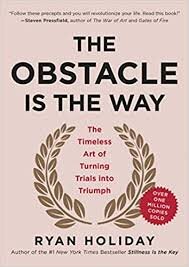
Too often, we act as if we have control over external things we can’t control—and as if we can’t control our own attitudes, which are well within our control. Seeing the truth of what we control and what we don’t control is a big part of wisdom. Here is how Ryan Holiday puts it in The Obstacle is the Way:
… recovering addicts learn the Serenity Prayer.
God, grant me the serenity to accept the things I cannot change
The courage to change the things I can,
And the wisdom to know the difference.
This is how they focus their efforts. It’s a lot easier to fight addiction when you aren’t also fighting the fact that you were born, that your parents were monsters, or that you lost everything. That stuff is done. Delivered. Zero in one hundred chances that you can change it.
So what if you focused on what you can change? That’s where you can make a difference.
Behind the Serenity Prayer is a two-thousand-year-old Stoic phrase: “ta eph’hemin, ta ouk eph’hemin.” What is up to us, what is not up to us.
And what is up to us?
Our emotions
Our judgments
Our creativity
Our attitude
Our perspective
Our desires
Our decisions
Our determination
This is our playing field, so to speak. Everything there is fair game. What is not up to us? Well, you know, everything else. The weather, the economy, circumstances, other people’s emotions or judgments, trends, disasters, et cetera.
…
In its own way, the most harmful dragon we chase is the one that makes us think we can change things that are simply not ours to change. That someone decided not to fund your company, this isn’t up to you. But the decision to refine and improve your pitch? That is. That someone stole your idea or got to it first? No. To pivot, improve it, or fight for what’s yours? Yes.
There are many things beyond your control. For example, for economists, opinions differ so widely on what is good and what is not so good that which referees an editor assigns to read your paper makes a huge difference to whether your paper gets accepted to an economics journal. And unfortunately for you, which particular referees an editor assigns to judge your paper is probably beyond your control. (I call this the “referee lottery.” Understanding the importance of the referee lottery is crucial to the mental health of economists who meet with bad luck when trying to publish. That understanding can also be a source of appropriate humility for those who meet with good luck in trying to publish.)
Many things are beyond your control. But I’m willing to bet that if you look closely enough, you’ll find that at least half of what makes your life pleasant or unpleasant has to do with what is going on within your own brain. This is your domain. It can be tricky to avoid overly self-critical or otherwise unproductive states of mind, but I’m willing to bet that the total amount of effort and consistent practice it takes to be able to intentionally get your mind into a better state is much, much less than the amount of effort and consistent practice that you and others reading my blog put into getting good at changing things in the world outside their heads. For many, then, there is likely to be a serious imbalance between the effort put into learning outward skills and the effort put into learning inward skills.
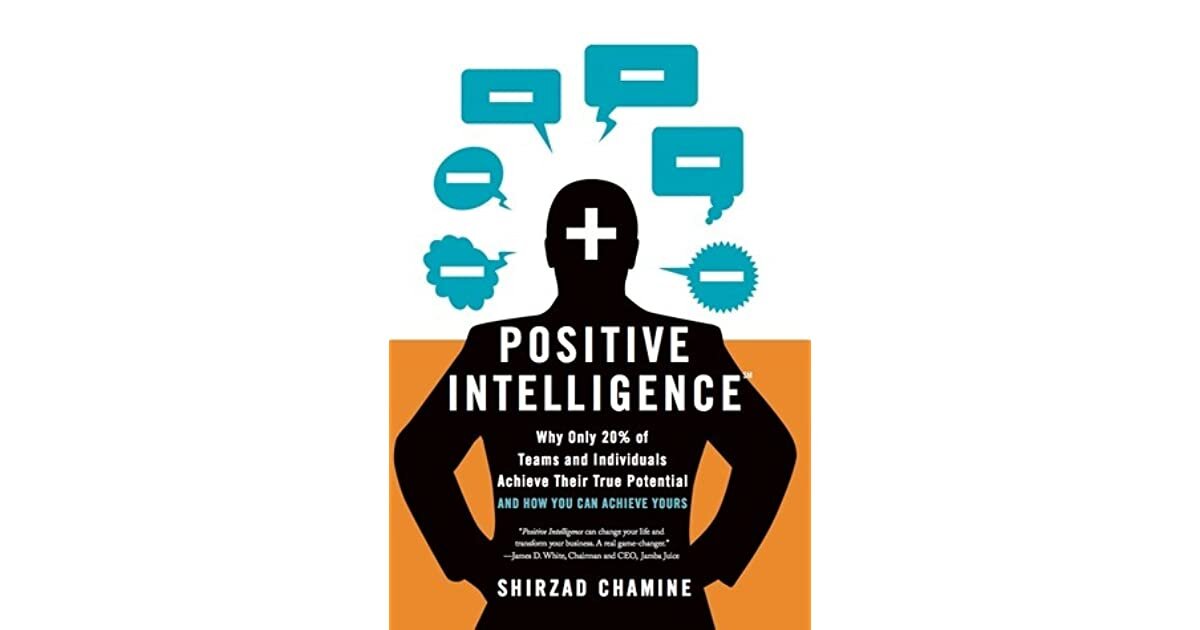
For the development of inward skills, in addition to using one of the many good meditation apps (in my case, “10% Happier”) I am a fan of the Shirzad Chamine’s pedagogy, which he has branded Positive Intelligence. He lays things out in a no-nonsense way, trying to use the latest neuroscience and findings in psychology. I have been impressed enough with the results from using these Positive Intelligence tools in my own life that I wanted to teach them to economists and their families. On that, see “How Economists Can Enhance Their Scientific Creativity, Engagement and Impact.”
At a more modest level, I have a set of blog posts about positive mental health and how to maintain your moral compass. I think you will find them useful.
Don’t Miss These Other Posts Related to Positive Mental Health and Maintaining One’s Moral and Scientific Compass:
Co-Active Coaching as a Tool for Maximizing Utility—Getting Where You Want in Life
How Economists Can Enhance Their Scientific Creativity, Engagement and Impact
Recognizing Opportunity: The Case of the Golden Raspberries—Taryn Laakso
Taryn Laakso: Battery Charge Trending to 0% — Time to Recharge
Savannah Taylor: Lessons of the Labyrinth and Tapping Into Your Inner Wisdom
Economics Needs to Tackle All of the Big Questions in the Social Sciences
Let's Set Half a Percent as the Standard for Statistical Significance
John Furlan on Shifts over Time in Leftwing Politics in the US →
I don’t agree with all the political view here, but the analysis of this part of political history seems on target to me.
How Perfectionism Has Made the Pandemic Worse

The Covid-19 pandemic has dominated the news in 2020. I’ve noticed one regularity in how the US (and many other countries) have handled the pandemic: perfectionism has been getting in the way of a quick and powerful response. Every little bit would have helped reduce the reproduction ratio of the coronavirus, but only things that were big bits were allowed. Let me list some instances of this perfectionism:
Early on, not yet having clear evidence of the benefits of masks was described to the public in a way that made it sound as if masks wouldn’t help much.
Highly accurate tests whose results take many days to arrive are next to useless. But the US government was very slow to approve tests of lower accuracy that could have made a big difference because they gave results within minutes.
Many decision-makers acted as if each person needed a test, when tests of samples pooled from many people could be very useful in showing where individual tests were needed and where they weren’t.
In what could have been a big mistake, the government was saying it would only allow a vaccine that was at least 50% effective, when even a 30% effective vaccine could have put a lot of downward pressure on the reproduction ratio of the virus—meaning that in conjunction with continued social distancing it could have brought the epidemic under control. Fortunately, the key vaccines seem to be coming in with effectiveness closer to 95%, making what could have been a big mistake moot.
Despite evidence that having had Covid-19 confers decent immunity, there is little push to conserve currently scarce vaccine doses by strongly discouraging those who have had Covid-19 from getting vaccinated until supplies of the vaccine are more abundant. I think using scarce vaccine doses on those who have already had the disease is motivated by the idea that the immunity of those who have had the disease is probably imperfect, which no doubt is true, because nothing is ever perfect. But Tom Frieden writes in “How to Handle the Covid-19 Vaccine Breakthrough the Right Way”: “very encouraging are the results of three new studies appearing to show that infection with the virus creates a high level of immunity to Covid-19. In the first study, examining a large outbreak on a fishing ship, none of the three people with antibodies got sick, while nearly everyone else got infected. In the second, of an outbreak at a summer camp, none of the 16 people with prior antibodies got sick or tested positive, while nearly everyone else did. More recently, a preliminary report from a study of infected health-care workers found that immunity appears strong and seems to last at least six months.”
Because the vaccine protocol used two doses, the vaccine-rollout plan while vaccine doses are scarce is to vaccinate half as many people with two doses rather than twice as many people with one dose, which the vaccine trials suggest has a high enough level of efficacy that vaccinating twice as many people with one dose would lower the vaccines reproduction ratio much more.
Finally, in something that shocks me, the article at the top, “Highly Touted Monoclonal Antibody Therapies Sit Unused in Hospitals” by Sarah Toy, Joseph Walker and Melanie Evans suggests that there is a reluctance to use monoclonal antibodies because there is not yet evidence that goes far beyond what was needed to get government approval. Monoclonal antibodies work by the same principles as vaccines; the big differences are (a) vaccines get your body to make antibodies, monoclonal antibody treatment directly injects antibodies, (b) the monoclonal antibodies are chosen to be especially high-quality antibodies, while your body might or might not make a lot of high-quality antibodies after you are vaccinated, and (c) you have to vaccinate everyone, but the monoclonal antibody treatment can be given to people after they start to show some symptoms and so can be prioritized better. You can bet that I would ask for monoclonal antibody treatment if I got Covid-19.
Some of the caution about evidence, accuracy, efficacy and side-effects would make sense if we were facing a lesser disease. But when people are dying all around, getting the job done is what counts, even if you get the job done by imperfect means. The way the reproduction ratio works, combining a set of several very imperfects means that pushed the reproduction ratio below the critical value of 1 could crush the spread of the coronavirus.
For a while, the Union’s top general in the Civil War was a perfectionist: George McClellan. George McClellan kept looking for the perfect opportunity to engage the forces of the Confederacy in battle. He accomplished little. Ulysses Grant and William Tecumseh Sherman got the job done by their willingness to use imperfect methods.
Other posts about the pandemic:
Indoors is Very Dangerous for COVID-19 Transmission, Especially When Ventilation is Bad
Paul Romer on How to Do Universal, Frequent Testing through Pooled Testing
Testing: Frequent, Fast, and Cheap is Better than Sensitive—Alex Tabarrok
Logarithms and Cost-Benefit Analysis Applied to the Coronavirus Pandemic
Seconding Paul Romer's Proposal of Universal, Frequent Testing as a Way Out
Two other related posts:
Daniel Jacobson on Freedom of Speech at Universities in the Age of Cancel Culture →
The title of this post links to an interview with Daniel Jacobson. I am proud to have served on the search committee that chose Daniel Jacobson for his current position at the University of Colorado Boulder. As a teaser, here are some quotations from this interview (bullets added):
I have become increasingly alarmed at the lack of intellectual and political diversity in philosophy and academia, as well as by its political biases and even bigotry. Scholars with heterodox views — conservatives, libertarians and classical liberals — are widely discriminated against and called racists for supporting race-neutral principles.
In my experience, some universities practice hiring and admissions policies that are blatantly illegal, even at public institutions in states that have more stringent anti-discrimination laws. Meanwhile, Jews and Asian-Americans are discriminated against openly …
… universities increasingly accept a dubious ideology that demonizes whatever it considers “whiteness.”
The University of Colorado, to its great credit, has a conception of diversity that includes opinion, not just identity group.
The series is about the rapid increase in social coercion of speech and the narrowing of the range of socially acceptable opinion among elite institutions. More and more, scholars and journalists with politically unpopular views are being harassed and personally attacked for questioning prevailing dogma. In the current phrase, they are being canceled — or at least people are attempting to cancel them.
This is antithetical to the proper mission of universities and the media. It is also exactly what those of us who have been defending freedom of speech predicted would happen once classes of opinion were put beyond the pale with terms such as “hate speech.” That creates an incentive for those who would silence unpopular opinions to classify their opponents as being motivated by hate or fear (as with the tendentious “-phobic” suffix). It seems absurd, but Martin Luther King Jr. would be guilty of committing “microaggressions” according to official University of California guidelines, which are unofficially accepted far more broadly in academia.
We humans are deeply conformist, and we tend to accept uncritically the opinions of those around us. This makes the ideological takeover of academia and prestige media especially harmful to the intellectual development of students.
I have taught advanced undergraduate courses where most students had never been exposed to the arguments for the morality of capitalism, for example. They were entirely unaware of arguments in favor of market-based economies over central economic planning. Somehow senior majors in PPE (Philosophy, Political Science, and Economics) had never read Hayek, Friedman or Thomas Sowell.
Nicole Rura: Close to Half of US Population Projected to Have Obesity by 2030
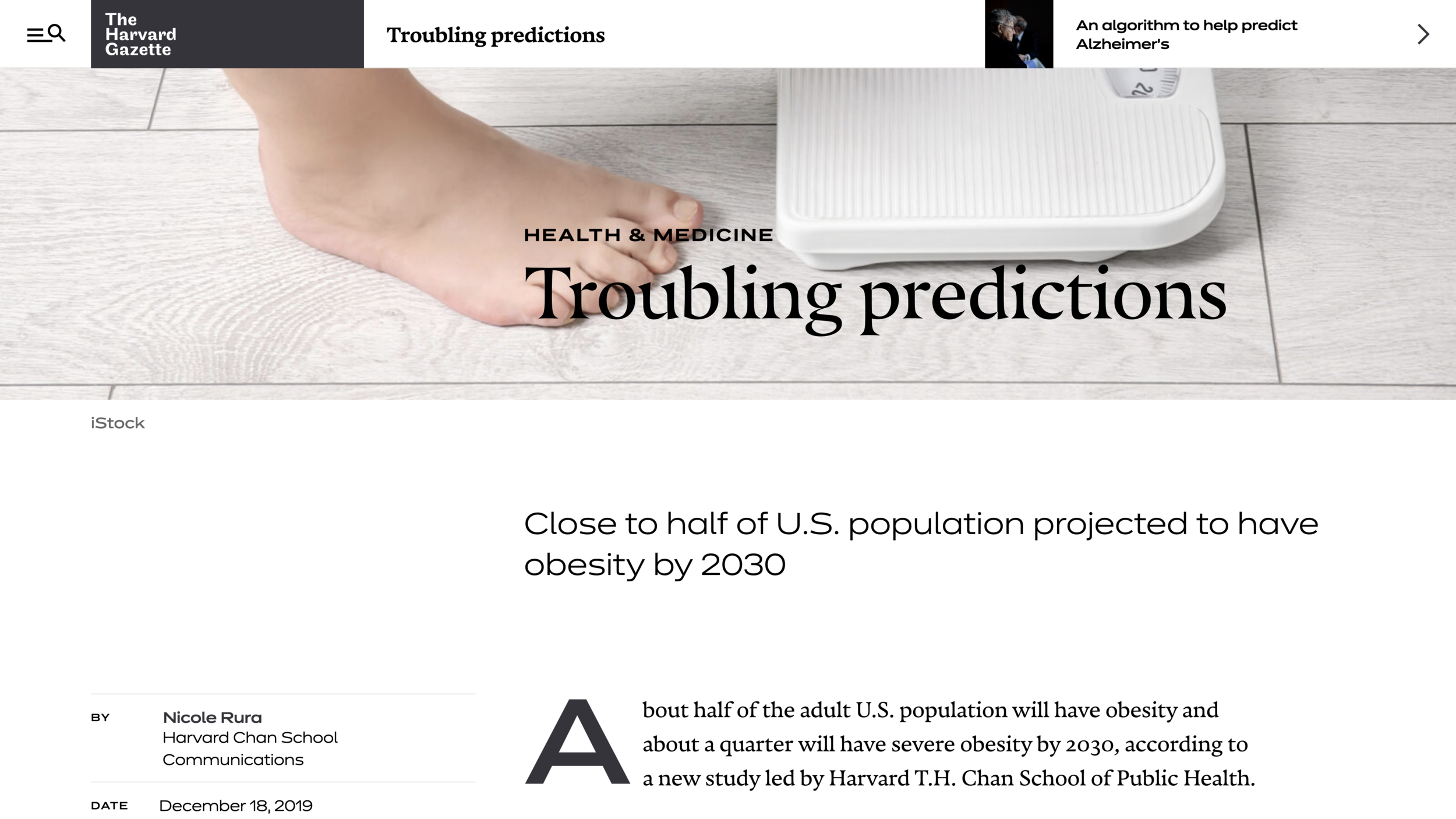
A big part of my motivation for blogging about diet and health (along with all the other subjects I blog about) is my awareness of how bad the trendlines are for obesity and other avoidable health problems.
Because we are affected by the behavior of those around us, anything visible that you do that is good or bad for your health also has spillovers for those around you. If you go off sugar, or pursue a more ambitious program of eating right, or exercise, you are benefitting not only yourself, but all the people who (possibly unconsciously) are inspired by your example. Conversely, if you eat scores of different foods with substantial sugar content (as you well might—look at the details on the box), delve deeply into junk food, or pursue the life of a couch potato, you harm not only yourself, but all the people who see such destructive behavior as a little more normal because so many people act that way. And some of the people you are likely to affect most strongly by the example of your behavior are those in your own household.
I am coming more and more to the view that a lot of what we think of as the normal effects of aging are the result of ways of behaving we take for normal in 2020, but won’t look normal at all when people look back from the year 2100. Much of what you need to know to be much healthier is known now but will take decades to become conventional wisdom and decades beyond that to be embraced as actual behavioral change. I hope to shorten that lag time for readers of my blog.
So far in this post, I was talking about physical health. But mental health is crucial as well. A key dimension of positive mental health is turning down the volume on the voice in your head that is constantly hypercritical of you. I am trying to write things that will be helpful there, too.
Don’t suffer in ignorance of all the things that could make your life better.
For annotated links to other posts on diet and health, see:
For links to posts on positive mental health and maintaining one’s moral compass, see:
The Federalist Papers #22 B: Supermajority Rules Aren't an Adequate Fix for Departures from One-Person One-Vote—Alexander Hamilton

How to make the wishes of each person count equally in a social choice problem is a very difficult problem. But sometimes things are skewed far enough in a certain direction that it is clear the opposite direction leads to greater equality in public decision-making. One way to tell might be to think of the hypothetical experiment asking the individuals in two groups in a society whether they would be willing to exchange the political rights and influence they have for the political rights and influence of the other group. But if two groups are unequal in numbers, then one must specify whether it is the political rights and influence per person in each group or the aggregate political rights and influence of each group.
When political rights and influence per person are unequal between two groups, some might claim that is OK if most decisions must be made by consensus or by large supermajorities. In the Federalist Papers #22, Alexander begs to differ. He argues that the power to veto a decision can easily be just as important as the power to get a decision through a legislature. Nations are beset by shocks that require responses if great harm is to be avoided. If a small minority can veto a response it is difficult to make the decision necessary to avoid the harm.
Moreover, Alexander Hamilton argues that if a small minority can veto a measure, it is easier to bribe enough legislators (or offer them other inducements) for corruption to prevent action. This is true even when it is a foreign power that wants to prevent action.
On bribery and other corrupt inducements to national leaders, Alexander Hamilton makes this interesting point:
An hereditary monarch, though often disposed to sacrifice his subjects to his ambition, has so great a personal interest in the government and in the external glory of the nation, that it is not easy for a foreign power to give him an equivalent for what he would sacrifice by treachery to the state.
There is a broader principle here: if a cohesive group has the power to govern by both pushing through legislation they want and preventing legislation they don’t want, this power is likely valuable enough that it will be hard for a foreign power to bribe them. Two circumstances go away from this case. First, if a group is not cohesive, an individual might be bought off. Second, if a small minority can veto legislation, or otherwise has outsized power in some respects, but not others, then it might be possible to buy off most of that small minority, not just individuals.
(On whether a monarch can be bribed to give foreigners a lot of power, an exception to the principle Alexander Hamilton claims is that a monarch might willingly sign a document giving foreigners power over the monarch’s country, thinking to not deliver on the promise of power to foreigners. In this, the monarch might misjudge how easy it is not to deliver on that promise.)
I have the full text below of Alexander Hamiltons arguments in these regards in the Federalist Papers #22. (I moved a footnote into square brackets within the main text at one point.)
The right of equal suffrage among the States is another exceptionable part of the Confederation. Every idea of proportion and every rule of fair representation conspire to condemn a principle, which gives to Rhode Island an equal weight in the scale of power with Massachusetts, or Connecticut, or New York; and to Deleware an equal voice in the national deliberations with Pennsylvania, or Virginia, or North Carolina. Its operation contradicts the fundamental maxim of republican government, which requires that the sense of the majority should prevail. Sophistry may reply, that sovereigns are equal, and that a majority of the votes of the States will be a majority of confederated America. But this kind of logical legerdemain will never counteract the plain suggestions of justice and common-sense. It may happen that this majority of States is a small minority of the people of America [New Hampshire, Rhode Island, New Jersey, Delaware, Georgia, South Carolina, and Maryland are a majority of the whole number of the States, but they do not contain one third of the people.]; and two thirds of the people of America could not long be persuaded, upon the credit of artificial distinctions and syllogistic subtleties, to submit their interests to the management and disposal of one third. The larger States would after a while revolt from the idea of receiving the law from the smaller. To acquiesce in such a privation of their due importance in the political scale, would be not merely to be insensible to the love of power, but even to sacrifice the desire of equality. It is neither rational to expect the first, nor just to require the last. The smaller States, considering how peculiarly their safety and welfare depend on union, ought readily to renounce a pretension which, if not relinquished, would prove fatal to its duration.
It may be objected to this, that not seven but nine States, or two thirds of the whole number, must consent to the most important resolutions; and it may be thence inferred that nine States would always comprehend a majority of the Union. But this does not obviate the impropriety of an equal vote between States of the most unequal dimensions and populousness; nor is the inference accurate in point of fact; for we can enumerate nine States which contain less than a majority of the people 4; and it is constitutionally possible that these nine may give the vote. Besides, there are matters of considerable moment determinable by a bare majority; and there are others, concerning which doubts have been entertained, which, if interpreted in favor of the sufficiency of a vote of seven States, would extend its operation to interests of the first magnitude. In addition to this, it is to be observed that there is a probability of an increase in the number of States, and no provision for a proportional augmentation of the ratio of votes.
But this is not all: what at first sight may seem a remedy, is, in reality, a poison. To give a minority a negative upon the majority (which is always the case where more than a majority is requisite to a decision), is, in its tendency, to subject the sense of the greater number to that of the lesser. Congress, from the nonattendance of a few States, have been frequently in the situation of a Polish diet, where a single VOTE has been sufficient to put a stop to all their movements. A sixtieth part of the Union, which is about the proportion of Delaware and Rhode Island, has several times been able to oppose an entire bar to its operations. This is one of those refinements which, in practice, has an effect the reverse of what is expected from it in theory. The necessity of unanimity in public bodies, or of something approaching towards it, has been founded upon a supposition that it would contribute to security. But its real operation is to embarrass the administration, to destroy the energy of the government, and to substitute the pleasure, caprice, or artifices of an insignificant, turbulent, or corrupt junto, to the regular deliberations and decisions of a respectable majority. In those emergencies of a nation, in which the goodness or badness, the weakness or strength of its government, is of the greatest importance, there is commonly a necessity for action. The public business must, in some way or other, go forward. If a pertinacious minority can control the opinion of a majority, respecting the best mode of conducting it, the majority, in order that something may be done, must conform to the views of the minority; and thus the sense of the smaller number will overrule that of the greater, and give a tone to the national proceedings. Hence, tedious delays; continual negotiation and intrigue; contemptible compromises of the public good. And yet, in such a system, it is even happy when such compromises can take place: for upon some occasions things will not admit of accommodation; and then the measures of government must be injuriously suspended, or fatally defeated. It is often, by the impracticability of obtaining the concurrence of the necessary number of votes, kept in a state of inaction. Its situation must always savor of weakness, sometimes border upon anarchy.
It is not difficult to discover, that a principle of this kind gives greater scope to foreign corruption, as well as to domestic faction, than that which permits the sense of the majority to decide; though the contrary of this has been presumed. The mistake has proceeded from not attending with due care to the mischiefs that may be occasioned by obstructing the progress of government at certain critical seasons. When the concurrence of a large number is required by the Constitution to the doing of any national act, we are apt to rest satisfied that all is safe, because nothing improper will be likely TO BE DONE, but we forget how much good may be prevented, and how much ill may be produced, by the power of hindering the doing what may be necessary, and of keeping affairs in the same unfavorable posture in which they may happen to stand at particular periods.
Suppose, for instance, we were engaged in a war, in conjunction with one foreign nation, against another. Suppose the necessity of our situation demanded peace, and the interest or ambition of our ally led him to seek the prosecution of the war, with views that might justify us in making separate terms. In such a state of things, this ally of ours would evidently find it much easier, by his bribes and intrigues, to tie up the hands of government from making peace, where two thirds of all the votes were requisite to that object, than where a simple majority would suffice. In the first case, he would have to corrupt a smaller number; in the last, a greater number. Upon the same principle, it would be much easier for a foreign power with which we were at war to perplex our councils and embarrass our exertions. And, in a commercial view, we may be subjected to similar inconveniences. A nation, with which we might have a treaty of commerce, could with much greater facility prevent our forming a connection with her competitor in trade, though such a connection should be ever so beneficial to ourselves.
Evils of this description ought not to be regarded as imaginary. One of the weak sides of republics, among their numerous advantages, is that they afford too easy an inlet to foreign corruption. An hereditary monarch, though often disposed to sacrifice his subjects to his ambition, has so great a personal interest in the government and in the external glory of the nation, that it is not easy for a foreign power to give him an equivalent for what he would sacrifice by treachery to the state. The world has accordingly been witness to few examples of this species of royal prostitution, though there have been abundant specimens of every other kind.
In republics, persons elevated from the mass of the community, by the suffrages of their fellow-citizens, to stations of great pre-eminence and power, may find compensations for betraying their trust, which, to any but minds animated and guided by superior virtue, may appear to exceed the proportion of interest they have in the common stock, and to overbalance the obligations of duty. Hence it is that history furnishes us with so many mortifying examples of the prevalency of foreign corruption in republican governments. How much this contributed to the ruin of the ancient commonwealths has been already delineated. It is well known that the deputies of the United Provinces have, in various instances, been purchased by the emissaries of the neighboring kingdoms. The Earl of Chesterfield (if my memory serves me right), in a letter to his court, intimates that his success in an important negotiation must depend on his obtaining a major's commission for one of those deputies. And in Sweden the parties were alternately bought by France and England in so barefaced and notorious a manner that it excited universal disgust in the nation, and was a principal cause that the most limited monarch in Europe, in a single day, without tumult, violence, or opposition, became one of the most absolute and uncontrolled.
Here are links to my other posts on The Federalist Papers so far:
The Federalist Papers #1: Alexander Hamilton's Plea for Reasoned Debate
The Federalist Papers #3: United, the 13 States are Less Likely to Stumble into War
The Federalist Papers #4 B: National Defense Will Be Stronger if the States are United
The Federalist Papers #5: Unless United, the States Will Be at Each Others' Throats
The Federalist Papers #6 A: Alexander Hamilton on the Many Human Motives for War
The Federalist Papers #11 A: United, the States Can Get a Better Trade Deal—Alexander Hamilton
The Federalist Papers #12: Union Makes it Much Easier to Get Tariff Revenue—Alexander Hamilton
The Federalist Papers #13: Alexander Hamilton on Increasing Returns to Scale in National Government
The Federalist Papers #14: A Republic Can Be Geographically Large—James Madison
The Federalist Papers #21 A: Constitutions Need to be Enforced—Alexander Hamilton
An Optical Illusion: Nativity Scene or Two T-Rex's Fighting over a Table Saw?

I learned about this optical illusion from Andrew Sargent on Facebook
Forgive Yourself

Tomorrow is the traditional date to celebrate the birth of a man who went around telling quite a few people that their sins were forgiven. I wouldn’t be surprised if some of those to whom he told that still couldn’t forgive themselves for things they had done. It can be remarkably hard to forgive yourself for your mistakes and badnesses.
Many of us believe that it would be dangerous to forgive ourselves for our past mistakes and badnesses. But I think there is a difference between
taking responsibility for what you have done and trying to make things right and
beating yourself up about what you have done in the past.
Energy spent on beating yourself up and perhaps on feebly (or strongly) defending yourself from your own attacks is energy you aren’t spending on doing better and trying to repair the damage you have done in the past. It is an empirical matter whether beating yourself up is more helpful than discernment of what you have done wrong minus an emphasis on blame. There is little evidence to show that the very painful strategy of beating yourself up works any better than “blameless discernment” (a phrase I take from Shirzad Chamine, author of Positive Intelligence.
I like the quotation at the top of this post: “Forgiveness is giving up all hope of having had a better past.” (More than one famous person has said something like this.) We can’t change the past. We can only change what we are doing to ourselves now using bits and pieces of what we remember from our past and what is in our heads about the past more generally. Is it really helping you or the world to make yourself miserable using pointed shards from your past?
Unless you want to make what I consider the bad bet that beating yourself up is really helping you, forgiving yourself (while resolving to do better) is a good option to consider. The funny thing about forgiving yourself is that it looks more like stopping something you are doing than like doing something. Just cut the power to your attacks on yourself, and you will probably feel better and do better.
Don’t Miss These Other Posts Related to Positive Mental Health and Maintaining One’s Moral Compass:
Co-Active Coaching as a Tool for Maximizing Utility—Getting Where You Want in Life
How Economists Can Enhance Their Scientific Creativity, Engagement and Impact
Recognizing Opportunity: The Case of the Golden Raspberries—Taryn Laakso
Taryn Laakso: Battery Charge Trending to 0% — Time to Recharge
Savannah Taylor: Lessons of the Labyrinth and Tapping Into Your Inner Wisdom
A Goldbug Notices 'Breaking Through the Zero Lower Bound' and 'Enabling Deep Negative Rates to Fight Recessions: A Guide'
It is a good sign when one’s proposals are noticed, even if by someone who opposes them. Much of the video above is the standard set of ideas that sells gold and silver. In particular, in the video, Lynette Zang makes a prediction of very high inflation in the future that I think is quite unlikely. As far as modest inflation goes, Lynette neglects to note that moderate inflation tends to raise nominal wage growth. Another thing to note is that the erosion of principal that Lynette so laments as a consequence of possible future negative interest rates is the other side of debt relief for debtors—something the Bible has a different system for, but talks about as a good thing.
The welfare of debtors is important. It would be foolish to focus only on the unpleasant consequences of low interest rates for lenders and ignore the pleasant consequences for debtors. If we don’t say that “The Fed should never raise rates high to restrain inflation” because that would hurt debtors, we shouldn’t say that “The Fed should never cut rates below zero to restrain unemployment” because that would hurt lenders.
If you want to read Ruchir Agarwal’s and my papers “Breaking Through the Zero Lower Bound” and “Enabling Deep Negative Rates to Fight Recessions: A Guide,” take a look at my bilbiographic post “How and Why to Eliminate the Zero Lower Bound: A Reader’s Guide” which has those links and much, much more, including links to recent news about negative interest rates in a section that is down a ways.
On one point, I am in agreement with Lynette: I think the government should be producing gold and silver coins of defined weight that people could use as currency in a post-apocalyptic scenario. On that, see “Is Electronic Money the Mark of the Beast?” It is important however, that these gold and silver coins not be used as a unit of account or unit of price stickiness in our current non-apocalyptic or pre-apocalyptic situation, since that would mess up monetary policy quite badly, as the gold standard did for so many years in the bad old days.
Beware: Monk Fruit Nonsugar Sweetener Raises Insulin

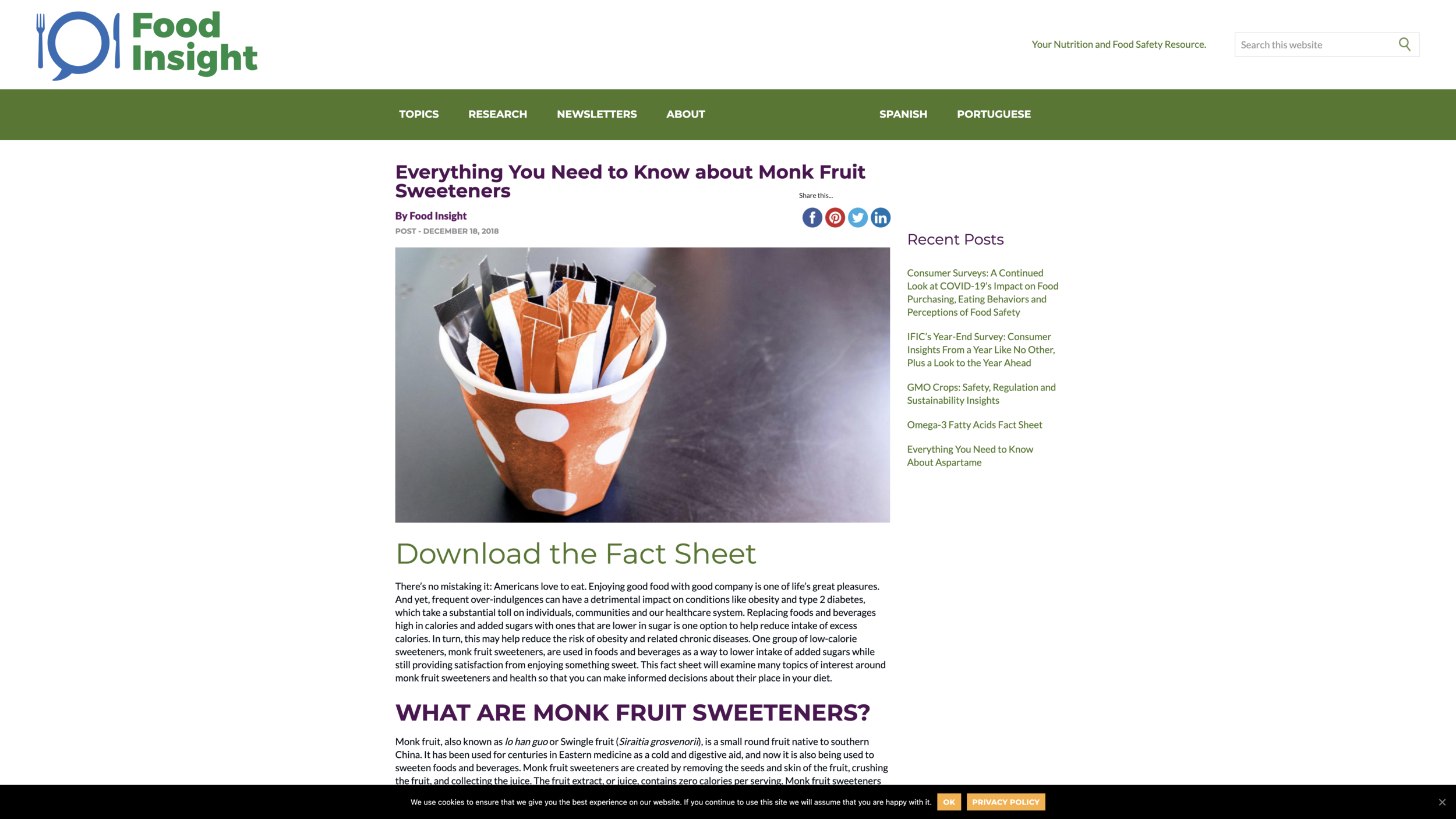
It is easy to find boosterish articles about monk fruit sweetener online like the article shown at the bottom of this post. By I worry that anything that raises insulin levels too much could lower blood sugar enough to induce hunger. That is the view I take in “Which Nonsugar Sweeteners are OK? An Insulin-Index Perspective.” From that perspective, the evidence in the abstract shown above is worrisome. It is from the paper “Insulin secretion stimulating effects of mogroside V and fruit extract of luo han kuo (Siraitia grosvenori Swingle) fruit extract.” Swingle fruit and luo han kuo are other names for monk fruit.
The article “Insulin secretion stimulating effects of mogroside V and fruit extract of luo han kuo (Siraitia grosvenori Swingle) fruit extract” tries to bill stimulation of insulin secretion as a good thing. I don’t think that is right. Extra insulin secretion is troublesome for many reasons. See:
Another thing to worry about with sweeteners labeled as being monk fruit is that, since monk fruit extract is such a powerful sweetener, the monk fruit extract is typically diluted with other stuff—other stuff that might itself be unhealthy. Check the label to see all the ingredients.
Sweetness itself can also be a concern, though not one that stops me from using carefully chosen nonsugar sweeteners. On that, read “Which Nonsugar Sweeteners are OK? An Insulin-Index Perspective.”
Unfortunately, I don’t know how to get my hands on the full paper “Insulin secretion stimulating effects of mogroside V and fruit extract of luo han kuo (Siraitia grosvenori Swingle) fruit extract,” so I don’t know how strong the insulin-raising effect of monk fruit is if you really get monk fruit extract by itself without other worrisome stuff. It may be that because of its strong sweetness, the quantity of pure monk fruit sweetener needed for sweetening is so small that the effect on insulin would also be small. So I don’t know for sure that monk fruit extract is unhealthy. But the fact that it raises insulin is not a good sign.
For annotated links to other posts on diet and health, see:
Contrasted Faults Through All Their Manners Reign
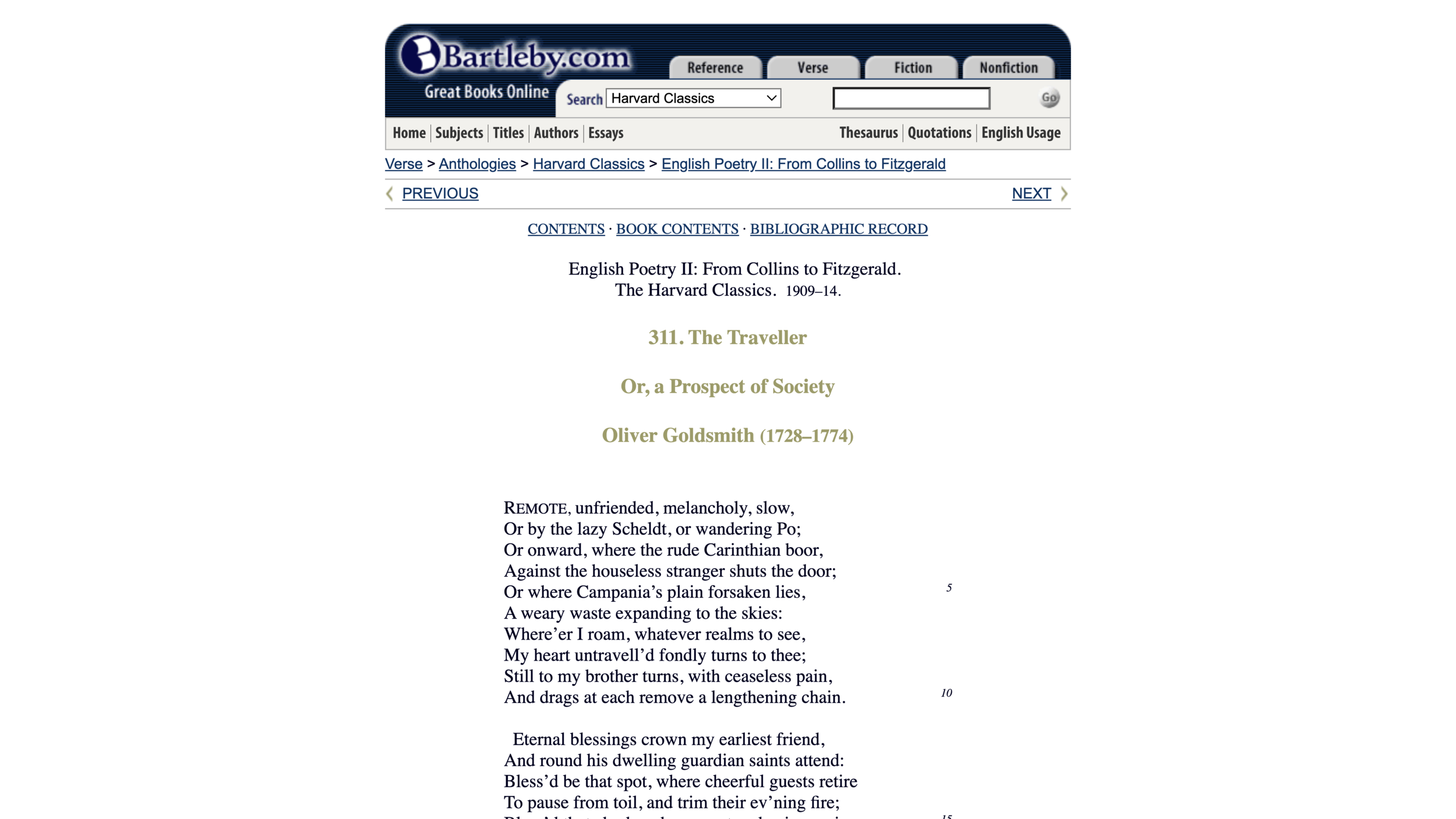
By modern standards, Oliver Goldsmith’s 18th century poem “The Traveler—Or, a Prospect of Society” is political incorrect four times over: it is not gender neutral; it has at least one sentence that seems racist, it includes a noncondemning mention of slave-holding as a sign of wealth; and it offends national pride in its treatment of various nations. Nevertheless, it has some profound passages. Let me repurpose the following passage as a criticism of our discipline of economics:
Though poor, luxurious; though submissive, vain,
Though grave, yet trifling; zealous, yet untrue;
The first contrast, “Though poor, luxurious” fits least well. But it can apply to many economists—or indeed to any workaholic—if one thinks of “poor” as referring to a life that is not full and rich in nonfinancial ways, while “luxurious” refers to what one has bought.
The second contrast, “though submissive, vain” strikes a more powerful chord. Many economists are are vain about the how many papers they have published in which journals, but submissive to implicit, sometimes arbitrary, rules about what topics one should pursue, what methods one should use, and what things one should say in a paper. They have made themselves unreflective cogs in a machine that sometimes does the right thing and sometimes goes awry.
The third contrast “Though grave, yet trifling” is apt for the seriousness with which many economists approve of and attack dimensions of research that are orthogonal to how much potential the research has for improving the human condition, providing deeper insight into how the world works, or enabling other economists to do their work better.
Being grave in this sense is often connected to the zeal of the fourth contrast: “zealous, yet untrue.” For me, “zealous” points to those who are taught dogmas that they internalize and try to enforce on the rest of the discipline throughout the rest of their careers. “Untrue” points to any willingness to misrepresent one’s results for the sake of either one’s career advancement or to advance an ideology or dogma one adheres to.
All papers should be thought of as teaching documents, and teaching often requires some oversimplification before all the complications are added. But there are ways of doing this that show that one cares about the truth and ways of doing this that show how little one cares about truth.
Here’s to less poverty, less luxuriousness, less submissiveness, less vanity, less of being grave, less of trifling, less zeal and less untruth!
Don’t Miss These Other Posts Related to Positive Mental Health and Maintaining One’s Moral Compass:
Co-Active Coaching as a Tool for Maximizing Utility—Getting Where You Want in Life
How Economists Can Enhance Their Scientific Creativity, Engagement and Impact
Recognizing Opportunity: The Case of the Golden Raspberries—Taryn Laakso
Taryn Laakso: Battery Charge Trending to 0% — Time to Recharge
Savannah Taylor: Lessons of the Labyrinth and Tapping Into Your Inner Wisdom