James Wells: The Discovery of the Higgs Boson Opens Up Other Puzzles in Particle Physics
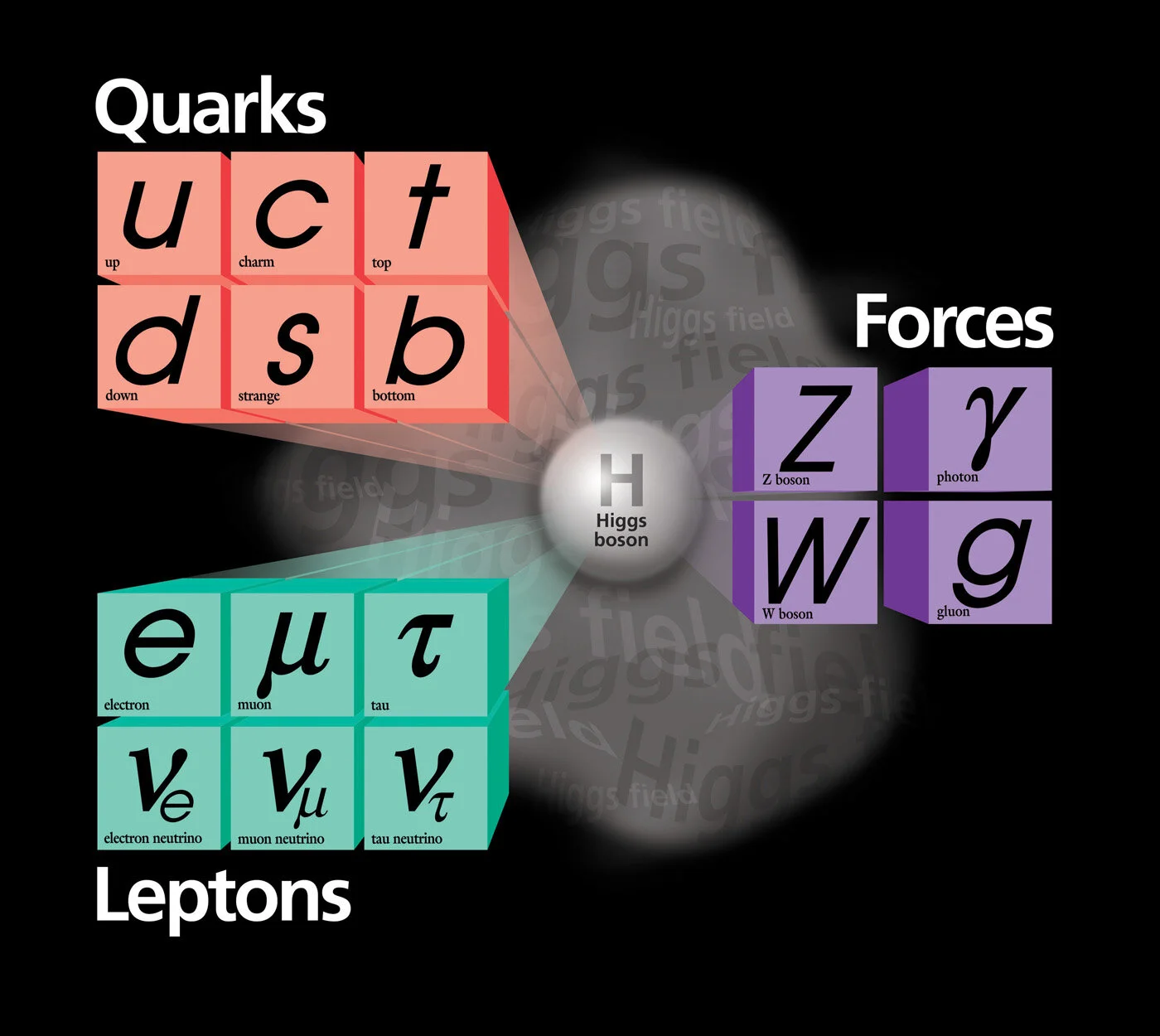
This SMHiggs_Fermilab.jpg figure comes from Fermilab communications. It depicts all the elementary particles, with the Higgs boson in the middle in the midst of its own generated "mist" (background non-zero field value)that gives mass to other other elementary particles.
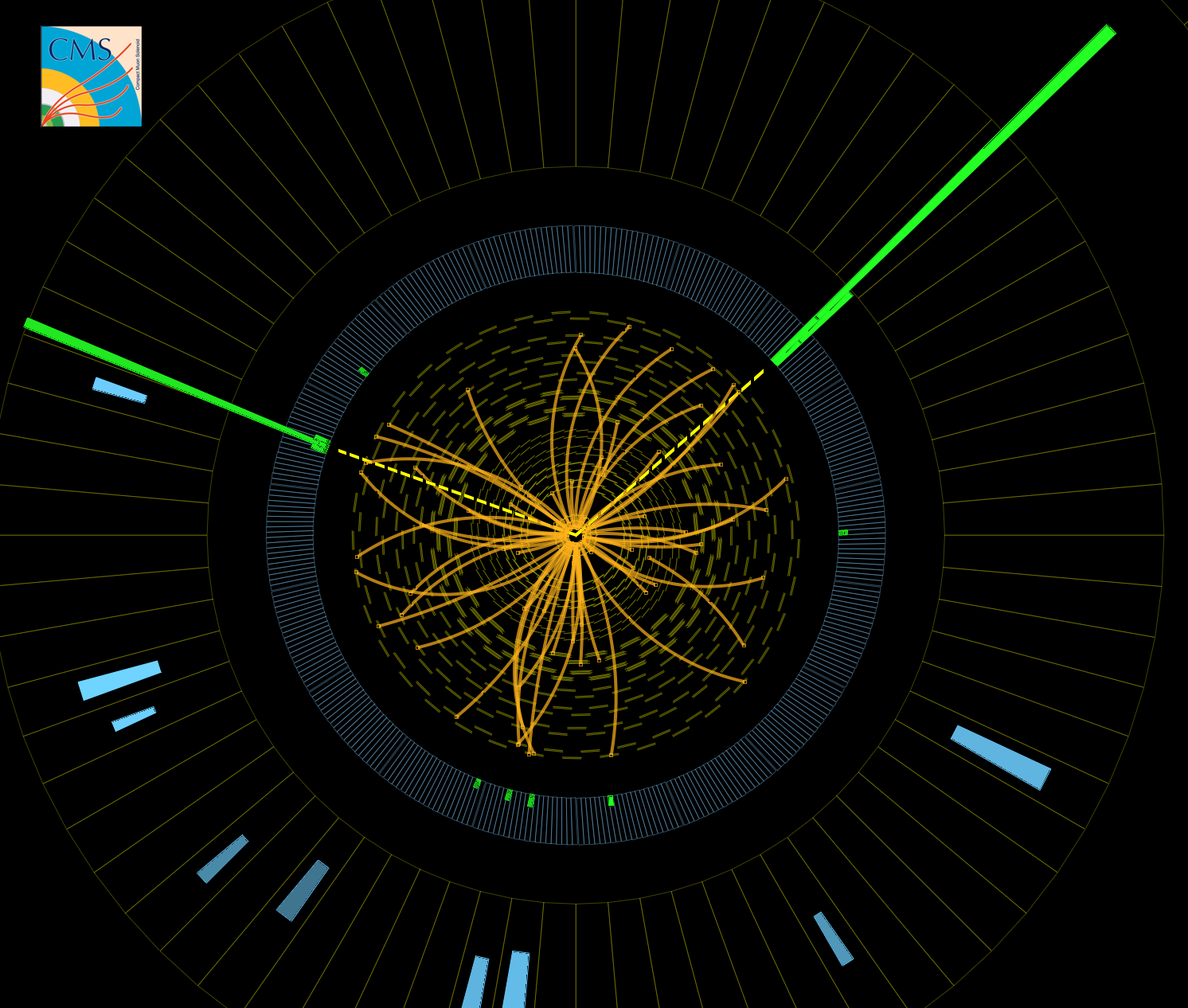
This gammagamma_CMS.png is a picture taken from here: https://cms.cern/news/world-without-higgs
It is a Higgs boson decay into two photons, where the photons are the dashed yellow and green lines coming out of the center, which is where the Higgs was created and decayed. (It's point of creation is extremely close to where it decays because the Higgs boson lifetime is so tiny.)
I am delighted to be able to share a guest post by my friend James Wells, a Physics Professor at the Leinweber Center for Theoretical Physics at the University of Michigan, who lists his interests as
Physics beyond the Standard Model
Higgs boson properties and interactions
Particle physics in early universe cosmology
Effective field theories; Quantum field theory
Foundations and history of physics
I asked James what physicists had learned from the discovery of the Higgs boson. Below the line is his answer to that question and more:
The Higgs boson is said to have been discovered in 2012 at the Large Hadron Collider in Geneva, Switzerland. However, the curious thing about the Higgs boson is that many people did not believe it could exist as an elementary particle until it was apparently found. Even more curious, many people still are not convinced that it exists.
We are not talking about a conspiracy on the level of fake moon landing staged in a warehouse studio in Des Moines. The issue is one of determining the “true nature” of a discovery. The particle found in Geneva walks like a duck, quacks like a duck, but it might not be a duck. In fact, many researchers hold that it cannot be a duck.
Why a Higgs boson?
Let’s first discuss why nature needs a Higgs boson at all, which at the same time will reveal its vulnerabilities. The Higgs boson was postulated in the 1960s by Peter Higgs and it was later understood to be an excellent candidate for the explanation of how all elementary particles can obtain mass. Let’s define what we mean by Higgs boson:
Higgs boson: the Higgs boson is a spin-less elementary particle, which has, unlike any other elementary particle, a non-zero field value that spreads across the entire universe and gives mass to every massive elementary particle that we know about, and completes the “story of mass” in elementary particle physics.
It’s difficult to understand what is meant by “non-zero field value” but for our purposes think of it analogously as a mist everywhere that all elementary particles feel, and by feeling the mist they obtain mass. The photon does not feel the mist at all, and so it is massless. The top quark feels the mist the strongest and is therefore the heaviest, about 185 times heavier than a hydrogen atom.
One might ask, “Why can’t the other elementary particles just have mass without the Higgs boson? An astronaut has mass even if you take it out of the earth’s gravitational field!” Well, the problem is that as we understood better the nature of electrons, and photons, and quarks, which are the constituent elementary particles of protons and neutrons, we had a rather serious conundrum. Our understanding of quantum field theories told us that masses for elementary particles were incompatible with the fundamental symmetries that we had derived from observations, most notably the symmetry that governs the so-called “weak decays” of heavy nuclei (“weak symmetry”).
These “weak decays” happen when one nucleus decays to another and ejects an electron and neutrino in the process, for example. We see them in the laboratory: Cobalt-60 decays to Nickel-60 plus an electron and neutrino. We can’t ignore that. But our beautiful quantum field theory that described that so well had no way of allowing the elementary particles to have mass, which was a major stumbling block to progress in physics for years. The Higgs boson and its all-pervasive mist solved the problem.
They found the Higgs boson, right?
Now fast forward to 2012, and the announcement that the Higgs boson had been discovered at CERN. I was a staff physicist in the Theory Department at CERN and had the good fortune to be in the auditorium for the discovery announcement. What an event it was. What an achievement of the human intellect. Much celebration. People crying with joy. Reporters swarming. TV cameras in every hallway it seemed. The Director General Heueur said, “I think we got it!” meaning they finally collared this elusive particle. They saw it by measuring a small excess of two photons and four leptons (electrons and muons are both in the category of “leptons”) over normal backgrounds being produced in the collisions of protons at very high energies. It was predicted we would find it that way. They spent decades developing the detectors to make exactly that discovery. It worked. Its mass was found to be equal to approximately 134 hydrogen atoms.
The question is, however, exactly what did they find at CERN? You must keep in mind that many physicists were not expecting the Higgs boson to be there at all. The esteemed Nobel Laureate Martinus Veltman said in 1997 that “by the time you get there [when the LHC runs] you will find something else…. I don’t believe the Higgs system … as it is advertised at this point … I really don’t believe that” [1]. He was certainly not alone. There were numerous research papers exploring “Higgsless theories” all the way up to the moment of Higgs boson discovery [2].
With significant opposition to the Higgs boson before its discovery it is not surprising that many are still loath to accept that what was found at CERN was indeed the Higgs boson elementary particle.
Why the animosity toward the Higgs boson?
Why do so many theoretical physicists really dislike the Higgs boson as a stand-alone elementary particle? One answer was from Harvard physicist Howard Georgi, who said that nature would be “malicious” if the Higgs boson were discovered since it would mean that nature would have skipped the opportunity to teach us new things [4]. Less reliant on human psychology, many theorists believed and still believe that a single Higgs boson elementary particle has a severe sickness. Let’s phrase it in the form of a conjecture:
The spin-less heavy elementary particle conjecture (SHEP conjecture): ordinary quantum field theory suggests to us that it is extraordinarily improbable that a spin-less elementary particle, like the purported Higgs boson, can have mass much less than the Planck mass, which is 16 orders of magnitude greater than the heaviest known elementary particle (i.e., Planck mass divided by top quark mass ~ 10^16).
The Planck mass is derived from gravitational physics and it is assumed that no elementary particle can have mass above it. Its numerical value is equivalent to about 10^19 hydrogen atoms, which is about 0.00002 grams. That sounds like a tiny and accessible mass, well below a pecan’s, so surely a particle could be that massive? But pecans are not “point-like” elementary particles, and it's the elementary particle by itself that has the Planck mass restriction inferred through quantum gravity considerations.
The SHEP conjecture is a claim based on the synthesis of hundreds of research papers on the so-called Naturalness, Hierarchy and Fine-tuning problem of the Higgs boson -- an amalgam of all the vulnerabilities perceived in the Higgs boson idea. We will not discuss the detailed reasons behind that and just go straight to its effect: Because of the SHEP conjecture few thought before the start of operations of CERN’s Large Hadron Collider that a Higgs boson would be discovered all alone, so light, trembling without an entourage of other particles or effects that would show us that the premises of the SHEP conjecture did not apply.
There had been already some evidence from previous experiments doing precision experiments on decays of the Z boson and precision mass determinations of the W boson (discovered in the 1980s) and the top quark (discovered in the 1990s) that a Higgs boson likely existed with mass less than the top quark mass (top quark mass = 186 hydrogen atoms). The research community was presented with the exciting prospect of discovery, but for those who accepted the dogma of the SHEP conjecture there was confusion and doubt about how it could exist. “I believe; help thou mine unbelief” is a pretty good summary of what most physicists felt. The resolution to the coexistence of the Higgs boson with the SHEP conjecture was that nature need only violate one or more premises of the SHEP conjecture and all would be well.
Violating the premises of the SHEP conjecture: supersymmetry
One can violate the premise of “ordinary quantum field theory” by introducing supersymmetry which is an exotic quantum field theory that has strict bindings between particles of different spins. A spin-less elementary particle, like the Higgs boson, would have to be paired with an elementary particle with spin, and that pairing immediately vacates the pressure that the spin-less particle has mass near the astronomically high Planck mass. The implications of supersymmetry is that many other particles -- superpartners to every known particle -- must exist and are discoverable if only colliders have enough energy to produce them.
Violating the premises of the SHEP conjecture: extra spatial dimensions
One can also manipulate the premise by adding extra spatial dimensions compactified into a tiny volume, which can have the effect of lowering the Planck mass from 10^16 times the Higgs boson mass to a value nearby. In that case, we satisfy the SHEP conjecture by saying that the Higgs boson is indeed not much less than the Planck scale. These extra dimensions are discoverable in principle, but in practice we don’t know how tiny the volume is for the extra spatial dimensions. The smaller this extra volume the higher energy we have to collide protons to see these dimensions unfold. (Don’t worry, it’s safe.)
Violating the premises of the SHEP conjecture: the Higgs boson is not elementary
Finally, one can violate the premises by assuming that the Higgs boson is simply not an elementary particle. It might be a composite particle like the proton or neutron, made up of smaller constituents [5]. Those smaller elementary particles that bind together to make the Higgs boson could be particles with spin, and then the SHEP conjecture would not apply and what we call the “Higgs boson” is a spin-less bound state of other particles whose spins cancel out, similar to what we see in superconductivity [6].
How to know if the Higgs boson is fictitious?
Each idea that we have discussed that allows the Higgs boson to exist but not violate the SHEP conjecture -- supersymmetry, new spatial dimensions, and compositeness -- implies that experiments in principle can see tiny deviations from what is otherwise expected if nature has only the pure elementary particle Higgs boson.
For example, experiments can count the number of times the Higgs boson decays into two photons. Under the assumption that the Higgs boson is strictly an elementary particle with no other additional features to support its existence, one can predict a value B for the number of times it decays into two photons. On the other hand, under the assumption that the Higgs boson exists in a more exotic way (again, supersymmetry, extra dimensions, or compositeness) the prediction will be a little different than B -- let’s call it B+x, where x is a small number compared to B.
At present, no final state decay of the Higgs boson is measured to better than 10%. In other words, the value of x can be as high as 10% of the value of B without running afoul of experimental results. So a theory of composite Higgs boson, or of supersymmetry or of extra dimensions, that predicts deviations that are less than 10% different from the predictions of an elementary Higgs boson is perfectly consistent with everything we know to date. Those who agree with the SHEP conjecture believe that these tiny deviations away from the elementary Higgs boson predictions will be seen if we can one day measure the Higgs boson decays with more precision.
So, physicists are not yet ready to call the Higgs boson a stand-alone elementary particle on the same level as we do an electron or a quark or a photon. We want to test all of the decays of the Higgs boson to better than a percent to give us more confidence ---the 10% determinations we have now are not good enough. We might be lucky and the CERN collider will discover small deviations as it collects more data starting next year. Or, more likely, we will have to wait for the proposed “Higgs factory” in Japan -- the International Linear Collider -- which has the ability to measure the Higgs boson properties to the sub-percent level and really test whether the Higgs boson can stand alone as a proud member of the elementary particle club like the electron, or whether it is fragile and reveals its supersymmetric, extra dimensional, or non-elementary heritage when we put it under a more powerful microscope.
References & End Notes
[1] M. Veltman. “Reflections on the Higgs system,” 17-21 March 1997, CERN. https://cds.cern.ch/record/334106
[2] J.D. Wells, “Beyond the Hypothesis: theory’s role in the genesis, opposition, and pursuit of the Higgs boson.” Stud.Hist.Phil.Sci B62, 36-44 (2018).
https://www.sciencedirect.com/science/article/abs/pii/S1355219816301551?via%3Dihub
[3] P. Anderson. “Higgs, Anderson, and all that”. Nature 11, 93 (2015).
https://www.nature.com/articles/nphys3247
[4] H. Georgi. “Why I would be very sad if a Higgs boson were discovered.” In Perspective on Higgs Physics II, ed. G.L. Kane. World Scientific, 1997.
[5] The prospect of the Higgs boson being composite is not so odd an assumption as it might appear on the surface, since there are bound states like that which already exist in nature, such as the pions. Pions are a class of particles with mass about 1/7th the mass of a hydrogen atom. They were first proposed by the Japanese physicist Hideki Yukawa in the 1930s in order to explain the strong force between protons and neutrons in the nucleus. Their experimental discovery was slow in coming, but by the 1950s they were firmly established empirically. However, it was not until the 1970s that it was understood that these pions are really just bound pairs of quarks and anti-quarks. Although the pions were spin-less, the constituent quarks that made the pions had spin that canceled out when paired. The Higgs boson could be a bound state analogous to the pion. “If nature can do it once, it can do it again,” was the rallying cry.
[6] Some materials when cooled to sufficiently low temperatures become perfect conductors of electricity -- superconductivity. The microscopic reason for why that happens is the formation of Cooper pairs, where two electrons, which have spin, bind in the material and form a spin-less boson very similar to the structure of a Higgs boson. If nature does it in superconductivity, maybe it can do the same thing for elementary particles. This line of thought led the Nobel Laureate physicist Phil Anderson, who is a condensed matter physicist that knows very little about particle physics, to declare in 2015 three years after the Higgs boson discovery that “maybe the Higgs boson is fictitious!” [3], as though we particle physicists had never thought about that possibility.

In Mice, High-Fat Diets Seem to Foster Cancers Involving Immune Cells

I have argued that cancer cells are often metabolically damaged and can more easily digest sugar and certain amino acids than fat:
Meat Is Amazingly Nutritious—But Is It Amazingly Nutritious for Cancer Cells, Too?
Cancer Cells Love Sugar; That’s How PET Scans for Cancer Work
So it is important to engage with a study that claims that high-fat diets are cancer promoting—at least on the surface the opposite to my claim that high-fat diets—and fasting, which puts body fat in the bloodstream—are hard on cancer.
There are several points I want to make.
First, many high-fat diets are also high in protein. The fat can easily get blamed for the cancer-promoting effects of the protein.
Second, mice are naturally adapted to high-carb diets; because mouse generations are much shorter than human generations mice are likely to be much, much better adapted to the human agricultural revolution than humans are. Fat is a relatively unusual diet component for mice. Thus, healthy mouse cells may be ill-adapted to process fat, while mouse cancer cells explore a wider set of possibilities. By contrast, until a few generations ago, a substantial amount of sugar was quite unusual for humans. Now, cancer cells may adapt to sugar-rich diets better than healthy cells.
Third, that the mouse finding about high-fat diets and tumor growth was limited to cancers with many immune cells is implicitly suggesting that other mouse cancers are not that great at drawing in and metabolizing fat. This may be the weakest of my three arguments for the simple reason that immune cells that become cancerous are probably key to metastasis: cancer cells migrating from one part of the body to another. Metastasis is often what makes cancers deadly. So immune cells becoming cancerous is a big deal.
In any case, high-fat diets in humans tend to lead to lower obesity compared to high-sugar diets. So Kevin Jiang’s Harvard Gazette article ‘A metabolic tug-of-war’ is off base to invoke the relationship between cancer and obesity in humans as something that is related to high-fat diets promoting certain types of cancer in mice. High-fat diets do tend to promote obesity in mice, so relating a correlation between obesity and cancer to a correlation between a high-fat-diet and cancer is more appropriate if the discussion is entirely restricted to mice.
What I worry about with this Harvard Gazette article is that people will read it through the lens of the traditional view that high-fat diets are bad for humans—a view that has not done very well at standing the test of time. To repeat, I think there is decent evidence that high-protein diets cause cancer—especially diets high in animal protein. Don’t blame dietary fat as cancer-causing unless you have carefully held the amount of protein and especially animal protein constant. And while mouse results can illuminate human biology in many areas, the great difference in the diet mice are adapted for compared to the diet humans are adapted for makes mouse evidence suspect when it comes to comparing high-carb to high-fat diets.
For annotated links to other posts on diet and health, see:
The Federalist Papers #22 A: The Articles of Confederation Lead to Uncoordinated Trade Policy and Military Free-Riding—Alexander Hamilton

In the absence of subgame-perfect enforcement mechanisms (where “subgame-perfect” means enforcement mechanisms that are OK enough that people are willing to use them), game theory suggests that it is easy to get into an “everyone-out-for-self” equilibrium. In the Federalist Papers #22, Alexander Hamilton begins by saying that the Articles of Confederation led toward an “everyone-out-for-self” equilibrium in both trade policy and in putting together an army.
The lack of a coordinated trade policy led to difficulties in negotiating favorable trade treaties with other countries:
No nation acquainted with the nature of our political association would be unwise enough to enter into stipulations with the United States, by which they conceded privileges of any importance to them, while they were apprised that the engagements on the part of the Union might at any moment be violated by its members, and while they found from experience that they might enjoy every advantage they desired in our markets, without granting us any return but such as their momentary convenience might suggest.
Uncoordinated trade policy also presented the danger of destroying a single market for the United States and in that process creating animosity between states:
The interfering and unneighborly regulations of some States … if not restrained by a national control, would be multiplied and extended till they became not less serious sources of animosity and discord than injurious impediments to the intercourse between the different parts of the Confederacy.
Lack of coordination in raising an army forfeited the monopsony power the government could otherwise have had in hiring troops (note that Alexander Hamilton seems to assume that a draft is not feasible):
The power of raising armies, by the most obvious construction of the articles of the Confederation, is merely a power of making requisitions upon the States for quotas of men. This practice … gave birth to a competition between the States which created a kind of auction for men. In order to furnish the quotas required of them, they outbid each other till bounties grew to an enormous and insupportable size.
Moreover, states not immediately threatened by enemy troops shirked in providing troops, thereby “free-riding” on the military efforts of the states closer to the fighting:
The States near the seat of war, influenced by motives of self-preservation, made efforts to furnish their quotas, which even exceeded their abilities; while those at a distance from danger were, for the most part, as remiss as the others were diligent, in their exertions.
These arguments seem persuasive, though needing to be combined with many other arguments to make a truly strong case for “a more perfect union” than the weak Articles of Confederation.
Below is the full text of the first part of the Federalist Papers #22. (I have inserted the text of footnotes within brackets in the main text.)
FEDERALIST NO. 22
The Same Subject Continued: Other Defects of the Present Confederation
From the New York Packet
Friday, December 14, 1787.
Author: Alexander Hamilton
To the People of the State of New York:
IN ADDITION to the defects already enumerated in the existing federal system, there are others of not less importance, which concur in rendering it altogether unfit for the administration of the affairs of the Union.
The want of a power to regulate commerce is by all parties allowed to be of the number. The utility of such a power has been anticipated under the first head of our inquiries; and for this reason, as well as from the universal conviction entertained upon the subject, little need be added in this place. It is indeed evident, on the most superficial view, that there is no object, either as it respects the interests of trade or finance, that more strongly demands a federal superintendence. The want of it has already operated as a bar to the formation of beneficial treaties with foreign powers, and has given occasions of dissatisfaction between the States. No nation acquainted with the nature of our political association would be unwise enough to enter into stipulations with the United States, by which they conceded privileges of any importance to them, while they were apprised that the engagements on the part of the Union might at any moment be violated by its members, and while they found from experience that they might enjoy every advantage they desired in our markets, without granting us any return but such as their momentary convenience might suggest. It is not, therefore, to be wondered at that Mr. Jenkinson, in ushering into the House of Commons a bill for regulating the temporary intercourse between the two countries, should preface its introduction by a declaration that similar provisions in former bills had been found to answer every purpose to the commerce of Great Britain, and that it would be prudent to persist in the plan until it should appear whether the American government was likely or not to acquire greater consistency. [This, as nearly as I can recollect, was the sense of his speech on introducing the last bill.]
Several States have endeavored, by separate prohibitions, restrictions, and exclusions, to influence the conduct of that kingdom in this particular, but the want of concert, arising from the want of a general authority and from clashing and dissimilar views in the State, has hitherto frustrated every experiment of the kind, and will continue to do so as long as the same obstacles to a uniformity of measures continue to exist.
The interfering and unneighborly regulations of some States, contrary to the true spirit of the Union, have, in different instances, given just cause of umbrage and complaint to others, and it is to be feared that examples of this nature, if not restrained by a national control, would be multiplied and extended till they became not less serious sources of animosity and discord than injurious impediments to the intercourse between the different parts of the Confederacy. "The commerce of the German empire [Encyclopedia, article "Empire."] is in continual trammels from the multiplicity of the duties which the several princes and states exact upon the merchandises passing through their territories, by means of which the fine streams and navigable rivers with which Germany is so happily watered are rendered almost useless." Though the genius of the people of this country might never permit this description to be strictly applicable to us, yet we may reasonably expect, from the gradual conflicts of State regulations, that the citizens of each would at length come to be considered and treated by the others in no better light than that of foreigners and aliens.
The power of raising armies, by the most obvious construction of the articles of the Confederation, is merely a power of making requisitions upon the States for quotas of men. This practice in the course of the late war, was found replete with obstructions to a vigorous and to an economical system of defense. It gave birth to a competition between the States which created a kind of auction for men. In order to furnish the quotas required of them, they outbid each other till bounties grew to an enormous and insupportable size. The hope of a still further increase afforded an inducement to those who were disposed to serve to procrastinate their enlistment, and disinclined them from engaging for any considerable periods. Hence, slow and scanty levies of men, in the most critical emergencies of our affairs; short enlistments at an unparalleled expense; continual fluctuations in the troops, ruinous to their discipline and subjecting the public safety frequently to the perilous crisis of a disbanded army. Hence, also, those oppressive expedients for raising men which were upon several occasions practiced, and which nothing but the enthusiasm of liberty would have induced the people to endure.
This method of raising troops is not more unfriendly to economy and vigor than it is to an equal distribution of the burden. The States near the seat of war, influenced by motives of self-preservation, made efforts to furnish their quotas, which even exceeded their abilities; while those at a distance from danger were, for the most part, as remiss as the others were diligent, in their exertions. The immediate pressure of this inequality was not in this case, as in that of the contributions of money, alleviated by the hope of a final liquidation. The States which did not pay their proportions of money might at least be charged with their deficiencies; but no account could be formed of the deficiencies in the supplies of men. We shall not, however, see much reason to reget the want of this hope, when we consider how little prospect there is, that the most delinquent States will ever be able to make compensation for their pecuniary failures. The system of quotas and requisitions, whether it be applied to men or money, is, in every view, a system of imbecility in the Union, and of inequality and injustice among the members.
Here are links to my other posts on The Federalist Papers so far:
The Federalist Papers #1: Alexander Hamilton's Plea for Reasoned Debate
The Federalist Papers #3: United, the 13 States are Less Likely to Stumble into War
The Federalist Papers #4 B: National Defense Will Be Stronger if the States are United
The Federalist Papers #5: Unless United, the States Will Be at Each Others' Throats
The Federalist Papers #6 A: Alexander Hamilton on the Many Human Motives for War
The Federalist Papers #11 A: United, the States Can Get a Better Trade Deal—Alexander Hamilton
The Federalist Papers #12: Union Makes it Much Easier to Get Tariff Revenue—Alexander Hamilton
The Federalist Papers #13: Alexander Hamilton on Increasing Returns to Scale in National Government
The Federalist Papers #14: A Republic Can Be Geographically Large—James Madison
The Federalist Papers #21 A: Constitutions Need to be Enforced—Alexander Hamilton
How Fast Should a Project Be Completed?

One of my current non-work projects is to learn German. My goal is to be able to read German; speaking it would be a bonus, but not as important to me. Having had a year of college German and listened responsively to the 5 levels of Pimsleur German (which I highly recommend), I don’t need more grammar for my purposes, just vocabulary. I was pleased to discover in a set of 4 “German Frequency Dictionaries” 10,000 German words listed in order of frequency with excellent example sentences, and part-of-speech lists. (I have to confess that the example sentences often emphasize interpersonal conflict!)

All I have to do is learn 10,000 words and I’ll be able to read German. (The books claim that only 5% of written German words are outside the top 10,000 words, and I figure those 5% are likely to be quite genre-specific and therefore quick to pick up for any given genre.)
But how hard should I work on learning German each day? Let me approach this as an abstract optimization problem that could be applied to other similar problems. (Brownie points are available for suggesting in a comment other problems the following math is relevant for.)
First, notation:
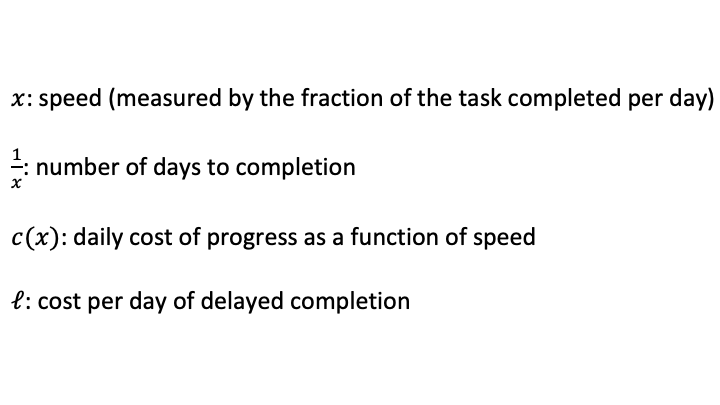
The idea is then to minimize the total cost, which equals the daily cost times the number of days to completion:
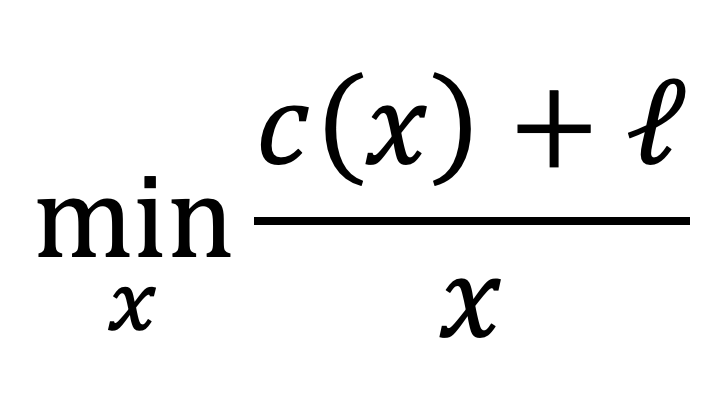
Minimizing the natural logarithm of the total cost has the same optimal speed:
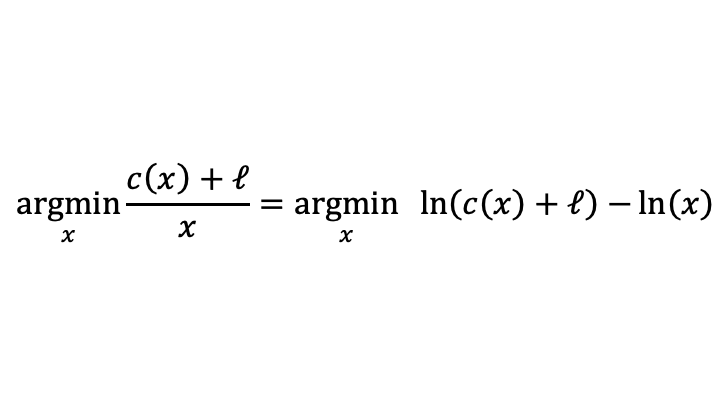
The first-order condition for the logarithmic version of the problem is:
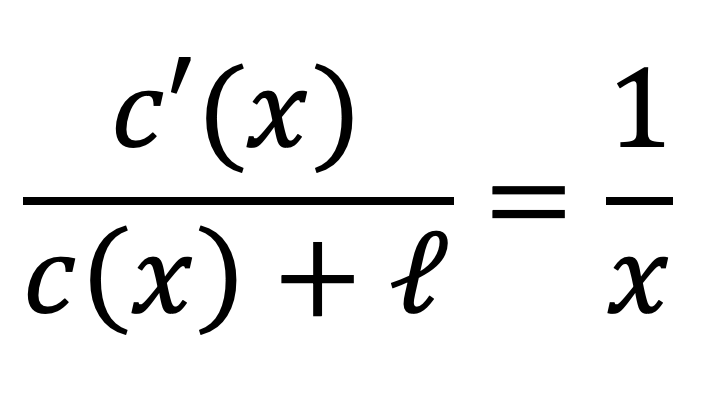
Rearranging the algebra, the first-order condition becomes:
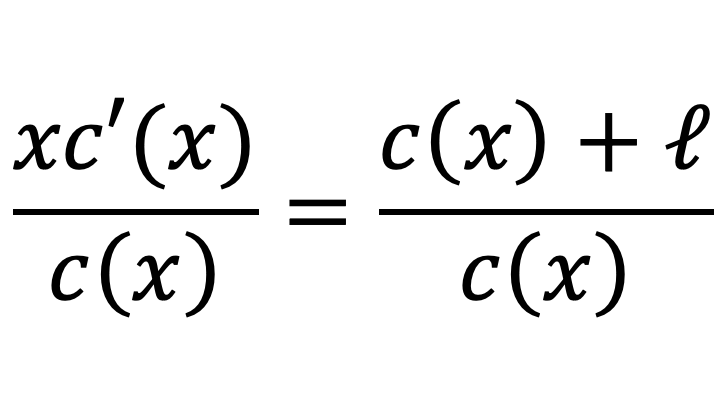
This has a nice interpretation: the elasticity of the daily cost of speed should be set equal to the ratio by which the total cost (including both the cost of speed and the cost of delay) exceeds the cost of speed alone.
If the daily cost of speed is increasing in speed, the right-hand side of this first order condition is decreasing in x. If, in addition, the elasticity of the daily cost of speed is increasing in speed, then any solution to the first-order condition will provide a unique solution for the optimal speed. Not surprisingly, for a given functional form of the cost of speed, the optimal speed will be higher the higher the cost of delay.
To me, this suggests that I should study German relatively fast. I don’t like not being able to read German. I think I have identified the right technology for learning it, having done Pimsleur German, with the books I have and using the memory techniques I talk about in “The Most Effective Memory Methods are Difficult—and That's Why They Work.” And on any day that is only medium busy (a little easier to come by during this pandemic), I don’t think the elasticity of the daily cost rises much above one until I get above an hour a day on German study.
See if this kind of logic helps you with any practical decision that you have. Basically, it says we should get things done fast unless there is a relatively-quickly-increasing cost to speed.
The extension to multiple projects each with this kind of costs and benefits turns out to be very interesting. I plan to do another blog post or two on that in the new year.
On Minimalist Shoes
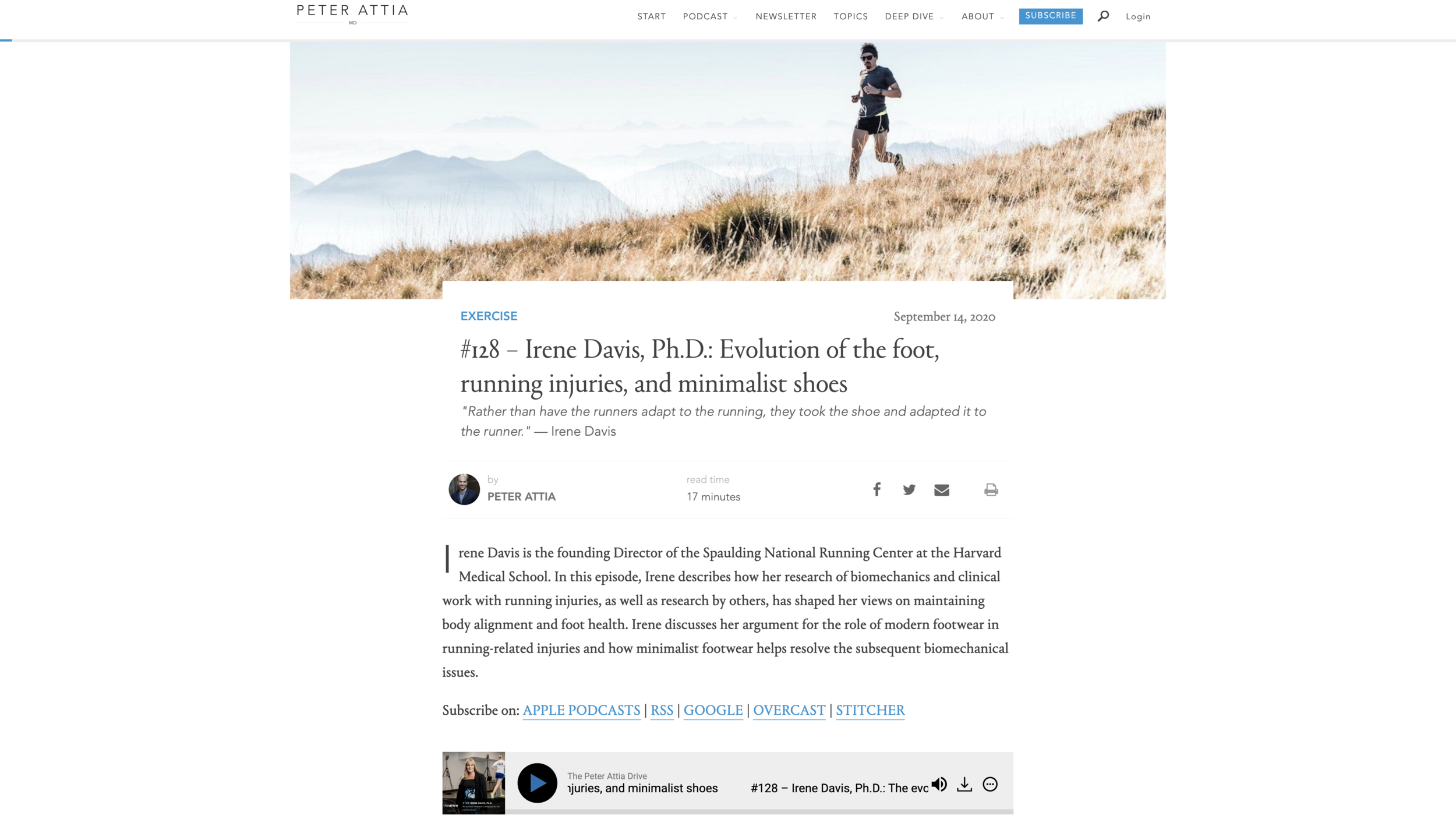
Peter Attia’s podcast is my go-to source for more knowledge about diet and health. His views are quite compatible with mine. And where Peter and I disagree, I believe him rather than me. (I still think I have a place in the ecosystem: Peter’s podcast is often more technical than my diet and health posts on this blog. I hope I simplify in a useful way!)
Peter Attia’s Podcast #128 is one of several of his podcasts that have changed my life. In this podcast he interviews the remarkably persuasive Irene Davis. Irene points out that in every area of physical therapy other than the feet, it is taken for granted that the relevant muscles should be strengthened. But when it comes to the feet, the standard approach has been to baby them in a way that leaves them weaker, not stronger. Irene recommends minimalist shoes in order to make one’s feet stronger; making them stronger makes feet more resistant to problems. She does note how important it is to adjust to minimalist shoes gradually.
Persuaded by that argument, I have some minimalist Xero shoes that I am enjoying. It is strange, but my after gradually getting used to them, my feet feel smarter and are enjoying their contact with the ground. (It may be that my adjustment process was a little easier because I ordinarily walk around barefoot or with only socks on in my house—a habit I got into when I spent 1979-1981 as a Mormon missionary in Japan, where it is rude to wear shoes inside a house.)
I expect to write many more blog posts based on what I have learned from Peter Attia and those he interviews. So far the most important blog posts I have based on Peter Attia’s podcast are these two:
Matt Burgess on 'Positive Intelligence' as a Tool for Economists →
Here is my post explaining the program Matt refers to, which I am offering to economists free of charge:
Also, at the bottom of the post below, there are links to other posts on making careers more meaningful and life better—including some that are specifically directed at economists:
Taryn Laakso: Battery Charge Trending to 0% — Time to Recharge

I am delighted to be able to share another guest post by my friend Taryn Laakso. Her previous guest posts are “Recognizing Opportunity: The Case of the Golden Raspberries” and “Taryn Laakso: Righting Your Ship Before You Capsize.”
I was challenged in a Powered by Play program earlier this year, lead by the delightful Play & Burnout Coach, Kaitlyn Lyons that went deep into learning my unique playstyle because I was on the verge of burnout. After 6 months of breaking away from corporate and spending 55+ hours a week building my coaching business during a pandemic, I forgot all about what rest, play, and fun was. I was going into a dark place with my well-being. My battery charge was on the brink of 0%.
My inner Sage was screaming at me to take care of myself but I felt like my options for getting rest and play weren't available to me due to the pandemic restrictions. I found myself comparing or judging others who seemed to be having fun on social media. I didn't like this feeling within myself. It felt icky! I needed to do something about this quick.
Hot Tip! Feelings of envy or judgment towards others is a clear signal that something is off!
What I discovered is that my version of rest and play is not something I should compare to someone else's version. Did you know there are 8 different personalities of play according to Dr. Stuart Brown?

For me, my ideal fun is movement, exploring, and storytelling. Staying at home and not traveling was a big hit to my play power levels. Some of the elements of Mover and Explorer meant traveling, backpacking, and dancing for me. Storytelling is about enjoying books, plays, watching movies, and reading books. Screech! I wasn’t doing any of this! I wasn't traveling, dancing, seeing plays, going to a new movie, or reading for fun. I had been heavy in reading about leadership and business building books. I was sitting behind my desk working on my business. Travel was out the window.
No wonder my battery was running on empty and my saboteurs were taking over my mental well being. All those ways of playing that I took for granted weren’t available. Here’s the impact when the dark side wants to take over…
I took it out on my partner by criticizing him, judging myself, and avoiding talking about my feelings. I am so grateful for the mental muscles I was building through the Positive Intelligence® work that allowed me to notice quickly how my Sage voice within was telling me to make a change. Pronto!
This meant the 10 Saboteurs from the Positive Intelligence work were creating a band of bullies at the playground in my head during this time. Here’s the line up of the entire bully band:
The Judge, Avoider, Controller, Hyper-Achiever, Hyper-Rational, Hyper-Vigilant, Pleaser, Restless, Stickler, and Victim.
For me, it was The Judge, Avoider, Hyper-Achiever, and Hyper-Rational that were depleting my energy by all their negative chatter in my head. Some serious butt-kicking was needed to evict them out of my head. It meant taking action of giving myself permission to rest and play. I enjoyed reading a mindless novel, took days off, traveled to Pt. Townsend or Lopez Island and walked outside as much as possible. Even if this meant working fewer hours and being less 'productive'. It was critical for recharging the batteries AND I actually got more done because I was rested.
It may feel hard to give yourself permission to rest and play. Here's what I know happens when you rest and play.
You are recharged
You are nicer to yourself and others
Your creativity is ignited
Do you want to feel rested, recharged, calm, and have a better relationship with your loved ones?
Don't let your saboteurs hijack you into thinking you have to 'push through' and create the 'perfect' holidays this year.
What fun can you create with the circumstances you are in right now?
What was something you loved to do when you 5 years old around the holidays?
What is something you are tolerating about the holidays that you would love to change?
This past weekend, we created fun indoors. The kids designed an obstacle course throughout the house as part of a 6 event mini Olympics. My attempt at creating and flying a paper airplane was a mess, but I laughed the whole time. We also had a competition building gingerbread houses. The winner was the one that looked like a sailboat! And yes, without shame, I admit that we had an event that was based on Beer Pong, sans the beer. I flexed my old college memory muscles for this one and beat my eldest daughter. Check out the video here of the time-lapse non-beer pong challenge.
So give yourself permission to create fun, rest and play while building stronger relationships with your family. Need ideas? Schedule time with me and I am happy to share what we've been up to!
We can also explore things you are judging yourself for and activate your fun and playful side in my next 7-week Mental Fitness Bootcamp. Registration is open now with limited spots! Bootcamp starts next Monday, December 7th.
It’s the perfect opportunity to see how judging ourselves or others could be putting a damper on play and joy this coming holiday season. You have a choice on how to experience your life. You get to redesign your definition of rest and play.
Want to turn this holiday into your own gift of joy? I'll show you how. Click here to learn more at www.bootcamp.unlaakingyourpotential.com
All the best in this messy and imperfect world,
Taryn Laakso, ACC | CPCC
Unlaaking Your Potential, LLC
Taryn Laakso provides individualized 1-on-1 coaching, group coaching programs, and resources designed to ignite creativity, stoke the flames of inspiration, and guide clients in developing their own inner wisdom. After years of working as an HR professional, she brings a consultative approach to her coaching and is passionate about working with entrepreneurial leaders who are transitioning out of their corporate careers and toward their passion work.
She is differentiated by her focus on mindset and weaves together a variety of coaching tools in her approach to transforming the lives of her clients. Taryn views herself as a “sherpa” whose role it is to guide her clients through their journey from a life of practicality and fear to a life of passion and purpose along with profit.
Outside of coaching, Taryn loves cooking, sailing, backpacking in the Pacific Northwest, reading, and spending quality time with her blended family.
What Fraction of Participants in a Randomized Controlled Trial Should Be Treated?

When reporting vaccine results in the news journalists often remiss fail to report which fraction of participants in a trial received the vaccine and which fraction received the placebo, which makes it harder to understand the results!
That made me wonder what fraction of participants in a randomized controlled trial should be given the treatment (with the remaining participants getting the placebo). At first, it might seem obvious that half should get the treatment and have should get the placebo to maximize power, but that is treating the number of participants as fixed rather than the budget as fixed. If the treatment costs more than the placebo, then somewhat less than half of the participants should be treated in order to maximize statistical precision per dollar spent on the trial.
The math makes for a good exercise. Let me lay out the notation first:

Instead of setting it up as a Lagrangian problem, in this case we can just maximize the variance of the treatment dummy per dollar:

This ratio is invariant to the total number of participants in the trial. So the optimal fraction of participants treated is invariant to how many participants are in the trial.
Getting the first-order condition is a little easier if we put the maximization problem in logarithmic form:

Here is the first-order condition itself:

All of the denominators are positive; after clearing fractions, this is a quadratic equation in p:

Only the positive root is relevant. Because it starts at -1 when p = 0 and always has a positive derivative when p > 0, there is only one positive root. Here is a table of solutions for different values of the cost ration c_v/c_0 :

The bottom line is that you might want to treat slightly less than half if the cost of treatment is greater than the cost of the placebo, but it takes quite a large cost ratio to drive the optimal fraction treated very far from 50%.
Note that costs of collecting the data have to be included in the cost of a participant who gets the placebo as well as the cost of a participant who gets the treatment. This drives the cost ratio closer to 1. Not also that all the efforts to make getting the placebo look indistinguishable to participants from getting the treatment also drives the cost ratio closer to 1. So often the optimal fraction treated will be quite close to 50%.
Christopher Peters and Benoit Essiambre on the Need for Negative Rates to Speed Recovery from the Pandemic →
The blog title is a link to a nice Twitter thread.
For a while, I thought that monetary stimulus should wait until after pandemic restrictions were over. Now, I think that for a while it is good to have both forces at work: pandemic restrictions (such as on restaurants and bars) to reduce coronavirus danger, combined with monetary stimulus to make it as likely as possible that those disemployed from one sector can find work in another—now instead of later.
Tai Chi to Prevent Falls

Our only alternative to getting older is to die young. When we do get old (and I am now 60), falls are a serious danger. A bad fall can easily lead to a permanently diminished quality of life, and to lower levels of activity that lead to other problems.
The review above, “Tai Chi for the Prevention of Falls Among Older Adults: A Critical Analysis of the Evidence,” by Samuel Nyman, takes some care at synthesizing the results of many studies on the effects of Tai Chi on falls, while worrying about things such as publication bias. Samuel Nyman comes to the conclusion that doing Tai Chi reasonably seriously reduces falls to about 4/5 of what they would otherwise be. (“Reasonably seriously” means at least an hour a week, and done standing up, rather than a watered-down “seated” Tai Chi.) Other forms of strength training and balance training may well have the same benefits for fall prevention as far as the evidence goes. But Tai Chi has other elements that are attractive. Samuel Nyman summarizes key elements of Tai Chi practice as follows:
Eight elements have been identified as follows: focused attention, imagery and visualization, enhanced integration of physiological systems, moving meditation, strength and flexibility training, more efficient breathing, social support from attending classes, and a vehicle for increased spirituality (Wayne & Fuerst, 2013).
In addition to the (often quite long) walks I take almost every day, Tai Chi (or some close substitute), along with strength training, is something I intend to do as I get even older. I easily found videos on how to do it online. I have to admit that, currently, I am simply doing one-legged knee bends with eyes open (see “Learning to Do Deep Knee Bends Balanced on One Foot”) and standing on one foot with eyes closed. At least I have down the idea that balance is important.
For annotated links to other posts on diet and health, see:
Scott Cunningham on 'Positive Intelligence' as a Tool for Economists →
Here is my post explaining the program Scott refers to, which I am offering to economists free of charge:
Also, at the bottom of the post below, there are links to other posts on making careers more meaningful and life better—including some that are specifically directed at economists: