Hope in Returning to the Road Not Taken in Psychiatry
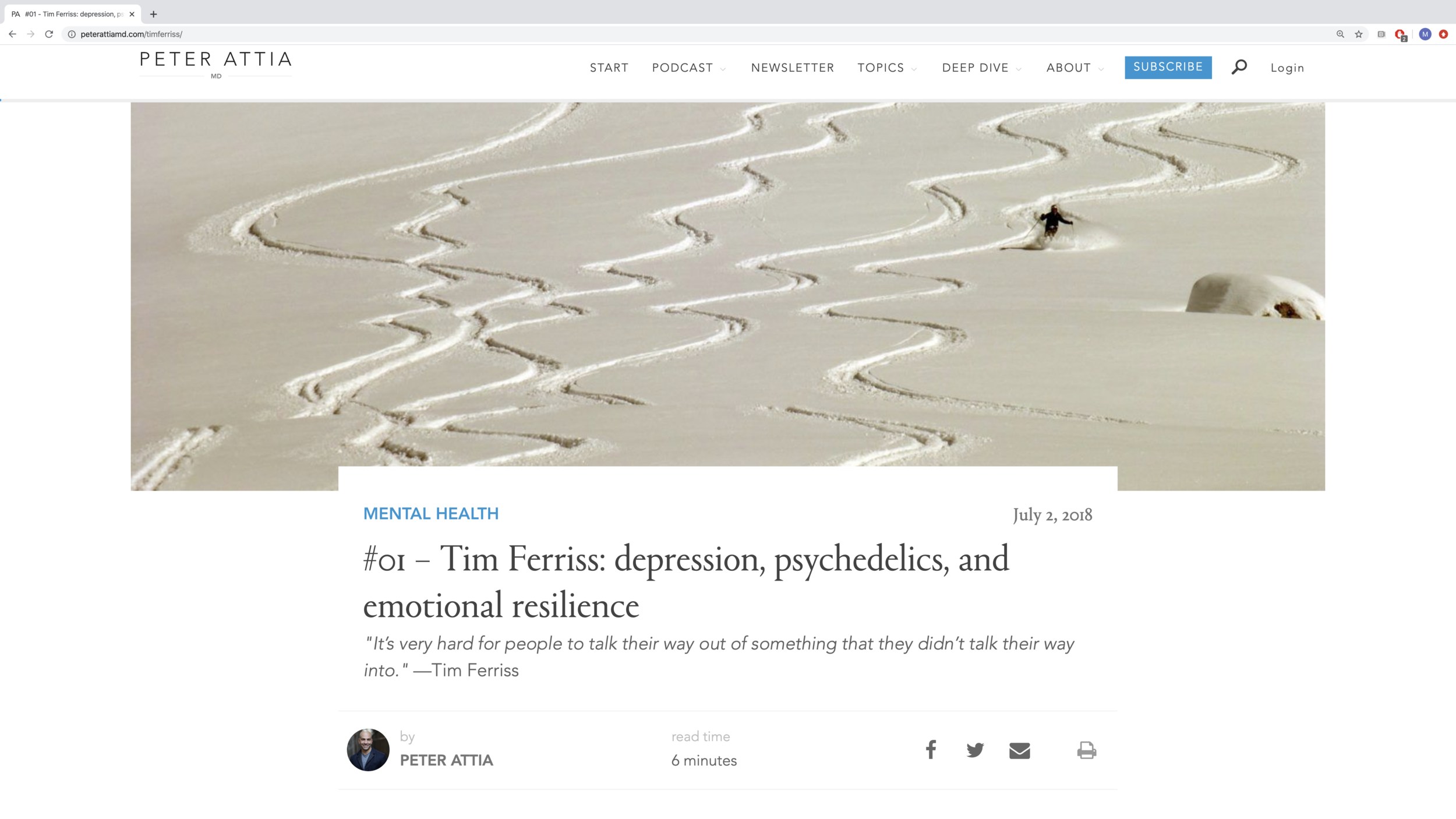
I have just begun listening to Peter Attia’s podcasts in his podcast series “The Drive.” So far, they seem very much in the same spirit as what I have been writing in my diet and health posts.
I first listened to Peter’s interview of Matthew Walker. That makes me look forward to reading Matthew Walker’s book Why We Sleep. The basic message is: “Respect sleep. If you don’t, you will pay.”
Peter’s very first podcast interviewing Tim Ferris is also powerful. Therapy using psychedelics such as LSD, psilocybin, MDMA (a pure form of “ecstasy”) and mescaline shows great promise. Two reasons psychedelics can help is (1) they can loosen the hold of longstanding top-level brain patterns, allowing a psychological “reboot” and (2) they can induce a temporary suspension of our normal intense awareness of the self-other distinction, allowing new, less self-centered perspectives to get in. I have zero personal experience with psychedelics, but I suspect that meditation and spiritual practices such as extended free-form personal prayer of the sort I used to do when I was a Mormon can induce similarly profound changes in brain activity.
A thumbnail history is that psychedelic therapy got derailed by government restrictions and cultural opprobrium in oppositional overreaction to the counterculture’s embrace of psychedelics in the 1960s. As a result, we may have lost the use of powerful therapies for many psychiatric ills for more than half a century.
I wonder, in particular, if my son Spencer’s suicide could have been averted with the help of psychelic therapy. (On that sad event, see my wife Gail’s guest post “The Shards of My Heart.”)
There is hope. Approval of MDMA to treat PTSD has been fast-tracked and it is possible it will be available for routine use by psychiatrists as early as 2021.
The way things work, as soon as a drug has been approved for one use, the system trusts medical doctors (including psychiatrists) to use it off-label. So demonstrating conclusively the value of one use case opens up the possibility of other legal therapeutic uses by medical doctors without going through the full (and expensive) drug approval process.
One example of an off-label use of a drug is the use of ketamine—which is approved for use as a anesthetic—to treat depression. I had a friend who was treated with a small dose of ketamine for serious depression that didn’t response to other treatments. It worked remarkably well. Ketamine is not a psychedelic but seems to have similar underutilized psychiatric potential.
Let me insert here a warning that (a) street drugs are often impure and (b) proper psychedelic therapy involves a lot of expert supervision. You could be in for a very bad trip or worse if you try to wing it. But in the hands of psychiatrists trained in their use, psychedelics have the advantage of being “anti-addictive” in the words of the podcast. Unlike opiates, where the benefit is upfront and the harm comes later, psychedelic experiences are often unpleasant while under the influence of the drug, but then leave lasting benefits.
I honor those who have been and are now pursuing research into the psychiatric potential of psychedelics. There is real hope that some of our most intractable psychiatric problems can be blunted.
I can’t fail to mention two relevant books. Reading my friend Randolph Nesse’s book Good Reasons for Bad Feelings: Insights from the Frontier of Evolutionary Psychiatry gave me an acute sense of how bad the current state of psychiatry and psychiatric treatment is. Breakthroughs are desperately needed. From reviews, Michael Pollan’s book How to Change Your Mind: What the New Science of Psychedelics Teaches Us About Consciousness, Dying, Addiction, Depression, and Transcendence (which I haven’t read yet, but want to), has a message similar to the message of Peter Attia’s interview of Tim Ferris.
For annotated links to other posts on diet and health, see:
Nolan Grey: Dead Malls, Explained
Hat tip to the excellent “Market Urbanism” Facebook group.
There is a Martin Luther King Day angle to this video that you will see if you watch it.
Respect Intuition
Most of you, my loyal readers, are very articulate. Having things articulated clearly is a huge help to intellectual work. It not only allows us to communicate with others, but also to understand things better ourselves.
But I have learned an important lesson in my career and in my life: there is great value in respecting intuitions and feelings that have not yet been clearly articulated. There can be genuine insight that arrives in an inarticulate form.
I have learned to respect intuition that cannot yet be fully articulated both when it is my own intuition and when it the intuition of another. In both cases, the one with the intuition needs to be given the time and the space needed to figure out how to articulate it better. Dissing the intuition saying something like “If you can’t back up your feeling with a good argument, you don’t have a leg to stand on” shuts off a channel of insight and can easily block the path to greater understanding or lead to a decision-making mistake.
Intuitions are far from foolproof. Sometimes they are off track. Sometimes they are wrong but lead to something that is right. And sometimes they represent with remarkable accuracy the understanding one has after working hard to articulate the intuition.
Respecting intuition also allows those who are less articulate but have important insights to help. Putting too much of a premium on things that are already articulated not only underrates certain ideas, it underrates certain people.
The problems, challenges and tasks we face are great enough that we need to take advantage of every tool we have to best them. Intuition is one of those tools.
Berk Özler: Better Conduct at Seminars →
I am personally a big offender here and need to improve.
How to Create Successful Fake News—And How Not To Be One of the People Snookered by It

The underlying scientific results should be taken with a grain of salt because of the reproducibility crisis in psychology, Gary Marcus’s and Annie Duke’s Wall Street Journal article “The Problem with Believing What We’re Told” are otherwise a fascinating rundown of indications that people are often quite sloppy about deciding whether something is true or false.
On that grain of salt, as I discuss in “Let's Set Half a Percent as the Standard for Statistical Significance," the article "Redefine Statistical Significance" on Psyarchive notes that—of results in psychology that according to the author’s statements, supposedly had only between 1/2 % and 5% of being due to chance, only 24% could be replicated in a follow-up study designed to verify those results.
But with that grain of salt, following are the suggestive results of psychological research on discernment of true/false as summarized by Gary Marcus and Annie Duke. I have added bullets to their words to separate different passages:
The simple act of repeating a lie can make it seem like truth … Test subjects became more likely to believe things as they were repeated, regardless of whether they were true or false. The third time they heard a false statement, they were just as likely to believe it as a true statement that they heard once.
When pictures were attached, people were more likely to believe the statements, including the fake ones.
… the presence of moral and emotional words like “hate,” “destroy” or “blame” acted like an accelerant, increasing the chance that a message would spread by about 20% for each additional emotional word. The study also found that most of the sharing was done within political parties rather than across political divides, creating an echo-chamber effect.
Savvy propagandists have long exploited the tendency of the human brain to take shortcuts. But social networks make it far easier, because they feed on a further human vulnerability: our need for approval, affection and positive feedback.
When first asked to assess the believability of true and false headlines posted on social media, the 68 participants—a mix of Democrats, Republicans and independents—were more likely to believe stories that confirmed their own prior views. But a simple intervention had an effect: asking participants to rate the truthfulness of the headlines. That tiny bit of critical reflection mattered, and it even extended to other articles that the participants hadn’t been asked to rate. The results suggest that just asking yourself, “Is what I just learned true?” could be a valuable habit.
… prompting people to consider why their beliefs might not be true leads them to think more accurately.
If borne out, this set of results provides a road map for creating successful fake news—and a road map for not being one of the people who is snookered.
BJ Fogg's Tips for New Year's Resolutions
Last January, I posted “3 Achievable Resolutions for Weight Loss.” So I was interested to read the Wall Street Journal op-ed BJ Fogg wrote to promote his new book Tiny Habits: The Small Changes That Change Everything. (I haven’t read the book itself.) I have some hope that his approach may help you in implementing some of the things I have recommended in my diet and health posts—such as going off sugar. (On that, also see “Letting Go of Sugar.”)
Here is the claim BJ Fogg makes for his approach:
It isn’t primarily repetition over a long period that creates habits; it’s the emotion that you attach to them from the start. Data from the most recent 5,200 people to complete a five-day course of our program showed that more than half were able to instill habits in five days or less.
He lays out the basics of his approach as follows. All of the following that is indented are BJ Fogg’s words; I have rearranged and added indentation, bullets and bolding:
It turns out that there is a formula for any successful shift in behavior. … To instill a habit,
1. the first thing you need is motivation: Pick a behavior that you want to do rather than one you merely feel obligated to do.
… don’t think you have to create motivation. Choose habits that you already are eager to adopt.
2. Second, you need to be able to do it: Make the change simple and small at first.
a busy mom named Amy, who needed to manage distractions and stay focused on essential tasks. The habit she initially designed with our help was just to write one must-do task on a Post-it Note and stick it on her car dashboard, prompted by each day’s kindergarten drop-off. She didn’t even have to do the task itself at first; the initial habit was all about setting priorities.
One of my favorite projects was at a research hospital where the challenge was to tackle the problem of nurse burnout, a large and growing issue in health care. …
I heard firsthand just how difficult it was for them to do basic things like drink enough water, eat regularly, and even get a full night’s sleep. So we worked together on creating healthy habits like “After I open my computer, I will take a sip of water,” or “After I answer the call light, I will take a deep breath.”
3. Third, you need a personal prompt: Identify a way to reliably trigger the behavior.
The best way to prompt a new habit is to anchor it to an existing routine in your life, whether it’s flushing the toilet, turning on the coffee pot in the morning or buckling your seat belt.
… every time he brushed his teeth, he would do two push-ups, then hold a “plank’’ position for just five seconds.
4. Finally, you need to celebrate your new habit, so that your brain associates it with positive feelings.
As you try each new habit, celebrate immediately. Cause yourself to feel good in that exact moment, whether it’s an inward “Good job!” or an outward fist pump.
If your goal is going off of sugar, an example of starting small would be to stop drinking sugary drinks such as soft drinks or juice; you could replace them with coffee or tea or flavored sparkling water. (See “In Praise of Flavored Sparkling Water.” On the trouble with juice, see “Forget Calorie Counting; It's the Insulin Index, Stupid.” On why not to substitute soft drinks with nonsugar sweeteners, see “Which Nonsugar Sweeteners are OK? An Insulin-Index Perspective.”)
An even easier goal to get you started toward better health would be to eat an avocado a day, one way or another, except on days when you are fasting. (See “In Praise of Avocados.”)
For annotated links to other posts on diet and health, see:
Bill Dudley on the Fed's New Floor System for Establishing Its Target Nominal Interest Rate →
This should be taken seriously; Bill Dudley was the President of the Federal Reserve Bank of New York (a position in the Federal Reserve System second in importance only to the Chair of the Federal Reserve Board) from 2009–2018).
Note: To explain the new and old approaches to establishing an interest rate, I wrote this post for my students:
The Federalist Papers #4 B: National Defense Will Be Stronger if the States are United

In the first half of The Federalist Papers #4 John Jay argues that the states must be prepared to defend themselves from other nations. (See “The Federalist Papers #4 A: The States Must Be Prepared to Defend against Aggression by Other Nations.”) In the second half he argues that they will be better able to defend themselves if they are united. His main arguments are these:
A larger nation has more military leaders to choose from, and so can typically get better leaders.
Coordinated preparations are valuable.
A united front allows for the internalization of externalities between the states in thinking through war aims (as reflected ultimately in the treaties the resolve wars).
A larger nation can have a larger military that it can concentrate at the most important place at any point in a conflict.
Unity of command is valuable.
In a war, states might well betray one another if they are not under one government.
If not united under one government squabbling among the states could make both the prosecution of war and the establishment of peace much more difficult.
The strength that comes from being united matters not only for victory, but also for deterring war.
I consider the second half of The Federalist Papers #4 to being with these two paragraphs pointing to the value of a strong national defense:
The people of America are aware that inducements to war may arise out of these circumstances, as well as from others not so obvious at present, and that whenever such inducements may find fit time and opportunity for operation, pretenses to color and justify them will not be wanting. Wisely, therefore, do they consider union and a good national government as necessary to put and keep them in SUCH A SITUATION as, instead of INVITING war, will tend to repress and discourage it. That situation consists in the best possible state of defense, and necessarily depends on the government, the arms, and the resources of the country.
As the safety of the whole is the interest of the whole, and cannot be provided for without government, either one or more or many, let us inquire whether one good government is not, relative to the object in question, more competent than any other given number whatever.
Then, John Jay lays out in detail the arguments I list above. Here they are, with my summary of the argument in bold before John Jay’s argument in full on that point:
1. A larger nation has more military leaders to choose from, and so can typically get better leaders.
One government can collect and avail itself of the talents and experience of the ablest men, in whatever part of the Union they may be found.
2. Coordinated preparations are valuable.
It can move on uniform principles of policy. It can harmonize, assimilate, and protect the several parts and members, and extend the benefit of its foresight and precautions to each.
3. A united front allows for the internalization of externalities between the states in thinking through war aims (as reflected ultimately in the treaties the resolve wars).
In the formation of treaties, it will regard the interest of the whole, and the particular interests of the parts as connected with that of the whole.
4. A larger nation can have a larger military that it can concentrate at the most important place at any point in a conflict.
It can apply the resources and power of the whole to the defense of any particular part, and that more easily and expeditiously than State governments or separate confederacies can possibly do, for want of concert and unity of system.
5. Unity of command is valuable.
It can place the militia under one plan of discipline, and, by putting their officers in a proper line of subordination to the Chief Magistrate, will, as it were, consolidate them into one corps, and thereby render them more efficient than if divided into thirteen or into three or four distinct independent companies.
What would the militia of Britain be if the English militia obeyed the government of England, if the Scotch militia obeyed the government of Scotland, and if the Welsh militia obeyed the government of Wales? Suppose an invasion; would those three governments (if they agreed at all) be able, with all their respective forces, to operate against the enemy so effectually as the single government of Great Britain would?
We have heard much of the fleets of Britain, and the time may come, if we are wise, when the fleets of America may engage attention. But if one national government, had not so regulated the navigation of Britain as to make it a nursery for seamen--if one national government had not called forth all the national means and materials for forming fleets, their prowess and their thunder would never have been celebrated. Let England have its navigation and fleet--let Scotland have its navigation and fleet--let Wales have its navigation and fleet--let Ireland have its navigation and fleet--let those four of the constituent parts of the British empire be under four independent governments, and it is easy to perceive how soon they would each dwindle into comparative insignificance.
6. In a war, states might well betray one another if they are not under one government.
Apply these facts to our own case. Leave America divided into thirteen or, if you please, into three or four independent governments--what armies could they raise and pay--what fleets could they ever hope to have? If one was attacked, would the others fly to its succor, and spend their blood and money in its defense? Would there be no danger of their being flattered into neutrality by its specious promises, or seduced by a too great fondness for peace to decline hazarding their tranquillity and present safety for the sake of neighbors, of whom perhaps they have been jealous, and whose importance they are content to see diminished? Although such conduct would not be wise, it would, nevertheless, be natural. The history of the states of Greece, and of other countries, abounds with such instances, and it is not improbable that what has so often happened would, under similar circumstances, happen again.
7. If not united under one government squabbling among the states could make both the prosecution of war and the establishment of peace much more difficult.
But admit that they might be willing to help the invaded State or confederacy. How, and when, and in what proportion shall aids of men and money be afforded? Who shall command the allied armies, and from which of them shall he receive his orders? Who shall settle the terms of peace, and in case of disputes what umpire shall decide between them and compel acquiescence? Various difficulties and inconveniences would be inseparable from such a situation; whereas one government, watching over the general and common interests, and combining and directing the powers and resources of the whole, would be free from all these embarrassments, and conduce far more to the safety of the people.
8. The strength that comes from being united matters not only for victory, but also for deterring war.
But whatever may be our situation, whether firmly united under one national government, or split into a number of confederacies, certain it is, that foreign nations will know and view it exactly as it is; and they will act toward us accordingly. If they see that our national government is efficient and well administered, our trade prudently regulated, our militia properly organized and disciplined, our resources and finances discreetly managed, our credit re-established, our people free, contented, and united, they will be much more disposed to cultivate our friendship than provoke our resentment. If, on the other hand, they find us either destitute of an effectual government (each State doing right or wrong, as to its rulers may seem convenient), or split into three or four independent and probably discordant republics or confederacies, one inclining to Britain, another to France, and a third to Spain, and perhaps played off against each other by the three, what a poor, pitiful figure will America make in their eyes! How liable would she become not only to their contempt but to their outrage, and how soon would dear-bought experience proclaim that when a people or family so divide, it never fails to be against themselves.
PUBLIUS.
There is a direct relevance of John Jay’s arguments to our situation today. China is rising in power. It is important for the world to have an adequate counterweight to that power. Allies are valuable, but John Jay’s arguments point out why it is more valuable to have the United States itself be larger and more powerful so it can act as a better counterweight. Here, “larger” doesn’t mean more territory, it means having a larger population that can support a larger total economy and therefore support a larger military if necessary.
Fortunately, the United States can easily become larger in population because many, many people—including many highly skilled people as well as many out of “your tired, your poor, your huddled masses yearning to breathe free” who would gladly serve in the US military in order to be able to become citizens of our fair republic. Unfortunately, in in some quarter, there are low levels of tolerance for the cultural differences of many of those who were born outside the US. I hope that Americans soon wake up to the importance for our national security and world stability of allowing more immigration to the US in order to bolster American power. Of course, assimilation to an important degree is crucial in order to make sure that immigrants do, in fact, bolster American power. But the US has a stellar record of assimilating newcomers and gaining their loyalty. On the value of allowing more immigration in order to keep up with China’s power, see
(There is also a moral dimension to allowing more immigration. On that, see "‘The Hunger Games’ Is Hardly Our Future--It's Already Here” and “The Message of ‘Sal Tlay Ka Siti’.”)
Here are links to my other posts on The Federalist Papers so far:
2019's Most Popular Posts

The "Key Posts" link in navigation at the top of my blog lists all important posts through the end of 2016. Along with "2017's Most Popular Posts" and “2018's Most Popular Posts,” this is intended as a complement to that list. (Also, my most popular storified Twitter discussions are here, and you can see other recent posts by clicking on the Archive link at the top of my blog.) Continuing this tradition, I give links to the most popular posts from 2019 below into six groups: popular new posts in 2019 on diet and health, popular new posts in 2019 on political philosophy, popular new posts in 2019 on other topics, and popular older posts in those three categories. I will put in the 2019 pageviews for each post when someone went specifically to that post.
I am pleased to be able to report 529,822 Google Analytics pageviews in the first half of 2019—over 10,000 pageviews per week. Of these, 38,858 were pageviews for my blog homepage.
New Posts in 2019 on Diet and Health
Kevin D. Hall and Juen Guo: Why it is so Hard to Lose Weight and so Hard to Keep it Off 1,930
David Ludwig: It Takes Time to Adapt to a Lowcarb, Highfat Diet 1,410
Layne Norton Discusses the Stephan Guyenet vs. Gary Taubes Debate (a Debate on Joe Rogan’s Podcast) 1,087
Don't Tar Fasting by those of Normal or High Weight with the Brush of Anorexia 700
After Gastric Bypass Surgery, Insulin Goes Down Before Weight Loss has Time to Happen 426
Eggs May Be a Type of Food You Should Eat Sparingly, But Don't Blame Cholesterol Yet 335
Jonathan Shaw: Could Inflammation Be the Cause of Myriad Chronic Diseases? 291
A Low-Glycemic-Index Vegan Diet as a Moderately-Low-Insulin-Index Diet 281
Mental Retirement: Use It or Lose It—Susann Rohwedder and Robert Willis 270
The Benefits of Fasting are Looking So Clear People Try to Mimic Fasting without Fasting 225
Framingham State Food Study: Lowcarb Diets Make Us Burn More Calories 221
On the Epistemology of Diet and Health: Miles Refuses to `Stay in His Lane’ 196
Crafting Simple, Accurate Messages about Complex Problems 173
Less Than 6 or More than 9 Hours of Sleep Signals a Higher Risk of Heart Attacks 153
Is 10,000 Steps a Day More Than is Necessary for Health? 121
Should Those Whose Main Symptom is Chest Pains Get Stent or Bypass Surgery? 116
Does Reducing Saturated Fat Reduce Cardiovascular Disease? 115
Cancer Cells Love Sugar; That’s How PET Scans for Cancer Work 108
New Posts in 2019 on Political Philosophy
John Locke: How to Resist Tyrants without Causing Anarchy 584
On Despotism 328
The Federalist Papers #1: Alexander Hamilton's Plea for Reasoned Debate 200
John Locke on Monarchs (Or Presidents) Who Destroy a Constitution 159
The Federalist Papers #2 A: John Jay on the Idea of America 111
John Locke: If Rebellion is a Sin, It is a Sin Committed Most Often by Those in Power 97
New Posts in 2019 on Other Topics
In Honor of Alan Krueger 8,801
Adding a Variable Measured with Error to a Regression Only Partially Controls for that Variable 3,559
The Costs of Inflation 2,476
Who Leaves Mormonism? 1,160
Supply and Demand for the Monetary Base: How the Fed Currently Determines Interest Rates 1,016
Ruchir Agarwal and Miles Kimball—Enabling Deep Negative Rates to Fight Recessions: A Guide 813
An Optical Illusion: Nativity Scene or Two T-Rex's Fighting over a Table Saw? 383
Co-Active Coaching as a Tool for Maximizing Utility—Getting Where You Want in Life 312
Measuring Learning Outcomes from Getting an Economics Degree 256
Reza Moghadam Flags 'Enabling Deep Negative Rates to Fight Recessions' in the Financial Times 225
Joshua Goldstein and Staffan Qvist: The Argument for Expanding Nuclear Power 215
Marriage 103 212
Andy Matuschak: Why Books Don't Work (linkpost) 197
Give Central Banks Independence and New Political Pressures to Balance the Old Ones 189
Teens are Too Suspicious for Anything But the Truth about Drugs to Work 167
Andrew Biggs and Miles Kimball Debate Retirement Savings Policy 142
Larry Summers Says the Fed Should Move Fast to Cut Rates 140
Dan Ariely: The Power of Morning, Time Together and Positive Feedback 133
FocusEconomics: Predictions for the Global Economy in 2019 from 13 Experts 117
Ken Rogoff Defends a Robust Negative Rate Policy at Hoover 112
Brian Flaxman—A Tale of Bipartisanship and Financial Interests: The Taxpayer First Act of 2019 109
Silvio Gesell's Plan for Negative Nominal Interest Rates Meets the Mormons 103
FocusEconomics: How and When will the Next Financial Crisis Happen?—26 Experts Weigh In 96
One Nation 96
Older Posts with Continuing Popularity on Diet and Health
Forget Calorie Counting; It's the Insulin Index, Stupid 51,454
How Fasting Can Starve Cancer Cells, While Leaving Normal Cells Unharmed 32,302
Which Nonsugar Sweeteners are OK? An Insulin-Index Perspective 15,533
Why a Low-Insulin-Index Diet Isn't Exactly a 'Lowcarb' Diet 12,731
Using the Glycemic Index as a Supplement to the Insulin Index 7,507
Obesity Is Always and Everywhere an Insulin Phenomenon 5,356
The Case Against Sugar: Stephan Guyenet vs. Gary Taubes 5,306
What Steven Gundry's Book 'The Plant Paradox' Adds to the Principles of a Low-Insulin-Index Diet 4015
Jason Fung's Single Best Weight Loss Tip: Don't Eat All the Time 2,318
The Keto Food Pyramid 1,951
Meat Is Amazingly Nutritious—But Is It Amazingly Nutritious for Cancer Cells, Too? 1,663
Jason Fung: Dietary Fat is Innocent of the Charges Leveled Against It 1,311
Letting Go of Sugar 1,139
My Giant Salad 1,088
Best Health Guide: 10 Surprising Changes When You Quit Sugar 960
The Case Against the Case Against Sugar: Seth Yoder vs. Gary Taubes 508
Is Milk OK? 385
Anthony Komaroff: The Microbiome and Risk for Obesity and Diabetes 316
Heidi Turner, Michael Schwartz and Kristen Domonell on How Bad Sugar Is 134
Carola Binder: The Obesity Code and Economists as General Practitioners 124
Older Posts with Continuing Popularity on Political Philosophy
John Locke: Freedom is Life; Slavery Can Be Justified Only as a Reprieve from Deserved Death 4,398
John Locke on Punishment 2,793
On the Achilles Heel of John Locke's Second Treatise: Slavery and Land Ownership 1,451
John Stuart Mill’s Vigorous Advocacy of Education Vouchers 1,168
Freedom Under Law Means All Are Subject to the Same Laws 1,122
John Locke: The Only Legitimate Power of Governments is to Articulate the Law of Nature 1,121
John Locke's Smackdown of Robert Filmer: Being a Father Doesn't Make Any Man a King 623
John Locke: People Must Not Be Judges in Their Own Cases 584
John Stuart Mill on Balancing Christian Morality with the Wisdom of the Greeks and Romans 500
An Experiment with Equality of Outcome: The Case of Jamestown 431
John Locke: The Right to Enforce the Law of Nature Does Not Depend on Any Social Contract 403
John Stuart Mill on the Protection of "Noble Lies" from Criticism 332
Social Liberty 317
John Stuart Mill’s Brief for the Limits of the Authority of Society over the Individual 282
John Locke: The Law of Nature Requires Maturity to Discern 274
John Locke: Defense against the Black Hats is the Origin of the State 247
John Locke: By Natural Law, Husbands Have No Power Over Their Wives 235
John Stuart Mill on the Sources of Prejudice About What Other People Should Do 192
John Stuart Mill on Being Offended at Other People's Opinions or Private Conduct 169
John Locke Off Base with His Assumption That There Was Plenty of Land at the Time of Acquisition 167
John Stuart Mill on China's Technological Lost Centuries 161
John Stuart Mill's Argument Against Political Correctness 148
John Locke: Law Is Only Legitimate When It Is Founded on the Law of Nature 142
John Locke: Rivalry in Consumption Makes Private Property Unavoidable 132
John Locke Looks for a Better Way than Believing in the Divine Right of Kings or Power to the Strong 131
If the Justice System Does Not Try to Deliver Justice, We Are in a State of War 113
John Stuart Mill on the Need to Make the Argument for Freedom of Speech 107
Genius Can Only Breathe Freely in an Atmosphere of Freedom 107
John Stuart Mill: Making the Government More Powerful than Necessary is Inimical to Freedom 99
John Locke: Thinking of Mothers and Fathers On a Par Undercuts a Misleading Autocratic Metaphor 96
Older Posts with Continuing Popularity on Other Topics
Monetary vs. Fiscal Policy: Expansionary Monetary Policy Does Not Raise the Budget Deficit 2,067
How and Why to Eliminate the Zero Lower Bound: A Reader’s Guide 1,945
The Medium-Run Natural Interest Rate and the Short-Run Natural Interest Rate 1,806
There's One Key Difference Between Kids Who Excel at Math and Those Who Don't (with Noah Smith) 1,610
The Message of Mormonism for Atheists Who Want to Stay Atheists 1,565
The Logarithmic Harmony of Percent Changes and Growth Rates 1,655
The Shards of My Heart 1,287
Why I Write 1,181
Economics Needs to Tackle All of the Big Questions in the Social Sciences 1,052
The Complete Guide to Getting into an Economics PhD Program 1043
Why Taxes are Bad 1,016
Returns to Scale and Imperfect Competition in Market Equilibrium 862
What is the Effective Lower Bound on Interest Rates Made Of? 845
Netflix as an Example of Clay Christensen's 'Disruptive Innovation' 682
The Most Effective Memory Methods are Difficult—and That's Why They Work 596
Even Central Bankers Need Lessons on the Transmission Mechanism for Negative Interest Rates 565
Godless Religion 539
Michael Weisbach: Posters on Finance Job Rumors Need to Clean Up Their Act, Too 460
Greg Shill: Does the Fed Have the Legal Authority to Buy Equities? 400
Sticky Prices vs. Sticky Wages: A Debate Between Miles Kimball and Matthew Rognlie 341
How Subordinating Paper Currency to Electronic Money Can End Recessions and End Inflation 324
18 Misconceptions about Eliminating the Zero Lower Bound 323
Negative Interest Rate Policy as Conventional Monetary Policy: Full Text 316
The Shape of Production: Charles Cobb's and Paul Douglas's Boon to Economics 304
Rodney Stark on the Status of Women in Early Christianity 299
The Deep Magic of Money and the Deeper Magic of the Supply Side 286
Why I am a Macroeconomist: Increasing Returns and Unemployment 283
The Mormon Church Decides to Treat Gay Marriage as Rebellion on a Par with Polygamy 244
Noah Smith: Why Do Americans Like Jews and Dislike Mormons? 211
Matthew Shapiro, Martha Bailey and Tilman Borgers on the Economics Job Market Rumors Website 208
Silvio Gesell's Plan for Negative Nominal Interest Rates 208
Markus Brunnermeier and Yann Koby's "Reversal Interest Rate" 198
John L. Davidson on Resolving the House Mystery: The Institutional Realities of House Construction 192
Barack Obama: Football as the Best Sports Analogy for Politics 188
One of the Biggest Threats to America's Future Has the Easiest Fix 186
Gather ’round, Children, Here’s How to Heal a Wounded Economy 174
How and Why to Expand the Nonprofit Sector as a Partial Alternative to Government: A Reader’s Guide 169
Marriage 101 165
Marriage 102 162
Optimal Monetary Policy: Could the Next Big Idea Come from the Blogosphere? 159
Clay Christensen, Jerome Grossman and Jason Hwang on the Three Basic Types of Business Models 159
Let's Set Half a Percent as the Standard for Statistical Significance 156
Miles's April 9, 2006 Unitarian Universalist Sermon: ‘UU Visions’ 156
My Dad 150
Owen Nie: Monetary Policy in Colonial New York, New Jersey and Delaware 148
The Coming Transformation of Education: Degrees Won’t Matter Anymore, Skills Will 146
Leveling Up: Making the Transition from Poor Country to Rich Country 145
How Conservative Mormon America Avoided the Fate of Conservative White America 143
So What If We Don't Change at All…and Something Magical Just Happens? 121
Responding to Joseph Stiglitz on Negative Interest Rates 116
When the Output Gap is Zero, But Inflation is Below Target 112
A Conversation with Clint Folsom, Mayor of Superior, Colorado 112
Eric Weinstein: Genius Is Not the Same Thing as Excellence 110
Roger Farmer and Miles Kimball on the Value of Sovereign Wealth Funds for Economic Stabilization 110
How Increasing Retirement Saving Could Give America More Balanced Trade 108
David Holland on the Mormon Church During the February 3, 2008–January 2, 2018 Monson Administration 108
‘The Hunger Games’ Is Hardly Our Future--It's Already Here 105
Robert Eisler—Stable Money: The Remedy for the Economic World Crisis 104
Why Scott Fullwiler Misses the Point in ‘Why Negative Nominal Interest Rates Miss the Point’ 100
Fields Medal Winner Maryam Mirzakhani's Slow-Cooked Math 100
Christian Kimball on the Fallibility of Mormon Leaders and on Gay Marriage 97
Annie Atherton: I Tried 7 Different Morning Routines — Here’s What Made Me Happiest (direct link) 94
Christian Kimball: Anger [1], Marriage [2], and the Mormon Church [3] 93
Reacting to 'The Carbohydrate-Insulin Model of Obesity Is Difficult to Reconcile With Current Evidence' by Kevin Hall, Stephan Guyenet and Rudolph Leibel →
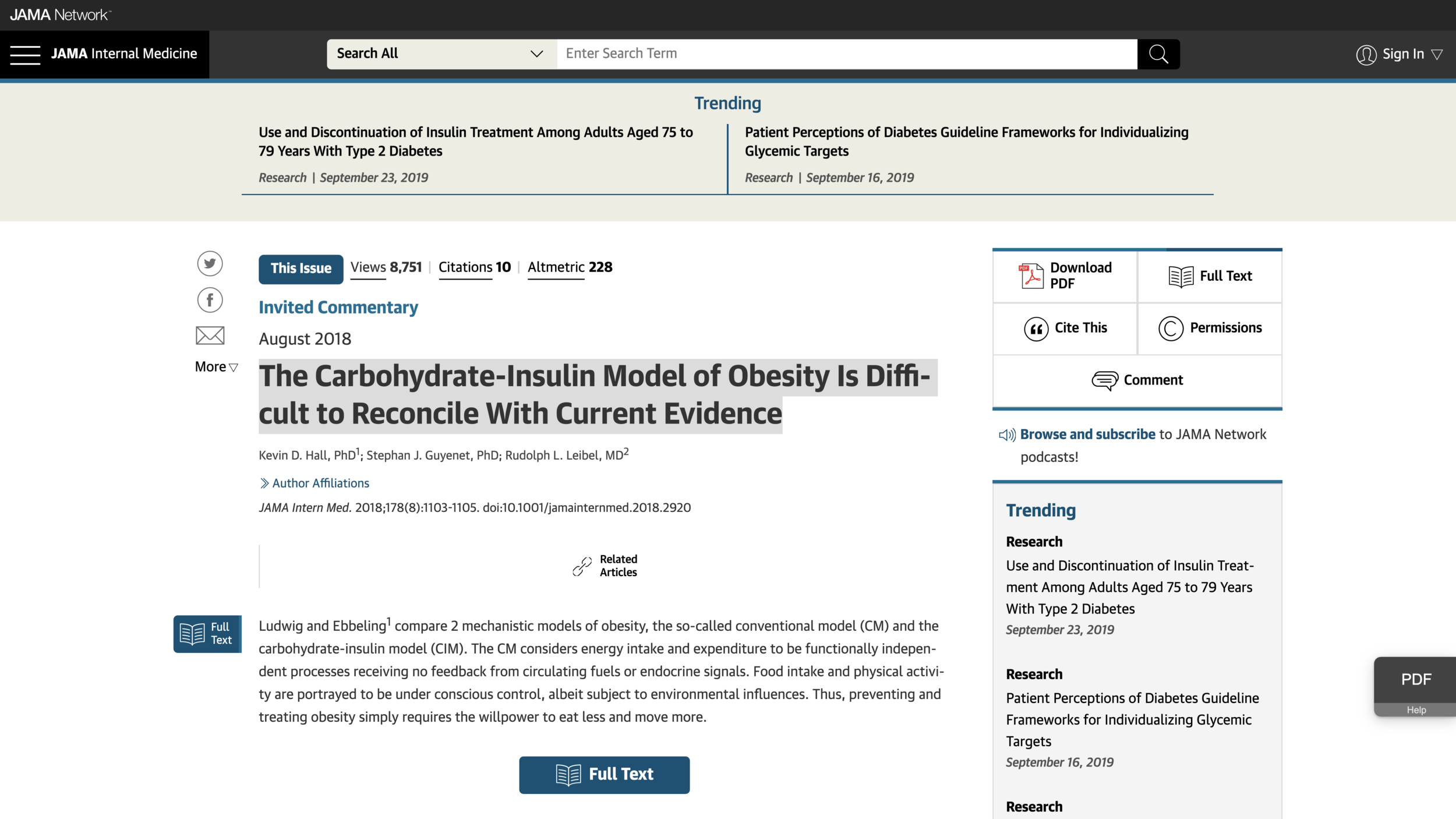
which was a response to:
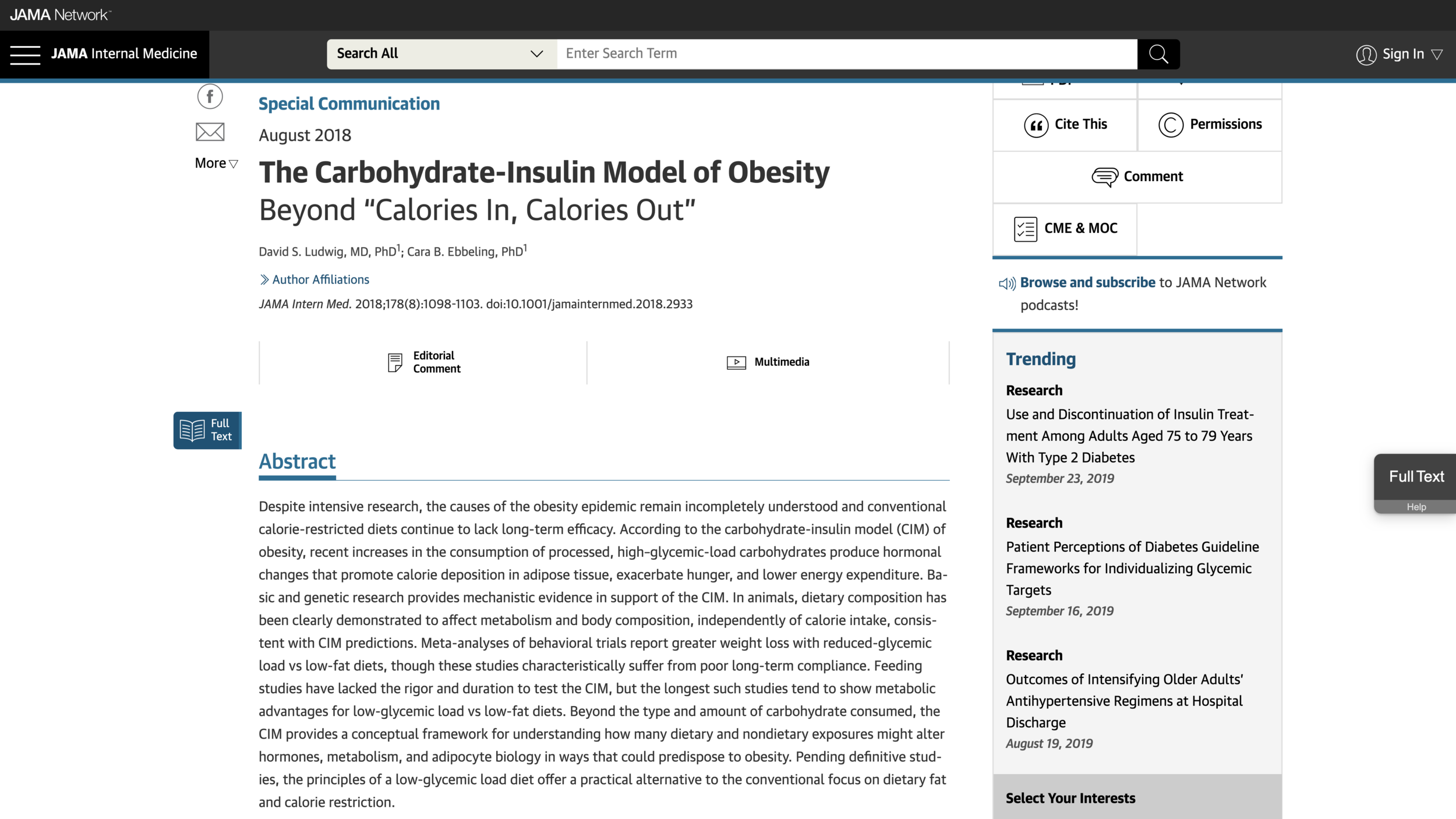
Alex Hutchison asked me on Twitter about the comment by Hall, Guyenet and Leibel shown at the top. My response is in this Twitter thread.