Joshua Goldstein and Staffan Qvist: The Argument for Expanding Nuclear Power

Link to the article above. All indented quotations below are from this article.
In their op-ed “Only Nuclear Energy Save the Planet,” I think Joshua Goldstein and Staffan Qvist underestimate how quickly solar energy can ramp up if it becomes dramatically cheaper (including becoming dramatically cheaper to install, say by solar collectors that are thin, flexible sheets). Nevertheless, the numbers they point to are daunting:
Any serious effort to decarbonize the world economy will require, then, a great deal more clean energy, on the order of 100 trillion kilowatt-hours per year, by our calculations—roughly equivalent to today’s entire annual fossil-fuel usage. A key variable is speed. To reach the target within three decades, the world would have to add about 3.3 trillion more kilowatt-hours of clean energy every year.
Solar and wind power alone can’t scale up fast enough to generate the vast amounts of electricity that will be needed by midcentury, especially as we convert car engines and the like from fossil fuels to carbon-free energy sources. Even Germany’s concerted recent effort to add renewables—the most ambitious national effort so far—was nowhere near fast enough. A global increase in renewables at a rate matching Germany’s peak success would add about 0.7 trillion kilowatt-hours of clean electricity every year. That’s just over a fifth of the necessary 3.3 trillion annual target.
In any case, why not use more nuclear energy? Joshua and Staffan claim:
… most countries’ policies are shaped not by hard facts but by long-standing and widely shared phobias about radiation.
Here is how they back that up:
1. Other power sources have been more dangerous than nuclear power:
Over six decades, nuclear power has experienced only one fatal accident, Chernobyl in 1986, which directly caused about 60 deaths and is blamed for thousands more over time from low-level radiation. That’s a serious accident, but other nonnuclear industrial accidents have been worse. A hydroelectric dam failure in China in 1975 killed tens of thousands, and the 1984 Bhopal gas leak at a Union Carbide plant in India killed 4,000 initially and an estimated 15,000 more over time. We don’t stigmatize those entire industries as a result.
The 1979 accident at Three Mile Island killed no one. In Japan in 2011, the fourth largest earthquake in recorded history and a 50-foot tsunami together took almost 20,000 lives—and damaged the Fukushima nuclear facility, which leaked radiation. Exposure during the incident contributed to one worker’s 2016 death, according to the Japanese government; the badly handled evacuation of the area, by contrast, is blamed for much hardship and many deaths.
2. Outside of the context of nuclear energy, people’s aversion to radiation is modest, as indicated for example by their willingness to live at high altitudes (as I do in Colorado) or fly in planes:
… we all walk around in a soup of background radiation, giving us an average of about 3 millisieverts (mSv) per year but ranging up to 200 in some places, with no demonstrated harm.
3. Nuclear waste is overrated as a problem:
An American’s entire lifetime of electricity use powered by nuclear energy would produce an amount of long-term waste that fits in a soda can. All spent fuel from U.S. reactors over the past 60 years would fit on a football field, stacked 20 feet high. Today we store spent fuel at reactor sites in concrete casks (radiation does not escape the concrete) that will be safe for a hundred years. After that, the waste can be burned in reactors that are currently being designed, or it can be buried permanently.
4. New kinds of nuclear reactors will be better.
Joshua and Staffan emphasize how nuclear energy can be made cheaper with better, more appropriate regulation and mass production of nuclear energy plants. But new forms of nuclear power are also likely to be safer and to better deal with the problem of nuclear waste. See the post “Is Nuclear Energy Safe? Well, Which One?” The standstill in building civilian nuclear power plants in the US means that we only have old nuclear power plants outside the military, so our image of nuclear power plants is of the old dinosaur nuclear power plants.
Conclusion.
The emotions surrounding nuclear power are great enough, I suspect many people are afraid to say nice things about nuclear power. For our planet, this is a much, much more damaging form of political correctness than many other forms of political correctness that people worry about. We need more people in the intersection of the sets of people who (a) do not deny the reality of global warming and the value of doing something about global warming and (b) know basic facts about nuclear power like those above, and (c) say every nice thing about nuclear power that they believe to be true.

The view out our window here in Colorado is worth a little extra radiation due to the higher altitude. See “Miles Moves to the University of Colorado Boulder.”
After Gastric Bypass Surgery, Insulin Goes Down Before Weight Loss has Time to Happen
In “Obesity Is Always and Everywhere an Insulin Phenomenon” I argue that insulin levels are a crucial determinant of weight gain and weight loss. I follow up on this idea in further posts,
and apply this idea in
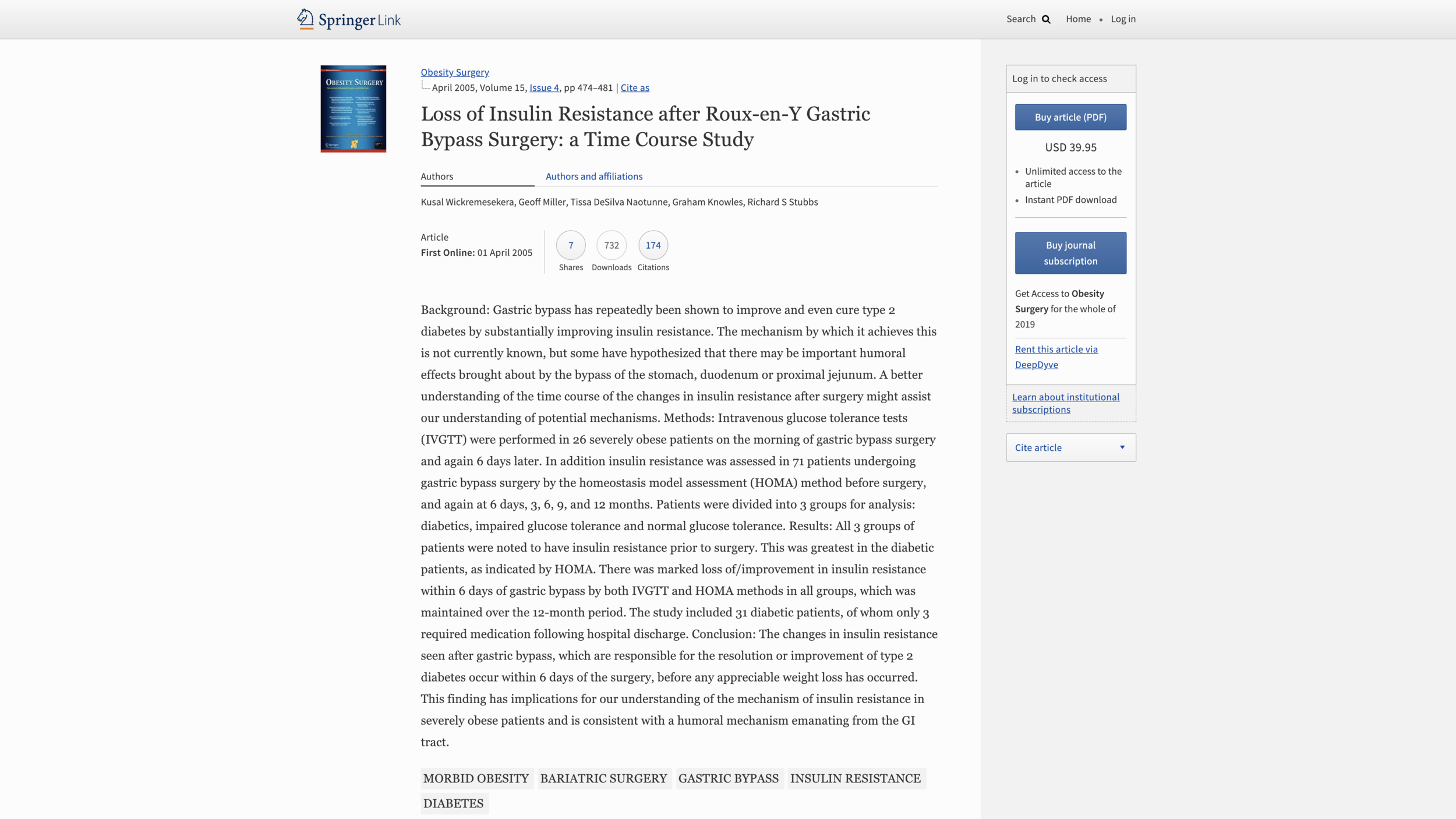
Today, let me point your attention toward an important study that gives more evidence of insulin’s importance for weight loss. In “Loss of Insulin Resistance after Roux-en-Y Gastric Bypass Surgery: a Time Course Study,” Kusal Wickremesekera, Geoff Miller, Tissa DeSilva Naotunne, Graham Knowles and Richard S Stubbs write:
Gastric bypass has repeatedly been shown to improve and even cure type 2 diabetes by substantially improving insulin resistance. … The changes in insulin resistance seen after gastric bypass, which are responsible for the resolution or improvement of type 2 diabetes occur within 6 days of the surgery, before any appreciable weight loss has occurred.
Insulin resistance is when many cells in the body have become somewhat “deaf” to insulin; the insulin-producing cells then respond by “shouting”: producing more insulin. Because not all responses to insulin are equally tamped down, the extra insulin increases the incidence of insulin side-effect. Even though it is produced by one’s own body, insulin must be considered a drug, and high doses cause trouble.
This link and those above will take you to the full abstract. Unfortunately, the article itself is behind a paywall, but going through the University of Colorado Boulder’s library website allows me free access. I consider the following paragraph the centerpiece of the paper. In order to understand it, you need to know the definition of “humoral”: relating to the body fluids.
There is abundant evidence from many centers indicating that type 2 diabetes can be cured by gastric bypass and by other forms of bariatric surgery. That this is achieved before appreciable loss of weight is an important clue to improving our under-standing of insulin resistance. Whereas obesity is conventionally thought to produce insulin resistance, it may emerge that obesity is another manifestation of insulin resistance. Put simply, insulin resistance may cause obesity, not vice versa. It has been postulated that gastric bypass improves diabetes through influences on the entero-insular axis, through a humoral effect. Our understanding of the changes in insulin resistance following surgery has been assisted by the documentation of marked falls in plasma insulin levels within days of gastric bypass.
Let me unpack this. It says that surgeries in the general category to which stomach stapling belongs can cure type 2 diabetes. Type 2 diabetes is basically a bad case of insulin resistance in which key cells have become so deaf to insulin that even if a lot of insulin is produced, they aren’t responding to the insulin enough. This is a bad situation!
The authors say explicitly that insulin resistance may cause obesity, as opposed to obesity causing insulin resistance.
What causes insulin resistance? High levels of insulin.
How can insulin resistance be reduced? Low levels of insulin.
How can insulin levels be reduced? One drastic way to lower insulin levels is gastric bypass surgery. It isn’t fully understood how gastric bypass surgery does this. Another way to reduce insulin levels and hence lower insulin resistance is to fast—that is, to eat nothing for a while. This effect is big enough that the authors worry in the paper about the reduced insulin resistance comes from the fact that people can’t eat for a while after gastric bypass surgery. Fasting is something you can do at home without having to go to the hospital!
Somewhat strangely, the authors write as if having some kind of operation is the only thing that would ever lead individuals to fast:
Without a sham operation being performed on severely obese individuals, it will be hard to resolve the role of fasting on insulin resistance in these patients. However, sham operations can be performed on animals, and experiments in a non-obese diabetic rat model support the hypothesis that the loss of insulin resistance is related to surgical bypass of components of the gut.
But many people are trying out fasting as a way to improve their insulin resistance.
I think of fasting (drinking water—and tea or coffee if desired—but not eating) as the most important idea I have come across for weight loss. It also has other health benefits. And if you are eating food that tends to produce relatively little insulin (see Forget Calorie Counting; It's the Insulin Index, Stupid), my experience and that of others I know is that fasting will be surprisingly easy. Or to put things another way, fasting gets a bad rap because people think of the agony of fasting in the wake of eating sugary food and other food that ramps up insulin. (Another factor in a low-insulin-index diet making it easier to fast may be that a low-insulin-index diet tends to be high in healthy fats, which makes the transition to burning one’s own body fat easier.)
A good place to start in putting these ideas into practice is last week’s post: “3 Achievable Resolutions for Weight Loss.” If you try these ideas, please let me know if they work for you—and even more importantly if they don’t work for you. I want to understand what works in practice, and hearing about things that didn’t work is a key way to get there.
Don’t miss my other posts on diet and health:
I. The Basics
Jason Fung's Single Best Weight Loss Tip: Don't Eat All the Time
What Steven Gundry's Book 'The Plant Paradox' Adds to the Principles of a Low-Insulin-Index Diet
II. Sugar as a Slow Poison
Best Health Guide: 10 Surprising Changes When You Quit Sugar
Heidi Turner, Michael Schwartz and Kristen Domonell on How Bad Sugar Is
Michael Lowe and Heidi Mitchell: Is Getting ‘Hangry’ Actually a Thing?
III. Anti-Cancer Eating
How Fasting Can Starve Cancer Cells, While Leaving Normal Cells Unharmed
Meat Is Amazingly Nutritious—But Is It Amazingly Nutritious for Cancer Cells, Too?
IV. Eating Tips
Using the Glycemic Index as a Supplement to the Insulin Index
Putting the Perspective from Jason Fung's "The Obesity Code" into Practice
Which Nonsugar Sweeteners are OK? An Insulin-Index Perspective
V. Calories In/Calories Out
VI. Wonkish
Anthony Komaroff: The Microbiome and Risk for Obesity and Diabetes
Carola Binder: The Obesity Code and Economists as General Practitioners
Analogies Between Economic Models and the Biology of Obesity
VIII. Debates about Particular Foods and about Exercise
Jason Fung: Dietary Fat is Innocent of the Charges Leveled Against It
Faye Flam: The Taboo on Dietary Fat is Grounded More in Puritanism than Science
Confirmation Bias in the Interpretation of New Evidence on Salt
Julia Belluz and Javier Zarracina: Why You'll Be Disappointed If You Are Exercising to Lose Weight, Explained with 60+ Studies (my retitling of the article this links to)
IX. Gary Taubes
X. Twitter Discussions
Putting the Perspective from Jason Fung's "The Obesity Code" into Practice
'Forget Calorie Counting. It's the Insulin Index, Stupid' in a Few Tweets
Debating 'Forget Calorie Counting; It's the Insulin Index, Stupid'
Analogies Between Economic Models and the Biology of Obesity
XI. On My Interest in Diet and Health
See the last section of "Five Books That Have Changed My Life" and the podcast "Miles Kimball Explains to Tracy Alloway and Joe Weisenthal Why Losing Weight Is Like Defeating Inflation." If you want to know how I got interested in diet and health and fighting obesity and a little more about my own experience with weight gain and weight loss, see “Diana Kimball: Listening Creates Possibilities” and my post "A Barycentric Autobiography.
John Locke's Argument for Limited Government
In Chapters VIII-XI of his 2d Treatise on Government: Of Civil Government, John Locke makes his central argument for limited government. In Chapters VIII and IX, he argues that governments arise out of a situation with no government, and so derive their powers from the intentions of those in that initial situation of no government. In Chapters X and XI, he lays out his views on the most basic rules for appropriate government constitutions.
Below, I give links to all of my posts on these chapters, as well as links at the bottom to the aggregator posts for earlier chapters. Of the posts on Chapters VIII-XI, the most important five are these:
Here are all the posts on Chapters VIII-XI:
Chapter VIII: Of the Beginning of Political Societies
Chapter IX: Of the Ends of Political Society and Government
Chapter X: Of the Forms of a Commonwealth
Chapter XI: Of the Extent of the Legislative Power
The Only Legitimate Power of Governments is to Articulate the Law of Nature
John Locke on the Importance of Established, Well-Publicized Laws
Links to posts on the earlier chapters of John Locke's 2d Treatise can be found here:
Posts on Chapters I-III: John Locke's State of Nature and State of War
Posts on Chapters IV-V: On the Achilles Heel of John Locke's Second Treatise: Slavery and Land Ownership
Posts on Chapters VI-VII : John Locke Against Natural Hierarchy
Links to posts on later chapters so far:
Chapter XII: Of the Legislative, Executive, and Federative Power of the Commonwealth
Chapter XIII: Of the Subordination of the Powers of the Commonwealth
Chapter XIV: Of Prerogative
Chapter XV: Of Paternal, Political, and Despotical Power, considered together
Chapter XVI: Of Conquest
Chapter XVII: Of Usurpation
Chapter XVIII: Of Tyranny
Chapter XIX: Of the Dissolution of Government
John Locke on Monarchs (Or Presidents) Who Destroy a Constitution
John Locke: If Rebellion is a Sin, It is a Sin Committed Most Often by Those in Power
Even Monarchists Admit there are Some Circumstances When It is Appropriate to Rise Up Against a King
Liam Dillon: California Governor Gavin Newsom Threatens to Cut State Funding from Cites that Don't Approve Enough Housing →
Kudos to Gavin Newsom for trying to get more housing in California.
Mark Whisman, Anna Gilmour and Julia Salinger: A Strong Negative Correlation Between Quality of Marriage and Later Mortality →
“…the magnitude of the association between marriage quality and mortality is similar to that of physical inactivity and mortality…”
Peter Conti-Brown: Can Trump Fire Jerome Powell?

Peter Conti-Brown is my coauthor on a paper in progress about negative interest rate law. I am grateful to Peter for permission to make his latest Wall Street Journal op-ed, “Can Trump Fire Jerome Powell? It’s a Political Question,” a guest post here. Here it is:
‘This is a challenging moment for central banking,” Federal Reserve Chairman Jerome Powell said shortly after his February appointment. He wasn’t kidding. Weeks later, President Trump launched the first in a series of broadsides against the Fed. In recent months Mr. Trump has called the central bank “crazy” and “a much bigger problem than China.” The conflict has been mostly confined to harrumphing. But last month Mr. Trump told the Journal: “Let’s see what happens with Jay Powell.” Can he raise the stakes by forcing the chairman out?
He isn’t the first president to ask the question. More than 50 years ago, Lyndon B. Johnson had a similar conflict with Chairman William McChesney Martin. No one wanted more guns and butter than LBJ, and Martin, predictably for a central banker, stood in the president’s way. He saw Johnson’s program as a threat to price stability.
In 1965 Johnson asked if he could fire McChesney. No, Deputy Attorney General Ramsey Clark answered in a memo—for two reasons. First, members of the Fed’s Board of Governors “are appointed for a 14-year term and may be removed from office by the President only ‘for cause.’ ” The term “cause” was limited to “neglect of duty or malfeasance in office.” Because the Fed was independent, “lack of confidence or disagreement with policies or judgment” wouldn’t be enough.
Second, because of the curious governance structure of the Federal Reserve, Martin wore two hats: He was a governor and the chairman. As chairman, he had a four-year term that lacked explicit statutory protection. But the lawyers wrote that since that term “is prescribed by the statute it is reasonably clear that, once designated, the chairman cannot be removed” before the end of that term. Johnson didn’t pursue the issue, and Martin served until 1970, outlasting Johnson by more than a year.
That sounds like good news for Mr. Powell. Unfortunately for him, a lot has changed. For one thing, the Supreme Court has repeatedly limited Congress’s ability to restrict presidential control of independent agencies. In Free Enterprise Fund v. Public Company Accounting Oversight Board (2010), for example, Chief Justice John Roberts wrote for the court that “the President cannot ‘take Care that the Laws be faithfully executed if he cannot oversee the faithfulness of the officers who execute them.”
The PCAOB, a body created by the Sarbanes-Oxley Act of 2002, is different from the Fed. But the high court’s recent decisions and present composition suggest a skepticism toward the administrative state. Brett Kavanaugh, probably the federal judge most skeptical of limitations on presidential power over administrative agencies, will likely move the court strongly in an antiadministrative direction.
Further, the lawyers were probably wrong in 1965 about the implications of the chairman’s four-year term. In 1976 Congress passed a law establishing a 10-year term for the director of the Federal Bureau of Investigation. As with the Fed chairman, that statute does not expressly prohibit the president from removing the FBI director at will. Under the Justice Department’s logic in 1965, it would follow that the president lacks the authority to fire the FBI director except for cause. But both Bill Clinton and Mr. Trump fired their FBI directors before the term expired. The Fed is different from the FBI in a lot of ways—but probably not in this one.
Mr. Trump, Mr. Powell and the public are unlikely to see a judicial resolution to this question. Waiting on the Supreme Court to resolve uncertainty about the control of the Federal Reserve would be devastating for the Fed’s credibility and inject substantial uncertainty into the global economy. In the face of such turmoil, either Mr. Trump or the Fed would blink. In other words, despite all kinds of law around the Fed, conflicts between the central bank and the president are always and everywhere political phenomena.
We’re now entering the second act of this drama. How the play ends depends not only on Donald Trump and Jay Powell, but Congress and the political process. If Americans and their representatives embrace Mr. Trump’s campaign against the Federal Reserve’s independence, no law will protect it.
Mr. Conti-Brown, an assistant professor at the University of Pennsylvania’s Wharton School of Business, is author of “The Power and Independence of the Federal Reserve” (Princeton University Press, 2016).
Don’t miss these other Peter Conti-Brown posts:
Peter Conti-Brown: More Checks and Balances Are Needed for the Fed's General Counsel
How to Keep a Zero Interest Rate on Reserves from Creating a Zero Lower Bound
Peter Conti-Brown on the Complexity of the Idea of “Independence” of a Central Bank
Peter Conti-Brown on Marriner Eccles and the Refounding of the Fed
Peter Conti-Brown on the Effect of Ideology on the Federal Reserve Board (Wakelet story of a Twitter conversation)
3 Achievable Resolutions for Weight Loss

A week after New Year’s Day, many people have already abandoned—or even forgotten—their New Year’s resolutions. So now is the time for some resolutions that will work better.
Let me suggest three resolutions for weight loss that work well together and have three helpful features:
They each have a bright line for whether you have done them or not.
They each are separately helpful, so even if you fail on one or two, the other one or two will still make a big difference, and you can feel good about that.
Each one, if you ever temporarily fall off the wagon and fail to do it on one occasion, has a fallback activity that will put you ahead.
Here are my three suggested resolutions, along with the fallback activity if you fall off the wagon, that will help you get back on the wagon.
Go Off Sugar. This one is simple and powerful. Stop eating sugar, except for a very limited list of exceptions that you have laid out in advance. (For example, most days I eat a few squares of chocolate bars that are 88% or more in cocoa content and so hopefully don’t have much room left for sugar in them. See “Intense Dark Chocolate: A Review.”)
One of the most powerful benefits of the determination to go off sugar is the knowledge you will gain from reading food labels to see how high up sugar is on the list of ingredients for each type of processed food. In addition to reading labels for processed food, you will want to read “Forget Calorie Counting; It's the Insulin Index, Stupid” or a sense of where other kinds of food fit in. My post “Letting Go of Sugar” has some helpful hints, including this link, which I repeat here: "56 Most Common Names for Sugar You Should Know."
Fallback Activity: If you do eat sugar, notice how you feel in the next couple of hours. My prediction is that you will feel a bit hungry and may well crave more sugar. If you are eating sugar all the time, such feelings will be so frequent in your life they will hard to notice as anything unusual; but if you manage to avoid sugar most of the time, then you have a chance to notice the effects of sugar in making you hungry. Noticing the effect that sugar has on you will make it easier to get back on the wagon and easier to remember the cost of eating sugar when you face your next temptation.
Choose and Keep To an Eating Window Shorter than 16 Hours a Day—With Appropriate Exceptions. One of the biggest causes of obesity is eating from getting up in the morning to bedding down at night. If you choose an eating window shorter than 16 hours a day and only eat within that window, you will be on your way to improved weight and improved health. (As long as you avoid sugar and the more problematic nonsugar sweeteners, coffee and tea are fine outside of that window. On the more problematic nonsugar sweeteners, see “Which Nonsugar Sweeteners are OK? An Insulin-Index Perspective.) Even if you choose an easy eating window of 15 hours, that will make you more aware of your sunup to sundown eating patterns. And if the eating window you have chosen starts seeming too easy, you can try a more ambitious eating window. One tip here: For healthy adults who are neither pregnant nor nursing, it is a myth that one needs to eat breakfast. The “Cui bono?” question of who gains from fostering this myth is easy to answer!
Note that the value of eating as a social activity means you should sometimes make an exception to your eating window policy. When you set your goal, it is a good idea to lay out the maximum number of days in the year with which you will make exceptions if there is a good reason, and what count as good reasons.
Fallback Activity: If you end up eating outside your eating window, try to think of what might make it easier to stick to that eating window that you can experiment with, going forward. Would shifting the time of the eating window in the day help? Would drinking coffee, tea or fizzy water (club soda or carbonated water made with Sodastream for example) during the time outside the window help? Does it help if your last meal or snack at the end of the eating window is especially low on the insulin index? (Again, see ““Forget Calorie Counting; It's the Insulin Index, Stupid”)
Come Up with an Inspirational and Informative Reading Program to Help with Weight Loss. It is important to be regularly reminded of the principles of weight loss, particularly since there are plenty of companies out there that can increase their profits by steering you wrong. It also helps to get ideas and inspiration. Many traditional religions have adherents listen to at least one sermon every week to help them stay on the strait and narrow. Weight loss is difficult enough that most people trying to lose weight will need at least that much in weight loss inspiration every week in order to succeed. There are many great things to read about weight loss. I have the links to all the diet and health posts I have written so far down below (which refer to the diet and health books I have found most valuable), and I am sure you can find many other great things to read online and in the bookstore. Not everyone has the same perspective I do; I hope you will at least consider my perspective along with the other perspectives you read.
Fallback Activity: If you realize you are behind on your reading goals, just take a moment to try to remember the ideas in the last few things you read and think about how those ideas might help you. In line with the principles I discuss in “The Most Effective Memory Methods are Difficult—and That's Why They Work,” this will do a lot to get those ideas into your long-term memory, where they can stick around and help you in the long run. Indeed, this fallback activity is so valuable, do it even if you are keeping up with your reading goals: at that moment you feel the glow of having achieved that goal, take a moment to remember and think about some of the ideas in the last few things you read.
Conclusion. Please let me know how well these suggestions work or if they don’t work at all! An overriding principle beyond anything I say above is that you need to be experimental. If one thing doesn’t work, try something else—either a variation on the theme or something entirely different.
One of my contentions is that what we have been doing as a society for the last 50 years hasn’t been working well, as evidenced by the upward trend line of obesity almost everywhere and among almost every group. So as a society, we need to experiment with other approaches than what the bulk of people have been doing.
Don’t miss my other posts on diet and health:
I. The Basics
Jason Fung's Single Best Weight Loss Tip: Don't Eat All the Time
What Steven Gundry's Book 'The Plant Paradox' Adds to the Principles of a Low-Insulin-Index Diet
David Ludwig: It Takes Time to Adapt to a Lowcarb, Highfat Diet
II. Sugar as a Slow Poison
Best Health Guide: 10 Surprising Changes When You Quit Sugar
Heidi Turner, Michael Schwartz and Kristen Domonell on How Bad Sugar Is
Michael Lowe and Heidi Mitchell: Is Getting ‘Hangry’ Actually a Thing?
III. Anti-Cancer Eating
How Fasting Can Starve Cancer Cells, While Leaving Normal Cells Unharmed
Meat Is Amazingly Nutritious—But Is It Amazingly Nutritious for Cancer Cells, Too?
IV. Eating Tips
Using the Glycemic Index as a Supplement to the Insulin Index
Putting the Perspective from Jason Fung's "The Obesity Code" into Practice
Which Nonsugar Sweeteners are OK? An Insulin-Index Perspective
V. Calories In/Calories Out
VI. Other Health Issues
VII. Wonkish
Framingham State Food Study: Lowcarb Diets Make Us Burn More Calories
Anthony Komaroff: The Microbiome and Risk for Obesity and Diabetes
Don't Tar Fasting by those of Normal or High Weight with the Brush of Anorexia
Carola Binder: The Obesity Code and Economists as General Practitioners
After Gastric Bypass Surgery, Insulin Goes Down Before Weight Loss has Time to Happen
A Low-Glycemic-Index Vegan Diet as a Moderately-Low-Insulin-Index Diet
Analogies Between Economic Models and the Biology of Obesity
Layne Norton Discusses the Stephan Guyenet vs. Gary Taubes Debate (a Debate on Joe Rogan’s Podcast)
VIII. Debates about Particular Foods and about Exercise
Jason Fung: Dietary Fat is Innocent of the Charges Leveled Against It
Faye Flam: The Taboo on Dietary Fat is Grounded More in Puritanism than Science
Confirmation Bias in the Interpretation of New Evidence on Salt
Eggs May Be a Type of Food You Should Eat Sparingly, But Don't Blame Cholesterol Yet
Julia Belluz and Javier Zarracina: Why You'll Be Disappointed If You Are Exercising to Lose Weight, Explained with 60+ Studies (my retitling of the article this links to)
IX. Gary Taubes
X. Twitter Discussions
Putting the Perspective from Jason Fung's "The Obesity Code" into Practice
'Forget Calorie Counting. It's the Insulin Index, Stupid' in a Few Tweets
Debating 'Forget Calorie Counting; It's the Insulin Index, Stupid'
Analogies Between Economic Models and the Biology of Obesity
XI. On My Interest in Diet and Health
See the last section of "Five Books That Have Changed My Life" and the podcast "Miles Kimball Explains to Tracy Alloway and Joe Weisenthal Why Losing Weight Is Like Defeating Inflation." If you want to know how I got interested in diet and health and fighting obesity and a little more about my own experience with weight gain and weight loss, see “Diana Kimball: Listening Creates Possibilities” and my post "A Barycentric Autobiography. I defend the ability of economists like me to make a contribution to understanding diet and health in “On the Epistemology of Diet and Health: Miles Refuses to `Stay in His Lane’.”
Christian Kimball on Middle-Way Mormonism
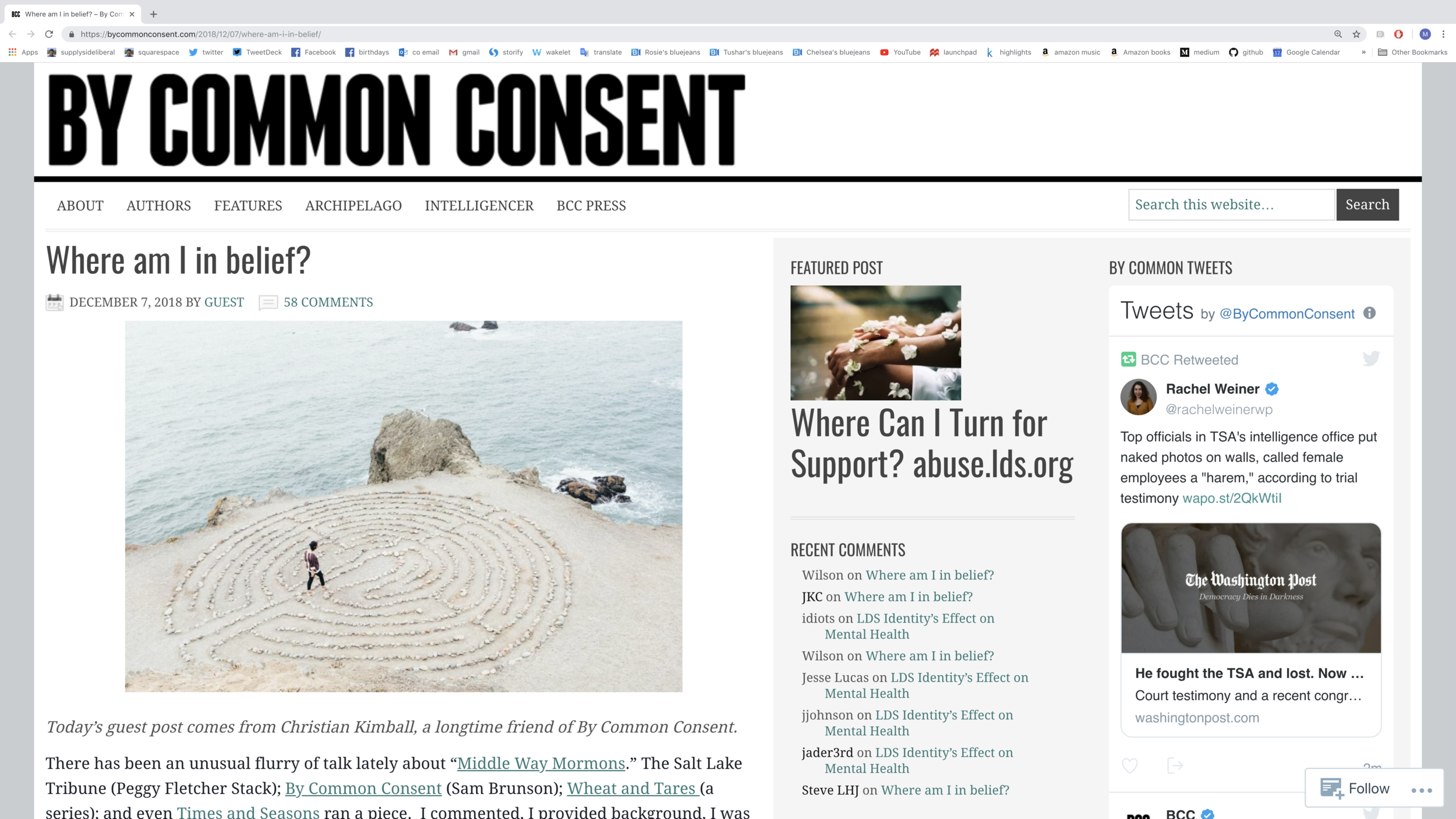
Although his spiritual journey has been different from mine, my brother Chris has also wrestled with the question of what to think of Mormonism. One of the other guest posts by Chris that I list at the bottom is “Chris Kimball: Having a Prophet in the Family, which makes clear why neither of us could escape that question. Below are Chris’s words:
There has been an unusual flurry of talk lately about “Middle Way Mormons.” The Salt Lake Tribune (Peggy Fletcher Stack); By Common Consent (Sam Brunson); Wheat and Tares (a series); and even Times and Seasons ran a piece. I commented, I provided background, I was quoted, but I have resisted doing my own “how it is” counter-essay until now.
I am a “Middle Way Mormon” by everybody’s definition. It is not my label—I prefer “Christian who practices with Mormons.” But it’s better than the alternatives on offer. This is not a to-be-wished-for designation—a high ranking Church leader sympathized with me about “living on a knife edge.” It’s just a label for a modern reality.
Somewhere in the middle of all the commentary, George Andrew Spriggs observed that “successful Middle Way Mormons . . . undercut the traditional boundaries and truth claims about the church.” This observation challenged me to describe the church I belong to. I have tried this before, and the reaction has been “no—doesn’t exist, you’re wrong, that isn’t a thing—just no.” Because of this history, exposing myself this way is scary.
This is long. This is personal. This is my opinion. For today--although reasonably stable for more than 20 years now. This is also my life, the real stuff. Reportage, not polemic. You should not be like me. You have been warned.
* * *
As a Christian who practices with members and at the meetings of The Church of Jesus Christ of Latter-day Saints, sometimes my choices come down to tradition and a hymnal. At the same time, I am officially a member of the Church. I haven’t resigned. I value my baptism. I take the sacrament with intent.
So what is this Church I belong to? As I see it. As I live it.
I view Joseph Smith as one of the religious geniuses of the 19th century, a man who had a theophany, from whom and through whom several books of scripture came to be, who experimented and collected and assembled a religious vision. And a prophet, in the sense of receiving the word of God and a charge to speak it.
Not necessarily a good man. Not right all the time. Not necessarily true to his own insights. Not always consistent.
I view founding a church, restoring priesthood, organizing ordinances and sacraments, and developing temple practices, as 19th century syncretic work by well-meaning men choosing from among existing Christian traditions.
I view the Book of Mormon as a 19th century creation. I read it as scripture. I find the subtitle “Another Testament of Jesus Christ” the most correct and useful description. The Church uses the Book of Mormon as a ‘proof of history.’ I don’t find value in that approach. The Church does not (very much) rely on the Book of Mormon for administration or theology. But I do read the Book of Mormon for theology and Christology and more. What I read impresses me as certain versions of New Testament Christian, Pauline, and even Trinitarian traditions, with flourishes.
For better or worse, I don’t find much value or spend much time with the Doctrine & Covenants or the Pearl of Great Price. I try to remain conversant, but in the limited sense of staying relevant in the community and not as a religious or devotional practice.
My understanding of prophets is that their job is to speak the words God gives them (not to speak “for God”). In that vein I consider Joseph Smith and other Church leaders as prophets. My operating assumption is that when a person is called to be a prophet, a tiny percentage of his or her words will turn out to be God’s words, they won’t necessarily know which are which themselves, and they may not understand the meaning or relevance of the words they are directed to say.
As a practical consequence, I apply a 50/50 skepticism even to statements labeled “the word of the Lord,” which looks like a cafeteria approach to General Conference talks and to the Doctrine & Covenants. For example, I view D&C 1:30 as an exaggeration, D&C 22 as the natural human expression of a restorationist mindset, and D&C 132 as a mistake—a confusing version of a Joseph Smith insight driven by a mixture of Bible study, wishful thinking, and domestic conflict.
Because I understand prophets (historically) to be mostly misunderstood outsiders with a revolutionary message, I think the Church’s practice of combining the prophet and president roles is problematic. I look for other prophets in addition to Church leaders.
I do not have a sense of divine destiny about the Church. The Church of Jesus Christ of Latter-day Saints is the survivor of a series of existential crises. A succession crisis. A crisis over polygamy. A crisis over financial viability. A crisis over the participation of men and women of relatively recent African descent. We tell the survival story after the fact, but I don’t view survival as predetermined. I can imagine the Church failing any one of the past crises. I can imagine the Church failing the next one.
I see the Church in crisis now. It is dealing with challenges to an identity myth built on a heavily manipulated white-washed history, alongside a theology built around eternal gender essentialism which makes it difficult to incorporate principles of feminism and to include non-binary persons in the Plan. I do not know whether the Church will survive. More accurately, I don’t know what the survivor will look like and how I will relate to it.
The Church offers a rich selection of Sacraments (ordinances) and a variety of rituals, which belong in a Christian practice and which I appreciate and celebrate. Not as unique or indispensable, but as valuable and inspiring.
On the other hand, embedded in Church practice are secret loyalty oath covenants, and an interview and disciplinary system serving up bishops as judges, that make idols of the institutional Church and its human leaders. I reject and avoid these parts of Church practice.
I view the institutional and administrative practices as built on good intentions (“guided by the spirit”). Most leaders are sincere and trying to do right. I have seen some frauds and some thieves, and too much abuse—ecclesiastical, emotional, sexual—but the most common sin of Church leaders is sucking up (managing up or making the boss happy or working for the next promotion).
I observe that good intentions are not the same as decision by principle, or decision by consensus or vote, or decision by systematic observation and experiment. Good intentions do not guarantee results. I do not see evidence of unusual foresight in Church decision making. I do not see a better than ordinary record of good decisions. I do see some very bad decisions.
Finally, the Church has almost nothing to do with my lived and living experience with God (the real thing, not doctrine or description, philosophy or religion) or my personal devotional life including my prayers. I consider them separate worlds.
Don’t miss these other guest posts by Chris:
Christian Kimball: Anger [1], Marriage [2], and the Mormon Church [3]
Christian Kimball on the Fallibility of Mormon Leaders and on Gay Marriage
In addition, Chris is my coauthor for
2018's Most Popular Posts

The "Key Posts" link at the top of my blog lists all important posts through the end of 2016. Along with "2017's Most Popular Posts," this is intended as a complement to that list. (Also, my most popular storified Twitter discussions are here, and you can see other recent posts by clicking on the Archive link at the top of my blog.) I put links to the most popular posts from 2018 below into four groups: popular new posts in 2018 on diet and health, popular new posts in 2018 on other topics, and popular older posts in those two categories.
I am no stranger to bragging; however, I give statistics not to brag, but because I am a data hound. I would love to see corresponding statistics from other blogs that I follow! The numbers shown are pageviews in 2018 according to Google Analytics. In that period, I had 313,231 pageviews total, of which 42,241 were pageviews for my blog homepage.
New Posts in 2018 on Diet and Health
How Fasting Can Starve Cancer Cells, While Leaving Normal Cells Unharmed 7034
Why a Low-Insulin-Index Diet Isn't Exactly a 'Lowcarb' Diet 5707
What Steven Gundry's Book 'The Plant Paradox' Adds to the Principles of a Low-Insulin-Index Diet 3038
The Case Against Sugar: Stephan Guyenet vs. Gary Taubes 2594
Using the Glycemic Index as a Supplement to the Insulin Index 2469
Is Milk OK? 1374
The Case Against the Case Against Sugar: Seth Yoder vs. Gary Taubes 1028
My Giant Salad 774
Best Health Guide: 10 Surprising Changes When You Quit Sugar 483
Carola Binder: The Obesity Code and Economists as General Practitioners 347
Which Nonsugar Sweeteners are OK? An Insulin-Index Perspective 324
Jason Fung's Single Best Weight Loss Tip: Don't Eat All the Time 241
Anthony Komaroff: The Microbiome and Risk for Obesity and Diabetes 206
Heidi Turner, Michael Schwartz and Kristen Domonell on How Bad Sugar Is 141
How Important is A1 Milk Protein as a Public Health Issue? 117
Michael Lowe and Heidi Mitchell: Is Getting ‘Hangry’ Actually a Thing? 68
New Posts in 2018 on Other Topics
John Locke: Freedom is Life; Slavery Can Be Justified Only as a Reprieve from Deserved Death 2285
On the Achilles Heel of John Locke's Second Treatise: Slavery and Land Ownership 1226
The Most Effective Memory Methods are Difficult—and That's Why They Work 606
Cousin Causality 407
On Perfectionism 348
Martin Feldstein Shows Too Little Imagination about How to Tame the US National Debt 340
A Conversation with Clint Folsom, Mayor of Superior, Colorado 332
On Rob Porter 327
The Economist: Improvements in Productivity Need to Be Accommodated by Monetary Policy 296
John Locke's Smackdown of Robert Filmer: Being a Father Doesn't Make Any Man a King 280
Greg Ip: A Decade After Bear’s Collapse, the Seeds of Instability Are Germinating Again 270
Netflix as an Example of Clay Christensen's 'Disruptive Innovation' 262
Why America Needs Marvin Goodfriend on the Federal Reserve Board 238
John Ioannidis, T. D. Stanley and Hristos Doucouliagos: The Power of Bias in Economics Research 225
Why Donald Trump's Support Among Republicans Has Solidified 224
The Real Test of the December 2017 Tax Reform Will Be Its Long-Run Effects 210
John Locke: The Law of Nature Requires Maturity to Discern 194
Eric Weinstein: Genius Is Not the Same Thing as Excellence 188
Tropozoics 179
John Locke: Thinking of Mothers and Fathers On a Par Undercuts a Misleading Autocratic Metaphor 179
David Holland on the Mormon Church During the February 3, 2008–January 2, 2018 Monson Administration 162
Martin A. Schwartz: The Willingness to Feel Stupid Is the Key to Scientific Progress 162
Alexander Trentin Interviews Miles Kimball on Next Generation Monetary Policy 155
John Locke: By Natural Law, Husbands Have No Power Over Their Wives 153
John Locke: Defense against the Black Hats is the Origin of the State 128
The Argument that We Are Likely to Be Living Inside of a Computer Simulation 122
Economists' Open Letter Open Letter to President Trump and Congress Against Protectionism 110
John Locke: The Only Legitimate Power of Governments is to Articulate the Law of Nature 109
Equality Before Natural Law in the Face of Manifest Differences in Station 105
Shane Phillips: Housing and Transportation Costs Have Become a Growing American Burden 102
The US Military Needs to Beef Up Its Artificial Intelligence and Cyberware Capabilities 95
John Locke Argues for the Historicity of Social Contracts 94
Stephen Williamson on an Inverted Yield Curve as a Harbinger of Recession 86
Steven Pinker on Transhumanism, Means-End Rationality and Cultural Appropriation 81
Walker Wright on the Mormon Church's Relatively Enlightened Stance on Immigration 69
The Religious Duty to Care about the Welfare of All Human Beings 63
John Locke on the Importance of Established, Well-Publicized Laws 55
Older Posts with Continuing Popularity on Diet and Health
Forget Calorie Counting; It's the Insulin Index, Stupid 18808
Key Posts 2507
Jason Fung: Dietary Fat is Innocent of the Charges Leveled Against It 868
Meat Is Amazingly Nutritious—But Is It Amazingly Nutritious for Cancer Cells, Too? 801
Debating 'Forget Calorie Counting; It's the Insulin Index, Stupid' 45
Older Posts with Continuing Popularity on Other Topics
There's One Key Difference Between Kids Who Excel at Math and Those Who Don't (with Noah Smith) 3266
The Logarithmic Harmony of Percent Changes and Growth Rates 2954
How and Why to Eliminate the Zero Lower Bound: A Reader’s Guide 1767
The Complete Guide to Getting into an Economics PhD Program (with Noah Smith) 1845
The Medium-Run Natural Interest Rate and the Short-Run Natural Interest Rate 1725
Monetary vs. Fiscal Policy: Expansionary Monetary Policy Does Not Raise the Budget Deficit 1661
Why I Write 1454
Why Taxes are Bad 1404
John Stuart Mill’s Vigorous Advocacy of Education Vouchers 1336
The Message of Mormonism for Atheists Who Want to Stay Atheists 1267
What is the Effective Lower Bound on Interest Rates Made Of? 679
Roger Farmer and Miles Kimball on the Value of Sovereign Wealth Funds for Economic Stabilization 586
John Stuart Mill on Balancing Christian Morality with the Wisdom of the Greeks and Romans 563
Economics Needs to Tackle All of the Big Questions in the Social Sciences 529
Returns to Scale and Imperfect Competition in Market Equilibrium 510
Freedom Under Law Means All Are Subject to the Same Laws 504
The Shape of Production: Charles Cobb's and Paul Douglas's Boon to Economics 480
Sticky Prices vs. Sticky Wages: A Debate Between Miles Kimball and Matthew Rognlie 459
John Locke: People Must Not Be Judges in Their Own Cases 459
An Experiment with Equality of Outcome: The Case of Jamestown 403
Let's Set Half a Percent as the Standard for Statistical Significance 396
Matthew Shapiro, Martha Bailey and Tilman Borgers on the Economics Job Market Rumors Website 384
John Stuart Mill’s Brief for the Limits of the Authority of Society over the Individual 361
The Coming Transformation of Education: Degrees Won’t Matter Anymore, Skills Will 329
Greg Shill: Does the Fed Have the Legal Authority to Buy Equities? 313
Michael Weisbach: Posters on Finance Job Rumors Need to Clean Up Their Act, Too 312
Bret Stephens and Paul Krugman: What Should a Correction Look Like in the Digital Era? 311
The Deep Magic of Money and the Deeper Magic of the Supply Side 309
Silvio Gesell's Plan for Negative Nominal Interest Rates 293
How Subordinating Paper Currency to Electronic Money Can End Recessions and End Inflation 273
Jeff Smith: More on Getting into an Economics PhD Program 266
Noah Smith: Why Do Americans Like Jews and Dislike Mormons? 258
18 Misconceptions about Eliminating the Zero Lower Bound 245
Why Scott Fullwiler Misses the Point in ‘Why Negative Nominal Interest Rates Miss the Point’ 238
John Stuart Mill on the Protection of ‘Noble Lies’ from Criticism 232
Rodney Stark on the Status of Women in Early Christianity 219
After Crunching Reinhart and Rogoff's Data, We Found No Evidence High Debt Slows Growth 213
Social Liberty 210
One of the Biggest Threats to America's Future Has the Easiest Fix (with Noah Smith) 199
Marriage 102 195
Why I am a Macroeconomist: Increasing Returns and Unemployment 194
My Dad 192
Christian Kimball on the Fallibility of Mormon Leaders and on Gay Marriage 191
Marriage 101 189
Even Central Bankers Need Lessons on the Transmission Mechanism for Negative Interest Rates 188
How Conservative Mormon America Avoided the Fate of Conservative White America . 177
How Increasing Retirement Saving Could Give America More Balanced Trade 172
Robert Eisler—Stable Money: The Remedy for the Economic World Crisis 169
John Stuart Mill on Being Offended at Other People's Opinions or Private Conduct 157
Barack Obama: Football as the Best Sports Analogy for Politics 153
‘The Hunger Games’ Is Hardly Our Future--It's Already Here 152
Godless Religion 149
John L. Davidson on Resolving the House Mystery: The Institutional Realities of House Construction 149
Isaac Sorkin: Don't Be Too Reassured by Small Short-Run Effects of the Minimum Wage 146
Matt Waite: How I Faced My Fears and Learned to Be Good at Math 145
Jordan B. Peterson on the True Purpose of a University Education 143
Fields Medal Winner Maryam Mirzakhani's Slow-Cooked Math 143
The Supply and Demand for Paper Currency When Interest Rates Are Negative 142
John Locke Pretends Land Ownership Goes Back to the Original Peopling of the Planet 138
When the Output Gap is Zero, But Inflation is Below Target 138
John Stuart Mill's Argument Against Political Correctness 138
Benjamin Franklin's Strategy to Make the US a Superpower Worked Once, Why Not Try It Again? 135
Owen Nie: Monetary Policy in Colonial New York, New Jersey and Delaware 126
How and Why to Expand the Nonprofit Sector as a Partial Alternative to Government: A Reader’s Guide 124
John Stuart Mill on the Need to Make the Argument for Freedom of Speech 116
Markus Brunnermeier and Yann Koby's ‘Reversal Interest Rate’ 116
Jing Liu: Show Kids that Solving Math Problems is Like Being a Detective 113
Leveling Up: Making the Transition from Poor Country to Rich Country 111
Annie Atherton: I Tried 7 Different Morning Routines — Here’s What Made Me Happiest (link post) 108
Glenn Ellison's New Book: Hard Math for Elementary School 106
Bruce Bartlett on Careers in Economics and Related Fields 105
Christian Kimball: Anger [1], Marriage [2], and the Mormon Church [3] 104
Janet Yellen is Hardly a Dove—She Knows the US Economy Needs Some Unemployment 104
The Mormon Church Decides to Treat Gay Marriage as Rebellion on a Par with Polygamy 103
Amy Morin and Steven Benna: 13 Things Mentally Strong People Don’t Do (link post) 102
John Locke: Law Is Only Legitimate When It Is Founded on the Law of Nature 101
Top 52 All-Time Posts and All My Columns Ranked by Popularity, as of May 23, 2014 101
Gather ’round, Children, Here’s How to Heal a Wounded Economy 99
So What If We Don't Change at All…and Something Magical Just Happens? 98
How Freedom of Speech for Falsehood Keeps the Truth Alive 97
John Stuart Mill on the Sources of Prejudice About What Other People Should Do 94
The Wrong Side of Cobb-Douglas: Matt Rognlie’s Smackdown of Thomas Piketty Gains Traction 87
Clay Shirky: Why I Just Asked My Students To Put Their Laptops Away 86
Bruce Greenwald: The Death of Manufacturing & the Global Deflation 86
John Locke: Rivalry in Consumption Makes Private Property Unavoidable 85
Bret Stephens Issues a Correction: ‘About Those Income Inequality Statistics’
Brian Flaxman: Yes! Economics Did Sway Obama Voters to Trump 80
How to Stabilize the Financial System and Make Money for US Taxpayers 80
The Importance of the Next Generation: Thomas Jefferson Grokked It 78
John Stuart Mill: Making the Government More Powerful than Necessary is Inimical to Freedom 77
John Locke Looks for a Better Way than Believing in the Divine Right of Kings or Power to the Strong 77
Christmas Dinner 2018 with the Kimballs in Colorado

Photography in this blog post by Jordan Matthew Kimball
Our son Jordan’s long-time girlfriend, Caroline, is a fabulous cook. She cooked Christmas dinner for Jordan, Gail, me and herself this year. What is even more remarkable, Caroline was good enough and talented enough to dream up and create dishes consistent with the way Gail and I are trying to eat—in accordance with principles I write about here on this blog in my weekly diet and health posts. Caroline graciously wrote up the recipes below.

Slow Roasted Prime Rib with Horseradish Cream and Balsamic Reduction
8 lb Standing or Bone-In Prime Rib
2-3 tbs Grated Horseradish
cup Sour Cream
½ cup Avocado Oil Mayo
½ tsp White Wine Vinegar
1 cup Balsamic Vinegar
Salt & pepper
● The balsamic reduction can be made up to a week before. I recommend making it at least a day before to keep your kitchen from reeking of vinegar. Heat the balsamic vinegar in an uncovered pot on medium until just boiling. Reduce heat to medium-low and allow it to simmer until it has been reduced by half. If you make this beforehand, let the reduction cool a little before storing in a heat-proof container. Once the reduction cools, it will be harder to pour.
● A day before serving the prime rib, coat the outside of the prime rib with salt & freshly cracked black pepper. Optionally loosen the fat cap from the bottom so that it hangs downward like a flap. This allows air flow when it roasts and helps crisp the fat. Leave uncovered in the fridge to allow to air dry.
● Also on the day before, mix the horseradish, sour cream, mayo and white wine vinegar together and refrigerate so the flavors have time to meld. Adjust the amount of horseradish to taste.
● Preheat the oven to 250 F. Place the roast on a deep roasting pan with a wire rack inside. Roast for 3 hours or until an instant meat thermometer shows an internal temperature of 135 F for a rosy pink prime rib. Remove the prime rib from the oven and allow to rest between 30 minutes to 1 hour. Just before serving, heat the oven to 450 F and blast the rib for 10 minutes to brown the outsides.
● Serve with horseradish cream and balsamic reduction.

Baked Brussel Sprouts with Pancetta, Chevre, Pine Nuts & Dried Cranberries
1 lb Brussel Sprouts
12 oz cubed Pancetta or Bacon
8 oz chopped Chevre or Creamy Goat Cheese
½ cup Pine Nuts
(optional) ¼ cup Dried Cranberries
Salt & pepper
● Preheat the oven to 450 F.
● Steam the brussel sprouts until a fork can just slide into the center. You can do this over a traditional steamer or by covering with a wet paper towel and microwaving for 5-7 minutes depending on the wattage of your microwave.
● Place steamed brussel sprouts in a flat roasting pan & cover with cubed pancetta. Roast until sprouts are crisp and browned on the outside and the pancetta or bacon is crisp. Turn off the heat and allow the pine nuts to gently toast in the residual heat for another minute.
● Once removed from the oven, season with salt & pepper to taste. Add goat cheese and dried cranberries if using and serve immediately.

Creamed Pearl Onions
1 lb frozen Pearl Onions
1 cup Chicken Stock
1 cup Heavy Whipping Cream
1 Bay Leaf
Salt & pepper
● Heat chicken stock, pearl onions, and bay leaf over medium-high heat. When chicken broth comes to a boil, reduce heat to medium and add the cream.
● Simmer the pearl onions for 15-20 minutes until onions are translucent and tender. Strain the creamy broth and save all but ½ cup for the Cream of Mushroom Soup.
● Add the reserved broth back to the onions and simmer until reduced. Season with salt & pepper to taste.

Cream of Mushroom Soup
1 cup Dried Mixed Mushrooms (I used oyster mushrooms, black trumpets, portobello & porcini.)
1 cup chopped fresh Button Mushrooms
1 diced Onion
2 tbs Butter
3 tbs Soy Sauce
½ cup Heavy Whipping Cream
1 tsp Dried Thyme
Reserved liquid from the Creamed Pearl Onions
Salt & pepper
● Wash the dried mushrooms to remove any remaining grit. Then soak the mushrooms in hot water for 15 minutes. Once the mushrooms have been reconstituted, reserve 1 cup of the liquid for the soup.
● Heat butter in soup pot over medium-high heat. Add the onions and cook until tender. Then add the fresh and dried mushrooms. Saute for 1 minute. Add the soy sauce and stir to distribute evenly.
● Add the reserved mushroom liquid and thyme. Cover and bring to a boil. The mushroom liquid may be a little bitter depending on your mix. Sweeten with the reserved pearl onion broth and add the cream. Season with salt & pepper. Keep covered over low heat to keep warm until ready to serve.

Blueberries, raspberries, blackberries and Camembert cheese
Don’t miss my other posts on diet and health:
I. The Basics
Jason Fung's Single Best Weight Loss Tip: Don't Eat All the Time
What Steven Gundry's Book 'The Plant Paradox' Adds to the Principles of a Low-Insulin-Index Diet
II. Sugar as a Slow Poison
Best Health Guide: 10 Surprising Changes When You Quit Sugar
Heidi Turner, Michael Schwartz and Kristen Domonell on How Bad Sugar Is
Michael Lowe and Heidi Mitchell: Is Getting ‘Hangry’ Actually a Thing?
III. Anti-Cancer Eating
How Fasting Can Starve Cancer Cells, While Leaving Normal Cells Unharmed
Meat Is Amazingly Nutritious—But Is It Amazingly Nutritious for Cancer Cells, Too?
IV. Eating Tips
Using the Glycemic Index as a Supplement to the Insulin Index
Putting the Perspective from Jason Fung's "The Obesity Code" into Practice
Which Nonsugar Sweeteners are OK? An Insulin-Index Perspective
V. Calories In/Calories Out
VI. Wonkish
Anthony Komaroff: The Microbiome and Risk for Obesity and Diabetes
Carola Binder: The Obesity Code and Economists as General Practitioners
Analogies Between Economic Models and the Biology of Obesity
VIII. Debates about Particular Foods and about Exercise
Jason Fung: Dietary Fat is Innocent of the Charges Leveled Against It
Faye Flam: The Taboo on Dietary Fat is Grounded More in Puritanism than Science
Confirmation Bias in the Interpretation of New Evidence on Salt
Julia Belluz and Javier Zarracina: Why You'll Be Disappointed If You Are Exercising to Lose Weight, Explained with 60+ Studies (my retitling of the article this links to)
IX. Gary Taubes
X. Twitter Discussions
Putting the Perspective from Jason Fung's "The Obesity Code" into Practice
'Forget Calorie Counting. It's the Insulin Index, Stupid' in a Few Tweets
Debating 'Forget Calorie Counting; It's the Insulin Index, Stupid'
Analogies Between Economic Models and the Biology of Obesity
XI. On My Interest in Diet and Health
See the last section of "Five Books That Have Changed My Life" and the podcast "Miles Kimball Explains to Tracy Alloway and Joe Weisenthal Why Losing Weight Is Like Defeating Inflation." If you want to know how I got interested in diet and health and fighting obesity and a little more about my own experience with weight gain and weight loss, see “Diana Kimball: Listening Creates Possibilities” and my post "A Barycentric Autobiography.
The Great Nara Money Experiment
Hat tip to Joseph Kimball
John Locke: No One is Above the Law, which Must Be Established and Promulgated and Designed for the Good of the People; Taxes and Governmental Succession Require Approval of Elected Representatives

John Locke’s views are important because so many of the framers of the US Constitution had read his works. In Sections 141-142 of his 2d Treatise on Government: Of Civil Government, he completes and summarizes his Chapter XI (“Of the Extent of the Legislative Power”) delineation of what powers rulers have and what they don’t have. In reading these sections, it is important to remember that John Locke uses the word “legislative” to refer to the ruler or rulers of a commonwealth.
As with taxation, John Locke views the transfer of power from one ruler to another as something that requires authorization by elected representatives—though his lack of insistence that a monarchy must be elective suggests that this authorization by elected representatives could be long prior to the existing ruler dying or stepping down:
§. 141. Fourthly, The legislative cannot transfer the power of making laws to any other hands: for it being but a delegated power from the people, they who have it cannot pass it over to others. The people alone can appoint the form of the commonwealth, which is by constituting the legislative, and appointing in whose hands that shall be. And when the people have said, We will submit to rules, and be governed by laws made by such men, and in such forms, nobody else can say other men shall make laws for them; nor can the people be bound by any laws, but such as are enacted by those whom they have chosen, and authorized to make laws for them. The power of the legislative, being derived from the people by a positive voluntary grant and institution, can be no other than what that positive grant conveyed, which being only to make laws, and not to make legislators, the legislative can have no power to transfer their authority of making laws, and place it in other hands.
In addition to succession within a commonwealth of a given geographical extent, this seems to imply that annexation of lands that were outside the commonwealth—or cession of lands that were in the commonwealth to the control of some ruler outside the commonwealth—requires approval by elected representatives of the people in those lands. However, John Locke does not directly address that issue in this passage.
In Section 142, John Lock gives a good summary of the limits to the power of rulers, I have boiled down this summary still further into the title of this post.
§. 142. These are the bounds, which the trust, that is put in them by the society, and the law of God and nature, have set to the legislative power of every commonwealth, in all forms of government.
First, They are to govern by promulgated established laws, not to be varied in particular cases, but to have one rule for rich and poor, for the favourite at court, and the country man at plough.
Secondly, These laws also ought to be designed for no other end ultimately, but the good of the people.
Thirdly, They must not raise Taxes on the property of the people, without the consent of the people, given by themselves, or their deputies. And this properly concerns only such governments, where the legislative is always in being, or at least where the people have not reserved any part of the legislative to deputies, to be from time to time chosen by themselves.
Fourthly, The legislative neither must nor can transfer the power of making laws to any body else, or place it any where, but where the people have.
For links to other John Locke posts, see these John Locke aggregator posts: