The Federalist Papers #23: The Federal Government Must Be Given Sufficient Power to Accomplish Whatever We Expect the Federal Government to Do—Alexander Hamilton
One of the things that has held back economic growth—as well as hobbling other dimensions of human flourishing—through thousands of years of human history is that it is quite a difficult design problem to make a government strong enough to keep people from stealing from, lying to and threatening each other without that government itself stealing from, lying to and threatening the people. But both sides of this design problem must be faced. It is no good trying to mitigate the danger of a tyrannical government by making that government too weak to do the things we expect that government to do. (Even in a libertarian system a la Robert Nozick, a private security company must be made adequately powerful, and then becomes much like a government.)
Alexander Hamilton makes the argument well in the Federalist Papers #23:
… it is both unwise and dangerous to deny the federal government an unconfined authority, as to all those objects which are intrusted to its management. It will indeed deserve the most vigilant and careful attention of the people, to see that it be modeled in such a manner as to admit of its being safely vested with the requisite powers.
The first sentence quoted above is the point addressed in the rest of the Federalist Papers #23. Alexander Hamilton defers discussion of how to keep the federal government well-behaved (the subject of the second sentence quoted above) to a later number in the Federalist Papers.
What do we expect the federal government to do? At a minimum: national defense, suppressing domestic insurrections, and foreign affairs. The performance of each of these requires considerable power. This list of three is Alexander Hamilton’s. To his list, I would add something for which we have gotten a greater understanding of both means and ends since Alexander Hamilton’s day: stabilizing the business cycle; stabilizing the business cycle is best enabled by giving the federal government the authority to conduct monetary policy. Ideally, that authority to conduct monetary policy would be in the Constitution, but at least it seems to be firmly ensconced not only in legislation, but in the unwritten constitution of our nation, as it is for many other nations.
Importantly, as Alexander Hamilton persuasively argues, the power to accomplish these key objectives of the national government must be direct power over the citizens of the nation. not merely power on paper to command the states. The Articles of Confederation included power on paper to command the states—especially to command them to contribute to the common defense—but in the event the states often ignored those commands.
Below is the full text of Alexander Hamilton’s argument in the Federalist Papers #23:
FEDERALIST NO. 23
The Necessity of a Government as Energetic as the One Proposed to the Preservation of the Union
From the New York Packet
Tuesday, December 18, 1787.
Author: Alexander Hamilton
To the People of the State of New York:
THE necessity of a Constitution, at least equally energetic with the one proposed, to the preservation of the Union, is the point at the examination of which we are now arrived.
This inquiry will naturally divide itself into three branches the objects to be provided for by the federal government, the quantity of power necessary to the accomplishment of those objects, the persons upon whom that power ought to operate. Its distribution and organization will more properly claim our attention under the succeeding head.
The principal purposes to be answered by union are these the common defense of the members; the preservation of the public peace as well against internal convulsions as external attacks; the regulation of commerce with other nations and between the States; the superintendence of our intercourse, political and commercial, with foreign countries.
The authorities essential to the common defense are these: to raise armies; to build and equip fleets; to prescribe rules for the government of both; to direct their operations; to provide for their support. These powers ought to exist without limitation, BECAUSE IT IS IMPOSSIBLE TO FORESEE OR DEFINE THE EXTENT AND VARIETY OF NATIONAL EXIGENCIES, OR THE CORRESPONDENT EXTENT AND VARIETY OF THE MEANS WHICH MAY BE NECESSARY TO SATISFY THEM. The circumstances that endanger the safety of nations are infinite, and for this reason no constitutional shackles can wisely be imposed on the power to which the care of it is committed. This power ought to be coextensive with all the possible combinations of such circumstances; and ought to be under the direction of the same councils which are appointed to preside over the common defense.
This is one of those truths which, to a correct and unprejudiced mind, carries its own evidence along with it; and may be obscured, but cannot be made plainer by argument or reasoning. It rests upon axioms as simple as they are universal; the MEANS ought to be proportioned to the END; the persons, from whose agency the attainment of any END is expected, ought to possess the MEANS by which it is to be attained.
Whether there ought to be a federal government intrusted with the care of the common defense, is a question in the first instance, open for discussion; but the moment it is decided in the affirmative, it will follow, that that government ought to be clothed with all the powers requisite to complete execution of its trust. And unless it can be shown that the circumstances which may affect the public safety are reducible within certain determinate limits; unless the contrary of this position can be fairly and rationally disputed, it must be admitted, as a necessary consequence, that there can be no limitation of that authority which is to provide for the defense and protection of the community, in any matter essential to its efficacy that is, in any matter essential to the FORMATION, DIRECTION, or SUPPORT of the NATIONAL FORCES.
Defective as the present Confederation has been proved to be, this principle appears to have been fully recognized by the framers of it; though they have not made proper or adequate provision for its exercise. Congress have an unlimited discretion to make requisitions of men and money; to govern the army and navy; to direct their operations. As their requisitions are made constitutionally binding upon the States, who are in fact under the most solemn obligations to furnish the supplies required of them, the intention evidently was that the United States should command whatever resources were by them judged requisite to the "common defense and general welfare." It was presumed that a sense of their true interests, and a regard to the dictates of good faith, would be found sufficient pledges for the punctual performance of the duty of the members to the federal head.
The experiment has, however, demonstrated that this expectation was ill-founded and illusory; and the observations, made under the last head, will, I imagine, have sufficed to convince the impartial and discerning, that there is an absolute necessity for an entire change in the first principles of the system; that if we are in earnest about giving the Union energy and duration, we must abandon the vain project of legislating upon the States in their collective capacities; we must extend the laws of the federal government to the individual citizens of America; we must discard the fallacious scheme of quotas and requisitions, as equally impracticable and unjust. The result from all this is that the Union ought to be invested with full power to levy troops; to build and equip fleets; and to raise the revenues which will be required for the formation and support of an army and navy, in the customary and ordinary modes practiced in other governments.
If the circumstances of our country are such as to demand a compound instead of a simple, a confederate instead of a sole, government, the essential point which will remain to be adjusted will be to discriminate the OBJECTS, as far as it can be done, which shall appertain to the different provinces or departments of power; allowing to each the most ample authority for fulfilling the objects committed to its charge. Shall the Union be constituted the guardian of the common safety? Are fleets and armies and revenues necessary to this purpose? The government of the Union must be empowered to pass all laws, and to make all regulations which have relation to them. The same must be the case in respect to commerce, and to every other matter to which its jurisdiction is permitted to extend. Is the administration of justice between the citizens of the same State the proper department of the local governments? These must possess all the authorities which are connected with this object, and with every other that may be allotted to their particular cognizance and direction. Not to confer in each case a degree of power commensurate to the end, would be to violate the most obvious rules of prudence and propriety, and improvidently to trust the great interests of the nation to hands which are disabled from managing them with vigor and success.
Who is likely to make suitable provisions for the public defense, as that body to which the guardianship of the public safety is confided; which, as the centre of information, will best understand the extent and urgency of the dangers that threaten; as the representative of the WHOLE, will feel itself most deeply interested in the preservation of every part; which, from the responsibility implied in the duty assigned to it, will be most sensibly impressed with the necessity of proper exertions; and which, by the extension of its authority throughout the States, can alone establish uniformity and concert in the plans and measures by which the common safety is to be secured? Is there not a manifest inconsistency in devolving upon the federal government the care of the general defense, and leaving in the State governments the EFFECTIVE powers by which it is to be provided for? Is not a want of co-operation the infallible consequence of such a system? And will not weakness, disorder, an undue distribution of the burdens and calamities of war, an unnecessary and intolerable increase of expense, be its natural and inevitable concomitants? Have we not had unequivocal experience of its effects in the course of the revolution which we have just accomplished?
Every view we may take of the subject, as candid inquirers after truth, will serve to convince us, that it is both unwise and dangerous to deny the federal government an unconfined authority, as to all those objects which are intrusted to its management. It will indeed deserve the most vigilant and careful attention of the people, to see that it be modeled in such a manner as to admit of its being safely vested with the requisite powers. If any plan which has been, or may be, offered to our consideration, should not, upon a dispassionate inspection, be found to answer this description, it ought to be rejected. A government, the constitution of which renders it unfit to be trusted with all the powers which a free people OUGHT TO DELEGATE TO ANY GOVERNMENT, would be an unsafe and improper depositary of the NATIONAL INTERESTS. Wherever THESE can with propriety be confided, the coincident powers may safely accompany them. This is the true result of all just reasoning upon the subject. And the adversaries of the plan promulgated by the convention ought to have confined themselves to showing, that the internal structure of the proposed government was such as to render it unworthy of the confidence of the people. They ought not to have wandered into inflammatory declamations and unmeaning cavils about the extent of the powers. The POWERS are not too extensive for the OBJECTS of federal administration, or, in other words, for the management of our NATIONAL INTERESTS; nor can any satisfactory argument be framed to show that they are chargeable with such an excess. If it be true, as has been insinuated by some of the writers on the other side, that the difficulty arises from the nature of the thing, and that the extent of the country will not permit us to form a government in which such ample powers can safely be reposed, it would prove that we ought to contract our views, and resort to the expedient of separate confederacies, which will move within more practicable spheres. For the absurdity must continually stare us in the face of confiding to a government the direction of the most essential national interests, without daring to trust it to the authorities which are indispensible to their proper and efficient management. Let us not attempt to reconcile contradictions, but firmly embrace a rational alternative.
I trust, however, that the impracticability of one general system cannot be shown. I am greatly mistaken, if any thing of weight has yet been advanced of this tendency; and I flatter myself, that the observations which have been made in the course of these papers have served to place the reverse of that position in as clear a light as any matter still in the womb of time and experience can be susceptible of. This, at all events, must be evident, that the very difficulty itself, drawn from the extent of the country, is the strongest argument in favor of an energetic government; for any other can certainly never preserve the Union of so large an empire. If we embrace the tenets of those who oppose the adoption of the proposed Constitution, as the standard of our political creed, we cannot fail to verify the gloomy doctrines which predict the impracticability of a national system pervading entire limits of the present Confederacy.
PUBLIUS.
Links to my other posts on The Federalist Papers so far:
The Federalist Papers #1: Alexander Hamilton's Plea for Reasoned Debate
The Federalist Papers #3: United, the 13 States are Less Likely to Stumble into War
The Federalist Papers #4 B: National Defense Will Be Stronger if the States are United
The Federalist Papers #5: Unless United, the States Will Be at Each Others' Throats
The Federalist Papers #6 A: Alexander Hamilton on the Many Human Motives for War
The Federalist Papers #11 A: United, the States Can Get a Better Trade Deal—Alexander Hamilton
The Federalist Papers #12: Union Makes it Much Easier to Get Tariff Revenue—Alexander Hamilton
The Federalist Papers #13: Alexander Hamilton on Increasing Returns to Scale in National Government
The Federalist Papers #14: A Republic Can Be Geographically Large—James Madison
The Federalist Papers #21 A: Constitutions Need to be Enforced—Alexander Hamilton
xkcd Comics on Statistics →
Hat tip to Christian Kimball
Cristina Beltran on a Possible Right-Wing Strategy of Saying ‘You Count as White Either If You are Racially White Or If You Are a Republican’ →
If by some definition, the number of white voters, with some defections to the left, becomes insufficient to support a majority (or is due to become insufficient in the future), then those who hope to maintain a racist system must expand the definition of who is white. This has happened before when Italian-Americans and Irish-Americans were declared white. There are three prominent alternatives here. First is to declare Hispanics who have been in the US for a long time to be white. The second alternative is to treat those who have some white ancestry as white even if they also have non-white ancestry. The third is to treat right-wing political allegiance as conferring honorary whiteness. The link on the title of this post is about that third possibility.
Note: On my part, this is not meant to be against the Republican party. I have hopes that the Republican party will fully distance itself not only from racism, but also from anti-immigrant attitudes. Changing demographics make that a fourth possible outcome.
My Highlights from Joseph Biden's First Inaugural Address
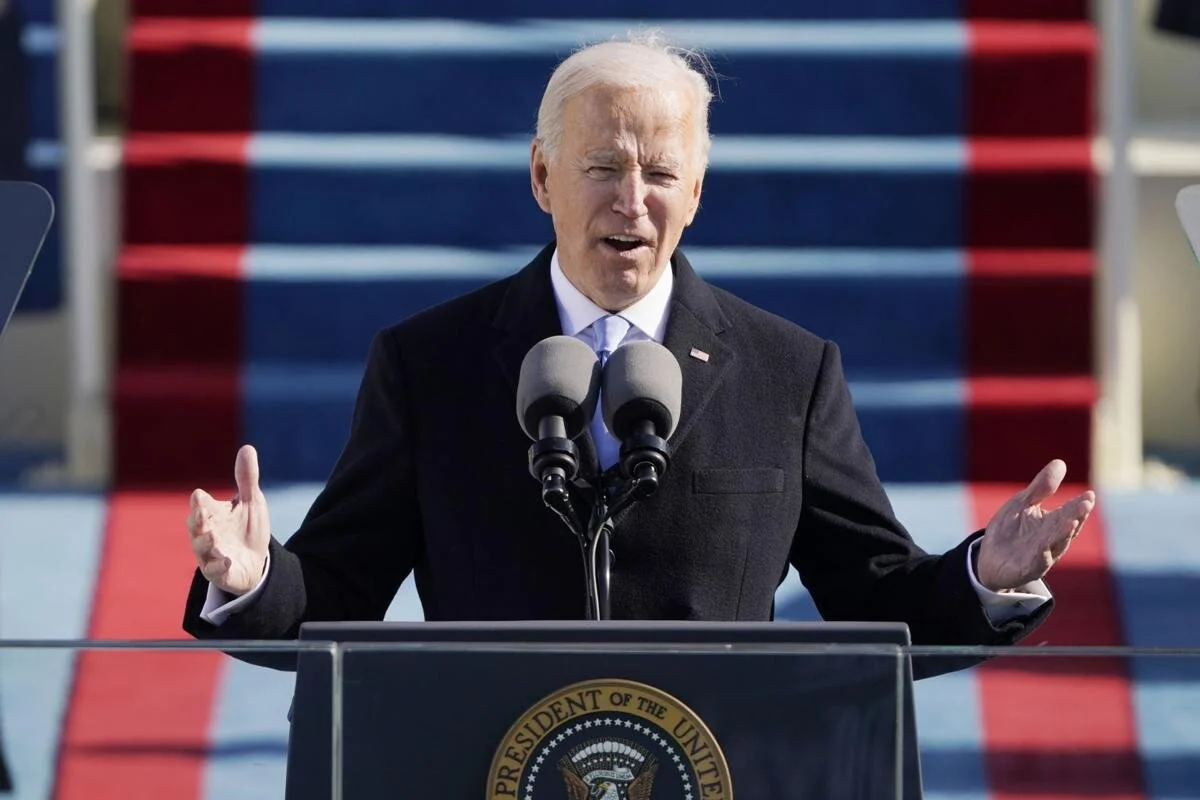
I was impressed by Joseph Biden’s First Inaugural Address as President of the United States. Let me share what to me were some of the highlights:
First, I am moved by the strength of our Constitution and the victory of Democracy over attempts to overturn an election on spurious grounds. Joe Biden described this in several ways:
… democracy is precious.
Democracy is fragile.
And at this hour, my friends, democracy has prevailed.
…
You know the resilience of our Constitution and the strength of our nation.
…
Here we stand across the Potomac from Arlington National Cemetery, where heroes who gave the last full measure of devotion rest in eternal peace.
And here we stand, just days after a riotous mob thought they could use violence to silence the will of the people, to stop the work of our democracy, and to drive us from this sacred ground.
That did not happen.
Second, I think it is both consequential and absolutely right that he listed nativism and racism as twin evils. I have no doubt that racism fuels a lot of nativism, but nativism—looking at those not born in the US as somehow a lesser type of human being—would be a great evil even if it weren’t fueled by racism. (See my post “It Isn't OK to Be Anti-Immigrant.”) Here is how Joseph Biden addressed racism and nativism:
A cry for racial justice some 400 years in the making moves us. The dream of justice for all will be deferred no longer.
…
Our history has been a constant struggle between the American ideal that we are all created equal and the harsh, ugly reality that racism, nativism, fear, and demonization have long torn us apart.
Third, Joe Biden addressed our national dysfunction of “othering” those whose political views are different from ours—which includes “othering” those who “other,” thereby taking on their bad habits. (On othering, see “Us and Them.”) Joe Biden said this on how to view others as not so “other”:
We can see each other not as adversaries but as neighbors.
We can treat each other with dignity and respect.
…
Politics need not be a raging fire destroying everything in its path.
Every disagreement doesn't have to be a cause for total war.
I write about “politicism” here.
Fourth, Joe Biden clearly distinguished between ordinary partisan differences and actions that are beyond the pale. (A) Attempts at violent overthrow of the Constitution of the United States are beyond the pale. But the right to peaceful dissent is at the heart of what it means to be a democracy:
To all those who did not support us, let me say this: Hear me out as we move forward. Take a measure of me and my heart.
And if you still disagree, so be it.
That's democracy. That's America. The right to dissent peaceably, within the guardrails of our Republic, is perhaps our nation's greatest strength.
(B) Lying to the public for partisan advantage—or to make a few bucks in ways that are harmful to the nation—is beyond the pale. Here is Joe Biden on truth:
…we must reject a culture in which facts themselves are manipulated and even manufactured.
…
What are the common objects we love that define us as Americans?
I think I know.
Opportunity.
Security.
Liberty.
Dignity.
Respect.
Honor.
And, yes, the truth.
Recent weeks and months have taught us a painful lesson.
There is truth and there are lies.
Lies told for power and for profit.
There are many lies told for profit. See for example:
How Many Thousands of Americans Will the Sugar Lobby's Latest Victory Kill?
Matthew Sedacca: To a Cigarette Maker, Your Life Is Worth About $10,000
Some economists have a blanket antipathy to all regulations, but to me, regulations that force corporations to tell the truth to their customers seem like a good idea. After all, the standard welfare theorems assume an absence of asymmetric information. Forcing corporations to tell their customers the truth will usually get us closer to that benchmark.
Because I want to hold my own profession to a high standard, let me also add that lying with statistics in order to advance one’s scientific career (or what would then be a pseudo-scientific career) is also very bad. On that, see:
Let's Set Half a Percent as the Standard for Statistical Significance
Adding a Variable Measured with Error to a Regression Only Partially Controls for that Variable
Joe Biden’s First Inaugural had a lot of repetition in it, but I think the repetition was warranted. We need to have the messages he kept repeating burned into our minds:
We must cherish democracy and fight to preserve it from those who would put partisanship above democracy.
We need racial justice—and it isn’t OK to be anti-immigrant.
We must treat everyone as a full human being, even those with different political views—and even those who don’t themselves treat everyone as a full human being.
Attempts to violently interfere with the workings of the Constitution of the United States are beyond the pale, and lying for partisan advantage is beyond the pale, but ordinary political disagreements are OK.
I’m sure Joe Biden will say things in the future that I disagree with. But in my book, his inaugural address was on solid ground.
Sugar Rots Your Teeth. Sugar Kills. So Don't Eat It.

I have written a lot about the other health dangers of sugar. Here are some of the other posts:
Best Health Guide: 10 Surprising Changes When You Quit Sugar
Heidi Turner, Michael Schwartz and Kristen Domonell on How Bad Sugar Is
Cancer Cells Love Sugar; That’s How PET Scans for Cancer Work
How Many Thousands of Americans Will the Sugar Lobby's Latest Victory Kill?
But there is one other health danger from sugar that everyone agrees on, but most people have chosen to ignore as a big toll of sugar: tooth damage.
Ever since I have gone off sugar, bread, rice, potatoes and all the processed foods that say on the package that they have a substantial amount of sugar, my dentist has been surprised by what good shape my teeth are in when I go in for a regular checkup. It makes a difference to your teeth when you eat right!
The causes of the dramatic rise in obesity over the last century are controversial. But it is hard to explain without looking at the rise in sugar consumption. Some explanations that sound different really include sugar: many scholars talk about the increasing palatability of food, where “palatability” refers in important measure to the superstimulus from sugar added to food. Others talk about highly processed food. From what I see looking around my local grocer store, it seems that 90% of highly processed food contains a substantial amount of sugar. And increased variety of food has come largely from the proliferation of different kinds of processed food. And if the only foods that had become cheaper were those with no sugar in them, I doubt there would be an obesity effect from declining food prices.
The one variable that could contribute a lot to explaining the rise in obesity that is fully distinct from increased use of sugar over the last century is the expansion of the average eating window to eating from soon after waking to shortly before going to bed, instead of having eating more nearly confined to three regular meals. (That is not to say that three meals without snacking is as good as an even more compressed eating window; but it is better than eating from right after waking to shortly before retiring for the night.) The upward trend average length of the eating window, for which, unfortunately, there is no readily available time series, could explain rising obesity during some of the more recent periods when sugar consumption has declined somewhat. (No readily available times series doesn’t at all mean it is impossible to gather evidence. Gathering that evidence would be a noble task for an economic historian.)
As a side note, in addition to sugar rotting our teeth, eating soft food (along with bad tongue posture) may be making our teeth crooked. See:
We treat our tooth problems (and the dental and orthodontic treatment they occasion) as if they were a law of nature. But Charles Gemmi, in the article flagged at the top of this post, reminds us:
Humans have a long history of brushing our teeth and an even longer history of not doing it at all. For thousands of years, our ancestors had no concept of dental care. You might think that they suffered as a result, but there’s actually no evidence to suggest that people from those early eras had any dental health problems at all. Why is that?
It really comes down to diet. Our ancestors had no GMO-filled fast foods, no baked goods, and no processed products of any kind. The foods they ate didn’t contain harmful additives or chemicals and were completely all-natural. Whatever they found is what they ate.
This meant that they weren’t deficient in the vitamins and minerals that promote oral health like calcium and phosphorus. They all got their daily allowances of fruits and vegetables. The tough, fibrous foods they ate also got their mouths moving, scraping their teeth on accident and preventing plaque buildup that leads to tooth decay in the modern mouth.
…
With the rise of sugar-dense foods and the increasing lack of basic mineral nutrition in the modern diet, it’s no wonder that dentists and orthodontists are recommending that people brush their teeth for at least 2 minutes at a time and at least twice a day.
… a modern diet means the modern necessity of brushing your teeth every day.
Next time you go to the dentist, remember the contribution that sugar makes to the necessity of going as often as you do—and especially how often you go to get a cavity filled or to undergo a more painful procedure. Going off sugar could easily add many years to your life. And going off sugar could easily add many years to your teeth.
If you are convinced and want to go off sugar, I have some posts meant to help you:
The really big gains in health come from also shortening your eating window and doing occasional longer fasts. But going off sugar, bread, rice and potatoes makes that much, much easier. So, although a logically distinct strategy, in practice a shorter eating window and occasional longer fasts is not a totally separate thing from going off sugar.
For annotated links to other posts on diet and health, see:
Peggy Noonan: Bring the Insurrectionists to Justice

Peggy Noonan is a Republican Wall Street Journal opinion columnist who has become more and more disgusted with Donald Trump. Like her, some other prominent Republicans have begun putting distance between themselves and Trump since his encouragement of the insurrection against the presidential vote counting in Congress. To me it is a very good thing for the nation if a large part of the Republican party distances itself from Donald Trump. I have certainly had other differences with Donald Trump (see for example “It Isn't OK to Be Anti-Immigrant”), as well as some somewhat common views (particularly on the potential value of negative interest rate policy). But, to put it simply, it is definitely not OK for a president to advocate the violent overthrow of the US government. For, make no mistake, to encourage people to use force to interrupt the constitutionally mandated procedures for determining who won a presidential election is to advocate the violent overthrow of the US government as the US government is defined by the Constitution of the United States. For Donald Trump to send lawyers into court to argue about what the constitution and the election facts on the ground allow is one thing. To inspire an armed mob to attack the Capitol is quite another thing.
I can understand other judgments, but in my view, opposing attempts at the violent overthrow of the US government is not a partisan issue. It is the agreement by both Democrats and Republicans that we should follow constitutional procedures (with the Supreme Court as the ultimate arbiter of disputes about what is a constitutional procedure) that makes our nation a democracy. I am for democracy. Many other systems of government have been tried. Everything else tried so far has been much worse than democracy. (And many things people want to try are much closer to political systems that we have historical evidence on than some people realize.) The democratic power of the electorate to “Throw the bums out,” though not always put in action at the most appropriate moments, is one of the greatest defenses we have against great political ills.
In addition to agreeing with Peggy Noonan’s sentiment that, without hesitation, and without excusing them for what they did, we should bring the insurrectionists to justice, I have flagged her op-ed because of this passage:
True conservatives tend to have a particular understanding of the fragility of things. They understand that every human institution is, in its way, built on sand. It’s all so frail. They see how thin the veil is between civilization and chaos, and understand that we have to go through every day, each in our way, trying to make the veil thicker. And so we value the things in the phrase that others use to disparage us, “law and order.” Yes, always, the rule of law, and order so that the people of a great nation can move freely on the streets and do their work and pursue their lives.
I want to keep living in a free country. Without adhering to constitutional procedures, we won’t stay a free country for long.
Postscript
Let me admit here that I was mistaken in my predictions. I thought Donald Trump would push every possible legal argument he could, but then would grudgingly accept the outcome when the courts said he had lost (while of course saying that he had really won). Donald Trump went a big step beyond that. I was wrong.
Don’t miss these closely related posts:
The Optimal Rate of Inflation

Link to the Wikipedia article “Inflation”
The Bank of Finland asked me to respond to a survey about the optimal rate of inflation. (This was the sort of survey that is sent to those who might have a professional opinion about the optimal rate of inflation.) I thought I’d share my answers here. I give their questions in bold. I give my answers in italics.
Should the central bank have an explicit inflation target? If so, what rate of inflation should it seek to achieve, given the current longer-term, structural economic trends?
Yes. 0%.
My answer of 0 inflation as the best target is assuming what I consider the appropriate strategy of being willing to use deep negative interest rates. I have written about that here:
All the pieces flagged here provide context:
Imagine a hypothetical scenario in which the central bank had previously not adopted an inflation target but now decides to adopt one. What rate of inflation should the central bank target, given the current longer-term, structural economic trends?
0%.
The argument is the same. The readiness to use deep negative rates (which is the appropriate strategy) makes an inflation target of zero optimal. But it is also important to do the transition from a higher inflation rate to zero in a low-cost way. Distinguish between paper currency and bank money ("electronic money"), allowing a nonpar exchange rate between them. While most prices are sticky in the paper unit of account, mechanically make e-money have a zero rate of inflation. Having established credibility in that way, it is likely that gradually more prices will be set in terms of the e-money unit of account. That can be encouraged by shifts in the literal accounting rules. As more and more prices are set in terms of the e-money unit of account, zero inflation in that e-money unit of account needs to be maintained by standard monetary policy tools. That can no longer be done mechanically when almost all prices are set in terms of the e-money unit of account.
What should the central bank's objective(s) be?
Please choose only one option.
Here, ‘central bank’ refers to the central bank responsible for monetary policy in your country of residence.
Price stability only
Price stability and other objective(s) with equal weights.
Price stability and subordinate objective(s). Please feel free to specify the secondary objective(s)
No opinion
Price stability and other objective(s) with equal weights.
Please feel free to specify the other objective(s):
Keeping the output gap equal to zero
Although not literally true, I consider the "divine coincidence" a useful rough approximation. Price stability and keeping the output gap at zero are the same objective when the "divine coincidence" holds, but to the extent that the divine coincidence does not hold, a central bank should worry about both objectives.
Among the options below, what specific observable variable(s) would be the most preferable target(s) for the central bank in the conduct of its monetary policy?
Please choose only one option.
Here, ‘central bank’ refers to the central bank responsible for monetary policy in your country of residence.
The inflation rate
The price level
The inflation rate and the unemployment rate
The growth rate of nominal GDP
The level of nominal GDP
Other, please specify
No opinion
The level of nominal GDP
What specific price index should the central bank use in the conduct of its monetary policy?
Here, ‘central bank’ refers to the central bank responsible for monetary policy in your country of residence.
Headline consumer price index
Core consumer price index (excluding food and energy prices)
Headline personal consumption expenditures index
Core personal consumption expenditures index (excluding food and energy prices)
GDP deflator
Other, please specify
No opinion
A price index with a higher weight on investment goods prices and other durables prices than the GDP deflator
How likely is the central bank to achieve its inflation target over the next three years?
Here, ‘central bank’ refers to the central bank responsible for monetary policy in your country of residence.
Relatively unlikely
The only reason I think average unemployment would decrease is that I believe unemployment is convex in inflationary/disinflationary pressures.
Given the current longer-term, structural economic trends, do you think that the benefits of increasing the inflation target of the central bank would outweigh the costs of doing so?
Costs clearly outweigh benefits
The right solution is readiness to use deep negative rates when called for, not increasing the inflation target. The appropriate paper currency policy for deep negative rates engineers inflation relative to paper currency, but not relative to e-money. Better to have comparatively innocent inflation relative to paper currency only when needed than to ever have the quite damaging inflation relative to the e-money unit of account.
Tiktok of Econolimerick #2
I hope you like the tiktok above. It is a duet with my former intermediate macro student Taylor McCoy, who devotes her tiktok channel to tiktoks about economics.
Here are links to all of my econolimericks so far (not all of which have TikToks yet):
Being of Normal Weight Seems to be More Protective against Cardiovascular and Heart Disease than against Cancer

In “Association of Body Mass Index With Lifetime Risk of Cardiovascular Disease and Compression of Morbidity,” by Sadiya Khan, Hongyan Ning, John T. Wilkins, Norrina Allen, Mercedes Carnethon, Jarett D. Berry, Ranya N. Sweis, Donald M. Lloyd-Jones argue that the claim moderately overweight people have greater longevity gives the wrong idea. For one thing, people who are already sick can lose weight for two different reasons: the direct effect of their illness, and doctors telling them they need to lose weight. When people talk about the effect of weight on illness, what they would normally be thinking of is the effect of one’s weight when seemingly healthy on later disease and mortality risk.
Also, some studies don’t look at survival to a given age, instead looking at survival from time of diagnosis. If risk of disease goes up for any reason, one is likely to get the disease at a younger age. Conditional on being diagnosed with a disease, one will probably survive more years beyond that time of diagnosis if one is younger at the time of diagnosis.
One way to address both of these problems is to find a set of apparently healthy people of the same age, some of normal weight and others in various overweight categories, and track what happens to them.
The simple answer from this study is that obese folks (body mass index 30 or above) tend to die quicker and get more of all kinds of diseases. Folks who are merely overweight (25.0-29.9 body mass index) die at about the same rate as those of normal weight (18.5 to 24.9 body mass index), but die a lot more from cardiovascular and heart disease and a lot more from other causes. Of course, we are all mortal, so if we don’t die of one thing we will die of another. But overall death rates at given ages are pretty similar for the overweight and those of normal weight.

I take this to mean that, leaving out the officially “obese,” the typical variation that makes some people of normal weight is helping those normal weight folks reduce their cardiovascular and heart disease risk a lot more than it is helping them reduce their cancer risk. The authors argue that reducing cardiovascular disease and heart disease risk is especially valuable, so there is a great benefit to whatever it is that makes people of normal weight. But I would argue that we need to understand where the extra cancer risk is coming from.
We don’t even have conclusive science on what makes some people of normal weight while others are overweight; there is a big debate about whether dietary sugar or dietary fat is a bigger culprit. (I blame dietary sugar.) And we don’t know why whatever makes people of normal weight instead of overweight contributes to cancer. But here is one hypothesis that needs to be closely examined: what if those who consume less sugar and other refined carbohydrates consume more protein? My reading suggests that both sugar and too much protein (especially animal protein) are cancer risks. If you reduce sugar and increase protein, what happens depends on the relative strength of the effect of sugar and the effect of protein. Among the health conscious, I think protein has much too positive a reputation at this point in history.
Another possibility is that the combination of having a metabolism that allows one to eat a lot without gaining weight and actually eating that food is a cancer risk. This seems a real possibility to me. A cancer cell with a high metabolism and plenty of available food might grow fast.
In all of this, it is crucial to notice my emphasis on the variation in the population that causes most of the difference between being (moderately) overweight and of “normal” weight. People who lose weight by regular fasting are probably not well represented in population data sets because not many people in the population have been serious fasters in the past. (I hope more people use fasting as a weight-loss and health tool in the future.) So losing weight by fasting could have a dramatically different effect on cancer mortality at each age than, say, cutting back on sugar while increasing animal protein consumption.
Don’t forget that normal weight seems protective against cardiovascular disease and heart disease. That is a benefit. But unless you are obese to begin with, you probably need to lose weight the right way to reduce cancer risk.
Posts on Anti-Cancer Eating:
Meat Is Amazingly Nutritious—But Is It Amazingly Nutritious for Cancer Cells, Too?
Cancer Cells Love Sugar; That’s How PET Scans for Cancer Work
For annotated links to other posts on diet and health, see:
Tiktok of Econolimerick #1
I hope you like the tiktok above. (This will be a test of my understanding of the technology.) It is a duet with my former intermediate macro student Taylor McCoy, who devotes her Tiktok channel to Tiktoks about economics.
Here are links to all of my econolimericks so far (not all of which have TikToks yet):
The Federalist Papers #22 C: Pillars of Democracy—The Judicial System, Military Loyal to the Constitution, and Police Loyal to the Constitution

Recent events make it worth thinking about what it is that can keep our nation’s government from being overthrown. I want to point to two key elements. First, judges whose partisanship is tempered by caring about the law and the respect for the judicial system that leads many powerful people outside the judicial system to take decisions of the Supreme Court as final. Second, a powerful military loyal to the Constitution, including the role of the Supreme Court in that Constitution.
Going beyond simply avoiding the overthrow of the government, in achieving social justice, a third element is key: police loyal to the Constitution—especially the 14th amendment that makes all equal before the law, regardless of race and other caste markers.
On judges, let me make an analogy. Unlike some, I am not worried about a resurgence of inflation in the United States (and have similar views for many other rich countries) because I know how the economists who staff the Fed are trained. They are all taught about the Great Inflation of the 1970s and how overly stimulative monetary policy caused that Great Inflation. Similarly, I believe that legal training instills a respect for the law that, for a large majority of judges, significantly influences their decisions away from being 100% partisan. Indeed, I believe that the law—the letter of the law and precedents—has at least as big an effect on judges as considerations of the good of the nation (beyond partisan ideology) has on voters.
On the military, I am very grateful that military training puts loyalty to the Constitution ahead of loyalty to the Commander in Chief. The words “I do solemnly swear that I will support and defend the Constitution of the United States against all enemies, foreign and domestic” come first, before mention of the President of the United States as Commander in Chief to be obeyed. Under some circumstances, the President of the United States could come within the set of “all enemies, foreign and domestic,” especially at moments of time close to a constitutionally ordained transfer of power. (See “John Locke: If Rebellion is a Sin, It is a Sin Committed Most Often by Those in Power.”)
On the police, I think we fall short in inculcating into them loyalty to the constitution. In particular, in order to carry out the promise of the 14th amendment which made all equal before the law, regardless of race, everything should be done to hire a police force composed of individual significantly less racist than the general population. I don’t think we have achieved this.
Rather than defund the police, I think we should spend more on one specific item: requiring all new hires to the police force to have bachelor’s degrees from rounded curricula at colleges and universities. (For adequate recruiting, I assume this will require somewhat higher average pay for those new hires.) Both sides of the partisan divide seem to agree that colleges and universities have some effect in getting students to try to be more politically correct. In the extreme, there may be some professions for which that is bad training (as when political correctness causes people to distort the truth of social-science findings). But I want the police to be a lot more politically correct than they have been, on average.
I don’t know the percentages, but I suspect that most police forces have at least a substantial minority of officers who have bachelor’s degrees already, so the danger of police forces giving the new, all college educated recruits too hard a time.
The bottom line is that we need to even more than we have in the past to inculcate loyalty to the constitution in those who get legal training, in our military, and in our police. That includes especially (since this seems to be difficult) to the 14th amendment, whose words I find inspiring:
All persons born or naturalized in the United States and subject to the jurisdiction thereof, are citizens of the United States and of the State wherein they reside. No State shall make or enforce any law which shall abridge the privileges or immunities of citizens of the United States; nor shall any State deprive any person of life, liberty, or property, without due process of law; nor deny to any person within its jurisdiction the equal protection of the laws.
Judges should be—and to an important extent, are in the real world—like priests of the Constitution. Without the judicial system and the respect it is afforded, the Constitution would be in grave danger of being merely words on paper, ignored whenever convenient. Alexander Hamilton made this point in the last five paragraphs of the Federalist Papers #22. In the last two paragraphs, he also points to two other great strengths of the then proposed constitution: first, that it had checks and balances in its structure, and second, that through ratification by a vote of the people it would have a clear supremacy over state governments.
Notice that the spirit of what Alexander Hamilton says about the importance of ratification by the people really goes well beyond ratification: it is of great importance that even in times of great stress, a large majority of people in the United States feels a deep loyalty to the constitution. And it is especially important that those given the heavy guns or the great power that police wield have a deep loyalty to the constitution.
Below is the full text of the last five paragraphs of the Federalist Papers #22:
A circumstance which crowns the defects of the Confederation remains yet to be mentioned, the want of a judiciary power. Laws are a dead letter without courts to expound and define their true meaning and operation. The treaties of the United States, to have any force at all, must be considered as part of the law of the land. Their true import, as far as respects individuals, must, like all other laws, be ascertained by judicial determinations. To produce uniformity in these determinations, they ought to be submitted, in the last resort, to one SUPREME TRIBUNAL. And this tribunal ought to be instituted under the same authority which forms the treaties themselves. These ingredients are both indispensable. If there is in each State a court of final jurisdiction, there may be as many different final determinations on the same point as there are courts. There are endless diversities in the opinions of men. We often see not only different courts but the judges of the came court differing from each other. To avoid the confusion which would unavoidably result from the contradictory decisions of a number of independent judicatories, all nations have found it necessary to establish one court paramount to the rest, possessing a general superintendence, and authorized to settle and declare in the last resort a uniform rule of civil justice.
This is the more necessary where the frame of the government is so compounded that the laws of the whole are in danger of being contravened by the laws of the parts. In this case, if the particular tribunals are invested with a right of ultimate jurisdiction, besides the contradictions to be expected from difference of opinion, there will be much to fear from the bias of local views and prejudices, and from the interference of local regulations. As often as such an interference was to happen, there would be reason to apprehend that the provisions of the particular laws might be preferred to those of the general laws; for nothing is more natural to men in office than to look with peculiar deference towards that authority to which they owe their official existence. The treaties of the United States, under the present Constitution, are liable to the infractions of thirteen different legislatures, and as many different courts of final jurisdiction, acting under the authority of those legislatures. The faith, the reputation, the peace of the whole Union, are thus continually at the mercy of the prejudices, the passions, and the interests of every member of which it is composed. Is it possible that foreign nations can either respect or confide in such a government? Is it possible that the people of America will longer consent to trust their honor, their happiness, their safety, on so precarious a foundation?
In this review of the Confederation, I have confined myself to the exhibition of its most material defects; passing over those imperfections in its details by which even a great part of the power intended to be conferred upon it has been in a great measure rendered abortive. It must be by this time evident to all men of reflection, who can divest themselves of the prepossessions of preconceived opinions, that it is a system so radically vicious and unsound, as to admit not of amendment but by an entire change in its leading features and characters.
The organization of Congress is itself utterly improper for the exercise of those powers which are necessary to be deposited in the Union. A single assembly may be a proper receptacle of those slender, or rather fettered, authorities, which have been heretofore delegated to the federal head; but it would be inconsistent with all the principles of good government, to intrust it with those additional powers which, even the moderate and more rational adversaries of the proposed Constitution admit, ought to reside in the United States. If that plan should not be adopted, and if the necessity of the Union should be able to withstand the ambitious aims of those men who may indulge magnificent schemes of personal aggrandizement from its dissolution, the probability would be, that we should run into the project of conferring supplementary powers upon Congress, as they are now constituted; and either the machine, from the intrinsic feebleness of its structure, will moulder into pieces, in spite of our ill-judged efforts to prop it; or, by successive augmentations of its force an energy, as necessity might prompt, we shall finally accumulate, in a single body, all the most important prerogatives of sovereignty, and thus entail upon our posterity one of the most execrable forms of government that human infatuation ever contrived. Thus, we should create in reality that very tyranny which the adversaries of the new Constitution either are, or affect to be, solicitous to avert.
It has not a little contributed to the infirmities of the existing federal system, that it never had a ratification by the PEOPLE. Resting on no better foundation than the consent of the several legislatures, it has been exposed to frequent and intricate questions concerning the validity of its powers, and has, in some instances, given birth to the enormous doctrine of a right of legislative repeal. Owing its ratification to the law of a State, it has been contended that the same authority might repeal the law by which it was ratified. However gross a heresy it may be to maintain that a PARTY to a COMPACT has a right to revoke that COMPACT, the doctrine itself has had respectable advocates. The possibility of a question of this nature proves the necessity of laying the foundations of our national government deeper than in the mere sanction of delegated authority. The fabric of American empire ought to rest on the solid basis of THE CONSENT OF THE PEOPLE. The streams of national power ought to flow immediately from that pure, original fountain of all legitimate authority.
Related post:
Links to my other posts on The Federalist Papers so far:
The Federalist Papers #1: Alexander Hamilton's Plea for Reasoned Debate
The Federalist Papers #3: United, the 13 States are Less Likely to Stumble into War
The Federalist Papers #4 B: National Defense Will Be Stronger if the States are United
The Federalist Papers #5: Unless United, the States Will Be at Each Others' Throats
The Federalist Papers #6 A: Alexander Hamilton on the Many Human Motives for War
The Federalist Papers #11 A: United, the States Can Get a Better Trade Deal—Alexander Hamilton
The Federalist Papers #12: Union Makes it Much Easier to Get Tariff Revenue—Alexander Hamilton
The Federalist Papers #13: Alexander Hamilton on Increasing Returns to Scale in National Government
The Federalist Papers #14: A Republic Can Be Geographically Large—James Madison
The Federalist Papers #21 A: Constitutions Need to be Enforced—Alexander Hamilton
2020's Most Popular Posts

The "Key Posts" link in navigation at the top of my blog lists all important posts through the end of 2016. Along with "2017's Most Popular Posts," “2018's Most Popular Posts” and “2019's Most Popular Posts,” this is intended as a complement to that list. (Also, my most popular storified Twitter discussions are here, and you can see other recent posts by clicking on the Archive link at the top of my blog.) Continuing this tradition, I give links to the most popular posts in the 2020 below into six groups: popular new posts in 2020 on diet and health, popular new posts in 2020 on political philosophy, popular new posts in 2020 on other topics, and popular older posts in those three categories. I provide the pageviews in 2020 for each post as counted when someone went specifically to that post.
I am pleased to be able to report 613,658 Google Analytics pageviews in 2020—over 50,000 pageviews per month. Of these, 31,480 were pageviews for my blog homepage. One other thing that stands out from the data is how well my back catalog does because of Google search.
New Posts in 2020 on Diet and Health
Getting More Vitamin D May Help You Fight Off the New Coronavirus 559
Don't Drink Sweet Drinks Between Meals—Whether Sugary or with Nonsugar Sweeteners 356
The Surprising Genetic Correlation Between Protein-Heavy Diets and Obesity 220
Fasting Tips 200
My Pillbox 123
Journal of the American College of Cardiology State-of-the-Art Review on Saturated Fats 118
An Inexpensive Cold Sore Treatment That Doubles as an Antiseptic Towelette 97
Potential Protective Mechanisms of Ketosis in Migraine Prevention 89
New Posts in 2020 on Political Philosophy
The Federalist Papers #14: A Republic Can Be Geographically Large—James Madison 109
The Federalist Papers #4 B: National Defense Will Be Stronger if the States are United 90
New Posts in 2020 on Other Topics
How Economists Can Enhance Their Scientific Creativity, Engagement and Impact 1,671
How Even Liberal Whites Make Themselves Out as Victims in Discussions of Racism 1,059
Logarithms and Cost-Benefit Analysis Applied to the Coronavirus Pandemic 995
100 Economics Blogs and 100 Economists Who Are Influential Online 795
Thinking about the 'Executive Order on Combating Race and Sex Stereotyping' 371
Responding to Negative Coverage of Negative Rates in the Financial Times 368
Seconding Paul Romer's Proposal of Universal, Frequent Testing as a Way Out 297
Narayana Kocherlakota Advocates Negative Interest Rates Now 283
Indoors is Very Dangerous for COVID-19 Transmission, Especially When Ventilation is Bad 262
Vicky Biggs Pradhan: How Crises Make Us Rethink Our Lives 255
Matt Adler's Critique of Methods Based on the Value of a Statistical Life 226
Brian Flaxman—Bern Notice: Why Bernie Sanders is the Best Candidate to Take on Donald Trump in 2020 216
The University of Colorado Boulder Deals with a Free Speech Issue 194
On Ex-Muslims 191
Michael Lind: College-Educated vs. Not is the New Class War 186
Dan Benjamin, Mark Fontana and Miles Kimball: Reconsidering Risk Aversion 179
The Mormon Church's Counterpart to a Sovereign Wealth Fund 176
Recognizing Opportunity: The Case of the Golden Raspberries—Taryn Laakso 166
Lumpers vs. Splitters: Economists as Lumpers; Psychologists as Splitters 162
On Policing: Roland Fryer, William Bratton, John Murad, Scott Thomson and the American People 161
Eric Lonergan and Megan Greene: Dual Interest Rates Give Central Banks Limitless Firepower 155
Marc Lipsitch: The New Coronavirus May Be Worse Than You Think (link post) 137
'Everything Happens for a Reason' for Nonsupernaturalists 108
Pressure on the Fed from the Market and Trump for Negative Rates 102
A Nonsupernaturalist Perspective on Meridians in Chinese Medicine 90
What Fraction of Participants in a Randomized Controlled Trial Should Be Treated? 90
Older Posts with Continuing Popularity on Diet and Health
Which Nonsugar Sweeteners are OK? An Insulin-Index Perspective 44,997
Forget Calorie Counting; It's the Insulin Index, Stupid 38,366
How Fasting Can Starve Cancer Cells, While Leaving Normal Cells Unharmed 18,025
Why a Low-Insulin-Index Diet Isn't Exactly a 'Lowcarb' Diet 16,636
Obesity Is Always and Everywhere an Insulin Phenomenon 4,347
Using the Glycemic Index as a Supplement to the Insulin Index 3,314
What Steven Gundry's Book 'The Plant Paradox' Adds to the Principles of a Low-Insulin-Index Diet 2,803
Jason Fung's Single Best Weight Loss Tip: Don't Eat All the Time 1,375
Jason Fung: Dietary Fat is Innocent of the Charges Leveled Against It 1,217
Meat Is Amazingly Nutritious—But Is It Amazingly Nutritious for Cancer Cells, Too? 1,201
The Keto Food Pyramid 1,069
The Case Against Sugar: Stephan Guyenet vs. Gary Taubes 1,004
Layne Norton Discusses the Stephan Guyenet vs. Gary Taubes Debate (a Debate on Joe Rogan’s Podcast) 940
David Ludwig: It Takes Time to Adapt to a Lowcarb, Highfat Diet 870
Don't Tar Fasting by those of Normal or High Weight with the Brush of Anorexia 751
My Giant Salad 717
Best Health Guide: 10 Surprising Changes When You Quit Sugar 665
Anthony Komaroff: The Microbiome and Risk for Obesity and Diabetes 498
A Low-Glycemic-Index Vegan Diet as a Moderately-Low-Insulin-Index Diet 478
After Gastric Bypass Surgery, Insulin Goes Down Before Weight Loss has Time to Happen 470
Mental Retirement: Use It or Lose It—Susann Rohwedder and Robert Willis 466
How Important is A1 Milk Protein as a Public Health Issue? 463
Kevin D. Hall and Juen Guo: Why it is So Hard to Lose Weight and So Hard to Keep it Off 451
Eggs May Be a Type of Food You Should Eat Sparingly, But Don't Blame Cholesterol Yet 312
Cancer Cells Love Sugar; That’s How PET Scans for Cancer Work 303
Is Milk OK? 231
The Case Against the Case Against Sugar: Seth Yoder vs. Gary Taubes 228
Is 10,000 Steps a Day More Than is Necessary for Health? 177
Carola Binder: The Obesity Code and Economists as General Practitioners 102
On the Epistemology of Diet and Health: Miles Refuses to `Stay in His Lane’ 98
Older Posts with Continuing Popularity on Political Philosophy
John Locke: Freedom is Life; Slavery Can Be Justified Only as a Reprieve from Deserved Death 3,901
John Locke on Punishment 2,877
John Locke: The Only Legitimate Power of Governments is to Articulate the Law of Nature 2,154
John Stuart Mill’s Vigorous Advocacy of Education Vouchers 1,297
Freedom Under Law Means All Are Subject to the Same Laws 1,107
John Locke: Defense against the Black Hats is the Origin of the State 961
John Locke: People Must Not Be Judges in Their Own Cases 913
On the Achilles Heel of John Locke's Second Treatise: Slavery and Land Ownership 764
John Locke's Smackdown of Robert Filmer: Being a Father Doesn't Make Any Man a King 691
John Locke: How to Resist Tyrants without Causing Anarchy 671
An Experiment with Equality of Outcome: The Case of Jamestown 566
John Stuart Mill on Balancing Christian Morality with the Wisdom of the Greeks and Romans 512
John Locke: The Right to Enforce the Law of Nature Does Not Depend on Any Social Contract 446
John Locke: By Natural Law, Husbands Have No Power Over Their Wives 410
Social Liberty 405
On Despotism 403
John Locke Off Base with His Assumption That There Was Plenty of Land at the Time of Acquisition 382
John Stuart Mill on the Protection of "Noble Lies" from Criticism 343
John Locke: If Rebellion is a Sin, It is a Sin Committed Most Often by Those in Power 330
John Stuart Mill on the Sources of Prejudice About What Other People Should Do 280
John Locke on Monarchs (Or Presidents) Who Destroy a Constitution 266
The Federalist Papers #2 A: John Jay on the Idea of America 246
John Stuart Mill on Being Offended at Other People's Opinions or Private Conduct 237
The Federalist Papers #1: Alexander Hamilton's Plea for Reasoned Debate 226
John Stuart Mill’s Brief for the Limits of the Authority of Society over the Individual 195
John Locke Looks for a Better Way than Believing in the Divine Right of Kings or Power to the Strong 189
John Locke: The Law of Nature Requires Maturity to Discern 182
John Locke: Law Is Only Legitimate When It Is Founded on the Law of Nature 171
If the Justice System Does Not Try to Deliver Justice, We Are in a State of War 131
John Stuart Mill's Argument Against Political Correctness 128
John Locke: Rivalry in Consumption Makes Private Property Unavoidable 115
John Stuart Mill—The Great Temptation: Telling Others What to Do 114
John Locke: An Unjust War Cannot Win Any True Right to Rule 109
John Stuart Mill on China's Technological Lost Centuries 102
John Stuart Mill on the Need to Make the Argument for Freedom of Speech 98
John Locke: Thinking of Mothers and Fathers On a Par Undercuts a Misleading Autocratic Metaphor 89
Older Posts with Continuing Popularity on Other Topics
What to Call the Very Rich: Millionaires, Vranaires, Okuaires, Billionaires and Lakhlakhaires 3,153
The Medium-Run Natural Interest Rate and the Short-Run Natural Interest Rate 2,687
Adding a Variable Measured with Error to a Regression Only Partially Controls for that Variable 2,662
Monetary vs. Fiscal Policy: Expansionary Monetary Policy Does Not Raise the Budget Deficit 2,550
How and Why to Eliminate the Zero Lower Bound: A Reader’s Guide 2,183
The Logarithmic Harmony of Percent Changes and Growth Rates 1,543
Why I Write 1,321
An Optical Illusion: Nativity Scene or Two T-Rex's Fighting over a Table Saw? 1,297
The Complete Guide to Getting into an Economics PhD Program 1198
Greg Shill: Does the Fed Have the Legal Authority to Buy Equities? 967
Supply and Demand for the Monetary Base: How the Fed Currently Determines Interest Rates 889
The Message of Mormonism for Atheists Who Want to Stay Atheists 825
There's One Key Difference Between Kids Who Excel at Math and Those Who Don't 772
The Deep Magic of Money and the Deeper Magic of the Supply Side 637
Returns to Scale and Imperfect Competition in Market Equilibrium 602
Netflix as an Example of Clay Christensen's 'Disruptive Innovation' 583
Reza Moghadam Flags 'Enabling Deep Negative Rates to Fight Recessions' in the Financial Times 534
The Most Effective Memory Methods are Difficult—and That's Why They Work 456
Co-Active Coaching as a Tool for Maximizing Utility—Getting Where You Want in Life 413
Even Central Bankers Need Lessons on the Transmission Mechanism for Negative Interest Rates 330
How Subordinating Paper Currency to Electronic Money Can End Recessions and End Inflation 324
Negative Interest Rate Policy as Conventional Monetary Policy: Full Text 298
Clay Christensen, Jerome Grossman and Jason Hwang on the Three Basic Types of Business Models 282
Rodney Stark on the Status of Women in Early Christianity 270
Ezra W. Zuckerman—On Genre: A Few More Tips to Academic Journal Article-Writers (link post to a pdf) 268
Marriage 101 265
When the Output Gap is Zero, But Inflation is Below Target 263
18 Misconceptions about Eliminating the Zero Lower Bound 258
Michael Weisbach: Posters on Finance Job Rumors Need to Clean Up Their Act, Too 250
The Shape of Production: Charles Cobb's and Paul Douglas's Boon to Economics 243
The Mormon Church Decides to Treat Gay Marriage as Rebellion on a Par with Polygamy 242
What is the Effective Lower Bound on Interest Rates Made Of? 234
Economics Needs to Tackle All of the Big Questions in the Social Sciences 232
Let's Set Half a Percent as the Standard for Statistical Significance 231
Markus Brunnermeier and Yann Koby's "Reversal Interest Rate" 213
Eric Weinstein: Genius Is Not the Same Thing as Excellence 184
Godless Religion 183
Roger Farmer and Miles Kimball on the Value of Sovereign Wealth Funds for Economic Stabilization 182
Silvio Gesell's Plan for Negative Nominal Interest Rates 170
The Coming Transformation of Education: Degrees Won’t Matter Anymore, Skills Will 162
How and Why to Expand the Nonprofit Sector as a Partial Alternative to Government: A Reader’s Guide 159
Robert Eisler—Stable Money: The Remedy for the Economic World Crisis 158
Sticky Prices vs. Sticky Wages: A Debate Between Miles Kimball and Matthew Rognlie 152
Marriage 102 130
Matthew Shapiro, Martha Bailey and Tilman Borgers on the Economics Job Market Rumors Website 121
Why I am a Macroeconomist: Increasing Returns and Unemployment 115
Miles's April 9, 2006 Unitarian Universalist Sermon: ‘UU Visions’ 113
Ruchir Agarwal and Miles Kimball—Enabling Deep Negative Rates to Fight Recessions: A Guide 109
Leveling Up: Making the Transition from Poor Country to Rich Country 108
Noah Smith: Why Do Americans Like Jews and Dislike Mormons? 108
Bruce Bartlett on Careers in Economics and Related Fields 98
‘The Hunger Games’ Is Hardly Our Future--It's Already Here 98
How Conservative Mormon America Avoided the Fate of Conservative White America 97
Ryan Silverman—$15 Federal Minimum Wage: Positive Intentions, Negative Results 91
Wallace Neutrality Roundup: QE May Work in Practice, But Can It Work in Theory? 91
So What If We Don't Change at All…and Something Magical Just Happens? 91
My Dad 90
Annie Atherton: I Tried 7 Different Morning Routines — Here’s What Made Me Happiest (linkpost) 90
The Logarithmic Harmony of Percent Changes and Growth Rates 89
How Mormon Scripture Declares the US Constitution to be the Work of God 87
How Many Thousands of Americans Will the Sugar Lobby's Latest Victory Kill?

Here is the news from Andrea Petersen’s December 29, 2020 Wall Street Journal article “New U.S. Dietary Guidelines Reject Recommendation to Cut Sugar, Alcohol Intake Limit”:
The federal government on Tuesday issued new dietary guidelines that keep current allowances for sugar and alcohol consumption unchanged, rejecting recommendations by its scientific advisory committee to make significant cuts.
The scientific committee, which was composed of 20 academics and doctors, had recommended cutting the limit for added sugars in the diet to 6% of daily calories from 10% in the current guidelines, citing rising rates of obesity and the link between obesity and health problems like Type 2 diabetes, heart disease and cancer. The committee also recommended lowering the limit for alcoholic beverages for men to one drink per day from two, matching the guidance for women. It pointed to research linking greater alcohol consumption to a higher risk of death.
Many of my readers are already convinced of the toll that sugar takes on our bodies, but may think that moderate drinking is harmless. If that is you, take a look at “Data on Asian Genes that Discourage Alcohol Consumption Explode the Myth that a Little Alcohol is Good for your Health” to have all the relevant information at your disposal. For some, the benefits of moderate drinking in other dimensions may make up for the physical harm, but there is some physical harm. If you thought in the past that there was no physical harm (or perhaps even the benefit claimed by those only looking at raw correlations) from alcohol, understanding the “Mendelian randomization” evidence about alcohol should lower your estimate of the optimal level of alcohol consumption.
Also, it should be noted that, according to Peter Attia, alcohol, even in moderate amounts, tends to seriously lower sleep quality. That alcohol sometimes makes it easier to fall asleep sometimes gives people the idea that alcohol is good for sleep, but overall it is disruptive of sleep. (It is seen as a bad sign in our culture if someone begins drinking early in the day. But for the sake of sleep, it would be better if our culture saw drinking at any time other than the morning—and that in moderation—as a shocking thing.)
Turning to sugar, I don’t know the precise death toll from the sugar lobby’s victory, but my title above asks the right question. Suppose for example that a reduction in the recommended ceiling from 10% of calories from sugar to 6% of calories from sugar led to people actually reducing sugar intake by half a percent of all calories? How many lives could have been saved over the coming five years (before the next set of guidelines are created)?
Although Brandon Lipps, deputy undersecretary for food, nutrition and consumer services at the Department of Agriculture paid lip service to an insufficiency of scientific evidence in explaining the decision. But Andrea Petersen reports this on the lobbying in favor of that decision:
The American Beverage Association, which represents drink makers including Coca-Cola and PepsiCo, urged the government to keep the 10% added-sugars limit during a public meeting in August. In response to the new guidelines, the organization’s president and chief executive Katherine Lugar said in a statement, “America’s beverage companies appreciate the common sense approach taken by USDA.”
The alcohol industry also lauded the government’s decision, with a spokesman for the Beer Institute praising “maintaining the long-standing definition of moderate alcohol consumption.”
A surprisingly large percentage of Americans believes in secret conspiracies. It is hard to keep secrets in large groups of people, so I tend to be skeptical about claims of secret conspiracies. But all one has to do is look around to see open conspiracies to harm the American people (for the sake of a buck). This is one.
(At least the new official guidelines recommend zero added sugar for children under two years old.)
For annotated links to other posts on diet and health, see: