Christian Kimball on Middle-Way Mormonism
Although his spiritual journey has been different from mine, my brother Chris has also wrestled with the question of what to think of Mormonism. One of the other guest posts by Chris that I list at the bottom is “Chris Kimball: Having a Prophet in the Family, which makes clear why neither of us could escape that question. Below are Chris’s words:
There has been an unusual flurry of talk lately about “Middle Way Mormons.” The Salt Lake Tribune (Peggy Fletcher Stack); By Common Consent (Sam Brunson); Wheat and Tares (a series); and even Times and Seasons ran a piece. I commented, I provided background, I was quoted, but I have resisted doing my own “how it is” counter-essay until now.
I am a “Middle Way Mormon” by everybody’s definition. It is not my label—I prefer “Christian who practices with Mormons.” But it’s better than the alternatives on offer. This is not a to-be-wished-for designation—a high ranking Church leader sympathized with me about “living on a knife edge.” It’s just a label for a modern reality.
Somewhere in the middle of all the commentary, George Andrew Spriggs observed that “successful Middle Way Mormons . . . undercut the traditional boundaries and truth claims about the church.” This observation challenged me to describe the church I belong to. I have tried this before, and the reaction has been “no—doesn’t exist, you’re wrong, that isn’t a thing—just no.” Because of this history, exposing myself this way is scary.
This is long. This is personal. This is my opinion. For today--although reasonably stable for more than 20 years now. This is also my life, the real stuff. Reportage, not polemic. You should not be like me. You have been warned.
* * *
As a Christian who practices with members and at the meetings of The Church of Jesus Christ of Latter-day Saints, sometimes my choices come down to tradition and a hymnal. At the same time, I am officially a member of the Church. I haven’t resigned. I value my baptism. I take the sacrament with intent.
So what is this Church I belong to? As I see it. As I live it.
I view Joseph Smith as one of the religious geniuses of the 19th century, a man who had a theophany, from whom and through whom several books of scripture came to be, who experimented and collected and assembled a religious vision. And a prophet, in the sense of receiving the word of God and a charge to speak it.
Not necessarily a good man. Not right all the time. Not necessarily true to his own insights. Not always consistent.
I view founding a church, restoring priesthood, organizing ordinances and sacraments, and developing temple practices, as 19th century syncretic work by well-meaning men choosing from among existing Christian traditions.
I view the Book of Mormon as a 19th century creation. I read it as scripture. I find the subtitle “Another Testament of Jesus Christ” the most correct and useful description. The Church uses the Book of Mormon as a ‘proof of history.’ I don’t find value in that approach. The Church does not (very much) rely on the Book of Mormon for administration or theology. But I do read the Book of Mormon for theology and Christology and more. What I read impresses me as certain versions of New Testament Christian, Pauline, and even Trinitarian traditions, with flourishes.
For better or worse, I don’t find much value or spend much time with the Doctrine & Covenants or the Pearl of Great Price. I try to remain conversant, but in the limited sense of staying relevant in the community and not as a religious or devotional practice.
My understanding of prophets is that their job is to speak the words God gives them (not to speak “for God”). In that vein I consider Joseph Smith and other Church leaders as prophets. My operating assumption is that when a person is called to be a prophet, a tiny percentage of his or her words will turn out to be God’s words, they won’t necessarily know which are which themselves, and they may not understand the meaning or relevance of the words they are directed to say.
As a practical consequence, I apply a 50/50 skepticism even to statements labeled “the word of the Lord,” which looks like a cafeteria approach to General Conference talks and to the Doctrine & Covenants. For example, I view D&C 1:30 as an exaggeration, D&C 22 as the natural human expression of a restorationist mindset, and D&C 132 as a mistake—a confusing version of a Joseph Smith insight driven by a mixture of Bible study, wishful thinking, and domestic conflict.
Because I understand prophets (historically) to be mostly misunderstood outsiders with a revolutionary message, I think the Church’s practice of combining the prophet and president roles is problematic. I look for other prophets in addition to Church leaders.
I do not have a sense of divine destiny about the Church. The Church of Jesus Christ of Latter-day Saints is the survivor of a series of existential crises. A succession crisis. A crisis over polygamy. A crisis over financial viability. A crisis over the participation of men and women of relatively recent African descent. We tell the survival story after the fact, but I don’t view survival as predetermined. I can imagine the Church failing any one of the past crises. I can imagine the Church failing the next one.
I see the Church in crisis now. It is dealing with challenges to an identity myth built on a heavily manipulated white-washed history, alongside a theology built around eternal gender essentialism which makes it difficult to incorporate principles of feminism and to include non-binary persons in the Plan. I do not know whether the Church will survive. More accurately, I don’t know what the survivor will look like and how I will relate to it.
The Church offers a rich selection of Sacraments (ordinances) and a variety of rituals, which belong in a Christian practice and which I appreciate and celebrate. Not as unique or indispensable, but as valuable and inspiring.
On the other hand, embedded in Church practice are secret loyalty oath covenants, and an interview and disciplinary system serving up bishops as judges, that make idols of the institutional Church and its human leaders. I reject and avoid these parts of Church practice.
I view the institutional and administrative practices as built on good intentions (“guided by the spirit”). Most leaders are sincere and trying to do right. I have seen some frauds and some thieves, and too much abuse—ecclesiastical, emotional, sexual—but the most common sin of Church leaders is sucking up (managing up or making the boss happy or working for the next promotion).
I observe that good intentions are not the same as decision by principle, or decision by consensus or vote, or decision by systematic observation and experiment. Good intentions do not guarantee results. I do not see evidence of unusual foresight in Church decision making. I do not see a better than ordinary record of good decisions. I do see some very bad decisions.
Finally, the Church has almost nothing to do with my lived and living experience with God (the real thing, not doctrine or description, philosophy or religion) or my personal devotional life including my prayers. I consider them separate worlds.
Don’t miss these other guest posts by Chris:
Christian Kimball: Anger [1], Marriage [2], and the Mormon Church [3]
Christian Kimball on the Fallibility of Mormon Leaders and on Gay Marriage
In addition, Chris is my coauthor for
2018's Most Popular Posts

The "Key Posts" link at the top of my blog lists all important posts through the end of 2016. Along with "2017's Most Popular Posts," this is intended as a complement to that list. (Also, my most popular storified Twitter discussions are here, and you can see other recent posts by clicking on the Archive link at the top of my blog.) I put links to the most popular posts from 2018 below into four groups: popular new posts in 2018 on diet and health, popular new posts in 2018 on other topics, and popular older posts in those two categories.
I am no stranger to bragging; however, I give statistics not to brag, but because I am a data hound. I would love to see corresponding statistics from other blogs that I follow! The numbers shown are pageviews in 2018 according to Google Analytics. In that period, I had 313,231 pageviews total, of which 42,241 were pageviews for my blog homepage.
New Posts in 2018 on Diet and Health
How Fasting Can Starve Cancer Cells, While Leaving Normal Cells Unharmed 7034
Why a Low-Insulin-Index Diet Isn't Exactly a 'Lowcarb' Diet 5707
What Steven Gundry's Book 'The Plant Paradox' Adds to the Principles of a Low-Insulin-Index Diet 3038
The Case Against Sugar: Stephan Guyenet vs. Gary Taubes 2594
Using the Glycemic Index as a Supplement to the Insulin Index 2469
Is Milk OK? 1374
The Case Against the Case Against Sugar: Seth Yoder vs. Gary Taubes 1028
My Giant Salad 774
Best Health Guide: 10 Surprising Changes When You Quit Sugar 483
Carola Binder: The Obesity Code and Economists as General Practitioners 347
Which Nonsugar Sweeteners are OK? An Insulin-Index Perspective 324
Jason Fung's Single Best Weight Loss Tip: Don't Eat All the Time 241
Anthony Komaroff: The Microbiome and Risk for Obesity and Diabetes 206
Heidi Turner, Michael Schwartz and Kristen Domonell on How Bad Sugar Is 141
How Important is A1 Milk Protein as a Public Health Issue? 117
Michael Lowe and Heidi Mitchell: Is Getting ‘Hangry’ Actually a Thing? 68
New Posts in 2018 on Other Topics
John Locke: Freedom is Life; Slavery Can Be Justified Only as a Reprieve from Deserved Death 2285
On the Achilles Heel of John Locke's Second Treatise: Slavery and Land Ownership 1226
The Most Effective Memory Methods are Difficult—and That's Why They Work 606
Cousin Causality 407
On Perfectionism 348
Martin Feldstein Shows Too Little Imagination about How to Tame the US National Debt 340
A Conversation with Clint Folsom, Mayor of Superior, Colorado 332
On Rob Porter 327
The Economist: Improvements in Productivity Need to Be Accommodated by Monetary Policy 296
John Locke's Smackdown of Robert Filmer: Being a Father Doesn't Make Any Man a King 280
Greg Ip: A Decade After Bear’s Collapse, the Seeds of Instability Are Germinating Again 270
Netflix as an Example of Clay Christensen's 'Disruptive Innovation' 262
Why America Needs Marvin Goodfriend on the Federal Reserve Board 238
John Ioannidis, T. D. Stanley and Hristos Doucouliagos: The Power of Bias in Economics Research 225
Why Donald Trump's Support Among Republicans Has Solidified 224
The Real Test of the December 2017 Tax Reform Will Be Its Long-Run Effects 210
John Locke: The Law of Nature Requires Maturity to Discern 194
Eric Weinstein: Genius Is Not the Same Thing as Excellence 188
Tropozoics 179
John Locke: Thinking of Mothers and Fathers On a Par Undercuts a Misleading Autocratic Metaphor 179
David Holland on the Mormon Church During the February 3, 2008–January 2, 2018 Monson Administration 162
Martin A. Schwartz: The Willingness to Feel Stupid Is the Key to Scientific Progress 162
Alexander Trentin Interviews Miles Kimball on Next Generation Monetary Policy 155
John Locke: By Natural Law, Husbands Have No Power Over Their Wives 153
John Locke: Defense against the Black Hats is the Origin of the State 128
The Argument that We Are Likely to Be Living Inside of a Computer Simulation 122
Economists' Open Letter Open Letter to President Trump and Congress Against Protectionism 110
John Locke: The Only Legitimate Power of Governments is to Articulate the Law of Nature 109
Equality Before Natural Law in the Face of Manifest Differences in Station 105
Shane Phillips: Housing and Transportation Costs Have Become a Growing American Burden 102
The US Military Needs to Beef Up Its Artificial Intelligence and Cyberware Capabilities 95
John Locke Argues for the Historicity of Social Contracts 94
Stephen Williamson on an Inverted Yield Curve as a Harbinger of Recession 86
Steven Pinker on Transhumanism, Means-End Rationality and Cultural Appropriation 81
Walker Wright on the Mormon Church's Relatively Enlightened Stance on Immigration 69
The Religious Duty to Care about the Welfare of All Human Beings 63
John Locke on the Importance of Established, Well-Publicized Laws 55
Older Posts with Continuing Popularity on Diet and Health
Forget Calorie Counting; It's the Insulin Index, Stupid 18808
Key Posts 2507
Jason Fung: Dietary Fat is Innocent of the Charges Leveled Against It 868
Meat Is Amazingly Nutritious—But Is It Amazingly Nutritious for Cancer Cells, Too? 801
Debating 'Forget Calorie Counting; It's the Insulin Index, Stupid' 45
Older Posts with Continuing Popularity on Other Topics
There's One Key Difference Between Kids Who Excel at Math and Those Who Don't (with Noah Smith) 3266
The Logarithmic Harmony of Percent Changes and Growth Rates 2954
How and Why to Eliminate the Zero Lower Bound: A Reader’s Guide 1767
The Complete Guide to Getting into an Economics PhD Program (with Noah Smith) 1845
The Medium-Run Natural Interest Rate and the Short-Run Natural Interest Rate 1725
Monetary vs. Fiscal Policy: Expansionary Monetary Policy Does Not Raise the Budget Deficit 1661
Why I Write 1454
Why Taxes are Bad 1404
John Stuart Mill’s Vigorous Advocacy of Education Vouchers 1336
The Message of Mormonism for Atheists Who Want to Stay Atheists 1267
What is the Effective Lower Bound on Interest Rates Made Of? 679
Roger Farmer and Miles Kimball on the Value of Sovereign Wealth Funds for Economic Stabilization 586
John Stuart Mill on Balancing Christian Morality with the Wisdom of the Greeks and Romans 563
Economics Needs to Tackle All of the Big Questions in the Social Sciences 529
Returns to Scale and Imperfect Competition in Market Equilibrium 510
Freedom Under Law Means All Are Subject to the Same Laws 504
The Shape of Production: Charles Cobb's and Paul Douglas's Boon to Economics 480
Sticky Prices vs. Sticky Wages: A Debate Between Miles Kimball and Matthew Rognlie 459
John Locke: People Must Not Be Judges in Their Own Cases 459
An Experiment with Equality of Outcome: The Case of Jamestown 403
Let's Set Half a Percent as the Standard for Statistical Significance 396
Matthew Shapiro, Martha Bailey and Tilman Borgers on the Economics Job Market Rumors Website 384
John Stuart Mill’s Brief for the Limits of the Authority of Society over the Individual 361
The Coming Transformation of Education: Degrees Won’t Matter Anymore, Skills Will 329
Greg Shill: Does the Fed Have the Legal Authority to Buy Equities? 313
Michael Weisbach: Posters on Finance Job Rumors Need to Clean Up Their Act, Too 312
Bret Stephens and Paul Krugman: What Should a Correction Look Like in the Digital Era? 311
The Deep Magic of Money and the Deeper Magic of the Supply Side 309
Silvio Gesell's Plan for Negative Nominal Interest Rates 293
How Subordinating Paper Currency to Electronic Money Can End Recessions and End Inflation 273
Jeff Smith: More on Getting into an Economics PhD Program 266
Noah Smith: Why Do Americans Like Jews and Dislike Mormons? 258
18 Misconceptions about Eliminating the Zero Lower Bound 245
Why Scott Fullwiler Misses the Point in ‘Why Negative Nominal Interest Rates Miss the Point’ 238
John Stuart Mill on the Protection of ‘Noble Lies’ from Criticism 232
Rodney Stark on the Status of Women in Early Christianity 219
After Crunching Reinhart and Rogoff's Data, We Found No Evidence High Debt Slows Growth 213
Social Liberty 210
One of the Biggest Threats to America's Future Has the Easiest Fix (with Noah Smith) 199
Marriage 102 195
Why I am a Macroeconomist: Increasing Returns and Unemployment 194
My Dad 192
Christian Kimball on the Fallibility of Mormon Leaders and on Gay Marriage 191
Marriage 101 189
Even Central Bankers Need Lessons on the Transmission Mechanism for Negative Interest Rates 188
How Conservative Mormon America Avoided the Fate of Conservative White America . 177
How Increasing Retirement Saving Could Give America More Balanced Trade 172
Robert Eisler—Stable Money: The Remedy for the Economic World Crisis 169
John Stuart Mill on Being Offended at Other People's Opinions or Private Conduct 157
Barack Obama: Football as the Best Sports Analogy for Politics 153
‘The Hunger Games’ Is Hardly Our Future--It's Already Here 152
Godless Religion 149
John L. Davidson on Resolving the House Mystery: The Institutional Realities of House Construction 149
Isaac Sorkin: Don't Be Too Reassured by Small Short-Run Effects of the Minimum Wage 146
Matt Waite: How I Faced My Fears and Learned to Be Good at Math 145
Jordan B. Peterson on the True Purpose of a University Education 143
Fields Medal Winner Maryam Mirzakhani's Slow-Cooked Math 143
The Supply and Demand for Paper Currency When Interest Rates Are Negative 142
John Locke Pretends Land Ownership Goes Back to the Original Peopling of the Planet 138
When the Output Gap is Zero, But Inflation is Below Target 138
John Stuart Mill's Argument Against Political Correctness 138
Benjamin Franklin's Strategy to Make the US a Superpower Worked Once, Why Not Try It Again? 135
Owen Nie: Monetary Policy in Colonial New York, New Jersey and Delaware 126
How and Why to Expand the Nonprofit Sector as a Partial Alternative to Government: A Reader’s Guide 124
John Stuart Mill on the Need to Make the Argument for Freedom of Speech 116
Markus Brunnermeier and Yann Koby's ‘Reversal Interest Rate’ 116
Jing Liu: Show Kids that Solving Math Problems is Like Being a Detective 113
Leveling Up: Making the Transition from Poor Country to Rich Country 111
Annie Atherton: I Tried 7 Different Morning Routines — Here’s What Made Me Happiest (link post) 108
Glenn Ellison's New Book: Hard Math for Elementary School 106
Bruce Bartlett on Careers in Economics and Related Fields 105
Christian Kimball: Anger [1], Marriage [2], and the Mormon Church [3] 104
Janet Yellen is Hardly a Dove—She Knows the US Economy Needs Some Unemployment 104
The Mormon Church Decides to Treat Gay Marriage as Rebellion on a Par with Polygamy 103
Amy Morin and Steven Benna: 13 Things Mentally Strong People Don’t Do (link post) 102
John Locke: Law Is Only Legitimate When It Is Founded on the Law of Nature 101
Top 52 All-Time Posts and All My Columns Ranked by Popularity, as of May 23, 2014 101
Gather ’round, Children, Here’s How to Heal a Wounded Economy 99
So What If We Don't Change at All…and Something Magical Just Happens? 98
How Freedom of Speech for Falsehood Keeps the Truth Alive 97
John Stuart Mill on the Sources of Prejudice About What Other People Should Do 94
The Wrong Side of Cobb-Douglas: Matt Rognlie’s Smackdown of Thomas Piketty Gains Traction 87
Clay Shirky: Why I Just Asked My Students To Put Their Laptops Away 86
Bruce Greenwald: The Death of Manufacturing & the Global Deflation 86
John Locke: Rivalry in Consumption Makes Private Property Unavoidable 85
Bret Stephens Issues a Correction: ‘About Those Income Inequality Statistics’
Brian Flaxman: Yes! Economics Did Sway Obama Voters to Trump 80
How to Stabilize the Financial System and Make Money for US Taxpayers 80
The Importance of the Next Generation: Thomas Jefferson Grokked It 78
John Stuart Mill: Making the Government More Powerful than Necessary is Inimical to Freedom 77
John Locke Looks for a Better Way than Believing in the Divine Right of Kings or Power to the Strong 77
Christmas Dinner 2018 with the Kimballs in Colorado

Photography in this blog post by Jordan Matthew Kimball
Our son Jordan’s long-time girlfriend, Caroline, is a fabulous cook. She cooked Christmas dinner for Jordan, Gail, me and herself this year. What is even more remarkable, Caroline was good enough and talented enough to dream up and create dishes consistent with the way Gail and I are trying to eat—in accordance with principles I write about here on this blog in my weekly diet and health posts. Caroline graciously wrote up the recipes below.

Slow Roasted Prime Rib with Horseradish Cream and Balsamic Reduction
8 lb Standing or Bone-In Prime Rib
2-3 tbs Grated Horseradish
cup Sour Cream
½ cup Avocado Oil Mayo
½ tsp White Wine Vinegar
1 cup Balsamic Vinegar
Salt & pepper
● The balsamic reduction can be made up to a week before. I recommend making it at least a day before to keep your kitchen from reeking of vinegar. Heat the balsamic vinegar in an uncovered pot on medium until just boiling. Reduce heat to medium-low and allow it to simmer until it has been reduced by half. If you make this beforehand, let the reduction cool a little before storing in a heat-proof container. Once the reduction cools, it will be harder to pour.
● A day before serving the prime rib, coat the outside of the prime rib with salt & freshly cracked black pepper. Optionally loosen the fat cap from the bottom so that it hangs downward like a flap. This allows air flow when it roasts and helps crisp the fat. Leave uncovered in the fridge to allow to air dry.
● Also on the day before, mix the horseradish, sour cream, mayo and white wine vinegar together and refrigerate so the flavors have time to meld. Adjust the amount of horseradish to taste.
● Preheat the oven to 250 F. Place the roast on a deep roasting pan with a wire rack inside. Roast for 3 hours or until an instant meat thermometer shows an internal temperature of 135 F for a rosy pink prime rib. Remove the prime rib from the oven and allow to rest between 30 minutes to 1 hour. Just before serving, heat the oven to 450 F and blast the rib for 10 minutes to brown the outsides.
● Serve with horseradish cream and balsamic reduction.
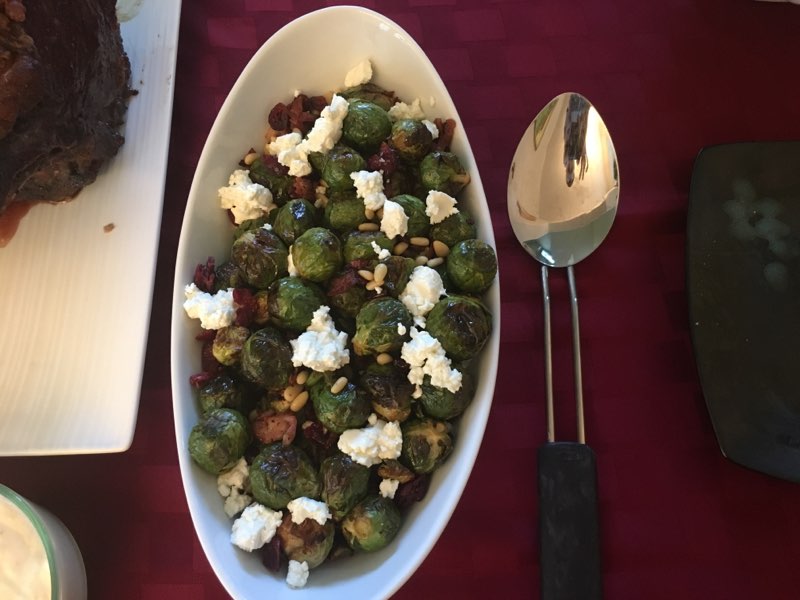
Baked Brussel Sprouts with Pancetta, Chevre, Pine Nuts & Dried Cranberries
1 lb Brussel Sprouts
12 oz cubed Pancetta or Bacon
8 oz chopped Chevre or Creamy Goat Cheese
½ cup Pine Nuts
(optional) ¼ cup Dried Cranberries
Salt & pepper
● Preheat the oven to 450 F.
● Steam the brussel sprouts until a fork can just slide into the center. You can do this over a traditional steamer or by covering with a wet paper towel and microwaving for 5-7 minutes depending on the wattage of your microwave.
● Place steamed brussel sprouts in a flat roasting pan & cover with cubed pancetta. Roast until sprouts are crisp and browned on the outside and the pancetta or bacon is crisp. Turn off the heat and allow the pine nuts to gently toast in the residual heat for another minute.
● Once removed from the oven, season with salt & pepper to taste. Add goat cheese and dried cranberries if using and serve immediately.

Creamed Pearl Onions
1 lb frozen Pearl Onions
1 cup Chicken Stock
1 cup Heavy Whipping Cream
1 Bay Leaf
Salt & pepper
● Heat chicken stock, pearl onions, and bay leaf over medium-high heat. When chicken broth comes to a boil, reduce heat to medium and add the cream.
● Simmer the pearl onions for 15-20 minutes until onions are translucent and tender. Strain the creamy broth and save all but ½ cup for the Cream of Mushroom Soup.
● Add the reserved broth back to the onions and simmer until reduced. Season with salt & pepper to taste.

Cream of Mushroom Soup
1 cup Dried Mixed Mushrooms (I used oyster mushrooms, black trumpets, portobello & porcini.)
1 cup chopped fresh Button Mushrooms
1 diced Onion
2 tbs Butter
3 tbs Soy Sauce
½ cup Heavy Whipping Cream
1 tsp Dried Thyme
Reserved liquid from the Creamed Pearl Onions
Salt & pepper
● Wash the dried mushrooms to remove any remaining grit. Then soak the mushrooms in hot water for 15 minutes. Once the mushrooms have been reconstituted, reserve 1 cup of the liquid for the soup.
● Heat butter in soup pot over medium-high heat. Add the onions and cook until tender. Then add the fresh and dried mushrooms. Saute for 1 minute. Add the soy sauce and stir to distribute evenly.
● Add the reserved mushroom liquid and thyme. Cover and bring to a boil. The mushroom liquid may be a little bitter depending on your mix. Sweeten with the reserved pearl onion broth and add the cream. Season with salt & pepper. Keep covered over low heat to keep warm until ready to serve.

Blueberries, raspberries, blackberries and Camembert cheese
Don’t miss my other posts on diet and health:
I. The Basics
Jason Fung's Single Best Weight Loss Tip: Don't Eat All the Time
What Steven Gundry's Book 'The Plant Paradox' Adds to the Principles of a Low-Insulin-Index Diet
II. Sugar as a Slow Poison
Best Health Guide: 10 Surprising Changes When You Quit Sugar
Heidi Turner, Michael Schwartz and Kristen Domonell on How Bad Sugar Is
Michael Lowe and Heidi Mitchell: Is Getting ‘Hangry’ Actually a Thing?
III. Anti-Cancer Eating
How Fasting Can Starve Cancer Cells, While Leaving Normal Cells Unharmed
Meat Is Amazingly Nutritious—But Is It Amazingly Nutritious for Cancer Cells, Too?
IV. Eating Tips
Using the Glycemic Index as a Supplement to the Insulin Index
Putting the Perspective from Jason Fung's "The Obesity Code" into Practice
Which Nonsugar Sweeteners are OK? An Insulin-Index Perspective
V. Calories In/Calories Out
VI. Wonkish
Anthony Komaroff: The Microbiome and Risk for Obesity and Diabetes
Carola Binder: The Obesity Code and Economists as General Practitioners
Analogies Between Economic Models and the Biology of Obesity
VIII. Debates about Particular Foods and about Exercise
Jason Fung: Dietary Fat is Innocent of the Charges Leveled Against It
Faye Flam: The Taboo on Dietary Fat is Grounded More in Puritanism than Science
Confirmation Bias in the Interpretation of New Evidence on Salt
Julia Belluz and Javier Zarracina: Why You'll Be Disappointed If You Are Exercising to Lose Weight, Explained with 60+ Studies (my retitling of the article this links to)
IX. Gary Taubes
X. Twitter Discussions
Putting the Perspective from Jason Fung's "The Obesity Code" into Practice
'Forget Calorie Counting. It's the Insulin Index, Stupid' in a Few Tweets
Debating 'Forget Calorie Counting; It's the Insulin Index, Stupid'
Analogies Between Economic Models and the Biology of Obesity
XI. On My Interest in Diet and Health
See the last section of "Five Books That Have Changed My Life" and the podcast "Miles Kimball Explains to Tracy Alloway and Joe Weisenthal Why Losing Weight Is Like Defeating Inflation." If you want to know how I got interested in diet and health and fighting obesity and a little more about my own experience with weight gain and weight loss, see “Diana Kimball: Listening Creates Possibilities” and my post "A Barycentric Autobiography.
The Great Nara Money Experiment
Hat tip to Joseph Kimball
John Locke: No One is Above the Law, which Must Be Established and Promulgated and Designed for the Good of the People; Taxes and Governmental Succession Require Approval of Elected Representatives

John Locke’s views are important because so many of the framers of the US Constitution had read his works. In Sections 141-142 of his 2d Treatise on Government: Of Civil Government, he completes and summarizes his Chapter XI (“Of the Extent of the Legislative Power”) delineation of what powers rulers have and what they don’t have. In reading these sections, it is important to remember that John Locke uses the word “legislative” to refer to the ruler or rulers of a commonwealth.
As with taxation, John Locke views the transfer of power from one ruler to another as something that requires authorization by elected representatives—though his lack of insistence that a monarchy must be elective suggests that this authorization by elected representatives could be long prior to the existing ruler dying or stepping down:
§. 141. Fourthly, The legislative cannot transfer the power of making laws to any other hands: for it being but a delegated power from the people, they who have it cannot pass it over to others. The people alone can appoint the form of the commonwealth, which is by constituting the legislative, and appointing in whose hands that shall be. And when the people have said, We will submit to rules, and be governed by laws made by such men, and in such forms, nobody else can say other men shall make laws for them; nor can the people be bound by any laws, but such as are enacted by those whom they have chosen, and authorized to make laws for them. The power of the legislative, being derived from the people by a positive voluntary grant and institution, can be no other than what that positive grant conveyed, which being only to make laws, and not to make legislators, the legislative can have no power to transfer their authority of making laws, and place it in other hands.
In addition to succession within a commonwealth of a given geographical extent, this seems to imply that annexation of lands that were outside the commonwealth—or cession of lands that were in the commonwealth to the control of some ruler outside the commonwealth—requires approval by elected representatives of the people in those lands. However, John Locke does not directly address that issue in this passage.
In Section 142, John Lock gives a good summary of the limits to the power of rulers, I have boiled down this summary still further into the title of this post.
§. 142. These are the bounds, which the trust, that is put in them by the society, and the law of God and nature, have set to the legislative power of every commonwealth, in all forms of government.
First, They are to govern by promulgated established laws, not to be varied in particular cases, but to have one rule for rich and poor, for the favourite at court, and the country man at plough.
Secondly, These laws also ought to be designed for no other end ultimately, but the good of the people.
Thirdly, They must not raise Taxes on the property of the people, without the consent of the people, given by themselves, or their deputies. And this properly concerns only such governments, where the legislative is always in being, or at least where the people have not reserved any part of the legislative to deputies, to be from time to time chosen by themselves.
Fourthly, The legislative neither must nor can transfer the power of making laws to any body else, or place it any where, but where the people have.
For links to other John Locke posts, see these John Locke aggregator posts:
Bloomberg #2—>False Advertising for College is Pretty Much the Norm
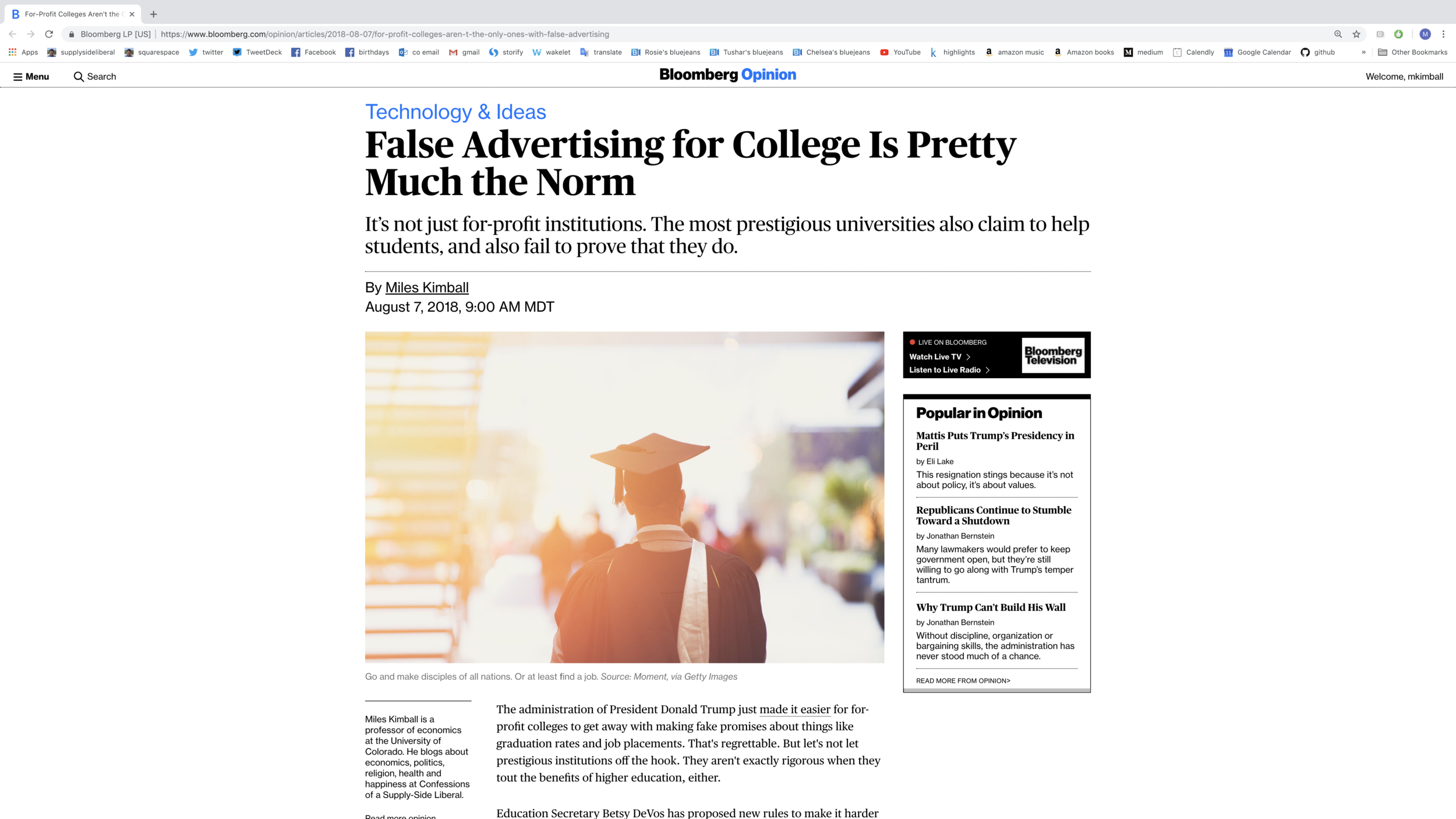
“False Advertising for College is Pretty Much the Norm” is my second piece as a Bloomberg columnist. I am grateful to Bloomberg Opinion for permission to reprint the full text of my column here. They retain all rights. You can see links to all my other columns in the popular press here.
For those who want a deeper dive into one of the points I mentioned, here is an ungated link to Stacy Dale and Alan Krueger's paper "Estimating the Payoff to Attending a More Selective College: An Application of Selection on Observables and Unobservables."
The administration of President Donald Trump just made it easier for for-profit colleges to get away with making fake promises about things like graduation rates and job placements. That's regrettable. But let's not let prestigious institutions off the hook. They aren't exactly rigorous when they tout the benefits of higher education, either.
Education Secretary Betsy DeVos has proposed new rules to make it harder for students to get loan forgiveness from schools that lured them with false advertising. Notably, the government wants to make aggrieved students show that the schools actually intended to defraud them, a high burden of proof.
The problem is that the prestige schools have undermined the case for making it easy to go after the bad ones, which just pretend to provide an education without really delivering. Though most colleges and universities mean well, they are also responsible for false advertising and don't always deliver the education they promised. If all institutions of higher education were held to higher standards, it would be easier legally to penalize the worst.
Colleges and universities claim to do two things for their students: help them learn and help them get jobs. It's hard to find even one college or university that provides solid data to back up these claims.
On job placement, the biggest deception by prestigious colleges and universities is to claim credit for the brainpower and work habits that students already had when they arrived. Another important deception is to obscure the difference between the job-placement accomplishments of students who graduate from technical fields such as economics, business, engineering or the life sciences, and the lesser success of students in the humanities, fields like communications or in most social sciences.
Solid data to back up a claim that a school helps students find jobs should include the following:
Graduation rates for different types of students,
The current jobs of graduates, separated out by major and year of graduation.
Data on the other schools a student was admitted to. That’s to identify the consensus view of admissions departments at many schools about the brainpower and work habits a student already had before entering college.
It's no wonder that schools don’t want to provide such data, given what the facts would probably show. Many students incur large educational loans going to a prestigious school but still can’t get a good job. And the economists Stacy Dale and Alan Krueger, former head of the Council of Economic Advisers, used data on which other schools a student was admitted to in a 2002 paper that casts doubt on the benefit from going to a more prestigious school instead of a less prestigious school.
To demonstrate that a school helps students learn, schools should have every student who takes a follow-up course take a test at the beginning of each semester on what they were supposed to have learned in the introductory course. The school can get students to take it seriously enough to get decent data — but not seriously enough to cram for it — by saying they have to pass it to graduate, but that they can always retake it in the unlikely event they don’t pass the first time. To me, it is a telling sign of how little most colleges and universities care as institutions about learning that so few have a systematic policy to measure long-run learning by low-stakes, follow-up tests at some distance in time after a course is over.
When I hear people talk about “fly-by-night” schools, the image I get is one of a “no-name” school with bad intentions. But for a school to meet its implied warranty, it is not enough for it to have a famous name and good intentions. We need to be able to distinguish between good and bad actors.
It's unlikely that colleges and universities will be held to high standards anytime in the next few years given the Trump administration’s strong push toward deregulation. But the next administration could go a long way toward turning the world of higher education right-side-up if it were to require all colleges and universities receiving federal funds to publicly post data on graduation rates and jobs of graduates by major, and provide systematic data to researchers on the other schools a student was admitted to and on long-run student learning.
Black Bean Brownies

image source (a different recipe for black bean brownies)
Christmas is a day for treats. But it doesn’t have to be a day of sugar. Our massage therapist Shannaw Martin pointed us to a recipe for black bean brownies that my wife Gail then modified. These brownies cannot match the addictive quality of sugary brownies, but for those who have gone off sugar and flour, the recipe below produces brownies that are surprisingly good.
Black Bean Brownies
Ingredients:
2/3 cup dried black beans that have been soaked overnight in 3 cups water—ideally with some baking soda added—which is then drained and replaced with another 3 cups water, then cooked in a pressure cooker. Follow the instructions of your pressure cooker when cooking the beans. (The presoaking and pressure cooking is to help destroy the lectins that I worry about in my post “What Steven Gundry's Book 'The Plant Paradox' Adds to the Principles of a Low-Insulin-Index Diet.”)
3 organic eggs
1/2 tsp baking powder
1/4 C cocoa powder (100% cocoa)
1/4 tsp salt
1/2 C Chocolate bar chipped
2/3 C Swerve (play with less—it's supposed to be sugar, so bear that in mind)
1 tsp organic vanilla
3 TBS coconut oil (warmed in the oven or on the stovetop to a liquid form)
1/2 tsp coffee
Preheat oven to 350.
The secret is in the order...
Wet -- pressure-cooked black beans, eggs, little extra vanilla, a little extra coffee in mixer, (mix good)
Dry — Swerve, baking powder, kosher salt, heaping cup of 100% special dark cocoa powder.
Add wet to dry and mix together. Add the heaping spoons of coconut oil that you warmed in the oven into mix.
Before adding 72% or higher organic chocolate chunks grease the pan with lots of coconut oil.
Mix all together and pour into pan. Bake 35-40 minutes at 350 degrees. The above recipe is for 10 brownies. I always double it! Enjoy!!
Grease pan with coconut oil
References:
Don’t miss my other posts on diet and health:
I. The Basics
Jason Fung's Single Best Weight Loss Tip: Don't Eat All the Time
What Steven Gundry's Book 'The Plant Paradox' Adds to the Principles of a Low-Insulin-Index Diet
II. Sugar as a Slow Poison
Best Health Guide: 10 Surprising Changes When You Quit Sugar
Heidi Turner, Michael Schwartz and Kristen Domonell on How Bad Sugar Is
Michael Lowe and Heidi Mitchell: Is Getting ‘Hangry’ Actually a Thing?
III. Anti-Cancer Eating
How Fasting Can Starve Cancer Cells, While Leaving Normal Cells Unharmed
Meat Is Amazingly Nutritious—But Is It Amazingly Nutritious for Cancer Cells, Too?
IV. Eating Tips
Using the Glycemic Index as a Supplement to the Insulin Index
Putting the Perspective from Jason Fung's "The Obesity Code" into Practice
Which Nonsugar Sweeteners are OK? An Insulin-Index Perspective
V. Calories In/Calories Out
VI. Wonkish
Anthony Komaroff: The Microbiome and Risk for Obesity and Diabetes
Carola Binder: The Obesity Code and Economists as General Practitioners
Analogies Between Economic Models and the Biology of Obesity
VIII. Debates about Particular Foods and about Exercise
Jason Fung: Dietary Fat is Innocent of the Charges Leveled Against It
Faye Flam: The Taboo on Dietary Fat is Grounded More in Puritanism than Science
Confirmation Bias in the Interpretation of New Evidence on Salt
Julia Belluz and Javier Zarracina: Why You'll Be Disappointed If You Are Exercising to Lose Weight, Explained with 60+ Studies (my retitling of the article this links to)
IX. Gary Taubes
X. Twitter Discussions
Putting the Perspective from Jason Fung's "The Obesity Code" into Practice
'Forget Calorie Counting. It's the Insulin Index, Stupid' in a Few Tweets
Debating 'Forget Calorie Counting; It's the Insulin Index, Stupid'
Analogies Between Economic Models and the Biology of Obesity
XI. On My Interest in Diet and Health
See the last section of "Five Books That Have Changed My Life" and the podcast "Miles Kimball Explains to Tracy Alloway and Joe Weisenthal Why Losing Weight Is Like Defeating Inflation." If you want to know how I got interested in diet and health and fighting obesity and a little more about my own experience with weight gain and weight loss, see “Diana Kimball: Listening Creates Possibilities” and my post "A Barycentric Autobiography.
Kenneth W. Phifer: My Sermon

Ferenc Dávid holding his speech at the Diet of Torda in 1568, (today Turda, Romania) when the Unitarian Church was recognized legally by the Transylvanian Diet. By Aladár Körösfői-Kriesch (1896)
Link to the Wikipedia article “Unitarianism.” Link to the Wikipedia article “Universalism.”
When I left Mormonism for the Unitarian Universalism in 2000, Ken Phifer was the minister of the Unitarian Universalist Congregation in Ann Arbor, Michigan. He gave beautiful sermons. I am grateful for his permission to reprint one of them here.
Ken’s sermon The Faith of a Humanist also appears on supplysideliberal.com. And you will find links to some of my own UU sermons here.
Below are Ken’s words.
It is a truism among those of us who have chosen homiletics, that is, preaching, as our field of expertise that we each have only one sermon in us. Since our work requires that we deliver far more than just one sermon, and preaching the same sermon every week would likely clear the pews/chairs very quickly, we have to learn how to ring the changes on our one message so that we can continue to “mount the pulpit” week by week and remain at least minimally interesting.
In that regard, all of us who preach do well to remember the biting words of Anthony Trollope in his novel Barchester Towers: “There is, perhaps, no greater hardship on mankind in civilized and free countries than the necessity of listening to sermons. No one but a preaching clergyman has, in these realms, the power of compelling an audience to sit silent and be tormented.”
I, of course, have no power to compel you to do anything, much less to force you “to sit silent and be tormented.” Indeed, it is one of the great strengths of our Unitarian Universalist religion that people participate according to their free will and not some notion of eternal suffering if they fail to attend.
UU’s don’t sit in torment. They leave, as during a section of one of my sermons that dealt with money some 15-20 people did. Only later did I learn that they were all headed for their children’s RE class for a special presentation. I learned only at the coffee hour why they had gone: because they were good parents, not because they did not like what I said.
I think.
Some stay physically but leave mentally, preparing grocery lists, ruminating on a problem at work, or admiring some fine specimen across the way. Albert Shanker once noted that people generally listen to the first ten
minutes of any talk and doze through the next ten minutes. After that, he remarked, people begin to have sexual fantasies.
This is the reason that I always talk for more than 20 minutes, so that every one can come away with at least something of interest.
Whatever congregants may do, preachers, unless they are genuinely unselfaware, preach their one sermon but in different ways, using different words with different emphases, expanding, contracting, amending, finding better phrases to express their one message.
Like a jazz musician who has played a tune hundreds of times but never the same way—Coleman Hawkins playing his classic Body and Soul, for example, or Art Tatum playing anything in his virtuoso piano style—preachers try to keep the message fresh and interesting, comforting and inspiring, challenging and caring, seeking always better ways to state the message.
The work of the preacher is not unlike that of the singer in a story told by Saul Bellow. She was young and making her debut at La Scala. After a particularly beautiful but difficult aria, the applause was thunderous. There were cries for her to do it again. After the fourth such encore, worn out from the challenging music sung again and yet again, she asked her audience how many more times she must sing it. A voice cried out, “Until you get it right!!”
Each week we preachers hope that we will get it right, or at least get closer to right than before. We know that we will likely fail, but we do not share the philosophy of the man who said, “If at first you don’t succeed, quit!”
Let me try this morning to get it a little bit right, placing before you three themes that are at the heart of my faith and, I believe, at the heart of the Unitarian Universalist faith. They form the core of my one sermon.
The first theme is history.
I majored in history in college because I saw history as an academic discipline within which I could study virtually anything. My doctoral work in Christian anti-Semitism continued this interest in the historical as the human arena within which all subjects could be studied.
As I began the process of moving into Unitarian Universalism, one of the most attractive features of the movement was its attitude towards history. In UU understanding, history, human experience, is where we find authority for our theologies and our moral values.
UU’s see past, present, and future linked together without thinking that one part of history is more important than another. All three matter. All are intertwined. Each affects the other two.
What we know and think about the past helps us to live in the present and plan for the future.
How we live in the present helps us to redeem the past and shape the future.
How we dream of and work for the future helps us to live meaningfully today and to accept the past.
This is in contrast to the orthodox understanding of history where some person, event, or revelation in the past is determinative. The orthodox believer says that all the truth that matters is in the past.
This rigid commitment to the past is why it was only twenty or so years ago that the Roman Catholic Church agreed that evolution was a sound theory, amounting to a fact, a position that creationists, now using the alias of intelligent design advocates, are still unable to accept.
Or consider the power of the violent right-wing Islamic believers, who are able to justify murder in their own minds because they think that the critical truths of life took place in the seventh century.
The radical says that the most important moment is yet to be. Despise the wicked past, loath the evil present, and look only to the glorious future is the message of the radical. The 20th century saw the coming to power of various totalitarian communist governments who blithely murdered millions in order to usher in that glorious future, ignoring present day evils and their own wickedness in the process.
Christopher Buice, a UU minister in Knoxville, Tennessee, captures the spirit of the UU approach to history, when he writes of bowling as a spiritual discipline. Bowl a ball too far to the right and you end up in the gutter of orthodoxy, trapped in the past. Bowl too far to the left and you end up in the gutter of radicalism, postponing a good life to a never-to-arrive future. To knock down the pins, you must strive to roll the ball in the lane between the gutters.
The Buddha taught the same wisdom: seek the Middle Way between the extremes that seem so tempting. Aristotle called it the Golden Mean.
UU’s respect the past, knowing in what measure it affects our lives. Our genetic inheritance, the social history of our species as well as the history of our family, and the environmental developments of the ages that have produced our present earth all have significance for us.
Historian Donald Kagan says that writers of history have “the responsibility of preserving the great, important, and instructive actions of human beings.” By knowing what has happened, we can see what good and evil are, what actions help human beings and what actions harm us.
History shows us clearly the wickedness of slavery and the oppression of women, the folly of war and of designing societies that are unjust so a few get rich and the many live in misery. Hitler and Stalin were evil and did monstrously evil things. Clara Barton and Sophia Lyon Fahs were good and did wonderfully good things.
Our moral values emerge out of seeing what actions and systems do good and which ones hurt people.
Then we create a vision of what might be and begin working to realize it. We understand the truth of Reinhold Niebuhr’s words that “nothing worth doing is completed in our lifetime.”
Worthy goals are not easily accomplished. The time to start working on them is now. We must do what we can, even if we do not see the completion of the task, and trust that others will carry on the work to make real the vision of a peaceable and just community.
History is about two things: remembering and dreaming.
We remember so that we can overcome the mistakes of the past and carry forward the noblest aspirations of humanity.
We dream so that we never become complacent about who and what we are, always striving to be better and help the world to be better.
The importance of history is the first theme of my sermon.
Humility is the second.
Humility is an impossible virtue. How on earth can we ever know if we are properly humble?
If I go on a diet, I have something to measure how well I am doing—the scales, how many times I succumb to the delicious pecan pie that I love or have that gorgeous Reuben sandwich, how many days I do not exercise. I can keep a chart of how I am doing and give myself pep talks about doing better.
How can I tell if I am improving in humility? How do I know if my humble demeanor—or yours—is not really a mask for vanity and arrogance?
I have never thought of myself as a particularly humble person. I am not sure if that means that I am or that I am not humble! I just do not know.
Despite the difficulties, I am persuaded that humility is a great virtue. I like what Max Ehrmann said about humility in “Desiderata,” though he did not use the word: “If you compare yourself with others, you may become vain and bitter; for always there will be greater and lesser persons than yourself.”
That is excellent advice for staying on course—the middle way!—but hard as the dickens to do. Most of us at one time or another do compare ourselves with others and find ourselves either desperately wanting or wallowing in self-admiration. Ehrmann was right to caution against it.
The trick is to appreciate ourselves, respect others, and enjoy life. Several things can be helpful in doing this.
First, who is not humbled by an awareness of the sheer vastness of the universe: hundreds of billions of stars in our galaxy which is one of hundreds of billions of galaxies. In the microscopic world, we seem to keep discovering teeny, tiny, miniscule little things that count as fundamental pieces of the make-up of physical reality. The last count I saw was 64 such elemental pieces.
There is vastness in time also, billions and billions of years of time that the earth has been around, billions and billions of years since the universe started, and no one knows what came before that point of singularity.
My goodness! How could anyone be uppity in the face of that knowledge?
The earth and its various life forms are also amazing. Beetles seem to be the most prolific life form with 400,000 species. Cockroaches seem to be the most durable form of life, said to be capable of surviving and prospering even in a nuclear war. Giraffes! Hippopotamuses! Duck-billed platypuses! Monkey pod trees! Roses and thorns! Mountains! Water! The human being!
Life is strange and beautiful and full of mystery and it long predates our brief interlude as part of it.
One last element of humility is the limits that constrain us.
The first and most painful of these limits is our mortality. Religions may propose faith commitments about living beyond this life, but there is not one scrap of evidence that we do. Even if we survive for another go-round—and I would welcome that, as most people would—that does not make this life any easier.
Here’s the truth about our mortality, told in two statements a quipster thought up in the heyday of the God Is Dead movement of the 1960’s. First came these words: “God is dead—Nietzsche.” Then came these words: “Nietzsche is dead—God.”
Whatever we consider the ultimate force of the universe to be, whatever our God is, it will long outlast our very short existence.
There are limits as well in what we can do. Like it or not, no matter how hard I might apply myself, I will never be able to play the piano as well as Fats Waller or Van Cliburn. For that matter, I can’t play as well as Fats Cliburn or Van Waller!
Very few are those gifted in all aspects of life. Some of us can cook and some of us cannot. Some of us are comfortable and capable with technology and others of us are not. Some of us are good with numbers and others of us are not. Some of us can hit a curve ball and others cannot.
Nobody does everything well.
Humility is an attitude firmly rooted in the reality of our situation, an infinitesimal part of life in a vast space-time universe in which our mortal days are few and our talents limited.
Accepting our real condition frees us to enjoy life, to appreciate what we have and what we can do rather than long for what we do not have or cannot do, to respect others and take delight in their accomplishments.
In the UU movement, humility is part of the reason why we have no binding dogma, no required creeds to believe, no rituals one must perform on pain of eternal loss. Humility teaches us that no one of us has the truth, no individual, no religion. At best, we may each have a little bit of the truth. Sharing humbly we can enlarge our understanding.
Humility is the reason we celebrate diversity.
Humility is the second theme of my sermon.
The third is learning how to distinguish between that which is of enduring value and that which is of only passing worth.
One of the watershed moments in UU history was the occasion of the installation of the Rev. Charles C. Shackford on May 19, 1841. At that ceremony, Theodore Parker preached a sermon called “The Transient and the Permanent in Christianity.”
Parker made the point that the authority of Christianity or of any religion rests on the truth of its words, not on who said the words, not on any doctrines of the faith. Doctrines are transient. So are rituals. So are people.
The permanent is found in love and morality and divine living, acting on the goodness that is part of every one of us. Parker said that what is demanded of us is “a divine life; doing the best thing, in the best way, from the highest motives.”
He went on to note that living in this way does not “demand that all men...(and women) think alike, but to think uprightly, and get as near as possible to truth; not all men…(and women) to live alike, but to live holy, and get as near as possible to a life perfectly divine.”
There are many ways of speaking the wisdom in Parker’s words. That wisdom is found in the words of the prophet Micah, when he declared that what is required of us is not rituals or sacrifices properly performed or doctrines correctly stated and believed, but that we “do justice, love mercy, and walk humbly with our God.”
Jesus taught us to love not just family and friends and those who agree with us, but also to love our enemies.
The Koran instructs us in the many ways that Allah’s voice can be heard, different voices in different places to different people.
The permanent is about love and morality, not transient things like wealth or power or fame or comfort.
We live in an age that celebrates the transient. A cartoon in a recent New Yorker showed a man being held up on the street and the robber saying, “Hand over your most recently acquired technology.”
Not even the thieves can keep up with the rapidly changing array of technological gimcrackery that crowds our lives and demands our attention. It’s all very exciting and all very lucrative for the inventors and sellers and all very temporary.
What religions are supposed to do is to remind us of what we need, remind us of the things that endure, the things that really matter: love and morality, justice and compassion, laughter and learning, sharing and hope, respect and thoughtfulness.
What the UU religion says is that these things can be found everywhere in life, not just in the teachings of one religion.
At the 2005 commencement exercises of my alma mater, the actor John Lithgow, a member of the class of 1967, spoke of what he had learned from some of the recipients of the Harvard Arts medal, awarded each year at the springtime Arts First Festival that Lithgow founded. “I began to see,” he said, “that many of the qualities that made them great artists were the same qualities that made them good people.” He then referred to folksinger Pete Seeger, who spearheaded efforts to clean up the Hudson River, to blues guitarist and singer Bonnie Raitt, who donated funds for guitar lessons for inner-city kids, and filmmaker Mira Nair, who started a film school in Uganda.
He briefly suggested four qualities these and others who have contributed to the welfare of humanity have. He urged his audience--he urged us all—to “be creative, to be useful, to be practical, and to be generous.”
That is wisdom that fits any age, truth that endures.
So is the kind of celebration of life that the poet Mary Oliver expresses in her poems, like this one:
Some things, say the wise ones who know everything,
are not living. I say,
you live your life your way and leave me alone.
I have talked with the faint clouds in the sky when they
are afraid of being left behind; I have said, Hurry, hurry!
and they have said: thank you, we are hurrying.
About cows, and starfish, and roses, there is no
argument. They die, after all.
But water is a question, so many living things in it,
but what is it, itself, living or not? Oh, gleaming
generosity, how can they write you out?
As I think this I am sitting on the sand beside
the harbor. I am holding in my hand
small pieces of granite, pyrite, schist.
Each one, just now, so thoroughly asleep.
—Mary Oliver, “Some Things Say the Wise Ones,” in Why I Wake Early (2004)
To see the sacredness in every part of life, to really live the truth of being part of the “interdependent web of all existence,” is to be in tune with the universe, with that which goes on, with that which endures.
Hold fast to love, morality, life, to that which endures.
We live best when we live consciously in history, when we live with humility, and when we live with permanent values not transient ones.
That is the central message of our Unitarian Universalist faith. When we live it, we make the world a better place and we make ourselves better people.
That is my faith.
That is My Sermon.
Bloomberg #1—>Fight the Backlash Against Retirement Saving Nudges: Everyone Benefits When People Save More for Old Age

Link to the article shown above. Originally published in Bloomberg Opinion June 29, 2018. Reprinted with permission.
"Fight the Backlash Against Retirement Planning Nudge" is my first piece as a Bloomberg columnist. Thanks to Noah Smith for recommending me to my new Bloomberg editor, Jonathan Landman. I am grateful to Bloomberg Opinion for permission to reprint the full text of my column here. They retain all rights. You can see links to all my other columns in the popular press here.
A Wall Street Journal analysis recently concluded that “more than 40 percent of households headed by people aged 55 through 70 lack sufficient resources to maintain their living standard in retirement.”
It isn’t easy to solve the problem for those already at retirement age, but behavioral economists, working at the border of economics and psychology, have a magic bullet for getting younger people to save more: make enrollment in retirement savings plans automatic. In 2006, Congress blessed this approach by shielding companies from legal complaints if they automatically enrolled workers in life-cycle funds that use a formula to choose a mix of stocks, bonds and other assets appropriate to a worker’s age.
A key aspect of automatic enrollment is that workers are allowed to opt out. So it isn’t forcing anyone to do anything, just nudging them in the right direction. This idea of nudging people to do the right thing without forcing them has been called “libertarian paternalism.” It's a politically attractive approach to improving decisions about health, wealth and happiness, and is the core idea of the book "Nudge" by the Nobel-prize-winning behavioral economist Richard Thaler and the Harvard University law professor and Bloomberg Opinion columnist Cass Sunstein, who was head of White House Office of Information and Regulatory Affairs in former President Barack Obama’s first term. The conservative opinion writer George Will wrote in favor of libertarian paternalism in a 2008 essay, “Nudge Against the Fudge.”
Many states, with Oregon leading the way, have begun to roll out automatic enrollment in individual retirement accounts for workers not covered by company retirement savings plans.
Automatic enrollment has now gained so much traction that it has generated a backlash. Some of it targets extra paperwork for small companies. But the stronger critique is coming from analysts who unearthed evidence that workers may run up debt to make up for the reduced take-home pay (when money is deducted to feed the retirement account).
Andrew G. Biggs of the American Enterprise Institute, a top conservative think tank, is one of those leading the charge against automatic enrollment. He is on target in saying that the low-income workers for whom automatic enrollment has the biggest effect are also the ones who may not need to save much for retirement because their Social Security checks will be almost as big as their paychecks. And many people at the bottom of the heap economically would be better served by encouragement to pay off credit card debts than encouragement to save in a retirement account.
Biggs also finds some support for the idea that automatic enrollment can cause people to run up debt in research by many of the key players who got the idea of automatic enrollment off the ground. In a Jan. 29 essay posted on aei.com, “Can retirement saving increase your debt,” he wrote:
If we push low-income workers who don’t need to save more for retirement to do so, one reaction might be to borrow more elsewhere. Sure, state auto-IRA plans would let you withdraw if you chose, but inertia is strong. Many households might remain in the IRA plan and have contributions automatically deducted from their paycheck, but then borrow in order to make up for the lost take-home pay.
But the story is complex. Though it is true that the U.S. Army’s 2010 introduction of automatic enrollment in its Thrift Savings Plan caused employees to run up more debt, this was because it helped people save up for down payments for houses and cars.
Rather than failing to get people to save, the Thrift Savings Plan had an intentional loophole that let people "borrow" their own savings for near-term purchases of cars and houses rather than requiring them to use it in retirement. That's probably a good thing, since Biggs has made the point that low-income people don't need much retirement saving.
Crucially, comparing employees in the years just before and the years just after automatic enrollment was introduced, there wasn’t any evidence that those automatically enrolled in the Thrift Savings Plan took on more credit-card debt. What they did do was to take out larger mortgages and larger auto loans. It is possible that they took out larger mortgages and auto loans because they made smaller down payments as a result of having less take-home pay. But given the ease of borrowing from their Thrift Savings Plan account, it seems more likely that they borrowed more because they were able to put down bigger down payments for better houses and cars than they would have been able to swing otherwise.
It's important to get the facts straight about automatic enrollment because there's more at stake than making sure people have enough resources for retirement.
When people save more, the whole economy benefits. A higher saving rate has the potential to reduce the trade deficit without protectionism. If accompanied by appropriate monetary policy, and not canceled out by bigger government budget deficits, a higher saving rate would also make more funds available for research and development. It should raise wages and reduce inequality. Advocates of automatic enrollment have been underplaying their hand by focusing only on the benefits for financial security in retirement.
Update December 21, 2018: Robert Flood writes on the Facebook page for this post:
Nudge is "rules vs discretion" dressed up and wearing a mustache.