On Perfectionism

As an academic, I am surrounded by perfectionists. Relative to the US average, I may be a perfectionist myself; but relative to other academics I don't look like much of a perfectionist at all. 

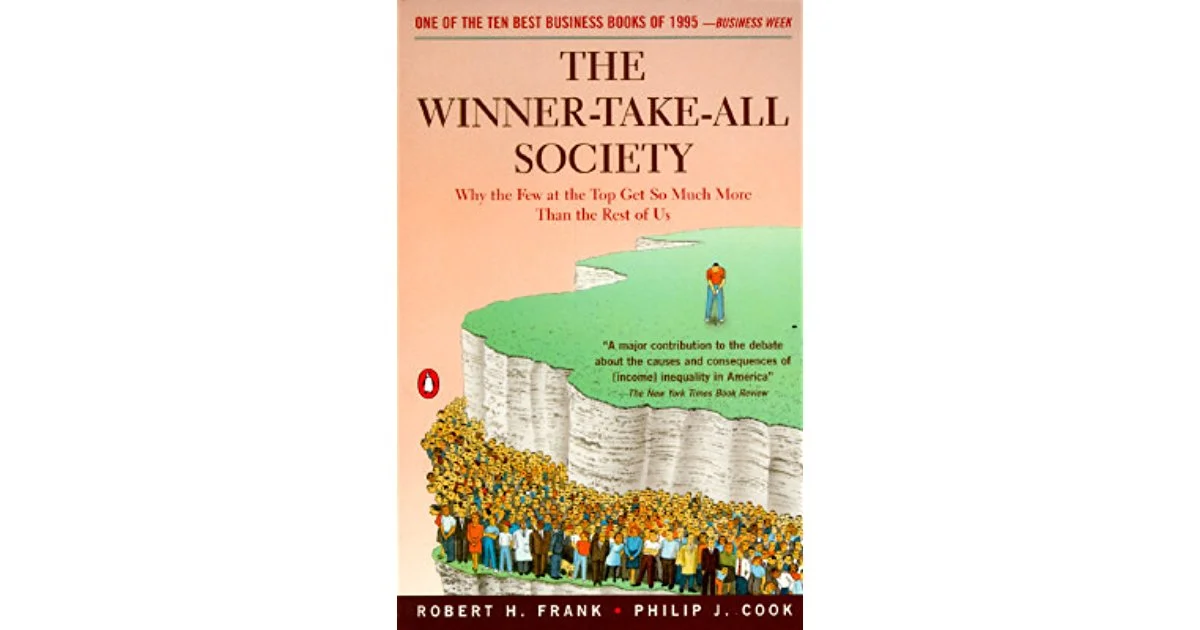
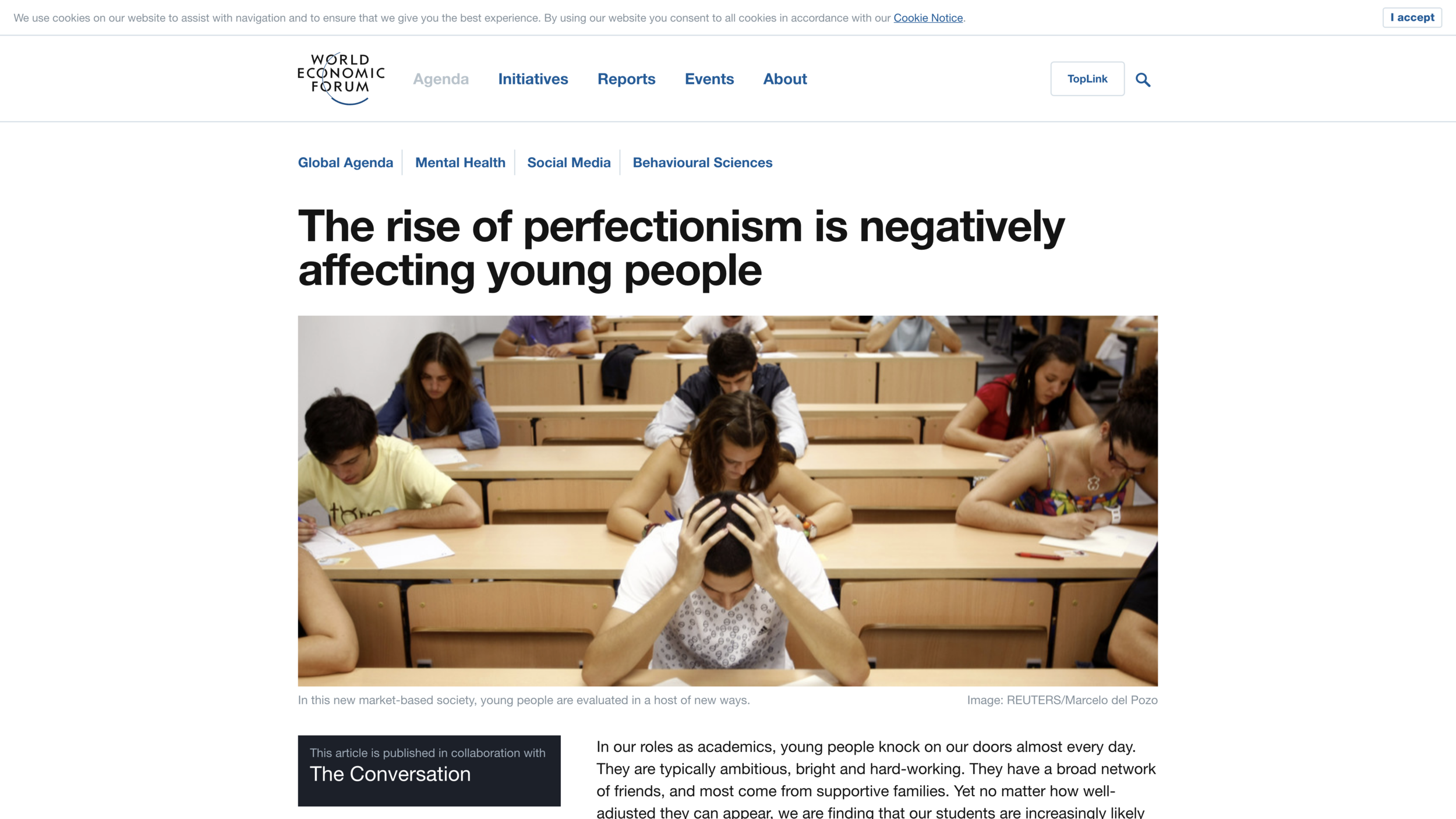
Emending the article above by Thomas Curran and Andrew Hill to be a little more cogent than it is, the article above blames a rise in perfectionism on the huge financial rewards for being #1 as compared to being #2, or as compared to being #10, #100 or #1000. This is an issue that Robert Frank and Philip Cook discuss in their book The Winner-Take-All Society. 


Whatever the market realities that encourage perfectionism, the psychological toll of going too far in the direction of perfectionism makes it important to put your own level of perfectionism under the microscope to see if it is making your life better or worse.

The description of perfectionism given by Thomas Curran and Andrew Hill points to two key elements of perfectionism. They write:

Broadly speaking, perfectionism is an irrational desire for flawlessness, combined with harsh self-criticism.

To make your life better in the fact of a tendency toward perfectionism, the place to start is in toning down the harsh self-criticism. You can worry about the irrational desire for flawlessness later. 

A story true of my life up to a certain point, and perhaps even now of you, gentle reader, is this: Sometime in your teens you figured out how to motivate yourself to get stuff done, like studying for a test, that takes self-discipline. The method was simple: you harshly criticized yourself if you weren't working hard. This worked so well, that still to this day you use harsh self-criticism as a key method of motivating yourself. You are deathly afraid that if you slack up on harsh self-criticism you might become very lazy. So you are afraid to let up on the harsh self-criticism long enough to experiment with any other method of self-motivation. So years of suffering from harsh self-criticism pile up, and your life seems hard. You haven't considered that you have many years of life experience behind you beyond that teen who long ago came up with harsh self-criticism as a method of motivating yourself.

I want to encourage you to put faith in your own ability to come up with another method of motivating yourself that doesn't cost you so much. (On faith, see my post "The Unavoidability of Faith.") If you do, I think you will be greatly rewarded with the happiness that comes from not figuratively whipping yourself all the time. 

Let's turn now to the irrational desire for flawlessness. In relation to any real-world problem, I honestly don't see how it is possible to be flawless. I can't count how many times I have reminded my co-researchers that "Nothing is perfect." I often amplify that by saying we'll be dead in the water in our research if we insist on perfection, because perfection is impossible. 

Where is perfection possible? In a game. If an endeavor is artificially constructed, it may be possible to follow every last rule and do everything as well as it can possibly be done. Even stepping away from the extreme of perfection, I think people feel they approach nearer to perfection in artificial pursuits than they do in trying to solve or mitigate what I am calling "real-world problems": problems like poverty, injustice and disease, or smaller but ever-so-real-world problems such as traffic, software glitches or petty interpersonal annoyances. The more you address problems that are us against the universe rather than you versus other competitors in a game, the less temptation you will have toward perfectionism. 

The trouble with competitive games, in particular, is that they get lots of people trying to do the same thing and win one of the very limited number of prizes. The more you can instead, find a unique or at least a less-traveled way of contributing to society, the easier it will be for you to feel successful even if other people are successful, too. This road has its own difficulties (see "Believe in Yourself"), but it can ultimately be very satisfying. 

Ultimately, I don't know all that well how to treat the malady of perfectionism, since I only had to deal with a mild case of it myself. But I see many around me suffering from it. So I know that finding good approaches to reducing the pain and suffering that come from perfectionism is important. I'd be glad for any insights you can provide that I can share.  

In other posts, I have two categories of advice for economists in relation to their work.

1. More personal advice:

2. Advice for doing good for the world:

Which Is Worse for You: Sugar or Fat?

Hat tip to Joseph Kimball for pointing me to this video.

I recommend Olivia Gordon's Complexly SciShow video above. In the first 8.5 minutes of this 13.5 minute video, Olivia Gordon demolishes the idea that dietary fat is a big problem by going through the history of nutritional thought on this issue. In the last 5 minutes, she goes too easy on sugar, saying basically "It's complicated." I think she and her team did this in order to seem balanced, but she shouldn't have. Let me try to cut through some of her attempts to go easy on sugar. 

Even If the Only Harm of Sugar Is Causing You To Gain Weight, That Is Pretty Bad. After admitting that there isn't much to be said in favor of sugar other than the direct pleasure it brings, Olivia says that while sugar is likely to make you gain weight, it is gaining weight that is most likely to cause diseases, not the direct effects of sugar. Of course, if sugar makes you fat and getting fat leads to disease, it doesn't matter that much whether sugar causes diseases directly—or indirectly through causing you to gain weight. 

How Much Sugar is Too Much? Olivia makes the statement: "While most of us are likely eating too much added sugar, no one really knows how much is too much." This is a question that sounds clearer than it is. Let's look at some logical possibilities:

  • If the harm of added sugar is approximately linear, then the harm is simply proportional to how much one eats. A little bit of added sugar would be a little too much and a lot of added sugar would be a great deal too much. It is possible there is a linear harm that has a small slope, but Olivia is not claiming that added sugar is a trivial matter, so she is not going there.

  • Added sugar could be beneficial up to a certain point, then begins to be harmful. I don't see Olivia claiming this. If she intended this, it is strange she didn't say something like "Some people think a little added sugar is beneficial for health."

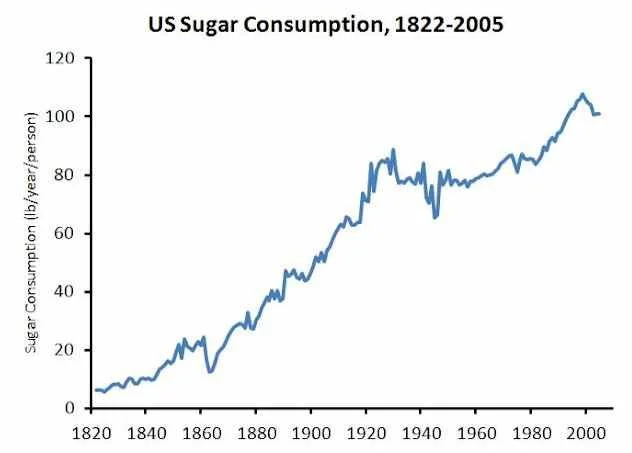
  • Added sugar could have a harm that accelerates with the amount of added sugar consumed. This is most in the spirit of what Olivia might mean by "... no one really knows how much is too much." (The extreme version of this is that there is a level up to which added sugar is totally harmless, after which it becomes harmful. That extreme version seems unlikely.) If sugar does indeed have a harm that accelerates with the amount of added sugar consumed, one should be very worried given how high average consumption of added sugar is relative to historical levels of added sugar—say, average levels prior to 1960. For example, if the harm of added sugar depends on the square of the amount of added sugar, then the harm of 100 pounds a year compared to 80 pounds a year would be 100/80 squared, or 1.5625 times as bad.


The Big Reasons to Avoid Sugar. After talking about the rise in popularity of lowcarb diets, Olivia points out that they are only good for about 11 pounds (5 kilograms) of weight loss on average. There are two key things to say about that. First, it is important to remember how much easier it is to avoid gaining weight in the first place than it is to lose weight once you have gained it. Insulin resistance, which is not so easy to reverse, is an important part of the story for why weight gain is hard to reverse. In economics and physics, when things are hard to reverse it is sometimes called hysteresis. Given how much easier it is to avoid gaining weight than it is to lose weight, a crucial question is how much a lowcarb diet or simply avoiding all added sugar from childhood on would contribute to avoiding weight gain. 

Second, what is crucial about a lowcarb diet—or even better, a low insulin index diet (see Forget Calorie Counting; It's the Insulin Index, Stupid)—is not so much that it, by itself will lead to weight loss, but that it makes it relatively painless to go for substantial stretches of time without eating anything. Going without food for a period of time is called fasting; in the kind of fasting I am talking about, you are encouraged to drink a lot of water while fasting. Fasting is the powerful technique for weight loss, not what you eat. But if you eat a lot of sugar, fasting is going to seem excruciatingly difficult. If you go off sugar, bread, rice and potatoes, and give yourself a month or so to adjust to that before trying to fast, I predict that fasting will seem much easier to you than going without food ever seemed to you before. If you are interested in weight lost, and start fasting after this period of adjustment to being off sugar, bread, rice and potatoes, you can start slow, along the lines discussed in "Stop Counting Calories; It's the Clock that Counts." But I predict you will find fasting so easy and so effective for weight loss that you will soon want to do somewhat more extended fasts. 

Tested Benefits of Going Off Sugar. Overall, Olivia makes it sound as if going off sugar might only benefit you a little bit. But a study she cites approvingly says otherwise: the Stanford DIETFITS Randomized Clinical Trial I discuss in "Why a Low-Insulin-Index Diet Isn't Exactly a 'Lowcarb' Diet." Currently, almost all highly processed food has added sugar. So going off sugar other than whole fruit implies also going off almost all processed food. Thus, going off sugar puts you squarely in the territory of the two diets that the DIETFITS Randomized Clinical Trial tested. They called one of the diets "healthy lowcarb" and the other "healthy lowfat," but don't be fooled. Given the fact that going off sugar currently means going off highly processed food, these two diets—and the possible diets in between—cover reasonably well the possible ways to eat if one goes off sugar (except for whole fruit). So the fact that both of these diets did a lot of good for people provides good evidence for the benefits of going off sugar. If you want to think of it as the benefits of going off highly processed food, that is also reasonable given the evidence we have. And you can get moral support on that from my post "The Problem with Processed Food."

(Note: Olivia cites the DIETFITS Randomized Controlled Trial, without naming it, on the point that there isn't much evidence yet for being able to predict from lab tests which approach will work best for each person. Currently, it is reasonable for everyone to begin with the same approach, then modify it based on their own experience.)  

How to Go Off Sugar. I highly recommend a rigorous approach to going off sugar. If you go off sugar, after a month or so, your body will adjust so that everything you eat tastes sweeter to you. I have been off sugar for about a year and a half; whole fruit tastes very sweet to me now, and even nuts with nothing added to them taste reasonably sweet to me. (To put the level of rigor I am talking about in perspective, I eat commercial salad dressing that lists 1 gram of carbs; it probably has some sugar in it. I eat chocolate with 88% cocoa in it, that definitely has some sugar. See "Intense Dark Chocolate: A Review." And I occasionally have some Halo Top ice cream, which is not entirely sugar-free.)

If you aren't rigorous about going off sugar, and just try to reduce your sugar consumption, you won't get full recalibration of your sense of sweetness. And your craving for sugar won't go away very fast, if at all. Nevertheless, you should get some benefit. For those who, contrary to my advice, are trying to reduce sugar consumption instead of almost entirely cutting it out, it is good for you to also think about reducing the amount of processed food you eat. By contrast, if you almost entirely cut out sugar, and look on the packages of processed food to see the almost ubiquitous added sugar, reducing processed foods would be automatic. ("How Sugar Makes People Hangry" has a list of names for different forms of sugar.)

Go for New Treats! Giving up added sugar doesn't have to mean giving up treats. The DIETFITS study indicates that you can replace sugar/highly processed food with dietary fat and be fine. For me, the Manchego cheese I buy from Costco and the frozen cherries from Costco or other whole fruit with half and half are great treats, as are cashews and almonds (also from Costco) that we bake ourselves. (Other than maybe in my mutual funds, I have no commercial interest in Costco! It is just a good place to get certain types of relatively healthy food at bulk prices.) The baked cashews and almonds are a perfectly good treat on the go; for me they have totally replaced power bars as a portable food when I am not fasting.  

I'll bet many of you can come up with tastier healthy treats than I can. I'd love to hear about your creations in a comment to this post or on Twitter: @mileskimball. Here are the rules of the game if you want to try:

  • Make the treat from scratch from unprocessed food. Note that flour counts as a processed food.

  • As long as it is unprocessed, it is OK if something is high-fat.

  • Don't do too much processing yourself in making it from scratch. For example, grinding something up or overcooking it probably makes it less healthy.

  • Don't add sugar or honey or agave. If you really need a sweetener, oligosaccharides, erythritol and maybe stevia could be OK.

  • Extra points for something being easy to make.

  • Simplicity is fine. It just needs to taste delicious and be healthy, not impress a professional chef.


Don’t miss my other posts on diet and health.

I. The Basics

II. Sugar as a Slow Poison

III. Anti-Cancer Eating

IV. Eating Tips

V. Calories In/Calories Out

VI. Wonkish

VIII. Debates about Particular Foods and about Exercise

IX. Gary Taubes

X. Twitter Discussions

XI. On My Interest in Diet and Health

See the last section of "Five Books That Have Changed My Life" and the podcast "Miles Kimball Explains to Tracy Alloway and Joe Weisenthal Why Losing Weight Is Like Defeating Inflation." If you want to know how I got interested in diet and health and fighting obesity and a little more about my own experience with weight gain and weight loss, see “Diana Kimball: Listening Creates Possibilities and my post "A Barycentric Autobiography.


From Each Individual as Judge, Jury and Executioner to Each Nation as Judge, Jury and Executioner

                                                Image source selling this t-shirt

                                                Image source selling this t-shirt

Section 87 of John Locke's 2d Treatise on Government: “Of Civil Government” (in Chapter VII, "Of Political or Civil Society") summarizes John Locke's contract theory much better than many summaries I have seen by others:

Man being born, as has been proved, with a title to perfect freedom, and an uncontrouled enjoyment of all the rights and privileges of the law of nature, equally with any other man, or number of men in the world, hath by nature a power, not only to preserve his property, that is, his life, liberty and estate against the injuries and attempts of other men: but to judge of, and punish the breaches of that law in others, as he is persuaded the offence deserves, even with death itself, in crimes where the heinousness of the fact, in his opinion, requires it. But because no political society can be, nor subsist, without having in itself the power to preserve the property, and in order thereunto, punish the offences of all those of that society: there, and there only is political society, where every one of the members hath quitted this natural power, resigned it up into the hand of the community in all cases that exclude him not from appealing for protection to the law established by it. And thus all private judgment of every particular member being excluded, the community comes to be umpire, by settled standing rules, indifferent, and the same to all parties; and by men having authority from the community, for the execution of those rules, decides all the differences that may happen between any members of that society concerning any matter of right; and punishes those offences which any member hath committed against the society, with such penalties as the law has established: whereby it is easy to discern, who are, and who are not, in political society together. Those who are united into one body, and have a common established law and judicature to appeal to, with authority to decide controversies between them, and punish offenders, are in civil society one with another: but those who have no such common people, I mean on earth, are still in the state of nature, each being, where there is no other, judge for himself, and executioner; which is, as I have before shewed it, the perfect state of nature.

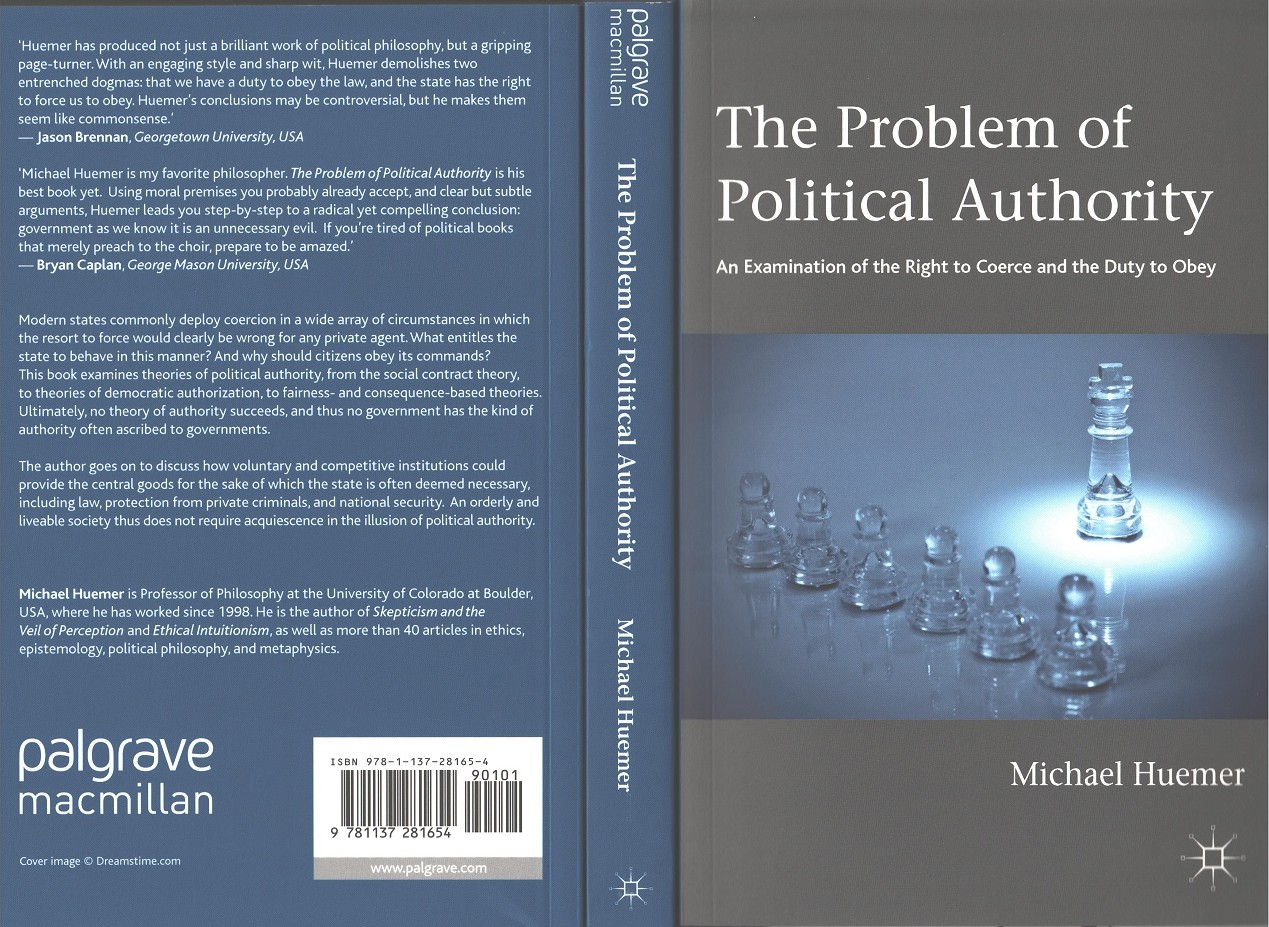
One of the remarkable assumptions that John Locke makes here, and in the 2d Treatise more generally, is that a government cannot have any power that individuals didn't have to begin with. This is a line of thinking that my fellow University of Colorado Boulder professor Michael Huemer pursues in a fascinating way in his book The Problem of Political Authority: 

To the extent I think that governments can legitimately do more than Michael Huemer thinks, it is in part because I think individuals in the state of nature also have the right to do more. For example, I consider individuals in the state of nature to have some rights to compel others to contribute to public goods, especially in exigent circumstances. 

What John Locke clearly states is that governments can put people on trial and punish them if found guilty because individuals had the right to put people on trial and punish them if found guilty in the state of nature. The great virtue of having governments put people on trial is that it is very difficult for individuals to see clearly when someone has done them wrong. I talked about this in "John Locke: People Must Not Be Judges in Their Own Cases." In application to present day circumstances I emphasized in that post the problem of cases with an administrative agency on one side and an individual of company on the other that are judged by judges hired by the administrative agency. A similar problem arises when a company is able to get away with mandatory arbitration in which cases are judged by judges hired by the company. This violates the sound practical principle of justice that people must not be judges in their own cases just as much as administrative agency cases being judged by judges hired by the administrative agency. Thus, in my view, the Consumer Financial Protection Bureau was upholding a Lockean principle when it ruled against mandatory arbitration, while Congress and President Donald Trump were anti-Lockean to overturn the rule against mandatory arbitration.  (I use principles from John Stuart Mill's On Liberty, John Locke's 2d Treatise and Robert Nozick’s Anarchy, State and Utopia to analyze the legitimacy of other aspects of the Consumer Financial Protection Bureau's role in "On the Consumer Financial Protection Bureau.")

The social design problem of organizing things so that our biases don't cause us to do things that are unfair comes up in many other contexts as well, that are less political. For example, economists who are members of the American Economics Association who care about justice have an interest in refereeing systems for the American Economic Review that minimize bias. One thing I worry about in that context, for example, is that the fear that an editor of a major journal might take revenge on someone may inhibit referees from being as tough on the paper of such an editor as on the paper of someone who is less powerful. This is not exactly being a judge in one's own case, but it presents a similar problem of bias. Here of course, I am taking as given the fact that it is very hard to hide the identity of a referee. Even if one avoids citing one's own work in a referee report, the society of economists is in many ways a small world, so that one's views and writing idiosyncrasies are often well known.  

To come full circle, note that one right people have in the state of nature that we don't give up in our polity is the right to criticize others. Here we often organize socially to do collective criticism, as in an election or a poll (where private enterprise is doing some of the social organizing), not because we are giving up the right to criticize as an individual, but because we are afraid of reprisals if we criticize powerful people as an individual, without some protection of anonymity.    

For links to other John Locke posts, see these John Locke aggregator posts: 

Also, see these other posts referencing Michael Huemer:


Critical Reading: Apprentice Level

                                                                    image …

                                                                    image source

                       image source

                       image source

                            image source

                            image source

                                                                  image source

                                                                  image source

Many people speak in favor of critical reading. The trouble is that they often either

(a) talk about critical reading either as if it were a mysterious, though praiseworthy skill, or 

(b) give a roadmap for critical reading that makes it sound very hard.

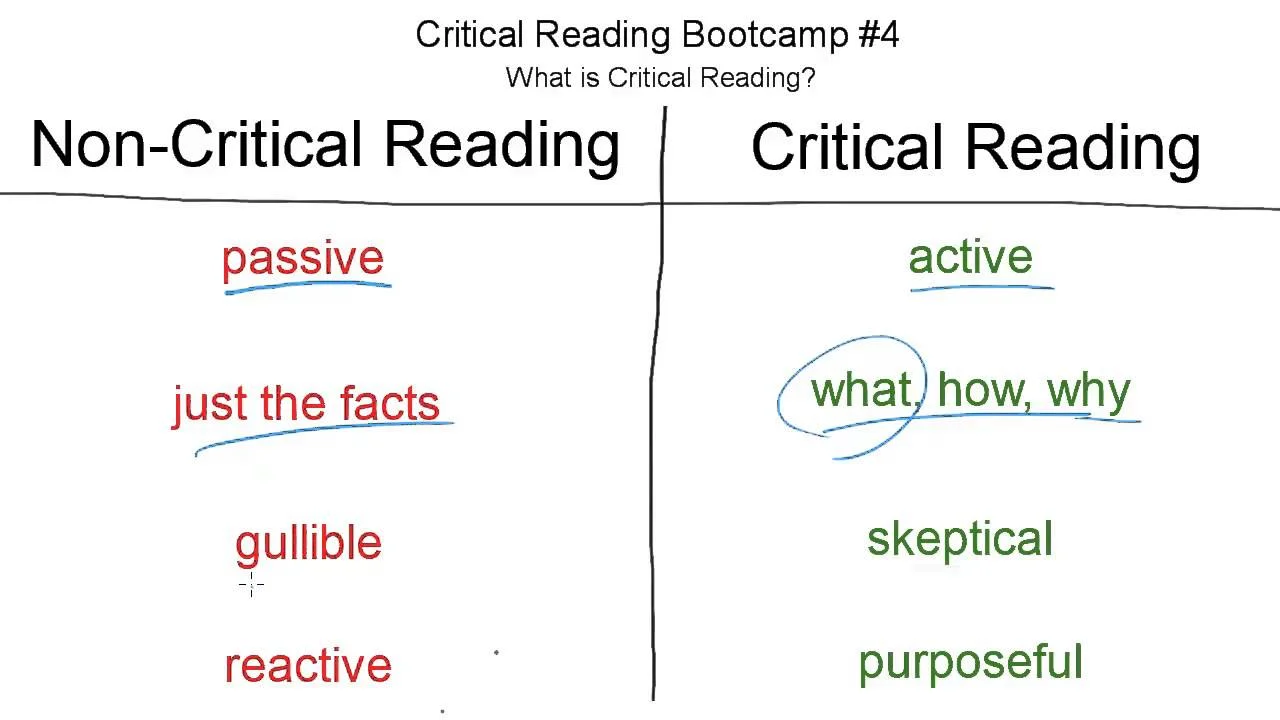
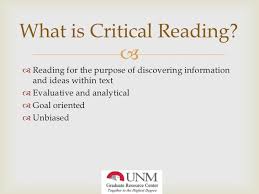
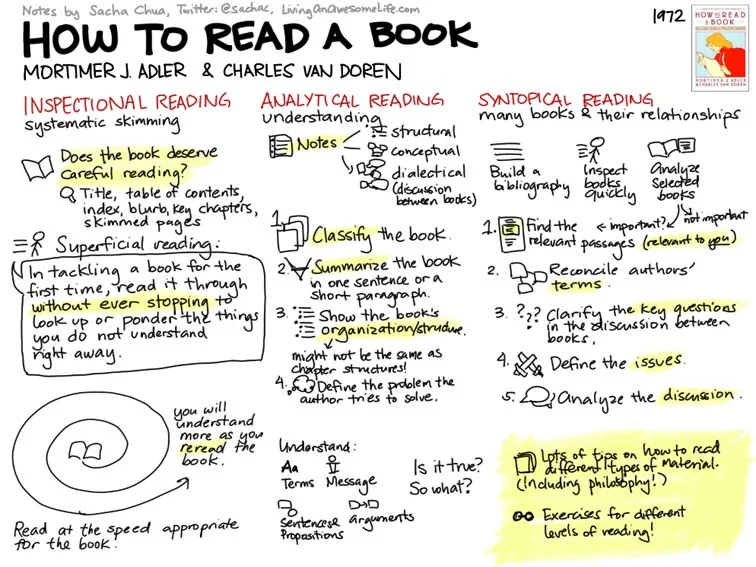
When I look at the descriptions of critical reading in the images above, I feel tired. I feel the same way when I read the first paragraph of the current version of the Wikipedia article on "Critical reading"

Critical reading is a form of language analysis that does not take the given text at face value, but involves a deeper examination of the claims put forth as well as the supporting points and possible counterarguments. The ability to reinterpret and reconstruct for improved clarity and readability is also a component of critical reading. The identification of possible ambiguities and flaws in the author's reasoning, in addition to the ability to address them comprehensively, are essential to this process. Critical reading, much like academic writing, requires the linkage of evidential points to corresponding arguments.

In this post, I want to stick with an easier level of critical reading I think it is reasonable to ask of my students: what I will call the apprentice level of critical reading. The main intent of the apprentice level of critical reading is simply to make what an author said easier to remember, while getting at least some hints of deeper insight. 

Here is how to reach the apprentice level of critical reading:

  • Every few sentences—or maybe every sentence if the writing is complex— ask yourself: "Do I agree with what the author is saying?" (You can do this with the image of thumbs up/thumbs down sign language.)


  • If you disagree, ask yourself

  1. Why do I disagree?

  2. Does the author have any good points on her or his side?

  3. Why might the author believe what they said sincerely, even if it isn't true—or say it insincerely?


  • If you agree, ask yourself

  1. Why do I agree?

  2. Do they have any good arguments I could use someday to argue for the point I agree with?

  3. What are the broader implications of the thing I agree with?


That's it. That is the apprentice level of critical reading. If you do it, you will nail down what the author thinks, where you agree and where you disagree, and you are likely to learn a few other things along the way.

From things you disagree with, you are likely to get ideas you can write about. From things you agree with, you are likely to get things you can think about. And if you are ever asked what the writer thought, you can just consider what you think and then check your memory for whether you were disagreeing or agreeing with the author on that. 


This is a follow-up post to "On Teaching and Learning Macroeconomics."


A Barycentric Autobiography

Before: Miles, May 27, 2016. In Montreal. Photo by Gail Cozzens Kimball. You may use this image as long as your use includes a link to this post.

Before: Miles, May 27, 2016. In Montreal. Photo by Gail Cozzens Kimball. You may use this image as long as your use includes a link to this post.

After: Miles Spencer Kimball, June 19, 2018. Photo by Gail Cozzens Kimball. You may use this image as long as your use includes a link to this post or the home page of this blog: supplysideliberal.com

After: Miles Spencer Kimball, June 19, 2018. Photo by Gail Cozzens Kimball. You may use this image as long as your use includes a link to this post or the home page of this blog: supplysideliberal.com

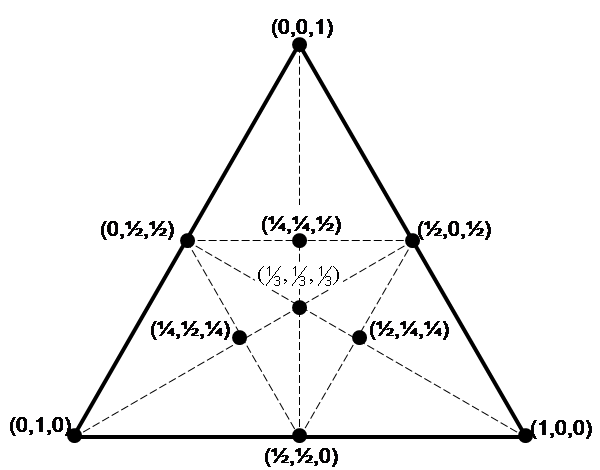
Barycentric coordinates in an equilateral triangle—not what this post is about! Link to the Wikimedia image source. Link to the Wikipedia article "Barycentric coordinate system." 

Barycentric coordinates in an equilateral triangle—not what this post is about! Link to the Wikimedia image source. Link to the Wikipedia article "Barycentric coordinate system." 

Today is the 6th anniversary of this blog, "Confessions of a Supply-Side Liberal." My first post, "What is a Supply-Side Liberal?" appeared on May 28, 2012. I have written an anniversary post every year since then:

  1. A Year in the Life of a Supply-Side Liberal
  2. Three Revolutions
  3. Beacons
  4. Why I Blog
  5. My Objective Function

I asked my self the question "What distinguished my blogging this past year from previous years?" The answer was obvious: for the first time, in the past 12 months, I have written a lot about diet and health. You can see links to those posts at the bottom of this post. My first major post on diet and health was "Obesity Is Always and Everywhere an Insulin Phenomenon," on September 21, 2017. That was preceded by

My posts on diet and health have attracted a lot of readers. For all of 2017, three of the top four posts talk about diet and health. Here is the top of the list from "2017's Most Popular Posts":

  1. Five Books That Have Changed My Life  6936
  2. Obesity Is Always and Everywhere an Insulin Phenomenon  5979
  3. There Is No Such Thing as Decreasing Returns to Scale  4441
  4. Forget Calorie Counting; It's the Insulin Index, Stupid  3927

(I discussed Jason Fung's book The Obesity Coden as one of the "Five Books That Have Changed My Life.")

In early July, I'll do a data post on the most popular posts in the first half of 2018. I can tell you already that diet and health posts will be at the top—both in the category of new posts in 2018 and posts from earlier years with continuing popularity. (Let me hasten to add that diet and health posts only account for about one blog post per week. I am still writing all the time about everything else!)

Because blogging about diet and health has become a thing for me, I thought I should give a little more history about why I am interested in this area. Part of the answer is that, as I intimated in "On Teaching and Learning Macroeconomics," as a macroeconomist I am always on the lookout for things that are a big deal for overall social welfare. You can see that angle on the rise of obesity in "Restoring American Growth: The Video."

Joe Weisenthal asked me how I got interested in this area in the podcast "Miles Kimball Explains to Tracy Alloway and Joe Weisenthal Why Losing Weight Is Like Defeating Inflation." I said two things. First, I have very broad interests. In my recruiting conversations here at the University of Colorado Boulder, I legitimately claim to have a toe in almost as many fields of economics as I have toes. I am also proud to say that according to REPEC I am currently in the top 100 economists in the world in "breadth of citations across fields." The second reason I gave Joe for how I got into diet and health is that it is personal for me.

Today, let me explain why my life experiences have made me think about diet and health. I am calling this a barycentric autobiography. "Bary" means heavy in Greek, and shows up in the the weight-loss context in the word "bariatric surgery." The word "barycentric" normally refers to the center of mass or weight, as in barycentric coordinate systems which specify a location by the weights it would take to make that location a center of mass. But here I am using the word "barycentric" in "barycentric autobiography" half in jest to mean "centered on weight."

My story begins with the fact that my mother was quite overweight. As I hinted at in my eulogy "My Mother," my mother had strong views about many things. She told us, her children, that from her we probably had gotten the "fat gene" and so needed to be especially careful about what we ate. She gave us strict rules that we couldn't eat at home outside of meal times without special permission. I remember being amazed when I visited my friend David Benforado's house how confident he was that his parents would be OK with his getting us ice cream for a snack when they weren't around. When I was turning 8 years old, the age when Mormons get baptized "for the remission of sins," I remember thinking I would have to stop stealing raisins from the refrigerator once I was baptized. 

My Dad was always relatively thin. My mother would have said he just didn't have the fat gene. (Recently, human genetics research has shown convincingly that there isn't one gene that has a big effect on body mass index; rather there are many, many genes that each have a small effect on body mass index, adding up to a big effect of genes overall, but one that leaves plenty of room for other factors besides genes to have an effect.) But there was another unusual fact about my Dad's eating habits that I now think helped keep him thin: my Dad routinely skipped breakfast and lunch. Typically, he only ate in the evening. Then he ate whatever he wanted. (See "Stop Counting Calories; It's the Clock that Counts.")

The upshot is that I was very aware of the dangers of weight gain from an early age. But my knowledge of what might contribute to weight gain was only what was conventional wisdom at the time. I was born in 1960. One idea common in the 70's, during my teens, was the idea that foods helpful for diabetics were also likely to be helpful for losing weight or avoiding weight gain, and avoiding sugar was thought to be crucial for diabetics.

Another bit of conventional wisdom both then and now is that exercise is helpful in avoiding weight gain. My take on the scientific evidence circa 2018 is that the idea exercise is helpful in avoiding weight gain is true, but that regular exercise is much more helpful in avoiding weight gain that it is in inducing weight loss. (See the article I renamed "Julia Belluz and Javier Zarracina: Why You'll Be Disappointed If You Are Exercising to Lose Weight, Explained with 60+ Studies.") Importantly, other evidence suggests that exercise helps make people happy, smart and healthy even when it does not lead to weight loss. In my late teens and early twenties, I would jog regularly. Later on, I made it a practice, still to this day to do a walk almost every day. I also have been on the lookout for situations where a willingness to do some serious walking and count it as part of my exercise time could save me parking fees or other inconveniences. And I have taken to heart the idea that one should lean toward taking the stairs instead of the elevator whenever it's reasonable. 

The guidance of the conventional wisdom was not enough to keep me from gradually gaining weight over the decades. I am 5' 7.5" (171.5 centimeters) tall. In high school, I wrestled at the weight of 132 pounds. When I married Gail in 1984, I weighed 148 pounds. By the time I moved from the University of Michigan to the University of Colorado Boulder in 2016, I weighed around 188 pounds. Along the way, I regularly read popular press articles about diet and health. In the late 1980's I followed the prevailing lowfat advice at the time. I ate a lot of Bran Flakes and skim milk and gained quite a few pounds from that experiment. Every once in a while I would go off ice cream and would lose several pounds. But I was mostly grateful I didn't have worse problems with weight, since I saw many friends who had weight problems, several of whom had to be treated for sleep apnea (trouble in breathing at night), for which the key risk factors are getting older and being overweight.

In the Summer of 2016, we sold our house in Ann Arbor before we could move into our new house in Colorado, so we stayed in an Airbnb in Ann Arbor for a couple of weeks at the tail end of living in Michigan. During that time, I ran into one of my friends in at the University of Michigan Survey Research Center who said he had had a lot of success losing weight on a program where he would alternate between days when he would eat freely and days when he would eat only 500 calories. He was convincing enough that I decided to try it. I followed that approach for about 6 months—roughly the second half of 2016—though I think I targeted 600-650 calories on the low-food days instead of 500. Trying to figure out how to get full on only 600 or so calories on the low-food days drove me to invent for myself the big salads that are still a mainstay of what I eat.  

I did lose some weight and found the program of eating only 600 or so calories every other day tolerable. But my wife Gail characterized me as grumpy on the days I was eating only 600 or so calories. I certainly felt a bit deprived. Once we were in Colorado, the days of unrestricted eating often featured a trip to one of the Boulder area's Sweet Cow ice-cream shops. 

Toward the end of 2016, I read reviews of Gary Taubes's book The Case Against Sugar. My wife Gail and I read it soon after it came out in December 2016. Online, Gail ran into someone who said that if you liked The Case Against Sugar, you should read Jason Fung's book The Obesity Code. We read that as well. Of the two books, The Obesity Code is much more impressive in how careful its arguments are. But both books had an effect on us. Gail and I went off sugar, bread, potatoes and rice in early 2016, and a few months later began experimenting with the periods of no food—"fasting"—that Jason Fung recommends. I'll leave the rest of Gail's story for her to tell. But my experience was that the pounds came off relatively quickly. Now, in May 2018, I weigh about 155 pounds. My goal for the next six months is to stay about even. 

One thing that gave me the confidence that I could fast is that as a Mormon (up until the age of 40) I fasted for close to 24 hours once a month. But relative to that experience fasting as a Mormon, I found fasting remarkably easy when I began fasting after having been off sugar, bread, potatoes and rice for a couple of months. The other remarkable comparison was that not eating at all for a whole day was a lot easier and more pleasant than eating 600 calories had been when I had been on the program alternating between days of 600 calories for the day and days of totally unrestricted eating. I attribute the difference to what was happening to my insulin levels; you can see how I think about this theoretically in "Obesity Is Always and Everywhere an Insulin Phenomenon" and "A Conversation with David Brazel on Obesity Research."

In brief, the idea is fasting can get one's insulin level low enough that body fat begins to be metabolized. Once body fat begins to be metabolized, there are enough nutrients in the bloodstream that hunger is quite mild. In other words, effective weight loss keeps you from being very hungry because your cells are getting fed well from your own stores of body fat. If you are really hungry, that is a sign not much fat burning is taking place. (According to my current views, the key to getting your body to metabolize body fat is to get your insulin levels low. The two keys to doing that are fasting and eating low on the insulin index when you do eat, as I discuss in "Forget Calorie Counting; It's the Insulin Index, Stupid.")

In Spring 2017, I gave my inaugural lecture for the Eugene D. Eaton Jr. Chair I hold here at the University of Colorado Boulder. You can see it in "Restoring American Growth: The Video." I realized that some of the feeling that the pace of improvement had slowed down in the United States had to do with something not measured in GDP: the rise of obesity. In that talk, I shared some graphs showing how widespread and relentless the rise in obesity is. This, along with all the interesting things I was learning from my own experience with a roughly lowcarb diet and fasting made me think I should start blogging about diet and health. 

The rest of the story is all there in my posts on diet and health. I plan to keep reading about diet and health and giving my views on what I read. And I plan to keep sharing practical approaches that worked well for me. I appreciate all the interest people have shown in what I have written about diet and health, and people who have shared the results from their own experience in trying out some of the ideas I have been talking about. 

Stepping back for a second from diet and health in particular, in my six years of blogging, I have been very grateful to have readers who have been willing to accept the wide range of topics I write about. Early on, I made the decision that I was going to write about politics and religion in addition to economics. And I have touched on many other topics along the way. To me, all of it is about trying to make the world a better place.

Turning back the rise of obesity would definitely make the world a better place. Getting the science right is crucial for that. Let me say in the strongest terms: I don't think the current conventional wisdom on obesity has the science right. What those who are now called experts say cannot be fully trusted. In my view, we as a society dare not trust an important scientific question to a single discipline. Each discipline gets blind spots. So we need to have at least two disciplines studying each important scientific question. For obesity research, I think economists have the right training to be immensely helpful in cross-checking the views of those who are now treated as experts in nutrition and weight loss.

For me personally, diet and health is only going to be a modest fraction of what I am working on in my career, but I hope some economists make it a major part of their careers. And let me say with all righteous indignation, in advance: Anyone who discourages an economist inclined to pursue research questions about diet and health deserves a black mark in history. Economists working on questions of diet and health have the power to literally save thousands and thousands of lives. I hope to live to see the day when many economists pursue such research. 


Don't miss these other posts on diet and health and on fighting obesity:

Also see the last section of "Five Books That Have Changed My Life" and the podcast "Miles Kimball Explains to Tracy Alloway and Joe Weisenthal Why Losing Weight Is Like Defeating Inflation."

Chris Kimball: Having a Prophet in the Family

It tickles me to have many members of my family as public figures to some degree. In the podcast above, my brother Chris is being interviewed what it was like to have my grandfather Spencer W. Kimball, the 12th President of the Mormon Church, in the family.

Chris has appeared in supplysideliberal.com many times. Here are other posts Chris authored or coauthored:  

Postscript. Other reasonably famous relatives include my great-great grandfather Heber C. Kimball, who was Brigham Young's First Counselor (2d in command of the Mormon Church back then); my father's first cousin Hal Eyring, who has been First Counselor to one Mormon Prophet and Second Counselor to two others; his father Henry Eyring, who, to quote Wikipedia's article on Henry Eyring

...received the Wolf Prize in Chemistry in 1980 and the National Medal of Science in 1966 for developing the Absolute Rate Theory or Transition state theory of chemical reactions, one of the most important developments of 20th-century chemistry.

Trying to live up to the standard of my great uncle Henry Eyring has been an important motivation to me in my scientific efforts as an economist. Trying to do something in the religious dimension that my grandfather, Spencer W. Kimball, excelled at, has been an important motivation to me in my efforts at blogging about religion. 

More distantly, Mitt Romney, whom I hope will soon be a senator from Utah, is my father's 2d cousin. Of my living relatives who are public figures to some degree, Mitt Romney and Henry B. Eyring are the two I would disagree with most. 

I have written about my Dad, Edward Lawrence Kimball here; he has a Wikipedia article, as does my uncle, Spencer Levan Kimball. My daughter, Diana has a popular blog at dianaberlin.com and a popular Twitter feed: @dianakimball.

Someone who is not a relative by the usual standards, but whom I would like to claim, is Eugene England. Eugene, who died in 2001, is my brother Jordan's father-in-law, a prominent Mormon intellectual, and a very good man. 

On Teaching and Learning Macroeconomics

Miles Kimball in Maui, November 2017—1/3 of a century wedding anniversary trip. Photo by Gail Kimball. See Gail's guest posts here and here.

Miles Kimball in Maui, November 2017—1/3 of a century wedding anniversary trip. Photo by Gail Kimball. See Gail's guest posts here and here.

I have been thinking about macroeconomics for 42 years. As for many other areas, I have many strongly held views. Fortunately, by the customary standards of the economics profession, I have paid my dues enough that most economists would consider me to have earned the right to strongly held views, even if they disagree with them.

In particular, I know personally the authors of many of the most popular macroeconomics textbooks, and am confident that they would be OK with me talking back to them on the question of how macroeconomics should best be taught. My dissertation advisor Greg Mankiw is the author of two bestselling macroeconomics textbooks: one at the Principles of Macro level and another at the Intermediate Macro level. Greg in particular would be OK with instructors having a back and forth dialectic between the views he presents and the views of the instructor of a macroeconomics course. 

Macroeconomics is a young field. Not everything in macroeconomics has been figured out. There are many things on which almost all macroeconomists agree. But there are many other things in macroeconomics on which there is no fully-agreed-upon consensus. So understanding macroeconomics requires learning to deal with debate. Dialectic, "the art of investigating or discussing the truth of opinions" (definition from Google), is an appropriate word here. Dealing with debate means not every issue will be nicely wrapped up in a bow. Students need to develop the skill to understand arguments, evaluate arguments, and formulate their own arguments. 

Although I have taught Principles of Macroeconomics and an advanced undergraduate Monetary and Financial Theory class many times in the past, currently, I teach the more advanced Intermediate Macroeconomics course required of economics majors. So I will focus most of my discussion here on Intermediate Macroeconomics. You can see a lot about how I approach my Intermediate Macro class on the fully public website for my Intermediate Macro class. (You might also be interested in the websites for my Principles of Macro class and for my Monetary and Financial Theory class.) 

There are two big purposes for taking a course in macroeconomics: gaining key skills, and gaining familiarity with key ideas related to macroeconomics. Let me start by laying out the key skills I want my students to gain, then touch on some of the ideas I want my students to become familiar with.

I consider the skills that students learn central because it is always possible to learn facts later on. But a college class is a golden opportunity to learn tough skills. Bryan Caplan has a book claiming that students don't really learn much in college. I hope that isn't true. And if it is true in general, I hope it isn't true in my class. 

Link to the Amazon page for Bryan Caplan's book The Case Against Education

Link to the Amazon page for Bryan Caplan's book The Case Against Education

Skills

Here are the skills I want my students to gain in my Intermediate Macro class:

  • Reading: the ability to read articles in the newspaper and posts in the blogosphere and understand them.

  • Writing: the ability to think of an angle with some bite to it, come up with a thesis statement and defend it.

  • Math: the ability to answer the question "how much" using the tool professional economists use routinely to answer this question: logarithms and the concept of a percent change as the change in a logarithm.

  • Graphing and Logic: the ability to work through the implications of a shock on many variables in a complex set of graphs and to figure out the directions of some effects that might look ambiguous but aren't.

Asking my students to write a blog post of their own each week, talking back to articles in the newspaper, articles online and even things I say, is the main way I organize things so students learn better how to write. I have had a lot of success in getting students to write quite well, as you can see from all the posts my students have written that I made into guest posts on this blog. I wrote "On Having a Thesis" and "Brio in Blog Posts" to help students with the basics of writing. I believe enough in the importance of writing that I spend significant class time early on talking about it. And the main job of my teaching assistant is to read and give feedback on students' writing. 

I hope that needing to get ideas to write about—and especially identifying other people's opinions they disagree with, helps students to learn to read better as well. In addition, I assign many of my own blog posts as extra reading assignments so that students are confronted with learning how to read and understand that kind of writing as well as to read and understand the kind of writing in the textbook. Update: See "Critical Reading: Apprentice Level."


My starting point for teaching how to use logarithms and "Platonic" percent changes defined as the change in logarithms is to have them read "The Logarithmic Harmony of Percent Changes and Growth Rates." I push those techniques further in "The Shape of Production: Charles Cobb's and Paul Douglas's Boon to Economics" and in many exercises on my Intermediate Macro website. In particular, see the resources linked here.  

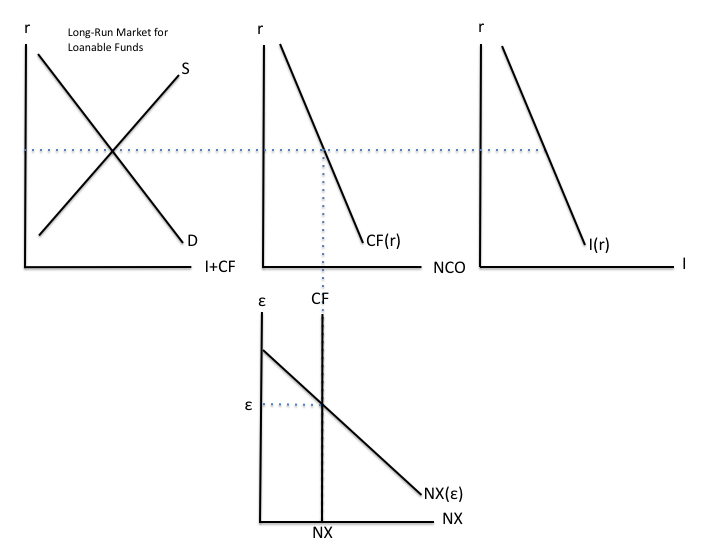
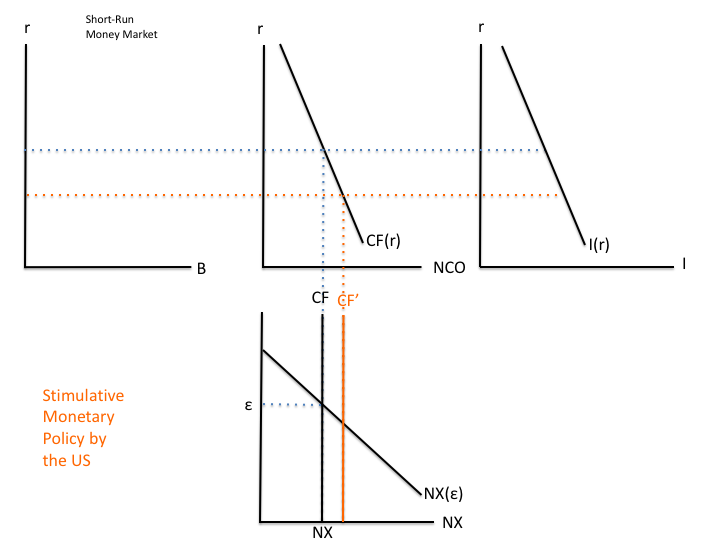
To teach graphing and logic, I emphasize a set of international finance graphs you can see below. I augment the large open economy graphs from Greg Mankiw's textbooks with an extra graph on the right showing physical investment as a function of the real interest rate. I also have two different versions: long-run and short-run. The long-run graphs have the market for loanable funds on the left, while the short-run graphs have the central-bank-determined real interest rate on the left. The other three graphs in the set of four stay the same between the long-run and short-run.   

If you want to see where logic comes in for resolving seeming ambiguities, take a look at this post from the class website. But it is quite advanced. Don't try until you are far along in my class or otherwise have a lot of training in economics. 

You can see my views about the primacy of skills in "The Coming Transformation of Education: Degrees Won’t Matter Anymore, Skills Will." I don't want my students to just get a degree. I want them to be able to impress employers with their skills, and to have the skills they need when they themselves becomes bosses. 

Ideas

I don't get bent out of shape trying to expose my students to every significant idea in macroeconomics. That would be impossible in one semester, even given what they have already learned in Principles of Macro. My main hope for students to learn every significant idea in macroeconomics is for them to get interested enough in reading the news and reading in the economics blogosphere. Decades of reading beats whatever can be taught in one semester, hands down. 

In class, I have gravitated over time to a less-is-more approach, particularly in relation to the content of the textbook. I only use the first ten chapters of Greg Mankiw's Intermediate Macro textbook Macroeconomics. This gives me time to talk about other key concepts my students might have an especially hard time picking up elsewhere. From the textbook, the most important ideas are these:

  • The difference between the short run and long run.

  • The art of economic modeling and how the concept of "exogenous" and "endogenous" set the boundary of any particular economic model; what is "exogenous"—outside the scope of things to be explained—in one econonomic model may be "endogenous"—within the scope of things to be explained—in another model. One objective of economic research is to bring more and more things within the scope of things to be explained by economic models. But in learning, it helps to start with simpler models and gradually work one's way up to models that bring more things within the scope of things to be explained.

  • Why central banks are able to have a big, important effect on the economy in the short run, but in the long run can only affect inflation and other relatively important things like real money balances.

  • Why net exports ("the trade balance") is determined by what people want to do with their savings.

  • How the question of why some countries are rich and some countries are poor is basically the same question as why some countries have had a lot of economic growth and others haven't. (Hint: All countries used to be poor.)

  • How the four main contributors to growth in per capita income are (a) physical capital accumulation, (b) education or "human capital accumulation," (c) copying technology from other countries, and (d) inventing new technology.

  • Why it takes a long time to see the benefits of physical or human capital accumulation.

  • Where we are in relation to the potential of capital accumulation to raise long-run consumption.

This is an impressive list. But many other important ideas are missing from most macroeconomic textbooks, even if one goes to the later chapters. Here are some of the ideas I consider so important that I teach them in class, and often have written blog posts to help explain them:

Finally, there are two ideas connected to the short-run/long-run distinction that are taught well in textbooks, but that I find I need to emphasize because it doesn't always get through:

  • In the short run, central banks control the nominal and therefore the real interest rate, but cannot control inflation. (I view not just the price level, but the rate of change in the price level as sticky or "sluggish" in Michael Kiley's terms. See "Trillions and Trillions: Getting Used to Balance Sheet Monetary Policy.")

  • In the long run, central banks control inflation and therefore the nominal interest rate, but cannot control the real interest rate. This means for example that pension funds that want a higher long-run interest rate are mistaken when they complain that central banks have made the long-run interest rate too low.

One of the reasons I can get away with focusing on just ten chapters of Mankiw's Macroeconomics is my view that central banks are powerful enough to do the job of macroeconomic stabilization. That view is explained in "Even Central Bankers Need Lessons on the Transmission Mechanism for Negative Interest Rates," "Responding to Joseph Stiglitz on Negative Interest Rates" and "Negative Rates and the Fiscal Theory of the Price Level." Other than automatic stabilizers and the normal reaction of fiscal policy to monetary policy that I discuss in "Negative Rates and the Fiscal Theory of the Price Level," I view the proper role of fiscal policy as a long-run role. The two exceptions are:

  • In the months before the effects of monetary policy take hold—for that I recommend credit policy which is somewhere in between monetary policy and fiscal policy (see "Monetary vs. Fiscal Policy: Expansionary Monetary Policy Does Not Raise the Budget Deficit")

  • Some countries share their monetary policy with other countries. The euro zone is the most important example. Credit policy may be useful for macroeconomic stabilization when the shared monetary policy is not well-adapted to the regional situation. Denmark, which is not in the euro zone, but keeps a fixed exchange rate with the euro, has used credit policy to good effect. See my Wakelet story "Denmark's Brilliant Stabilization Policy."

The other way that an appreciation of modern and next generation monetary policy can simplify teaching is the realization that interest rate targets make the details of the money multiplier relatively unimportant except in explaining the Great Depression and some of the investment mistakes people made during the Great Recession betting on inflation because they didn't understand that both the money multiplier and velocity had fallen dramatically. (On what I mean by next generation monetary policy, see "Next Generation Monetary Policy," "Alexander Trentin Interviews Miles Kimball on Next Generation Monetary Policy" and in relation to one dimension of next generation monetary policy, "The Economist: Improvements in Productivity Need to Be Accommodated by Monetary Policy.") 

Applying the Science of Successful Learning

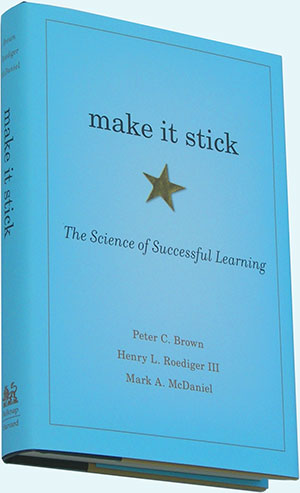
Anyone who wants to be a B student, an A student or learn even more than that should read the book Make It Stick. I can summarize the main point this way. If you want to get knowledge into long-term memory, reading and rereading won't do the trick. Your brain only puts something into long-term memory if you prove to your brain that it is worth remembering that thing by trying to remember it. So the activity of trying to remember things is the key to learning something not just for the exam tomorrow but learning it for good.

Besides telling my students what I just said in the last paragraph, the way I use this principle in my class is by treating exams primarily as learning opportunities and only secondarily as evaluation devices. Exams cause students to try to remember things. Before each of the three exams, I ask students to do over the weekend the exam from the previous year as a practice exam—under time pressure. Then I go over that practice exam carefully in the class right before the exam. After the exam, I consider the class where I go over the answers one of the most important class periods for learning.

When I write each exam, I am thinking about what I most want students to remember down the road, since I know they will remember what ended up on the exams much more than any other specific things from the class. The answers to the exam questions represent the bulk of the key ideas and some of the key skills I want the students to take away from the class. 

Update: I channeled the book Make It Stick in this Quartz column:The Most Effective Memory Methods are Difficult—and That's Why They Work.” Be sure to take a look at that column.

Conclusion

"Macro" comes from the Greek word for "large." To me, macroeconomics is exciting because the issues it addressed are a big deal in the real world. Debates about macroeconomic policy are the heart and soul of macroeconomics. And anything that is a really big deal for overall economic welfare is appropriately a part of macroeconomics. It doesn't make sense to study macroeconomics without talking about the ways in which we might be able to make the world a better place by judicious economic policies that have a big effect on the economy as a whole.  

Finally, macroeconomics tends to focus on overall economic growth. But fairness is also important. In the buzzwords from Principles of Microeconomics, "equity" matters as well as "efficiency." The two topics I don't have time to cover in Intermediate Macro, but did cover when I taught Principles of Macro, were how to calculate present values to figure out how much saving you need to do for retirement, and how to apply diminishing marginal utility to think about social welfare functions. You can see a hint of how I taught those ideas on my Principles of Macro website. You can see more of how I approach social welfare functions in "What is a Supply-Side Liberal?" and "Inequality Aversion Utility Functions: Would $1000 Mean More to a Poorer Family than $4000 to One Twice as Rich?" To see why you should be concerned about issues of fairness, see Brad DeLong's eloquent technical discussion of the objective function of the free market here


Other Posts that Are on the Advanced Side, But Could Be Useful in Teaching Macroeconomics"