Attaining and maintaining an appropriate weight is an increasingly rare accomplishment. It has, in expectation, many health benefits, as well as numerous other practical benefits. (See "The Heavy Non-Health Consequences of Heaviness.") If you share the goal of attaining and maintaining a healthy weight, it is important to focus on the timing of eating, as I argue in "Stop Counting Calories; It's the Clock that Counts." In addition, as I argue In "Forget Calorie Counting; It's the Insulin Index, Stupid," you should focus on the food insulin index in choosing which foods to eat.
"Forget Calorie Counting; It's the Insulin Index, Stupid" gives an organized table of all the data on the food insulin index I have been able to lay my hands on so far. Unfortunately, there are many, many foods and beverages for which the insulin index has not been measured. Sometimes it is possible to guess the insulin index of a food or beverage from the insulin index for similar foods—especially when similar foods have a very high insulin index. But in other cases, not knowing the insulin index for a particular type of food makes it hard to guess whether that type of food is healthy or not. In some fraction of those cases, the glycemic index can be helpful, if used with great caution.
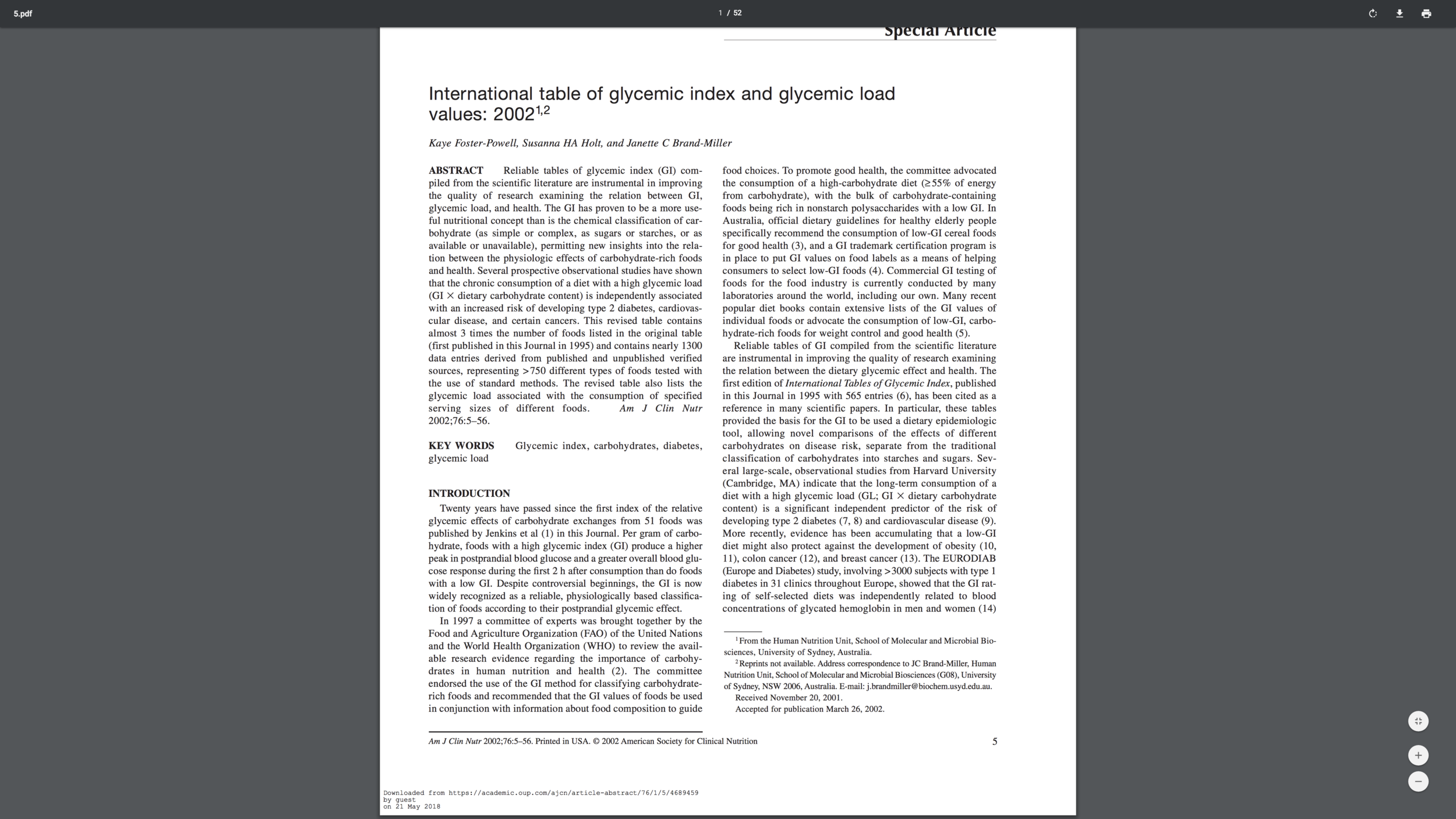
The big advantage of the glycemic index is that it has been measured for a huge range of foods and beverages. At the top of the post is a link to an especially extensive list that I use as my primary data source for this post. This list has several advantages. First, it shows the range of different estimates for different varieties of seemingly similar foods with very different glycemic indexes. Second, it gives standard errors. (Remember that you have to double the standard error on each side of the point index to get a 95% confidence interval.) Third, the article having been peer-reviewed makes me a little more confident that the numbers in the table are of reasonable quality.
I focus here on what I learned from reading this table. Where the message is the same as in "Forget Calorie Counting; It's the Insulin Index, Stupid" (for example "Nuts are great!") I won't say much here. And indeed, the bulk of the table flagged above was saying that foods I categorized as unhealthy in "Forget Calorie Counting; It's the Insulin Index, Stupid" also look unhealthy through the lens of the glycemic index.
Limitations of the Glycemic Index.
The glycemic index measures the effect of a food or beverage on blood sugar. Since a surge in blood sugar reliably generates an insulin response, a high glycemic index almost always indicates a high insulin index. But the reverse is not necessarily true. A food or beverage can have a relatively low glycemic index while having a much higher insulin index. There are three big blind spots of the glycemic index:
Protein often generates an insulin response. So meat and other high-protein foods are not as innocent as they appear from looking at the glycemic index.
Oversimplifying a bit, fructose goes straight to the liver without staying long in the bloodstream. A large amounts of fructose going straight to the liver is not so great. So anything with fructose in it is much less innocent than it might appear from looking at the glycemic index.
Though the science is at a much earlier stage than I would like, some types of nonsugar sweeteners boost insulin. So nonsugar sweeteners are not all as innocent as they appear from looking at the glycemic index.
Although I focus here on what can be learned from the glycemic index, remember that you can experiment with yourself as a guinea pig and quickly learn a lot from your own experience. It doesn't take long for data you collect on yourself to have more statistical power than the typical data set in macroeconomics. And a close look at the table above shows that the precision in the table as indicated by the standard errors has often been achieved from studying a relatively small sample. So don't underestimate what you can learn from your own experience.
The key to experimenting with yourself to guess how big an insulin kick a given food or beverage has is closely connected to why you should care about the insulin index in the first place. The big problem with high-insulin-index foods and beverages is that big spikes in insulin drive down blood sugar and make you hungry again relatively soon. And from my own experience and that of others I know well, I can say that consuming foods and beverages high on the insulin index can make it significantly more difficult to fast. (Though I don't fully understand the mechanism, subjective hunger during fasting, even 24 hours later, seems to be higher if one was eating foods high on the insulin index before beginning the fast.) So the way to get a read on the insulin kick of a given food or beverage is to pay attention to whether you feel hungry again relatively soon afterwards and whether you have extra difficulty fasting after consuming that food or beverage. My wife Gail and I use this approach all the time to get an additional reading on how healthy a given type of food is.
Lessons from the Glycemic Index
In cases where protein, fructose and nonsugar sweeteners are not an issue, my rule of thumb for converting a glycemic index to an insulin index equivalent (as discussed in "Forget Calorie Counting; It's the Insulin Index, Stupid) is to multiply by 1.1. This rule of thumb uses the version of the glycemic index that gives glucose a glycemic index of 100, which is given in the leftmost column of numbers in the table flagged at the top of this post. Confusingly, sometimes a glycemic index with white bread as 100 is used. Making white bread instead of glucose 100 makes the number for the glycemic index 1.4 times as big. This explains some tables in existence that have glycemic indexes that look too high.
Combined with my rule of thumb of avoiding any food that has an insulin index of 50 or above, the rule of thumb of multiplying a glycemic index by 1.1 to get an insulin-index equivalent means my recommendation is to avoid anything with a glycemic index above 45. But I give a little extra leeway to whole fruit, since I find myself unable to completely shake the conventional wisdom that fruit is healthy. (I have no trouble in completely dismissing the conventional wisdom that fruit juice is healthy. It isn't. Fruit juice has way too much sugar that hits your system like a ton of bricks.)
I should say that the advice of avoiding anything with an insulin index 50 or above or a glycemic index above 45 is for anyone who has ever had a problem with their weight. If you have been thin all your life so far, my advice is less rigorous: those who have always been thin might well be able to stay that way simply by strictly avoiding anything with added sugar or sugars, avoiding sweet beverages and processed food, and keeping their eating window each day down to 10 or 12 hours. I base this advice on my view of the epidemiology of obesity: the two things that have approximately the right timing to explain the secular rise of obesity are the ready availability of sugar, the rise of processed foods and beverages and the trend toward eating around the clock every waking moment.
Now, to what I learned from studying glycemic index tables:
A. Bean and Lentils May Be OK. The insulin index data on beans and lentils are quite sparse. The glycemic index data on beans and lentils are reassuring that they may be OK. But you should make sure to pay attention to data from your own experience as your own personal guinea pig for two reasons:
Nevertheless, I think it is quite reasonable to experiment and see if you can eat beans and lentils without getting too hungry later on. It should go without saying that you should avoid processed foods made from beans and lentils that have added sugar. Unfortunately, that will include most canned soup as well as many varieties of canned beans. On the likely dangers of sugar, see "Diseases of Civilization", "Sugar as a Slow Poison", "The Case Against Sugar: Stephan Guyenet vs. Gary Taubes", The Case Against the Case Against Sugar: Seth Yoder vs. Gary Taubes", and "Gary Taubes Makes His Case to Nick Gillespie: How Big Sugar and a Misguided Government Wrecked the American Diet." On processed food more generally, see "The Problem with Processed Food."
I should also warn that beans and lentils are likely to be in the category I labeled "Portion Sizes Should Be Kept Small Except on Special Occasions" in "Forget Calorie Counting; It's the Insulin Index, Stupid." In other words, beans and lentils are not freebies. My prediction is that most people can eat moderate amounts of them without getting rebound hunger, but will get rebound hunger if they eat large amounts of beans and lentils.
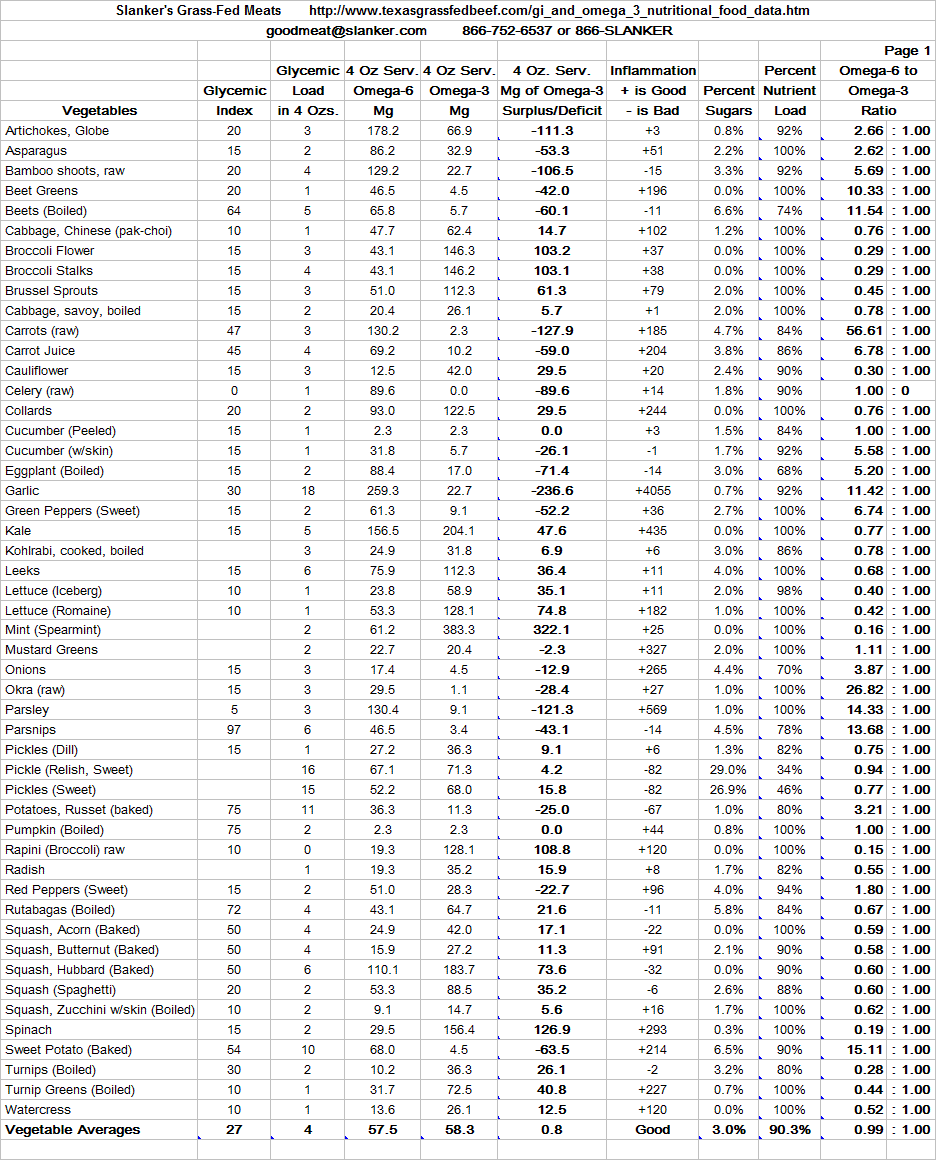
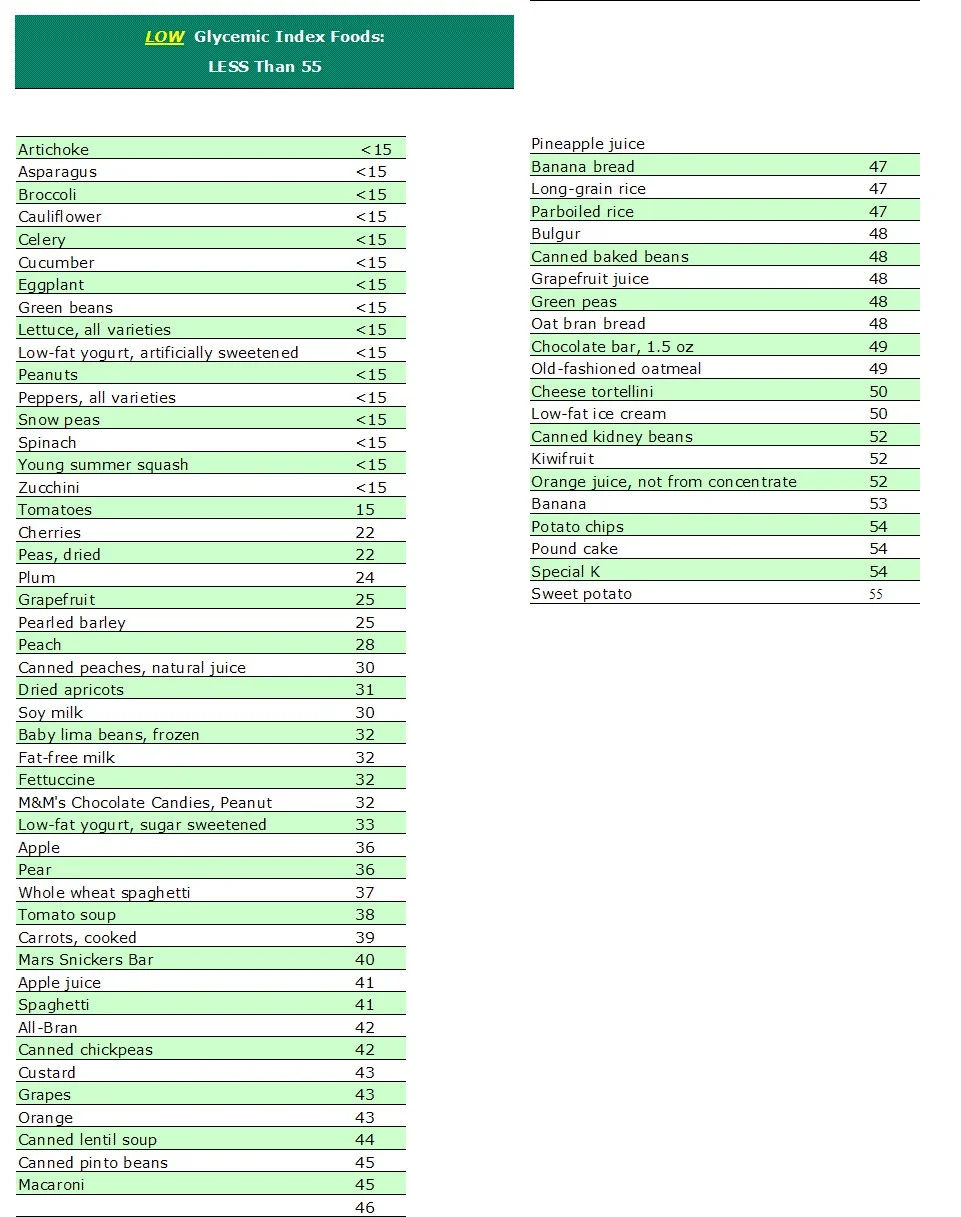
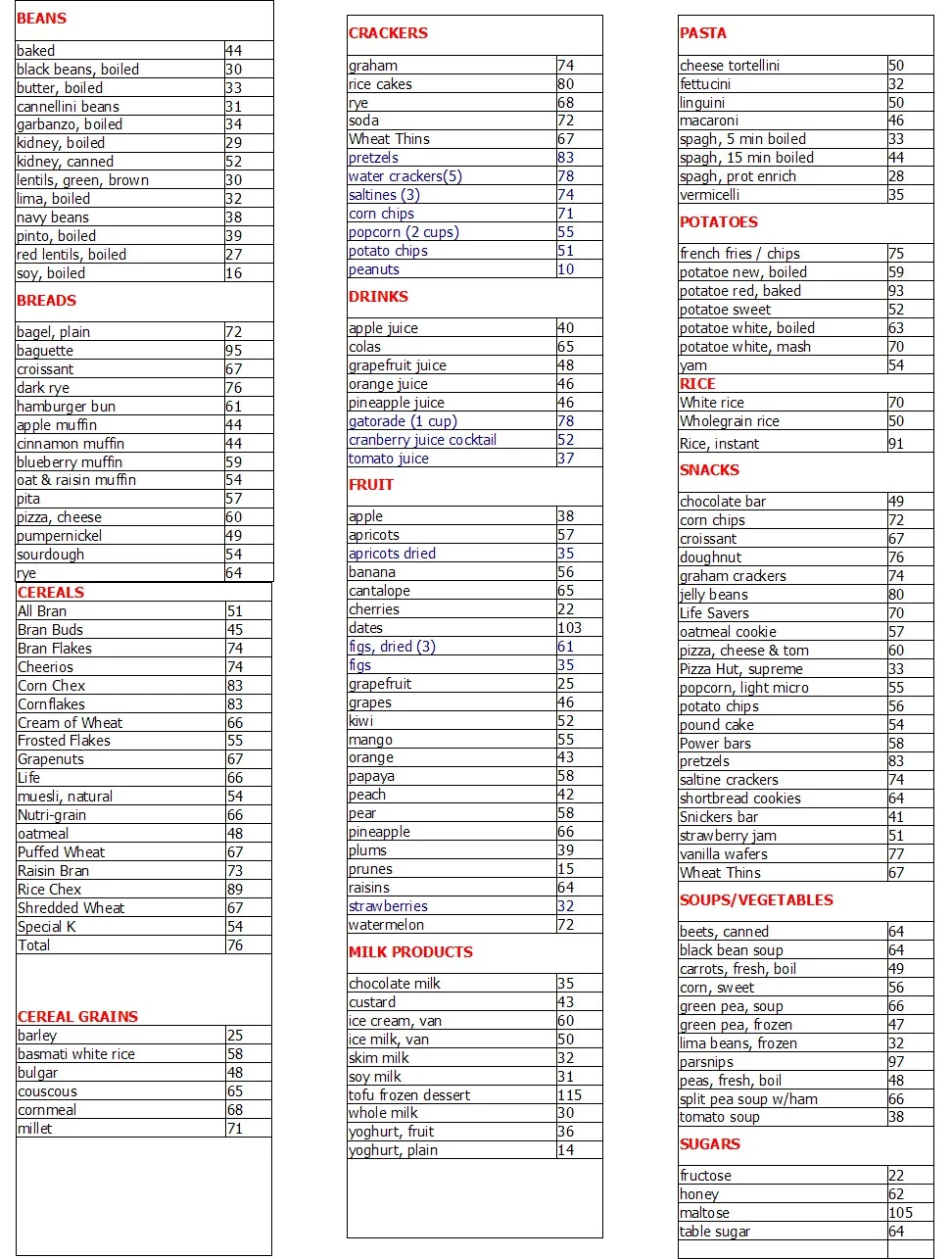
B. Nonstarchy Vegetables are Indeed Good. In "Why a Low-Insulin-Index Diet Isn't Exactly a 'Lowcarb' Diet" I mirror Wikipedia's list of nonstarchy vegetables. Below I give that list again, plus a few additions, with glycemic index numbers beside them. Strangely, the table flagged above reports almost no glycemic indexes for nonstarchy vegetables, so these numbers are from other sources, particularly the charts I found by searching for Google Images related to the glycemic index. I mirror a few of those images after the list. When they disagreed, I chose the higher of the numbers. In the few cases when something had a high glycemic index I removed it from this list and put it on the list of (presumptively) starchy vegetables further below.
Alfalfa sprouts
Arugula
Artichoke 20
Asparagus <15
Bamboo shoots (raw) 20
Bean sprouts
Beet greens 20
Bok choy 10
Broccoli 15
Brussels sprouts 15
Cabbage 15
Cauliflower <15
Celery (raw) 0
Chayote
Chicory
Chinese cabbage
Chinese spinach
Collard greens 20
Cucumber 15
Eggplant 15
Fennel
Garlic 30
Green beans <15
Green onions
Greens (beet or collard greens, dandelion, kale, mustard, turnip)
Hearts of palm
Herbs (parsley, cilantro, basil, rosemary, thyme, etc.)
Jicama
Kale 15 (but other sources suggest kale is a bit lower than lettuce)
Kohlrabi
Leeks 15
Lettuce 10
Mushrooms
Okra (raw) 15
Onions 15
Parsley 5
Peppers <15
Purslane
Radishes
Rapini
Rhubarb
Sauerkraut
Scallions
Shallots
Snow peas or pea pods <15 (Peas that are eaten without eating the pods are much higher on the glycemic index. See below.)
Spinach 15
Summer squash <15 (Note that other kinds of squash that are eaten without the rind have a much higher glycemic index.)
Swiss chard
Tomatillos
Turnips 30
Water chestnuts
Watercress 10
Yellow, wax or Italian beans
Zucchini <15