The Keto Food Pyramid
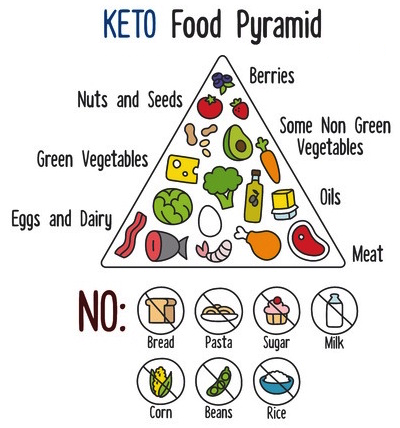
Link to the source for this graphic
I consider the amount of insulin a food or beverage causes the body to produce a key benchmark for nutrition research. For any nutrition claim, I want to know how much of the causality is working through insulin and what effect is left over when insulin production is held constant either experimentally or statistically. You can see why I take this view in "Obesity Is Always and Everywhere an Insulin Phenomenon" and "Forget Calorie Counting; It's the Insulin Index, Stupid."
Bonnie Kavoussi pointed me to the graphic above, which does a good job at showing how to avoid the types of food that are the very highest on the insulin index. However, taking the insulin index that I discuss in detail in "Forget Calorie Counting; It's the Insulin Index, Stupid" as the gold standard, let me point to a few problems with this graphic:
The Keto Food Pyramid doesn't do a good job at distinguishing between types of food that are medium on the insulin index and those that are low on the insulin index. Avoiding high is most important, but leaning toward low in the choice between low and medium also matters. In particular, any fruit (including berries), as well as most types of meat, poultry and fish need to be eaten in moderation.
While skim milk is high on the insulin index, whole milk is not.
While some types of beans are high on the insulin index, other types of beans are reasonably low on the insulin index.
While I suspect typical American spaghetti is indeed quite bad, existing evidence on the insulin index suggests (surprisingly) that there may be some types of pasta that are not so bad. More research is needed on this.
It is only raw carrots that are OK. Cooked carrots have a higher glycemic index, suggesting a high insulin index.
Potatoes should be on the banned list.
Most important of all, soft drinks, punch and juice need to be on the banned list!
In addition to the key posts mentioned above,
don’t miss my other posts on diet and health:
I. The Basics
Jason Fung's Single Best Weight Loss Tip: Don't Eat All the Time
What Steven Gundry's Book 'The Plant Paradox' Adds to the Principles of a Low-Insulin-Index Diet
David Ludwig: It Takes Time to Adapt to a Lowcarb, Highfat Diet
II. Sugar as a Slow Poison
Best Health Guide: 10 Surprising Changes When You Quit Sugar
Heidi Turner, Michael Schwartz and Kristen Domonell on How Bad Sugar Is
Michael Lowe and Heidi Mitchell: Is Getting ‘Hangry’ Actually a Thing?
III. Anti-Cancer Eating
How Fasting Can Starve Cancer Cells, While Leaving Normal Cells Unharmed
Meat Is Amazingly Nutritious—But Is It Amazingly Nutritious for Cancer Cells, Too?
IV. Eating Tips
Using the Glycemic Index as a Supplement to the Insulin Index
Putting the Perspective from Jason Fung's "The Obesity Code" into Practice
Which Nonsugar Sweeteners are OK? An Insulin-Index Perspective
V. Calories In/Calories Out
VI. Other Health Issues
VII. Wonkish
Framingham State Food Study: Lowcarb Diets Make Us Burn More Calories
Anthony Komaroff: The Microbiome and Risk for Obesity and Diabetes
Don't Tar Fasting by those of Normal or High Weight with the Brush of Anorexia
Carola Binder: The Obesity Code and Economists as General Practitioners
After Gastric Bypass Surgery, Insulin Goes Down Before Weight Loss has Time to Happen
A Low-Glycemic-Index Vegan Diet as a Moderately-Low-Insulin-Index Diet
Analogies Between Economic Models and the Biology of Obesity
Layne Norton Discusses the Stephan Guyenet vs. Gary Taubes Debate (a Debate on Joe Rogan’s Podcast)
VIII. Debates about Particular Foods and about Exercise
Jason Fung: Dietary Fat is Innocent of the Charges Leveled Against It
Faye Flam: The Taboo on Dietary Fat is Grounded More in Puritanism than Science
Confirmation Bias in the Interpretation of New Evidence on Salt
Eggs May Be a Type of Food You Should Eat Sparingly, But Don't Blame Cholesterol Yet
Julia Belluz and Javier Zarracina: Why You'll Be Disappointed If You Are Exercising to Lose Weight, Explained with 60+ Studies (my retitling of the article this links to)
IX. Gary Taubes
X. Twitter Discussions
Putting the Perspective from Jason Fung's "The Obesity Code" into Practice
'Forget Calorie Counting. It's the Insulin Index, Stupid' in a Few Tweets
Debating 'Forget Calorie Counting; It's the Insulin Index, Stupid'
Analogies Between Economic Models and the Biology of Obesity
XI. On My Interest in Diet and Health
See the last section of "Five Books That Have Changed My Life" and the podcast "Miles Kimball Explains to Tracy Alloway and Joe Weisenthal Why Losing Weight Is Like Defeating Inflation." If you want to know how I got interested in diet and health and fighting obesity and a little more about my own experience with weight gain and weight loss, see “Diana Kimball: Listening Creates Possibilities” and my post "A Barycentric Autobiography. I defend the ability of economists like me to make a contribution to understanding diet and health in “On the Epistemology of Diet and Health: Miles Refuses to `Stay in His Lane’.”
Debating 'Forget Calorie Counting; It's the Insulin Index, Stupid' →
In addition to the storify story at the link above, for more contrarian discussion of nutrition, obesity and chronic diseases, don't miss:
- Forget Calorie Counting; It's the Insulin Index, Stupid
- Obesity Is Always and Everywhere an Insulin Phenomenon
- Mass In/Mass Out: A Satire of Calories In/Calories Out
- Jason Fung: Dietary Fat is Innocent of the Charges Leveled Against It
- Faye Flam: The Taboo on Dietary Fat is Grounded More in Puritanism than Science
- Sugar as a Slow Poison
- Kearns, Schmidt and Glantz—Sugar Industry and Coronary Heart Disease Research: A Historical Analysis of Internal Industry Documents
- Salt Is Not the Nutritional Evil It Is Made Out to Be
- Confirmation Bias in the Interpretation of New Evidence on Salt
- Whole Milk Is Healthy; Skim Milk Less So
- How the Calories In/Calories Out Theory Obscures the Endogeneity of Calories In and Out to Subjective Hunger and Energy
- Putting the Perspective from Jason Fung's "The Obesity Code" into Practice
- Julia Belluz and Javier Zarracina: Why You'll Be Disappointed If You Are Exercising to Lose Weight, Explained with 60+ Studies (my retitling of the article this links to)
- Meat Is Amazingly Nutritious—But Is It Amazingly Nutritious for Cancer Cells, Too?
- On Fighting Obesity
- Analogies Between Economic Models and the Biology of Obesity
- Diana Kimball: Listening Creates Possibilities
Also see the last section of "Five Books That Have Changed My Life."
How Did Evolution Give Us Religion?
Hat tip to Joseph Kimball for flagging the video above
Above is a very interesting video that discusses the problems with explanations of religion based on genetic evolution.
This suggests that religion is more likely to be a product of memetic evolution. Internet "memes" may be an example of memes, but in many respects a bad example. The current incarnation of the Wikipedia article "Meme" defines a meme this way:
A meme (/ˈmiːm/ MEEM) is an idea, behavior, or style that spreads from person to person within a culture — often with the aim of conveying a particular phenomenon, theme, or meaning represented by the meme. A meme acts as a unit for carrying cultural ideas, symbols, or practices, that can be transmitted from one mind to another through writing, speech, gestures, rituals, or other imitable phenomena with a mimicked theme. Supporters of the concept regard memes as cultural analogues to genes in that they self-replicate, mutate, and respond to selective pressures.
Richard Dawkins is the coiner of the word "meme," giving it this meaning in his book The Selfish Gene:

The key point Dawkins made was that evolution only requires something that can be (a) propagated with reasonable fidelity, but (b) not with perfect fidelity, leading to variation, which (c) provides the raw material for some variants to be propagated more effectively than others.
Richard Dawkins made another, less well known point in his book River out of Eden:

In the chapter "God's Utility Function," as I interpret it, Richard Dawkins argues that it is things that are subject to evolutionary selection that have utility functions. Viewing things that way, genes have utility functions, and so do memes. The utility functions of religious memes are especially obvious.

For a brilliant book on the memetics of religion, read Pascal Boyer's Religion Explained. Among memes that already exist, fidelity in transmission is a big evolutionary advantage. Among other things, Pascal Boyer shows how to do simple experiments akin to Chinese whispers ("the telephone game" in the US) to gauge the transmission fidelity of different concepts of God or the supernatural. He finds, for example, that violating one normal law of nature is much more memorable than violating two at once—at least until a meme gets off the ground.
Pascal Boyer's technique of Chinese whispers experiments to measure transmission fidelity can be applied to other types of memes as well. For example, I have long thought that the memetics of ideas in the heads of people who trade in financial markets should be studied in this way. If ideas circulating on Wall Street and among traders on other exchanges were identified early on and tested for how memorable they are and how much people want to repeat them, it might be possible to predict which way markets would move in the future. (An idea identifiably good at propagating is likely to gets into more heads.) This would be a way of making more testable Robert Shiller's view of the stock market that I write of in "Robert Shiller: Against the Efficient Markets Theory."
There is a key difference between financial market memes and memes in established religions. Many financial market memes—including financial market memes that move markets—are quite falsifiable. When they are falsified, they often die. By contrast, religious memes that have survived for a long time tend to be very hard to falsify. For example, beliefs about the afterlife are not that easy to falsify. Young religions sometimes have easily falsifiable beliefs, old religions much less.
One of the things that made it easier for me to stop believing in Mormonism is that Mormonism, as a young religion (officially founded in 1830), it still has many reasonably falsifiable beliefs, such as the belief that one can get personal revelations from God that I write about in the middle section of "Five Books That Have Changed My Life." Believing Mormons who read my account are likely to immediately being pushing the belief in personal revelation in a less falsifiable direction, and even I did some of that, but not enough to keep me a believer.
I have long had a fascination with Memetics. (Twice, I taught a Spring semester course on genetic and memetic evolution at the University of Michigan.) I have heard that many people in Silicon Valley and the rest of the tech community have this fascination as well—which is part of how the word "meme" became attached to certain internet objects. I think much more should be done to strengthen Memetics as a scientific discipline. Within anthropology, Memetics is typically called "cultural evolution." That is an important field within anthropology. But Memetics is important for other social sciences as well.
I hope to write more about Memetics here on this blog in the future.
Emma Munbodh: Cashless Shops in the UK →
One question is whether this would be legal in the US. The answer is yes. Below is Q&A text copied from a Federal Reserve Board webpage that Daniel Reck pointed me to on the Facebook page for this post:
Is it legal for a business in the United States to refuse cash as a form of payment?
Section 31 U.S.C. 5103, entitled "Legal tender," states: "United States coins and currency [including Federal reserve notes and circulating notes of Federal reserve banks and national banks] are legal tender for all debts, public charges, taxes, and dues."
This statute means that all United States money as identified above is a valid and legal offer of payment for debts when tendered to a creditor. There is, however, no Federal statute mandating that a private business, a person, or an organization must accept currency or coins as payment for goods or services. Private businesses are free to develop their own policies on whether to accept cash unless there is a state law which says otherwise.
What this means is that there is no Federal law that businesses must accept cash. My question then is this: Which states require businesses to accept cash?
Also on the Facebook page for this post, my nephew Peter Kimball points out that the salad restaurant Sweetgreens in Washington D.C. does not accept cash.
Mass In/Mass Out: A Satire of Calories In/Calories Out
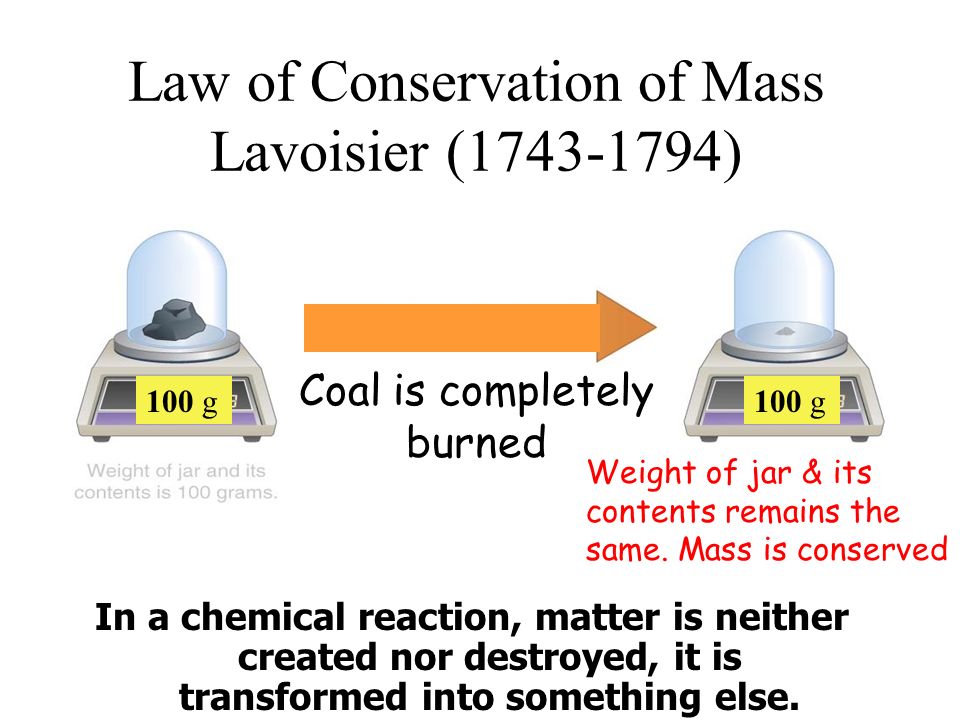
My satirical talents fall far short of Jonathan Swift (see his "Modest Proposal"), so a more accurate title of this post would be "Mass In/Mass Out: Toward a Satire of Calories In/Calories Out." My aim is to provide conceptual raw material for such a satire by someone else with superior satirical and parodying talent.
Many people believe the meaning of calories in/calories out to weight loss is obvious. But in believing that, they are sneaking in an assumption that calories in an calories out are primarily governed by conscious decisions, so that the importance of physiological variation in metabolic rate and the half-conscious impact of the primal motivational forces of hunger and how energetic one feels are obscured.
One reason the rhetorical move of talking as if the meaning of calories in/calories out is so attractive is that
weight gain in calories = calories in - calories out
is an identity. So that if one can sneak in one's interpretation of what calories in/calories out means, then that interpretation can be made to seem like an incontestable principle. Indeed, people have been know to claim that their interpretation of what calories in/calories out means for weight loss is as incontrovertible as the law of conservation of energy itself (also known as the first law of thermodynamics).
In "Forget Calorie Counting; It's the Insulin Index, Stupid," "Obesity Is Always and Everywhere an Insulin Phenomenon," "How the Calories In/Calories Out Theory Obscures the Endogeneity of Calories In and Out to Subjective Hunger and Energy" and below, I write directly about the common misinterpretation of the meaning of the calories in/calories out identity. But here let me begin by showing the wrongheadedness of the typical misinterpretation of calories in/calories out by applying the same interpretive angle to another identity: mass in/mass out.
Mass in/mass out is an identity under exactly the same circumstances as calories in/calories out: when there is only a trivial amount of mass-energy conversion going on, as will be true for human beings who are not part of a nuclear explosion. Given that assumption of non-explosivity, the identity for mass in/mass out is even simpler than for calories in/calories out:
weight gain (pounds) = mass in (pounds) - mass out (pounds)
It is simpler because mass in and mass out are in the same units as weight gain: pounds. (Or all three of weight gain, mass in and mass out are in kilograms for those outside the metric-benighted US.) The calories in/calories out identity is complicated by the fact that a pound of body fat corresponds to about 3500 calories, while muscle, glycogen and water in the body all contain a different number of calories per pound. No such complications for the mass in/mass out identity!
Taking the same interpretive angle as is typically used for calories in/calories out, the implications of mass in/mass out for weight loss are as follows. (Warning for those who find it difficult to understand satire: Most of this is bad advice. Please do not take this seriously! If you do, you could harm yourself.) If you think any of these are bad or even dangerous bits of advice, think of how bad the advice might also be from this interpretive angle for calories in/calories out.
To lose weight using the principles of mass in/mass out:
- eat less
- drink less (including drinking less water)
- poop more
- urinate more
- sweat more
- spit
There are a few other things that one could do to reduce mass in or increase mass out (bulimics abuse one), but that is a pretty good list.
To me, it is also a familiar list. I was a wrestler in junior high and high school. Like boxers, wrestlers are divided into different weight classes, and it gives a wrestler an advantage to go down to a lower weight. In order to "make weight," wrestlers often do all of the above in the last 24 hours or so before a match or a tournament. Personally, all I did was to not eat or drink for 24 hours before the weigh-in. I didn't need to sweat or spit, and urination and pooping came naturally. The fact that wrestlers use mass in/mass out so successfully shows the truth of its principles.
Warning: If mass in/mass out is a big way you think about weight loss, it could be a warning sign that you have anorexia and bulimia. If you have any suspicious that you might be anorexic or bulimic, you need to get help!
Analogies between Mass In/Mass Out and Calories In/Calories Out
It is not easy for people to understand how the usual interpretation of calories in/calories out can be so wrong. Deep contemplation of mass in/mass out is a potential remedy for this misunderstanding.
Both mass in/mass out and calories in/calories out (interpreted from the usual calories in/calories out angle) are brute force approaches to weight loss. The analogy between mass in/mass out and calories in/calories out is quite good. In both cases, what might seem like the logical advice has some truth to it, but ignores the longer-run regulatory mechanisms at work. For example, with a bit of a lag, drinking water simply causes one to urinate more (and perhaps salivate and sweat a bit more), so over a horizon a few days or a week, drinking water has no effect on weight. Similarly, as I discuss in "Forget Calorie Counting; It's the Insulin Index, Stupid" and "Obesity Is Always and Everywhere an Insulin Phenomenon," more calories in from something that does not cause the body to generate much insulin—say olive oil or nuts—increases metabolic rate and makes you less hungry (so you are likely to eat less of other things). So unless you actively interfere with the regulatory mechanisms, drinking water won't lead to long-run weight gain—and neither will consuming more olive oil or nuts.
Let me give another pair of examples. On the mass in/mass out side, if you eat less, you will poop less, so mass in/mass out doesn't give as powerful an effect from eating less over long horizons as it does over short horizons. There is a limit to how empty one's gastrointestinal tract can be. Over longer horizons, the slower weight-loss process of liquidating glycogen and then the even slower weight-loss process of burning body fat are all one can manage.
On the calories in/calories out side, if you exercise more, you will tend to work up an appetite, and you are also likely to fidget and move around less the rest of the day. That is how the experts explain why you are likely to be disappointed if you are exercising to lose weight. (On the other hand, if you are exercising in order to be healthier, happier and smarter, you are on the right track. For that matter, if you are exercising so you can settle in to your desk chair and get a lot of work done the rest of the day, you might also be on the right track.) Exercising can have some effect on the insulin-sensitivity of muscles, so it can have some long-run weight-loss effect, but naive application of calories in/calories out gives a very bad idea of how much weight loss exercise is likely to lead to in the absence of active interference with the regulatory mechanisms for calories in/calories out.
Both mass in/mass out and calories in/calories out are true identities. But deriving good weight-loss advice from these identities is not so easy. Understanding the regulatory mechanisms is the key. For calories in/calories out, insulin is at the heart of the single most important regulatory mechanism. For mass in/mass out, I leave it as an exercise for the reader to identify the relevant regulatory mechanisms.
Postscript: In addition to being useful for wrestlers and boxers trying to make weight, thinking about mass in/mass out can be very helpful in understanding the short-run fluctuations in weight that can often discourage those on a weight-loss program. By weighing more than once a day, it is easy to convince yourself that over periods of time too short for any significant fat burning or accumulation to take place that your weight can easily vary over a 5 pound range.
For more contrarian discussion of nutrition, obesity and chronic diseases, don't miss:
- Forget Calorie Counting; It's the Insulin Index, Stupid
- Obesity Is Always and Everywhere an Insulin Phenomenon
- Mass In/Mass Out: A Satire of Calories In/Calories Out
- Jason Fung: Dietary Fat is Innocent of the Charges Leveled Against It
- Faye Flam: The Taboo on Dietary Fat is Grounded More in Puritanism than Science
- Sugar as a Slow Poison
- Kearns, Schmidt and Glantz—Sugar Industry and Coronary Heart Disease Research: A Historical Analysis of Internal Industry Documents
- Salt Is Not the Nutritional Evil It Is Made Out to Be
- Confirmation Bias in the Interpretation of New Evidence on Salt
- Whole Milk Is Healthy; Skim Milk Less So
- How the Calories In/Calories Out Theory Obscures the Endogeneity of Calories In and Out to Subjective Hunger and Energy
- Putting the Perspective from Jason Fung's "The Obesity Code" into Practice
- Julia Belluz and Javier Zarracina: Why You'll Be Disappointed If You Are Exercising to Lose Weight, Explained with 60+ Studies (my retitling of the article this links to)
- Meat Is Amazingly Nutritious—But Is It Amazingly Nutritious for Cancer Cells, Too?
- On Fighting Obesity
- Analogies Between Economic Models and the Biology of Obesity
- Diana Kimball: Listening Creates Possibilities
Also see the last section of "Five Books That Have Changed My Life."
Bloomberg's Series on Reviving Productivity →
Don't miss my take on this topic of reviving productivity: "Restoring American Growth: The Video." Bonnie Kavoussi gives the highlights of that talk in "Bonnie Kavoussi's Tweetstorm on "Restoring American Growth."
Against Occupational Licensing
Amid many questionable opinions, the Wall Street Journal editorial page has an excellent take on occupational licensing, as can be seen from the November 24, 2017 editorial linked above. The editorial draws from the report "License to Work: A National Study of Burdens from Occupational Licensing" by the Institute of Justice.
I have been a vocal opponent of occupational licensing for longer than I have been a proponent of negative interest rates as a monetary policy tool (November 5, 2012). In my August 12, 2012 post "When the Government Says "You May Not Have a Job" I write
... sometimes, the rich and the middle class both gang up on the poor. This is nowhere more in evidence than in the area of occupational licensing. ...
Once an occupational licensing regime is set up, one factor making the system hard to change is that those who “paid their dues” to get the license resent the idea that others could do what they do without a license. But even before an occupational licensing regime is set up, an important impetus is often those within a field who resent the idea that others who do lower quality work should be allowed to tarnish the reputation of a field. There is a problem here. It is often a low level of skills that puts someone in the position of being poor. Therefore, to say that no one should be allowed to put up a shingle to do cheap, low-quality work is often to say that a poor person should not be allowed to work. But somehow, the poor who look so sympathetic in other contexts start looking like “riffraff” when they are the competition. ...
... if political forces are insistent that something must be done by government, there is all the difference in the world between government regulation of labels and government regulation of substance. ...
To the extent that even the urge toward substantive occupational licensing cannot be resisted because of at least superficially plausible arguments about health and safety, it might be possible to get a better balance by imposing some kind of global budget constraint on licensing requirements that forces regulation to focus on those requirements that have the least specious justifications.
The kind of global budget constraint I have in mind in that last sentence is the one I proposed in my July 22, 2012 post "Magic Ingredient 1: More K-12 School":
What I want to do is to restrain the tendency to go overboard on occupational licensing while allowing genuinely necessary competencies to be transmitted by requiring states to ensure that their schools high school tracks that would make it reasonably possible to be meet the legal qualifications for any of at least 60% of all licensed occupations, with each student able to be qualified with his or her high school diploma for at least 10% of all licensed occupations. Then the graduates might actually be able to get a job. This requirement for getting the Federal education grant could be met by any combination of reducing licensing requirements and increasing effective training that each state chose. I am sure that states would game the rule, so that the overall effect would be less than what this sounds on the surface, but it would be better than the way things are now, where students graduating from high school are kept out of many of the more desirable occupations by occupational licensing restrictions.
For those who want to fight occupational licensing as I do, the editorial linked above, "Licenses to Kill Opportunity" is itself a rich resource, hinting at the richness of the Institute of Justice report "License to Work: A National Study of Burdens from Occupational Licensing." Below let me first give some quotations from the Wall Street Journal about the facts, then about the interpretation of the motivation for licensing and the costs of licensing:
Facts:
- California’s door repairmen, carpenters and landscapers must first rack up 1,460 days of supervised on-the-job experience, then pay more than $500 for the license, before they can work as a contractor.
- Until recently, the New Hampshire Board of Barbering, Cosmetology & Esthetics could levy fines on salons that have a barber’s pole—or even a pole painted red, white and blue that resembles one—but no licensed barber.
- Only three states and the District of Columbia require a license for interior designers. But in all four, aspirants must clock six years of education or experience, pass an exam, and pay between $1,120 and $1,485 for the license. That’s far more training than is required for a dental assistant (Washington, D.C.), optician (Florida), midwife (Louisiana) or pharmacy technician (Nevada).
- In February an Arizona board targeted a cosmetology student who dared to give free haircuts to the homeless. He risked being barred from the profession until Gov. Doug Ducey interceded.
The Motivation for Licensing:
- The cost and time to obtain a license is no accident, as professional guild members sit on state licensing boards and reinforce the racket. They want to limit competition to keep prices high.
- Licensing proponents claim they’re merely protecting public health. But the Institute for Justice found that on average tree trimmers undergo 16 times more training than an emergency medical technician, and cosmetologists more than 11 times.
- ... heavy-handed licensing doesn’t follow party lines, which means the rules are rooted in political muscle more than ideology.
The Costs of Licensing:
- Stiff licensing requirements are often prohibitive for America’s working poor, keeping them trapped in low-wage, low-skill jobs.
- Many states also bar people with a criminal record from working in a licensed profession. Society pays the price. Researchers at Arizona State University’s Center for the Study of Economic Liberty found that in states with burdensome licensing requirements, recidivism rates increased by more than 9% over a 10-year span. In states where it was easier to get a license, the rates went down.
- Nationwide, licensing drives up prices by as much as $203 billion annually. The requirements also hurt consumers by restricting access to goods and services.
Because it is a genuinely bipartisan good government initiative, the fight against the overgrowth of occupational licensing is a fight that can be won. (It isn't just the Wall Street Journal and Institute of Justice trying to restrain occupational licensing. The Obama administrations Treasury Department also weighed in against excessive occupational licensing.) Because it is a fight at the state level, it is a good effort for politically inclined high school and college students as well as their elders to get involved in.
Confirmation Bias in the Interpretation of New Evidence on Salt →
In addition to the link above, for more contrarian discussion of nutrition, obesity and chronic diseases, don't miss:
- Forget Calorie Counting; It's the Insulin Index, Stupid
- Obesity Is Always and Everywhere an Insulin Phenomenon
- Jason Fung: Dietary Fat is Innocent of the Charges Leveled Against It
- Faye Flam: The Taboo on Dietary Fat is Grounded More in Puritanism than Science
- Sugar as a Slow Poison
- Kearns, Schmidt and Glantz—Sugar Industry and Coronary Heart Disease Research: A Historical Analysis of Internal Industry Documents
- Salt Is Not the Nutritional Evil It Is Made Out to Be
- Confirmation Bias in the Interpretation of New Evidence on Salt
- Whole Milk Is Healthy; Skim Milk Less So
- How the Calories In/Calories Out Theory Obscures the Endogeneity of Calories In and Out to Subjective Hunger and Energy
- Putting the Perspective from Jason Fung's "The Obesity Code" into Practice
- Julia Belluz and Javier Zarracina: Why You'll Be Disappointed If You Are Exercising to Lose Weight, Explained with 60+ Studies (my retitling of the article this links to)
- Meat Is Amazingly Nutritious—But Is It Amazingly Nutritious for Cancer Cells, Too?
- On Fighting Obesity
- Analogies Between Economic Models and the Biology of Obesity
- Diana Kimball: Listening Creates Possibilities
Also see the last section of "Five Books That Have Changed My Life."
John Locke Off Base with His Assumption That There Was Plenty of Land at the Time of Acquisition

"Range's End" by Edward Hopper (or is it "Ranges End"?)
In "John Locke's Song of Praise for Work," treating section 32 of John Locke's 2d Treatise on Government, I discuss John Quiggin's post "John Locke Against Freedom." John Quiggin argues that John Locke wrote his 2d Treatise in order to justify English freedom on the one hand, enslavement of Africans and expropriation of Native American lands on the other. I am not willing to follow John Locke in disregarding the claims of Native Americans. (See "John Locke on Diminishing Marginal Utility as a Limit to Legitimately Claiming Works of Nature as Property" where I argue against the expropriation of native lands as follows:
To justify, theoretically, taking that land from the Native Americans, one would have to add the principle that when technology changes so that people need less land to support themselves, then previous land claims need to be reevaluated. In general, such a principle is a recipe for a big mess. Better to, at a minimum, require rich outsiders to purchase land as European Americans did from Native Americans in a few cases, and as the European New Zealanders did to a much greater degree from the Maori. If technology has really improved dramatically, they should be able to do so.
But even if one blithely and callously disregards the claims of Native Americans to the lands they occupied before the Europeans arrived, John Lockes' argument in section 33 that there is so much land that no one should object to someone claiming the amount that individual can cultivate runs afoul of actual history after the time John Locke wrote. When farmers claimed land in the American West, and put up barbed wire to mark their claim, the cowboys who had been used to driving cattle through were mightily aggrieved. Keep that vivid bit of history in mind when reading the text of section 33:
Nor was this appropriation of any parcel of land, by improving it, any prejudice to any other man, since there was still enough, and as good left; and more than the yet unprovided could use. So that, in effect, there was never the less left for others because of his inclosure for himself: for he that leaves as much as another can make use of, does as good as take nothing at all. No body could think himself injured by the drinking of another man, though he took a good draught, who had a whole river of the same water left him to quench his thirst: and the case of land and water, where there is enough of both, is perfectly the same.
Of course, tortured logic is exactly what one should expect when someone is twisting his arguments to get a complex set of politically desired argumentative results that don't really hang together.
If John Locke's theory of land ownership is marred, where then can one turn for a theory of land ownership? Here is my view so far:
- As John Quiggin quotes David Hume, but limited to land only: “there is no property in ... lands ... when carefully examined in passing from hand to hand, but must, in some period, have been founded on fraud and injustice.” (The original of the quotation from David Hume mentions houses as well, but I don't agree with David Hume about houses, since someone might have built their own house or built a house and voluntarily conveyed it to someone else.)
- As with national borders, to avoid endless conflict, there must be a statute of limitations on land claims.
- There should be a heavy Henry George tax on land, to reduce the injustice from the current distribution of land based on the first two points. (I won't call it a single tax, because unfortunately, it would be hard to raise enough revenue from this alone to do all of the things the government is currently doing.) Zera has a nice post on the "Economic Theories" blog about John Stuart Mill's approach to such a land tax.
What seems to me even more precious than land is sovereignty: the right to construct one's own government, which in our world—both now and historically—often goes along with certain pieces of land. John Locke, although he deserves to be reprobated for his support of slavery and the expropriation of Native American lands, does deserve credit for helping to at least some degree separate the justification of sovereignty from the possession of particular pieces of land.
Don't miss other John Locke posts. Links at "John Locke's State of Nature and State of War."
Luigi Guiso, Helios Herrera, Massimo Morelli and Tommaso Sonno: There Is a Cultural Channel Causing People to Vote for Populism, But Not a Cultural Cause. The Cause Is Still Economic Insecurity

Note: This post is closely related to "Brian Flaxman: Yes! Economics Did Sway Obama Voters to Trump."
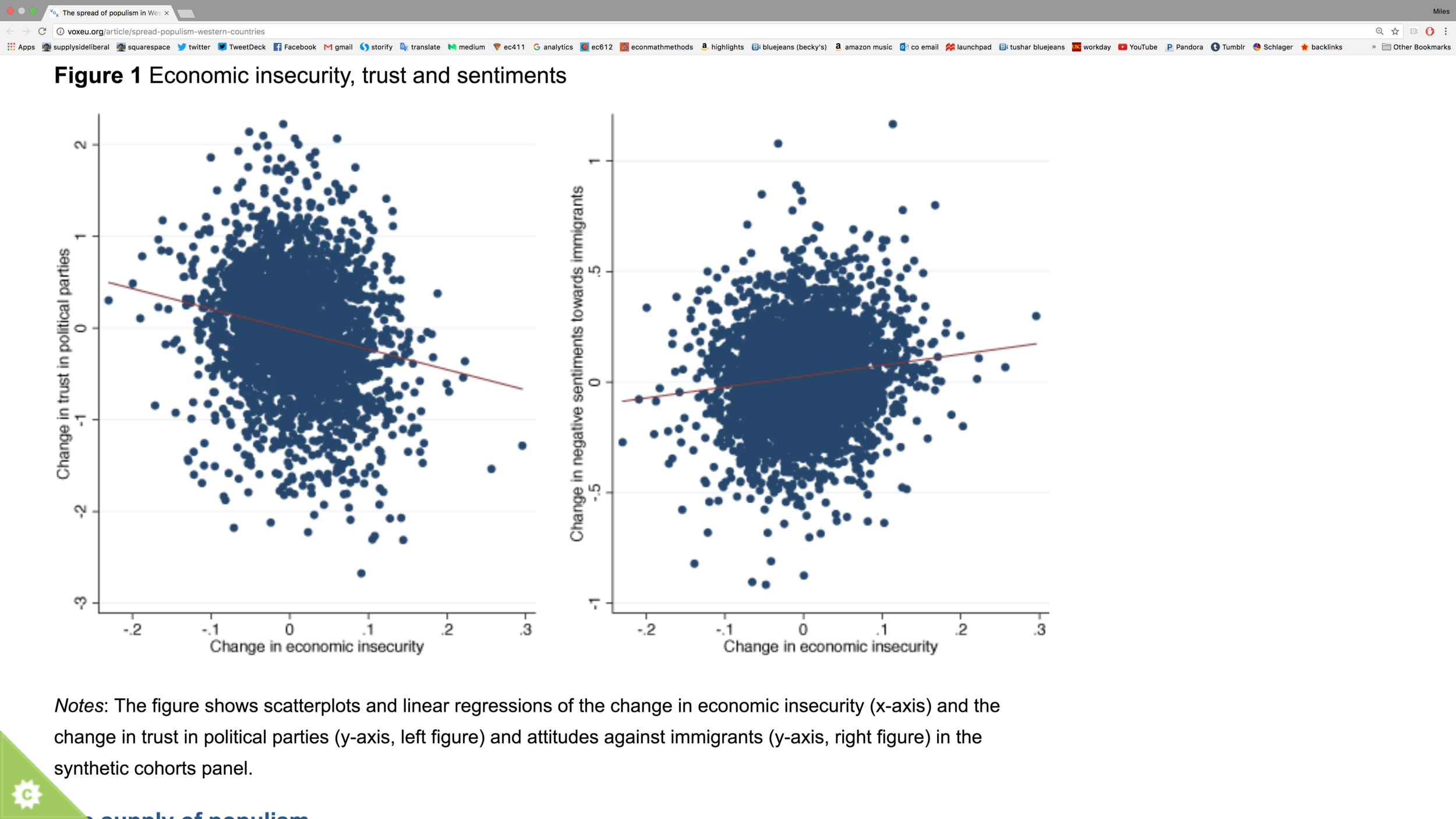
Bonnie Kavoussi pointed me to this interesting VoxEU article. The gist is given by these excerpts:
Economic insecurity is our key determinant of the demand for populism. Because we consider turnout, we can establish a mechanism for the effect of economic insecurity on populism. It acts on two margins: it discourages participation, and increases the chance of voting for a populist party among those who decide to exert their voting right.
An individual who goes from no economic insecurity to economic insecurity is more likely to vote for a populist party. The probability increases by 14.5% of the unconditional sample mean. The individual is also 21 percentage points less likely to vote, equivalent to 27% of the sample mean. These are substantial effects.
Voting, and voting for a populist party, are affected also by two cultural variables:
Trust in political parties ...
Adverse attitudes towards immigrants ...
So, there is a cultural channel causing people to vote, and vote for populism but not a cultural cause. The cause is still economic insecurity. Trust and attitudes towards immigrants are proximate causes of the populist vote, not deep drivers.
I want to point out that the current sense of economic insecurity in turn has identifiable causes. Technological trends—in particular manufacturing going the way of agriculture—and trade deficits have played an important role. But flawed monetary policy has also played a big role. If there had been full economic recovery by 2010, politics in the US, the UK and the euro zone would have evolved in a dramatically different way. And such an outcome was quite possible, given a different monetary policy, as I argue in "America's Big Monetary Policy Mistake: How Negative Interest Rates Could Have Stopped the Great Recession in Its Tracks." The details of how to successfully implement deep negative rates can be found in "How and Why to Eliminate the Zero Lower Bound: A Reader’s Guide."
Also, dramatically higher capital requirements could have made the Financial Crisis of 2008 no worse than the popping of the dotcom bubble in 2000. On that, see my post "Martin Wolf: Why Bankers are Intellectually Naked."
Finally, note that high capital requirements and a readiness to use deep negative rates when called for are complementary policies that work better in combination than separately, as I lay out in "Why Financial Stability Concerns Are Not a Reason to Shy Away from a Robust Negative Interest Rate Policy."
Monetary policy matters for politics and the broad sweep of history, not just for immediate economic outcomes. The storified tweets in "The Historical Effects of Monetary Policy Mistakes" point to some obvious examples from the past.
What matters going forward is to reduce economic insecurity in the future:
- Central banks need to be prepared to use deep negative interest rates in the next crisis.
- Capital requirements, and in particular, the capital conservation buffer should be pushed to a much higher level, despite those in the pay of—cognitively captured by banks—who want to keep capital requirements relatively low.
- US Trade deficits should be reduced by the method that will actually work: by raising our saving rate and insisting that foreign-government-generated capital flows be negotiated. See "How Increasing Retirement Saving Could Give America More Balanced Trade" and "Alexander Trentin Interviews Miles Kimball about Establishing an International Capital Flow Framework." (This, too, is a policy that is complementary with central banks around the world having robust negative interest rate tools.)
- Economists and other scholars need to search for answers to the long-run problems that I discuss in "Restoring American Growth: The Video." (For the short version, see "Bonnie Kavoussi's Tweetstorm on 'Restoring American Growth.'")
Those who care about the direction of politics need to also care about technical economic remedies that can make things better. It isn't just about winning elections by talking about things that sound good. It is also about delivering the goods to people when your faction is in charge, as I write in "Economics Is Unemotional—And That's Why It Could Help Bridge America's Partisan Divide":
Subtler dimensions of economic policies may not work in stump speeches—but they can be the kind of good governance that gets politicians reelected.
... the party that gets to stay in power the longest will be the one that does a good job handling economic policy when it gets its turn in the driver’s seat.
Why I Am Not a Neoliberal
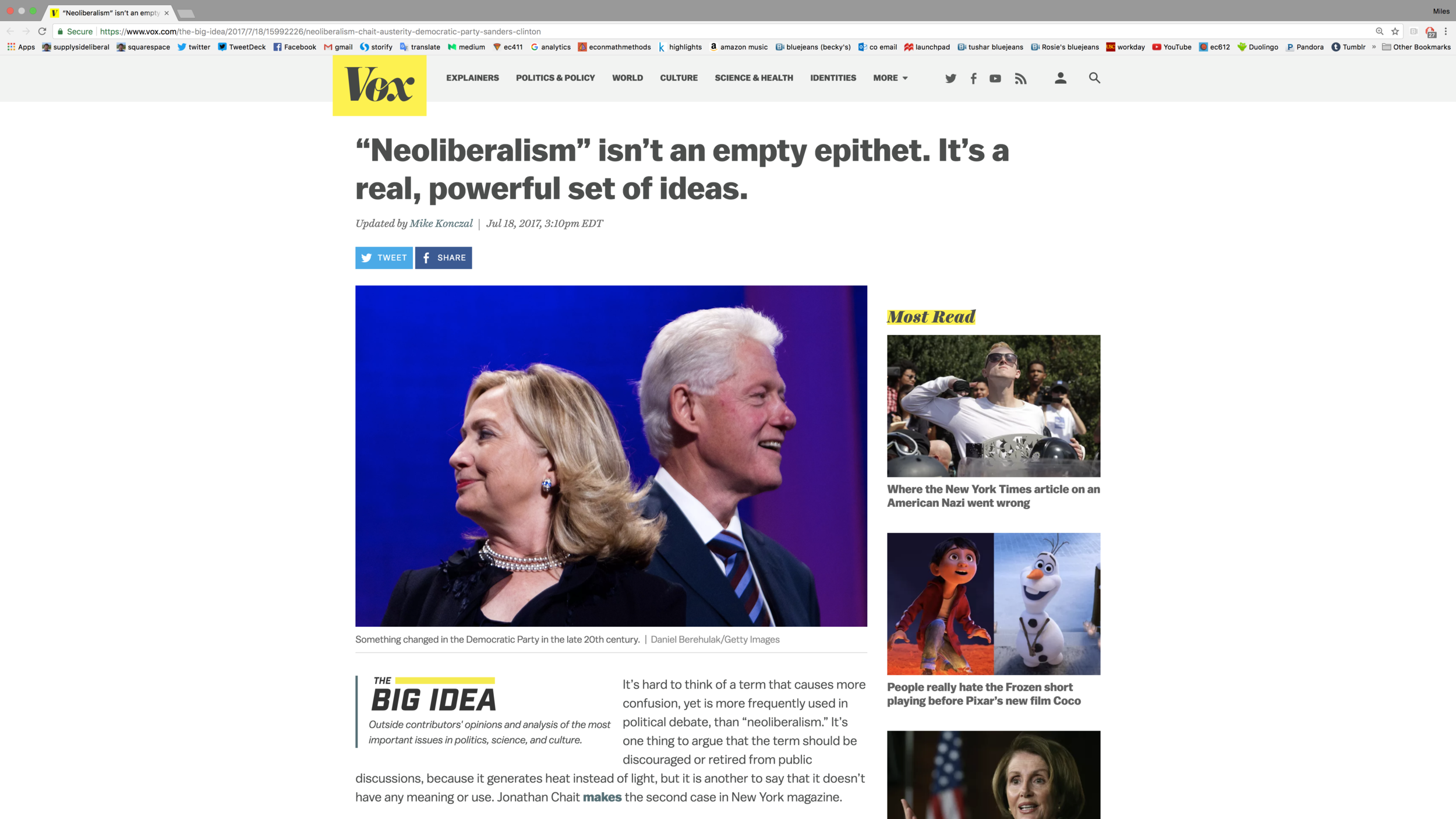
Link to the article above
Without looking at the details, I would have thought that I was a Neoliberal. Indeed, I have a Storify story "The Time Miles was Called a "Neoliberal Sellout" by Matt Yglesias and was Glad for the Compliment in the End." But digging deeper, I am now not at all sure I am a Neoliberal. Let me consider point by point where I agree with Neoliberalism and where I disagree.
Whole books have been written on Neoliberalism, but I haven't read them. So let me take Mike Konczal's take on Neoliberalism in his excellent Vox essay "'Neoliberalism' isn’t an empty epithet. It’s a real, powerful set of ideas" as a rough-and-ready definition of Neoliberalism. My discussion of whether I am a Neoliberal or not will only be relative to Mike Konczal's description of Neoliberalism there. If Neoliberalism moves in the direction of Supply-Side Liberalism as laid out in all of the posts in this blog, so much the better. But historically, Neoliberalism seems to have many differences from my version of Supply-Side Liberalism.
Early on in his essay, Mike Konczal cautions:
The difficulty of the term ["Neoliberalism"] is that it’s used to described three overlapping but very distinct intellectual developments.
Moving to the Political Center
The first of these three intellectual developments was political:
In political circles, ["Neoliberalism" is] most commonly used to refer to a successful attempt to move the Democratic Party to the center in the aftermath of conservative victories in the 1980s. [One] can look to Bill Galston and Elaine Kamarck’s influential 1989 The Politics of Evasion, in which the authors argued that Democratic “programs must be shaped and defended within an inhospitable ideological climate, and they cannot by themselves remedy the electorate's broader antipathy to contemporary liberalism.”
To me, this is just democracy in action—when political entrepreneurs don't get blinded by their own personal ideology. Ignoring the views of close to half the electorate can be politically dangerous. You can see some of my views about the partisan divide abroad and in the US in
Nationalists vs. Cosmopolitans: Social Scientists Need to Learn from Their Brexit Blunder
Economics Is Unemotional—And That's Why It Could Help Bridge America's Partisan Divide
Personally, I have a great deal of sympathy for many (but by no means all) "Conservative" arguments.
The Washington Consensus
Mike Konczal continues:
In economic circles, however, “neoliberalism” is most identified with an elite response to the economic crises of the 1970s: stagflation, the energy crisis, the near bankruptcy of New York. The response to these crises was conservative in nature, pushing back against the economic management of the midcentury period. It is sometimes known as the “Washington Consensus,” a set of 10 policies that became the new economic common sense.
It is this “Washington Consensus” that I most want to put under the microscope. John Williamson's 1990 Peterson Institute of International Economics paper "What Washington Means by Policy Reform" is the touchstone Mike Konczal refers to for the "Washington Consensus." Looking at this document, one can see that, to this day, when policy folks talk about "structural reform," they are often talking about reform in line with the "Washington Consensus."
1. Fiscal Discipline
Fiscal discipline is the first tenet of the Washington Consensus. (All of this about the Washington consensus is "according to John Williamson in 1990.") I am a fiscal hawk in the sense that I worry quite a bit about the national debt. You can see this in my early post "Avoiding Fiscal Armageddon." Yichuan Wang and I interpreted the data as providing no support for the idea that national debt lowers GDP growth in "After Crunching Reinhart and Rogoff's Data, We Found No Evidence High Debt Slows Growth," but there we write:
We don’t want anyone to take away the message that high levels of national debt are a matter of no concern. As discussed in "Why Austerity Budgets Won't Save Your Economy," the big problem with debt is that the only ways to avoid paying it back or paying interest on it forever are national bankruptcy or hyper-inflation. And unless the borrowed money is spent in ways that foster economic growth in a big way, paying it back or paying interest on it forever will mean future pain in the form of higher taxes or lower spending.
What I said in "Why Austerity Budgets Won't Save Your Economy" is:
To understand the other costs of debt, think of an individual going into debt. There are many appropriate reasons to take on debt, despite the burden of paying off the debt:
To deal with an emergency—such as unexpected medical expenses—when it was impossible to be prepared by saving in advance.
To invest in an education or tools needed for a better job.
To buy an affordable house or car that will provide benefits for many years.
There is one more logically coherent reason to take on debt—logically coherent but seldom seen in the real world:
To be able to say with contentment and satisfaction in one’s impoverished old age, “What fun I had when I was young!”
In theory, this could happen if when young, one had a unique opportunity for a wonderful experience—an opportunity that is very rare, worth sacrificing for later on. Another way it could happen is if one simply cared more in general about what happened in one’s youth than about what happened in one’s old age.
Tax increases and government spending cuts are painful. Running up the national debt concentrates and intensifies that pain in the future. Since our budget deficits are not giving us a uniquely wonderful experience now, to justify running up debt, that debt should be either (i) necessary to avoid great pain now, or (ii) necessary to make the future better in a big enough way to make up for the extra debt burden.
My worries about the national debt are also an important impetus behind my arguing for a public contribution program, as introduced in "No Tax Increase Without Recompense" and developed in other posts linked in my bibliographic post "How and Why to Expand the Nonprofit Sector as a Partial Alternative to Government: A Reader’s Guide."
But what about fiscal stimulus? I am firmly of the view that, other than automatic stabilizers (such as taxes that go up with income and benefits that increase with low income), monetary policy should take on the primary stabilization role. One of my signature efforts has been to figure out the most practical and acceptable possible ways to eliminate the zero lower bound. My organized bibliography for that effort is "How and Why to Eliminate the Zero Lower Bound: A Reader’s Guide." Once a central bank's target interest rate can go as low as necessary, aggregate demand is no longer scarce. So there is no excuse for a government to then run deficits beyond those induced by automatic stabilizers to stimulate the economy.
There are three exceptions to this generalization. First, as part of the monetary policy transmission mechanism, the fiscal arm of the government should spend most of the windfall from reduced interest expenses when interest rates go down and cut back spending to compensate for higher interest expenses when interest rates go up. (See "Negative Rates and the Fiscal Theory of the Price Level.") Most governments will do this without extra prompting. Ideally, the government should also do some intertemporal substitution in spending that responds to high or low interest rates in the way that would be optimal for a private corporation. Governments have been surprisingly slow to do this.
Second, in a monetary union such as the euro zone, where countries in disparate economic situations share monetary policy, an individual nation might need to use some sort of fiscal stimulus. For that I recommend the kind of credit policy I discuss in my paper "Getting the Biggest Bang for the Buck in Fiscal Policy," which is introduced in my blog post of the same name. The abstract for the paper clarifies the key issue for fiscal hawks who see the need for some stimulus:
In ranking fiscal stimulus programs, it is useful to focus on the ratio of extra aggregate demand to extra national debt that results. This note argues that (because of repayment after the end of a recession) “national lines of credit”--that is, government-issued credit cards with countercyclical credit limits and favorable interest rates—would generate a higher ratio of extra aggregate demand to extra national debt than tax rebates. Because it involves government loans that are anticipated in advance to involve some losses and therefore involve a fiscal cost even after efforts to minimize losses, such a policy lies between traditional monetary policy and traditional fiscal policy.
Third, because monetary policy has a lag of 9 months or so in its effects, the same kind of credit policies can be of some value in the first few quarters after an unexpected shock.
Other than these exceptions, I come down decisively in favoring monetary policy over fiscal policy for economic stabilization. See for example:
Monetary vs. Fiscal Policy: Expansionary Monetary Policy Does Not Raise the Budget Deficit
How and Why to Avoid Mixing Monetary Policy and Fiscal Policy
On the other hand, I do not always look like a fiscal hawk. In "What Should the Historical Pattern of Slow Recoveries after Financial Crises Mean for Our Judgment of Barack Obama's Economic Stewardship?" I strongly criticize Barack Obama for not politically prioritizing and pushing through a larger fiscal expansion in 2009. At that time, the fact that interest rates could go as far negative as needed with easy-to-implement policies was not well understood, so Barack Obama should have done at least three times the amount of fiscal stimulus that he did historically. Because he didn't, a big part of the harm of the Great Recession in the US was his fault. The political prioritization necessary to get a bigger fiscal stimulus package through could easily have meant not getting the Obamacare legislation in anything close to the actual "Patient Protection and Affordable Care Act" through. But to me, avoiding a significant part of the harm of the Great Recession at the cost of being forced to proceed with health care reform on a more bipartisan basis seems the better choice.
On a more technical issue, I believe strongly that there should be a separate capital budget for national governments. Noah Smith and I argue this in "One of the Biggest Threats to America's Future Has the Easiest Fix" and I have thought hard about technical details of how to make a capital budget work well by keeping incentives to game the system mostly in check: see my powerpoint file "The Applied Theory of Capital Budgeting," which I presented at the Congressional Budget Office in May 2014. My post and the associated Powerpoint file "Discounting Government Projects" addresses another technical issue in capital budgeting.
2. The Composition of Public Expenditures
The second tenet of the Washington Consensus is that health, education and infrastructure spending are especially good types of public expenditure and that indiscriminate subsidies are especially bad types of public expenditure. Here I am in total agreement.
3. Tax Reform
For the most part, I don't want to talk about the current Republican tax reform plans being hatched in the House and Senate today. Those plans are a mix of very bad measures with some good technocratic measures. But I am sympathetic to widely agreed-upon principles of tax reform. John Williamson writes:
.. there is a very wide consensus about the most desirable method of raising whatever level of tax revenue is judged to be needed. The principle is that the tax base should be broad and marginal tax rates should be moderate.
I favor the more transparent approach of taxing the rich people who (for the most part) own corporations rather than the opaque approach of taxing the corporations themselves. And I favor consumption taxation, as you can see in "Scrooge and the Ethical Case for Consumption Taxation" and "VAT: Help the Poor and Strengthen the Economy by Changing the Way the US Collects Tax."
I do not depart from the Washington Consensus here.
4. Real Interest Rates Market-Determined and Positive
According to John Williamson, a fourth tenet of the Washington Consensus is that real interest rates should be market-determined, positive and moderate. Distinguishing between the short-run, medium-run and long-run as I do in "The Medium-Run Natural Interest Rate and the Short-Run Natural Interest Rate," in the medium-run and long-run, I certainly agree that interest rates should be market-determined. But a market-determined medium-run or long-run rate may or may not be positive. As John Williamson himself wrote in 1990:
The question obviously arises as to whether these two principles are mutually consistent. Under noncrisis conditions, I see little reason to anticipate a contradiction.
With policy heavy-weights such as Larry Summers and Olivier Blanchard talking about secular stagnation, I think the Washington Consensus may be moving toward realizing that situations where real interest rates need to be negative in the long-run are quite possible.
I fully agree that there are many bad market interventions that push some interest rates down. A good example is the low interest rates given by state-owned banks to state-owned enterprises in current Chinese policy. These divert funds away from the non-state sector, raising the rates in the non-state sector, thereby making it harder for households and private businesses to borrow.
In the short-run, the idea that interest rates should be market-determined and positive is not helpful. First, I see it as inevitable that some sort of monetary policy be central to interest-rate determination. There is no neutral "free-market" monetary policy. The gold standard is not a neutral monetary policy. The closest it is possible to come to a free-market monetary policy is for the central bank to do its best to get the economy quickly back to the natural level of output, the natural level of unemployment and the natural interest rate. I advocate that strongly, as you can see in my paper "Next Generation Monetary Policy."
Second, I believe negative rates—both real and nominal—are crucial for cutting short recessions and enabling a lower inflation target. See "How Subordinating Paper Currency to Electronic Money Can End Recessions and End Inflation."
5. Free Capital Flows
Here I think the "Washington Consensus" shifted between when John Williamson was writing and now. I feel there has been more and more emphasis not just on competitive exchange rates, but also free capital flows. Here I favor a more managed version of international capital flows than the current consensus. See "Alexander Trentin Interviews Miles Kimball about Establishing an International Capital Flow Framework."
6. Free Trade
I am in favor of free trade. Here I am in agreement with the Washington Consensus. But, in something the Washington Consensus did not push, I think the benefits are much greater for freer immigration than from freer trade. See ""The Hunger Games" Is Hardly Our Future--It's Already Here." But as I mentioned above, I think international capital flows should be better managed in order to get more balanced trade:
7. Foreign Direct Investment
I agree that encouraging foreign direct investment is a good thing. For many countries it is a very good thing. Looking at things from the standpoint of countries doing foreign direct investment, one of my favorite essays is "Nicholas Kristof: "Where Sweatshops are a Dream."
8. Privatization
I agree that many enterprises are better run privately than by the government. But privatization of core government functions such as prisons has often led to very poor quality. For a country like the US, if further privatization took place, my guess is that it would be more likely to move in the wrong direction than in the right direction.
Part of the problem with privatization of core government functions is the great danger of corruption in government contracting. Suppose I define:
core government function = something where if it isn't done by the government itself, the government needs to contract with a private firm for the service.
Then one needs to consider whether any inefficiency of having the government do the job itself is outweighed by the likely corruption in the contracting relationship.
In what might seem, but isn't, a view antithetical to a pro-privatization view, I think the US government should take a much bigger role in bringing down the risk premium with a sovereign wealth fund, which would involve it owning, at least indirectly, a large amount of stock. See:
How to Stabilize the Financial System and Make Money for US Taxpayers
Roger Farmer and Miles Kimball on the Value of Sovereign Wealth Funds for Economic Stabilization
The reason a sovereign wealth fund wouldn't violate the principle of avoiding undue government meddling is that it would be required to hold only ETFs that had no voting rights.
9. Deregulaton
Regulation is one of the areas where I most strongly disagree with the Washington Consensus. I think capital requirements/leverage limits are much too loose. I have said this strongly many times. "Martin Wolf: Why Bankers are Intellectually Naked" is a good post to start with. I have also cheered on the efforts of the Consumer Financial Protection Bureau under Richard Cordray. I give the philosophical justification for the type of regulation done by the CFPB in "On the Consumer Financial Protection Bureau." I also think there are many types of wealth that are ill-gotten, even though they are legal. See "Odious Wealth: The Outrage is Not So Much Over Inequality but All the Dubious Ways the Rich Got Richer."
On the other hand, at the state and local level, regulation is often used as a tool to keep the poor from living next door or competing with middle-class jobs. That is, state and local regulation is often effectively a tool of oppression. I write about the common impulse behind immigration restrictions at the national level and land-use and occupational licensing restrictions at the state and local level in "Keep the Riffraff Out!"
Affordable housing in desirable cities for all the people who want it requires an adequate total amount of housing. That in turn requires allowing needed construction. In "Building Up With Grace," I call for every substantial city to have some district with no height limits that has excellent bus service to the rest of the city. This is for the sake of those of modest means who want to live and work in the city. (Genuine earthquake dangers might lead to some height limits, but these should not be used as an excuse beyond genuine safety needs.)
In relation to regulatory restrictions on construction, I find myself in sympathy with the great bulk of posts on the excellent Facebook group "Market Urbanism." I highly recommend it.
I should note that allowing more construction has financial stability benefits as well as benefitting social justice. See "With a Regulatory Regime That Freely Accomodates Housing Construction, Lower Interest Rates Drive Down Rents Instead of Driving Up the Price of Homes."
Occupational licensing requirements often keep those at the bottom of the heap out of jobs, as I discuss in my post “When the Government Says “You May Not Have a Job.” The extent to which this is done in practice is unconscionable. Fortunately, occupational licensing reform efforts are afoot. But these efforts could easily stall out. This is an important area to focus on.
For those who haven't thought much about occupational licensing, there are two key related points to take away. First, occupational certification and occupational licensing are not the same thing. In "John Stuart Mill: Certification, Not Licensing" I write:
As for licensing itself, although they are often spoken of in the same breath, there is a world of difference between certification and licensing. Certification requirements say that you have to inform customers of your level of qualifications or lack of qualifications in unmistakable ways, according to a well-defined terminology established by the government. They are based on the principle of telling the truth and not deceiving, but do entail some details to make sure no one misunderstands.
By contrast, licensing requirements say you can be fined or thrown in jail for getting paid for something that someone with an absolutely crystal clear idea of your lack of qualifications is perfectly happy to pay you to do. For example, I would run afoul of the law in Michigan if I cut someone else’s hair for pay–a law ultimately backed up by the threat of throwing me in jail, even if the initial penalty is only a fine. The real reason for that stipulation is that barbers want that barrier to entry in place (I think at least a year and a half of training), not any danger that I will seriously harm someone with a basic haircut. I express some of how wrong I think the overgrowth of licensing requirements is in my post “When the Government Says “You May Not Have a Job'."
I have no problem with certification—it simply makes things clear. But I do have a problem with licensing, which says to people "You may not have a job" unless they devote time and money to training they may not be able to afford.
(Update: See also my December 5, 2017 post "Against Occupational Licensing.")
For practical reform efforts, the second key point to make about occupational licensing is that establishing a low-hurdle licensing category in each general type of job has many of the good effects of having a certification regime instead of a licensing regime. It isn't too harmful to require that "barbers" have a year and a half of training if there is also an occupational licensing category of "haircutter" that requires only a week of training, and haircutters are legally allowed to do everything that barbers are allowed to do. In that case "barber" would indicate someone highly trained, which is useful, but barbers and haircutters would still compete.
My post "Against Anticompetitive Regulation" discusses other regulatory issues as well. The title of that post indicates the very first question you should ask about any regulation: "Is the regulation about keeping everyone honest, or is it about keeping down the competition?"
Crucially, "keeping everyone honest" doesn't mean "ensuring high quality." If someone honestly signals that what they are selling is low-quality but inexpensive, they should be allowed to sell their honestly low-quality goods and services.
Overall, more regulation is needed of the financial industry; less regulation is needed for service jobs and housing construction. And it is important to watch out for firms running to the government to get the government to put an obstacle in the way of a potential competitor. Finally, regulations that make corporate deception illegal are almost always a good thing. After all, the key welfare theorems suggesting that a free market will do a good job all rely on people knowing and understanding the truth! (General anti-fraud principles in the legal code are helpful, but often don't do enough.)
10. Property Rights
There are many virtues to property rights as they exist in the United States. But I think we have gone much too far with intellectual property rights. See:
One of the bad aspects of trade negotiations in the last few years has been the emphasis by the United States on imposing its dysfunctional intellectual property system on the rest of the world. (See Dani Rodrik on one aspect of that here.) The United States should get its own house in order on intellectual property, and only then recommend its intellectual property system to other nations.
On property rights more generally, I think if, by a high standard of proof, an action can be shown to be a bad action that should have been prohibited in the past, then taxing away the wealth resulting from that action is appropriate. If done right, this has good incentives: companies and people will try to avoid doing things that people in the future will realize were wrong. However, there may need to be some statute of limitations on this.
And where uncertainty about future legal treatment stands in the way of important investments, the government may need to provide better guarantees of future legal treatment. I am thinking here of the development of self-driving cars, that could be seriously hindered if there were too much legal uncertainty. Fortunately, that seems to have been avoided.
Markets Defining More and More of Our Lives
Leaving the Washington Consensus, the last of the three meanings of "Neoliberalism" Mike Konczal writes of is markets defining more and more of our lives:
The third meaning of “neoliberalism,” most often used in academic circles, encompasses market supremacy — or the extension of markets or market-like logic to more and more spheres of life. This, in turn, has a significant influence on our subjectivity: how we view ourselves, our society, and our roles in it. One insight here is that markets don’t occur naturally but are instead constructed through law and practices, and those practices can be extended into realms well beyond traditional markets.
Another insight is that market exchanges can create an ethos that ends up shaping more and more human behavior; we can increasingly view ourselves as little more than human capital maximizing our market values.
Here let me break out as a distinct problem the idea that companies should only be concerned about maximizing shareholder value. Even if "obeying the law" is added as a constraint on that goal, it still leads to serious problems, as corporations look for every possible loophole to maximize shareholder value even at the expense of social welfare. Although it isn't perfect, a much better goal for big companies, quite consistent with economic theory, would be to maximize the overall welfare of those people who hold index funds covering all the public companies in the nation or in the world.
In his book Finance and the Good Society, Robert Shiller speaks approvingly of legal structures for corporations that stipulate that a given corporation should pursue goals beyond shareholder value maximization. This is likely to be helpful where it is used.
But what is most needed is for business school professors to quit teaching that maximizing shareholder value is the be-all and end-all duty of those who run public corporations—perhaps with obeying the law as an added duty. I am not at all satisfied with the alternatives proposed by most of those who want companies to pursue something other than shareholder value maximization. In the immediate future, I think what I mentioned above—"maximizing the overall welfare of those people who hold index funds covering all the public companies in the nation"—would be a good alternative to shareholder value maximization in business school instruction. With thought, I have no doubt that careful thinkers can come up with an even better alternative that still has some of the hard edge of economic theory but that is even more conducive to social welfare.
More specifically on the issue of markets defining more and more of our lives, I think economists need to appreciate more all of the non-monetary motives that drive people. I wrote about this in "Scott Adams's Finest Hour: How to Tax the Rich." In addition to affecting taxation and being a big part of the argument for the public contribution program I have proposed in order to expand the non-profit sector, non-monetary motives are a key reason why current copyright law is off-track, as discussed in my post "Copyright."
Religious motives are good examples of non-monetary motives though far from the only non-monetary motives. Personally, I know well how powerful non-monetary motives can be from my forty years as a Mormon. (See "Five Books That Have Changed My Life.") The posts I noted there can help you appreciate how big a difference non-monetary motives can make:
The Message of Mormonism for Atheists Who Want to Stay Atheists
How Conservative Mormon America Avoided the Fate of Conservative White America
Also see this Bloomberg View article by Megan McArdle:
The biggest share of my research time is currently being devoted to collecting and analyzing data in order to write a paper with the working title of "What Do People Want?" with Dan Benjamin, Kristen Cooper and Ori Heffetz, supported by a brilliant and capable team of research assistants: Becky Royer, Tuan Nguyen, Tushar Kundu, Rosie Li and (early on) Samantha Cunningham, and by heavy-duty coding support from Robbie Strom and Itay Zandbank. That exercise demonstrates well how many things people care about—of which only some can be purchased in the market. I hope to share some of our latest results in a few months. But for now, take a look at the results from an earlier round of data collection that I discuss in "Judging the Nations: Wealth and Happiness Are Not Enough."
It is a big mistake to think that people only care about things that can be bought and sold. Acting as if people do care only about things that can be bought and sold impoverishes our interactions with one another.
Markets are useful tools, but they have downsides as well as the many upsides that we teach in economics courses.
Conclusion
There are many areas where I agree with Neoliberalism. But I disagree with Neoliberalism in important areas:
the need for more financial regulation (particularly the need for stricter capital requirements and leverage limits and more regulation in the domain of the Consumer Financial Protection Bureau)
the need for negative interest rates
the need for international capital flow policies that lead to more balanced trade
the need for less restrictive intellectual property law
the perils of corporate decision-makers believing their job is "shareholder value maximization"
the downsides of excessive marketization—and even more the downsides of having a view of human beings as motivated almost entirely by the things money can buy
the prevalence of ill-gotten legal wealth in countries like the US
the virtues of (possibly debt-financed) sovereign wealth funds as a policy tool for countries such as the US, Japan, the UK and many other European countries
These differences seem important enough that I do not consider myself a Neoliberal. Supply-Side Liberalism is not Neoliberalism. It is a different animal.
Putting the Perspective from Jason Fung's "The Obesity Code" into Practice →
For more contrarian discussion of nutrition, obesity and chronic diseases, don't miss:
- Forget Calorie Counting; It's the Insulin Index, Stupid
- Obesity Is Always and Everywhere an Insulin Phenomenon
- Jason Fung: Dietary Fat is Innocent of the Charges Leveled Against It
- Faye Flam: The Taboo on Dietary Fat is Grounded More in Puritanism than Science
- Sugar as a Slow Poison
- Kearns, Schmidt and Glantz—Sugar Industry and Coronary Heart Disease Research: A Historical Analysis of Internal Industry Documents
- Salt Is Not the Nutritional Evil It Is Made Out to Be
- Whole Milk Is Healthy; Skim Milk Less So
- How the Calories In/Calories Out Theory Obscures the Endogeneity of Calories In and Out to Subjective Hunger and Energy
- Putting the Perspective from Jason Fung's "The Obesity Code" into Practice
- Julia Belluz and Javier Zarracina: Why You'll Be Disappointed If You Are Exercising to Lose Weight, Explained with 60+ Studies (my retitling of the article this links to)
- Meat Is Amazingly Nutritious—But Is It Amazingly Nutritious for Cancer Cells, Too?
- Diana Kimball: Listening Creates Possibilities
- On Fighting Obesity
- Analogies Between Economic Models and the Biology of Obesity
Kurt Andersen's New Admiration for Mormons
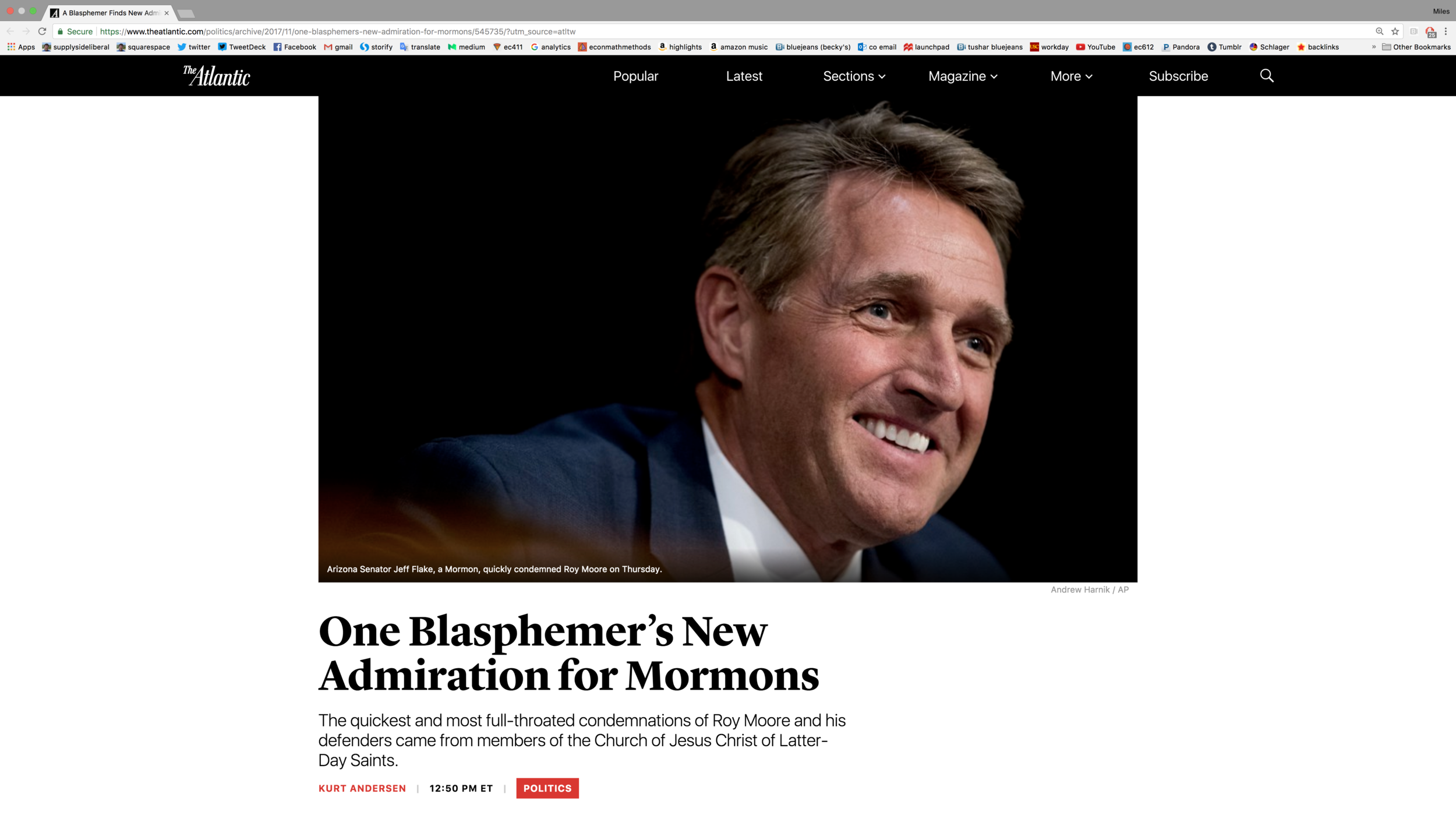
In our current political polarization, politics has often trumped people's commitment to truth. It has also often trumped people's commitment to morality and principles such as freedom of religion. A welcome exception is the Mormons. The case of Roy Moore has provided a test. Here is what Kurt Andersen writes in the article linked above:
... while I find their religious beliefs as extreme and strange as I do those of most American Protestants, Mormons seem more consistently virtuous and disciplined in the ways they live their lives.
In the Trump era, compared to the rest of the religious Republican base, they have walked that walk as citizens. Nationally, Trump’s share of the Mormon vote was 20 percent less than he got from white evangelical voters. In Utah, as The New York Times noted, more people voted against Donald Trump than for him in the general election.
Jeff Flake, one of five Republican U.S. senators who are Mormon, represents Arizona, the state with the fifth most Mormons. Right after Roy Moore won the Alabama Senate nomination in September, Flake was “the only Republican lawmaker to criticize Moore” according to The Washington Post—weeks before Flake announced he was leaving the Senate. Later he elaborated on his displeasure, focusing on Islamophobia, saying Moore’s “belief that a Muslim should not be a member of Congress because of his faith … was wrong.”
In response to the variously grotesque defenses of Moore, Flake tweeted: “Come on, Republicans. Is this who we are? This cannot be who we are.” ...
America’s most famous Mormon Republican, the one who declined to endorse Trump in 2016 because of his “trickle-down racism, trickle-down bigotry, trickle-down misogyny,” and who said in August that Trump’s “apologists strain to explain that he didn’t mean what we heard” concerning Charlottesville, remarks that had “caused racists to rejoice.” Mitt Romney stepped up first thing Friday morning, making superb use of Twitter’s new 280-character limit, advancing the logic of the case by batting away other Republicans’ main line of defense: “Innocent until proven guilty is for criminal convictions, not elections. I believe Leigh Corfman. Her account is too serious to ignore. Moore is unfit for office and should step aside.”
... Latter-Day Saints were the brave, virtuous avant garde, and as ridiculous as I find their supernatural beliefs, they are in this instance an outpost of true, real-world righteousness in a party in the grip of a terrible Faustian bargain.
See my own take on Mormonism in my Thanksgiving 2017 post "Five Books That Have Changed My Life."