The "Wait But Why" Blog on Why Generation Y Yuppies are Unhappy

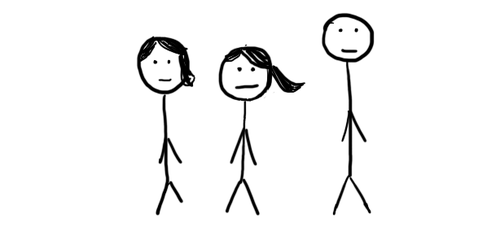
Here is a picture of Lucy, who appears in the post “Why Generation Y Yuppies are Unhappy” on the Wait But Why blog.

Noah Smith tweeted that the post “Why Generation Y Yuppies are Unhappy” on the Wait But Why blog sounded like the theory of happiness that Bob Willis and I have been putting forward. (On that theory, see my post “The Egocentric Illusion”–my riff on David Foster Wallace’s Kenyon College Commencement Address.)

After reading “Why Generation Y Yuppies are Unhappy,” I tweeted

Read this wonderful blog post about happiness before you bother with anything I have ever written: http://www.waitbutwhy.com/2013/09/why-generation-y-yuppies-are-unhappy.html

As you can see in that twitter thread, I then begged the author to let me reprint that blog post here, and was delighted to get that permission. I think you will see why if you keep reading. I think this post applies to many more of us than only those of us in Generation Y. 


Say hi to Lucy. Lucy is part of Generation Y, the generation born between the late 1970s and the mid 1990s.  She’s also part of a yuppie culture that makes up a large portion of Gen Y.  

I have a term for yuppies in the Gen Y age group—I call them Gen Y Protagonists & Special Yuppies, or GYPSYs.  A GYPSY is a unique brand of yuppie, one who thinks they are the main character of a very special story.

So Lucy’s enjoying her GYPSY life, and she’s very pleased to be Lucy. Only issue is this one thing:

Lucy’s kind of unhappy.

To get to the bottom of why, we need to define what makes someone happy or unhappy in the first place.  It comes down to a simple formula:

It’s pretty straightforward—when the reality of someone’s life is better than they had expected, they’re happy.  When reality turns out to be worse than the expectations, they’re unhappy. 

To provide some context, let’s start by bringing Lucy’s parents into the discussion:

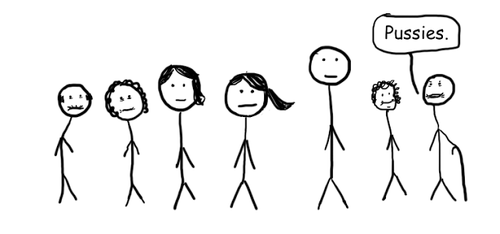
Lucy’s parents were born in the 50s—they’re Baby Boomers.  They were raised by Lucy’s grandparents, members of the G.I. Generation, or “the Greatest Generation,” who grew up during the Great Depression and fought in World War II, and were most definitely not GYPSYs.

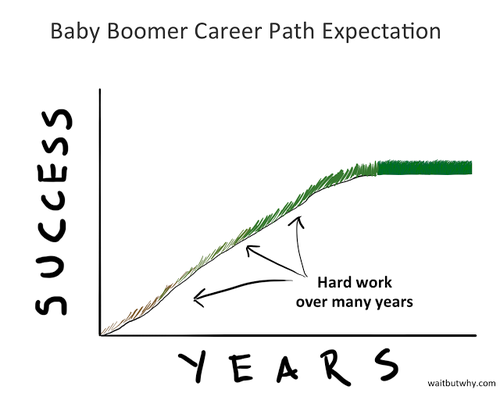
Lucy’s Depression Era grandparents were obsessed with economic security and raised her parents to build practical, secure careers.  They wanted her parents’ careers to have greener grass than their own, and Lucy’s parents were brought up to envision a prosperous and stable career for themselves.  Something like this:

They were taught that there was nothing stopping them from getting to that lush, green lawn of a career, but that they’d need to put in years of hard work to make it happen. 

blog.supplysideliberal.com tumblr_inline_mtt67zEOEV1r57lmx.png

After graduating from being insufferable hippies, Lucy’s parents embarked on their careers.  As the 70s, 80s, and 90s rolled along, the world entered a time of unprecedented economic prosperity.  Lucy’s parents did even better than they expected to.  This left them feeling gratified and optimistic.

blog.supplysideliberal.com tumblr_inline_mtt68sdUx01r57lmx.png

With a smoother, more positive life experience than that of their own parents, Lucy’s parents raised Lucy with a sense of optimism and unbounded possibility.  And they weren’t alone.  Baby Boomers all around the country and world told their Gen Y kids that they could be whatever they wanted to be, instilling the special protagonist identity deep within their psyches.

This left GYPSYs feeling tremendously hopeful about their careers, to the point where their parents’ goals of a green lawn of secure prosperity didn’t really do it for them.  A GYPSY-worthy lawn has flowers.

This leads to our first fact about GYPSYs:

GYPSYs Are Wildly Ambitious

The GYPSY needs a lot more from a career than a nice green lawn of prosperity and security.  The fact is, a green lawn isn’t quite exceptional or uniqueenough for a GYPSY.  Where the Baby Boomers wanted to live The American Dream, GYPSYs want to live Their Own Personal Dream.  

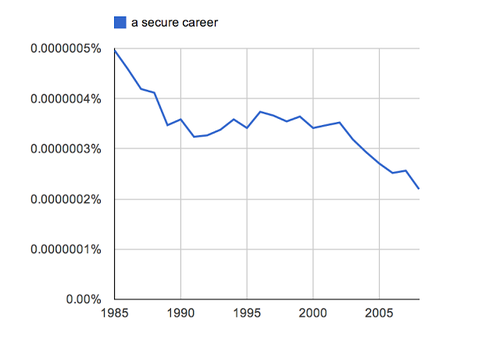
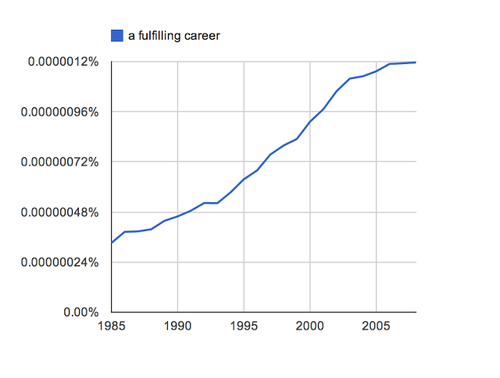
Cal Newport points out that “follow your passion” is a catchphrase that has only gotten going in the last 20 years, according to Google’s Ngram viewer, a tool that shows how prominently a given phrase appears in English print over any period of time. The same Ngram viewer shows that the phrase “a secure career" has gone out of style, just as the phrase "a fulfilling career" has gotten hot.

To be clear, GYPSYs want economic prosperity just like their parents did—they just also want to be fulfilled by their career in a way their parents didn’t think about as much.

But something else is happening too.  While the career goals of Gen Y as a whole have become much more particular and ambitious, Lucy has been given a second message throughout her childhood as well:

This would probably be a good time to bring in our second fact about GYPSYs:

GYPSYs Are Delusional

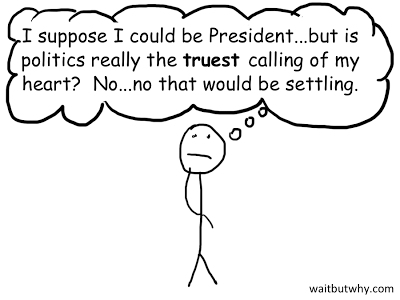
"Sure,” Lucy has been taught, “everyone will go and get themselves some fulfilling career, but I am unusually wonderful and as such, my career and life path will stand out amongst the crowd.” So on top of the generation as a whole having the bold goal of a flowery career lawn, each individual GYPSY thinks that he or she is destined for something even better—A shiny unicorn on top of the flowery lawn.  

So why is this delusional?  Because this is what all GYPSYs think, which defies the definition of special:

spe-cial | ‘speSHel |
adjective
better, greater, or otherwise different from what is usual.

According to this definition, most people are not special—otherwise “special” wouldn’t mean anything.

Even right now, the GYPSYs reading this are thinking, “Good point…but I actually am one of the few special ones"—and this is the problem.

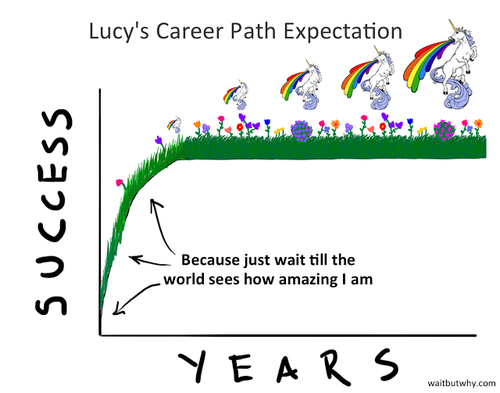
A second GYPSY delusion comes into play once the GYPSY enters the job market.  While Lucy’s parents’ expectation was that many years of hard work would eventually lead to a great career, Lucy considers a great career an obvious given for someone as exceptional as she, and for her it’s just a matter of time and choosing which way to go.  Her pre-workforce expectations look something like this:

Unfortunately, the funny thing about the world is that it turns out to not be that easy of a place, and the weird thing about careers is that they’re actually quite hard.  Great careers take years of blood, sweat and tears to build—even the ones with no flowers or unicorns on them—and even the most successful people are rarely doing anything that great in their early or mid-20s.

But GYPSYs aren’t about to just accept that.

Paul Harvey, a University of New Hampshire professor and GYPSY expert, has researched this, finding that Gen Y has "unrealistic expectations and a strong resistance toward accepting negative feedback,” and “an inflated view of oneself."  He says that "a great source of frustration for people with a strong sense of entitlement is unmet expectations. They often feel entitled to a level of respect and rewards that aren’t in line with their actual ability and effort levels, and so they might not get the level of respect and rewards they are expecting.”

For those hiring members of Gen Y, Harvey suggests asking the interview question, “Do you feel you are generally superior to your coworkers/classmates/etc., and if so, why?”  He says that “if the candidate answers yes to the first part but struggles with the ‘why,’ there may be an entitlement issue. This is because entitlement perceptions are often based on an unfounded sense of superiority and deservingness. They’ve been led to believe, perhaps through overzealous self-esteem building exercises in their youth, that they are somehow special but often lack any real justification for this belief.“

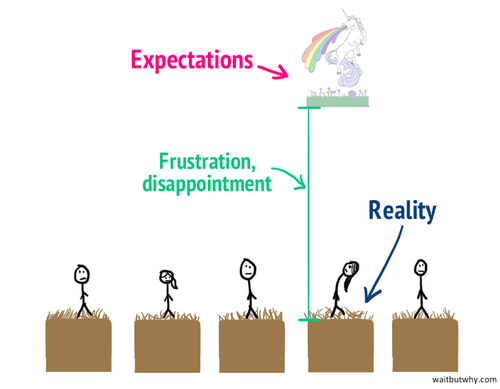
And since the real world has the nerve to consider merit a factor, a few years out of college Lucy finds herself here:

Lucy’s extreme ambition, coupled with the arrogance that comes along with being a bit deluded about one’s own self-worth, has left her with huge expectations for even the early years out of college.  And her reality pales in comparison to those expectations, leaving her "reality - expectations” happy score coming out at a negative.

And it gets even worse.  On top of all this, GYPSYs have an extra problem that applies to their whole generation:

GYPSYs Are Taunted

Sure, some people from Lucy’s parents’ high school or college classes ended up more successful than her parents did.  And while they may have heard about some of it from time to time through the grapevine, for the most part they didn’t really know what was going on in too many other peoples’ careers.

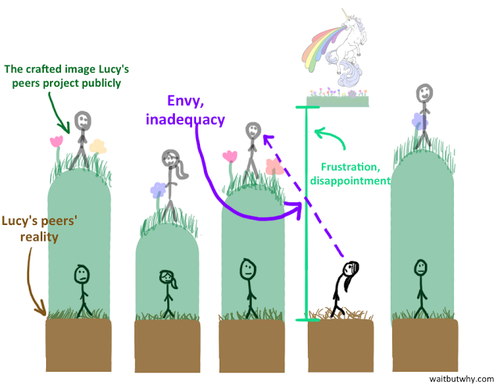
Lucy, on the other hand, finds herself constantly taunted by a modern phenomenon: Facebook Image Crafting.

Social media creates a world for Lucy where A) what everyone else is doing is very out in the open, B) most people present an inflated version of their own existence, and C) the people who chime in the most about their careers are usually those whose careers (or relationships) are going the best, while struggling people tend not to broadcast their situation.  This leaves Lucy feeling, incorrectly, like everyone else is doing really well, only adding to her misery:

So that’s why Lucy is unhappy, or at the least, feeling a bit frustrated and inadequate.  In fact, she’s probably started off her career perfectly well, but to her, it feels very disappointing. 

Here’s my advice for Lucy:

1) Stay wildly ambitious.  

The current world is bubbling with opportunity for an ambitious person to find flowery, fulfilling success.  The specific direction may be unclear, but it’ll work itself out—just dive in somewhere.

2) Stop thinking that you’re special.  

The fact is, right now, you’re not special.  You’re another completely inexperienced young person who doesn’t have all that much to offer yet.  You can become special by working really hard for a long time.  

3) Ignore everyone else. 

Other people’s grass seeming greener is no new concept, but in today’s image crafting world, other people’s grass looks like a glorious meadow. The truth is that everyone else is just as indecisive, self-doubting, and frustrated as you are, and if you just do your thing, you’ll never have any reason to envy others.

Wallace Neutrality Roundup: QE May Work in Practice, But Can It Work in Theory?

Quantitative easing or “QE” is the large scale purchases by a central bank of long-term or risky assets. QE has been used in a big way by the Fed since the financial crisis and by the Bank of Japan since the recent Japanese election, and is an important item on the monetary policy menu of all central banks that have already lowered short-term safe rates to close to zero. Moreover, purchases by the European Central Bank of risky sovereign debt at heavily discounted market prices can rightly be seen as a form of QE–indeed, as a relatively powerful form of QE.  

For monetary stimulus, I favor replacing QE by negative interest rates, made possible by a fee when private banks deposit paper currency with the central bank and establishing electronic money as the unit of account. (See “How and Why to Eliminate the Zero Lower Bound: A Reader’s Guide.”) But my proposal to eliminate the liquidity trap is viewed as radical enough that its near-term prospects are quite uncertain. So understanding quantitative easing (“QE”) remains of great importance for practical discussions of monetary policy. The key theoretical issue for thinking about QE is the logic of Wallace Neutrality. I wrote a lot about Wallace Neutrality in my first few months of blogging, (as you can see by going back to the beginning in 2012 in my blog archive) but haven’t written as frequently about Wallace Neutrality since I turned my attention to eliminating the zero lower bound. This post gives a roundup of some of the online discussion about Wallace Neutrality in the last year or so. 

I should note that I typically don’t even realize that someone has written a response to one of my posts unless someone sends a tweet with “@mileskimball” in it, tells me in a comment, or sends me an email. So I appreciate Richard Serlin letting me know about several posts he and others have written about Wallace Neutrality.  

Richard Serlin 1: Richard has two posts. In the first, published September 9, 2012, “Want to Understand the Intuition for Wallace Neutrality (QE Can’t Work), and Why it’s Wrong in the Real World?” Richard sets the stage this way:

This refers to Neil Wallace’s 1981 AER article, “A Modigliani-Miller theorem for open-market operations”. The article has been very influential today, as it has been used as a reason why quantitative easing can’t work. Here are some example quotes:

“No, in a liquidity trap, if the Fed purchases gold, it does not change the price of gold, just as it will not change the prices of Treasury bonds if it purchases them.” – Stephen Williamson
“The Fed can buy all the government debt it wants right now, and that will be irrelevant, for inflation or anything else.” – Stephen Williamson
“If it were up to me, I would have given Wallace the [Nobel] prize a long time ago, and I think Sargent would say the same. However, not everyone in the profession is aware of Wallace’s contributions, and people who are aware don’t necessarily get as excited about them as I do.” – Stephen Williamson
“…the influence of Wallace neutrality thinking on the Fed is clear from the emphasis the Fed has put on telling the world what it is going to do with interest rates in the future…I have a series of other posts also discussing Wallace neutrality. In fact, essentially all of my posts listed under Monetary Policy in the June 2012 Table of Contents are about Wallace neutrality.” – Miles Kimball

In Wallace’s model, when the Fed prints money and buys up an asset with it, this affects no asset’s price, and doesn’t even change inflation! Amazing claims, but they’re mathematically proven to be true – in Wallace’s model, and with the accompanying assumptions. So the big question is, even in a model, how can claims like this make sense? What could be the intuition for that? 

Brad DeLong: Richard points to this from Brad DeLong as some of the best intuition for Wallace Neutrality that he had found up to that point:

Long ago, Bernanke (2000) argued that monetary policy retains enormous power to boost production, demand, and employment even at the zero nominal lower bound to interest rates:

The general argument that the monetary authorities can increase aggregate demand and prices, even if the nominal interest rate is zero, is as follows: Money, unlike other forms of government debt, pays zero interest and has infinite maturity. The monetary authorities can issue as much money as they like. Hence, if the price level were truly independent of money issuance, then the monetary authorities could use the money they create to acquire indefinite quantities of goods and assets. This is manifestly impossible in equilibrium. Therefore money issuance must ultimately raise the price level, even if nominal interest rates are bounded at zero. This is an elementary argument, but, as we will see, it is quite corrosive of claims of monetary impotence…

His argument, however, seems subject to a powerful critique: The central bank expandeth the money stock, the central bank taketh away the money stock, blessed be the name of the central bank. In order for monetary policy to be effective at the zero nominal lower bound, expectations must be that the increases in the money stock via quantitative easing undertaken will not be unwound in the future after the economy exits from its liquidity trap. If expectations are that they will be unwound, then there is potentially money to be made by taking the other side of the transaction: sell bonds to the central bank now when their prices are high, hold onto the cash until the economy exits from the liquidity trap, and then buy the bonds back from the central bank in the future when it is trying to unwind its quantitative easing policies. A Modigliani Miller-like result applies.

Richard Serlin 1 Again: Richard then gives this rundown of Neil Wallace’s paper itself:

The government prints dollars and buys the single consumption good, which I like to call c’s….

People are going to want to store a certain amount of c’s anyway, because that’s utility maximizing to help smooth consumption. What the government essentially does in this model is say, hey, store your c’s with us instead of at the private storage facility. Give us a c, and we’ll give you some dollars, which are like a receipt, or bond. We’ll then store the c’s – we won’t consume them, we won’t use them for anything (these are crucial assumptions of Wallace, required to get his stunning results) – We will just hold them in storage (implied in the equations, not stated explicitly).

Next period, you give us back those dollars, and we give you back your c’s, plus some return (from the dollar per c price changing over that period). In equilibrium, the return from storing c’s via the dollar route must be equal to the return from storing c’s via the private storage facility route. Or at least the return must be worth the same amount at the equilibrium state prices; so either way you go you can arrange at the same cost in today c’s, the same exact next period payoff in any state that can occur….

It is analogous to Miller-Modigliani, in that if a corporation increases its debt holding, then shareholders will just decrease their personal debt holding by an equivalent amount, so that their total debt stays exactly where it was, which was the amount they had previously calculated to be utility maximizing for them (And there’s a lot of very unrealistic and material assumptions that go with this that have been long acknowledged as such in academic and practitioner finance; when you learn Miller-Modigliani, at the bachelors, masters, and PhD levels – which I have –  they always start by teaching the model and its strong assumptions, and then go into the various reasons why it far from holds in reality. This is long accepted in academic finance; pick up any text that covers MM.)

Richard offers one other intuition for Wallace Neutrality, based on asset pricing principles when asset prices are at their fundamental values:

Suppose dollars are printed and used to buy 10 year T-bonds. Or gold, like in the Stephen Williamson quote at the beginning of this post. And everybody knows (making a Wallace-like assumption) that in five years the T-bonds or gold will be sold back for dollars. We’re making all of the perfect assumptions here: For all investors, perfect information, perfect foresight, perfect analysis, perfect rationality, perfect liquidity,…

Now, what is the price of gold? How is it calculated in this world of perfects?

Well, as a financial asset it’s worth only what it’s future cash flows are. Suppose you are going to hold onto the gold and sell it in one year. Then, what it’s worth is its price in one year (which you know at least in every state – perfect foresight) discounted back to the present at the appropriate discount rate.

But suppose this: During that year that you will be holding the gold in your vault, you are told the government will borrow your gold for five minutes, take it out of your vault, and replace it with green slips of paper with dead presidents, then five minutes later they will take back the green slips and replace back your gold in the vault. Do you really care? This doesn’t affect how much you will get for the gold when you sell it in a year, and as a financial asset that’s all you care about when you decide how much gold is worth today.

If you’re going to hold the gold for ten years, and sell it then, then you only care about what the price of gold will be in ten years. And the price of gold in ten years only depends on what the supply and demand for gold is in ten years. If the government takes 100 million ounces of gold out of private vaults, and put it in its vaults, then puts it back in the private vaults three years later, this has no effect on the supply of gold in ten years. So in ten years the price of gold is the same. And if gold will be the same price in ten years, then it will be worth the same price today for someone who’s not going to sell for ten years anyway.

Jérémie Cohen-Setton and Éric Monnet: A year later, September 6, 2012, Richard wrote a follow-up post: The Intuition for Wallace Neutrality, Part II: Why it doesn’t Work in the Real World. Richard flags an excellent synthesis by Jérémie Cohen-Setton and Éric Monnet on 10th September 2012: Blogs review: Wallace Neutrality and Balance Sheet Monetary PolicyJérémie and Éric start by explaining why understanding the issues surrounding Wallace Neutrality matters in the real world, with particular reference to Mike Woodford’s conclusions assuming Wallace Neutrality, and then give this summary discussions of Wallace Neutrality by Richard, Brad DeLong, Michael Woodford and me:

Miles Kimball defines Wallace neutrality as follows:  a property of monetary economic models in which differences in the government’s overall balance sheet at moments in time when the nominal interest rate is zero have no general equilibrium effect on interest rates, prices, or non-financial economic activity. Richard Serlin (HT Mark Thoma) writes that in Wallace’s model, when the Fed prints money and buys up an asset with it, this affects no asset’s price, and doesn’t even change inflation!

Brad DeLong and Miles Kimball think that Wallace neutrality has baseline modeling status, in the same manner as Ricardian neutrality. Saying a model has baseline modeling status is saying that it should be the starting point for thinking about how the world works – as it reflects how the simplest economics models behave within the category of “optimizing models.”. The discussion is then about what might plausibly make things behave differently in the real world from that theoretical starting point.  Miles Kimball argues that the difference in the theoretical status of Wallace neutrality as compared to Ricardian neutrality is that we are earlier in the process of putting together good models of why the real world departs from Wallace neutrality. Studying theoretical reasons why the world might not obey Ricardian neutrality was frontier research 25 years ago.  Showing theoretical reasons why the world might not obey Wallace neutrality is frontier research now….

As far as intuition for Wallace Neutrality goes, here is Jérémie and Éric channeling Mike Woodford:

Michael Woodford notes that it is important to note that such “portfolio-balance effects” do not exist in a modern, general-equilibrium theory of asset prices. Within this framework the market price of any asset should be determined by the present value of the random returns to which it is a claim, where the present value is calculated using an asset pricing kernel (stochastic discount factor) derived from the representative household’s marginal utility of income in different future states of the world. Insofar as a mere re-shuffling of assets between the central bank and the private sector should not change the real quantity of resources available for consumption in each state of the world, the representative household’s marginal utility of income in different states of the world should not change. Hence the pricing kernel should not change, and the market price of one unit of a given asset should not change, either, assuming that the risky returns to which the asset represents a claim have not changed.

On reasons why Wallace Neutrality might not hold in the real world, I am pleased to see that Jérémie and Éric reference the Wikipedia article on Wallace Neutrality that Fudong Zhang got started:

The Wikipedia page for Wallace Neutrality – the result of a proposed public service provided by the readers of the Miles Kimball’s blog, Confessions of a Supply-Side Liberal – point to other recent works which invalidate Wallace neutrality based on different relaxed assumptions and novel mechanisms. For example, in Andrew Nowobilski’s (2012) paper, open market operations powerfully influence economic outcomes due to the introduction of a financial sector engaging in liquidity transformation.

Richard Serlin 2: Now for the core of what Richard says in his second post, The Intuition for Wallace Neutrality, Part II: Why it doesn’t Work in the Real World. Richard has kindly given me permission to quote at some length from his nice explanation of the logic behind Wallace Neutrality and why it might not hold in the real world: 

I had gone down various roads in thinking about why the neutrality that worked in Wallace’s model would not work in the real world, and I just wasn’t able to really nail down any of them the way I wanted to, at least not the ones I wanted to. But thinking about this again, the idea came to me. The intuition is this:

Suppose the Fed does buy up 100 million ounces of gold in a quantitative easing. And the people who are savvy, well informed, expert, and rational know that in some years the economy will turn around, and the Fed will just sell back all of those 100 million ounces. So, in 10 years, the supply of gold will be the same as it would have been if the quantitative easing had never occurred. The ownership papers will shift from private parties to the federal government in the interim, but will be back again to private parties like they never left in 10 years. So, no fundamental change to the asset’s value in 10 years.

And if no fundamental change to the asset’s value in 10 years, then no fundamental change to the asset’s value today, as the value today, for a financial asset with no dividends, coupons, etc., is just the discounted present value of the asset’s value 10 years from now.

Now, as should be obvious – especially with gold – not all investors are savvy, well informed, expert, and rational – let alone sane! So, when the price of gold starts to go up, some of them will not sell at that higher price, even though fundamentally the price should not go higher; nothing has changed about the long run, or 10 year, price of gold.

In the Wallace model, and commonly in financial economics models, no problem, arbitrage opportunity! Suppose there are investors who are less than perfectly expert, knowledgeable, and rational – or way less – and they don’t sell when the government buys up the price a little. Who cares. It just takes one expert knowledgeable investor to recognize that there’s an arbitrage opportunity when the price of gold goes up merely because the government is buying it in a QE, and he’ll milk it ceaselessly until the price is all the way back down again and the arbitrage disappears….

Now, for this to work as advertised, first you need 100% complete markets, so you must have a primitive asset (or be able to synthetically construct one) for every possible state at every possible time in the world.

[using Chandler Bing voice] Have you seeeen our world? The number of states just one minute from now is basically infinite. Even the number of significant finitized states over the next day, let alone a path of years, is so large, it’s for all intents and purposes infinite. Thus, try to construct a synthetic asset that pays off the same as gold, now and over time, and you’re not going to come very close. And if you try buying it to sell gold, or vice versa, to get an “arbitrage”, you’re going to expose yourself to a lot of risk.

And this is a key. I think a lot of misunderstanding comes from loose use of the word “arbitrage”. The textbook definition of arbitrage is a set of transactions that has zero risk, zero. It’s 100% risk free. It’s not low risk, as often things that are called arbitrage are. It’s not 99% risk-free. It’s riskless, zero. That’s what makes it so powerful in models, at least one of the things.

Another one of the things that makes it so powerful in models is that it requires none of your own money. If there’s an expert and informed enough investor anywhere, even just a single one, who sees it, it doesn’t matter if he doesn’t have two nickels to rub together, he can do it. He can borrow the money to buy the assets necessary, and at the market interest rate. Or, he can just sign the necessary contracts, for whatever amounts, no matter how big. His credit and credibility are always considered good enough….

Well, what are the problems with that? The usual one you hear is that savvy investors are only a small minority of all investors, and this is especially true of highly expert investors who are highly informed about a given individual asset, or even asset class. And they only have so much money. Eventually, if the government keeps buying in a QE it could exhaust their funds, their ability to counter, by, for example, selling gold they own, or selling gold they don’t own short.

Even rich people and institutions only have so much money and liquidity, or credit. You can’t outlast the Fed, if the Fed is truly determined. Your pockets may be very deep, but the Fed’s pockets are infinite.

So, you usually hear that.

But there’s another reason why the savvy marginal investor is limited in his ability and willingness to push prices back to their fundamentals that I never hear. It’s a powerful and important reason: The more a savvy investor jumps on a mispriced individual asset, the more his portfolio gets undiversified, and that can quickly become dangerous and not worth it.

Miles: Despite having turned my primary attention in relation to monetary policy to eliminating the zero lower bound, I have written a fair amount about QE in the last year. My column “Why the US Needs Its Own Sovereign Wealth Fund” discusses my intuition that Wallace Neutrality will be further from the truth for assets that have the largest risk and term premiums and what this suggests for monetary policy, given that the Fed doesn’t have non-emergency authority to buy corporate stocks and bonds:

…what if longer-term Treasuries and mortgage-backed securities are the wrong assets for the Fed to buy? Most of those rates are already below 3%, so it’s not that easy to push the rates down further. What is worse, when long-term assets already have low interest rates, pushing down those interest rates pushes the prices of those assets up dramatically. So the Fed ends up paying a lot for those assets, and when it later has to turn around and sell them—as it ultimately will need to, to raise interest rates and avoid inflation, it will lose money. Avoiding buying high and selling low is tough when the Fed has to move interest rates to do the job it needs to do. At least economic recovery reduces mortgage defaults and so helps raise the prices of mortgage-backed securities through that channel. But the effects of interest rates on long-term assets cut against the Fed’s bottom line in a way that is never an issue when the Fed buys and sells 3-month Treasury bills in garden-variety monetary policy.

From a technical point of view, once 3-month Treasury bill rates (and overnight federal funds rates) are near zero, the ideal types of assets for “quantitative easing” to work with are assets that (a) have interest rates far above zero and (b) are buoyed up in price when the economy does well. That means the ideal assets for quantitative easing are stock index funds or junk bond funds!

Yet, is the Federal Reserve even the right institution to be making investment decisions like this?…

Why not create a separate government agency to run a US sovereign wealth fund? Then the Fed can stick to what it does best—keeping the economy on track—while the sovereign wealth fund takes the political heat, gives the Fed running room, and concentrates on making a profit that can reduce our national debt….

As an adjunct to monetary policy, the details of what a US Sovereign Wealth Fund buys don’t matter. As long as the fund focuses on assets with high rates of return, the effect on the economy will be stimulative, and the Fed can use its normal tools to keep the economy from getting too much stimulus.

In May 2013, I wrote a full column on quantitative easing: “QE or not QE: Even Economists Need Lessons in Quantitative Easing, Bernanke Style,” sparked by a Martin Feldstein column. There, in relation to Wallace Neutrality, I write:

Once the Fed has hit the “zero lower bound,” it has to get more creative. What quantitative easing does is to compress—that is, squish down—the degree to which long-term and risky interest rates are higher than safe, short-term interest rates. The degree to which one interest rate is above another is called a “spread.” So what quantitative easing does is to squish down spreads. Since all interest rates matter for economic activity, if safe short-term interest rates stay at about zero, while long-term and risky interest rates get pushed down closer to zero, it will stimulate the economy. When firms and households borrow, the markets treat their debt as risky. And firms and households often want to borrow long term. So reducing risky and long-term interest rates makes it less expensive to borrow to buy equipment, hire coders to write software, build a factory, or build a house.

Some of the confusion around quantitative easing comes from the fact that in the kind of economic models that come most naturally to economists, in which everyone in sight is making perfect, deeply-insightful decisions given their situation, and financial traders can easily borrow as much as they want to, quantitative easing would have no effect. In those “frictionless” models, financial traders would just do the opposite of whatever the Fed does with quantitative easing, and cancel out all the effects. But it is important to understand that in these frictionless models where quantitative easing gets cancelled out, it has no important effects. Because in the frictionless models quantitative easing gets canceled out, it doesn’t stimulate the economy. But because in the frictionless models quantitative easing gets cancelled out it has no important effects. In the world where quantitative easing does nothing, it also has no side effects and no dangers. Any possible dangers of quantitative easing only occur in a world where quantitative easing actually works to stimulate the economy!

Now it should not surprise anyone that the world we live in does have frictions. People in financial markets do not always make perfect, deeply-insightful decisions: they often do nothing when they should have done something, and something when they should have done nothing. And financial traders cannot always borrow as much as they want, for as long as they want, to execute their bets against the Fed, as Berkeley professor and prominent economics blogger Brad DeLong explains entertainingly and effectively in “Moby Ben, or, the Washington Super-Whale: Hedge Fundies, the Federal Reserve, and Bernanke-Hatred.” But there is an important message in the way quantitative easing gets canceled out in frictionless economic models. Even in the real world, large doses of quantitative easing are needed to get the job done, since real-world financial traders do manage to counteract some of the effects of quantitative easing as they go about their normal business of trying to make good returns. And “large doses” means Fed purchases of long-term government bonds and mortgage-backed bonds that run into trillions and trillions of dollars. (As I discuss in “Why the US Needs Its Own Sovereign Wealth Fund,” quantitative easing would be more powerful if it involved buying corporate stocks and bonds instead of only long-term government bonds and mortgage-backed bonds.) It would have been a good idea for the Fed to do two or three times as much quantitative easing as it did early on in the recession, though there are currently enough signs of economic revival that it is unclear how much bigger the appropriate dosage is now….

Sometimes friction is a negative thing—something that engineers fight with grease and ball bearings. But if you are walking on ice across a frozen river, the little bit of friction still there between your boots and the ice allow you to get to the other side. It takes a lot of doing, but quantitative easing uses what friction there is in financial markets to help get us past our economic troubles.

In response to one commenter (by email) who thought that QE had not done much either for the stock market or the economy as a whole, I wrote:

But this seems like an argument for a bigger dosage of QE. And it is not clear that the counterfactual is share prices staying the same. Without any QE, the economy would probably have been hurting enough that stock prices would have gone down….

The key point I am trying to make is that it is the ratio of stimulus to undesirable side-effect that matters, not the ratio of stimulus to dollar size of asset purchase. I think you are saying that the Fed has done a lot of QE with relatively little effect, but to the extent that the QE has relatively little effect in undesirable directions as well as relatively little effect in terms of stimulus, the answer is simply to scale up the size of the asset purchases. For example, if a given level of QE has little effect on the level of stock prices and therefore little stimulus, it presumably has relatively little effect on financial stability as well, to the extent financial stability worries have to do with the level of the stock market.  
The one undesirable effect I know of that depends on the size of the asset purchase *as opposed to the size of the stimulus generated,* is the capital losses the Fed will face when it sells the long-term bonds. That is something I write about in my column advocating a US Sovereign Wealth Fund as a way to do a fixed quantum of QE that focuses on assets that would gain more in value from general equilibrium effects than long-term government bonds would: “Why the US Needs Its Own Sovereign Wealth Fund.”

The point

…it is the ratio of stimulus to undesirable side-effect that matters, not the ratio of stimulus to dollar size of asset purchase.

is of course the point I was making in my first post on Wallace Neutrality (and second post on QE) back in June 2012,

“Trillions and Trillions: Getting Used to Balance Sheet Monetary Policy." (There is a similar point in my working paper "Getting the Biggest Bang for the Buck in Fiscal Policy” about National Lines of Credit.“You can read the blog post here, which has a link to the paper.)  

Quartz #31—>America's Big Monetary Policy Mistake: How Negative Interest Rates Could Have Stopped the Great Recession in Its Tracks

Link to the Column on Quartz

Here is the full text of my 31st Quartz column, ”America’s huge mistake on monetary policy: How negative interest rates could have stopped the Great Recession in its tracks,” now brought home to supplysideliberal.com. It was first published on September 6, 2013. Links to all my other columns can be found here.

If you want to mirror the content of this post on another site, that is possible for a limited time if you read the legal notice at this link and include both a link to the original Quartz column and the following copyright notice:

© September 6, 2013: Miles Kimball, as first published on Quartz. Used by permission according to a temporary nonexclusive license expiring June 30, 2014. All rights reserved.

This post is a rearticulation of my argument for electronic money, focusing on the negative interest rates themselves. You can see links to all my other work on electronic money in “How and Why to Eliminate the Zero Lower Bound: A Reader’s Guide.”

An early draft had the following lead paragraph that was cut for reasons of brevity and focus, but that I think will be of interest to many readers:

John von Neumann, who revolutionized economics by inventing game theory (before going on to help design the first atom bomb and lay out the fundamental architecture for nearly all modern computers), left an unfinished book when he died in 1957: The Computer and the Brain. In the years since, von Neumann’s analogy of the brain to a computer has become commonplace. The first modern economist, Adam Smith, was unable to make a similarly apt comparison between a market economy and a computer in his books, The Theory of Moral Sentiments or in the The Wealth of Nations, because they were published, respectively, in 1759 and 1776—more than 40 years before Charles Babbage designed his early computer in 1822. Instead, Smith wrote in The Theory of Moral Sentiments:

“Every individual … neither intends to promote the public interest, nor knows how much he is promoting it … he intends only his own security; and by directing that industry in such a manner as its produce may be of the greatest value, he intends only his own gain, and he is in this, as in many other cases, led by an invisible hand to promote an end which was no part of his intention.”

Now, writing in the 21st century, I can make the analogy between a market economy and a computer that Adam Smith could not. Instead of transistors modifying electronic signals, a market economy has individuals making countless decisions of when and how much to buy, and what jobs to take, and companies making countless decisions of what to buy and what to sell on what terms. And in place of a computer’s electronic signals, a market economy has price signals. Prices, in a market economy, are what bring everything into balance.


There’s a reason why the workings of the price system through supply and demand are taught as one of the first lessons when studying economics. This is where the action is. When people want to buy more of something than others want to sell, the price of that good goes up, signaling that more needs to be produced and less needs to be bought. When the opposite occurs (there’s more to sell than people want to buy), the price of that good goes down to signal that less needs to be produced and more needs to be bought to bring things into balance. Interference with those price signals lowers the IQ of the “invisible hand,” this competition that naturally guides markets.

One key set of prices in the economy are interest rates—which, after accounting for inflation, tell how much more one has to pay to buy something now instead of later. Interest rates are crucial in balancing the total amount of goods and services households and firms want to buy and use now with the total amount of goods and services they want to produce and sell now. Indeed, if anything prevents interest rates from adjusting appropriately to balance aggregate supply and demand, bad things happen: if interest rates are too low, the imbalance will cause the economy to overheat and generate inflation; if interest rates are too high, the imbalance will cause the economy to fall into a recession. Conversely, when interest rates do adjust appropriately, anytime the economy starts to overheat, interest rates go up to balance aggregate supply and demand and stop the overheating in its tracks; anytime the economy starts to fall into a recession, interest rates go down to balance aggregate supply and demand and stop the recession in its tracks.

There are two complications in the adjustment of interest rates that do not apply to other prices. First, short-run movements in interest rates are tangled up with money supply and demand. In practice, that means that central banks such as the Federal Reserve choose interest rates, not always appropriately. Second, there is a traditional floor of zero for interest rates. (There also used to be a ceiling of 5% on certain interest rates, but thankfully, that has receded into the mists of time.) Each of these is a big issue. Let me leave the details of appropriate interest rate setting by central banks to a later column, and focus here on the second wrench in the works of interest rate adjustment: the traditional floor of zero on interest rates, or as it is called by macroeconomic policy wonks, the “zero lower bound on nominal interest rates.”

Putting a floor of zero on interest rates is like cutting a wire in the economy’s computer. The importance of the zero lower bound (abbreviated to “ZLB” by said wonks) can easily be seen by googling “zero lower bound” and “John Taylor” + “zero lower bound.”

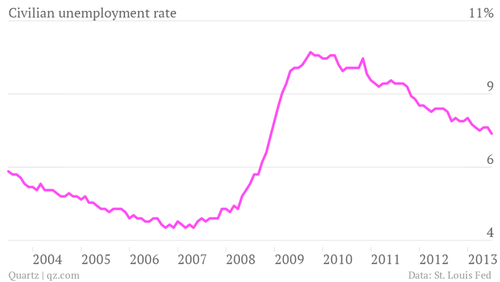
The paper Robert Hall presented at last month’s Jackson Hole conference (pdf) on monetary policy has a good statement of this widely-held view that the zero lower bound has been a major factor in the miserable course of economic events in the last few years (pdf). The simple truth is that the Great Recession was very painful and US unemployment is still painfully high five years later, primarily because of the zero lower bound. Even without the ZLB, there would have been some hit from the financial crisis that ensued with the bankruptcy of Lehman Brothers on Sept. 15, 2008, but negative interest rates in the neighborhood of 4% below zero would have brought robust recovery by the end of 2009.

blog.supplysideliberal.com tumblr_inline_mtt8un9yid1r57lmx.png

The reason negative interest rates are needed during a serious recession (at least for countries that have low rates of inflation) is that businesses are scared to invest, banks are scared to make loans, and even better-off households are scared to spend when times are bad. If it is easy to sit on cash, then frightened businesses, banks and households that have a cash cushion will sit on cash. If businesses aren’t spending to build factories, buy machines, or do R&D, and households aren’t spending on things to make their lives better, everyone who is trying to produce and sell something is left in the lurch. Negative interest rates for idle cash would motivate those who would otherwise sit on that cash to take the risks to put it to use to build the economy. Those who needed safety the most could still get that safety, if they are willing to pay for it. But those willing to take risks would be rewarded. All of this would simply be the price system doing its work of keeping the economy on target, in the particular case of interest rates.

What is behind the tradition of a floor of zero on interest rates? First, when inflation is high, interest rates never get down as far as zero anyway. So people get used to interest rates above zero. Second, even in the absence of inflation, when the economy is healthy, there are many investment projects that have the potential to earn a good return. Thus, when the economy is healthy, businesses vying for the funds to do their investment projects push interest rates above zero. Consumers who see the advantage of getting a car or a house or an education now rather than later also help push interest rates above zero when the economy is healthy. So the zero lower bound only becomes a problem when an economy conquers the bulk of inflation and then has a bad recession.

The way that the traditional floor of zero for interest rates is enforced by government policy is by the government’s guarantee of what, leaving aside storage costs, amounts to an exactly zero interest rate on paper currency. As long as the government guarantees an interest rate of zero on paper currency, who would ever accept a significantly lower interest rate? As a technical matter, there is no difficulty in repealing the government’s current guarantee of a zero interest rate on paper currency and thereby freeing up all interest rates to go negative, if necessary. The key technical issue is to make it so there is no place to hide from the negative interest rates, not even by putting cash under the mattress; paper currency would earn more or less the same negative interest rate as money in bank accounts. See my first column on electronic money here and the presentation I have been giving at central banks around the world here. So it all comes down to interest rate politics. If, politically, the government doesn’t dare let interest rates go negative, they won’t be able to. But if the government quit gumming up the works of the price system by guaranteeing a minimum interest rate of zero, then negative rates would be quite possible, and even half-decent monetary policy using negative rates would be enough to prevent another Great Recession.

The key political arguments for high interest rates when the economy needs low rates center on being fair to savers. Saving helps people to be self-sufficient in times of trouble, rather than having to beg others for help. And when the economy is healthy, additional saving makes it possible to finance more investment that builds up the productive capacity of the economy. So as a character trait, being a saver is rightly praised. But there is a time and place for everything, and the middle of a recession is the one time when we need people to spend rather than save in order to balance the economy. So while, in general, it is appropriate to reward savers handsomely for saving—as positive interest rates do in good times—it is also appropriate to charge savers for saving in bad times when we desperately need those who have a little financial leeway to spend. In bad times, there is no way to earn a positive return on business investment without taking some risk. So it is right and proper for those who insist on total safety in those times to pay for that safe storage, just as people are accustomed to paying to keep their belongings in physical storage units. What is more, the imperative of rewarding savers for the virtue of saving argues for returning the economy to robust health and positive interest rates as soon as possible. During serious recessions, negative interest rates are the key to quick economic recovery. The relatively ineffective alternative is zero or near-zero interest rates for years and years. Therefore, both on grounds of effectiveness and kindness to savers, negative interest rates for a few quarters are better than zero interest rates for years and years.

Ultimately, the choice we face is whether:

(a) to make the economy stupid in the face of recessions by imposing a zero lower bound

(b) to steer away from the zero lower bound by permanently higher inflation, with all of its attendant costs, or

( c) to repeal the zero lower bound and allow negative interest rates for brief periods when economic recovery requires them.

To me, the best choice is clear.

How I Became Optimistic

For the most part, those around me tend to think of me as relatively cheerful and optimistic. I want to tell you the story of how that came to be.

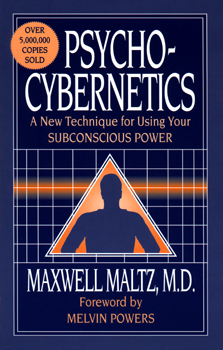
For several years when I was a teenager, I felt that facing reality meant I mustn’t fool myself by being optimistic. Studiously avoiding optimism had the side-effect of making me less cheerful. But then I read the Maxwell Maltz’s book Psycho-Cybernetics. Maxwell made an argument that changed my life. He argues that visualizing positive outcomes is a way to be prepared in case something good happened and a way to instruct one’s subconcious mind to strive for that outcome. In other words, visualizing a desired outcome is a way to tell one’s subconscious mind what its objective function should be.

To me this was like a bolt out of the blue. Visualizing a positive outcome was not a claim that that outcome would happen, it was simply presenting a certain image to one’s mind without any claim to inevitability, in a way meant to increase the probability that the positive image might be realized. Thus, it was possible to carefully maintain objectivity for analytical decision-making and evaluation purposes, while still gaining the psychological benefits of optimism.

Ever since the day that logic made its way into my brain, I have allowed myself to be relatively optimistic, in what I hope is a careful way, and I have been noticeably more cheerful than I was before.

For many of you, this book was before your time, but it was reasonably important in its day, and in its effect on later events. Below is what the Wikipedia article on Psycho-Cybernetics has to say:

Psycho-Cybernetics is a classic self-help book, written by Maxwell Maltz in 1960 and published by the non-profit Psycho-Cybernetics Foundation.[1] Motivational and self-help experts in personal development, including Zig ZiglarTony RobbinsBrian Tracy have based their techniques on Maxwell Maltz. Many of the psychological methods of training elite athletes are based on the concepts in Psycho-Cybernetics as well.[2] The book combines the cognitive behavioral technique of teaching an individual how to regulate self-concept developed by Prescott Lecky with the cybernetics of Norbert Wiener and John von Neumann. The book defines the mind-body connection as the core in succeeding in attaining personal goals.[3]

Maltz found that his plastic surgery patients often had expectations that were not satisfied by the surgery, so he pursued a means of helping them set the goal of a positive outcome through visualization of that positive outcome.[3] Maltz became interested in why setting goals works. He learned that the power of self-affirmation and mental visualisation techniques used the connection between the mind and the body. He specified techniques to develop a positive inner goal as a means of developing a positive outer goal. This concentration on inner attitudes is essential to his approach, as a person’s outer success can never rise above the one visualized internally.

I can’t guarantee that Zig Ziglar, Tony Robbins and Brian Tracy maintain the same distinction between analytical realism and mental-imagery optimism that I try to, but their embrace of Psycho-Cybernetics indicates some of the reach it has had.

GiveWell: Top Charities

In my post “Inequality Aversion Utility Functions: Would $1000 Mean More to a Poorer Family than $4000 to One Twice as Rich?” I use math and survey data on inequality aversion to argue that the big gains from redistribution are from taking care of the desperately poor. GiveWell is a website that rates charities in a way consistent with that criterion. Take a look. 

I learned about GiveWell from Michael Huemer’s excellent book The Problem of Political Authority.

Arindrajit Dube: Jonathan Meer and Jeremy West's Negative Correlation for Minimum Wages and Employment Growth is a Statistical Artifact

Back in February, I did a post “Jonathan Meer and Jeremy West: Effects of the Minimum Wage on Employment Dynamics” sympathetic to Jonathan and Jeremy’s claims. Arindrajit Dube has now seriously questioned those findings, writing that the lower employment growth is in manufacturing, where the minimum wage is not very relevant, while it is hard to find employment effects in retail, accomodation and food services, where one would expect the minimum wage to matter if it matters much anywhere. 

One interesting possibility is that (a) at US levels minimum wages do not have very big economic effects, but (b) the urge to raise minimum wages is positively correlated with other policy views that are more harmful to employment growth.  

Legal Issues Relevant for the Transition to Electronic Money

Yesterday, I gave a presentation on eliminating the zero lower bound to in the seminar series of the University of Michigan’s new Center for Finance Law and Policy. Here is a 23-slide Powerpoint file reflecting what we talked about. I volunteered for this talk especially because I wanted to get the help of lawyers in the group in understanding legal issues that matter for making the transition to electronic money. (You can see a full-length Powerpoint file that is less focused on the legal issues here.)

This bit from the introduction to the still very rough-draft of the paper “Breaking Through the Zero Lower Bound” served as the abstract for the talk: 

Under current monetary systems, paper currency (and coins) guarantee a zero nominal rate of return, apart from storage costs, which are relatively small. It is then difficult for central banks to reduce their target interest rates below the rate of return on paper currency storage, which is not far below zero.  This limitation on central bank target interest rates is called the “zero lower bound.” Because the zero lower bound is a consequence of how monetary systems handle paper currency, it is possible to eliminate the zero lower bound by alternative paper currency policies. Though there are costs as well as benefits to any policy, there is nothing intrinsically difficult about paper currency policies that eliminate the zero lower bound. Eliminating the zero lower bound would give central banks a wider range of options for their target interest rates. 

I started by pointing the participants to my recent post “How and Why to Eliminate the Zero Lower Bound: A Reader’s Guide,” and gave a quick rundown of the how and why in the Powerpoint file for the talk. But for me, the heart of the discussion was a series of legal questions I posed. I list them below, together with the answers I got from the audience, when I put them on the spot in bold, according to my understanding of their answers. I would be glad for corrections and other views from any reader. I would also love to hear about other legal issues you think are important for the transition to electronic money.

  1. Does the central bank (the Federal Reserve, in the US case) have the authority to levy a proportional fee when banks deposit paper currency in their account with the central bank? Probably yes.
  2. Does the central bank have the authority to have vault cash held banks count less toward reserve requirements than reserves in the account the bank has with the central bank? Yes.
  3. Is it legal for retailers to charge more when a customer pays in paper currency than when a customer pays by credit card, debit card or check? Yes.
  4. Is a loan contract provision enforceable that stipulates that a borrower must pay a surcharge if the borrower makes interest or principal payments in paper currency? Yes.
  5. In typical existing loan contracts, could lender refuse to accept repayment made with large amounts of paper currency? No. Note that, according to the argument in “The Path to Electronic Money as a Monetary System,” this “no” answer still leaves it possible to eliminate the zero lower bound, but without legislation to change this, the transition unfortunately would be a “soft-money transition." 
  6. If, in principal, typical existing loan contracts allow a borrower to repay with large amounts of paper currency, how difficult would it be to get a judgment to that effect? It is the lender who has to take the borrower to court to enforce payment. So the lender bears most of the transactions costs. That means that many borrowers might insist on paying in paper currency might become an issue even when paper currency is only modestly below par (i.e., even when deposit fee the central bank levies on deposits of paper currency is still relatively small).
  7. Does Congress or Parliament have the authority to stipulate that “dollar” or other currency in existing loan contracts means the amount that a dollar in a bank account would be worth, if the value of a dollar worth of paper currency diverged from the value of a dollar in a bank account. This question was about constitutional issues. In the US, the "takings clause” of the 5th Amendment might get in the way of a withdrawal fee–which is not part of my proposal. A suit against the paper currency deposit fee that is a mainstay of my proposal could be brought based on this sentence: “The validity of the public debt of the United States, authorized by law, including debts incurred for payment of pensions and bounties for services in suppressing insurrection or rebellion, shall not be questioned.” The argument would be that paper currency was a form of debt of the Federal Government and so should be honored at par. If this argument succeeded, then eliminating the zero lower bound in a constitutional way might require ending the issuance of traditional currency and replacing traditional currency with small denomination bearer bonds with a variable interest rate that would function as currency as I discussed in “A Minimalist Implementation of Electronic Money."
  8. Under current law, can the IRS disallow payment in paper currency? Up until the point things wind up in court, the IRS can certainly insist on payment by check, credit card, or electronic transfer, but if things wound up in court the taxpayer might be able to claim the right to pay the debt to the government in paper currency because it is legal tender. But it seems that the taxpayer would pay many of the costs of taking things to court, even if this maneuver would work. 
  9. In the Eurozone, does the European Central Bank have the authority to require national central banks to impose a proportional fee on the deposit by banks of paper currency with the national central bank? Not clear. 
  10. Alternatively, does the European Central Bank have the authority to centralize all reserve accounts of banks in Frankfurt so that any bank depositing paper currency would face an ECB paper currency deposit fee directly? Not clear.

Don't Believe Anyone Who Claims to Understand the Economics of Obamacare

Here is a link to my 33d column on Quartz “Don’t believe anyone who claims to understand the economics of Obamacare.”

Here is my original introduction, which was drastically trimmed down for the version on Quartz: 

Republican hatred of Obamacare, and Democratic support for Obamacare, have shut down the “non-essential” activities of the Federal Government. So, three-and-a-half years since President Obama signed the “Patient Protection and Affordable Care Act” into law, and a year or so since a presidential election in which Obamacare was a major issue, it is a good time to think about Obamacare again.

In my first blog post about health care, back in June 2012, I wrote:

I am slow to post about health care because I don’t know the answers. But then I don’t think anyone knows the answers. There are many excellent ideas for trying to improve health care, but we just don’t know how different changes will work in practice at the level of entire health care systems.  

That remains true, but thanks to the intervening year, I have high hopes that with some effort, we can be, as the saying goes, “confused on a higher level and about more important things.”

One thing that has come home to me in the past year is just how far the US health care sector—with or without Obamacare—is from being the kind of classical free market Adam Smith was describing when he talked about the beneficent “invisible hand” of the free market. 

Reactions: Gerald Seib and David Wessel Included this column in their “What We’re Reading” Feature in the Wall Street Journal. Here is their excellent summary:

The key to the long-run impact of Obamacare will be whether it smothers innovation in health care – both in the way it is organized and in the development of new treatments. And no one today can know whether that’ll happen, says economist Miles Kimball. [Quartz]

(In response, Noah Smith had this to say about me and the Wall Street Journal.) This column was also featured in Walter Russell Mead’s post “How Will We Know If Obamacare Succeeds or Fails.” (Thanks to Robert Graboyes for pointing me to that post.) He writes:

Meanwhile, at Quartz, Miles Kimball has a post entitled “Don’t Believe Anyone Who Claims to Understand the Economics of Obamacare.” The whole post is worth reading, but near the end, he argues that the ACA’s effect on innovation could eventually be the most important thing about it’s long-term legacy…

From our perspective, these are both very good places to start thinking about how to measure Obamacare’s impact. Of course, Tozzi’s metric is easier to quantify than Kimball’s: it will be difficult to judge how the ACA is or isn’t limiting innovation. But that doesn’t mean we shouldn’t try: without innovation, there’s no hope for a sustainable solution to the ongoing crisis of exploding health care costs.

I have also been pleased by some favorable tweets. Here is a sampling:

JP Koning Defends Electronic Money vis a vis Ashok Rao

Ashok Rao wrote a blog post questioning the importance of eliminating the zero lower bound: 

The Economy’s Not a Rock, and Paper Isn’t Killing It

Here is my pictorial reply: 

For a more serious answer to Ashok, I was delighted to see JP Koning’s answer to Ashok’s arguments in the comments section of Ashok’s blog. Thanks to JP for his permission to reprint those comments here.


Good stuff. Some comments:

“Michael Woodford or Paul Krugman’s preferred monetary policy – “credibly promising to be irresponsible” – might be better achieved under negative interest rates but, even then, that’s not a clear conclusion. ”

Actually, the whole point of being able to set negative interest rates is so you don’t have to credibly promise to be irresponsible. It allows a central banker to reduce the return on reserves in the present (to some negative amount) rather than having to promise a future reduction in returns. It’s just a continuation of the conventional policy of manipulating interest rates that we had during the Great Moderation, except with the possibility of going negative — Greenspan, for instance, never had to commit to being irresponsible, he just lowered the overnight rate.

“what exactly is the point of militating for the abolishment of paper money – which is a far more radical experiment altogether?”

Aren’t you focusing in on the wrong experiment? Remember, Miles’s plan isn’t necessarily about abolishing paper. It’s about introducing a variable conversion rate between paper and deposits. If you think about it, this strategy isn’t even an experiment, actually. It’s very similar in concept to policies adopted in the late 1800s to go off the bimetallic standard and onto a pure gold standard. Rather than enforce a fixed ratio between gold:silver, authorities let the ratio float. That way the economy needn’t revert between gold and silver every few decades. Doing the same with notes:deposits means that we won’t experience mass movements from deposits to notes when the ZLB becomes a problem.

“[there’s no reason why following a Taylor Rule when rates exceed zero ] and an ‘exponential growth of asset purchases’ when rates fall below zero is any more discretionary.”

But that’s the whole problem. Rates can’t get below 0 because of the existence of 0% cash. No amount of QE will ever be able to make rates fall below 0.

That isn’t to say that huge QE can’t have some effect on the price level. By promising to keep huge amounts of reserves outstanding in the future, a central bank can lower today’s return on reserves and inspire movements today out of reserves into other goods and assets. Near term bills will fall to 0%, and eventually mid-term bonds will hit 0%, and finally long term bonds will fall towards 0%. The problem here, as Miles points out, is that we lose any sort of term structure of interest rates. Reducing rates below 0%, on the other hand, preserves the existing term structure of interest rates. Insofar as the term structure provides important information to economic actors, we may desire to preserve it rather than distort it.

How and Why to Eliminate the Zero Lower Bound: A Reader’s Guide

Even with links, it has become hard for me to explain in the 140 characters I have on Twitter how an interested reader should approach reading or listening to what I have to say about eliminating the zero lower bound.  This post is meant to meet that need.  It also serves as an annotated bibliography for my Breaking Through the Zero Lower Bound with Electronic Money sub-blog. (I hope to keep it updated when I add relevant new posts.)

I have organized all the posts on my Electronic Money sub-blog into categories; a few fall into more than one category. Within each category, they appear in chronological order, earliest to most recent. (Let me know if I have left out a relevant post.) The last category below is for posts that are in part about some other topic, but that contain a brief appeal for eliminating the zero lower bound and putting negative interest rates in the monetary policy toolkit–brief enough to copy out below.

If you have only 5 minutes, the video of the CEPR interview with me that will catch your eye below is a great place to start. A little further down is a video of my 20-minute talk at Brookings. For links to other videos, see "Electronic Money: The Powerpoint File."

If you want academic policy papers, please turn to these two: 

“Negative Interest Rate Policy as Conventional Monetary Policy” has been translated into German. These papers incorporate many (though not all) of the arguments in the other links below. 

Note: some of the most important posts below have been translated into Japanese here, thanks to the efforts of Makoto Shimizu. Makoto has also written a book on negative interest rate policy in Japanese that you can find here.  Suparit Suwanik has begun to translate key posts into Thai.

The Core Argument

Explanations of Negative Interest Rates in Alternative Media

Operational Details for Eliminating the Zero Lower Bound

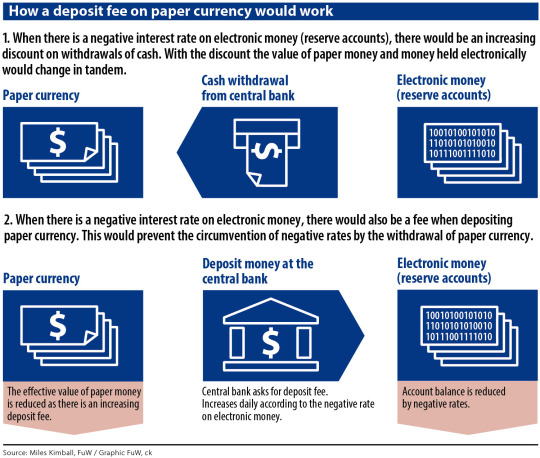
The graphic above is a translation of the one here, graciously provided by Finanz und Wirtschaft through the good offices of Alexander Trentin. Used by permission.

The graphic above is a translation of the one here, graciously provided by Finanz und Wirtschaft through the good offices of Alexander Trentin. Used by permission.

Legal Issues

Comparison of Negative Interest Rates to Other Tools for Stimulating the Economy

News and Trends

Radio and Video Interaction

History of Thought and Economic History

Q&A, Discussion and Rebuttal

Storified Twitter Discussions

Reactions

Brief Appeals for Eliminating the Zero Lower Bound, Short Enough to Copy Out Here

It is the fear of massive storage of paper currency that prevents the US Federal Reserve and other central banks from cutting short-term rates as far below zero as necessary to bring full recovery. (If electronic dollars, yen, euros and pounds are treated as “the real thing”—the yardsticks for prices and contracts—it is OK for people to continue using paper currency as they do now, as long as the value of paper money relative to electronic money goes down fast enough to keep people from storing large amounts of paper money as a way of circumventing negative interest rates on bank accounts.) As I argued in “Could the UK be the first country to adopt electronic money,” the low interest rates that electronic money allows would stimulate not only business investment and home building, but exports as well—something that would lead to a virtuous domino effect as the adoption of an electronic money standard by one country led to its adoption by others to avoid trade deficits. If I were writing that column now, I would be asking if Japan could be the first country to adopt electronic money, since Japan’s new prime minister Shinzo Abe is calling for a new direction in monetary policy. For the Euro zone, I argue in “How the electronic deutsche mark can save Europe” that electronic money is not only the way to achieve full recovery, but the solution to its debt crisis as well….

Franklin Roosevelt famously said:

“The country needs and, unless I mistake its temper, the country demands bold, persistent experimentation. It is common sense to take a method and try it: If it fails, admit it frankly and try another. But above all, try something.”

We are at such a moment again. The usual remedies have failed. It is time to try something new.

… it is an even more important mistake to think that monetary policy can’t cut short-term interest rates below zero. Weisenthal quotes a post on Barnejek’s blog, “Has Britain Finally Cornered Itself?” that illustrates the faulty thinking I’m talking about:

“Before I start, however, I would like to thank the British government for conducting a massive social experiment, which will be used in decades to come as a proof that a tight fiscal/loose monetary policy mix does not work in an environment of a liquidity trap. We sort of knew that from the theory anyway but now we have plenty of data to base that on.”

“Liquidity trap” is code for the inability of the Bank of England to lower interest rates below zero. The faulty thinking is to treat the “liquidity trap” or the “Zero Lower Bound,” as modern macroeconomists are more likely to call it, as if it were a law of nature. _The Zero Lower Bound is not a law of nature! _It is a consequence of treating money in bank accounts and paper currency as interchangeable. As I explain in a series of Quartz columns (1, 2, 3 and 4) and posts on my blog—that is a matter of economic policy and law that can easily be changed. As soon as paper pounds are treated as different creatures from electronic pounds in bank accounts, it is easy to keep paper pounds from interfering with the conduct of monetary policy. In times when the Bank of England needs to lower short-term interest rates below zero, the effective rate of return on paper pounds can be kept below zero by announcing a crawling peg “exchange rate” between paper pounds and electronic pounds that has the paper pounds gradually depreciating relative to electronic pounds.

In his advice for the UK, Weisenthal should either explain why having an exchange rate between paper pounds and pounds in bank accounts is worse than a massive explosion of debt or join me in tilting against a windmill less tilted against. And for those who read Krugman’s columns, it would take a bad memory indeed not to recall that he gives the corresponding advice of stimulus by additional government spending for the US, which faces its own debt problem. I hope Paul Krugman will join me too in attacking the Zero Lower Bound.

In 1896 William Jennings Bryan famously declared:

“… you shall not crucify mankind on a cross of gold.”

In our time it is not gold that is crucifying the world economy (though some would return us to the problems that were caused by the gold standard), but the unthinking worldwide policy of treating paper currency as interchangeable with money in bank accounts. So for our era, let us say: You shall not crucify humankind on a paper cross.

Although there are a few other economists who might match Bernanke in their monetary policy judgments, through his years at the helm of the Fed, Bernanke has developed an unparalleled skill in explaining and defending controversial monetary policy measures to Congress and to the public. The most important ways in which US monetary policy has fallen short in the last few years are because of the limits Congress has implicitly and explicitly placed on the Fed. Negative interest rates could be much more powerful than quantitative easing, but require a legal differentiation between paper currency and electronic money in bank accounts to avoid massive currency storage that would short-circuit the intended stimulus to the economy.

For the US, the most important point is that using monetary policy to stimulate the economy does not add to the national debt and that even when interest rates are near zero, the full effectiveness of monetary policy can be restored if we are willing to make a legal distinction between paper currency and electronic money in bank accounts—treating electronic money as the real thing, and putting paper currency in a subordinate role. (See my columns, “How paper currency is holding the US recovery back” and “What the heck is happening to the US economy? How to get the recovery back on track.”) As things are now, Ben Bernanke is all too familiar with the limitation on monetary policy that comes from treating paper currency as equivalent to electronic money in bank accounts. He said in his Sept. 13, 2012 press conference:

“If the fiscal cliff isn’t addressed, as I’ve said, I don’t think our tools are strong enough to offset the effects of a major fiscal shock, so we’d have to think about what to do in that contingency.”

Without the limitations on monetary policy that come from our current paper currency policy, the Fed could lower interest rates enough (even into negative territory for a few quarters if necessary) to offset the effects of even major tax increases and government spending cuts.

…the tools currently at the Fed’s disposal plus clearly communicating a nominal GDP target are not enough to get the desired result. The argument goes as follows. Interest rates are the price of getting stuff—goods and services—now instead of later. If people are out of work, we want customers to buy stuff now by having low interest rates. Thinking about short-term interest rates like the usual federal funds rate target that the Fed uses, the timing of the low interest rates matters. If everyone knows we are going to have low short-term interest rates in 2016, then it encourages buying in the whole period between now and 2016 in preference to buying after 2016. But to get the economy out of the dumps, we really want people to buy right now, not spread out their purchases over 2013, 2014, and 2015. The lower we can push short-term interest rates, the more we can focus the extra spending on 2013, so that we can have full recovery by 2014, without overshooting and having _too much _spending in 2015. This is an issue that economist and New York Times columnist Paul Krugman alludes to recently in a column about Japanese monetary policy.

There is only one problem with pushing the short-term interest rate down far enough to focus extra spending right now when we need it most: the way we handle paper currency. The Fed doesn’t dare try to lower the interest rate it targets below zero for fear of causing people to store massive amounts of currency (which _effectively _earns a zero interest rate). Indeed, most economists, like the Fed, are so convinced that massive currency storage would block the interest rate from going more than a hair below zero that they talk regularly about a zero lower bound on interest rates. The solution is to treat paper currency as a different creature than electronic money in bank accounts, as I discuss in many other columns. (“What Paul Krugman got wrong about Italy’s economy” gives links to other columns on electronic money as well.) If instead of being on a par with electronic money in bank accounts, paper currency is allowed to depreciate in value when necessary, the Fed can lower the short-term interest as far as needed, even if that means it has to push the short-term interest rate below zero

Keeping the Economy on Target

In the current economic doldrums, breaking through the zero lower bound with electronic money is the first step in ensuring that monetary policy can quickly get output back to its natural level. A better paper currency policy puts the ability to lower the Fed’s target interest rate back in the toolkit. That makes it possible for the Fed to get the timing of extra spending by firms and households right to meet a nominal GDP target—hopefully one that has been appropriately adjusted for the rate of technological progress.

The reason I wrote this post is because many people don’t seem to understand that low levels of output lower the net rental rate and therefore lower the short-run natural interest rate. Leaving aside other shocks to the economy, monetary policy will not tend to increase output above its current level unless the interest rate is set below the short-run natural interest rate. That means that the deeper the recession an economy is in, the lower a central bank needs to push interest rates in order to stimulate the economy….

If a country makes the mistake of having a paper currency policy that prevents it from lowering the nominal interest rate below zero, then the MP curve has to flatten out somewhere to the left. (The zero lower bound on the nominal interest rate puts a bound of minus expected inflation on the real interest rate. That makes the floor on the real interest rate higher the lower inflation is.) The lower bound on the MP curve might then make it hard to get the interest rate below the net rental rate (a.k.a. the short-run natural interest rate). In my view, this is what causes depressions. QE can help, but is much less powerful than simply changing the paper currency policy so that the nominal interest rate can be lowered below the short-run natural interest rate, however low the recession has pushed that short-run natural interest rate.

The questions I would like to ask Larry Summers and Janet Yellen are many, but let’s focus on three big ones:

  1. Eliminating the “Zero Lower Bound” on Interest Rates. Given all of the problems that a floor of zero on short-term interest rates causes for monetary policy, what do you think of going to negative short-term interest rates, as I have argued for here and here and here? If we repealed the “zero lower bound” that prevents interest rates from going below zero, there would be no need to rely on the large scale purchases of long-term government debt that are a mainstay of “quantitative easing,” the quasi-promises of zero interest rates for years and years that go by the name of “forward guidance,” or inflation to make those zero rates more potent. Repealing the “zero lower bound” would require dramatic changes in monetary policy (and in particular, a dramatic change in the way we handle paper currency), but wouldn’t that be worth it?

… the Fed’s approach of talk therapy is problematic because it is hard to communicate a monetary policy that is strongly stimulative now but will be less stimulative in the future. As I discussed in a previous column and in the presentation I have been giving to central banks around the world, adjusting short-term interest rates has an almost unique ability to get the timing of monetary policy right. Unfortunately, the US government’s unlimited guarantee that people can earn at least a zero interest rate by holding massive quantities of paper currency stands in the way of simply lowering short-term interest rates….

My own recommendations for the Fed are no secret:


The solution to the dilemma of a Fed doing less than it thinks should be done because it is afraid of the tools it has left when short-term interest rates are zero? Give the Fed more tools. Unfortunately, it takes time to craft new tools for the Fed, but that is all the more reason to get started. (Sadly, even if all goes well in the next few years, this isn’t the last economic crisis we will ever have.) As I have written about herehere, and here, three careful and deliberate steps by the US government would make it possible for the Fed to cut interest rates as far below zero as necessary to keep the economy on course:

  1. facilitate the development of new and better means of electronic payment and enhance the legal status of electronic money,

  2. trim back the legal status of paper currency, and

  3. give the Federal Reserve the authority to charge banks for storing money at the Fed and for depositing paper currency with the Fed.

If the Fed could cut interest rates below zero, it wouldn’t need QE, it wouldn’t need forward guidance, and it wouldn’t wind up begging Congress and the president to run budget deficits to stimulate the economy. And because the Fed understands interest rates—whether positive or negative—much, much better than it understands either QE or forward guidance, the Fed would finally know what it was doing again.

Automatic enrollment in retirement savings plans is so powerful that some economists will worry that its spread will help exacerbate a global glut of saving. But if paper currency policy gets out of the way of the appropriate interest rate adjustments, financial markets will find the appropriate equilibrium. They will balance the supply and demand for saving, and companies will realize the extent to which an abundance of saving makes available the funds they need to dream big by creating new markets and technologies that the future of America depends on.

John Stuart Mill on the Role of Custom in Human Life

From John Stuart Mill's On Liberty, Chapter 3 “Of Individuality, as One of the Elements of Well-Being,” paragraph 3:

Nobody denies that people should be so taught and trained in youth, as to know and benefit by the ascertained results of human experience. But it is the privilege and proper condition of a human being, arrived at the maturity of his faculties, to use and interpret experience in his own way. It is for him to find out what part of recorded experience is properly applicable to his own circumstances and character. The traditions and customs of other people are, to a certain extent, evidence of what their experience has taught them;presumptive evidence, and as such, have a claim to his deference: but, in the first place, their experience may be too narrow; or they may not have interpreted it rightly. Secondly, their interpretation of experience may be correct, but unsuitable to him. Customs are made for customary circumstances, and customary characters; and his circumstances or his character may be uncustomary. Thirdly, though the customs be both good as customs, and suitable to him, yet to conform to custom, merely as custom, does not educate or develop in him any of the qualities which are the distinctive endowment of a human being. The human faculties of perception, judgment, discriminative feeling, mental activity, and even moral preference, are exercised only in making a choice. He who does anything because it is the custom, makes no choice. He gains no practice either in discerning or in desiring what is best. The mental and moral, like the muscular powers, are improved only by being used.

Quartz #30—>How to Avoid Another Nasdaq Meltdown: Slow Down Trading (to Only 20 Times Per Second)

Link to the Column on Quartz

Here is the full text of my 30th Quartz column, ”How to avoid another Nasdaq meltdown: Slow down trading” now brought home to supplysideliberal.com. It was first published on August 23, 2013. Links to all my other columns can be found here.

If you want to mirror the content of this post on another site, that is possible for a limited time if you read the legal notice at this link and include both a link to the original Quartz column and the following copyright notice:

© August 23, 2013: Miles Kimball, as first published on Quartz. Used by permission according to a temporary nonexclusive license expiring June 30, 2014. All rights reserved.

The last paragraph of this column is especially heartfelt. 


Whatever the exact trigger that brought Nasdaq down today, it is likely that a contributing cause is the huge increase in lightning-fast high-frequency computer trading in recent years. Nathaniel Popper wrote in the New York Times in October 2012 that the profits from high-frequency-trading have started to fall because the volume of stock-trading has fallen in the wake of the Great Recession, but that

Many market experts have argued that the technical glitches that have recently hit the market have been a result of a broader trend of the market splintering into dozens of automated trading services and a lack of human oversight.

High-frequency trading has been controversial because of the idea that it takes advantage of slower human investors. Back in 2009, the New York Times’s Charles Duhigg detailed an insider account of one case of computers besting humans:

The slower traders began issuing buy orders [for Broadcom]. But rather than being shown to all potential sellers at the same time, some of those orders were most likely routed to a collection of high-frequency traders for just 30 milliseconds—0.03 seconds—in what are known as flash orders. While markets are supposed to ensure transparency by showing orders to everyone simultaneously, a loophole in regulations allows marketplaces like Nasdaq to show traders some orders ahead of everyone else in exchange for a fee.

In less than half a second, high-frequency traders gained a valuable insight: the hunger for Broadcom was growing.

In terms of fairness, this seems worse than the controversial two-second advance notice subscribers could get for the University of Michigan’s Index of Consumer Sentiment. At least in that case, subscribers’ fees for the advance notice pay for the collection of scientifically valuable survey data. But what social benefit flows from letting high-frequency traders peek at market supply and demand 30 milliseconds before everyone else? It could be that giving high-frequency traders that kind of advantage entices them to provide liquidity in the market, selling to those who want to buy and buying from those who want to sell. But the magnitude of this supposed benefit is unproven. As Popper writes: “Regulators are still grappling with whether the rise of high-speed firms has been a net benefit or loss for investors.”

If letting high-frequency traders have an advantage measured in milliseconds doesn’t provide enough benefits to be worth the seeming unfairness, what can be done? One simple approach would be to have the market only clear 20 times per second, and insisting that all orders received by, say, 11:05:02.05 a.m., be treated in a totally even-handed way in that moment of market clearing (as buy and sell orders are matched). Further, it should be insisted that orders be absolutely secret from other traders until the moment of market clearing when that order is supposed to be revealed and executed. It is possible that having the market clear only 20 times per second would reduce the total amount of information processing done by the market every day, but discouraging high-frequency traders and their advantageous zero-sum game off sheer speed of execution might lead the traders to focus on more socially valuable forms of information processing.

In academic finance, concerns about high-frequency trading go under the heading of “market microstructure” issues. There are other bigger problems in finance at the macroeconomic level that I have talked about more than once. The best reason to fix unfairness—or even perceived unfairness—in market microstructure is so people aren’t distracted from noticing how those in the financial industry use low levels of equity financing (often misleadingly called capital) to shift risks onto the backs of taxpayers and rewards into their own pockets. In quantum mechanics, electrons can “tunnel” from one side of a barrier to another. Using massive borrowing to ensure later government bailouts, the financial industry has perfected an even more amazing form of tunneling: the art of tunneling money from the government so that the profits appear on their balance sheets and in their pockets long before the money disappears from the US Treasury in bailouts. By comparison with this financial quantum tunneling of money from the US taxpayer that has been a mainstay of the financial industry, high-frequency trading profits of a few billion dollars a year are small change.

Ragnarok

When I was 14 or 15 (circa 1975), I wrote the only science fiction story I have written of any length. I revised it a few years later, and then, at the urging of my son, again in early 2002, but without changing that much from what I wrote as a teenager. Having some sense of its many imperfections, I set it out here in case some of you find it entertaining. 


Act 1

Beta Hydri had set on the horizon of Minas Tirith.  In his palatial garden, Patrick Austen looked up at the stars.  The Universe still awed him after all his years of traversing it.  Man had hardly scratched the surface of God’s Creation.  Man had visited one hundred odd systems in a Galaxy of two hundred billion suns, and a universe of millions of galaxies.  Thinking of the almost limitless possibilities filled him with impatience, with a feeling of futility that he could not realize his dreams that moment.  In a galaxy to conquer, Patrick Austen had but on lifetime.

Patrick found Ursa Minor, and there, a drop falling into the dipper, found Sol, center of the Terran Empire.  He felt a quiet pride at his role in the formation of that empire, as commodore of a Squadron in subjugating the Cetian League, and as a Fleet Admiral in freeing Atlantis and Eriador from the Jacobites. 

Only three years ago he had entered Minas Tirith in triumph.  The people of Eriador, joyful of their freedom from Jacob Hamilton’s religion with its tithes and enforced observances had staged a fantastic celebration, fireworks, mock space battles and all the gimmickry of twenty-third century science.

After the loss of Eriador the Jacobites had disappeared.  He had made an attempt at search but had found nothing.  Nine months ago, the Jacobites had made a raid on Mordor, destroying all its installations.  The empire had renewed the search and had kept the entire Hydnan and Pavonian systems well protected.

Patrick broke his reverie and began walking back to his palace.  Theta projections surrounded the palace.  Any imaginable scene could be projected by variation of the theta beams, reactivity, resoundance, and strength.  Now, the computer projected a continuously changing, iridescent wall.  From time to time a recognizable form emerged to dissolve a moment later.  “In an empire of billions of people, its leaders are able to live well without undue strain on the populace”, Patrick thought wryly.

As he passed through the projected wall, the communicator implanted in his skull spoke.  “Emperor David Briant has been assassinated.  Imperialists under Andrei Petrovich now control the government.  Malcolm Johns – Emperor’s counselor, March 5, 2216.” 

A wave of despair coursed through him.  Then grief overcame him.  For the first time, Patrick realized the full extent of David Briant’s greatness.  David Briant, who had raised Terra from an anarchic wilderness, ravaged by intra-systemic war, to the seat of an empire of forty systems, David Briant, who had unified Terra in the face of an attack by Thor, who had shown that a united Earth was still a match for any other world.  David Briant, who for seventeen years had governed an empire for the benefit of all, and David Briant, who had recognized the talent of an obscure flotilla commander.

Now, he was dead.  Not just dead; murdered.  Suddenly a terrible anger and hatred of Petrovich and his imperialists consumed Patrick.  They had undoubtedly killed Briant because he was fair to the outsystems, treating all alike, and not, as the Imperialists wished, taxing away their strength to create greater megalithic monuments to adorn each Terran’s backyard, replacing oppression with oppression.  The hatred left Patrick as swiftly as it came, leaving only the grief.

In the midst of his mourning, his communicator again spoke.  Administrator Heath requests an immediate conference in his offices.”  Transforming his emotion into physical energy, Patrick sprinted into his palace, a castle taken straight from the Lord of the Rings.  As he passed through the entrance, two dragons swooped down, shot up again, executed a few aerial maneuvers, and gradually faded away.  Inside the entrance to the left, a door slid open at the touch of his hand.  He entered a small cubical, sitting on the chair within.  “Administrator’s offices” he intoned.  The transporter dropped down a few feet, then accelerated forward.  Twenty five seconds later, the chair turned around to prepare for deceleration.  The transporter came to a stop, then shot upward.  Patrick hung a few seconds in weightlessness as the transporter came to a halt.  The door opened to reveal the office of the administrator of Eriador with Heath, Lugano, the planetary defense chief, and Patrick’s four Squadron commanders seated around a mahogany table.  As Patrick took his place, Halladay, the Vice-Administrator, entered from another transporter. 

The Administrator began to speak.  He had a look of sadness in his eyes, but he spoke forcefully.  “A coup has overthrown the emperor and his government.  I called this conference to decide whether we should accept this new government or oppose it.”  His eyes swept over the conferees.

Black, one of the commodores, spoke.  “Recognizing Petrovich’s government after he caused the murder of the Emperor would exemplify the highest cowardice, bestowing on all the Universe the right to kill our leaders whenever they wish.  We must avenge this outrage.”

“Vengeance, oh sweet vengeance!  Poisoner of souls, destroyer of Men!”  Patrick derided.  “Enough have died, without our vengeance.”  Realizing how distraught he was, he paused for a moment, then continued in a quieter tone, “We cannot raise the dead with blooded swords.  I, too, favor opposition to Petrovich.  I fear he will destroy the Empire with his Regionalism.”

Deliberately, Heath proffered, “It is distasteful to me to submit to Petrovich.  But have we any chance of defeating him?  He has the might of Terra behind him.”

Thoughtfully Patrick answered, “Because of the razing of Mordor, we have fourteen capital ships, Atlantis has eleven.  In the entire empire, there are sixty-four.  I believe we have more popular support; the Imperialists will have to garrison everything.  They’d be on the defensive; if they lose Terra it would hurt them much more than our loss of Eriador…

The lines creasing the administrator’s face softened as he heard this.  He interrupted Patrick, “Does anyone else have objections to armed opposition?”  All shook their heads, except the Planetary Defense Chief.  After a slight hesitation, he also shook his head.  “We should have no trouble convincing the Assembly.  You can lift off as soon as they approve.” Heath instructed Patrick.

The council began to make some tentative plans.  When they began to disperse, Patrick and his commodores went to the Admiralty offices where they worked late into the night organizing the expedition.

Act 2

Eighteen days later, the Hydrian fleet approached Delta Pavonis.  In one second, each ship executed sextillions of microscopic quantum jumps.  Each jump displaced every particle in the vessel a fraction of a milli-micron without passing through any of the intervening space, just as electrons jump from one energy level to another without experiencing any intermediate states.

At normal cruising speed, the fleet covered about a light-year every two days.  Nevertheless, the true velocity remained exactly the same, unaffected by the quantum drive quasi-velocity.

The quantum drive magnifies the effect of tidal strain.  In each jump, gravity affects the ship as if it had moved that distance.  Otherwise, the quantum drive would break the law of conservation of energy.  Thus, at normal drive speeds, gravity and tidal strain are multiplied a millionfold.  In addition, the quantum drive unavoidably weakens nuclear cohesion.  As a result, starships must slow down in the vicinity of a star or planet, and, within a certain distance, totally refrain from using the quantum drive.

About 250 million kilometers from Delta Pavonis, the Hydrian fleet reached this boundary.  Its true velocity was already directed toward Atlantis.  The fleet decelerated at about 170 meters per second squared. 

Thirteen hours later, the fleet orbited Atlantis.  Obtaining permission to land, Patrick descended to New Berlin, the capital.  Ships of every type covered the spaceport, intra-systemic vessels, interstellar merchant ships, mapping shipsand warships.  Patrick easily picked out the warships by their mirror surfaces.  Each warship burned with reflected sunlight.  The mirror coating reflected most of the force of laser beams in battle.

Wilhelm Koenig, the Admiral of the Pavonian fleet, met Patrick at the foot of the ramp which had extended itself from the ship.  They entered an aircar.  As the computer controlled vehicle flew to the administrative offices of Atlantis, Patrick observed the city.  It was rather mundane compared to some cities.  It exhibited little of the elaborate domes and spires and fairy arches supported by strengthening energies.  To many people, these things were a sign of decadence, especially to those who cannot afford them. 

Their vehicle landed on the roof of the Administration building, a skyscraper in the center of the city.  A door slid open at Admiral Koenig’s touch.  The door responded to his unique cell frequency pattern.  They entered another executive council similar to the one Patrick had attended eighteen days earlier. 

Six hours later found the council still debating whether to join the venture.  Patrick became slowly desperate.  Without the help of Pavonis and its fleet, the counter-revolution had little chance of succeeding.  Patrick was once again enumerating the possible benefits and attempting to belittle the resks of the expedition.  The implanted communicators spoke.  “An incoming group of ships has been detected at 152/197/109.”  This threw the council into a furor.  This threw the council into a furor.  This resolved doubts of the extent of Imperialist ambition swayed the council into deciding to support the counter-revolution.

Patrick had no time to celebrate.  The two admirals returned to Patrick’s flagship Alexander the Great and began to formulate an operational plan. 

Lloyd Zumbrennen, newly elevated Admiral of the First Expeditionary Fleet of Sol, considered the situation.  The Atlanteans had given no answer to his demand of surrender.  With his nineteen capital ships he could easily defeat the eleven-capitalship fleet that had garrisoned Atlantis before the revolution.  However, the strength of that fleet could have been augmented.  On a planet’s surface, ships are undetectable at all but the closest ranges.  A thousand ships could be on the ground on Atlantis without knowing knowledge. The mundane emissions of Atlantis would even hamper detection of ships in the surrounding space.  “Would Atlantis dare ignore his broadcast if it did not have enough strength to defend itself?” “Yes,” he answered himself, “if they thought they could bluff.”

When he actually attacked they could claim they had been attempting to compose a suitable reply.  “I have little choice in any case.  If I withdrew now, Petrovich would inevitably sack me on my return.” 

His fingers flashed over the communicator keys.  Automatically, he remembered the code formula transforming the binary digits of the message.  An arbitrarily chosen function of time and the message, the code was easy enough to remember but essentially impossible to break.  Because of the time argument, the same message was coded differently each time.

Glancing at the projected representation of local space, Zumbrennen noticed a light cruiser confrontation flare up.  He could do little about it.  Tactical conflicts cannot be effectively controlled across speed of light communication gap, which signals require seconds or even minutes to bridge.  Beyond a few million kilometers, ships must operate self-sufficiently.  Indeed, the main failing of battle computers is their inability to make decisions with the lack of data caused by the communication lag.

Zumbrennen ordered the light ships of his fleet to contract toward the flagship to avoid such contact, in which the enemy would have the advantage by concentration and dispersing before the rest of his fleet could be brought to bear.  He noted with pleasure that the Pavonians also drew their screen of light ships back.

As the Expeditionary fleet pressed forward, the Hydrian fleet, now formed up between Atlantis and the Imperialists, began to fall back towards Atlantis.  The Solarian fleet followed.  Suddenly, the atmosphere of Atlantis swarmed with Ships.  The Solarian fleet was committed by its momentum. The Hydrian fleet engaged it, making retreat even more difficult.  Within minutes, the Pavonian fleet came within range and the confrontation began in earnest.  In the center of the conflict, the battleships hammered each other with laser cannons.  Cruisers, without the elaborate shielding and reradiation laser defenses of a battleship, used their greater acceleration and maneuverability to converge on selected battleships, or battled enemy cruisers attempting to accomplish the same thing.  Destroyer flotillas performed caracoles; charging in to loose their missiles, then swerving off to avoid annihilation by laser.

Patrick remembered well the development of these tactics in the last three wars.  The foremost problem had been to strike a balance between propulsion, defense, and the two weapon systems of missiles and lasers.  This had been accomplished by specialized ship types.  To hurl missiles, which have a shorter range than lasers, the destroyers had speed and expendability.  Cruisers were designed according to the dictum that swiftness increases effective strength since it allows a ship’s influence to be felt over a wider region in a given time period.  And finally, the battleship, a flying powerhouse, efficiently utilized the immense range and instantaneity of laser cannon.  This differentiation between ships and its associated tactics had a crucial role in the wars that had formed the empire.  But in the battle of Atlantis, both combatants had fleets of the same type, with the same composition and doctrine. Thus, the numerical advantage of the Hydrian-Pavonian force prevailed.

A squadron comprising two capital ships, ten cruisers and twenty-two destroyers swept in from its station at Mu, the next planet out from Atlantis, to administer the coup de grace. Admiral Zumbrennen ordered withdrawal, the Expeditionary fleet commenced to acceleration out of the system.  The Hydrian and Pavonian fleets followed.  With the photon engines devouring the power produced by the battle, ships of both factions, the fighting slackened off.  The lighter ships, with their greater power to mass ratios, continued to fight.  When the two forces neared the edge of the quantum drive forbidden zone, Patrick ordered a halt.  A fleet in quantum drive cannot be effectively followed.  Detection instruments limited by the speed of light are inadequate when dealing with velocities hundreds of times that of light.  The counter-revolutionary fleet dealt a parting barrage.  The retreating fleet, still expending energy for acceleration, could not retaliate.  In hopes of avoiding giving this advantage, Admiral Zumbrennen had waited longer to order a retreat than he otherwise would have. 

When it had passed the limit, the remnant of the first Solarian Expeditionary fleet vanished, moving too swiftly to create an image.  It had lost six capital ships destroyed, one damaged, fourteen cruisers destroyed, three damaged and twenty-six destroyers destroyed, four damaged; more than an entire flotilla.  The Hydrian and Pavonian fleets had lost only one battleship, three cruisers and six destroyers to vaporization.  None of the damaged ships were lost as they now controlled the battlefield. 

The two fleets returned to Atlantis to celebrate a triumph.  “When it requires weeks to travel between stars, a day or two makes little difference,” mused Patrick. 

Despite the gratification of victory, he did not sleep well that night.  Visions of nameless men asphyxiated or laser burned troubled his dreams.

Act 3

Admiral Koenig relinquished his fleet to Patrick in the interests of a unified command.  He declined to accompany the expedition, preferring to remain on Atlantis.  Patrick christened the combined fleet the First Tartarian Fleet, referring to the unofficial name used for the area once held by the Jacobites.  The name had more significance than just that this region occupied the lowest portion of most star maps.  The Jacobites had professed to a hell in the hereafter while providing one in the here-and-now.

Two days later, on the seventeenth of April, Terran Standard Time, the Tartarian fleet lifted from Atlantis.  It began cruising towards Epsilon Indi.  With one Imperialist fleet in retreat, Patrick had decided on a direct advance.  In his maproom, Patrick touched a few buttons to bring forth a projection of space.  Instantly, hundreds of tiny lights appeared, suspended in mid-air.  Beside each one glowed a label, a concise exposition of the most important data on that system.  Whichever direction he looked, the labels all faced him.  A light blue haze indicated the part of the empire still under Petrovich’s control.  The region loyal to Patrick, the legitimate continuation of the Solar Empire, was indicated by red.  To nadir, below the empire, yellow marked the suspected original domain of the Jacobites.  To zenith in green, lay the ambitious Sivan realm centered at Eta Cassiopeiae.  Patrick touched another button.  All but the empire vanished, and the unimportant systems dimmed.  The Empire contained nine planets with conditions suitable to unprotected men.  Patrick thoughtfully regarded each one of the corresponding lights.  To the west, eighteen hours right ascension, somewhat below the equatorial plane, Camelot and Olympus orbited 36 and 70 Ophiuchi, respectively.  Petrovich had undoubtedly already commandeered their meager fleets.  Above Sol, because of that regions dearth of sol-type stars, only Osiris circling 61 Cygni was habitable.  Four light years to nadir from Sol, Thor of Alpha Centauri, once second in only to Terra, now attempted to recover from Terra’s destruction of its industrial network.  Situated almost as far nadirward as Atlantis, to the southeast, way 82 Eridani and its satellite Korosh, which had voluntarily associated itself with the empire two years ago.  Patrick had sent a courier to Korash to enlist some little aid.  Since couriers travel about twice as fast as other ships or more than one light year each day it had reached Eridani a few days before. 

Patrick reviewed the strategic situation.  The fleet’s present destination, Quetzalcoatl in the Indian system, roughly equidistand from Terra and Asgard of Tau Ceti, the second most important planet of the empire, threatened both.  However, with the slow pace of communications and the inability to detect ships in quantum drive, he would not know which had been left more unprotected until he attacked one of the planets.  Even if he succeeded in capturing Terra or Asgard, as long as petrovich retained a larger fleet, recapture would easily follow capture.  Patrick needed a decisive battle. 

On the sixth of May, the counter-revolutionary fleet landed on Quetzalcoatl.  The counter-revolutionary fleet found the system entirely undefended.  The planet’s government readily surrendered, having no great sympathy for the Imperialists.  Zumbrennen’s retreating had left a day and a half before, taking the Imperialist garrison with it. 

After refueling and reprovisioning, the Tartarian fleet lifted from Quetzalcoatl.  Each squadron accelerated out in a somewhat different direction to attain a different true velocity vector, each according to Patrick’s strategy.  Once in interstellar space, a squadron of five capital ships and a proportionate number of lighter ships separated from the remainder of the fleet, heading toward Sol.

The rest of the fleet had to delay twelve days.  Patrick wanted news of Commodore black’s squadron’s appearance in the Solar System to reach Tau Ceti before he attacked there. 

Fifteen days later, the fleet entered the system of CD-360, only four light years from Epsilon Indi.  The system claimed one planet, Thoeris.  Thoeris is a small, frigid world, lit only by the wan light of a red dwarf.  It derived its only importance from its closeness to the route between Epsilon Indi and Tau Ceti.  It had little more than an anti-matter planet, producing the universal spaceship fuel from the fusion energy of the water extracted from the planet’s crust, and the facilities to sustain the operators of the anti-matter planet. 

Thousands of worlds are extimated to wander the galaxy without a sun which would serve refueling centers as the progeny of red dwarfs, but the immensity of interstellar space conceals them better than a thousand kilometers of rock.  Starships can cross interstellar space, but to search it, the distance they must cover is cubed.  So while CD-360 does not give Thoeris a livable temperature, it has great value in providing a beacon to guide man to it. 

Patrick’s main purpose in stopping at Thoeris was not refueling.  His ships had a range of at least fifteen light years.  The day after his fleet’s arrival there, a Korashan contingent of two ships equivalent to battleships and a number of accompanying lighter ships joined the Tartarian fleet as Patrick had requested.  Patrick was jubilant.  He had doubted that the Korashans would send anything.

Act 4

The twelfth of June found the counter-revolutionary fleet some forty billion kilometers from Tau Ceti.  The reception of a message indicating the Black’s arrival in the Solar System commenced flight towards Tau Ceti.  Less than an hour later, three fifths of the Tartarian fleet, twelve capital ships, descended upon Niflheim, the main interstellar transshipment point for the Cetian system, outside the systemic forbidden zone and too small to create much of one itself.

Two hours later, Patrick miled with satisfaction as he added an outgoing fleet from Asgard to his systemic map.  It seemed the Imperialist commander was not too enthused at the prospect of leaving Patrick in control of Miflheim.  Patrick had executed a double feint to both Terra and Niflheim, to draw off forces from his real target—Asgard.  The second feint was not crucial.  If the Imperialists had remained entrenched near Asgard, Patrick would still have attacked. 

When the Imperialist fleet neared the edge of the forbidden region, it became possible for the force holding Niflheim, with an essentially stationary true velocity, to reach Asgard, before the outward bound fleet, which would have to decelerate and regress.  In addition, the three squadrons still in quantum drive, which had high inward velocity, could arrive at Asgard even sooner, to take it if it were unprotected.

The Imperialist fleet maintained a cautiously low velocity.  When it began decelerating, Patrick set his fleets in motion.  The journey to the edge of the forbidden zone took twenty minutes.  Four squadrons, of three capital ships each, accelerated toward Asgard.  Three squadrons, already with a velocity of over seven thousand kilometers per second, decelerated in their mad rush towards Asgard.  The seventeen capital ship Imperialist fleet hastened its deceleration.

As the foremost Tartarian force approached Asgard, eight battleships, twenty-four cruisers, and thirty-seven destroyers appeared above the clouds.  The Tartarian vanguard hung back, waiting for the other force.  Its slight numerical advantage did not warrant an attack, when the Imperialists had the assistance of Asgard’s planetary and orbital defenses. 

The counter-revolutionary fleet recombined.  The inrushing Imperialist fleet allotted two hours to disperse Asgard’s defending fleet.

As the Tartarian fleet moved in for the assault, another force of six capital ships rose from Asgard.  Patrick groaned in dismay.  “Petrovich’s entire fleet is here in the Cetian system!”  Patrick still considered his position relatively good, but two more enemy squadrons certainly did not further his cause. 

Adrenalin began rising in his veins.  After the hours long systemic level duel of wits, he would now direct a tactical conflict, furious strife, often decided within minutes.  The battle computer actually handled the details of command.  His orders were only general directives to the computer.  Even so, short-range confrontations taxed his endurance.

Outnumbered by fifty percent, the Imperialist force began to retreat towards Asgard.  It made a stand for a while by Asgard’s orbital defenses, but finally dropped to the surface of the planet. 

Only then did Patrick realize the strength of Asgard’s orbital defenses.  In the three months since his coup, Petrovich had more than doubled their strength.  These defenses, relatively cheap non-motile weapon systems, were relatively easy to destroy, but, left intact, could wreak havoc on anything passing.  If the Tartarian fleet attempted to cross the defended region to attack the vulnerable grounded ships, any advantage it now had would be lost. 

Patrick ordered the clearing of the defended region.  He saw that it could not be completed in time.  Could he retreat now?  The fleet now on Asgard would hamper his fleet’s movement and the incoming fleet directly blocked his path.  Half despairing, his mind worked with feverish haste.  There was a way.  Even grounded ships could halt anything that could trickle through the defensive region, if it were directed at them.  But the horizon limited their ability to stop missiles aimed away from them.  In an atmosphere, the effects of an antimatter warhead extend for hundreds of kilometers.  The Imperialist fleet on Asgard could be destroyed.  But it would mean the decimation of Asgard, a literal Ragnarok. 

Savagely, as though possessed by the devil, his fingers flew over the keys to give the order.  Asgard must die, that an empire would not be ruined under the Imperialist heel.

In half an hour, it was done.  The fleet from Tartarus turned to meet the oncoming Imperialist force.  The battle began.  Patrick seemed to have inhuman discernment. Added to his numerical advantage, he still had nineteen capital ships, it began to overcome the Imperialists.  Then, the clear voice of a courier’s computer came over the communicator.  “Terra is captured—Black.”  Soon after, the Imperialists received the same message.  The Imperialist fleet surrendered. 

With the tension gone, Patrick collapsed with exhaustion.  With disconcerting clarity, his mind’s eye saw a gutted planet and seven hundred million corpses.  He remembered this scripture: “For what is a man profited if he shall gain the whole world, and lose his own soul?”…Matt. 16:26.

He thrust it out of his mind.  “I have much to do if I am to make Asgard’s destruction meaningful.” 

Postscript: Austen, Parick James—2177-2221—Patrick Austen was the third Terran Emperor.  Too often remembered only for his annihilation of Asgard in 2216, in his short eight-year rein he put the empire on a firm footing, accomplishing more than most of the emperors did in a lifetime…Encyclopedia of Terra interstellar copyright 2839.


David Beckworth and Miles Kimball: The Padding on Top of the Zero Lower Bound

David Beckworth and I had an email exchange we thought worth sharing. (We did some light editing and I added some links.) David is publishing this simultaneously on his blog Macro and Other Market Musings under the title “Further Ossification of the Zero Lower Bound.”


David: I have been meaning to contact you.  I am about to start blogging again and one of the issues I want to raise is the implication of the Fed introducing its fixed rate, full allotment, reverse repo.  I understand the point that it will help with the collateral shortage problem in repo markets—though I think this point ignores the counterfactual of what would happened to repo markets had their been no QE—but I also see it as further cementing the ZLB.  It, along with the IOR, will effectively create a floor on short-term interest rates given the Fed’s preferences to shore up money markets.  While this may be a nice short-term palliative, I see it as creating problems in future recessions if Fed preferences for money markets do not change.  This particularly seems problematic in light of what you have written about creating negative interest rates with e-money.  Here is a twitter exchange with the folks at FTAlphaville on this issue. 

Does this critique make sense? If I am missing something here please let me know.

Miles: Thanks for your kind tweet today!

I confess I don’t see the issue. If the Fed has a reverse repo rate, the Fed can lower that too, when needed. The key is that when the repo rate is introduced, it should be made clear that it might potentially go negative, and have the machinery for that in place.   

In seminars on electronic money, I say that the Fed should move 4 interest rates in tandem:

  1. fed funds rate
  2. discount rate
  3. interest rate on reserves (no longer on just excess reserves when it is negative) 
  4. paper currency interest rate

This would add a 5th:

5. reverse repo rate

I also emphasize in seminars that lowering 1–3 while keeping 4 the same leads to unnatural spreads, and these unnatural spreads could, in fact, be worrisome for financial markets. On the other hand, I wouldn’t want to discourage lowering 1–3, since I think it is a big step towards lowering 1–4.  (Politically, the negative rates are the biggest deal, and the technical stuff to let the paper currency interest rate decline is more manageable politically once one has already taken the political hit from 1–3 going negative.)  If all four interest rates–or now all five–are lowered in tandem, spreads are normal, and only nominal illusion and troubles lowering nominal wages are of concern.  

In sum, if a reverse repo rate is introduced AND it is explicitly said at the time that it could go negative, that seems to me a good thing rather than a bad thing. But even if it is not explicitly said that it could go negative, I don’t see why that would be hard in the context of making 1–3 go negative, say. It is not like Japanese postal saving giving zero interest rates, where another institution is involved; all the rates are set by the Fed and it would only seem natural to lower the reverse repo rate if the others are lowered.   

Am I missing something?  

One side note: I confess that in a blog post about this, I would value highly a very detailed explanation of how the repo markets work, and what was going on with the negative interest rates in the repo market that you talked about here. What would be ideal would be an explanation understandable by a bright undergraduate with no experience in financial markets. Then maybe I can understand it, too! 

In that context, the main thing to say is that the Fed should not be using the reverse repo rate to raise interest rates, when it is trying to keep other interest rates as low as possible. If the current repo rate is negative, the Fed should not raise that rate to zero. If the strains caused by abnormal spreads tempt them to do so, that is actually an argument for lowering the paper currency interest rate instead. Note the very important point that a modest lowering of the paper currency interest rate operative for financial firms can be achieved by a modest time-varying paper currency deposit charge when banks want to deposit paper currency with the Fed, without any other institutional change. (Because of the substantial transactions costs involved in taking someone to court, legal tender issues shouldn’t arise until paper currencies are several hundred basis points below zero, and in any case are manageable. Adjustments in how vault cash applies to reserve requirements are easy to make, if needed.) It would be great if this could be done in a somewhat quiet, technical-seeming way at this point. With that in place, it would be clearer that the interest rate on reserves (IOR) could be lowered.     

David: Thanks Miles. No, I agree that introducing the IOR and the reverse repo in principle does not prevent the Fed from making rates go negative. (It may even make it easier to push rates negative since it has now has greater influence over more markets.)  My concern is that the reason—at least what I have seen—for doing IOR and now the reverse repo is to help the interbank and repo markets.  And in practice that means keeping these rates in these markets positive. For example, the reverse repo seems geared toward helping the collateral-starved repo market by reselling to it the much desired treasuries.  But this would keep the repo rate up, or least keep it from falling.  

So it is not the technical capability of the IOR and reverse repo that concerns me, but how it is being used.  If this pattern continues, it seems the Fed will be further cementing the ZLB.

Miles: I think this is the unnatural spreads problem. As long as the paper currency interest rate is kept at zero, I think there is a genuine tension between wanting to keep normal spreads and wanting to keep interest rates down. Of course, QE is making other spreads unnaturally small. So it is a matter of being concerned about certain spreads. My image is not of cementing the zero lower bound, but adding a cushion to the zero lower bound to keep spreads from getting too thin. To the extent it is felt that that cushion is necessary to keep certain spreads from getting too thin, it makes the zero lower bound tighter than it otherwise would be. But the tension is all coming from the fixed paper currency interest rate. 

I feel there can be legitimate disagreements about how much to worry about making certain spreads that are critical for certain financial institutions extra-thin and wanting to keep interest rates low. But what there should be no legitimate disagreement about (but of course, in fact there is plenty of disagreement about) is about the virtues of lowering all interest rates in tandem, including the paper currency interest rate. My UK friends Tomas Hirst and Frances Coppola have not fully come around to my view that with normal spreads, financial institutions will be fine even with negative interest rates. (See the links on their names, and my many discussions with them chronicled on my electronic money sub-blog.) But I think that is basically right, at least given a little advance warning of negative rates in order to adjust the nominal illusion bits of their business models. The strains on financial institutions from lowering all interest rates but the paper currency interest rate should not be extrapolated to a situation where all interest rates are lowered, including the paper currency interest rate. 

David: Great point. If all interest rates are lowered in tandem so that spreads are relatively stable, then negative interest rates should not be a problem for financial firms.  Their net interest margins will be stable too and financial intermediation should continue.  That is a neat way to frame this issue.