Quartz #32—>Talk Ain't Cheap: You Should Expect Overreaction When the Fed Makes a Mess of Explaining Its Plans

blog.supplysideliberal.com tumblr_inline_mumuv8YTC61r57lmx.png

Link to the Column on Quartz

Here is the full text of my 31st Quartz column, “You should expect panic when the Fed makes a mess of explaining its plans," now brought home to supplysideliberal.com. It was first published on September 19, 2013. Links to all my other columns can be found here.

If you want to mirror the content of this post on another site, that is possible for a limited time if you read the legal notice at this link and include both a link to the original Quartz column and the following copyright notice:

© September 19, 2013: Miles Kimball, as first published on Quartz. Used by permission according to a temporary nonexclusive license expiring June 30, 2015. All rights reserved.


Back in June, Ben Bernanke told the press:

If the incoming data are broadly consistent with this forecast, the Committee currently anticipates that it would be appropriate to moderate the monthly pace of [asset] purchases later this year.

That sentence was interpreted as signaling a tightening of the path of monetary policy, and rocked markets around the world. Bernanke and other members of the US Federal Reserve’s monetary policy committee made great efforts to fight that perception of tighter policy intentions, but it is only with yesterday’s announcement that

… the Committee decided to await more evidence that progress will be sustained before adjusting the pace of its [asset] purchases

the markets have been convinced that the Fed intends to continue to use the “quantitative easing” provided by buying long-term government bonds and mortgage-backed assets to stimulate the economy until things look better.

I agree with Justin Wolfers, writing in Bloomberg, that the way Bernanke talked in June about “tapering” off asset purchases was a serious mistake, only partly rectified by the Fed’s announcement today. But the real fault lies with an approach to monetary policy that relies so heavily on communicating the Fed’s future intentions.

Monetary policy’s dependence on what the Fed calls “communications” is problematic because members of the Fed’s monetary policy committee don’t even agree on what war they are fighting. Some view the battle as one of fighting back from a close call with the possibility of another Great Depression. Janet Yellen, the clear frontrunner to succeed Ben Bernanke now that Larry Summers has bowed out, is in this camp. Some just want to make sure monetary policy doesn’t contribute to another financial crisis. Still others worry about avoiding the inflationary mistakes of the 1970s. It is hard for a many-headed beast to signal a clear direction.

Secondly, the Fed’s approach of talk therapy is problematic because it is hard to communicate a monetary policy that is strongly stimulative now but will be less stimulative in the future. As I discussed in a previous column and in the presentation I have been giving to central banks around the world, adjusting short-term interest rates has an almost unique ability to get the timing of monetary policy right. Unfortunately, the US government’s unlimited guarantee that people can earn at least a zero interest rate by holding massive quantities of paper currency stands in the way of simply lowering short-term interest rates. Without being able to cut short-term rates, the two choices left are (a) stimulative both now and later or (b) not-so-stimulative either now or later. Since the appropriate level of monetary stimulus now and a year or two from now are likely to be different, it is easy to see how the Fed’s thinking—and the market’s interpretation of the Fed’s thinking—could oscillate between focusing on getting the right level of monetary stimulus now, and getting the right level of monetary stimulus later.

My own recommendations for the Fed are no secret:

  1. Eliminate the zero-lower bound on nominal interest rates—or at least begin making the case to Congress for that authority.
  2. Develop a more rule-based approach to monetary policy focused on the level of nominal GDP in which (aside from urgent crises like that in late 2008) the role of “judgment calls” would be limited primarily to judgments about the highest level of output consistent with avoiding a permanent increase in inflation. Such an approach would allow the Fed to speak with a more unified voice despite disagreements among members of the monetary policy committee.
  3. Deal with financial stability by raising equity requirements for banks and other financial firms rather than thinking that tight monetary policy is the key to financial stability.

The Unavoidability of Faith

Sometimes we think of faith as something optional, and something directed toward the supernatural. Not so. Faith is unavoidable, and faith directed toward the supernatural is a small part of all faith.

As for many discussions of faith, the starting point for my discussion of faith are the words of the (unknown) author of the Epistle to the Hebrews. Using William Tyndale’s translation with modern spelling, Hebrews 11:1 reads

Faith is a sure confidence of things which are hoped for and a certainty of things which are not seen. 

In my book, the more evidence we have to go on and the less faith we have to depend on, the better. That is, I disagree with the words the resurrected Jesus is reported to have said to a doubting Thomas (John 20:29, Tyndale):

Thomas, because thou hast seen me therefore thou believest: Happy are they that have not seen and yet believe.

Rather, happy are they who have much evidence to base their choices on. But choices–to act, or not to act–often have to be made when evidence is scarce. That is where faith comes in.

One might be tempted to think of faith as a Bayesian prior. But it isn’t that simple. In Bayesian decision-making, “prior beliefs” are left unexplained. But in the real world they come from different ways of responding to and reasoning about past experience. New data sometimes simply updates prior beliefs within the same paradigm, as Bayesian theory suggests. But other times, new data upends the thin tissue of reasoning and reaction that was crucial for the formation of those prior beliefs, resulting in a much bigger change in views than straightforward Bayesian updating would imply. And sometimes additional reasoning–in the absence of any additional data whatsoever–can dramatically change one’s views.

A simpler point is that what is prior to one set of events is posterior to earlier events. Putting both points together, faith is what one believes at a given moment in time, however one has managed to cobble together those beliefs.

In situations where one is willing to think of one choice as inaction, with costly actions having debatable benefits, one can distinguish between a “belief in nothing” that leads one to continue in inaction, and a “belief in something” that leads one to act. When proponents of action say “Have faith!” they are advocating a belief in a high enough marginal product of action to make it worth the costs. That is very much the perspective of the Lectures on Faith, which were once part of the Mormon canon, but now enjoy only semi-canonical status. (The full text of the Lectures on Faith can be found here.)  Let me quote a passage from the Lectures on Faith that has stuck with me, again modernizing the spelling:    

If men were duly to consider themselves, and turn their thoughts and reflections to the operations of their own minds, they would readily discover that it is faith, and faith only, which is the moving cause of all action, in them; that without it, both mind and body would be in a state of inactivity, and all their exertions would cease, both physical and mental.

Were this class to go back and reflect upon the history of their lives, from the period of their first recollection, and ask themselves, what principle excited them to action, or what gave them energy and activity, in all their lawful avocations, callings and pursuits, what would be the answer? Would it not be that it was the assurance which we had of the existence of things which we had not seen, as yet? Was it not the hope which you had, in consequence of your belief in the existence of unseen things, which stimulated you to action and exertion, in order to obtain them? Are you not dependent on your faith, or belief, for the acquisition of all knowledge, wisdom and intelligence? Would you exert yourselves to obtain wisdom and intelligence, unless you did believe that you could obtain them? Would you have ever sown if you had not believed that you would reap? Would you have ever planted if you had not believed that you would gather? Would you have ever asked unless you had believed that you would receive? Would you have ever sought unless you had believed that you would have found? Or would you have ever knocked unless you had believed that it would have been opened unto you? In a word, is there any thing that you would have done, either physical or mental, if you had not previously believed? Are not all your exertions, of every kind, dependent on your faith? Or may we not ask, what have you, or what do you possess, which you have not obtained by reason of your faith? Your food, your raiment, your lodgings, are they not all by reason of your faith? Reflect, and ask yourselves, if these things are not so. Turn your thoughts on your own minds, and see if faith is not the moving cause of all action in yourselves; and if the moving cause in you, it it not in all other intelligent beings?

Application 1: The Cognitive Economics of Human Capital

Let me apply this idea to Jill’s decision of whether to go to college and learn economics or not. Some consequences of college might be relatively easy to discern, such as the costs,  and if she is relatively well informed, the likely effect on her future wage. But what about the benefits learning economic analysis might have for her future decision-making? A tempting approach to analyzing Jill’s problem would be to think of her computing what her life would be like (or a probability distribution thereof) if she does go to college, as well as what her life would be like if she doesn’t go to college, compare the two to see which one she prefers, and make that choice. But in this case, Jill can't compute what her life will be like if she goes to college and learns economics because she doesn’t know now the analytical tools that could influence her life in critical ways if she does go to college and learn economics. In other words, she can’t make a fully rational choice (according to the demanding standards of most economic models) of whether or not to go to college without knowing the very things that she would be learning in college. But if she knew those things already, she wouldn’t need to go to college!  

The Handbook of Contemporary Behavioral Economics: Foundations and Developments, page 343 points to the more general conundrum of which Jill’s problem is an example:

The inability to formulate an optimization problem that folds in the cost of its own solution has become known as the “infinite regress problem,” with Savage (1954) appearing to be the first to use the regress label.  

Application 2: The Cognitive Economics of R&D

Another good example of the infinite regress problem is the decision of which lines of research to pursue. The issue is stark in a decision of whether or not to undertake a research project in mathematical economic theory. There is no way to make a fully rational decision according to the demanding standards of most economic models because the most economic models assume that information processing (as distinct from information acquisition) comes free, but the issue is precisely whether one’s own finite thinking ability will allow one to find a publishable theoretical result within a reasonable amount of time. Therefore, one must make the decision according to a hunch of some sort–or in other words, by faith. The analogy that makes one believe that a proof might exist is not itself the proof, and may fall apart. But that analogy makes one willing to take the risk. Except in cases where undecidability of the sort that shows up in Goedel’s theorem comes into play, the only fully rational probability that one could find a proof would be either 0 or 1, because one would already know the answer. But that just isn’t the way it is when you make the decision. You have some notion of the probability you will be able to find a proof–a probability that by its nature cannot have a firm foundation, yet still guides one’s choice: faith.

Application 3: The Cognitive Economics of Economic Growth

Growth theory faces a similar problem. It would be a lot easier to form a sensible probability distribution for future technological progress if one actually knew the technology already. Someday, economists studying the economics of other planets under the restriction of Star Trek’s (often violated) Prime Directive of non-intervention may be able to do growth theory that way. But we 21st century economists must do growth theory in ignorance of scientific and engineering principles that may be crucial to future economic growth. It would be nice to know the answers to questions such as how hard it is to make batteries more efficient, for example, or whether theoretically possible subatomic particles that could catalyze fusion exist or not. (My friend, theoretical physicist James Wells, has worked on the theory. The right kind of heavy, but relatively stable negatively charged particle could do it by taking the place of electrons in hydrogen atoms and making the exotic hydrogen atoms much smaller in size.) If it were all just a matter of getting experimental results, the economic model might be standard, but what if just thinking more clearly with the evidence one already has could make it possible to get to the answer with one decisive experiment instead of an inefficient series of 100 experiments. 

Just as with the standard approach to human capital, we often look at technological progress from the outside, in a relatively bloodless way: a shifter in the production function changes. But the inside story of most technological progress is that in some sense we were doing something stupid, but now have stopped being stupid in that particular way. I say “in some sense” because–while our finite cognition is painful–it is possible to be smart in recognizing our cognitive limitations and making reasonable decisions despite having to walk more by faith that we would like in making decisions that depend on technologies we don’t yet know exist.

Application 4: Locus of Control

A central life decision is whether to attempt to better one’s life by making an effort to do so. Information acquisition and learning how to process information are themselves costly, so the initial decision of whether to do the information acquisition and other learning that are a logical first step must be made in a fog of ignorance. Some people are lucky enough to have parents who instill in them confidence that effort to gain knowledge, learn and grow will be well rewarded in life, at least on average. It is good luck to have that belief, because it seems to be true for most people. But believing that it is true for you–that your efforts to better your life will be rewarded–must be an act of faith. For you are not exactly like anyone else. And even knowing that most people are similar in this regard is a bit of knowledge that might cost you dearly to acquire if you are not so lucky to as to have your parents, or someone else you trust tell you so.

If you decide that it is not worth the effort trying to better your life, you will not collect much evidence on the marginal product of effort, and so there will be precious little that could provide direct evidence to change your mind. In such a low-effort trap, it will not be hard evidence about your own marginal product of effort that switches you from believing in an external locus of control (outside forces govern outcomes with little effect of own effort) to an internal locus of control (own efforts have an important effect on quality of outcomes). If you escape the trap of believing in an external locus of control, it will be by believing some kind of evidence or reasoning that is much less definitive.

Conclusion

I do not believe in the supernatural. So for me, faith is not about the supernatural. Yet still we must walk by faith. Walking by the light of evidence is better, but such is not always our lot.

Not only must we sometimes walk by faith–whether we like or not–so must others. It matters what kind of faith we instill in those around us, to the extent we have any influence.

To me, faith in progress and human improvability–both individually and collectively–is a precious boon. It is not enough for us to have that faith. Many are caught in what I believe to be the trap of believing they can not better their lives. I believe it is important for them to have faith in progress and human improvability as well. If you believe in progress and human improvability as I do, let us together seek for better and better ways of transmitting that faith to those who do not yet believe.

Robert Graboyes on Enabling Supply-Side Innovation in Health Care

When my column “Don’t Believe Anyone Who Claims to Understand the Economics of Obamacare” appeared, Robert Graboyes sent me a link to his October 2, 2013 post in the Mercatus Center’s “McClatchy Tribune” blog also emphasizing the importance of innovation: “Paging Dr. Jobs.” (Here is a link to the article in the Dallas Morning News.) I liked it so much I asked to reprint it here. He kindly gave me permission. Here it is. One action Robert caused me to take is that I bought the Kindle edition of  “The Innovator’s Prescription” by Clayton Christensen, Jerome Grossman, and Jason Hwang.


American health care has no Steve Jobs or Bill Gates. No Jeff Bezos, Elon Musk, Burt Rutan, or Henry Ford. No innovator whose genius and sweat deliver the twin lightning bolts of cost-reduction and quality improvement across the broad landscape of health care. Why not? Either we answer that question soon and uncork the genie, or we consign our health care to a prolonged, unaffordable stagnation.

America leads the world in health-care innovation — but not the innovation that sends costs plunging and unleashes previously undreamed-of quality improvements. That kind of innovation occurs only in isolated pockets of health care. In the aggregate, health care spending rises rapidly and relentlessly.

If implemented as planned, the Affordable Care Act ensures the health-care industry will never have the flexibility it needs to generate a Steve Jobs. Tightly constricted, top-down micromanagement will deprive health care of the oxygen essential to attract and incentivize cost-cutting innovators. This suffocating environment predated the ACA, but the law worsens things considerably by tightly controlling providers, patients, and employers.

Unfortunately, advocates of decentralized, market-oriented approaches have never offered the electorate convincing alternatives to centralized, bureaucratic command and control.

If the ACA crumbles, market-oriented health care reformers have one more chance to articulate a vision. A quick Internet search already churns up chatter (some gleeful, some mournful) about replacing a failed ACA with a single-payer system. Decentralizers will need to formulate and articulate — quickly — why American health care never produces a Steve Jobs and how markets could usher in cost-cutting innovation. Importantly, their narratives would need to ring true to people who are not already persuaded that markets can function in health care.

To illustrate the conceptual and rhetorical rut we are in, imagine if people in early 1964 had discussed computers the way we in 2013 discuss health care. (At that time, computers were mostly room-size mainframes costing millions in 2013 dollars, at least). Discussing computers as we today discuss health care, all the parties in 1964 would agree there is a “computer crisis” — out-of-control prices, a widening gap between haves and have-nots. Only rich companies, they fret, can afford computers.

Some would offer an array of solutions: The government could become the sole manufacturer of mainframes. Alternatively, the government could become the sole purchaser of mainframes — using its great market clout to force IBM to sell its mainframes for, say, $950,000 rather than $1 million. Or the government could tightly regulate mainframe manufacturers — prohibiting them, say, from charging more than $900,000 for a computer.

Others, conversely, would argue that the answer to the hypothetical computer crisis is a more open market. We need more stores, they say, in which to buy mainframes. Mainframe stores in every shopping mall — and a greater capacity to buy and sell mainframes across state lines.

Apolitical business end-users would seek to band together in purchasing cooperatives — demanding as one that IBM moderate its mainframe prices.

Meanwhile, the industry would still be mainframes, mainframes, mainframes all the way down. No minis, micros, laptops, or smartphones. In fact, in our allegorical world of 1964, everyone would agree to laws and regulations and institutions that virtually forbid the emergence of a Steve Jobs or Bill Gates.

Let’s return, now, to 2013 and health care. To unleash innovators, we have to recognize what leashes them in the first place. Consider some candidates: Medicare’s reimbursement formula muffles prices and distorts resource allocation in ways that impact private insurance. Tax laws effectively bind employees to their employers’ health plans. State regulations protect insiders through scope-of-practice regulations, protectionist licensing, and certificate-of-need requirements. The structure of medical education (heavily influenced by state regulations) locks obsolete management practices in place. Tort law discourages heterodox innovation. Even more challenging, fixing one of these at a time may not do the trick.

Building the case for market solutions in health care, then, demands that market advocates think large. For inspiration, they should look beyond their usual array of reading sources. Cost-cutting innovation, also known as “disruptive innovation” is brilliantly described in “The Innovator’s Prescription” by Clayton Christensen, Jerome Grossman, and Jason Hwang.

A key insight from that literature is that cost-cutting innovation almost always comes from the supply side, not the demand side. It emerges from the protean genius of previously unknown people who see our wishes and hopes before we ourselves do. Tellingly, most of today’s policy prescriptions from the left, right, and center focus on the demand-side incentives. But the problem is that consumers can’t visualize what the disruptive innovations in health care will be — any more than they could have known in 1964 how the laptop, smartphone, and internet would soon restructure their lives.

Message to market enthusiasts: The clock is ticking. One more chance to get health care right may be in the offing. There’s no time to waste. And you had best learn to persuade those who don’t already agree with you.

Monetary vs. Fiscal Policy: Expansionary Monetary Policy Does Not Raise the Budget Deficit

Monetary policy and fiscal policy are not equally good as ways to stimulate the economy. Traditional monetary policy (that is, lowering the short-term interest rate) has two key advantages over traditional fiscal policy:

  • It does not add to the national debt
  • Because many governments have–however controversially–been willing to let monetary policy be handled by an independent central bank, it is not doomed to be tangled up in politics to the same extent that discretionary fiscal policy inevitably gets tangled up in long-running political disputes about taxing and spending.

My subtitle “Expansionary Monetary Policy Does Not Raise the Budget Deficit” is a quotation from Alan Blinder’s October 25, 2010 Wall Street Journal op-ed “Our Fiscal Policy Paradox,” where Alan also points to the political difficulties of using discretionary fiscal for macroeconomic stabilization:

The practice of monetary and fiscal policy is fraught with difficulties, but the central concept is straightforward, compelling and, by the way, 75 years old: The government should push the economy forward when unemployment is high and slow it down when inflation threatens.
To do so, governments normally have two principal sets of weapons. Fiscal policy means moving some taxes or elements of public spending up or down to either propel or restrain total spending. In the United States, such decisions are made politically, by Congress and the president. Monetary policy normally (but not now) means lowering or raising short-term interest rates to either speed up growth or slow it down. That power, of course, resides in the technocratic Federal Reserve….
There are plenty of powerful weapons left in the fiscal-policy arsenal. But Congress is tied up in partisan knots that will probably get worse after the election….
But what about using monetary policy? Chairman Ben Bernanke and his Federal Reserve colleagues are not paralyzed by politics. They have not fallen victim to misleading advertising claiming that past policies have not helped. And expansionary monetary policy does not raise the budget deficit. So why the hesitation?

Monetary Policy. My view is that we need tools for macroeconomic stabilization that (a) can be applied technocratically and (b) do not add greatly to national debt when they are used to stimulate the economy. Monetary policy fills that bill, once it is unhobbled by eliminating the zero lower bound. Here is what I wrote in my column “Why Austerity Budgets Won’t Save Your Economy”:

For the US, the most important point is that using monetary policy to stimulate the economy does not add to the national debt and that even when interest rates are near zero, the full effectiveness of monetary policy can be restored if we are willing to make a legal distinction between paper currency and electronic money in bank accounts—treating electronic money as the real thing, and putting paper currency in a subordinate role….
Without the limitations on monetary policy that come from our current paper currency policy, the Fed could lower interest rates enough (even into negative territory for a few quarters if necessary) to offset the effects of even major tax increases and government spending cuts.

The Costs of National Debt. That column is also important in giving some of the best arguments I know for worrying about the national debt now that it is hard to argue that national debt slows economic growth. (On the effect of national debt on economic growth, see my two columns with Yichuan Wang “After Crunching Reinhart and Rogoff’s Data, We Found No Evidence High Debt Slows Growth” and Examining the Entrails: Is There Any Evidence for an Effect of Debt on Growth in the Reinhart and Rogoff Data? and the other work they flag.) Here is what I had to say about the costs of debt in "Why Austerity Budgets Won’t Save Your Economy“:

…lenders are showing no signs of doubting the ability of the US government to pay its debts. But there can be costs to debt even if no one ever doubts that the US government can pay it back.
To understand the other costs of debt, think of an individual going into debt. There are many appropriate reasons to take on debt, despite the burden of paying off the debt:
  • To deal with an emergency—such as unexpected medical expenses—when it was impossible to be prepared by saving in advance.
  • To invest in an education or tools needed for a better job.
  • To buy an affordable house or car that will provide benefits for many years.
There is one more logically coherent reason to take on debt—logically coherent but seldom seen in the real world:
  • To be able to say with contentment and satisfaction in one’s impoverished old age, “What fun I had when I was young!”
In theory, this could happen if when young, one had a unique opportunity for a wonderful experience—an opportunity that is very rare, worth sacrificing for later on. Another way it could happen is if one simply cared more in general about what happened in one’s youth than about what happened in one’s old age.
Tax increases and government spending cuts are painful. Running up the national debt concentrates and intensifies that pain in the future. Since our budget deficits are not giving us a uniquely wonderful experience now, to justify running up debt, that debt should be either (i) necessary to avoid great pain now, or (ii) necessary to make the future better in a big enough way to make up for the extra debt burden. The idea that running up debt is the only way to stimulate an economic recovery when interest rates are near zero is exactly what I question… If reforming the way we handle paper currency made it clear that running up the debt is not necessary to stimulate the economy, what else could justify increasing our national debt? In that case, only true investments in the future would justify more debt: things like roads, bridges, and scientific knowledge that would still be there in the future yielding benefits—benefits for which our children and we ourselves in the future will be glad to shoulder the burden of debt.

National Lines of Credit: I write about the importance of stabilization policy that can be applied technocratically, without getting tangled up in politics in the context of my other main proposal for stabilization policy: National Lines of Credit (or equivalently "Federal Lines of Credit”). The key post there is “Preventing Recession-Fighting from Becoming a Political Football.” In any case, I think National Lines of Credit would get less tangled up in politics than regular traditional fiscal policy, but it would also be possible to set them up so that they were initiated in an explicitly technocratic way. Here is the relevant passage from my working paper “Getting the Biggest Bang for the Buck in Fiscal Policy”:

The lack of legal authority for central banks to issue national lines of credit is not set in stone. Indeed, for the sake of speed in reacting to threatened recessions, it could be quite valuable to have legislation setting out many of the details of national lines of credit but then authorizing the central bank to choose the timing and (up to some limit) the magnitude of issuance. Even when the Fed funds rate or its equivalent is far from its zero lower bound at the beginning of a recession, the effects of monetary policy take place with a significant lag (partly because of the time it takes to adjust investment plans), while there is reason to think that consumption could be stimulated quickly through the issuance of national lines of credit. Reflecting the fact that national lines of credit lie between traditional monetary and traditional fiscal policy, the rest of the government would still have a role both in establishing the magnitude of this authority and perhaps in mandating the issuance of additional lines of credit over the central bank’s objection (with the overruled central bank free to use contractionary monetary policy for a countervailing effect on aggregate demand).

Though not as good as monetary stimulus, National Lines of Credit are also much better than traditional fiscal policy in yielding a high ratio of stimulus to the amount ultimately added to the national debt.

National Rainy Day Accounts. There is a related mode of stabilization policy that I consider superior to National Lines of Credit. The National Rainy Day Accounts described in this passage of my working paper “Getting the Biggest Bang for the Buck in Fiscal Policy” would not add to the national debt at all: 

It is also worth pointing out that, in principle, national lines of credit in times of low demand could be superseded in the long run (at least in part) by a modest level of forced saving in times of high demand,  with the funds from these “national rainy day accounts” released to households in time of recession (and also perhaps in the case of one of a well-defined list of documentable personal financial emergencies).

The National Rainy Day Accounts also have household finance benefits for people who have difficulty saving for emergencies without some external discipline. The main limitations of National Rainy Day Accounts as stabilization policy is (a) that they require advance preparation and (b) the resources of National Rainy Day Accounts might sometimes be exhausted before getting enough stimulus.

Top 40 All-Time Posts and All My Columns Ranked by Popularity, as of October 14, 2013

8 of my top 10 columns and 2 of my top 10 posts are totally new since the last time I made a list of my biggest hits, so it is time to make a new list. You can see my explanation of the rankings and other musings after the lists. 

All Quartz Columns So Far, in Order of Popularity

  1. There’s One Key Difference Between Kids Who Excel at Math and Those Who Don’t
  2. The Hunger Games is Hardly Our Future: It’s Already Here
  3. The Complete Guide to Getting into an Economics PhD Program
  4. The Case for Gay Marriage is Made in the Freedom of Religion
  5. After Crunching Reinhart and Rogoff’s Data, We Find No Evidence That High Debt Slows Growth
  6. The Shakeup at the Minneapolis Fed and the Battle for the Soul of Macroeconomics
  7. Human Grace: Gratitude is Not Simple Sentiment; It is the Motivation that Can Save the World
  8. Larry Summers Just Confirmed That He is Still a Heavyweight on Economic Policy
  9. An Economist’s Mea Culpa: I Relied on Reinhart and Rogoff
  10. Examining the Entrails: Is There Any Evidence for an Effect of Debt on Growth in the Reinhart and Rogoff Data
  11. How to Avoid Another NASDAQ Meltdown: Slow Down Trading (to Only 20 Times Per Second)
  12. Benjamin Franklin’s Strategy to Make the US a Superpower Worked Once, Why Not Try It Again?
  13. America’s Big Monetary Policy Mistake: How Negative Interest Rates Could Have Stopped the Great Recession in Its Tracks
  14. Gather ‘round, Children, and Hear How to Heal a Wounded Economy
  15. Show Me the Money!
  16. QE or Not QE: Even Economists Needs Lessons In Quantitative Easing, Bernanke Style
  17. Don’t Believe Anyone Who Claims to Understand the Economics of Obamacare
  18. The Government and the Mob
  19. How Italy and the UK Can Stimulate Their Economies Without Further Damaging Their Credit Ratings
  20. Janet Yellen is Hardly a Dove: She Knows the US Economy Needs Some Unemployment
  21. Four More Years! The US Economy Needs a Third Term of Ben Bernanke
  22. Why the US Needs Its Own Sovereign Wealth Fund
  23. One of the Biggest Threats to America’s Future Has the Easiest Fix
  24. Could the UK be the First Country to Adopt Electronic Money?
  25. Optimal Monetary Policy: Could the Next Big Idea Come from the Blogosphere?
  26. Get Real: Bob Shiller’s Nobel Should Help the World Improve Imperfect Financial Markets
  27. Actually, There Was Some Real Policy in Obama’s Speech
  28. Read His Lips: Why Ben Bernanke Had to Set Firm Targets for the Economy
  29. More Muscle than QE3: With an Extra $2000 in their Pockets, Could Americans Restart the U.S. Economy?
  30. How Subordinating Paper Money to Electronic Money Can End Recessions and End Inflation
  31. That Baby Born in Bethlehem Should Inspire Society to Keep Redeeming Itself
  32. Three Big Questions for Larry Summers, Janet Yellen, and Anyone Else Who Wants to Head the Fed
  33. Judging the Nations: Wealth and Happiness Are Not Enough
  34. Yes, There is an Alternative to Austerity Versus Spending: Reinvigorate America’s Nonprofits
  35. John Taylor is Wrong: The Fed is Not Causing Another Recession
  36. Why Austerity Budgets Won’t Save Your Economy
  37. Monetary Policy and Financial Stability
  38. Make No Mistake about the Taper—the Fed Wishes It Could Stimulate the Economy More
  39. Off the Rails: What the Heck is Happening to the US Economy? How to Get the Recovery Back on Track
  40. Talk Ain’t Cheap: You Should Expect Overreaction When the Fed Makes a Mess of Explaining Its Plans
  41. Obama Could Really Help the US Economy by Pushing for More Legal Immigration
  42. Does Ben Bernanke Want to Replace GDP with a Happiness Index?
  43. How to Stabilize the Financial System and Make Money for US Taxpayers
  44. How the Electronic Deutsche Mark Can Save Europe
  45. Al Roth’s Nobel Prize is in Economics, but Doctors Can Thank Him, Too
  46. Symbol Wanted: Maybe Europe’s Unity Doesn’t Rest on Its Currency. Joint Mission to Mars, Anyone?
  47. Meet the Fed’s New Intellectual Powerhouse
  48. Governments Can and Should Beat Bitcoin at Its Own Game (on Slate, no data yet)
  49. Why George Osborne Should Give Everyone in Britain a New Credit Card (in The Independent, no pageview data)

Top 40 Posts on supplysideliberal.com:

  1. Contra John Taylor 7010
  2. Dr. Smith and the Asset Bubble 6442  
  3. Scott Adams’s Finest Hour: How to Tax the Rich 4361
  4. Balance Sheet Monetary Policy: A Primer 4264
  5. The Medium-Run Natural Interest Rate and the Long-Run Natural Interest Rate 4186
  6. Noah Smith Joins My Debate with Paul Krugman: Debt, National Lines of Credit, and Politics 3761
  7. Isaac Sorkin: Don’t Be Too Reassured by Small Short-Run Effects of the Minimum Wage 3698
  8. What is a Supply-Side Liberal? 3653
  9. Sticky Prices vs. Sticky Wages: A Debate Between Miles Kimball and Matthew Rognlie 3457
  10. The Logarithmic Harmony of Percent Changes and Growth Rates 3150
  11. The Deep Magic of Money and the Deeper Magic of the Supply Side 2737
  12. Trillions and Trillions: Getting Used to Balance Sheet Monetary Policy 2454
  13. You Didn’t Build That: America Edition 2333
  14. The Egocentric Illusion 2328
  15. Two Types of Knowledge: Human Capital and Information 2191
  16. Books on Economics 2003
  17. No Tax Increase Without Recompense 1999
  18. How Conservative Mormon America Avoided the Fate of Conservative White America 1973
  19. Getting the Biggest Bang for the Buck in Fiscal Policy 1912
  20. Why I am a Macroeconomist: Increasing Returns and Unemployment 1847
  21. Why Taxes are Bad 1792
  22. Milton Friedman: Celebrating His 100th Birthday with Videos of Milton 1744
  23. The Shape of Production: Charles Cobb’s and Paul Douglas’s Boon to Economics 1705
  24. Let the Wrong Come to Me, For They Will Make Me More Right 1689
  25. Jobs 1683
  26. Three Goals for Ph.D. Courses in Economics 1662
  27. Scrooge and the Ethical Case for Consumption Taxation 1640
  28. Teleotheism and the Purpose of Life 1638
  29. The Mormon View of Jesus 1637
  30. Kevin Hassett, Glenn Hubbard, Greg Mankiw and John Taylor Need to Answer This Post of Brad DeLong’s Point by Point 1592
  31. Is Taxing Capital OK? 1520
  32. Inequality Aversion Utility Functions: Would $1000 Mean More to a Poorer Family than $4000 to One Twice as Rich? 1490
  33. Corporations are People My Friend 1486
  34. When the Government Says “You May Not Have a Job” 1447
  35. Leveling Up: Making the Transition from Poor Country to Rich Country 1380
  36. Thoughts on Monetary and Fiscal Policy in the Wake of the Great Recession: supplysideliberal.com’s First Month 1380
  37. Is Monetary Policy Thinking in Thrall to Wallace Neutrality? 1379
  38. Avoiding Fiscal Armageddon 1366
  39. For Sussing Out Whether Debt Affects Growth, the Key is Controlling for Past Growth 1361
  40. Mark Thoma: Laughing at the Laffer Curve 1315

Explanation of the rankings

The top 40 posts on supplysideliberal.com listed below are based on Google Analytics pageviews from June 3, 2012 through midday, October 13, 2013. The number of pageviews is shown by each post. Not counting Quartz pageviews and pageviews from some forms of subscription, Google Analytics counts 327,807 pageviews during this period but, for example, 101,669 homepage views could not be categorized by post.  

I have to handle my Quartz columns separately because that pageview data is proprietary. My very most popular pieces have been Quartz columns, so I list them first. Since there are less than 40, I have listed them all, with the ones with no data (yet) listed at the bottom. (To avoid duplication, I have disqualified companion posts to Quartz columns from the top 40 blog post list, since they eventually get recombined with the Quartz columns when I repatriate the columns. For these columns, the ranking is by pageviews at a point where things have settled down. For later posts, that is standardized to pageviews during the first 30 days when Quartz has an exclusive.  

I plan to update the list of columns as new columns appear, but the list of posts is locked in place until the next time I do a post like this. 

You might also find other posts you like in this earlier list of top posts. This post and that one cover everything that has ever been on one of most popular lists so far. 

Musings: 

  • Five of the top ten columns are coauthored: 1, 3 and 6 with Noah Smith, 5 and 10 with Yichuan Wang. It helps to have a top-notch coauthor. 
  • Three of the top ten are about Reinhart and Rogoff. Levels of interest for understanding Reinhart and Rogoff’s was extraordinary.
  • Three of the top ten–2, 4 and 7–are relatively recent columns with a strong religious or moral tone to them. I am glad to see that my efforts to articulate religious and moral themes find an audience as well as what I have to say about economics. 
  • There is a clear time trend in the data. Later columns and posts have an advantage over earlier columns and posts of equal quality.
  • "Contra John Taylor“  edged out ”Dr. Smith and the Asset Bubble“ for the top spot among the posts. 
  • The 2 new blog posts in the top 10 are ”The Medium-Run Natural Interest Rate and the Long-Run Natural Interest Rate“ in the 5th spot and ”Sticky Prices vs. Sticky Wages: A Debate Between Miles Kimball and Matthew Rognlie“ in the 9th spot. In general, posts that have something new to offer for undergraduate and graduate education (including self-education) are doing very well.
  • The mini-bio for me on Quartz says I blog about "economics, politics and religion.” I am glad to see that my religion posts (collected in my Religion Humanities and Science sub-blog) are getting some attention. Religion is represented by four posts in the top forty, in spots 14, 18, 28 and 29. Since the presidential election, I actually haven’t written that much about politics–other than in very close connection to policy, so I am not surprised that politics doesn’t make much of an appearance in either of the lists above. The major exception is “That Baby Born in Bethlehem Should Inspire Society to Keep Redeeming Itself." 

John Stuart Mill on Humans vs. the Lesser Robots

Someday robots will have great moral worth of their own as conscious beings. But there is another image of robots in our culture as something distinctly less than human: emotionless, stilted, doing routine things by rote. Just think of the connotations of the word “robotic,” when applied to humans. So among robots, let me distinguish between

  • androids–the higher robots who are like us, only different, and
  • automatons–lesser robots that are distinctly less than human.

Part of John Stuart Mill’s argument for freedom urges us to strive to elevate ourselves far above the level of these lesser robots. He never uses the word “robot,” since that word only entered the English language in 1923, in the English translation of a 1920 Czech play by Karel Capek. But John did use the word “automaton,” in exactly the sense I just defined. Here is what he has to say in On Liberty, chapter III, “Of Individuality, as One of the Elements of Well-Being,” paragraph 4:   

He who lets the world, or his own portion of it, choose his plan of life for him, has no need of any other faculty than the ape-like one of imitation. He who chooses his plan for himself, employs all his faculties. He must use observation to see, reasoning and judgment to foresee, activity to gather materials for decision, discrimination to decide, and when he has decided, firmness and self-control to hold to his deliberate decision. And these qualities he requires and exercises exactly in proportion as the part of his conduct which he determines according to his own judgment and feelings is a large one. It is possible that he might be guided in some good path, and kept out of harm’s way, without any of these things. But what will be his comparative worth as a human being? It really is of importance, not only what men do, but also what manner of men they are that do it. Among the works of man, which human life is rightly employed in perfecting and beautifying, the first in importance surely is man himself. Supposing it were possible to get houses built, corn grown, battles fought, causes tried, and even churches erected and prayers said, by machinery—by automatons in human form—it would be a considerable loss to exchange for these automatons even the men and women who at present inhabit the more civilized parts of the world, and who assuredly are but starved specimens of what nature can and will produce.

There is power in large groups of human beings acting in concert. But when that concerted effort is enforced by making each one of those human beings less–a little like an automaton–then the power is greatly reduced. There is greater power in a large group of human beings acting in concert when each individual is acting with the full capacity that comes from freedom.

Lightbulbs & Corridors

Though our styles are not exactly the same, I share the sentiment my daughter Diana expresses in one of her most recent Tumblr posts:

There’s no better feeling than making a difference. But because the type of difference I’m best at making comes through quiet observation and subtly shifting people’s minds, I rarely get the honor of knowing what changes happen as a result. I can feel the warm glow of a lightbulb turning on in conversation, but I don’t usually get to see down the whole corridor it illuminates.

Once in a blue moon, though, I catch a glimpse of the bend in the hallway. Those are the very best days.

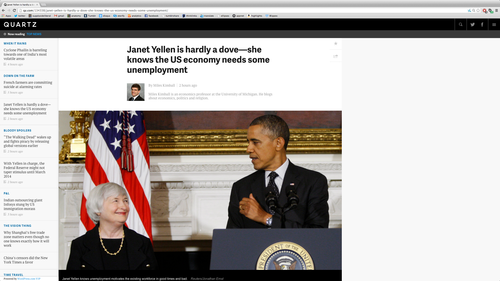
Janet Yellen is Hardly a Dove—She Knows the US Economy Needs Some Unemployment

Here is a link to my 34th column on Quartz: “Janet Yellen is hardly a dove–she knows the US economy needs some unemployment.”

October 18, 2013 Update: Given his 780,386 Twitter followers, a tweet from Ezra Klein is worth reporting. I like his modification to my tweet: 

No, she’s a human being RT @mileskimball: Don’t miss my column “Janet Yellen is hardly a dove” http://blog.supplysideliberal.com/post/63725670856/janet-yellen-efficiency-wages-and-monetary-policy

Notes:

Andy Harless’s Question: Where Does the Curvature Come From? Andy Harless asks why there is an asymmetry–in this case a curvature–that makes things different when unemployment goes up than when it goes down. The technical answer is in Carl Shapiro and Joseph Stiglitz’ paper “Unemployment as a Worker Discipline Device.” It is not easy to make this result fully intuitive. A key point is that unemployed folks find jobs again at a certain rate. This and the rate at which diligent workers leave their jobs for exogenous reasons dilute the motivation from trying to reduce one’s chances of leaving a job. The discount rate also dilutes any threats that get realized in the future. So the key equation is 

dollar cost of effort per unit time 

                    =  (wage - unemployment benefit) 

                                                          · detection rate

÷ [detection rate + rate at which diligent workers leave their jobs                              + rate at which the unemployed find jobs + r]  

That is, the extra pay people get from work only helps deter dereliction of duty according to the fraction of the sum of all the rates that comes from the detection probability. And the job finding rate depends on the reciprocal of the unemployment rate. So as unemployment gets low, the job finding rate seriously dilutes the effect of the detection probability times the extra that workers get paid.

(The derivation of the equation above uses the rules for dealing with fractions quite heavily, backing up the idea in the WSJ article I tweeted as follows.

The Dividing Line: Why Are Fractions Key to Future Math Success? http://on.wsj.com/15rlupS

Deeper intuition for the equation above would require developing a deeper and more solid intuition about fractions in general than I currently have.)

Solving for the extra pay needed to motivate workers yields this equation:

(wage - unemployment benefit) 

           = dollar cost of effort per unit time 

· [detection rate + rate at which diligent workers leave their jobs                              + rate at which the unemployed find jobs + r]  ÷

                                  detection rate

In labor market dynamics the rates are high, so a flow-in-flow-out steady state is reached fairly quickly, and we can find the rate at which the unemployed find jobs by the equation flow in = flow out, or since in equilibrium the firms keep all their workers motivated,  

rate at which diligent workers lose jobs * number employed

= rate at which the unemployed find jobs * number unemployed.

Solving for the rate of job finding:

rate at which the unemployed find jobs 

= rate at which diligent workers leave their jobs 

· number employed  ÷  number unemployed

Finally, it is worth noting that

rate at which diligent workers leave their jobs

+ rate at which the unemployed find jobs

= rate at which diligent workers leave their jobs 

· [number unemployed + number employed]/[number unemployed]

= rate at which diligent workers leave their jobs 

÷ unemployment rate

Morgan Warstler’s Reply: The original link in the column about Morgan Warstler’s plan was to a Modeled Behavior discussion of his plan. Here is a link to Morgan Warstler’s own post about his plan. Morgan’s reply in the comment thread is important enough I will copy it out here so you don’t miss it:

1. The plan is not Dickensian. It allows the poor to earn $280 per week for ANY job they can find someone to pay them $40 per week to do. And it gives them the online tools to market themselves.

Work with wood? Those custom made rabbit hatches you wish you could get the business of the ground on? Here ya go.

Painter, musician, rabbit farmer, mechanic - dream job time.

My plan is built to be politically WORKABLE. The Congressional Black Caucus, the Tea Party and the OWS crowd. They are beneficiaries here.

2. No one in economics notices the other key benefit - the cost of goods and services in poor zip codes goes down ;:So the $280 minimum GI check buys 30% more! (conservative by my napkin math) So real consumption goes up A LOT.

This is key, bc the effect is a steep drop in income inequality, and mobility.

That $20 gourmet hamburger in the ghetto costs $5, and it’s kicking McDonalds ass. And lots of hipsters are noticing that the best deals, on things OTHER THAN HOUSING are where the poor live.

Anyway, I wish amongst the better economists there was more mechanistic thinking about how thigns really work.

Going off the Paper Standard

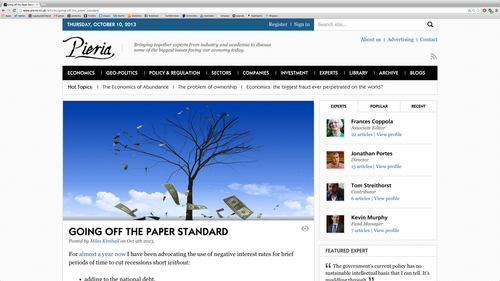
Here is a link to my 1st Pieria exclusive: “Going off the Paper Standard." 

I like the website Pieria because of its focus on serious economic issues. Pieria counts me as one of its "experts,” and I keep good company in that role. In the past Pieria has mirrored many of my posts in accordance with my general permission to mirror my posts on other sites, under certain conditions. For the first time, I have engaged in an arrangement to post something on Pieria first. In about two weeks, I will repatriate it to supplysideliberal.com.

Unlike my Quartz articles, in this case, I have written exactly what I would have written if the post had appeared first on supplysideliberal.com. Pieria added the picture and a section heading, but otherwise didn’t change one word, and the title is mine. This post is at a higher level of economic sophistication than would be appropriate for Quartz.     

The "Wait But Why" Blog on Why Generation Y Yuppies are Unhappy

Here is a picture of Lucy, who appears in the post “Why Generation Y Yuppies are Unhappy” on the Wait But Why blog.

Noah Smith tweeted that the post “Why Generation Y Yuppies are Unhappy” on the Wait But Why blog sounded like the theory of happiness that Bob Willis and I have been putting forward. (On that theory, see my post “The Egocentric Illusion”–my riff on David Foster Wallace’s Kenyon College Commencement Address.)

After reading “Why Generation Y Yuppies are Unhappy,” I tweeted

Read this wonderful blog post about happiness before you bother with anything I have ever written: http://www.waitbutwhy.com/2013/09/why-generation-y-yuppies-are-unhappy.html

As you can see in that twitter thread, I then begged the author to let me reprint that blog post here, and was delighted to get that permission. I think you will see why if you keep reading. I think this post applies to many more of us than only those of us in Generation Y. 


Say hi to Lucy. Lucy is part of Generation Y, the generation born between the late 1970s and the mid 1990s.  She’s also part of a yuppie culture that makes up a large portion of Gen Y.  

I have a term for yuppies in the Gen Y age group—I call them Gen Y Protagonists & Special Yuppies, or GYPSYs.  A GYPSY is a unique brand of yuppie, one who thinks they are the main character of a very special story.

So Lucy’s enjoying her GYPSY life, and she’s very pleased to be Lucy. Only issue is this one thing:

Lucy’s kind of unhappy.

To get to the bottom of why, we need to define what makes someone happy or unhappy in the first place.  It comes down to a simple formula:

It’s pretty straightforward—when the reality of someone’s life is better than they had expected, they’re happy.  When reality turns out to be worse than the expectations, they’re unhappy. 

To provide some context, let’s start by bringing Lucy’s parents into the discussion:

Lucy’s parents were born in the 50s—they’re Baby Boomers.  They were raised by Lucy’s grandparents, members of the G.I. Generation, or “the Greatest Generation,” who grew up during the Great Depression and fought in World War II, and were most definitely not GYPSYs.

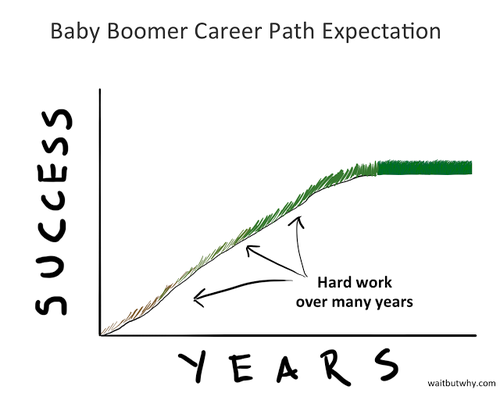
Lucy’s Depression Era grandparents were obsessed with economic security and raised her parents to build practical, secure careers.  They wanted her parents’ careers to have greener grass than their own, and Lucy’s parents were brought up to envision a prosperous and stable career for themselves.  Something like this:

They were taught that there was nothing stopping them from getting to that lush, green lawn of a career, but that they’d need to put in years of hard work to make it happen. 

blog.supplysideliberal.com tumblr_inline_mtt67zEOEV1r57lmx.png

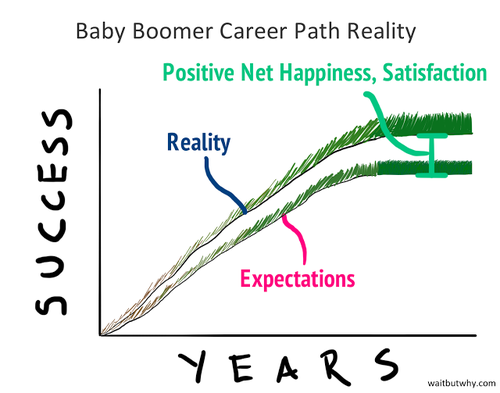
After graduating from being insufferable hippies, Lucy’s parents embarked on their careers.  As the 70s, 80s, and 90s rolled along, the world entered a time of unprecedented economic prosperity.  Lucy’s parents did even better than they expected to.  This left them feeling gratified and optimistic.

blog.supplysideliberal.com tumblr_inline_mtt68sdUx01r57lmx.png

With a smoother, more positive life experience than that of their own parents, Lucy’s parents raised Lucy with a sense of optimism and unbounded possibility.  And they weren’t alone.  Baby Boomers all around the country and world told their Gen Y kids that they could be whatever they wanted to be, instilling the special protagonist identity deep within their psyches.

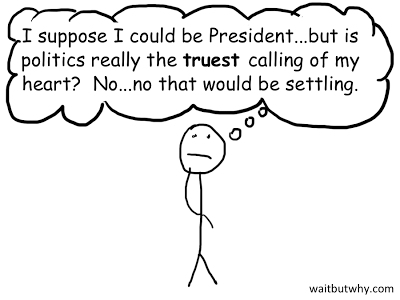
This left GYPSYs feeling tremendously hopeful about their careers, to the point where their parents’ goals of a green lawn of secure prosperity didn’t really do it for them.  A GYPSY-worthy lawn has flowers.

This leads to our first fact about GYPSYs:

GYPSYs Are Wildly Ambitious

The GYPSY needs a lot more from a career than a nice green lawn of prosperity and security.  The fact is, a green lawn isn’t quite exceptional or uniqueenough for a GYPSY.  Where the Baby Boomers wanted to live The American Dream, GYPSYs want to live Their Own Personal Dream.  

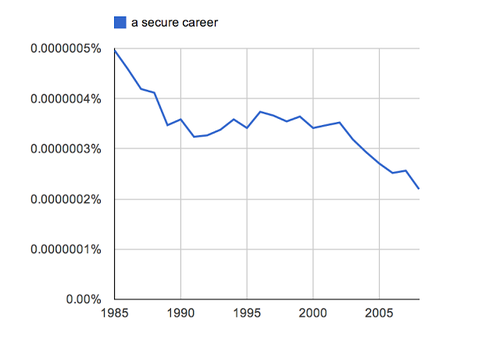
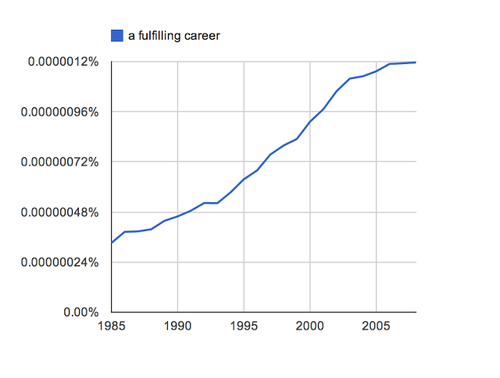
Cal Newport points out that “follow your passion” is a catchphrase that has only gotten going in the last 20 years, according to Google’s Ngram viewer, a tool that shows how prominently a given phrase appears in English print over any period of time. The same Ngram viewer shows that the phrase “a secure career" has gone out of style, just as the phrase "a fulfilling career" has gotten hot.

To be clear, GYPSYs want economic prosperity just like their parents did—they just also want to be fulfilled by their career in a way their parents didn’t think about as much.

But something else is happening too.  While the career goals of Gen Y as a whole have become much more particular and ambitious, Lucy has been given a second message throughout her childhood as well:

This would probably be a good time to bring in our second fact about GYPSYs:

GYPSYs Are Delusional

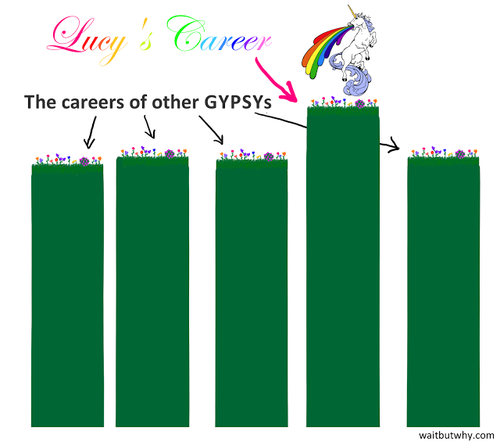
"Sure,” Lucy has been taught, “everyone will go and get themselves some fulfilling career, but I am unusually wonderful and as such, my career and life path will stand out amongst the crowd.” So on top of the generation as a whole having the bold goal of a flowery career lawn, each individual GYPSY thinks that he or she is destined for something even better—A shiny unicorn on top of the flowery lawn.  

So why is this delusional?  Because this is what all GYPSYs think, which defies the definition of special:

spe-cial | ‘speSHel |
adjective
better, greater, or otherwise different from what is usual.

According to this definition, most people are not special—otherwise “special” wouldn’t mean anything.

Even right now, the GYPSYs reading this are thinking, “Good point…but I actually am one of the few special ones"—and this is the problem.

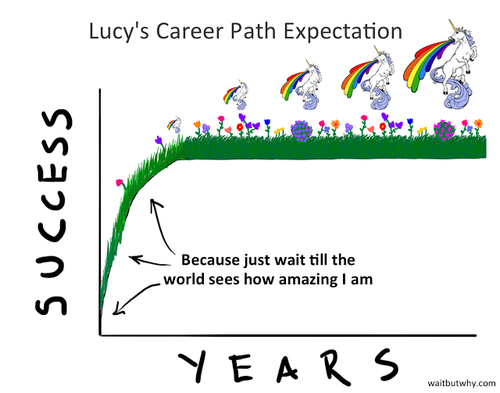
A second GYPSY delusion comes into play once the GYPSY enters the job market.  While Lucy’s parents’ expectation was that many years of hard work would eventually lead to a great career, Lucy considers a great career an obvious given for someone as exceptional as she, and for her it’s just a matter of time and choosing which way to go.  Her pre-workforce expectations look something like this:

Unfortunately, the funny thing about the world is that it turns out to not be that easy of a place, and the weird thing about careers is that they’re actually quite hard.  Great careers take years of blood, sweat and tears to build—even the ones with no flowers or unicorns on them—and even the most successful people are rarely doing anything that great in their early or mid-20s.

But GYPSYs aren’t about to just accept that.

Paul Harvey, a University of New Hampshire professor and GYPSY expert, has researched this, finding that Gen Y has "unrealistic expectations and a strong resistance toward accepting negative feedback,” and “an inflated view of oneself."  He says that "a great source of frustration for people with a strong sense of entitlement is unmet expectations. They often feel entitled to a level of respect and rewards that aren’t in line with their actual ability and effort levels, and so they might not get the level of respect and rewards they are expecting.”

For those hiring members of Gen Y, Harvey suggests asking the interview question, “Do you feel you are generally superior to your coworkers/classmates/etc., and if so, why?”  He says that “if the candidate answers yes to the first part but struggles with the ‘why,’ there may be an entitlement issue. This is because entitlement perceptions are often based on an unfounded sense of superiority and deservingness. They’ve been led to believe, perhaps through overzealous self-esteem building exercises in their youth, that they are somehow special but often lack any real justification for this belief.“

And since the real world has the nerve to consider merit a factor, a few years out of college Lucy finds herself here:

Lucy’s extreme ambition, coupled with the arrogance that comes along with being a bit deluded about one’s own self-worth, has left her with huge expectations for even the early years out of college.  And her reality pales in comparison to those expectations, leaving her "reality - expectations” happy score coming out at a negative.

And it gets even worse.  On top of all this, GYPSYs have an extra problem that applies to their whole generation:

GYPSYs Are Taunted

Sure, some people from Lucy’s parents’ high school or college classes ended up more successful than her parents did.  And while they may have heard about some of it from time to time through the grapevine, for the most part they didn’t really know what was going on in too many other peoples’ careers.

Lucy, on the other hand, finds herself constantly taunted by a modern phenomenon: Facebook Image Crafting.

Social media creates a world for Lucy where A) what everyone else is doing is very out in the open, B) most people present an inflated version of their own existence, and C) the people who chime in the most about their careers are usually those whose careers (or relationships) are going the best, while struggling people tend not to broadcast their situation.  This leaves Lucy feeling, incorrectly, like everyone else is doing really well, only adding to her misery:

So that’s why Lucy is unhappy, or at the least, feeling a bit frustrated and inadequate.  In fact, she’s probably started off her career perfectly well, but to her, it feels very disappointing. 

Here’s my advice for Lucy:

1) Stay wildly ambitious.  

The current world is bubbling with opportunity for an ambitious person to find flowery, fulfilling success.  The specific direction may be unclear, but it’ll work itself out—just dive in somewhere.

2) Stop thinking that you’re special.  

The fact is, right now, you’re not special.  You’re another completely inexperienced young person who doesn’t have all that much to offer yet.  You can become special by working really hard for a long time.  

3) Ignore everyone else. 

Other people’s grass seeming greener is no new concept, but in today’s image crafting world, other people’s grass looks like a glorious meadow. The truth is that everyone else is just as indecisive, self-doubting, and frustrated as you are, and if you just do your thing, you’ll never have any reason to envy others.

Wallace Neutrality Roundup: QE May Work in Practice, But Can It Work in Theory?

Quantitative easing or “QE” is the large scale purchases by a central bank of long-term or risky assets. QE has been used in a big way by the Fed since the financial crisis and by the Bank of Japan since the recent Japanese election, and is an important item on the monetary policy menu of all central banks that have already lowered short-term safe rates to close to zero. Moreover, purchases by the European Central Bank of risky sovereign debt at heavily discounted market prices can rightly be seen as a form of QE–indeed, as a relatively powerful form of QE.  

For monetary stimulus, I favor replacing QE by negative interest rates, made possible by a fee when private banks deposit paper currency with the central bank and establishing electronic money as the unit of account. (See “How and Why to Eliminate the Zero Lower Bound: A Reader’s Guide.”) But my proposal to eliminate the liquidity trap is viewed as radical enough that its near-term prospects are quite uncertain. So understanding quantitative easing (“QE”) remains of great importance for practical discussions of monetary policy. The key theoretical issue for thinking about QE is the logic of Wallace Neutrality. I wrote a lot about Wallace Neutrality in my first few months of blogging, (as you can see by going back to the beginning in 2012 in my blog archive) but haven’t written as frequently about Wallace Neutrality since I turned my attention to eliminating the zero lower bound. This post gives a roundup of some of the online discussion about Wallace Neutrality in the last year or so. 

I should note that I typically don’t even realize that someone has written a response to one of my posts unless someone sends a tweet with “@mileskimball” in it, tells me in a comment, or sends me an email. So I appreciate Richard Serlin letting me know about several posts he and others have written about Wallace Neutrality.  

Richard Serlin 1: Richard has two posts. In the first, published September 9, 2012, “Want to Understand the Intuition for Wallace Neutrality (QE Can’t Work), and Why it’s Wrong in the Real World?” Richard sets the stage this way:

This refers to Neil Wallace’s 1981 AER article, “A Modigliani-Miller theorem for open-market operations”. The article has been very influential today, as it has been used as a reason why quantitative easing can’t work. Here are some example quotes:

“No, in a liquidity trap, if the Fed purchases gold, it does not change the price of gold, just as it will not change the prices of Treasury bonds if it purchases them.” – Stephen Williamson
“The Fed can buy all the government debt it wants right now, and that will be irrelevant, for inflation or anything else.” – Stephen Williamson
“If it were up to me, I would have given Wallace the [Nobel] prize a long time ago, and I think Sargent would say the same. However, not everyone in the profession is aware of Wallace’s contributions, and people who are aware don’t necessarily get as excited about them as I do.” – Stephen Williamson
“…the influence of Wallace neutrality thinking on the Fed is clear from the emphasis the Fed has put on telling the world what it is going to do with interest rates in the future…I have a series of other posts also discussing Wallace neutrality. In fact, essentially all of my posts listed under Monetary Policy in the June 2012 Table of Contents are about Wallace neutrality.” – Miles Kimball

In Wallace’s model, when the Fed prints money and buys up an asset with it, this affects no asset’s price, and doesn’t even change inflation! Amazing claims, but they’re mathematically proven to be true – in Wallace’s model, and with the accompanying assumptions. So the big question is, even in a model, how can claims like this make sense? What could be the intuition for that? 

Brad DeLong: Richard points to this from Brad DeLong as some of the best intuition for Wallace Neutrality that he had found up to that point:

Long ago, Bernanke (2000) argued that monetary policy retains enormous power to boost production, demand, and employment even at the zero nominal lower bound to interest rates:

The general argument that the monetary authorities can increase aggregate demand and prices, even if the nominal interest rate is zero, is as follows: Money, unlike other forms of government debt, pays zero interest and has infinite maturity. The monetary authorities can issue as much money as they like. Hence, if the price level were truly independent of money issuance, then the monetary authorities could use the money they create to acquire indefinite quantities of goods and assets. This is manifestly impossible in equilibrium. Therefore money issuance must ultimately raise the price level, even if nominal interest rates are bounded at zero. This is an elementary argument, but, as we will see, it is quite corrosive of claims of monetary impotence…

His argument, however, seems subject to a powerful critique: The central bank expandeth the money stock, the central bank taketh away the money stock, blessed be the name of the central bank. In order for monetary policy to be effective at the zero nominal lower bound, expectations must be that the increases in the money stock via quantitative easing undertaken will not be unwound in the future after the economy exits from its liquidity trap. If expectations are that they will be unwound, then there is potentially money to be made by taking the other side of the transaction: sell bonds to the central bank now when their prices are high, hold onto the cash until the economy exits from the liquidity trap, and then buy the bonds back from the central bank in the future when it is trying to unwind its quantitative easing policies. A Modigliani Miller-like result applies.

Richard Serlin 1 Again: Richard then gives this rundown of Neil Wallace’s paper itself:

The government prints dollars and buys the single consumption good, which I like to call c’s….

People are going to want to store a certain amount of c’s anyway, because that’s utility maximizing to help smooth consumption. What the government essentially does in this model is say, hey, store your c’s with us instead of at the private storage facility. Give us a c, and we’ll give you some dollars, which are like a receipt, or bond. We’ll then store the c’s – we won’t consume them, we won’t use them for anything (these are crucial assumptions of Wallace, required to get his stunning results) – We will just hold them in storage (implied in the equations, not stated explicitly).

Next period, you give us back those dollars, and we give you back your c’s, plus some return (from the dollar per c price changing over that period). In equilibrium, the return from storing c’s via the dollar route must be equal to the return from storing c’s via the private storage facility route. Or at least the return must be worth the same amount at the equilibrium state prices; so either way you go you can arrange at the same cost in today c’s, the same exact next period payoff in any state that can occur….

It is analogous to Miller-Modigliani, in that if a corporation increases its debt holding, then shareholders will just decrease their personal debt holding by an equivalent amount, so that their total debt stays exactly where it was, which was the amount they had previously calculated to be utility maximizing for them (And there’s a lot of very unrealistic and material assumptions that go with this that have been long acknowledged as such in academic and practitioner finance; when you learn Miller-Modigliani, at the bachelors, masters, and PhD levels – which I have –  they always start by teaching the model and its strong assumptions, and then go into the various reasons why it far from holds in reality. This is long accepted in academic finance; pick up any text that covers MM.)

Richard offers one other intuition for Wallace Neutrality, based on asset pricing principles when asset prices are at their fundamental values:

Suppose dollars are printed and used to buy 10 year T-bonds. Or gold, like in the Stephen Williamson quote at the beginning of this post. And everybody knows (making a Wallace-like assumption) that in five years the T-bonds or gold will be sold back for dollars. We’re making all of the perfect assumptions here: For all investors, perfect information, perfect foresight, perfect analysis, perfect rationality, perfect liquidity,…

Now, what is the price of gold? How is it calculated in this world of perfects?

Well, as a financial asset it’s worth only what it’s future cash flows are. Suppose you are going to hold onto the gold and sell it in one year. Then, what it’s worth is its price in one year (which you know at least in every state – perfect foresight) discounted back to the present at the appropriate discount rate.

But suppose this: During that year that you will be holding the gold in your vault, you are told the government will borrow your gold for five minutes, take it out of your vault, and replace it with green slips of paper with dead presidents, then five minutes later they will take back the green slips and replace back your gold in the vault. Do you really care? This doesn’t affect how much you will get for the gold when you sell it in a year, and as a financial asset that’s all you care about when you decide how much gold is worth today.

If you’re going to hold the gold for ten years, and sell it then, then you only care about what the price of gold will be in ten years. And the price of gold in ten years only depends on what the supply and demand for gold is in ten years. If the government takes 100 million ounces of gold out of private vaults, and put it in its vaults, then puts it back in the private vaults three years later, this has no effect on the supply of gold in ten years. So in ten years the price of gold is the same. And if gold will be the same price in ten years, then it will be worth the same price today for someone who’s not going to sell for ten years anyway.

Jérémie Cohen-Setton and Éric Monnet: A year later, September 6, 2012, Richard wrote a follow-up post: The Intuition for Wallace Neutrality, Part II: Why it doesn’t Work in the Real World. Richard flags an excellent synthesis by Jérémie Cohen-Setton and Éric Monnet on 10th September 2012: Blogs review: Wallace Neutrality and Balance Sheet Monetary PolicyJérémie and Éric start by explaining why understanding the issues surrounding Wallace Neutrality matters in the real world, with particular reference to Mike Woodford’s conclusions assuming Wallace Neutrality, and then give this summary discussions of Wallace Neutrality by Richard, Brad DeLong, Michael Woodford and me:

Miles Kimball defines Wallace neutrality as follows:  a property of monetary economic models in which differences in the government’s overall balance sheet at moments in time when the nominal interest rate is zero have no general equilibrium effect on interest rates, prices, or non-financial economic activity. Richard Serlin (HT Mark Thoma) writes that in Wallace’s model, when the Fed prints money and buys up an asset with it, this affects no asset’s price, and doesn’t even change inflation!

Brad DeLong and Miles Kimball think that Wallace neutrality has baseline modeling status, in the same manner as Ricardian neutrality. Saying a model has baseline modeling status is saying that it should be the starting point for thinking about how the world works – as it reflects how the simplest economics models behave within the category of “optimizing models.”. The discussion is then about what might plausibly make things behave differently in the real world from that theoretical starting point.  Miles Kimball argues that the difference in the theoretical status of Wallace neutrality as compared to Ricardian neutrality is that we are earlier in the process of putting together good models of why the real world departs from Wallace neutrality. Studying theoretical reasons why the world might not obey Ricardian neutrality was frontier research 25 years ago.  Showing theoretical reasons why the world might not obey Wallace neutrality is frontier research now….

As far as intuition for Wallace Neutrality goes, here is Jérémie and Éric channeling Mike Woodford:

Michael Woodford notes that it is important to note that such “portfolio-balance effects” do not exist in a modern, general-equilibrium theory of asset prices. Within this framework the market price of any asset should be determined by the present value of the random returns to which it is a claim, where the present value is calculated using an asset pricing kernel (stochastic discount factor) derived from the representative household’s marginal utility of income in different future states of the world. Insofar as a mere re-shuffling of assets between the central bank and the private sector should not change the real quantity of resources available for consumption in each state of the world, the representative household’s marginal utility of income in different states of the world should not change. Hence the pricing kernel should not change, and the market price of one unit of a given asset should not change, either, assuming that the risky returns to which the asset represents a claim have not changed.

On reasons why Wallace Neutrality might not hold in the real world, I am pleased to see that Jérémie and Éric reference the Wikipedia article on Wallace Neutrality that Fudong Zhang got started:

The Wikipedia page for Wallace Neutrality – the result of a proposed public service provided by the readers of the Miles Kimball’s blog, Confessions of a Supply-Side Liberal – point to other recent works which invalidate Wallace neutrality based on different relaxed assumptions and novel mechanisms. For example, in Andrew Nowobilski’s (2012) paper, open market operations powerfully influence economic outcomes due to the introduction of a financial sector engaging in liquidity transformation.

Richard Serlin 2: Now for the core of what Richard says in his second post, The Intuition for Wallace Neutrality, Part II: Why it doesn’t Work in the Real World. Richard has kindly given me permission to quote at some length from his nice explanation of the logic behind Wallace Neutrality and why it might not hold in the real world: 

I had gone down various roads in thinking about why the neutrality that worked in Wallace’s model would not work in the real world, and I just wasn’t able to really nail down any of them the way I wanted to, at least not the ones I wanted to. But thinking about this again, the idea came to me. The intuition is this:

Suppose the Fed does buy up 100 million ounces of gold in a quantitative easing. And the people who are savvy, well informed, expert, and rational know that in some years the economy will turn around, and the Fed will just sell back all of those 100 million ounces. So, in 10 years, the supply of gold will be the same as it would have been if the quantitative easing had never occurred. The ownership papers will shift from private parties to the federal government in the interim, but will be back again to private parties like they never left in 10 years. So, no fundamental change to the asset’s value in 10 years.

And if no fundamental change to the asset’s value in 10 years, then no fundamental change to the asset’s value today, as the value today, for a financial asset with no dividends, coupons, etc., is just the discounted present value of the asset’s value 10 years from now.

Now, as should be obvious – especially with gold – not all investors are savvy, well informed, expert, and rational – let alone sane! So, when the price of gold starts to go up, some of them will not sell at that higher price, even though fundamentally the price should not go higher; nothing has changed about the long run, or 10 year, price of gold.

In the Wallace model, and commonly in financial economics models, no problem, arbitrage opportunity! Suppose there are investors who are less than perfectly expert, knowledgeable, and rational – or way less – and they don’t sell when the government buys up the price a little. Who cares. It just takes one expert knowledgeable investor to recognize that there’s an arbitrage opportunity when the price of gold goes up merely because the government is buying it in a QE, and he’ll milk it ceaselessly until the price is all the way back down again and the arbitrage disappears….

Now, for this to work as advertised, first you need 100% complete markets, so you must have a primitive asset (or be able to synthetically construct one) for every possible state at every possible time in the world.

[using Chandler Bing voice] Have you seeeen our world? The number of states just one minute from now is basically infinite. Even the number of significant finitized states over the next day, let alone a path of years, is so large, it’s for all intents and purposes infinite. Thus, try to construct a synthetic asset that pays off the same as gold, now and over time, and you’re not going to come very close. And if you try buying it to sell gold, or vice versa, to get an “arbitrage”, you’re going to expose yourself to a lot of risk.

And this is a key. I think a lot of misunderstanding comes from loose use of the word “arbitrage”. The textbook definition of arbitrage is a set of transactions that has zero risk, zero. It’s 100% risk free. It’s not low risk, as often things that are called arbitrage are. It’s not 99% risk-free. It’s riskless, zero. That’s what makes it so powerful in models, at least one of the things.

Another one of the things that makes it so powerful in models is that it requires none of your own money. If there’s an expert and informed enough investor anywhere, even just a single one, who sees it, it doesn’t matter if he doesn’t have two nickels to rub together, he can do it. He can borrow the money to buy the assets necessary, and at the market interest rate. Or, he can just sign the necessary contracts, for whatever amounts, no matter how big. His credit and credibility are always considered good enough….

Well, what are the problems with that? The usual one you hear is that savvy investors are only a small minority of all investors, and this is especially true of highly expert investors who are highly informed about a given individual asset, or even asset class. And they only have so much money. Eventually, if the government keeps buying in a QE it could exhaust their funds, their ability to counter, by, for example, selling gold they own, or selling gold they don’t own short.

Even rich people and institutions only have so much money and liquidity, or credit. You can’t outlast the Fed, if the Fed is truly determined. Your pockets may be very deep, but the Fed’s pockets are infinite.

So, you usually hear that.

But there’s another reason why the savvy marginal investor is limited in his ability and willingness to push prices back to their fundamentals that I never hear. It’s a powerful and important reason: The more a savvy investor jumps on a mispriced individual asset, the more his portfolio gets undiversified, and that can quickly become dangerous and not worth it.

Miles: Despite having turned my primary attention in relation to monetary policy to eliminating the zero lower bound, I have written a fair amount about QE in the last year. My column “Why the US Needs Its Own Sovereign Wealth Fund” discusses my intuition that Wallace Neutrality will be further from the truth for assets that have the largest risk and term premiums and what this suggests for monetary policy, given that the Fed doesn’t have non-emergency authority to buy corporate stocks and bonds:

…what if longer-term Treasuries and mortgage-backed securities are the wrong assets for the Fed to buy? Most of those rates are already below 3%, so it’s not that easy to push the rates down further. What is worse, when long-term assets already have low interest rates, pushing down those interest rates pushes the prices of those assets up dramatically. So the Fed ends up paying a lot for those assets, and when it later has to turn around and sell them—as it ultimately will need to, to raise interest rates and avoid inflation, it will lose money. Avoiding buying high and selling low is tough when the Fed has to move interest rates to do the job it needs to do. At least economic recovery reduces mortgage defaults and so helps raise the prices of mortgage-backed securities through that channel. But the effects of interest rates on long-term assets cut against the Fed’s bottom line in a way that is never an issue when the Fed buys and sells 3-month Treasury bills in garden-variety monetary policy.

From a technical point of view, once 3-month Treasury bill rates (and overnight federal funds rates) are near zero, the ideal types of assets for “quantitative easing” to work with are assets that (a) have interest rates far above zero and (b) are buoyed up in price when the economy does well. That means the ideal assets for quantitative easing are stock index funds or junk bond funds!

Yet, is the Federal Reserve even the right institution to be making investment decisions like this?…

Why not create a separate government agency to run a US sovereign wealth fund? Then the Fed can stick to what it does best—keeping the economy on track—while the sovereign wealth fund takes the political heat, gives the Fed running room, and concentrates on making a profit that can reduce our national debt….

As an adjunct to monetary policy, the details of what a US Sovereign Wealth Fund buys don’t matter. As long as the fund focuses on assets with high rates of return, the effect on the economy will be stimulative, and the Fed can use its normal tools to keep the economy from getting too much stimulus.

In May 2013, I wrote a full column on quantitative easing: “QE or not QE: Even Economists Need Lessons in Quantitative Easing, Bernanke Style,” sparked by a Martin Feldstein column. There, in relation to Wallace Neutrality, I write:

Once the Fed has hit the “zero lower bound,” it has to get more creative. What quantitative easing does is to compress—that is, squish down—the degree to which long-term and risky interest rates are higher than safe, short-term interest rates. The degree to which one interest rate is above another is called a “spread.” So what quantitative easing does is to squish down spreads. Since all interest rates matter for economic activity, if safe short-term interest rates stay at about zero, while long-term and risky interest rates get pushed down closer to zero, it will stimulate the economy. When firms and households borrow, the markets treat their debt as risky. And firms and households often want to borrow long term. So reducing risky and long-term interest rates makes it less expensive to borrow to buy equipment, hire coders to write software, build a factory, or build a house.

Some of the confusion around quantitative easing comes from the fact that in the kind of economic models that come most naturally to economists, in which everyone in sight is making perfect, deeply-insightful decisions given their situation, and financial traders can easily borrow as much as they want to, quantitative easing would have no effect. In those “frictionless” models, financial traders would just do the opposite of whatever the Fed does with quantitative easing, and cancel out all the effects. But it is important to understand that in these frictionless models where quantitative easing gets cancelled out, it has no important effects. Because in the frictionless models quantitative easing gets canceled out, it doesn’t stimulate the economy. But because in the frictionless models quantitative easing gets cancelled out it has no important effects. In the world where quantitative easing does nothing, it also has no side effects and no dangers. Any possible dangers of quantitative easing only occur in a world where quantitative easing actually works to stimulate the economy!

Now it should not surprise anyone that the world we live in does have frictions. People in financial markets do not always make perfect, deeply-insightful decisions: they often do nothing when they should have done something, and something when they should have done nothing. And financial traders cannot always borrow as much as they want, for as long as they want, to execute their bets against the Fed, as Berkeley professor and prominent economics blogger Brad DeLong explains entertainingly and effectively in “Moby Ben, or, the Washington Super-Whale: Hedge Fundies, the Federal Reserve, and Bernanke-Hatred.” But there is an important message in the way quantitative easing gets canceled out in frictionless economic models. Even in the real world, large doses of quantitative easing are needed to get the job done, since real-world financial traders do manage to counteract some of the effects of quantitative easing as they go about their normal business of trying to make good returns. And “large doses” means Fed purchases of long-term government bonds and mortgage-backed bonds that run into trillions and trillions of dollars. (As I discuss in “Why the US Needs Its Own Sovereign Wealth Fund,” quantitative easing would be more powerful if it involved buying corporate stocks and bonds instead of only long-term government bonds and mortgage-backed bonds.) It would have been a good idea for the Fed to do two or three times as much quantitative easing as it did early on in the recession, though there are currently enough signs of economic revival that it is unclear how much bigger the appropriate dosage is now….

Sometimes friction is a negative thing—something that engineers fight with grease and ball bearings. But if you are walking on ice across a frozen river, the little bit of friction still there between your boots and the ice allow you to get to the other side. It takes a lot of doing, but quantitative easing uses what friction there is in financial markets to help get us past our economic troubles.

In response to one commenter (by email) who thought that QE had not done much either for the stock market or the economy as a whole, I wrote:

But this seems like an argument for a bigger dosage of QE. And it is not clear that the counterfactual is share prices staying the same. Without any QE, the economy would probably have been hurting enough that stock prices would have gone down….

The key point I am trying to make is that it is the ratio of stimulus to undesirable side-effect that matters, not the ratio of stimulus to dollar size of asset purchase. I think you are saying that the Fed has done a lot of QE with relatively little effect, but to the extent that the QE has relatively little effect in undesirable directions as well as relatively little effect in terms of stimulus, the answer is simply to scale up the size of the asset purchases. For example, if a given level of QE has little effect on the level of stock prices and therefore little stimulus, it presumably has relatively little effect on financial stability as well, to the extent financial stability worries have to do with the level of the stock market.  
The one undesirable effect I know of that depends on the size of the asset purchase *as opposed to the size of the stimulus generated,* is the capital losses the Fed will face when it sells the long-term bonds. That is something I write about in my column advocating a US Sovereign Wealth Fund as a way to do a fixed quantum of QE that focuses on assets that would gain more in value from general equilibrium effects than long-term government bonds would: “Why the US Needs Its Own Sovereign Wealth Fund.”

The point

…it is the ratio of stimulus to undesirable side-effect that matters, not the ratio of stimulus to dollar size of asset purchase.

is of course the point I was making in my first post on Wallace Neutrality (and second post on QE) back in June 2012,

“Trillions and Trillions: Getting Used to Balance Sheet Monetary Policy." (There is a similar point in my working paper "Getting the Biggest Bang for the Buck in Fiscal Policy” about National Lines of Credit.“You can read the blog post here, which has a link to the paper.)  
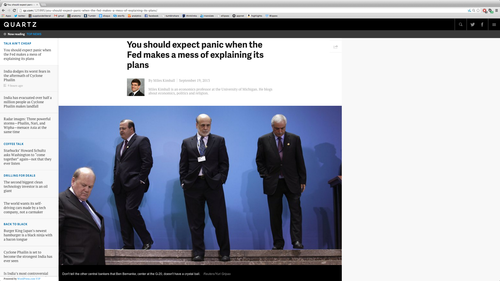
Quartz #31—>America's Big Monetary Policy Mistake: How Negative Interest Rates Could Have Stopped the Great Recession in Its Tracks

Link to the Column on Quartz

Here is the full text of my 31st Quartz column, ”America’s huge mistake on monetary policy: How negative interest rates could have stopped the Great Recession in its tracks,” now brought home to supplysideliberal.com. It was first published on September 6, 2013. Links to all my other columns can be found here.

If you want to mirror the content of this post on another site, that is possible for a limited time if you read the legal notice at this link and include both a link to the original Quartz column and the following copyright notice:

© September 6, 2013: Miles Kimball, as first published on Quartz. Used by permission according to a temporary nonexclusive license expiring June 30, 2014. All rights reserved.

This post is a rearticulation of my argument for electronic money, focusing on the negative interest rates themselves. You can see links to all my other work on electronic money in “How and Why to Eliminate the Zero Lower Bound: A Reader’s Guide.”

An early draft had the following lead paragraph that was cut for reasons of brevity and focus, but that I think will be of interest to many readers:

John von Neumann, who revolutionized economics by inventing game theory (before going on to help design the first atom bomb and lay out the fundamental architecture for nearly all modern computers), left an unfinished book when he died in 1957: The Computer and the Brain. In the years since, von Neumann’s analogy of the brain to a computer has become commonplace. The first modern economist, Adam Smith, was unable to make a similarly apt comparison between a market economy and a computer in his books, The Theory of Moral Sentiments or in the The Wealth of Nations, because they were published, respectively, in 1759 and 1776—more than 40 years before Charles Babbage designed his early computer in 1822. Instead, Smith wrote in The Theory of Moral Sentiments:

“Every individual … neither intends to promote the public interest, nor knows how much he is promoting it … he intends only his own security; and by directing that industry in such a manner as its produce may be of the greatest value, he intends only his own gain, and he is in this, as in many other cases, led by an invisible hand to promote an end which was no part of his intention.”

Now, writing in the 21st century, I can make the analogy between a market economy and a computer that Adam Smith could not. Instead of transistors modifying electronic signals, a market economy has individuals making countless decisions of when and how much to buy, and what jobs to take, and companies making countless decisions of what to buy and what to sell on what terms. And in place of a computer’s electronic signals, a market economy has price signals. Prices, in a market economy, are what bring everything into balance.


There’s a reason why the workings of the price system through supply and demand are taught as one of the first lessons when studying economics. This is where the action is. When people want to buy more of something than others want to sell, the price of that good goes up, signaling that more needs to be produced and less needs to be bought. When the opposite occurs (there’s more to sell than people want to buy), the price of that good goes down to signal that less needs to be produced and more needs to be bought to bring things into balance. Interference with those price signals lowers the IQ of the “invisible hand,” this competition that naturally guides markets.

One key set of prices in the economy are interest rates—which, after accounting for inflation, tell how much more one has to pay to buy something now instead of later. Interest rates are crucial in balancing the total amount of goods and services households and firms want to buy and use now with the total amount of goods and services they want to produce and sell now. Indeed, if anything prevents interest rates from adjusting appropriately to balance aggregate supply and demand, bad things happen: if interest rates are too low, the imbalance will cause the economy to overheat and generate inflation; if interest rates are too high, the imbalance will cause the economy to fall into a recession. Conversely, when interest rates do adjust appropriately, anytime the economy starts to overheat, interest rates go up to balance aggregate supply and demand and stop the overheating in its tracks; anytime the economy starts to fall into a recession, interest rates go down to balance aggregate supply and demand and stop the recession in its tracks.

There are two complications in the adjustment of interest rates that do not apply to other prices. First, short-run movements in interest rates are tangled up with money supply and demand. In practice, that means that central banks such as the Federal Reserve choose interest rates, not always appropriately. Second, there is a traditional floor of zero for interest rates. (There also used to be a ceiling of 5% on certain interest rates, but thankfully, that has receded into the mists of time.) Each of these is a big issue. Let me leave the details of appropriate interest rate setting by central banks to a later column, and focus here on the second wrench in the works of interest rate adjustment: the traditional floor of zero on interest rates, or as it is called by macroeconomic policy wonks, the “zero lower bound on nominal interest rates.”

Putting a floor of zero on interest rates is like cutting a wire in the economy’s computer. The importance of the zero lower bound (abbreviated to “ZLB” by said wonks) can easily be seen by googling “zero lower bound” and “John Taylor” + “zero lower bound.”

The paper Robert Hall presented at last month’s Jackson Hole conference (pdf) on monetary policy has a good statement of this widely-held view that the zero lower bound has been a major factor in the miserable course of economic events in the last few years (pdf). The simple truth is that the Great Recession was very painful and US unemployment is still painfully high five years later, primarily because of the zero lower bound. Even without the ZLB, there would have been some hit from the financial crisis that ensued with the bankruptcy of Lehman Brothers on Sept. 15, 2008, but negative interest rates in the neighborhood of 4% below zero would have brought robust recovery by the end of 2009.

blog.supplysideliberal.com tumblr_inline_mtt8un9yid1r57lmx.png

The reason negative interest rates are needed during a serious recession (at least for countries that have low rates of inflation) is that businesses are scared to invest, banks are scared to make loans, and even better-off households are scared to spend when times are bad. If it is easy to sit on cash, then frightened businesses, banks and households that have a cash cushion will sit on cash. If businesses aren’t spending to build factories, buy machines, or do R&D, and households aren’t spending on things to make their lives better, everyone who is trying to produce and sell something is left in the lurch. Negative interest rates for idle cash would motivate those who would otherwise sit on that cash to take the risks to put it to use to build the economy. Those who needed safety the most could still get that safety, if they are willing to pay for it. But those willing to take risks would be rewarded. All of this would simply be the price system doing its work of keeping the economy on target, in the particular case of interest rates.

What is behind the tradition of a floor of zero on interest rates? First, when inflation is high, interest rates never get down as far as zero anyway. So people get used to interest rates above zero. Second, even in the absence of inflation, when the economy is healthy, there are many investment projects that have the potential to earn a good return. Thus, when the economy is healthy, businesses vying for the funds to do their investment projects push interest rates above zero. Consumers who see the advantage of getting a car or a house or an education now rather than later also help push interest rates above zero when the economy is healthy. So the zero lower bound only becomes a problem when an economy conquers the bulk of inflation and then has a bad recession.

The way that the traditional floor of zero for interest rates is enforced by government policy is by the government’s guarantee of what, leaving aside storage costs, amounts to an exactly zero interest rate on paper currency. As long as the government guarantees an interest rate of zero on paper currency, who would ever accept a significantly lower interest rate? As a technical matter, there is no difficulty in repealing the government’s current guarantee of a zero interest rate on paper currency and thereby freeing up all interest rates to go negative, if necessary. The key technical issue is to make it so there is no place to hide from the negative interest rates, not even by putting cash under the mattress; paper currency would earn more or less the same negative interest rate as money in bank accounts. See my first column on electronic money here and the presentation I have been giving at central banks around the world here. So it all comes down to interest rate politics. If, politically, the government doesn’t dare let interest rates go negative, they won’t be able to. But if the government quit gumming up the works of the price system by guaranteeing a minimum interest rate of zero, then negative rates would be quite possible, and even half-decent monetary policy using negative rates would be enough to prevent another Great Recession.

The key political arguments for high interest rates when the economy needs low rates center on being fair to savers. Saving helps people to be self-sufficient in times of trouble, rather than having to beg others for help. And when the economy is healthy, additional saving makes it possible to finance more investment that builds up the productive capacity of the economy. So as a character trait, being a saver is rightly praised. But there is a time and place for everything, and the middle of a recession is the one time when we need people to spend rather than save in order to balance the economy. So while, in general, it is appropriate to reward savers handsomely for saving—as positive interest rates do in good times—it is also appropriate to charge savers for saving in bad times when we desperately need those who have a little financial leeway to spend. In bad times, there is no way to earn a positive return on business investment without taking some risk. So it is right and proper for those who insist on total safety in those times to pay for that safe storage, just as people are accustomed to paying to keep their belongings in physical storage units. What is more, the imperative of rewarding savers for the virtue of saving argues for returning the economy to robust health and positive interest rates as soon as possible. During serious recessions, negative interest rates are the key to quick economic recovery. The relatively ineffective alternative is zero or near-zero interest rates for years and years. Therefore, both on grounds of effectiveness and kindness to savers, negative interest rates for a few quarters are better than zero interest rates for years and years.

Ultimately, the choice we face is whether:

(a) to make the economy stupid in the face of recessions by imposing a zero lower bound

(b) to steer away from the zero lower bound by permanently higher inflation, with all of its attendant costs, or

( c) to repeal the zero lower bound and allow negative interest rates for brief periods when economic recovery requires them.

To me, the best choice is clear.

How I Became Optimistic

For the most part, those around me tend to think of me as relatively cheerful and optimistic. I want to tell you the story of how that came to be.

For several years when I was a teenager, I felt that facing reality meant I mustn’t fool myself by being optimistic. Studiously avoiding optimism had the side-effect of making me less cheerful. But then I read the Maxwell Maltz’s book Psycho-Cybernetics. Maxwell made an argument that changed my life. He argues that visualizing positive outcomes is a way to be prepared in case something good happened and a way to instruct one’s subconcious mind to strive for that outcome. In other words, visualizing a desired outcome is a way to tell one’s subconscious mind what its objective function should be.

To me this was like a bolt out of the blue. Visualizing a positive outcome was not a claim that that outcome would happen, it was simply presenting a certain image to one’s mind without any claim to inevitability, in a way meant to increase the probability that the positive image might be realized. Thus, it was possible to carefully maintain objectivity for analytical decision-making and evaluation purposes, while still gaining the psychological benefits of optimism.

Ever since the day that logic made its way into my brain, I have allowed myself to be relatively optimistic, in what I hope is a careful way, and I have been noticeably more cheerful than I was before.

For many of you, this book was before your time, but it was reasonably important in its day, and in its effect on later events. Below is what the Wikipedia article on Psycho-Cybernetics has to say:

Psycho-Cybernetics is a classic self-help book, written by Maxwell Maltz in 1960 and published by the non-profit Psycho-Cybernetics Foundation.[1] Motivational and self-help experts in personal development, including Zig ZiglarTony RobbinsBrian Tracy have based their techniques on Maxwell Maltz. Many of the psychological methods of training elite athletes are based on the concepts in Psycho-Cybernetics as well.[2] The book combines the cognitive behavioral technique of teaching an individual how to regulate self-concept developed by Prescott Lecky with the cybernetics of Norbert Wiener and John von Neumann. The book defines the mind-body connection as the core in succeeding in attaining personal goals.[3]

Maltz found that his plastic surgery patients often had expectations that were not satisfied by the surgery, so he pursued a means of helping them set the goal of a positive outcome through visualization of that positive outcome.[3] Maltz became interested in why setting goals works. He learned that the power of self-affirmation and mental visualisation techniques used the connection between the mind and the body. He specified techniques to develop a positive inner goal as a means of developing a positive outer goal. This concentration on inner attitudes is essential to his approach, as a person’s outer success can never rise above the one visualized internally.

I can’t guarantee that Zig Ziglar, Tony Robbins and Brian Tracy maintain the same distinction between analytical realism and mental-imagery optimism that I try to, but their embrace of Psycho-Cybernetics indicates some of the reach it has had.

GiveWell: Top Charities

In my post “Inequality Aversion Utility Functions: Would $1000 Mean More to a Poorer Family than $4000 to One Twice as Rich?” I use math and survey data on inequality aversion to argue that the big gains from redistribution are from taking care of the desperately poor. GiveWell is a website that rates charities in a way consistent with that criterion. Take a look. 

I learned about GiveWell from Michael Huemer’s excellent book The Problem of Political Authority.

Arindrajit Dube: Jonathan Meer and Jeremy West's Negative Correlation for Minimum Wages and Employment Growth is a Statistical Artifact

Back in February, I did a post “Jonathan Meer and Jeremy West: Effects of the Minimum Wage on Employment Dynamics” sympathetic to Jonathan and Jeremy’s claims. Arindrajit Dube has now seriously questioned those findings, writing that the lower employment growth is in manufacturing, where the minimum wage is not very relevant, while it is hard to find employment effects in retail, accomodation and food services, where one would expect the minimum wage to matter if it matters much anywhere. 

One interesting possibility is that (a) at US levels minimum wages do not have very big economic effects, but (b) the urge to raise minimum wages is positively correlated with other policy views that are more harmful to employment growth.