Sugar Puts You in Greater Danger from Covid-19

Note: I put my thoughts stimulated by our recent wake up call about racism into Sunday’s post: “Glennon Doyle on Wild Humanity.”


Some of the other diseases that make Covid-19 especially dangerous can be at least partially cured in relatively short order by changes in diet. For example, Jason Fung, whom I talk about in “Obesity Is Always and Everywhere an Insulin Phenomenon,” regularly treats Type II diabetics with a carefully monitored regimen of fasting that in a substantial fraction of cases cures their Type II diabetes in short order. Short of that, cutting out sugar, potatoes rice and bread and regularly skipping breakfast can do a lot to help. For how to get there, see:

Like me, Nina Teicholz is a known enemy of sugar and easily-digested carbs. Let me quote a few passages from her May 30, 2020 Wall Street Journal article “A Low-Carb Strategy for Fighting the Pandemic’s Toll.” I have added bullets to separate different passages:

  • Americans with obesity, diabetes, heart disease and other diet-related diseases are about three times more likely to suffer worsened outcomes from Covid-19, including death. 

  • The good news is that changes in diet can start to reverse these conditions in a matter of weeks. In one controlled trial at the University of Indiana involving 262 adults with Type 2 diabetes, 56% were able to reverse their diagnosis by following a very low-carbohydrate diet, with support from a mobile app, in just 10 weeks. The results of this continuing study have been sustained for two years, with more than half the study population remaining free of a diabetes diagnosis.

  • A 2011 study in the journal Obesity on 300 clinic patients eating a very low-carbohydrate diet saw blood pressure quickly drop and remain low for years.

  • Yet the federal government’s dietary guidelines themselves stand in the way of making low-carb diets a viable option for the 60% of Americans with at least one chronic disease. That’s because the guidelines call for a diet high in grains, with more than 50% of calories coming from carbohydrates. The guidelines aren’t mere advice: They drive the National School Lunch Program, feeding programs for the elderly and the poor, and military food. Many patients learn about the guidelines from their doctors and dietitians.

Nina cites many more studies than this and give more of the story of why US dietary guidelines don’t yet officially recognize sugar for the slow poison that it is. (Saturated fat may be bad, but the evidence against sugar is a lot stronger than the evidence against saturated fat.)

The 2020-2025 dietary guidelines will be out soon. I hope they begin to recognize the scourge that sugar is. Sugar is one of the greatest allies Covid-19 has in killing us.

For annotated links to other posts on diet and health, see:

Glennon Doyle on Wild Humanity

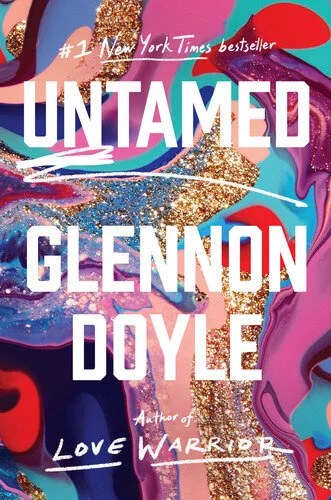
Since I was born in 1960, I have been watching Feminism for a long time. Glennon Doyle’s recent book Untamed is an impressive addition to the Feminist canon. She addresses many issues with chapters that are, in effect, a tightly integrated set of personal essays. In addition to feminism, Glennon writes about her own gay awakening and about racism, but the biggest overarching theme is human liberation—how all of us can gain from “burning memos” we have received from our culture that are inappropriate. Through all of this, Glennon’s skill as a writer helps bring her message home.

Glennon begins Untamed with a true story about a tame cheetah. Her metaphor is that there is something off about a tame cheetah. Just so, there is something off about an overly tame human being. (It is good that over evolutionary time we have domesticated ourselves genetically, but have we gone too far in cultural taming beyond that?)

Untamed is an excellent source for powerful quotations and vivid stories. Let me share some of my favorites. In doing so, I am inevitably selecting those that speak to me, a straight, white man. There are many, many other passages that I suspect might be even more striking to women reading the book than the passages I have selected. I’ll organize things by topic area. A substantial vertical gap indicates a separate passage. My words are the unindented ones.

The Effect of Sexism on Men:

I opened the shower curtain and noticed the twelve empty bottles littering the tub’s edge. All the bottles on the right side were red, white, and blue. All the bottles on the left side were pink and purple. I picked up a red bottle from what was clearly my son’s side. It was tall, rectangular, bulky. It yelled at me in bold red, white, and blue letters:

3X BIGGER, DOESN’T ROB YOU OF YOUR DIGNITY, ARMOR UP IN MAN SCENT, DROP-KICK DIRT, THEN SLAM ODOR WITH A FOLDING CHAIR.

I thought: What the hell? Is my son taking a shower or preparing for war in here?

I picked up one of the girls’ slim, metallic, pink bottles. Instead of barking marching orders at me, that bottle, in cursive, flowy font, whispered disconnected adjectives: alluring, radiant, gentle, pure, illuminating, enticing, touchable, light, creamy. Not a verb to be found. Nothing to do here, just a list of things to be.


Being an American boy is a setup. We train boys to believe that the way to become a man is to objectify and conquer women, value wealth and power above all, and suppress any emotions other than competitiveness and rage. Then we are stunned when our boys become exactly what we have trained them to be. Our boys cannot follow our directions, but they are cheating and dying and killing as they try to. Everything that makes a boy human is a “real man’s” dirty secret. Our men are caged, too. The parts of themselves they must hide to fit into those cages are the slices of their humanity that our culture has labeled “feminine”—traits like mercy, tenderness, softness, quietness, kindness, humility, uncertainty, empathy, connection. We tell them, “Don’t be these things, because these are feminine things to be. Be anything but feminine.” The problem is that the parts of themselves that our boys have been banished from are not feminine traits; they are human traits. There is no such thing as a feminine quality, because there is no such thing as masculinity or femininity. “Femininity” is just a set of human characteristics a culture pours into a bucket and slaps with the label “feminine.”


I don’t want my son to be tamed into loneliness. So when I get stuck carpooling Chase and his friends all over God’s green Earth, I turn down the radio and say:

What was your most embarrassing moment this week?

What’s your favorite thing about Jeff? Juan? Chase?

Hey, guys: Who do you imagine is the loneliest kid in your class?

How do you feel during those active-shooter drills when you’re hiding in the closet with your friends?

In the rearview mirror, I catch them rolling their eyes at each other. Then they start talking, and I marvel at how interesting their inner thoughts, feelings, and ideas are.

My friend Jason told me that for the entirety of his childhood, he had cried only in the bathroom because his tears would bother his father and mother. “Man up,” they’d say.

He told me that he and his wife, Natasha, were trying to raise their son differently. They want Tyler to be able to express all of his emotions safely, so Jason has been modeling vulnerability by expressing himself more openly in front of his son and his wife. After he told me that he said, “This might be in my head, but I feel like when I try to get vulnerable, Natasha gets uncomfortable. She says she wants me to be sensitive, but the two times I’ve cried in front of her or admitted that I was afraid, I’ve felt her pull back.”

Natasha is my dear friend, so I asked her about that. When I told her what Jason had said, she looked surprised: “I can’t believe he noticed that, but he’s right. When he cries, I feel weird. I am embarrassed to say that what I feel is kind of like disgust. Last month he admitted that he was afraid about money. I told him we would get through it together, but, on the inside, I felt myself thinking: Man up, dude. MAN UP? I’m a feminist, for God’s sake. It’s terrible. It doesn’t make any sense.”

It’s not terrible, and it makes perfect sense. Since women are equally poisoned by our culture’s standards of manhood, we panic when men venture out of their cages. Our panic shames them right back in. So we must decide whether we want our partners, our brothers, our sons to be strong and alone or free and held.

I am proud of even my limited athletic career of little-league football and high school wrestling, with a little cross-country thrown in. But I have to admit that a key motivation for doing that athletics was the fear that as a bookworm I wouldn’t be seen as masculine enough and so would be teased. Moreover, I leaned toward fairly hard-edged intellectual debate because it seemed masculine—one more way to try to avoid being teased for not being masculine enough.


Cell Phones for Kids:

I was once talking to a Silicon Valley executive who had played an integral role in the creation and proliferation of cell phones. I asked how old her kids had been when she’d bought them phones. She laughed and said, “Oh, my kids don’t have phones.” “Ah,” I said. Don’t get your kids high on your own supply. Those who made the phones are creative people, and they want their children to become people who create, not just consume. They don’t want their children searching for themselves out there; they want them discovering themselves in here. They know that phones were designed to keep us addicted to exterior life and that if we never dive inward, we never become who we were meant to be.

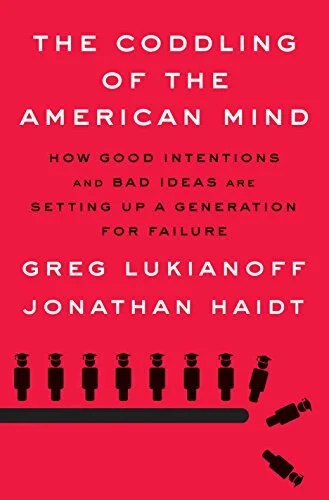
The dangers of social media in particular for young minds is one of the themes of The Coddling of the American Mind by Greg Lukianoff and Jonathan Haidt. Based on timing, they tie the rise in depression and anxiety among college freshwoman to having a “Like” button in service during the impressionable middle-school years. (Males were somewhat protected by leaning toward video games more than social media.) The recommendation is to not let children have fully-enabled cell phone until high school at the earliest.

Racism and Antiracism:

I imagined myself to be the kind of white person who would have stood with Dr. King because I respect him now. Close to 90 percent of white Americans approve of Dr. King today. Yet while he was alive and demanding change, only about 30 percent approved of him—the same rate of white Americans who approve of Colin Kaepernick today. So, if I want to know how I’d have felt about Dr. King back then, I can’t ask myself how I feel about him now; instead I have to ask myself: How do I feel about Kaepernick now? If I want to know how I’d have felt about the Freedom Riders back then, I can’t ask myself how I feel about them now; instead, I have to ask myself: How do I feel about Black Lives Matter now? If I want to know how I’d have shown up in the last civil rights era, I have to ask myself: How am I showing up today, in this civil rights era?

So I will commit to showing up with deep humility and doing the best I can. I will keep getting it wrong, which is the closest I can come to getting it right. When I am corrected, I will stay open and keep learning. Not because I want to be the wokest woke who ever woked. But because people’s children are dying of racism, and there is no such thing as other people’s children. Hidden racism is destroying and ending lives.

What I didn’t know back then is that there are several valid and contradictory schools of thought about how white women should show up in the racial justice movement. One view: White women—when accountable to and led by women of color—should use our voices and platforms to call other white women into anti-racism work. Another view: White women should only use their voices to point to people of color already doing the work. Those who subscribed to the latter philosophy were furious with me about this webinar. Why would you try to teach instead of pointing toward women of color who are already doing this work?

Why would you take up space in this movement when so many women of color have been doing this work forever? You offering a free course is taking money out of black educators’ pockets. Offering a “safe space” for white women to talk about race is wrong—white women don’t need to be safe; they need to be educated. You are canceled. You are a racist. You are a racist, Glennon. You are nothing but a racist. Everywhere, the word racist.

I talk to women all the time about how the misogyny pumped into the air by our culture affects us deeply. How it corrupts our ideas about ourselves and pits women against each other. How that programmed poison makes us sick and mean. How we all have to work hard to detox from it so that we don’t keep hurting ourselves and other women. Women cry and nod and say, “Yes, yes, me, too. I’ve got misogyny in me, and I want it out.” No one is terrified to admit she has internalized misogyny, because there is no morality attached to the admission. No one decides that being affected by misogyny makes her a bad person. When a woman says she wants to work to detox herself of misogyny, she is not labeled a misogynist. It is understood that there is a difference between a misogynist and a person affected by misogyny who is actively working to detox. They both have misogyny in them, programmed by the system, but the former is using it to wield power to hurt people and the latter is working to untangle herself from its power so she can stop hurting people

But then when I bring up racism, the same women say, “But I’m not racist. I am not prejudiced. I was raised better than that.”

We are not going to get the racism out of us until we start thinking about racism like we think about misogyny. Until we consider racism as not just a personal moral failing but as the air we’ve been breathing. How many images of black bodies being thrown to the ground have I ingested? How many photographs of jails filled with black bodies have I seen? How many racist jokes have I swallowed? We have been deluged by stories and images meant to convince us that black men are dangerous, black women are dispensable, and black bodies are worth less than white bodies. These messages are in the air and we’ve just been breathing. We must decide that admitting to being poisoned by racism is not a moral failing—but denying we have poison in us certainly is.

In America, there are not two kinds of people, racists and nonracists. There are three kinds of people: those poisoned by racism and actively choosing to spread it; those poisoned by racism and actively trying to detox; and those poisoned by racism who deny its very existence inside them.

In the last week, I have been thinking a lot about racism and antiracism. Some thoughts:

  • For at least half a century, a large fraction of the people in our culture have been working on antiracism. Clearly, these efforts have not been entirely effective. It is totally legitimate to question whether doubling down on the antiracism methods in common use is the best way to go.

  • Field experiments and associated analysis examining the effects of antiracism interventions is an important way that economists can contribute to antiracism. (As one example, I have heard that standard corporate diversity training has been examined in this way and found wanting.)

  • To me, limiting antiracism efforts or even antiracism leadership to only those of particular races or particular ethnicities seems like a mistake. Obviously, those who have not directly experienced racist denigration directed at them should approach this area with great humility and eagerness to hear about the experiences of those who have. But the value of competition in ideas should extend to encouraging even white people who feel so inspired to try to innovate in the difficult area of antiracism.

  • I hate the idea of people being told to shut up. This is a visceral thing for me. I think that in particular, people vulnerably sharing their own experiences is quite valuable. The vulnerable sharing of the experiences of those who have been racially denigrated is probably relatively more important for antiracism, but there is likely to be some value in white people vulnerably sharing their own experiences. (On vulnerability, don’t miss these two TED talks by the academician Brene Brown: “The power of vulnerability” and “Listening to shame.”)

  • In line with the last two passages from Untamed I have above, I find a “mindfulness” approach to antiracism inspiring. Let’s acknowledge and shine a light on even buried, unconscious racism and institutional racism wherever we find it. But just as those being trained to meditate are told not to make themselves wrong for their “monkey mind” but rather gently bring themselves back to the meditation practice when their mind wanders, let us be gentle with those who try to fight their own racism but have (unsurprisingly) failed to fully eradicate it from their minds and hearts. (We can be much tougher on those who either glory in their own racism or refuse to acknowledge and fight the racism that they carry.)

  • “Extremists” tend to be an important ingredient in social change because it is only the existence of extremists who make “moderates” look moderate. But note that this principle only applies to extremists of a type for which a moderate version of that view has some appeal. (Relatedly, see my discussion of “hippie-punching” in “Will Women Ever Get the Mormon Priesthood?”)

Gay Rights Shouldn’t Depend on Whether Being Gay is Genetic

What I want to say is: What if I wasn’t born this way at all? What if I married Abby not just because I’m gay but because I’m smart? What if I did choose my sexuality and my marriage and they are simply the truest, wisest, most beautiful, most faithful, most divine decisions I’ve ever made in my entire life? What if I have come to see same-gender love as a really solid choice—just a brilliant idea? Something I would highly recommend?

And what if I demand freedom not because I was “born this way” and “can’t help it” but because I can do whatever I choose to do with my love and my body from year to year, moment to moment—because I’m a grown woman who does not need any excuse to live however I want to live and love whomever I want to love?

What if I don’t need your permission slip because I’m already free?

I addressed some of this issue in “New Evidence on the Genetics of Homosexuality.” But Glennon has a much more powerful statement of human liberation in this passage:

What if I don’t need your permission slip because I’m already free?

The History of the Anti-Abortion and Anti-Gay Movements

I did my research. Turns out, the memo he was trying to pass me—“A good Christian bases her faith on disapproving of gays and abortion”—started being issued only forty years ago. In the 1970s, a few rich, powerful, white, (outwardly) straight men got worried about losing their right to continue racially segregating their private Christian schools and maintaining their tax-exempt status. Those men began to feel their money and power being threatened by the civil rights movement. In order to regain control, they needed to identify an issue that would be emotional and galvanizing enough to unite and politically activate their evangelical followers for the first time.

They decided to focus on abortion. Before then—a full six years after the Roe v. Wade Supreme Court decision—the prevailing evangelical position was that life began with the baby’s first breath, at birth. Most evangelical leaders had been indifferent to the Court’s decision in Roe, and some were cited as supporting the ruling. Not anymore. They wrote a new memo using freshly feigned outrage and rhetoric calling for “a holy war…to lead the nation back to the moral stance that made America great.” They sponsored a meeting of 15,000 pastors—called The Religious Roundtable—to train pastors on how to convince their congregations to vote for antichoice, antigay candidates. This is how they disseminated the memo down to evangelical ministers, who passed it down to pews across America. The memo read, To be aligned with Jesus, to have family values, to be moral, one must be against abortion and gay people and vote for the candidate that is antiabortion and antigay.

Presidential candidate Ronald Reagan—who, as governor of California had signed into law one of the most liberal abortion laws in the country—began using the language from the new memo. Evangelicals threw their weight behind him, and voted in a bloc for the first time to elect President Reagan. The Religious Right was born. The face of the movement was the “pro-life and pro-family values” stance of millions, but the blood running through the movement’s veins was the racism and greed of a few.

I find this fascinating. I wish I knew how accurate this historical account is. It sounds like something that might well be contested. But if true, this provides an important perspective.

Being Inspired Instead of Envious

When I see a joyful, confident woman moving through the world with swagger, I’m going to forgive myself for my first reaction because it’s not my fault, it’s just my conditioning.

First reaction: Who the hell does she think she is?

Second reaction: She knows she’s a goddamn cheetah.

The same principle applies to human liberation more generally. Other things that other people have may be harder to get. But if you seem someone who has an attitude you envy, there is a good chance that with some work, tou can get that attitude too.

Glennon Doyle (right) and her wife Abby Wambach (left). Image source.

Glennon Doyle (right) and her wife Abby Wambach (left). Image source.

Econolimerick #5

The much-touted-by-Milton-and-fans
M1 and M2 in our hands,
We think that we know
The way that things go,
But behold base supply and demands!

For the economics behind this limerick, see:

My choice of the plural for “demands” at the end of the limerick is significant: there are three qualitatively different sources of demand for the monetary base. Those who don’t understand all of these sources of demand for the monetary base can easily mislead themselves with naive monetarist predictions. The demand (singular) for the monetary base (which is defined as the sum of currency and reserves) is the horizontal sum of these three demands (plural):

  1. demand for paper currency and coins for transactions and storage (which is affected by the secrecy affordances of paper currency and coins),

  2. demand for reserves for required reserves and for precautionary reasons,

  3. demand for reserves in order to earn interest on reserves.

Those who don’t understand the demand for reserves in order to earn interest on reserves can easily mislead themselves into thinking that a large increase in the monetary base and in M1 and M2 must be very inflationary. This is not so because the demand for the monetary base to earn reserves is a demand that tends to immobilize that part of the monetary base, leading a reduction in the base velocity (and typically a reduction in M1 velocity and M2 velocity as well).

Don’t miss my other econolimericks:

Adam McCloskey and Pascal Michaillat: Calculating Incentive Compatible Critical Values Points to a t-Statistic of 3 as the 5% Critical Value after Accounting for p-Hacking

I was very interested to learn that colleague Adam McCloskey and his coauthor Pascal Michaillat had a paper that can be seen as backing up the idea that a t-statistic of 3 would be a useful critical value for us to impose as a rule in the social sciences—an idea I write about in “Let's Set Half a Percent as the Standard for Statistical Significance.” (However, setting a standard that appears to be a p-value of half a percent that way things are usually talked about is really something close to setting a 5% standard that is robust to p-hacking.) Below is a guest post from Adam, distilling the message of his paper with Pascal: “Incentive Compatible Critical Values.”


Motivated by the replicability crisis occurring across the sciences, Pascal Michaillat and I set out to produce a means of assessing statistical significance that is immune from the all-too-common phenomenon of p-hacking. 

Broadly speaking, p-hacking refers to a researcher searching through data, model specifications and/or estimation methods to produce results that can be considered statistically significant.  This behavior can take on many forms such as collecting additional data and examining multiple regression specifications. 

There is now a large body of research showing that p-hacking is quite pervasive in empirical research in economics and across many other scientific fields.  This fact presents a major problem for scientific credibility and replicability since our standard means of assessing whether data support a scientific hypothesis assume away this type of behavior.  Indeed, the standard distributions (e.g., standard normal) to which we compare test statistics (e.g., t statistics) to assess significance are justified upon the presumption that the test statistics were constructed from a single data set, model specification, and estimator. 

In other words, the tools empirical researchers use every day to assess whether a finding is merely a result of chance are ill-suited to the very behavior these researchers engage in.  This fact mechanically leads researchers to find spurious “discoveries” at a rate much higher than conventionally acceptable levels, such as 5%, and an inability for other researchers to replicate such “discoveries”.

Ours is certainly not the first attempt to overcome this problem of hypothesis test over-rejection resulting from p-hacking.  Several admirable proposals have been made and, in some cases implemented, ranging from constraining researcher behavior via pre-analysis plans to raising the bar for whether a finding ought to be deemed statistically significant.

However, there are limitations to each of these.  Pre-analysis plans are not entirely enforceable, are very difficult to implement with the observational data that researchers are commonly limited to and, perhaps most importantly, do not allow researchers to use their data to explore which questions may be interesting to address in the first place.  Using data to search for interesting problems is often done with the best intentions for scientific progress: data can help us to discover new and important hypotheses to test.  

Another recent proposal to mitigate p-hacking is to reduce conventional significance levels from 5% to 0.5%. However, it is reasonable to worry that mechanically raising the bar for statistical significance can lead to a statistical significance arms race in which researchers continue to p-hack until finding a result that crosses the more stringent statistical criterion.

In our paper, “Incentive-Compatible Critical Values,” we propose to let the incentives of researchers enter the calculation for whether a result ought to be deemed statistically significant.  Since the vast majority of empirical results that journals choose to publish are rejections of a null hypothesis, we assume that a researcher will continue to conduct “studies” until finding a statistically significant rejection, or until the benefit from conducting an additional study falls below the cost.  Here, “studies” can take many forms that range from collecting additional data to changing model specifications or estimation methods. 

In our framework, as in practice, a finding is determined statistically significant when the test statistic used to test the finding exceeds a critical value threshold.  In addition to the costs of conducting research and the benefits of publishing, we note that the number of studies a researcher will choose to conduct is a function of (among other things) this critical value: if the critical value is small, the researcher has the incentive to conduct multiple studies, while if it is too large, she may not conduct any studies at all.    

Rather than constructing this critical value under the classical assumptions we know are violated in practice, we account not only for the fact that researchers respond to critical value thresholds by conducting multiple studies to search for significance but also that it is costly to do so.  Given the endogenous response of researchers, we propose the use of a critical value at which the probability of finding a statistically significant result can be controlled at a conventionally acceptable level, such as 5%.  This amounts to solving a fixed-point problem to find the Incentive-Compatible Critical Value (ICCV).

We calibrate the costs and benefits of conducting studies as well as the researcher’s subjective beliefs to an experimental setting and calculate the ICCV under various scenarios for how the researcher combines the data she obtains in each successive experiment and updates her beliefs about the truth as she collects more data.  We then perform a sensitivity analysis to look across fairly wide ranges of costs, benefits and researcher beliefs centered on our empirical calibration. 

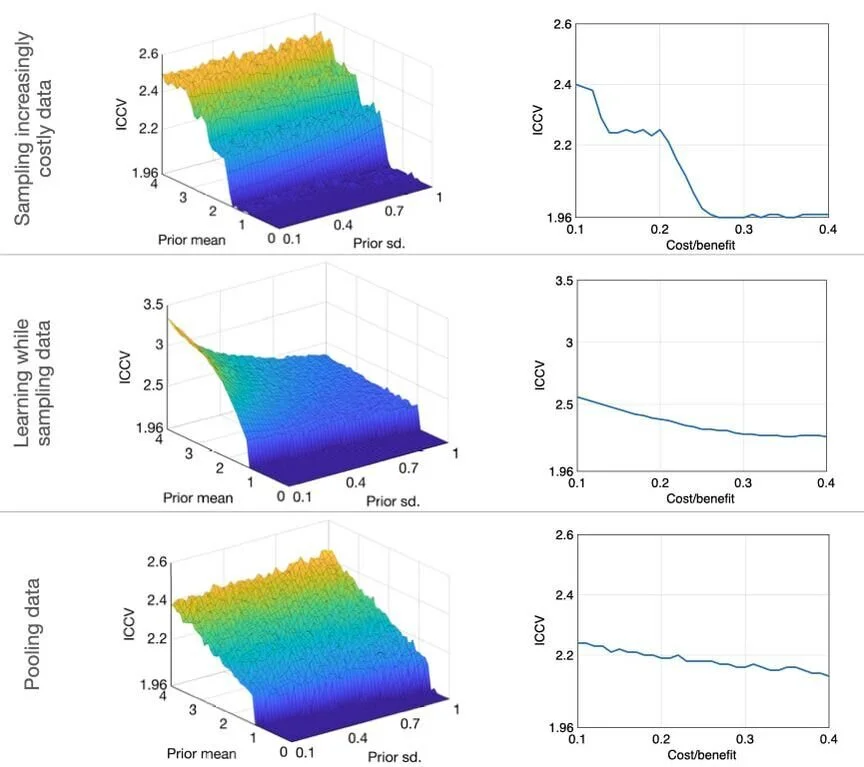
Since they allow researchers to search for significance across multiple studies, the ICCVs are necessarily larger than classical critical values (e.g., 1.96).  Yet, for the broad range of researcher behaviors and beliefs we examine, they lie in a fairly narrow range (see figure).  For a two-sided t-test with a level of 5%, we calculate the ICCV range to equal about 1.96 to 3.  In other words, a critical value equal to about 3 limits false rejection probabilities to 5% in experimental settings across a wide range of researcher behaviors and beliefs.

Looking forward, more data measuring the costs and benefits of research and researchers’ subjective beliefs across various scientific disciplines and methodologies would be extremely valuable for computing appropriate tailor-made ICCVs.

Gerard Theoret: 3 Turns of the Screw

Gérard Théorêt

Gérard Théorêt

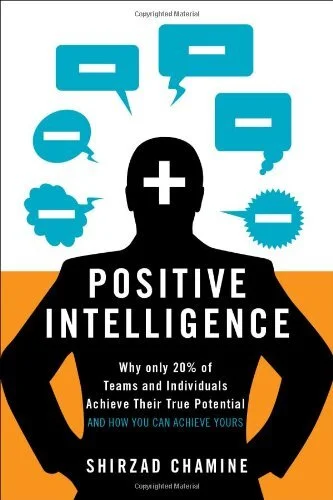
I am pleased to be able to share a guest post from Gerard Theoret, one of my friends from the Co-Active Leadership Program. Note that Gerard mentions Shirzad Chamine’s book Positive Intelligence, which I talk about in my post “On Human Potential,” which you might want to take a look at. Here is Gerard:


In the story below, I write about “Procrastination”.  I submitted this draft to Miles Kimball for his blog and then wrote back telling him not to bother reading it, that I needed to rewrite it.  I didn’t think it would meet the standards for his blog.  I had previously shared with him that my Positive Intelligence test results showed that my top internal saboteur is “Stickler”.

This is how Miles responded:  You have a challenge of discerning between (a) great ideas and curiosity about upgrading an essay and (b) perfectionism, or what Shirzad (Chamine) calls the "Stickler" saboteur.

I’m not going to let my saboteur have its way with me.  Here’s the essay in its original form:

3 Turns of the Screw!

Procrastination is probably one of my greatest self saboteurs. 

 Why do I procrastinate?  Am I lazy?  No!  

Am I easily distracted?  Yes, but I don't believe that that is the reason I procrastinate. 

What then?  Well, I often procrastinate about making seemingly important decisions because I worry that maybe there's a better decision to be made, and I want to take the time to do my due diligence about weighing the odds.  But, a good friend convinced me, yes convinced me, that means I believe it, that there are no bad decisions; you just have to make a decision and do what it takes to make it the right decision.  And, if for any reason that is proving to not be the optimal choice, make a new decision.  I try to remind myself of that when I get to those crossroads that keep showing up.  There's never just one opportunity or one challenge to leave or take; it seems to always be multiple choice for me.   

Do I get overwhelmed?  Oh yes, definitely, yes.  There is so much I want to do that I don't know where to begin.  So what do I do?  I run away!  I grab the car keys and drive over to my favorite consignment store or thrift shop and pretend I'm at the museum.  I can spend hours imagining the previous life of each item.  Disclaimer:  I'm not doing that right now because these stores are not open during Stay at Home restrictions due to Covid-19.  So now, I don a mask and put on my latex gloves and I escape to the grocery stores and while I'm out, I might as well stop at the Pharmacy and pick up extra vitamins.

Avoidance is only a temporary remedy.  In fact it's not a remedy at all; it's a momentary distraction.  I still have the To Do List sitting in front of me and the tightness in my shoulders and the feeling of guilt barely eased up through those brief excursions. 

And, I'm still not quite ready to face the music—the to do list.  I'll play a few of my on-going games of Word With Friends while I decide what I'm going to make for dinner.  After all, I can’t focus if I’m hungry.  Sometimes the games get interrupted by a ping on my phone.  Someone has sent me a very funny video with a political edge.  Oh, and the follow-up video in that stream is a very interesting take on that political view.  Oh, I think I need to forward that to another friend whom I'm sure will have a very sobering comment to make about that one.  And, I'd better go back and comment or at least react to that funny video.  

Oh, my goodness, look at the time.  I'd better do something about dinner.  Oh, the NEWS is on.  That's okay: I can prepare food during the commercials.

I can't "do" anything while I'm eating; I might as well turn the TV back on.  Oh, this must be a new series.  Oh look, they've melded these two series into a continuous story;  the firemen from this series are dating the doctors from that series. 

Look at the time.

I've got to read at least the next chapter in my book before I go to bed.

Okay, that was two chapters, but that was really quite enlightening.

I must go to bed.

Oh, no, I can't go another day without at least a short entry in my journal. 

Okay, maybe not so short.  Well, I did get a few things done. 

I think that my best accomplishment was the 3 Turns of the Screw.

For a couple of years now the door to the guest bedroom hasn't closed properly.  When I have guests I simply tell them to pull up a bit on the door handle and the door will close just fine.  It makes an obnoxious noise that grates on my nerves and it has pulled some of the paint near the top end of the door jamb, so I'll have to repaint the door jamb at some point after I've gotten that door fixed.  Just one more thing to do.  Add it to the list.

As I was putting away my measuring tape a couple of days ago, I noticed my multi-head screwdriver sitting there in the same box.  I was only a few steps away from that door.  I wonder if it might help to tighten that top hinge.

One, two, three turns of the screw and the door closes perfectly smoothly and quietly.

I wonder if there’s a lesson to be learned there? 3 turns of the screw!  Two years!

What is wrong with me?

Starting today... Whenever I find myself procrastinating or overwhelmed  or facing any other of my self saboteurs, I will say out loud:  3 Turns of the Screw.  I don't care if anyone hears. 


Before becoming a Life Coach and enlisting in the Coactive Training Institute’s Leadership Program Gerard Theoret’s background was in the Performing Arts.  Of note, he  played the role of The Baron in Cirque du Soleil’s Saltimbanco; he was Artistic Director of Cirque du Soleil’s Corteo; he was Associate Artistic Director of the Canadian productions Phantom of the Opera; he was an actor at the Stratford Festival in Canada and was a Soloist with Canada’s Royal Winnipeg Ballet.  He has been a Professor of Dance and Theatre at the University of Alberta and at Cornish College of the Arts. 

If you are interested in life coaching, you can contact Gerard at gerardtheoret@gmail.com

Some things are easy. Photo by Miles Kimball

Some things are easy.

Photo by Miles Kimball

The Federalist Papers #10 B: The Larger the Republic, the Easier It is to Find Thoughtful Legislators and the Harder It is to Put Together a Majority to do Unjust Things—James Madison

In the first half of the Federalist Papers #10, James Madison argues that “Conflicts Arising from Differences of Opinion Are an Inevitable Accompaniment of Liberty.” In the second half, James Madison is interested in how to avoid those differences of opinion leading to oppression of the minority by the majority. He argues that large republics have two advantages for avoiding such oppression: in a large republic,

  1. there are more people to choose from as elected representatives, while the number of elected representative doesn’t need to go up proportionately, so the electorate can be choosier, and

  2. the bad things people want to legislate are more diverse, so it is harder to get together a majority for something truly bad—and harder to get together a critical mass for succeeding in an unconstitutional conspiracy.

These two points are closely related to the two ways James Madison sees for avoiding oppression of a political minority by the majority. With my notes added in brackets, here is what he says on that:

Either the existence of the same passion or interest in a majority at the same time must be prevented [diversity of bad things people want to do helps], or the majority, having such coexistent passion or interest, must be rendered, by their number and local situation, unable to concert and carry into effect schemes of oppression [representatives instead of direct democracy helps if some legislators are public-spirited, and it is harder to organize a successful unconstitutional action in a large nation].

Let me back up James Madison on these points.

First, I do think our national politicians are, on average, smarter and more competent than our state and local politicians, while the state and local politicians are more corrupt than our national politicians. It might not seem that way, because a greater share of the corruption of national politicians is revealed by the more numerous press covering them than the share of corruption revealed of state and local politicians. But actively recalling stories of corruption by state and local politicians can give a more balanced perspective. (I’d love to see some comparable statistics on corruption by national politicians as compared to corruption to state and local politicians.)

Second, although we have quite a bit of polarization of our national politics, and for substantial fractions of our national history, there were majorities for racial and gender and sexual injustice, there are types of injustice for which there are likely majorities at the state level but not at the national level. James Madison gives the example of the oppression of religious minorities with laws that suit the religious majority:

A religious sect may degenerate into a political faction in a part of the Confederacy; but the variety of sects dispersed over the entire face of it must secure the national councils against any danger from that source.

And even in our polarized time, it is clear that the extreme left wing and the extreme right wing have an easier time putting together a majority in an individual state than in the United States as a whole. Just think of the states that are dominated by these two extremes.

It must be admitted that the problem of the majority enacting unjust laws remains with us. But I think James Madison is right that the problem would be worse if each state were a separate nation. Just look at the European Union: some of the nations within it have gone significantly away from respect for the rights of political minorities. If the European Union were a nation rather than a group of nations, fair treatment of political minorities might prevail somewhat more uniformly.


FEDERALIST NO. 10

The Same Subject Continued: The Union as a Safeguard Against Domestic Faction and Insurrection

From the New York Packet
Friday, November 23, 1787.

Author: James Madison

To the People of the State of New York:


If a faction consists of less than a majority, relief is supplied by the republican principle, which enables the majority to defeat its sinister views by regular vote. It may clog the administration, it may convulse the society; but it will be unable to execute and mask its violence under the forms of the Constitution. When a majority is included in a faction, the form of popular government, on the other hand, enables it to sacrifice to its ruling passion or interest both the public good and the rights of other citizens. To secure the public good and private rights against the danger of such a faction, and at the same time to preserve the spirit and the form of popular government, is then the great object to which our inquiries are directed. Let me add that it is the great desideratum by which this form of government can be rescued from the opprobrium under which it has so long labored, and be recommended to the esteem and adoption of mankind.

By what means is this object attainable? Evidently by one of two only. Either the existence of the same passion or interest in a majority at the same time must be prevented, or the majority, having such coexistent passion or interest, must be rendered, by their number and local situation, unable to concert and carry into effect schemes of oppression. If the impulse and the opportunity be suffered to coincide, we well know that neither moral nor religious motives can be relied on as an adequate control. They are not found to be such on the injustice and violence of individuals, and lose their efficacy in proportion to the number combined together, that is, in proportion as their efficacy becomes needful.

From this view of the subject it may be concluded that a pure democracy, by which I mean a society consisting of a small number of citizens, who assemble and administer the government in person, can admit of no cure for the mischiefs of faction. A common passion or interest will, in almost every case, be felt by a majority of the whole; a communication and concert result from the form of government itself; and there is nothing to check the inducements to sacrifice the weaker party or an obnoxious individual. Hence it is that such democracies have ever been spectacles of turbulence and contention; have ever been found incompatible with personal security or the rights of property; and have in general been as short in their lives as they have been violent in their deaths. Theoretic politicians, who have patronized this species of government, have erroneously supposed that by reducing mankind to a perfect equality in their political rights, they would, at the same time, be perfectly equalized and assimilated in their possessions, their opinions, and their passions.

A republic, by which I mean a government in which the scheme of representation takes place, opens a different prospect, and promises the cure for which we are seeking. Let us examine the points in which it varies from pure democracy, and we shall comprehend both the nature of the cure and the efficacy which it must derive from the Union.

The two great points of difference between a democracy and a republic are: first, the delegation of the government, in the latter, to a small number of citizens elected by the rest; secondly, the greater number of citizens, and greater sphere of country, over which the latter may be extended.

The effect of the first difference is, on the one hand, to refine and enlarge the public views, by passing them through the medium of a chosen body of citizens, whose wisdom may best discern the true interest of their country, and whose patriotism and love of justice will be least likely to sacrifice it to temporary or partial considerations. Under such a regulation, it may well happen that the public voice, pronounced by the representatives of the people, will be more consonant to the public good than if pronounced by the people themselves, convened for the purpose. On the other hand, the effect may be inverted. Men of factious tempers, of local prejudices, or of sinister designs, may, by intrigue, by corruption, or by other means, first obtain the suffrages, and then betray the interests, of the people. The question resulting is, whether small or extensive republics are more favorable to the election of proper guardians of the public weal; and it is clearly decided in favor of the latter by two obvious considerations:

In the first place, it is to be remarked that, however small the republic may be, the representatives must be raised to a certain number, in order to guard against the cabals of a few; and that, however large it may be, they must be limited to a certain number, in order to guard against the confusion of a multitude. Hence, the number of representatives in the two cases not being in proportion to that of the two constituents, and being proportionally greater in the small republic, it follows that, if the proportion of fit characters be not less in the large than in the small republic, the former will present a greater option, and consequently a greater probability of a fit choice.

In the next place, as each representative will be chosen by a greater number of citizens in the large than in the small republic, it will be more difficult for unworthy candidates to practice with success the vicious arts by which elections are too often carried; and the suffrages of the people being more free, will be more likely to centre in men who possess the most attractive merit and the most diffusive and established characters.

It must be confessed that in this, as in most other cases, there is a mean, on both sides of which inconveniences will be found to lie. By enlarging too much the number of electors, you render the representatives too little acquainted with all their local circumstances and lesser interests; as by reducing it too much, you render him unduly attached to these, and too little fit to comprehend and pursue great and national objects. The federal Constitution forms a happy combination in this respect; the great and aggregate interests being referred to the national, the local and particular to the State legislatures.

The other point of difference is, the greater number of citizens and extent of territory which may be brought within the compass of republican than of democratic government; and it is this circumstance principally which renders factious combinations less to be dreaded in the former than in the latter. The smaller the society, the fewer probably will be the distinct parties and interests composing it; the fewer the distinct parties and interests, the more frequently will a majority be found of the same party; and the smaller the number of individuals composing a majority, and the smaller the compass within which they are placed, the more easily will they concert and execute their plans of oppression. Extend the sphere, and you take in a greater variety of parties and interests; you make it less probable that a majority of the whole will have a common motive to invade the rights of other citizens; or if such a common motive exists, it will be more difficult for all who feel it to discover their own strength, and to act in unison with each other. Besides other impediments, it may be remarked that, where there is a consciousness of unjust or dishonorable purposes, communication is always checked by distrust in proportion to the number whose concurrence is necessary.

Hence, it clearly appears, that the same advantage which a republic has over a democracy, in controlling the effects of faction, is enjoyed by a large over a small republic,--is enjoyed by the Union over the States composing it. Does the advantage consist in the substitution of representatives whose enlightened views and virtuous sentiments render them superior to local prejudices and schemes of injustice? It will not be denied that the representation of the Union will be most likely to possess these requisite endowments. Does it consist in the greater security afforded by a greater variety of parties, against the event of any one party being able to outnumber and oppress the rest? In an equal degree does the increased variety of parties comprised within the Union, increase this security. Does it, in fine, consist in the greater obstacles opposed to the concert and accomplishment of the secret wishes of an unjust and interested majority? Here, again, the extent of the Union gives it the most palpable advantage.

The influence of factious leaders may kindle a flame within their particular States, but will be unable to spread a general conflagration through the other States. A religious sect may degenerate into a political faction in a part of the Confederacy; but the variety of sects dispersed over the entire face of it must secure the national councils against any danger from that source. A rage for paper money, for an abolition of debts, for an equal division of property, or for any other improper or wicked project, will be less apt to pervade the whole body of the Union than a particular member of it; in the same proportion as such a malady is more likely to taint a particular county or district, than an entire State.

In the extent and proper structure of the Union, therefore, we behold a republican remedy for the diseases most incident to republican government. And according to the degree of pleasure and pride we feel in being republicans, ought to be our zeal in cherishing the spirit and supporting the character of Federalists.


Here are links to my other posts on The Federalist Papers so far:

Econolimerick #4

If you know that log times is add logs,
And log power is displayed on your togs,
Economics to sing,
You need one more thing:
Percent changes are changes in logs.

On Human Potential

Today is the 8th anniversary of this blog, "Confessions of a Supply-Side Liberal." My first post, "What is a Supply-Side Liberal?" appeared on May 28, 2012. I have written an anniversary post every year since then:

  1. A Year in the Life of a Supply-Side Liberal

  2. Three Revolutions

  3. Beacons

  4. Why I Blog

  5. My Objective Function

  6. A Barycentric Autobiography

  7. Crafting Simple, Accurate Messages about Complex Problems

As I look back over the past year, other than the pandemic we are all in the midst of, the biggest shift for me in my life has been digging in ever more deeply into what I will call “human potential.” In addition to the well-known psychologists William James, Abraham Maslow, Viktor Frankl and Carl Rogers, the Wikipedia article “Human Potential Movement” lists Werner Erhard as a notable proponent. Werner Erhard was the originator of est, which is the institutional ancestor of Landmark Worldwide, which was one of my points of contact with the human potential movement. On that, see my posts:

Other points of contact for me with the human potential movement are my practice of transcendental meditation and my study of co-active coaching and co-active leadership, which I will focus on in this post. I also include in the human potential movement broadly-writ the Economics of Happiness and other well-being research (see https://blog.supplysideliberal.com/tagged/happiness) and principles such as a growth mindset and grit (see “There's One Key Difference Between Kids Who Excel at Math and Those Who Don't,” “How to Turn Every Child into a 'Math Person'“ and Visionary Grit”).

Thinking it is possible to dramatically improve human performance and human well-being, is, from another point of view, saying we are dramatically inside of a possibility frontier, doing something dramatically suboptimal. That is exactly what I believe. For example, on the purely cognitive side, we are almost all nowhere near the potential of our ability to learn things. (See “The Most Effective Memory Methods are Difficult—and That's Why They Work” and “Joshua Foer on Memory.”)

I don’t believe the old saw that “We use only 10% of our brains” But the fact that we don’t understand what a lot of our brains are doing certainly leaves open the possibility of a much greater potential than is commonly realized.

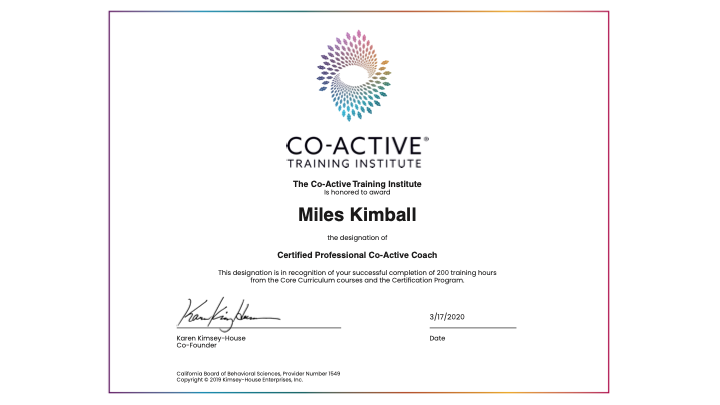
Turning to the Co-Active arm of the Human Potential Movement, I have spent an important chunk of the last 12 months becoming a Certified Professional Co-Active Coach:

CPCC certificate.png

I describe Co-Active coaching in “Co-Active Coaching as a Tool for Maximizing Utility—Getting Where You Want in Life” and I now have a related series of blog posts on “positive mental health” to which I have collected the links so far in the most recent in the series. (Some of these are guest posts by members of my cohort or “tribe” in the Co-Active Leadership Program.) Co-Active Coaching is a very powerful technique for discovering one’s objective function and bringing one’s actions in alignment with that objective function. I have spoken quite positively on this blog about my experience with the Landmark Worldwide courses. I view Co-Active coaching as equally powerful, but tailored to an individual, where the Landmark courses focus on a few common human struggles.

Let me give two examples of what I have gained from a Co-Active approach. (Down the road, when I’m further along in it, I’ll write more about what I have gained from the Co-Active Leadership Program.)

First, I have been able to dramatically reduce the amount of unhappiness in my (already mostly happy) life using the ideas in Shirzad Chamine’s book Positive Intelligence. book Positive Intelligence has been giving me tools to tame and subdue negative and limiting voices in my head. Coaches call them “saboteurs” or “gremlins.” Using factor analysis, Shirzad has put saboteurs into a typology of ten main types. Understanding this typology makes it a lot easier to notice and intercept saboteurs. Saboteurs are a reflection of the survival-oriented part of the brain. The curiosity-and-opportunity-oriented part of the brain he calls “the sage.” One powerful principle of Positive Intelligence is that even as little as ten seconds of some kind of mindfulness exercise—which can be as simple as watching one’s breath, rubbing two fingers together with enough attention to notice the ridges, or noticing each of one’s ten toes in turn—can help shift your brain away from activation of your saboteurs to activation of your sage.

A good way to get a little taste of Positive Intelligence in very little time is to take Shirzad’s free “Saboteur Assessment” to see what some of your top Saboteurs are. There are three tools for weakening the power one’s saboteurs. One is to deepen the emotional connection with your goals so that your saboteurs don’t stop you and are sidelined. This is the tool of resonance. The second tool is to unmask your saboteurs by naming them: “My saboteur thinks I am worthless” is a statement that leads to a lot less trouble and suffering than “I am worthless.” The third tool to weaken your saboteurs is using some mindfulness practice, even if only for ten seconds.

My second simple (perhaps even mundane, but useful) example of something I have gotten from Co-Active coaching is that my own coach encouraged me to lay out the key domains of my life that I care about, in a personalized way. I have 7, which I can symbolize by a 7-pointed star:

  1. saving the world (what I hope is a lovably grandiose way of talking about the kind of thing I try to do on this blog)

  2. my marriage

  3. friends and family

  4. teaching, coaching and mentoring

  5. taking care of myself physically and mentally

  6. learning

  7. fun and self-expression. (This blog is an important part of self-expression for me! You can see that from “A Year in the Life of a Supply-Side Liberal.”

I find it has had a surprisingly important effect on how I conduct my life to periodically check in on how I am doing in each of these areas, so I can shore up any point of the seven-pointed star that is weak. My willingness to do that check-in depends a lot on the fact that I personalized the layout of these seven areas to be interesting for me.

In “Co-Active Coaching as a Tool for Maximizing Utility—Getting Where You Want in Life” I express the wish that everyone had a coach. When I say that, the image I have in my mind is, in particular, every teenager having a Co-Active coach. It would be a better world! The past was much, much, much worse than the present, especially if you go at least 100 years back. So the world can get better! (See for example “Things are Getting Better: 3 Videos.”) The human potential movement gained momentum in the 1960s. We should be in store for another Great Awakening beginning about 2040 if one believes the intuition-generating cyclical theory of history I discuss in “William Strauss and Neil Howe's American Prophecy in 'The Fourth Turning: What the Cycles of History Tell Us About America's Next Rendezvous with Destiny'.” The next level up of the human potential movement—which to me is represented by the kind of tools I have discussed or at least pointed to in this post—could be a big part of the next Great Awakening. Let’s hope so!

Don’t Miss These Other Posts Related to Positive Mental Health:

Recognizing Opportunity: The Case of the Golden Raspberries—Taryn Laakso

Golden Raspberries

Golden Raspberries

I am pleased to be able to share a guest post from my friend Taryn Laakso from my Co-Active Leadership Program Tribe. I like her story about golden raspberries. Here it is:


My partner's backyard has a great patch of raspberry plants. Last summer, I was excited to know we'd be getting some fresh berries during the summer because we'd be moving in together and I would get a chance to pick berries and make some jam! My bubble of excitement quickly burst when he laughed and mentioned he never gets any ripe berries off the bushes because either the birds or the bunnies take all the berries as soon as they ripen. I was bummed out but it didn't last long, I went right into scheming mode. I would outfox those birds and bunnies. I solve problems for a living!

So one summer afternoon I was out in the backyard taking a look at the berries bushes determining how to protect them. There were so many berries that I was confused about how the birds and bunnies could eat ALL THE BERRIES before they got ripe. My intuition was whispering to me saying "this isn't right. Something is off." I took a closer look. The berries were a light orange color, so to the untrained eye, it could seem as if the berries never got ripe. I recalled from my younger teenager days while working loooong days at my parent's garden shop that there are numerous varieties of raspberries in the world.

I wondered if these weren't actually red raspberries at all, but some other variety because these did look so darn plump and juicy, even though they were golden orange! I reached out and gently squeezed one between my fingers. It was plump and soft, but not too squishy. It slid off the stem with ease. Ha! This IS a ripe berry. I popped it into my mouth and holy berry batman! This was juicy and sweet! We had GOLDEN RASPBERRIES! I felt I struck gold with this discovery.

You can probably picture my now gloating face when I came into the kitchen with a handful of fresh berries for him to try. I wish I had had my camera ready for the expression on his face after he took a bite of the golden berry. Gobsmacked—as my kids would say in their fake British accents. He was totally gobsmacked! I was tickled orange to know we had a crop of fresh berries in our backyard. I outfoxed the bunnies and birds after all with very little effort and a shifted mindset of curiosity! Problem solved!

Sometimes we make assumptions and create stories that have us miss out on delicious opportunities. What is possible when we let our curiosity guide us? A shift in perspective may be all that is needed to show us something is ripe right in front of our eyes and ready to be picked. A much better outcome than being frustrated and blaming others for a situation!

Don't miss out on opportunities just because they don't fit into an old thought pattern. Learn to reach out and pluck the golden berry. It might be more delicious than you expected!


Taryn is a co-active coach and supports emerging leaders unlock their potential so they can navigate their life with more confidence, clarity and calm through the choppy waters of business and life.

Here is her coaching contact information:

email address: tarynlaakso@unlaakingyourpotential.com Web: www.unlaakingyourpotential.com

phone number: (206) 310-9409

Click here if you would like to schedule a complimentary 30 minute coaching sessions to unlock your potential!

(link: https://unlaakingyourpotential.coachesconsole.com/calendar/unlaaking-your-potential-sample-session)

Taryn Laakso

Taryn Laakso

Christian Kimball: Doubting Thomas

I am pleased to have another guest post on religion from my brother Chris. You can see other guest posts by Chris listed at the bottom of this post.


Doubting Thomas

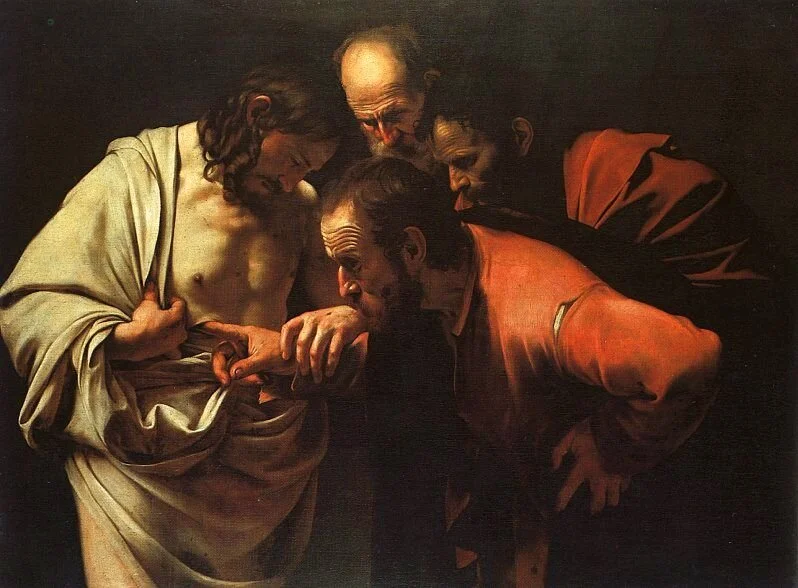
The Octave Day of Easter or Sunday after Easter is variously called White Sunday, Renewal Sunday, Low Sunday (Anglican; 20th century Roman Catholic), Divine Mercy Sunday (21st century Roman Catholic), Antipascha (Orthodox), or Thomas Sunday (especially among Byzantine Rite Christians). By any name, the traditional gospel reading for this day is the story of Doubting Thomas.

In John 20 (but not the other Gospels) we read about Thomas who said

Except I shall see in his hands the print of the nails, and put my finger into the print of the nails, and thrust my hand into his side, I will not believe. (John 20:25 KJV) 

The phrase “doubting Thomas” has come to be a negative term. Just check out Wikipedia: “A doubting Thomas is a skeptic who refuses to believe without direct personal experience.” It’s the “refuses” that signals moral judgment. They will say "if only you would choose to believe, all would be well. Just choose."

I am a self-confessed doubting Thomas. As I have written elsewhere:

I am a skeptic, an empiricist, a Bayesian. . . . A skeptic questions the possibility of certainty or knowledge about anything (even knowledge about knowing). An empiricist recognizes experience derived from the senses. A Bayesian views knowledge as constantly updating degrees of belief. In a functional sense, in the way it works in my life, I only know anything as a product of neurochemicals and hormones in the present.

Isn’t it possible that Thomas’ “I will not believe” is a simple statement of fact? As opposed to the childish playground taunt “prove it!”, maybe he was just saying “Guys, it won’t happen. Sorry about that but it’s how I’m built.”

What is important to me is that Jesus came. What modern criticism of doubters and skeptics would hint at is an alternate ending where Jesus went away, shunning Thomas the unbeliever. But what we’re taught is that Jesus came. Jesus came and said, “Peace be unto you. Reach hither thy finger, and behold my hands; and reach hither thy hand, and thrust it into my side.” And Thomas replied “My Lord and my God.”

Yes, maybe there is a message that skepticism is second best, second to believing without seeing. If that is so, I’ll accept second place. Because I have no choice, because I cannot do otherwise. For me, the important message is that Jesus came to Thomas. And Thomas saw and knew.

My “testimony” to fellow unbelievers is to be a doubting Thomas if that is how you are built. Jesus Himself proved it's OK. And maybe somewhere, someday, maybe on the road, maybe not in the middle of a church, Jesus will come to you. Too.


Chris circulated this essay among a small group of people before its appearance here. So it comes with an instant comment section:

>I think this is a perennial topic. I like the idea that there are people naturally constituted as skeptics who still need to be ministered to. 

>I don't think Thomas was chastised for his skepticism. After all, it is difficult to believe that a dead person is no longer dead. I think he was chastised because he refused to believe the testimonies of many honorable men that he knew. To clearly understand what they are testifying of, to be able to question them thoroughly, and yet to doubt what they are saying, is to put yourself in the prideful position of being a superior potential witness: "I would not have been so easily fooled had I been there."

>I read D&C 46:11-14 as instructive:

For all have not every gift given unto them; for there are many gifts, and to every man is given a gift by the Spirit of God. To some is given one, and to some is given another, that all may be profited thereby. To some it is given by the Holy Ghost to know that Jesus Christ is the Son of God, and that he was crucified for the sins of the world. To others it is given to believe on their words, that they also might have eternal life if they continue faithful.

To my way of thinking, if it was not Thomas’ gift to believe on their words, then he is not “accountable” for rejecting the testimony of witnesses and desiring to see for himself. 

>But for the skeptic, "believing on their words" is hard. 

>Agreed but I wouldn't use "But." All have not every gift is to say some--i.e., skeptics--do not have the "gift" to believe on their words. Quoting scripture is a way to say it is not a fault or failing (for an audience that gives credence to scripture), but simply part of the human condition. 

>The testimony that the Holy Ghost can deliver to people is not the same kind of truth that a court of law seeks to establish. The testimony that Thomas' fellow apostles offered to him was the former type.

>The various kinds of testimony—of the Holy Ghost, of a trusted friend, of an otherwise anonymous neighbor—does make sense to me. People do make distinctions and weight them differently and take multiple factors into account in assessing the strength and reliability. I place more weight on the words of a trusted friend. That’s almost tautological—that’s what “trusted” means to me. Many religious people argue that the testimony of the Holy Ghost is of a different class, a different kind of testimony or knowledge. Like a direct line to knowledge or the ultimate source. It doesn’t work that way for me. Certainly, some evidence and some testimony is better or more persuasive than others, but I remain a skeptic throughout. Others have told me they are like me, so I don’t feel alone or an isolated instance of a skeptic. Although I cannot know, in my imagination Thomas was like me.

>If someone claims that the Holy Ghost told them something, that is for their benefit only, unless the message is from a church leader. Then I will follow it because that's my duty as a member, not that I necessarily believe it. I still need evidence that appeals to my sense of reason.

>Is it the words of the church leader you have a duty to follow? Or is it the testimony of the Holy Ghost to you about those words that you have a duty to follow?

>Prophets, priests, and ministers, have a tendency to communicate that (a) they know, and (b) listeners have an obligation to believe on their words. A skeptic says it doesn't work that way for me, as a statement of fact. In effect, this discussion is about the conflict between the attempt to impose an obligation and the observed fact that it doesn't happen.

>I remember reading the account in the New Testament for the first time myself and thinking Thomas's response to the others' statement as most reasonable. I had heard negative comments about Thomas and his supposed unbelief as though it were denial. The sort of short-hand comments people throw around when describing others. But when I read the account for myself, it read naturally, that Thomas didn't doubt the others' belief in their belief or their reality of their experience. I'm glad Thomas was not there that first day Christ returned. That gives me hope there will come a time when I too will know.

>Is knowing better than having faith? Maybe “knowing” will never be my gift and maybe “having faith” is the greater gift, or the gift for me.


Don’t miss these other guest posts by Chris:

In addition, Chris is my coauthor for

Don't miss these posts on Mormonism:

Also see the links in "Hal Boyd: The Ignorance of Mocking Mormonism."

Don’t miss these Unitarian-Universalist sermons by Miles:

By self-identification, I left Mormonism for Unitarian Universalism in 2000, at the age of 40. I have had the good fortune to be a lay preacher in Unitarian Universalism. I have posted many of my Unitarian-Universalist sermons on this blog.

4 Types of Heterogeneity that Offer a Bit of Extra Hope for Keeping the Pandemic Under Control without Blanket Lockdowns

Yesterday, in “On the Herd Immunity Strategy” I wrote:

Before we have a vaccine for COVID-19, there are three alternatives to lockdowns:

  1. Massive testing (where tracing can substitute to some extent for number of tests)—see for example “Seconding Paul Romer's Proposal of Universal, Frequent Testing as a Way Out

  2. Treatment improvements—for example, it is possible the monoclonal antibodies might work really well

  3. Herd immunity of key subgroups of the population—see for example “How Does This Pandemic End?

That post and “How Does This Pandemic End?” emphasized how spread of COVID-19 among groups (especially the young) that have relatively low personal risk of death from infection and have high social interactivity as soon as a lockdown is loosened even a little might build up partial herd immunity. The correlation between 1st, low personal risk of bad outcome from infection and 2d, high social interactivity (given even a mild loosening of restrictions) is helpful here. Once we have partial herd immunity (which we are still quite far from), it may be that a 3d type of heterogeneity can help us get by with partial lockdowns: the fact that some types of social interaction are much worse for spreading the disease than others. As a result, simply shutting down “super-spreader events” might do a lot of good. There is a 4th type of heterogeneity that also helps: heterogeneity in the cost of social distancing. We should of course continue to have people do activities online if those activities can be done reasonably well online.

Let me focus on the 3d heterogeneity, the heterogeneity in events in this post. To see how powerful this is, note that spread has to do with the number of pairs of people who are near one another for a long time in which one member of the pair is infected and infectious and the other member of the pair is susceptible. If all members of a gathering are near one another for a long time, the total number of pairs in that gathering goes up roughly as the square of the number of people in the gathering. So a gathering of 100 people is roughly 100 times worse than a gathering of 10 people. Using a more precise calculation, one can also say that a gathering of 10 people has 45 pairs, while a gathering of 3 people has 3 pairs, so a gathering of 10 people has 15 times as many pairs as a gathering of 3 people. (One interesting implication of this reasoning is that very small restaurants may present less of an infection-transmission danger than large restaurants, as long as the restaurant staff gets tested with rapid-results tests at high frequency.)

Note that many people, including policy-makers, are talking as if it is just a matter of distance. But duration of being near one another is likely to matter every bit as much as distance. Being 12 feet away for hours and hours may allow effective transmission. (The details of air circulation are also likely to matter.)

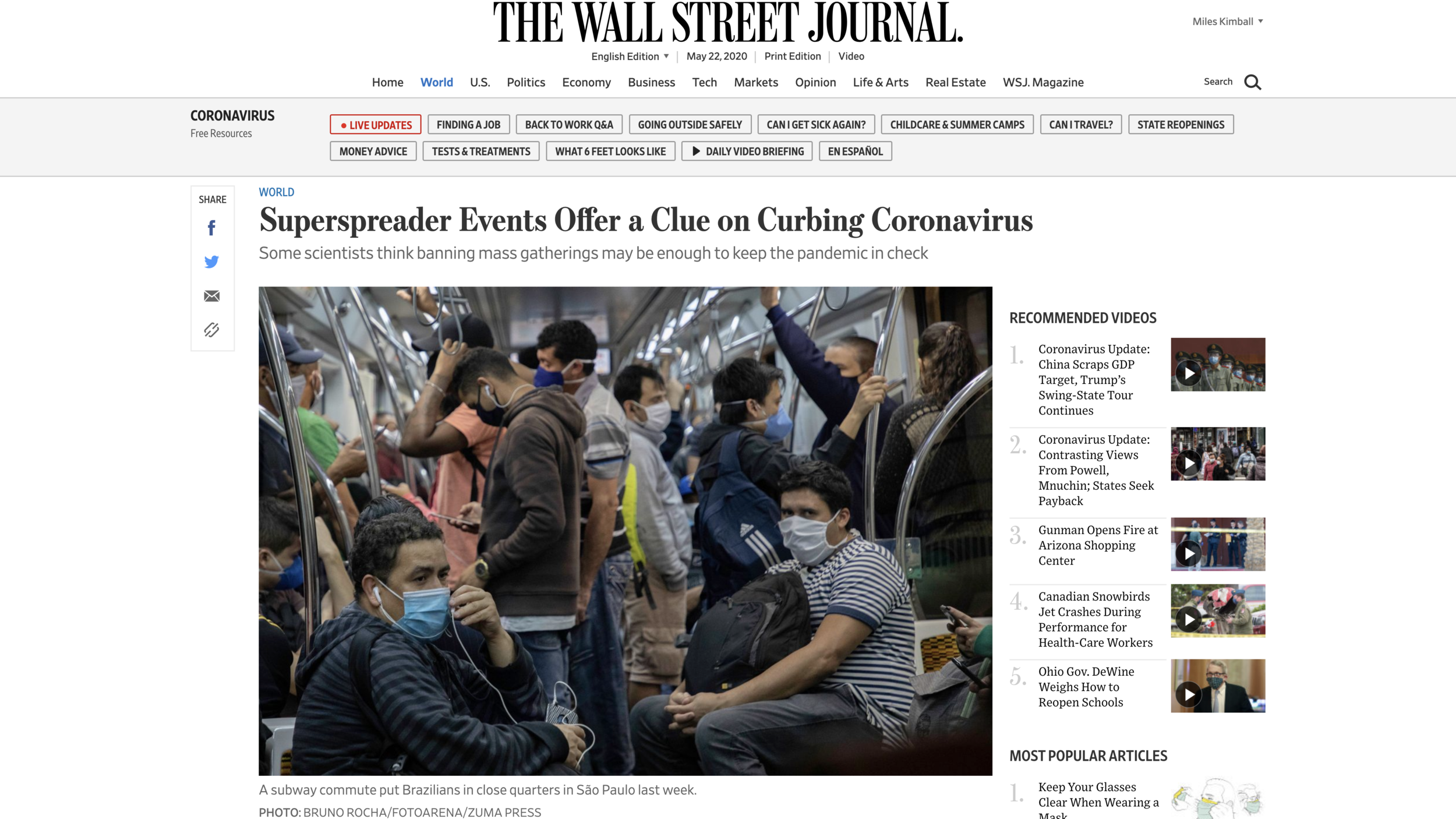
Bojan Pancevski’s May 20, 2020 Wall Street Journal article “Superspreader Events Offer a Clue on Curbing Coronavirus” gets into some useful perspective on super-spreader events. Consider the following two passages from Bojan’s article:

  • The theory is that banning mass public events where hundreds of attendees can infect themselves in the space of a few hours, along with other measures such as wearing face masks, might slow the pace of the new coronavirus’s progression to a manageable level even as shops and factories reopen.

Researchers believe that the explosive growth of coronavirus infections that overwhelmed hospitals in some countries was primarily driven by such events earlier this year—horse races in Britain, carnival festivities in the U.S. and Germany or a soccer match in Italy.

  • … mass infections tend to be more serious than those contracted in other circumstances, perhaps because of sustained exposure to a larger amount of virus.

  • The experience of several European countries seems to confirm the special role played by superspreading events. Over the past four weeks, Germany, Austria, Denmark, Norway and other countries that have exited early from lockdowns have removed most restrictions on public life except those targeting mass gatherings. So far, new infections have remained low and constant. Sweden, which never had a mandatory lockdown, managed to control and then reduce the spread by relying on only one restrictive measure: prohibiting gatherings of over 50 people.

Unfortunately, banning superspreader events still prevents life from being all that close to normal. In particular, public transportation is likely to be a big infection danger. Bojan writes:

What about crowded subways and commuter trains? Prof. Small is confident that the use of subways during rush-hour is certain to turn into a super-spreading event.

And with the long duration of proximity, the only way I can see air travel becoming safe is if everyone—passengers and crew—has to have a certificate of a negative test result from a rapid-result test within 24 hours of when they show up at airport security. This should be feasible. The ordinary cost of a single flight makes the cost of a test necessary to be allowed to take that flight look quite reasonable.

Conclusion: There is a big methodological point here: given the number of important heterogeneities in play, modeling of the pandemic and of possible pandemic-control measures won’t get anything near the correct predictions unless many heterogeneities are included in the model.


Don’t miss these other posts on the coronavirus pandemic:

On the Herd Immunity Strategy

Screen Shot 2020-05-20 at 6.53.44 PM.png

Before we have a vaccine for COVID-19, there are three alternatives to lockdowns:

  1. Massive testing (where tracing can substitute to some extent for number of tests)—see for example “Seconding Paul Romer's Proposal of Universal, Frequent Testing as a Way Out

  2. Treatment improvements—for example, it is possible the monoclonal antibodies might work really well

  3. Herd immunity of key subgroups of the population—see for example “How Does This Pandemic End?

I have been frustrated by the relative dearth of forthright discussions of a strategy of going for herd immunity of key subgroups of the population. This relative dearth of forthright discussion is unfortunate, because I think that a herd immunity strategy is what most people who favor relative quick opening up of the economy have in mind, even if the focus of their rhetoric is simply on the high economic cost of lockdowns. One reason it is so important to think through various strategies is that, as I noted in “Two Dimensions of Pandemic-Control Externalities,” pandemic mitigation is not a concave problem: there is every reason to think that there are multiple local optima. If our metaphor is trying to keep damage low, we want a strategy that puts us in the lowest point; but even if we are at the bottom of one valley, over the neighboring mountains might be another valley with an even lower point.

If one is following a strategy that gets to herd immunity that allows the combination of declining COVID-19 prevalence and a return to some semblance of normality even before a vaccine, there is a very important strategic consideration: assuming one is keeping the timing and rate such that bad outcomes for each group given infection are about as low as they can reasonably be, however many infections there ultimately will be in the strategy, it is better to have those infections happen as early as possible, so that gradual improvements in herd immunity make it possible to begin opening up as soon as possible.

There are several things to unpack in what I just said. First, I think the lockdowns we have done so far can be justified by the need we had for greater scientific knowledge about the virus: both what affects its spread, who is at greatest danger, and how to treat it. I think we will have fewer deaths and other bad outcomes per infection as a result of that delay in some of the infections. Second, I am using “herd immunity” loosely to refer to what fraction of the population is immune. Using this loose definition, “herd immunity” is not an either/or thing. If more people in each subgroup are immune, COVID-19 can be kept in check with fewer restrictions on economic activity.

Along the lines of the scenario I discussed in “How Does This Pandemic End?” and in the strategy that Daron Acemoglu, Victor Chrnozhukov, Ivan Werning and Michael Winston study in their recent NBER Working Paper “A Multi-Risk SIR Model with Optimally Targeted Lockdown,” we might be muddling into a strategy of having those with high risk of a bad outcome given infection (especially the old) continuing to do strenuous social distancing, while those with a lower risk of a bad outcome given infection (especially the young) resuming social interactions that will let the disease spread fairly fast among them. If indeed, this is what we are going to do, it is better to do it now than later. It is only if we are going to try to avoid having the young avoid infection entirely and not get immune until the vaccine that we would want to force a strict lockdown on them. In other words, there is a discontinuity between the two strategies.

To get the benefit of strategy of trying to keep the number of infections low even for the young, one has to make it all the way to the finish line keeping those infections low. It is not enough even for that to be the right strategy. One would have to be quite confident one could politically pull it off. But trying to have few young people ever get infected might require such draconian and long-lasting lockdowns that they might not be politically feasible, even if they were, politically unconstrained, a good idea. Jesus made a good point about the low value of an unfinished tower (which can be a good metaphor for being stuck somewhere in the badlands between two distinct local optima):

Suppose one of you wants to build a tower. Won't you first sit down and estimate the cost to see if you have enough money to complete it? (Luke 14:28)

Here, it may not be literally “the cost” that needs to be estimated, but rather the political feasibility of a lockdown-heavy strategy. You might have to do a lockdown-heavy strategy all the way to have it be a good strategy. Are you really able to pull that off?


Some Wall Street Journal Perspectives on the Herd Immunity Strategy

I have seen some relatively forthright discussion of a herd immunity strategy in the news—and of course what is written about the pandemic is so vast that the absolute amount must be high, even if the percentage seems low.

In the May 14, 2020 op-ed “Scenes from the Class Struggle in Lockdown,” Peggy Noonan shows an awareness of the argument that, however many infections we are going to have in each subgroup, (once we get to more or less constant treatment effectiveness) better to have them come early and reopen the economy quickly than have them come late:

It’s not that those in red states don’t think there’s a pandemic. They’ve heard all about it! They realize it will continue, they know they may get sick themselves. But they also figure this way: Hundreds of thousands could die and the American economy taken down, which would mean millions of other casualties, economic ones. Or, hundreds of thousands could die and the American economy is damaged but still stands, in which case there will be fewer economic casualties—fewer bankruptcies and foreclosures, fewer unemployed and ruined.

They’ll take the latter. It’s a loss either way but one loss is worse than the other. They know the politicians and scientists can’t really weigh all this on a scale with any precision because life is a messy thing that doesn’t want to be quantified.

Aaron Ginn, who was interviewed by Allysia Finley for “The Lockdown Skeptic They Couldn’t Silence” (which appeared May 15, 2020), raises many issues relevant for a herd-immunity strategy. I’ll add bold italics to label different issues. Anything indented and set off from now on in this post is from this interview with Aaron Ginn.

One thing he says that I would counter is his suggestion that one meter (3.25 feet) might be enough social distancing. This makes it sounds as if distance is key. But duration is probably every bit as important as distance. Except in a retail context, indoor interactions tend to be of quite long duration and so are likely to pose quite a high risk of transmission. By contrast, most outdoor interactions by those who didn’t arrive together tend to be brief. (On indoor vs. outdoor, see this tweet.)

School Reopening:

One of his priorities is reopening schools. “When it comes to children, the data coming out of Europe is very, very strong,” he says. “You have, I would say, near-unanimous consensus among European scientists, public-health officials—including in Australia, South Korea and Japan—that children, for some reason, while they do get infected, they are not very infectious.”

A recent study from Australia identified only 18 cases (nine children and nine staff) across 15 schools, and only two of the infected children’s 863 close contacts at the schools became ill. Another review last month, published by the Royal College of Paediatricians and Child Health, couldn’t find an instance of a child passing on the virus to adults and noted that the evidence “consistently demonstrates reduced infection and infectivity of children in the transmission chain.”

Sweden Seems to Be Rapidly Moving Towards a Type of Herd Immunity that Allows “Segment and Shield” without a Disastrous Path There:

Mr. Ginn has been closely following Sweden, which has kept children under 16 in school and let most businesses stay open while restricting gatherings of more than 50 people. His daily briefings frequently cite Sweden’s state epidemiologist, Anders Tegnell, who has argued that government lockdowns lack a “scientific basis” and “people should be able to keep a reasonably normal life.” Dr. Tegnell recently estimated that 40% of Stockholm’s population would be immune to the virus by the end of May.

That could bring Sweden closer to “herd immunity” than countries that have sought to suppress spread altogether. “We need to ‘segment and shield,’ ” Mr. Ginn says, “and let the epidemic go through”: “The question is: How are you going to best protect those that are vulnerable in the larger population?”

A paper last week by Stockholm University mathematicians estimates herd immunity could be around 43% if young, socially active people mix more and gain immunity, protecting older, less socially active people. In other words, Stockholm may have already achieved herd immunity. Dr. Tegnell said this week that the declining number of cases in Stockholm supports this possibility.

Heterogeneity in Social Interactivity and Physical Reaction to the Virus Means We Might Only Need Herd Immunity for the Super-Spreader Subgroup to Be in a Much Better Position:

Some scientists say herd immunity would require 60% to 70% of the population to be infected, which would entail massive deaths. Mr. Ginn says those numbers are up for debate. A recent study from a large team of international researchers including some at Oxford and the National Institutes of Health (which hasn’t undergone peer review) estimates that “variation in susceptibility or exposure to infection can reduce these estimates” so that some populations may achieve herd immunity with an infection rate of only 10% to 20%.

All of these claims need to be questioned, but all claims anywhere in the ballpark of these claims need to be seriously considered. It could make a big difference to the optimal strategy.

Don’t miss these other posts on the coronavirus pandemic: