Jerome Powell on How Money is Created

Link to the tweet shown above

Pelley: Fair to say you simply flooded the system with money?

Powell: Yes. We did. That’s another way to think about it. We did.

Pelley: Where does it come from? Do you just print it?

Powell: We print it digitally. So as a central bank, we have the ability to create money digitally. And we do that by buying Treasury Bills or bonds or other government guaranteed securities. And that actually increases the supply of money. We also print actual currency and we distribute that through the Federal Reserve Banks.

Dave Baillie: Calibrate Your Compass

Link to the Amazon page for “Man’s Search for Meaning,” by Viktor Frankl

Link to the Amazon page for “Man’s Search for Meaning,” by Viktor Frankl

One of the best things about the Co-Active Leadership Program I am now a student in is the tight bonds one forms with the other members of one’s “tribe.” I have seventeen new friends that I am very proud of. Dave Baillie is one of them. Dave is a combination of great personal power, great personal warmth and great desire for a deeper understanding of the human condition. Today, I am pleased to be able to add guest post from Dave to the guest posts from my other new friends you can see links for at the bottom. Here is Dave:


Sitting on my patio in southern California, it is now the golden hour, that last hour of daylight that has a special glow and brings a quiet reflectiveness—both about what is past and what is yet to come. I realize that, for me, it has been the golden hour of reflection and reorientation for the last decade and that I am at the dawn of a yet-undiscovered future. A new book in the series of my life has begun with the conscious quest for a beautiful life purpose as I author the rest of my life.

Defining “my life purpose”—my new aims—is something worth puzzling over. I have 56 lived years now under my belt. I open this decade by stepping away from a home city, a career, and a marriage each of nearly 3 decades. 

Central to my efforts toward defining my forward life purpose is the work I am doing in courses given by the Co-Active Training Institute (CTI). (A past protégé who referred me to CTI’s coaching and leadership programs.) I began by thinking about ambitions and goals of a familiar sort. But during a mentoring walk with a career Naval Officer, my dive went deeper than expected as he shared with me his life pivot point while on a mission during the Iraq war in the 2000s. He spoke of virtue, love and a life well led. He urged me to read Viktor Frankl’s book Man’s Search for Meaning. Reading Man’s Search for Meaning is helping me reframe my life purpose. I feel as if I am being opened up so that I can discover what life is asking of me—and how I will show up to answer that calling. 

First published in 1946 as A Psychologist Experiences the Concentration Camp and later called Say Yes to Life in Spite of Everything, today’s English edition of Man’s Search for Meaning, includes an Introduction to Logotherapy (1964) and a postscript written in 1984 entitled The Case for Tragic Optimism.  Viktor Frankl’s 1946 work is less a documentary of concentration camps, and more an observation of the psychological effects of going through that harrowing experience, and the understanding he gained of what makes for a fulfilling life—a life with true meaning. Herein lies the core of Logotherapy: to be confronted with and reoriented toward the meaning of one’s life. (The definitions of all the possible meanings of the Greek word logos run on for pages, but one of those meanings is “meaning” itself.) His Experiences in a Concentration Camp opens with a statement that his writing is not intended to be an account of all the suffering—there are other books for that. Instead, Viktor conveys how the experience was reflected in the mind of the average prisoner and how those psychological effects can illuminate a broader understanding of the human quest for meaning.

Man’s Search for Meaning opens with the scene of Viktor disembarking a rail car upon arrival at Auschwitz with his young, and pregnant, wife. Immediately, they were commanded to leave their suitcases on the train and stand in two lines, one for men, the other for woman. There is no mention of a farewell. At the head of the line, a well-dressed SS officer who wielded, literally, a fickle finger of fate, as he wiggled his index finger left or right; right for work, while left led to the gas chambers and crematorium:

The significance of the finger game was explained to us in the evening. It was the first selection, the first verdict made on our existence or non-existence.

Having smuggled the manuscript of his life’s work into camp, he retained some hope, but even this was taken from him as they were stripped naked, showered, and then given prison rags to wear. Nothing of his former life retained.  Later, Frankl realized that the one last vital possession which could not be taken was how he chose to show up in the world, no matter the situation! 

Next to being dragged to a concentration camp, my situation is heaven on earth, but by more ordinary standards, leaving a marriage of 3 decades, moving to a new town, taking up a new career assignment—and, along with many other people, being put under a form of home arrest by this pandemic—are upending.  It has rattled my conception that life is stable, the future predictable. 

As a goad for thinking through one’s life purpose, Viktor Frankl offers this quotation from Friedrich Nietzsche:

He who has a why to live can bear with almost any how.

To that, Viktor adds:

It is a peculiarity of man that he can only live by looking to the future - sub specie aeternitatis. And this is his salvation in the most difficult moments of his existence, although he sometimes has to force his mind to the task.

and

The prisoner who had lost faith in the future – his future – was doomed. 

This underscores the value of connecting with a vision of one’s future as well as tuning into one’s purpose.

Whether you have recently experienced a pivot point in your life journey or been knocked off balance by the world’s pandemic shift, you too may be wondering, “what’s the point?  What’s the meaning of life and where do I go from here?” Dr. Frankl’s work has helped me consider these questions for myself. Let me share the process I am using to become better attuned to my true self and to reframe my life purpose—a process that is allowing me to see opportunities and a vision of a resonant future even amid personal upheaval and the ever-changing mess of the world around me.


Searching for Meaning: Dave’s Process 

  1. A life pivot point is any event that can create a fundamental shift to one’s perspective and attitude towards life. Leverage the shift.

  2. Through life’s challenges we alone can choose to play victim or take ownership of our lives.  When things are really bad, as in Viktor Frankl’s situation when everything was taken from him, we may only truly own how we choose to show up. Attitude is everything – so, choose a good one.

  3. Calibrate your internal compass.  Create space and spend time to get to know your true, authentic self again. What virtues do you subscribe to?  What are your boundaries?  What feeds your soul? 

  4. We discover our life purpose only once we take full responsibility for showing up as our authentic selves and stand in our own truth.  When we are impeccable with our word and our actions come from a heart of love.

  5. There is no singular, abstract definition of the meaning of life. Our purpose is not defined by what we expect from life.  Rather, what really matters is what life expects from us.

  6. Life is comprised of tasks (actions) and experiences.  Therefore, life is concrete, not abstract.  By being in tune with our authentic self and remaining open to the challenge and possibility of each situation, we will discover and live our purpose. 

  7. The answers we seek may be found through action, and how we choose to show up.  We can:

    • Drive to shape our fate through creative action, or;

    • Simply accept fate and bear its cross. 

Either may be the “right answer”- the path that is at once authentic to ourselves and responsive to the situation at hand. There is a lot to be said about allowing fate to unfold and then remaining open about what to do next.

There is a third choice.  We can contemplate the situation in order to realize the help and resources that are available, and with these to step into action as our fully authentic selves.  This requires great humility: ask for help and be open to receiving unanticipated gifts.

The answers we seek are be found through authentic action.  But the key is that word “authentic.” To be able to be authentic, you will need to calibrate your compass.


David Baillie is an experienced leadership coach and facilitator who helps managers in public service grow into their full leadership potential.  He has over 30 years experience as a leader in the U.S. Navy and is currently engaged in his next leadership quest through co-active coaching and leadership programs.  He lives in Ventura, CA and may be contacted through his LinkedIN account:  https://www.linkedin.com/in/david-baillie-209954/

Don’t Miss These Other Posts Related to Positive Mental Health:

The Federalist Papers #10 A: Conflicts Arising from Differences of Opinion Are an Inevitable Accompaniment of Liberty—James Madison

Partisanship is an inevitable accompaniment to democracy. Partisanship can be more or less unpleasant, and more or less destructive of friendly relationships, but it will be there. In the Federalist Papers #10, James Madison argues that we can’t get rid of what he calls “faction (which we might define as energetic differences of opinion that affect politics) but that we can mitigate the baleful effects of faction.

The beginning of the Federalist Paper #10 details some of the baleful effects of faction:

  • violence

  • instability

  • injustice

  • confusion

  • disregard of the public good

  • violation of the rights of those in the minority

  • overbearing laws

  • distrust of government

To see how James Madison says this, take a look at the first paragraph of #10:

|| Federalist No. 10 || 

The Same Subject Continued: The Union as a Safeguard Against Domestic Faction and Insurrection
From the New York Packet.
Friday, November 23, 1787.

Author: James Madison

To the People of the State of New York:

AMONG the numerous advantages promised by a well-constructed Union, none deserves to be more accurately developed than its tendency to break and control the violence of faction. The friend of popular governments never finds himself so much alarmed for their character and fate, as when he contemplates their propensity to this dangerous vice. He will not fail, therefore, to set a due value on any plan which, without violating the principles to which he is attached, provides a proper cure for it. The instability, injustice, and confusion introduced into the public councils, have, in truth, been the mortal diseases under which popular governments have everywhere perished; as they continue to be the favorite and fruitful topics from which the adversaries to liberty derive their most specious declamations. The valuable improvements made by the American constitutions on the popular models, both ancient and modern, cannot certainly be too much admired; but it would be an unwarrantable partiality, to contend that they have as effectually obviated the danger on this side, as was wished and expected. Complaints are everywhere heard from our most considerate and virtuous citizens, equally the friends of public and private faith, and of public and personal liberty, that our governments are too unstable, that the public good is disregarded in the conflicts of rival parties, and that measures are too often decided, not according to the rules of justice and the rights of the minor party, but by the superior force of an interested and overbearing majority. However anxiously we may wish that these complaints had no foundation, the evidence, of known facts will not permit us to deny that they are in some degree true. It will be found, indeed, on a candid review of our situation, that some of the distresses under which we labor have been erroneously charged on the operation of our governments; but it will be found, at the same time, that other causes will not alone account for many of our heaviest misfortunes; and, particularly, for that prevailing and increasing distrust of public engagements, and alarm for private rights, which are echoed from one end of the continent to the other. These must be chiefly, if not wholly, effects of the unsteadiness and injustice with which a factious spirit has tainted our public administrations.

Above, I defined faction as “energetic differences of opinion that affect politics.” James Madison’s definition is next in #10:

By a faction, I understand a number of citizens, whether amounting to a majority or a minority of the whole, who are united and actuated by some common impulse of passion, or of interest, adversed to the rights of other citizens, or to the permanent and aggregate interests of the community.

James Madison’s main theme in #10 is about controlling the effect of faction. But he must first argue that the causes of faction cannot be eliminated.

There are two methods of curing the mischiefs of faction: the one, by removing its causes; the other, by controlling its effects.

There are again two methods of removing the causes of faction: the one, by destroying the liberty which is essential to its existence; the other, by giving to every citizen the same opinions, the same passions, and the same interests.

For James Madison’s readers, arguing that we shouldn’t eliminate faction by eliminating liberty is easy:

It could never be more truly said than of the first remedy, that it was worse than the disease. Liberty is to faction what air is to fire, an aliment without which it instantly expires. But it could not be less folly to abolish liberty, which is essential to political life, because it nourishes faction, than it would be to wish the annihilation of air, which is essential to animal life, because it imparts to fire its destructive agency.

Then he needs to argue that differences of opinion are inevitable. Here he argues based both on human nature and on differences of self-interest.

James Madison says this about human nature giving rise to differences of opinion:

The second expedient is as impracticable as the first would be unwise. As long as the reason of man continues fallible, and he is at liberty to exercise it, different opinions will be formed. As long as the connection subsists between his reason and his self-love, his opinions and his passions will have a reciprocal influence on each other; and the former will be objects to which the latter will attach themselves. The diversity in the faculties of men, from which the rights of property originate, is not less an insuperable obstacle to a uniformity of interests. The protection of these faculties is the first object of government. From the protection of different and unequal faculties of acquiring property, the possession of different degrees and kinds of property immediately results; and from the influence of these on the sentiments and views of the respective proprietors, ensues a division of the society into different interests and parties.

The latent causes of faction are thus sown in the nature of man; and we see them everywhere brought into different degrees of activity, according to the different circumstances of civil society. A zeal for different opinions concerning religion, concerning government, and many other points, as well of speculation as of practice; an attachment to different leaders ambitiously contending for pre-eminence and power; or to persons of other descriptions whose fortunes have been interesting to the human passions, have, in turn, divided mankind into parties, inflamed them with mutual animosity, and rendered them much more disposed to vex and oppress each other than to co-operate for their common good. So strong is this propensity of mankind to fall into mutual animosities, that where no substantial occasion presents itself, the most frivolous and fanciful distinctions have been sufficient to kindle their unfriendly passions and excite their most violent conflicts.

With no paragraph break, James Madison goes on to discuss differences of self-interest giving rise to differences of opinion:

But the most common and durable source of factions has been the various and unequal distribution of property. Those who hold and those who are without property have ever formed distinct interests in society. Those who are creditors, and those who are debtors, fall under a like discrimination. A landed interest, a manufacturing interest, a mercantile interest, a moneyed interest, with many lesser interests, grow up of necessity in civilized nations, and divide them into different classes, actuated by different sentiments and views. The regulation of these various and interfering interests forms the principal task of modern legislation, and involves the spirit of party and faction in the necessary and ordinary operations of the government.

Next, James Madison refers to a principle enunciated by John Locke: “People Must Not Be Judges in Their Own Cases.” His intended audience is familiar enough with John Locke’s principle that he doesn’t even mention the name “John Locke.” James Madison says that when broad groups of people have similar interests, it can be difficult for legislation not to involve a group of people effectively being judge in their own collective case. This opens up the way for injustice and the other evils mentioned above. Here is how James Madison argues this point:

No man is allowed to be a judge in his own cause, because his interest would certainly bias his judgment, and, not improbably, corrupt his integrity. With equal, nay with greater reason, a body of men are unfit to be both judges and parties at the same time; yet what are many of the most important acts of legislation, but so many judicial determinations, not indeed concerning the rights of single persons, but concerning the rights of large bodies of citizens? And what are the different classes of legislators but advocates and parties to the causes which they determine? Is a law proposed concerning private debts? It is a question to which the creditors are parties on one side and the debtors on the other. Justice ought to hold the balance between them. Yet the parties are, and must be, themselves the judges; and the most numerous party, or, in other words, the most powerful faction must be expected to prevail. Shall domestic manufactures be encouraged, and in what degree, by restrictions on foreign manufactures? are questions which would be differently decided by the landed and the manufacturing classes, and probably by neither with a sole regard to justice and the public good. The apportionment of taxes on the various descriptions of property is an act which seems to require the most exact impartiality; yet there is, perhaps, no legislative act in which greater opportunity and temptation are given to a predominant party to trample on the rules of justice. Every shilling with which they overburden the inferior number, is a shilling saved to their own pockets.

It is in vain to say that enlightened statesmen will be able to adjust these clashing interests, and render them all subservient to the public good. Enlightened statesmen will not always be at the helm. Nor, in many cases, can such an adjustment be made at all without taking into view indirect and remote considerations, which will rarely prevail over the immediate interest which one party may find in disregarding the rights of another or the good of the whole.

The bottom line is that partisanship or “faction” is going to be a problem for any democracy beyond a tiny number of people. So ways are needed to manage it. James Madison sums up this part of his argument thus:

The inference to which we are brought is, that the CAUSES of faction cannot be removed, and that relief is only to be sought in the means of controlling its EFFECTS.
Here are links to my other posts on The Federalist Papers so far:

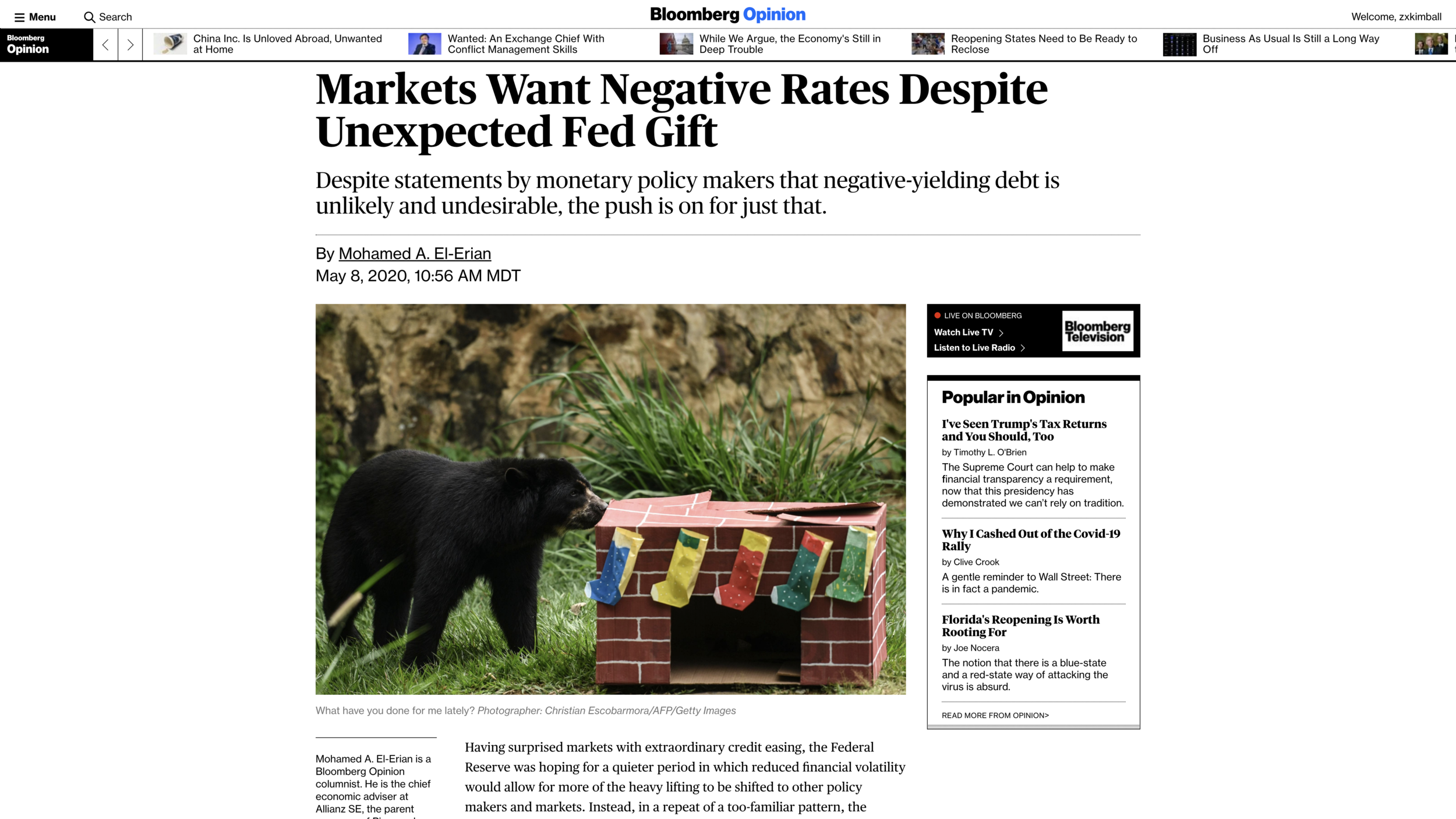
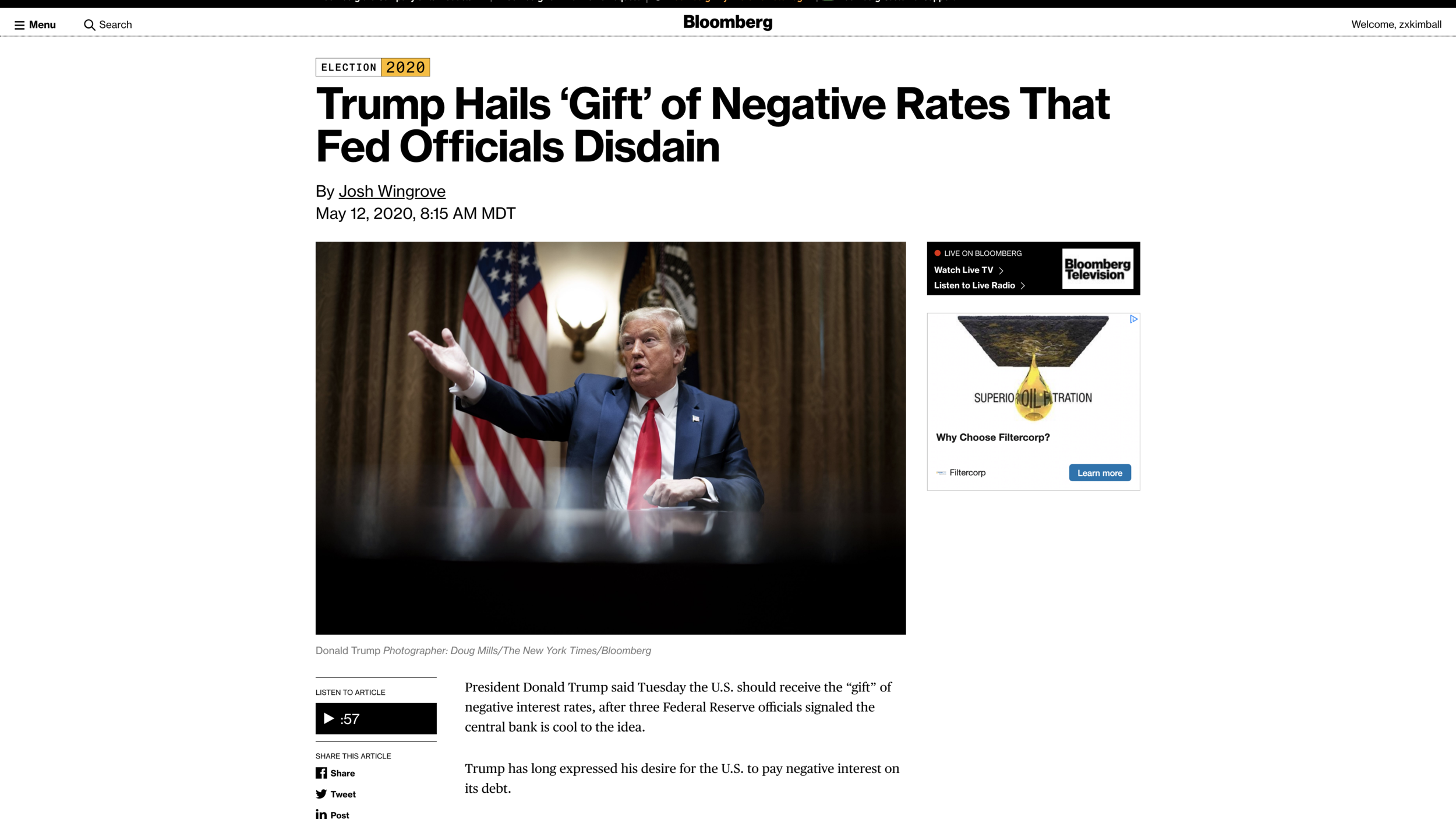
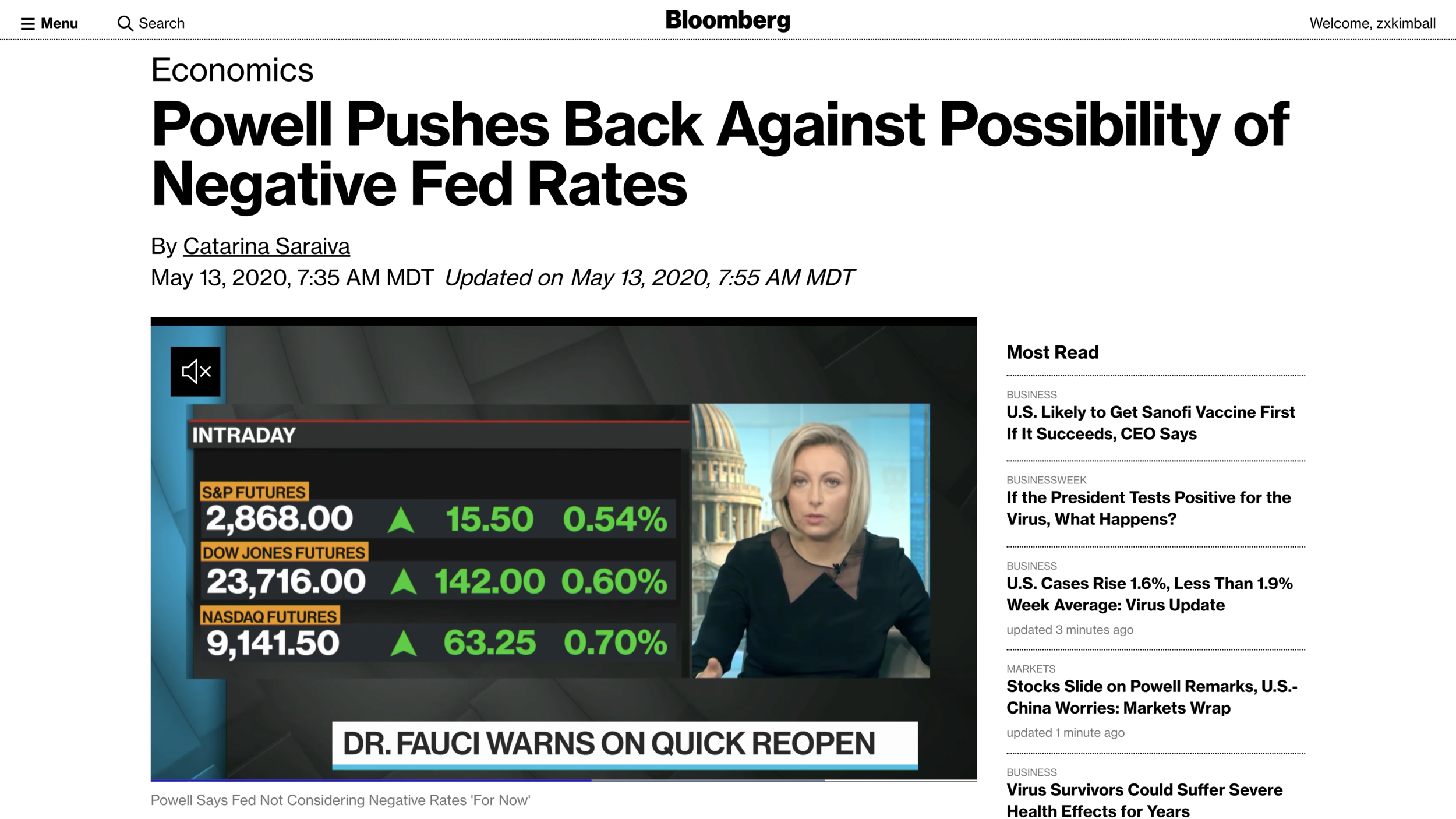
Pressure on the Fed from the Market and Trump for Negative Rates

Screen Shot 2020-05-13 at 6.46.44 PM.png

If, in its collective heart, the Fed, or more specifically the Federal Open Market Committee (FOMC) is willing to do negative rates, it may be managing the politics of negative rates by having the market and the President of the United States call for negative rates before it goes there. But if there is a genuine reluctance to use negative rates, not just now, but after the economy broadly reopens, that is a mistake—a big one. As I wrote in “The Wisdom of Jerome Powell”:

History may judge Jerome Powell in important measure on whether he is willing to use negative interest rates to get us out of the hole our economy is in some months from now. The “how” of negative interest rates is now well-worked out, the President of the United States is supportive of negative rates, and there is a clear legal path to negative rates in the United States. So there is no excuse not to use them if they are needed, as they are likely to be.

See also “Narayana Kocherlakota Advocates Negative Interest Rates Now” and “Why We are Likely to Need Strong Aggregate Demand Stimulus after Tight Social Distancing Restrictions are Over.”

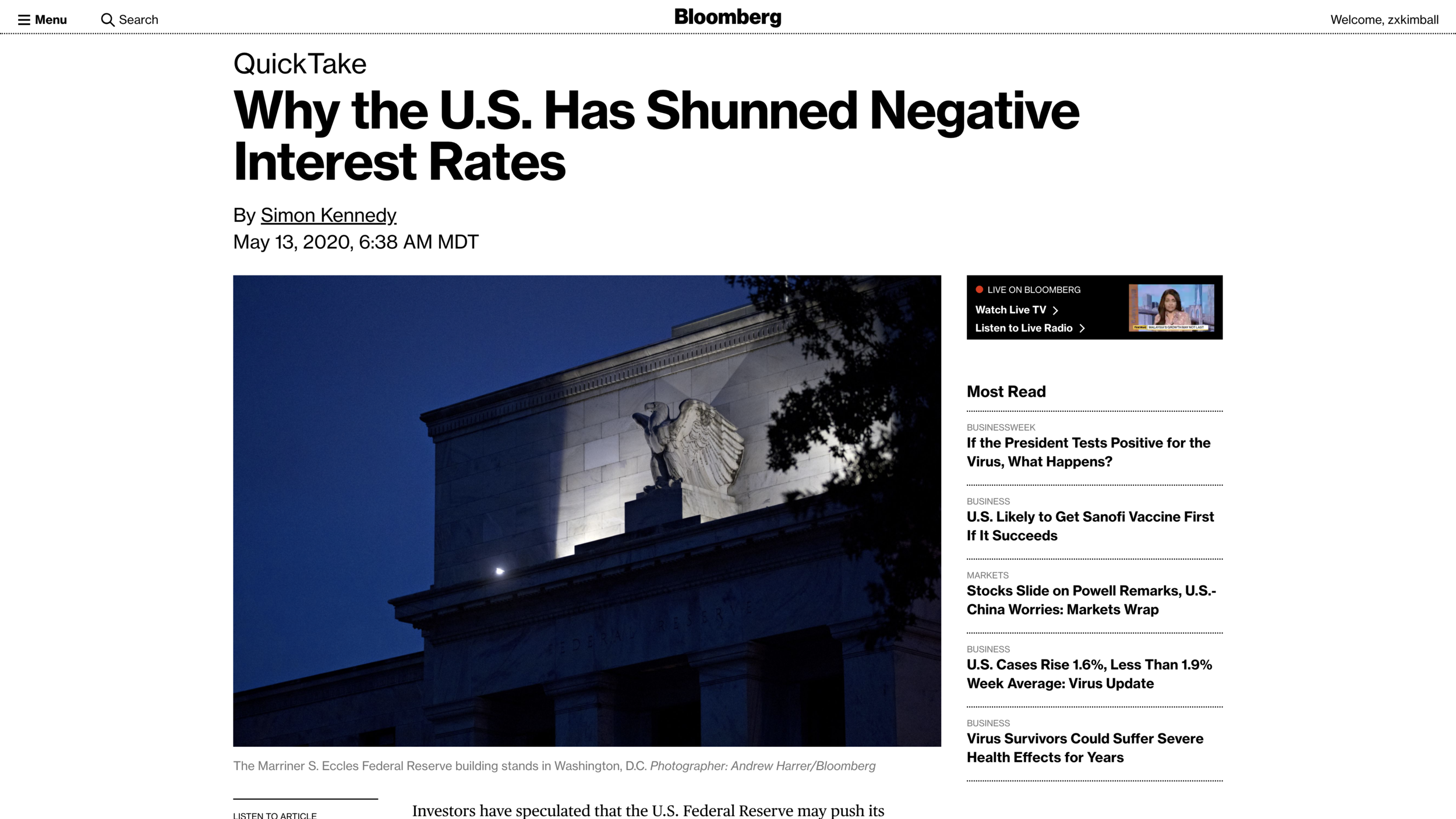
Among the arguments against negative rates in the articles shown above, the worry about stress on banks I answer in “Responding to Negative Coverage of Negative Rates in the Financial Times.” Simon Kennedy’s Bloomberg article “Why the U.S. Has Shunned Negative Interest Rates” does introduce an argument I haven’t seen as often:

The risk in money markets relates to concerns that investors could start boycotting them and seek yield elsewhere. The U.S. relies on these markets -- at a size of roughly $4.8 trillion -- more than economies elsewhere. In minutes of an October Fed meeting, officials saw the risk of “significant complexity or distortions to the financial system.”

Here the problem is that we didn’t complete the financial stability fix after the 2008 financial crisis. Money market mutual funds should never, ever, ever be allowed to pretend that their shares are worth exactly $1, because that is pretending that they face no risk. This invites a panic when investors are reminded by events that there is risk in money market mutual funds. The solution is called “net-asset-value” pricing. The Fed, using its regulatory authority, needs to immediately do its utmost to discourage money market mutual funds from pretending their shares are worth exactly $1. At a minimum, it can tell money market mutual funds to have ready a substitute fund with net-asset-value pricing that investors can shift their funds into if and when money market mutual funds begin breaking the buck. There still might be a “run” on money-market mutual funds that look like they might “break the buck,” but if it is a run taking money from those funds and putting it into net-asset-value money-market funds that can already be bought at a discount, then the money market mutual fund system will still continue functioning reasonably well. At any rate, the Fed needs to immediately work on preparing money market mutual funds for the possibility of negative rates!

Addendum: See the related Twitter discussion I have with Ivan Werning and with Jay Kahn and Steve Hou.

Update: An interesting comment in a tweet:

And below is the quotation from Gandalf:


For an organized bibliography of what I have written on negative interest rate policy, see:

An Inexpensive Cold Sore Treatment That Doubles as an Antiseptic Towelette

I have been trying to focus many Tuesday diet and health posts lately on things that can be immediately useful during the pandemic we are in. Here is something that is prosaic, but genuinely useful. Some people have had trouble finding all of the antiseptic wipes they want. Benzalkonium Chloride wipes seem to still be available.

I assume that Benzalkonium Chloride is lethal to the novel coronavirus, but don’t know for sure. (Here is a recent article that is relevant.) What I can vouch for is the usefulness of these Benzalkonium Chloride wipes for another use. Like a large fraction of Americans, I am subject to periodic outbreaks of cold sores. The remedy that my experience showed was the most effective was small vials of Benzalkonium Chloride that one breaks to get the Benzalkonium Chloride onto the little sponge of the applicator. The trouble with this as a remedy is that, because it cost quite a few dollars per application, I was always reluctant to use it in that critical period when I didn’t know whether I had a cold sore or just a minor irritation. Then, searching online about benzalkonium chloride, I discovered that Benzalkonium Chloride wipes were a relatively inexpensive antiseptic wipe. So I made a bulk purchase of Benzalkonium Chloride Antiseptic Towelettes that put things in the 5 cent per towelette range. They would be about 12 cents per towelette if not purchased in bulk, which is still pretty low. So now, when I have any tingle that might possibly be a cold sore, I use a Benzalkonium Chloride wipe immediately and repeat after a few hours, with no inhibition because of the cost. That prevents a lot more cold sores. Indeed, I hardly ever get full-blown cold sores any more.

For annotated links to other posts on diet and health, see:

The Wisdom of Jerome Powell

For the video above: YouTube link; Brookings link; link to full text on the Federal Reserve Board website

Crises often reveal the strengths and weaknesses of leaders. Federal Reserve Board Chair Jerome Powell’s April 9, 2020 speech on COVID-19 and the economy impressed me. Let me highlight some passages in his speech that struck me as especially wise. First:

None of us has the luxury of choosing our challenges; fate and history provide them for us. Our job is to meet the tests we are presented.

According to Rod Dreher, this echoes Gandalf:

A young man once confided to a religious elder his anxiety over the hard times in which he was living. This is natural, said the elder, but such things are beyond our control: “All we have to decide is what to do with the time that is given us.”

In fact, the anxious youngster was no man, but a hobbit, Frodo Baggins; the religious elder was the wizard Gandalf, to whom Frodo disclosed his fear on the road to the evil realm of Mordor. 

(From the April 30, 2020 Wall Street Journal op-ed “Courage in the Darkness,” by Rod Dreher.)

Second, both because social-distancing and shutdowns are mandated by the government and because being poor makes every dollar count more, Jerome Powell says we should be conscious of those of low or moderate income who are taking on great burdens as a result of our COVID-19-fighting strategy:

All of us are affected, but the burdens are falling most heavily on those least able to carry them. It is worth remembering that the measures we are taking to contain the virus represent an essential investment in our individual and collective health. As a society, we should do everything we can to provide relief to those who are suffering for the public good.

Third, he emphasizes that the Fed is engaged in lending programs, not spending programs.

Many of the programs we are undertaking to support the flow of credit rely on emergency lending powers that are available only in very unusual circumstances—such as those we find ourselves in today—and only with the consent of the Secretary of the Treasury. We are deploying these lending powers to an unprecedented extent, enabled in large part by the financial backing from Congress and the Treasury. We will continue to use these powers forcefully, proactively, and aggressively until we are confident that we are solidly on the road to recovery.

I would stress that these are lending powers, not spending powers. The Fed is not authorized to grant money to particular beneficiaries. The Fed can only make secured loans to solvent entities with the expectation that the loans will be fully repaid. 

Of course, some of the lending is to lending entities from which the Fed expects repayment only because the US Treasury and Congress are backstopping the solvency of the entity.

[Update, May 17, 2020: Fourth, he both recognizes how hard the pandemic has been on people economically as well as medically, but remains optimistic for the medium- and long-run:

This is a time of great suffering and difficulty and it’s come on so quickly and with such force that you really can’t put into words the pain people are feeling and the uncertainty they’re realizing. But I would just say this: In the long run, and even in the medium run, you wouldn’t want to bet against the American economy.]

There is only one part of Jerome Powell’s speech that to me strikes a false note. He writes of cutting interest rates to zero as if that were a dramatic action. But there is nothing special about zero. The Fed’s target rate could easily go lower. Here is what he says:

The Fed can also contribute in important ways: by providing a measure of relief and stability during this period of constrained economic activity, and by using our tools to ensure that the eventual recovery is as vigorous as possible.

To those ends, we have lowered interest rates to near zero in order to bring down borrowing costs.

Compare that discussion of zero as if zero were special to the discussion the importance of negative interest rates in these two recent posts:

History may judge Jerome Powell in important measure on whether he is willing to use negative interest rates to get us out of the hole our economy is in some months from now. The “how” of negative interest rates is now well-worked out, the President of the United States is supportive of negative rates, and there is a clear legal path to negative rates in the United States. So there is no excuse not to use them if they are needed, as they are likely to be.

But I’ll let Jerome Powell have the last words:

I want to close by thanking the millions on the front lines: those working in health care, sanitation, transportation, grocery stores, warehouses, deliveries, security—including our own team at the Federal Reserve—and countless others. Day after day, you have put yourselves in harm's way for others: to care for us, to ensure we have access to the things we need, and to help us through this difficult time.

Miles Kimball's Discussion of "When to Release the Lockdown: A Wellbeing Framework for Analysing Benefits and Costs," by Layard, Clark, De Neve, Krekel, Fancourt, Hey and O'Donnell

Richard Layard, Andrew Clark, Jan-Emmanuel De Neve, Christian Kekel, Daisy Fancourt, Nancy Hey and Gus O’Donnell are to be commended for doing a transparent cost-benefit analysis based on well-being of a key dimension of the policy choice we now: how long to continue the lockdowns. And Paul Frijters is to be commended for an excellent discussion of this paper, arguing that despite their bottom line that lockdowns should be ended soon, that Layard et al. are too kind to lockdowns. Let me offer some comments that might point out some aspects of the issue that might not be fully apparent from reading the Layard et al. paper and Paul Frijters’s discussion of it. I will not focus on their assumptions about what the consequences of different policies would be, except to say that their implicit epidemiological model seems too static when exponential dynamics are crucial. I will focus on the economics-of-happiness techniques used for evaluating the assumed consequences of policies.

The first issue to mention is that Layard et al. focus on life satisfaction, but there are many other dimensions of well-being. Indeed the UK Office of National Statistics now measures 4 aspects of well-being on a huge sample each month. No doubt the typical person would be willing to sacrifice some amount of being satisfied with their lives in order to gain in feeling that the things that they do in life are worthwhile. So life satisfaction isn’t everything. I could go on at greater length, but let me bring this up along the way where I can see how it might affect the calculations.

One issue I think is important methodologically—that could affect the calculations either way—is that Layard et al. implicitly assume that life satisfaction of 0 on a 0-10 scale is the level of life satisfaction at which—if that is what one would face form now on—one would be indifferent between living longer or dying immediately. This could be wrong in either direction. 0 is pretty low and most people report quite high numbers. Even a situation in which one reported a life satisfaction of 1 might be so intolerable that if doomed to that for the rest of one’s life, one might actively want to die. On the other hand, one might very much want to continue living even in a situation in which one barely reported a life satisfaction of zero even though one might wish to die in a situation where one had a latent desire to say -4 on the survey but was constrained to a nonnegative number. (Note also that some people who give a 0 for life satisfaction might, say, report a rating of 5 to “Overall, to what extent do you feel that the things you do in your life are worthwhile?” which is another question in the same UK Office for National Statistics survey.) Methodologically, the answer is that surveys need to be used to explicitly ask about tradeoffs between losing years of life and losing points of wellbeing. My understanding is that this is done a lot in the quality-adjusted life-years literature. The corresponding work needs to be done in the well-being adjusted life years literature.

A related methodological issue is that a point of life satisfaction might mean more near the bottom of the scale than at the top (or more at the top of the scale than near the bottom). Asking about tradeoffs with longevity given different starting levels of life satisfaction would be very useful. (The tradeoffs people are willing to make may also depend on the level of lifespan.)

Also, even once outcomes are measured in life-years of a benchmark level of well-being, just adding those life-years up may not be appropriate. One needs to decide how to deal with inequality. This is not addressed in the paper. Taking into account inequality probably makes the results more favorable to ending lockdowns if the economic harm is tilted more toward those of low well-being or low life-span than the health harm is, but makes the results more favorable to continuing lockdowns if the health harm is more toward those of low well-being or low-lifespan than the economic harm is.

Now, on to some considerations that, at least individually, have a clearer direction of effect on the bottom line. On how to value income, Layard et al. write:

There have been literally thousands of studies of the relation between wellbeing and income. They yield broadly similar results, which imply that a 1% gain in income increases wellbeing (measured 0-10) by around 0.002 points.

Layard et al. claim this number is uncontroversial, but Paul Frijters writes:

So they basically chose one of the lowest wellbeing effects of income one can find in the literature, which is the effect of hardly noticed changes in income on life satisfaction –  easily a factor 10 times less than normal for how people have been found to react to noticed losses of income …

Paul also makes another points in two different ways: government dollars can be used to save a lot of lives in ways that have nothing to do with the SARS-CoV2 and to increase well-being adjusted life years in other ways. Valuing all dollars or pounds at the best possible use the government could make of those dollars is probably valuing those dollars or pounds too highly. But valuing that fraction of extra dollars that would actually be extra tax revenue and actually be used by the government to do particular additional things at the value of those additional things seems fair. Even this latter is a big number, Paul argues.

On the valuation of dollars or pounds in life satisfaction or other well-being units, let me point out two relevant concerns.

First, dollars and pounds contribute to many, many other aspects of well-being that people care about besides life-satisfaction. Relative to many other aspects of well-being, dollars and pounds have a particularly low effect on life-satisfaction.

For what it’s worth, in data that Dan Benjamin, Kristen Cooper, Ori Heffetz and our team collected, we found a 1% increase in income raising a broader measure of well-being by .03 to .04 points on a 0-100 scale on which, to avoid top-coding and bottom-coding, we had urged people to use only 25-75, but allowed them to use the whole 0-100 range. That converts to somewhere between .003 and .008 on a 0-10 scale, depending on how you count the effects of our urging of people to use only 25-75.

Second, going the other direction, in this case, we are not talking about a pure loss of income: it is a loss of income associated with an increase in “leisure” broadly construed as the time away from paid work. Some of that extra time away from paid work is devoted to home production that yields reasonably close substitutes for market goods. And some of that extra time away from paid work is devoted to things like bonding time with family and (perhaps distant) friends for which there is no close substitute among market goods. The loss of income coupled with this increase in leisure shouldn’t be as bad for well-being as the loss of income from a lower wage with the same number of hours at work.

Combining the well-being value of a dollar or pound with the number of life-years at stake and the level of well-being at which one would be indifferent between living and dying implies a value of a statistical life or the closest thing to a value of a statistical life in a well-being-adjusted life years calculation. It is crucial to grasp philosophically with the differences between the numbers obtained in this way and the numbers obtained through other methods of getting a value of a statistical life. That is too big a topic for this post, but deserves a lot of thought and discussion.

Unemployment is awful, and an important part of the well-being calculation. But because it doesn’t seem as much like a personal failure, unemployment in this situation may not be as awful as unemployment usually is. Of course, the issue is not just unemployment now, but how long one will be unemployed. That depends a lot on monetary policy. (See and “Why We are Likely to Need Strong Aggregate Demand Stimulus after Tight Social Distancing Restrictions are Over” and “Narayana Kocherlakota Advocates Negative Interest Rates Now.”)

One contribution to the cost of lockdowns that Layard et al. give a relatively small number to is the cost of school closures. Here let me simply say that closing schools now doesn’t have to mean less school total. In the US at least, if this pandemic led to a policy shift toward somewhat more total months and hours per month of schooling, that policy improvement would be an important silver lining, and in any case could soon make up for less schooling or lower quality schooling right now. See “Magic Ingredient 1: More K-12 School.”

Conclusion: On the bottom line of whether lockdowns so far have been justified and whether it is justified to continue the lockdowns for somewhat longer, what I keep coming back to as the main justifications for the lockdowns is to give us time to figure out COVID-19 science. If in hindsight we consider the danger of the novel coronavirus to be low enough that we shouldn’t have done the lockdowns given that hindsight, that is great. It might not have been a mistake given our lack of knowledge at the time, which left open the possibility that the novel coronavirus was much worse. For example, the US seems to have a much greater prevalence of preexisting conditions that interact badly with COVID-19 than South Korea. Without substantial experience, we couldn’t depend on US mortality rates being much, much worse. Alternatively, maybe we needed time to figure out less costly partial lockdowns that could do much of the same job as more comprehensive lockdowns and the more comprehensive lockdown helps us figure out what dimensions of a lockdown are especially cost-effective and what are not so cost-effective. Or maybe some test-and-trace strategy will emerge that has a great benefit/cost profile, but requires that overall incidence not be too high, which it would have been with no lockdown.

Actually, figuring out and hopefully getting somewhat greater consensus on how to approach well-being cost-benefit analysis for our current situation is part of the COVID-19 science that we have bought time for with the lockdowns.

I honestly don’t know what the right policy is going forward. But unlike Paul Frijters, I don’t regret the lockdowns we have done so far as opposed to having done no relatively comprehensive lockdowns (though I regret many other aspects of our history of COVID-19 policy, especially the lack of an earlier response).

Don’t miss these other posts on the coronavirus pandemic:

Also, click on this link to see other posts tagged “happiness.”

Vicky Biggs Pradhan: The Lost Art of Curiosity

The primary theme of Positive Psychology is that mental health is not just about fixing problems—it is also about building strengths. In this vein, I have found Co-Active coaching and Co-Active leadership training to be one of the most powerful tools for building strengths and for tackling psychological problems of the sort that almost every human being has. I believe in this approach; I have voted with my feet by becoming a Certified Professional Co-Active Coach (on top of my job as an economics professor) and by participating in the Co-Active Leadership Program. As I have already begun to do (see the links at the bottom of this post), I plan to ask other Co-Active coaches I know and others I know in the Co-Active Leadership program to write guest posts about how to enhance your life by building your psychological strengths and tackling the kind of psychological issues most human beings face. (I am likely to have these appear on either a Sunday or a Tuesday.)

Vicky Pradhan has already written one guest post: “Vicky Biggs Pradhan: How Crises Make Us Rethink Our Lives.” Here is her next installment:


While attending university, I didn’t particularly like studying in the library, as I found it dark and stuffy. Instead, I would study at a bright, welcoming cafe called, “The Curious Mind,” located a couple miles off campus. A soulful Jeff Buckley song always seemed to be playing through the crackly speakers as I walked in the door.  The small cafe was well-appointed with the tables and books-for-sale arranged just right, making the space seem double its actual size. Upon settling in, I would invariably abandon my studies prematurely so I could explore the vast selection of books on display. 

While I acknowledge the power of suggestion that’s kicked off by a name like “The Curious Mind,” I recall feeling as though there was a bright light of inquisitiveness shining within as I engaged with these books. I was open and wanted to learn about new concepts, theories and topics ranging from the psychology of nostaligia to how to effectively run an air traffic control tower. I had an insatiable curiosity. I believed naively it would always persist and would differentiate me from others. However, unbeknownst to me, this belief was about to be challenged as I set off to begin my life as a new graduate.  

At some point in our life, we get a message, either direct or implied, that says we now need to have all the answers. And so, we stop being curious. Asking questions becomes a liability, as it could be misinterpreted as not knowing. Exploration for curiosity’s sake is replaced by the need to be knowledgeable and to be right. It’s as though we’re turning down the volume on our wonder and making a transition from abstract to definitive.  

In my particular case, I began to suppress my curiosity as I progressed in my career. As the professional stakes became higher, my questioning drifted further away—into the distance. This was magnified when I switched industries and I believed proving myself was paramount. I found myself in a competitive industry with people who were highly credentialed, where touting one’s intellect was ingrained in the culture. During this time, my urge to deviate from asking questions to looking impressive came from a desire to build credibility and earn respect.  

My young daughter recently asked me what it was like for us all to live without the internet when I was a little girl. “Were people less curious because they knew they couldn’t have all their questions answered?  Did you just have to shut down your curiosity because there were limited ways to get information?” As I began to explain that the lack of technology didn’t affect how much curiosity I had, I started drifting away into my own private thoughts. It was me and only me who got in the way of my own curiosity, despite having all of the access to information I ever needed. 

We spend so much time in our own heads, putting endless energy into ensuring we are heard, understood, seen and respected.  It might come in the form of needing to have the loudest voice, wanting to formulate the smartest response or being the most knowledgeable in a particular subject, or worse, on all topics. Anything to mask the fear of judgement or being exposed as not being smart enough. When we think we have all the answers, we stunt ourselves. We stop learning and harden.

Quashing our curiosity is especially damaging in relationships. Let me dig into that. What if we could set aside our own agenda and simply get curious about the person we are engaging with and their viewpoint? Imagine how the conversation would change if we took the flashlight we regularly shine on ourselves and point it in the direction of the other person? What if the beam of light shined so bright that it started to illuminate the space between you or me and the one on the other side of the conversation, enfolding that conversation in a warm ambient light?

Most of us think we have to solve, fix and direct in order to be valuable, whether we are leading a business, raising a family, or teaching and doing research. We often experience immediate gratification when we’ve solved a problem or rectified a situation. It’s hard to ignore the ego boost that comes with feedback like “you always know what to do” or “I knew you’d have the answer for me.” When we hear this it inspires us to be even more prepared with the winning solution the next time we are called upon so we can continue to feel valued.  This becomes an addiction, with the crushing of self-worth as a withdrawal symptom. (Ego isn’t always the culprit.  In some cases, we truly do have the best of intentions and we simply want to impart our wisdom to others whom we care about.) 

The next time you are inclined to come to the rescue with a solution or an answer, entertain the possibility that the person who has come to you already holds the answer. Imagine for a moment they actually know precisely what to do.  Perhaps they are in the habit of looking outward instead of inward or they may be seeking reassurance, as they aren’t prepared to own their power quite yet. If you resist the urge to be the hero that solves the problem and instead energize your curiosity to ask questions that help the person gain clarity around their own perspective they can take steps to arrive at their own answers. I propose we make a choice to view those around us as competent and capable.  Consider this seriously for a moment and call to mind a particular person you interact with regularly with whom you frequently share your direction, suggestions and solutions. Envision the shift that would take place if you could see them, not as an object or something to fix, but as a person who is resourceful that you need to better understand. How would the interactions be different? 

If a lack of curiosity can damage relationships, energizing curiosity can often help repair them. During the holidays, I decided to organize old photos and memorabilia from college and the following years. I found a sticky note with a quotation on it, which was unintentionally stuck to a picture of me with my college roommates. The neatly printed words on the sticky were beginning to fade with age. It said, “I do not like that man. I must get to know him better”- Abraham Lincoln. I smiled, vaguely remembering this quotation, and couldn’t help but think that Lincoln’s wisdom, along with my innate curiosity, somehow got buried throughout the years. It brought me back to my beloved Curious Mind Cafe, and made me realize that I was so different then, yet in another way much the same as I am today. It has been an interesting journey, recommitting to curiosity—a secret weapon that has helped me move away from judgment toward discovery. 


Vicky is an executive coach. As I wrote in “Vicky Biggs Pradhan: How Crises Make Us Rethink Our Lives,”

Vicky Pradhan, like me, is a Certified Professional Co-Active Coach, and someone I think would be an especially good fit as a coach for readers of my blog. I had Vicky coach me for a session in order to get a good sense of her style. She is both extremely logical and very emotionally perceptive, and works hard to get to the bottom of things.

See more in my intro to “Vicky Biggs Pradhan: How Crises Make Us Rethink Our Lives.”

Here is some contact information:

Vicky Pradhan, vicky@v2executivecoaching.com

V2 Executive Coaching, www.v2executivecoaching.com

Vicky is the founder of V2 Executive Coaching. She is a certified Co-Active® Coach, CPCC, who coaches entrepreneurs, executives, founders, creators and musicians on their mission towards something bigger than themselves. Her clients are passionate and aspiring towards more fulfillment, stronger leadership, better communication and in some cases more self-acceptance. The one element they have in common is they’ve identified there is a gap between where they are currently and where they want to be. 

Don’t Miss These Other Posts Related to Positive Mental Health:

The Federalist Papers #9 B: A Large Confederation May Be More Politically Stable Than a Small Nation—Alexander Hamilton Cites Montesquieu

Alexander Hamilton considered Montesquieu to be in such high regard among his readers that in the Federalist Paper #9, he takes pains

  1. to parry Montesquieu’s praise of small nations

  2. to trumpet Montesquieu’s praise of confederations

  3. to argue that it is OK to have the federal government interject itself into state governments to a considerable extent

  4. to argue that it is OK to have more populous states have more votes in the federal government.

The subject to which Alexander Hamilton applies this treatment of Montesquieu is the “enlargement of the orbit” of the type of republican systems that existed within each of the states:

To this catalogue of circumstances that tend to the amelioration of popular systems of civil government, I shall venture, however novel it may appear to some, to add one more, on a principle which has been made the foundation of an objection to the new Constitution; I mean the ENLARGEMENT of the ORBIT within which such systems are to revolve, either in respect to the dimensions of a single State or to the consolidation of several smaller States into one great Confederacy. The latter is that which immediately concerns the object under consideration. It will, however, be of use to examine the principle in its application to a single State, which shall be attended to in another place.

Alexander Hamilton parries Montesquieu’s praise of small nations by pointing out that following this opinion of Montesquieu would require breaking up some of the larger of the thirteen states, then depending on his readers to think that would be a ridiculous thing to do:

The utility of a Confederacy, as well to suppress faction and to guard the internal tranquillity of States, as to increase their external force and security, is in reality not a new idea. It has been practiced upon in different countries and ages, and has received the sanction of the most approved writers on the subject of politics. The opponents of the plan proposed have, with great assiduity, cited and circulated the observations of Montesquieu on the necessity of a contracted territory for a republican government. But they seem not to have been apprised of the sentiments of that great man expressed in another part of his work, nor to have adverted to the consequences of the principle to which they subscribe with such ready acquiescence.

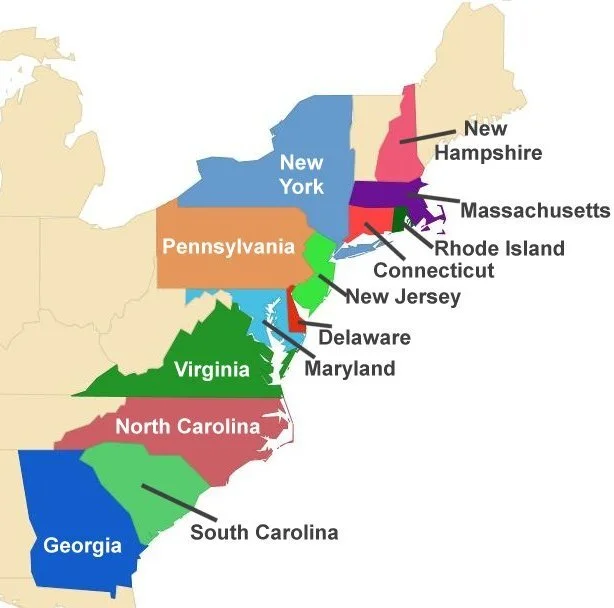
When Montesquieu recommends a small extent for republics, the standards he had in view were of dimensions far short of the limits of almost every one of these States. Neither Virginia, Massachusetts, Pennsylvania, New York, North Carolina, nor Georgia can by any means be compared with the models from which he reasoned and to which the terms of his description apply. If we therefore take his ideas on this point as the criterion of truth, we shall be driven to the alternative either of taking refuge at once in the arms of monarchy, or of splitting ourselves into an infinity of little, jealous, clashing, tumultuous commonwealths, the wretched nurseries of unceasing discord, and the miserable objects of universal pity or contempt. Some of the writers who have come forward on the other side of the question seem to have been aware of the dilemma; and have even been bold enough to hint at the division of the larger States as a desirable thing. Such an infatuated policy, such a desperate expedient, might, by the multiplication of petty offices, answer the views of men who possess not qualifications to extend their influence beyond the narrow circles of personal intrigue, but it could never promote the greatness or happiness of the people of America.

Then Alexander Hamilton cites Montequieu as seeing great virtues in a confederation. (I am trying to use forms of the word that do not conjure up the Civil War Confederacy.) Montesquieu’s main arguments in favor of what he calls a “confederate republic” are:

  • A large enough confederation has enough military power to provide security against external threats.

  • It is harder for a tyrant to gain power in a large confederation than in a small nation.

  • It is harder for a popular insurrection to succeed in a large confederation than in a small nation.

Here is how Alexander Hamilton cites Montesquieu in these regards (I tried to make one footnote easier to understand):

Referring the examination of the principle itself to another place, as has been already mentioned, it will be sufficient to remark here that, in the sense of the author who has been most emphatically quoted upon the occasion, it would only dictate a reduction of the SIZE of the more considerable MEMBERS of the Union, but would not militate against their being all comprehended in one confederate government. And this is the true question, in the discussion of which we are at present interested.

So far are the suggestions of Montesquieu from standing in opposition to a general Union of the States, that he explicitly treats of a CONFEDERATE REPUBLIC as the expedient for extending the sphere of popular government, and reconciling the advantages of monarchy with those of republicanism.

"It is very probable,'' (says he [“The Spirit of the Laws,'' vol. i., book ix., chap. i.] ) "that mankind would have been obliged at length to live constantly under the government of a single person, had they not contrived a kind of constitution that has all the internal advantages of a republican, together with the external force of a monarchical government. I mean a CONFEDERATE REPUBLIC.

"This form of government is a convention by which several smaller STATES agree to become members of a larger ONE, which they intend to form. It is a kind of assemblage of societies that constitute a new one, capable of increasing, by means of new associations, till they arrive to such a degree of power as to be able to provide for the security of the united body.

"A republic of this kind, able to withstand an external force, may support itself without any internal corruptions. The form of this society prevents all manner of inconveniences.

"If a single member should attempt to usurp the supreme authority, he could not be supposed to have an equal authority and credit in all the confederate states. Were he to have too great influence over one, this would alarm the rest. Were he to subdue a part, that which would still remain free might oppose him with forces independent of those which he had usurped and overpower him before he could be settled in his usurpation.

"Should a popular insurrection happen in one of the confederate states the others are able to quell it. Should abuses creep into one part, they are reformed by those that remain sound. The state may be destroyed on one side, and not on the other; the confederacy may be dissolved, and the confederates preserve their sovereignty.

"As this government is composed of small republics, it enjoys the internal happiness of each; and with respect to its external situation, it is possessed, by means of the association, of all the advantages of large monarchies.''

I have thought it proper to quote at length these interesting passages, because they contain a luminous abridgment of the principal arguments in favor of the Union, and must effectually remove the false impressions which a misapplication of other parts of the work was calculated to make. They have, at the same time, an intimate connection with the more immediate design of this paper; which is, to illustrate the tendency of the Union to repress domestic faction and insurrection.

Alexander Hamilton was a proponent of a strong federal government. He was also a proponent of more populous states having more votes within the federal government. He is alert to set out arguments in favor of both of these. He begins by simply saying the case for a weak federal government or equal voting power by each state is not clear and asserts without providing evidence that equal voting power in a confederation regardless of population “has been the cause of incurable disorder and imbecility in the government:

A distinction, more subtle than accurate, has been raised between a CONFEDERACY and a CONSOLIDATION of the States. The essential characteristic of the first is said to be, the restriction of its authority to the members in their collective capacities, without reaching to the individuals of whom they are composed. It is contended that the national council ought to have no concern with any object of internal administration. An exact equality of suffrage between the members has also been insisted upon as a leading feature of a confederate government. These positions are, in the main, arbitrary; they are supported neither by principle nor precedent. It has indeed happened, that governments of this kind have generally operated in the manner which the distinction taken notice of, supposes to be inherent in their nature; but there have been in most of them extensive exceptions to the practice, which serve to prove, as far as example will go, that there is no absolute rule on the subject. And it will be clearly shown in the course of this investigation that as far as the principle contended for has prevailed, it has been the cause of incurable disorder and imbecility in the government.

Alexander Hamilton then argues that the proposed Constitution doesn’t take away too much power from the states:

The definition of a CONFEDERATE REPUBLIC seems simply to be "an assemblage of societies,'' or an association of two or more states into one state. The extent, modifications, and objects of the federal authority are mere matters of discretion. So long as the separate organization of the members be not abolished; so long as it exists, by a constitutional necessity, for local purposes; though it should be in perfect subordination to the general authority of the union, it would still be, in fact and in theory, an association of states, or a confederacy. The proposed Constitution, so far from implying an abolition of the State governments, makes them constituent parts of the national sovereignty, by allowing them a direct representation in the Senate, and leaves in their possession certain exclusive and very important portions of sovereign power. This fully corresponds, in every rational import of the terms, with the idea of a federal government.

Finally, Alexander Hamilton cites Montesquieu to argue it is OK for a federal government to interject itself into state government affairs in an important way and that voting rights in the federal government that depend on population are OK:

In the Lycian confederacy, which consisted of twenty-three CITIES or republics, the largest were entitled to THREE votes in the COMMON COUNCIL, those of the middle class to TWO, and the smallest to ONE. The COMMON COUNCIL had the appointment of all the judges and magistrates of the respective CITIES. This was certainly the most, delicate species of interference in their internal administration; for if there be any thing that seems exclusively appropriated to the local jurisdictions, it is the appointment of their own officers. Yet Montesquieu, speaking of this association, says: "Were I to give a model of an excellent Confederate Republic, it would be that of Lycia.'' Thus we perceive that the distinctions insisted upon were not within the contemplation of this enlightened civilian; and we shall be led to conclude, that they are the novel refinements of an erroneous theory.

PUBLIUS.