Mark Fontana, Stephen Lyman, Gourab Sarker, Douglas Padgett and Catherine MacLean: Using Machine Learning to Predict Outcomes for Joint Surgery

Mark Fontana is a coauthor of mine (“Reconsidering Risk Aversion,” with Dan Benjamin as well). I was the chair of his dissertation committee at the University of Michigan. He finished his Economics PhD in just 3 and a half years. This paper, on which he is the lead author (note the non-alphabetical ordering), gives a nice example of the use of machine learning. 

Andrew Burton and Miles Kimball on the Rise of the Nationalist Right

Crafting Simple, Accurate Messages about Complex Problems

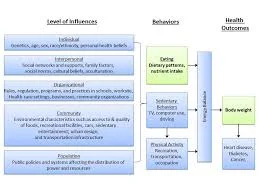
image source. #1 image from googling “complexity of obesity”

image source. #1 image from googling “complexity of obesity”

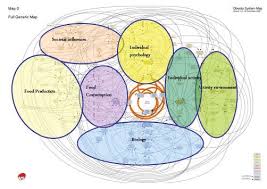
image source. #2 image from googling “complexity of obesity”

image source. #2 image from googling “complexity of obesity”

image source. #3 image from googling “complexity of obesity”

image source. #3 image from googling “complexity of obesity”

Today is the 7th anniversary of this blog, "Confessions of a Supply-Side Liberal." My first post, "What is a Supply-Side Liberal?" appeared on May 28, 2012. I have written an anniversary post every year since then:

  1. A Year in the Life of a Supply-Side Liberal

  2. Three Revolutions

  3. Beacons

  4. Why I Blog

  5. My Objective Function

  6. A Barycentric Autobiography

Beyond family activities (within which my new role as a grandfather is a special joy), a large share of my efforts this past year have been devoted to three big projects that I believe in deeply as ways to make the world a better place:

  • Working toward the elimination of any lower bound on interest rates to restore the firepower of monetary policy. The big news in this area is my new IMF Working Paper with Ruchir Agarwal. See “Ruchir Agarwal and Miles Kimball—Enabling Deep Negative Rates to Fight Recessions: A Guide” or click on the “neg.rates” link right underneath my blog subtitle “A PARTISAN NONPARTISAN BLOG: CUTTING THROUGH CONFUSION SINCE 2012.”

  • Working out the principles for a national well-being index that could be credible as a full coequal to GDP with Dan Benjamin, Ori Heffetz, Kristen Cooper and our ace research assistant Tushar Kundu—with help from Rosie Li, who has mainly been working with Patrick Turley and me on the genetics of assortative mating. (See my happiness subblog for related posts.)

  • Fighting obesity, one diet and health post at a time. (See the links at the bottom of this post.)

Blogging about diet and health, I have gotten some pushback from those who are paid to be experts on diet and health, as you can see from “On the Epistemology of Diet and Health: Miles Refuses to `Stay in His Lane’.” One of the more common criticisms is to say that issues of diet and health are complex, and I am oversimplifying. I think if you took the time to read the full set of blog posts, you would agree that I am allowing for a lot of complexity. But to make ideas understandable, it is important not to be juggling too many ideas at once. In “Brio in Blog Posts” I recommend that a blog post should have one central idea—otherwise it should be split into more than one blog post. I am afraid I don’t take my own advice, but that maxim has pulled me toward making blog posts more focused than if I didn’t have that maxim in mind.

I believe that fighting obesity requires more focused advice. Not “Do everything right, and here is the long list.” Instead, start with one action: go off sugar. I give some advice for that in “Letting Go of Sugar.” Don’t worry about anything else in the area of diet and health until you have accomplished that. After that, you can see where to go next in “4 Propositions on Weight Loss.” And if that all becomes old hat, then I recommend a reading program. I hope my blog posts are of some help, but those blog posts also point to some useful books to read. (To summarize, see “3 Achievable Resolutions for Weight Loss.”)

I am by nature a believer. I start by assuming that people are telling the truth or at least telling it as they see it. But being a blogger and interacting on Twitter has been for me a cold bath in reality: I have become more and more aware of people being dishonest or intellectually slovenly in ways they think can advance their careers. (For an example of intellectual slovenliness, see “Let's Set Half a Percent as the Standard for Statistical Significance.”) Let me get pointed in relation to diet and health: for some, it is all too easy to serve the interests of sugar companies by saying it is all complex and sugar is only a small part of the picture. If the statement that “Sugar is only a small part of the problem” is true at all, it is far from being proven. And given that almost everyone feels they need to agree that cutting back on sugar is a good idea, saying it is only a small part of the problem is the main available option for defending sugar.

In my view, saying something is complex can be consistent with crafting simple accurate messages about that issue. When price affects quantity and quantity affects price, one can say it is all complex—“the seamless web of history”—or one can use the analytical tools of supply and demand. It often is possible to cut through complexity to make useful points.

One of the strengths of economics is its emphasis on the craft of choosing which elements to put into a model and which elements to leave out. This is crucial for insight and understanding. It is crucial for insight and understanding because of the limitations of the human mind. (See “Cognitive Economics.”) Thinking that a map is unnecessary because we have the territory in front of us is usually a big mistake.

One of the strengths of blogging is that it is conducive to breaking complex issues into manageable pieces. Each post can tackle a different aspect of a complex issue, from a different angle. But hyperlinked together, those posts can respect the complexity without making everything totally opaque.

I hope that my tagline “cutting through confusion since 2012” isn’t an entirely false boast. If it isn’t entirely false, that gives me the motivation to continue blogging for the next seven years and beyond.

Don’t miss my other posts on diet and health:

I. The Basics

II. Sugar as a Slow Poison

III. Anti-Cancer Eating

IV. Eating Tips

V. Calories In/Calories Out

VI. Other Health Issues

VII. Wonkish

VIII. Debates about Particular Foods and about Exercise

IX. Gary Taubes

X. Twitter Discussions

XI. On My Interest in Diet and Health

See the last section of "Five Books That Have Changed My Life" and the podcast "Miles Kimball Explains to Tracy Alloway and Joe Weisenthal Why Losing Weight Is Like Defeating Inflation." If you want to know how I got interested in diet and health and fighting obesity and a little more about my own experience with weight gain and weight loss, see “Diana Kimball: Listening Creates Possibilities and my post "A Barycentric Autobiography. I defend the ability of economists like me to make a contribution to understanding diet and health in “On the Epistemology of Diet and Health: Miles Refuses to `Stay in His Lane’.”

Disregard for truth as a Sign of a Totalitarian Impulse

The headline: “MFA confirms offensive remarks from patrons, bans two members.”

Link to the tweet above. Link to a more recent Boston Globe article about the incident.

I responded to Melissa McDaniel’s tweet above with these tweets:

It is dangerous to our society when finding out and verifying the truth is denigrated. Racism and sexism are real. Proving that they reared their ugly head in a particular instance is a valuable service in fighting them.

Let me say that in relation to sexual harassment and sexual abuse, a good Bayesian assessment of whether it occurred in a given instance requires an understanding of how high the base rates are. But we don't want to create strong incentives (now quite weak) for false accusation.

The temptation to set aside or denigrate truth in service of a cause is an old one. Many religions, believing that people’s eternal souls or the fate of the world were at stake, have subordinated ordinary garden variety small-t truth to what they considered a grander Truth. But as I said in “What is a Partisan Nonpartisan Blog?” I am with my best friend Kim Leavitt in believing

We are in trouble if we let our devotion to Truth get in the way of our devotion to truth.

In particular, those who show a disregard for truth in their eagerness to get particular results betray a certain controlling—and in the extreme—totalitarian impulse. Or to take another perspective, one time that deception and lying is justified is in wartime. But by that analogy, lying to me is a sign that the liar is my enemy. I would much rather make a judgment myself, knowing the truth, than let someone else make that judgment for me. Any argument that I am not able to make that judgment puts me at a lower rank than those who can be trusted to know the truth. In some contexts, such as national security or grand jury testimony, I am OK with being at a lower rank. But in regard to, say, making a judgment about, say, Brett Kavanaugh, as I did in “On Guilt by Association,” or Donald Trump, I would not be OK with the antidemocratic approach of saying only others could be trusted to see the evidence.

Trust but Verify: Bayes Rule. Let me explain my remarks about a Bayesian approach. Bayes’ Rule says that the probability P( ) that someone is guilty of, say, sexual abuse, given being accused, is

P(guilty given accused) = P(guilty) P(accused when guilty) /

P(guilty) P(accused when guilty) + P(innocent) P(accused when innocent)

The fact that sexual abuse is common makes P(guilty) high for the accused and non-accused combined. This “base right” that so many people are, in fact, guilty of sexual abuse makes it more likely that any particular person who is accused is, in fact, guilty. But something that can drag down the probability that any particular person is guilty when accused is if the probably of being accused even when innocent—P(accused when innocent)—is high. Currently, I think the probability of being accused of sexual abuse when innocent is only of moderate magnitude. (It becomes higher in custody battles and political battles where there is more to gain from a false accusation.) And the base rate of being innocent when including both the accused and non-accused—P(innocent)—is high. So if the fraction of innocent people who are accused ever were to become high, that would totally change the equation.

We currently have a system that asks for enough verification that the incentives to falsely accuse are kept in check. But if we ever stopped asking for verification, the number of false accusations could skyrocket. One cannot generalize from a small number of false accusations now to a small number of accusations in a future world where we stopped asking for verification (leaving the accuser unavenged or unhappy if verification cannot be found).

Conclusion. To me, confirming is a noble thing. We need to know what is true and what is not. Anyone who can help us in that regard is doing a good thing. (I talked about some of the key exceptions in my discussion of blackmail in “The Government and the Mob.”) Wherever public policy relies on concealment or deception, we should always be looking for alternative ways of achieving the end (assuming the end is worthwhile) that do not require concealment or deception.’

In the arena of truth, I feel that scientists—both natural and social scientists—have an extra responsibility to serve the truth. It makes me angry to ever see a scientist subvert truth for the sake of other ends—whether those ends are furthering a career or furthering a cause. Trying to turn this principle on myself, I wrote in “What is a Partisan Nonpartisan Blog?

In a fractal recapitulation of the “team-loyalty versus unvarnished opinion on each issue” conflict, fidelity to the truth can sometimes hurt the overall thread of one’s argument on an issue. Here, fidelity to the truth has to come first. Let me list the legitimate excuses: (a) there is no duty to mention facts that seem to run against one’s argument that are actually unimportant and could easily be answered; (b) for clarity it is permissible to defer dealing with even important, widely-known facts until a commenter sets up the Q part of the Q&A; and (c) human language always deals in approximations, especially in short-form essays. But for a blogger who hopes to have the trust of readers, it is never OK to say something one knows to be false and misleading, even in the service of what one might think is a higher Truth.

I am also angry with anyone who says, in any context, that it isn’t important to verify the truth before rushing to judgment in any matter of consequence.

Related posts:


Brian Flaxman—A Tale of Bipartisanship and Financial Interests: The Taxpayer First Act of 2019

Brian Flaxman

Brian Flaxman

I am pleased to have another guest post from Brian Flaxman, a PhD student here at the University of Colorado Boulder. Brian’s first guest post here was “Yes! Economics Did Sway Obama Voters to Trump.” Below are Brian’s words:


On March 28 of this year, the Taxpayer’s First Act of 2019 was proposed and sent to the House Ways and Means Committee and Financial Services Committee. It made its way out of both committees and passed the House on April 9th. It was sponsored by Democratic Rep. John Lewis, and had 18 Democratic Cosponsors and 10 Republican Cosponsors. Among two of the cosponsors were head of the Ways and Means Committee Democratic Rep. Richard Neal, and the ranking Republican on the committee Rep. Kevin Brady, considered to be one of the architects of the controversial Tax Reform Bill passed at the end of 2017. In fact, there was such a large support for the bill, it was able to be passed with a voice vote rather than the standard role-call vote. This act of bipartisan support for the legislation may be seen by some as a rare moment in today’s political climate. However, the problematic nature of this legislation is a prime example of why bipartisanship should not be heralded in and of itself.

Many of the provisions in the bill are positive for the everyday tax payer, including the institution of an independent appeal process for taxpayer discrepancies that avoids litigation and creating several measures to crack down on IRS corruption. However, the bill continues indefinitely the IRS Free File program. This program, created in 2002 and set to expire in 2021, allows for low-income taxpayers to use private sector tax-filing software for little or no cost. However, this program also explicitly forbids the IRS from creating its own publicly available tax filing software. And permanently codifying the entire program also indefinitely prevents the IRS from producing a viable, cost-effective, competition-increasing alternative to privately available software. While bad for the average American, the tax preparation industry benefits from this measure significantly. It is therefore no surprise then that preventing the IRS from creating such software is a long time priority by the tax preparation industry.

If the Free File program was successful, the argument could be made that keeping it in place while continuing to ban the IRS from creating competing software is a tradeoff that ends up benefiting the American public. In practice though, the American public has seen minimal benefit as the program is massively underutilized. Only 3% of the taxpayers that qualify for the program (70% of the public is eligible) end up using the Free File program. According to estimates by Pro Publica, while the program has saved taxpayers $1.5 billion in 16 years, taxpayers eligible for the program spend an unnecessary $1 billion dollars per year on tax filing software. This is because tax-preparation companies have actively tried to minimize the usage of the program by obscuring its presence in two different ways. First, Intuit customer service representatives actively steer clients away from the Free File version to a basic free version and are told to mention the program only when specifically asked about the Free File program. This in many cases leads to eligible taxpayers unnecessarily paying for their tax preparation.

However, the main way they are able to obscure the presence of the program involves both their website’s design and intentional manipulation of search engine optimization. TurboTax’s main website does not contain the Free File version of their program called the “Freedom Version,” while barely mentioning its existence. In fact, one of the only mentions of the Free File version is hidden away in their FAQ, where they plainly admit that it is not on their main site.

However, on their main website where they advertise their list of products, TurboTax prominently displays a basic free version completely separate from the Free File of their program that handles some basic filings, but then upsells other services.

Source: TurboTax Website

Source: TurboTax Website

And the lack of public knowledge about the program is furthered by manipulating search engine results by paying for ads. For example, a simple search of “IRS Free File Taxes” on Google will first bring up ads for the tax preparation companies, but are not the Free File versions. To find Intuit’s true Free File program, it takes a Google search of “TurboTax Freedom Edition.” Because of these deceptive practices, a class action lawsuit has been filed against both Intuit and H&R Block.

Given the failures of the program, it is no surprise that the program’s continuation has led to an immense backlash, one so large that the bill has stalled in the Senate. So why did the House of Representatives pass the legislation, and with such bipartisan support? Maybe it has something to do with the active lobbying and campaign donations that the tax preparation industry is a part of. The tax preparation lobby spent over $6.7 million in lobbying in 2018 alone. Furthermore, members of the two committees through which the bill passed through before making it to the House floor received many donations from the tax preparation lobby. The committee whose members received the most in contributions from both H&R block and Intuit in the 2018 election cycle was the Ways and Means committee. Members of the Ways and Means Committee received over $100 thousand dollars in contributions from the two companies’ combined. While Intuit did not contribute a large amount to members in the Financial Services Committee, H&R Block did, with them coming in second, and receiving over $60,000. It is important to note that these figures are from companies that only perform tax-preparation. Any financial firm that performs tax preparation would be negatively impacted by a public tax filing software, and many large diversified financial firms will regularly spend tens of millions of dollars on lobbying and donations in a single election cycle.

Given that the Republican Party has a more corporate-friendly agenda, it would be reasonable to assume that Republicans were the main beneficiaries of campaign donations. However, this is not the case. Democratic Ways and Means Committee members received $41,345 in total with the Republican members receiving $67,500. And when it comes to the over $60,000 donated to members of the Financial Services Committee, Democrats actually received more than Republicans, with a $35,565 to $27,500 split. Obviously, profit-maximizing firms are spending so much on lobby and campaign contributions because they seek a return on investment, which they almost certainly did with the Taxpayer First Act of 2019.

While the passage of the Taxpayer First Act is only a single piece of legislation that will not greatly impact the public in the grand scheme of things, it acts as a microcosm of the dysfunction with our political system. This bill is obviously detrimental to the average American, yet it was passed anyway after heavy political activity from corporate interests. It is quite difficult to view the massive spending by these corporate interests as anything other than a form of legalized bribery, and the public’s confidence in political institutions continues to erode. It also shows that while bipartisanship in Washington is alive and well, that is not positive in and of itself, because much of the time, the driving force behind the parties agreeing is based on the interests of their common donors and not on issues Americans of both parties agree on.

Sources:

Critiquing `All-Cause and Cause-Specific Mortality with Low-Carbohydrate Diets' by Mohsen Mazidi, Niki Katsiki, Dimitri P. Mikhailidis, Naveed Sattar and Maciej Banach

I am fortunate to have free access to the full text of most medical and nutritional studies through the wonderful website for the University of Colorado Boulder’s Norlin library. So let me contribute to the nutritional debate by telling what I learned from digging into the full article “Lower carbohydrate diets and all-cause and cause-specific mortality: a population-based cohort study and pooling of prospective studies” behind the ungated distillation by the authors Mohsen Mazidi, Niki Katsiki, Dimitri P Mikhailidis, Naveed Sattar and Maciej Banach, which is supertitled “Higher risk of all-cause and cause-specific mortality with low-carbohydrate diets.”

The authors divided people into four groups based on a score that gave “low carbohydrate diet” points for having a diet low in percentage of calories from carbohydrates, points for being high in percentage of calories from fat and points for being high in percentage of protein. The coefficients are not transparent. They write:

]Consumption of carbohydrates was scored from 10 (lowest consumption) to 0 (highest consumption), whereas protein and fat intake were scored from 0 (lowest consumption) to 10 (highest consumption). 

A key point I want to emphasize is that they are not testing the seeming effects of a low-carb, high-fat diet, but the effects of a low-carb, high-fat and high-protein diet. In particular, their strongest results are for the fourth quartile, which has dramatically higher protein as well as dramatically higher fat than the other quartiles. They write:

Participants were stratified into quartiles, based on LCD score:

  • Q1: median LCD score of 12, 367 g carbohydrates/day, 77 g protein/day, 73 g fat/day [reference]

  • Q2: median LCD score of 15, 245 g carbohydrates/day, 69 g protein/day, 65 g fat/day

  • Q3: median LCD score of 18, 205 g carbohydrates/day, 72 g protein/day, 70 g fat/day

  • Q4: median LCD score of 21, 214 g carbohydrates/day, 103 g protein/day, 105 g fat/day

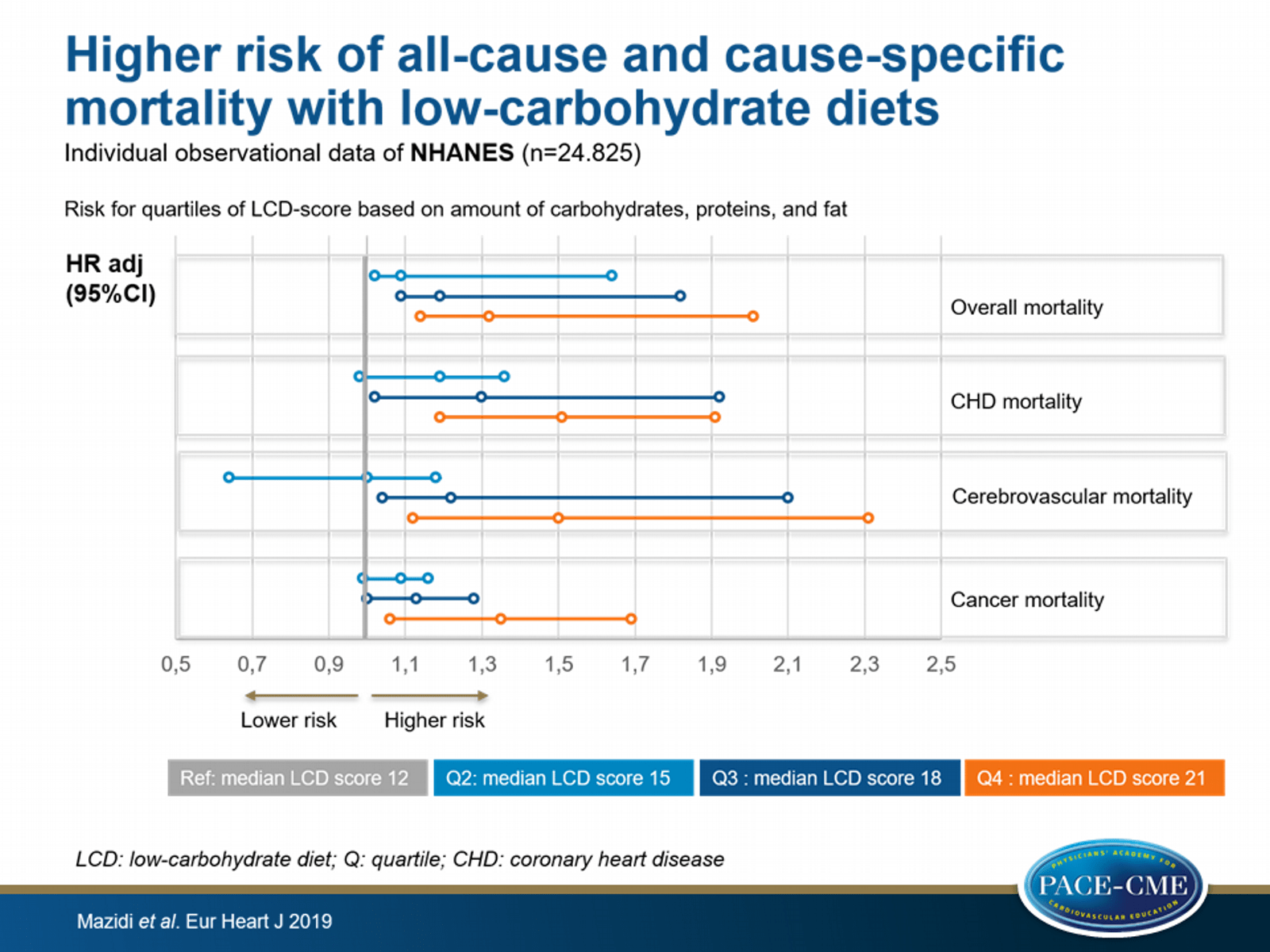
The distillation has a striking graph:

The colored lines with the small circles show the point estimates and 95% confidence intervals for risk ratios implied by the regression coefficients in a multivariable Cox proportional hazards model. The risk ratios are for each of the other quartiles compared to the first quartile, which is very high carb.

The Possible Dangers of a High-Protein Diet. I am not at all surprised that the high-protein diet indicated by the red line might be dangerous. I have written about the possible danger that too much protein might promote cancer in these two blog posts:

  1. How Sugar, Too Much Protein, Inflammation and Injury Could Drive Epigenetic Cellular Evolution Toward Cancer

  2. Meat Is Amazingly Nutritious—But Is It Amazingly Nutritious for Cancer Cells, Too?

The results in the study by Mohsen Mazidi, Niki Katsiki, Dimitri P Mikhailidis, Naveed Sattar and Maciej Banach raises the question of whether protein creates a risk for stroke and heart disease as well. Unfortunately, it is hard to distinguish in an observational study like this between the effects of dietary fat and the effects of dietary protein since dietary fat and dietary protein are highly correlated. My suspicion, partly coming from just my love of being contrarian, is that dietary protein has too positive a reputation and dietary fat too negative a reputation. That is, I think that dietary fat is often getting blamed for the harm caused by dietary protein, especially animal protein.

Controlling for Calories Consumed Changes the Interpretation Dramatically, in a Way the Authors Do Not Recognize or Acknowledge. Leaving the fourth quartile results undisputed as a possible warning about high-protein diets (with other besides me free to dispute them), let’s turn to the light and dark blue lines showing the estimated risk ratios for the second and third quartiles relative to the first. If you look carefully at what I have copied out above, you can see something strange. The second and third quartiles have a median consumption of all three macronutrients that is lower than in the first quartile. Why would eating less fat, less protein and less carbs lead to higher mortality? It isn’t as if these folks are starving. The answer is that the multivariable Cox model controls for total number of calories consumed. The authors write in the full paper:

… we had two different models: Model 1 adjusted for age, sex, race, education, marital status, poverty to income ratio, total energy intake, physical activity, smoking, and alcohol consumption; and Model 2 adjustment for Model 1 plus body mass index (BMI), waist circumference, hypertension, serum cholesterol and diabetes.

To my mind, this doesn’t give a low-carbohydrate diet a fair chance. The main harm I see from carbohydrates (especially easily-digested carbohydrates) is that they make you hungry so you eat more total calories. That story certainly matches what is happening with the median consumption numbers in the first quartile: carbohydrate grams are much higher in the first quartile without fat or protein grams being any lower—indeed, fat and protein grams are somewhat higher. If most of the harm of a high-carb diet is that people end up eating too much and the benefit of a low-carb diet is that people end up eating less, controlling for total calorie consumption in the regression slices out one of the main mechanisms through which low-carb diets are helpful. Note that Model 2 goes even further in this direction, by controlling for body mass index, which thereby insures that any benefit of a low-carb diet that operates through weight loss is sliced out. And without other analyses, that means that effects of low-carb diets that operate through reducing appetite and through weight loss are ignored.

It is important to have a multivariable model, because the first quartile has lower alcohol consumption and less smoking, but controlling for something that might be a key intermediate causal variable totally changes the interpretation of the results. Let me point to one specific possibility to make the issue more vivid. One type of low-carb diet that would still leave me hungry so that I’d be likely to eat a lot would be cutting back drastically on vegetables and whole grains while keeping my sugar consumption at full throttle. So when the regression looks at people whose carb consumption is low but who are eating a lot of calories, it might be focusing on people whose carb consumption is almost entirely unhealthy carbs that keep appetite up, with the healthy carbs cut out.

The Author’s Meta-Analysis of Other Studies also Makes High-Protein Look Bad. In addition to their own regressions, the authors to a meta-analysis of regressions by other authors. In their report on the meta-analysis, they appropriately emphasize the “high-protein” aspect of the story:

Low-carbohydrate/high protein diet mortality

There was a significant association between LC/HP and overall mortality [RR 1.16, 1.07–1.26, P <0.001, n = 5 studies, (no heterogeneity, I2 = 17.6, P =0.825), Supplementary material onlineFigure S2], as well as a positive correlation between LC/HP and CVD mortality (RR 1.35, 1.07–1.69, P <0.001, n = 5 studies, Supplementary material onlineFigure S3), with minimal evidence of heterogeneity (I2 = 21.5, P =0.736). In contrast, a significant trend between LC/HP and cancer mortality was observed (RR 1.03, 0.99–1.07, P =0.084, n = 3 studies, Supplementary material onlineFigure S4), but with modest of heterogeneity, (I2= 57.3, P =0.036).

Conclusion. A general point is that authors in the nutrition area are not always good at interpreting their own results. Economists are rewarded professionally for finding the flaws in other researchers’ regression designs and interpretations. So we get good at finding such chinks in the armor. I think everyone would get a much more accurate sense of what the evidence about nutrition really says if more economists got involved in thinking about that evidence. I could personally be mistaken quite easily. But if many economists were scrutinizing nutrition studies, collectively they would add a lot to understanding in this area.

Don’t miss my other posts on diet and health:

I. The Basics

II. Sugar as a Slow Poison

III. Anti-Cancer Eating

IV. Eating Tips

V. Calories In/Calories Out

VI. Other Health Issues

VII. Wonkish

VIII. Debates about Particular Foods and about Exercise

IX. Gary Taubes

X. Twitter Discussions

XI. On My Interest in Diet and Health

See the last section of "Five Books That Have Changed My Life" and the podcast "Miles Kimball Explains to Tracy Alloway and Joe Weisenthal Why Losing Weight Is Like Defeating Inflation." If you want to know how I got interested in diet and health and fighting obesity and a little more about my own experience with weight gain and weight loss, see “Diana Kimball: Listening Creates Possibilities and my post "A Barycentric Autobiography. I defend the ability of economists like me to make a contribution to understanding diet and health in “On the Epistemology of Diet and Health: Miles Refuses to `Stay in His Lane’.”


John Locke: How to Resist Tyrants without Causing Anarchy

In the first half of Chapter XVIII of his 2d Treatise on Government: Of Civil Government, “Of Tyranny,” John Locke describes how tyrants differ from lawful rulers. (See “John Locke: How to Recognize a Tyrant.”) In the second half of that chapter, he lays out an argument he must confront. What if his interlocutor said something like this:

§. 203. May the commands then of a prince be opposed? may he be resisted as often as any one shall find himself aggrieved, and but imagine he has not right done him? This will unhinge and overturn all polities, and, instead of government and order, leave nothing but anarchy and confusion. 

John Lock gives a subtle answer, laying out how to appropriately oppose a tyrant.

John Locke’s Rules for those Who Would Oppose Tyrants

1. Don’t escalate the use of force; don’t start by physically attacking the tyrant.

§. 204.  To this I answer, that force is to be opposed to nothing, but to unjust and unlawful force; whoever makes any opposition in any other case, draws on himself a just condemnation both from God and man; and so no danger or confusion will follow, as is often suggested, for,  

§. 205. First, As, in some countries, the person of the prince by the law is sacred; and so, whatever he commands or does, his person is still free from all question or violence, not liable to force, or any judicial censure or condemnation. … unless he will, by actually putting himself into a state of war with his people, dissolve the government, and leave them to that defence which belongs to every one in the state of nature: for of such things who can tell what the end will be? and a neighbour kingdom has shewed the world an odd example. In all other cases the sacredness of the person exempts him from all inconveniences, whereby he is secure, whilst the government stands, from all violence and harm, whatsoever; than which there cannot be a wiser constitution: for the harm he can do in his own person not being likely to happen often, nor to extend itself far; nor being able by his single strength to subvert the laws, nor oppress the body of the people, should any prince have so much weakness, and ill-nature, as to be willing to do it, the inconveniency of some particular mischiefs, that may happen sometimes, when a heady prince comes to the throne, are well recompensed by the peace of the public, and security of the government, in the person of the chief magistrate, thus set out of the reach of danger: it being safer for the body, that some few private men should be sometimes in danger to suffer, than that the head of the republic should be easily, and upon slight occasions, exposed.

Any kind of immunity of a tyrant can seem galling, but John Locke points out that personal immunity typically typically does not, by itself, allow a tyrant to do a huge amount of harm.

2. Question, oppose and resist unjust, illegal acts, regardless of a tyrant’s endorsement of them, while continuing to respect and obey just and legal actions of the tyrant.

§. 206. Secondly, But this privilege, belonging only to the king’s person, hinders not, but they may be questioned, opposed, and resisted, who use unjust force, though they pretend a commission from him, which the law authorizes not; as is plain in the case of him that has the king’s writ to arrest a man, which is a full commission from the king; and yet he that has it cannot break open a man’s house to do it, nor execute this command of the king upon certain days, nor in certain places, though this commission have no such exception in it; but they are the limitations of the law, which if any one transgress, the king’s commission excuses him not: for the king’s authority being given him only by the law, he cannot impower any one to act against the law, or justify him, by his commission, in so doing; the commission, or command of any magistrate, where he has no authority, being as void and insignificant, as that of any private man; the difference between the one and the other being that the magistrate has some authority so far, and to such ends, and the private man has none at all: for it is not the commission, but the authority, that gives the right of acting; and against the laws there can be no authority. But, notwithstanding such resistance, the king’s person and authority are still both secured, and so no danger to governor or government.  

For those on a tyrant’s staff, one of the best ways to resist an unjust or illegal command of the tyrant is to do nothing. Whenever doing nothing can stop the tyrant in his tracks, this is a very attractive option.

3. Exhaust opportunities for appeal before taking up arms.

§. 207. Thirdly, Supposing a government wherein the person of the chief magistrate is not thus sacred; yet this doctrine of the lawfulness of resisting all unlawful exercises of his power, will not upon every slight occasion indanger him, or imbroil the government: for where the injured party may be relieved, and his damages repaired by appeal to the law, there can be no pretence for force, which is only to be used where a man is intercepted from appealing to the law: for nothing is to be accounted hostile force, but where it leaves not the remedy of such an appeal; and it is such force alone, that puts him that uses it into a state of war, and makes it lawful to resist him. A man with a sword in his hand demands my purse on the highway, when perhaps I have not twelve pence in my pocket: this man I may lawfully kill. To another I deliver 100l. to hold only whilst I alight, which he refuses to restore me, when I am got up again, but draws his sword to defend the possession of it by force, if I endeavour to retake it. The mischief this man does me is a hundred, or possibly a thousand times more than the other perhaps intended me (whom I killed before he really did me any;) and yet I might lawfully kill the one, and cannot so much as hurt the other lawfully. The reason whereof is plain; because the one using force, which threatened my life, I could not have time to appeal to the law to secure it: and when it was gone, it was too late to appeal. The law could not restore life to my dead carcass: the loss was irreparable; which to prevent, the law of nature gave me a right to destroy him, who had put himself into a state of war with me, and threatened my destruction. But in the other case, my life not being in danger, I may have the benefit of appealing to the law, and have reparation for my 100l. that way.  

A key test of how bad a tyrant is is whether the tyrant tries to interfere with an appeal of his decision to a court of law.

4. Enforce the law yourself before taking up arms in civil war.

§. 208. Fourthly, But if the unlawful acts done by the magistrate be maintained (by the power he has got,) and the remedy which is due by law be by the same power obstructed; yet the right of resisting, even in such manifest acts of tyranny, will not suddenly, or on slight occasions, disturb the government: for if it reach no farther than some private men’s cases, though they have a right to defend themselves, and to recover by force what by unlawful force is taken from them; yet the right to do so will not easily engage them in a contest, wherein they are sure to perish; it being as impossible for one, or a few oppressed men to disturb the government, where the body of the people do not think themselves concerned in it, as for a raving madman, or heady malcontent to overturn a well-settled state: the people being as little apt to follow the one, as the other.  

To distil this into a maxim: “Don’t be a rebel when you can be a vigilante instead.”

5. Take up arms in civil war only if the tyranny is systematic.

§. 209. But if either these illegal acts have extended to the majority of the people; or if the mischief and oppression has lighted only on some few, but in such cases, as the precedent, and consequences seem to threaten all; and they are persuaded in their consciences, that their laws, and with them their estates, liberties, and lives are in danger, and perhaps their religion too; how they will be hindered from resisting illegal force, used against them, I cannot tell. This is an inconvenience, I confess, that attends all governments whatsoever, when the governors have brought it to this pass, to be generally suspected of their people; the most dangerous state which they can possibly put themselves in; wherein they are the less to be pitied, because it is so easy to be avoided; it being as impossible for a governor, if he really means the good of his people, and the preservation of them, and their laws together, not to make them see and feel it, as it is for the father of a family, not to let his children see he loves, and takes care of them.  

§. 210. But if all the world shall observe pretences of one kind, and actions of another; arts used to elude the law, and the trust of prerogative (which is an arbitrary power in some things left in the prince’s hand to do good, not harm to the people) employed contrary to the end for which it was given: if the people shall find the ministers and subordinate magistrates chosen suitable to such ends, and favoured, or laid by, proportionably as they promote or oppose them: if they see several experiments made of arbitrary power, and that religion underhand favoured, (though publicly proclaimed against) which is readiest to introduce it; and the operators in it supported, as much as may be; and when that cannot be done, yet approved still, and liked the better: if a long train of actions shew the councils all tending that way; how can a man any more hinder himself from being persuaded in his own mind, which way things are going; or from casting about how to save himself, than he could from believing the captain of the ship he was in was carrying him, and the rest of his company to Algiers, when he found him always steering that course, though cross winds, leaks in his ship, and want of men and provisions did often force him to turn his course another way for some time, which he steadily returned to again, as soon as the wind, weather, and other circumstances would let him?

To me, a key sign of whether the tyranny is systematic is whether resisting often leads the tyrant to give in and do better, or whether resisting leads to an escalation on the part of the tyrant against those who are resisting. Escalation by a tyrant goes a long way toward making the tyranny systematic, which, if carried far enough, may justify taking up arms against the tyrant.

For links to other John Locke posts, see these John Locke aggregator posts: 
On the Epistemology of Diet and Health: Miles Refuses to `Stay in His Lane’

What happens when someone from outside a field engages in debate with those inside the field? It depends. The more self-confident a discipline is, the more those in the field will simply point out errors in fact and logic. The less self-confident a discipline is, the more it will circle the wagons and try to exclude scholars based on lack of the approved credentials.

In general, I think allowing disciplines to keep folks from other disciplines out is dangerous. In my view, every important scientific question needs at least two disciplines looking at it. The different incentives in those two disciplines then gives some hope that there will be a bit of competition and some difference in perspectives.

Today, I thought it would be entertaining to show you some of the abuse that has been heaped on me for daring to get involved in thinking about diet and health without bowing down to those who have credentials in the field of nutrition.

For perspective, I need to emphasize that for my purpose today, the tweets below focus on the most negative moments in the Twitter discussions. There were some good substantive discussions along the way and usually a degree of rapprochement toward the end of each Twitter discussion. So people can rise above this type of exclusionary credentialism that claims a scientific monopoly on certain questions for a field. But people’s initial reflexes are often quite contrary to the ideals I personally have for open intellectual debate. You will get some sense of the ideals I have for open intellectual debate in my tweets below.

I should also note that sometimes when people are helpful and send me links so I can see more clearly what they are thinking, I discover that I have been in the middle of a scientific debate within the field. Rather than saying something ridiculous, I find I am saying what one side of the debate within the field is saying. In any case, expressing and acting on a view is a great way to get corrected, challenged, or to begin to get relevant data or experience.

Finally, note the circularity in some of the debate below. The starting point is debating whether Jason Fung encouraging people to experiment with a 28-day fast could possibly be reasonable. Then people question my credentials. I say it is really Jason Fung’s credentials that are at issue, and that he is an MD. Then someone says his credentials are worthless because he is encouraging people to experiment with a 28-day fast. I would submit that Jason Fung has a lot more experience with seeing what happens with 28-day fasts than everyone else in this Twitter discussion.

By the way, don’t try a fast longer than 48 hours without reading Jason’s books (and the cautions in them) first. And I can also warn you that if you don’t make the transition to a low-insulin-index diet first, fasting even 24 hours is likely to be miserable. See my section of links on “The Basics” at the bottom of the post.


Update May 30, 2019: Here is another more recent twitter thread that refers back to the post above. A few of the most interesting tweets from this thread:

Don’t miss my other posts on diet and health:

I. The Basics

II. Sugar as a Slow Poison

III. Anti-Cancer Eating

IV. Eating Tips

V. Calories In/Calories Out

VI. Other Health Issues

VII. Wonkish

VIII. Debates about Particular Foods and about Exercise

IX. Gary Taubes

X. Twitter Discussions

XI. On My Interest in Diet and Health

See the last section of "Five Books That Have Changed My Life" and the podcast "Miles Kimball Explains to Tracy Alloway and Joe Weisenthal Why Losing Weight Is Like Defeating Inflation." If you want to know how I got interested in diet and health and fighting obesity and a little more about my own experience with weight gain and weight loss, see “Diana Kimball: Listening Creates Possibilities and my post "A Barycentric Autobiography.

Who Leaves Mormonism?

Stephen Cranney’s BYU Studies article “Who Is Leaving the Church? Demographic Predictors of Ex–Latter-day Saint Status in the Pew Religious Landscape Survey” not only answers an interesting question, but also provides some basic lessons on interpreting statistics. In as close to a representative sample of the US population as any survey that provides the needed data, he compares 191 people who grew up Mormon who no longer self-identify as Mormons and 379 who grew up Mormon and still think of themselves as Mormons. (Let me say that I refuse to accommodate current Mormon Church President Russell Nelson’s disavowal of the nickname “Mormon.” An earlier Mormon Church President Gordon B. Hinckley embraced the nickname “Mormon.”)

On overall numbers leaving, Stephen points out that it is roughly the same as the number of converts, so that growth of Mormonism in the US is largely from natural increase: births minus deaths. (Mormons still have relatively high fertility and are younger than population averages, so natural increase is substantial.)

Stephen asks the interesting question of what religious status ex-Mormons go to. The answer (with some sampling error in it) is:

  • 58% went to “no religion” or unaffiliated

  • 18% went to evangelical Protestant denominations

  • 8% went to Mainline Protestant denominations

  • 10% went to generic Christianity

  • That leaves about 6%, about equally split between becoming Buddhists, joining a Mormon splinter group or going to some other religion not listed above.

Stephen’s Table 2 in this article gives a logit for predictors of leaving Mormonism rather than staying, among this sample of individuals who all grew up in Mormonism. I favor the logit that includes all covariates at once: the rightmost column. Stephen makes no multiple hypothesis testing correction, but the hypotheses he is testing are natural enough that at least I am not worried about a lot of hidden hypotheses that are not reported.

In my own research with coauthors, I have found using a false-discovery-rate (FDR) threshold to be so convenient and practical that there isn’t much of an excuse for anyone to neglect making multiple-hypothesis-testing corrections any more. (I hope to do a blog post in the future on using the false discovery rate approach.) A false discovery rate of x% means that on average no more than x% of the claims made are likely to be false. The more claims made, the more total claims are likely to be false, but the percentage of claims that are false in expectation is below the threshold.

Doing the false-discovery-rate approach myself, I can see that in the rightmost column of Table 2, everything with *** is significant with a false-discovery-rate threshold of no more than 1.5%, everything with ** is significant with a false-discovery-rate threshold of no more than 3.75%, and everything with * is significant with a false-discovery-rate threshold of no more than 15%. (Mechanically, take the p-value for which the significance level reported in the table is a ceiling, multiply by the number of hypotheses tested—15—then divide by the number of claims made up to that point, including the current claim, when they are made starting from the lowest p-value and going up. One of the ***s is the first claim. The ** is the fourth claim. The * with the lowest p-value is the fifth claim. There are some caveats to this procedure, but it is generally quite accurate.)

Given that in this case am not worried about hidden hypotheses that were tested, found wanting and then put in a drawer, these significance levels are adequate.

Here are the results, from ones we are more sure of, to those we are less sure of, with some of Stephen’s interpretative comments.

FDR threshold of no more than 1.5%

Cohabiting and divorce are correlated with leaving Mormonism. Stephen is admirably cautious about interpreting this:

Because there is no information on when people left the Church, it is difficult to speculate about why ex–Latter-day Saints tend to be divorced more than those who remain in the Church. It is theoretically plausible that the trauma of undergoing a divorce led to a loss of faith, activity, and ultimately identification with the Church; it is also possible that a loss of faith led to intermarital strife with a member spouse; finally, it is possible that Latter-day Saint marriages tend to have lower divorce rates overall. Some incidental support exists for this last point in the fact that the Latter-day Saint sample here has a significantly lower chance of being in the divorced category than the general non–Latter-day Saint PRLS sample, whereas the ex–Latter-day Saint sample does not show a statistically significant difference with the general sample. This suggests that ex-members may simply lose whatever Latter-day Saint–specific protections against divorce that may exist.

Political liberalism is correlated with leaving Mormonism. Stephen is careful to put things in perspective:

Ex–Latter-day Saints do appear to be more liberal than those who stay (see tables 1 and 2). However, the political switch may be less of a switch from “conservative” to “liberal” than from “conservative” to “moderate.” Contrary to stereotypes about liberal ex–Latter-day Saints, many ex–Latter-day Saints (27 percent) still identify as politically conservative, with 39 percent identifying as political moderates, and only a minority (35 percent) identifying as politically liberal.

While on their face the political findings support the familiar narrative of liberal latter-day Saints leaving over social issues, the fact that only a minority of ex–Latter-day Saints identify as liberals and that hardly any of them switch to liberal Protestant denominations nuances this perspective. While social issues are undoubtedly salient for some people’s exodus from the Church, it is likely that this narrative receives a disproportion- ate amount of attention in informal and online discourse on this subject, and the size of the liberal Latter-day Saint exodus over social issues should not be exaggerated.

FDR threshold of no more than 3.75%

High education predicts a lower probability of leaving Mormonism. Again, Stephen is admirably cautious in interpreting this result:

In the summary statistics, ex–Latter-day Saints tend to be less educated, with lower income. While distinct, these findings conceptually support prior research that has shown that, unlike most religions, for Latter-day Saints education is positively associated with activity.4 However, when education is controlled for, income becomes insignificant, suggesting that those who stay in the Church are wealthier because they are more educated.

… there are a number of theoretically plausible stories for why ex–Latter-day Saints tend to be less educated and have lower incomes. It could be that there is a Latter-day Saint emphasis on education and occupational success that leads to higher incomes and more education, or it could be that people are more likely to stay in the Church if the lifestyle is working out for them socioeconomically.

FDR threshold of no more than 15%

Men are more likely to leave Mormonism. For most of those who grow up in Mormonism, gender can be taken as fairly exogenous. Given the controversies about how Mormonism treats women, one might have thought that women would be more likely to leave. Here is what Stephen says about that:

Related to the issue of leaving over social issues is the question of gender. For a religion with an all-male priesthood that treats the notion of gender seriously, it is worth investigating whether women are more likely to leave than men. In this sample, men are overrepresented among those who have left; these results comport with prior findings in the large American Religious Identification Survey that men tend to disproportionately leave the Church. This difference may be a Latter-day Saint– specific manifestation of the fact that in the United States men tend to be less religious than women.

Older people are more likely to have left Mormonism. Stephen tends to dismiss this finding because he focuses less than I do on the logit with everything in it. I think this is real, because a simple hazard model would suggest that if one is ever going to leave Mormonism, having more time pass makes that more likely to have happened already. (Even if some people return to Mormonism after having left, when starting with a group that are 100% Mormon in childhood, there is likely to be convergence—which is most likely to be monotonic—to a higher fraction non-Mormon.)

Those living in Utah are less likely to have left Mormonism. Stephen explains the interpretive issues:

Ex–Latter-day Saints also appear to be less likely to reside in Utah in the summary statistics (34 percent versus 26 percent, but this barely misses the cutoff for significance at p = .065), and the Utah effect is sporadically significant in the regression analysis, suggesting that, whether because they are more likely to leave when growing up outside of Utah or because they are more likely to move outside of Utah after they leave (or a combination of both), ex–Latter-day Saints are disproportionately found outside of Utah compared to Latter-day Saints who did not leave.

Being Hispanic is not associated with leaving Mormonism (in a sizeable enough way to be reliably detected in this size of sample), but being Black non-Hispanic or of a race other than White, Black or non-Black Hispanic is correlated with leaving Mormonism. Here is what Stephen writes about that:

Finally, the racial effects found here lend themselves to any number of interpretations, but perhaps the most reasonable is that being a racial minority in a predominantly white Church may cause its own stresses that make continued activity and identification with the Church less likely.

A bit of background here that Stephen doesn’t here is that the Mormon Church is thriving in Latin American countries and the Mormon Church has many congregations with church services conducted in Spanish in the US, so that Hispanics in the US may feel somewhat less like outsider minorities in the Mormon Church than their raw numbers (4%) suggest.

Update May 20, 2019: A reader asks on Twitter “I'd be interested to know if your experience aligns with the paper.” My reply:

I left Mormonism. Positively correlated with that: I am politically moderate, male, older and have lived outside of Utah since age 24. Negatively correlated with leaving: I'm married (1st time), highly educated (with a PhD in Economics, which never challenges religion) & white.


Don't miss these posts on Mormonism:

Also see the links in "Hal Boyd: The Ignorance of Mocking Mormonism."

Don’t miss these Unitarian-Universalist sermons by Miles:

By self-identification, I left Mormonism for Unitarian Universalism in 2000, at the age of 40. I have had the good fortune to be a lay preacher in Unitarian Universalism. I have posted many of my Unitarian-Universalist sermons on this blog.

Don’t miss these guest posts on Mormonism by my brother Chris Kimball:

In addition, Chris is my coauthor for