Sutton, Beyl, Early, Cefalu, Ravussin and Peterson: Early Time-Restricted Feeding Improves Insulin Sensitivity, Blood Pressure, and Oxidative Stress Even without Weight Loss in Men with Prediabetes
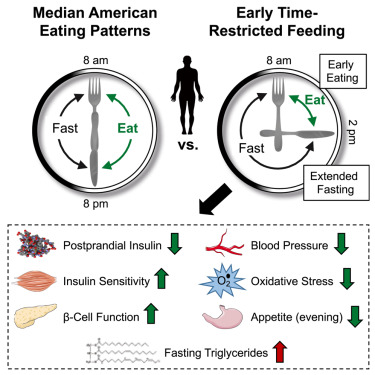
Image source: the article shown below

The topics of my diet and health posts often touch on areas where research is sorely lacking. One bright spot in the research outlook is that a great deal of research is being done on short-term fasting. The introductory paragraph to the June 2018 Cell Metabolism article “Early Time-Restricted Feeding Improves Insulin Sensitivity, Blood Pressure, and Oxidative Stress Even without Weight Loss in Men with Prediabetes” by Elizabeth F.Sutton, Robbie Beyl, Kate S. Early, William T. Cefalu, EricRavussin, and Courtney M.Peterson gives a nice rundown of recent work in this area. To make the paragraph easier to read, I have bolded everything that is not a list of citations:
Intermittent fasting (IF)—the practice of alternating periods of eating and fasting—has emerged as an effective therapeutic strategy for improving multiple cardiometabolic endpoints in rodent models of disease, ranging from insulin sensitivity and ectopic fat accumulation to hard endpoints such as stroke and diabetes incidence (Antoni et al., 2017, Harvie and Howell, 2017, Mattson et al., 2017, Patterson and Sears, 2017). The first clinical trials of IF in humans began about a decade ago, including trials on alternate-day fasting (Catenacci et al., 2016, Heilbronn et al., 2005a, Heilbronn et al., 2005b), alternate-day modified fasting (ADMF) (Bhutani et al., 2013, Eshghinia and Mohammadzadeh, 2013, Halberg et al., 2005, Hoddy et al., 2014, Hoddy et al., 2016, Johnson et al., 2007, Klempel et al., 2013, Kroeger et al., 2018, Soeters et al., 2009, Trepanowski et al., 2017a, Trepanowski et al., 2017b, Varady et al., 2009, Varady et al., 2013, Wegman et al., 2015), the 5:2 diet (Carter et al., 2016, Harvie et al., 2011, Harvie et al., 2013, Harvie et al., 2016), and the fasting-mimicking diet (Brandhorst et al., 2015, Choi et al., 2016, Wei et al., 2017, Williams et al., 1998). Data from these trials suggest that IF has similar benefits in humans: IF can reduce body weight or body fat, improve insulin sensitivity, reduce glucose and/or insulin levels, lower blood pressure, improve lipid profiles, and reduce markers of inflammation and oxidative stress (Bhutani et al., 2013, Brandhorst et al., 2015, Carter et al., 2016, Catenacci et al., 2016, Eshghinia and Mohammadzadeh, 2013, Halberg et al., 2005, Harvie et al., 2011, Harvie et al., 2013, Harvie et al., 2016, Heilbronn et al., 2005a, Heilbronn et al., 2005b, Hoddy et al., 2014, Hoddy et al., 2016, Johnson et al., 2007, Klempel et al., 2013, Trepanowski et al., 2017b, Varady et al., 2009, Varady et al., 2013, Wegman et al., 2015, Wei et al., 2017, Williams et al., 1998).
I find the topic of “early time-restricted feeding” especially interesting because my typical pattern qualifies as “early time-restricted feeding”: on days when I am working at home, I try to have an eating window from about 11 AM to 3 PM. Sutton, Beyl, Early, Cefalu, Ravussin and Peterson give this summary of previous research on time-restricted feeding (TRF) in general (again I have bolded everything that is not citations):
TRF is a type of IF that extends the daily fasting period between dinner and breakfast the following morning, and, unlike most forms of IF, it can be practiced either with or without reducing calorie intake and losing weight. Since the median American eats over a 12-hr period (Kant and Graubard, 2014), we define TRF as a form of IF that involves limiting daily food intake to a period of 10 hr or less, followed by a daily fast of at least 14 hr. Studies in rodents using feeding windows of 3–10 hr report that TRF reduces body weight, increases energy expenditure, improves glycemic control, lowers insulin levels, reduces hepatic fat, prevents hyperlipidemia, reduces infarct volume after stroke, and improves inflammatory markers, relative to grazing on food throughout the day (Belkacemi et al., 2010, Belkacemi et al., 2011, Belkacemi et al., 2012, Chung et al., 2016, Duncan et al., 2016, García-Luna et al., 2017, Hatori et al., 2012, Kudo et al., 2004, Manzanero et al., 2014, Olsen et al., 2017, Park et al., 2017, Philippens et al., 1977, Sherman et al., 2011, Sherman et al., 2012, Sundaram and Yan, 2016, Woodie et al., 2017, Wu et al., 2011, Zarrinpar et al., 2014). We chose to test TRF over other forms of IF in part because TRF consistently improves health endpoints in rodents, even when food intake and/or body weight is matched to the control group (Belkacemi et al., 2012, Hatori et al., 2012, Olsen et al., 2017, Sherman et al., 2012, Woodie et al., 2017, Wu et al., 2011, Zarrinpar et al., 2014).
The four previous human trials of a short eating window suggested that restricting eating to the middle of the day yielded good outcomes, while restricting eating to the end of the day didn’t improve things that much. So Sutton, Beyl, Early, Cefalu, Ravussin and Peterson decided to study early time-restricted feeding (eTRF). They also made three other key decisions. First, they wouldn’t try to study whether people could adhere to a short eating window on their own, nor would they try to keep people in the metabolic ward. They used the in-between procedure of insisting study participants eat only food provided by the study staff and only in the presence of one of the study staff. Second, they were looking for health benefits that occurred even without any weight loss, and so gave participants enough food to keep their weight constant. Third, in their crossover study, each participant ate the same 3 meals each day over a 6-hour early eating window each day for 5 weeks as they ate each day over a 12-hour eating window for five weeks. The order of these two 5-week periods was randomized, and the two 5-week periods were separated by a 7-week washout period.
Unfortunately, they had a sample-size of only 8. They did find some good hints of effects across many measures, though. This that they mention in their abstract is only some of the results: “eTRF improved insulin sensitivity, β cell responsiveness, blood pressure, oxidative stress, and appetite.”
Another limitation of their study is that for at least 3 of the 5 weeks, study participants wouldn’t have been fully adapted to burning body fat during their 18-hours of no food. Fasting even 18 hours can be stressful on the body when one has not yet made the transition to metabolizing fat instead of carbs. (See my post “David Ludwig: It Takes Time to Adapt to a Lowcarb, Highfat Diet.” Burning body fat is likely to be similar metabolically to a highfat diet.)
I don’t find the restriction of their sample to people with prediabetes a serious limitation: a larger share of everyone who is overweight has some degree of insulin resistance, which is the key dimension of prediabetes. The limitation to only men with no women is a more serious limitation.
I find the comments the authors make about feasibility and acceptability interesting:
Participants also reported that the challenge of eating within 6 hr each day was more difficult than the challenge of fasting for 18 hr per day (difficulty scores: 65 ± 20 versus 29 ± 18 mm; p = 0.009). In fact, all but one participant reported that it was not difficult or only moderately difficult (<50 mm on a 100-mm scale) to fast for 18 hr daily.
This matches my experience. Not eating at all is relatively easy, and it is hard to overeat in a short eating window.
It is fortunate that much more research on fasting is on its way.
Don’t miss my other posts on diet and health:
I. The Basics
Jason Fung's Single Best Weight Loss Tip: Don't Eat All the Time
What Steven Gundry's Book 'The Plant Paradox' Adds to the Principles of a Low-Insulin-Index Diet
David Ludwig: It Takes Time to Adapt to a Lowcarb, Highfat Diet
II. Sugar as a Slow Poison
Best Health Guide: 10 Surprising Changes When You Quit Sugar
Heidi Turner, Michael Schwartz and Kristen Domonell on How Bad Sugar Is
Michael Lowe and Heidi Mitchell: Is Getting ‘Hangry’ Actually a Thing?
III. Anti-Cancer Eating
How Fasting Can Starve Cancer Cells, While Leaving Normal Cells Unharmed
Meat Is Amazingly Nutritious—But Is It Amazingly Nutritious for Cancer Cells, Too?
IV. Eating Tips
Using the Glycemic Index as a Supplement to the Insulin Index
Putting the Perspective from Jason Fung's "The Obesity Code" into Practice
Which Nonsugar Sweeteners are OK? An Insulin-Index Perspective
V. Calories In/Calories Out
VI. Other Health Issues
VII. Wonkish
Framingham State Food Study: Lowcarb Diets Make Us Burn More Calories
Anthony Komaroff: The Microbiome and Risk for Obesity and Diabetes
Don't Tar Fasting by those of Normal or High Weight with the Brush of Anorexia
Carola Binder: The Obesity Code and Economists as General Practitioners
After Gastric Bypass Surgery, Insulin Goes Down Before Weight Loss has Time to Happen
A Low-Glycemic-Index Vegan Diet as a Moderately-Low-Insulin-Index Diet
Analogies Between Economic Models and the Biology of Obesity
Layne Norton Discusses the Stephan Guyenet vs. Gary Taubes Debate (a Debate on Joe Rogan’s Podcast)
VIII. Debates about Particular Foods and about Exercise
Jason Fung: Dietary Fat is Innocent of the Charges Leveled Against It
Faye Flam: The Taboo on Dietary Fat is Grounded More in Puritanism than Science
Confirmation Bias in the Interpretation of New Evidence on Salt
Eggs May Be a Type of Food You Should Eat Sparingly, But Don't Blame Cholesterol Yet
Julia Belluz and Javier Zarracina: Why You'll Be Disappointed If You Are Exercising to Lose Weight, Explained with 60+ Studies (my retitling of the article this links to)
IX. Gary Taubes
X. Twitter Discussions
Putting the Perspective from Jason Fung's "The Obesity Code" into Practice
'Forget Calorie Counting. It's the Insulin Index, Stupid' in a Few Tweets
Debating 'Forget Calorie Counting; It's the Insulin Index, Stupid'
Analogies Between Economic Models and the Biology of Obesity
XI. On My Interest in Diet and Health
See the last section of "Five Books That Have Changed My Life" and the podcast "Miles Kimball Explains to Tracy Alloway and Joe Weisenthal Why Losing Weight Is Like Defeating Inflation." If you want to know how I got interested in diet and health and fighting obesity and a little more about my own experience with weight gain and weight loss, see “Diana Kimball: Listening Creates Possibilities” and my post "A Barycentric Autobiography.
Robert P. Murphy's Summary of Friedrich Hayek's Contributions and Views →
This is the clearest account of Friedrich Hayek’s views I have ever read. Hat tip to Greg Ransom.
I agree with Friedrich Hayek about the value of freedom, the great danger of government encroaching on freedom, and the importance of dispersed knowledge, but not with his business cycle views.
John Locke: How to Recognize a Tyrant

Chapter XVIII of John Locke’s 2d Treatise on Government: Of Civil Government, “Of Tyranny,” discusses two marks of a tyrant: going beyond the law and working for their own (often unenlightened) self-interest rather than for the good of the people. John Locke says this several times in sections 199-202. I especially like this formulation:
… the difference betwixt a king and a tyrant to consist only in this, that one makes the laws the bounds of his power, and the good of the public, the end of his government; the other makes all give way to his own will and appetite.
Drawing from sections 199-202, which you can see below, let me collect descriptors for a lawful ruler and a tyrant here:
Lawful Ruler(s):
making use of power for the good of those who are under it
commands and actions directed to the preservation of the properties of his people
the law as the rule
acknowledges himself to be ordained for the procuring of the wealth and property of his people
bound to protect as well the people, as the laws of his kingdom
glad to bound themselves within the limits of their laws
makes the laws the bounds of his power, and the good of the public, the end of his government
uses power for the preservation of the properties of the people
Tyrant(s):
exercise of power beyond right
making use of power for private separate advantage
his will the rule
commands and actions for the satisfaction of his own ambition, revenge, covetousness, or any other irregular passion.
thinks his kingdom and people are only ordained for satisfaction of his desires and unreasonable appetites
makes all give way to his own will and appetite
uses power to impoverish, harass, or subdue them to the arbitrary and irregular commands of those that have it
transgresses law to another’s harm
exceeds the power given him by the law, and makes use of the force he has under his command, to compass that upon the subject, which the law allows not
In section 202, John Locke argues that rulers bear a greater responsibility to obey the law and further the public good the more power they have. Great power does not absolve them of responsibility:
… the exceeding the bounds of authority is no more a right in a great, than in a petty officer; no more justifiable in a king than a constable; but is so much the worse in him, in that he has more trust put in him, has already a much greater share than the rest of his brethren, and is supposed, from the advantages of his education, employment, and counsellors, to be more knowing in the measures of right and wrong.
Below is the context for all of these points I have drawn out:
§. 199. AS usurpation is the exercise of power, which another hath a right to; so tyranny is the exercise of power beyond right, which nobody can have a right to. And this is making use of the power any one has in his hands, not for the good of those who are under it, but for his own private separate advantage. When the governor, however intitled, makes not the law, but his will the rule; and his commands and actions are not directed to the preservation of the properties of his people, but the satisfaction of his own ambition, revenge, covetousness, or any other irregular passion.
§. 200. If one can doubt this to be truth, or reason, because it comes from the obscure hand of a subject, I hope the authority of a king will make it pass with him. King James the First, in his speech to the parliament, 1603, tells them thus, “I will ever prefer the weal of the public, and of the whole commonwealth, in making of good laws and constitutions, to any particular and private ends of mine; thinking ever the wealth and weal of the commonwealth to be my greatest weal and worldly felicity; a point wherein a lawful king doth directly differ from a tyrant: for I do acknowledge that the special and greatest point of difference that is between a rightful king and an usurping tyrant, is this, that whereas the proud and ambitious tyrant doth think his kingdom and people are only ordained for satisfaction of his desires and unreasonable appetites, the righteous and just king doth by the contrary acknowledge himself to be ordained for the procuring of the wealth and property of his people.” And again, in his speech to the parliament, 1609, he hath these words, “The king binds himself by a double oath, to the observation of the fundamental laws of his kingdom; tacitly, as by being a king, and so bound to protect as well the people, as the laws of his kingdom; and expressly, by his oath at his coronation; so as every just king, in a settled kingdom, is bound to observe that paction to his people, by his laws, in framing his government agreeable thereunto, according to that paction which God made with Noah after the deluge. Hereafter, seed-time and harvest, and cold and heat, and summer and winter, and day and night, shall not cease while the earth remaineth. And therefore a king governing in a settled kingdom, leaves to be a king, and degenerates into a tyrant, as soon as he leaves off to rule according to his laws.” And a little after, “Therefore all kings that are not tyrants, or perjured, will be glad to bound themselves within the limits of their laws; and they that persuade them the contrary, are vipers, and pests both against them and the commonwealth.” Thus that learned king, who well understood the notion of things, makes the difference betwixt a king and a tyrant to consist only in this, that one makes the laws the bounds of his power, and the good of the public, the end of his government; the other makes all give way to his own will and appetite.
§. 201. It is a mistake, to think this fault is proper only to monarchies: other forms of government are liable to it, as well as that: for wherever the power, that is put in any hands for the government of the people, and the preservation of their properties, is applied to other ends, and made use of to impoverish, harass, or subdue them to the arbitrary and irregular commands of those that have it; there it presently becomes tyranny, whether those that thus use it are one or many. Thus we read of the thirty tyrants at Athens, as well as one at Syracuse; and the intolerable dominion of the Decemviri at Rome was nothing better.
§. 202. Wherever law ends, tyranny begins, if the law be transgressed to another’s harm; and him whosoever in authority exceeds the power given him by the law, and makes use of the force he has under his command, to compass that upon the subject, which the law allows not, ceases in that to be a magistrate; and, acting without authority, may be opposed, as any other man, who by force invades the right of another. This is acknowledged in subordinate magistrates. He that hath authority to seize my person in the street, may be opposed as a thief and a robber, if he endeavours to break into my house to execute a writ, notwithstanding that I know he has such a warrant, and such a legal authority, as will impower him to arrest me abroad. And why this should not hold in the highest, as well as in the most inferior magistrate, I would gladly be informed. Is it reasonable, that the eldest brother, because he has the greatest part of his father’s estate, should thereby have a right to take away any of his younger brothers’ portions? or that a rich man, who possessed a whole country, should from thence have a right to seize, when he pleased, the cottage and garden of his poor neighbour? The being rightfully possessed of great power and riches, exceedingly beyond the greatest part of the sons of Adam, is so far from being an excuse, much less a reason, for rapine and oppression, which the endamaging another without authority is, that it is a great aggravation of it: for the exceeding the bounds of authority is no more a right in a great, than in a petty officer; no more justifiable in a king than a constable; but is so much the worse in him, in that he has more trust put in him, has already a much greater share than the rest of his brethren, and is supposed, from the advantages of his education, employment, and counsellors, to be more knowing in the measures of right and wrong.
For links to other John Locke posts, see these John Locke aggregator posts:
Ruchir Agarwal and Miles Kimball—Enabling Deep Negative Rates to Fight Recessions: A Guide

My latest paper with Ruchir Agarwal on negative interest rate policy is out as an IMF Working Paper: “Enabling Deep Negative Rates to Fight Recessions: A Guide.” If you read one thing about negative interest rate policy, read this paper. I do have to warn you that it is quite a long paper! Ruchir and I tried to be as comprehensive as we knew how on issues around negative interest rate policy without getting too formal. (Our next priority is precisely to do more formal modeling.)
If you want to start by reading or listening to something shorter, or want more after you have finished this paper, take a look at the links and other resources in my bibliographic post “How and Why to Eliminate the Zero Lower Bound: A Reader’s Guide.” This is the post my “Neg Rates” link at the top of my blog goes to. I just updated it.
We thank many people for giving us helpful comments on early drafts of the paper. In terms of the magnitude of contribution to how the paper turned out, Ken Rogoff, Matt Rognlie and seminar audiences at Harvard, MIT, Brown and BU in Fall 2018 had the biggest impact on the paper.
Let me say something strong: No one should pretend they know what they are talking about in relation to negative interest rate policy without having read this paper. Anyone who does read it and wants to offer a critique to what we wrote, Ruchir and I will take seriously.
David Ludwig: It Takes Time to Adapt to a Lowcarb, Highfat Diet

In my diet and health posts, I have emphasized fasting as a key tool for weight loss. I have also emphasized how much harder fasting is if one is eating a lot of carbs or other foods that have a high insulin index. (See “Forget Calorie Counting; It's the Insulin Index, Stupid” and “Why a Low-Insulin-Index Diet Isn't Exactly a 'Lowcarb' Diet.”) This is an issue over several time scales:
Insulin secretion stimulated by high-insulin-index foods contributes to appetite in the next few hours.
Eating carbs may make it tougher to convert over to body-fat burning over the course of the next day.
In addition, David Ludwig, in his post “Adapting to Fat on a Low-Carb Diet,” discusses evidence that for people who have, in general, been eating a highcarb diet, it takes at least three weeks to adjust to powering the brain from fat instead of powering the brain from carbs.
What this means is that you should go off sugar and be eating low on the insulin index in other dimensions for at least three weeks (and I would recommend at least six weeks) before trying to add fasting to your health and weight-loss regimen. That is, worry about “Letting Go of Sugar” and otherwise eating low on the insulin index for six weeks before trying to incorporate the insights of “Stop Counting Calories; It's the Clock that Counts,” “Jason Fung's Single Best Weight Loss Tip: Don't Eat All the Time” and “Lisa Drayer: Is Fasting the Fountain of Youth?” into your life. (“Obesity Is Always and Everywhere an Insulin Phenomenon” and “4 Propositions on Weight Loss talk about both steps.)
Another consequence if this at-least-three-week adaptation period for power the brain more from fat and less from carbs is that studies of lowcarb diets that last only a few weeks make lowcarb diets look worse than they really are. During the adjustment process, if your brain feels undernourished because it is used to carbs you are cutting back on, that could easily make you feel less energetic and raise your appetite. Think about metabolic ward studies in which what people eat is totally controlled. In metabolic ward studies of lowcarb, highfat diets versus lowfat, highcarb diets, the first three weeks of data will just be the adjustment period and should be disregarded if the sample is of people who are not initially adapted to a lowcarb, highfat diet. The two options for researchers is to run longer metabolic ward studies or to have a design with an initial sample drawn from two groups: one group drawn from people who have been doing a lowcarb, highfat diet for a long time in their regular life and the other group drawn from people who have been doing a lowfat highcarb diet. Then each group can be randomized in the metabolic ward into a lowcarb, highfat diet or a lowfat, highcarb diet. That randomizes each individual into either a diet similar in macronutrients to what they are used or to a diet that is quite different from what they are used to.
This matters for Kevin Hall’s and Juen Guo’s meta-analysis in “Obesity Energetics: Body Weight Regulation and the Effects of Diet Composition” of resting energy expenditure and other dimensions of energy expenditure with lowcarb, highfat versus lowfat highcarb diets. It is much easier to do short metabolic ward studies than long ones, and most metabolic ward studies have not tried to get samples of people who had distinctive dietary patterns in their regular lives before the studies. Therefore, their meta-analytic results are not the strong evidence it purports to be on the effect of these diets in the long run: if the bulk of the studies in a meta-analysis all have the same bias, that bias affects the meta-analytic summary results as well. It is not good enough to say something like “Metabolic ward studies lasting more than a few weeks are very hard to do.” Either you figure out a strategy that identifies differences between the effects of lowcarb, highfat diets and lowfat, highcarbs in the long run, or you say that the evidence can’t speak to the issue.
(When evidence is inadequate, people still need to decide what to do and often also make a decision on what to advise others to do. That is inevitable, but anyone doing so should freely admit the weakness of evidence when queried about it. And where theory comes in, they should freely explain the theoretical framework they are coming from in judging the evidence.)
An even more important research area is to look at the complementarity between lowcarb, highfat diets and fasting, both for effectiveness and for people’s ability to stick with the program.
Don’t miss my other posts on diet and health:
I. The Basics
Jason Fung's Single Best Weight Loss Tip: Don't Eat All the Time
What Steven Gundry's Book 'The Plant Paradox' Adds to the Principles of a Low-Insulin-Index Diet
David Ludwig: It Takes Time to Adapt to a Lowcarb, Highfat Diet
II. Sugar as a Slow Poison
Best Health Guide: 10 Surprising Changes When You Quit Sugar
Heidi Turner, Michael Schwartz and Kristen Domonell on How Bad Sugar Is
Michael Lowe and Heidi Mitchell: Is Getting ‘Hangry’ Actually a Thing?
III. Anti-Cancer Eating
How Fasting Can Starve Cancer Cells, While Leaving Normal Cells Unharmed
Meat Is Amazingly Nutritious—But Is It Amazingly Nutritious for Cancer Cells, Too?
IV. Eating Tips
Using the Glycemic Index as a Supplement to the Insulin Index
Putting the Perspective from Jason Fung's "The Obesity Code" into Practice
Which Nonsugar Sweeteners are OK? An Insulin-Index Perspective
V. Calories In/Calories Out
VI. Other Health Issues
VII. Wonkish
Framingham State Food Study: Lowcarb Diets Make Us Burn More Calories
Anthony Komaroff: The Microbiome and Risk for Obesity and Diabetes
Don't Tar Fasting by those of Normal or High Weight with the Brush of Anorexia
Carola Binder: The Obesity Code and Economists as General Practitioners
After Gastric Bypass Surgery, Insulin Goes Down Before Weight Loss has Time to Happen
A Low-Glycemic-Index Vegan Diet as a Moderately-Low-Insulin-Index Diet
Analogies Between Economic Models and the Biology of Obesity
Layne Norton Discusses the Stephan Guyenet vs. Gary Taubes Debate (a Debate on Joe Rogan’s Podcast)
VIII. Debates about Particular Foods and about Exercise
Jason Fung: Dietary Fat is Innocent of the Charges Leveled Against It
Faye Flam: The Taboo on Dietary Fat is Grounded More in Puritanism than Science
Confirmation Bias in the Interpretation of New Evidence on Salt
Eggs May Be a Type of Food You Should Eat Sparingly, But Don't Blame Cholesterol Yet
Julia Belluz and Javier Zarracina: Why You'll Be Disappointed If You Are Exercising to Lose Weight, Explained with 60+ Studies (my retitling of the article this links to)
IX. Gary Taubes
X. Twitter Discussions
Putting the Perspective from Jason Fung's "The Obesity Code" into Practice
'Forget Calorie Counting. It's the Insulin Index, Stupid' in a Few Tweets
Debating 'Forget Calorie Counting; It's the Insulin Index, Stupid'
Analogies Between Economic Models and the Biology of Obesity
XI. On My Interest in Diet and Health
See the last section of "Five Books That Have Changed My Life" and the podcast "Miles Kimball Explains to Tracy Alloway and Joe Weisenthal Why Losing Weight Is Like Defeating Inflation." If you want to know how I got interested in diet and health and fighting obesity and a little more about my own experience with weight gain and weight loss, see “Diana Kimball: Listening Creates Possibilities” and my post "A Barycentric Autobiography. I defend the ability of economists like me to make a contribution to understanding diet and health in “On the Epistemology of Diet and Health: Miles Refuses to `Stay in His Lane’.”
Chris Kimball on `A Liberal Turn in the Mormon Church'

Chris Kimball and his grandson
When I wrote “A Liberal Turn in the Mormon Church” I had already arranged with my brother Chris that he would write a guest post as a response. I was reassured to know that any errors of fact or emphasis I made because of my increasing distance in time from being a Mormon would be corrected. Below is Chris’s response.
In my own defense vis a vis one of his themes, let me point out that I had previously written about some of the other important changes Russell Nelson has made in the Mormon Church besides those I mentioned in “A Liberal Turn in the Mormon Church.” See the links to other related posts at the bottom of this post.
A letter to my brother in response to “A Liberal Turn in the Mormon Church”
Dear Miles:
I read with interest “A Liberal Turn in the Mormon Church” two weeks ago. In the friendliest and most loving way (a standard opening for sharp disagreement), I have a couple of things to say.
Before diving in, let me say that this is a letter between brothers chock full of personal opinion and 50% confidence statements. Knowing you are going to publish it, but not caveating every other sentence to make this some kind of pronouncement or “truth” or careful lawyer’s brief. Just one brother talking to another.
Now diving in, my first observation is that you increasingly write as an outsider to the Church. I think you would acknowledge that (and hopefully not take umbrage). On the flip side I am conscious of the fact that my most recent piece (generously referenced in your “Liberal Turn”) was so much an insider view that we both agreed it was unpublishable outside the Bloggernacle--the segment of the blogosphere focused on Mormon issues.
“Outsider” means several things for my review. First, it means that you select and give attention to changes you notice, which is an interesting and revealing subset of the whole. Second, it means that your characterization of Church leaders seems more resume-based than listening based. Third, it means that your “liberal” label is an outside-looking-in label.
You highlight changes in the temple ceremony, calling an African-American General Authority, and reversing the 2015 policy on people in same-sex marriages and their children. No question these are newsworthy changes, and I have written extensively about the third so I can’t honestly downplay them. However, I will argue that they are somewhat less important than you make them out to be, and only three among many.
Less important in the following ways—
Changes in the temple ceremony occur from time to time. They are seldom talked about much, out of respect for the temple, strong secret/sacred bonds on certain parts of the ceremonies that make insiders cautious about discussing any parts, and a mystique that the ceremonies are “revealed truth” in ancient, unchanged, and unchangeable form (which is obviously not true in the strong sense, for anybody who pays attention, but is a valuable myth that many would like to preserve). In addition, the observant among us report particular instructions not to discuss these recent changes. But for all the quietness around the temple ceremony, it is relatively well known that changes do occur—and the Church said so in the context of these recent changes—and probably will continue.
With respect to the changes having to do with “sexist” language, my perspective is rather more cautious or measured than some of the excited reports in the Salt Lake Tribune. My perspective is that the changes I know about have been needed and talked about for forty years at least. They have been identified in focus group and survey results. Furthermore, the changes were only part of the work that seems needed. (All my opinion, of course.) The interesting questions to me are not “where did this come from?” but “why now?” and “why not finish the job?”
Calling an African-American General Authority is wonderful. But inevitable. From the first days after the 1978 inclusion of all men in priesthood roles and all men and women in temple activities without respect to race, there have been highly qualified African-American men available and holding responsible positions. As a practical matter (not theological or doctrinal) there is a very long “working up” ladder for high Church callings and I didn’t expect an African-American General Authority right away. However, 40+ years later the inclusion of the first African-American General Authority speaks to me of absolutely no affirmative action, no inclusive outreach, but simply business-as-usual. Notice that Elder Johnson joined the Church in 1986 at age 19. He is now 52, having spent his entire adult life in a Church that fully recognized his value and worth. From what little I know he is highly qualified and well respected, but just like all the new General Authorities with a lifetime of experience and service in the Church. Remarkable in that select company only for his skin color. Again, the interesting questions to me are not “why Peter Johnson?” but “why now (and not sooner)?” and “why just one?”
Reversing the Exclusion Policy had to happen. It was a blot on the Church. I know very well there is a large constituency of Church members who maintain the Church never makes a mistake. However, in this case there is an unusually large contra group, who believe—without regard to the Church’s attitudes and practices regarding LGBTQ persons—that the Policy was a mistake. For myself, I believe the reversal was a 39-month exercise of internal consultation and consideration at the highest levels, from a baseline of recognizing the Policy as a mistake. What is interesting is not that the Policy was reversed, but that it was reversed relatively quickly and without doing the full job. The full job meaning to squarely address the civil marriage parity question (which I argue has only one acceptable workable outcome). For the third time, “why now?” and “why not more?”
Three among many in that the changes in the first 15 months of the Russell M. Nelson presidency are stunning in number and breadth. In addition to the three you focus on, we have seen:
· New attention to the name of the Church. The naming conventions change from time to time, including change to the scripture that is often cited for the official name of the Church. But I thought this was reasonably settled in 1990. A 30-year type change.
· A new Sunday School curriculum, a change to the system I have been familiar with since 1986. A 30-year or 35-year change.
· A two-hour block for Church meetings. Although meeting schedule tinkering happens from time to time, this is the biggest change since 1980. A 40-year change.
· A collapse of adult priesthood quorums into one at the local level. The last change of this magnitude was the 1986 elimination of Stake-level 70s quorums. Another 30-35 year change.
· Adopting a ministering program in place of home teaching and visiting teaching. “Ward teaching” was the 1912 program. “Home teaching” was the 1963 version. A 50-year change.
· Missionaries allowed to call home weekly and on special occasions. This may seem small, but it is extraordinarily meaningful for missionaries and families of missionaries. The mission programs change regularly, but I don’t remember a time when missionaries were free to contact family like they are today. A more than 60-year change.
· Young men can now be ordained to the Aaronic Priesthood as early as age 11, and the correlative change for young women means that 11 year-olds can now attend the temple for the first time. The prior 12-year-old schedule was set in 1908, and probably believed to be inviolable by most people alive today. A more than century change.
There are far-reaching consequences of these changes. Some are apparent already. Some will play out in the decades to come.
Why Now?
I think the most interesting question you raise is why now? I think your analysis of leadership change, policies that don’t work, and declining numbers, is reasonable but skewed by viewing through the lens of “liberalizing” practice. When I remove the “liberalizing” lens and ask myself about change more broadly, I conclude that it is all about President Nelson.
But I should explain.
There are traditional Mormons declaring that President Nelson is a visionary of a sort we haven’t seen since Joseph Smith, as though the heavens have opened and dropped revelation after revelation. Or maybe I should say “dreamer” as in “And it shall come to pass in the last days, saith God, I will pour out of my Spirit upon all flesh: and your sons and your daughters shall prophesy, and your young men shall see visions, and your old men shall dream dreams.” Acts 2:17. And yes, I have heard “last days” talk. It won’t surprise you when I say this isn’t me. With all due respect to President Nelson, I look for more ordinary earth-bound explanations.
I grant that the numbers are not looking good. I assume this is a constant concern; it should be. The growth rate is down, the birth rate is down, there is reason to believe tithing receipts have declined (although there are no reliable numbers outside the Church, to my knowledge). For all that, my deepest concern would be changing numbers and attitudes in younger generations. As noted by Jana Reiss in her new book The Next Mormons: How Millennials Are Changing the Mormon Church, “Mormonism used to keep about three quarters of its adherents. Among young adults it is now retaining less than half.” With respect to same-sex marriage, an important tell-tale of attitudes by generation, Reiss shows that 58% of Mormons of our generation strongly agreed with the now-reversed policy, but only 40% of Mormon millennials strongly agreed. More telling (to my mind) former Mormons strongly disagreed with the policy in even higher numbers and with little generational difference.
I do believe President Dallin Oaks is an instrument of change himself. I know he is typecast by many as an ultra-conservative disciplinarian. But I see him as strongly inclined conservative but more importantly a deep thinker able to learn and change his mind and work effectively in a dynamic world. Persuadable, in other words.
Also, it should be noted that there are pressures from several years when former President Thomas Monson was either unwilling or unable to direct needed change, leading inevitably to an accumulation or backlog of changes and decisions and a likely spike in the number of significant changes with any new and decisive President.
All this I grant, but I still think the greatest reason for change is President Nelson himself. I think he is the key to the current dynamism in the Church. I see this in the following characteristics:
· He is vigorous but at 94 years old it can’t last. He is in a hurry for good reason. While it may be a small additional impetus, I believe he looked up to Spencer W. Kimball who called him as an apostle in 1984, and recognizes the early years of SWK’s presidency as an example he would like to emulate, and the later years as a fear he is racing.
· He is self-confident—he believes in himself in that he pays attention to and has confidence in the promptings and nudgings and visions and dreams, and he believes in himself in that he makes decisions.
· I view him as a pragmatic problem solver before an ideologue. I suspect he is politically conservative, I am fairly confident his social policy views are conservative, and I hear from the pulpit conservative theology and doctrine (in a mid-20th century conservative sense). But I think he solves problems first.
· Most remarkably, especially for the leader of a large institution that has historically been slow to change and never apologize, he seems able and ready to experiment, to make a decision, watch it play out, and make another. If I were to choose one characteristic only, it would be this.
So why now? Because there is a need, it’s the right thing to do, and there is a man in place who is ready and able.
Love from your brother,
Chris.
P.S. It occurs to me that you and I have discussed some of these changes with varying degrees of approval or dismay, and I do have strong opinions about some of the changes. But this letter is really about the high rate of change and the reasons for that high rate of change.
Don't miss these posts on Mormonism:
The Message of Mormonism for Atheists Who Want to Stay Atheists
How Conservative Mormon America Avoided the Fate of Conservative White America
The Mormon Church Decides to Treat Gay Marriage as Rebellion on a Par with Polygamy
David Holland on the Mormon Church During the February 3, 2008–January 2, 2018 Monson Administration
Also see the links in "Hal Boyd: The Ignorance of Mocking Mormonism."
Don’t miss these other guest posts by Chris:
Christian Kimball: Anger [1], Marriage [2], and the Mormon Church [3]
Christian Kimball on the Fallibility of Mormon Leaders and on Gay Marriage
In addition, Chris is my coauthor for
Don’t miss these Unitarian-Universalist sermons by Miles:
By self-identification, I left Mormonism for Unitarian Universalism in 2000, at the age of 40. I have had the good fortune to be a lay preacher in Unitarian Universalism. I have posted many of my Unitarian-Universalist sermons on this blog.
Alexander Trentin Interviews Miles Kimball about Macroeconomic Stabilization: Negative Rates and Sovereign Wealth Funds
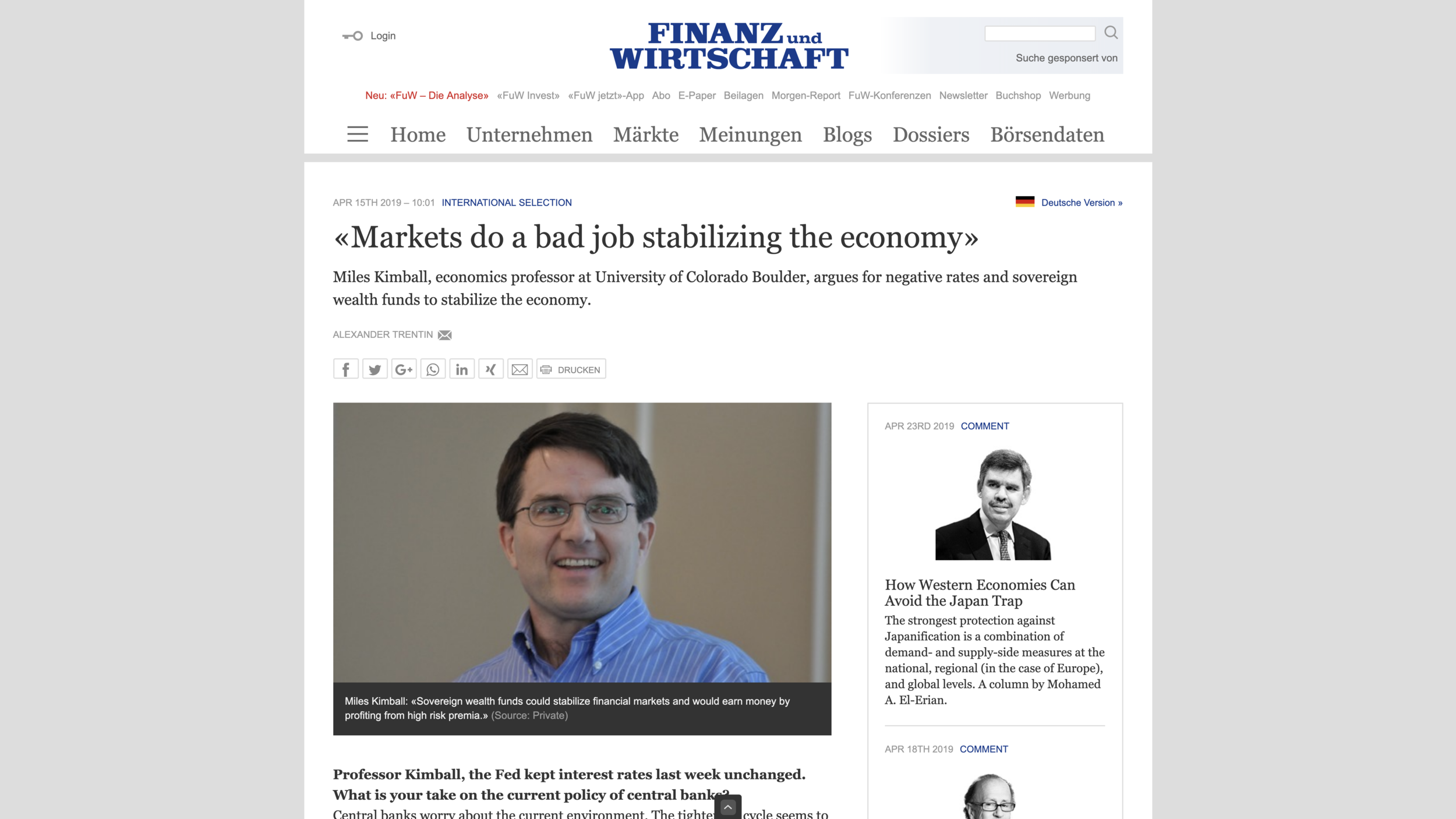
I am grateful for permission to reproduce the text of this interview here on my blog. I have been pleased with all of Alexander Trentin's interviews of me. The previous interviews are here:
Negative Interest Rates and Financial Stability: Alexander Trentin Interviews Miles Kimball
Alexander Trentin: Negative Interest Rates and the Swan Song of Cash
The International Trade System Should Be Designed to Foster More Balanced Trade
Alexander Trentin Interviews Miles Kimball on Next Generation Monetary Policy
Also, let me highlight this piece by Alexander:
What follows is Alexander’s newest interview of me:
Miles Kimball, economics professor at University of Colorado Boulder, argues for negative rates and sovereign wealth funds to stabilize the economy.
Miles Kimball: “Sovereign wealth funds could stabilize financial markets and would earn money by profiting from high risk premia.”
Professor Kimball, the Fed kept interest rates last week unchanged. What is your take on the current policy of central banks?
Central banks worry about the current environment. The tightening cycle seems to be coming to an end. It is about a balance of risks. From a political perspective, it might be easier now for the Fed and other central banks to keep rates unchanged or lowering them rather than increasing them. If a central bank raises rates in the current environment, people will blame it if the economy does badly. By contrast, it seems less risky to be lenient: if inflation heats up, inflation will just be moving in the direction of the inflation target. At this moment, politics and good policy are aligned. One positive factor is that long-term yields are much lower.
How is that positive?
During and after the financial crisis the expectations of interest rates were too high, the expectations turned out to be wrong as interest rates stayed low. Now the situation has changed: long-term yields and expectations for future interest rates are low. The reason is that markets know the playbook of central banks: how they would deal with an economic downturn with all the new policy tools. The last time the markets didn’t know that. This is positive for the economy, because long-term rates matter as well as short-term rates for the economy. And long-term rates depend on expectations of future central bank policy. However, given where it is now, the Eurozone could be in trouble if the ECB feels it can’t lower rates any further.
Do you mean you think the ECB should set negative rates further below zero?
Yes. Things are not going that well in the Eurozone. In comparison, Japan appears to have a much stronger recovery. The ECB should think of its next move, especially how to set lower rates. There is one easy thing they could implement that would open the way to set rates considerably lower.
What do you propose?
The immediate concern about negative rates is not yet that people would store paper currency, but a concern about bank profits and a concern that there would be bad headlines if savers faced negative interest rates on their accounts. Central banks should subsidize the provision of zero interest rates in checking and savings accounts, up to a limit. Then checking and savings accounts with balances under that limit would not be affected by negative policy rates. You could tell people: We are implementing negative rates in a way that shields regular people from negative rates in their checking and savings accounts.
But wouldn’t that dilute the effect of a negative interest rate policy?
It is totally misguided to think that negative rates on small checking and savings accounts are a crucial part of the transmission mechanism. A few thousand dollars per person could be exempted without any serious harm to the transmission mechanism. Those with large amounts in checking and savings accounts would still be subject to negative rates, and it is the interest rate on the last dollar or euro or franc in large accounts that matters for transmission.
How do you answer concerns that negative rates are a burden for bank profits?
Central banks do worry about the effect on bank profits when negative interest rates reduce net interest margins. But the main way in which negative rates reduce net interest margins is that banks are reluctant to reduce rates on checking and savings accounts below zero. If the central bank subsidizes zero rates for small checking and savings accounts, it deals with this in two ways: first, with the subsidy, bank profits do not suffer from providing zero rates to small accounts, and second, the limit on the quantity of checking and savings that can get the subsidy makes it easier for banks to explain why they need to have negative rates on large accounts beyond that level.
Are there other ways to help banks in a negative rate environment?
Even if a central bank doesn’t want to subsidize zero rates for small accounts, there are many ways in which central banks can effectively throw money at commercial banks to help their balance sheets. The question is more whether it is politically viable to throw money to commercial banks—and the answer is yes if it is done in the right way. In the Eurozone, the LTRO programs offers banks cheap liquidity to do more lending. And in Switzerland, you have tiered reserves, which excludes some bank reserves from negative rates. Nevertheless of concerns about net interest margins, which the subsidy for zero rates on small accounts takes care of, negative rates are helpful to bank balance sheets. First, banks profit from capital gains when interest rates decreases. Second, banks benefit from a more robust economy as fewer people and businesses default.
The Fed stopped its interest rate hikes not only due to macroeconomic news but also due to financial market turmoil. Should financial markets influence monetary policy?
I am not sympathetic to the idea that central banks should observe the stock market closely. There is too much noise trading. The conditions in the stock markets are not very important for the capital costs of companies; stock prices affect financing costs directly only when a firm does an IPO. What is more important is the risk premium observable in the market for commercial paper or junk bonds. There is research suggesting it would be better monetary policy if rates were routinely cut almost one-for-one if the spread between commercial paper rates and Treasury bill rates, or the spread between junk bond rates and Treasury bill rates increases beyond what can be justified by increased default risk. Though this policy can be justified without any reference to financial stability, it also helps improve financial stability.
What if a central bank is not ready to implement deep negative rates?
One solution would be to finance a sovereign wealth fund by issuing Treasury bills. This is much safer than borrowing to spend money with the idea of using fiscal policy to stimulate the economy. I think it is much better to add debt to buy assets than to add debt to increase government spending. Sovereign wealth funds could stabilize financial markets and would earn money by profiting from high risk premia. Organizationally, they should be independent of Central Banks as they require a different kind of expertise.
When advocating intervention in financial markets, you seem to mistrust markets.
I defer to the market microeconomically, but not macroeconomically. If the government wants to intervene in a microeconomic way, there should be a high burden of proof. However, markets by themselves do a bad job stabilizing the economy at a macroeconomic level. There are chronically high risk premia, fluctuations are too large, and sticky prices lead to regular business cycles. I also don’t agree with free bankers who say that a private market should be responsible for monetary policy. Governments have a large risk-bearing capacity, that political entrepreneurs will try to use in one way or another—typically by government guarantees that are off budget but often cost taxpayers dearly when something goes wrong and the government has to pay up on the guarantee. This applies also to the need for the government to do bailouts if the economy would otherwise fall apart. With a sovereign wealth fund, taxpayers would not only bear the risks but would also gain the profits from this risk-bearing capacity. And done right, a sovereign wealth fund would add to financial stability and so make it less likely that the government would need to do a bailout. However, higher capital requirements, beyond those currently mandated, are the real key to greater financial stability.
What do you think of Modern Monetary Theory, which advocates using debt-financed fiscal policy to have full employment?
I think in an extreme interpretation MMT is technically not correct. In a not so extreme interpretation, it is equivalent to standard economic theory—which means it would have none of the new implications MMT folks are claiming. But even if MMT is not correct, it might be politically helpful and I welcome a diverse field of opinions. Here is how it might be helpful: government spending is currently not responsive enough to the level of interest rates – if interest rates are low, spending—especially government spending on genuine investments that will raise government revenue later on—should be higher. However, I don’t think fiscal policy should do the job of monetary policy to stabilize the economy. Whenever I hear a central bank president saying they need more help from fiscal policy, I want to say: “Don’t wait for fiscal policy—do your job!” If their tools are not sufficient, they should innovate to add new tools to their toolkit.
Other posts on negative interest rate policy are organized in this bibliographic post:
Other posts related to sovereign wealth funds:
How a US Sovereign Wealth Fund Can Alleviate a Scarcity of Safe Assets
How to Stabilize the Financial System and Make Money for US Taxpayers
Four More Years! The US Economy Needs a Third Term of Ben Bernanke
After Crunching Reinhart and Rogoff’s Data, We Found No Evidence High Debt Slows Growth
Roger Farmer and Miles Kimball on the Value of Sovereign Wealth Funds for Economic Stabilization
Answering Adam Ozimek’s Skepticism about a US Sovereign Wealth Fund
Tristan Hanson and Eric Lonergan: What Would a UK Sovereign Wealth Fund Look Like?
In addition, I have three storified Twitter discussions about sovereign wealth funds:
some posts on closely related issues (two of which are guest posts):
and many posts (of which I will only list three right now) on a key scientific issue relevant for sovereign wealth funds–the level of efficacy of quantitative easing:
Trillions and Trillions: Getting Used to Balance Sheet Monetary Policy
Wallace Neutrality Roundup: QE May Work in Practice, But Can It Work in Theory?
Freakonomics: The Story of Bananas
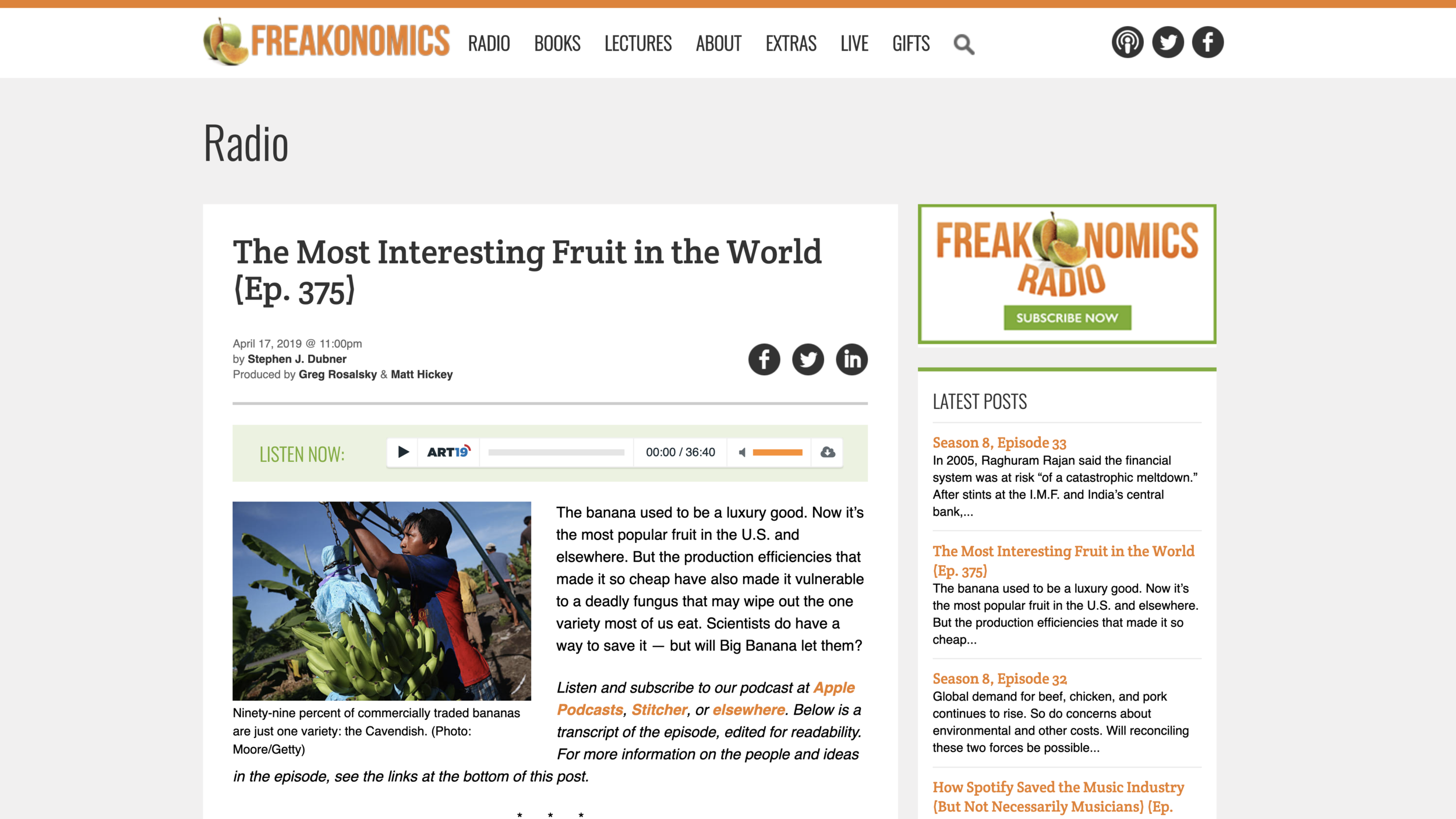
The story of bananas told by Freakonomics podcast #375: “The Most Interest Fruit in the World,” is fascinating. According to the podcast, one reason that bananas are as inexpensive as they are is that almost all the bananas we see are clones: the Cavendish variety. As a result, techniques for dealing with those bananas can be standardized.
Unfortunately, the fungus that knocked the Gros Michel or “Big Mike” clones from their top banana spot is coming for the Cavendish clones. It looks like the fungus can be defeated by adding or editing genes to match key genes of another variety of bananas that doesn’t have all the desirable properties of the Cavendish variety, but can defeat the fungus. That may save the day. But many people are leery of adding or editing genes. The most likely outcome is that in the future, the typical grocery store will have more varieties of bananas: a tweak on the Cavendish for those who are OK with genetic modification or editing and other varieties for those who aren’t.
I love bananas. Unfortunately, they are a somewhat high on the insulin index: 59 or so. (See “Forget Calorie Counting; It's the Insulin Index, Stupid.” In the belief that green bananas have a lower insulin index than that, I buy the greenest bananas I can find in the grocery store, and then put them in the refrigerator as soon as I get home. This isn’t what most people do: after shipping, bananas are put into ripening rooms for 4-7 days, because most people want yellow bananas.
A common treat for me is to cut up a green banana and poor over it half a can of coconut milk from Costco (actually coconut cream—not the watery stuff):

I sprinkle on some Ceylon cinnamon from Whole Foods:

I also often add a bit of Swerve.
In addition to bananas, I often get Plantains. I often don’t know how ripe a plantain will be. Even if it looks somewhat green, a Plantain is often ripe enough that I can eat it exactly as I would a banana. If it is less ripe than that, I slice it up, fry it in avocado oil and eat it with goat butter. The experience is somewhere in between that of eating a baked potato and eating the french fries—both of which I now carefully avoid.
Don’t miss my other posts on diet and health:
I. The Basics
Jason Fung's Single Best Weight Loss Tip: Don't Eat All the Time
What Steven Gundry's Book 'The Plant Paradox' Adds to the Principles of a Low-Insulin-Index Diet
II. Sugar as a Slow Poison
Best Health Guide: 10 Surprising Changes When You Quit Sugar
Heidi Turner, Michael Schwartz and Kristen Domonell on How Bad Sugar Is
Michael Lowe and Heidi Mitchell: Is Getting ‘Hangry’ Actually a Thing?
III. Anti-Cancer Eating
How Fasting Can Starve Cancer Cells, While Leaving Normal Cells Unharmed
Meat Is Amazingly Nutritious—But Is It Amazingly Nutritious for Cancer Cells, Too?
IV. Eating Tips
Using the Glycemic Index as a Supplement to the Insulin Index
Putting the Perspective from Jason Fung's "The Obesity Code" into Practice
Which Nonsugar Sweeteners are OK? An Insulin-Index Perspective
V. Calories In/Calories Out
VI. Other Health Issues
VII. Wonkish
Framingham State Food Study: Lowcarb Diets Make Us Burn More Calories
Anthony Komaroff: The Microbiome and Risk for Obesity and Diabetes
Don't Tar Fasting by those of Normal or High Weight with the Brush of Anorexia
Carola Binder: The Obesity Code and Economists as General Practitioners
After Gastric Bypass Surgery, Insulin Goes Down Before Weight Loss has Time to Happen
A Low-Glycemic-Index Vegan Diet as a Moderately-Low-Insulin-Index Diet
Analogies Between Economic Models and the Biology of Obesity
Layne Norton Discusses the Stephan Guyenet vs. Gary Taubes Debate (a Debate on Joe Rogan’s Podcast)
VIII. Debates about Particular Foods and about Exercise
Jason Fung: Dietary Fat is Innocent of the Charges Leveled Against It
Faye Flam: The Taboo on Dietary Fat is Grounded More in Puritanism than Science
Confirmation Bias in the Interpretation of New Evidence on Salt
Eggs May Be a Type of Food You Should Eat Sparingly, But Don't Blame Cholesterol Yet
Julia Belluz and Javier Zarracina: Why You'll Be Disappointed If You Are Exercising to Lose Weight, Explained with 60+ Studies (my retitling of the article this links to)
IX. Gary Taubes
X. Twitter Discussions
Putting the Perspective from Jason Fung's "The Obesity Code" into Practice
'Forget Calorie Counting. It's the Insulin Index, Stupid' in a Few Tweets
Debating 'Forget Calorie Counting; It's the Insulin Index, Stupid'
Analogies Between Economic Models and the Biology of Obesity
XI. On My Interest in Diet and Health
See the last section of "Five Books That Have Changed My Life" and the podcast "Miles Kimball Explains to Tracy Alloway and Joe Weisenthal Why Losing Weight Is Like Defeating Inflation." If you want to know how I got interested in diet and health and fighting obesity and a little more about my own experience with weight gain and weight loss, see “Diana Kimball: Listening Creates Possibilities” and my post "A Barycentric Autobiography.
John Locke: Usurpation is a Kind of Domestic Conquest, with this Difference, that an Usurper Can Never Have Right on His Side

Chapter XVII of John Locke’s 2d Treatise on Government: Of Civil Government, “Of Usurpation,” has a very simply point, expressed in the title above. By simple usurpation, John Locke means taking a role in a government one is not entitled to, without otherwise changing the form of the government. Increasing the power of that role beyond what that role is entitled to would be tyranny added to usurpation:
§. 197. AS conquest may be called a foreign usurpation, so usurpation is a kind of domestic conquest, with this difference, that an usurper can never have right on his side, it being no usurpation, but where one is got into the possession of what another has a right to. This, so far as it is usurpation, is a change only of persons, but not of the forms and rules of the government: for if the usurper extend his power beyond what of right belonged to the lawful princes, or governors of the commonwealth, it is tyranny added to usurpation.
Even simple usurpation is a serious violation of the principle of consent. Indeed, John Locke repeatedly compares a violation of the method a state has for choosing its leaders as being akin to anarchy:
§. 198. In all lawful governments, the designation of the persons, who are to bear rule, is as natural and necessary a part as the form of the government itself, and is that which had its establishment originally from the people; the anarchy being much alike, to have no form of government at all; or to agree, that it shall be monarchical, but to appoint no way to design the person that shall have the power, and be the monarch. Hence all commonwealths, with the form of government established, have rules also of appointing those who are to have any share in the public authority, and settled methods of conveying the right to them: for the anarchy is much alike, to have no form of government at all: or to agree that it shall be monarchical, but to appoint no way to know or design the person that shall have the power, and be the monarch. Whoever gets into the exercise of any part of the power, by other ways than what the laws of the community have prescribed, hath no right to be obeyed, though the form of the commonwealth be still preserved; since he is not the person the laws have appointed, and consequently not the person the people have consented to. Nor can such an usurper, or any deriving from him, ever have a title, till the people are both at liberty to consent, and have actually consented to allow, and confirm in him the power he hath till then usurped.
I find John Locke’s comparison of usurpation to anarchy puzzling. Even in the Roman Empire, where usurpation occurred with stunning frequency, the situation was much better than anarchy. And if usurpation occurred only occasionally, the improvement over anarchy might be quite substantial, assuming those usurpations were not combined with tyranny. (It is possible that the word anarchy did not have quite the same connotations in John Locke’s day as it does now.)
For links to other John Locke posts, see these John Locke aggregator posts:
Neil Lewis Jr.: Has Gender Stereotype Threat Declined? →
The title is a link to an interesting Twitter thread about stereotype threat.