Libertarianism, a US Sovereign Wealth Fund, and I
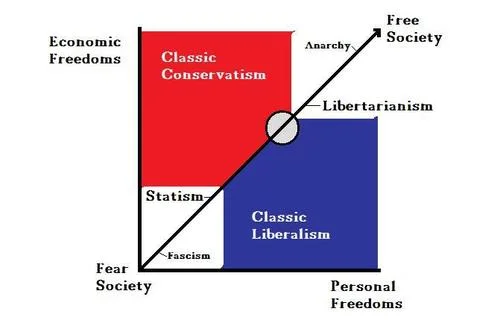
In reaction to my Quartz column “Why the US Needs Its Own Sovereign Wealth Fund” (which I followed up with “Miles’s First TV Interview: A US Sovereign Wealth Fund” and “Miles Kimball, David A. Levine, Robert Waldmann and Noah Smith on the Design of a US Sovereign Wealth Fund.”), I received this question:
Question:
Chris Lindsay Advocating another government agency? The “libertarian” label that I see/hear people put on you is being tested. Heh.
Answer:
There are really two questions here: (A) “Am I a Libertarian?” and (B) “How can I square my proposal for a US Sovereign Wealth Fund with a concern for freedom and the consequences of too much government power for freedom?”
(A) Philosophically, I am much closer to being a Utilitarian than a Libertarian. Given that, how is it that I sound as much like a Libertarian as I do?
- First, I believe that people love freedom–and hate being under someone else’s thumb–so freedom should be very important to a Utilitarian. I discuss evidence for human beings’ love of liberty and hatred of oppression in my post “Judging the Nations: Wealth and Happiness are Not Enough,” which expands on my Quartz column “Obama the libertarian? Americans say they’d be happy if government got out of the way.”
- Second, I love freedom myself. I think about freedom a lot when I am writing posts. Typing in the word “freedom” in the search box at my sidebar will lead you to an interesting set of posts that back up this claim. One of the most memorable things I heard from my peers in grade school was “It’s a free country”–a statement that always had, in context, a clear practical meaning. To me “It’s a free country” means that anyone who wants to tell me to do something has the burden (sometimes easy, sometime hard) of persuading me that is what I should do.
- Third, I believe that freedom has enormous instrumental value in furthering all of our other interests. Freedom of thought fosters science. Freedom of speech fosters better government. Freedom in making economic decisions fosters prosperity.
However, the statement that freedom in making economic decisions fosters prosperity must be qualified if there is theft, deception or violence, and it must be qualified if there is serious internal conflict or a lack of understanding on the part of the decision-maker.
One area where I am not Libertarian at all is in the regulation of food and drink, where I think most of us face serious internal conflict–one part of each of us wanting to do one thing, the other part another thing. Of course, any benefits of such regulation need to be weighed against my first point–the simple fact that people love freedom and hate being under someone else’s thumb–often even when they believe it is for their own good. And the administration of rules often attracts as functionaries those who like to boss others around–something that makes an abridgment of freedom even more painful.
(B) Now, let’s judge a US Sovereign Wealth Fund against a concern for freedom. All a US Sovereign Wealth Fund does is buy risky assets, financed by the issuance of Treasury bills and Treasury bonds. (Think in terms of an initial fund of $1 Trillion, financed by the issuance of Treasury bill and Treasury bonds.) The US Sovereign Wealth Fund does not tell anyone, other than its employees, what to do. It would not have the same political pressures to undercharge customers and overpay employees (and thereby lose money) as other government enterprises. Indeed, I am much more worried that political pressure would cause the US Sovereign Wealth Fund to underpay its key employees. Rather than costing money as government spending does and thereby leading to higher taxes, a US Sovereign Wealth Fund would most likely make money for the government, and thereby allow lower taxes. Since higher taxes are a serious blow to freedom, anything likely to reduce them is–at least on that account–a plus for freedom.
Notice that a US Sovereign Wealth Fund reduces the temptation to dream up additional government spending to take advantage of the very low interest rates at which the US government can borrow. We should indeed borrow more to take advantage of low real interest rates, but we should weigh carefully whether we should be spending more or putting those borrowings to work in the asset markets.
“Fairness” to Firms. Some financial firms will dislike a US Sovereign wealth fund because it would act, in effect, as a competitor. They would say it unfair that they have to compete with an institution that can borrow at such a low rate. But which is more fair–to have all taxpayers share in some of the benefits of the rich return to risk available in asset markets, or to have a much smaller share of the population take all of the benefit through the financial firms, often costing taxpayers directly when they need bailouts? And none of this fairness discussion has anything directly to do with freedom.
Limiting the Influence of Politics on the US Sovereign Wealth Fund. I have discussed in previous posts how, in order to insulate the US Sovereign Wealth Fund from political pressures to invest in particular companies or industries, it is important that it have a level of independence comparable to (but separate from) the Federal Reserve. A board with long, staggered terms would hire and fire the portfolio managers, with a dual mandate to make a good return for taxpayers and to contribute to financial stability through a contrarian investment strategy and through having a staff with deep financial expertise.
But there is one other key issue for a US Sovereign Wealth Fund I haven’t yet addressed. To avoid backdoor regulation, it is important to have a structure that limits the influence of politics on how the shares owned by the US Sovereign Wealth Fund are voted. When I first thought of this, I was inclined to totally prohibit shareholder voting by the US Sovereign Wealth Fund. But banning all voting could hurt returns, as when it is time to vote for a takeover that would significantly raise the value of shares. So here is my proposal. The Federal Reserve System has industry input through the boards of the regional Federal Reserve banks. Suppose we created a system where pension fund managers with broadly diversified portfolios would have representation on a council that would decide on how the US Sovereign Wealth Fund’s shares were voted. They would have no other formal role in the US Sovereign Wealth Fund. With broadly diversified portfolios like the broadly diversified portfolio of the US Sovereign Wealth Fund, their interests in raising their own returns should be reasonably consistent with taxpayers’ interests in earning a higher return. The head of the US Sovereign Wealth Fund would serve on this council on the voting of shares, in order to allow some coordination with the portfolio decisions and financial stability concerns of the US Sovereign Wealth Fund, but none of the other members of the governing board of the US Sovereign Wealth Fund would serve on the council on the voting of shares.
Edmund Burke's Wisdom
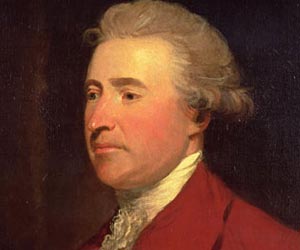
Like many, I think highly of Edmund Burke. The introduction to the Wikipedia article on Edmund Burke indicates how many want to claim him as one of their guiding lights:
Edmund Burke (12 January 1729 – 9 July 1797) was an Irish statesman, author, orator, political theorist and philosopher who, after moving to England, served for many years in the House of Commons of Great Britain as a member of the Whig party.
He is mainly remembered for his support of the cause of the American Revolutionaries, and for his later opposition to the French Revolution. The latter led to his becoming the leading figure within the conservative faction of the Whig party, which he dubbed the “Old Whigs”, in opposition to the pro–French Revolution “New Whigs”, led by Charles James Fox.
Burke was praised by both conservatives and liberals in the 19th century.Since the 20th century, he has generally been viewed as the philosophical founder of modern conservatism, as well as a representative of classical liberalism.
The website brainyquote.com has a beautiful layout of quotations from Edmund Burke. Here are some of my favorites among those I had not seen before.
- Nobody made a greater mistake than he who did nothing because he could do only a little.
- If we command our wealth, we shall be rich and free; if our wealth commands us, we are poor indeed.
- Religion is essentially the art and the theory of the remaking of man. Man is not a finished creation.
- Hypocrisy can afford to be magnificent in its promises, for never intending to go beyond promise, it costs nothing.
- Sin has many tools, but a lie is the handle which fits them all.
- Never despair, but if you do, work on in despair.
- Facts are to the mind what food is to the body.
- All human laws are, properly speaking, only declaratory; they have no power over the substance of original justice.
There is one quotation from Edmund Burke that I don’t like:
- But the age of chivalry is gone. That of sophisters, economists, and calculators has succeeded; and the glory of Europe is extinguished forever.
Miles's First TV Interview: A US Sovereign Wealth Fund
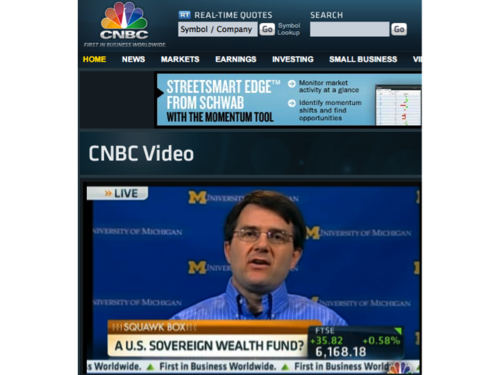
Here is a link to my first TV interview. It was about my proposal for a US Sovereign Wealth Fund.
This interview was sparked by my Quartz column “Why the US Needs Its Own Sovereign Wealth Fund.”
The primary motivation for having a US Sovereign Wealth Fund is to give the Fed running room for monetary policy. (Its establishment is a powerful balance sheet operation–more powerful than quantitative easing with long-term government bonds or mortgage backed securities.) But I think there are other benefits of a sovereign wealth fund as wealth fund:
- making money for the taxpayer,
- contributing to financial stability both directly by a contrarian investment strategy and indirectly through the financial expertise of its staff, and
- serving as a political lightning rod to draw political controversy away from the Fed.
Within the Overton Window

Yesterday, I listed some proposals that are not yet easy for politicians to talk about. Today, let me list some policy positions I favor that are sometimes echoed by politicians, and so lie within the Overton window of what can be said without sounding too extreme. Here they are, with links:
- Free Trade
- Free Speech
- Charter Cities
- School Choice
- The Free Market
- Copyright Reform
- Honoring Tax Payers
- Libertarian Paternalism
- Redesigning Mortgages
- Laws Against Deception
- Taking Care of the Poor
- Nonpartisan Redistricting
- Medical Reform Federalism
- Keeping the Federal Reserve
- The Reintroduction of the Deutsche Mark
- A Dramatic Reduction in Occupational Licensing
- Exporting Jobs to Places They are Desperately Needed
- Public Health Interventions in the Area of Food and Drink
- Frontloading Federal Transfers to States During Recessions
- Going to War If Necessary to Stop Iran from Getting Nuclear Weapons
- The End of Income Taxes and Capital Taxes, Replaced by Consumption Taxes (also here)
- The Careful Use of Subjective Measures of Well Being to Inform Policy (also here)
- A Modest Carbon Tax (also here) and Increased Support for Research in Low-Carbon Energy Technology, Without Alarmism
- Reorienting Unions and Workplace Law toward Improving the Workplace Experience and away from Politics and from Artificially Pushing Up Wages and Benefits
Together with yesterday’s post, this post gives an update to the post
which in turn is an update of
The Overton Window

A while back, I was intrigued by Chris Dillow’s mention of the “Overton window” in his post “Fiscal Policy and the Overton Window.”
Wikipedia defines the Overton window as follows:
The Overton window is a political theory that describes as a narrow “window” the range of ideas that the public will find acceptable, and that states that the political viability of an idea is defined primarily by this rather than by politicians’ individual preferences.[1]It is named for its originator, Joseph P. Overton,[2] a former vice president of the Mackinac Center for Public Policy.[3] At any given moment, the “window” includes a range of policies considered politically acceptable in the current climate of public opinion, which a politician can recommend without being considered too extreme to gain or keep public office.
The set of ideas politicians feel they can talk about in turn limits the range of ideas that are considered relevant policies for typical political debates. As a result, a great deal of political discussion is about a very narrow range of policies. One of the most important ways that the blogosphere can contribute to the political debate is by talking about attractive policies that politicians are not talking about. That makes those policies more familia–and so safer for politicians to talk about–thereby expanding the Overton window.
I have proposed a many policies that are currently not a big part of the political discussion in our country. It is my hope that additional discussion of these ideas in the blogosphere can expand the Overton window to encompass them as genuine political possibilities. Here are a few, with links:
- Electronic Money as a Way to Eliminate the Zero Lower Bound on Monetary Policy
- A Public Contribution System as an Alternative to Tax Increases
- Federal Lines of Credit as an Alternative to Tax Rebates
- A US Sovereign Wealth Fund to Give the Fed Running Room
- A Constitutional Amendment to Limit Government Spending to Less than Half of GDP
- A Dramatic Increase in Legal Immigration
- Year-Round Schooling
For proposals that are more nearly within the bounds of current political debate, see my post “Within the Overton Window,”
Note: This post, plus “Within the Overton Window” constituted a list of "save-the-world posts.“ My most current list of "save-the-world posts” is “Making a Difference: Save-the-World Posts as of December 3, 2013."
An earlier list of "save-the-world” posts can be found in
and still earlier in
Yes, There is an Alternative to Austerity Versus Spending: Reinvigorate America's Nonprofits
I like the name my editor, Mitra Kalita, gave to the link itself, as well:
Twitter Round Table on Our Disastrous Policy of Pegging Paper Currency at Par →
Before reading this Twitter round table, linked here and above, I recommend reading my short post “Paper Currency Policy: A Primer.”
Paper Currency Policy: A Primer →
The title is a link to storified tweets. I have transcribed them below as well. The last tweet is a link to what will be tomorrow’s post. So you can get a sneak peak.
- Let me explain paper currency policy a little more. Our current paper currency policy is that 1 paper $ = 1 electronic $ always.
- Let’s treat the electronic $ (e-$) as our yardstick–the unit of account. We want to encourage people to state prices in terms of the e-$.
- With 1 paper $ = 1 electronic $ all the time, paper currency earns a zero rate of interest. So people won’t lend at a worse negative rate.
- So a paper currency policy of pegging paper currency at par (1 p-$ = 1 e-$) puts a floor of zero under interest rates.
- Like other price floors, a floor of 0 on interest rates messes up markets big time when the equilibrium interest rate would otherwise be <0.
- We see the messed up markets from the floor of 0 on interest rates all around us these days in the troubled world economy.
- The alternative paper currency policy looks like this: In January 2013, 1 paper $ = 1 e-$. In January 2014, 1 paper $ = .95 e-$.
- If 1 paper $ = 1 e-$ now, but 1 paper-$ = .95 e-$ a year from now (95 e-cents), then paper currency effectively earns a -5% interest rate.
- Call our current paper currency policy “pegging at par.” (Par: 1 p-$=1 e-$) The alternative paper currency policy is called a crawling peg
- With a crawling peg that allows paper currency to depreciate relative to electronic money, paper money earns a negative interest rate.
- If the crawling peg makes paper money earn -5%, there is no reason the Fed can’t choose any interest rate above -5%.
- Institutionally, the Fed should be given control of paper currency policy and have the target rate and ROR on paper money move together.
- ROR = rate of return = effective interest rate in a case like this, when the ROR is a fixed, certain number.
- The Fed should move the effective interest rate on paper money in tandem with the fed funds rate and the interest rate on excess reserves.
- For those just tuning in, here is my first column on electronic money and a followup column: http://qz.com/21797/the-case-for-electric-money-the-end-of-inflation-and-recessions-as-we-know-it/ http://qz.com/35991/could-the-uk-be-the-first-country-to-adopt-electronic-money/
- Twitter Round Table on Our Disastrous Policy of Pegging Paper Currency at Par: http://storify.com/mileskimball/twitter-round-table-on-our-disastrous-policy-of-pe
The Spell of Mathematics

Poincare’s Prize, by George Szpiro
For those who are mathematically inclined, a good math problem has the power to take over the mind like nothing else. George Szpiro’s book Poincare’s Prize describes how attempts to prove the Poincare Conjecture had just this effect on many mathematicians. The Poincare Conjecture was finally proved by the reclusive Russian mathematician Grigori Perelman, who refused the $1 million prize that the Clay Institute wanted to award for his proof.
The spell of mathematics is nicely illustrated by a hair-raising story about RH Bing, who was one of the many mathematicians who contributed to the solution of the Poincare Conjecture. George Szpiro quotes a a University of Texas at Austin memorial tribute to Bing as follows:
It was a dark and stormy night when RH Bing volunteered to drive some stranded mathematicians from the fogged-in Madison airport to Chicago. Freezing rain pelted the windscreen and iced the roadway as Bing drove on–concentrating deeply on the mathematical theorem he was explaining. Soon the windshield was fogged from the energetic explanation. The passengers too had beaded brows, but their sweat arose from fear. As the mathematical description got brighter, the visibility got dimmer. Finally, the conferees felt a trace of hope for their survival when Bing reached forward–apparently to wipe off the moisture from the windshield. Their hope turned to horror when, instead, Bing drew a figure with his finger on the foggy pane and continued his proof–embellishing the illustration with arrows and helpful labels as needed for the demonstration. (p. 128)
I don’t recommend RH Bing’s driving while proving, but this story reminds me of the feeling I have often had that a math problem promises sparkling hidden knowledge just beyond the next obstacle, or that proving a long-sought-after result will briefly make me something more than merely human. That kind of mathematical spell can easily keep me up at night. Indeed, chasing a mathematical will-o’-the-wisp that seemed to promise–but did not deliver–a powerful proof, kept me up most of the night through the wee hours of this past Tuesday.
Q&A on the Financial Cycle
Question: eloquentwhimsy asked you:
What do you make of Claudio Borio’s new working paper (“The financial cycle and macroeconomics: What have we learnt?”), in particular the idea of needing to model money as an active rather than “frictional” factor and the importance of debt and credit cycles (which is similar to Hyman Minsky’s work)? In particular, the idea that private sector debt-reduction should be the most important part of any solution to the recession has long struck me as the ultimate reason to see policies like yours (Federal Lines of Credit) as the future of Government stimulus which ultimately should seek to empower households and firms to pay down their debts. There are two primary benefits to this: cutting out the middleman of stimulus projects and eliminating “multiplier” estia.
Answer: It took me a long time to think through this one. I found Claudio Borio’s paper very interesting. Here are some thoughts:
- A great deal of our current trouble is due to the zero lower bound on nominal interest rates. I think electronic money is the most straightforward way to get more aggregate demand and allow us to return to the natural level of output.
- I am intrigued by your argument that Federal Lines of Credit, as described in my post “Getting the Biggest Bang for the Buck in Fiscal Policy” and in my short-run fiscal policy sub-blog http://blog.supplysideliberal.com/tagged/shortrunfiscal might also be helpful in balancing the economy in our current situation, even if we did have electronic money. Certainly, in the absence of electronic money, Federal Lines of Credit would help immensely, both to create additional aggregate demand and to reduce the most troublesome components of household debt. I have always thought that an important benefit of Federal Lines of Credit would be making households feel more secure so that they would spend more, even if a household does not actually need to draw on its Federal Line of Credit at all.
- Claudio emphasizes the effects that the financial cycle has on the natural level of output. It occurred to me that my belief in a relatively high intertemporal elasticity of labor supply (see “What is a Supply-Side Liberal?”) indicates that the natural level of output might fluctuate quite a bit in response to financial phenomena. I am imagining, for example, a model that combines the irrational expectations of noise-trader models with the kind of machinery in models of “news shocks” such as Robert Barsky’s and Eric Sims’s “News Shocks and Business Cycles.”
- In relation to point 3, it is worth noting that, believing as I do that the elasticity of intertemporal substitution for consumption is below 1 and that income and substitution effects for labor supply are of roughly the same size, permanently higher rate of return expectations should lower labor supply, not raise it. To have the increase in labor supply necessary to have an irrational financial boom raise the natural level of output, either or both (a) the increased rate of return needs to be perceived as temporary–which is very interesting in this context–or (b) the increased risk could cause precautionary saving in the form of increased labor supply as well as reduced consumption.
- The bottom line I would emphasize is that research on financial dynamic stochastic general equilibrium models–including those that have irrational elements–needs to be brought together with research on business cycle dynamic stochastic general equilibrium models. As a step in that direction, a greater fraction of financial dynamic stochastic general equilibrium models should include elastic labor supply.
Marvin Goodfriend on Electronic Money

In this post, I wanted to line up a little more of the academic literature and history of thought on electronic money. In particular, Marvin Goodfriend ably lays out the principles behind electronic money in his November 2000 Journal of Money, Credit and Banking article
Here is what he says in his introduction:
… No one will lend money at negative nominal interest if cash is costless to carry over time. Therefore, the power of open market operations to lower short-term interest rates to fight deflation and recession is strictly limited when nominal rates are already low on average. (p. 1007)
Later, Marvin explains the difficulties caused by the zero lower bound in this way:
The zero bound is a potential problem for two reasons. First, negative real interest rates may have helped the economy to recover from recessions in the past, particularly in periods of financial market stress. Second, deflation expectations in economic downturns can actually raise expected real interest rates when nominal rates are at the zero bound, with perverse effects on demand and employment. The possibility of a deflation spiral worries economists and central bankers alike. Nominal interest rates might only need to be negative occasionally and temporarily. If they are not free to do so, however, recessions could be much deeper and longer than otherwise. (p. 1010)
Indeed, it is no exaggeration to say that a large share of the economic problems the world has faced in the last few years are a result of the zero lower bound created by the fact that currency now earns an interest rate of zero.
Moreover, Marvin points out that the difficulties created by the zero lower bound have motivated prominent economists to recommend a higher rate of inflation than they otherwise would:
Keynes (1936) was very much concerned with the consequences for macroeconomics and monetary policy of the zero bound on nominal interest rates. That concern was revived by Summers (1991,1996) and Fischer (1996). Summers and Fischer argue that central banks should target inflation in a range as high as 3 percent per year so that the inflation premium would make room for nominal interest rates to fall an additional 3 percentage points before hitting the zero bound. (p. 1008)
The Larry Summers and Stan Fischer references are:
- Fischer, Stanley. "Why Are Central Banks Pursuing Long-Run Price Stability?” In Achieving Price Stability, pp. 7-34. Kansas City: Federal Reserve Bank of Kansas City, 1996.
- Summers, Laurence. “Commentary: Why Are Central Banks Pursuing Long-Run Price Stability?” In Achieving Price Stability, pp. 35-43. Kansas City: Federal Reserve Bank of Kansas City, 1996.
- Summers, Laurence. “How Should Long-Term Monetary Policy be Determined.” Journal of Money, Credit, and Banking, 23 (August 1991, Part 2). 625-31.
Where Willem Buiter Goes Beyond Marvin Goodfriend. The only important thing Marvin misses is the possibility of a crawling peg exchange rate between electronic money (reserves) and currency that Willem Buiter discusses here and attributes to Robert Eisler in 1932:
Eisler, Robert (1932), Stable Money: the remedy for the economic world crisis: a programme of financial reconstruction for the international conference 1933; with a preface by Vincent C. Vickers. London: The Search Publishing Co.
Willem formalizes Eisler’s proposal of a crawling peg exchange rate between electronic money in two academic articles, which appeared after Marvin’s 2000 article:
Buiter, Willem H. (2004) ,”Overcoming the Zero Bound: Gesell vs. Eisler; Discussion of Mitsuhiro Fukao’s “The Effects of ‘Gesell’ (Currency) Taxes in Promoting Japan’s Economic Recovery” . Discussion presented at the Conference on Macro/Financial Issues and International Economic Relations: Policy Options for Japan and the United States, October 22-23, 2004, Ann Arbor, MI, USA. International Economics and Economic Policy, Volume 2, Numbers 2-3, November 2005, pp. 189-200. Publisher: Springer-Verlag GmbH; ISSN: 1612-4804 (Paper) 1612-4812 (Online).
Buiter, Willem H. (2007), “Is Numérairology the Future of Monetary Economics? Unbundling numéraire and medium of exchange through a virtual currency with a shadow exchange rate”, Open Economies Review, Publisher Springer Netherlands; ISSN 0923-7992 (Print); 1573-708X (Online). Electronic publication date: Thursday, May 03, 2007. See “Springer Website”.
I discuss the idea of a crawling peg exchange rate between currency and electronic money in my posts
- How Subordinating Paper Money to Electronic Money Can End Recessions and End Inflation
- How the Electronic Deutsche Mark Can Save Europe
- More on the History of Thought for Negative Nominal Interest Rates
- Could the UK be the First Country to Adopt Electronic Money?
- Miles’s First Radio Interview on Electronic Money
- Q&A: How Can Electronic Money Eliminate Inflation?
Marvin Goodfriend’s Proposal
Marvin’s proposal follows Silvio Gesell’s line of thought instead of Robert Eisler’s. Marvin writes:
Under my proposal, the floor on short-term nominal interest rates would be determined by the carry tax imposed by a central bank on electronic reserve balances. When interest rates are pressed against that floor, a monetary policy committee could vary the carry tax in order to adjust its interest rate target. The carry tax would anchor the short end of the yield curve much as, say, the intended federal funds rate does today in the United States. To assure that the carry tax on electronic reserve balances sets the economy’s nominal interest rate floor, a carry tax could also be imposed on currency and vault cash. I discuss how this might be done, too. (p. 1008)
Marvin elaborates later on as follows:
Modern payments system technology makes it possible to impose and vary a carry tax on electronic bank reserves at the central bank. With a system to do so in place, the zero bound would cease to be a technological constraint on interest rate policy. Whenever the intended target for the interbank interest rate reached zero, the policy committee could activate a daily tax on electronic reserve balances that would make the interbank rate negative. By calibrating the daily tax as a percent per annum, the policy committee could adjust the cost of carry so as to move the interbank rate in 25 basis point steps and continue to make interest rate policy exactly as it does today. 24
To supplement the carry tax on electronic reserves, a carry tax could be imposed on currency by imbedding a magnetic strip in each bill. The magnetic strip could visibly record when a bill was last withdrawn from the banking system. A carry tax could be deducted from each bill upon deposit according to how long the bill was in circulation since last withdrawn and how much carry tax was “past due.” Likewise, a carry tax could be assessed on currency held as vault cash in banks. (p. 1016)
There is a lot in Marvin’s paper, including a prescient discussion of balance sheet monetary policy, but let me focus two things I feel are particularly important: Marvin’s discussion of using an exchange rate target to stimulate an economy when up against the zero lower bound and his discussion of allowing a free floating exchange rate between currency and reserves.
Marvin Goodfriend’s Critique of Foreign Exchange Rate Targeting as a Way to Deal with the Zero Lower Bound.
Marvin writes:
McCallum (2000) suggests that a central bank confronting the zero bound should adopt the foreign exchange rate as its policy instrument. Specifically, he proposes following a monetary policy rule that varies an exchange rate policy instrument to stabilize inflation and output. This is not the place to discuss the operating characteristics of McCallum’s exchange rate rule. To get an idea of how an exchange rate instrument might work, however, suppose that a country pegged its currency at a much depreciated foreign exchange rate. The exchange rate depreciation, then, would create an increase in net exports, the nominal short interest rate would immediately match the foreign currency interest rate, and prices would move up over time in proportion to the exchange rate depreciation. The expected inflation would imply a low or even negative real interest rate for a while.
The problem with an exchange rate oriented monetary policy is that it could be perceived as working at the expense of its trading partners, and it might not work very well at all for a very large country such as the United States. If the United States adopted such a policy to lift itself out of a deflationary, zero bound trap, it might export deflation and recession without helping itself much. (p. 1012)
Suspension of Payment of Currency as a Way to Allow a Free Floating Exchange Rate Between Currency and Electronic Money. I find Marvin’s footnote 23 the most indispensable part of his paper, since to my knowledge, no one before or after has said it better. He writes:
23. In principle, as an alternative to imposing a carry tax on currency, banks could agree to suspend the payment of currency for deposits whenever a carry tax was imposed on electronic reserves at the central bank. Currency and deposits each have a comparative advantage in making payments. Currency is more efficient for small transactions made in person, and checkable deposits are useful for making larger payments at a distance. The respective demands for the two monies would be well-defined. The imposition of a negative nominal interest rate coupled with a suspension would cause the deposit price of currency to jump to the point that the expected negative deposit return to holding currency matched the negative nominal rate on deposits.
This mechanism is reminiscent of the temporary suspensions that occurred in the US prior to the establishment of the Federal Reserve. For instance, currency went to a few percent premium over deposits for a few months during the suspension that occurred in the aftermath of the banking panic of 1907.
Suspending the payment of currency for deposits would avoid the cost of imposing a carry tax on currency. After the initial capital gain, however, currency would bear the same expected negative return as deposits. Moreover, the proposal would involve the inconvenience of dealing with a fluctuating deposit price of currency. Furthermore, the possibility of making a capital gain on currency relative to deposits when a suspension occurs would create destabilizing speculative runs on the banking system. Such attacks would be annoying and costly for banks. Effort invested in attacking banks would be a waste of resources from society’s point of view.
To put this in my own words, not letting people get cash when they go to the bank will work as a way to free up the exchange rate between currency and electronic money (reserves), but it is very messy–perhaps dangerously so–compared to a managed, crawling peg exchange rate between currency and electronic money. Nevertheless, historical incidents in which payment of currency was suspended may provide important parallels for electronic money, providing a lower bound on how well electronic money would work. I would be very interested in learning more about the history of suspensions of payment of currency.
New Words for a New Year

Barbara Wallraff’s Word Fugitives
Inspired by Steven Pinker’s reference to it in The Stuff of Thought, I ordered Barbara Wallraff’s book Word Fugitives. Barbara had a column of this name in which one reader would propose an idea that deserved a new word to express it and other readers would propose candidates. Barbara’s book draws on several other books, including Rich Hall’s book Sniglets (Snig'lit: Any Word That Doesn’t Appear in the Dictionary, But Should), which has given the name “sniglets” to a wished-for word. Barbara has been selective, and I will be even more selective.
The holy grail of word coining is a set of gender neutral singular pronouns that succeed at becoming generally accepted; a huge number of candidates have been proposed for such pronouns. Among the proposals, I am partial to “shehe,” “herhim,” and “herhis.” These are are derived by deletion of the front slash from the clunky but unmistakable-in-meaning, already-in use combination pronouns “she/he,” “her/him” and “her/his.” Use of these combinations in speech (say in large economics lectures around the world), with appropriate slurring, would be a big step toward their general acceptance. They have the advantage that, if their use in speech is questioned, one can always claim after the fact to have included a silent front slash, while the front slash remains absent in the presence of more accepting hearers.
In various categories below, I have tried to choose words from Word Fugitives that will be genuinely useful, rather than just entertaining. So, for example, I left off the list the entertaining game-theory word “penultimatum,” defined as “I’m going to tell you this only one more time after this …” (p. 163). Some of my judgments are different from Barbara’s; I have put page numbers in Word Fugitives if you want to see what she says.
Policy
- blunderang: a measure undertaken with high hopes to make things better which, in fact, makes things worse. (p.104)
- fixasco: a problem caused by a heavy-handed attempt to cure another problem. (p. 104)
- virtuecrat: (1) someone who thinks fostering virtue is an important aim for public policy OR (2) someone who thinks certain public policy views are especially virtuous. (p. 23)
Psychology
- retrotort: a brilliant reply to an argument, realized after the fact. (p. 138)
- newbiquitous: adjective for something one hears about for the first time and then starts seeing everywhere. (p. 33)
- parentriloquism: saying something to one’s child and then realizing–often with shock–how much it sounds like one of one’s own parents. (p. 38)
- whomnesia: inability to remember a name one knew at one point. (p. 115)
Production
- fussgadget: an object that works only if one employs a trick known to its owner or a frequent user. (p. 75)
- showflake: a person who chronically misses every appointment. (p. 70)
- azugo: an item to be carried upstairs or downstairs by the next person going that way. (An example of joint production, p. 84)
Relationship Terms
- nieblings: nieces and nephews. (p. 7)
- consuegra: the mother-in-law of one’s son or daughter (p. 169, from Spanish)
- consuegro: the father-in-law of one’s son or daughter (p. 169, from Spanish)
In the area of relationship terms, I don’t like the standard terminology of, say “second-cousin once-removed” for the child of one’s second cousin, or the second cousin of one’s parent. It seems to me that family relationship terminology ought to highlight the vertical dimension–which generation someone else is in relation to the reference person–and then how distant horizontally. The “removed” in “second-cousin once removed” comes late, and worse leaves ambiguous whether the generational difference is up or down. My proposed alternative is to call all non-ancestor blood relatives (and their spouses) who are of an earlier generation uncles and aunts for one generation up, great uncles and aunts for two generations up, with more greats for higher generations, and to call all non-descendant blood relatives who are of a later generation nephews and nieces for one generation down, great nephews and nieces for two generations down, and so on. The horizontal distance is indicated by first, second, third, etc. For example, for me, it would be as follows:
- second aunt: one of my parent’s first cousins (female)
- second uncle: one of my parent’s first cousins (male)
- third aunt: one of my parent’s second cousins (female)
- third uncle: one of my parent’s second cousins (male)
- second great aunt: one of my grandparent’s first cousins (female)
- second great uncle: one of my grandparent’s first cousins (male)
- second niece: one of my first cousin’s daughters.
- second nephew: one of my first cousin’s sons.
- third niece: one of my second cousin’s daughters.
- third nephew: one of my second cousin’s sons.
- second great niece: one of my first cousin’s granddaughters
- second great nephew: one of my first cousin’s grandsons
Most people need an explanation, or at least a reminder, even for the standard terminology. So even the first use of this new terminology is not much more burdensome than the standard “removed” terminology. I maintain that after a few times of use, the new terminology will be easier to remember. And to me, the new terminology has warmer connotations than any terminology involving the word “removed.”
On my word wish list: I would like to know of more words like “widget,” that sound as if they were specific examples of things in economics, but in fact serve mainly as placeholders.
Steven Pinker on the Goal of Education
In the third-to-last and second-to-last paragraphs of The Stuff of Thought (pp. 438-439, emphasis added), Steven Pinker writes:
When all the pieces fall into alignment, people can grope their way toward the mouth of [Plato’s] cave. In elementary education, children can be taught to extend their number sense beyond “one, two, many” by sensing an analogy between an increase in rough magnitude and the order of number words in the counting sequence. In higher education, people can be disabused of their fallacies in statistics or evolution by being encouraged to think of a population as a collection of individuals rather than as a holistic figure. Or they can unlearn their faulty folk economics by thinking of money as something that can change in value as it is slid back and forth along a time line and of interest as the cost of pulling it forward. In science and engineering, people can dream up analogies to understand their subjects (a paintbrush is a pump, heat is a fluid, inheritance is a code) and to communicate them to others (sexual selection is a room with a heater and a cooler). Carefully interpreted, these analogies are not just alluring frames but actual theories, which make testable predictions and can prompt new discoveries. In the governance of institutions, openness and accountability can be reinforced by reminding people that the intuitions of truth they rely on in their private lives—their defense against being cheated or misinformed or deluded—also apply in the larger social arena. These reminders can militate against our natural inclinations toward taboo, polite consensus, and submission to authority.
None of this, of course, comes easily to us. Left to our own devices, we are apt to backslide to our instinctive conceptual ways. This underscores the place of education in a scientifically literate democracy, and even suggests a statement of purpose for it (a surprisingly elusive principle in higher education). The goal of education is to make up for the shortcomings in our instinctive ways of thinking about the physical and social world. And education is likely to succeed not by trying to implant abstract statements into empty minds but by taking the mental models that are our standard equipment, applying them to new subjects in selective analogies, and assembling them into new and more sophisticated combinations.
The one thing I want to add is: moral education serves an analogous purpose: to make up for the shortcomings in the behavior our untutored instincts would lead us into.
Matt Strassler on Theoretical Physics

Last night I asked my friend, University of Michigan Professor and theoretical physicist James Wells, what the latest evidence from CERN’s Large Hadron Collider means for supersymmetry. The main thing he said is that theory gives much less guidance for what the masses of hypothetical particles should be than one might gather from news accounts. In particular, even if supersymmetry is true, it is not clear that the idea that the lowest-mass supersymmetric particles will be in the range accessible to the Large Hadron Collider.
As a physics blog to trust on theoretical physics, James gave his highest recommendation to Matt Strassler’s blog Of Particular Significance. For those who want to go further, another theoretical physics blog with some inside jokes in it is Adam Falkowski’s blog Resonaances.
In case the Large Hadron Collider is not powerful enough to unlock all the mysteries of the physics, in our Quartz column “Maybe Europe’s unity doesn’t rest on its currency. Joint mission to Mars anyone?” Ruediger Bachmann and I mentioned another supercollider surpassing CERN’s current Large Hadron Collider as one of the many possible projects that would be a better symbol of European unity than the euro.
Steven Pinker on Scientific Etiquette
Steven Pinker, in The Stuff of Thought, pp. 437-438, writes:
… The intuition that ideas can point to real things in the world or can miss them, and that beliefs about the world can be true or just believed, can drive people to test their analogies for fidelity to the causal structure of the world, and to prune away irrelevant features and zero in on the explanatory ones.
Needless to say, this combination of aptitudes does not endow any of us with a machine for churning out truths. Not only is a single mind limited in experience and ingenuity, but even a community of minds won’t pool and winnow its inventions unless their social relationships are retuned for that purpose. Disagreements in everyday life can threaten our sense of face, which is why our polite interactions center on topics on which all reasonable people agree, like the weather, the ineptitude of bureaucracies, and the badness of airline or dormitory food. Communities that are supposed to evaluate knowledge, such as science, business, government, and journalism, have to find workarounds for this stifling desire for polite consensus. At a scientific conference, when a student points out a flaw in a presenter’s experiment, it won’t do to shut her up because the presenter is older and deserving of respect, or because he worked very hard on the experiment and the criticism would hurt his feelings. Yet these reactions would be perfectly legitimate in an everyday social interaction based on authority or communality.
… In science and other knowledge-driven cultures, the mindset of communality must be applied to the commodity of good ideas, which are each treated as resources to be shared. This is a departure from the more natural mindset in which ideas are thought of as traits that reflect well on a person, or inherent wants that comrades must respect if they are to maintain their communal relationship. The evaluation of ideas also must be wrenched away from our intuitions of authority: department chairs can demand larger offices and salaries, but cannot demand that their colleagues acquiesce to their theories. These radically new rules for relationships are the basis for open debate and peer review in science, and for the checks and balances and accounting systems found in other formal institutions.
Ryan Avent on a Key to Growth: Markets Broad and Deep →
This article by Ryan Avent situates the argument for free trade as part of a larger argument for “market potential,” using Natalia Ramondo, Andres Rodriguez-Clar and Milagro Saborio-Rodriguez’s NBER Working Paper “Scale Effects and Productivity Across Countries: Does Country Size Matter.”