Edward Harrison: Lael Brainard Speech Echoes Powell in Hawkish Fed Policy Shift →
The piece linked above is an excellent discussion of Lael Brainard's speech, which in turn is a very interesting discussion of the state of the US economy.
A Partisan Nonpartisan Blog: Cutting Through Confusion Since 2012
The piece linked above is an excellent discussion of Lael Brainard's speech, which in turn is a very interesting discussion of the state of the US economy.
In the course of arguing against parental power as a justification for monarchy, John Locke gives a powerful statement of how law serves freedom in section 57 of his 2d Treatise on Government: “Of Civil Government” (Chapter VI. Of Paternal Power).
First, John Locke argues that natural law is rational:
The law, that was to govern Adam, was the same that was to govern all his posterity, the law of reason. But his offspring having another way of entrance into the world, different from him, by a natural birth, that produced them ignorant and without the use of reason, they were not presently under that law; for nobody can be under a law, which is not promulgated to him; and by this law being promulgated or made known by reason only, he that is not come to the use of his reason, cannot be said to be under this law;
Then he makes the startling claim that because children can't fully understand natural law, they are not fully free:
... and Adam’s children, being not presently as soon as born under this law of reason, were not presently free:
John Locke then suggests that law has a utilitarian (if not, anachronistically Utilitarian) purpose:
... for law, in its true notion, is not so much the limitation as the direction of a free and intelligent agent to his proper interest, and prescribes no farther than is for the general good of those under that law:
As a good proto-economist, John Locke then suggests that if law didn't make people better off, it would be discarded:
... could they be happier without it, the law, as an useless thing, would of itself vanish;
One of his nicest lines is this example of how limits are not always a reduction in freedom:
... and that ill deserves the name of confinement which hedges us in only from bogs and precipices.
Freedom is not just doing what you want, it is other people not doing what you desperately want them not to do:
So that, however it may be mistaken, the end of law is not to abolish or restrain, but to preserve and enlarge freedom: for in all the states of created beings capable of laws, where there is no law, there is no freedom: for liberty is, to be free from restraint and violence from others; which cannot be, where there is no law:
One of the toughest issues for Libertarians is the autocratic authority of employers over their employees. Chris Bertram, Corey Robin and Alex Gourevitch make this point trenchantly in "Let It Bleed: Libertarianism and the Workplace." (I also wrestle with this a bit in my post "Jobs.") In those situations the boss does whatever he wants, but the employees have little freedom. What John Locke says next seems relevant here:
... but freedom is not, as we are told, a liberty for every man to do what he lists: (for who could be free, when every other man’s humour might domineer over him?)
Liberty is not for a few people to be able to do whatever they want, but for each individual to have a sphere in which she or he is the master:
... but a liberty to dispose and order as he lists, his person, actions, possessions, and his whole property, within the allowance of those laws under which he is, and therein not to be subject to the arbitrary will of another, but freely follow his own.
To me, the most interesting new idea is that to count as freedom, there must be enough rules to prevent any individual from being domineering. That is a tough standard for a society to meet, but a worthy goal.
For links to other John Locke posts, see these John Locke aggregator posts:

Link to the article above
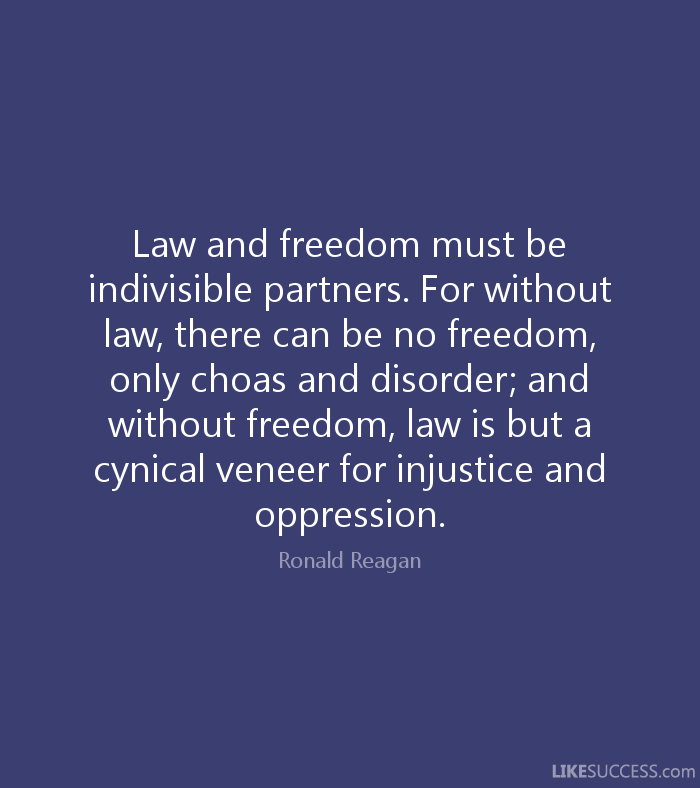
As I wrote in "QE or Not QE: Even Economists Need Lessons in Quantitative Easing, Bernanke Style," Martin Feldstein is a very important, influential and intelligent economist. So it is disappointing that he has no new ideas to offer in order to rein in the trajectory of the US national debt in his latest Wall Street Journal op-ed, "Reagan’s Cure for America's Debt Disease."
Martin Feldstein suggests that we can raise the retirement ages built into Social Security's formula and increase premiums for Medicare for those with higher incomes. Proposals like this have been around for a long time. They would both be quite painful to many people and not do enough to rein in the trajectory of the US national debt.
One particular problem with raising the retirement ages built into the Social Security formulas is that it would lead to more people trying to claim disability insurance; determination of eligibility for disability insurance generates considerable transactions costs.
A late retirement age for Social Security is particularly difficult for blue collar workers who have had physically grueling jobs. It is also hard on people who simply have less money. Furthermore, the poor tend to die young, so that delaying Social Security has a large effect on the total amount they get.
Let me lay out some ideas that are less painful, while avoiding any strong incentive for people to reduce their work effort or to make other changes that are socially wasteful.
1. Raising the Social Security Retirement Age Only for the Well-Off. One way to deal with the fact that a later retirement age is cruel to the poor is to have a gradual increase in the normal Social Security retirement age (and the early Social Security retirement age) be limited to individuals who have a high level of total lifetime Social Security earnings. This is a much better way of doing means-testing than making Social Security benefits or Medicare premiums depend on current income. For people near retirement, for whom most of the total lifetime Social Security earnings are far in the past, it shouldn't create much of an incentive to reduce work effort. And even for young workers, any additional incentive to work less would (a) require a well-above-average level of foresight, (b) caring a lot about the distant future and (c) a change in lifestyle since the change in labor income would have to be long-term.
2. Get More Immigrants Who Will Pay a Lot of Social Security and Medicare Taxes. Let me now turn to ways to deal with the challenge of paying for Social Security and Medicare that have nothing to do with cutting benefits or raising premiums. One of the easiest is to let in more immigrants in a way designed to maximize the extra tax revenue and minimize the extra costs of the additional immigrants. This involves making it much easier for young people with high skills to immigrate. (See Obama Could Really Help the US Economy by Pushing for More Legal Immigration.") If, in addition to skills that will help in the labor market, we required high levels of language skills and high levels of familiarity with American culture, there would be less backlash from this kind of immigration than immigration by low-skilled individuals who have more difficulty with English and less familiarity with American culture. (I am also in favor of more of allowing more immigration by people who would be desperately poor in their country of origin who could have a decent life if we allowed them in. See "'The Hunger Games' Is Hardly Our Future--It's Already Here." However, that type of immigration is somewhat less helpful with our debt problem. Moreover—at least temporarily—the political winds are blowing the other way.)
3. Require More Charitable Donations for a Limited List of Good Things that Includes Better Taking Care of the Elderly. As I say in "How and Why to Expand the Nonprofit Sector as a Partial Alternative to Government: A Reader’s Guide," there are many advantages to getting certain things done through the nonprofit sector rather than through the government:
I argued in "No Tax Increase Without Recompense" that a "public contribution system" of requiring people to either pay more taxes or increase their "public contributions" by the same amount could avoid a big increase in the national debt while still making sure key things get taken care of. We want to get a lot of public goods—including knowing that our elderly are well taken care of. We can get those public goods while still letting people have the fun of deciding where their public contribution should go. This would be much like our current system of charitable donations, with a lot of choices for individuals about how their money would be used, but somewhat more focused on things that the government would otherwise have to do, or should be doing if it is not taken care of by private efforts.
If we simply resent "the rich," or feel that "the rich" have too much power, then a key objective of a tax increase might be to force them to give up their money and let that money be spent in a democratically determined way. (Here are I am trying to channel some of the comments I have received from people objecting to my idea for a public contribution system.) In that case, the system could be designed to cap the amount of extra taxes that could be avoided by making public contributions (at some cost of reducing the incentive to become rich.) But those who we don't put in the mental category "the rich" also need to be required to either pay more taxes or give more to charity, or we won't get enough things done. Our mental category of "the rich" tends to be small enough that there just isn't enough money among "the rich" to get all the public goods we should have. European countries that have a lot of government spending make middle-class people pay a lot of taxes. They don't manage to do it by taxing "the rich" alone.
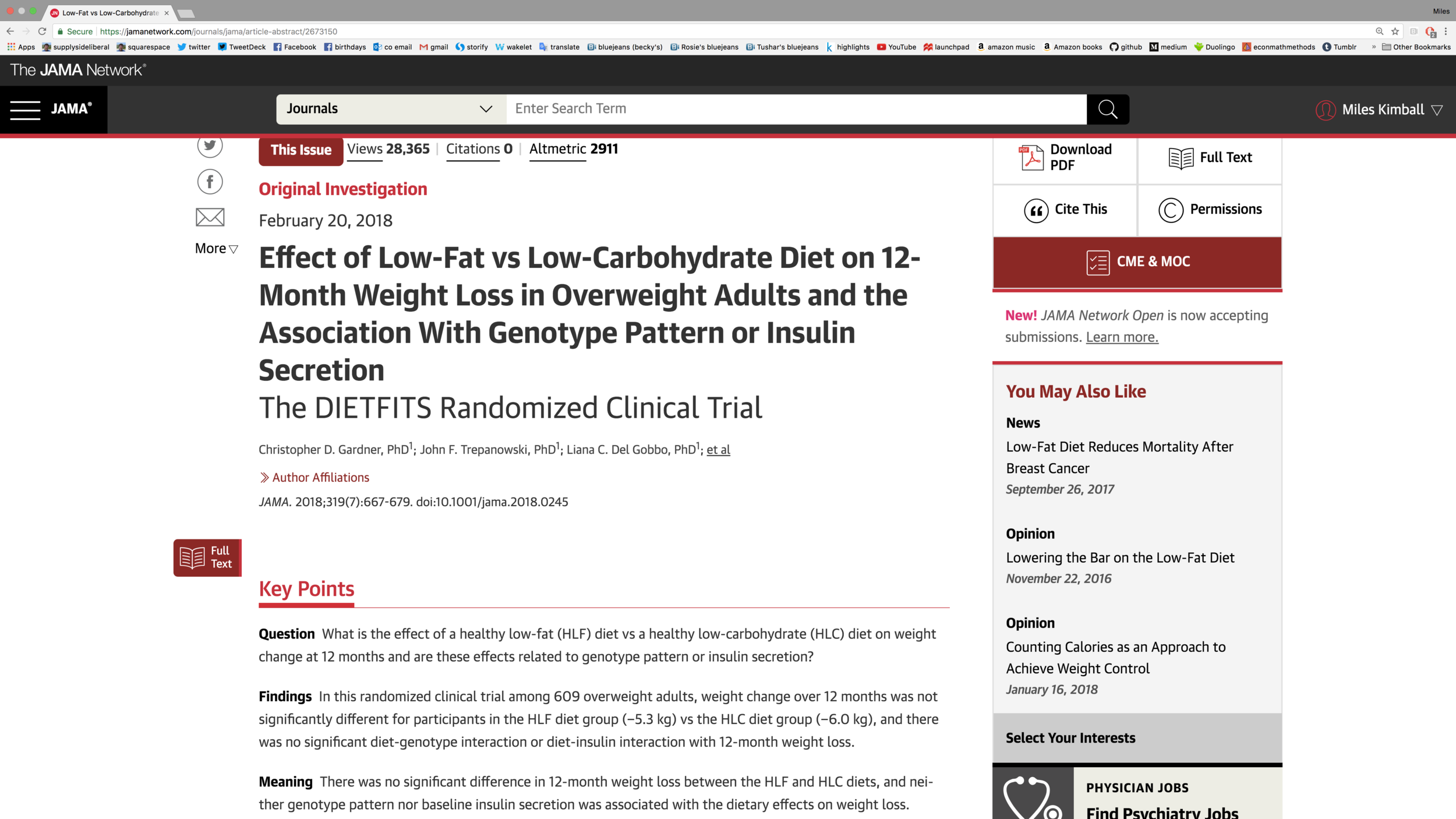
4. More Scientific Research on How to Fight Obesity. A large share of Medicare costs come from diseases associated with obesity. Many of these are chronic diseases are expensive to treat the way we treat them now. But they might be relatively inexpensive to prevent. A good example of the kind of research that can really help is the DIETFITS Randomized Clinical Trial that I wrote about earlier this week in "Why a Low-Insulin-Index Diet Isn't Exactly a 'Lowcarb' Diet." In that post and the posts flagged at the bottom of that one, you can see my thoughts about how to fight the rising tide of obesity, including some ideas about questions that need to be researched.
The DIETFITS study cost $8 million, which is peanuts compared to the Medicare costs that can be saved due to the insights it provided. But because of the funding situation, this study was only funded after 7 grant rejections. What a travesty to let there be so many obstacles in the path to doing such research! We need many more studies like this, testing many hypotheses about what will work in bending the curve on obesity. The US government is being penny-wise and pound-foolish if it doesn't dramatically increase the funding for research on fighting obesity.
If funding is tight for obesity research, it doesn't just reduce the total amount of funding for obesity research, it reduces the share of that research pie that is truly daring, that could overturn established orthodoxies. When most grants get rejected, the few that get through are usually those that hew to whatever the orthodoxy is in a field.
Conclusion. The increase in national debt that we will see if current policies are continued is indeed a problem. But Martin Feldstein offers only old ideas. There are better ways to tame the US national debt in the face of the aging of the US population.
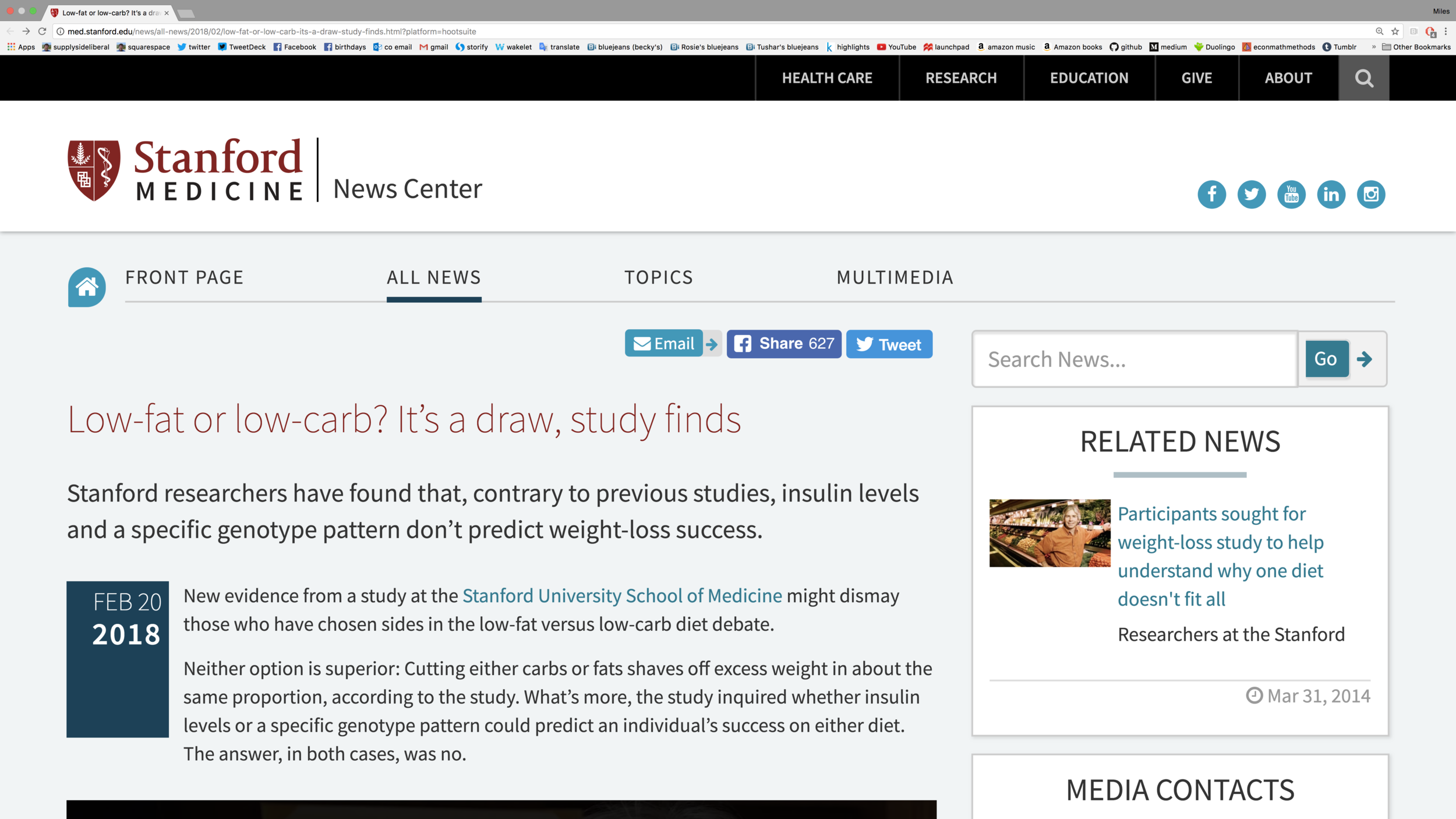
Link to the article above. Thanks to Andrew Baker for pointing me to this article on healthy lowfat diets versus healthy lowcarb diets.
Introduction
When I am at a restaurant, I often tell the waiter that I am eating lowcarb as a convenient way of explaining what I am going for. But that is not really true. What I am doing is following a low-insulin-index diet as a complement to the weight-loss power of time-restricted eating. I introduce these two key ideas in my posts
I discuss the theory behind these ideas in
Of these two ideas, time-restricted eating is by far the most important idea. But eating foods low on the insulin index when you do eat makes it much, much easier to go for periods of time without eating at all—whether those periods without eating are the last few hours before bed and then skipping breakfast the next day, or going without eating for more extended periods of time. So it is worth understanding what low-insulin-index eating is.
([2025-03-01 EDIT:] I have done many long fasts, which were much easier than you would think and were very successful at weight loss. However, since I first wrote this post—influenced by Peter Attia’s book Outlive: The Science and Art of Longevity, I have become more concerned about loss of muscle mass from long fasts, and so only intend to do one long fast a year.[END EDIT])
I found it fascinating to study the available information on which foods generate a large insulin response to write "Forget Calorie Counting; It's the Insulin Index, Stupid." There are many surprises. I distilled six general principles:
Avoid foods labeled "lowfat"
Avoid cold cereal
Avoid sweet beverages, including fruit juice
Avoid things with added sugar
Avoid starchy foods
If you drink alcohol, lean towards white wine instead of beer
But there are many other things to learn from the evidence on which foods have a big insulin kick. For example, in addition to avoiding pancakes, bread and potatoes, and yogurt marketed as healthy that has a lot of sugar added, certain fruits, such as honeydew melon, seem to have a powerful insulin kick, with a reported 95% confidence interval of 63 to 123. (I think the insulin index of other types of melon is simply unknown because no one has done the experiment yet.)
Not All Types of Meat Are Freebies
One of the most important things to know is that meat is moderately high in its insulin kick because certain proteins can cause a substantial insulin response. Consider these numbers from among those I retail in "Forget Calorie Counting; It's the Insulin Index, Stupid," selected here to make a point:
vanilla ice cream: 65
chocolate cake brownie with chocolate frosting: 60
white rice: 58
croissants: 58
chocolate chip cookies: 57
McDonald's french fries: 57
doughnuts with cinnamon sugar: 54
battered fish fillets: 54
white fish: 43
cinnamon swirl pastry: 42
honey-raisin bran muffin: 37
snickers bar: 37
beef steak: 37
white corn tortillas: 36
chocolate milk: 34
Australian brown pasta (I assume with no sugar added): 29
Australian white pasta (I assume with no sugar added): 29
The point is that white fish and steak are in the 30-50 insulin index category I label "Portion Sizes Should Be Kept Small Except on Special Occasions." They are not foods to make a regular part of your diet if you want to eat low on the insulin index, any more than chocolate milk, snickers bars or cinnamon swirl pastry.
Because the insulin index has not been measured for everything, particularly in all the shrouded variations that occur in processed food, an important test is to think of how hungry you feel an hour or two or three after eating something. I do eat meat in restaurants, but I feel just a bit hungry afterwards. I deal with that by eating a mix of almonds and cashews afterwards. So white fish and steak (and presumably a range of other types of meat that we don't have a measured insulin index for) are not freebies; they are medium-high on the insulin index—not so high that you shouldn't ever eat them, but high enough that you should eat them sparingly.
Some Types of Meat Are Low on the Insulin Index. There are types of meat that are much lower on the insulin index. Here are some for which we have data, along with some comparison items:
In the "Go-To Staples for a Low-Insulin Approach" Category:
tuna canned in water: 26
milk: 24
eggs: 23
prawns: 21
7% fat cheddar cheese: 20
In the "Especially Good Foods" Category:
chicken fried in olive oil with skin: 19 (95% confidence interval from 11 to 27)
roast chicken without skin: 17 (95% confidence interval from 9 to 25)
tuna canned in oil: 16
Australian hot dog (I assume with no sugar added): 16
Australian bologna (I assume with no sugar added): 11
In the "Suitable for Eating and Drinking Even on an Extended "Modified Fast" Category:
full-fat bacon (with no added sugar): 9
[2025-03-01 EDIT] I am a big fan of Peter Attia. His book Outlive: The Science and Art of Longevity convinced me that protein is crucial for maintaining muscle mass, especially as I age. And I have been reading that protein is very satiating. Finally, I have read that while protein raises insulin quite a bit, it also raises glucagon—a hormone that functions as a kind of anti-insulin. Glucagon has become more famous lately because “glucagon-like peptides” reduce people’s appetites and are the active ingredient in the revolutionary new weight-loss injections and pills. In my view, these new weight-loss pills work in important measure precisely because they tickle the glucagon receptors and so act as anti-insulins.
Given this reasoning, I have increased my protein intake markedly. I want to stay strong as I age! Nevertheless, I still worry about protein being good nutrition for cancer cells. See “Meat Is Amazingly Nutritious—But Is It Amazingly Nutritious for Cancer Cells, Too?” [END EDIT PASSAGE]
Bad Carbs and Good Carbs
The bottom line is that a low-insulin-index diet is not exactly a "lowcarb diet" in the usual sense of a "lowcarb diet" in our culture. Even less is a low-insulin-index diet a "lowcarb diet" in the sense that researchers often use. As far as the insulin index is concerned, the problem is not really carbohydrates, but easily-digestible carbohydrates such as all the many types of sugar and the most obviously starchy-seeming kinds of vegetables. Technically, even non-starchy vegetables and nuts have a lot of "carbohydrates," but these are carbohydrates that are digested slowly, so they don't cause much of an insulin spike. To repeat, it isn't "carbohydrates" that are the problem, but easily-digestible carbohydrates.
Here, straight from the list of nonstarchy vegetables on Wikipedia, are a list of vegetables I highly recommend as part of your diet (given what I know), even though they are full of carbohydrates as a matter of chemistry:
Alfalfa sprouts
Beans (green, Italian, yellow or wax)
Greens (beet or collard greens, dandelion, kale, mustard, turnip)
Raw vs. Cooked; Intact vs. Pulverized. One of the intriguing facts pointing to the importance of whether a type of cabohydrate is easily-digestible or not is one I discussed in "The Keto Food Pyramid": cooked carrots have a higher glycemic index than raw carrots. The glycemic index isn't the same thing as the insulin index, but within the same food group it is highly enough correlated with the insulin index that I use the glycemic index to guess the insulin index when direct data on the insulin index is not available. What this means is that you have to think not only about the processing of food by big food companies, but the processing of food that you do at home! In addition to what food you eat, you need to think about what you do to it before you eat it. Cooking carrots makes them easier to digest, so they cause a bigger spike in blood sugar.
I don't know of anyone having done this experiment, but I'd love to see someone measure the insulin index of intact veggies as compared to veggies that have been run through a blender to make a veggie smoothie. I am betting that the veggie smoothie will have a higher insulin index than the very same ingredients if they are eaten intact.
This doesn't mean that you shouldn't cook your food. Making food delicious matters as well as weight loss. Fortunately, it is easy to make delicious food that is low on the insulin index. For gustatory delight, the fact that dietary fat is OK from the standpoint of the insulin index makes it easy to compensate for sugar being banned, for the most part. (On banning sugar, I personally make an exception by eating a few squares of chocolate with 88% or more cocoa, even if it has some sugar, as I talk about in "Intense Dark Chocolate: A Review." Also, I bend the no-sugar rule by using commercial full-fat ranch dressing despite its having a bit of sugar listed in the ingredients, and not always making it to Whole Foods to get sugar-free "Paleo" bacon when we want to have bacon.)
The DIETFITS Randomized Intervention Trial
Let me use this distinction between a low-insulin-index diet and a lowcarb diet to discuss the recently reported results of the DIETFITS Randomized Trial flagged at the top of this post. The video of Christopher Gardner, in particular, is good at explaining what they did.
First, both diets tried to get people to avoid sugar, refined grains and processed foods. These are all great for a low-insulin-index approach. This similarity between the two diets tested was much, much more important than the modest differences between the two diets that got into the headline. Although the two approaches were not directed in any big way toward time-restricted eating, and so couldn't test the most important idea very well, I see the results of this study as a vindication for the idea of a low-insulin-index diet. These two diets, which did the key things to lower the insulin index of food eaten, resulted in 11.6 pounds and 13.2 pounds of weight lost on average, once I convert from kilograms to pounds. Let me excerpt the key passages from the abstract of the study:
The Diet Intervention Examining The Factors Interacting with Treatment Success (DIETFITS) randomized clinical trial included 609 adults aged 18 to 50 years without diabetes with a body mass index between 28 and 40. ...
Results Among 609 participants randomized (mean age, 40 [SD, 7] years; 57% women; mean body mass index, 33 [SD, 3]; 244 [40%] had a low-fat genotype; 180 [30%] had a low-carbohydrate genotype; mean baseline INS-30, 93 μIU/mL), 481 (79%) completed the trial. In the HLF [Healthy Low Fat] vs HLC [Healthy Low Carb] diets, respectively, the mean 12-month macronutrient distributions were 48% vs 30% for carbohydrates, 29% vs 45% for fat, and 21% vs 23% for protein. Weight change at 12 months was −5.3 kg for the HLF diet vs −6.0 kg for the HLC diet (mean between-group difference, 0.7 kg [95% CI, −0.2 to 1.6 kg]). There was no significant diet-genotype pattern interaction (P = .20) or diet-insulin secretion (INS-30) interaction (P = .47) with 12-month weight loss. There were 18 adverse events or serious adverse events that were evenly distributed across the 2 diet groups.
The key points are
(a) This was a relatively large intervention study, with 609 participants
(b) The difference between the two diets is stated in terms of differences in proportions of calories from the three macronutrient categories of fat, protein and carbohydrates, which lumps both the unhealthy easily-digestible carbs and the healthy carbs in things such as nuts and nonstarchy vegetables together under the heading of carbohydrates .
(c) Viewed from the perspective of the insulin index, the difference between the two diets was relatively modest, which makes it less surprising that there was little difference in the results. If you are already avoiding sugar, refined grains, and processed foods, then cutting back further on what are technically carbohydrates in a scattershot way that doesn't pay attention to the insulin index is not that valuable. On the other side, trying to cut back on fat is not particularly valuable.
(d) The study did not have a formal control group that continued to eat as they would have normally. But if one is willing to think of people in the population at large as if they were a control group (technically "adults aged 18 to 50 years without diabetes with a body mass index between 28 and 40") then the weight-loss relative to that "control group" is impressive. So the elements the two diets had in common seemed helpful: avoid sugar, avoid refined grains and avoid processed foods. These are all things that can dramatically lower the insulin index of the food one eats, even if one is not thinking explicitly about the insulin index.
(e) The researchers looked for interactions between individual differences in insulin-secretion across people and which diet worked better for that individual and didn't find anything. Here I think there was a big missed opportunity. If you are looking for interactions between differences between two diets and the insulin-secretion patterns of different individuals, to find anything you need to make the two diets quite different in their food insulin indexes. Despite being interested in differences in insulin secretion patterns across people, these researchers did not do the logical thing of focusing on a high food-insulin-index diet and a low food-insulin-index diet. I hope they focus on this in their next big study!
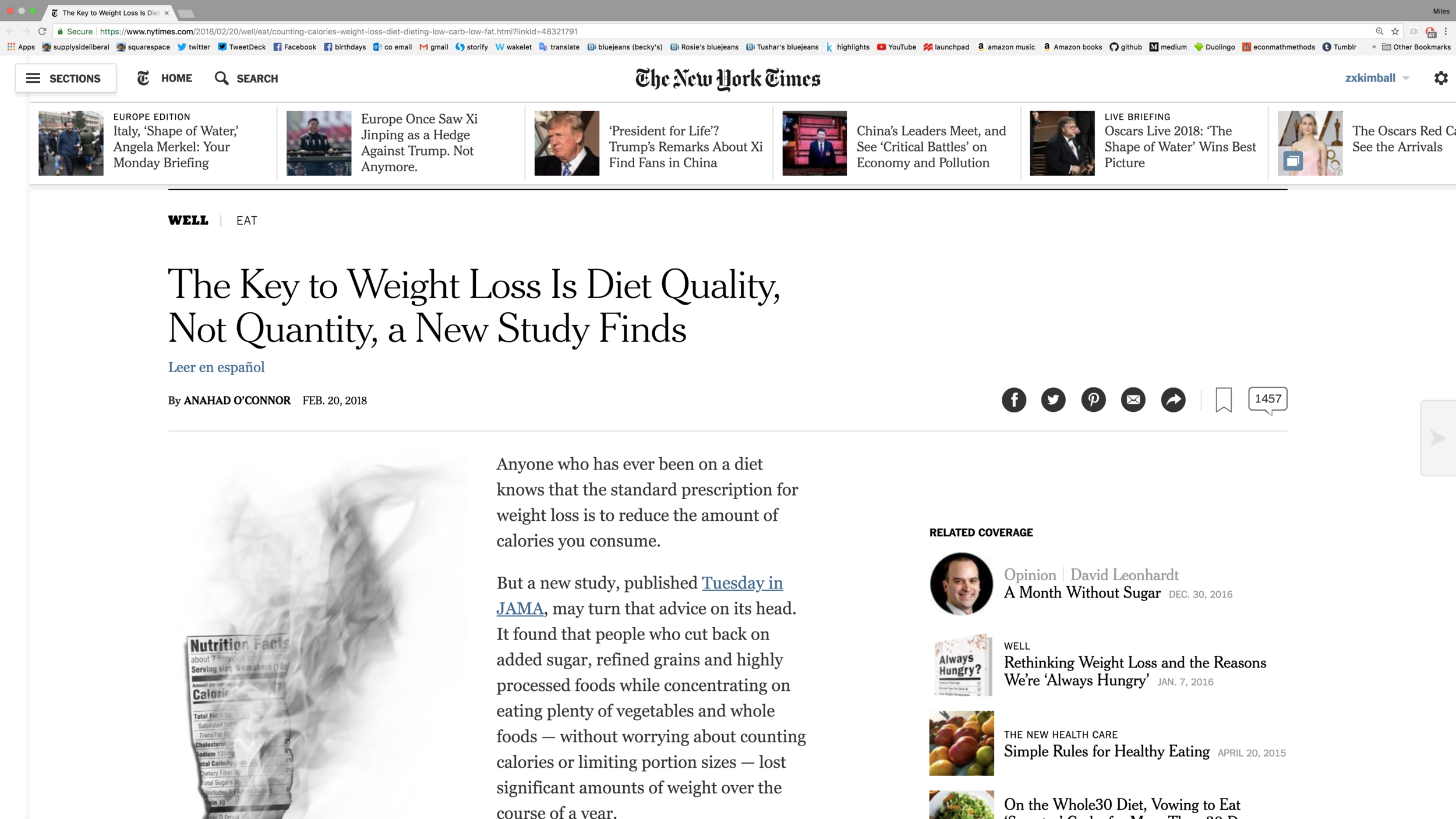
Anahad O'Connor, writing in the New York Times, has a take on the results of the study similar to mine. Here is Anahad's description of key elements of the study:
... the low-fat group was told to avoid those things and eat foods like brown rice, barley, steel-cut oats, lentils, lean meats, low-fat dairy products, quinoa, fresh fruit and legumes. The low-carb group was trained to choose nutritious foods like olive oil, salmon, avocados, hard cheeses, vegetables, nut butters, nuts and seeds, and grass-fed and pasture-raised animal foods.
The participants were encouraged to meet the federal guidelines for physical activity but did not generally increase their exercise levels ...
The new study stands apart from many previous weight-loss trials because it did not set extremely restrictive carbohydrate, fat or caloric limits on people and emphasized that they focus on eating whole or “real” foods — as much as they needed to avoid feeling hungry. ...
“We really stressed to both groups again and again that we wanted them to eat high-quality foods,” Dr. Gardner said. “We told them all that we wanted them to minimize added sugar and refined grains and eat more vegetables and whole foods. We said, ‘Don’t go out and buy a low-fat brownie just because it says low fat. And those low-carb chips — don’t buy them, because they’re still chips and that’s gaming the system.’”
Dr. Gardner said many of the people in the study were surprised — and relieved — that they did not have to restrict or even think about calories. ...
... both groups ultimately ended up consuming fewer calories on average by the end of the study, even though they were not conscious of it. The point is that they did this by focusing on nutritious whole foods that satisfied their hunger.
Conclusion
A low-insulin-index diet is not the same thing as a "lowcarb diet" either as the phrase "lowcarb diet" is used in common speech or as "low-carbohydrate-diet" is used in nutrition research. All of these involve avoiding sugar, refined grains and processed foods, which is a big deal. But beyond that, they are different.
It is unfortunate that the results of the DIETFITS study were reported as showing that a lowcarb diet and a lowfat diet were equally good, when in the nontechnical sense of what most people mean when they say "lowcarb diet" both diets were "lowcarb" because they both involved avoiding sugar, refined grains and processed foods. (You can see another example of such reporting here in this otherwise excellent article.) Note here that the researchers who did the DIETFITS study did not question the idea that sugar is bad, despite the dispute about just how bad sugar is that I discuss in "The Case Against Sugar: Stephan Guyenet vs. Gary Taubes" and "The Case Against the Case Against Sugar: Seth Yoder vs. Gary Taubes." (See also "How Sugar Makes People Hangry" and "Sugar as a Slow Poison.") In the language of the team who did the DIETFITS study, both a "Healthy Low-Carbohydrate Diet" and a "Healthy Low-Fat Diet" are low in sugar, refined grains and processed foods.
[2025-03-01 EDIT] At a deeper level, here is the important point: It isn't eating “lowcarb” that is important. It is (i) avoiding sugar, grains and ultra-processed food, (ii) among the foods and drinks left, eating low on the insulin index, and (iii) stopping eating early in the evening. [END EDIT PASSAGE]
For annotated links to other posts on diet and health, see:
For example, here is what the first section looks like:
I. The Basics
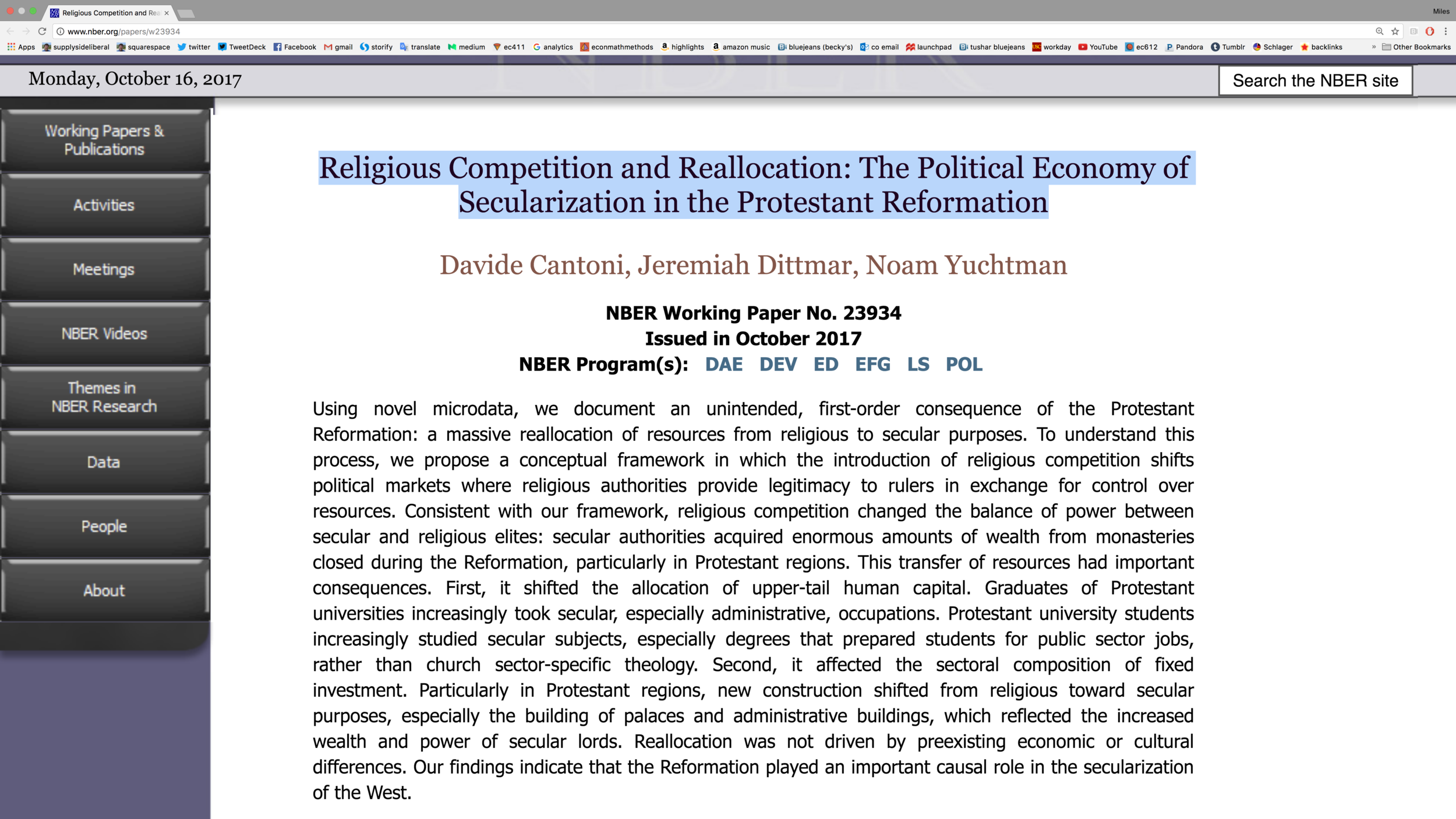
Louis Johnston flagged this very interesting NBER Working Paper in a tweet. Unfortunately, the paper itself is gated, but I think you will find the abstract fascinating. In case it is hard to read above, here it is:
Using novel microdata, we document an unintended, first-order consequence of the Protestant Reformation: a massive reallocation of resources from religious to secular purposes. To understand this process, we propose a conceptual framework in which the introduction of religious competition shifts political markets where religious authorities provide legitimacy to rulers in exchange for control over resources. Consistent with our framework, religious competition changed the balance of power between secular and religious elites: secular authorities acquired enormous amounts of wealth from monasteries closed during the Reformation, particularly in Protestant regions. This transfer of resources had important consequences. First, it shifted the allocation of upper-tail human capital. Graduates of Protestant universities increasingly took secular, especially administrative, occupations. Protestant university students increasingly studied secular subjects, especially degrees that prepared students for public sector jobs, rather than church sector-specific theology. Second, it affected the sectoral composition of fixed investment. Particularly in Protestant regions, new construction shifted from religious toward secular purposes, especially the building of palaces and administrative buildings, which reflected the increased wealth and power of secular lords. Reallocation was not driven by preexisting economic or cultural differences. Our findings indicate that the Reformation played an important causal role in the secularization of the West.
I was delighted see that the Economist noticed my paper with Susanto Basu and John Fernald: "Are Technology Improvements Contractionary?" This is the paper for which the first sentence in the abstract is simply "Yes." Even better, the Economist interpreted it correctly: the historical pattern of technology improvements being contractionary is an indictment of the historical monetary policy response to technology shocks.
Standard optimal monetary policy theory suggests that monetary policy should come close to stabilizing the price level around a steady trend. The failure of monetary policy to do this in response to technology shocks can be seen in these estimated impulse responses:
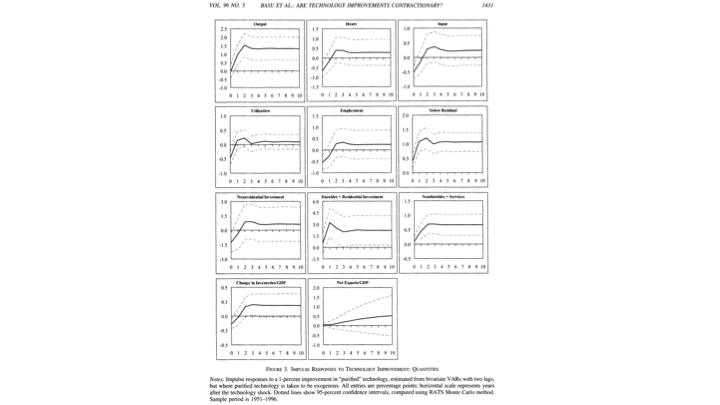
The failure to have sufficiently stimulative monetary policy after technology improvements results in the dysfunctional impulse responses shown below, in which employment and investment fall in response to an improvement in technology!
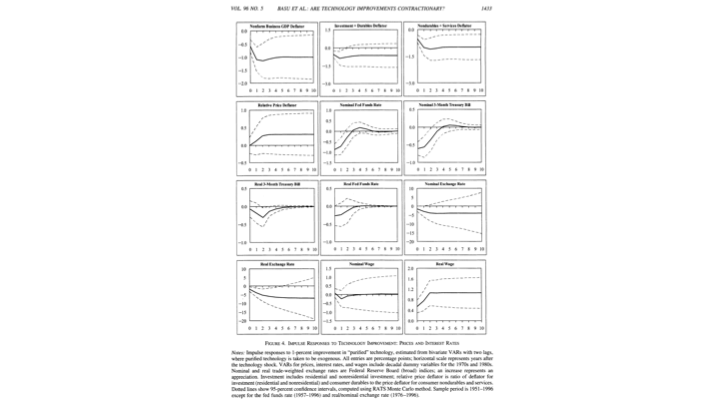
One of the underappreciated aspects of these results is what strong evidence they provide against real business cycle models. Nothing that comes anywhere close to a social planner's problem would result in a reduction in investment in response to an immediate permanent technology improvement that we estimate. And if the technology improvement was predicted in advance, a negative response of investment to the actual arrival of the technology improvement would be even harder to generate.
It isn't that the real business cycle model couldn't be approximately true in the future: better monetary policy would make the economy behave a lot like a real business cycle model would say it should. The "Divine Coincidence" of monetary policy is that keeping prices on a steady track is exactly what is needed to keep output, employment, investment, the real interest rate and so on at the natural level that a real business model would deliver. There may be modest departures from the Divine Coincidence, but if a central bank were doing monetary policy as it should, it would be quite difficult to statistically distinguish the behavior of the economy from what a real business cycle model would lead to.
Monetary policy does not act instantaneously. Even with excellent monetary policy, the economy may be away from the natural level for 9 to 15 months after an unexpected shock, simply do to the lags in the effects of monetary policy. But there is forewarning for many shocks, and shocks that act through the financial system are likely to have the same lags in their effects as monetary policy, so vigorous enough monetary countermeasures should be able to limit damage to a few month's time after a financial shock that does not diminish the long-run capacity of the economy. A key point though, is that "vigorous enough" may mean using negative interest rates for a brief period of time until the economy is put to rights and positive interest rates can be restored. On this, see my post "On the Great Recession."
Here is the paragraph in which the Economist refers to our paper, after positing a new high-skilled-labor-saving medical technology:
Indeed, in a paper published in 2006, Susantu Basu, John Fernald and Miles Kimball concluded that advances in technology are usually contractionary, tending to nudge economies towards slump conditions. They estimated that technological improvements tend to depress the use of capital and labour (think, in this example, stethoscopes and doctors) and business investment (new clinics) for up to two years. To those living through such periods, this depressing effect would show up in lower inflation and wage rises. That, in turn, suggests that an alert central bank with an inflation target ought to swing into action to provide more monetary stimulus and keep price and wage growth on track. That stimulus should spur more investment in growing parts of the economy, helping them to absorb quickly the resources freed up by the new, doctor-displacing technology and thus averting a slump.
The Economist then proceeds to diagnose why central banks might do this:
Two obstacles usually get in the way of such a benign outcome. First, these steps unfold with a lag. The slowdown in price and wage growth will be gradual, as displaced workers tighten their belts and compete with other jobseekers for new employment. Central banks might then wait to see whether low inflation reflects a genuine economic trend or is merely a statistical blip. Even after they act, their tools take time to have an effect.
To the extent the Economist is right in its diagnosis, I have these several things to say to central bankers caught in this kind of thinking. First, a track of prices that is too low is something that should be corrected just as quickly as a track of prices that is too high. If you don't think so, you probably have too high a long-run inflation target, as I discuss in "The Costs and Benefits of Repealing the Zero Lower Bound...and Then Lowering the Long-Run Inflation Target." With a zero inflation target, the idea that prices going off track in the downward direction is just as serious as prices going off track in the upward direction is easier to feel at a gut level. Second, central banks should act quickly on whatever information they have, knowing that they can reverse course quickly if further information points in the opposite direction. Third, as I have emphasized at many central banks in my visits to central banks around the world, central banks should begin a major international cooperative effort to monitor early signs of technological change.
I discuss these monetary policy issues and more in my paper "Next Generation Monetary Policy."
Thanks to Ori Heffetz for alerting me to this article in the Economist
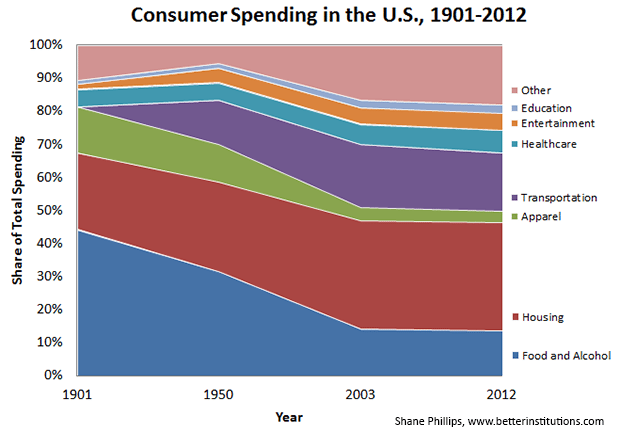
The story is all in the graph above. Note that because household spending is graphed, only direct payments for health insurance and out-of-pocket health care costs are counted.
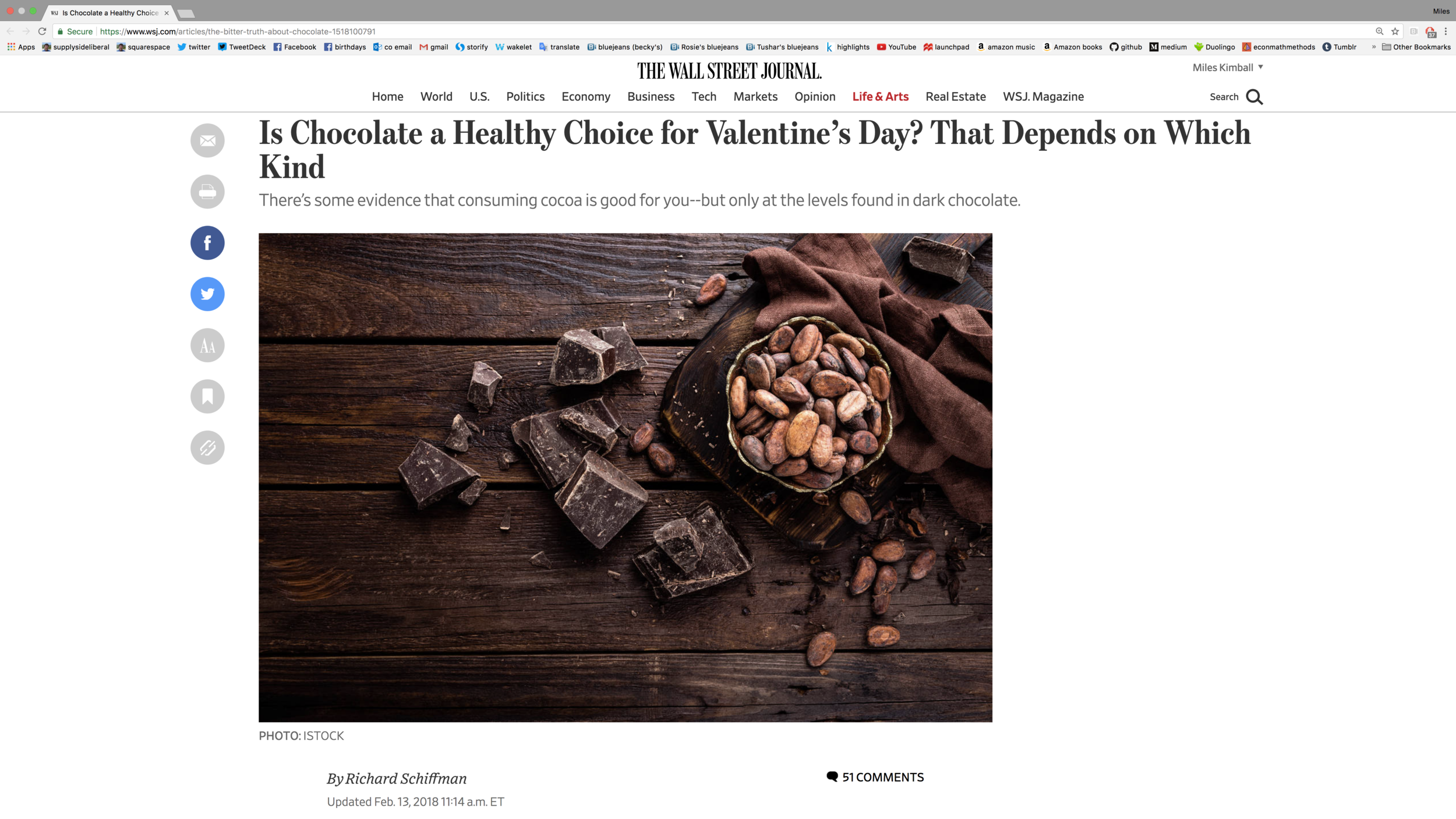
Besides frozen cherries with half and half and homemade nutbars, one of my healthy treats is a few squares of intense dark chocolate each day that I am eating anything. (On the benefits of fasting, see my posts "Obesity Is Always and Everywhere an Insulin Phenomenon" and "Stop Counting Calories; It's the Clock that Counts.") Although the sugar in most chocolate is a problem, I think of the cocoa in chocolate as being good for my health. In this, I am not alone. As Richard Shiffman writes in his interesting Valentine's Day Wall Street Journal article "Is Chocolate a Healthy Choice for Valentine’s Day? That Depends on Which Kind":
U.S. sales of chocolate went from $14.2 billion in 2007 to $18.9 billion in 2017, a period during which overall sales for candy declined, largely because of growing health concerns over sugar.
How did chocolate manage to buck the bear market in candy? One reason is the widespread perception that chocolate, unlike other sweet treats, is not just delicious but good for you.
Here is some of the evidence for the health benefits of chocolate, according to Richard Shiffman in the same article:
Leaving aside such historical hype, many modern studies have shown, in fact, an association between the consumption of pure cocoa, which is rich in compounds called flavanols, and moderate reductions in risk for a range of cardiovascular illnesses and even for diabetes. Research done in 2009 on the Kuna people, who live on islands off the coast of Panama, lends some credence to these results. Dr. Norman Hollenberg of Harvard Medical School found that the Kuna, who drink up to 10 cups of gravy-thick homegrown hot cocoa a day, live longer and have lower rates of hypertension, heart disease and stroke than most Western populations, though other factors may also contribute to their outstanding health.
Science has also delved into the impact of cocoa products on various brain functions. A review published last May in the journal Frontiers in Nutrition found evidence that cocoa flavanols may help to focus concentration and improve memory and may even slow the mental decline that often comes with aging.
... ... the Cosmos trial—is administering cocoa flavanol capsules together with placebos to over 21,000 individuals. Harvard’s Dr. JoAnn Manson, a co-director of the study, says that while previous research shows that cocoa can lower blood pressure and increase the elasticity of blood vessels, “the jury is still out on whether this translates as lower risk of heart attack and strokes.” The researchers hope to provide some definitive answers when they publish their findings in 2020.
However, this evidence needs to be taken with a grain of salt:
Dr. Marion Nestle (no relation to the chocolate manufacturer), a professor emerita in the nutrition and food studies department at New York University, points out that most chocolate research has been funded, at least in part, by chocolate companies. “In general, they get overwhelmingly positive results. Whereas studies that are independently funded have mixed results,” Dr. Nestle said. “Bias can creep in with the research question that they ask, or how they interpret the results.” In fact, all of the studies I have cited in this article have received at least some of their funding from chocolate manufacturers or analyze research that did.
As I touch on in "Let's Set Half a Percent as the Standard for Statistical Significance," scientists distort evidence quite a bit just for the academic rewards of getting published in journals. The desire to secure funding can also tilt research.
Still, I think of chocolate as not only delicious but healthy—except for the sugar in most chocolate. So I try to eat chocolate that has such a high percentage of cocoa that I figure there isn't much room left for a lot of sugar.
Let me review several types of chocolate bars with very high percentages of cocoa. I assure you, I don't receive any money from companies that sell chocolate, unless you count my income from the University of Colorado Boulder, the University of Michigan and the University of Southern California, which no doubt sell chocolate in their university bookstores.
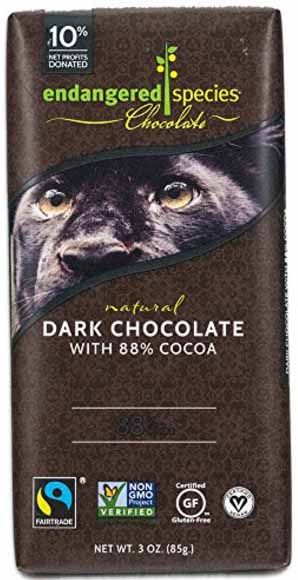
Because it is easy to get at the grocery store, not unreasonably expensive, and delicious, my main go-to chocolate is squares from a panther bar, which advertises itself as 88% cocoa:
I have tried many other types of chocolate with percentages of cocoa at 88% or above. One exception to my general rule of 88% cocoa or more are ChocoPerfection bars, which only 60% cocoa, but are sugarfree:
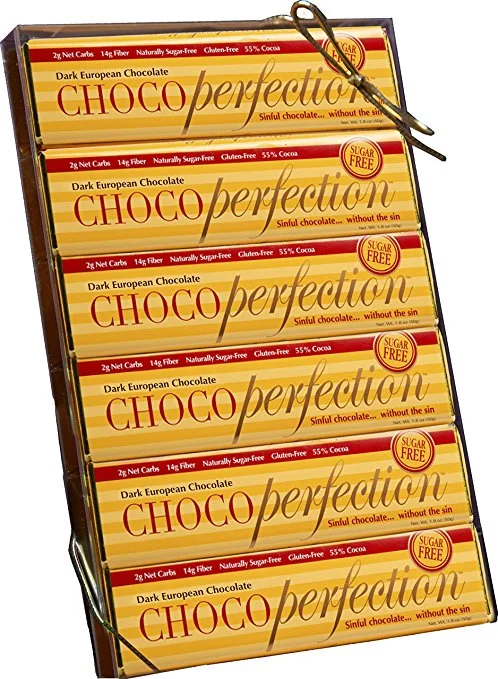
Link to the Amazon site for ChocoPerfection bars
ChocoPerfection bars are sweetened to chicory root and erythritol. Though my approach differs from keto in important ways—see especially "Forget Calorie Counting; It's the Insulin Index, Stupid" and "The Keto Food Pyramid"—I take the keto folks as my experts on which nonsugar sweeteners are OK: chicory root and erythritol are some of the few that pass muster by a reasonable consensus among keto folks. Most of the time, ChocoPerfection bars seem too sweet most of the time, but sometimes a jolt of sweetness is nice.
Beyond those two types, I have tried many others that I found by one of two procedures: (1) searching on Amazon for every type of chocolate advertising a percentage of cocoa 88% or above and (2) looking for everything 88% or above in my local Whole Foods store, where I thought I could catch some more exotic brands. I am sure I missed some, and new brands keep getting added. If there is anything I don't mention that is 88% or above—or even 85% or above—that you recommend, let me know and I will try it if I can find it reasonably easily.
100%
The most interesting subcategory are those chocolate bars that advertise themselves as 100% or cocoa, which I assume means 99.5% or more cocoa. To best tasting of these to me is the very expensive Arete Vietnam Lam Dong 100% Dark Chocolate, listed at $15 a bar:
I am intrigued to try Arete's Guatemala Lachua Micro-lot 100% Dark Chocolate when it is no longer sold out.
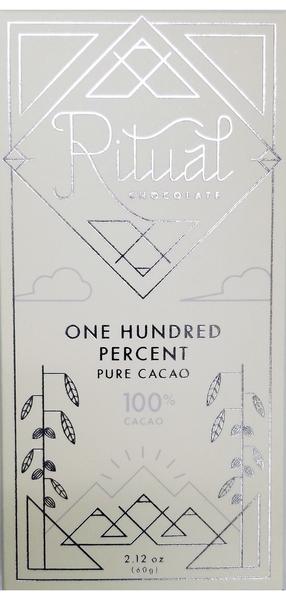
I also enjoyed One Hundred Percent Pure Cacao Ritual Chocolate, listed at $11 a bar:
It is actually a hard decision which I prefer between the Arete Vietnamese 100% Chocolate and the Ritual 100% Chocolate. Each has its own distinctive sophisticated taste. The Ritual 100% Chocolate has a floral aftertaste.
Lastly in this category, Primal Chocolate Midnight Coconut advertises itself as 100% cocoa. It has no sugar and a little coconut. I don't recommend it, but it was better than I expected from a 100% chocolate bar before I tried the Arete and Ritual chocolate bars above.
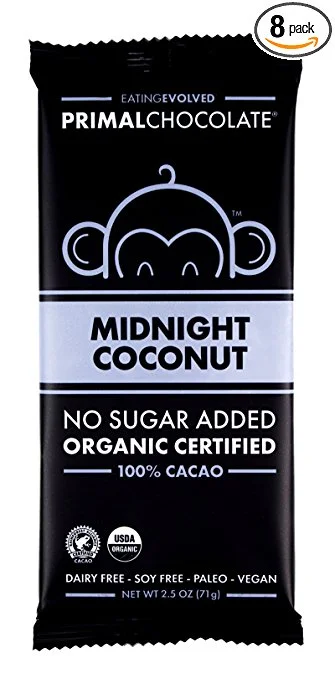
Link to Amazon site for MIdnight Coconut
98%-99%
Within this category, I found the Lindt 99% bars surprisingly accessible. They sometimes have the label "Noir Absolu" or "absolute black" from some version of French:
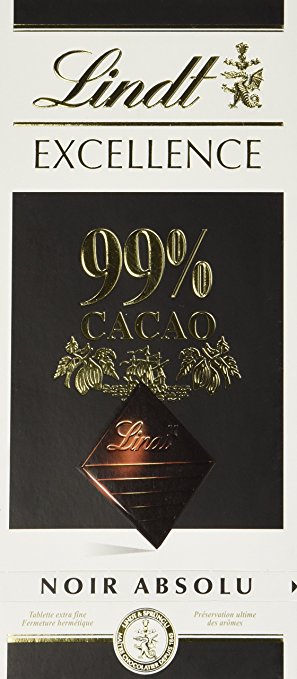
Link to the Amazon site for Lindt 99% Noir Absolu Bars
Of course, the flipside of "accessible" is that some may consider these bars a little bland. But they go down easily and have a pleasing aftertaste.
More challenging to the tastebuds, but quite edible is Dante Confections 98% Extra Dark Chocolate:
These use stevia as a sweetener instead of sugar. Opinions on stevia as a nonsugar sweetener seem to vary more than opinions on chicory root and erythritol.
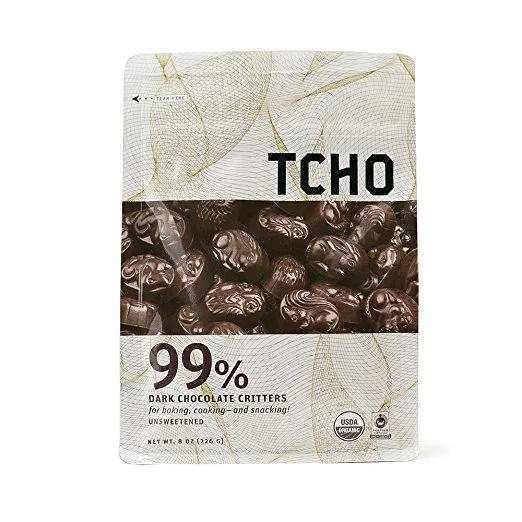
Also challenging, but quite edible, are TCHO Dark Chocolate Critters:
TCHO Dark Chocolate Critters advertise themselves as good for baking and cooking. In that context I think they would be great.
95%
The only type I found between 92% and 98% was Taza Wicked Dark at 95%:
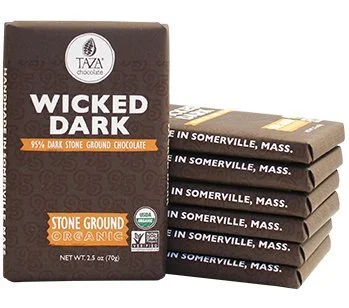
Amazon sit for Taza Chocolate Wicked Dark
To me, Wicked Dark bars tasted awfully, by far the worst of any of the chocolate bars reviewed here. They are suitable only for gustatory masochism, unless your tastes are quite different from mine.
88%-92%
Jumping from the worst to the best of those I am reviewing, I found the Equal Exchange Chocolates Extreme Dark delicious—better tasting than the panther bars:
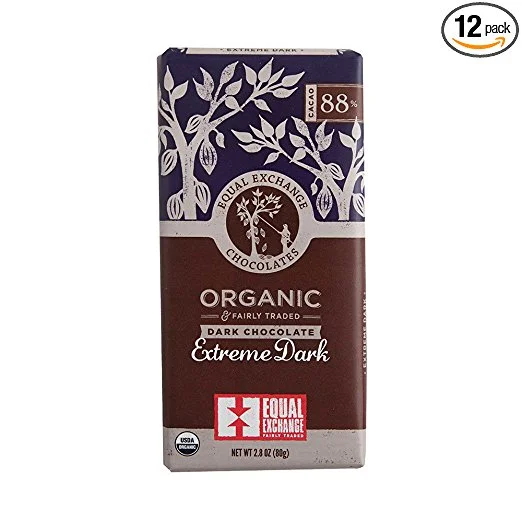
Link to the Amazon site for Equal Exchange Chocolates Extreme Dark
I expect to eat many more of them in the future.
I also very much like LAmourette's Extra Smooth Chocolat Noir 91% cacao bar shown below.
Online it appears to list for $30 a bar! But I bought one for $7.95 at the wonderful Boulder Book Store on Pearl Street.
To my taste, the LAmourette's Extra Smooth Chocolat Noir 91% cacao bar is also a step above the Endangered Species panther bar.
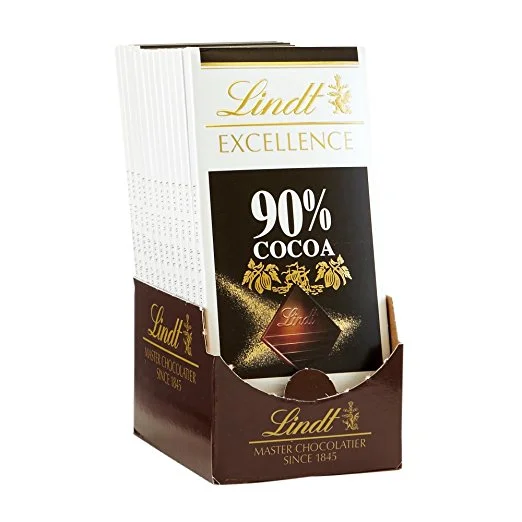
By contrast, the a 90% chocolate bar that is easy to find in stores but that I find boring is Lindt 90% chocolate.
A bit bland was a virtue in the 99% Lindt bar, but at 90%, a chocolate bar should be delicious. To me, the Lindt 90% chocolate bar isn't.
Finally, I tried 4 kinds that weren't terrible, and each was interesting in its own way, but were significantly below panther bars in taste. You might like one of them better than I did. Starting from those with the highest cocoa content, here they are:
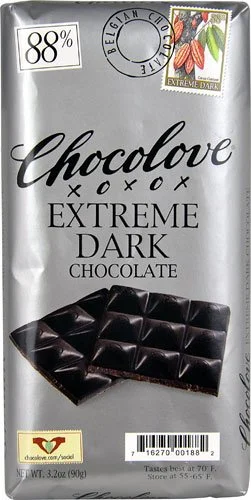
Link to the Amazon site for Chocolove Extreme Dark Chocolate
Intense dark chocolate is a good example of the many food pleasures available to those striving to eat food that is low on the insulin index. The panther bars also illustrate my boundaries for sugar: a few squares of a panther bar a day represents the most sugar that I eat on any regular basis. (I defend my negative view of sugar in "The Case Against Sugar: Stephan Guyenet vs. Gary Taubes" and "The Case Against the Case Against Sugar: Seth Yoder vs. Gary Taubes." Also see "Sugar as a Slow Poison" and "How Sugar Makes People Hangry.")
In the Greek myths, Prometheus was punished for giving fire to humans. In a Mesoamerican myth, Quetzalcoatl was cast out from among the other gods for sharing chocolate with humans. So by ancient American tradition, chocolate is the food of the gods. Enjoy!
Update: Morgan Warstler recommends cold-brewed chocolate made with these cocoa nibs
and this bag. He also tweets a recommendation for these cocoa extract pills. More recommendations from others are coming in that I will report as I get them clear.
Don’t miss my other posts on diet and health:
I. The Basics
Jason Fung's Single Best Weight Loss Tip: Don't Eat All the Time
What Steven Gundry's Book 'The Plant Paradox' Adds to the Principles of a Low-Insulin-Index Diet
David Ludwig: It Takes Time to Adapt to a Lowcarb, Highfat Diet
II. Sugar as a Slow Poison
Best Health Guide: 10 Surprising Changes When You Quit Sugar
Heidi Turner, Michael Schwartz and Kristen Domonell on How Bad Sugar Is
Michael Lowe and Heidi Mitchell: Is Getting ‘Hangry’ Actually a Thing?
III. Anti-Cancer Eating
How Fasting Can Starve Cancer Cells, While Leaving Normal Cells Unharmed
Meat Is Amazingly Nutritious—But Is It Amazingly Nutritious for Cancer Cells, Too?
IV. Eating Tips
Using the Glycemic Index as a Supplement to the Insulin Index
Putting the Perspective from Jason Fung's "The Obesity Code" into Practice
Which Nonsugar Sweeteners are OK? An Insulin-Index Perspective
V. Calories In/Calories Out
VI. Other Health Issues
VII. Wonkish
Framingham State Food Study: Lowcarb Diets Make Us Burn More Calories
Anthony Komaroff: The Microbiome and Risk for Obesity and Diabetes
Don't Tar Fasting by those of Normal or High Weight with the Brush of Anorexia
Carola Binder: The Obesity Code and Economists as General Practitioners
After Gastric Bypass Surgery, Insulin Goes Down Before Weight Loss has Time to Happen
A Low-Glycemic-Index Vegan Diet as a Moderately-Low-Insulin-Index Diet
Analogies Between Economic Models and the Biology of Obesity
Layne Norton Discusses the Stephan Guyenet vs. Gary Taubes Debate (a Debate on Joe Rogan’s Podcast)
VIII. Debates about Particular Foods and about Exercise
Jason Fung: Dietary Fat is Innocent of the Charges Leveled Against It
Faye Flam: The Taboo on Dietary Fat is Grounded More in Puritanism than Science
Confirmation Bias in the Interpretation of New Evidence on Salt
Eggs May Be a Type of Food You Should Eat Sparingly, But Don't Blame Cholesterol Yet
Julia Belluz and Javier Zarracina: Why You'll Be Disappointed If You Are Exercising to Lose Weight, Explained with 60+ Studies (my retitling of the article this links to)
IX. Gary Taubes
X. Twitter Discussions
Putting the Perspective from Jason Fung's "The Obesity Code" into Practice
'Forget Calorie Counting. It's the Insulin Index, Stupid' in a Few Tweets
Debating 'Forget Calorie Counting; It's the Insulin Index, Stupid'
Analogies Between Economic Models and the Biology of Obesity
XI. On My Interest in Diet and Health
See the last section of "Five Books That Have Changed My Life" and the podcast "Miles Kimball Explains to Tracy Alloway and Joe Weisenthal Why Losing Weight Is Like Defeating Inflation." If you want to know how I got interested in diet and health and fighting obesity and a little more about my own experience with weight gain and weight loss, see “Diana Kimball: Listening Creates Possibilities” and my post "A Barycentric Autobiography. I defend the ability of economists like me to make a contribution to understanding diet and health in “On the Epistemology of Diet and Health: Miles Refuses to `Stay in His Lane’.”
Because people are so obviously unequal in so many ways, it is tricky saying what one means by saying everyone is "equal before the law." Putting a high value on freedom makes that easier, because then "equality before the law" means that everyone gets to do whatever they want in as long as they respect other people's right to do whatever they want. I discuss some of the complexities in this in "The Complexity of Liberty: How Equality Enters into a Good Definition of Liberty," but the basic idea has become intuitive in our society, which has a fairly well-defined notion of the boundaries of each person's private sphere.
The issues I discussed in "The Complexity of Liberty: How Equality Enters into a Good Definition of Liberty" were about setting the boundaries between the private spheres of different adults. After laying out how freedom provides a way of thinking about equality under the law in section 54 of his 2d Treatise on Government: “Of Civil Government” (Chapter VI. Of Paternal Power), in sections 55 and 56, John Locke deals with a different complication: limitations on the size of the private sphere of freedom for children. What John Locke emphasizes is that the limitations on children should be temporary ones.
Though I have said above, Chap. II. That all men by nature are equal, I cannot be supposed to understand all sorts of equality: age or virtue may give men a just precedency: excellency of parts and merit may place others above the common level: birth may subject some, and alliance or benefits others, to pay an observance to those to whom nature, gratitude, or other respects, may have made it due: and yet all this consists with the equality, which all men are in, in respect of jurisdiction or dominion one over another; which was the equality I there spoke of, as proper to the business in hand, being that equal right, that every man hath, to his natural freedom, without being subjected to the will or authority of any other man.
Children, I confess, are not born in this full state of equality, though they are born to it. Their parents have a sort of rule and jurisdiction over them, when they come into the world, and for some time after; but it is but a temporary one. The bonds of this subjection are like the swaddling clothes they art wrapt up in, and supported by, in the weakness of their infancy: age and reason, as they grow up, loosen them, till at length they drop quite off, and leave a man at his own free disposal.
Adam was created a perfect man, his body and mind in full possession of their strength and reason, and so was capable, from the first instant of his being, to provide for his own support and preservation, and govern his actions according to the dictates of the law of reason which God had implanted in him. From him the world is peopled with his descendants, who are all born infants, weak and helpless, without knowledge or understanding: but to supply the defects of this imperfect state, till the improvement of growth and age hath removed them, Adam and Eve, and after them all parents were, by the law of nature, under an obligation to preserve, nourish, and educate the children they had begotten; not as their own workmanship, but the workmanship of their own maker, the Almighty, to whom they were to be accountable for them.
In American society, we take it for granted than children are no longer subject to their parents after a certain age (typically 18), absent a serious mental disability. But not all societies have allowed children to be automatically emancipated from their parents at a certain age. I suspect that English society already allowed children to be emancipated after a certain age even in John Locke's time, so that John Locke could use that English custom to give a counterargument to the idea that the authority of monarchy could derive from the power of parents over their children.
For links to other John Locke posts, see these John Locke aggregator posts:
This is an interesting panel discussion. In addition to useful background explanation, the discussion had three specific bits I found revealing. Let me transcribe those parts. Then I will expand on what Michele Mazzocco says.
Lindsey Jones: ... there is a beautiful study by Aaron Maloney and Sian Beilock showing that when parents have math anxiety and they do homework with their children, then their children end up being even more math anxious and performing even worse in school.
Lindsey Jones: But there are things we can do as well. So there is research showing that suggests that for example if you engage students in what is called "expressive writing" exercises, before they take, for example, a high-stakes math exam—they simply write down how they feel about the upcoming test, how they feel about the upcoming exam—and if you do that, you lessen the effects of the anxiety on the subsequent test performance.
Michele Mazzocco: In our longitudinal study, we looked back at kindergarten, first, second graders' descriptions of math and reading. And, again, looking at the different groups of children, those who had consistently shown difficulties with math throughout the study, we looked back at how they had defined math and reading in first and second grade. They were significantly more likely to use negative language in describing math compared to reading, more likely to describe it as difficult compared to their typically-achieving peers.
And this gets back to the chicken-or-egg problem that Daniel was talking about: Is it that they disliked math and therefore they avoided it and therefore didn't get better at math? Or is it that they disliked math because it was difficult and math would have continued to be problematic for them, regardless of their disposition towards math?
And I think that this speaks to the broader issue of math disposition. Math anxiety is a very real phenomenon; it's something that we should not ignore. But there's also the part of the math disposition that reflects how children feel about the importance of math—it's usefulness—and the sentiment that "Hey, you know this might be one of those things that's hard. It might be something where I need a recipe guide or I need some help. I need some scaffolds. But that's OK, because we all need some scaffolding for different kinds of tasks, and putting forth effort actually leads to some success." So if we have this healthy disposition towards math and recognize that effort is required, that effort doesn't mean necessarily that I'm bad at it—it just means that I need to work harder.
After Noah Smith's and my column "There's One Key Difference Between Kids Who Excel at Math and Those Who Don't" went viral (and was translated into Spanish here), many people shared their own personal stories of ultimate success at learning math even when they went through a period of thinking they were bad at math. Many other people shared wonderful ideas for how to help people learn math. I tried to distil those ideas and some of my own into the advice in "How to Turn Every Child into a 'Math Person'" One of the key ideas is that it is OK to learn math slowly:
A second related idea is that for children, math needs to be made as fun, relevant and unthreatening as possible:
In "How to Turn Every Child into a 'Math Person'," I pointed to leading a math club for children as a wonderful choice for those willing to volunteer to help kids.
I have also been interested in how to teach math effectively in more formal settings:
More recently, I have run across discussions of stereotypes for particular demographic groups that can get in the way of learning math:
For those who need a little extra confidence boost to counteract a tendency to underestimate themselves, I also discuss "Travis Bradberry: Ten Guaranteed Ways To Appear Smarter Than You Are."
At a high level, the confidence that one can learn math, as well as the idea of "slow math" is important in the advice Noah and I give in "The Complete Guide to Getting into an Economics PhD Program."
By the way, I dug out these links simply by typing "math" into my blog search box. There are more, especially guest posts people telling personal stories of overcoming the belief that they were bad at math.
The most important principle is the key not only to learning math but to succeeding at almost anything: knowing that you can get smarter by working hard at getting smarter. Here is that message, generalized: