The Heavy Non-Health Consequences of Heaviness

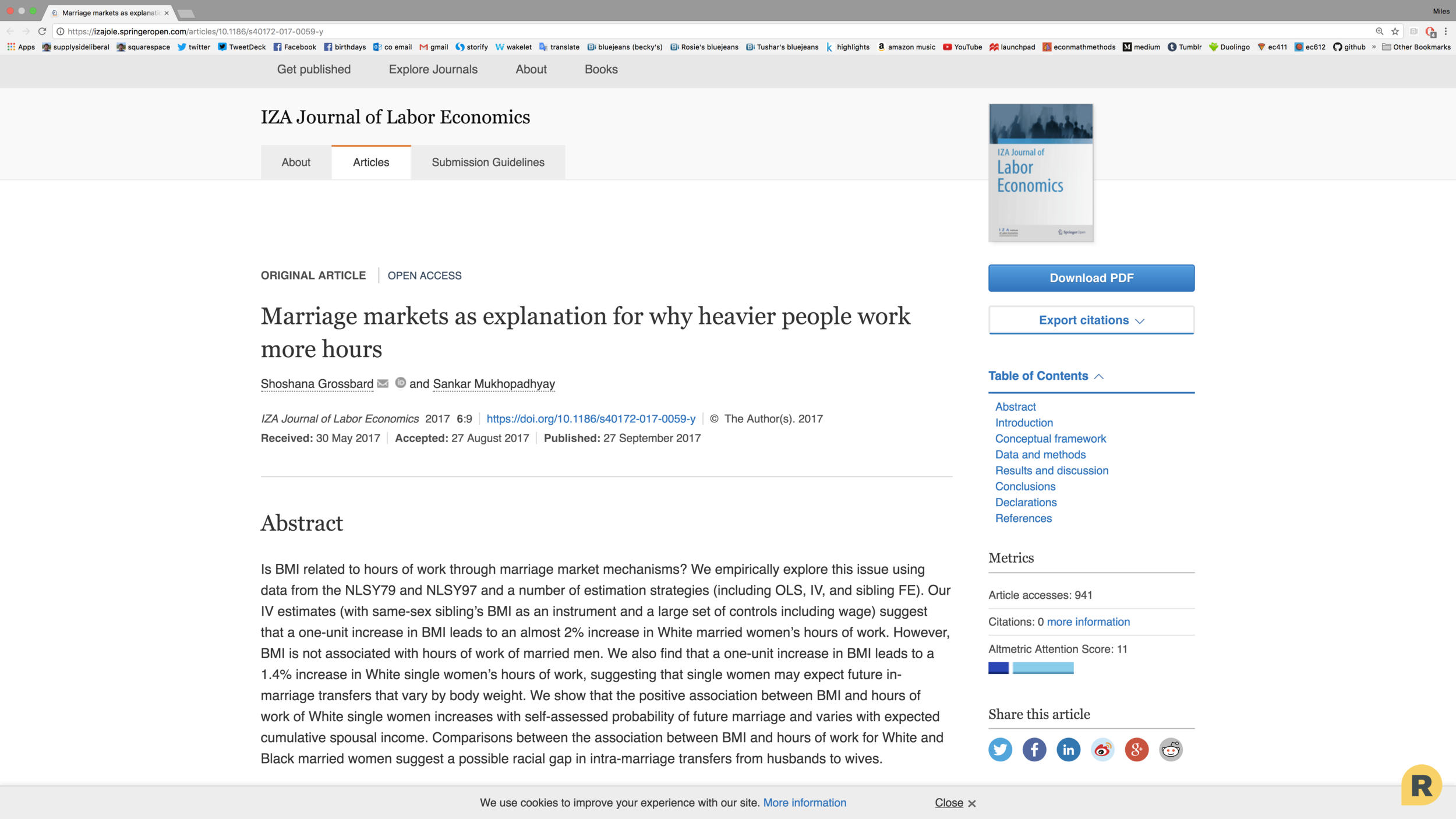
Screen Shot 2018-01-31 at 7.06.25 PM.png
                                                  Link to the article above

                                                  Link to the article above

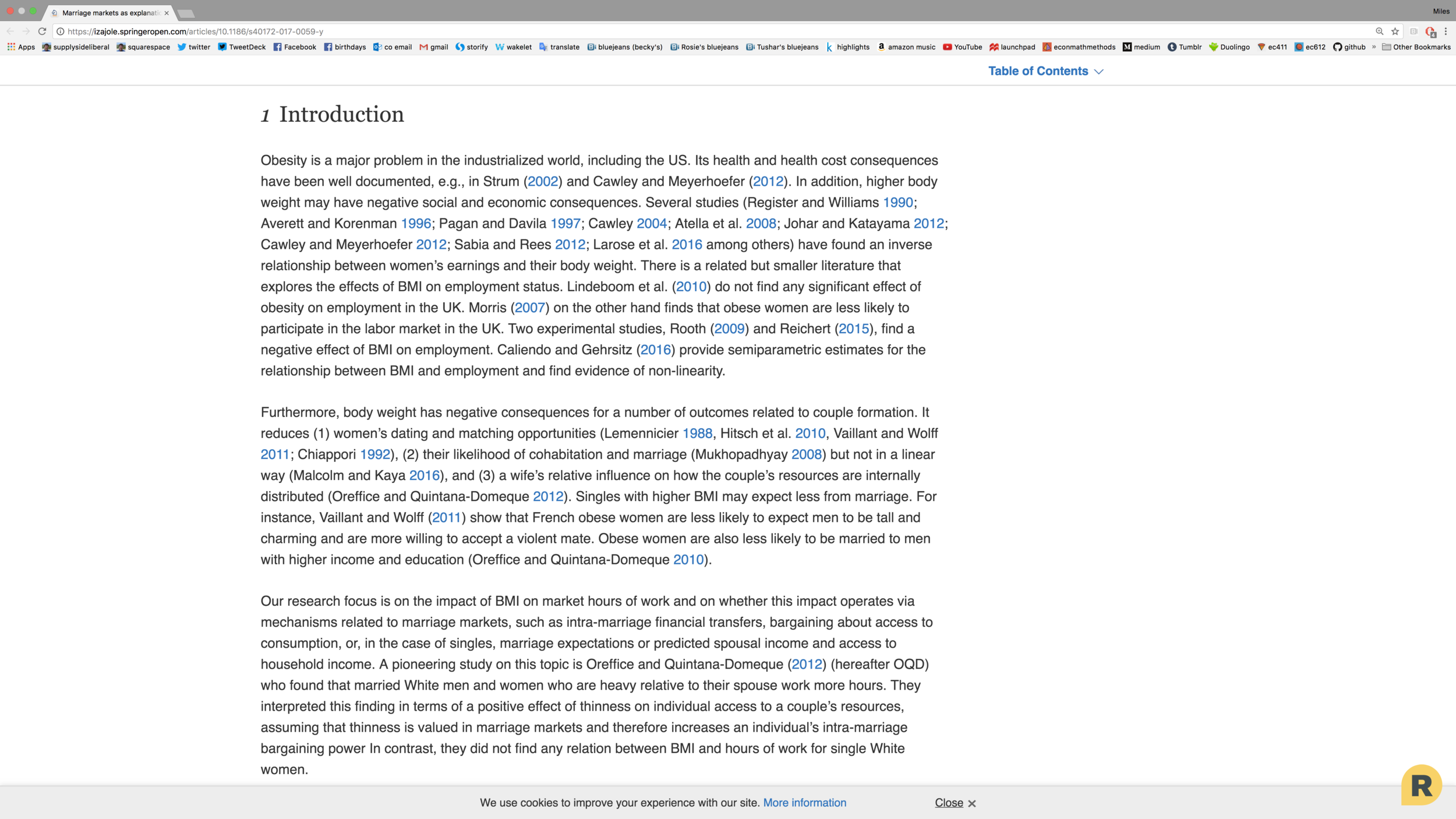
Obesity has many other negative consequences in our culture beyond its negative health consequences. The introduction to Shoshana Grossbard and Sankar Mukhopadhyay's article flagged above lists many:

Obesity is a major problem in the industrialized world, including the US. Its health and health cost consequences have been well documented, e.g., in Strum (2002) and Cawley and Meyerhoefer (2012). In addition, higher body weight may have negative social and economic consequences. Several studies (Register and Williams 1990; Averett and Korenman 1996; Pagan and Davila 1997; Cawley 2004; Atella et al. 2008; Johar and Katayama 2012; Cawley and Meyerhoefer 2012; Sabia and Rees 2012; Larose et al. 2016 among others) have found an inverse relationship between women’s earnings and their body weight. There is a related but smaller literature that explores the effects of BMI on employment status. Lindeboom et al. (2010) do not find any significant effect of obesity on employment in the UK. Morris (2007) on the other hand finds that obese women are less likely to participate in the labor market in the UK. Two experimental studies, Rooth (2009) and Reichert (2015), find a negative effect of BMI on employment. Caliendo and Gehrsitz (2016) provide semiparametric estimates for the relationship between BMI and employment and find evidence of non-linearity.

Furthermore, body weight has negative consequences for a number of outcomes related to couple formation. It reduces (1) women’s dating and matching opportunities (Lemennicier 1988, Hitsch et al. 2010, Vaillant and Wolff 2011; Chiappori 1992), (2) their likelihood of cohabitation and marriage (Mukhopadhyay 2008) but not in a linear way (Malcolm and Kaya 2016), and (3) a wife’s relative influence on how the couple’s resources are internally distributed (Oreffice and Quintana-Domeque 2012). Singles with higher BMI may expect less from marriage. For instance, Vaillant and Wolff (2011) show that French obese women are less likely to expect men to be tall and charming and are more willing to accept a violent mate. Obese women are also less likely to be married to men with higher income and education (Oreffice and Quintana-Domeque 2010).

The research behind their article identifies another, as described in the abstract:

Is BMI related to hours of work through marriage market mechanisms? We empirically explore this issue using data from the NLSY79 and NLSY97 and a number of estimation strategies (including OLS, IV, and sibling FE). Our IV estimates (with same-sex sibling’s BMI as an instrument and a large set of controls including wage) suggest that a one-unit increase in BMI leads to an almost 2% increase in White married women’s hours of work. However, BMI is not associated with hours of work of married men. We also find that a one-unit increase in BMI leads to a 1.4% increase in White single women’s hours of work, suggesting that single women may expect future in-marriage transfers that vary by body weight. We show that the positive association between BMI and hours of work of White single women increases with self-assessed probability of future marriage and varies with expected cumulative spousal income. Comparisons between the association between BMI and hours of work for White and Black married women suggest a possible racial gap in intra-marriage transfers from husbands to wives.

Moreover, beyond all the negative consequences listed above, I am struck by what a great share of the consciousness of many people is filled by thoughts about their own unsuccessful weight-loss efforts. That is, these negative consequences of obesity and being overweight are on top of the costs people incur to try to weigh less. I emphasize the expenditure of consciousness itself, but of course there is a great deal of time and money spent in weight-loss efforts as well. It is a bit like crime: we suffer from crime and we are hurt by all of the costs we incur to try to reduce crime.  

Having emphasized all the costs on top of the health cost, how big is the health cost itself? Here is a way to get an idea of the right order of magnitude. A little googling turns up the 2013 PLOS One article "Life Years Lost Associated with Obesity-Related Diseases for U.S. Non-Smoking Adults" by Su-Hsin Chang , Lisa M. Pollack, Graham A. Colditz which cites these CDC figures in the introduction:

The Centers for Disease Control and Prevention (CDC) estimates that approximately 112,000 deaths are associated with obesity each year in the United States [6][7].

When combined with a $9 million valuation of a statistical life, which is not an unreasonable number (see the Wikipedia article "Value of Life"), that comes to slightly over $1 trillion worth of obesity-related deaths each year

The total cost of obesity, including all of the above, motivates me to keep writing about how to fight it. Here are the main posts I have written so far on fighting obesity:

Also see the last section of "Five Books That Have Changed My Life."

John Locke: Thinking of Mothers and Fathers On a Par Undercuts a Misleading Autocratic Metaphor

Large-scale matriarchies appear often in fiction, but are hard to point to in real life. Some of these fictions project matriarchy into prehistory. But I suspect the status of women relative to men is better now than at any other time since the…

Large-scale matriarchies appear often in fiction, but are hard to point to in real life. Some of these fictions project matriarchy into prehistory. But I suspect the status of women relative to men is better now than at any other time since the emergence of Homo Sapiens. For better than now, we need to look to the future, not the past.

The word "patriarchy" points to a very real correlation between autocratic hierarchy and sexism. There are, and there have been female dictators and semi-dictators. But it is hard to come up with an example of an autocratic government that has as high a percentage of women in the top echelons of power (say in a list of the top 100 most politically powerful people in a nation) as many democracies do. (Communist governments officially proclaimed the equality of men and women. But they did not and do not have a large percentage of women in the top echelons of power.)

In sections 52 and 53 of John Locke's 2d Treatise on Government: “Of Civil Government” (Chapter VI. Of Paternal Power), John Locke points to an interesting reason that gender equality is a bad fit for autocracy: it put two people at the head of each family, instead of one, and thereby undercuts the notion that one person needs to be at the top of society:

It may perhaps be censured as an impertinent criticism, in a discourse of this nature, to find fault with words and names, that have obtained in the world: and yet possibly it may not be amiss to offer new ones, when the old are apt to lead men into mistakes, as this of paternal power probably has done, which seems so to place the power of parents over their children wholly in the father, as if the mother had no share in it; whereas, if we consult reason or revelation, we shall find, she hath an equal title. This may give one reason to ask, whether this might not be more properly called parental power? for whatever obligation nature and the right of generation lays on children, it must certainly bind them equal to both the concurrent causes of it. And accordingly we see the positive law of God every where joins them together, without distinction, when it commands the obedience of children, “Honour thy father and thy mother,” Exod. xx. 12. “Whosoever curseth his father or his mother,” Lev. xx. 9. “Ye shall fear every man his mother and his father,” Lev. xix. 3. “Children, obey your parents,” &c. Eph. vi. 1. is the style of the Old and New Testament.  1

 Had but this one thing been well considered, without looking any deeper into the matter, it might perhaps have kept men from running into those gross mistakes, they have made, about this power of parents; which, however it might, without any great harshness, bear the name of absolute dominion, and regal authority, when under the title of paternal power it seemed appropriated to the father, would yet have sounded but oddly, and in the very name shewn the absurdity, if this supposed absolute power over children had been called parental; and thereby have discovered, that it belonged to the mother too: for it will but very ill serve the turn of those men, who contend so much for the absolute power and authority of the fatherhood, as they call it, that the mother should have any share in it; and it would have but ill supported the monarchy they contend for, when by the very name it appeared, that that fundamental authority, from whence they would derive their government of a single person only, was not placed in one, but two persons jointly. But to let this of names pass.

The image of mothers and fathers being equal leaders of a family is not even a good fit as an image for oligarchic rule: most mother-father pairs leading families jointly have dispositions that differ more than the three individuals in a triumvirate, for example. So the image of mothers and fathers leading families jointly tends to suggest the idea that it is possible for people who are different to be involved in ruling. That is at least partway toward the idea of democracy. 

I have become enamored of the idea that involving people with different dispositions and different views in making a decision is likely to result in a better decision. Believing this forces me into the awkward position of being open to the possibility that I might be wrong even in situations where I am convinced that I am right. It also leads me to hope that my words persuade when I am right and don't persuade when (unbeknownst to me) I am wrong. 

I have enough confidence in my own views that if somehow, I were magically in the position of being a benevolent dictator in a society that would tolerate a departure from democracy, it would be hard to lay down that power entirely. But one of the first things I would do would be to gather around me a set of councillors I respected and trusted who would not hesitate to tell me when they thought I was wrong. Then I would irrevocably cede constitutional authority to the council that I had appointed—and mandate a transition to democracy by the time most of those councillors would become unable to serve due to death or advanced age. 


For links to other John Locke posts, see these John Locke aggregator posts: 

Most of the Gender Wage Gap Stems from Inequality in the Household, Inequality in the Culture, and Hostile Workplaces

In this video, Christina Hoff Sommers recounts the standard result that after accounting for differences occupational choices, there isn't much of a gender gap left. She note that there are also plenty of omitted variables in the typical study to potentially account for most of the rest. 

Christina also emphasizes the market logic that could lead to such a result: if women are cheaper, a private equity firm could make a lot of money by taking over firms that are slowly losing money and make them profitable just by hiring cheaper women. They could cut wages and still get plenty of employees simply by being willing to hire mostly women. Somewhat harder, entrepreneurs willing to hire mostly women should often be successful against established businesses that are reluctant to hire women. I had a storify discussion about this: "The Argument that the Free Market Will Rectify Discrimination as a Guide to Business Opportunities.

Let me say something about these two points in reverse order.

The logic that predicts the profit motive is enough to close the gender wage gap does not operate in areas where the profit motive is weak. This means that a good place to look for genuine gender wage gaps is in the nonprofit sector—for example, in nonprofit universities. Even there, cost-minimization in the hiring of lower staff is likely to suppress genuine gender wage gaps for lower-level staff. The genuine gender wage gaps are more likely to be concentrated among the professoriate. This does present a genuine opportunity for universities that hire more female professors. But it is not easy for private equity firms to take over a university and make it follow a policy of hiring more female professors. Nor is it easy to establish successful new universities that can compete at the top rank. So universities themselves need to decide to seize the opportunity if it is going to happen; it is not likely to be forced on them. (On this opportunity for Economics Departments specifically, see my post "When Women Don’t Get Any Credit for Coauthoring with Men.")

Turning to Christina's research summary suggesting their is very little in the way of a genuine gender wage gap, I am struck first by how many of the differences in occupational choices made by men and women to back to inequality within households headed by a male-female pair. In this list, let me use the terminology "husband" and "wife," with the understanding that similar issues applied to unmarried heterosexual couples:

  1. Husbands are less willing to relocate to help out their wives' careers than wives are to help out their husband's careers. 
  2. When there are children, more of the childcare duties typically fall on the wives than the husbands. In particular, being "on-call" for unpredictable child-related events such as a kid getting sick tends to fall more on wives than on husbands. Both regular childcare duties and being "on-call" for unpredictable child-related events make it more difficult to work long hours and more difficult to be "on-call" for an employer. 

Second, I am struck by the role of sometimes subtly, sometimes not-so-subtly hostile workplaces in discouraging women from pursuing many lucrative professions. For example, think of Christina's list of high-paying careers in which women are underrepresented:

  • Petroleum Engineering
  • Math and Computer Sciences
  • Aerospace Engineering
  • Chemical Engineering

I am willing to bet that women face ill-treatment in all of these fields. What I know best is that Silicon Valley has produced many stories of ill-treatment for women in the tech industry. In math, the discouragement of women begins early in telling them they are not good at math and sciences. On this, see "Calculus is Hard. Women Are More Likely to Think That Means They’re Not Smart Enough for Science, Technology, Engineering and Math" and "There's One Key Difference Between Kids Who Excel at Math and Those Who Don't." 

In addition to outright ill-treatment, a common type of discrimination against women comes from workplace cultures that amp up the need for highly "competitive" self-serving behaviors that our culture has more actively socialized women against doing than it has socialized men against doing. Men also take advantage of prosocial things that women have been socialized towards doing. 

The details differ by particular occupation. To see how this places out in a narrow neck of the woods, see "How Big is the Sexism Problem in Economics?

When men create hostile or unfair workplaces for women, there can be a tipping point where private equity firms and entrepreneurs swoop in and switch to workplaces with such a preponderance of women that the few men are unable to enforce a hostile workplace environment. But this can require a very discontinuous change. A few more women and a few less men won't do it. There are market opportunities here, but only for the bold.

Third, I do think that our culture bestows more approval on women who sacrifice salary for nonpecuniary benefits than on men who sacrifice salary for nonpecuniary benefits. Men who choose a low-paid meaningful job are more likely to face criticism than women are for not sucking it up and taking the alternative soul-deadening job in order to better support the family. Leaving anything related to child-rearing in another category (see above), here are some of the other nonpecuniary benefits women are given more social approval than men for choosing even at the cost of low pay:

  • the knowledge that one is making the world a better place with one's job
  • the knowledge that one is greatly helping particular individuals with one's job
  • satisfying interpersonal interactions on the job with either coworkers or customers/clients
  • an artistic element to a job
  • physical safety

Looking at another, more complex dimension, both men and women are given more social approval for choosing jobs that seem gender appropriate. This cuts in all kinds of ways on the relative pay of men and women. For example, men may be too slow to leave the declining manufacturing sector for mid-level and low-level healthcare positions because a factory job seems more masculine. Here women are helped by the fact that nursing, which is a relative good career compared to factory work (given the way things are going), has been deemed gender-appropriate for women. On the other hand, women may be especially ready to go into elementary school teaching despite its low pay because even in 2018, this seems like an especially gender-appropriate career. 

Conclusion: The bottom line is this:

  1. There are opportunities to do well by doing good in rectifying inequality in the workplace between men and women, but they may take insight and courage.
  2. In addition to its direct harm, men behaving badly to women can be part of the source of pay differences. Better behavior is called for. It is great to see the dam break that guarded a cesspool of sexual assault and harrassment as the #MeToo moment continues with strength. Beyond that, there are a few words recommending better behavior in my post "On Being a Good Guy." 
  3. The personal is economic. If husbands won't relocate for the sake of their wives' careers and won't take on tougher childcare duties, it puts women behind in the workplace.
  4. Just because most employers aren't discriminating in the purest sense of discrimination doesn't mean that things are fair.  


Hat tip to Joseph Kimball for pointing me to this video. 


Julia Rohrer on the Selection Distortion Effect—That Weird Third Variable Problem: Conditioning on a Collider

I really like this blog post.

Here is how I stumbled across it. When I suggested that correlations being caused by a third factor needed a snappier, catchier name in "Cousin Causality," Chris Chabris tweeted that it was called "third-variable causation" in psychology. Though neither this nor the other term in use, "shared causation", meet my standards for being snappy and catchy, knowing the phrase "third-variable causation" led me to a search on Twitter that turned up Julia Rohrer's post.  

Diseases of Civilization

Update: In my post “Vindicating Gary Taubes: A Smackdown of Seth Yoder,” I retract the criticisms I make of Gary Taubes in "The Case Against the Case Against Sugar: Seth Yoder vs. Gary Taubes.”

In "Obesity Is Always and Everywhere an Insulin Phenomenon" I quote Gary Taubes at some length about the dramatically higher incidence of diseases such as heart disease, cancer, diabetes, etc. in countries with a modern diet and lifestyle. But having realized from reading Seth Yoder's devastating post how unreliable a reporter Gary Taubes is, as I detailed in "The Case Against the Case Against Sugar: Seth Yoder vs. Gary Taubes, I wanted to document that while various authors disagree about the causes of what are variously called the "Diseases of Civilization," "Western Diseases" and "Diseases of Affluence," there is broad agreement about the fact that these diseases are rare among less affluent groups with longstanding indigenous diets and lifestyles.  

Let me start with some passages from The Big Fat Surprise: Why Butter, Meat and Cheese Belong in a Healthy Diet by Nina Teicholz. Nina's main concern is to exonerate dietary fat and animal food more generally as the causes of the Diseases of Civilization. After beginning Chapter 1 by talking about Inuit's meat-heavy diet, Nina turns other groups (I have added the group names in bold as subheadings):


The Masai and Samburus: Across the globe half a century later, George V. Mann, a doctor and professor of biochemistry who had traveled to Africa, had a similarly counterintuitive experience. Although his colleagues in the United States were lining up in support of an increasingly popular hypothesis that animal fats cause heart disease, in Africa Mann was seeing a totally different reality. He and his team from Vanderbilt University took a mobile laboratory to Kenya in the early 1960s in order to study the Masai people. Mann had heard that the Masai men ate nothing but meat, blood, and milk—a diet, like the Inuits’, comprised of almost entirely animal fat—and that they considered fruits and vegetables fit to be eaten only by cows.

Mann was building upon the work of A. Gerald Shaper, a South African doctor working at a university in Uganda, who had traveled farther north to study a similar tribe—the Samburus. A young Samburu man would drink from 2 to 7 liters of milk each day, depending on the season, which worked out on average to well over a pound of butterfat. His cholesterol intake was sky-high, especially during periods when he would add 2 to 4 pounds of meat to his daily diet of milk. Mann found the same with the Masai: the warriors drank 3 to 5 liters of milk daily, usually in two meals. When milk ran low in the dry season, they would mix it with cow blood. Not shirking the meat, they ate lamb, goat, and beef regularly, and on special occasions or on market days, when cattle were killed, they would eat 4 to 10 pounds of fatty beef per person. For both tribes, fat was the source of more than 60 percent of their calories, and all of it came from animal sources, which meant that it was largely saturated. For the young men of the warrior (“murran”) class, Mann reported that “no vegetable products are taken.”

Despite all of this, the blood pressure and weight of both these Masai and the Samburu peoples were about 50 percent lower than their American counterparts—and, most significantly, these numbers did not rise with age. “These findings hit me very hard,” said Shaper, because they forced him to realize that it was not biologically normal for cholesterol, blood pressure, and other indicators of good health automatically to worsen with aging, as everyone in the United States assumed. In fact, a review of some twenty-six papers on various ethnic and social groups concluded that in relatively small homogenous populations living under primitive conditions, “more or less undisturbed by their contacts with civilization,” an increase in blood pressure was not part of the normal aging process. Was it possible that we in the Western world were the anomaly, driving up our blood pressure and generally ruining our health by some aspect of our diet or modern way of life?

True, the Masai were free from the kind of emotional and competitive stresses that gnaw away at the citizens of more “civilized” countries and which some people believe contribute to heart disease. The Masai also got more exercise than desk-bound Westerners: these tall, slender shepherds would walk for many miles each day with their cattle, searching for food and water. Mann thought that perhaps all this exercise might be protecting the Masai from heart disease.II But he also acknowledged that subsistence was “easy” and “labor light,” and that the elders, who “seem sedentary,” were not dying from heart attacks, either.

If our current belief about animal fat is correct, then all the meat and dairy these tribesmen were eating would have caused an epidemic of heart disease in Kenya. However, Mann found exactly the opposite—he could identify almost no heart disease at all. He documented this by performing electrocardiograms on four hundred of the men, among whom he found no evidence of a heart attack. (Shaper did the same test on one hundred of the Samburu and found “possible” signs of heart disease in only two cases.) Mann then performed autopsies on fifty Masai men and found only one case with “unequivocal” evidence of an infarction. Nor did the Masai suffer from other chronic diseases, such as cancer or diabetes. ...

The Sikhs and the Hunzas: In the early 1900s, for instance, Sir Robert McCarrison, the British government’s director of nutrition research in the Indian Medical Service and perhaps the most influential nutritionist of the first half of the twentieth century, wrote that he was “deeply impressed by the health and vigour of certain races there. The Sikhs and the Hunzas,” notably, suffered from “none of the major diseases of Western nations such as cancer, peptic ulcer, appendicitis, and dental decay.” These Indians in the north were generally long-lived and had “good physique[s],” and their vibrant health stood “in marked contrast” to the high morbidity of other groups in the southern part of India who ate mainly white rice with minimal dairy or meat. McCarrison believed he could rule out causes other than nutrition for these differences, because he found that he could reproduce a similar degree of ill-health when feeding experimental rats a diet low in milk and meat. The healthy people McCarrison observed ate some meat but mostly “an abundance” of milk and milk products such as butter and cheese, which meant that the fat content of their diet was mainly saturated.

Native Americans of the Southwest between 1898 and 1905: Meanwhile, the Native Americans of the Southwest were observed between 1898 and 1905 by the physician-turned-anthropologist Aleš Hrdlička, who wrote up his observations in a 460-page report for the Smithsonian Institute. The elders among the Native Americans he visited would likely have been raised on a diet of predominantly meat, mainly from buffalo until losing their traditional way of life, yet, as Hrdlička observed, they seemed to be spectacularly healthy and lived to a ripe old age. The incidence of centenarians among these Native Americans was, according to the 1900 US Census, 224 per million men and 254 per million women, compared to only 3 and 6 per million among men and women in the white population. Although Hrdlička noted that these numbers were probably not wholly accurate, he wrote that “no error could account for the extreme disproportion of centenarians observed.” Among the elderly he met of age ninety and up, “not one of these was either much demented or helpless.”

Hrdlička was further struck by the complete absence of chronic disease among the entire Indian population he saw. “Malignant diseases,” he wrote, “if they exist at all—that they do would be difficult to doubt—must be extremely rare.” He was told of “tumors” and saw several cases of the fibroid variety, but never came across a clear case of any other kind of tumor, nor any cancer. Hrdlička wrote that he saw only three cases of heart disease among more than two thousand Native Americans examined, and “not one pronounced instance” of atherosclerosis (buildup of plaque in the arteries). Varicose veins were rare. Nor did he observe cases of appendicitis, peritonitis, ulcer of the stomach, nor any “grave disease” of the liver. Although we cannot assume that meat eating was responsible for their good health and long life, it would be logical to conclude that a dependence on meat in no way impaired good health.

Colonial Africa and Asia: In Africa and Asia, explorers, colonialists, and missionaries in the early twentieth century were repeatedly struck by the absence of degenerative disease among isolated populations they encountered. The British Medical Journal routinely carried reports from colonial physicians who, though experienced in diagnosing cancer at home, could find very little of it in the African colonies overseas. So few cases could be identified that “some seem to assume that it does not exist,” wrote George Prentice, a physician who worked in Southern Central Africa, in 1923. Yet if there were a “relative immunity to cancer” it could not be attributed to the lack of meat in the diet ...


Gary Taubes claims that the Diseases of Civilization were brought on by the consumption of sugar and white flour. T. Colin Campbell and Thomas M. Campbell II claim that the Diseases of Civilization are caused primarily by the consumption of animal protein in their book The China Study. (See "Meat Is Amazingly Nutritious—But Is It Amazingly Nutritious for Cancer Cells, Too?") Here is their description of the Diseases of Civilization:


It doesn’t take a scientist to figure out that the possibility of death has been holding pretty steady at 100% for quite some time. There’s only one thing that we have to do in life, and that is to die. I have often met people who use this fact to justify their ambivalence toward health information. But I take a different view. I have never pursued health hoping for immortality. Good health is about being able to fully enjoy the time we do have. It is about being as functional as possible throughout our entire lives and avoiding disabling, painful, and lengthy battles with disease. There are many better ways to die, and to live.

Because the China Cancer Atlas had mortality rates for more than four dozen different kinds of disease, we had a rare opportunity to study the many ways that people die. We wondered: Do certain diseases tend to cluster in certain areas of the country? For example, did colon cancer occur in the same regions as diabetes? If this proved to be the case, we could assume that diabetes and colon cancer (or other diseases that clustered) shared common causes. These causes could include a variety of possibilities, ranging from the geographic and environmental to the biological. However, because all diseases are biological processes (gone awry), we can assume that whatever “causes” are observed, they will eventually operate through biological events.

When these diseases were cross-listed in a way that allowed every disease rate to be compared with every other disease rate,11 two groups of diseases emerged: those typically found in more economically developed areas (diseases of affluence) and those typically found in rural agricultural areas (diseases of poverty)12 (Chart 4.4).

The diseases shown in Chart 4.4 tend to be associated with diseases in their own list but not in the opposite list. A region in rural China that has a high rate of pneumonia, for example, will not have a high rate of breast cancer, but will have a high rate of a parasitic disease. The disease that kills most Westerners, coronary heart disease, is more common in areas where breast cancer also is more common. Coronary heart disease, by the way, is relatively uncommon in many developing societies of the world. This is not because people die at a younger age, thus avoiding these Western diseases. These comparisons are age-standardized rates, meaning that people of the same age are being compared.

Chart 4.4: Disease Groupings Observed in Rural China

  • Disease of Affluence (Nutritional extravagance) Cancer (colon, lung, breast, leukemia, childhood brain, stomach, liver), diabetes, coronary heart disease

  • Disease of Poverty (Nutritional inadequacy and poor sanitation) Pneumonia, intestinal obstruction, peptic ulcer, digestive disease, pulmonary tuberculosis, parasitic disease, rheumatic heart disease, metabolic and endocrine disease other than diabetes, diseases of pregnancy, and many others


Disease associations of this kind have been known for quite some time in the United States and other Western countries die from diseases of affluence. For this reason, these diseases are often referred to as Western diseases. Some rural counties had few diseases of affluence while other counties had far more. The core question of the China Study was this: Is it because of differences in dietary habits? [pp. 65, 66]


To give a couple of examples at the time of our study, the death rate from coronary heart disease was seventeen times higher among American men than rural Chinese men.16 The American death rate from breast cancer was five times higher than the rural Chinese rate. Even more remarkable were the extraordinarily low rates of coronary heart disease in the southwestern Chinese provinces of Sichuan and Guizhou. During a three-year observation period (1973–1975), not one single person died of coronary heart disease before the age of sixty-four, among 246,000 men in a Guizhou county and 181,000 women in a Sichuan county!17 After these low cholesterol data were made public, I learned from three very prominent heart disease researchers and physicians, Drs. Bill Castelli, Bill Roberts, and Caldwell Esselstyn, Jr., that in their long careers they had never seen a heart disease fatality among their patients who had blood cholesterol levels below 150 mg/dL. Dr. Castelli was the long-time director of the famous Framingham Heart Study of NIH; Dr. Esselstyn was a renowned surgeon at the Cleveland Clinic who did a remarkable study on reversing heart disease (chapter five); and Dr. Roberts has long been editor of the prestigious medical journal Cardiology. [p. 69]


My hero Jason Fung is a proponent of lowcarb diets, and would be sympathetic to the recommendations I make in "Forget Calorie Counting; It's the Insulin Index, Stupid," but in the following passage, he points to processed foods as a major cause of the Diseases of Civilization:


Humans evolved to eat a wide range of foods without detrimental health consequences. The Inuit peoples traditionally ate diets extremely high in animal products, which means high percentages of fat and protein. Others, such as the Okinawans, ate a traditional diet based on root vegetables, which means it’s high in carbohydrates. But both populations traditionally did not suffer metabolic diseases. These only appeared with the increasing Westernization of their diets. What humans haven’t evolved to eat are highly processed foods. During processing, the natural balance of macronutrients, fiber, and micronutrients is completely disrupted. For example, processing the wheat berry to remove all the fat and protein means that the result, white flour, is almost pure carbohydrates. Wheat berries are natural; white flour is not. It is also ground to an extremely fine consistency that greatly speeds the absorption of carbohydrates into the bloodstream. Most other processed grains suffer the same problems. Our body has evolved to handle natural foods, and when we feed it unnatural ones, the result is illness.


Thus, while there is no agreement about what aspect of the modern diet is most to blame for the Diseases of Civilization, there is something about the modern diet and lifestyle that is causing trouble. 


Don’t miss my other posts on diet and health. My views of Gary Taubes have evolved. I have an entire section below of links to posts about Gary Taubes and his work.

I. The Basics

II. Sugar as a Slow Poison

III. Anti-Cancer Eating

IV. Eating Tips

V. Calories In/Calories Out

VI. Wonkish

VIII. Debates about Particular Foods and about Exercise

IX. Gary Taubes

X. Twitter Discussions

XI. On My Interest in Diet and Health

See the last section of "Five Books That Have Changed My Life" and the podcast "Miles Kimball Explains to Tracy Alloway and Joe Weisenthal Why Losing Weight Is Like Defeating Inflation." If you want to know how I got interested in diet and health and fighting obesity and a little more about my own experience with weight gain and weight loss, see “Diana Kimball: Listening Creates Possibilities and my post "A Barycentric Autobiography. 

Charles Murray on Taking Religion Seriously

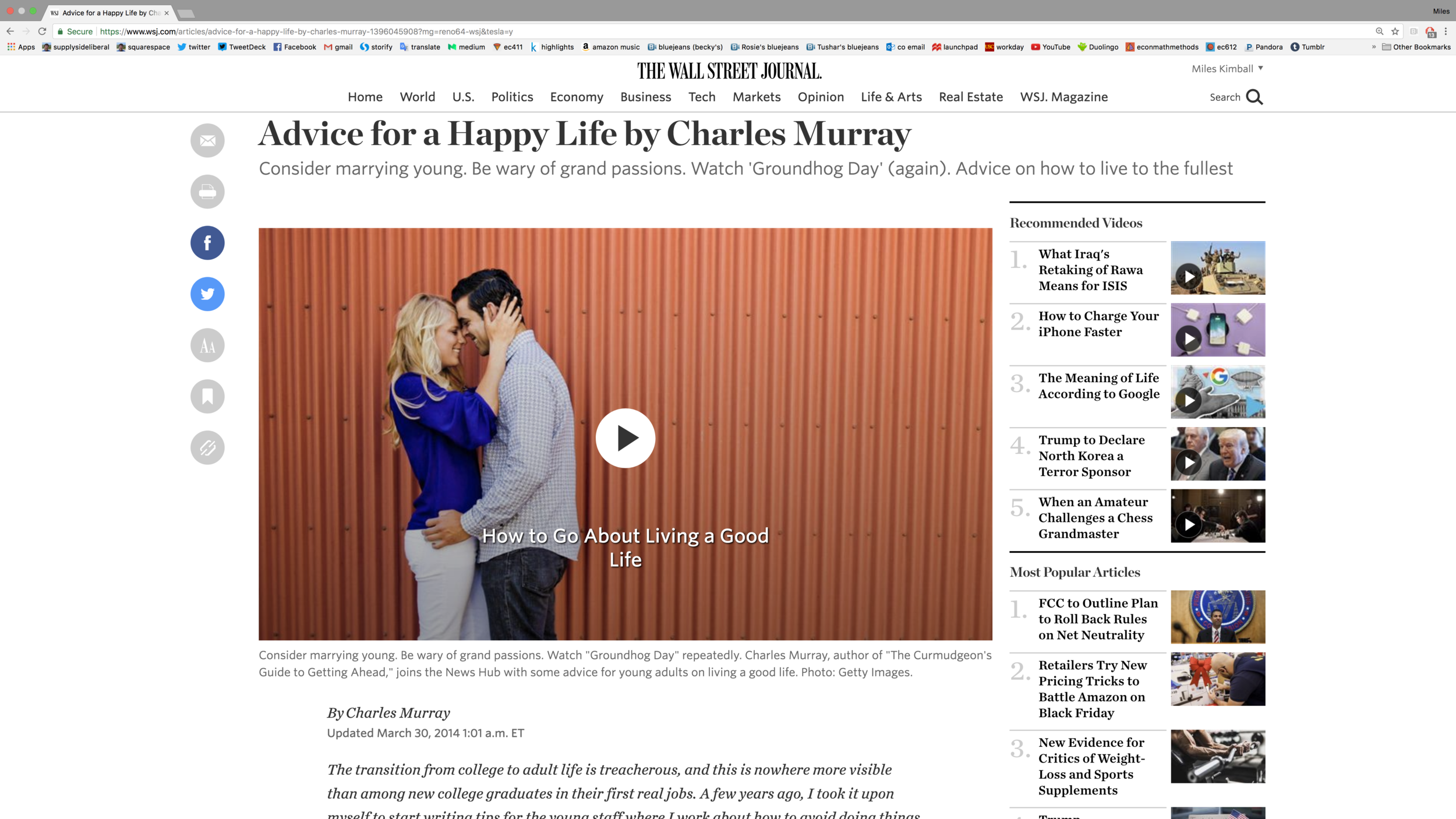
Charles Murray has an advice book: The Curmudgeon's Guide to Getting Ahead: Dos and Don'ts of Right Behavior, Tough Thinking, Clear Writing, and Living a Good Life.  It sets down the kind of advice he gave to young staffers at work. The Wall Street Journal piece flagged above is his teaser for the book. (It appeared on March 30, 2014.)

Charles's five points are:

  1. Consider Marrying Young [in your 20s instead of in your 30s]
  2. Learn How to Recognize Your Soul Mate
  3. Eventually Stop Fretting About Fame and Fortune
  4. Take Religion Seriously
  5. Watch 'Groundhog Day' Repeatedly

I like all of his advice in this essay. Here, in this post, let me focus on the 4th point: taking religion seriously. 

After letting off the hook anyone who is already seriously engaged with religion, Charles defines his audience for this section:

Now that we're alone, here's where a lot of you stand when it comes to religion: It isn't for you. You don't mind if other people are devout, but you don't get it. Smart people don't believe that stuff anymore.

After an account of how he finally came to take religion seriously (though he is still an agnostic). Charles describes what it means to take religion seriously:  

Taking religion seriously means work. If you're waiting for a road-to-Damascus experience, you're kidding yourself. Getting inside the wisdom of the great religions doesn't happen by sitting on beaches, watching sunsets and waiting for enlightenment. It can easily require as much intellectual effort as a law degree.

Even dabbling at the edges has demonstrated to me the depths of Judaism, Buddhism and Taoism. I assume that I would find similar depths in Islam and Hinduism as well. I certainly have developed a far greater appreciation for Christianity, the tradition with which I'm most familiar. The Sunday school stories I learned as a child bear no resemblance to Christianity taken seriously. You've got to grapple with the real thing.

To begin becoming more reflective, he recommends reading both religious literature and modern cosmology: "The universe isn't only stranger than we knew; it is stranger and vastly more unlikely than we could have imagined, and we aren't even close to discovering its last mysteries." As an even bigger step toward taking religion seriously: 

Find ways to put yourself around people who are profoundly religious. You will encounter individuals whose intelligence, judgment and critical faculties are as impressive as those of your smartest atheist friends—and who also possess a disquieting confidence in an underlying reality behind the many religious dogmas.

In "Five Books That Have Changed My Life" I give a thumbnail sketch of my experience being a Mormon for the first 40 years of my life. I am glad I am not a Mormon now. But I gained a great deal from having been a Mormon. I do take religion seriously. I know how deep religious feelings, religious motivations, and religious insights can be. I hope the every-other-week religion posts I have been putting up since soon after I began blogging are of some help to others—especially those who, like me, are nonsupernaturalists—in getting some inkling of the depths of religion. 

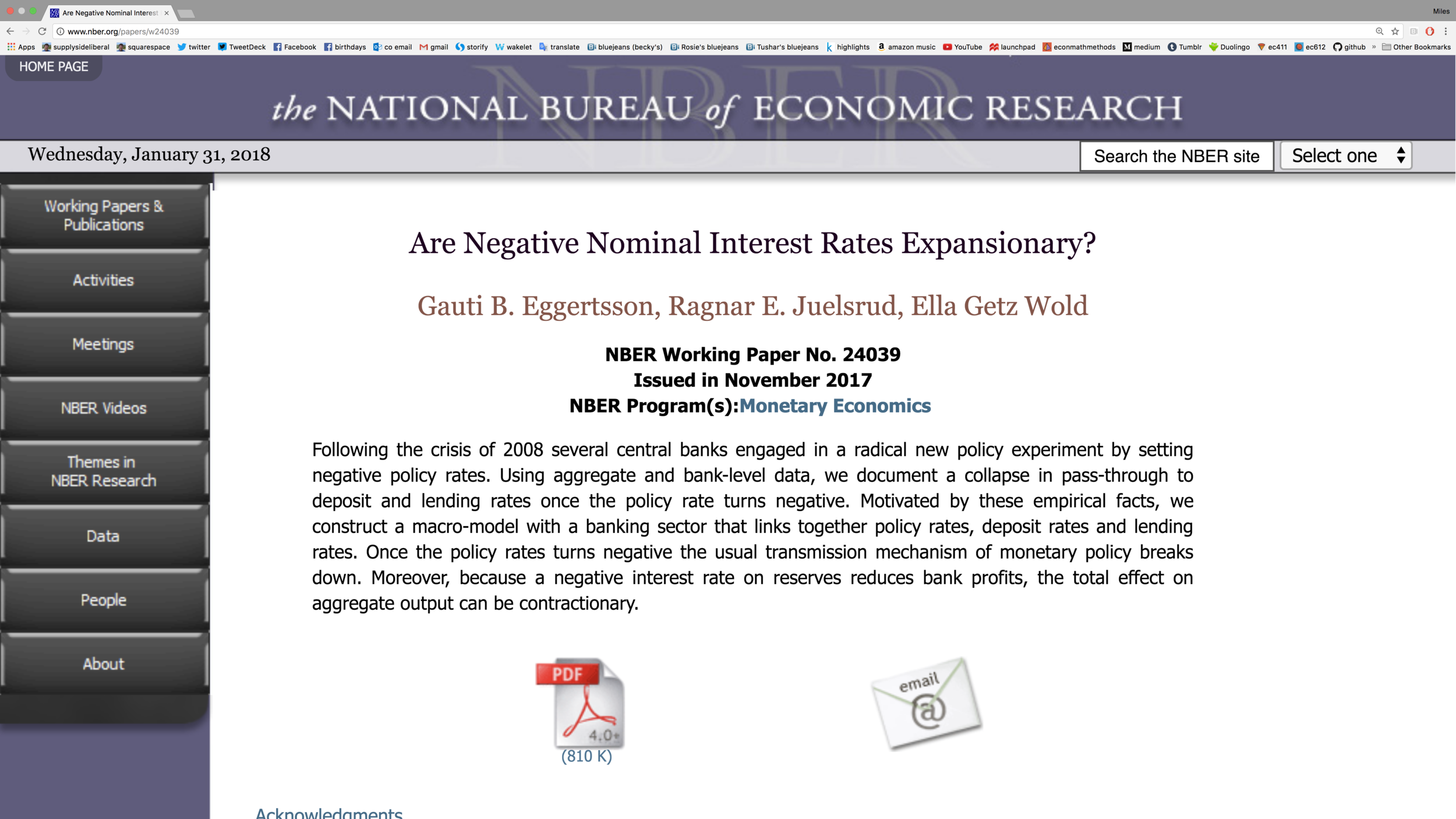
Gauti Eggertsson, Ragnar Juelsrud and Ella Getz Wold: Are Negative Nominal Interest Rates Expansionary?

It is great to see people doing formal modeling of negative interest rate policy. And it is especially good to see work of this type by a team including Gauti Eggertsson, whose research I wrote so highly of in my post "Pro Gauti Eggertsson." I wish I knew Gauti's coauthors, Ragnar Juelsrud and Ella Getz Wold better. Since this was originally posted, I have corresponded with them. Ragnar sent me this link to an ungated version of the paper

One of the most remarkable things about this paper is that instead of saying that the lower bound on interest rates is inevitable it explicitly bills itself as showing why the lower bound on interest rates needs to be removed. On pages 5 and 6, Gauti, Ragnar and Ella write this:

There is a older literature however, dating at least back to the work of Silvio Gesell more than a hundred years ago (Gesell, 1916), which contemplates more radical monetary policy regime changes than we do here. This literature has been rapidly growing in recent years. In our model, the storage cost of money, and hence the lower bound, is treated as fixed. However, policy reforms can potentially alter the lower bound or even remove it completely. An example of such policies is a direct tax on paper currency, as proposed first by Gesell and discussed in detail by Goodfriend (2000) and Buiter and Panigirtzoglou (2003). This scheme directly affects the storage cost of money, and thereby the lower bound on deposits which we derive in our model. Another possibility is abolishing paper currency altogether. This policy is discussed, among others, in Agarwal and Kimball (2015), Rogoff (2017c) and Rogoff (2017a), who also suggest more elaborate policy regimes to circumvent the ZLB. An example of such a regime is creating a system in which paper currency and electronic currency trade at different exchange rates. The results presented here should not be considered as rebuffing any of these ideas. Rather, we are simply pointing out that under the current institutional framework, empirical evidence and a stylized variation of the standard New Keynesian model do not seem to support the idea that a negative interest rate policy is an effective tool to stimulate aggregate demand. This should, in fact, be read as a motivation to study further more radical proposals such as those presented by Gesell over a century ago and more recently in the work of authors such as Goodfriend (2000), Buiter and Panigirtzoglou (2003), Rogoff (2017c) and Agarwal and Kimball (2015). In the discussion section we comment upon how our model can be extended to explore further some of these ideas, which we consider to be natural extensions.

Gauti, Ragnar and Ella return to this theme on page 33, near the end of the main body of the working paper:

In our model exercise, the storage cost of money was held fix. However, one could allow the storage cost of money - and therefore the lower bound on the deposit rate - to depend on policy. One way of making negative negative rates be expansionary, which is consistent with our account, is if the government takes actions to increase the cost of holding paper money. There are several ways in which this can be done. The oldest example is a tax on currency, as outlined by Gesell (1916). Gesell’s idea would show up as a direct reduction in the bound on the deposit rate in our model, thus giving the central bank more room to lower the interest rate on reserves - and the funding costs of banks. Another possibility is to ban higher denomination bills, a proposal discussed in among others Rogoff (2017c). To the extent that this would increase the storage cost of money, this too, should reduce the bound on the banks deposit rate. An even more radical idea, which would require some extensions to our model, is to let the reserve currency and the paper currency trade at different values. This proposal would imply an exchange rate between electronic money and paper money, and is discussed in Agarwal and Kimball (2015), Rogoff (2017a) and Rogoff (2017b). A key pillar of the proposal – but perhaps also a challenge to implementability – is that it is the reserve currency which is the economy wide unit of account by which taxes are paid, and accordingly what matters for firm price setting. If such an institutional arrangement is achieved, then there is nothing that prevents a negative interest rate on the reserve currency while cash in circulation would be traded at a different price, given by an arbitrage condition. We do not attempt to incorporate this extension to our model, but note that it seems relatively straightforward, and has the potential of solving the ZLB problem. Indeed, the take-away from the paper should not be that negative nominal rate are always non-expansionary, simply that they are predicted to be so under the current institutional arrangement. This gives all the more reason to contemplate departures from the current framework, such as those mentioned briefly here and discussed in detail by the given authors.

My post that most directly expresses this point is "If a Central Bank Cuts All of Its Interest Rates, Including the Paper Currency Interest Rate, Negative Interest Rates are a Much Fiercer Animal"

Putting their model in the context of my post "The Supply and Demand for Paper Currency When Interest Rates Are Negative," they are treating the case of a Rate of Effective Return on Cash (ROERC) curve that is flat after a certain point. I argue in my post that is not the only plausible case. There are several other ways in which their model simplifies away from issues I have stressed on my blog:

1. Gauti, Ragnar and Ella deemphasize transmission mechanisms that do not involve banks, which I argue in three key posts are quite important:

However, even though there are transmission mechanisms that go around banks, causing problems for the banking system could easily be seen as an unacceptable side effect. I make this point in "What is the Effective Lower Bound on Interest Rates Made Of?"

2. In a way Gauti, Ragnar and Ella are very clear about, their model leaves out the subsidies that central banks pursuing negative interest rates can provide to private banks. Here is a key passage from pages 36 and 37:

Our model exercise focuses exclusively on the impact of negative policy rates39. Other monetary policy measures which occurred over the same time period are not taken into account. This is perhaps especially important to note in the case of the ECB, which implemented its targeted longer-term refinancing operations (TLTROs) simultaneously with lowering the policy rate below zero. Under the TLTRO program, banks can borrow from the ECB at attractive conditions. Both the loan amount and the interest rate are tied to the banks’ loan provision to households and firms. The borrowing rate can potentially be as low as the interest rate on the deposit facility, which is currently -0.40 percent40. Such a subsidy to bank lending is likely to affect both bank interest rates and bank profits, and could potentially explain why lending rates in the Euro Area have fallen more than in other places once the policy rate turned negative.

I have emphasized the importance of central bank subsidies to private banks in several posts:

3. In Gauti, Ragnar and Ella's model, if private banks tried to have negative rates on checking or savings accounts, all of their customers would turn to paper currency storage. But that is not the only possible interpretation of why they did not lower their checking and savings account rates below zero in negative interest rate companies. Thinking that even 5% of their customers would jump ship to another bank if they went first to negative checking and saving account rates would be enough to make these checking and saving account rates quite sticky at zero. But if the central bank took its target rate and interest on reserves into deeper negative territory, banks might lower their checking and saving account rates despite this fear. And if other banks followed suit, they might not lose as many customers as they feared.

In other words, isn't the first fear the fear of customers jumping to another bank if checking and saving account rates are reduced below zero, not paper currency storage? This would generate a stickiness that could be overcome in the way paper currency storage with a linear effective return of -.01 % annually cannot be overcome (without changing paper currency policy).

4. In line with much of the literature modeling monetary policy, Gauti, Ragnar and Ella do not have investment in the model. This makes their facsimile of the Great Recession in the model deficient. For what I consider a better model of the Great Recession, see "On the Great Recession."

Conclusion. I look forward to more articles doing formal models on negative interest rate policy. I wrote about paper that Gauti, Ragnar and Ella mention in "Markus Brunnermeier and Yann Koby's "Reversal Interest Rate." Matthew Rognlie has also written a nice paper in this genre: “What lower bound? Monetary policy with negative interest rates." 

I anticipate writing something in this genre myself at some point in the future. Right now my priorities in writing academic papers on negative interest rate policy are writing a second policy-focused paper with Ruchir Agarwal and a paper with Peter Conti-Brown on the law relevant to negative interest rate policies in the US. 


The Case Against the Case Against Sugar: Seth Yoder vs. Gary Taubes

Link to the webpage on Seth Yoder shown above

Link to the webpage on Seth Yoder shown above

Update: In “Vindicating Gary Taubes: A Smackdown of Seth Yoder,” I retract my serious criticisms of Gary Taubes below. However, this post is still important in defending Gary’s substantive views.

Seth Yoder, in his post "The Case Against the Case Against Sugar" fully convinced me that Gary Taubes displays a serious lack of reportorial honesty in his book The Case Against Sugar. And Seth somehow made reading through the trainwreck of how Gary Taubes routinely misquotes or otherwise misrepresents dead people's views perversely entertaining. 

Seth's devastating demonstration of Gary Taubes's lack of reliability as a historian means I need to examine places where I have relied on information from Gary, much as I had to reassess my reliance on Carmen Reinhart and Ken Rogoff when the shoddiness of their statistical analysis came to light. (The spreadsheet error was only the tip of the iceberg. See "An Economist’s Mea Culpa: I Relied on Reinhart and Rogoff," "After Crunching Reinhart and Rogoff’s Data, We Find No Evidence That High Debt Slows Growth" and "Examining the Entrails: Is There Any Evidence for an Effect of Debt on Growth in the Reinhart and Rogoff Data?") 

Fortunately, in the area of diet and health, Jason Fung is my guy (see "Five Books That Have Changed My Life"), not Gary Taubes. And I always took Gary Taubes's reasoning with a grain of salt. For example, in my post "The Case Against Sugar: Stephan Guyenet vs. Gary Taubes," I write:

First, I should say that I start out expecting less from journalists like Gary Taubes than the standard that Stephan Guyenet wants to judge them buy. Stephan mentions repeatedly the "Igon Value Problem," which refers to a term "coined by Steven Pinker in a review of Malcolm Gladwell's book What the Dog Saw." Malcolm Gladwell did not know what an eigenvalue was, and so misheard it as an "Igon value." Similarly, Gary Taubes is not himself a scientist and so does not fully understand everything he is talking about.

It was also pretty obvious to me that Gary Taubes was tilting his selection of what to tell and what not to tell toward things that helped his case against sugar. But I thought the "facts" that he did tell about would be accurate. Just after the passage above from "The Case Against Sugar: Stephan Guyenet vs. Gary Taubes," is this:

But [Gary Taubes] does give us a tour through the history of thought about nutrition and what he felt he learned by talking to many scientists, with an emphasis on what the more contrarian scientists said. This is a useful service. 

After seeing the misquotations and misrepresentations that Seth Yoder identifies, I no longer know which bits of this history of nutritional though are true and which are false. But let me attempt to examine where I stand, post by post where I was in danger of relying too much on Gary Taubes. Using my blog search box identified only four posts where I mention Gary Taubes other than in referring to the title of another blog post. Below I analyze my degree of reliance on Gary Taubes for each. After that, I register a couple of disagreements with Seth.

The Case Against Sugar: Stephan Guyenet vs. Gary Taubes

In "The Case Against Sugar: Stephan Guyenet vs. Gary Taubes," I summarized what I thought I had learned from The Case Against Sugar thus:

  • Sugar is very, very bad. I will say more below on why convincing people of that is an important accomplishment.

  • What the nutrition establishment is telling us needs to be closely examined and cross-checked by scientists outside the nutrition establishment. It is very unwise to simply trust the nutrition establishment.

I think I could have gotten this much from Jason Fung alone. The basic reason sugar is very, very bad is that most foods with a substantial sugar content are quite high on the insulin index. See "Forget Calorie Counting; It's the Insulin Index, Stupid." 

In "The Case Against Sugar: Stephan Guyenet vs. Gary Taubes," I actually disagree with Gary Taubes a lot. Here are some examples of my words in that post that disagree with Gary:

  • Gary argues that other than Western diets adding sugar and flour, every other aspect of Western diets was duplicated by at least some indigenous diet, so sugar and flour must be the culprit. This is a strong argument. However, I would add in the possibility that people in almost every indigenous population had substantial chunks of time when they had no food consumption. Whether their fasts were involuntary or not, they probably fasted reasonably frequently. So in my view, the key aspects of Western diets that brought Western Diseases were sugar, flour and a reduction in periods of time with no food consumption.

  • Gary Taubes is at his most confused when discussing calories in/calories out. This is one of the first things I had to straighten out theoretically in my own mind after readings Gary's books. That effort is reflected in the title of my early foray into a Twitter discussion on diet: "How the Calories In/Calories Out Theory Obscures the Endogeneity of Calories In and Out to Subjective Hunger and Energy."

  • [Contrary to what Gary Taubes claims,] I am inclined to agree with Stephan that rodent data do not support the idea that sugar is more harmful than fat (though it does seem to support the idea that fat plus sugar is worse than fat alone). But I am struck by the possibility that rodents might be much better adapted to highcarb diets than humans are.

  • Gary goes overboard in talking down the benefits of exercise.

  • After catching Gary in a serious misquotation, Stephan begins to wind down ...

Salt Is Not the Nutritional Evil It Is Made Out to Be

Seth Yoder promises to write a post in the future focusing on salt. (Is it out already? I couldn't find it.) I will be eager to read it. 

The heart of my post "Salt Is Not the Nutritional Evil It Is Made Out to Be" is discussing chunks of Gary Taubes's earlier book Good Calories, Bad Calories. These ideas are reprised in The Case Against Sugar. Readers of my post pointed me to very recent research about salt reported in Gina Kolata's May 8, 2017 New York Times article "Why Everything We Know About Salt May Be Wrong." This makes me continue to doubt that salt is the nutritional evil that standard advice says it is.

Although Seth thinks the connection to sugar is tenuous, he does take seriously the idea that insulin resistance is an important factor in hypertension. Seth writes:

Taubes eventually gets to some positive evidence for a link between sugar and hypertension, though it’s rather murky and kind of contradicts his point about sodium. It turns out that hyperinsulinemia may lead to an increase in blood pressure by increasing sodium retention.(87–89) So what causes hyperinsulinemia? The cited literature makes the case for insulin resistance as the primary factor. Taubes would have you believe that sugar intake causes insulin resistance and diabetes, but the evidence for that claim just is not very abundant nor is it mentioned as a risk factor in the texts. However, you might imagine someone who is constantly swilling sodas all day, every day to have elevated insulin levels.

To think that sugar is the only cause of insulin resistance and obesity is, of course, a straw man—that Gary Taubes has chosen to personify. In "The Case Against Sugar: Stephan Guyenet vs. Gary Taubes," I push these as the main reasons for the rise in insulin resistance and obesity:

  1. The shift toward consumption of foods that are high on the insulin index. (See "Forget Calorie Counting; It's the Insulin Index, Stupid.") Many of these are high in sugar, but some are not. For example, processed "lowfat" foods are higher on the insulin index than the corresponding full fat foods. So the spread of lowfat foods could be contributing to the rise in obesity even in a period when sugar consumption itself is declining somewhat.

  2. The expansion of the "eating window" within each day, with the corresponding shortening of the biggest chunk of time with no food consumption. (See "Stop Counting Calories; It's the Clock that Counts.")

If insulin resistance tends to lead to high blood pressure, then these would be contributing factors towards high blood pressure as well. 

Meat Is Amazingly Nutritious—But Is It Amazingly Nutritious for Cancer Cells, Too?

Despite including large pro-meat quotations from Gary Taubes in my post "Meat Is Amazingly Nutritious—But Is It Amazingly Nutritious for Cancer Cells, Too?" I end up being somewhat negative about meat. Here is the somewhat nuanced view I put forward:

In other words, meat, dairy and eggs, by providing an abundance of complete proteins may help build strong cancer cells, but there is no good evidence that they make people fat.

Since I wrote those words, my own experience and that of some of my fellow experimenters in our own lives has been that we often get hungry after eating things that are between 30 and 50 on the insulin index. This is a range that many types of meat fall into. (See "Forget Calorie Counting; It's the Insulin Index, Stupid.) As far as the insulin kick is concerned, it isn't as bad as eating pancakes, rice, bananas or orange juice, but it isn't a nothing either. I continue to eat meat when I go to restaurants, but I often need to eat nuts afterwards to stave off the hunger induced by the medium-high insulin index of that meat. 

In any case, even when I wrote that post, my position was very different from Gary Taubes's position on mat, and since then has moved a bit further away.  

Obesity Is Always and Everywhere an Insulin Phenomenon

In "Obesity Is Always and Everywhere an Insulin Phenomenon" I am embarrassed to have the word "excellent" in this phrase:

Gary Taubes, in his excellent history of nutritional thought Good Calories, Bad Calories ...

Indeed, I am embarrassed enough that I intend to update the word "excellent" out as soon as I have a few minutes to do that update. But although Gary Taubes is overly certain about what the key aspect of Westernization is the passage I actually quote is mainly focused on the remarkable transition to Western diseases itself, which I have not seen seriously disputed: 

On April 16, 1913, Albert Schweitzer arrived at Lambaréné, a small village in the interior lowlands of West Africa, to establish a missionary hospital on the banks of the Ogowe River. Attended by his wife, Hélène, who had trained as a nurse, he began treating patients the very next morning. Schweitzer estimated that he saw almost two thousand patients in the first nine months, and then averaged thirty to forty a day and three operations a week for the better part of four decades. The chief complaints, at least in the beginning, were endemic diseases and infections: malaria, sleeping sickness, leprosy, elephantiasis, tropical dysentery, and scabies. 

Forty-one years after Schweitzer’s arrival, and a year and a half after he received the Nobel Peace Prize for his missionary work, Schweitzer encountered his first case of appendicitis among the African natives. Appendicitis was not the only Western disease to which the natives seemed to be resistant. “On my arrival in Gabon,” he wrote, “I was astonished to encounter no cases of cancer…. I can not, of course, say positively that there was no cancer at all, but, like other frontier doctors, I can only say that if any cases existed they must have been quite rare.” In the decades that followed, he witnessed a steady increase in cancer victims. “My observations inclined me to attribute this to the fact that the natives were living more and more after the manner of the whites.”

As Schweitzer had suggested, his experience was not uncommon for the era. In 1902, Samuel Hutton, a University of Manchester–trained physician, began treating patients at a Moravian mission in the town of Nain, on the northern coast of Labrador, or about as far from the jungles of West Africa as can be imagined, in both climate and the nature of the indigenous population. As Hutton told it, his Eskimo patients fell into two categories: There were those who lived isolated from European settlements and ate a traditional Eskimo diet. “The Eskimo is a meat eater,” he wrote, “the vegetable part of his diet is a meager one.” Then there were those Eskimos living in Nain or near other European settlers who had taken to consuming a “settler’s dietary,” consisting primarily of “tea, bread, ship’s biscuits, molasses, and salt fish or pork.” Among the former, European diseases were uncommon or remarkably rare. ...

Most of these historical observations came from colonial and missionary physicians like Schweitzer and Hutton, administering to populations prior to and coincidental with their first substantial exposure to Western foods. The new diet inevitably included carbohydrate foods that could be transported around the world without spoiling or being devoured by rodents on the way: sugar, molasses, white flour, and white rice. Then diseases of civilization, or Western diseases, would appear: obesity, diabetes mellitus, cardiovascular disease, hypertension and stroke, various forms of cancer, cavities, periodontal disease, appendicitis, peptic ulcers, diverticulitis, gallstones, hemorrhoids, varicose veins, and constipation. When any diseases of civilization appeared, all of them would eventually appear. This led investigators to propose that all these diseases had a single common cause—the consumption of easily digestible, refined carbohydrates. The hypothesis was rejected in the early 1970s, when it could not be reconciled with Keys’s hypothesis that fat was the problem, an attendant implication of which was that carbohydrates were part of the solution. But was this alternative carbohydrate hypothesis rejected because compelling evidence refuted it, or for reasons considerably less scientific?

That is the only context where Gary Taubes appears in "Obesity Is Always and Everywhere an Insulin Phenomenon

Two Points Where I Disagree with Seth

My first disagreement with Seth over the point he is trying to make in this passage:

  1. Is anyone under the impression that we need MORE sugar in our diets? That we would be healthier if people drank MORE high-calorie sugar water and ate MORE Oreos? Are doctors and nutritionists and policy-makers saying things like “In order to fight this obesity epidemic, all we need to do is get people to start adding cokes, cookies, candy, cake, cream-puffs, and corn syrup into their diet”? Of course not.

I really don't think people realize how bad sugar is. To me, the key test is how many people would agree with the statement "For health, reducing sugar intake is more important than reducing fat intake." If that statement was conventional wisdom, I think it would be a huge step forward in public health. 

I say something similar in "The Case Against Sugar: Stephan Guyenet vs. Gary Taubes": 

... Stephan writes:

The Case Against Sugar is a journey through sugar history and science that argues the point that sugar is the principal cause of obesity, diabetes, coronary heart disease, and many other common noncommunicable diseases. This differs from the prevailing view in the research and public health communities that obesity and noncommunicable disease are multi-factorial, with refined sugar playing a role among other things like excess calorie intake, physical inactivity, cigarette smoking, alcohol and illegal drug use, and various other diet and lifestyle factors. I side with the latter view.

Here Stephan seems to be saying "Sensible people like me realize that sugar is one of several coequal causes of obesity, diabetes, heart disease etc., not the only cause." But walking down the aisles of any grocery store and comparing the number of "lowfat" offerings to the number of "no sugar added" offerings makes it clear that in the popular imagination the dangers of sugar are rated far, far below the dangers of dietary fat. So there is a lot of work to be done to get people's perception of the dangers of sugar up to the level of being "sugar is bad on a par with four or five other things" that Stephan seems to give as his own view.


My other disagreement with Seth is that he writes as if one should be controlling for overall calorie consumption when judging the harms of sugar. In my view, one of the main harms of sugar (along with other foods high on the insulin index) is that it makes people hungry a couple of hours later so they eat more total. In addition, sugar adds a heavy dose of instant gratification to many many foods, causes people to eat more total in the first place when sugar is added. So with sugar, it isn't just the calories of the sugar, it is the calories of the other things the sugar encourages you to eat—both now and later—that is the issue.

Another way to say this is that holding total calories constant statistically when looking at the effects of sugar is not appropriate if the typical eater doesn't hold calories constant when shehe eats more sugar. Here are the two hypotheses I am putting forward in relation to sugar and fat:

Two Hypotheses:

  1. In addition to the extra calories of the sugar itself, eating sugar tends to make people eat more nonsugar calories as well.

  2. By contrast, if one avoids all foods that are high on the insulin index, eating more fat calories tends to make people reduce nonfat calories more than one-for-one.


Don't miss these other posts on diet and health:

Also see the last section of "Five Books That Have Changed My Life."


On the Achilles Heel of John Locke's Second Treatise: Slavery and Land Ownership

Link to the Wikipedia page "Achilles heel"

Link to the Wikipedia page "Achilles heel"

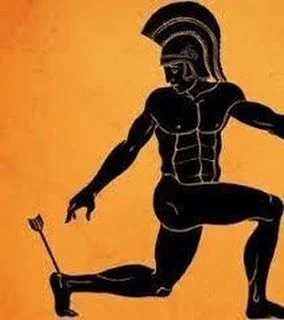
As the Wikipedia article on "Achilles heel" currently begins, "An Achilles' heel is a weakness in spite of overall strength." John Locke's Second Treatise on Government: Of Civil Government is an amazing achievement, that unlike Achilles, remains standing and strong to this day. But its weakest chapters are those where John Locke discusses slavery and land ownership. Even there, there a points where John Locke's arguments are very strong. But there are other points where he is trying to make a case that is difficult to make.

It has been very interesting for me to wrestle with both the strong and weak points of John Locke's treatment of slavery and land ownership in a series of blog posts every other week for six months. I have disagreed with John Locke much more in these posts than in the posts on earlier chapters that you can see laid out in "John Locke's State of Nature and State of War." Here are my posts reacting to John Locke's treatment of slavery and land ownership in his Second Treatise:

Chapter IV. Of Slavery

Chapter V. Of Property


Update: Links to posts on earlier and later chapters can be found in these aggregator posts:

Posts on Chapters I-III:  John Locke's State of Nature and State of War 

Posts on Chapters IV-V:  On the Achilles Heel of John Locke's Second Treatise: Slavery and Land Ownership

Posts on Chapters VI-VII : John Locke Against Natural Hierarchy

Posts on Chapters VIII-XI:  John Locke's Argument for Limited Government

On Being a Good Guy

                                               Link to the Peggy Noonan editorial above

                                               Link to the Peggy Noonan editorial above

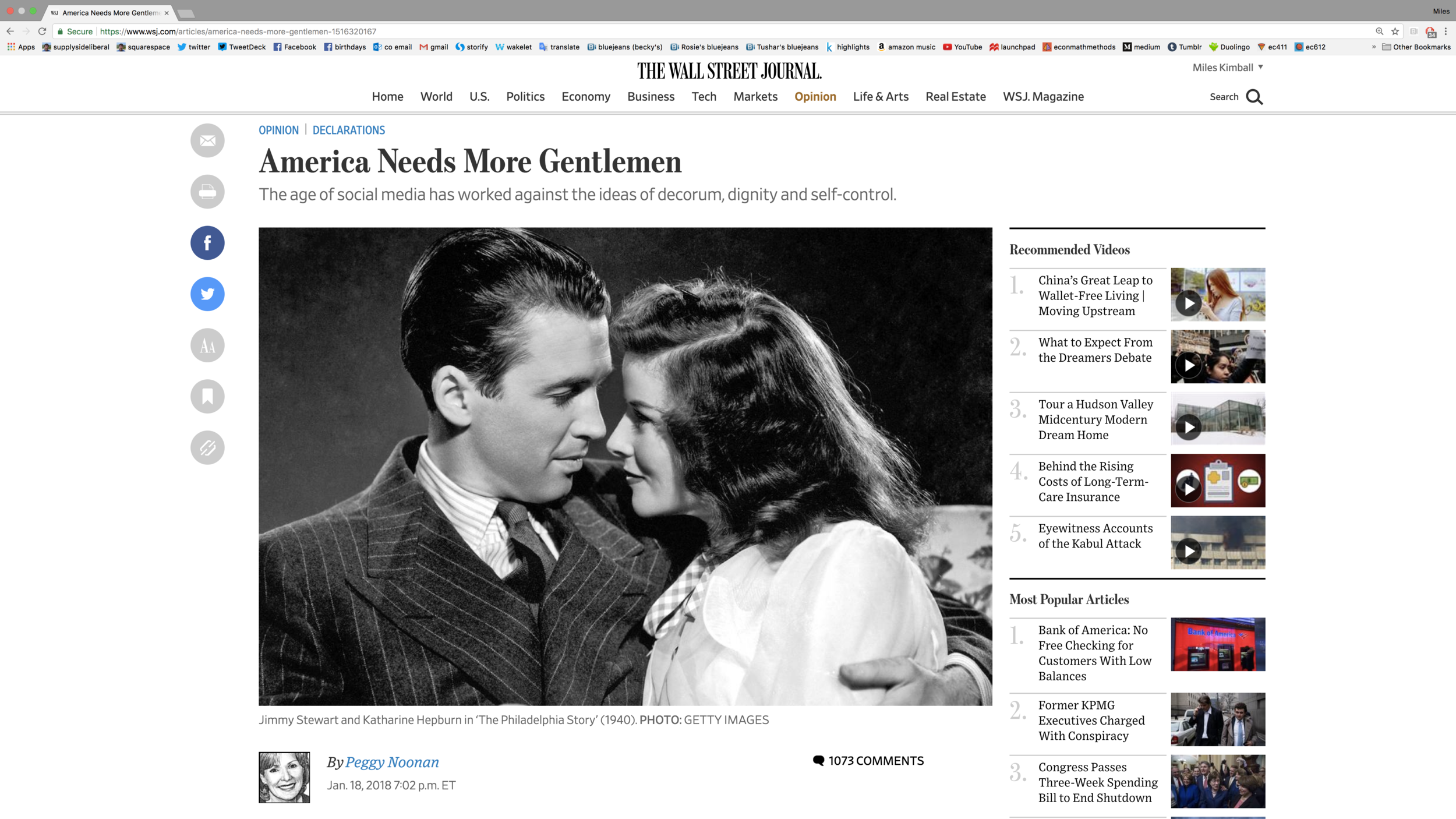
Etymologically, it is too bad that many of our words for being a good person go back to the offensive idea that people of higher social rank are better people than those of lower social rank. The noun "gentleman," like the adjective "noble," is an example. So let me translate Peggy Noonan's word "gentleman" to "good guy." To me, that is a powerful phrase. 

Peggy Noonan's context is the all-too-frequent mistreatment of women by men. But the elements of character she points to are just as wonderful in women. I am told by the many young people I hang around with as a professor that the word "guy" has been taking on more and more of a gender-neutral sense over time. But in the quotations, you will need to translate "gentleman" and "gentlemen" into the appropriate gender-neutral terms yourself. For example, take

A gentleman is an encourager of women.

Translated to apply to women, it says that a woman, to be a "good guy," needs to be an encourager of other women, just as a man to be a "good guy," needs to be an encourager of women. That is an important message. 

My favorite bit from Peggy's piece is this, that she attributes to the Urban Dictionary:

The true gentleman is the man whose conduct proceeds from good will . . . whose self control is equal to all emergencies, who does not make the poor man conscious of his poverty, the obscure man of his obscurity, or any man of his inferiority or deformity.

Note that this is the antithesis of standing on one's social rank. In a similar vein:

The 19th-century theologian John Henry Newman —an Anglican priest who became a Catholic cardinal—said a gentleman tries not to inflict pain. He tries to remove the obstacles “which hinder the free and unembarrassed action of those about him.” He is “tender toward the bashful, gentle toward the distant, and merciful toward the absurd. . . . He is never mean or little in his disputes, never takes unfair advantage.”

I also like this passage:

A gentleman is good to women because he has his own dignity and sees theirs. He takes opportunities to show them respect. He is not pushy, manipulative, belittling. He stands with them not because they are weak but because they deserve friendship.

However, I know there is one count on which I don't stand up very well to this standard: I am often pushy—especially for ideas. This can sometimes be hard for those around me to deal with. 

Peggy's third-to-last paragraph says something obvious and documentable:

The age of social media has worked against the ideas of decorum, dignity and self-control—the idea of being a gentleman. You can, anonymously, be your lowest, most brutish self, and the lowering spreads like a virus.

One of the places this has been documented is in Economics Job Market Rumors. On that see these three posts:

To be a good guy in economics, don't follow the example of the most misogynist posters on Economics Job Market rumors. There are a few other things you should do to be a good guy within economics:

  1. Don't routinely assume that a female coauthor didn't contribute much to a paper. (See "When Women Don’t Get Any Credit for Coauthoring with Men.")
  2. Be sensitive to the extra burdens and hurdles that women often face in economics. (See "How Big is the Sexism Problem in Economics?")
  3. Tell everyone, especially women, who might need the message more, "You can do it" when they are wondering if they can do math well. (See "There's One Key Difference Between Kids Who Excel at Math and Those Who Don't" and "Calculus is Hard. Women Are More Likely to Think That Means They’re Not Smart Enough for Science, Technology, Engineering and Math.")


Literary Note: This post can be read in two slightly different ways:

  1. In the phrase "good guy," put the stress on the word "guy."
  2. In the phrase "good guy," put the stress on the word "good." 

I intend both readings. 

Broadening the Message: Take a look at "On Idealism Versus Cynicism," also sparked by a Peggy Noonan essay, which has a similar message, but on a broader them than gender relations.