Schumpeter: Digital Disruption on the Farm | The Economist

It is always good to see real-world examples of technology shocks. Here are some key excerpts from this article:

Farmers can be among the most hidebound of managers, so it is no surprise that they are nervous about a new idea called prescriptive planting, which is set to disrupt their business. In essence, it is a system that tells them with great precision which seeds to plant and how to cultivate them in each patch of land. …

Prescriptive planting is catching on fast. …

The benefits are clear. Farmers who have tried Monsanto’s system say it has pushed up yields by roughly 5% over two years, a feat no other single intervention could match. The seed companies think providing more data to farmers could increase America’s maize yield from 160 bushels an acre (10 tonnes a hectare) to 200 bushels—giving a terrific boost to growers’ meagre margins. …

Farmers might be expected to have mixed feelings about the technology anyway: although it boosts yields, it reduces the role of discretion and skill in farming—their core competence. However, the bigger problem is that farmers distrust the companies peddling this new method. They fear that the stream of detailed data they are providing on their harvests might be misused. Their commercial secrets could be sold, or leak to rival farmers; the prescriptive-planting firms might even use the data to buy underperforming farms and run them in competition with the farmers; or the companies could use the highly sensitive data on harvests to trade on the commodity markets, to the detriment of farmers who sell into those markets.

I view aggregate technology shocks as primarily representing the steep part of an S-shaped adoption curve for a technology. As such, most aggregate technology shocks should be predictable in advance if the natural logarithms of [(market share/ (1 - market share)]  for promising techniques are graphed against time. (Such graphs are something Clay Christensen and coauthors recommend to predict the future course of disruptive innovations. Watch for my post on Clay Christensen, tomorrow morning, at half-past midnight EDT.)


Another Quality Control Failure on the Wall Street Journal Editorial Page?

Crucial Update: Donna D'Souza, who worked with me on an electronic money storybook, tweeted the CBO document to which Neil Gilbert refers in claiming that the bottom quintile’s average disposable income us up 49% since 1979: page 18 here. But she also tweets that, puzzlingly, the CBO numbers for bottom-quintile income growth from 1979 to 2007 are much lower at 18% as you can see here. It seems unlikely that the real disposable income of the bottom quintile has shot up dramatically in the last 7 years without all of us noticing. Like Donna, I would be glad for any clarification of what is going on. 

Donna’s Clarification: Donna tweets that on closer study of the CBO’s documents, what happened is that the CBO recently (since 2007) started to include more fully the value of government-provided health insurance, such as Medicaid. The bottom line, I think, is that to the extent the bottom quintile can be said to have 49% higher real disposable income now than in 1979, more than all of the increase in imputed disposable income is in the increased value of the medical care that they get.  


On December 31, my post “The Wall Street Journal’s Quality-Control Failure: Bret Stephens’s Misleading Use of Nominal Income in His Editorial “Obama’s Envy Problem” amplified David Beffert’s tweet that the Wall Street Journal had let Bret Stephens inappropriately use nominal income figures to suggest that the middle class has seen truly dramatic economic improvements over the last few decades. He wrote:

Besides which, so what? In 1979 the mean household income of the bottom 20% was $4,006. By 2012, it was $11,490. That’s an increase of 186%. For the middle class, the increase was 211%. For the top fifth it’s 320%. The richer have outpaced the poorer in growing their incomes, just as runners will outpace joggers who will, in turn, outpace walkers. But, as James Taylor might say, the walking man walks.

Paul Krugman further amplified our complaint at this serious misuse of statistics in his post "Disinformation on Inequality.” 

I followed up later with the post “Bret Stephens and Paul Krugman: What Should a Correction Look Like in the Digital Era?” talks about how Paul Krugman further amplified this complaint. Since then, I have noticed that as I recommended, the Wall Street Journal does seem to be posting corrections at the end of the online version of the original article, where it is easier for those who most need to know about the correction to see it.

Although the numbers are not ones that would suggest a use of nominal income, the numbers Neil Gilbert's op-ed piece “The Denial of Middle-Class Prosperity” in the May 16, 2014 Wall Street Journal seem very far off to me–perhaps indicating another serious quality-control failure on the part of the Wall Street Journal. Neil writes:

Countless reports now claim that the middle class is being crushed by inequality, declining mobility and diminishing income. A closer look at the facts suggests otherwise: Members of America’s middle class are better off than they were 30 years ago, and they live much more comfortably than counterparts in other countries.

The problem with the research showing middle-class stagnation is that it looks at market incomes, which exclude taxes, government transfers and adjustments for household size. Market income is an accurate gauge of employment compensation but a misleading way to consider a family’s financial resources. It overlooks the welfare state’s enormous power to redistribute income.

The Congressional Budget Office’s 2011 report on income inequality trends offers a more precise accounting, dispelling the notion that the past three decades have been characterized by the rich getting richer at the expense of the poor while the middle class stays about the same. The CBO adjusts market income by subtracting taxes and adding the cash value of social benefits. When households are then divided into five equal income groups, the data reveal that average disposable household income has increased across all groups since 1979. The average household income grew by 40% for the middle quintile and increased by 49% for the bottom quintile.

The numbers I am familiar with suggest that at the bottom, things have gotten a bit worse in the last few decades before fringe benefits are taken into account and marginally better if the increasing value of fringe benefits (especially medical benefits) is added in. Neil emphasizes income after taxes and transfers, but I just don’t see taxes and transfers as having become so much more redistributive since 1979 that they could generate the 49% increase in the average disposable income of the bottom quintile since 1979. Thus I suspect some non-random error is at work on Neil’s and the Wall Street Journal's part.

Amanda Foreman: When Justice Drowns in Law

I agree with what Amanda says about the damage done when laws are written in an attempt to micromanage things–as many laws now are. Here are some key excerpts:

1. In “The Federalist Papers,” No. 62, James Madison warned his readers against drawing up laws that were unnecessarily dense or complicated: “It will be of little avail to the people…if the laws be so voluminous that they cannot be read, or so incoherent that they cannot be understood.”

2. “The more laws,” Cicero said, “the less justice.”

3. Palmerston replied, “Well, you know, we have been adding a great many laws to the Statute Book every year, and we can’t go on passing law after law. I think we have almost done enough. A little law reform, a little bankruptcy legislation, and"—he cheerfully rubbed his hands—"I think that will do.” Three years later, Parliament repealed more than 1,300 statutes.

Progress Without Individuality?

I always worry when, instead of laying down general rules of the road or specifying one key thing, a government program or law spells out in detail what people must do. In On Liberty,Chapter III: “Of Individuality, as One of the Elements of Well-Being,” paragraph 17, John Stuart Mill explains why you should worry along with me: 

We have discarded the fixed costumes of our forefathers; every one must still dress like other people, but the fashion may change once or twice a year. We thus take care that when there is change it shall be for change’s sake, and not from any idea of beauty or convenience; for the same idea of beauty or convenience would not strike all the world at the same moment, and be simultaneously thrown aside by all at another moment. But we are progressive as well as changeable: we continually make new inventions in mechanical things, and keep them until they are again superseded by better; we are eager for improvement in politics, in education, even in morals, though in this last our idea of improvement chiefly consists in persuading or forcing other people to be as good as ourselves. It is not progress that we object to; on the contrary, we flatter ourselves that we are the most progressive people who ever lived. It is individuality that we war against: we should think we had done wonders if we had made ourselves all alike; forgetting that the unlikeness of one person to another is generally the first thing which draws the attention of either to the imperfection of his own type, and the superiority of another, or the possibility, by combining the advantages of both, of producing something better than either.

Here is the message I take away:

It is not enough to be for improvement.

Let us also be for the freedom

that allows the experiments

that make it possible for us to improve!

Wei Zhu: Zipper Projects in China

When talking about large Keynesian multipliers, professors often talk about how even “having workers dig a ditch and filling it in” could under certain circumstances, and with certain parameter values, be a good idea. Make work projects like that can also be a way to credibly identify people who desperately need money (who are willing to do hard, meaningless work) from people who only claim to desperately need money. So make work projects have some importance in economic theory. I learned from Wei Zhu’s guest post below that make work projects have a very descriptive name in China: zipper projects. (Although I have heard of make work projects in India, I am not sure they go this far in explicitly undoing things.) If you like this post, you should definitely read Wei’s other guest post, which appeared last Saturday: “The Sharing Economy.”


When we talk about unemployment in the U.S., we’re talking about economic conditions. When it comes to unemployment in China, it’s a social problem. When 1.35 billion people live in an economy second to the U.S.’s, how many jobs do you think that are available to the country? Yet China’s unemployment rate is as low as 4.1%. Despite the fact that labor-intensive manufacturing has provided abundant positions to hold the figure, during the process of urbanization, however, there are still a considerable number of farmers turning into jobless workers. In order to sponge out these extra workforces, local governments invented a special kind of projects – “Zipper” projects.

So what really is zipper project? Like a zipper, which is frequently zipped and unzipped, zipper project is a kind of frequently repeated construction or maintenance project. Most of the zipper projects are labor intensive, cheap and time-consuming. If you’ve been to China, you should’ve seen workers planting rode-side trees or fixing roads, those are most frequently used zipper projects. The reason I’m so sure that you have seen them is because they are there all the time – not long after the projects are finished, the same or another group of workers will be sent back to tear everything down and start over. It’s kind of like “the Myth of Sisyphus” in real life, only that it’s not a punishment but a way to provide temporary job opportunities.

“Zipper” project, is yet another unique social phenomenon in China. It exists to solve a social problem, but it’s not a real solution, because zipper projects can’t eliminate the migrant worker problem from the root. If anything, it’s a compromise.

It’s a compromise between keeping the rapid growth of China’s economy and maintaining the stableness of China’s society. You have to admit the difficulty of running a country is not linear to its population. Feeding the biggest population in the world while keeping up with the world’s economy growth is not an easy task. Many think the idea of zipper projects sounds ridiculous, as it makes no sense for a city to waste resources on prying and patching the same part of the road repeatedly. The reality is, however, if it weren’t for the zipper projects, there would be hardly enough temporary jobs to buffer the huge number of incoming migrant workers. When these people coming into the city without jobs, trouble comes, too. Between putting the the society at risk and wasting resource, it’s wiser to choose the latter.

This reminds me of the famous “Trolley Problem”: you see a trolley running towards five people out of control and there’s lever that can divert the trolley to a sidetrack where there lies one person, what would you do? I guess for the Chinese decision makers who shoulder the responsibility of 1.35 billion people, utility beats morality.

Top 52 All-Time Posts and All My Columns Ranked by Popularity, as of May 23, 2014

I keep my ranking of top columns updated along the way, but it is time to update the ranking of my top blog posts. You can see my explanation of the rankings and other musings after the lists. 

All Quartz Columns So Far, in Order of Popularity:

  1. There’s One Key Difference Between Kids Who Excel at Math and Those Who Don’t
  2. The Coming Transformation of Education: Degrees Won’t Matter Anymore, Skills Will
  3. The Hunger Games is Hardly Our Future: It’s Already Here
  4. The Complete Guide to Getting into an Economics PhD Program
  5. Why Thinking about China is the Key to a Free World
  6. The Case for Gay Marriage is Made in the Freedom of Religion
  7. How to Turn Every Child into a “Math Person”
  8. How Big is the Sexism Problem in Economics?
  9. After Crunching Reinhart and Rogoff’s Data, We Find No Evidence That High Debt Slows Growth
  10. The Swiss National Bank Means Business with Its Negative Rates
  11. The National Security Case for Raising the Gasoline Tax Right Now
  12. Will Narendra Modi’s Economic Reforms Put India on the Road to Being a Superpower?
  13. The Shakeup at the Minneapolis Fed and the Battle for the Soul of Macroeconomics
  14. How Increasing Retirement Saving Could Give America More Balanced Trade
  15. Human Grace: Gratitude is Not Simple Sentiment; It is the Motivation that Can Save the World
  16. Larry Summers Just Confirmed That He is Still a Heavyweight on Economic Policy
  17. An Economist’s Mea Culpa: I Relied on Reinhart and Rogoff
  18. Examining the Entrails: Is There Any Evidence for an Effect of Debt on Growth in the Reinhart and Rogoff Data?
  19. How to Avoid Another NASDAQ Meltdown: Slow Down Trading (to Only 20 Times Per Second)
  20. Odious Wealth: The Outrage is Not So Much Over Inequality but All the Dubious Ways the Rich Got Richer
  21. Benjamin Franklin’s Strategy to Make the US a Superpower Worked Once, Why Not Try It Again?
  22. America’s Big Monetary Policy Mistake: How Negative Interest Rates Could Have Stopped the Great Recession in Its Tracks
  23. Gather ‘round, Children, and Hear How to Heal a Wounded Economy
  24. Show Me the Money!
  25. QE or Not QE: Even Economists Needs Lessons In Quantitative Easing, Bernanke Style
  26. Don’t Believe Anyone Who Claims to Understand the Economics of Obamacare
  27. Swiss Pioneers! The Swiss as the Vanguard for Negative Interest Rates
  28. Radical Banking: The World Needs New Tools to Fight the Next Recession
  29. The Government and the Mob
  30. How Italy and the UK Can Stimulate Their Economies Without Further Damaging Their Credit Ratings
  31. Janet Yellen is Hardly a Dove: She Knows the US Economy Needs Some Unemployment
  32. Four More Years! The US Economy Needs a Third Term of Ben Bernanke
  33. Japan Should Be Trying Out a Next Generation Monetary Policy
  34. Why the US Needs Its Own Sovereign Wealth Fund
  35. One of the Biggest Threats to America’s Future Has the Easiest Fix
  36. Could the UK be the First Country to Adopt Electronic Money?
  37. Righting Rogoff on Japan’s Monetary Policy
  38. Optimal Monetary Policy: Could the Next Big Idea Come from the Blogosphere?
  39. Why You Should Care about Other People’s Children as Much as Your Own
  40. Get Real: Bob Shiller’s Nobel Should Help the World Improve Imperfect Financial Markets
  41. In Defense of Clay Christensen: Even the ‘Nicest Man Ever to Lecture’ at Harvard Can’t Innovate without Upsetting a Few People
  42. Actually, There Was Some Real Policy in Obama’s Speech
  43. Meet the Fed’s New Intellectual Powerhouse
  44. Read His Lips: Why Ben Bernanke Had to Set Firm Targets for the Economy
  45. More Muscle than QE3: With an Extra $2000 in their Pockets, Could Americans Restart the U.S. Economy?
  46. How Subordinating Paper Money to Electronic Money Can End Recessions and End Inflation
  47. That Baby Born in Bethlehem Should Inspire Society to Keep Redeeming Itself
  48. Three Big Questions for Larry Summers, Janet Yellen, and Anyone Else Who Wants to Head the Fed
  49. Judging the Nations: Wealth and Happiness Are Not Enough
  50. The Man in the Tank: It’s Time to Honor the Unsung Hero of Tiananmen Square
  51. Yes, There is an Alternative to Austerity Versus Spending: Reinvigorate America’s Nonprofits
  52. John Taylor is Wrong: The Fed is Not Causing Another Recession
  53. However Low Interest Rates Might Go, the IRS Will Never Act Like a Bank
  54. Why Austerity Budgets Won’t Save Your Economy
  55. Monetary Policy and Financial Stability
  56. Make No Mistake about the Taper—the Fed Wishes It Could Stimulate the Economy More
  57. Nationalists vs. Cosmopolitans: Social Scientists Need to Learn from Their Brexit Blunder
  58. Off the Rails: What the Heck is Happening to the US Economy? How to Get the Recovery Back on Track
  59. VAT: Help the Poor and Strengthen the Economy by Changing the Way the US Collects Tax
  60. Talk Ain’t Cheap: You Should Expect Overreaction When the Fed Makes a Mess of Explaining Its Plans
  61. Obama Could Really Help the US Economy by Pushing for More Legal Immigration
  62. Does Ben Bernanke Want to Replace GDP with a Happiness Index?
  63. How to Stabilize the Financial System and Make Money for US Taxpayers
  64. How the Electronic Deutsche Mark Can Save Europe
  65. Al Roth’s Nobel Prize is in Economics, but Doctors Can Thank Him, Too
  66. Italy Should Look to Ancient Rome to Reform Its Ineffective Senate
  67. Symbol Wanted: Maybe Europe’s Unity Doesn’t Rest on Its Currency. Joint Mission to Mars, Anyone?

Major Pieces First Appearing in Other Outlets (in Arbitrary Order)

Columns Rejected by Quartz Because of Their Topics

Top 52 Posts on supplysideliberal.com:

  1. The Wall Street Journal’s Quality-Control Failure: Bret Stephens’s Misleading Use of Nominal Income in His Editorial 'Obama’s Envy Problem’ 7508 
  2. Contra John Taylor 7390
  3. The True Size of Africa, Revisited 7317
  4. Joshua Foer on Deliberate Practice 7110 
  5. Dr. Smith and the Asset Bubble 6735
  6. Daniel Coyle on Deliberate Practice 6425
  7. Shane Parrish on Deliberate Practice 6413
  8. The Medium-Run Natural Interest Rate and the Long-Run Natural Interest Rate 5961
  9. Scott Adams’s Finest Hour: How to Tax the Rich 4866
  10. Balance Sheet Monetary Policy: A Primer 4761
  11. Sticky Prices vs. Sticky Wages: A Debate Between Miles Kimball and Matthew Rognlie 4744
  12. The Logarithmic Harmony of Percent Changes and Growth Rates 4724
  13. What is a Supply-Side Liberal? 4684
  14. The Message of Mormonism for Atheists Who Want to Stay Atheists 4108
  15. Isaac Sorkin: Don’t Be Too Reassured by Small Short-Run Effects    of the Minimum Wage  3977
  16. Noah Smith Joins My Debate with Paul Krugman: Debt, National Lines of Credit, and Politics 3848
  17. On Master’s Programs in Economics 3711
  18. Heroes of Science Action Figures 3013
  19. The Deep Magic of Money and the Deeper Magic of the Supply Side 2860
  20. Noah Smith: God and SuperGod 2853
  21. Trillions and Trillions: Getting Used to Balance Sheet Monetary Policy 2624
  22. You Didn’t Build That: America Edition 2583
  23. The Egocentric Illusion 2522
  24. Why I Write 2521
  25. Two Types of Knowledge: Human Capital and Information 2499
  26. Why Taxes are Bad 2471
  27. Noah Smith: Mom in Hell 2414
  28. How Conservative Mormon America Avoided the Fate of Conservative White America 2378
  29. How and Why to Eliminate the Zero Lower Bound: A Reader’s Guide 2271
  30. No Tax Increase Without Recompense 2260
  31. Monetary vs. Fiscal Policy: Expansionary Monetary Policy Does Not Raise the Budget Deficit 2137
  32. Books on Economics 2108
  33. Getting the Biggest Bang for the Buck in Fiscal Policy 2098
  34. The Unavoidability of Faith 2060
  35. Teleotheism and the Purpose of Life 2029
  36. The Mormon View of Jesus 1951
  37. Why I am a Macroeconomist: Increasing Returns and Unemployment 1921
  38. Milton Friedman: Celebrating His 100th Birthday with Videos of Milton 1871
  39. The Shape of Production: Charles Cobb’s and Paul Douglas’s Boon to Economics 1841
  40. Electronic Money: The Powerpoint File 1831
  41. Three Goals for Ph.D. Courses in Economics 1803
  42. Let the Wrong Come to Me, For They Will Make Me More Right 1802
  43. John Stuart Mill’s Brief for Freedom of Speech 1766
  44. Inequality Aversion Utility Functions: Would $1000 Mean More to a Poorer Family than $4000 to One Twice as Rich? 1750
  45. On the Great Recession 1745
  46. Scrooge and the Ethical Case for Consumption Taxation 1723
  47. Government Purchases vs. Government Spending 1721
  48. Jobs 1695
  49. Kevin Hassett, Glenn Hubbard, Greg Mankiw and John Taylor Need to Answer This Post of Brad DeLong’s Point by Point 1614
  50. Top 10 Posts on supplysideliberal.com 1584
  51. Is Taxing Capital OK? 1553
  52. When the Government Says “You May Not Have a Job” 1529

Explanation of the rankings: 

The top 52 posts on supplysideliberal.com listed above are based on Google Analytics pageviews from June 3, 2012 through around 9 pm on May 22, 2014. The number of pageviews is shown by each post. Not counting Quartz pageviews and pageviews from some forms of subscription, Google Analytics counts 504,893 pageviews during this period but, for example, 135,805 homepage views could not be categorized by post.

I have to handle my Quartz columns separately because that pageview data is proprietary. My very most popular pieces have been Quartz columns, so I list them first. I have listed them all plus a few columns in other outlets, with the ones with no data (yet) listed at the bottom. (To avoid duplication, I have disqualified companion posts to Quartz columns from the top 40 blog post list, since they eventually get recombined with the Quartz columns when I repatriate the columns. For these columns, the ranking is by pageviews at a point where things have settled down. For later posts, that is standardized to pageviews during the first 30 days when Quartz has an exclusive.)

Going forward as in the past, I plan to update the list of columns as new columns appear, but the list of posts is locked in place until the next time I do a post like this.

You might also find other posts you like in this earlier list of top posts. If you want to compare all the shifts to the last time I did the list of top blog posts, here it is. Last time, October 14, 2013, I did the top 40. In just the top 40 above, there are 15 new entrants since that last time. Conversely, 6 out of last time’s top 40 didn’t even make it into the top 52 this time.   

Musings: 

Why I Read More Books than Economic Journal Articles

One of my economist friends asked me why it is that I read more books than economic journal articles. The question made me think. Here is the answer I came to.

First, books are on average much better written–at least the books I read. There are some journal articles that are a joy to read, but the average economics journal article is not. (In the quality of writing, reading a newspaper article or a good blog post is more like reading a book than it is like reading an economic journal article.)

Second, I think of myself as a social scientist first and an economist second, so there is a lot of ground to cover.

Third, I often find it exhausting to read a journal article because if I really dig in to understand it, I find myself either (a) figuring out how one could write the paper it should have been, if the article is not that good, or much more infrequently, (b) finding myself inspired and wanting to do half a dozen new projects because the article is so great. (And a new project inspired by a journal article is seldom something that can be completed quickly.) Because reading journal articles tempts me to rechannel my energies in many new directions when I am already spread thin, that effect from reading a journal article is much more distracting to the essential work I need to focus on than reading books is.

Evolutionary theory has the concept of frequency-dependent selection: there are some things, like left-handedness that are advantageous for survival and reproduction as long as they are reasonably rare. (In the case of left-handedness, the speculation is that if it is rare, left-handedness gave an advantage in combat because one’s opponent would have to face moves he had less experience with.)  My pattern is unusual among economists who publish in economic journals with some regularity, but precisely because it is rare, I think having one more person (me) doing things the way I do is valuable.

In another context, when I was criticized for being weak in a particular dimension helpful for professional success, I thought to myself “What strengths I have don’t come for free.” I have the strengths I have in important measure because I spend a lot of time developing those strengths–something that has unavoidable tradeoffs in less time to develop certain other skills.

Actually, having that thought is something that itself came from hard-won knowledge about the malleability of intelligence from reading the kind of books that Noah Smith and I talk about in “There’s One Key Difference Between Kids Who Excel at Math and Those Who Don’t.” I tell the story in “How the Idea that Intelligence is Genetic Distorted My Life—Even Though I Worked Hard Trying to Get Smarter Anyway” of how culturally, I was brought up to believe that one simply started out smart or not. If that were true, it would mean that for those who are lucky, intellectual strengths would come largely for free. I don’t believe that any more, but it took a lot of reading to get to the view I have now–the view Noah and I lay out in “There’s One Key Difference Between Kids Who Excel at Math and Those Who Don’t."

Noah Smith: Buddha Was Wrong About Desire

In this image, the one on the elephant represents Noah Smith.

In this image, the one on the elephant represents Noah Smith.

I am pleased to be able to publish another guest religion post by Noah Smith. Noah's other guest religion posts on supplysideliberal.com are

  1. God and SuperGod
  2. You Are Already in the Afterlife
  3. Go Ahead and Believe in God
  4. Mom in Hell

My favorite of Noah’s religion posts is still “God and SuperGod,” but Noah’s personal favorite is this one, right here. Here is Noah’s tussle with classic Buddhism:


“Sun/ Felt numb”  – Nirvana

One of the central tenets of Buddhism is that tanha, or desire, leads to dukkha, or suffering. Much of Buddhism, as it was originally conceived, is about eliminating suffering, in part by eliminating desire. If you extinguish all suffering, you reach Nirvana. This idea has appealed to many in the West in recent decades, especially among those who are looking to make a break with Christianity, Judaism, and other traditional Western religions. It dovetails with the idea that consumerism is a “hedonic treadmill” - that our modern society encourages us to buy more stuff, which just makes us want more stuff. It also seems to promise a relief from the stress of capitalist competition. Wouldn’t it be great if we could just leave all these cravings behind? 

No, it would not. How do I know that? Because I’ve been there. I have achieved Nirvana. And let me tell you, it was a lot more like the band than the Buddhist state of enlightenment. 

I’m talking, of course, about clinical depression. Most people think of depression as a very severe sad mood, or some other form of negative emotion. But mostly, it’s not like that. Mostly, it’s a feeling of emptiness that is unlike any emotion that non-depressed people experience. But it’s not an enlightened emptiness, or a neutral, robotic emptiness - it’s an awful emptiness. Here is a pretty good (and grimly entertaining) description of what it’s like by Allie, the writer of the blog Hyperbole and a Half. Here was my briefer, less colorful attempt. Though I hadn’t read her post when I wrote mine, you’ll quickly see that we’re describing exactly the same thing. Depression, basically, is a total lack of volition and desire. And it’s the worst thing that it’s possible to experience. 

Now, I’m sure Buddha didn’t intend for people to eliminate their desires by becoming clinically depressed! But he probably simply did not understand how human desire works. Now, with the help of modern science, we know a few things. For example, we’ve learned that the nucleus accumbens is responsible for many of our feelings of pleasure and happiness. But it’s also responsible for our feelings of desire! From Wikipedia:

The activation of dopamine in the nucleus accumbens is central to forming desire for something. Dopamine release in the accumbens occurs in anticipation of reward, and facilitates many kinds of approach and goal-oriented behaviors like exploration, affiliation, aggression, sexual behavior, and food hoarding. Lesions to the nucleus accumbens reduce the motivation to work for reward.

This sort of desire is exactly the “tanha” that Buddhism tells us we should get rid of. But in experiments, this kind of desire is essentially indistinguishable from pleasure:

Rats in Skinner boxes with metal electrodes implanted into their nucleus accumbens will repeatedly press a lever which activates this region, and will do so in preference over food and water, eventually dying from exhaustion.

In other words, desire is not the cause of suffering; it is the opposite of suffering. Desire is what feels good. And so it’s no surprise that stimulating the nucleus accumbens is an incredibly effective treatment for depression. Anyone who has been depressed will not be surprised in the slightest to hear that result. 

The truth is, desire is good. Desire is what keeps us going in life. It’s not getting stuff that makes us happy, it's wanting stuff, hoping for stuff, dreaming of stuff - stuff like love, success, adventure, or meaning. Desire itself is the payoff!

Sure, sometimes we’re frustrated. Sometimes we get what we want, only to find out that it’s not as great as we thought. But to try to eliminate the central feature of a good human life just because of these stumbling blocks is to throw the baby out with the bathwater. These stumbling blocks are a necessary cost of leading a good human life.

So I think that the main tenet of classic Buddhism is totally wrongheaded, and reflects a deep lack of understanding of what constitutes human happiness. But like all religions - maybe more than other religions! - Buddhism is fluid, and subject to revision, interpretation, and improvement. So it pleases me to report that Soka Gakkai, a Japanese form of Buddhism, has this to say about desire: 

But can such desires and attachments really be eliminated? Attachments are, after all, natural human feelings, and desires are a vital and necessary aspect of life. The desire, for example, to protect oneself and one’s loved ones has been the inspiration for a wide range of advances–from the creation of supportive social groupings to the development of housing and heating. Likewise, the desire to understand humanity’s place in the cosmos has driven the development of philosophy, literature and religious thought. Desires are integral to who we are and who we seek to become.

In this sense, the elimination of all desire is neither possible nor, in fact, desirable. Were we to completely rid ourselves of desire, we would end up undermining our individual and collective will to live.

The teachings of Nichiren thus stress the transformation, rather than the elimination, of desire. Desires and attachments are seen as fueling the quest for enlightenment.

Damn straight.

Wei Zhu: The Sharing Economy

Link to Wei Zhu’s economics blog

My Winter 2014 “Monetary and Financial Theory” class is over, but I read a flurry of excellent posts toward the end of the semester that I plan to publish as guest posts here in the coming Saturdays. Wei Zhu is one of several students in the class who have set up their own public blogs to continue blogging even now that the class is over. I think you will like his post about the Sharing Economy. (Catherine Rampell objects to calling it “sharing” in her Washington Post essay “What preschoolers can teach Silicon Valley about ‘sharing’”. I am very sympathetic to Catherine’s argument that the word “sharing” is being bent out of shape when applied to new, more convenient forms of rental, but I suspect that that moniker “sharing economy” is here to stay–at least for a few years, until it is old hat.)


What do

have in common? They are all billion-dollar ideas based on one concept: the Sharing Economy.

Like the name suggests, the Sharing Economy is “a socio-economic system built around the sharing of human and physical assets”(Wikipedia). The system sees the excess capacity in goods and services as a problem and solves it with collaborative consumption. Simply put, the Sharing Economy wants to lower your cost of living by letting you borrow a bike from you neighbor and make your trip in Puerto Rico much more enjoyable while cheaper by renting you a house in San Juan.

Jeremy Rifkin’s comments on Airbnb’s success explains a lot about the Sharing Economy:

Airbnb owes its meteoric rise to a new phenomenon — near zero marginal cost — which is disrupting entire sectors of the global economy and giving rise to a new economic system riding alongside the conventional market. Marginal cost is the cost of producing an additional unit of a good or service once a business has its fixed costs in place, and for businesses like Airbnb, that cost is extremely low.”

The extremely low marginal cost is one of the greatest benefits of Sharing Economics. By efficiently redistributing resources among the crowd, this economy system significantly decreases the pressure of purchasing for individuals. For example, if you want to buy a vacuum machine, in the conventional market, you have to pay $200. That’s $200 per person. But with the sharing model, although the nominal price of the vacuum machine is the same, since you can share the purchase with your neighbor, the real cost becomes $200 divided by n. The more you share, the less you actually pay.

The concept is simple, but the impact can be huge.

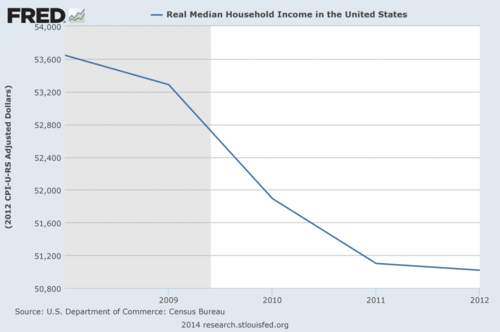
Since the beginning of the Great Recession, most households’ real income has been decreasing.

This forces average households to spend a greater portion of their income on food and other basic living expenses. People are scared of big purchases because of the financial pressure. Shared purchases, however, remove this pressure. The real expense on shareable goods is divided among several– and sometimes many–people therefore becomes much lower. With the shareable goods looking cheaper, people will be willing to pay for access to more goods.

The Sharing Economy can help people feel they have abundance despite scarce resources in a world that, despite falling birth rates, will have more people in the future than it does now. (The UN projects that, by the year of 2050, there will be 9.3 billion people in the world.) A world without resource-sharing would be relatively impoverished in that future.

One thing that may hold back the Sharing Economy, at least in the short run, is regulatory uncertainty. The Sharing Economy’s model suggests that everybody can be a service provider or property lender. This will surely introduce problems when it comes to security, licensing and the tax treatment of the Sharing Economy. But the success of Airbnb and Uber in their respective industries suggests that these regulatory issues can ultimately be overcome.

Capital Budgeting: The Powerpoint File

blog.supplysideliberal.com tumblr_inline_n5ngk0597z1r57lmx.jpg

Writing “One of the Biggest Threats to America’s Future Has the Easiest Fix” with Noah Smith about capital budgeting inspired the seminar presentation I am giving today at the Congressional Budget Office, Here is a link to my Powerpoint file for the presentation:

The Applied Theory of Capital Budgeting

It is quite technical, and is a work in progress. If you do want to brave it, I recommend that you first read "One of the Biggest Threats to America’s Future Has the Easiest Fix.“

Update: I learned today that the Congressional Budget Office put out a document on "Capital Budgeting” in 2008. I hope they now put out a new document on capital budgeting!

Sliding Doors: Hillary vs. Barack

“Sliding Doors” Wikipedia article. Please imagine in your mind’s eye a version of this poster with Barack Obama on top and Hillary Clinton on the Bottom to represent the two alternate histories: actual history and “Hillary wins in 2008.”

“Sliding Doors” Wikipedia article. Please imagine in your mind’s eye a version of this poster with Barack Obama on top and Hillary Clinton on the Bottom to represent the two alternate histories: actual history and “Hillary wins in 2008.”

“Sliding Doors” is one of my wife Gail’s and my favorite movies. It explores the perennially fascinating theme of alternate histories–“what if” or “counterfactual” histories.

Although it is too early for me to attempt any serious discussion of the race to be elected president in 2016, it is not too early to rerun the what-ifs raised by the 2008 Democratic primary that came down to a hard-fought battle between Hillary Clinton and Barack Obama. Most political observers believe that Hillary would also have defeated John McCain in the general election, as Barack did, so the Democratic primary in 2008 comes closer than the general election to providing a “sliding-doors” moment when history could easily have gone either way. If I had the technical skill, I would photoshop the “Sliding Doors” poster above to have Barack on top and Hillary on the bottom, instead of blond and brunette Gwyneth Paltrow. 

I would be interested in your opinion about how the world would be different if Hillary had won instead of Barack. I have two thoughts on that subject, that I am happy to have you dispute.

First, I think the 2008 Financial Crisis was baked in the cake by the time of the 2008 primaries, so whoever became president would have had to deal with the same type of economic problems, and the differences between Hillary and Barack could have been crucial. I think Hillary, having been burned on the health care reform front before, would have pursued health care reform, but would have put it as a lower priority relative to economic recovery than Barack did. As I wrote in “What Should the Historical Pattern of Slow Recoveries after Financial Crises Mean for Our Judgment of Barack Obama’s Economic Stewardship?” I think it was a mistake for Barack not to devote every ounce of his political capital to getting a bigger stimulus package for economic recovery; so at that juncture, it was a mistake to let the goal of health care reform distract from the goal of economic recovery.

In my book, to the extent a health care reform steamroller would then have been impossible, that also might have been a good thing. Given how little we know about what works in health care reform at a systemic level (see my column “Don’t Believe Anyone Who Claims to Understand the Economics of Obamacare”), I believe that Medical Reform Federalism would have been the best course, and this might have been exactly the kind of compromise eventually reached had Barack not been in the presidency to push through Obamacare. As I wrote in my post “Evan Soltas on Medical Reform Federalism–in Canada” here is what I mean by Medical Reform Federalism:

Let’s abolish the tax exemption for employer-provided health insurance, with all of the money that would have been spent on this tax exemption going instead to block grants for each state to use for its own plan to provide universal access to medical care for its residents.

Second, I think that Hillary would have helped the Syrian rebels more as President than she could as Secretary of State, which in turn would have projected enough more toughness that Vladimir Putin would not have dared to seize Crimea for Russia and Ukraine would not be facing that loss of the Crimea and possible further loss of territory right now. Supposing that is true, even greater differences between the two alternate histories I am considering (actual history and Hillary winning in 2008) are likely to open up as time goes on.

I was stimulated to think again about Hillary vs. Barack by a Washington Post article this morning by  Philip Rucker and Zachary A. Goldfarb that can be found online here:

“The Clintons fight back, signaling a new phase in 2016 preparations”

Here are some memorable passages from that article:

1. Bill Clinton reveled in mocking Karl Rove for his suggestion that Hillary Clinton may have suffered brain damage from a fall in late 2012 … 

Referring to Rove’s remarks, [Bill] Clinton chuckled and fired back with humor.

“First they said she faked her concussion, and now they say she’s auditioning for a part on ‘The Walking Dead,’ ” he said, referring to a television series about zombies. “If she does [have brain damage], then I must be in really tough shape because she’s still quicker than I am.”

2. Asked whether [Hillary] Clinton is still a stateswoman operating above the political fray, Republican presidential strategist Mark McKinnon wrote in an e-mail, “There is no ‘above the fray’ in politics anymore. There is only ‘the fray.’”

3.  [Bill] Clinton, who has faced criticism that income inequality worsened on his watch in the 1990s, defended income growth during his term but acknowledged that the gap between the rich and the poor represents a significant problem.

“You can say, ‘Well, inequality has still increased,’ because the top 1 percent did better, but I don’t think there’s much you could do about that unless you want to start jailing people,” he said.

Colleges Should Stand Up For Freedom of Speech!

Christine Lagarde

Christine Lagarde

The list of scheduled commencement speakers who have been disinvited or encouraged to withdraw because of threatened student protests keeps growing. (If the speakers were just scared of facing a ruckus, so much the worse for them, but if college or university administrators encouraged them to withdraw, that is bad business on the part of those college and university administrators.) Yesterday’s Wall Street Journal reported that Christine Lagarde, the head of the International Monetary Fund is now on this list: 

If colleges were standing up for freedom of speech, they would let the speakers come and use the fact of the student protests as a chance to teach everyone there about the importance of freedom of speech both for the invited speaker and for the protestors. When colleges treat having an outwardly pleasant commencement event as more important than upholding the principle that one should have a chance to hear the major viewpoints on an issue before making a judgment about it, they betray the quest for truth that is their reason for existence.

Now, it would be possible to give more dignity to hearing all sides of an issue. For example, a college could have a selection procedure to have the most eloquent student who wants to argue against the brief of the invited speaker have some time to talk after that speaker. Any invited speaker who is unwilling to come if he or she has to face a rebuttal afterward is no great loss. But I seriously doubt that someone like Ayaan Hirsi Ali would be afraid of a debate–the Ayaan Hirsi Ali of whom Ruth Wisse wrote after Brandeis backtracked on giving her an honorary degree:

Here in the United States, the educated class thinks nothing of denying an honorary degree to a fearless Muslim woman who at peril of her life, and in the name of liberal democracy, has insisted on exposing…outrages [done in the name of Islam] to the light.

Ayaan Hirsi Ali

Ayaan Hirsi Ali

I think I understand where college administrators are coming from. They are worried about what will happen to alumni donations if commencements are contentious rather than being pleasant ceremonies. But that path ultimately leads to freedom of speech at official podiums only when people don’t understand enough, or care enough about an idea to object, or when the idea happens to be congenial to those who come from the most aggressive tradition of protest.     

Update: Bonnie Kavoussi alerted me to this related post by Harvard Computer Science Professor Harry Lewis: “A bad day for the right to offend.”