Willem Buiter: The Wonderful World of Negative Nominal Interest Rates, Again

I realized recently that Willem Buiter had written a second post on negative nominal interest rates. This link is part of my series on the history of thought for negative nominal interest rates and electronic money. Other posts in this series are

And here is a link to my sub-blog on electronic money:

http://blog.supplysideliberal.com/tagged/emoney

(There is also a handy link at my sidebar.)

So You Want to Save the World

Logo for the TV series "Heroes,“ which engraved the phrase "save the world” into my brain.

Logo for the TV series "Heroes,“ which engraved the phrase "save the world” into my brain.

This is the text for my June 9, 2013 Unitarian-Universalist sermon to the  Community Unitarian-Universalists in Brighton, Michigan. You can see the video here

This is the fourth  Unitarian-Universalist sermon I have posted. The others are

This is the first sermon I have given that I have known in advance I would post. I wrote it with my online readers in mind as well as the Unitarian Universalists in Brighton. 

Abstract: Many of us have a strong desire to do something big, both because we  want to make the world a better place and because of ambition.  That desire can get twisted in various ways, but it is also behind much of the progress in the world.  How can we harness ambition for good, and link it to genuine visions of a better world?

Human beings are roiling puddles of emotions, not all of them pretty. For example, the Medieval Pope Gregory I listed seven deadly sins: wrath, greed, sloth, pride, lust, envy, and gluttony. And yet we roiling puddles of emotions sometimes set out to make the world a better place.  How can entities so imperfect accomplish anything good? I want to argue that if we turn our emotions, even the ugly ones, into sources of energy for action—while putting careful guardrails on our actions to try to ensure that we do good rather than harm—then together we can save the world.

Economists like me think a lot about the fact that living standards and lifespans are dramatically higher than they were as recently as a century ago. And Steven Pinker argues that there is a lot less violence than in the past in his book “The Better Angels of Our Nature.” But it is clear the world still needs saving. Many live in poverty. Many live under oppressive dictatorships. There are a thousand reasons why and ways in which people are mistreated, sometimes even by their own families. The possibilities of a nuclear holocaust fostered by nuclear proliferation or catastrophic climate change fostered by the burning of coal and other fossil fuels cast monstrous shadows over the future. And in a very immediate way, the global economic slump in the last few years has shaken people’s faith in governments and economies.

A year ago, I started a blog, “Confessions of a Supply-Side Liberal,” out of a mixture of raw ambition, desire for self-expression, duty, and hope. Sometimes duty keeps me up late at night, but it is raw ambition that makes me wake up too early in the morning so that I slip further and further behind in my sleep. And sometimes, alongside that raw ambition, I find anger driving my writing, when I see someone who is relatively influential saying things that I think not just off-base, but potentially destructive. (See for example “Contra John Taylor" and ”Even Economists Need Lessons in Quantitative Easing, Bernanke Style.“) Whatever redeeming social value there is to what I write when in that state does not take away the fact that the experience is one of giving vent to anger.    

The Christian tradition emphasizes the motivations someone has in doing any particular action. At one level, this makes a lot of sense. In the Sermon on the Mount, Jesus said:

But if thine eye be evil, thy whole body shall be full of darkness. If therefore the light that is in thee be darkness, how great is that darkness! (Matthew 6:22)

and

Beware of false prophets, which come to you in sheep’s clothing, but inwardly they are ravening wolves. Ye shall know them by their fruits. Do men gather grapes of thorns, or figs of thistles? Even so every good tree bringeth forth good fruit; but a corrupt tree bringeth forth evil fruit. A good tree cannot bring forth evil fruit, neither can a corrupt tree bring forth good fruit. (Matthew, 7:15-18)

If someone’s overall objective is evil or self-serving, the only way what they do will have a good effect on the world is if all their attempts to get their way by harming others are forestalled by careful social engineering. It is exactly such social engineering to prevent people from stealing, deceiving, or threatening violence that yields the good results from free markets that Adam Smith talks about in The Wealth of Nations—the book that got modern economics off the ground. And even then, social pressure to favor those in the old boys’ club can deprive others of the full benefits of the free market. 

But what if there is a bumper-car derby in one’s heart between an overall desire to do good and uglier emotions such as wrath, greed, sloth, pride, lust, envy, and gluttony? Are all one’s efforts polluted? 

The simple answer to this question is that when motives are impure, the danger of a bad result is great, but that careful checks and balances can sometimes yield a good result from imperfect soil. One of the best examples is Martin Luther King. He committed serial adultery and plagiarized an important piece of his Ph.D. dissertation in a way that makes no sense unless he was subject to lust, greed, sloth, pride and envy. But for the Civil Rights Movement, the main danger was from unchecked anger, and the principle of nonviolence that Martin Luther King championed set up a key guardrail for the effects of anger that was crucial to the degree of racial reconciliation that he and his coworkers wrought in the world.

On the other side of the question, suppose one’s motives are pure as the driven snow. Is a good result inevitable? 

St. Bernard of Clairvaux gave the answer when he said “The road to hell is paved with good intentions,” or in another loose translation: “Hell is full of good meanings, but heaven is full of good works.” There are at least two gaps between good intentions and good works. One is inaction; the other is lack of the knowledge and wisdom to take a good objective and turn it into good policy. The law of unintended consequences is particularly powerful in economics. It is not easy understanding complex social systems. And doing the wrong thing for the right reason reliably yields the wrong result. At least in economics, the history of thought and the things we have tried in the past have given us some hard-won expertise. The law of unintended consequences may operate even more powerfully in some other area of social change, but where our understanding of cause and effect is even less than our understanding of economics, we have little choice but to try what seems best and see what happens, hoping to learn from our mistakes. 

How to go about saving the world: Let’s say that despite all the difficulties, you want to save the world. That is, you want to make things better and make a difference. How should you proceed?

A. Find a vision: First you need to decide what your goal is. What is your vision of how the world should be? How does the world fall short? What kinds of outcomes would make you feel the world was getting closer to that vision? A few years back, I argued that Unitarian Universalists should make sharing our individual visions of what a wonderful world would look like a regular part of our religious practice, just as Unitarian Universalists have made sharing our individual beliefs—our credos—a regular part of our religious practice. 

One bit of training I found very useful in finding and expressing a vision was Landmark Education’s personal growth and leadership courses. These courses are a bit of applied philosophy with an Existentialist twist, but touch on both religious and psychological issues. They go back to Werner Erhard’s est, but are the kinder, gentler version. They take place typically in a large group setting of maybe 150 people. With a group of that size, it is easy for the leader of the class to get volunteers to set out problems from their lives that they would like to solve. I found these courses very powerful and helpful, and recommended them to many of my friends and family at the time I was doing them. I recommend them to this day even though I have not personally done any courses since the mid-90’s. Most of my friends and family also had a good experience, though a few were turned off by hard-sell and the forcefulness of some of those running the courses. One of the most impressive outcomes from the Landmark course is the frequency with which people are able to let go of longstanding grudges and forgive others in their lives as a result of the courses.    

Let me give a brief summary of what I learned. In the first course, the nature of our daily lives is dissected into the grudges, the self-pity and the serviceable but overused strategies that cover over our underlying insecurity. The Existential twist is that while all of this is meaningless, it is OK that it is meaningless, since that gives each of us the opportunity to choose what we want our lives to mean—our individual visions of a good life and a wonderful world. The later courses talk about how to articulate that vision, how to work backward from that vision to see what needs to be done now, and how to express that vision to others and involve them in helping to make it a reality. 

In the Landmark courses, an ingenious screening mechanism along the lines of Kant’s categorical imperative is used to ensure that a vision is not too self-serving. Kant wrote:

Act only according to that maxim whereby you can, at the same time, will that it should become a universal law.

In the Landmark courses, a typical stem for a vision or personal mission statement is

“I am the possibility of all people …”

The other bit of quality control is that the rest of the people in the class vote on whether they think the vision speaks to them as well, though of course it is likely to have a special personal resonance to the one declaring the vision. What I articulated in the end was this:

I am the possibility of

  • all people being empowered by math and other tools of understanding;
  • fun;
  • adventure into the unknown;
  • human connection and justice and welfare;
  • profound relationship;
  • all people being joined together in discovery and wonder. 

A declaration like that is a good start on a vision. 

B. Make sure you know what you are doing. Here, one of the big dangers is that there are many people who will want to mislead you about what will really make a difference in the world. Many companies try to increase sales by convincing people that buying their product will save the world. And many organizations try to increase membership by convincing people that joining and supporting their organization will save the world. In some cases, it may be that buying the product or joining and supporting the organization will in fact help to save the world, but it pays to be skeptical. 

In addition to cases like this where a bit of cynicism can actually be protective, there are many cases where someone you have chosen as a guide, though quite sincere, doesn’t know what he or she is talking about. In practice, there is no good substitute for trying to figure things out for yourself enough so that you can begin to separate the wheat from the chaff. It takes a little bit of expertise of your own to distinguish the true experts from the posers. And even then, you have to combine the facts and understanding you get from them with your own vision. For example, the balance you want to strike between symbolism and substance might be different than the balance struck by the expert you trust.

C. Stay on track. But finding a vision and making sure you know what you are doing are only the beginning. You need to set up guardrails so that your personal temptations and failings don’t distort or destroy the good you hope to do. Sloth could easily stop you in your tracks. Greed could lead you to sell out. Pride and envy could make you see someone who could be your biggest ally as if they were your biggest enemy. Lust, unchecked, can derail almost anyone’s efforts, as it derailed a substantial portion of what Bill Clinton could have otherwise done as president. Wrath can easily steer you wrong. And gluttony can lead to an early death that cuts everything short.

Avoiding the seven deadly sins isn’t enough. Here are some other principled guardrails.

1. The Basics: First, follow basic rules such as trying to give everyone a fair hearing, keeping your promises, giving credit where credit is due, and avoiding gratuitous nastiness.

I say “avoiding gratuitous nastiness” because I can understand why people sometimes feel that getting the job done requires sharp words, satire of opponents, or vigorous attacks. Fareed Zakaria, in a CNN interview with Paul Krugman about his spat with Carmen Reinhart and Ken Rogoff about their claim that government debt leads to lower economic growth, asked Paul this:

Fareed Zakaria: Are you surprised how personal this has gotten?

Paul Krugman: No, the stakes are high. I guess from my point of view, they went pretty far out on a limb with work which is far weaker than everything else in their careers. And, unfortunately, that became what they’re known for. And then if you said, well, this is really bad work and this had a deleterious effect on policy, which I believe to be the truth, how can it not be personal?

Let me say it, by the way – who cares, right? I mean who cares about my feelings or Carmen Reinhart’s feelings or Ken Rogoff’s feelings? We’re having a global economic crisis which is not over, which we have handled abysmally. We have massive long-term unemployment in the United States. We have massive youth unemployment in Southern Europe.

I don’t think the question of how civil a bunch of comfortable academic economists who went to MIT in the mid-1970s…I don’t think that matters at all compared to the question of the substantive issues and are we doing this wrong, which I think we are.

Quite apart from the substance of Paul’s debate with Carmen and Ken, I have to agree with Paul that when issues are important enough there can be a danger of being too nice to get down to brass tacks. However, being harsh also frays the social fabric in important ways. So it is a difficult judgment call. 

2. The Truth. Second, don’t ever abandon the truth, even if it doesn’t seem to suit your purpose. There are two levels to honoring the truth:

  • frankly recognizing and admitting facts that go contrary to the case you are trying to make, and
  • giving your honest best judgment about an issue even if it puts you at odds with your own group. 

One reason to honor the truth is that, in the end, it is hard to be genuinely effective at fooling others except by fooling yourself. And fooling yourself is one of the easiest ways to cloud your vision of a better world.

3. Equality. Third, treat everyone as an equal. Treat ordinary people with dignity and they will become extraordinary. Treat the high and mighty as human, and they won’t be able to hypnotize you by the trappings of power with which they surround themselves. 

4. Perspective. Fourth, keep perspective. Among all the tasks that need to be accomplished to get the world a bit closer to your vision, some are more important than others. But it is easy to forget what is most important to the overall goal as the realities of overcoming obstacles narrows focus to one particular task at hand. Usually, the only way to keep perspective is keep returning to the original vision you identified as your goal, and again think through how each task fits into that larger goal.  

5. Balance. Finally, in trying to save the world, don’t forget the rest of your life. In his first letter to Timothy (1 Timothy 5:18), the Apostle Paul quotes the Torah saying  “Do not muzzle an ox while it is treading out the grain” and “the worker deserves his wages.” If you are trying to save the world you deserve to have enough of a life besides that to recharge and replenish yourself. And you have duties to those close to you—your family and friends—as well as to those far away. And should you forget the other parts of your life, that neglect will take a toll on the grand cause you have set for yourself, whether by lack of sleep, lack of serendipitous input into your thinking, or the distractions that come from troubled personal relationships. It is far better to bring others around to your vision, or get them started in finding their own, than to burn yourself out trying to save the world on your own.

As one would expect from a principle of balance, the demands of balance are not absolute. Sometimes sacrifices are necessary. But don’t be too quick to assume that the part of your overarching effort that is at hand is so important as to be worth sacrificing the parts of your overarching effort that are yet to come, that you haven’t yet even imagined. For most who set out to save the world, setting a pace that can last a lifetime and keeping to it will yield more fruit than going out in one blaze of glory. And time may bring yet greater wisdom.  

Summary. To sum up, if you want to save the world, find a vision, make sure you know what you are doing, and stay on track by

  • being wary of the seven deadly sins,
  • following the basics of fair play and decency,
  • honoring the truth,
  • treating everyone as an equal,
  • keeping perspective and
  • maintaining balance.

One more thing that can make saving the world a rewarding experience–instead of a dreary one–is to be cheerful. The efforts of our ancestors to save the world have succeeded to a remarkable degree, giving us a much better world to live in than they had. There is no reason to doubt that our best efforts, too, will succeed in making the world our children and grandchildren live in better still.

Note: I have collected links to some of my "save-the-world” posts in “The Overton Window” and “Within the Overton Window.”


Pieria Debate on Electronic Money and Negative Rates

Miles Kimball, Jonathan Portes, Frances Coppola and Tomas Hirst gathered for lunch in London and May 22, 2013 to discuss the case for electronic money and negative interest rates. This post appeared first on Pieria on May 23, 2013.

Miles Kimball: I summarised the core of my presentation to the Bank of England in my post earlier this week – “A Minimalist Implementation of Electronic Money”. A lot of economic discussion in recent years has been about the zero lower bound so it’s important to start there.

I was trying to think about how you achieve electronic money legally as I think it sounds a little less radical if you look at it from that perspective. In general the public don’t understand the zero lower bound but negative rates on savings seem too crazy. So the real issue politically is going to negative nominal interest rates in the first instance but once you’re there eliminating the zero lower bound is not such a big step.

Cash storage is the issue but you’ve got three parts to that – taking electronic money out of cashpoints as paper money, storing it and putting it back into accounts. You don’t want to attack it at the withdrawal stage as then you’re blocking people from spending it, which is what you’re trying to avoid. Moreover, the storage stage is difficult to attack as we know that people are already hoarding lots of paper currency. So the number one thing you need for electronic money is for the central bank to have a deposit charge that varies over time.

Conceptually, you just set the interest rate on paper currency. That then determines what the exchange rate with electronic money is in a very simple way. Imagine say £1 earning that interest rate over a given period of time, then on any particular date I can work out its value. You could just set the interest rate on paper currency to be equal to the bank rate. 

Jonathan Portes: Suppose you wanted an interest rate of -5%. If I’ve got £1000 in my bank account now what’s going to happen to it?

Miles Kimball: Under that scenario that’s going to turn in £950 in a year if you leave it in your bank account. Now I want to make sure that if you take it out of your bank account and put it back in at a later date it turns into the same £950.

So you say if you put paper pounds into your account a year from now you face a 5% deposit charge. The Bank of England only has to do that on reserves that it holds, but the banks would transmit that to everybody else.

Frances Coppola: They might not.

Miles Kimball: That’s why you have to allow people to refuse payment in paper currency at par, which is the key legal issue. Firms, individuals, creditors and government agencies have to be allowed to refuse payment at par. 

Jonathan Portes: So let me get this straight, I know if I leave my £1000 in my account the bank is offering me an interest rate of -5% so I decide to take £1000 out. Now say I return it a year later, how does the bank know how much to charge?

Miles Kimball: They don’t need to. The Bank of England is announcing on any day what the exchange rate is so all the banks need to do is look at whatever the exchange rate is on that day. 

As long as you have one central bank and two currencies the idea is totally credible. Nobody doubts that a pound is worth one hundred pence and that’s because the same central bank can issue both currencies. The same principle applies to electronic money and paper money.

Tomas Hirst: So if you take a £10 note to a shop to buy ten pounds worth of goods, how is a shopkeeper supposed to refuse to accept the payment?

Miles Kimball: It’s going to take you months and months before the deposit charge is even 3%. Right now shops are paying something like 1.5% in credit card company fees so at the moment shops hope people pay in cash but under this proposal they might prefer people to pay on credit card. If shops can absorb the 1.5% they can probably absorb 3% before having to push up prices.

People might even be able to get cash at a discount from the banks for a period of time. However, I do worry a little bit about spreads opening up if banks decide not to pass on negative rates to people.

From a legal point of view if you abolish legal tender, it’s just a central bank deposit charge – although you would need to insure that vault cash counted in reserve requirements was discounted in the same way.

Frances Coppola: I’m convinced that the mechanism can work, but it’s the effects that worry me. The key question is whether we are talking about negative deposit rates, negative lending rates or both. There have already been some experiments with negative deposit rates but not lending rates.

When you’ve got a negative deposit rate you might get some very untoward things start happening such as yield curve inversion. It could also mean the end of shadow banking as it would force money market funds to “break the buck”.

What actually happened when they attempted it in Denmark is that banks hid it from their customers by raising rates to borrowers. They absorbed the charge and didn’t pass the negative rates to customers. That’s absolutely not the impact you want. 

Miles Kimball: They wouldn’t have done that if rates had been dropped to say -3% as they couldn’t have afforded to. 

Frances Coppola: Yes, they could. And that’s what worries me. There’s no particular reason why banks would want to pass negative rates onto customers knowing that it could cause them simply to leave.

Miles Kimball: If domestic banks are doing that and running down their capital you could just raise capital requirements to prevent it from happening.

Frances Coppola: But you’re assuming that banks want to lend. In the UK we have a very badly damaged banking system, which as far as I can see doesn’t want to lend.

Miles Kimball: There’s got to be some rate low enough that would compel them to lend. You have to make sure there’s no place to hide other than putting money to work in the real economy.

Jonathan Portes: What stops companies from just moving all their money abroad? 

Miles Kimball: The great thing about electronic money is that if any major country does it, it would force other countries to follow. You get a massive carry trade and capital outflows so if the UK does it you would get a massive export boost.

Hopefully others would then follow and you would get a massive worldwide monetary expansion. 

Tomas Hirst: Doesn’t that assume that there is no structural impairment to the export sector and it can respond quickly to currency falls?

Miles Kimball: People in the UK may want to send pounds abroad but remember those pounds are still earning an interest rate of -5%, say, so folks abroad aren’t going to want to hold onto them either.

So if you don’t get others to follow, you can invite them to do a currency intervention and buy government debt at -5% and in effect you get a huge subsidy.

Further Reading 

How to Set the Exchange Rate Between Paper Currency and Electronic Money – Confessions of a Supply-Side Liberal 

The strange world of negative interest rates – Coppola Comment

Lingering Doubts over Negative Rates – Pieria

Doubting Tomas: Electronic Money in an Open Economy with Wounded Banks – Storify 

JOIN PIERIA TODAY!

Keep up to date with the latest thinking on some of the day’s biggest issues and get instant access to our members-only features, such as the News DashboardReading ListBookshelf & Newsletter. It’s completely free.

An Independent Blog

A recent picture of Miles

I was pleased that Brian Milner of the Globe and Mail found his way to my blog post “After Crunching Reinhart and Rogoff’s Data, We Found No Evidence That High Debt Slows Growth,” and in his article and in “Rogoff-Reinhart put cart before the horse” quotes my sentence: 

What I find remarkable is that despite the likely negative effect of debt on growth from refinancing difficulties, we found no overall negative effect of debt on growth.

But Brian was inaccurate when he followed that quotation with the attribution

…Mr. Kimball wrote in a blog post at Quartz.

Brian didn’t realize that supplysideliberal.com is an independent blog.

Though I love my editors at Quartz, I have fiercely guarded the principle of the independence of supplysideliberal.com itself. As I said in my anniversary post

“A Year in the Life of a Supply-Side Liberal,”

it means a lot to me that I can say here anything that I think needs to be said on my own account without asking anyone’s permission.

Ori Heffetz: Quantifying Happiness

Link to the article on the Johnson Business School website at Cornell

Ori Heffetz is now my coauthor many times over. There is a bio of him at the link. Here is his guest post on some of our joint work on the economics of happiness. Ori asks

Should governments monitor citizens’ happiness and use that data to inform policy? Many say yes; the question is how.

Most of our students at Johnson may be too young to remember, but in 1988, for the first time in history, an a cappella song made it to the #1 spot on the Billboard Hot 100 chart. Many of our alumni however won’t forget the huge success of Bobby McFerrin’s “Don’t Worry, Be Happy.” The artist’s unparalleled singing abilities aside, the song became an instant hit much thanks to its simple message that immediately resonated with everybody. After all, nobody wants to worry, and everybody wants to be happy. 

But if everybody wants to be happy, shouldn’t governments be constantly monitoring the public’s level of happiness, assessing how different policies affect it, and perhaps even explicitly designing policies to improve national happiness (and reduce national worry)? Wouldn’t it make sense to add official happiness measures to the battery of indicators governments already closely track and tie policy to — such as GDP, the rate of unemployment, and the rate of inflation? 

Researchers increasingly think so. Some advocate conducting nation-wide “happiness” surveys (or “subjective well-being” (SWB) surveys, to use the academic term), and using the responses to construct indicators that would be tracked alongside GDP-like measures. Although these proposals are controversial among economists, policymakers have begun to embrace them. In the past two years alone, for example, the U.S. National Academy of Sciences’ Committee on National Statistics convened a series of meetings of a “Panel on Measuring Subjective Well-Being in a Policy-Relevant Framework”; the OECD, as part of its Better Life Initiative, has been holding conferences on “Measuring Well-Being for Development and Policy Making”; and the U.K. Office of National Statistics began including the following SWB questions in its Integrated Household Survey, a survey that reaches 200,000 Britons annually:

Overall, how satisfied are you with your life nowadays?

Overall, how happy did you feel yesterday?

Overall, how anxious did you feel yesterday?

Overall, to what extent do you feel the things you do in your life are worthwhile?

These and other efforts follow the French government’s creation, in 2008, of the now-famous Stiglitz Commission — officially, the “Commission on the Measurement of Economic Performance and Social Progress”— whose members included a few Nobel laureates, and whose 2009 report recommends the collection and publication of SWB data by national statistical agencies. No wonder Gross National Happiness, a concept conceived in Bhutan in the 1970’s, is back in the headlines. Can a few simple questions on a national survey, such as the British (Fab) Four above, be the basis of a reliable indicator of national wellbeing? Will the Bank of England soon tie its monetary policy to the “rate of happiness” (or to the “rate of anxiety”), making central banks that still tie their policies to traditional indicators such as the rate of unemployment seem outdated? 

Not so fast. While demand for SWB indicators is clearly on the rise — witness Ben Bernanke’s discussion of “the economics of happiness” in several speeches in recent years — efforts to construct and apply survey-based well-being indicators are still in their infancy. Among the most urgent still-unresolved practical questions are: Which SWB questions should governments ask? And how should responses to different questions be weighted relative to each other? The four questions above, for example, ask about life satisfaction, happiness, anxiety, and life being worthwhile. But does the public consider these the only — or even the most — important dimensions of well-being? And even if it does, how would people feel about — and will they support — a government policy that increases, say, both happiness and anxiety at the same time? 

These are the questions that my colleagues — Dan Benjamin and Nichole Szembrot here at Cornell, and Miles Kimball at the University of Michigan — and I address in our working paper, “Beyond Happiness and Satisfaction: Toward Well-Being Indices Based on Stated Preference” (2012). The idea behind our proposed method for answering the two questions — the “what to ask” question and the “how to weight different answers” question — is simple and democratic, and consists of two steps: first, gather a list, as long as you can, of potential SWB questions that governments could potentially include in their surveys; and second, let the public determine, through a special-purpose survey that we designed, the relative weights. 

To demonstrate our method, we followed these two steps. We began by compiling a list of 136 aspects of well-being, based on key factors proposed as important components of well-being in major works in philosophy, psychology, and economics. While far from exhaustive, our list represents, as far as we know, the most comprehensive compilation effort to date. It includes SWB measures widely used by economists (e.g., happiness and life satisfaction) as well as other measures, including those related to goals and achievements, freedoms, engagement, morality, self-expression, relationships, and the well-being of others. In addition, for comparison purposes, we included “objective” measures that are commonly used as indicators of well-being (e.g., GDP, unemployment, inflation). 

Next, we designed and conducted what economists call a stated preference (SP) survey to estimate the relative marginal utility of these 136 aspects of well-being. In plain English, what that means is that we asked a few thousands of survey respondents to state their preference between aspects from our list (e.g., if you had to choose, would you prefer slightly more love in your life or slightly more sense of control over your life?). With enough such questions, we could estimate the relative weight our respondents put on each of these aspects of life. 

Among other things, we found that while commonly measured aspects of well-being such as happiness, life satisfaction, and health are indeed among those with the largest relative weight (or marginal utility), other aspects that are measured less commonly have relative marginal utilities that are at least as large. These include aspects related to family (well-being, happiness, and relationship quality); security (financial, physical, and with regard to life and the future in general); values (morality and meaning); and having options (freedom of choice, and resources). Using policy-choice questions in which respondents vote between two policies that differ in how they affect aspects of well-being for everyone in the nation — rather than state which of two options they prefer for themselves — we continued to find the patterns above and in addition found high marginal utilities for aspects related to political rights, morality of others, and compassion towards others, in particular the poor and others who struggle. We also explored differences across demographic-group and political-orientation subpopulations of our respondents. 

But these findings themselves are perhaps less important. After all, our sample was not representative, and we had to make practical compromises in our data collection and analysis that governments would not have to make. The main contribution of our work, we believe, lies in outlining a new method, and in demonstrating its feasibility. Our method for evaluating SWB questions and for determining their relative weight in a well-being index can now be discussed, criticized, and, as a result, improved on. The familiar conventional indicators such as GDP, inflation, and unemployment did not start in the refined state we know them today: they have been continually fine-tuned over many decades. We hope that our work will contribute to a similar process regarding a SWB-based index. 

Many practical obstacles still have to be overcome before standardized, systematic measurement and tracking of SWB for policymaking purposes becomes a reality. But if the endeavor is successful, then perhaps our children — who I doubt will have heard of Bobby McFerrin’s #1 hit - will at some point consider a DWBH index - “Don’t Worry Be Happy” index - as standard as GDP and other indicators.


Note: I (Miles) give my take on the same research in my column “Judging the Nations: Wealth and Happiness are Not Enough.”

For Sussing Out Whether Debt Affects Future Growth, the Key is Carefully Taking into Account Past Growth

A Joint Post by Miles Kimball and Yichuan Wang

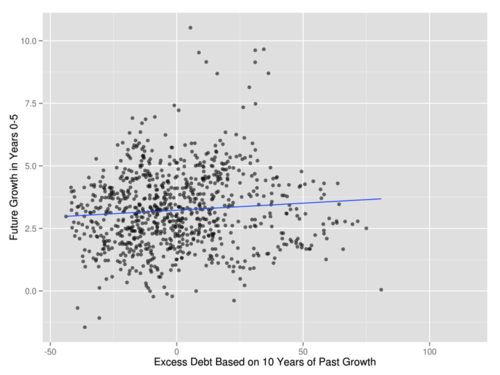
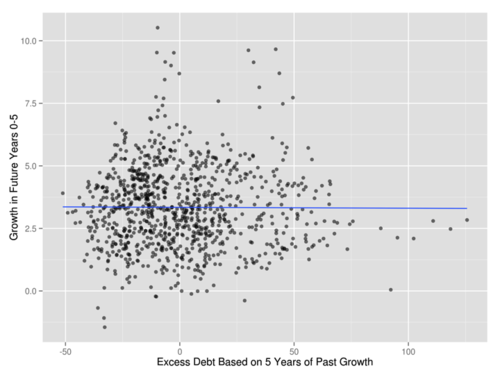
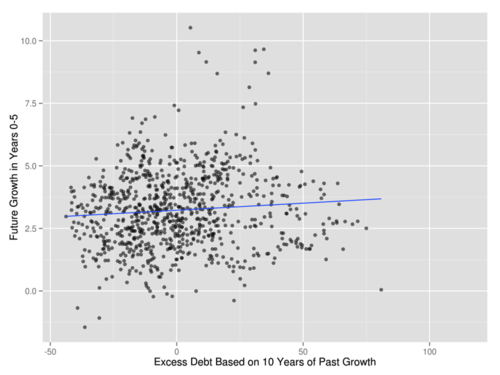
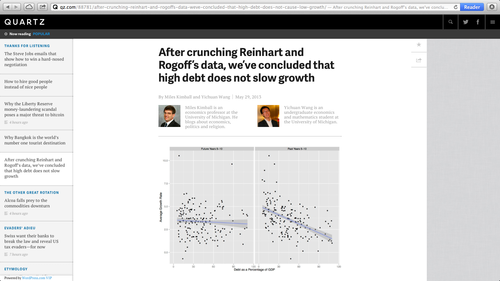
We are very pleased with the response to our May 29, 2013 Quartz column, “After crunching Reinhart and Rogoff’s data, we concluded that high debt does not slow growth.” Miles gives links to some of the online reactions in his (more accurately titled) companion blog post the next day, “After Crunching Reinhart and Rogoff’s Data, We Found No Evidence That High Debt Slows Growth.” The one reaction that called for another full post was Arindrajit Dube’s post “Dube on Growth, Debt and Past Versus Future Windows.”  Arindrajit suggests in that post that in his working paper “A Note on Debt, Growth and Causality,” he had actually explored the variations that the two of us focus on, but we want to argue here that we did one important thing that Arindrajit did not try in his working paper: controlling for ten years worth of data on past growth, as we did in our Quartz column. In this post, we argue that controlling for ten years worth of data on past growth is the key to getting positive slopes for the partial correlation between debt and future growth. We were surprised to find that controlling for ten years of past GDP growth makes the partial correlation between debt and near future growth in future years 0 to 5positive(as well as the further future growth in future years 5 to 10).The graph at the top shows our main message. Since this is a long post, let us give the bottom line here and return to it below:

The two of us could not find even a shred of evidence in the Reinhart and Rogoff data for a negative effect of government debt on growth for either growth either in the short run (the next five years) or in the long run (as indicated by growth from five to ten years later).   

The most important proviso in this statement is the clause “in the Reinhart and Rogoff data." 

Yichuan has placed our programs in a public dropbox folder. Also, on Yichuan’s blog Synthenomics, we have an additional companion post, "Instrumental Tools for Debt and Growth,” showing that instrumenting the debt to GDP ratio by the past debt to GDP ratio in order to isolate high debt and low debt policies from high or low debt caused by recent events makes the relationship between debt and future growth more positive. (This is mainly due to evidence from movements of debt in tandem across countries over time rather than movements in debt that distinguish one country from another at a give time.) 

Why it matters: Why does it matter whether the seeming effect of debt on future growth is a small positive number or a small negative number? Let us illustrate. Brad DeLong says (and Paul Krugman quotes Brad DeLong saying):

…an increase in debt from 50% of a year’s GDP to 150% is associated with a reduction in growth rates of 0.1%/year over the subsequent five years…

The first thing to say about this is that some of the estimates for going from 0 debt to a 50% debt to GDP ratio are bigger negative numbers. As Miles wrote in the companion post “After crunching Reinhart and Rogoff’s Data, We Found No Evidence That High Debt Slows Growth”:

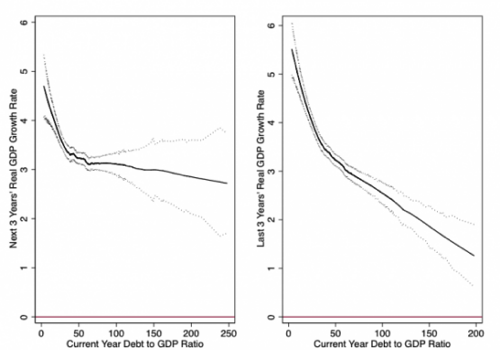
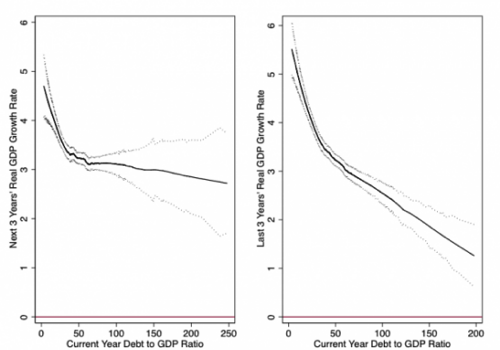
if I were convinced Arin Dube’s left graph were causal, the left graph seems to suggest that higher debt causes low growth in a very important way, though of course not in as big a way as slow growth causes higher debt. If it were causal, the left graph suggests it is the first 30% on the debt to GDP ratio that has the biggest effect on growth, not any 90% threshold.

The second thing to say is that reducing the growth rate .1% per year adds up. After five years, GDP would be .5% lower. Since the extra debt going from 50% to 150% is a year’s GDP, that is like a .5% per year addition to the interest on that extra debt, except that people throughout the economy experience the cost rather than the government alone. And if the effect on the path of GDP is permanent, that annual cost might not go away even when the debt is later repaid.

So we think it matters whether the best evidence points to what looks like a small positive slope or what looks like a small negative slope. And given how important the issues are, the Bayesian updating from results that are statistically insignificant at conventional levels of significance can have substantial practical importance.

Ten years worth of past GDP growth data are significantly better at predicting future GDP growth than five years worth of past GDP growth data.

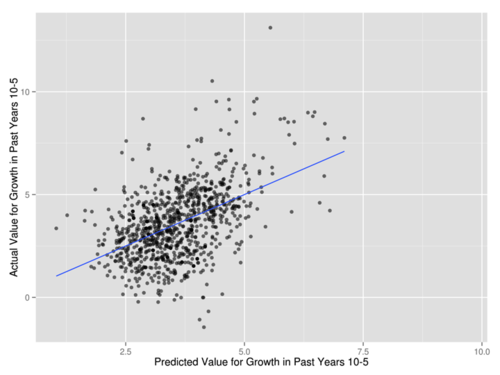
There is a wide range of growth rates in the data. Even within a given country, growth rates can be very different over the many decades of time represented in the Reinhart and Rogoff data. So it should not be surprising that it is helpful to use data on many years of past growth in order to predict past growth. Define time t as the year in which the debt/GDP ratio is measured. Then what we focus on is the difference between predicting future real GDP growth based on only the growth rates from t-5 to t-4, t-4 to t-3, t-3 to t-2, t-2 to t-1, and t-1 to t, and adding to those five most recent past annual growth rates the average growth rate from t-10 to t-5.  The graph immediately below shows that there is, indeed, variation in the growth rate from t-10 to t-5 that can’t be predicted by the most recent past five annual growth rates of GDP.   

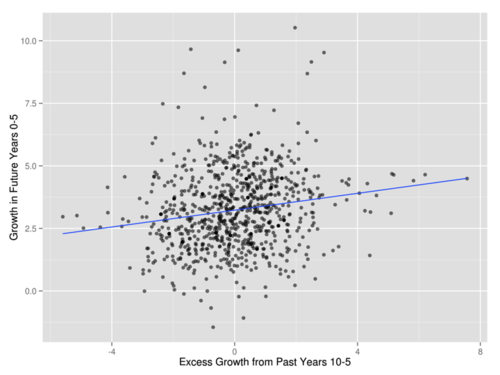
The next graph shows that the average growth rate from t-10 to t-5 does, indeed, help in predicting the future growth rate of GDP from t to t+5:

Here, “Excess Growth from Past Years 10-5” just means growth in past years 10 to 5 beyond what one could have guessed from knowing the most recent past five annual growth rates. In the multiple regression of future growth from t to t+5 on past growth, the t-statistic on “deep past” growth from t-10 to t-5 is 3.75, and so meets a very high standard of statistical significance.  

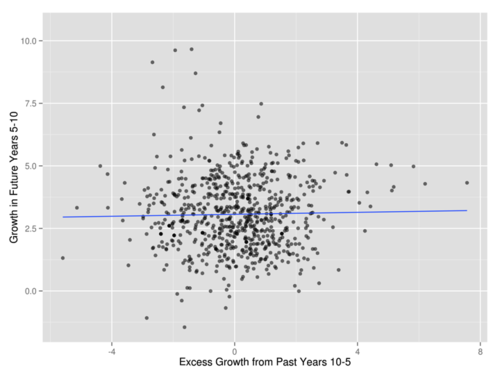
One way to think of why growth from t-10 to t-5 might help in predicting future growth is that it might help indicate the pace of growth to which growth will tend to mean revert after short-run dynamics play themselves out. But one would expect that there is a limit to the extent to which more and more growth data from the past will help. We find that growth from t-10 to t-5 does not help much in predicting growth in the five-year period fifteen years later from t+5 to t+10, as can be seen in the following graph:

What would we have found if we had neglected to control for growth in past years 10 to 5? 

To illustrate the importance of carefully taking into account the predictive value of many past years of growth for future growth, let us show first what we would have gotten if we had only controlled for the most recent five annual growth rates of GDP.

Here we get a small downward slope. But we don’t believe this small downward slope is causal, since it doesn’t adequately control for all the things other than debt that make both past and future growth tend to be higher or that make both past and future growth tend to be low, and as a byproduct, also have an effect on debt. 

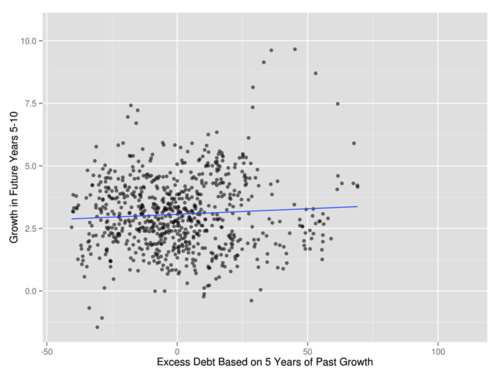
Looking at further future growth in future years 5 to 10, we see a positive relationship between excess debt and further future GDP growth. 

THE MAIN EVENT: THE RELATIONSHIP BETWEEN DEBT AND FUTURE GROWTH AFTER CONTROLLING FOR TEN YEARS OF PAST GROWTH.

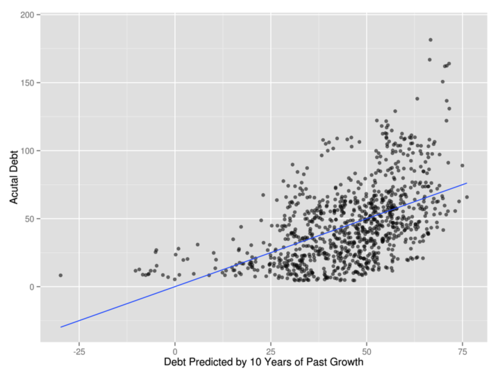
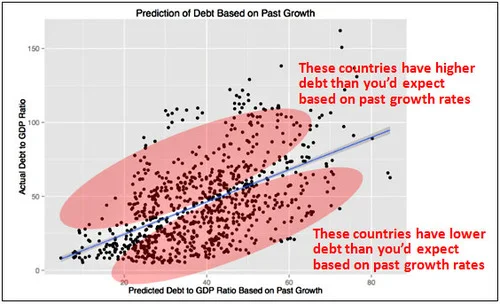
Someone might object that after controlling for a full ten years of past GDP growth (the most recent five years of annual growth, plus the average growth rate in past years 10 to 5), there wouldn’t be much independent variation in debt left with which to identify the effects of debt, but that is not so. The following graph shows that some country-years have higher debt than would be predicted by ten years of past growth and some have lower debt than would be predicted by ten years of past growth.

We call the difference between actual debt and what could have been predicted by ten years of past growth is “excess debt.” (It is important to understand that this is only of interest as a statistical object.) As can be seen in the graph immediately below (identical to the graph at the top of the post), debt above what could have been predicted by ten years of past growth has a positive relationship to future growth in the five years after the year when the debt to GDP ratio is measured.  

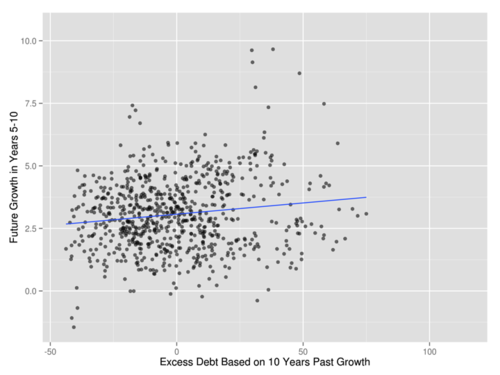
Looking further into the future, to average GDP growth in future years 5 to 10, the relationship between excess debt and further growth looks more strongly positive. 

Year Fixed Effects: How much of the evidence is from movements in average debt across all countries over time and how much is from movements of debt in one country relative to another? 

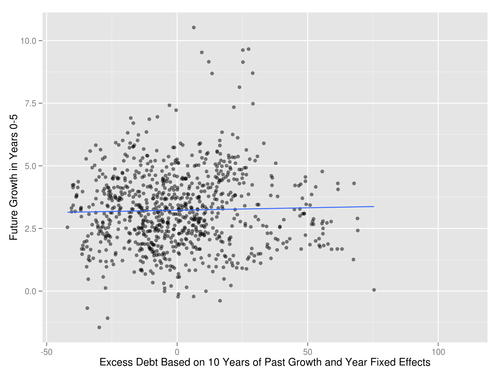
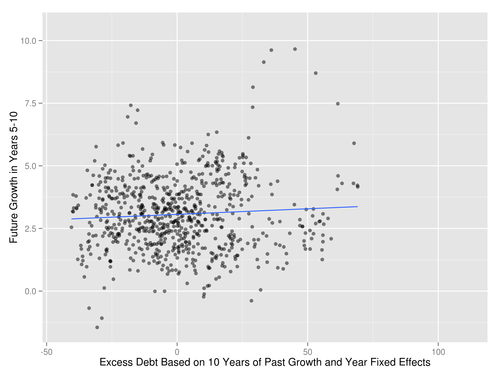
In our Quartz column “After crunching Reinhart and Rogoff’s data, we concluded that high debt does not slow growth,” we mentioned, but did not show, what happens when time fixed effects are included in order to isolate what part of the evidence depends on distinct movements in different countries as opposed to movement of debt in many different countries in tandem over time. Surprisingly, with the specification here, even with year fixed effects, we find a positive partial correlation between debt and future growth, for both GDP growth in future years 0 to 5 and GDP growth in future years 5 to 10. (See the two graphs immediately below.) These positive slopes are smaller, however, reflecting the subtraction of the evidence from movements of debt in many different countries in tandem over time.   

blog.supplysideliberal.com tumblr_inline_mnus8rqOEc1qz4rgp.png

The bottom line is that the only time we ever found a negative partial correlation between debt and future growth–that is, the only time we found a relationship between excess debt and future growth that would result in a negative coefficient in a multiple regression–was when we only controlled for five years of growth when looking at debt and near future growth in future years 0 to 5. When we control for a full ten years of past growth, we get a positive relationship between debt and future growth in both future growth windows and both with and without year fixed effects.

In our Quartz column “After crunching Reinhart and Rogoff’s data, we concluded that high debt does not slow growth,“ we wrote 

…the two of us could not find even a shred of evidence in the Reinhart and Rogoff data for a negative effect of government debt on growth.

There, we meant, we could not find even a shred of evidence in the Reinhart and Rogoff data for a negative effect of government debt on growth in the long run, as indicated by GDP growth from five to ten years later. Now let us amplify our statement to say, as we did at the top:

The two of us could not find even a shred of evidence in the Reinhart and Rogoff data for a negative effect of government debt on growth for either growth either in the short run (the next five years) or in the long run (as indicated by growth from five to ten years later).   

The most important proviso in this statement is the clause "in the Reinhart and Rogoff data." 

A key limitation of our analysis: the Reinhart-Rogoff data set may undersample troubled countries. 

In his post “None the Wiser After Reinhart, Rogoff, et al.,” Paul Andrews argues: 

What has not been highlighted though is that the Reinhart and Rogoff correlation as it stands now is potentially massively understated. Why? Due to selection bias, and the lack of a proper treatment of the nastiest effects of high debt: debt defaults and currency crises.

The Reinhart and Rogoff correlation is potentially artificially low due to selection bias. The core of their study focuses on 20 or so of the most healthy economies the world has ever seen. A random sampling of all economies would produce a more realistic correlation. Even this would entail a significant selection bias as there is likely to be a high correlation between countries who default on their debt and countries who fail to keep proper statistics.

Furthermore Reinhart and Rogoff’s study does not contain adjustments for debt defaults or currency crises.  Any examples of debt defaults just show in the data as reductions in debt. So, if a country ran up massive debt, could’t pay it back, and defaulted, no problem!  Debt goes to a lower figure, the ruinous effects of the run-up in debt is ignored. Any low growth ensuing from the default doesn’t look like it was caused by debt, because the debt no longer exists! 

In the light of Paul Andrews’s critique, we want to make it clear that our analysis is about the claim we felt Carmen Reinhart and Ken Rogoff seem to have been making that there might well be a negative effect of debt on growth even for countries that no doubts will repay their debts. That is, the question we are trying to answer is whether there is a negative effect of debt on growth other than the obvious effect that national bankruptcy or fears of national bankruptcy have.

Quartz #22—>An Economist's Mea Culpa: I Relied on Reinhart and Rogoff

blog.supplysideliberal.com tumblr_inline_mnskj3mUg61qz4rgp.png

Link to the Column on Quartz

Here is the full text of my 22d Quartz column, “An Economist’s Mea Culpa: I Relied on Reinhart and Rogoff,"  now brought home to supplysideliberal.com. The comments I made when I first flagged this column on my blog now seem outdated. You would be better advised to read my post "After Crunching Reinhart and Rogoff’s Data, We Found No Evidence that High Debt Slows Growth” and the Quartz column I wrote with Yichuan Wang that it links to. Yichuan and I plan another follow-up post to that very soon. Note that the argument below about debt raising interest rates for countries that do not have their own currency still stands, and has been amplified by Paul Andrews here, though the other worries I mention based on the Reinhart and Rogoff data set have been allayed.

I hope you notice the allusions to incentives and mechanism design below. In terms of what Carmen Reinhart and Ken Rogoff should have done that they didn’t do, “Be very careful to double-check for mistakes” is obvious. But on consideration, I also felt dismayed that they didn’t do a bit more analysis on their data early on to make a rudimentary attempt to answer the question of causality. I wouldn’t have said it quite as strongly as Matthew Yglesias, but the sentiment is basically the same.    

If you want to mirror the content of this post on another site, that is possible for a limited time if you read the legal notice at this link and include both a link to the original Quartz column and the following copyright notice:

© April 20, 2013: Miles Kimball, as first published on Quartz. Used by permission according to a temporary nonexclusive license expiring June 30, 2014. All rights reserved.


Ken Rogoff is an economist who has always been kind to me, and for whom I have deep respect. And I have no animus toward Carmen Reinhart. Nevertheless, I hope there has been a nightmarish quality to the last few days of what Quartz writer Matt Phillips called a “bone-crunching social media pile-on that Harvard economists Ken Rogoff and Carmen Reinhart received in recent days after some other researchers questioned their influential findings that high government debt is a drag on economic growth.” I say this because I know from my own experience as a researcher how powerfully the hint of such an embarrassment motivates economists and other researchers to sweat the details to get things right.  Some errors will always slip through the cracks, but a researcher ought to live in mortal fear of a contretemps like that Reinhart and Rogoff have found themselves in this week.

Reinhart and Rogoff have not only caused embarrassment for themselves, but also for all those who have in any way relied on their results. Those who made their case by overinterpreting the particular results that have now been discredited should be the most embarrassed. Quartz’s Tim Fernholz gives a rundown of politicians and other policy makers who relied heavily on Reinhart and Rogoff’s results in “How influential was the Reinhart and Rogoff study warning that high debt kills growth?

But I, like many others, have relied on Reinhart and Rogoff’s results in smaller ways—and wish this embarrassment on myself as a warning for the future. No one is perfect, but it is important not to undercut the motivation to be careful by softening the penalty for error too much. I am lucky I can heal the damage; I have fully updated the argument I made based on Reinhart and Rogoff’s results in my column “What Paul Krugman got wrong about Italy’s economy” in a way that I think leaves the force of the overall argument in that column intact. Here in full, is the new passage, which also gives my view of the substantive issue that Reinhart and Rogoff have now occasioned so much confusion about:

And despite the recent revelation of errors in Carmen Reinhart and Ken Rogoff’s famous study of debt levels and economic growth, which I discuss here and which motivated the update you are reading (the original passage can be found here), there are reasons to think that high levels of debt are worth worrying about.

First, for a country like Italy that does not have its own currency (since it shares the euro with many other countries), Paul Krugman’s own graph shows a correlation between national debt as a percentage of GDP and the interest rate that a country pays.

Second, the paper by Thomas Herndon, Michael Ash and Robert Pollin that criticizes Reinhart and Rogoff finds that, on average, growth rates do decline with debt levels. Divide debt levels into medium high (60% to 90% of GDP), high (90% to 120% of GDP), and very high (above 120% of GDP). Then the growth rates are 3.2% with medium-high debt, 2.4% with high debt, and 1.4% with very high debt.  (I got these numbers by combining the 4.2% growth rate for countries in the 0 to 30% debt-to-GDP ratio range from Table 3 with the estimates in Table 4 for how things are different at higher debt levels.) Moreover, contrary to the impression one would get from the column here, Herndon, Ash and Pollin’s Table 4 indicates that the differences between low levels of debt and high levels of debt are not just due to chance, though what Herndon, Ash and Pollin emphasize is that very low levels of debt, below 30% of GDP, have a strong association with higher growth rates. Overall, with the data we have, we don’t know what causes what, so there is no definitive answer to how much we should worry about debt, but ample reason not to treat debt as if it were a nothing. [For a more recent reassessment of that evidence, see my post “After Crunching Reinhart and Rogoff’s Data, We Found No Evidence that High Debt Slows Growth” and the Quartz column I wrote with Yichuan Wang that it links to.]

There is definitely a reasonable case to be made that if additional spending or tax cuts are the only way to stimulate the economy, then we should do it even at the cost of additional debt. But as I argue both in “What Paul Krugman got wrong about Italy’s economy” and in “Why austerity budgets won’t save your economy,” there are ways to stimulate the economy without adding to its debt burden, and stimulating the economy in a way that doesn’t add substantially to the national debt is better than stimulating the economy in a way that does.

Unlike what many politicians would do in similar circumstances, Reinhart and Rogoff have been forthright in admitting their errors. (See Chris Cook’s Financial Times post, “Reinhart and Rogoff Recrunch the Numbers.”) They also used their response to put forward their best argument that correcting the errors does not change their bottom line. Given the number of bloggers arguing the opposite case—that Reinhart and Rogoff’s bottom line has been destroyed—it is actually helpful for them to make their case in what has become an adversarial situation, despite their self-justifying motivation for doing so. And though I see a self-justifying motivation, I find it credible that Reinhart and Rogoff’s original error did not arise from political motivations, since as they note in their response, of their two major claims—(1) debt hurts growth and (2) economic slumps typically last a long time after a financial crisis—the claim that debt hurts growth is congenial to Republicans, while the claim that it is normal for slumps to last a long time after a financial crisis is congenial to Democrats. But it hurt the nation’s decision-making process when the true statement, that we should be worried high levels of national debt might have a negative effect on growth, was mangled into the idea that a debt-to-GDP ratio of 90% is a critical threshold for the effects of debt on the economy—an idea that gained the traction it did because of Reinhart and Rogoff’s mistake.

In Praise of Trolls

My usage of the word “troll” is informed by Noah Smith’s wildly popular post “Econotrolls: An Illustrated Bestiary." The current wikipedia entry on internet trolls has this note:

Application of the term troll is subjective. Some readers may characterize a post as trolling, while others may regard the same post as a legitimate contribution to the discussion, even if controversial.

The "trolls” of my title are exactly these borderline trolls whom some call “trolls” and some think are making legitimate, albeit controversial contributions. Although I will not promise to always feed the trolls myself, John Stuart Mill had some words to say in praise of trolls that I agree with. This is what he said in On Liberty, Chapter II “Of the Liberty of Thought and Discussion,” from the middle of paragraph 29 through paragraph 33:

There are many reasons, doubtless, why doctrines which are the badge of a sect retain more of their vitality than those common to all recognised sects, and why more pains are taken by teachers to keep their meaning alive; but one reason certainly is, that the peculiar doctrines are more questioned, and have to be oftener defended against open gainsayers. Both teachers and learners go to sleep at their post, as soon as there is no enemy in the field.

The same thing holds true, generally speaking, of all traditional doctrines—those of prudence and knowledge of life, as well as of morals or religion. All languages and literatures are full of general observations on life, both as to what it is, and how to conduct oneself in it; observations which everybody knows, which everybody repeats, or hears with acquiescence, which are received as truisms, yet of which most people first truly learn the meaning, when experience, generally of a painful kind, has made it a reality to them. How often, when smarting under some unforeseen misfortune or disappointment, does a person call to mind some proverb or common saying, familiar to him all his life, the meaning of which, if he had ever before felt it as he does now, would have saved him from the calamity. There are indeed reasons for this, other than the absence of discussion: there are many truths of which the full meaning cannot be realized, until personal experience has brought it home. But much more of the meaning even of these would have been understood, and what was understood would have been far more deeply impressed on the mind, if the man had been accustomed to hear it argued pro and con by people who did understand it. The fatal tendency of mankind to leave off thinking about a thing when it is no longer doubtful, is the cause of half their errors. A contemporary author has well spoken of “the deep slumber of a decided opinion.”

But what! (it may be asked) Is the absence of unanimity an indispensable condition of true knowledge? Is it necessary that some part of mankind should persist in error, to enable any to realize the truth? Does a belief cease to be real and vital as soon as it is generally received—and is a proposition never thoroughly understood and felt unless some doubt of it remains? As soon as mankind have unanimously accepted a truth, does the truth perish within them? The highest aim and best result of improved intelligence, it has hitherto been thought, is to unite mankind more and more in the acknowledgment of all important truths: and does the intelligence only last as long as it has not achieved its object? Do the fruits of conquest perish by the very completeness of the victory? 

I affirm no such thing. As mankind improve, the number of doctrines which are no longer disputed or doubted will be constantly on the increase: and the well-being of mankind may almost be measured by the number and gravity of the truths which have reached the point of being uncontested. The cessation, on one question after another, of serious controversy, is one of the necessary incidents of the consolidation of opinion; a consolidation as salutary in the case of true opinions, as it is dangerous and noxious when the opinions are erroneous. But though this gradual narrowing of the bounds of diversity of opinion is necessary in both senses of the term, being at once inevitable and indispensable, we are not therefore obliged to conclude that all its consequences must be beneficial. The loss of so important an aid to the intelligent and living apprehension of a truth, as is afforded by the necessity of explaining it to, or defending it against, opponents, though not sufficient to outweigh, is no trifling drawback from, the benefit of its universal recognition. Where this advantage can no longer be had, I confess I should like to see the teachers of mankind endeavouring to provide a substitute for it; some contrivance for making the difficulties of the question as present to the learner’s consciousness, as if they were pressed upon him by a dissentient champion, eager for his conversion.

But instead of seeking contrivances for this purpose, they have lost those they formerly had. The Socratic dialectics, so magnificently exemplified in the dialogues of Plato, were a contrivance of this description. They were essentially a negative discussion of the great questions of philosophy and life, directed with consummate skill to the purpose of convincing any one who had merely adopted the commonplaces of received opinion, that he did not understand the subject—that he as yet attached no definite meaning to the doctrines he professed; in order that, becoming aware of his ignorance, he might be put in the way to attain a stable belief, resting on a clear apprehension both of the meaning of doctrines and of their evidence. The school disputations of the middle ages had a somewhat similar object. They were intended to make sure that the pupil understood his own opinion, and (by necessary correlation) the opinion opposed to it, and could enforce the grounds of the one and confute those of the other. These last-mentioned contests had indeed the incurable defect, that the premises appealed to were taken from authority, not from reason; and, as a discipline to the mind, they were in every respect inferior to the powerful dialectics which formed the intellects of the “Socratici viri:” but the modern mind owes far more to both than it is generally willing to admit, and the present modes of education contain nothing which in the smallest degree supplies the place either of the one or of the other. A person who derives all his instruction from teachers or books, even if he escape the besetting temptation of contenting himself with cram, is under no compulsion to hear both sides; accordingly it is far from a frequent accomplishment, even among thinkers, to know both sides; and the weakest part of what everybody says in defence of his opinion, is what he intends as a reply to antagonists. It is the fashion of the present time to disparage negative logic—that which points out weaknesses in theory or errors in practice, without establishing positive truths. Such negative criticism would indeed be poor enough as an ultimate result; but as a means to attaining any positive knowledge or conviction worthy the name, it cannot be valued too highly; and until people are again systematically trained to it, there will be few great thinkers, and a low general average of intellect, in any but the mathematical and physical departments of speculation. On any other subject no one’s opinions deserve the name of knowledge, except so far as he has either had forced upon him by others, or gone through of himself, the same mental process which would have been required of him in carrying on an active controversy with opponents. That, therefore, which when absent, it is so indispensable, but so difficult, to create, how worse than absurd is it to forego, when spontaneously offering itself! If there are any persons who contest a received opinion, or who will do so if law or opinion will let them, let us thank them for it, open our minds to listen to them, and rejoice that there is some one to do for us what we otherwise ought, if we have any regard for either the certainty or the vitality of our convictions, to do with much greater labor for ourselves.

The online world has in abundance what John Stuart Mill worried might be in short supply: trolls

After Crunching Reinhart and Rogoff's Data, We Found No Evidence That High Debt Slows Growth

blog.supplysideliberal.com tumblr_inline_mnlb0fz9DP1qz4rgp.png

Here is a link to my 24th column on Quartz, “After crunching Reinhart and Rogoff’s data, we’ve concluded that high debt does not slow growth,” coauthored with Yichuan Wang. The title chosen by our editor is too strong, but not so much so that I objected to it; the title of this post is more accurate.

Yichuan only recently finished his first year at the University of Michigan. Yichuan’s blog is Synthenomics. You can see Yichuan on Twitter here. Let me say already that from reading Yichuan’s blog and working with him on this column, I know enough to strongly recommend Yichuan for admission to any Ph.D. program in economics in the world. He should finish has bachelor’s degree first, though. 

I genuinely went into our analysis expecting to find evidence that high debt does cause low growth, though of course, to a much smaller extent than low growth causes high debt. I was fully prepared to argue (first to Yichuan and then to the world) that even a statistically insignificant negative effect of debt on growth that was plausibly causal had to be taken seriously from a Bayesian perspective. Our analysis set out the minimal hurdles I felt had to be jumped over to convince me that there was some solid evidence that high debt causes low growth. A key jump was not completed. That shifted my views.

I hope others will try to replicate our findings. That should let me rest easier.

From a theoretical point of view, I am especially intrigued by the possibility that any effect on growth from refinancing difficulties might depend on a country’s debt to GDP ratio compared to that of other countries. What I find remarkable is that despite the likely negative effect of debt on growth from refinancing difficulties, we found no overall negative effect of debt on growth. It is as if there is some other, positive effect of debt on growth to the extent a country’s relative debt position stays the same. Besides the obvious, but uncommonly realized, possibility of very wisely deployed deficit spending, I can think of two intriguing mechanisms that could generate such an effect. First, from a supply-side point of view, lower tax rates now could make growth look higher now, perhaps at the expense of growth at some future date when taxes have to be raised to pay off the debt, with interest. Second, government debt increases the supply of liquid (and often relatively safe) assets in the economy that can serve as good collateral. Any such effect could be achieved without creating a need for higher future taxes or lower future spending by investing the money raised in corporate stocks and bonds through a sovereign wealth fund.

I have thought a little about why borrowing in a currency one can print unilaterally makes such a difference to the reactions of the bond market to debt. One might think that the danger of repudiating the implied real debt repayment promises by inflation would mean the risks to bondholders for debt in one’s own currency would be almost the same as for debt in a foreign currency or a shared currency like the euro. But it is one thing to fear actual disappointing real repayment spread over some time and another thing to have to fear that the fear of other bondholders will cause a sudden inability of a government to make the next payment at all.  

Note: Brad Delong writes:

Miles Kimball and Yichuan Wang confirm Arin Dube: Guest Post: Reinhart/Rogoff and Growth in a Time Before Debt | Next New Deal:

As I tweeted,

  1. .@delong undersells our results. I would have read Arin Dube’s results alone as saying high debt *does* slow growth.
  2. *Of course* low growth causes debt in a big way. But we need to know if high debt causes low growth, too. No ev it does!

In tweeting this, I mean, if I were convinced Arin Dube’s left graph were causal, the left graph seems to suggest that higher debt causes low growth in a very important way, though of course not in as big a way as slow growth causes higher debt. If it were causal, the left graph suggests it is the first 30% on the debt to GDP ratio that has the biggest effect on growth, not any 90% threshold. Yichuan and I are saying that the seeming effect of the first 30% on the debt to GDP ratio could be due in important measure to the effect of growth on debt, plus some serial correlation in growth rates. The nonlinearity could come from the fact that it takes quite high growth rates to keep a country from have some significant amounts of debt–as indicated by Arin Dube’s right graph, which is more likely to be primarily causal.

By the way, I should say that Yichuan and I had seen the Rortybomb piece on Arin Dube’s analysis, but we were not satisfied with it. But I want to give credit for this as a starting place for Yichuan and me in our thinking.

Brad Delong’s Reply: Thanks to Brad DeLong for posting the note above as part of his post “DeLong Smackdown Watch: Miles Kimball Says That Kimball and Wang is Much Stronger than Dube.”

Brad replies:

From my perspective, I tend to say that of course high debt causes low growth–if high debt makes people fearful, and leads to low equity valuations and high interest rates. The question is: what happens in the case of high debt when it comes accompanied by low interest rates and high equity values, whether on its own or via financial repression?

Thus I find Kimball and Wang’s results a little too strong on the high-debt-doesn’t-matter side for me to be entirely comfortable…

My Thoughts about What Brad Says in the Quote Just Above: As I noted above, my reaction is to what we Yichuan and I found is similar to Brad’s. There must be a negative effective of debt on growth through the bond vigilante channel, as Yichuan and I emphasize in our interpretation. For example, in our final paragraph, Yichuan and I write:

…other than the danger from bond market vigilantes, we find no persuasive evidence from Reinhart and Rogoff’s data set to worry about anything but the higher future taxes or lower future spending needed to pay for that long-term debt.

The surprise is the pattern that when countries around the world shifted toward higher debt than would be predicted by past growth, that later growth turned out to be somewhat higher than after countries around the world shifted to lower debt. It may be possible to explain why that evidence from trends in the average level of debt around the world over time should be dismissed, but if not, we should try to understand those time series patterns. It is hard to get definitive answers from the relatively small amount of evidence in macroeconomic time series, or even macroeconomic panels across countries, but given the importance of the issues, I think it is worth pondering the meaning of what limited evidence there is from trends in the average level of debt around the world over time. That is particularly true since in the current crisis, many people have, recommended precisely the kind of worldwide increase deficit spending–and therefore debt levels–that this limited evidence speaks to. 

I am perfectly comfortable with the idea that the evidence from trends in the average level of debt around the world over time is limited enough so theoretical reasoning that shifts our priors could overwhelm the signal from the data. But I want to see that theoretical reasoning. And I would like to get reactions to my theoretical speculations above, about (1) supply-side benefits of lower taxes that reverse in sign in the future when the debt is paid for and (2) liquidity effects of government debt (which may also have a price later because of financial cycle dynamics). 

Matt Yglesias’s Reaction: On MoneyBox, you can see Matthew Yglesias’s piece “After Running the Numbers Carefully There’s No Evidence that High Debt Levels Cause Slow Growth.” As I tweeted:

Don’t miss this excellent piece by @mattyglesias about my column with @yichuanw on debt and growth. Matt gets it.


In the preamble of my post bringing the full text of “An Economist’s Mea Culpa: I Relied on Reihnart and Rogoff” home to supplysideliberal.com, I write:

In terms of what Carmen Reinhart and Ken Rogoff should have done that they didn’t do, “Be very careful to double-check for mistakes” is obvious. But on consideration, I also felt dismayed that they didn’t do a bit more analysis on their data early on to make a rudimentary attempt to answer the question of causality. I wouldn’t have said it quite as strongly as Matthew Yglesias, but the sentiment is basically the same.    

Paul Krugman’s Reaction: On his blog, Paul Krugman characterized our findings this way:

There is pretty good evidence that the relationship is not, in fact, causal, that low growth mainly causes high debt rather than the other way around.

Kevin Drum’s Reaction: On the Mother Jones blog, Kevin Drum gives a good take on our findings in his post “Debt Doesn’t Cause Low Growth. Low Growth Causes Low Growth.” He notices that we are not fans of debt. I like his version of one of our graphs:

Mark Gongloff’s Reaction: On Huffington Post, Mark Gongloff’s “Reinhart and Rogoff’s Pro-Austerity Research Now Even More Thoroughly Debunked by Studies” writes:

…University of Michigan economics professor Miles Kimball and University of Michigan undergraduate student Yichuan Wang write that they have crunched Reinhart and Rogoff’s data and found “not even a shred of evidence” that high debt levels lead to slower economic growth.

And a new paper by University of Massachusetts professor Arindrajit Dube finds evidence that Reinhart and Rogoff had the relationship between growth and debt backwards: Slow growth appears to cause higher debt, if anything….

This contradicts the conclusion of Reinhart and Rogoff’s 2010 paper, “Growth in a Time of Debt,” which has been used to justify austerity programs around the world. In that paper, and in many other papers, op-ed pieces and congressional testimony over the years, Reinhart And Rogoff have warned that high debt slows down growth, making it a huge problem to be dealt with immediately. The human costs of this error have been enormous….

At the same time, they have tried to distance themselves a bit from the chicken-and-egg problem of whether debt causes slow growth, or vice-versa. “The frontier question for research is the issue of causality,” [Reinhart and Rogoff] said in their lengthy New York Times piece responding to Herndon. It looks like they should have thought a little harder about that frontier question three years ago.

There is an accompanying video by Zach Carter.

Paul Andrews Raises the Issue of Selection Bias: The most important response to our column that I have seen so far is Paul Andrews’s post “None the Wiser After Reinhart, Rogoff, et al.” This is the kind of response we were hoping for when we wrote “We look forward to further evidence and further thinking on the effects of debt.” Paul trenchantly points out the potential importance of selection bias: 

What has not been highlighted though is that the Reinhart and Rogoff correlation as it stands now is potentially massively understated. Why? Due to selection bias, and the lack of a proper treatment of the nastiest effects of high debt: debt defaults and currency crises.

The Reinhart and Rogoff correlation is potentially artificially low due to selection bias. The core of their study focuses on 20 or so of the most healthy economies the world has ever seen. A random sampling of all economies would produce a more realistic correlation. Even this would entail a significant selection bias as there is likely to be a high correlation between countries who default on their debt and countries who fail to keep proper statistics.

Furthermore Reinhart and Rogoff’s study does not contain adjustments for debt defaults or currency crises.  Any examples of debt defaults just show in the data as reductions in debt. So, if a country ran up massive debt, could’t pay it back, and defaulted, no problem!  Debt goes to a lower figure, the ruinous effects of the run-up in debt is ignored. Any low growth ensuing from the default doesn’t look like it was caused by debt, because the debt no longer exists!

I think this issue needs to be taken very seriously. It would be a great public service for someone to put together the needed data set. 

Note that Paul Andrews views are in line with our interpretation of our findings. Let me repeat our interpretation, with added emphasis:

other than the danger from bond market vigilantes, we find no persuasive evidence from Reinhart and Rogoff’s data set to worry about anything but the higher future taxes or lower future spending needed to pay for that long-term debt.

Of course, it is disruptive to have a national bankruptcy. And nationalbankruptcies are more likely to happen at high levels of debt than low levels of debt (though other things matter as well, such as the efficiency of a nation’s tax system). And the fear by bondholders of a national bankruptcy can raise interest rates on government bonds in a way that can be very costly for a country. The key question for which the existing Reinhart and Rogoff data set is reasonably appropriate is the question of whether an advanced country has anything to fear from debt even if, for that particular country, no one ever seriously doubts that country will continue to pay on its debts.

A Year in the Life of a Supply-Side Liberal

Update: Below is my 1st anniversary post. You might also be interested in  my 2d anniversary post, “Three Revolutions.”


Today it has been exactly one year since my first post, “What is a Supply-Side Liberal?” on May 28, 2012. It has been a surprising year–surprising because my hopes when I decided to start blogging have been realized.

For many years, I wanted to do something in the public domain, but couldn’t figure out how to do it. So, after talking to Noah Smith and Justin Wolfers about what it was like to be a blogger, I took on blogging as a serious career move.

For someone with my talkative personality, there is a frustration at having things to say and trying to be heard through the traditional means of in-person conversations, seminars and formal working papers or journal articles alone. (Anyone seeking roots of that talkative personality in my childhood can look to the competition for attention and airtime with six siblings.) It is a great relief to know that my readers will be able to find what I have to say online within hours after I have written it down and make it public.

In the public arena, not having a blog, Twitter account, Facebook page or similar platform felt to me a little like being one of those ghosts in the movies who try to talk to their still-living friends and family, but find that their words are inaudible. Now I can talk back when I disagree with what I read in the Wall Street Journal at the breakfast table. Or I can add my two cents to an idea that I agree with.

Though I call the transition “starting to blog,” in fact, Facebook mirroring of my blog posts, Twittercolumns on Quartz, and a few radio (1, 2), TV and Huffpost Live (1, 2), round out the picture so far. For a blogger who also wants to also keep publishing in the academic journals, I think of Milton Friedman as the model of an academic as a public intellectual. I am amazed at how persuasive Milton is in the videos I curated in “Milton Friedman: Celebrating His 100th Birthday with Videos of Milton.”

As an academic “blogger,” each medium reinforces the others. Publishing in economic journals provides an anchor of rigor and depth, and the credibility to talk to policy makers in terms they respect, Twitter invites questions and dialogue in a way anyone can join in on, Facebook gives a sense of personal connection and displays links in a beautiful way, Radio and TV satisfy a primal human curiosity about how someone looks and sounds, writing on Quartz gives me the excellent feedback of my editors Mitra Kalita and Lauren Brown to make difficult ideas more accessible than they would otherwise be, and my blog itself gives me the independence and space to say whatever I think needs to be said, unfiltered by anyone else.

This post marks the end of the “third cycle” for my blog. The first whirlwind month constituted the “first cycle.” Here is what I was thinking at the end of that first month:

The rest of the summer of 2012, my “second cycle,” was also a time of intense blogging. My thoughts at the end of that summer are recounted in

Since then, it has been hard to find time to sit back and take stock until now. The third cycle, from September 1 to now has been very different than those first months:

  • Mitra Kalita liked my post “Why My Retirement Savings Accounts are 100% in the Stock Market,” and recruited me for the Atlantic Corporation’s new international business website Quartz. She initially suggested a pace of once every other week, but I wanted to set a goal of one column a week. In the event, I have written 23 columns in the 246 days since my first Quartz column appeared on September 24, 2012, or about one every week and a half. I rank my first 22 Quartz columns (and my other top blog posts) by popularity here.    
  • Beyond my Quartz columns, my day job teaching macroeconomics and doing economic research made it hard to find time to write major posts unless I could kills two birds with one stone, by, say writing something that would help with my teaching, such as “The Deep Magic of Money and the Deeper Magic of the SupplySide.” But events sometimes inspired me to steal time to write a major post, such as when I tried to see if I could twist the words of my distant cousin Mitt Romney’s acceptance speech enough to get a supply-side liberal interpretation in “The Magic of Etch-a-Sketch: A Supply-Side Liberal Fantasy.” The most personal post I wrote was about the death of my mother.
  • For my regular readers, I have tried hard (with some lapses) to have at least one new post every day on my blog. Some are links to other posts and articles I like. Some are my favorite excerpts from books I have been reading. As I was drawn into lively Twitter discussions (with 2900 followers this morning), an increasing number were links to storified Twitter interactions on substantive issues. And I found a significant fraction of my writing effort devoted to my goal of publishing a worthy religion or philosophy post each Sunday. I view writing my Sunday religion or philosophy post as an important discipline to try to keep a broader perspective.
  • For me, more of the joy of blogging than I expected has come from choosing the illustrations at the top of my posts. I love trying to make my blog beautiful as well as substantive. I talk about this in “Illustration Note to ‘Leading States in the Fiscal Two-Step” and “In Praise of Tumblr.” The most recent illustration choice I am proud of is the image of a Piet Mondrian painting at the top of “A Minimalist Implementation of Electronic Money.” My daughter Diana had a lot to do with the look and feel of my blog, making that aspect much better than it would have been otherwise. She writes about the beginnings of supplysideliberal.com here.  
  • I have felt some nostalgia for those early months of true obsession with my blog and particularly for the hours I allowed myself then to write a post on the spot on idea I was inspired by. But I am glad that the blog-excitement-induced insomnia I reported in “Thoughts on Monetary and Fiscal Policy in the Wake of the Great Recession: supplysideliberal.com’s First Month” has abated to about a third or a quarter the intensity it had then. At this point my meta-self would rather get more sleep than write another blog post. But part of me doesn’t agree. 

In terms of substance on my blog and in Quartz, I am still following the agenda set out in my first post What is a Supply-Side Liberal? Because of the aftermath of the great recession, a huge fraction of my writing this past year has been devoted to backing up my claim there that

…there is no shortage of powerful tools to revive both the U.S. economy and the world economy.  This is true despite (A) short-term interest rates already being close to zero in the U.S. and many other countries and (B) most countries not being able to afford to add much to their national debt

At the time, I had in mind Federal Lines of Credit and quantitative easing (addressed in my second and third posts) as tools for stimulating the economy at the zero lower bound. It was news to me when it dawned on me that it was possible to eliminate the zero lower bound through electronic money and that the most effective form of quantitative easing,  buying corporate stocks and bonds, could be undertaken best by a sovereign wealth fund separate from the Fed or other central bank, and how such a sovereign wealth fund could aid financial stability as well. The other big revelatory moment was was reading John Cochrane’s review of Anat Admati and Martin Hellwig’s book The Banker’s New Clothes (summarized in my post here), which deconstructs the arguments bank lobbyists make against high bank equity (“capital”) requirements as a means of ensuring financial stability. For macroeconomic and financial stability, the two policies I believe would make the most difference are the combination of eliminating the zero lower bound through electronic money and high bank equity requirements, in the range of 30 to 50%, achieved gradually by prohibiting banks from paying dividends or buying back stock until they achieve that level.

Less of my writing than I would like has been devoted to exploring “the enduring dilemmas of economic policy,” among which “the most important is the conflict between efficiency and equity." This summer, I hope to write more about tax policy, and other issues that touch on the distribution of income and wealth. On issues of income distribution and tax policy, the most important posts I have written are

Let me say a few more words about my approach to blog writing. As I say in Thoughts on Monetary and Fiscal Policy in the Wake of the Great Recession: supplysideliberal.com’s First Month, my blog posts are intended to stand the test of time–and are all meant to fit together into a coherent whole. As I say in What is a Partisan Nonpartisan Blog? and in my mini-bio, I am passionate about issues, but I am neither a Republican nor a Democrat. My primary strategy for making the world a better place is not to influence politics in the short run, but to make my case on the merits for each issue to the cohort of young economists who will collectively have such a big influence on policy in decades to come, and to the economists who now staff government agencies (including the Federal Reserve System).

Some other notes on my approach can be found in 

Here is a final word to the wise. In A Guided Tour Through Meta-posts at the End of the Second Cycle, many of the "meta-posts” I mentioned were collections of links to posts on specific topics. Now, those collections of links to posts on specific topics have been replaced by the links to sub-blogs at my sidebar. And I recommend the other links on my sidebar as well. I hope you will check them out, if you haven’t already.  

Some Statistics: Part of the responsibility I feel toward my readers comes from seeing the numbers. The 249,571 pageviews recorded by Google Analytics since June 3, 2012 (which are a lower bound because they don’t count people reading columns on Quartz or people using Google Reader) come from 81,850 unique visitors, with the following distribution by the number of visits a visitor has made (there are some anomalies on divisibility, but that is the way the Google Analytics data is): 

Visits/Person      # of Visits From Category   Implied # Readers in Category

1:                                     81,913                          81,913

2:                                     16,430                           8,215

3:                                       8,393                           2,798

4:                                      5,590                           1,398

5:                                       4,167                             833

6:                                       3,296                             549

7:                                       2,774                             396

8:                                       2,365                             296

9-14:                                 9,814                             892 (dividing by 11)

15-25:                               9,656                             508 (dividing by 19)

26-50:                             10,279                             294 (dividing by 35)

51-100:                             7,909                             113 (dividing by 70)

101-200:                           5,066                               36 (dividing by 140)

201+:                                 4,503                               18 (dividing by 250)

I have hundreds of very loyal readers, for whom I am very grateful. That is a full auditorium’s worth in cyberspace.

Tyler Cowen: The Egalitarian Tradition in Economics

I find this New York Times essay by Tyler Cowen inspiring. When many felt that innate difference among human beings largely accounted for differences in social outcomes, or feel that different classes of human beings ought to be treated very differently, economists have been appropriately skeptical.

Now, when the pendulum has sometimes swung toward downplaying innate differences too much, economists (along with Steven Pinker) are appropriately skeptical about the “blank slate” view, as well, emphasizing that there are, indeed, some important innate differences–but that these differences do not justify treating people badly:

Joshua Foer on Deliberate Practice

The idea of deliberate practice is one that I have been very eager to get my students to understand. I found a nice passage in Moonwalking with Einstein: The Art and Science of Remembering Everything, explaining deliberate practice. Here it is, from pages 169-175:

When people first learn to use a keyboard, they improve very quickly from sloppy single-finger pecking to careful two-handed typing, until eventually the fingers move so effortlessly across the keys that the whole process becomes unconscious and the fingers seem to take on a mind of their own. At this point, most people’s typing skills stop progressing. They reach a plateau. If you think about it, it’s a strange phenomenon. After all, we’ve always been told that practice makes perfect, and many people sit behind a keyboard for at least several hours a day in essence practicing their typing. Why don’t they just keep getting better and better. 

In the 1960’s, the psychologists Paul Fitts and Michael Posner attempted to answer this question by describing the three stages that anyone goes through when acquiring a new skill. During the first phase, known as the “cognitive stage,” you’re intellectualizing the task and discovering new strategies to accomplish it more proficiently. During the second, “associative stage,” you’re concentrating less, making fewer major errors, and generally becoming more efficient. Finally you reach what Fitts called the “autonomous stage,” when you figure that you’ve gotten as good as you need to get at the task and you’re basically running on autopilot….

What separates the experts from the rest of us is that they tend to engage in a very directed, highly focused routine, which Ericsson has labeled “deliberate practice.” Having studied the best of the best in many different fields, he has found that top achievers tend to follow the same general pattern of development. They develop strategies for consciously keeping out of the autonomous stage while they practice by doing three things: focusing on their technique, staying goal-oriented, and getting constant and immediate feedback on their performance. 

Amateur musicians, for example, are more likely to spend their practice time playing music, whereas pros are more likely to work through tedious exercises or focus on specific, difficult parts of pieces. The best ice skaters spend more of their practice time trying jumps that they land less often, while lesser skaters work more on jumps they’ve already mastered. Deliberate practice, by its nature, must be hard….

The best way to get out of the autonomous stage and off the OK plateau, Ericsson has found, is to actually practice failing. One way to do that is to put yourself in the mind of someone far more competent at the task that you’re trying to master, and try to figure out how that person works through problems. Benjamin Franklin was apparently an early practitioner  of this technique. In his autobiography, he describes how he used to read essays by the great thinkers and try to reconstruct the the author’s arguments according to Franklin’s own logic. He’d then open up the essay and compare his reconstruction to the original words to see how his own chain of thinking stacked up against the master’s. The best chess players follow a similar strategy. They will often spend several hours a day replaying the games of grand masters one move at a time, trying to understand the expert’s thinking at each step. Indeed, the single best predictor of an individual’s chess skill is not the amount of chess he’s played against opponents, but rather the amount of time he’s spent sitting alone working through old games.

The secret to improving at a skill is to retain some degree of conscious control over it while practicing–to force oneself to stay out of autopilot. With typing, it’s relatively easy to get past the OK plateau. Psychologists have discovered that the most efficient method is to force yourself to type faster than feels comfortable, and to allow yourself to make mistakes. In one noted experiment, typists were repeatedly flashed words 10 to 15 percent faster than their fingers were able to translate them onto the keyboard. At first they weren’t able to keep up, but over a period of days they figured out the obstacles that were slowing them down, and overcame them, and then continued to type at the faster speed. By bringing typing out of the autonomous stage and back under their conscious control, they had conquered the OK plateau….

This, more than anything, is what differentiates the top memorizers from the second tier: they approach memorization like a science. They develop hypotheses about their limitations; they conduct experiments and track data. “It’s like you’re developing a piece of technology, or working on a scientific theory,” the two-time world champ Andi Bell once told me. “You have to analyze what you’re doing." 

Also see my post ”Joshua Foer on Memory.

How to Set the Exchange Rate Between Paper Currency and Electronic Money

Beginning with “How Subordinating Paper Currency to Electronic Money Can End Recessions and End Inflation,” and continuing in the many posts collected in my electronic money sub-blog, I have often written of how a crawling-peg exchange rate between paper currency and electronic money can eliminate the zero lower bound. In this post, I want to give more detail about how to determine the appropriate exchange rate.  Also, in “A Minimalist Implementation of Electronic Money,” I wrote of a “deposit charge” for paper currency deposited with the central bank. One minus the deposit charge is the effective exchange rate there. That is, $1 of paper currency would, in effect, be worth $(1-deposit charge) of electronic money, since that is what it would become once deposited. So determining the appropriate exchange rate at which paper currency can be exchanged for electronic money also determines the “deposit charge” (and ideally, the equal withdrawal discount) in the minimalist implementation of electronic money

The way to determine the appropriate exchange rate between paper currency and electronic money is to first decide what the effective interest rate on paper currency should be. The current paper currency policies all around the world amount to the choice to have the nominal interest rate on paper currency be equal to zero all the time. (In this post, I will always be talking about the effective interest rate on paper currency before storage costs.) This policy decision (or non-decision) to keep the interest rate on paper currency equal to zero is what creates the zero lower bound. 

In order to eliminate the zero lower bound as a lower bound, the interest rate on paper currency needs to be chosen somewhere below the desired policy interest rate (the fed funds rate in the US, the bank rate in the UK, the repo rate in Sweden, etc.) In an electronic money system, the monetary policy committee would decide on a paper currency interest rate at the same time it chose the policy interest rate. Once the paper currency interest rate is decided upon, that paper currency interest determines how the exchange rate between paper currency and electronic money evolves. 

The math is exactly the math needed to see what $1 turns in to if it earns at each moment the variable interest rate in the graph. Of course the graph above is only an example. What matters is the paper currency interest rate the central bank decides on.

I will give the math for compound interest with a variable interest rate below, but in this context, the basic idea is that to make the paper currency interest rate negative, the exchange rate between paper currency and electronic money has to make a paper dollar worth gradually less and less compared to an electronic dollar. On the other hand, to make the paper currency interest rate positive, the exchange rate between paper currency and electronic money has to make a paper dollar worth gradually more and more compared to an electronic dollar.  

To give the technical description of how the exchange rate is determined from the math of compound interest with a variable interest rate, start from a moment when the paper dollar (or euro, or yen or pound, …) is at par relative to the electronic dollar. An obvious moment when paper currency is at par is the moment electronic money is introduced. Draw the graph of the desired paper currency interest rate as in the graph above. Figure out the area between the x-axis and the curve of the desired paper currency interest rate, with area below the axis counting as negative and area above the axis counting as positive. In calculus, this area is called an integral. (This integral needs to be calculated with 1% per year being represented as .01/year, 2% and .02/year, and so on; or if not you will need to divide the integral by 100 to get the right number. Also, notice that -3% per year is only -0.25% per month, or -0.75% per quarter. I like to think of the % sign as just another name for .01, with a hint that some sort of proportion and maybe some kind of compounding is going on.) The integral of the paper currency interest rate from when electronic money is introduced is then the natural logarithm of the appropriate exchange rate–the value of a paper dollar in terms of electronic dollars. (I give an introduction to natural logarithms in my post  “The Logarithmic Harmony of Percent Changes and Growth Rates.”) Equivalently, if you calculate the integral (with 1% treated as another name for .01) and then use the exp key (or e to the x power key) on a calculator on that number, you will get the appropriate exchange rate. 

Another way to describe things is that, to a good approximation, for exchange rates not too far from par, the integral gives the size of the deposit charge in the minimalist implementation of electronic money that determines the effective exchange rate, except that a negative integral corresponds to a positive deposit charge. 

In the graph above, the integral is shown shaded in over a period of time when the intended interest rate on paper currency is always negative. That will yield an exchange rate in which a paper dollar is worth less than an electronic dollar. 

In the graph below, the integral is shown shaded in over a longer period of time over which the intended interest rate on paper currency is first negative, then positive. With the area below the axis counted as negative and the area above the axis counted as positive, the overall integral is getting close to zero again, so the exchange rate is quickly coming back up towards par. (The earlier moment in time when the paper currency hit zero on its way from negative territory to positive territory was the moment when the value of a paper dollar relative to an electronic dollar was the lowest. After that the exchange rate is going up again.)

The most important point is this: the zero lower bound is a policy choice. From the perspective I am taking, the zero lower bound arises when governments choose to have a paper currency interest rate equal to zero all the time, in order to keep paper currency at par. The world has suffered a great deal in the past few years from paper currency interest rates too high to allow full economic recovery. In our current environment, a paper currency interest rate of zero is too high in many countries. In countries that are still below the natural level of output, let’s lower paper currency interest rates, along with policy interest rates, the interest rate on reserves, and the discount rate at which central banks lend.