Eliminating the Zero Lower Bound: An Introduction →
A Social Media Story storified by Miles Kimball
A Partisan Nonpartisan Blog: Cutting Through Confusion Since 2012
A Social Media Story storified by Miles Kimball

This is a reblogged post from my daughter Diana. She makes me very proud.
Every now and then, I write a letter about what I’ve learned lately. Today’s letter was a little different.
Over the past year, people have often wondered out loud: what will you do next? What happens after you graduate? For a while now, I’ve had a hunch. But now that it’s official, I wanted to share the news with all of you.
What’s happening next is this: I’m moving to Berlin to work at SoundCloud.
!!!
The most amazing part? Erik is, too. After two years of long distance, we’re reuniting on the other side of the world. I’ll be joining SoundCloud as a Community Manager focused on scaling up their community engagement efforts; Erik will be joining as a Developer Evangelist. I am pretty much over the moon.
I’ve been on the lookout for a way to work with David Noël ever since our first conversation. The day we met, I tweeted in awe: “Too energized to sleep after dinner & ideas with @David, thanks to @eqx1979’s introduction. Future history, left turns & leading by example.” Over the next two years, we talked all the time; every conversation blew my mind. But SoundCloud was still in Berlin, and the rest of my life was still in San Francisco, and neither city would budge. The impasse was undeniable, but so was the draw.
The first turning point came when David invited me to Berlin last November to meet with the rest of the team—just to see. What I wasn’t prepared for was that every conversation would leave me in awe. Back in my teal and orange hotel room after a day of those conversations, I remember telling Erik in disbelief: I think I need to work here. I returned to Boston exhilarated, but perplexed. I stayed that way for weeks.
The second turning point came in December. Erik and I were on FaceTime, just catching up on each other’s lives, when suddenly he brought up an idea:what if I worked at SoundCloud, too? My eyes went wide as the idea sank in; I tried my hardest not to explode with excitement. That would be AMAZING. The next time David and I talked, I mentioned the idea and he broke out one of the biggest smiles I’ve ever seen.
The rest is history…except for what happens next.

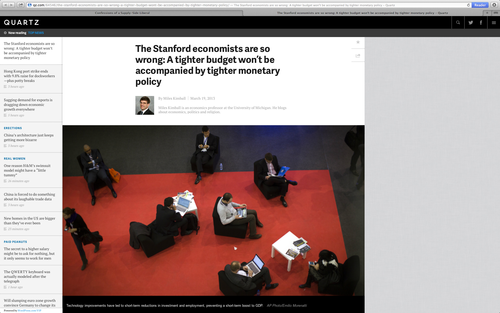
Here is the full text of my 18th Quartz column, “The Stanford economists are so wrong: A tighter budget won’t be accompanied by tighter monetary policy.”I honestly couldn’t think of a good working title of my own before my editor Mitra Kalita gave it the title it has on Quartz. But it finally came to me what I wanted my version of the title to be: the main theme is short-run monetary policy dominance, so my title is “Show Me the Money!”
The heart of this column is a discussion of the paper I wrote with Susanto Basu and John Fernald:“Are Technology Improvements Contractionary?” It was first published on March 19, 2013. Links to all my other columns can be found here.
If you want to mirror the content of this post on another site, that is possible for a limited time if you read the legal notice at this link and include both a link to the original Quartz column and the following copyright notice:
© March 19, 2013: Miles Kimball, as first published on Quartz. Used by permission according to a temporary nonexclusive license expiring June 30, 2014. All rights reserved.
Until the election last year, Stanford economics professor John Taylor was one of Mitt Romney’s chief campaign economists. This morning, he joins his Stanford colleague John Cogan in a Wall Street Journal opinion piece, “How the House Budget Would Boost the Economy.” Cogan and Taylor write:
According to our research, the spending restraint and balanced-budget parts of the House Budget Committee plan would boost the economy immediately.
Leaving aside the long-run merits of the House Budget, let’s evaluate Cogan and Taylor’s argument about what its short-run effects would be. The key to any hope that cutting spending would stimulate the economy is that the spending cuts are all in the future—hopefully after the economy has already fully recovered:
The House budget plan keeps total federal outlays at their current level for two years. Thereafter, spending would rise each year, but more slowly than if present policies continue.
If government spending doesn’t change for the next two years, why might the budget being put forward by the US House of Representatives boost the economy now? Put plainly, their argument is that companies sitting on big piles of cash will invest more and individuals who have money to spend because they have funds in stocks, bonds and bank accounts will spend more now because of reduced concerns about higher future business and personal taxes.
The thing that Cogan and Taylor leave obscure in their argument is that the short-run effect of the House Budget would depend critically on the Federal Reserve’s reaction to it. Let me illustrate the importance of what the Fed does by pointing to the short-run effects of technology shocks. All economists agree that, in the long run, technological progress raises GDP—more than anything else. Yet, in our paper “Are Technology Improvements Contractionary?” which appeared in the scholarly journal American Economic Review, Susanto Basu, John Fernald and I showed that, historically, technology improvements have led to short-run reductions in investment and employment that were enough to prevent any short-run boost to GDP, despite improved productivity. (Independently, using very different methods, many other economists, starting with Jordi Gali, had found the negative short-run effect of technology improvements on how much people work.)
How can something that stimulates the economy in the long run lead people to work and invest less? It is all about the monetary policy reaction. Historically, in the wake of technology improvements, the Fed has cut interest rates somewhat, but has failed to do enough to keep the price level on track and accommodate in the short run the higher level of GDP that eventually follows from a technological improvement in the long run.
So what monetary policy do Cogan and Taylor envision to go along with the House Budget’s proposed cuts in future government spending? Arguing that the results of the House Budget would be even better than predicted by the model they are relying on, Cogan and Taylor write:
Nor does the model account for beneficial changes in monetary policy that could accompany enactment of the budget plan. Lower deficits and national debt would reduce pressure on the Federal Reserve to continue buying long-term Treasury bonds.
To translate, Cogan and Taylor are envisioning tighter monetary policy to go along with the House Budget. But, to the extent that their arguments about the stimulative effects of cutting future government spending have any merit, it would be in conjunction with continued—and likely accelerated–Fed purchases of long-term government bonds and mortgage bonds. As I discussed in an earlier column and at much greater length on my blog, John Taylor is so strongly opposed to even what the Fed is currently doing to support the economy that he is willing to resort to specious arguments to argue for Fed tightening. There is no hope that the House Budget will stimulate the economy as Cogan and Taylor claim unless John Taylor gives up his misguided wish for tighter monetary policy.
The top 25 posts on supplysideliberal.com listed below are based on Google Analytics pageviews from June 3, 2012 through midday, May 5, 2013. The number of pageviews is shown by each post. Not counting Quartz pageviews and pageviews from some forms of subscription, Google Analytics counts 240,923 pageviews during this period but, for example, 79,445 homepage views could not be categorized by post.
I have to handle my Quartz columns separately because that pageview data is proprietary. My very most popular pieces have been Quartz columns. Since there are only 22, I have listed them all. You might also find other posts you like in this earlier list of top posts, at this link.
I have some musings on this data after the lists.
All 22 Quartz Columns So Far, in Order of Popularity:
Top 25 Posts on supplysideliberal.com:

Reblogged from isomorphismes:
Population distribution of the United States in units of Canadas.
For practical policy debates, the most important ethical principle is that the pain and suffering—and the joy—of each human being is of equal importance, without regard to who that person is. Treating some human beings and their concerns as being of lesser importance is the root of much evil in the world.
For those who cannot manage to approach the well-being of all human beings on an equal footing (and of course, this includes almost all of us in our personal dealings), let me recommend this:
At least for public policy purposes,
on the way to treating the concerns of all human beings as of equal value,
let us treat the concerns of those human beings we treat as least important
as being at least one-hundredth as important
as the concerns of those we treat as most important.
Update: I have added a Twitter discussion sparked by this post at the end of the storified tweets from earlier. In that discussion, I call the rule just above, treating foreigners as at least one-hundredth as important as citizens, the tin rule.
I have been worrying about how faithful readers will adapt to the imminent demise of Google Reader. Please share your advice for replacements for Google Reader in the comments.
For following this blog, one possibility you might want to consider is following it directly on Tumblr. When I started supplysideliberal.com, my tech-savvy daughter, dianakimball recommended that I use Tumblr. I have always been glad for that. Tumblr is a blog site designed for visual and multimedia posts. What that means for me in practice is that it looks good. But there are many word-focused bloggers like me on Tumblr as well.
If you want to follow me directly on Tumblr, just click on the “Join Tumblr” button on the upper right hand of your screen. Tumblr will send you posts it recommends until you follow at least five Tumblogs, but you will find it is easy to find five Tumblogs worth following. I mainly see what is on Tumblr in passing as I write blog posts. I find it a pleasure. Here are the ten I follow, some primarily word-focused and some primarily visual:
I would never have seen the accidental architectural frog above if it hadn’t been for the Tumblr reblogging chain that brought it to me through 33arquitectures.
Please share your recommendations for other Tumblogs to follow in the comments.
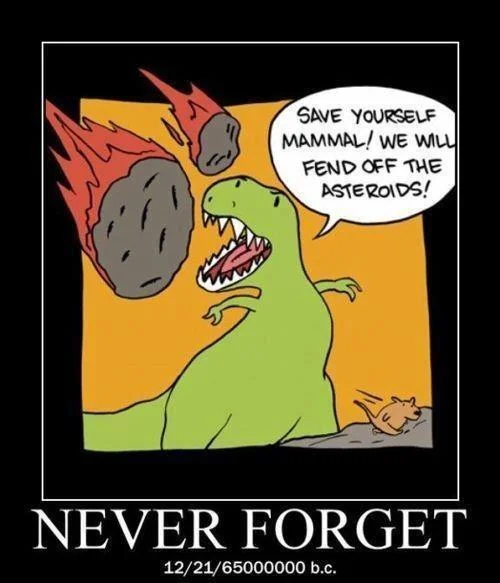
Original source here, from Saturday Morning Breakfast Cereal and “Never Forget” version here.
Thanks to Unlearning Economics for flagging this funny and moving poster. When I asked him the source, he tweeted:
@mileskimball it’s actually a joke comment but I prefer the never forget version, bleeding heart that I am: http://www.smbc-comics.com/index.php?db=comics&id=1535#comic…
By that measure, I may be not just a supply-side liberal, but a bleeding-heart supply-side liberal.
Here is the full text of my 17th Quartz column, “What Paul Krugman Got Wrong About Italy’s Economy,” now brought home to supplysideliberal.com and given my preferred title. It was first published on February 26, 2013. Links to all my other columns can be found here.
If you want to mirror the content of this post on another site, that is possible for a limited time if you read the legal notice at this link and include both a link to the original Quartz column and the following copyright notice:
© February 26, 2013: Miles Kimball, as first published on Quartz. Used by permission according to a temporary nonexclusive license expiring June 30, 2014. All rights reserved.
The combative title my editor gave this column attracted Paul Krugman’s attention in one of his columns, linked in my reply “Noah Smith Joins My Debate with Paul Krugman: Debt, National Lines of Credit and Politics.”
Note that I have a nuanced position toward national debt, which is also articulated in my columns “Why austerity budgets won’t save your economy” and “An economist’s mea culpa: I relied on Reinhart and Rogoff." On Twitter, I have encapsulated this nuanced view into the hashtag #nakedausterity–
The point of the hashtag is this:
When you are worried about debt, #nakedausterity is not the answer.
Update: More recently, Yichuan Wang and I examined what the Reinhart and Rogoff data set suggests about the effects of debt on growth and found no evidence for such an effect. Links to all our analysis can be found in our Quartz column "Autopsy: Economists looked even closer at Reinhart and Rogoff’s Data–and the results might surprise you.” Our earlier Quartz column “After crunching Reinhart and Rogoff’s data, we’ve concluded that high debt does not slow growth”, my companion post “After Crunching Reinhart and Rogoff’s Data, We Found No Evidence That High Debt Slows Growth,” and my post “Why Austerity Budgets Won’t Save Your Economy” discuss other reasons one might be concerned about high levels of national debt.
Editor’s note: This post was updated on April 19, 2013, to reflect an error in the referenced study on debt levels by Carmen Reinhart and Ken Rogoff.
In the last few days, while the US political debate centers on ways to deal with burgeoning debt, UK government debt has been downgraded and investors are demanding much higher yields on Italian debt in the wake of the Italian election results (paywall). As concerns about national credit ratings push economies around the world toward austerity–government spending cuts and tax hikes–some commentators are still calling for economic stimulus at any cost. Joe Weisenthal wrote that David Cameron must spend more money in order to save the British economy. Paul Krugman wrote in “Austerity, Italian Style” that austerity policies simply don’t work. The downside of their prescription of more spending—and perhaps lower taxes—is that it would add to the United Kingdom’s and to Italy’s national debt.
And despite the recent revelation of errors in Carmen Reinhart and Ken Rogoff’s famous study of debt levels and economic growth, which I discuss here and which motivated the update you are reading (the original passage can be found here), there are reasons to think that high levels of debt are worth worrying about.
First, for a country like Italy that does not have its own currency (since it shares the euro with many other countries), Paul Krugman’s own graph shows a correlation between national debt as a percentage of GDP and the interest rate that a country pays.

Second, the paper by Thomas Herndon, Michael Ash and Robert Pollin that criticizes Reinhart and Rogoff finds that, on average, growth rates do decline with debt levels. Divide debt levels into medium high (60% to 90% of GDP), high (90% to 120% of GDP), and very high (above 120% of GDP). Then the growth rates are 3.2% with medium-high debt, 2.4% with high debt, and 1.4% with very high debt. (I got these numbers by combining the 4.2% growth rate for countries in the 0 to 30% debt-to-GDP ratio range from Table 3 with the estimates in Table 4 for how things are different at higher debt levels.) Moreover, contrary to the impression one would get from the column here, Herndon, Ash and Pollin’s Table 4 indicates that the differences between low levels of debt and high levels of debt are not just due to chance, though what Herndon, Ash and Pollin emphasize is that very low levels of debt, below 30% of GDP, have a strong association with higher growth rates. Overall, with the data we have, we don’t know what causes what, so there is no definitive answer to how much we should worry about debt, but ample reason not to treat debt as if it were a nothing.
In an environment in which stimulus is needed, but extra debt is a problem, there should be a laser-like focus on the ratio of stimulus any measure provides relative to the amount of debt it adds. In every one of my proposals for stimulating the economy, I have been careful to avoid proposals that would make a large addition to national debt. So I do not follow Joe Weisenthal and Paul Krugman in their recommendations.
First, instead of raising spending or cutting taxes, the Italian and UK governments can directly provide lines of credit to households, as I have proposed for troubled euro-zone countries and for the UK, as well as for the US. Although there would be some loan losses, the better ratio of stimulus to the addition to the national debt would lead to a much better outcome. In particular, after full economic recovery in the short run, there would be much less debt overhang to cause long-run problems after such a national lines of credit policy than under Weisenthal’s or Krugman’s prescriptions.
But for the UK, it is an even more important mistake to think that monetary policy can’t cut short-term interest rates below zero. Weisenthal quotes a post on Barnejek’s blog, “Has Britain Finally Cornered Itself?” that illustrates the faulty thinking I’m talking about:
Before I start, however, I would like to thank the British government for conducting a massive social experiment, which will be used in decades to come as a proof that a tight fiscal/loose monetary policy mix does not work in an environment of a liquidity trap. We sort of knew that from the theory anyway but now we have plenty of data to base that on.
“Liquidity trap” is code for the inability of the Bank of England to lower interest rates below zero. The faulty thinking is to treat the “liquidity trap” or the “Zero Lower Bound,” as modern macroeconomists are more likely to call it, as if it were a law of nature. The Zero Lower Bound is not a law of nature! It is a consequence of treating money in bank accounts and paper currency as interchangeable. As I explain in a series of Quartz columns (1, 2, 3 and 4) and posts on my blog—that is a matter of economic policy and law that can easily be changed. As soon as paper pounds are treated as different creatures from electronic pounds in bank accounts, it is easy to keep paper pounds from interfering with the conduct of monetary policy. In times when the Bank of England needs to lower short-term interest rates below zero, the effective rate of return on paper pounds can be kept below zero by announcing a crawling peg “exchange rate” between paper pounds and electronic pounds that has the paper pounds gradually depreciating relative to electronic pounds.
In his advice for the UK, Weisenthal should either explain why having an exchange rate between paper pounds and pounds in bank accounts is worse than a massive explosion of debt or join me in tilting against a windmill less tilted against. And for those who read Krugman’s columns, it would take a bad memory indeed not to recall that he gives the corresponding advice of stimulus by additional government spending for the US, which faces its own debt problem. I hope Paul Krugman will join me too in attacking the Zero Lower Bound.
In 1896 William Jennings Bryan famously declared: “… you shall not crucify mankind on a cross of gold.”
In our time it is not gold that is crucifying the world economy (though some would return us to the problems that were caused by the gold standard), but the unthinking worldwide policy of treating paper currency as interchangeable with money in bank accounts. So for our era, let us say: You shall not crucify humankind on a paper cross.
Here is the full text of my 16th Quartz column, “Queasy Money: We should stop expecting monetary policy alone to save the US economy” now brought home to supplysideliberal.com and given my preferred title. It was first published on February 22, 2013. Links to all my other columns can be found here.
If you want to mirror the content of this post on another site, that is possible for a limited time if you read the legal notice at this link and include both a link to the original Quartz column and the following copyright notice:
© February 22, 2013: Miles Kimball, as first published on Quartz. Used by permission according to a temporary nonexclusive license expiring June 30, 2014. All rights reserved.
Minutes of the US Federal Reserve’s monetary policy committee meeting on Jan. 29 and 30 and other recent statements by Fed officials reveal a vigorous debate within the central bank about the effects of monetary policy stimulus on financial markets. Most strikingly, the minutes indicate that Kansas City Federal Reserve Bank president Esther George “…dissented from the committee’s policy decision, expressing concern that loose credit increased the risks of future economic and financial imbalances….” In the same vein, Cleveland Fed president Sandra Pianalto expressed in a Feb. 15 speech her worry that “… financial stability could be harmed if financial institutions take on excessive credit risk by “reaching for yield” —that is, buying riskier assets, or taking on too much leverage—in order to boost their profitability in this low-interest rate environment.”
These worries are not without some foundation. For example, in a Feb. 20 Wall Street Journal article “Fed Split Over How Long to Keep Cash Spigot Open,” reporters Jon Hilsenrath and Victoria McGrane show graphs of dramatic flows of money into junk bonds, junk loans, and real estate investment trusts. Nevertheless, Boston Fed president Eric Rosengren is quoted as saying:
…that it wasn’t the central bank’s job to halt every episode of financial excess. Individual financial institutions regularly fail without bringing down the economy, and financial bubbles don’t always wreck financial systems. When the tech bubble burst in 2000, for example, the U.S. experienced a relatively brief and shallow recession. It didn’t lead to the same cascade of market collapses and a deep downturn as in 2008.
And they report Dallas Fed president Richard Fisher saying that although he is alert to possible dangers, “These robust markets are part of the Fed’s policy intent.”
In an extended question and answer session at the University of Michigan on Jan. 14, Federal Reserve Board Chairman Ben Bernanke revealed his philosophy about dealing with financial stability: “… we will, obviously, be working very hard in financial stability. We’ll be using our regulatory and supervisory powers. We’ll try to strengthen the financial system. And if necessary, we will adjust monetary policy as well but I don’t think that’s the first line of defense.” Although Bernanke does not want fears about financial stability to constrain monetary policy too much, he is more concerned about the effects of quantitative easing (buying long-term Treasury bonds and mortgage-backed securities) and forward guidance (making announcements about future short-term interest rates) than he would be if the Fed could just push the current short-term interest rate below the near-zero level it is at now:
… we have to pay very close attention to the costs and the risks and the efficacy of these non-standard policies as well as the potential economic benefits. And to the extent that there are costs or risks associated with non-standard policies which do not appear or at least not to the same degree for standard policies then you would, you know, economics tells you when something is more costly, you do a little bit less of it.
I find wisdom in the words of Rosengren, Fisher and Bernanke. In my view:
1. Monetary Policy Works Through Raising Asset Prices, Loosening Borrowing Constraints, or Affecting the Exchange Rate. It doesn’t make sense for firms to produce things no one wants to buy. Aggregate demand is the willingness to buy goods and services that determines how much is produced in the short run. Aggregate demand is the sum of the willingness of households (meaning families and individuals) to spend and build houses, of firms to buy equipment, build factories, office buildings, and stores, and spend on research and development, of government purchases, and of net exports: how much more foreigners buy from us than we buy from them (an area where the US is now in the hole).
To analyze household spending, it is a useful simplification to think of households as divided into two groups: (i) those who either don’t need to borrow or can borrow all they want at reasonable rates, and (ii) those who are borrowing as much as they can already and can’t borrow more. Economic theory suggests that those who don’t need to borrow or can borrow all they want at reasonable rates will look at the value of their wealth—including the asset value of their future paychecks—and spend a small fraction of that full wealth every year. The size of that fraction depends primarily on long-run factors, and is mostly beyond the Fed’s control. So, by and large, the only way the Fed can get those who don’t need to borrow to spend more is by increasing the value of their full wealth. If the full wealth goes up because they expect fatter paychecks in the future, no one gets worried, but otherwise that increase in wealth has to come from an increase in highly visible asset prices.
Those who are already borrowing as much as they can, will only be able to spend more if they can get their hands on more money in the here and now. Tax policy matters here, but the most recent change—the expiration of the Obama payroll tax cut—goes in the wrong way, reducing what people living from paycheck to paycheck have to spend. My proposal of a $2,000 Federal Line of Credit to every taxpayer would be a way to stimulate the spending of this group without adding much to the national debt. But this is beyond the Federal Reserve’s authority under current law. The way monetary policy now affects the spending of those who face limits on their borrowing is by lowering the cost of funds to banks so much that banks start to think about lending to people they were unwilling to lend to before.
A similar division by ability to borrow helps in understanding business investment as well. For firms who have trouble borrowing, additional investment spending will depend on borrowers-previously-deemed-too-risky getting loans. For firms that don’t need to borrow or can borrow all they want at reasonable rates, the key determinant of business investment is how valuable a firm thinks a new factory, office building, store, piece of equipment, or patent will be. But, by and large, the same factors that affect how valuable a new investment will be affect how valuable existing factories, office buildings, stores, equipment, and patents are. So the prices of the stocks and bonds that would allow one to buy a firm outright—with all of its factories, office buildings, stores, equipment and patents—will have to increase if the Fed is to encourage investment. The same logic holds for houses: it is hard to make it more valuable to build a new house without also making existing houses more valuable and pushing up their prices.
Aside from government purchases—which are the job of the president and the warring Democrats and Republicans in Congress rather than the Fed—that leaves net exports. There the problem is that while any one country can increase its aggregate demand by increasing its net exports, this doesn’t work when all countries try to increase net exports at the same time. The reason that monetary expansion isn’t a zero-sum game across countries is because monetary policy can increase aggregate demand by raising asset prices and encouraging lenders to lend to borrowers they didn’t want to lend to before. The big danger is that those making the decisions within the Federal Reserve will mistake the normal workings of monetary policy—acting through asset prices and risky lending—for financial shenanigans that need to be stamped out by premature monetary tightening.
2. Nonstandard Monetary Policy. That said, nonstandard monetary policy in the form of purchases of long-term Treasury bonds and mortgage-backed securities and “forward guidance” on future short-term interest rates take the economy into uncharted territory. But uncharted territory brings not only the possibility of new monsters but also the near certainty of previously unseen creatures that might look like monsters, but are harmless.
3. Facing the Real Financial Dangers Squarely. So what distinguishes the real monsters from the paper dragons? Eric Rosengren had the key when he pointed to the contrast between the collapse of the internet stock bubble in 2000 and the financial crisis in 2008, that stemmed from the collapse of the housing bubble. The difference was that, by and large, people invested in the internet stock price boom with their own money, and took the hit themselves when the bubble collapsed; people invested in the house price boom—both directly and indirectly—with borrowed money, and so imposed their losses on those they borrowed from and on taxpayers through bailouts. “High capital requirements” is the name of the policy of forcing big banks to put enough of their own money at risk to be able to absorb financial losses without imposing those losses on others. Capital requirements for banks are akin to down payment requirements for individuals buying houses. The financial crisis we are still suffering from arose from too little of both. Needless to say, banks hate capital requirements, since the secret for all too great a share of financial profits is taking the upside while foisting the downside on others (often taxpayers) who don’t know they are taking the downside, and aren’t being compensated for taking that risk.
Beyond pushing for high capital requirements—especially during booms, when financial shenanigans are most likely—the Fed can do a lot to foster financial stability by continuing to make a list of possible macroeconomic risks to use in subjecting financial firms to “stress tests” as it has done in 2009, 2011, 2012 and 2013. But it can do more with this list of possible macroeconomic risks by requiring financial firms to explicitly insure themselves against these risks and imposing very tough capital requirements on those who purport to provide such insurance. Indeed, for deep pockets, the ideal provider of such insurance would be a sovereign wealth fund, as I proposed in “Why the US Needs Its Own Sovereign Wealth Fund.” The problem is not having taxpayers bear these risks, it is having taxpayers bear these risks without being compensated for doing so. The bedrock principle should be to bring as many macroeconomic risks as possible out of the shadows into the light of day, so that prices can be put on those risks. If risks are out in the open, then those who face them will face them knowingly, and won’t be able to shirk the responsibility they have undertaken when those risks materialize.
Fostering financial stability by enforcing high capital requirements during booms and working toward the naming and pricing of macroeconomic risks is its own reward. But it also has the extraordinary benefit of freeing up monetary policy to pursue its main mission of protecting the economy from inflation and high unemployment. The more potential evils we face, the more tools we need. Rather than attempting to use the familiar tool of monetary policy for a task to which it is ill-suited, let us fashion new tools to enhance financial stability.
This Twitter conversation gives my reply to Tomas Hirst’s post “Lingering Doubts Over Negative Rates.”
Here is the full text of my 15th Quartz column, “How to stabilize the financial system and make money for US taxpayers” now brought home to supplysideliberal.com. It was first published on February 8, 2013. Links to all my other columns can be found here.
If you want to mirror the content of this post on another site, that is possible for a limited time if you read the legal notice at this link and include both a link to the original Quartz column and the following copyright notice:
© February 8, 2013: Miles Kimball, as first published on Quartz. Used by permission according to a temporary nonexclusive license expiring June 30, 2014. All rights reserved.
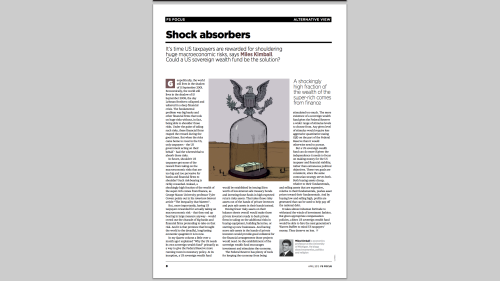
Note: a version of this column is also slated to be published in FS Focus, the financial services magazine of the ICAEW, an organization of accountants in the UK. In that version, the passage from “In brief, …” to the end of its paragraph was replaced with this passage, which I think you will find interesting as well:
At its inception, a US sovereign wealth fund would be established by issuing $1 trillion worth of low-interest safe Treasury bonds and investing those funds in high-expected-return risky assets. That takes those risky assets off the hands of private investors and puts safe assets in the hands of those private investors instead. Having fewer risky assets on their balance sheets overall would make those private investors readier to back private firms in taking on the additional risks involved in buying equipment, building factories, or starting up new businesses. And having more safe assets in the hands of private investors would provide good collateral for the financial arrangements those projects would need. Thus, the establishment of the sovereign wealth fund encourages investment and stimulates the economy. The Fed has plenty of tools for keeping the economy from being stimulated too much. So the mere existence of the sovereign wealth fund gives the Fed a wider range of stimulus levels to choose from. Moreover, any given level of stimulus would requires a less aggressive course of quantitative easing (QE) on the part of the Fed than it would otherwise need to pursue.
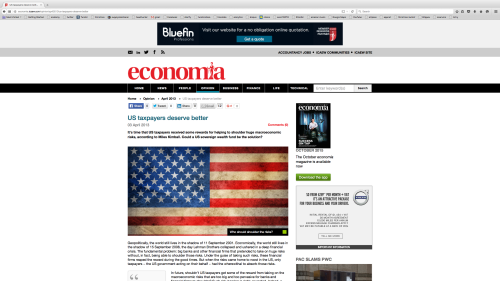
Geopolitically, the world still lives in the shadow of Sept. 11, 2001. Economically, the world still lives in the shadow of Sept. 15, 2008, the day Lehman Brothers collapsed and ushered in a deep financial crisis. The fundamental problem: big banks and other financial firms that pretended to take on huge risks without, in fact, being able to shoulder those risks. Under the guise of taking such risks, these financial firms reaped the reward during the good times. But when the risks came home to roost, only US taxpayers—the US government acting on their behalf—had the wherewithal to absorb those risks.
In the future, shouldn’t US taxpayers get some of the reward from taking on the macroeconomic risks that are too big and too pervasive for banks and financial firms to shoulder? Such risk-bearing is richly rewarded. Indeed, as George Mason University professor Tyler Cowen points out in his American Interest article, “The Inequality that Matters,” a shockingly high fraction of the wealth of the super-rich comes from finance. But more importantly, having US taxpayers rewarded for actually taking on macroeconomic risk—risk that US taxpayers end up bearing in large measure anyway—would crowd out the charade of big banks and financial firms pretending to take on that risk. And it is that pretense that brought the world to the dreadful, long-lasting economic quagmire it is in now.
In my Quartz column a little over a month ago I explained “Why the US needs its own sovereign wealth fund” primarily as a way to give the Federal Reserve more running room in monetary policy. In brief, the mere existence of a US sovereign wealth fund, one that issued through the Treasury $1 trillion worth of low-interest safe bonds and invested it in high-expected-return risky assets, would give the Federal Reserve a lot more room to maneuver. Moreover, it would allow the Fed to pursue a less aggressive course of quantitative easing (QE) than it would otherwise need to pursue. The US fund would draw political controversy to itself, and away from the Fed, thereby preserving the independence of monetary policy that we need in order to avoid inflation in the long run.
But a US sovereign wealth fund can do more if given the independence it needs to focus on (1) making money for the US taxpayer and (2) financial stability, rather than extraneous political objectives. These two goals are consistent, since the same contrarian strategy serves both. Buying assets cheap, relative to their fundamentals, and selling assets that are expensive, relative to their fundamentals, both pushes asset prices toward their fundamentals and, by buying low and selling high, makes profits that we can use to help pay off the national debt. It takes almost inhuman fortitude to withstand the winds of investment fashion. But given appropriate compensation policies, a $1 trillion US sovereign wealth fund would be able to hire the next generation’s Warren Buffett to take care of US taxpayers’ money. They deserve no less.
Update: I discovered in a forgotten email a pdf of a version of this in print (on page 8) and a link to a version on the Economia website. I find those mostly interesting for the visuals:

My title is a riff on this verse in the Gospel of Luke. The Vogel von Vogelstein painting reproduced above illustrates the scene. Here is a link to this and other paintings of the event. (I don’t see any reason to think that the event described by this Biblical verse is not historical.)
In the blogosphere and in academia, the frustration those who are wrong represent for those who are right is often palpable. It is good to remember that, as long as they do not win, those who are wrong provide an important service to those who are right. For you to understand this post, let’s stipulate that you are absolutely right. Here is what you and those on your side get from those who are wrong, as laid out by John Stuart Mill in On Liberty, chapter II:
However unwillingly a person who has a strong opinion may admit the possibility that his opinion may be false, he ought to be moved by the consideration that however true it may be, if it is not fully, frequently, and fearlessly discussed, it will be held as a dead dogma, not a living truth.
There is a class of persons (happily not quite so numerous as formerly) who think it enough if a person assents undoubtingly to what they think true, though he has no knowledge whatever of the grounds of the opinion, and could not make a tenable defence of it against the most superficial objections. Such persons, if they can once get their creed taught from authority, naturally think that no good, and some harm, comes of its being allowed to be questioned. Where their influence prevails, they make it nearly impossible for the received opinion to be rejected wisely and considerately, though it may still be rejected rashly and ignorantly; for to shut out discussion entirely is seldom possible, and when it once gets in, beliefs not grounded on conviction are apt to give way before the slightest semblance of an argument. Waving, however, this possibility—assuming that the true opinion abides in the mind, but abides as a prejudice, a belief independent of, and proof against, argument—this is not the way in which truth ought to be held by a rational being. This is not knowing the truth. Truth, thus held, is but one superstition the more, accidentally clinging to the words which enunciate a truth.
… If the cultivation of the understanding consists in one thing more than in another, it is surely in learning the grounds of one’s own opinions. Whatever people believe, on subjects on which it is of the first importance to believe rightly, they ought to be able to defend against at least the common objections. But, some one may say, “Let them be taught the grounds of their opinions. It does not follow that opinions must be merely parroted because they are never heard controverted. Persons who learn geometry do not simply commit the theorems to memory, but understand and learn likewise the demonstrations; and it would be absurd to say that they remain ignorant of the grounds of geometrical truths, because they never hear any one deny, and attempt to disprove them.” Undoubtedly: and such teaching suffices on a subject like mathematics, where there is nothing at all to be said on the wrong side of the question. The peculiarity of the evidence of mathematical truths is, that all the argument is on one side. There are no objections, and no answers to objections. But on every subject on which difference of opinion is possible, the truth depends on a balance to be struck between two sets of conflicting reasons. Even in natural philosophy, there is always some other explanation possible of the same facts; some geocentric theory instead of heliocentric, some phlogiston instead of oxygen; and it has to be shown why that other theory cannot be the true one: and until this is shown, and until we know how it is shown, we do not understand the grounds of our opinion. But when we turn to subjects infinitely more complicated, to morals, religion, politics, social relations, and the business of life, three-fourths of the arguments for every disputed opinion consist in dispelling the appearances which favour some opinion different from it. The greatest orator, save one, of antiquity, has left it on record that he always studied his adversary’s case with as great, if not with still greater, intensity than even his own. What Cicero practised as the means of forensic success, requires to be imitated by all who study any subject in order to arrive at the truth. He who knows only his own side of the case, knows little of that. His reasons may be good, and no one may have been able to refute them. But if he is equally unable to refute the reasons on the opposite side; if he does not so much as know what they are, he has no ground for preferring either opinion. The rational position for him would be suspension of judgment, and unless he contents himself with that, he is either led by authority, or adopts, like the generality of the world, the side to which he feels most inclination. Nor is it enough that he should hear the arguments of adversaries from his own teachers, presented as they state them, and accompanied by what they offer as refutations. That is not the way to do justice to the arguments, or bring them into real contact with his own mind. He must be able to hear them from persons who actually believe them; who defend them in earnest, and do their very utmost for them. He must know them in their most plausible and persuasive form; he must feel the whole force of the difficulty which the true view of the subject has to encounter and dispose of; else he will never really possess himself of the portion of truth which meets and removes that difficulty. Ninety-nine in a hundred of what are called educated men are in this condition; even of those who can argue fluently for their opinions. Their conclusion may be true, but it might be false for anything they know: they have never thrown themselves into the mental position of those who think differently from them, and considered what such persons may have to say; and consequently they do not, in any proper sense of the word, know the doctrine which they themselves profess. They do not know those parts of it which explain and justify the remainder; the considerations which show that a fact which seemingly conflicts with another is reconcilable with it, or that, of two apparently strong reasons, one and not the other ought to be preferred. All that part of the truth which turns the scale, and decides the judgment of a completely informed mind, they are strangers to; nor is it ever really known, but to those who have attended equally and impartially to both sides, and endeavoured to see the reasons of both in the strongest light. So essential is this discipline to a real understanding of moral and human subjects, that if opponents of all important truths do not exist, it is indispensable to imagine them, and supply them with the strongest arguments which the most skilful devil’s advocate can conjure up.
See links to my other John Stuart Mill posts here:
This site is a dynamic network graph. When you hover over a name, it shows connections among the top 500 Economic influencers on Twitter. Very cool.
I am on line 11.
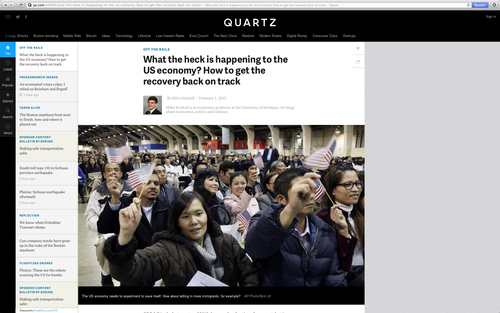
Here is the full text of my 14th Quartz column, “Off the Rails: What the heck is happening to the US Economy? How to get the recovery back on track,” now brought home to supplysideliberal.com. It was first published on February 1, 2013. Links to all my other columns can be found here.
If you want to mirror the content of this post on another site, that is possible for a limited time if you read the legal notice at this link and include both a link to the original Quartz column and the following copyright notice:
© February 1, 2013: Miles Kimball, as first published on Quartz. Used by permission according to a temporary nonexclusive license expiring June 30, 2014. All rights reserved.
GDP fell in the last quarter of 2012. It was only a fraction of a percent, but it means the recovery is on hiatus. Why? Negative inventory adjustments tend to be short-lived, so let me leave that aside, although it definitely made last quarter’s statistics look worse. Of the longer-lived forces, on the positive side,
On the negative side,
Net exports and government purchases are the big worries going forward as well.
How much the rest of the world buys from the US depends on how other economies are faring. And most of the rest of the world is hurting economically. The Japanese are so fed up with their economic situation that they are on their sixth prime minister in the six and a half years since Junichiro Koizumi left office in 2006. The European debt crisis is in a lull right now, but could still resume full force at any time. In addition to all of its other problems, the United Kingdom is facing a mysterious decline in productivity, explained in Martin Wolf’s Financial Times article “Puzzle of Falling UK Labour Productivity” and the Bank of England analysis by Abigail Hughes and Jumana Saleheen.
The decline in US government spending comes from the struggle of state and local governments with their budgets and at the federal level from the ongoing struggle between the Democrats and Republicans about the long-run future of taxing and spending. Last quarter saw a remarkable decline in military spending that Josh Mitchell explains this way in today’s Wall Street Journal (paywall).
The biggest cuts came in military spending, which tumbled at a rate of 22.2%, the largest drop since 1972. …
Military analysts said the decline likely was a result of pressure on the Pentagon from a number of areas.
Among them: reductions in spending on the war in Afghanistan as it winds down, a downturn in planned military spending, a constraint placed on the Pentagon budget because the federal government is operating on short-term resolutions that limit spending growth, as well as concern that further cuts may be in the pipeline.
The problem is that, absent a big increase in economic growth, balancing the federal budget in the long run requires big increases in taxes or big reductions in spending. But, although opinions differ on which option is worse, tax increases and spending cuts themselves are enemies of economic growth. So the traditional options for balancing the federal budget in the long run all have the potential to make things much worse.
Our problems are so big they need new solutions. In our current situation, the fact that a proposal is “untried” is a plus, since none of the economic approaches we have tried lately have worked very well. In the last few months I have focused my Quartz columns on explaining how the US and the world can get out of the economic mess we are in with new solutions. A recap:
Franklin Roosevelt famously said:
The country needs and, unless I mistake its temper, the country demands bold, persistent experimentation. It is common sense to take a method and try it: If it fails, admit it frankly and try another. But above all, try something.
We are at such a moment again. The usual remedies have failed. It is time to try something new. Any one of these proposals could make a major difference. In combination, they would transform the world.
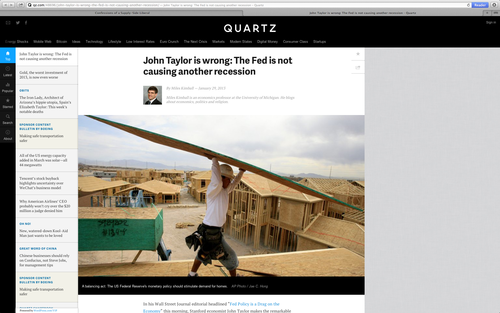
Here is the full text of my 13th Quartz column, “John Taylor is Wrong: The Fed is not causing another recession,” now brought home to supplysideliberal.com. It was first published on January 29, 2013. Links to all my other columns can be found here.
If you want to mirror the content of this post on another site, that is possible for a limited time if you read the legal notice at this link and include both a link to the original Quartz column and the following copyright notice:
© January 29, 2013: Miles Kimball, as first published on Quartz. Used by permission according to a temporary nonexclusive license expiring June 30, 2014. All rights reserved.
In his Wall Street Journal editorial headlined “Fed Policy is a Drag on the Economy“ this morning, Stanford economist John Taylor makes the remarkable claim that the US Federal Reserve’s efforts to keep interest rates down by asset purchases now—and promises of asset purchases in the future—is like rent control. If this were true, then the Fed’s actions to lower interest rates could be contractionary and could cause another recession. But it is just wrong.
The Fed’s actions to lower interest rates are more like encouraging the construction of more apartments—by granting building permits more readily—in an effort to keep rents down. That makes all the difference. The Fed’s actions are stimulative because the Fed is acting within the framework of supply and demand bringing markets to equilibrium. While the Fed is intervening in asset markets, contrary to Taylor’s claim, it is not doing anything to take away the role of interest rates to equate supply and demand. So when the Fed brings interest rates down, people will build more houses and factories, and buy more machines and consumer durables than they otherwise would.
This column is the two-paragraph précis of my post “Contra John Taylor.”
Twitter provided some reviews of these two pieces that I liked. Here are a few:
Paul Krugman cited “Contra John Taylor.” in his column “Calvinist Monetary Economics,” writing
Actually, as Miles Kimball points out, [John Taylor is] committing a basic microeconomic fallacy — a fallacy you usually identify with Econ 101 freshmen early in the semester…
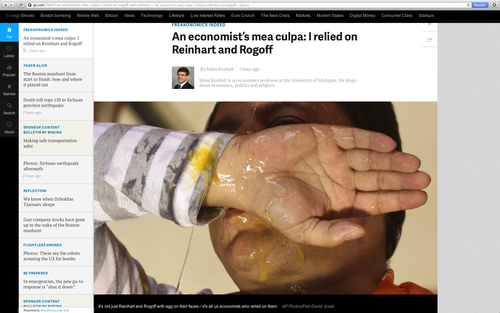
Here is a link to my 22d column on Quartz: “An economist’s mea culpa: I relied on Reinhart and Rogoff.”
Let me also reprint here from my update to “Noah Smith Joins My Debate with Paul Krugman: Debt, National Lines of Credit and Politics” in the light of recent events:
You can see what I have to say in the wake of Thomas Herndon, Michael Ash and Robert Pollin’s critique of Carmen Reinhart and Ken Rogoff’s work on national debt and growth in my column “An economists mea culpa: I relied on Reinhart and Rogoff.” (You can see my same-day reaction here.) Also, on the substance, see Owen Zidar’s nice graph in his post “Debt to GDP & Future Economic Growth.” I sent a query to Carmen Reinhart and Ken Rogoff about whether any adjustments are needed to the two figures from the paper with Vincent Reinhart that I display below, but it is too soon to have gotten a reply. I think that covers most of the issues that recent revelations raise.
Note that I have revised “What Paul Krugman got wrong about Italy’s economy.” [My post “Noah Smith Joins My Debate with Paul Krugman: Debt, National Lines of Credit and Politics”] is now the go-to source for what I originally said there, relying on “Debt Overhangs, Past and Present” (which has Vincent Reinhart as a coauthor along with Carmen Reinhart and Ken Rogoff).
One final thought. Given the spotlight they put on Reinhart and Rogoff, and the spotlight that is therefore on them as well, Thomas Herndon, Michael Ash and Robert Pollin may not be as careful as they should be. Am I mistaken in what I said in this tweet:
Herndon, Ash & Pollin report 11% p-value for 30-60% debt GDP vs. BOTH 60-90% and >90% bins, but don’t report p-value for 60-90% vs. >90% !
One way or the other, they should report the p-value for the 60-90% bin vs. the above 90% bin alongside the test they do report, which is less germane to the controversy about the 90% threshold. They should have made the results of the 60-90% vs. above 90% statistical test impossible to miss. How easy is it to find their report of that statistic in their paper?
Note on Comments on this Blog: I want to encourage more commentary on my blog. I need to approve each comment unless you are whitelisted. But if you send me a tweet to let me know you need a comment approved, I will get to it quicker, and normally approve it and whitelist you. I do try to enforce a certain level of civility and decorum (including a language filter), but on substance, I want a robust debate. For Quartz columns, the link I post on my blog (usually the day after the column appears) is a good place to make comments.