Adam Ozimek's Regional Visa Proposal

The immigration reform debate should turn in earnest to Adam Ozimek’s proposal for regional visas, which you can see at this link.

Here is a slightly tidied up version of what I had to say about his proposal when I appeared on Huffpost Live:

The United States is like a college that has everyone wanting to get in. We ought to be able to do something with that. Let me give you just one idea. I love Adam Ozimek’s idea of region-based visas. If you let states and cities and towns apply for visas for people, then you require people to buy a house and get a job in that area, then we can let the different areas decide how many immigrants to bring in. Some places don’t think they can handle immigrants, and some places think they can. I’ll tell you what will happen: those places that let in lots of immigrants will have the dynamic local economies, and pretty soon people will see just how much immigrants bring to the economy. But you don’t have to believe me. Just allow these region-based visas, and then the states and localities that are willing to try it will show the way, and show how much immigrants add to our economy.

Postscript: See my earlier post about that appearance on HuffPost Live, “Miles on Huffpost Live: The Wrong Debate and How to Change It” for the rest of what I said. In particular, I was able to make a pitch for electronic money. Here is the video itself, including also commentary by Robert Kuttner, Dan Gross, Zach Carter and Stephanie Kelton.

Jonathan Meer and Jeremy West: Effects of the Minimum Wage on Employment Dynamics

After my post “Isaac Sorkin: Don’t Be too Reassured by Small Short-Run Effects of the Minimum Wage,” I heard about Jonathan Meer and Jeremy West’s empirical paper on the same theme: “Effects of the Minimum Wage on Employment Dynamics.” They find evidence that an increase in the minimum wage doesn’t lead bosses to fire or lay off workers they already have, but does reduce the rate at which new workers are hired.   

Their abstract summarizes their results well:

The voluminous literature on minimum wages offers little consensus on the extent to which a wage floor impacts employment. For both theoretical and econometric reasons, we argue that the effect of the minimum wage should be more apparent in employment dynamics than in levels. Using administrative data in a state-year panel, we evaluate each employment margin directly. We find that the minimum wage reduces gross hiring of new employees, but that there is no effect on gross separations. Moreover, despite having an insignificant discrete effect on the employment level, increases in the legal wage floor directly reduce job growth. Neither labor force turnover nor the entry or exit rate of establishments are affected.

Taking all hires as a base for the percentage, not just hires into minimum-wage jobs, Jonathan and Jeremy’s estimates point to a 1.36% reduction in gross hiring when the minimum wage is increased by 10%. (The standard error on that number is .43%.) The percentage effect on hiring into minimum-wage jobs would be considerably higher. While there is no sudden effect on the level of employment, their estimates point to a reduction of .35% per year reduction in overall net job growth for all jobs from a 10% increase in the minimum wage. (The standard error on that number is .17% per year.) These two numbers are reasonably consistent with one another. They write about the base turnover rate that “on average about 29% of an establishment's current employment roster is filled by different employees from year-to-year.” A 1.36% reduction in the inflow to this 29% turnover should yield a .4% per year reduction in overall net job growth, which is well within the margin of error from the .35% per year they found from directly estimating effects on overall net job growth.

Based on my reading of it, Jonathan and Jeremy’s paper appears carefully done. But let me know if you see a flaw in their statistical methods. One loophole they identify themselves is that since they focus on number of jobs rather than hours, their data allow the logical possibility that an increase in the minimum wage could reduce the number of jobs, but lead to higher hours for the workers who remain. I am not aware of anyone championing the idea that minimum wages gradually reduce jobs but gradually raise hours for those remain. Does anyone want to seriously argue that case?

Update: Here is a link to Reihan Salam’s post on Jonathan and Jeremy’s work. 

How Truth Prevails

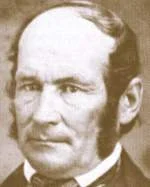
Heber C. Kimball (1801-1868)

Heber C. Kimball (1801-1868)

On September 2, 1837, after crossing the ocean to preach Mormonism in England, my great great grandfather Heber C. Kimball wrote this to his wife (not my great great grandmother, since I am descended from  another of his many wives):

MY DEAR COMPANION,

I take this opportunity to write a few lines to you, to let you know I am in the land of the living, I am a pilgrim on the earth, and a stranger in a strange land far from my home, and among those that seek my life because I preach the truth and those things that will save their lives in the day of tribulation.  On the 18th of July [1837] we landed in Liverpool in the forenoon.  I had peculiar feelings when we landed, the spirit of God burned in my breast, and at the same time I felt to covenant before God to live a new life, and to pray that the Lord would help me to do the same.  We remained there three days, resting our bodies.  On Saturday, the 22nd, we took coach for Preston, the distance 31 miles; we arrived there at four in the afternoon.

After we had unloaded our things, Brother Fielding had gone to see his brother, and Brother Goodson had gone to get lodgings.  All at once I looked up.  There was a large flag before me with large gilded letters written thereon, “TRUTH WILL PREVAIL."  We said, "amen, so let it be Lord.”

Having heard that story many times growing up, I was pleased to read John Stuart Mill’s explanation of how truth prevails. John, 1806-1873 was five years junior to Heber. In his 1867 essay On Liberty, Chapter 2, “Of the Liberty of Thought and Discussion,” he writes:

It is a piece of idle sentimentality that truth, merely as truth, has any inherent power denied to error, of prevailing against the dungeon and the stake. Men are not more zealous for truth than they often are for error, and a sufficient application of legal or even of social penalties will generally succeed in stopping the propagation of either. The real advantage which truth has, consists in this, that when an opinion is true, it may be extinguished once, twice, or many times, but in the course of ages there will generally be found persons to rediscover it, until some one of its reappearances falls on a time when from favourable circumstances it escapes persecution until it has made such head as to withstand all subsequent attempts to suppress it.

Clay Christensen, Jeffrey Flier and Vineeta Vijayaraghavan on How to Make Health Care More Cost Effective

Clay Christensen, Jeffrey Flier and Vineeta Vijaraghavan argue in their Wall Street Journal op-ed “The Coming Failure of Accountable Care” a few days ago that Obamacare’s “accountable care organizations” will have trouble changing doctors’ behavior in the dramatic ways envisioned. They will have even more trouble changing patients’ behavior, since accountable care organizations provide few incentives for patients to change their behavior.  

In the debates over health care reform, advocates of Obamacare have made a great deal of the lower per-patient costs of medical care in other advanced countries. Those lower per-patient costs of medical care in other advanced countries have a lot to do with lower pay for doctors and other medical-care providers. If something on the Obamacare model  succeeds in lowering medical costs significantly, I suspect it will be because it forces down doctors’ pay, as government budget constraints lead to tighter and tighter price controls.

Clay, Jeffrey and Vineeta’s list of recommendations would instead use market liberalization to lower the amount paid for medical services. Here is their prescription:  

• Consider opportunities to shift more care to less-expensive venues, including, for example, “Minute Clinics” where nurse practitioners can deliver excellent care and do limited prescribing. New technology has made sophisticated care possible at various sites other than acute-care, high-overhead hospitals.

• Consider regulatory and payment changes that will enable doctors and all medical providers to do everything that their license allows them to do, rather than passing on patients to more highly trained and expensive specialists.

• Going beyond current licensing, consider changing many anticompetitive regulations and licensure statutes that practitioners have used to protect their guilds. An example can be found in states like California that have revised statutes to enable highly trained nurses to substitute for anesthesiologists to administer anesthesia for some types of procedures.

• Make fuller use of technology to enable more scalable and customized ways to manage patient populations. These include home care with patient self-monitoring of blood pressure and other indexes, and far more widespread use of “telehealth,” where, for example, photos of a skin condition could be uploaded to a physician. Some leading U.S. hospitals have created such outreach tools that let them deliver care to Europe. Yet they can’t offer this same benefit in adjacent states because of U.S. regulation.

Free market advocates have been calling for such approaches for some time. Doctors have understandably lobbied for a continuation of market restrictions that boost their pay. Now that doctors face reduced pay under budget pressures created by Obamacare as well, such market liberalization in medical care may begin to seem like the lesser of two evils for doctors. And it could be a great boon to the rest of us.

For the record, here is my position on health care reform, quoted from my post “Evan Soltas on Medical Reform Federalism–in Canada”

Let’s abolish the tax exemption for employer-provided health insurance, with all of the money that would have been spent on this tax exemption going instead to block grants for each state to use for its own plan to provide universal access to medical care for its residents.

This recommendation is based on what I said in my first post about health care, “Health Economics”:

I am slow to post about health care because I don’t know the answers. But then I don’t think anyone knows the answers. There are many excellent ideas for trying to improve health care, but we just don’t know how different changes will work in practice at the level of entire health care systems.

The more the Washington encourages a diversity of approaches to health care, the more we will learn about what works. On the other hand, the more Washington does to force health care policy into the same mold in each state, the more likely it is that we will only learn one thing at the systems-level: that the first try in the one-size-fits-all approach doesn’t work very well.

Isaac Sorkin: Don't Be Too Reassured by Small Short-Run Effects of the Minimum Wage

(Note: on this topic, see also “Jonathan Meer and Jeremy West: Effects of the Minimum Wage on Employment Dynamics.”)

In light of the current debate about raising the minimum wage, I wanted to bring to your attention University of Michigan graduate student Isaac Sorkin’s work on the minimum wage. He begins his paper “Minimum Wages and the Dynamics of Labor Demand” by raising the issue of long-run versus short-run: 

Typical analyses of the employment effects of minimum wages find effects too small to easily reconcile with the short-run elasticities implied by the textbook approach. However, if many firms do not fully adjust their labor demand in the short run, then the short-run employment responses would be much smaller in magnitude than the textbook approach implies, and in line with empirical work.

Later in the introduction, Isaac explains:

The main contribution of this paper is that it revives, formalizes and quantifies an old argument about the employment response to minimum wage increases that has been curiously neglected in the modern literature. In the famous Lester (1946), Machlup (1946), and Stigler (1946) debate about minimum wages, … Lester’s argument is that in response to temporary changes in wages, employers are unlikely to make the fundamental changes in how they do business necessary to reduce labor demand simply because it is not worth it to them to pay the adjustment cost. Thus, this paper follows in that tradition by arguing that the presence of adjustment costs on labor demand provides a cohesive explanation for the small short and long-run employment effects found in the minimum wage literature. 

The relevant quotation from Lester is this:

Most industrial plants are designed and equipped for a certain output, requiring a certain work force. Often effective operation of the plant involves a work force of a given size…Under such circumstances, management does not and cannot think in terms of adding or subtracting increments of labor except perhaps when it is a question of expanding the plant and equipment, changing the equipment, or redesigning the plant…

From much of the literature the reader receives the impression that methods of manufacture readily adjust to changes in the relative cost of productive factors. But the decision to shift a manufacturing plant to a method of production requiring less or more labor per unit of output because of a variation in wages is not one that the management would make frequently or lightly.

Richard A. Lester (1946, pg. 72-73). 

If the long-run effect of minimum wages is substantial, why then don’t we see this effect? Isaac argues it is because there have been very few long-run changes in the minimum wage in the United States, so evidence on their effects is scant. The minimum wages is set in nominal terms, so it declines with inflation, is raised, declines with inflation, is raised, etc.  This yields a sawtooth pattern of the real (inflation-adjusted) minimum wage in which almost all changes in the real minimum wage are temporary. And Isaac argues that temporary changes in the minimum wage have muted effects. In Isaac’s words:

… if adjustment is slow (because it is costly), then labor demand today is a forward-looking decision and depends critically both on the realized path, and the expectations, of minimum wages. In the US, minimum wages are mostly set in nominal terms and so a given increase is not very persistent. As a result, labor demand would never fully adjust to a given minimum wage increase and the long-run consequences of a given minimum wage increase for employment might be quite small.

Isaac backs up his story about how machinery adapted to be used by a given number of workers can influence labor demand by discussing detailed micro-data of the reaction to an important set of minimum wage increases in 1938 and 1939 (pp. 4-6).  

The implementation of the Fair Labor Standards Act of 1938 in the case of the seamless hosiery industry provides a nice example of this mechanism since the Bureau of Labor Statistics collected data on both employment and the kind of capital in January of 1938 and August of 1940, which is tabulated in US Department of Labor (1941)….

The minimum wage was implemented in two stages: it was set to 25 cents an hour in October 1938 and then raised to 32.5 cents in September 1939. The minimum wage was binding in the seamless hosiery industry….

The fundamental technological choice facing the seamless hosiery industry was whether to use machines where the top of the stocking was knit on a different machine than the stocking itself, or machines where the top was knit on the same machine as the stocking. The most labor-intensive process used the hand-transfer machine, where the top of the stocking was knit on a separate machine and then carried by hand to the knitting machine. A converted hand-transfer machine included an attachment to the hand-transfer machine that “in effect converts transfer machines into automatic machines” (US Department of Labor (1941, pg. 75)), while an automatic machine performed both steps in an integrated fashion. The hand-transfer machines were roughly four times more labor-intensive than the automatic machines (Hinrichs (1940, pg. 25, n. 15))….

… five points. First, as Seltzer (1997) emphasizes, the earnings and employment numbers are consistent with the minimum wage decreasing employment. Average hourly earnings rose three times faster in the low-wage plants than the high-wage plants. And employment fell in the low- wage plants and not in the high-wage plants.

Second, the plants paying higher wages in 1938 had a significantly different mix of machines than plants paying lower wages. In particular, half of the machines in the low-wage plants were the most labor-intensive, while only a quarter of the machines in the high-wage plants were the most labor-intensive. This is consistent with long-run differences in wages leading to differences in technology choice.

Third, in the two and a half year window around the implementation of minimum wages, bothhigh and low-wage plants shifted toward more capital-intensive machines, with much stronger shifts at the lower wage plants.

Fourth, the sharp increases in usage of more capital-intensive machines implies that the quantity of capital in use adjusts at least somewhat in the short run.

Finally, the speed of substitution toward more capital-intensive machines was slow.Two years after the change in relative labor costs, the use of the most labor-intensive machines declined by less than a quarter. Even among the plants paying on average below the minimum wage before its implementation, the use of the most labor-intensive machines declined by less than a third.

This evidence is consistent with a model in which conditional on installation of a machine the capital-labor ratio is fixed. Because the capital cost is sunk, the machines that continue to function remain in use, even if they do not have the optimal capital-labor ratio. To allow for the fact that there was a reduction in use of these labor-intensive machines even two year after the wage increase, some machines have to stop working at any given point in time. To capture the rapid increase in the use of capital-intensive machines, the model has to feature free entry into operating machines. The next section develops such a model and analyzes its implications for labor demand.

The Pope and the Prophet: Letting Go

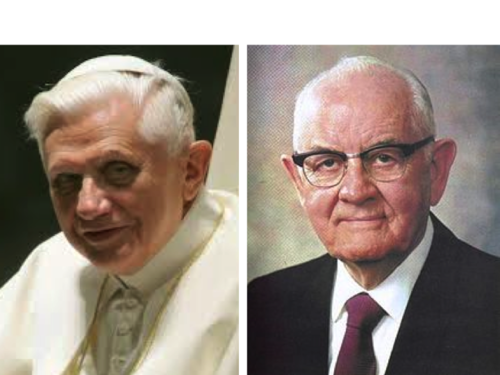
For the first time in six centuries, a Pope is resigning. I admire Pope Benedict’s willingness to face forthrightly the reality of how advancing age has affected his ability to perform his duties by handing off leadership to another Pope to be chosen soon by the College of Cardinals.

Although I have no special insight into the inner workings of the Catholic Church, I saw the last years of my grandfather, Spencer W. Kimball, who remained President and Prophet of the Mormon Church from 1974 until the day he died in 1985 at the age of 90. At the age of 83 (in 1978), he declared that he had received a revelation from God that the Mormon priesthood–and all of the ceremonies in Mormon temples–should be opened to those of African ancestry, who had previously been barred from ordination to the priesthood and full participation in Mormon temple ceremonies. But from at least age 86 on, my grandfather was seldom up to carrying on a normal conversation. His position as leader of the Mormon Church still mattered because other Mormon Church leaders tried to do what they thought he would have, but the decisions he himself made were at the level of nodding his head to something suggested by one of his lieutenants—especially the then relatively young Gordon B. Hinckley, who later went on to lead the Mormon Church in a very visible way because of his high level of comfort with the news media.

My grandfather believed it was his duty to serve as head of the Mormon Church until God released him from that position by death. Part of his reasoning was the tradition within the Mormon Church that upon the death of the Prophet, the longest-serving surviving Apostle becomes the new Prophet. Thus, he believed that the timing of his own death might be part of the way in which God chose who would become the next Prophet. For Pope Benedict, there is no such consideration, since the next Pope is chosen by the decision of the College of Cardinals rather than by life and death. But still, he had to buck six centuries worth of tradition that Popes serve until the day they die—a span of time more than three times as long as the Mormon Church has been in existence.

All of us face death, and many of us will face serious disability before death. Forthrightly admitting those possibilities to ourselves–and dealing with their actual arrival with grace, as Pope Benedict has–can both help us lead a good life and help ensure that those people and causes we love are taken care of when we are gone or fading, in body or mind.

Duncan Grant, Interior at Gordon Square, 1914-1915

I posted this originally simply because it is beautiful, but Ian Preston pointed out that the interior depicted is 46 Gordon Square, where John Maynard Keynes lived! Along with my economist dinner companions, I made a pilgrimage to see the plaque on the outside of the building after giving a seminar on the Economics of Happiness at LSE in June 2011. Here are some walking tour directions that Ian Preston tweeted.

Math Post: Isomorphismes on Transforming a Problem Into Something Easier to Understand

Isomorphismes is one of my favorite Tumblogs. Here is a math post I liked. 

Going the long way: What does it mean when mathematicians talk about a bijection or homomorphism?

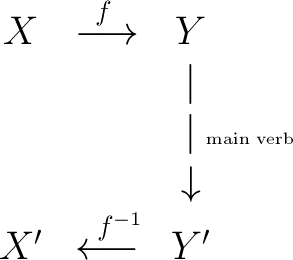
Imagine you want to get from X to X′ but you don’t know how. Then you find a “different way of looking at the same thing” using ƒ. (Map the stuff with ƒ to another space Y, then do something else over in image ƒ, then take a journey over there, and then return back with ƒ ⁻¹.)

The fact that a bijection can show you something in a new way that suddenly makes the answer to the question so obvious, is the basis of the jokes on www.theproofistrivial.com.

In a given category the homomorphisms Hom ∋ ƒ preserve all the interesting properties. Linear maps, for example (except when det=0) barely change anything—like if your government suddenly added another zero to the end of all currency denominations, just a rescaling—so they preserve most interesting properties and therefore any linear mapping to another domain could be inverted back so anything you discover over in the new domain (image of ƒ) can be used on the original problem.
All of these fancy-sounding maps are linear:
Fourier transform
Laplace transform
taking the derivative
Box-Müller
They sound fancy because whilst they leave things technically equivalent in an objective sense, the result looks very different to people. So then we get to use intuition or insight that only works in say the spectral domain, and still technically be working on the same original problem.
Pipe the problem somewhere else, look at it from another angle, solve it there, unpipe your answer back to the original viewpoint/space.
“Going the long way” can be easier than trying to solve a problem directly.

Top 10 Quartz Columns and Top 25 All-Time Posts as of February 12, 2013

The top 25 posts on supplysideliberal.com listed below are based on Google Analytics pageviews from June 3, 2012 through February 11, 2013. The number of pageviews is shown by each post. (There were 195,923 pageviews during this period, but, for example, 66,802 homepage views could not be categorized by post.) I have to handle my Quartz columns separately because that pageview data is proprietary. So there I am giving only the order in the Top 10 list immediately below. The list of top posts would be quite misleading without the inclusion of the Quartz columns. You might also find other posts you like in this earlier list of top posts, at this link.

Top 10 Quartz Columns, in Order of Popularity

  1. Why the US Needs Its Own Sovereign Wealth Fund
  2. Could the UK be the First Country to Adopt Electronic Money?
  3. Read His Lips: Why Ben Bernanke Had to Set Firm Targets for the Economy
  4. More Muscle than QE3: With an Extra $2000 in their Pockets, Could Americans Restart the U.S. Economy?
  5. How Paper Currency is Holding the US Recovery Back (How Subordinating Paper Money to Electronic Money Can End Recessions and End Inflation)
  6. Emotional Indicator: Obama the Libertarian? Americans Say They’d be Happy if Government Got Out of Their Way (Judging the Nations: Wealth and Happiness Are Not Enough)
  7. Yes, There is an Alternative to Austerity Versus Spending: Reinvigorate America’s Nonprofits
  8. John Taylor is Wrong: The Fed is Not Causing Another Recession
  9. Off the Rails: What the Heck is Happening to the US Economy? How to Get the Recovery Back on Track
  10. Obama Could Really Help the US Economy by Pushing for More Legal Immigration

Top 25 Posts on supplysideliberal.com:

  1.  Dr. Smith and the Asset Bubble 6054
  2.  Contra John Taylor 5266
  3.  Scott Adams’s Finest Hour: How to Tax the Rich 4043
  4.  Balance Sheet Monetary Policy: A Primer 3701
  5.  What is a Supply-Side Liberal? 2771
  6.  The Deep Magic of Money and the Deeper Magic of the Supply Side 2363
  7.  You Didn’t Build That: America Edition 2129
  8.  Trillions and Trillions: Getting Used to Balance Sheet Monetary Policy 2020 
  9.  The Egocentric Illusion 1896
  10. Two Types of Knowledge: Human Capital and Information 1839
  11. Books on Economics 1781
  12. No Tax Increase Without Recompense 1757
  13.  Why I am a Macroeconomist: Increasing Returns and Unemployment 1686
  14. Jobs 1636
  15. The Logarithmic Harmony of Percent Changes and Growth Rates 1623
  16. Getting the Biggest Bang for the Buck in Fiscal Policy 1600
  17. Scrooge and the Ethical Case for Consumption Taxation 1538
  18. Kevin Hassett, Glenn Hubbard, Greg Mankiw and John Taylor Need to Answer This Post of Brad DeLong’s Point by Point 1527
  19. The Shape of Production: Charles Cobb’s and Paul Douglas’s Boon to Economics 1522
  20. Is Taxing Capital OK? 1385
  21. Corporations are People, My Friend 1314
  22. Why Taxes are Bad 1275
  23. Avoiding Fiscal Armageddon 1274
  24. Thoughts on Monetary and Fiscal Policy in the Wake of the Great Recession: supplysideliberal.com’s First Month 1261
  25. Is Monetary Policy Thinking in Thrall to Wallace Neutrality?  1247

For those who want to find this post again, the “Top 25 posts in order of popularity” button at my sidebar will link to it until I make another post like this.

Economists' Learned Helplessness

As economists, it is important for us to pay attention to the unintended side effects of our usual initial working assumption that people are fully optimizing–doing the best they can given the situations they are in. To the extent we treat this not just as an initial working assumption, but as if it were the God’s truth, we are in danger of missing opportunities for helping people make better decisions.

Fortunately, economists don’t routinely assume that those in government are always optimizing. Instead, a routine starting point for policy analysis is to act as if those in government want to improve the general welfare (along with some more self-interested motives), but don’t always know how. In an excellent Project Syndicate essay, “The Tyranny of Political Economy,” Dani Rodrik writes about the learned helplessness that can result if one follows to a logical conclusion the assumption that those in government are already fully optimizing–often in a self-serving way–subject to their constraints. He argues that new ideas and advice can make a difference.  

Dani Rodrik worries that the logic of optimization is leading economists to doubt, on principle, whether policy advice can make any difference. I worry that the logic of optimization is leading economists to doubt, on principle, whether advice to households or firms can make any difference.  If we assume people are already optimizing, where in fact they are not, then we will be blind to opportunities to help. If individuals are optimizing 95% of the way, the approximation that they are optimizing 100% of the way could well be an appropriate simplification in building a larger model, but when focusing attention on that decision, it still leaves a 5% leeway for improvement. That 5% improvement in decision-making could correspond to a large increase in welfare–an especially important opportunity because the increase in welfare from better decision-making would require no coercive action, but only persuasion based on the hearer’s appropriate self-interest.

John Stuart Mill's Argument Against Political Correctness

From John Stuart Mill's On Liberty, Chapter 2–“Of the Liberty of Thought and Discussion”

Our merely social intolerance kills no one, roots out no opinions, but induces men to disguise them, or to abstain from any active effort for their diffusion. With us, heretical opinions do not perceptibly gain, or even lose, ground in each decade or generation; they never blaze out far and wide, but continue to smoulder in the narrow circles of thinking and studious persons among whom they originate, without ever lighting up the general affairs of mankind with either a true or a deceptive light. And thus is kept up a state of things very satisfactory to some minds, because, without the unpleasant process of fining or imprisoning anybody, it maintains all prevailing opinions outwardly undisturbed, while it does not absolutely interdict the exercise of reason by dissentients afflicted with the malady of thought. A convenient plan for having peace in the intellectual world, and keeping all things going on therein very much as they do already. But the price paid for this sort of intellectual pacification, is the sacrifice of the entire moral courage of the human mind. A state of things in which a large portion of the most active and inquiring intellects find it advisable to keep the general principles and grounds of their convictions within their own breasts, and attempt, in what they address to the public, to fit as much as they can of their own conclusions to premises which they have internally renounced, cannot send forth the open, fearless characters, and logical, consistent intellects who once adorned the thinking world. The sort of men who can be looked for under it, are either mere conformers to commonplace, or time-servers for truth, whose arguments on all great subjects are meant for their hearers, and are not those which have convinced themselves. Those who avoid this alternative, do so by narrowing their thoughts and interest to things which can be spoken of without venturing within the region of principles, that is, to small practical matters, which would come right of themselves, if but the minds of mankind were strengthened and enlarged, and which will never be made effectually right until then: while that which would strengthen and enlarge men’s minds, free and daring speculation on the highest subjects, is abandoned.

Those in whose eyes this reticence on the part of heretics is no evil, should consider in the first place, that in consequence of it there is never any fair and thorough discussion of heretical opinions; and that such of them as could not stand such a discussion, though they may be prevented from spreading, do not disappear. But it is not the minds of heretics that are deteriorated most, by the ban placed on all inquiry which does not end in the orthodox conclusions. The greatest harm done is to those who are not heretics, and whose whole mental development is cramped, and their reason cowed, by the fear of heresy. Who can compute what the world loses in the multitude of promising intellects combined with timid characters, who dare not follow out any bold, vigorous, independent train of thought, lest it should land them in something which would admit of being considered irreligious or immoral? Among them we may occasionally see some man of deep conscientiousness, and subtle and refined understanding, who spends a life in sophisticating with an intellect which he cannot silence, and exhausts the resources of ingenuity in attempting to reconcile the promptings of his conscience and reason with orthodoxy, which yet he does not, perhaps, to the end succeed in doing. No one can be a great thinker who does not recognise, that as a thinker it is his first duty to follow his intellect to whatever conclusions it may lead. Truth gains more even by the errors of one who, with due study and preparation, thinks for himself, than by the true opinions of those who only hold them because they do not suffer themselves to think. Not that it is solely, or chiefly, to form great thinkers, that freedom of thinking is required. On the contrary, it is as much and even more indispensable, to enable average human beings to attain the mental stature which they are capable of. There have been, and may again be, great individual thinkers, in a general atmosphere of mental slavery. But there never has been, nor ever will be, in that atmosphere, an intellectually active people. When any people has made a temporary approach to such a character, it has been because the dread of heterodox speculation was for a time suspended. Where there is a tacit convention that principles are not to be disputed; where the discussion of the greatest questions which can occupy humanity is considered to be closed, we cannot hope to find that generally high scale of mental activity which has made some periods of history so remarkable. Never when controversy avoided the subjects which are large and important enough to kindle enthusiasm, was the mind of a people stirred up from its foundations, and the impulse given which raised even persons of the most ordinary intellect to something of the dignity of thinking beings.

Three Goals for Ph.D. Courses in Economics

Since I am teaching in the second-year macroeconomic field sequence this year, I have been thinking about the objectives for my teaching. I see three goals for a Ph.D. course:

  1. to teach some of the skills directly necessary to fill out the body of an economics paper, including the computations from data and from simulations (to be laid out in tables or figures), and how to write down the details of proofs.
  2. to give enough of a picture of how the world works to make it possible to begin to judge how important a potential research result might be: for one’s career, for the discipline of economics, and ultimately, in the potential contribution to overall social welfare. (On how the world works, see the recurring refrain in one of my most popular posts ever: “Dr. Smith and the Asset Bubble.”)
  3. to teach analytical tools that–with a few hours or a few days effort–can help one to predict the likely distribution of results one might get from a potential research project that might take months or even years.

a. For straight theory, the development of mathematical intuition is the key for predicting what a project might lead to.

b. For empirical work, key skills for predicting what a project might lead to are

  • understanding identification,
  • understanding the sources and characteristics of measurement errors, 
  • understanding at least rudimentary power analysis in the sense of knowing something about what goes into the standard errors one is likely to get, and
  • understanding that the data are endogenous in two very different senses: (i) data from naturally occurring situations come from a complex web of causal relationships and forces and (ii) economists can cause data to come into existence through surveys, field experiments and lab experiments to help fulfill their research objectives.

c. For computational work, such as a project using a Dynamic Stochastic General Equilibrium model, or a project simulating life-cycle consumption, labor supply and portfolio behavior, some key skills for predicting the likely behavior of a model are

  • understanding general comparative statics and comparative dynamics results;
  • understanding general principles about how models behave, such as key neutrality results that cut across large classes of models and often require intentional modeling devices in order to break (monetary neutrality, Ricardian neutrality, Modigliani-Miller, Wallace neutrality, etc.)
  • knowing how to design a set of graphs to get to the heart of what is going on in a model: graphs that serve the purpose for that advanced model that supply and demand serve for Economics 101 (see for example the graphs in my paper “Q-Theory and Real Business Cycle Analytics”); and
  • knowing how to compute quantitative results for a few simple models by hand in order to get a sense of the likely size of various effects. (You can see an example of what I mean in some of the chapters of my draft textbook “Business Cycle Analytics.”

Of course, in all of these areas, research experience and seeing what other people have done–both in published articles and in work presented in seminars–will also help one predict what a project will lead to. Unfortunately, seeing what other people have done is most helpful in understanding paths that are already well-trodden. But sound criticism of what other people have done is immensely helpful in teaching what to avoid. (Helpful hint: when reading papers, be very suspicious of what is claimed in abstracts. At least half the time, abstracts misrepresent what a paper has really accomplished.) Whether one’s own research experience ultimately leads to unique insight into the likely outcomes of various potential projects depends on the directions one strikes out in during the early days of one’s research career.