Tomas Hirst: Worrying about Secular Stagnation and Worrying about Overheating Now are Logically Inconsistent

There is one important note to add to what Tomas says. More aggregate demand from fiscal expansion being OK doesn’t mean that the makeup of that fiscal expansion is what it should be. We want to push to the economy’s capacity, and pushing against that capacity to raise inflation is a reasonable thing to do if you are not ready to embrace negative interest rate policy, but that capacity is still finite and should be used for providing the most important things.

On negative interest rate policy, see my bibliographic post laying out what I have written on that topic:

A Personal Mission Statement: Keep It Short

A powerful aid for making big life decisions is to have a personal mission statement or “life purpose” statement that has been tested by time. In her talk during University of Michigan Commencement this year, Twyla Tharp gave a very simple recipe for putting together a personal mission statement: choose one verb and one noun. Her two-word mission statement is “MAKE DANCE.”

I tell about some lengthier statements of my chosen life purpose in “My Objective Function.” If I strip it down to one verb and one noun, I choose for my life purpose “LOVE TRUTH.” What is yours?


Don’t Miss These Posts Related to Positive Mental Health and Maintaining One’s Moral Compass:

Pandemic Passage: My Past 12 Months in Blogging

Today is the 9th anniversary of this blog, "Confessions of a Supply-Side Liberal." My first post, "What is a Supply-Side Liberal?" appeared on May 28, 2012. I have written an anniversary post every year since then:

  1. A Year in the Life of a Supply-Side Liberal

  2. Three Revolutions

  3. Beacons

  4. Why I Blog

  5. My Objective Function

  6. A Barycentric Autobiography

  7. Crafting Simple, Accurate Messages about Complex Problems

  8. On Human Potential

Every year, events in the world and events in my own blog inspire blog posts. On this 9th blogiversary, I want to take you on a tour of how events, both personal and national, affected my blogging in the past year.

Let me begin by saying what hasn’t changed this past year on my blog. With few exceptions, every week I do three full-scale blog posts, and have a link-of-the-day to something someone else has written on the other four days of the week. On Tuesdays, I blog about diet and health; here is my bibliographic post laying those posts out: “Miles Kimball on Diet and Health: A Reader's Guide.” Every other Sunday, I blog my way through a classic. Having finished blogging through John Stuart Mill’s On Liberty and John Locke’s Second Treatise a while back (see “John Stuart Mill’s Defense of Freedom” and “The Social Contract According to John Locke”), I am now blogging my way through The Federalist Papers. All the links to the posts I have done so far on The Federalist Papers are in the most recent of those posts: “The Federalist Papers #31: Alexander Hamilton's Attempt at a Formal Argument for a Robust Federal Power of Taxation.” On Thursdays, I write about a wide variety of topics, including many core economic issues, such as negative interest rate policy (see for example “How the Nature of the Transmission Mechanism from Rate Cuts Guarantees that Negative Rates have Unlimited Firepower” and my bibliographic post on negative interest rate policy, “How and Why to Eliminate the Zero Lower Bound: A Reader’s Guide”), “The Optimal Rate of Inflation,” fiscal policy (see for example “Critiquing the Wall Street Journal Editorial Pages on Fiscal Policy”) and financial stability policy (see for example “Higher Capital Requirement May Be Privately Costly to Banks, But Their Financial Stability Benefits Come at a Near Zero Cost to Society”).

What has shifted this year? First, the past year’s news has been dominated by the COVID-19 pandemic, demonstrations and debates about racism, antiracism and wokeness, and the 2020 US Presidential election and related subsequent events. Each of those news threads inspired some of my blog posts this past year.

Though I wrote many of my posts on the pandemic a little over a year ago, in the past 12 months, I had …

On the Pandemic:

The heightened discussion of racism, antiracism and wokeness in the past year made me think not only about those subjects, but about feminist issues as well …

On Racism, Anti-Racism, Feminism and Wokeness:

On my blog I stayed out of politics more than usual in the last little while, simply because I was imposing a screen of what I could write about in a way that would be reasonably nonpartisan. But I did have these 4 posts …

On the 2020 US Presidential election and related subsequent events:

Among big personal events in my life were the death of my son-in-law’s mother from COVID-19 and the deaths of my sister and sister-in-law from other causes. I didn’t write about my son-in-law’s mother’s death because that wasn’t my story to tell, but I did write about my sister and my sister-in-law:

On Deaths in My Family:

The other big thing in my personal life this past year is that I took advantage of the pandemic lockdown to get a lot more training as a life coach. Remotely, I had 112 hours worth of training as an Organization and Relationship System’s coach and a lot of training as a Positive Intelligence coach—modes of coaching that dovetail nicely with being a Certified Professional Co-Active coach. I did all of this together with my wife Gail. This interest in coaching has been reflected in many blog posts. See all the links in The Golden Mean as Concavity of Objective Functions.”

I am using my training as a Positive Intelligence coach to offer free Positive Intelligence group coaching for “economists and family.” See

Already, I have taken many dozen “economists and family” through this program in Positive Intelligence Circles I have been a co-leader for. This has been a great experience for me as well as for the participants in this program.

Posts inspired by coaching have taken many of the Sunday slots not taken by The Federalist papers. In the past I have thought of those slots as primarily for religion posts, and there have been some of those this past 12 months …

On Religion:

Another theme with roots in my more distant blogging past has become more salient in the past year: the “religious” or “theological” implications of science for a convinced nonsupernaturalist like me. In reverse chronological order, going back even before the last 12 months, here is the type of post I mean …

On the “Theological” Implications of Science:

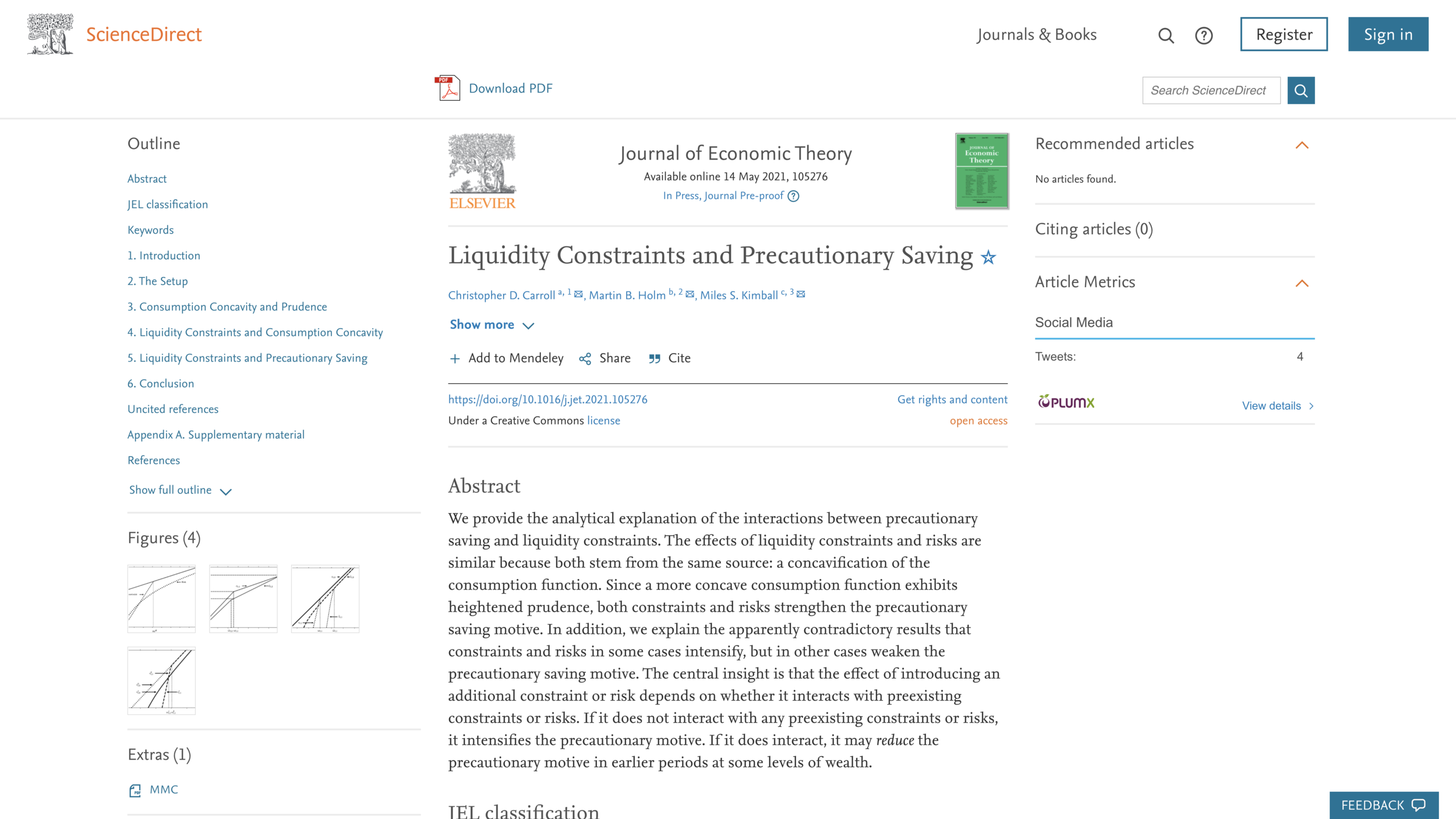
My research continued this past year, as usual; I had mostly been working with coauthors on Zoom even before the pandemic. Several papers I coauthored came to some level of completion. I wrote about them in these posts …

On Papers Miles has Coauthored:

I also had occasion to think about the research process and about math, both specifically and generally …

On the Research Process and Math:

One of my whimsical endeavors this past year was to write some limericks about economics, and to make Tiktoks of some of them. You can see all the links to the ones so far in “Tiktok of Econolimerick #2.”

Finally, some things in my life didn’t generate blog posts. I was delighted by a granddaughter born this past year, now 10 months old. She was playing happily here in my study while I was writing this post—a wonderful thing that Covid-19 vaccination has made safe. Our grandson is two-and-a-half and is now talking up a storm. Gail and I celebrated our 36th wedding anniversary this past year. Our children and their partners are doing well. Gail and I settled in to some serious binge watching of TV series during the pandemic. Gail watched my all-time favorite series “Babylon 5” with me. (It was at least the 3d time for me.) Other notable series we finished were “Game of Thrones,” “The Americans,” “Elementary,” “The Man in the High Castle,” “The Crown,” and “Victoria.” Currently, we are watching “Homeland” and “House.” I recommend them all.

James Carville: Wokeness is a Problem and We All Know It

James Carville is the political strategist who propelled a lot of Bill Clinton’s success in presidential politics. The title above is a link to a fascinating interview with him about how the Democratic Party is messing up its political strategy.

Let me give you some teasers from the interview, to encourage you to read the whole thing. All are quotations from the interview the title above links to. (I separate passages by added bullets and bleep out some profanity.) I follow with some comments of my own.

  • … we’ve got to stop speaking Hebrew and start speaking Yiddish. We have to speak the way regular people speak, the way voters speak. It ain’t complicated. That’s how you connect and persuade. And we have to stop allowing ourselves to be defined from the outside.

  • … take someone like Marjorie Taylor Greene, the new Republican congresswoman from Georgia. She’s absolutely loonier than a tune. We all know it. And yet, for some reason, the Democrats pay a bigger political price for AOC than Republicans pay for Greene. That’s the problem in a nutshell. And it’s ridiculous because AOC and Greene are not comparable in any way.

  • No matter how you look at the map, the only way Democrats can hold power is to build on their coalition, and that will have to include more rural white voters from across the country. Democrats are never going to win a majority of these voters. That’s the reality. But the difference between getting beat 80 to 20 and 72 to 28 is all the difference in the world.

  • How is it we have all this talk about Jim Jordan (R-OH) and Matt Gaetz (R-FL) and we don’t talk about Dennis Hastert, the longest-serving Republican speaker of the House in Congress? If Hastert was a Democrat who we knew had a history of molesting kids and was actually sent to prison in 2016, he’d still be on Fox News every &%#@^# ing night. The Republicans would never shut the hell up about it.

  • You now have Democrats saying Florida is a lost cause. Really? In 2018 in Florida, giving felons the right to vote got 64 percent. In 2020, a $15 minimum wage, which we have no chance of passing [federally], got 67 percent.

  • We won the White House against a world-historical buffoon. And we came within 42,000 votes of losing. We lost congressional seats. We didn’t pick up state legislatures. So let’s not have an argument about whether or not we’re off-key in our messaging. We are. And we’re off because there’s too much jargon and there’s too much esoterica and it turns people off.

  • Do you realize that climate is the only major social or political movement that I can think of that refuses to use emotion? Where’s the identifiable song? Where’s the bumper sticker? Where’s the slogan? Where’s the flag? Where’s the logo?

  • They have to make the Republicans own that insurrection every day. They have to pound it. They have to call bookers on cable news shows. They have to get people to write op-eds. There will be all kinds of investigations and stories dripping out for god knows how long, and the Democrats should spend every day tying all of it to the Republican Party. They can’t sit back and wait for it to happen.

    Hell, just imagine if it was a bunch of nonwhite people who stormed the Capitol. Imagine how Republicans would exploit that and make every news cycle about how the Dems are responsible for it. Every political debate would be about that. The Republicans would bludgeon the Democrats with it forever.

Of all the things that James Carville says, the one that points to the biggest social-science mystery is this: Why don’t the Democrats attack the Republicans more vigorously? They often talk as if it were obvious that there are bad things in the Republican Party, when it is clear that it is not obvious to much of the electorate. Repeating over and over again the worst things in the Republican party is necessary. Even for an independent like me, I would wish for them to do that because I want the worst things purged from both parties. Absolutely relentless attacks on the worst things in the other party is important for the health of our republic because it might reduce the influence of unhinged fringes.

I find what James Carville says about Florida intriguing because the Democratic Party’s troubles in Florida might provide a good measure of the electoral cost of excessive wokeness.

On the climate issue, I want to propose a particular challenge for economists. Most economists favor a carbon tax. How do you make the genuine virtues of a carbon tax into a catchy slogan, song, bumper sticker, flag, logo, or the like? The same question applies to more solar power research to make solar power become cheaper even faster. Bonus points for making the newer, much safer types of nuclear power that we could have in the future sound good in a a catchy slogan, song, bumper sticker, flag, logo, or the like. Because it isn’t just political action pretending to address global warming that we need. It is the right actions.

Hypoallergenic Nuts

As I wrote in “Our Delusions about 'Healthy' Snacks—Nuts to That!” nuts are almost the only portable snack that is actually healthy—just check for sugar or easily digestible starch as an ingredient. Remember that almost all commercially available fruit has a lot of sugar in it—partly because it was bread that way. See for example “Nutritionally, Not All Apple Varieties Are Alike.” Also, beware: although raw nuts aren’t that hard to find, many packaged nuts have sugar added. Others have peanut oil added, which is OK if and only if you think peanut oil is OK. Still others have salt added, which I don’t worry about.

Because nuts have so many pluses, I have explored a wide variety of nuts—and hope to try many more.

Sadly, I am allergic (meaning that I get canker sores in my mouth) from regular walnuts, pecans and pistachios. For walnuts, I discovered to my delight that black walnuts, which are a different species, are OK for me. Below is the Amazon page for the black walnuts I get. Here is the Wikipedia article for eastern black walnuts: “Juglans nigra.” But I haven’t found any variant of pecans or pistachios that I can eat without suffering for it. ‘

This post has two purposes: First, to let others who love the taste of walnuts but suffer from walnut allergies know about black walnuts, which they might be able to eat. Second to make a plea for entrepreneurs to develop hypoallergenic nuts, including hypoallergenic pecans and pistachios. There is a market out there! Third, to ask for any information anyone else has about the availability of hypoallergenic nuts that are as close substitutes to the regular nuts as black walnuts are to regular walnuts. If you know anything along those lines, leave a comment!

Melissa Pandika’s August 23, 2014 NPR blog post “Hypoallergenic Nuts: A Solution To Nut Allergies?” gives some hope that research is being done on hypoallergenic nuts. She says:

… researchers at the U.S. Department of Agriculture have shifted their focus. Instead of treating people who suffer from nut allergies, they're trying to treat the nut. That means "disrupting [the] structure" of nut proteins, says Christopher Mattison, a molecular biologist at the USDA's Agricultural Research Service.

That sounds sensible to me.


For annotated links to other posts on diet and health, see:

The Federalist Papers #31: Alexander Hamilton's Attempt at a Formal Argument for a Robust Federal Power of Taxation

It is said that at the door of Plato’s academy were the words “Let no one ignorant of geometry enter.” For those with the kind of Classical education common to many of the rich and cultured in Alexander Hamilton’s 18th century audience, this would have given geometry great prestige. In the Federalist Papers #31, Alexander Hamilton tries to borrow that prestige to make an argument for the proposed constitution’s power of federal taxation—and to castigate the opponents of the Constitution as if they were knuckleheads who can’t understand a geometric proof.

Alexander Hamilton begins with this abstract statement of the argument:

  • there cannot be an effect without a cause

  • the means ought to be proportioned to the end

  • every power ought to be commensurate with its object

  • there ought to be no limitation of a power destined to effect a purpose which is itself incapable of limitation.

I’m not sure this abstract statement adds much to a more transparent argument:

  • We might really need a lot of money in wartime.

  • Therefore, the federal government needs to have the power to raise a lot of money.

Later on in the Federalist Papers #31, Alexander Hamilton fills in other crucial pieces of his argument for a robust federal power of taxation. The quotations below are his words.

First, states can’t be depended on to comply with assessments:

As theory and practice conspire to prove that the power of procuring revenue is unavailing when exercised over the States in their collective capacities, the federal government must of necessity be invested with an unqualified power of taxation in the ordinary modes.

Second, state governments are just as able to misbehave as the federal government; we shouldn’t worry about the federal government misbehaving any more than we worry about a state government misbehaving:

… all observations founded upon the danger of usurpation ought to be referred to the composition and structure of the government, not to the nature or extent of its powers. The State governments, by their original constitutions, are invested with complete sovereignty. In what does our security consist against usurpation from that quarter? Doubtless in the manner of their formation, and in a due dependence of those who are to administer them upon the people.

Third, the states can hold their own in a contest with the federal government:

It should not be forgotten that a disposition in the State governments to encroach upon the rights of the Union is quite as probable as a disposition in the Union to encroach upon the rights of the State governments. What side would be likely to prevail in such a conflict, must depend on the means which the contending parties could employ toward insuring success. As in republics strength is always on the side of the people, and as there are weighty reasons to induce a belief that the State governments will commonly possess most influence over them, the natural conclusion is that such contests will be most apt to end to the disadvantage of the Union; and that there is greater probability of encroachments by the members upon the federal head, than by the federal head upon the members.

Fourth, in any case, the people will govern the balance of power between the states and the federal government:

Every thing beyond this must be left to the prudence and firmness of the people; who, as they will hold the scales in their own hands, it is to be hoped, will always take care to preserve the constitutional equilibrium between the general and the State governments.

The two bullets above and the four complementary arguments below that are Alexander Hamilton’s real argument. The reference to geometry is just empty rhetoric. See for yourself in the full text of the Federalist Papers #31 below.


FEDERALIST NO. 31

The Same Subject Continued: Concerning the General Power of Taxation

From the New York Packet
Tuesday, January 1, 1788.

Author: Alexander Hamilton

To the People of the State of New York:

IN DISQUISITIONS of every kind, there are certain primary truths, or first principles, upon which all subsequent reasonings must depend. These contain an internal evidence which, antecedent to all reflection or combination, commands the assent of the mind. Where it produces not this effect, it must proceed either from some defect or disorder in the organs of perception, or from the influence of some strong interest, or passion, or prejudice. Of this nature are the maxims in geometry, that "the whole is greater than its part; things equal to the same are equal to one another; two straight lines cannot enclose a space; and all right angles are equal to each other." Of the same nature are these other maxims in ethics and politics, that there cannot be an effect without a cause; that the means ought to be proportioned to the end; that every power ought to be commensurate with its object; that there ought to be no limitation of a power destined to effect a purpose which is itself incapable of limitation. And there are other truths in the two latter sciences which, if they cannot pretend to rank in the class of axioms, are yet such direct inferences from them, and so obvious in themselves, and so agreeable to the natural and unsophisticated dictates of common-sense, that they challenge the assent of a sound and unbiased mind, with a degree of force and conviction almost equally irresistible.

The objects of geometrical inquiry are so entirely abstracted from those pursuits which stir up and put in motion the unruly passions of the human heart, that mankind, without difficulty, adopt not only the more simple theorems of the science, but even those abstruse paradoxes which, however they may appear susceptible of demonstration, are at variance with the natural conceptions which the mind, without the aid of philosophy, would be led to entertain upon the subject. The INFINITE DIVISIBILITY of matter, or, in other words, the INFINITE divisibility of a FINITE thing, extending even to the minutest atom, is a point agreed among geometricians, though not less incomprehensible to common-sense than any of those mysteries in religion, against which the batteries of infidelity have been so industriously leveled.

But in the sciences of morals and politics, men are found far less tractable. To a certain degree, it is right and useful that this should be the case. Caution and investigation are a necessary armor against error and imposition. But this untractableness may be carried too far, and may degenerate into obstinacy, perverseness, or disingenuity. Though it cannot be pretended that the principles of moral and political knowledge have, in general, the same degree of certainty with those of the mathematics, yet they have much better claims in this respect than, to judge from the conduct of men in particular situations, we should be disposed to allow them. The obscurity is much oftener in the passions and prejudices of the reasoner than in the subject. Men, upon too many occasions, do not give their own understandings fair play; but, yielding to some untoward bias, they entangle themselves in words and confound themselves in subtleties.

How else could it happen (if we admit the objectors to be sincere in their opposition), that positions so clear as those which manifest the necessity of a general power of taxation in the government of the Union, should have to encounter any adversaries among men of discernment? Though these positions have been elsewhere fully stated, they will perhaps not be improperly recapitulated in this place, as introductory to an examination of what may have been offered by way of objection to them. They are in substance as follows:

A government ought to contain in itself every power requisite to the full accomplishment of the objects committed to its care, and to the complete execution of the trusts for which it is responsible, free from every other control but a regard to the public good and to the sense of the people.

As the duties of superintending the national defense and of securing the public peace against foreign or domestic violence involve a provision for casualties and dangers to which no possible limits can be assigned, the power of making that provision ought to know no other bounds than the exigencies of the nation and the resources of the community.

As revenue is the essential engine by which the means of answering the national exigencies must be procured, the power of procuring that article in its full extent must necessarily be comprehended in that of providing for those exigencies.

As theory and practice conspire to prove that the power of procuring revenue is unavailing when exercised over the States in their collective capacities, the federal government must of necessity be invested with an unqualified power of taxation in the ordinary modes.

Did not experience evince the contrary, it would be natural to conclude that the propriety of a general power of taxation in the national government might safely be permitted to rest on the evidence of these propositions, unassisted by any additional arguments or illustrations. But we find, in fact, that the antagonists of the proposed Constitution, so far from acquiescing in their justness or truth, seem to make their principal and most zealous effort against this part of the plan. It may therefore be satisfactory to analyze the arguments with which they combat it.

Those of them which have been most labored with that view, seem in substance to amount to this: "It is not true, because the exigencies of the Union may not be susceptible of limitation, that its power of laying taxes ought to be unconfined. Revenue is as requisite to the purposes of the local administrations as to those of the Union; and the former are at least of equal importance with the latter to the happiness of the people. It is, therefore, as necessary that the State governments should be able to command the means of supplying their wants, as that the national government should possess the like faculty in respect to the wants of the Union. But an indefinite power of taxation in the LATTER might, and probably would in time, deprive the FORMER of the means of providing for their own necessities; and would subject them entirely to the mercy of the national legislature. As the laws of the Union are to become the supreme law of the land, as it is to have power to pass all laws that may be NECESSARY for carrying into execution the authorities with which it is proposed to vest it, the national government might at any time abolish the taxes imposed for State objects upon the pretense of an interference with its own. It might allege a necessity of doing this in order to give efficacy to the national revenues. And thus all the resources of taxation might by degrees become the subjects of federal monopoly, to the entire exclusion and destruction of the State governments."

This mode of reasoning appears sometimes to turn upon the supposition of usurpation in the national government; at other times it seems to be designed only as a deduction from the constitutional operation of its intended powers. It is only in the latter light that it can be admitted to have any pretensions to fairness. The moment we launch into conjectures about the usurpations of the federal government, we get into an unfathomable abyss, and fairly put ourselves out of the reach of all reasoning. Imagination may range at pleasure till it gets bewildered amidst the labyrinths of an enchanted castle, and knows not on which side to turn to extricate itself from the perplexities into which it has so rashly adventured. Whatever may be the limits or modifications of the powers of the Union, it is easy to imagine an endless train of possible dangers; and by indulging an excess of jealousy and timidity, we may bring ourselves to a state of absolute scepticism and irresolution. I repeat here what I have observed in substance in another place, that all observations founded upon the danger of usurpation ought to be referred to the composition and structure of the government, not to the nature or extent of its powers. The State governments, by their original constitutions, are invested with complete sovereignty. In what does our security consist against usurpation from that quarter? Doubtless in the manner of their formation, and in a due dependence of those who are to administer them upon the people. If the proposed construction of the federal government be found, upon an impartial examination of it, to be such as to afford, to a proper extent, the same species of security, all apprehensions on the score of usurpation ought to be discarded.

It should not be forgotten that a disposition in the State governments to encroach upon the rights of the Union is quite as probable as a disposition in the Union to encroach upon the rights of the State governments. What side would be likely to prevail in such a conflict, must depend on the means which the contending parties could employ toward insuring success. As in republics strength is always on the side of the people, and as there are weighty reasons to induce a belief that the State governments will commonly possess most influence over them, the natural conclusion is that such contests will be most apt to end to the disadvantage of the Union; and that there is greater probability of encroachments by the members upon the federal head, than by the federal head upon the members. But it is evident that all conjectures of this kind must be extremely vague and fallible: and that it is by far the safest course to lay them altogether aside, and to confine our attention wholly to the nature and extent of the powers as they are delineated in the Constitution. Every thing beyond this must be left to the prudence and firmness of the people; who, as they will hold the scales in their own hands, it is to be hoped, will always take care to preserve the constitutional equilibrium between the general and the State governments. Upon this ground, which is evidently the true one, it will not be difficult to obviate the objections which have been made to an indefinite power of taxation in the United States.

PUBLIUS.


Links to my other posts on The Federalist Papers so far:

Should Policy Tilt So Far in Favor of Homeownership?

In the United States, the idea that homeownership is better than renting is a political article of faith. But is it?

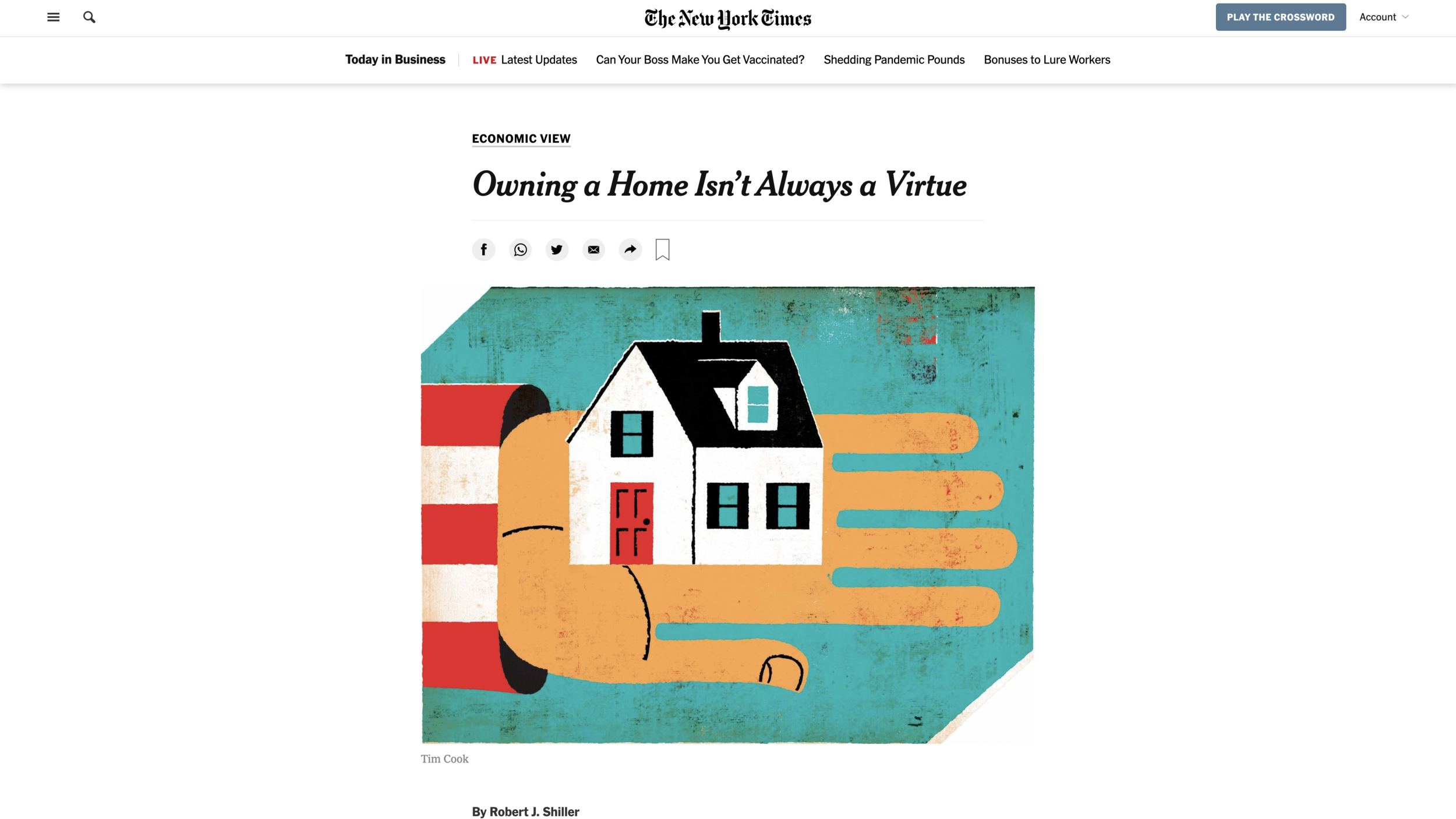
In his July 13, 2013 New York Times op-ed “Owning a Home Isn’t Always a Virtue,” Bob Shiller makes the case that renting has advantages, too. Adding bullet points added to separate ideas, he writes:

  • … renters are more mobile. That means they are more likely to accept jobs in another city, or even on the other side of a large metropolis.

  • In addition, it’s hardly wise to put all of one’s life savings into a single, highly leveraged investment in a home — as millions of underwater borrowers today can attest.

To see that more renting and less homeownership doesn’t cause anything terrible to happen, Bob Shiller points to Switzerland:

Consider Switzerland, which by several accounts has had one of the lowest rates of homeownership in the developed world. In 2010, only 36.8 percent of Swiss homes housed an owner-occupant; in the United States that same year, the rate was 66.5 percent.

Why the difference? Switzerland doesn’t favor homeownership in the tax law as the US and many other countries do. And it has laws that help make renting smoother.

There are several points on the side of homeownership (in my words):

  • Homeowndership seems to serve as a commitment device for saving.

  • Homeownership makes it easy for people to radically customize their home to their own preferences.

  • Homeownership avoids moral hazard problems of occupants not taking care of a rental unit very well.

But a big part of the political sentiment in favor of homeownership is, as Bob Shiller writes, that “Homeownership was thought to encourage planning, discipline, permanency and community spirit.” Let me parse this:

  • Planning: The idea seems to be that homeownership lengthens people’s planning horizons—presumably because they can predict their personal future better.

  • Discipline: Having to meet a mortgage or face a large transactions cost to move to another house is thought to be good for the soul.

  • Permanency: People may like having the same neighbors for a long time. Playing a repeated game with neighbors leads to more neighborliness.

  • Community Spirit: Homeowners gain from making the community more pleasant to live in—whether they stay to enjoy that pleasantness themselves, or get a better price from the next owner who wants that pleasantness.

To counterpose to these arguments for the virtues of homeownership is a huge political economy minus: homeowners have an incentive to vote for local government policies that restrict construction as collusion to keep the prices of houses up. This deprives people who would very much like to live in the community, but can’t afford much from being able to live there. Sometimes there is a token amount of subsidized housing, but it takes a lot of units to house a lot of people if a lot of people want to live in a desirable city. If there isn’t a lot of construction, many people lose out.

I address the political economy problems from homeownership in “A Political Economy Externality that Should Be Taught in Every ‘Principals of Economics’ Course.” If this giant political economy problem from homeownership is addressed—by say state mandated construction targets with a state agency allowed to approve construction if a city doesn’t meet its target—then homeownership is a much better thing than homeownership is as the situation stands.

Don’t miss:

How the Ancient Greeks Invented Eye Movement Desensitizing and Reprocessing to Deal with Trauma

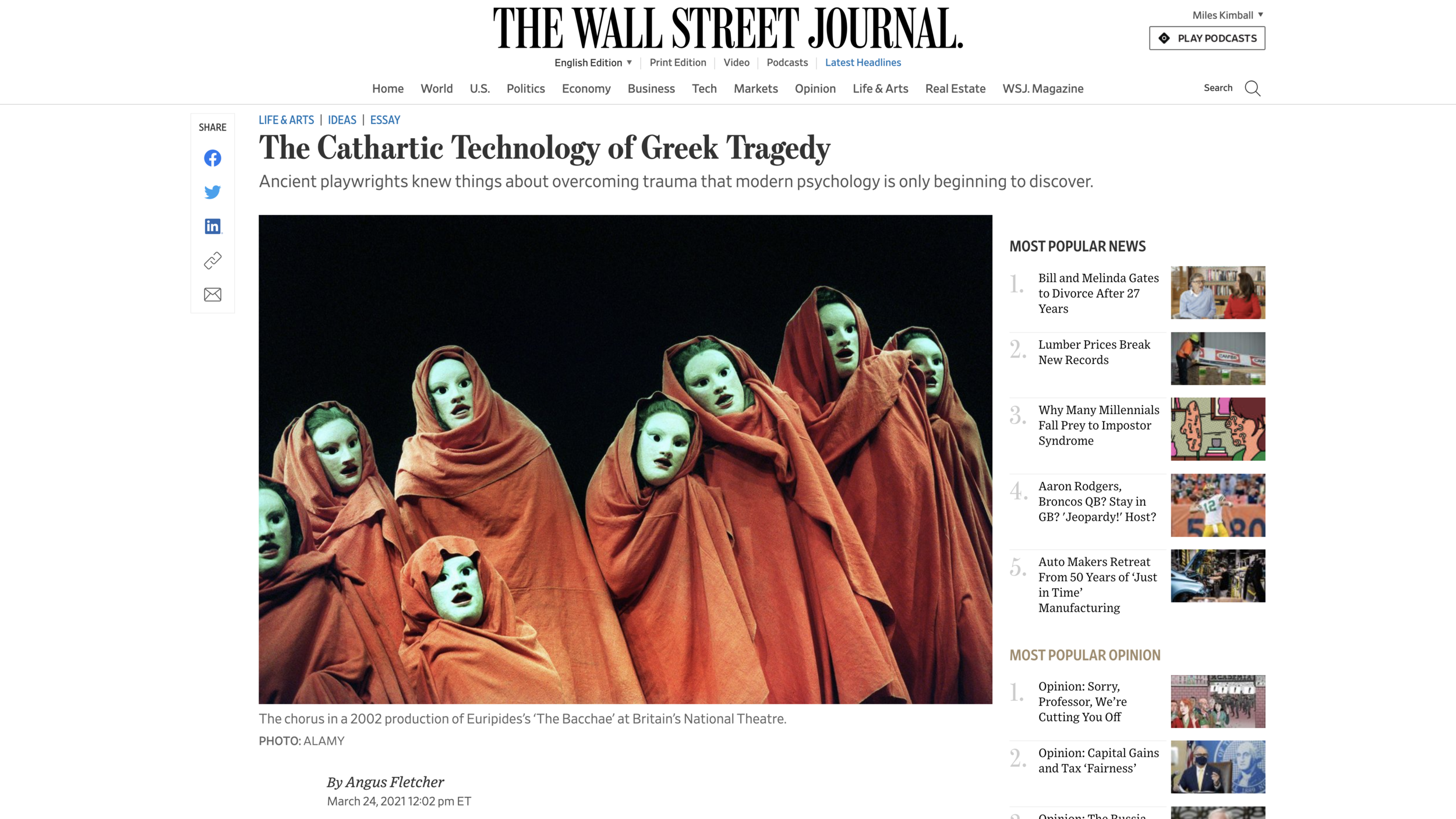
EMDR—eye movement desensitizing and reprocessing—is one of the stranger psychological treatments. But there is good evidence that it helps people who have been through traumatic experiences. About this, let me draw on the Angus Fletcher’s fascinating March 24, 2021 Wall Street Journal article “The Cathartic Technology of Greek Tragedy,” which in turn draws on his new book Wonderworks: The 25 Most Powerful Inventions in the History of Literature. Unless noted otherwise, all quotations here are from “The Cathartic Technology of Greek Tragedy.” Angus writes:

… it can help to sweep our eyes from side to side while we mentally review the trauma. This curious fact was stumbled upon by researcher Francine Shapiro in the late 1980s, and at the time it appeared so random, even magical, that it was regarded warily as a drift into pseudoscience. But recent studies on mice have suggested that side-to-side eye movement may stimulate a small region of our brain called the superior colliculus-mediodorsal thalamus circuit, which is involved in fear attenuation. Eye movement has proved effective enough in clinical trials to produce its own trauma therapy—eye movement desensitizing and reprocessing (EMDR)—that has been formally recommended by the American Psychiatric Association and the Department of Veterans Affairs.

Intriguingly, the Ancient Greeks guessed this. (The Ancient Greeks had to deal with plenty of battle trauma from war.) “Catharsis” is the purging of fear that was supposed to come from tragedy. But the Greek tragedies didn’t just depict traumatic events, they moved the audiences eyes from side to side during the play:

… choral chants such as the ones found in Aeschylus’s “Agamemnon,” from 458 BCE: “The law of our world is pain, the scar that teaches the hardness of days and leaves its mark in every heart.” …

… Like EMDR, the play’s chorus delivered that prompt in a dynamic performance that shifted the eyes left and right.

When Greek tragedies are performed now in a way that moves the audience’s eyes side to side, they help with post-traumatic stress disorder:

Performances of “Agamemnon” and other Greek tragedies have been staged for combat veterans by initiatives such as Bryan Doerries’s Theater of War Productions and Peter Meineck’s Aquila Theatre Company, which places particular emphasis on the side-to-side movement incorporated into EMDR. These performances led the veterans to self-report a decrease in feelings of isolation, hypervigilance and other symptoms of post-traumatic fear.

Angus identifies one other aspect of some Greek tragedies that can help salve post-traumatic stress disorder: letting the audience know things the character doesn’t know. This puts them in a position of wishing they could help someone else rather than simply being absorbed in their own troubles:

This neural experience of supporting Oedipus in his time of need is deeply therapeutic. When we discover our ability to assist others through their trauma, we increase our confidence that we can cope with trauma ourselves.

Despite the name, EMDR isn’t always done with eye movement. Sometimes it is done with tappers near someones legs that alternately tap on the right side and then the left. As the Wikipedia article “Eye movement desensitization and reprocessing” currently says:

Eye movement desensitization and reprocessing (EMDR) is a form of psychotherapy developed by Francine Shapiro starting in 1988 in which the person being treated is asked to recall distressing images; the therapist then directs the patient in one type of bilateral stimulation, such as side-to-side eye rapid movement or hand tapping.

Many standard treatments in psychiatry don’t work very well. It is great to have a treatment as safe as EMDR that works so well. Another example of a psychiatric treatment that seems to work surprisingly well is psychedelics or ketamine for people who are depressed or are thinking about suicide. See “Hope in Returning to the Road Not Taken in Psychiatry.” (My son Spencer committed suicide despite being under the care of a psychiatrist and having spent time in the psyche ward at a University of Michigan hospital. I wonder if psychedelics of ketamine could have helped him. See “The Shards of My Heart” on this trauma for us.)

Freud famously said “much will be gained if we succeed in transforming your hysterical misery into common unhappiness.” That is certainly true. And for those who are not in terrible shape, are not diagnosible with a psychiatric malady, but are suffering from “common unhappiness,” a life coach can be immensely helpful. I have links to some posts about that below.

Don’t Miss These Posts Related to Positive Mental Health and Maintaining One’s Moral Compass:

The Golden Mean as Concavity of Objective Functions

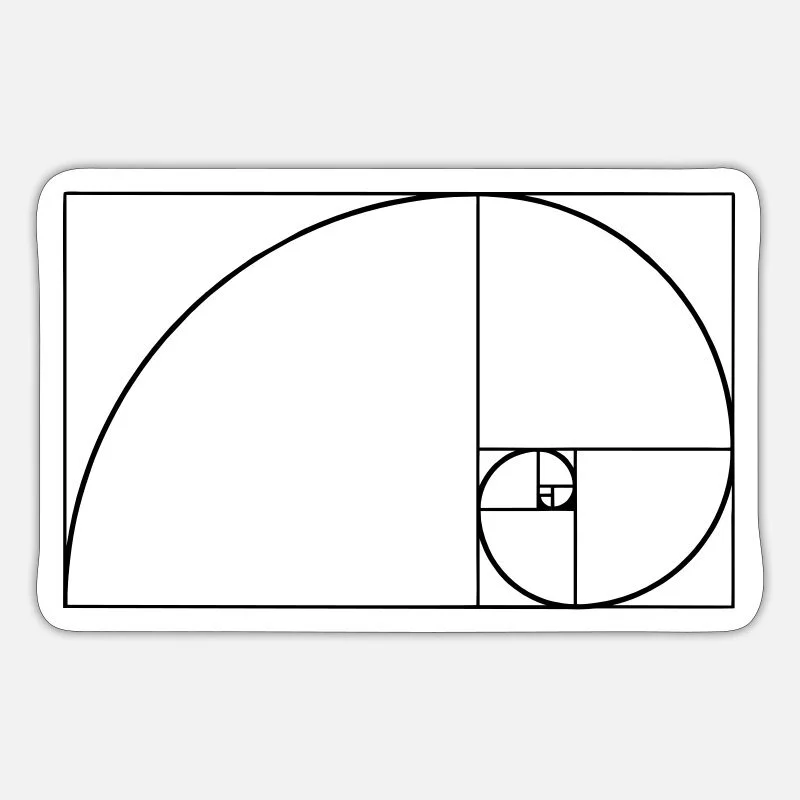
image sourceThe “Golden Ratio” corresponds to a rectangle where taking a square out of the rectangle leaves behind a smaller rectangle that is similar to the original rectangle. It is sometimes called the “Golden Mean.” Felicitously, the illustration above of the Golden Mean in action also provides a concave function, if you look at only the top of the curve..

image source

The “Golden Ratio” corresponds to a rectangle where taking a square out of the rectangle leaves behind a smaller rectangle that is similar to the original rectangle. It is sometimes called the “Golden Mean.” Felicitously, the illustration above of the Golden Mean in action also provides a concave function, if you look at only the top of the curve..

The Wikipedia article “Golden mean (philosophy)” currently begins:

The golden mean or golden middle way is the desirable middle between two extremes, one of excess and the other of deficiency. It appeared in Greek thought at least as early as the Delphic Maxim nothing to excess and emphasized in later Aristotelian philosophy

It gives the example of recklessness and cowardice as the two contrasting vices; courage is the golden mean between recklessness and cowardice.

Where there is a golden mean, we often have maxims that seem like opposites, but can be thought of as both pointing to the golden mean. Think of the two maxims “Haste makes waste” and “They who hesitate are lost.” Unfortunately, people often listen only to the maxim they interpret as advising going further toward an extreme rather than realizing that one is meant for other people; they should be paying most attention to the contrasting maxim that could tug them toward the golden mean.

In economics, the golden mean shows up as the idea that there is often an interior optimum when the objective function is concave.

Despite being trained in the use of concave functions in economics, I find myself often lapsing into the idea that if a little is good, then a lot must be better. That would be true if the objective function were linear, but it often isn’t. Moderation in all things!

Except that sometimes the objective function is linear, or close to linear. Here are two important examples (neither of which is original to me):

  1. Suppose the objective function is stated in terms of a probability, and your preferences are expected utility preferences. If there are two possible outcomes, you always want a higher probability of the better outcome. There is no gain to flipping a coin between the two outcomes to “get something in the middle.”

  2. Suppose you want to give money to charity out of pure altruism. You aren’t trying to look good; you aren’t trying to make yourself feel good; you are just trying to do the most good in the world. If you are thinking of giving to large charities for which the amount of money you are giving is small compared to the total funds used by that charity, the marginal benefit is essentially the same for the last dollar you give as for the first dollar you give. In this case, you should just go with whichever charity you think can do the most good with every extra dollar, without worrying that the benefit from an extra dollar will be affected by your giving.

These are important examples, but usually the objective function is concave and extremes are a bad idea.

The bulk of corner solutions, where it is the best choice to go to an edge are because the edge is not extreme at all. In cases where the edge is close in, there can be quite a bit of concavity, yet the corner solution still be the right answer. (The curve is bending to have a lower slope, but is still upward-sloping when you hit the boundary.) For example, unless you you think the covariance between what economists are paid and the stock market is not only positive, but quite high, you should put 100% of your retirement savings contributions into risky assets as a new assistant professor, because “extreme” is measured by the stock of risky assets you have relative to the value of your full wealth including your human capital. It will be a while before you accumulate enough in your retirement savings accounts for those accounts to be a big fraction of the present-discounted value of your lifetime labor income. That is, the stock/flow distinction combined with mentally integrating human capital into your portfolio means that 100% of the contribution flow in the first while toward risky assets isn’t really extreme at all. After you have accumulated quite a bit in your retirement savings account, then you can reassess.

Although I have only a few clients, I am a certified life coach. It makes me happy when economics can feed into life coaching—as in this concept of the Golden Mean.


Don’t Miss These Posts Related to Positive Mental Health and Maintaining One’s Moral Compass:

Paul Stametz: 6 Ways Mushrooms Can Save the World

Don’t miss my other post about mushrooms: “Replacing Meat with Mushrooms—In Whole or in Part.”

Also, you might be interested in Eugenia Bone’s Wall Street Journal review shown below of Finding the Mother Tree, by Suzanne Simard. The most interesting passage is this:

It has long been established that plants trade some of the sugar they make for micronutrients foraged in the soil by fungi, and there had already been some research done that showed the link between fungi and trees. Ms. Simard’s study discovered that fungi in fact attach to the roots of multiple trees of different species, creating pipelines by which a forest community might share nutrients and other molecules and thereby “challenge the prevailing theory that cooperation is of lesser importance than competition in evolution and ecology.”

Notice that in ecology they are clear the trade is a form of cooperation. Guess what: trade is a form of cooperation in economics as well!

I found the TED talk the title of this post links to from this passage:

… fungi as a metaphor for the common good.

This last notion derives from predominantly 21st-century research showing that the forest is not merely a collection of trees but a community connected by fungi. The idea has captured the imagination of the public, through movies such as “Avatar,” books like Peter Wohlleben’s “The Hidden Life of Trees” and the mycologist Paul Stamets’s TED talk, “Six Ways That Mushrooms Can Save the World,” which has been viewed almost 10 million times. 

Liz Cheney on Democracy and the Rule of Law

Link to the full text of Liz Cheney’s May 11, 2021 speech on the floor of the House of Representatives

For whatever length of time Donald Trump continues to have political influence, Liz Cheney’s six-and-a half-minute speech yesterday should be required viewing for all citizens of the United States.

I found myself getting choked up because she points powerfully to the blessing of having a political system that gives us freedom and our need to tend the foundations of that system.

In addition to invoking the principles of democracy and the rule of law, Liz Cheney also invokes many core principles of the Republican party. She bids fair to become the leader of the wing of the Republican Party not in bondage to Donald Trump.

Liz Cheney has shown a lot of courage. Challenging Donald Trump so directly may make it impossible for her to be reelected in Wyoming. She must have thought that through. Yet she went ahead anyway.

(Though Mitt Romney has also shown courage, I think the electoral danger is less for him than for Liz Cheney. The large contingent of Mormons in Utah are still very proud of Mitt as the first major party Mormon nominee for President of the United States. That gives him a floor of support even after bucking Donald Trump.)