Why We Want More Jobs
PODCAST BASED ON THIS POST CREATED BY GOOGLE’S NOTEBOOK LM

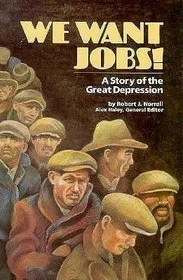
All I know of the book above is the cover. But it raises a good question: "Why do we want more jobs?" Inside the models taught in Principles of Economics, people don't want more jobs. In those models, if anyone worked any more, they would be working more than they wanted to. In those models, the firms and the government also think everyone is working just the right amount, too. Famously, some of those who believe too much in models along the lines of this taught in Principles of Economics argued that the Great Depression was caused by people suddenly deciding they hated working more than they used to—a story that seems at some variance with the narrative history of the Great Depression. So what is difference between the real world and those models that makes households, the government and firms all cheer when employment goes up? 

Before tackling the question, I need to clarify the question I have in mind. First, I think it is obvious why people who earn wages want high wages. That is not my question. My question is why we like the idea of more jobs even at the current wages. And firms that employ people dislike having to pay high wages, while most firms seem to like the idea of aggregate employment going up. 

Second, when I say we want more jobs, I am ignoring the effect of more jobs on inflation. The Fed could probably drive the unemployment rate down to 1% for a while, but if it tried to keep it there, for ten years, without any other policy change other than monetary policy, it is almost certain that inflation would go up, up and away into hyperinflation. So when I ask why we want more jobs, it is equivalent to asking why we wish that more jobs weren't so inflationary. If we didn't want more jobs, we wouldn't care if more jobs were inflationary, since on other accounts we didn't want more jobs anyway. But we do want more jobs, it is sad that having a lot of jobs would ultimately be quite inflationary.  
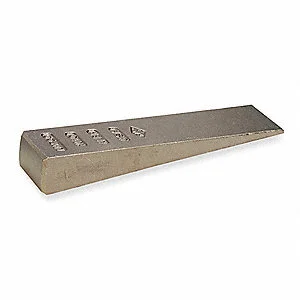
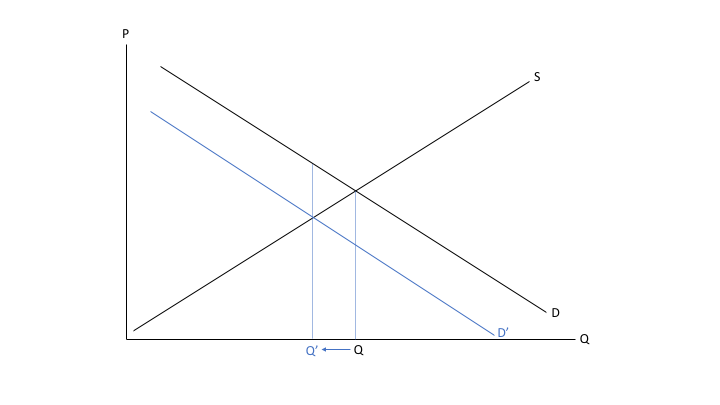
My answer boils down to three wedges. I might have titled this post "The Three Wedges," but then many potential readers would have no clue what it was about. Economists use the word "wedge" to describe a situation where some transactions that would make both parties better off don't happen because the buyer is being charged more than what something is worth to the seller. The simplest case is a tax wedge. Take a simple sales tax like the gasoline tax. If the seller is charged the tax, you could think of it is a shift in the supply curve, like this:

If the buyer is charged the sales tax, you could think of it as a shift in the demand curve, like this:
Slide2.png

But for same size tax, the effect is the same: the reduction in the quantity sold is the same, the amount the buyer ends up paying is the same, and the amount the seller ends up getting is the same. So regardless of who is paying the tax, economists like to think of the tax as a gap or "wedge" between the price the seller gets and the amount the buyer pays, like this:
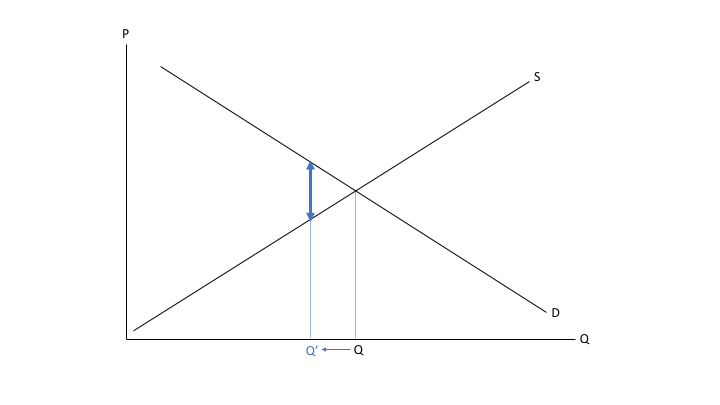
Once you get use to it, this is a much easier way to think about the effects of taxes than shifting the supply curve or demand curve. The two-sided blue arrow is the tax wedge. And the triangle formed by the two points of of that two-sided blue arrow and the intersection where things would be if there were no tax is the deadweight loss triangle. The deadweight loss triangle represents the value of the good transactions that don't happen because of the tax.  

If there are three wedges instead of one, then the situation looks like this: 
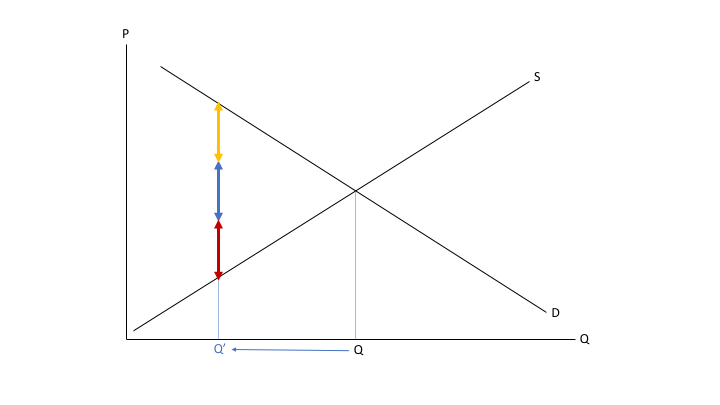
With three wedges, the quantity bought and sold goes down a lot more, and the deadweight loss triangle is much, much bigger. Typical formal macroeconomic models in the economics journals only deal with one of the wedges listed below at a time, and so miss how much bigger the issues are when one wedge piles on top of another. 

Here are the three wedges:

The Product Market Wedge: P > MC

To me, increasing returns to scale are central to macroeconomics. Three of my blog posts focus on this:

If it were just as efficient and productive to have one person working alone as to have big firms, everyone could be self-employed, and there would be no problem of unemployment. So increasing returns to scale is central to unemployment. Direct evidence of increasing returns to scale comes from the business world, where business people talk about having a fixed cost that can be spread over more units if they can increase the scale of their operations. I consider the kind of increasing returns to scale one gets from having a fixed cost and constant marginal cost quite reasonable. This yields an average cost curve that declines from a high value and ultimately gets very close to the flat average cost curve.
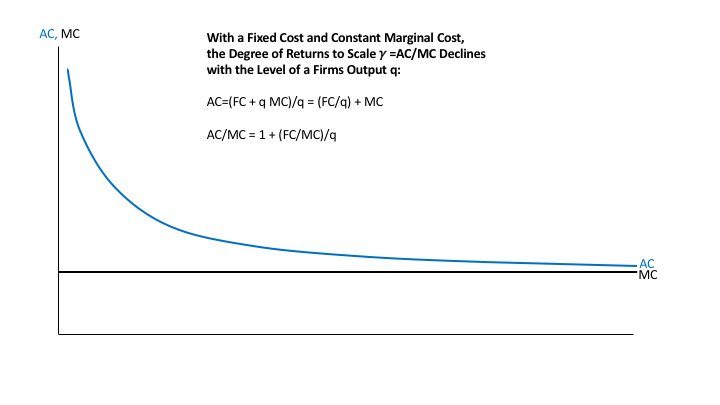
This, not the ridiculous U-shaped average cost curve, is what should be taught to students in their microeconomics classes. (See my Wakelet story "Is There Any Excuse for U-Shaped Average Cost Curves?")

As discussed in detail in "Returns to Scale and Imperfect Competition in Market Equilibrium" (and in "Next Generation Monetary Policy"), as long as there is free entry and exit of firms, increasing returns to scale goes hand in hand with imperfect competition. There is also direct evidence of imperfect competition. If a firm can raise the price of a product without losing every last customer, it faces imperfect competition. If a firm has to work hard to sell more at the same price, it faces imperfect competition. If a firm even is in the position of setting its own price at all, as opposed to just accepting a price determined on some exchange, then it faces imperfect competition. 

Under imperfect competition, when a firm adjusts its price, it should look for a price that, on average, is above its marginal cost. The graph for either a monopolist or a monopolistic competitor looks like this:
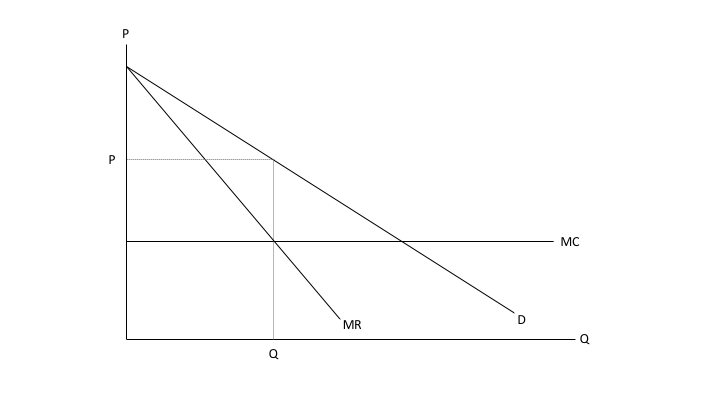
The marginal revenue curve shows how much the firm makes by selling an extra unit if it has to cut its prices overall in order to sell an extra unit

Now think of the firm's situation in the short run when it doesn't adjust its price. To be concrete, suppose it costs a firm $1.60 to produce a widget, but the firm sells a widget for $2. In that situation, a firm makes extra profit of 40 cents on every extra widget it sells if it didn't have to make any effort to sell that widget. As mentioned above, if it had to cut its prices to sell an extra widget, that doesn't get the firm ahead. And if it has to pay for advertising to sell an extra widget, that might not be so attractive. But if the economy as a whole heats up so that the firm sells an extra widget without any extra effort, that is going to look great to the firm:
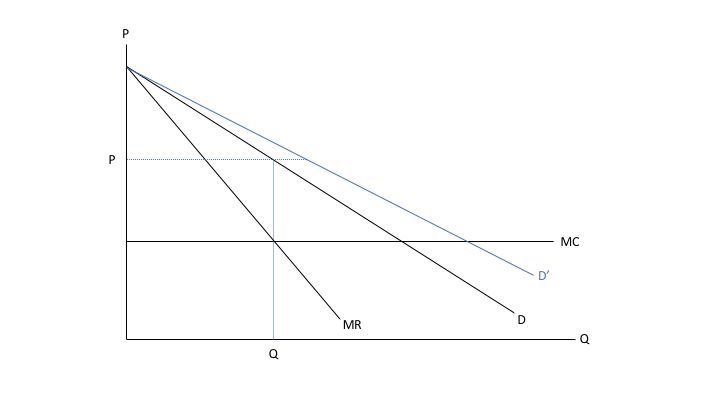
This is an example of the firm being able to sell more widgets without extra effort, and make 40 cents on each extra widget it sells. So on this account, the firm is happy about the economy heating up. If wages get pushed up, that is good for the workers and bad for the firm. But leaving that aside, the firm cheers any increase in aggregate demand because of the extra profit that goes along with higher sales. 

The Firm's Willingness to Pay for Labor: To translate from the price and marginal cost of widgets to the value of what a worker produces and what the firm is willing to pay, imagine that an extra hour of work leads to 10 extra widgets being produced. Then at $2 per widget, the value of the extra production from an extra hour of work is $20: the price times the 10 widgets per hour marginal physical product of labor. But since selling the extra widgets would require cutting the price of widgets or advertising, the firm only nets $1.60 in marginal revenue after cutting prices to sell an extra widget, so it is only willing to pay $16 an hour: the marginal revenue of $1.60 a widget times the 10 widgets per hour marginal physical product of labor.

(Actually, although this is usually called the marginal revenue product, when marginal revenue is equal to marginal cost, one can also call this the "marginal cost product." And in the short-run when prices are sticky it is the marginal cost product (the marginal cost times the marginal physical product of labor), not the marginal revenue product (marginal revenue times the marginal physical product of labor) that matters. Indeed, while a price is sticky, marginal revenue doesn't do anything at all. Marginal revenue only matters when a firm is in the process of adjusting its price. So it would be odd if marginal revenue product mattered while a firm has a temporarily fixed price. It doesn't. While a firm has a temporarily fixed price, it is the marginal cost product that tells how much a firm is willing to pay a worker.) 

The Marginal Tax Rate Wedge

Since I started explaining the idea of wedges by talking about tax wedges, it shouldn't be hard to understand the marginal tax rate wedge. I have in mind taxes like social security taxes where the total amount of tax goes up with one's total labor income or income taxes that go up with one's total income, including labor income. It is very important here to distinguish between a lump-sum tax that may be painful, but doesn't get any worse if one works more, and something like social security wage taxes or a general income tax that goes up if one works more. (See “How Marginal Tax Rates Work” and the links it has at the bottom of the post.)

Suppose that, combining both the firm's and worker's social security taxes and income taxes, the marginal tax rate for an extra hour of work is 25%. Then the firm is willing to pay $16 an hour, but after all those taxes, if the firm shells out $16 an hour, the worker gets 25% less: only $12 an hour. $4 an hour goes to the government through the IRS.

This is now the second reason we want more jobs. When there are more jobs, there is more government revenue. That means the government can pay off the debt, provide more public goods or transfers, or cut taxes: all good things. People may disagree about what to do with the extra government revenue, but something desirable is likely to happen. So when aggregate demand goes up, the government and the taxpayers and those who benefit from government purchases and transfers cheer.  

The Labor Market Wedge

The most difficult of all the wedges to suss out is the labor market wedge. We don't fully understand it, but we know it is there. How? Even at the after-tax wages on offer after the firm worries about the difficulty of selling more goods and the government takes its cut, workers are happy to get jobs

In the example I have been laying out, suppose that someone is happy to get the $16 an hour job that nets $12 an hour after taxes. If they are happy to get the job, rather than just feeling meh about it, what they are giving up—namely, the cool things they could be doing at home or out and about—must be worth less than $12 an hour to them. To be concrete, let's say the opportunity cost of their time is $8. Then, the social marginal benefit of an hour of their work is $20, while the social marginal cost of an hour of their work is only $8. If they work an extra hour due to extra aggregate demand, society as a whole is $12 ahead:

  • the firm is $4 an hour ahead due to extra profits

  • the government and taxpayers are $4 an hour ahead due to extra government revenue

  • the worker is $4 an hour ahead due to the $12 an hour after-tax wage being higher than the $8 an hour opportunity cost of time

These are all good reasons for us to want more jobs. 

Why would a firm stop hiring with an after-tax wage of $12 an hour instead of hiring more workers at a lower wage when workers might be willing to work for $8 an hour? One possibility is wages kept up by a minimum wage or a wage a union insists on. Another possibility is that a wage higher than the opportunity cost of time is necessary to induce workers to go through the arduous process of searching for a job. But my favorite explanation is efficiency wages: higher wages make a job valuable, so the worker has something to lose if they get fired. So higher wages give workers an incentive to do what the boss tells them to. I discuss this in detail in "Janet Yellen is Hardly a Dove—She Knows the US Economy Needs Some Unemployment." 

The Bottom Line

Higher aggregate demand that raises sales and employment makes profits, government revenue, and household utility go up. So what's not to like? Inflation. Unfortunately, the three wedges mean that extra output and the jobs the extra output brings become inflationary long before we are at the level of jobs we would otherwise like to have. Firms pushing price above marginal cost makes output inflationary sooner. Taxes that go up with income make output inflationary sooner. And anything that pushes wages above the bare minimum people needed to get people to work makes output inflationary sooner. 

Inflation—and not just a little inflation, but the specter of hyperinflation—is the threat that enforces supply-side relationships. By supply-side relationships, I mean simply the real equations that determine the medium-run equilibrium and the long-run equilibrium of the economy. On these ideas, see "The Deep Magic of Money and the Deeper Magic of the Supply Side" and "The Medium-Run Natural Interest Rate and the Short-Run Natural Interest Rate."

There are many things that can be done to get output and employment closer to the ideal level and get the extra jobs we want:

  • antitrust to reduce the degree of imperfect competition and get prices down closer to marginal cost

  • lower marginal tax rates to make what workers get after taxes closer to what firms pay

  • ways of putting the fear of the boss into workers or getting workers to work hard on the job that don't depend on losing a job being a terrible thing for the worker

There are also policies to raise productivity for a given number of work hours and so have a bigger pie. Prominent among these is government funding of basic research, which could easily be worth the extra distortion from somewhat higher taxes if it was funded by the income tax. 

But none of these are monetary policy. Close to the best that monetary policy can do is to keep output at the "natural" level of jobs that is neither inflationary nor disinflationary. The natural level of jobs is below the ideal level of jobs in the absence of inflationary worries. But it is sustainable, where the otherwise ideal level of jobs is not. And it is likely to be better than the other sustainable policy of sometimes having more jobs than the natural level and sometimes having fewer. That policy is likely to have such a big deadweight loss triangle when jobs are fewer, that it isn't worth it, even though it is nice to sometimes have more jobs. You can see more on this in this Powerpoint file.

Conclusion

Many macroeconomics courses fail to ever explain our intuition that it would be good to have more jobs. The feeling that it would be good to have more jobs is so basic to the real world, a macroeconomics course that fails in this respect fails in an important way. I hope this post helps fill the gap. 

Postscript, added March 20, 2020

The three wedges above all make us want more jobs. Is there anything that could make us want fewer jobs if it were bigger than all the three wedges above combined? Theoretically yes, if the activities of those jobs would create large negative environmental externalities that are not taken into account by firms and households. Fortunately, if this is the case, there are policy remedies. For examples, see “How to Fight Global Warming.”

Gary Taubes Makes His Case to Nick Gillespie: How Big Sugar and a Misguided Government Wrecked the American Diet

Update: My views on Gary Taubes have evolved. In the list of links to related posts at the bottom, I have a section on other posts about Gary Taubes and his work, most notably “Vindicating Gary Taubes: A Smackdown of Seth Yoder.”

The video above is an excellent interview of Gary Taubes by Nick Gillespie. I recommend it to anyone looking for inspiration to begin a more effective weight-loss program. The text of the interview appeared as the Reason article "Meet the Man Who Hated Carbs Before It Was Cool: Gary Taubes on how big sugar and big government wrecked the American diet."

Nick Gillespie makes Gary Taubes look good, and I find myself agreeing with everything Gary Taubes says in this interview. But that is not because I agree with everything Gary Taubes says in general.  In my post "The Case Against Sugar: Stephan Guyenet vs. Gary Taubes," I gave this summary of my views on Taubes:


... whatever the flaws in Gary Taubes's books, he is ultimately convincing on two points: 

  • Sugar is very, very bad. I will say more below on why convincing people of that is an important accomplishment.

  • What the nutrition establishment is telling us needs to be closely examined and cross-checked by scientists outside the nutrition establishment. It is very unwise to simply trust the nutrition establishment.


In my later post "The Case Against the Case Against Sugar: Seth Yoder vs. Gary Taubes," I added this:

Seth Yoder, in his post "The Case Against the Case Against Sugar" fully convinced me that Gary Taubes displays a serious lack of reportorial honesty in his book The Case Against Sugar. And Seth somehow made reading through the trainwreck of how Gary Taubes routinely misquotes or otherwise misrepresents dead people's views perversely entertaining. 

In "The Case Against the Case Against Sugar: Seth Yoder vs. Gary Taubes" I walk through a reevaluation of every post in which I had relied on what Gary Taubes had said. But I neglected to put a note about my new qualms about Gary Taubes in my earlier post "Salt Is Not the Nutritional Evil It Is Made Out to Be." That led to this interesting exchange in the comments section: 

Michael: Hi Miles. l used to follow you ~five years ago but fell out of the blogosphere. l have recently returned to twitter and came across some of your writings again. l was particularly intrigued by your health focused research as of late. However, as someone who really respects your economic opinions (and follows nutritional / longevity research pretty closely), you really should stop paying attention to hyper-sensationalist authors like Taubes. l am truly astounded to hear that that such a praiseworthy, truth-discerning economist such as yourself would even bother reading anything he publishes. Never mind endorse and promote his work... Look, l understand that health may not be your forte and that your biology background may be weak, but for the love of God, read anyone but Taubes. I'm honestly surprised the haughty, agenda driven style that Taubes espouses didn't set off any alarm bells for you. And also...citing WebMD? Come on, Miles, you know you're better than that. Really just shows that you are way out of your depth here with anything health / medicine related. l certainly don't think you're too stupid to tackle health issues. Far from it actually. But maybe spend some time reading cell biology / biochemistry books before you dive any further. Because this honestly all reads like bitcoin maximalists writing pet-theories about economics / finance / investment advice: people with no background in an area writing somewhat convincing arguments at the surface that just really hold little water when scrutinized by people with actual grasps on the topics.

You can continue to blog about health. Just maybe keep those thoughts to yourself until you’ve fortified your biology background a bit. Then you can open it up to the public. Because Honestly, citing Taubes taints all of the other interesting other work you’ve done in your actual field.

I’m not sure what the fascination is with economists moving into health (probably because epidemiology and such is "easy" work and does not really require much background biology), but you guys really have to stop speaking so authoritatively about it. Especially when you are referencing wikipedia…Not because wikipedia is wrong per se, but because it shows you are engaging with such limited material (in comparison to, say, Pub Med).

Anyway, l hope this was more enlightening than it was offensive. If you want to follow a health nut on the internet, go with someone like Rhonda Patrick or researcher Valter Longo over Taubes and Fung. Fung isn’t awful, he is just too much of keto acolyte for my taste. Looking forward to your future entries on health and disease.


Miles:  I trash Gary Taubes [in] The Case Against the Case Against Sugar: Seth Yoder vs. Gary Taubes and distance myself from Gary Taubes while defending him as much as is possible (which isn't much) here: The Case Against Sugar: Stephan Guyenet vs. Gary Taubes So on Gary Taubes, I agree.

On issues of diet and health more generally, I am delighted to have people correct me where I am wrong, but I plan to keep writing about what I am thinking along the road of my intellectual journey in this area.

That is the same standard I apply to others. I never say "Stay silent until you have studied economics for a couple more years; then come back and talk to me." I say "What you said was wrong for this reason." Or sometimes I say "You're right."

On that last point, below here I am in the comment section of "Carola Binder: The Obesity Code and Economists as General Practitioners" telling a different commenter he is wrong. The topic is one where I am I am on the same page as Gary Taubes. In the right hands, calories in/calories out can be a useful identity for thinking about technical scientific issues, but it is a bust as an instrument for public health education.

mike: Ultimately the biggest reason your fat cells have their fat metabolized is the body needs energy ... and because there isn't enough from food it undergoes lipolysis (fat burning) to get more energy and atp...and the reason is their is a net caloric deficit :)

basically as you state calories in are easier to be less than calories out when you fast and go low carb... I am fine with that formulation, but the basic means is simply energy deficit. let semantics continue on.

Miles:  As Carola reinforces, calories in/calories out is a true identity, but it is not much of an explanation of anything. The big questions are (a) Why are calories in what they are? (b) Why are calories out what they are? (c) OK, so calories in are less than calories out, how good or bad does the individual feel in that calorie deficit situation? (d) What are the side effects of a particular way of getting to that calorie deficit situation[?]

The implicit answers for many people's thinking are (a) It is a matter of psychology what people eat. (b) Activity levels, such as how much people exercise is the only thing that matters for calories out. (c) There is no way to have a significant calorie deficit without suffering. (d) The way to undesirable side effects of a calorie deficit is to have regular meals but have the overall number of calories restricted.

All of these 4 answers are wrong.

To learn more about why, see these other posts on diet and health and on fighting obesity:

I. The Basics

II. Sugar as a Slow Poison

III. Anti-Cancer Eating

IV. Eating Tips

V. Calories In/Calories Out

VI. Wonkish

VIII. Debates about Particular Foods and about Exercise

IX. Gary Taubes

X. Twitter Discussions

XI. On My Interest in Diet and Health

See the last section of "Five Books That Have Changed My Life" and the podcast "Miles Kimball Explains to Tracy Alloway and Joe Weisenthal Why Losing Weight Is Like Defeating Inflation." If you want to know how I got interested in diet and health and fighting obesity and a little more about my own experience with weight gain and weight loss, see “Diana Kimball: Listening Creates Possibilities and my post "A Barycentric Autobiography.


The Shards of My Heart

"Wolf," by Spencer Miles Kimball, 2008If you want to use this image for any purpose, you need to include a link back to www.resilienceconspiracy.com, where the original of this post can be found.

"Wolf," by Spencer Miles Kimball, 2008

If you want to use this image for any purpose, you need to include a link back to www.resilienceconspiracy.com, where the original of this post can be found.

My wife Gail has appeared in one previous guest post, "Marriage—Not for the Faint of Heart." In this post below, she beautifully and poignantly addresses the death of our son Spencer by suicide—a topic I haven't known how to broach on this blog. I have referenced his death obliquely with posts about depression around the anniversary of the day of his death, and on one such occasion a post with my science fiction story "Ragnarok" that Spencer encouraged me to complete. 

Spencer still has a blog of his own in existence. He is the author of a book of poetry, You Owe Me This, published by Redbeard Press, which was named after Spencer's red beard. You can see the book here. 

Gail's words below first appeared on her blog The Resilience Conspiracy, at resilienceconspiracy.com


On September 21, 2009, our son Spencer wrote a suicide note and overdosed on his antidepressants.  He soon thought better of this and called his girlfriend who summoned both an ambulance and his parents.  We rushed to Spencer's side in the emergency room.  He was still alert enough to tell us he was sorry.  Hours went by as the overworked emergency room staff researched what to do for the particular antidepressant cocktail Spencer had taken.  

We eventually left his bedside that evening feeling gut-punched by Spencer's choice, but certain he would live.  We were wrong.  On Saturday, September 26th, after spending five days in a medically induced coma, Spencer's temperature soared due to the massive amount of serotonin from his antidepressants.  Spencer died that evening.  He was 20 years old.

Our daughter, Diana, wrote of her brother:  "Spencer was a writer and a poet. Music and reading were his solace and joy.  He believed in the power of fiction and the elegance of truth. He loved his family and his friends fiercely, and was loyal to a fault." He was all of this, and he was our beloved son. 

When you have a child you have a visceral, nearly cellular urge to keep them from harm's way. You protect them from open stairways, busy streets, head injuries, angry siblings, stray dogs, poison ivy, and sunburn.  It is one of the horrible truths of death by suicide that the victim is also the perpetrator.   When someone dies young, blame comes into play and we lean into explanations extra hard for solace and closure.  When your child dies by their own choice, where do you place the blame?

I felt my heart was shattered, sharp shards of it waiting to bring fresh wounds any time I thought about Spencer.  Endless "What ifs?" became my thought companions during a siege of chronic insomnia that still troubles me to this day. I am grateful for a good therapist, great friends, and a life companion who has suffered with me and held onto me when I was in danger of drowning in our shared sorrow. 

Grief is a beast.  It howls and tears at your equilibrium. When it's not active, you feel its presence next to you and you become afraid to wake it.  Will its next active phase unmoor you once again? The answer is always, yes.  It will unmoor you and send you flailing after answers and stable ground on which to stake your intentions and hopes.  

Grief is a gift, wrapped in the worst possible package. It shows you who you are, and teaches you lessons you would never have learned otherwise. Your compassion for others is magnified. Your understanding of what motivates people sharpens. You are grateful for small wonders and embrace happy moments as never before, because you know—you are absolutely clear about this—that you must celebrate when you can and while you can. Grief has taught you not to take these moments for granted.  You become an open invitation for wonder.

Spencer would have turned 29 years old on April 21st. I wonder, as you might expect, what he would be doing if he had lived. He would have loved some of the movies that have come out since 2009.  He would have loved many of the books that have been written.  I would have loved to read the books he could have written.

A few weeks ago Miles and I took a piece of art to be framed.  I told the framer that our son, Spencer, who had died too young, had made this piece. For many years after his death, and through a move from Michigan to Colorado I could not look at this piece without feeling undone. Miles and I are ready to look at it now.

Instead of the searing pain it once caused, I look into the yellow eyes of the wolf and see a fierce desire.  Depression robs its victims of so much. In this piece, Spencer created a watchful, knowing creature with a question I'm ready to hear:  How will you live your life bravely, authentically, and truthfully?

I begin by picking up the shards of my heart and owning the shattered aspect, the lessons of the fissures that will never go away.  

Why You Should Worry about Cancer Promotion by Diet as Much as You Worry about Cancer Initiation by Carcinogens

Many people are obsessed with avoiding carcinogens. But what makes cancers grow may be just as important as what gets cancer started. T. Colin Campbell and Thomas M. Campbell II argue that what food we eat can make a difference for how well cancer grows.

In this post, I don't want to put too much emphasis on the particular dietary danger they discuss; I mainly want to emphasize that what fuels the growth of cancer is just as important a question as what gets cancer started. Let me quote from Chapter 3, of their book The China Study: "Turning Off Cancer." First, on pages 40 and 41, they delineate three stages of cancer: initiation, promotion, and progression.

Cancer proceeds through three stages: initiation, promotion, and progression. To use a rough analogy, the cancer process is similar to planting a lawn. Initiation is when you put the seeds in the soil, promotion is when the grass starts to grow, and progression is when the grass gets completely out of control, invading the driveway, the shrubbery, and the sidewalk. So what is the process that successfully “implants” the grass seed in the soil in the first place—that is, initiates cancer-prone cells? Chemicals that do this are called carcinogens. These chemicals are most often the by-products of industrial processes, although small amounts may be formed in nature, as is the case with aflatoxin. ...

At this point in our lawn analogy, the grass seeds have been put in the soil and are ready to germinate. Initiation is complete. The second growth stage is called promotion. Like seeds ready to sprout blades of grass and turn into a green lawn, our newly formed cancer-prone cells are ready to grow and multiply until they become a visibly detectable cancer. This stage occurs over a far longer period of time than initiation, often many years for humans. It is when the newly initiated cluster multiplies and grows into larger and larger masses and a clinically visible tumor is formed. But just like seeds in the soil, the initial cancer cells will not grow and multiply unless the right conditions are met. The seeds in the soil, for example, need a healthy amount of water, sunlight, and other nutrients before they make a full lawn. If any of these factors are denied or are missing, the seeds will not grow. If any of these factors are missing after growth starts, the new seedlings will become dormant, while awaiting further supply of the missing factors. This is one of the most profound features of promotion. Promotion is reversible, depending on whether the early cancer growth is given the right conditions in which to grow. This is where certain dietary factors become so important. These dietary factors, called promoters, feed cancer growth. Other dietary factors, called anti-promoters, slow cancer growth. Cancer growth flourishes when there are more promoters than anti-promoters; when anti-promoters prevail, cancer growth slows or stops. It is a push-pull process. The profound importance of this reversibility cannot be overemphasized. The third phase, progression, begins when a bunch of advanced cancer cells progress in their growth until they have done their final damage. It is like the fully grown lawn invading everything around it: the garden, driveway, and sidewalk. Similarly, a developing cancer tumor may wander away from its initial site in the body and invade neighboring or distant tissues. When the cancer takes on these deadly properties, it is considered malignant. When it actually breaks away from its initial home and wanders, it is metastasizing. This final stage of cancer results in death.

Second, from pp. 46-48, some results of rat experiments:

Foci are precursor clusters of cells that grow into tumors. Although most foci do not become full-blown tumor cells, they are predictive of tumor development. By watching foci develop and measuring how many there are and how big they become, we could learn indirectly how tumors also develop and what effect protein might have. By studying the effects of protein on the promotion of foci instead of tumors, we could avoid spending a lifetime and a few million dollars working in the lab. ...

Animals starting with the most cancer initiation (high-aflatoxin dose) developed substantially less foci when fed the 5% protein diet. In contrast, animals initiated with a low-aflatoxin dose actually produced substantially more foci when subsequently fed the 20% protein diet. A principle was being established. Foci development, initially determined by the amount of the carcinogen exposure, is actually controlled far more by dietary protein consumed during promotion. Protein during promotion trumps the carcinogen, regardless of initial exposure. ...

The most significant finding of this experiment was this: foci developed only when the animals met or exceeded the amount of dietary protein (12%) needed to satisfy their body growth rate. That is, when the animals met and surpassed their requirement for protein, disease onset began.

It is very difficult to reduce exposure to carcinogens to zero. So most of us have or have had cells with the potential to bloom into cancer. The decisive difference between getting full-blown cancer may come from providing cancers with an abundance of their favorite nutrients. We had better get the research done to figure out exactly what is most nutritious to cancer. It is especially valuable if we can identify nutrients that are much more important to cancer than to the normal workings of the body. I discuss this idea more in these two posts:


Don't miss these other posts on diet and health and on fighting obesity:

Also see the last section of "Five Books That Have Changed My Life."


John Locke's Smackdown of Robert Filmer: Being a Father Doesn't Make Any Man a King

In many economic departments, there is a sense that professors who publish many papers in good journals should have extra weight in department decision-making. But research and strategic vision and good sense are different skills. I wouldn't be surprised if they are positively correlated skills. But there are many impressive researchers whose views on department decisions should be politely disregarded most of the time. John Locke argued that the consent of the governed, not any other attribute, makes someone a legitimate ruler. In department politics, that means a legitimate leader is someone who either canvasses other members of the department to see what they want and effectively aggregates those desires, or someone who genuinely persuades other members of the department of the wisdom of a course of action. 

In John Locke's own day, he had to fight the idea promoted by Robert Filmer that a divine right of kings had been passed down from Adam and that fatherly authority was not only a good model for kingship but a solid basis for it. But fatherhood and kingship are not the same thing at all. In Chapter VI, "Of Paternal Power" in his 2d Treatise on Government: “Of Civil Government”, John Locke does a good job in criticizing Robert Filmer's claims. 

First, John Locke relied on the sexism of his audience back then to recoil at the parallel idea that the right to rule was based on motherhood. This line of argument can be seen in sections 52 and 53, as I discussed here:

 It can be seen again in sections 64 and 65 and later on in the chapter on paternal power:


 §. 64. But what reason can hence advance this care of the parents due to their offspring into an absolute arbitrary dominion of the father, whose power reaches no farther than by such a discipline, as he finds most effectual, to give such strength and health to their bodies, such vigour and rectitude to their minds, as may best fit his children to be most useful to themselves and others; and, if it be necessary to his condition, to make them work, when they are able, for their own subsistence. But in this power the mother too has her share with the father.

  §. 65. Nay, this power so little belongs to the father by any peculiar right of nature, but only as he is guardian of his children, that when he quits his care of them, he loses his power over them, which goes along with their nourishment and education, to which it is inseparably annexed; and it belongs as much to the foster-father of an exposed child, as to the natural father of another. So little power does the bare act of begetting give a man over his issue; if all his care ends there, and this be all the title he hath to the name and authority of a father. And what will become of this paternal power in that part of the world, where one woman hath more than one husband at a time? or in those parts of America, where, when the husband and wife part, which happens frequently, the children are all left to the mother, follow her, and are wholly under her care and provision? If the father die whilst the children are young, do they not naturally every where owe the same obedience to their mother, during their minority, as to their father were he alive? and will any one say, that the mother hath a legislative power over her children? that she can make standing rules, which shall be of perpetual obligation, by which they ought to regulate all the concerns of their property, and bound their liberty all the course of their lives? or can she inforce the observation of them with capital punishments? for this is the proper power of the magistrate, of which the father hath not so much as the shadow. His command over his children is but temporary, and reaches not their life or property: it is but a help to the weakness and imperfection of their non-age, a discipline necessary to their education: and though a father may dispose of his own possessions as he pleases, when his children are out of danger of perishing for want, yet his power extends not to the lives or goods, which either their own industry, or another’s bounty has made their’s; nor to their liberty neither, when they are once arrived to the infranchisement of the years of discretion. The father’s empire then ceases, and he can from thence forwards no more dispose of the liberty of his son, than that of any other man: and it must be far from an absolute or perpetual jurisdiction, from which a man may withdraw himself, having licence from divine authority to leave father and mother, and cleave to his wife.


In sections 66-70, John Locke distinguished between the duty of "honoring one's parents," which he endorses, and any duty of obedience to parents, which he denies that adult children have:   


§. 66. But though there be a time when a child comes to be as free from subjection to the will and command of his father, as the father himself is free from subjection to the will of any body else, and they are each under no other restraint, but that which is common to them both, whether it be the law of nature, or municipal law of their country; yet this freedom exempts not a son from that honour which he ought, by the law of God and nature, to pay his parents. God having made the parents instruments in his great design of continuing the race of mankind, and the occasions of life to their children: as he hath laid on them an obligation to nourish, preserve, and bring up their offspring; so he has laid on the children a perpetual obligation of honouring their parents, which containing in it an inward esteem and reverence to be shewn by all outward expressions, ties up the child from any thing that may ever injure or affront, disturb or endanger, the happiness or life of those from whom he received his; and engages him in all actions of defence, relief, assistance and comfort of those, by whose means he entered into being, and has been made capable of any enjoyments of life: from this obligation no state, no freedom can absolve children. But this is very far from giving parents a power of command over their children, or an authority to make laws and dispose as they please of their lives or liberties. It is one thing to owe honour, respect, gratitude and assistance; another to require an absolute obedience and submission. The honour due to parents, a monarch in his throne owes his mother; and yet this lessens not his authority, nor subjects him to her government.

  §. 67. The subjection of a minor places in the father a temporary government, which terminates with the minority of the child: and the honour due from a child places in the parents a perpetual right to respect, reverence, support and compliance too, more or less, as the father’s care, cost, and kindness in his education, has been more or less. This ends not with minority, but holds in all parts and conditions of a man’s life. The want of distinguishing these two powers, viz. that which the father hath in the right of tuition,during minority, and the right of honour all his life, may perhaps have caused a great part of the mistakes about this matter: for to speak properly of them, the first of these is rather the privilege of children, and duty of parents, than any prerogative of paternal power. The nourishment and education of their children is a charge so incumbent on parents for their children’s good, that nothing can absolve them from taking care of it: and though the power of commanding and chastising them go along with it, yet God hath woven into the principles of human nature such a tenderness for their offspring, that there is little fear that parents should use their power with too much rigour; the excess is seldom on the severe side, the strong bias of nature drawing the other way. And therefore God Almighty when he would express his gentle dealing with the Israelites, he tells them, that though he chastened them, he chastens them as a man chastens his son, Deut. viii. 5. i. e.with tenderness and affection, and kept them under no severer discipline than what was absolutely best for them, and had been less kindness to have slackened. This is that power to which children are commanded obedience, that the pains and care of their parents may not be increased, or ill rewarded.

  §. 68. On the other side, honour and support, all that which gratitude requires to return for the benefits received by and from them, is the indispensible duty of the child, and the proper privilege of the parents. This is intended for the parent’s advantage, as the other is for the child’s; though education, the parent’s duty, seems to have most power, because the ignorance and infirmities of childhood stand in need of restraint and correction; which is a visible exercise of rule, and a kind of dominion. And that duty which is comprehended in the word honour requires less obedience, though the obligation be stronger on grown, than younger children; for who can think the command, Children obey your parents, requires in a man, that has children of his own, the same submission to his father, as it does in his yet young children to him; and that by this precept he were bound to obey all his father’s commands, if, out of a conceit of authority, he should have the indiscretion to treat him still as a boy?

  §. 69. The first part then of paternal power, or rather duty, which is education, belongs so to the father, that it terminates at a certain season; when the business of education is over, it ceases of itself, and is also alienable before: for a man may put the tuition of his son in other hands; and he that has made his son an apprentice to another, has discharged him, during that time, of a great part of his obedience both to himself and to his mother. But all the duty of honour, the other part, remains nevertheless entire to them; nothing can cancel that: it is so inseparable from them both, that the father’s authority cannot dispossess the mother of this right, nor can any man discharge his son from honouring her that bore him. But both these are very far from a power to make laws, and inforcing them with penalties, that may reach estate, liberty, limbs and life. The power of commanding ends with non-age; and though, after that, honour and respect, support and defence, and whatsoever gratitude can oblige a man to, for the highest benefits he is naturally capable of, be always due from a son to his parents; yet all this puts no sceptre into the father’s hand, no sovereign power of commanding. He has no dominion over his son’s property, or actions; nor any right, that his will should prescribe to his son’s in all things; however it may become his son in many things, not very inconvenient to him and his family, to pay a deference to it.

  §. 70. A man may owe honour and respect to an ancient, or wise man; defence to his child or friend; relief and support to the distressed; and gratitude to a benefactor, to such a degree, that all he has, all he can do, cannot sufficiently pay it: but all these give no authority, no right to any one, of making laws over him from whom they are owing. And it is plain, all this is due not only to the bare title of father; not only because, as has been said, it is owing to the mother too; but because these obligations to parents, and degrees of what is required of children, may be varied by the different care and kindness, trouble and expence, which is often employed upon one child more than another.


In section 71, John Locke points out that many fathers are not kings, and yet have whatever authority over children is proper to being a father:


  §. 71. This shews the reason how it comes to pass, that parents in societies, where they themselves are subjects, retain a power over their children, and have as much right to their subjection, as those who are in a state of nature. Which could not possibly be, if all political power were only paternal, and that in truth they were one and the same thing: for then, all paternal power being in the prince, the subject could naturally have none of it. But these two powers, political and paternal, are so perfectly distinct and separate; are built upon so different foundations, and given to so different ends, that every subject, that is a father, has as much a paternal power over his children, as the prince has over his: and every prince, that has parents, owes them as much filial duty and obedience, as the meanest of his subjects do theirs; and can therefore contain not any part or degree of that kind of dominion, which a prince or magistrate has over his subject.


Then in section 72, John Locke turns economist, presaging Doug Bernheim, B. Douglas, Andrei Shleifer, and Larry Summers's 1985 paper “The Strategic Bequest Motive,” by pointing out that adult children may obey their parents in hopes of getting more of an inheritance: 


  §. 72. Though the obligation on the parents to bring up their children, and the obligation on children to honour their parents, contain all the power on the one hand, and submission on the other, which are proper to this relation, yet there is another power ordinarily in the father, whereby he has a tie on the obedience of his children; which though it be common to him with other men, yet the occasions of shewing it, almost constantly happening to fathers in their private families, and the instances of it elsewhere being rare, and less taken notice of, it passes in the world for a part of paternal jurisdiction. And this is the power men generally have to bestow their estates on those who please them best; the possession of the father being the expectation and inheritance of the children, ordinarily in certain proportions, according to the law and custom of each country; yet it is commonly in the father’s power to bestow it with a more sparing or liberal hand, according as the behaviour of this or that child hath comported with his will and humour.


In section 73, he points out that inheritance of property is the source of an important illusion about political duties being inherited:


  §. 73. This is no small tie on the obedience of children: and there being always annexed to the enjoyment of land, a submission to the government of the country, of which that land is a part; it has been commonly supposed, that a father could oblige his posterity to that government, of which he himself was a subject, and that his compact held them; whereas, it being only a necessary condition annexed to the land, and the inheritance of an estate which is under that government, reaches only those who will take it on that condition, and so is no natural tie or engagement, but a voluntary submission: for every man’s children being by nature as free as himself, or any of his ancestors ever were, may, whilst they are in that freedom, choose what society they will join themselves to, what commonwealth they will put themselves under. But if they will enjoy the inheritance of their ancestors, they must take it on the same terms their ancestors had it, and submit to all the conditions annexed to such a possession. By this power indeed fathers oblige their children to obedience to themselves, even when they are past minority, and most commonly too subject them to this or that political power, but neither of these by any peculiar right of fatherhood, but by the reward they have in their hands to inforce and recompense such a compliance; and is no more power than what a French man has over an English man, who, by the hopes of an estate he will leave him, will certainly have a strong tie on his obedience: and if, when it is left him, he will enjoy it, he must certainly take it upon the conditions annexed to the possession of land in that country where it lies, whether it be France or England.


Finally, at the end of the chapter on paternal power, John Locke has to admit that in small groups, fathers are often chosen as chiefs by the consent of the governed, so that fatherhood is sometimes correlated with governing power even over adult children. But the fact that children sometimes consent to be governed by their fathers or grandfathers even in adulthood does not alter the logical distinction between being a father and being a ruler. 


  §. 74. To conclude then, though the father’s power of commanding extends no farther than the minority of his children, and to a degree only fit for the discipline and government of that age; and though that honour and respect, and all that which the Latins called piety, which they indispensibly owe to their parents all their life time, and in all estates, with all that support and defence is due to them, gives the father no power of governing, i. e. making laws and enacting penalties on his children; though by all this he has no dominion over the property or actions of his son: yet it is obvious to conceive how easy it was, in the first ages of the world, and in places still, where the thinness of people gives families leave to separate into unpossessed quarters, and they have room to remove or plant themselves in yet vacant habitations, for the father of the family to become the prince of it; [Locke references here the quotation from Hooker at the bottom of this post] he had been a ruler from the beginning of the infancy of his children: and since without some government it would be hard for them to live together, it was likeliest it should, by the express or tacit consent of the children when they were grown up, be in the father, where it seemed without any change barely to continue; when indeed nothing more was required to it, than the permitting the father to exercise alone, in his family, that executive power of the law of nature, which every free man naturally hath, and by that permission resigning up to him a monarchical power, whilst they remained in it. But that this was not by any paternal right, but only by the consent of his children, is evident from hence, that no body doubts, but if a stranger, whom chance or business had brought to his family, had there killed any of his children, or committed any other fact, he might condemn and put him to death, or otherwise have punished him, as well as any of his children; which it was impossible he should do by virtue of any paternal authority over one who was not his child, but by virtue of that executive power of the law of nature, which, as a man, he had a right to: and he alone could punish him in his family, where the respect of his children had laid by the exercise of such a power, to give way to the dignity and authority they were willing should remain in him, above the rest of his family.

  §. 75. Thus it was easy, and almost natural for children, by a tacit, and scarce avoidable consent, to make way for the father’s authority and government. They had been accustomed in their childhood to follow his direction, and to refer their little differences to him; and when they were men, who fitter to rule them? their little properties, and less covetousness, seldom afforded greater controversies; and when any should arise, where could they have a fitter umpire than he, by whose care they had every one been sustained and brought up, and who had a tenderness for them all? It is no wonder that they made no distinction betwixt minority and full age; nor looked after one-and-twenty, or any other age that might make them the free disposers of themselves and fortunes, when they could have no desire to be out of their pupilage: the government they had been under, during it, continued still to be more their protection than restraint; and they could no where find a greater security to their peace, liberties, and fortunes, than in the rule of a father.

  §. 76. Thus the natural fathers of families, by an insensible change, became the politic monarchs of them too: and as they chanced to live long, and leave able and worthy heirs, for several successions, or otherwise; so they laid the foundations of hereditary, or elective kingdoms, under several constitutions and manners, according as chance, contrivance, or occasions happened to mould them. But if princes have their titles in their father’s right, and it be a sufficient proof of the natural right of fathers to political authority, because they commonly were those in whose hands we find, de facto, the exercise of government: I say, if this argument be good, it will as strongly prove, that all princes, nay princes only, ought to be priests, since it is as certain, that in the beginning, the father of the family was priest, as that he was ruler in his own household.


Note 1. It is no improbable opinion therefore, which the arch-philosopher was of, that the chief person in every household was always, as it were, a king: so when numbers of households joined themselves in civil societies together, kings were the first kind of governors amongst them, which is also, as it seemeth, the reason why the name of fathers continued still in them, who, of fathers, were made rulers; as also the ancient custom of governors to do as Melchisedec, and being kings, to exercise the office of priests, which fathers did at the first, grew perhaps by the same occasion. Howbeit, this is not the only kind of regiment that has been received in the world. The inconveniences of one kind have caused sundry others to be devised; so that in a word, all public regiment, of what kind soever, seemeth evidently to have risen from the deliberate advice, consultation and composition between men, judging it convenient and behoveful; there being no impossibility in nature considered by itself, but that man might have lived without any public regiment. Hooker’s Eccl. P. lib. i. sect. 10.


For links to other John Locke posts, see these John Locke aggregator posts: 

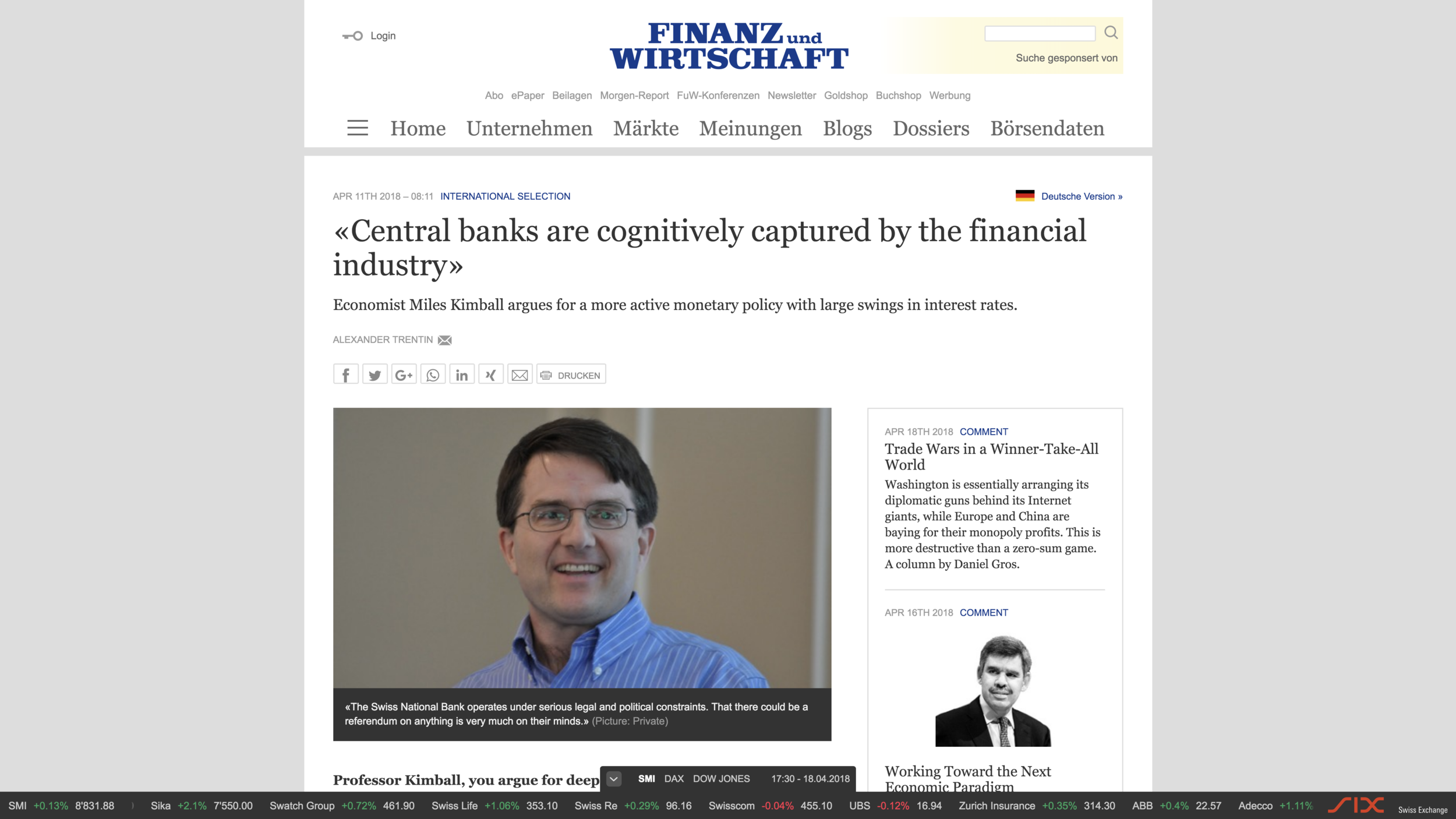
Alexander Trentin Interviews Miles Kimball on Next Generation Monetary Policy

I have been pleased with all of Alexander Trentin's interviews of me. The previous interviews are here:

Also, let me highlight this piece by Alexander:

My post "Improvements in Productivity Need to Be Accommodated by Monetary Policy" prompted Alexander's latest interview. Our discussion ranged widely, centering around the recommendations for monetary policy that I give in my paper "Next Generation Monetary Policy." Below the line is the edited text of the interview in English. I am grateful for permission to mirror these texts here. The links to the text of the interview on the original website are above under the screen shot at the top of this post.

This is Alexander's summary: 

Miles Kimball, professor of economics at the University of Colorado Boulder, is one of the main proponents for deep negative interest rates as a monetary policy instrument. In an interview with «Finanz und Wirtschaft», he argues that central banks are misguided when the try to smooth the path of interest rates. Monetary policy should be more active with large swings in interest rates. His view is that «stable prices and low unemployment are the things which matter for economic welfare» – not stable interest rates. Miles Kimball publishes a popular economics blog, «Confessions of a Supply-side Liberal».


Professor Kimball, you argue for deep negative interest rates as a tool for monetary policy. Now the Fed has moved to raise rates. Do you think it is regrettable that the pressure on central banks to innovate in monetary policy has gone?
Central banks still should keep working hard thinking about how to expand the monetary policy toolkit. It is their job to be ready for the next recession. They shouldn’t just pat themselves on the back that the economy finally climbed out of the Great Recession and its aftermath. Things might have been worse if it hadn’t been for monetary policy innovations such as Quantitative Easing, QE. But in absolute terms it was a terrible performance for monetary policy with very bad outcomes. Next time such a performance would be totally unacceptable. I worry that central bankers think that now they figured everything out—that it is good enough to use the same approach next time.

Why was it that Quantitative Easing was implemented relatively quickly, but not deep negative rates?
The conceptual framework for Quantitative Easing was already sitting there in 2008, but the framework for deep negative rates was not ready. I hope I contributed somewhat toward getting the conceptual framework for deep negative rates ready for the next time it is needed. I worry that the concept of deep negative rates has to compete with QE in the future. If the concept had been ready in 2008, things might have played out better.

In Switzerland we have quite low interest rates already. Is the Swiss National Bank ready to go deeper?
The Swiss National Bank is very sophisticated in its understanding of negative rate policy, including what needs to be done to effectively implement deep negative rates. When I visited the Swiss National Bank in late 2016, they demonstrated a thorough understanding of my approach and my arguments. But, as they emphasized, the Swiss National Bank operates under serious legal and political constraints. That there could be a referendum on anything is very much on their minds.

In June Swiss people will vote on such a referendum. The proponents of «Vollgeld» – similar to 100%-reserve banking – want to prohibit banks from creating money when issuing new loans. What is your opinion on that?
I don’t have any objection in principle against this initiative. In theory, as long as the central bank creates enough base money to keep the overall money supply the same, such a proposal can work. Fractional-reserve banking is mainly a way to throw seigniorage to the private banks. In 100%-reserve banking, the government keeps all the seigniorage for itself. Implementing such a reform will take an adjustment process. There are unknowns, but to experiment with theoretically reasonable things might be valuable. On the other hand, there is more cautious and also reasonable view «If it isn’t broken, don’t fix it.»

I think the Swiss people might not like the idea to be part of an experiment in monetary policy.
Presumably somebody thinks there is an upside to 100%-reserve banking, or they wouldn’t be advocating it. Why do people advocate a «Yes» vote on this referendum?

One argument is that it makes the financial system safer as bail-outs of banks would not be necessary anymore.
I wish they would devote their energies to something that can do a lot more for the safety of the financial system than that! If you want to make the banking system safer, you should advocate dramatically higher capital requirements. I explain this to my students with toppling dominoes. You can compare the ratio of capital to a bank’s balance sheet to the width of a domino. If a bank has only 3% equity relative to your balance sheet, that’s comparable to a very thin domino and it falls over easily. If you have 30% equity, that would be a very fat domino which would not fall over easily. Even if one falls over, it will not propagate the same way, as other dominoes will not be affected so easily.

You argue for a very active monetary policy which could result in large swings of interest rates. Would it not make sense to aim for stable interest rates?
The goal for monetary policy is not to stabilize interest rates, but to stabilize prices and employment. Stable prices and low unemployment are the things which matter for economic welfare. Forward guidance by central banks is much less necessary if they say that there could be large swings in interest rates for short periods of time whenever needed. Central banks have a desire to smooth interest rates – and I strongly believe this is misguided.

But financial markets react strongly even to small changes in rates.
Central banks are cognitively captured by the financial industry in their concern with having smooth interest rates. Those in the financial industry want to have a placid life. They would have to get used to large movements in rates. The economy overall ought to be more stable after people get used to this new style of monetary policy. If interest rates move, it would be for a short period of time. Once people understood that, they would react less strongly to any given movement in interest rates.  Today every quarter point move signals a big changes in the path of interest rates for the future. In my proposal, people would infer less for the future path of interest rates from interest rate movements now. They would not have to read the tea leaves so carefully.

What role does the exchange rate play in your ideal monetary policy framework? The SNB is looking at the exchange rate when conducting monetary policy.
What applies to the interest rate also applies to the exchange rate. It should not be a goal for monetary policy. When there are shocks to the exchange rate because of capital flows, a central bank would need to react to that. But this is not because of what happens to the exchange rate, but because of what happens to prices and unemployment.

In one of your papers you argue that monetary policy should take technological progress into account. Why should central banks think about such long-term developments as technological progress?
Shocks to technology, which are defined as unpredictable movements in productivity, can matter in the short term. Real business cycle theory is an extreme which argues that business cycles are mostly caused by technology shocks. I don’t believe that. But I think technology shocks matter in the short run. There are substantial fluctuations in technology.

How can that be?
One might think that technology improves only gradually. The data seems to say otherwise. There can be speedy changes in technology. What shows up as a technology shock in the aggregate data is  not the invention of new things, but rather the adoption of a new approach by a large share of businesses in some sector of the economy. Economists define technology very broadly. It doesn’t have to be high tech, it can be any new way of organizing production that allows more output to be produced with the same inputs or the same amount of output to be produced by fewer inputs. Adoption follows an S-shaped curve: First there are only a few early adopters, but later on the adoption curve becomes very steep.

That means at one point in time there can be rapid changes in technology?
Robert Solow said in 1987, you can see the computer revolution everywhere but in the productivity statistics. But the productivity growth was coming later. For example, the spread of e-mail allowed a bigger span of control. One manager could have more direct-reports. As a result, companies didn’t need as many levels of managers, and many mid-level managers became obsolete.

Another nice example of a big change in technology that is easy to understand is the containerization of shipping. Having standardized containers that could go straight from ships to the back of a truck dramatically improved the efficiency of transporting goods.

What is the right response of monetary policy to an improvement in technology?
If you need less factor inputs to produce the same economic output, you can have the same output with fewer people, which would create unemployment. Or you can produce more with the same level of employment and overall, people are richer. Monetary policy determines if a major technology improvement leads to unemployment or not.

So the effects of technological change on employment can be neutralized by central banks?
Even if monetary policy is done right, there will be shifts in employment and pains of adjustment. Some people need to find new jobs as sub-sectors made obsolete by technological improvements need less labor. Some people’s wages will go up and some people’s wages will go down. But it is completely unnecessary for technological improvement to create more unemployment overall. If there is an increase in unemployment overall after a technogical improvement, the central bank hasn’t done enough to increase aggregate demand when facing increased aggregate supply.

Did central banks do this wrong in the past?
In theory, improvements in the efficiency of producing machines should result in a stronger boom, because investment should increase. But the US data do not show this: There is a larger improvement if there is an improvement in producing non-durable consumption goods. One plausible reason for this is that the Fed was staring at the consumption deflator. If productivity in manufacturing nondurable consumption goods goes up, consumer prices fall and the Fed shifts to a more expansionary monetary policy. A comparable reduction in the prices of machines for factories didn’t show up as a decline in the consumption deflator, so the Fed underreacted, leading to unemployment.

So they did not do the right thing in response to improvements in the productivity of producing investment goods such as machines?
Right. Theory tells us that prices of investment goods should be more important for monetary policy than their share of GDP would seem to indicate. But a central bank staring only at the consumption deflator is treating investment goods as less important than their share in GDP would suggest.

Unfortunately, the literature on sticky prices, which is an important basis for monetary policy, have emphasized the importance of consumer goods prices and neglected investment good prices. Also, most models of optimal monetary policy don’t have investment goods in them at all. This is a big problem with these models.

So what has all this meant for how monetary policy is done in practice?
Central banks have to keep the price level stable. But what the US data shows is that after a technology improvement inflation typically went down. Inflation shouldn’t go down, if a central bank is doing the right thing. Inflation should be stabilized. It is a monetary policy mistake to have inflation decline after a technological improvement. There are a lot of early warnings that a technological improvement is coming if central banks look carefully. Due to the S-shaped adoption curve, you see early on when firms first start to adopt new technologies. You should be able to see early adoption a couple of years before the steep part of the S-curve when a technology quickly becomes widespread.


Magic Bullets vs. Multifaceted Interventions for Economic Stimulus, Economic Development and Weight Loss

                                            image source for the silver bullets above

                                            image source for the silver bullets above

In "Obesity Is Always and Everywhere an Insulin Phenomenon," and the podcast "Miles Kimball Explains to Tracy Alloway and Joe Weisenthal Why Losing Weight Is Like Defeating Inflation" I compared successful weight loss to defeating inflation. In this post I reverse the direction of the analogy and compare successful weight loss to providing what it would have taken to get out of the Great Recession, as I laid out in "America's Big Monetary Policy Mistake: How Negative Interest Rates Could Have Stopped the Great Recession in Its Tracks."

Sometimes there is an intervention so powerful that it can solve a particular type of problem regardless of the specific causes of the problem and with only minimal assistance from complementary tools. For example, when economic stimulus is called for, deep enough interest rate cuts can provide the needed stimulus. As the posts linked in "How and Why to Eliminate the Zero Lower Bound: A Reader’s Guide" explain, for a smart, independent central bank, there is no effective lower bound on interest rates. So interest rate cuts can be the magic bullet for providing economic stimulus. Like any type of economic stimulus, too much is inflationary, but whatever is the right amount of stimulus, interest rate cuts can provide it. My detailed argument for the essentially unlimited power of negative interest rates to provide stimulus can be found in:

Just as negative interest rates are the magic bullet for providing economic stimulus, for those who can tolerate it, fasting—periods of time with water but no food—is the magic bullet for weight loss. Like negative interest rates, many people rule fasting out of bounds as a weight-loss tool, and end up instead with a complex set of recommendations that don't work very well individually, and are only halfway effective even in combination. Instead of ruling negative interest rates out of bounds, people should concentrate on making them work as smoothly as possible when they are needed. Instead of ruling fasting out of bounds, people should concentrate on making fasting as easy and painless as possible. 

The secret to making periods with no food as easy and painless as possible is to eat foods that raise one's insulin index relatively little when one does eat. On how to do that, see my post "Forget Calorie Counting; It's the Insulin Index, Stupid." If you do that, you will be surprised at how painless it is to go for, say, 20 hours without eating. It is still important to arrange things to make it easy not to think about food by staying away from food as much as possible and having distractions from food such as work or a good TV show, but if you eat food low on the insulin index when you do eat, you will feel a lot less bodily hunger during fasting than you expect. 

One thing I don't know is how long a period of time you need to have eaten low on the insulin index before fasting will become easy. Keto folks say it takes some time for your body to get used to generating energy from food that is not as easily digestible as sugar and other carbohydrates that have an insulin kick. In particular, the idea is that eating enough dietary fat can train your body to be able to generate energy from its own fat. If your body is good at processing its own fat, then there is a limit to how hungry you will be while fasting: once your blood sugar and insulin levels get low enough, your body will start turning your own fat into energy. If you get close to running out of body fat, you would have a problem, but most of us aren't that close to running out of body fat. 

Here is my own experience: for the last half of 2016, I tried eating only 600 or so calories every other day without otherwise modifying my diet. I managed to do it, but that was hellish. In early 2017, I went off sugar, potatoes, rice and bread for several months. After that I started skipping meals and found it was easy. Also, I notice that when I cheat a little and eat some easily digestible carbs or other food high on the insulin index, I get hungrier and the fasting is harder.

Unlike negative interest rates, there aren't many people disputing the idea that fasting will help you lose weight. Instead, they claim that fasting is dangerous or hellish. I discussed hellish above. What about dangerous? Here I keep going back to this: surely human beings must be physically designed to go extended periods without food. Otherwise, how did our ancestors survive to become our ancestors? It just wasn't that easy to always have plenty of food handy two hundred thousand or thirty thousand years ago. 

One important thing about a magic bullet is that it can work even if the set of all the things that affect something are complex. Many other things besides fasting can affect weight loss and weight gain. For example, in "A Conversation with David Brazel on Obesity Research," I mention the idea that keeping it cold—say keeping the thermostat at 68 degrees Fahrenheit instead of 72 degrees Fahrenheit—might aid weight loss. But fasting is such a powerful weight loss tool that you might not need to know every detail such as that. So I end up disagreeing with Marc Bellemare's very interesting post "Is the Study of Obesity Like Development Economics?" You may remember Marc from his guest post here: "Marc F. Bellemare's Story: 'I'm Bad at Math'" I am grateful for his permission to mirror "Is the Study of Obesity Like Development Economics?" below. Here are Marc's words:


I received a new book titled The Obesity Code last week, written by Canadian nephrologist Jason Fung.

Over the last year, I had read a few things by Dr. Fung on his clinic’s blog, but one of the things he says about obesity in his book made me believe that the study of obesity has a lot in common with development economics. Specifically, on p. 216 of his book, Dr. Fung writes:

The multifactorial nature of obesity is the crucial missing link. There is no one single cause of obesity. Do calories cause obesity? Yes, partially. Do carbohydrates cause obesity? Yes, partially. Does fiber protect us from obesity? Yes, partially. Does insulin resistance cause obesity? Yes, partially. Does sugar cause obesity? Yes, partially. All these factors converge on several hormonal pathways that lead to weight gain, and insulin is the most important of these. Low carbohydrate diet reduce insulin. Low-calorie diets restrict all food in there for reduce insulin. Paleo and [low-carb, high-fat] diets reduce insulin. Cabbage-soup diets reduce insulin. Reduced-food-reward diets reduce insulin. …

Obesity is a multifactorial disease. What we need is a framework, a structure, a coherent theory to understand how all its factors fit together. Too often, our current model of obesity assumes that there is only one single true cause, and that all others are pretenders to the throne. Endless debates ensue. Too many calories cause obesity. No, too many carbohydrates. No, too much saturated fat. No, too much red meat. No, too much processed foods. No, too much high-fat dairy. No, too much wheat. No, too much sugar. No, too much highly palatable foods. No, too much eating out. It goes on and on. They are all partially correct. …

Without understanding the multifactorial nature of obesity–which is critical–we are doomed to an endless cycle of blame.

In his book, Dr. Fung proposes a multi-pronged strategy to fight obesity. It looks as though he knows what he is talking about, since he has apparently helped several patients return to a normal weight.

Having long toyed with the idea of developing a model of individual weight dynamics wherein an S-shaped fat accumulation curve leads to there being two equilibria, much as in the modified Solow growth model with poverty traps, what the above excerpt made me think of is the equally multifactorial nature of poverty. Indeed, one of the first things I teach students when I teach a development course is that persistent economic under-development–poverty, that is–is the result of multiple market failures. The corollary of that statement is that there are no silver bullets in development. So unless you tackle all the problems at once, you might make a small, temporary dent in poverty, but people will tend to slide right back to where they were–much like people who, say, cut their calories tend to lose weight in the short run, but tend to go right back up to were they were after a few months.

In practice, this means that in situations of persistent economic under-development, microfinance will not magically lift people out of poverty. Nor will an input subsidy program. Nor will a micro-insurance scheme. Nor will any single intervention not aimed at resolving multiple market failures at once. And lest you think this makes me an advocate of something like the Millennium Villages Project, it does not. At least not in its current form, which does not lend itself to rigorous impact evaluation.

(By the way, this is why I had a hard time with Why Nations Fail: Because the authors are some of the smartest people alive today, yet their rhetoric seems to suggest that economic under-development has a single cause: extractive institutions. The journal articles on which they base the book are a lot more nuanced, so I imagine a publisher asked them to be slightly more polemic in order to make the book make an argument that sells better.)

If it were so simple as simply providing people with micro-loans, poverty would be a thing of the past. Similarly, if it were simply a question of “eat less, exercise more,” obesity would be a thing of the past as well. But whenever someone is suggesting a simple solution to a persistent problem, it is a safe bet that you are probably being sold snake oil.

I don’t know if Dr. Fung is the originator of the claim that obesity is multifactorial. But my intuition is that the claim is correct, and I certainly hope it gains traction with the publication of Dr. Fung’s book. As to what Dr. Fung advocates to treat obesity, you will have no doubt guessed that he does not advocate any single thing. Rather, The Obesity Code advocates doing all of the following:

  • Reducing one’s consumption of added sugars
  • Reducing one’s consumption of refined grains
  • Consuming a moderate amount of protein
  • Increasing one’s consumption of natural fats
  • Fasting for periods of 24, 36, even 48 hours
  • Getting seven to nine hours of sleep every night
  • Meditating

Of this list of things Jason Fung recommends, I argue that fasting is the centerpiece. The other things will help. And the low consumption of added sugars, refined grains and moderate consumption of protein is a key to making the fasting experience reasonably pleasant. But fasting is the big one. 

Afterword: Returning briefly to economics, I really like what Marc says about economic development needing many interventions at once. I think that is right. Economic development can only be done in complex ways. Economic development is like getting healthy—something that requires many more elements than just weight loss. By contrast, economic stimulus, like weight loss, is best kept simple. There are many monetary policy papers talking about how to deal with the lower bound on interest rates, many advising things that are otherwise bad ideas. It is simpler and better to just eliminate the lower bound on interest rates! (See for example "The effective lower bound and the desirability of gradual interest rate adjustments," Sebastian Schmidt and compare this to my argument in "Next Generation Monetary Policy.") 


Don't miss these other posts on diet and health and on fighting obesity:

Also see the last section of "Five Books That Have Changed My Life."