Charles Murray on Taking Religion Seriously
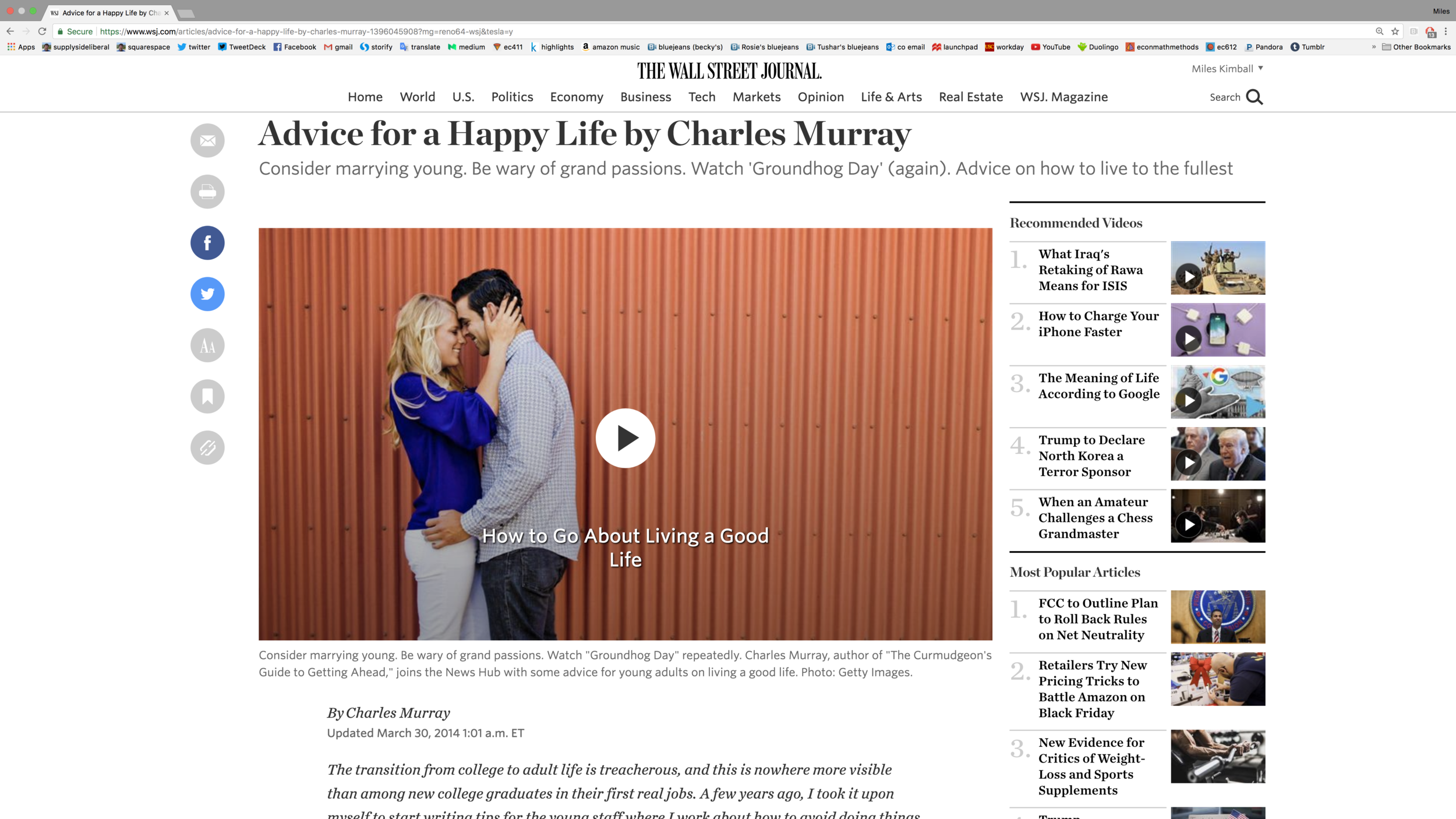
Charles Murray has an advice book: The Curmudgeon's Guide to Getting Ahead: Dos and Don'ts of Right Behavior, Tough Thinking, Clear Writing, and Living a Good Life. It sets down the kind of advice he gave to young staffers at work. The Wall Street Journal piece flagged above is his teaser for the book. (It appeared on March 30, 2014.)
Charles's five points are:
- Consider Marrying Young [in your 20s instead of in your 30s]
- Learn How to Recognize Your Soul Mate
- Eventually Stop Fretting About Fame and Fortune
- Take Religion Seriously
- Watch 'Groundhog Day' Repeatedly
I like all of his advice in this essay. Here, in this post, let me focus on the 4th point: taking religion seriously.
After letting off the hook anyone who is already seriously engaged with religion, Charles defines his audience for this section:
Now that we're alone, here's where a lot of you stand when it comes to religion: It isn't for you. You don't mind if other people are devout, but you don't get it. Smart people don't believe that stuff anymore.
After an account of how he finally came to take religion seriously (though he is still an agnostic). Charles describes what it means to take religion seriously:
Taking religion seriously means work. If you're waiting for a road-to-Damascus experience, you're kidding yourself. Getting inside the wisdom of the great religions doesn't happen by sitting on beaches, watching sunsets and waiting for enlightenment. It can easily require as much intellectual effort as a law degree.
Even dabbling at the edges has demonstrated to me the depths of Judaism, Buddhism and Taoism. I assume that I would find similar depths in Islam and Hinduism as well. I certainly have developed a far greater appreciation for Christianity, the tradition with which I'm most familiar. The Sunday school stories I learned as a child bear no resemblance to Christianity taken seriously. You've got to grapple with the real thing.
To begin becoming more reflective, he recommends reading both religious literature and modern cosmology: "The universe isn't only stranger than we knew; it is stranger and vastly more unlikely than we could have imagined, and we aren't even close to discovering its last mysteries." As an even bigger step toward taking religion seriously:
Find ways to put yourself around people who are profoundly religious. You will encounter individuals whose intelligence, judgment and critical faculties are as impressive as those of your smartest atheist friends—and who also possess a disquieting confidence in an underlying reality behind the many religious dogmas.
In "Five Books That Have Changed My Life" I give a thumbnail sketch of my experience being a Mormon for the first 40 years of my life. I am glad I am not a Mormon now. But I gained a great deal from having been a Mormon. I do take religion seriously. I know how deep religious feelings, religious motivations, and religious insights can be. I hope the every-other-week religion posts I have been putting up since soon after I began blogging are of some help to others—especially those who, like me, are nonsupernaturalists—in getting some inkling of the depths of religion.
Gauti Eggertsson, Ragnar Juelsrud and Ella Getz Wold: Are Negative Nominal Interest Rates Expansionary?
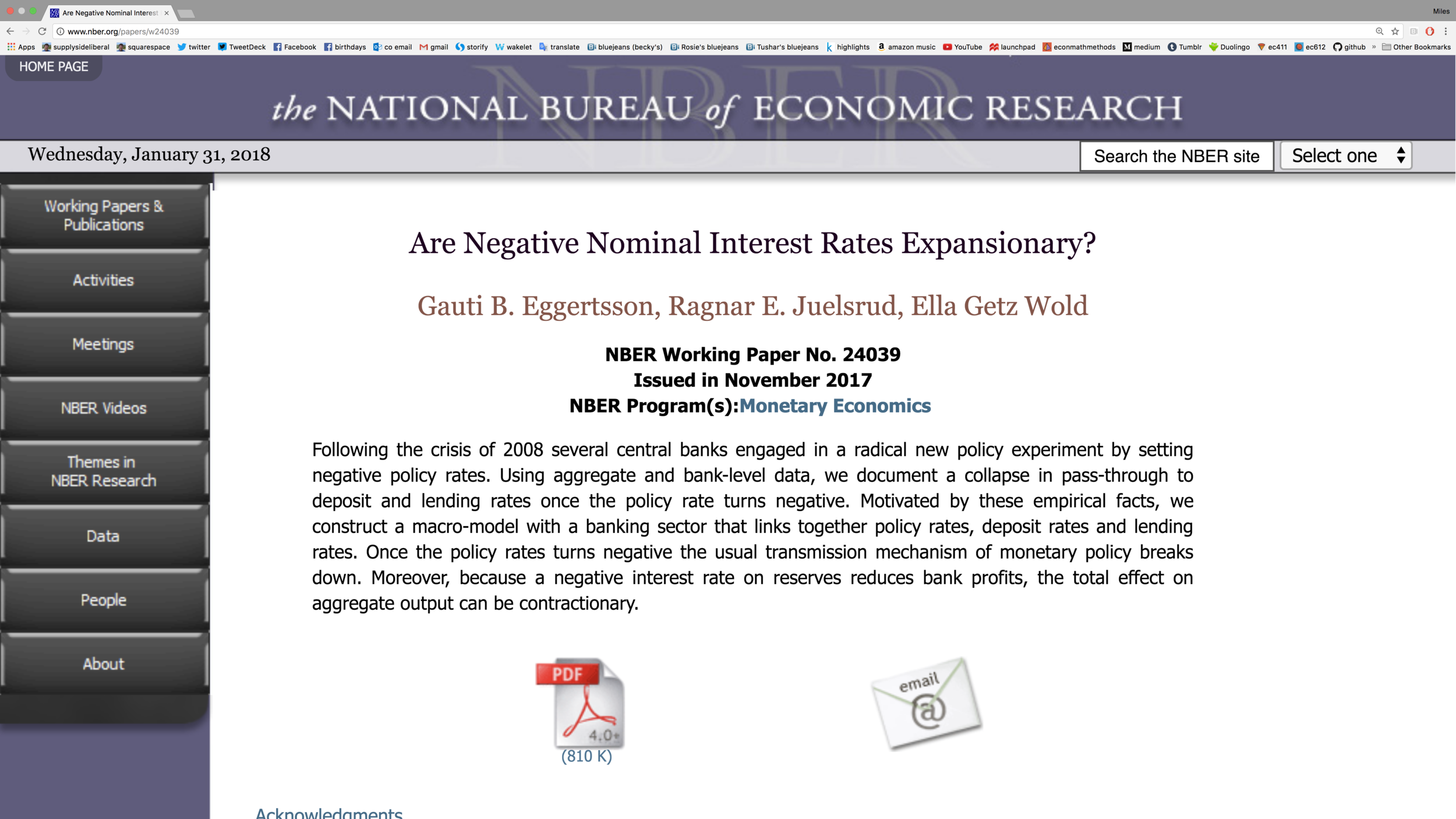
Link to the NBER page for this paper. For an ungated version, use this link.
It is great to see people doing formal modeling of negative interest rate policy. And it is especially good to see work of this type by a team including Gauti Eggertsson, whose research I wrote so highly of in my post "Pro Gauti Eggertsson." I wish I knew Gauti's coauthors, Ragnar Juelsrud and Ella Getz Wold better. Since this was originally posted, I have corresponded with them. Ragnar sent me this link to an ungated version of the paper.
One of the most remarkable things about this paper is that instead of saying that the lower bound on interest rates is inevitable it explicitly bills itself as showing why the lower bound on interest rates needs to be removed. On pages 5 and 6, Gauti, Ragnar and Ella write this:
There is a older literature however, dating at least back to the work of Silvio Gesell more than a hundred years ago (Gesell, 1916), which contemplates more radical monetary policy regime changes than we do here. This literature has been rapidly growing in recent years. In our model, the storage cost of money, and hence the lower bound, is treated as fixed. However, policy reforms can potentially alter the lower bound or even remove it completely. An example of such policies is a direct tax on paper currency, as proposed first by Gesell and discussed in detail by Goodfriend (2000) and Buiter and Panigirtzoglou (2003). This scheme directly affects the storage cost of money, and thereby the lower bound on deposits which we derive in our model. Another possibility is abolishing paper currency altogether. This policy is discussed, among others, in Agarwal and Kimball (2015), Rogoff (2017c) and Rogoff (2017a), who also suggest more elaborate policy regimes to circumvent the ZLB. An example of such a regime is creating a system in which paper currency and electronic currency trade at different exchange rates. The results presented here should not be considered as rebuffing any of these ideas. Rather, we are simply pointing out that under the current institutional framework, empirical evidence and a stylized variation of the standard New Keynesian model do not seem to support the idea that a negative interest rate policy is an effective tool to stimulate aggregate demand. This should, in fact, be read as a motivation to study further more radical proposals such as those presented by Gesell over a century ago and more recently in the work of authors such as Goodfriend (2000), Buiter and Panigirtzoglou (2003), Rogoff (2017c) and Agarwal and Kimball (2015). In the discussion section we comment upon how our model can be extended to explore further some of these ideas, which we consider to be natural extensions.
Gauti, Ragnar and Ella return to this theme on page 33, near the end of the main body of the working paper:
In our model exercise, the storage cost of money was held fix. However, one could allow the storage cost of money - and therefore the lower bound on the deposit rate - to depend on policy. One way of making negative negative rates be expansionary, which is consistent with our account, is if the government takes actions to increase the cost of holding paper money. There are several ways in which this can be done. The oldest example is a tax on currency, as outlined by Gesell (1916). Gesell’s idea would show up as a direct reduction in the bound on the deposit rate in our model, thus giving the central bank more room to lower the interest rate on reserves - and the funding costs of banks. Another possibility is to ban higher denomination bills, a proposal discussed in among others Rogoff (2017c). To the extent that this would increase the storage cost of money, this too, should reduce the bound on the banks deposit rate. An even more radical idea, which would require some extensions to our model, is to let the reserve currency and the paper currency trade at different values. This proposal would imply an exchange rate between electronic money and paper money, and is discussed in Agarwal and Kimball (2015), Rogoff (2017a) and Rogoff (2017b). A key pillar of the proposal – but perhaps also a challenge to implementability – is that it is the reserve currency which is the economy wide unit of account by which taxes are paid, and accordingly what matters for firm price setting. If such an institutional arrangement is achieved, then there is nothing that prevents a negative interest rate on the reserve currency while cash in circulation would be traded at a different price, given by an arbitrage condition. We do not attempt to incorporate this extension to our model, but note that it seems relatively straightforward, and has the potential of solving the ZLB problem. Indeed, the take-away from the paper should not be that negative nominal rate are always non-expansionary, simply that they are predicted to be so under the current institutional arrangement. This gives all the more reason to contemplate departures from the current framework, such as those mentioned briefly here and discussed in detail by the given authors.
My post that most directly expresses this point is "If a Central Bank Cuts All of Its Interest Rates, Including the Paper Currency Interest Rate, Negative Interest Rates are a Much Fiercer Animal"
Putting their model in the context of my post "The Supply and Demand for Paper Currency When Interest Rates Are Negative," they are treating the case of a Rate of Effective Return on Cash (ROERC) curve that is flat after a certain point. I argue in my post that is not the only plausible case. There are several other ways in which their model simplifies away from issues I have stressed on my blog:
1. Gauti, Ragnar and Ella deemphasize transmission mechanisms that do not involve banks, which I argue in three key posts are quite important:
- Even Central Bankers Need Lessons on the Transmission Mechanism for Negative Interest Rates
- Responding to Joseph Stiglitz on Negative Interest Rates
- Negative Rates and the Fiscal Theory of the Price Level
However, even though there are transmission mechanisms that go around banks, causing problems for the banking system could easily be seen as an unacceptable side effect. I make this point in "What is the Effective Lower Bound on Interest Rates Made Of?"
2. In a way Gauti, Ragnar and Ella are very clear about, their model leaves out the subsidies that central banks pursuing negative interest rates can provide to private banks. Here is a key passage from pages 36 and 37:
Our model exercise focuses exclusively on the impact of negative policy rates39. Other monetary policy measures which occurred over the same time period are not taken into account. This is perhaps especially important to note in the case of the ECB, which implemented its targeted longer-term refinancing operations (TLTROs) simultaneously with lowering the policy rate below zero. Under the TLTRO program, banks can borrow from the ECB at attractive conditions. Both the loan amount and the interest rate are tied to the banks’ loan provision to households and firms. The borrowing rate can potentially be as low as the interest rate on the deposit facility, which is currently -0.40 percent40. Such a subsidy to bank lending is likely to affect both bank interest rates and bank profits, and could potentially explain why lending rates in the Euro Area have fallen more than in other places once the policy rate turned negative.
I have emphasized the importance of central bank subsidies to private banks in several posts:
- How to Handle Worries about the Effect of Negative Interest Rates on Bank Profits with Two-Tiered Interest on Reserves Policies
- Ben Bernanke: Negative Interest Rates are Better than a Higher Inflation Target
- The Bank of Japan Renews Its Commitment to Do Whatever It Takes
- Why Central Banks Can Afford to Subsidize the Provision of Zero Rates to Small Household Checking and Savings Accounts
3. In Gauti, Ragnar and Ella's model, if private banks tried to have negative rates on checking or savings accounts, all of their customers would turn to paper currency storage. But that is not the only possible interpretation of why they did not lower their checking and savings account rates below zero in negative interest rate companies. Thinking that even 5% of their customers would jump ship to another bank if they went first to negative checking and saving account rates would be enough to make these checking and saving account rates quite sticky at zero. But if the central bank took its target rate and interest on reserves into deeper negative territory, banks might lower their checking and saving account rates despite this fear. And if other banks followed suit, they might not lose as many customers as they feared.
In other words, isn't the first fear the fear of customers jumping to another bank if checking and saving account rates are reduced below zero, not paper currency storage? This would generate a stickiness that could be overcome in the way paper currency storage with a linear effective return of -.01 % annually cannot be overcome (without changing paper currency policy).
4. In line with much of the literature modeling monetary policy, Gauti, Ragnar and Ella do not have investment in the model. This makes their facsimile of the Great Recession in the model deficient. For what I consider a better model of the Great Recession, see "On the Great Recession."
Conclusion. I look forward to more articles doing formal models on negative interest rate policy. I wrote about paper that Gauti, Ragnar and Ella mention in "Markus Brunnermeier and Yann Koby's "Reversal Interest Rate." Matthew Rognlie has also written a nice paper in this genre: “What lower bound? Monetary policy with negative interest rates."
I anticipate writing something in this genre myself at some point in the future. Right now my priorities in writing academic papers on negative interest rate policy are writing a second policy-focused paper with Ruchir Agarwal and a paper with Peter Conti-Brown on the law relevant to negative interest rate policies in the US.
The Case Against the Case Against Sugar: Seth Yoder vs. Gary Taubes

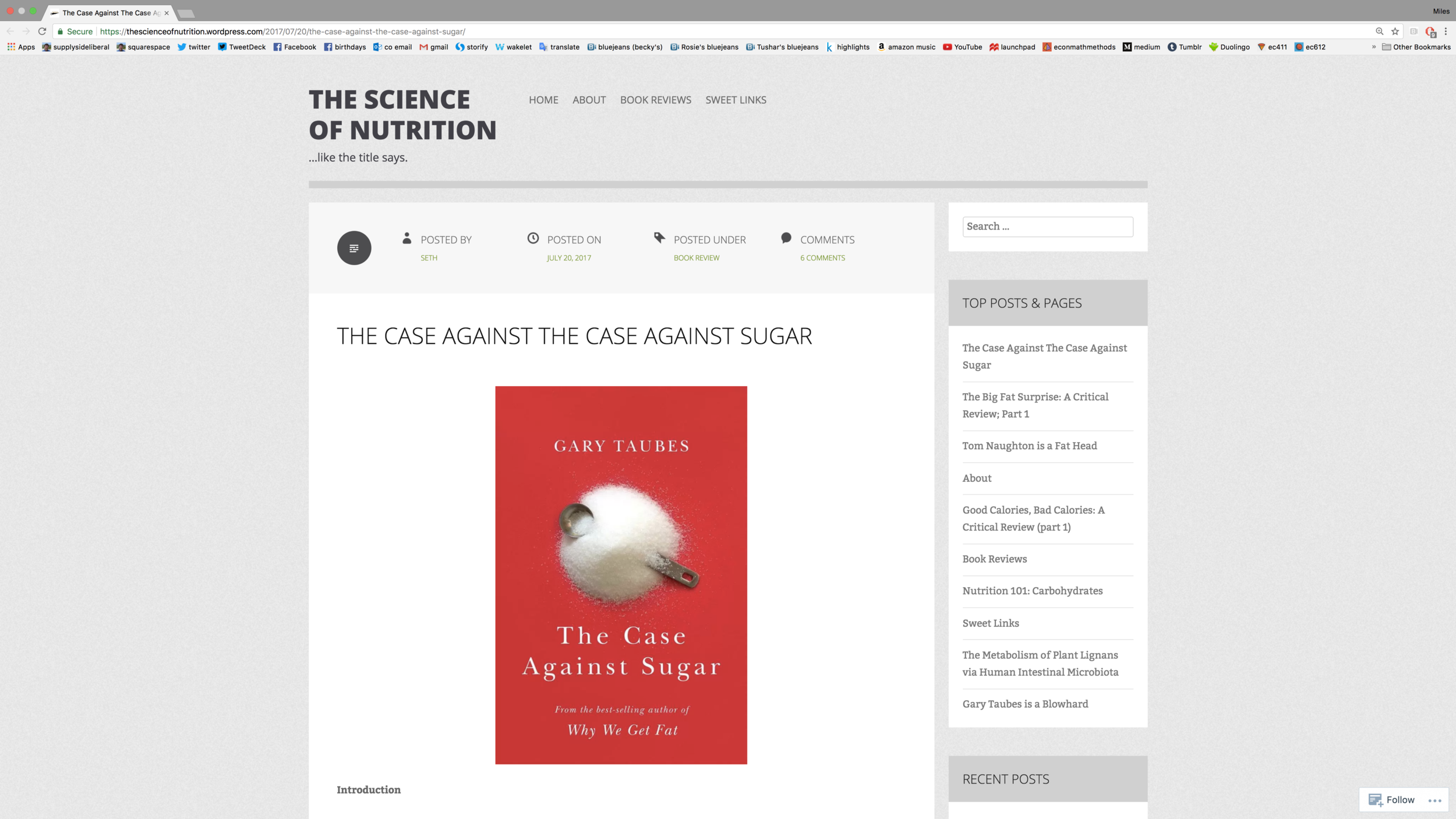
Link to the webpage on Seth Yoder shown above
Update: In “Vindicating Gary Taubes: A Smackdown of Seth Yoder,” I retract my serious criticisms of Gary Taubes below. However, this post is still important in defending Gary’s substantive views.
Seth Yoder, in his post "The Case Against the Case Against Sugar" fully convinced me that Gary Taubes displays a serious lack of reportorial honesty in his book The Case Against Sugar. And Seth somehow made reading through the trainwreck of how Gary Taubes routinely misquotes or otherwise misrepresents dead people's views perversely entertaining.
Seth's devastating demonstration of Gary Taubes's lack of reliability as a historian means I need to examine places where I have relied on information from Gary, much as I had to reassess my reliance on Carmen Reinhart and Ken Rogoff when the shoddiness of their statistical analysis came to light. (The spreadsheet error was only the tip of the iceberg. See "An Economist’s Mea Culpa: I Relied on Reinhart and Rogoff," "After Crunching Reinhart and Rogoff’s Data, We Find No Evidence That High Debt Slows Growth" and "Examining the Entrails: Is There Any Evidence for an Effect of Debt on Growth in the Reinhart and Rogoff Data?")
Fortunately, in the area of diet and health, Jason Fung is my guy (see "Five Books That Have Changed My Life"), not Gary Taubes. And I always took Gary Taubes's reasoning with a grain of salt. For example, in my post "The Case Against Sugar: Stephan Guyenet vs. Gary Taubes," I write:
First, I should say that I start out expecting less from journalists like Gary Taubes than the standard that Stephan Guyenet wants to judge them buy. Stephan mentions repeatedly the "Igon Value Problem," which refers to a term "coined by Steven Pinker in a review of Malcolm Gladwell's book What the Dog Saw." Malcolm Gladwell did not know what an eigenvalue was, and so misheard it as an "Igon value." Similarly, Gary Taubes is not himself a scientist and so does not fully understand everything he is talking about.
It was also pretty obvious to me that Gary Taubes was tilting his selection of what to tell and what not to tell toward things that helped his case against sugar. But I thought the "facts" that he did tell about would be accurate. Just after the passage above from "The Case Against Sugar: Stephan Guyenet vs. Gary Taubes," is this:
But [Gary Taubes] does give us a tour through the history of thought about nutrition and what he felt he learned by talking to many scientists, with an emphasis on what the more contrarian scientists said. This is a useful service.
After seeing the misquotations and misrepresentations that Seth Yoder identifies, I no longer know which bits of this history of nutritional though are true and which are false. But let me attempt to examine where I stand, post by post where I was in danger of relying too much on Gary Taubes. Using my blog search box identified only four posts where I mention Gary Taubes other than in referring to the title of another blog post. Below I analyze my degree of reliance on Gary Taubes for each. After that, I register a couple of disagreements with Seth.
The Case Against Sugar: Stephan Guyenet vs. Gary Taubes
In "The Case Against Sugar: Stephan Guyenet vs. Gary Taubes," I summarized what I thought I had learned from The Case Against Sugar thus:
Sugar is very, very bad. I will say more below on why convincing people of that is an important accomplishment.
What the nutrition establishment is telling us needs to be closely examined and cross-checked by scientists outside the nutrition establishment. It is very unwise to simply trust the nutrition establishment.
I think I could have gotten this much from Jason Fung alone. The basic reason sugar is very, very bad is that most foods with a substantial sugar content are quite high on the insulin index. See "Forget Calorie Counting; It's the Insulin Index, Stupid."
In "The Case Against Sugar: Stephan Guyenet vs. Gary Taubes," I actually disagree with Gary Taubes a lot. Here are some examples of my words in that post that disagree with Gary:
Gary argues that other than Western diets adding sugar and flour, every other aspect of Western diets was duplicated by at least some indigenous diet, so sugar and flour must be the culprit. This is a strong argument. However, I would add in the possibility that people in almost every indigenous population had substantial chunks of time when they had no food consumption. Whether their fasts were involuntary or not, they probably fasted reasonably frequently. So in my view, the key aspects of Western diets that brought Western Diseases were sugar, flour and a reduction in periods of time with no food consumption.
Gary Taubes is at his most confused when discussing calories in/calories out. This is one of the first things I had to straighten out theoretically in my own mind after readings Gary's books. That effort is reflected in the title of my early foray into a Twitter discussion on diet: "How the Calories In/Calories Out Theory Obscures the Endogeneity of Calories In and Out to Subjective Hunger and Energy."
[Contrary to what Gary Taubes claims,] I am inclined to agree with Stephan that rodent data do not support the idea that sugar is more harmful than fat (though it does seem to support the idea that fat plus sugar is worse than fat alone). But I am struck by the possibility that rodents might be much better adapted to highcarb diets than humans are.
Gary goes overboard in talking down the benefits of exercise.
After catching Gary in a serious misquotation, Stephan begins to wind down ...
Salt Is Not the Nutritional Evil It Is Made Out to Be
Seth Yoder promises to write a post in the future focusing on salt. (Is it out already? I couldn't find it.) I will be eager to read it.
The heart of my post "Salt Is Not the Nutritional Evil It Is Made Out to Be" is discussing chunks of Gary Taubes's earlier book Good Calories, Bad Calories. These ideas are reprised in The Case Against Sugar. Readers of my post pointed me to very recent research about salt reported in Gina Kolata's May 8, 2017 New York Times article "Why Everything We Know About Salt May Be Wrong." This makes me continue to doubt that salt is the nutritional evil that standard advice says it is.
Although Seth thinks the connection to sugar is tenuous, he does take seriously the idea that insulin resistance is an important factor in hypertension. Seth writes:
Taubes eventually gets to some positive evidence for a link between sugar and hypertension, though it’s rather murky and kind of contradicts his point about sodium. It turns out that hyperinsulinemia may lead to an increase in blood pressure by increasing sodium retention.(87–89) So what causes hyperinsulinemia? The cited literature makes the case for insulin resistance as the primary factor. Taubes would have you believe that sugar intake causes insulin resistance and diabetes, but the evidence for that claim just is not very abundant nor is it mentioned as a risk factor in the texts. However, you might imagine someone who is constantly swilling sodas all day, every day to have elevated insulin levels.
To think that sugar is the only cause of insulin resistance and obesity is, of course, a straw man—that Gary Taubes has chosen to personify. In "The Case Against Sugar: Stephan Guyenet vs. Gary Taubes," I push these as the main reasons for the rise in insulin resistance and obesity:
The shift toward consumption of foods that are high on the insulin index. (See "Forget Calorie Counting; It's the Insulin Index, Stupid.") Many of these are high in sugar, but some are not. For example, processed "lowfat" foods are higher on the insulin index than the corresponding full fat foods. So the spread of lowfat foods could be contributing to the rise in obesity even in a period when sugar consumption itself is declining somewhat.
The expansion of the "eating window" within each day, with the corresponding shortening of the biggest chunk of time with no food consumption. (See "Stop Counting Calories; It's the Clock that Counts.")
If insulin resistance tends to lead to high blood pressure, then these would be contributing factors towards high blood pressure as well.
Meat Is Amazingly Nutritious—But Is It Amazingly Nutritious for Cancer Cells, Too?
Despite including large pro-meat quotations from Gary Taubes in my post "Meat Is Amazingly Nutritious—But Is It Amazingly Nutritious for Cancer Cells, Too?" I end up being somewhat negative about meat. Here is the somewhat nuanced view I put forward:
In other words, meat, dairy and eggs, by providing an abundance of complete proteins may help build strong cancer cells, but there is no good evidence that they make people fat.
Since I wrote those words, my own experience and that of some of my fellow experimenters in our own lives has been that we often get hungry after eating things that are between 30 and 50 on the insulin index. This is a range that many types of meat fall into. (See "Forget Calorie Counting; It's the Insulin Index, Stupid.) As far as the insulin kick is concerned, it isn't as bad as eating pancakes, rice, bananas or orange juice, but it isn't a nothing either. I continue to eat meat when I go to restaurants, but I often need to eat nuts afterwards to stave off the hunger induced by the medium-high insulin index of that meat.
In any case, even when I wrote that post, my position was very different from Gary Taubes's position on mat, and since then has moved a bit further away.
Obesity Is Always and Everywhere an Insulin Phenomenon
In "Obesity Is Always and Everywhere an Insulin Phenomenon" I am embarrassed to have the word "excellent" in this phrase:
Gary Taubes, in his excellent history of nutritional thought Good Calories, Bad Calories ...
Indeed, I am embarrassed enough that I intend to update the word "excellent" out as soon as I have a few minutes to do that update. But although Gary Taubes is overly certain about what the key aspect of Westernization is the passage I actually quote is mainly focused on the remarkable transition to Western diseases itself, which I have not seen seriously disputed:
On April 16, 1913, Albert Schweitzer arrived at Lambaréné, a small village in the interior lowlands of West Africa, to establish a missionary hospital on the banks of the Ogowe River. Attended by his wife, Hélène, who had trained as a nurse, he began treating patients the very next morning. Schweitzer estimated that he saw almost two thousand patients in the first nine months, and then averaged thirty to forty a day and three operations a week for the better part of four decades. The chief complaints, at least in the beginning, were endemic diseases and infections: malaria, sleeping sickness, leprosy, elephantiasis, tropical dysentery, and scabies.
Forty-one years after Schweitzer’s arrival, and a year and a half after he received the Nobel Peace Prize for his missionary work, Schweitzer encountered his first case of appendicitis among the African natives. Appendicitis was not the only Western disease to which the natives seemed to be resistant. “On my arrival in Gabon,” he wrote, “I was astonished to encounter no cases of cancer…. I can not, of course, say positively that there was no cancer at all, but, like other frontier doctors, I can only say that if any cases existed they must have been quite rare.” In the decades that followed, he witnessed a steady increase in cancer victims. “My observations inclined me to attribute this to the fact that the natives were living more and more after the manner of the whites.”
As Schweitzer had suggested, his experience was not uncommon for the era. In 1902, Samuel Hutton, a University of Manchester–trained physician, began treating patients at a Moravian mission in the town of Nain, on the northern coast of Labrador, or about as far from the jungles of West Africa as can be imagined, in both climate and the nature of the indigenous population. As Hutton told it, his Eskimo patients fell into two categories: There were those who lived isolated from European settlements and ate a traditional Eskimo diet. “The Eskimo is a meat eater,” he wrote, “the vegetable part of his diet is a meager one.” Then there were those Eskimos living in Nain or near other European settlers who had taken to consuming a “settler’s dietary,” consisting primarily of “tea, bread, ship’s biscuits, molasses, and salt fish or pork.” Among the former, European diseases were uncommon or remarkably rare. ...
Most of these historical observations came from colonial and missionary physicians like Schweitzer and Hutton, administering to populations prior to and coincidental with their first substantial exposure to Western foods. The new diet inevitably included carbohydrate foods that could be transported around the world without spoiling or being devoured by rodents on the way: sugar, molasses, white flour, and white rice. Then diseases of civilization, or Western diseases, would appear: obesity, diabetes mellitus, cardiovascular disease, hypertension and stroke, various forms of cancer, cavities, periodontal disease, appendicitis, peptic ulcers, diverticulitis, gallstones, hemorrhoids, varicose veins, and constipation. When any diseases of civilization appeared, all of them would eventually appear. This led investigators to propose that all these diseases had a single common cause—the consumption of easily digestible, refined carbohydrates. The hypothesis was rejected in the early 1970s, when it could not be reconciled with Keys’s hypothesis that fat was the problem, an attendant implication of which was that carbohydrates were part of the solution. But was this alternative carbohydrate hypothesis rejected because compelling evidence refuted it, or for reasons considerably less scientific?
That is the only context where Gary Taubes appears in "Obesity Is Always and Everywhere an Insulin Phenomenon"
Two Points Where I Disagree with Seth
My first disagreement with Seth over the point he is trying to make in this passage:
Is anyone under the impression that we need MORE sugar in our diets? That we would be healthier if people drank MORE high-calorie sugar water and ate MORE Oreos? Are doctors and nutritionists and policy-makers saying things like “In order to fight this obesity epidemic, all we need to do is get people to start adding cokes, cookies, candy, cake, cream-puffs, and corn syrup into their diet”? Of course not.
I really don't think people realize how bad sugar is. To me, the key test is how many people would agree with the statement "For health, reducing sugar intake is more important than reducing fat intake." If that statement was conventional wisdom, I think it would be a huge step forward in public health.
I say something similar in "The Case Against Sugar: Stephan Guyenet vs. Gary Taubes":
... Stephan writes:
The Case Against Sugar is a journey through sugar history and science that argues the point that sugar is the principal cause of obesity, diabetes, coronary heart disease, and many other common noncommunicable diseases. This differs from the prevailing view in the research and public health communities that obesity and noncommunicable disease are multi-factorial, with refined sugar playing a role among other things like excess calorie intake, physical inactivity, cigarette smoking, alcohol and illegal drug use, and various other diet and lifestyle factors. I side with the latter view.
Here Stephan seems to be saying "Sensible people like me realize that sugar is one of several coequal causes of obesity, diabetes, heart disease etc., not the only cause." But walking down the aisles of any grocery store and comparing the number of "lowfat" offerings to the number of "no sugar added" offerings makes it clear that in the popular imagination the dangers of sugar are rated far, far below the dangers of dietary fat. So there is a lot of work to be done to get people's perception of the dangers of sugar up to the level of being "sugar is bad on a par with four or five other things" that Stephan seems to give as his own view.
My other disagreement with Seth is that he writes as if one should be controlling for overall calorie consumption when judging the harms of sugar. In my view, one of the main harms of sugar (along with other foods high on the insulin index) is that it makes people hungry a couple of hours later so they eat more total. In addition, sugar adds a heavy dose of instant gratification to many many foods, causes people to eat more total in the first place when sugar is added. So with sugar, it isn't just the calories of the sugar, it is the calories of the other things the sugar encourages you to eat—both now and later—that is the issue.
Another way to say this is that holding total calories constant statistically when looking at the effects of sugar is not appropriate if the typical eater doesn't hold calories constant when shehe eats more sugar. Here are the two hypotheses I am putting forward in relation to sugar and fat:
Two Hypotheses:
In addition to the extra calories of the sugar itself, eating sugar tends to make people eat more nonsugar calories as well.
By contrast, if one avoids all foods that are high on the insulin index, eating more fat calories tends to make people reduce nonfat calories more than one-for-one.
Don't miss these other posts on diet and health:
The Case Against the Case Against Sugar: Seth Yoder vs. Gary Taubes
Carola Binder: The Obesity Code and Economists as General Practitioners
Jason Fung: Dietary Fat is Innocent of the Charges Leveled Against It
Faye Flam: The Taboo on Dietary Fat is Grounded More in Puritanism than Science
Putting the Perspective from Jason Fung's "The Obesity Code" into Practice
Julia Belluz and Javier Zarracina: Why You'll Be Disappointed If You Are Exercising to Lose Weight, Explained with 60+ Studies (my retitling of the article this links to)
Meat Is Amazingly Nutritious—But Is It Amazingly Nutritious for Cancer Cells, Too?
Analogies Between Economic Models and the Biology of Obesity
Debating 'Forget Calorie Counting; It's the Insulin Index, Stupid'
Also see the last section of "Five Books That Have Changed My Life."
On the Achilles Heel of John Locke's Second Treatise: Slavery and Land Ownership
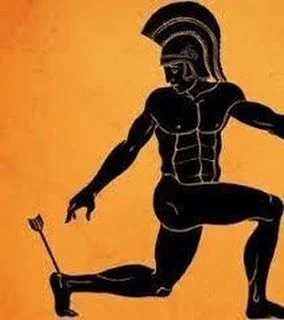
Link to the Wikipedia page "Achilles heel"
As the Wikipedia article on "Achilles heel" currently begins, "An Achilles' heel is a weakness in spite of overall strength." John Locke's Second Treatise on Government: Of Civil Government is an amazing achievement, that unlike Achilles, remains standing and strong to this day. But its weakest chapters are those where John Locke discusses slavery and land ownership. Even there, there a points where John Locke's arguments are very strong. But there are other points where he is trying to make a case that is difficult to make.
It has been very interesting for me to wrestle with both the strong and weak points of John Locke's treatment of slavery and land ownership in a series of blog posts every other week for six months. I have disagreed with John Locke much more in these posts than in the posts on earlier chapters that you can see laid out in "John Locke's State of Nature and State of War." Here are my posts reacting to John Locke's treatment of slavery and land ownership in his Second Treatise:
Chapter IV. Of Slavery
Chapter V. Of Property
John Locke: Rivalry in Consumption Makes Private Property Unavoidable
John Locke on How Things That Are No One's Property Become Someone's Property
John Locke Off Base with His Assumption That There Was Plenty of Land at the Time of Acquisition
John Locke: Land Title is Needed to Protect Buildings and Improvements from Expropriation
John Locke Pretends Land Ownership Goes Back to the Original Peopling of the Planet
Update: Links to posts on earlier and later chapters can be found in these aggregator posts:
Posts on Chapters I-III: John Locke's State of Nature and State of War
Posts on Chapters IV-V: On the Achilles Heel of John Locke's Second Treatise: Slavery and Land Ownership
Posts on Chapters VI-VII : John Locke Against Natural Hierarchy
Posts on Chapters VIII-XI: John Locke's Argument for Limited Government
On Being a Good Guy

Etymologically, it is too bad that many of our words for being a good person go back to the offensive idea that people of higher social rank are better people than those of lower social rank. The noun "gentleman," like the adjective "noble," is an example. So let me translate Peggy Noonan's word "gentleman" to "good guy." To me, that is a powerful phrase.
Peggy Noonan's context is the all-too-frequent mistreatment of women by men. But the elements of character she points to are just as wonderful in women. I am told by the many young people I hang around with as a professor that the word "guy" has been taking on more and more of a gender-neutral sense over time. But in the quotations, you will need to translate "gentleman" and "gentlemen" into the appropriate gender-neutral terms yourself. For example, take
A gentleman is an encourager of women.
Translated to apply to women, it says that a woman, to be a "good guy," needs to be an encourager of other women, just as a man to be a "good guy," needs to be an encourager of women. That is an important message.
My favorite bit from Peggy's piece is this, that she attributes to the Urban Dictionary:
The true gentleman is the man whose conduct proceeds from good will . . . whose self control is equal to all emergencies, who does not make the poor man conscious of his poverty, the obscure man of his obscurity, or any man of his inferiority or deformity.
Note that this is the antithesis of standing on one's social rank. In a similar vein:
The 19th-century theologian John Henry Newman —an Anglican priest who became a Catholic cardinal—said a gentleman tries not to inflict pain. He tries to remove the obstacles “which hinder the free and unembarrassed action of those about him.” He is “tender toward the bashful, gentle toward the distant, and merciful toward the absurd. . . . He is never mean or little in his disputes, never takes unfair advantage.”
I also like this passage:
A gentleman is good to women because he has his own dignity and sees theirs. He takes opportunities to show them respect. He is not pushy, manipulative, belittling. He stands with them not because they are weak but because they deserve friendship.
However, I know there is one count on which I don't stand up very well to this standard: I am often pushy—especially for ideas. This can sometimes be hard for those around me to deal with.
Peggy's third-to-last paragraph says something obvious and documentable:
The age of social media has worked against the ideas of decorum, dignity and self-control—the idea of being a gentleman. You can, anonymously, be your lowest, most brutish self, and the lowering spreads like a virus.
One of the places this has been documented is in Economics Job Market Rumors. On that see these three posts:
- Signalling When Everyone Knows about Last-Place Aversion: An Application to Economics Job Market Rumors
- Matthew Shapiro, Martha Bailey and Tilman Borgers on the Economics Job Market Rumors Website
- Michael Weisbach: Posters on Finance Job Rumors Need to Clean Up Their Act, Too
To be a good guy in economics, don't follow the example of the most misogynist posters on Economics Job Market rumors. There are a few other things you should do to be a good guy within economics:
- Don't routinely assume that a female coauthor didn't contribute much to a paper. (See "When Women Don’t Get Any Credit for Coauthoring with Men.")
- Be sensitive to the extra burdens and hurdles that women often face in economics. (See "How Big is the Sexism Problem in Economics?")
- Tell everyone, especially women, who might need the message more, "You can do it" when they are wondering if they can do math well. (See "There's One Key Difference Between Kids Who Excel at Math and Those Who Don't" and "Calculus is Hard. Women Are More Likely to Think That Means They’re Not Smart Enough for Science, Technology, Engineering and Math.")
Literary Note: This post can be read in two slightly different ways:
- In the phrase "good guy," put the stress on the word "guy."
- In the phrase "good guy," put the stress on the word "good."
I intend both readings.
Broadening the Message: Take a look at "On Idealism Versus Cynicism," also sparked by a Peggy Noonan essay, which has a similar message, but on a broader them than gender relations.
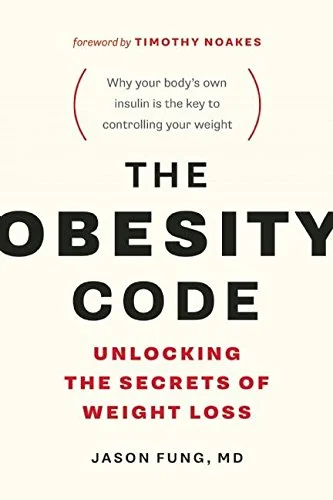
Carola Binder: The Obesity Code and Economists as General Practitioners

Carola Binder
I was delighted to see that Carola Binder not only read Jason Fung's book The Obesity Code on my recommendation, but also wrote a nice blog post about it: "The Obesity Code and Economists as General Practitioners."
Carola begins by praising economists as generalists, and modern economists as scholars ready to take on any question that their training has prepared them for, whether it is part of the traditional sphere of economics or not. This a view after my own heart, as you can see from my post "Defining Economics."
Carola then has a nice treatment of calories in/calories out as an accounting identity can only become a theory by adding assumptions—and can easily be converted into a pernicious theory by adding the assumption the assumption that calories out is unaffected by calories in. Let me quote at length from this section of Carola's blog post:
The Trouble with Accounting Identities (and Counting Calories)
Fung's book takes issue with the dominant "Calories In/Calories Out" paradigm for weight loss. This idea-- that to lose weight, you need to consume fewer calories than you burn-- is based on the First Law of Thermodynamics: energy can neither be created nor destroyed in an isolated system. Fung obviously doesn't dispute the Law, but he disputes its application to weight loss, premised on "Assumption 1: Calories In and Calories Out are independent of each other."
Fung argues that in response to a reduction in Calories In, the body will reduce Calories Out, citing a number of studies in which underfed participants started burning far fewer calories per day, becoming cold and unable to concentrate as the body expended fewer resources on heating itself and on brain functioning. ...
The First Law of Thermodynamics is also an accounting identity. It is true that if Calories In exceed Calories Out, we will gain weight, and vice versa. But it is not true that reducing Calories In leaves Calories Out unchanged. And according to Fung, Calories Out may respond so strongly to Calories In, almost one-for-one, that sustained weight loss will not occur.
Proximate and Ultimate Causes
A caloric deficit (Calories In < Calories Out) is a proximate cause of weight loss, and a caloric surplus a proximate cause of weight gain. But proximate causes are not useful for policy prescriptions. Think again about the GDP=C+I+G+NX accounting identity. This tells us that we can increase GDP by increasing consumption. Great! But how can we increase consumption? We need to know the deeper determinants of the components of GDP. Telling a patient to increase her caloric deficit to lose weight is as practical as advising a government to boost consumption to achieve higher GDP, and neither effort is likely to be very sustainable. So most of Fung's book is devoted to exploring what he claims are the ultimate causes of body weight and the policy implications that follow.
In discussing insulin as an underlying cause of weight gain and weight loss, Carola makes the analogy between the development of insulin resistance and the Phillips Curve shifting:
Persistence Creates Resistance
So how does the body's set point rise enough that a person becomes obese? Fung claims that the Calories In/Calories Out model neglects the time-dependence of obesity, noting that it is much easier for a person who has been overweight for only a short while to lose weight. If someone has been overweight a long time, it is much harder, because they have developed insulin resistance. Insulin levels normally rise and fall over the course of the day, not normally causing any problem. But persistently high levels of insulin, a hormonal imbalance, result in insulin resistance, leading to yet higher levels of insulin, and yet greater insulin resistance (and weight gain). Fung uses the cycle of antibiotic resistance as an analogy for the development of insulin resistance:
Exposure causes resistance...As we use an antibiotic more and more, organisms resistance to it are naturally selected to survive and reproduce. Evenually, these resistance organisms dominate, and the antibiotic becomes useless (p. 110).
He also uses the example of drug resistance: a cocaine user needs ever greater doses. "Drugs cause drug resistance" (p. 111). Macroeconomics provides its own metaphors. In the early conception of the Phillips Curve, it was believed that the inverse relationship between unemployment and inflation could be exploited by policymakers. Just as a doctor who wants to cure a bacterial infection may prescribe antibiotics, a policymaker who wants lower unemployment must just tolerate a little higher inflation. But the trouble with following such a policy is that as that higher inflation persists, people's expectations adapt. They come to expect higher inflation in the future, and that expectation is self-fulfilling, so it takes yet higher inflation to keep unemployment at or below its "set point."
Rats and Mice: One other thing that Carola mentions along the way is Jason Fung's distrust of the applicability of animal studies for key obesity issues:
At the beginning of the book, Fung announces his refusal to even consider animal studies. This somewhat surprises me, as I thought that finding a result consistently across species could strengthen our conclusions, and mechanisms are likely to be similar, but he seems to view animal studies as totally uninformative for humans. If that is true, then why do we use animals in medical research at all?
I had forgotten that Jason Fung took that position. But in "The Case Against Sugar: Stephan Guyenet vs. Gary Taubes," I wrote:
I am inclined to agree with Stephan that rodent data do not support the idea that sugar is more harmful than fat (though it does seem to support the idea that fat plus sugar is worse than fat alone). But I am struck by the possibility that rodents might be much better adapted to highcarb diets than humans are. This may even allow them to eat sugar with less harm than humans. Am I wrong in thinking that for many, many generations rodents outside laboratories have tended to eat highcarb diets? The "many, many generations" is important. Even if rodents had only been eating highcarb diets for the same number of years as humans, the larger number of generations per century would have allowed rodents that hang around humans to be naturally selected to tolerate highcarb diets more than long-generationed humans.
Every discipline tends to develop conventions that the best research that is feasible for the typical researcher should be treated with respect. But if the best experimental research that is feasible is studies on rodents that might be much better adapted to highcarb diets than humans and small-sample-size human studies, it shouldn't make it any more persuasive to those of us who are not acculturated diet scientists for them to say "This is the state of the art."
Advocacy of Fasting as Jason Fung's Key Contribution: In her last two paragraphs, Carola says on the one hand "most of [Jason Fung's] advice is unlikely to be controversial" and then distances herself from the centerpiece of Jason Fung's advice: fasting, in the sense of going for periods time without any food. The reduction in obesity (and associated ills) to be had from eating a lowcarb diet are small compared to the reduction in obesity that is possible from scheduling in substantial chunks of time with no food.
A lowcarb diet does have some direct benefits, but the most important thing to know is that fasting is very hard when one is eating a lot of carbs when one does eat. More precisely, eating foods high on the insulin index when one does eat makes fasting very hard. (See "Forget Calorie Counting; It's the Insulin Index, Stupid" on what foods are high and what foods are low on the insulin index.) Conversely keeping one's insulin levels relatively low when one does eat makes the adjustment to an even lower insulin level while fasting much smoother.
Many pages in The Obesity Code and in Jason Fung's other book The Complete Guide to Fasting are devoted to arguing that fasting is not harmful and specifying the exceptions: such as that pregnant women and children should be wary of fasting. (Also, I would add that women who want to get pregnant should not fast. It is likely that the body takes no food as a signal it is not a good time to head toward having a baby.) There is not much scientific dispute over the claim that fasting will lead to weight loss. And there is an increasing amount of evidence that even modest increases in fasting can help. See "Stop Counting Calories; It's the Clock that Counts."
The key dispute is over whether fasting is (a) hard and (b) dangerous. It is on these grounds that Jason Fung's contentions are the most important. Given individual differences, and the current state of knowledge, individual experimentation is important in helping to figure out the answer to whether fasting is hard. My claim is that fasting for up to 20 hours might not be all that hard for you if you have already starting eating lowcarb. For those who have no particular reason to think that fasting would be dangerous for them, widespread experience with fasting for religious reasons and the many situations our ancestors faced that meant they simply didn't have food for a 20 hour stretch of time suggests that fasting that length of time is not likely to be all that dangerous.
The bottom line is that Jason Fung minus the idea of fasting would not be the Jason Fung who is my hero. What makes Jason Fung important is his trenchant advocacy of fasting as a way to fight obesity and its accompanying ills.
Technical Note on Snacking: Carola speaks of her love of grazing. I don't think of snacking per se as bad. It is length of the eating window within a day that matters. If the total length of the eating window is kept to a reasonably short time—say ten or twelve hours if one is just trying to keep a steady weight—snacking as often as desired on things with a low insulin index during the eating window is fine in my book. A warning though: much of what is called "snack food" is quite high on the insulin index and would indeed be a problem. But my snack of choice, a mix of sugar-free roasted almonds and cashews, is no problem at all.
Don't miss these other posts on fighting obesity:
- Stop Counting Calories; It's the Clock that Counts
- Forget Calorie Counting; It's the Insulin Index, Stupid
- Obesity Is Always and Everywhere an Insulin Phenomenon
- Sugar as a Slow Poison
- How Sugar Makes People Hangry
- The Case Against Sugar: Stephan Guyenet vs. Gary Taubes
- The Keto Food Pyramid
- Mass In/Mass Out: A Satire of Calories In/Calories Out
- Jason Fung: Dietary Fat is Innocent of the Charges Leveled Against It
- Faye Flam: The Taboo on Dietary Fat is Grounded More in Puritanism than Science
- Katherine Ellen Foley—Candy Bar Lows: Scientists Just Found Another Worrying Link Between Sugar and Depression
- Ken Rogoff Against Sugar and Processed Food
- Kearns, Schmidt and Glantz—Sugar Industry and Coronary Heart Disease Research: A Historical Analysis of Internal Industry Documents
- Salt Is Not the Nutritional Evil It Is Made Out to Be
- Whole Milk Is Healthy; Skim Milk Less So
- How the Calories In/Calories Out Theory Obscures the Endogeneity of Calories In and Out to Subjective Hunger and Energy
- Putting the Perspective from Jason Fung's "The Obesity Code" into Practice
- Julia Belluz and Javier Zarracina: Why You'll Be Disappointed If You Are Exercising to Lose Weight, Explained with 60+ Studies (my retitling of the article this links to)
- Meat Is Amazingly Nutritious—But Is It Amazingly Nutritious for Cancer Cells, Too?
- Diana Kimball: Listening Creates Possibilities
- On Fighting Obesity
- Analogies Between Economic Models and the Biology of Obesity
- Debating 'Forget Calorie Counting; It's the Insulin Index, Stupid'
Also see the last section of "Five Books That Have Changed My Life."
David Holland on the Mormon Church During the February 3, 2008–January 2, 2018 Monson Administration →
Link to the Wikipedia article on Thomas S. Monson
Thomas S. Monson, the President of the Mormon Church, died on January 2, 2018. This occasions a change in the leadership in the Mormon Church. The link on the title to this post is to a very interesting interview about Thomas Monson's administration and what comes next by Harvard Divinity School's Michael Naughton of David Holland, a Mormon who is Harvard Divinity School John A. Bartlett Professor of New England Church History.
When the President of the Mormon Church dies, the longest serving apostle becomes the next president. The next President will therefore be Russell M. Nelson. This link has a nice infographic showing seniority and ages for apostles for those interested in who is most likely to serve as President of the Mormon Church after Russell M. Nelson.
Don't miss these related posts on Mormonism!
- The Message of Mormonism for Atheists Who Want to Stay Atheists
- How Conservative Mormon America Avoided the Fate of Conservative White America
- Will Women Ever Get the Mormon Priesthood?
- The Mormon Church Decides to Treat Gay Marriage as Rebellion on a Par with Polygamy
- Flexible Dogmatism: The Mormon Position on Infallibility
- Inside Mormonism: The Home Teachers Come Over
- The Mormon View of Jesus
Cousin Causality
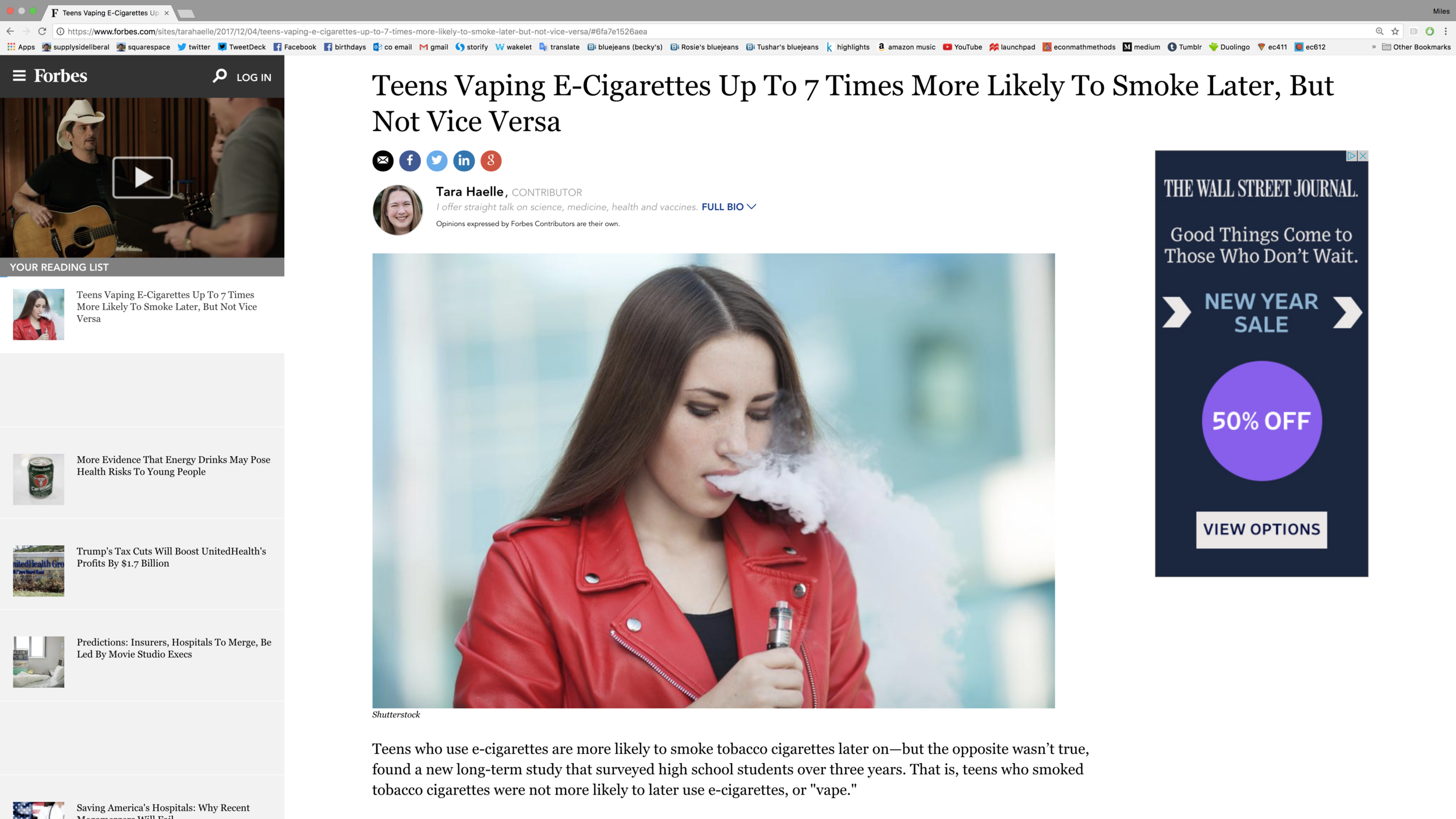

It is often said, rightly, that "Correlation is not causation." But one can say even more: "Correlation between A and B with A coming earlier in time than B is not causation." Let's say A and B are correlated, and someone is interested in knowing if A causes B. The most common reasons for A being correlated with B are
A causes B
B causes A
C causes A and C causes B.
Given that someone is interested in whether or not A causes B, the second possibility, B causes A is called "reverse causality." Unfortunately, the third possibility does not have a snappy name that I am aware of. Over my entire teaching career I have ended up calling it "A third thing causes both ___ and ____." Unless someone knows a better name, let me propose calling the third possibility "cousin causality" of A and B.
The analogy is that for any pair of cousins, a grandparent helped cause both of those two cousins. The two cousins may never have interacted directly at all, and could have been adopted at birth by different families on opposite coasts, but they will share traits in common.
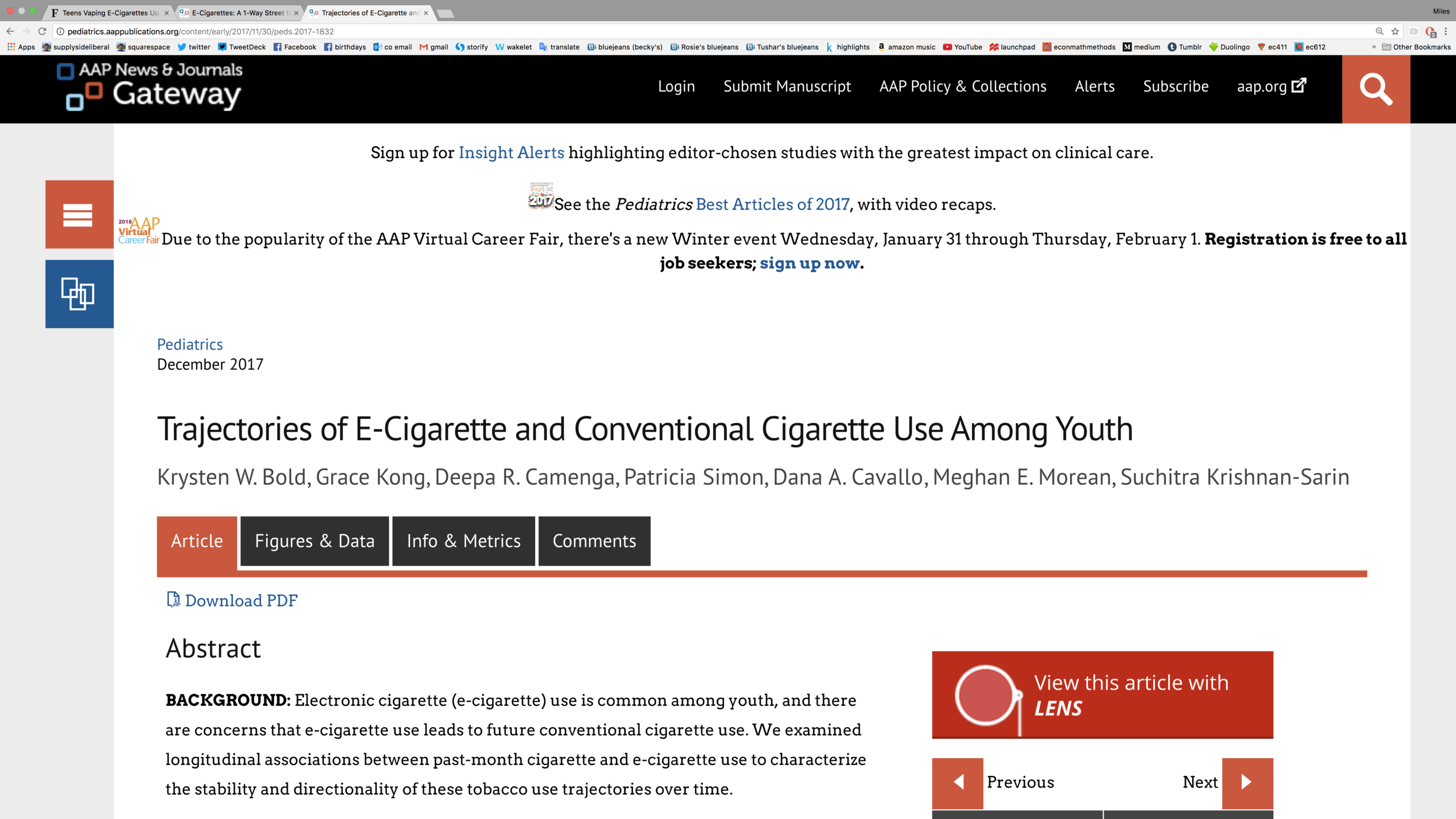
Vaping. Let me apply the old, but newly rechristened concept of cousin causality to article and associated editorial linked above. The article is "Trajectories of E-Cigarette and Conventional Cigarette Use Among Youth by Krysten W. Bold, Grace Kong, Deepa R. Camenga, Patricia Simon, Dana A. Cavallo, Meghan E. Morean and Suchitra Krishnan-Sarin." The "Conclusions" section of the abstract begins impressively:
E-cigarette use was associated with future cigarette use across 3 longitudinal waves, yet cigarette use was not associated with future e-cigarette use.
This is useful information. In this case it makes it harder to maintain a story of reverse causality. But it does nothing to rule out cousin causality. What if some kids
(a) think things like smoking are a cool symbol of rebellion,
(b) at a young enough age, both vaping and smoking count as "things like smoking," but
(c) at an older age, vaping no longer counts because it is the sort of thing that youngsters do,
(d) except for the growing realization that vaping is babyish just discussed, between vaping and smoking there is some tendency for kids to keep doing the one they started doing?
In this story, if you take away vaping, the kids who think smoking and the like are a cool symbol of rebellion will still take up smoking. The vaping didn't cause smoking, the desire to be cool caused both vaping and smoking. And we can explain the time sequence by saying that at older ages the desire to be cool tends to cause smoking relatively more compared to vaping.
The authors interpret their results as if there were no chance of cousin causality. Without much sign of caution, the abstract assumes causality from vaping to smoking:
Future research needs to examine mechanisms through which e-cigarette use leads to cigarette use.
In other words, "Because vaping allows one to predict later smoking, we now know that vaping causes smoking, it is just a matter of how vaping causes smoking." Just in case there is any doubt that the authors are claiming that vaping causes smoking, the next line is:
E-cigarette regulation and prevention programs may help prevent future use of cigarettes among youth.
At least this has the word "may" in it, but in combination with the previous sentence, it is a strong claim that vaping causes smoking.
The editorial by Jonathan Klein in the same issue of Pediatrics also has no qualms about asserting that this evidence points to vaping causing smoking:
"With this study, we add longitudinal, causal evidence that the transition from e-cigarettes to combustible products, at least for adolescents, is a one-way street,” wrote Jonathan Klein, MD, from the University of Illinois Pediatrics Department in Chicago, in an accompanying editorial.
If the word "causal" were dropped, the phrase "one-way street" might be a clever way to imply causality while having deniability that one had ever claimed causality:
With this study, we add longitudinal evidence that the transition from e-cigarettes to combustible products, at least for adolescents, is a one-way street
But with the word "causal" the claim that vaping causes smoking is overt.
Financial Education. There are many other applications where the possibility of cousin causality needs to be considered. For example, suppose we want to know to what extent a given dose of financial education causes people to make better financial decisions. Just looking at how well financial education predicts good financial decisions won't do the trick, because being smart through processes prior to the financial education can both lead someone to get financial education and make someone better at making financial decisions. Take away the financial education, and the intelligence that preceded the financial education will still lead to better financial decisions.
Holding the social environment fixed, I find it very difficult to think of anything that would make one person more likely to get financial education than another in the cross-section that doesn't also have a direct effect in improving financial decisions. For example, think about characteristics of parents. The sort of parent who would encourage a kid to get financial education would also be likely to transmit financial knowledge and savvy at home. Personally, I find it easy to believe that this knowledge and savvy transmitted at home might be much more powerful in its effects on financial decisions than a few semesters of formal financial education.
To get causality of financial education requires something like a randomized trial or the introduction of an additional financial education requirement in a particular state. And randomized trials are difficult because the dosage of financial education that would cause a detectable different in financial decision-making might be quite expensive.
Long-Term Bond Prices. I have been focusing on cousin causality, but there are cases where A coming before B in some sense can't even rule out reverse causality: B causing A. The standard theory of the term-structure of interest rates says that if the Fed is now expected to raise future short-term interest rates faster than was expected before, long-term bond prices will be driven down—which is equivalent to long-term interest rates going up. So in some sense the level of future short-term rates is causing the current level of long-term rates.
Of course, this isn't quite right. There is something already out there, now, that is likely to cause future short-term rates to be higher than they otherwise would be and is causing current long-term rates to be higher through people's thoughts now about future short-term rates. Seen that way, current long-term interest rates being able to predict future short-term rates is an example of cousin causality. Whatever is driving the Fed's plans is driving both future short-term rates and—through thoughts about future short-term rates—current long-term rates. In any case, the fact that the movement in long-term rates comes before the movement in short-term rates doesn't mean that the movement in long-term rates now caused the movement in short-term rates later.
Conclusion. I want to end with a challenge. Now that you know the handy term "cousin causality," look for examples of where this might be going on—especially where it might mean that someone's claim of causality is less of an open-and-shut case than they think. Examples won't be hard to find. For both people and nations, good things tend to cluster with good things and bad things tend to cluster with bad things. But in my view, most of the correlations come from cousin causality. It isn't so easy to single out the underlying causes that are the "grandparents" in the analogy behind the naming of cousin causality.