4000 Years of History, as Seen in 1931
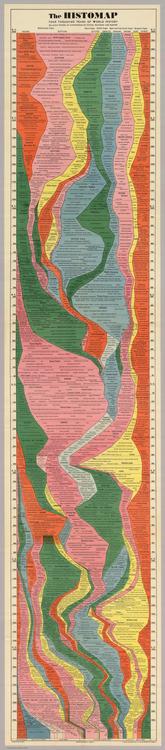
Rebecca Onion posted this note on a gorgeous chart of 4000 years of history created by John Sparks in 1931. (Rebecca’s post loads faster than the link under the illustration.)
A Partisan Nonpartisan Blog: Cutting Through Confusion Since 2012
Rebecca Onion posted this note on a gorgeous chart of 4000 years of history created by John Sparks in 1931. (Rebecca’s post loads faster than the link under the illustration.)
This is a nice profile of Susan Athey, whom I got to know early on because she looks at the economics of risk from a direction I very much like. See for example her paper “Monotone Comparative Statics Under Uncertainty."
You can see my other posts on monetary policy on my Monetary Policy sub-blog (which also has a permanent link on my sidebar).
This passage is from Michael Huemer’s wonderful book The Problem of Political Authority, pages 192-194.
Take the case of a social theory proposing that all citizens should work for the benefit of society, while receiving equal pay. A simple theoretical prediction is that, in such a system, productivity will decline. Individuals have a high degree of control over their own productivity, and greater productivity usually demands greater effort….
This prediction is in fact correct. The twentieth century’s experiments with social systems in this vicinity are well-known, so I shall not dwell on them. An interesting, but little-known illustration is provided by America’s first experiment with communism, which took place at Jamestown, the first permanent English settlement in America. When the colony was established in 1607, its founding charter stipulated that each colonist would be entitled to an equal share of the colony’s product, regardless of how much that individual personally produced. The result: the colonists did little work, and little food was produced. Of the 104 founding colonists, two-thirds died in the first year–partly due to unclean water, but mostly due to starvation. More colonists arrived from England, so that in 1609 there were 500 colonists. Of those, only 60 survived the winter of 1609-10. In 1611, England sent a new governor, Sir Thomas Dale, who found the skeletal colonists bowling in the streets instead of working. Their main source of food was wild plants and animals, which they gathered secretely at night so as to evade the obligation to share with their neighbors. Dale later converted the colony to a system based on private property, granting every colonist a three-acre plot to tend for his own individual benefit. The result was a dramatic increase in production. According to Captain John Smith’s contemporaneous history,
When our people were fed out of the common store and labored jointly together, glad was he [who] could slip from his labor or slumber over his task, he care not how; nay, the most honest among them would hardly take so much true pains in a week as now for themselves they will do in a day … so that we reaped not so much corn from the labors of thirty, as now three or four do provide themselves.
One lesson from this episode is that, simple as the account of human nature I have advanced is, it can yield very useful predictions. If the company that created the Jamestown charter had known a little economics, hundreds of lives might have been spared. Another is that the impact of human selfishness depends greatly on the social system in which people are embedded: in one kind of system, selfishness may have disastrous consequences, while in another, it promotes prosperity.
I wanted to back up some of what I have been writing about deliberate practice with more academic references. It matters because the evidence indicates that human capital accumulation can be dramatically improved by getting to best practice about practicing skills. K. Anders Ericsson is one of the foremost academic experts about deliberate practice. Here is an excerpt from his “Expert Performance and Deliberate Practice”:
The recent advances in our understanding of the complex representations, knowledge and skills that mediate the superior performance of experts derive primarily from studies where experts are instructed to think aloud while completing representative tasks in their domains, such as chess, music, physics, sports and medicine (Chi, Glaser & Farr, 1988; Ericsson & Smith, 1991; Starkes & Allard, 1993). For appropriate challenging problems experts don’t just automatically extract patterns and retrieve their response directly from memory. Instead they select the relevant information and encode it in special representations in working memory that allow planning, evaluation and reasoning about alternative courses of action (Ericsson & Lehmann, 1996). Hence, the difference between experts and less skilled subjects is not merely a matter of the amount and complexity of the accumulated knowledge; it also reflects qualitative differences in the organization of knowledge and its representation (Chi, Glaser & Rees, 1982). Experts’ knowledge is encoded around key domain-related concepts and solution procedures that allow rapid and reliable retrieval whenever stored information is relevant. Less skilled subjects’ knowledge, in contrast, is encoded using everyday concepts that make the retrieval of even their limited relevant knowledge difficult and unreliable. Furthermore, experts have acquired domain-specific memory skills that allow them to rely on long-term memory (Long-Term Working Memory, Ericsson & Kintsch, 1995) to dramatically expand the amount of information that can be kept accessible during planning and during reasoning about alternative courses of action. The superior quality of the experts’ mental representations allow them to adapt rapidly to changing circumstances and anticipate future events in advance. The same acquired representations appear to be essential for experts’ ability to monitor and evaluate their own performance (Ericsson, 1996; Glaser, 1996) so they can keep improving their own performance by designing their own training and assimilating new knowledge.
Below are some references. You can find a lot more by googling “Ericsson deliberate practice."
References:
Bolger, F., and G. Wright, 1992, ‘Reliability and validity in expert judgment.’ In *Expertise and Decision Support*, G. Wright and F. Bolger, eds. New York: Plenum, pp. 47-76.
Camerer, C. F., and E. J. Johnson, 1991, ‘The process-performance paradox in expert judgment: How can the experts know so much and predict so badly?’ In *Towards a General Theory of Expertise: Prospects and Limits*, K. A. Ericsson and J. Smith, eds. Cambridge: Cambridge University Press, pp. 195-217.
Charness, N., R. Th. Krampe, and U. Mayr, 1996, ‘The role of practice and coaching in entrepreneurial skill domains: An international comparison of life-span chess skill acquisition.’ In *The Road to Excellence: The Acquisition of Expert Performance in the Arts and Sciences, Sports, and Games*, K. A. Ericsson, ed. Mahwah, NJ: Erlbaum, pp. 51-80.
Chase, W. G., and H. A. Simon, 1973, ‘The mind’s eye in chess.’ In *Visual Information Processing*, W. G. Chase, ed. New York: Academic Press, pp. 215-281.
Chi, M. T. H., R. Glaser, and M. J. Farr, eds., 1988, *The nature of expertise*. Hillsdale, NJ: Erlbaum.
Chi, M. T. H., R. Glaser, and E. Rees, 1982, ‘Expertise in problem solving.’ In *Advances in the Psychology of Human Intelligence*, R. S. Sternberg, ed. Hillsdale , NJ Erlbaum, Vol. 1, pp. 1-75.
Dawes, R. M., 1994, *House of Cards: Psychology and Psychotherapy Built on Myth*. New York: Free Press.
Djakow, Petrowski, and Rudik, 1927, *Psychologie des Schachspiels [Psychology of Chess]*. Berlin: Walter de Gruyter
Doll, J., and U. Mayr, 1987, ‘Intelligenz und Schachleistung - eine Untersuchung an Schachexperten. [Intelligence and achievement in chess - a study of chess masters].’ *Psychologische Beiträge*, 29: 270-289.
de Groot, A., 1978, *Thought and Choice in Chess*. The Hague: Mouton. (Original work published 1946).
Ericsson, K. A., 1996, ‘The acquisition of expert performance: An introduction to some of the issues.’ In *The Road to Excellence: The Acquisition of Expert Performance in the Arts and Sciences, Sports, and Games*, K. A. Ericsson, ed. Mahwah, NJ: Erlbaum, pp. 1-50.
Ericsson, K. A., and W. Kintsch, 1995, ‘Long-term working memory.’ *Psychological Review*, 102: 211-245.
Ericsson, K. A., R. Th. Krampe, and C. Tesch-Römer, 1993, ‘The role of deliberate practice in the acquisition of expert performance.’ *Psychological Review*, 100: 363-406.
Ericsson, K. A., and A. C. Lehmann, 1996, ‘Expert and exceptional performance: Evidence on maximal adaptations on task constraints.’ *Annual Review of Psychology*, 47: 273-305.
Ericsson, K. A., and J. Smith, eds., 1991, *Toward a General Theory of Expertise: Prospects and Limits*. Cambridge, England: Cambridge University Press.
Glaser, R., 1996, ‘Changing the agency for learning: Acquiring expert performance.’ In *The Road to Excellence: The Acquisition of Expert Performance in the Arts and Sciences, Sports, and Games*, K. A. Ericsson, ed. Mahwah, NJ: Erlbaum, pp. 303-311.
Hoffman, R. R. ed., 1992, *The Psychology of Expertise: Cognitive Research and Empirical AI*. New York: Springer-Verlag.
Proctor, R. W., and A. Dutta, 1995, *Skill Acquisition and Human Performance*. Thousand Oaks, CA: Sage
Richman, H. B., F. Gobet, J. J. Staszewski, and H. A. Simon, 1996,‘Perceptual and memory processes in the acquisition of expert performance: The EPAM model.’ In *The Road to Excellence: The Acquisition of Expert Performance in the Arts and Sciences, Sports, and Games*, K. A. Ericsson, ed. Mahwah, NJ: Erlbaum, pp. 167-187.
Simon, H. A., and W. G. Chase, 1973, ‘Skill in chess.’ *American Scientist*, 61: 394-403.
Sloboda, J. A., J. W. Davidson, M. J. A. Howe, and D. G. Moore, 1996, ‘The role of practice in the development of performing musicians.’ *British Journal of Psychology*, 87: 287-309.
Starkes, J. L., and F. Allard, eds., 1993, *Cognitive Issues in Motor Expertise*. Amsterdam: North Holland.
Starkes, J. L., J. Deakin, F. Allard, N. J. Hodges, and A. Hayes, 1996, ‘Deliberate practice in sports: What is it anyway?’ In *The Road to Excellence: The Acquisition of Expert Performance in the Arts and Sciences, Sports, and Games*, K. A. Ericsson, ed. Mahwah, NJ: Erlbaum, pp. 81-106
Taylor, I. A., 1975, ‘A retrospective view of creativity investigation.’ In *Perspectives in creativity*, I. A. Taylor and J. W. Getzels, eds. Chicago, IL: Aldine Publishing Co, pp. 1-36.
VanLehn, K., 1996, ‘Cognitive skill acquisition.’ *Annual Review of Psychology*, 47: 513-539.
*Webster’s third new international dictionary*, 1976. Springfield, MA: Merriam
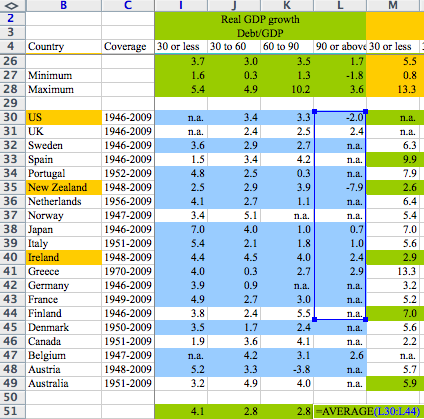
Ace labor economist Jeff Smith’s office is only a few doors down from mine. Hearing what he had to say about Reinhart and Rogoff in a hallway conversation, I suggested it would make a good blog post on his blog Econjeff. I was right: Jeff’s May 1, 2013 post about Reinhart and Rogoff is excellent. (That was aftermy April 20 mea culpa about relying on Reinhart and Rogoff, but well before my two columns with Yichuan Wang about Reinhart and Rogoff on May 29 and June 12.) Jeff kindly gave me permission to reprint that post here.
My thoughts on the Reinhart and Rogoff coding error:
Thanks to Miles Kimball for some encouragement.
From John Stuart Mill's On Liberty, Chapter 3 “Of Individuality, as One of the Elements of Well-Being,” paragraph 3:
No one’s idea of excellence in conduct is that people should do absolutely nothing but copy one another. No one would assert that people ought not to put into their mode of life, and into the conduct of their concerns, any impress whatever of their own judgment, or of their own individual character. On the other hand, it would be absurd to pretend that people ought to live as if nothing whatever had been known in the world before they came into it; as if experience had as yet done nothing towards showing that one mode of existence, or of conduct, is preferable to another.

One of the Tumblr blogs I follow, thekhooll, featured the repair and transformation of a historic building in one of my hometowns, Provo, Utah, into a Mormon Temple.
How to Lift a Seven Million Pound, 112-year-old Building. Engineers first gutted the damaged interior and then supported the exterior walls with special scaffolding as they dug down to create space for a two story basement, so in actuality the building hasn’t even moved. The entire structure is now on stilts some 40 feet in the air and from some angles appears to be floating above ground. Photo By by Brian Hansen

Stendhal's The Red and the Black
In his Wall Street Journal essay “Who Ruined the Humanities,” Lee Siegel makes a powerful case that the rising generation needs an introduction to literature through high school survey courses, simply to know what wonderful books exist, much more than it needs any special tools to understand literature.
It does seem to me that any aspect of the study of literature that is not effective at opening students’ eyes to the wonders of literature should be seen and judged either (a) as instruction in how to achieve similar effects in creative writing, or (b) as some combination of linguistics, history, philosophy, psychology, anthropology, sociology, geography, political science, or the like. Indeed, Lee writes that early in the 20th Cenutry, many literature departments “consisted mostly of philologists who examined etymology and the history of a text,” which could be considered a combination of linguistics and history.
Here is the heart of Lee’s argument:
Literature changed my life long before I began to study it in college and then, in a hapless trance, in graduate school. Born into modest circumstances, I plunged with wonder into the turbulent emotions of Julien Sorel, the young romantic striver of Stendhal’s “The Red and the Black.” My parents might have fought as their marital troubles crashed into divorce, but Chekhov’s stories sustained me with words that captured my sadness, and Keats’s language filled me with a beauty that repelled the forces that were making me sad.
Books took me far from myself into experiences that had nothing to do with my life, yet spoke to my life. Reading Homer’s “Iliad,” I could feel the uncanny power of recognizing the emotional universe of radically alien people. Yeats gave me a special language for a desire that defined me even as I had never known it was mine: “And pluck till time and times are done/The silver apples of the moon/The golden apples of the sun.”
But once in the college classroom, this precious, alternate life inside me got thrown back into that dimension of my existence that vexed or bored me. Homer, Chekhov and Yeats were reduced to right and wrong answers, clear-cut themes, a welter of clever and more clever interpretations. Books that transformed the facts were taught like science and social science and themselves reduced to mere facts. Novels, poems and plays that had been fonts of empathy, and incitements to curiosity, were now occasions of drudgery and toil….
… I am not making a brief against reading the classics of Western literature. Far from it. I am against taking these startling epiphanies of the irrational, unspoken, unthought-of side of human life into the college classroom and turning them into the bland exercises in competition, hierarchy and information-accumulation that are these works’ mortal enemies….
The literary classics are a haven for that part of us that broods over mortal bewilderments, over suffering and death and fleeting happiness. They are a refuge for our secret self that wishes to contemplate the precious singularity of our physical world, that seeks out the expression of feelings too prismatic for rational articulation. They are places of quiet, useless stillness in a world that despises any activity that is not profitable or productive.
Literary art’s sudden, startling truth and beauty make us feel, in the most solitary part of us, that we are not alone, and that there are meanings that cannot be bought, sold or traded, that do not decay and die. This socially and economically worthless experience is called transcendence, and you cannot assign a paper, or a grade, or an academic rank, on that. Literature is too sacred to be taught. It needs only to be read….
If there is any hand-wringing to do, it should be over the disappearance of what used to be a staple of every high-school education: the literature survey course, where books were not academically taught but intimately introduced—an experience impervious to inane commentary and sterile testing. Restore and strengthen that ground-shifting encounter and the newly graduated pilgrims will continue to read and seek out the transfiguring literary works of the past the way they will be drawn to love.
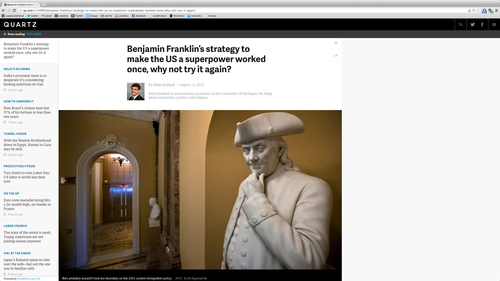
Here is the full text of my 28th Quartz column, ”Benjamin Franklin’s strategy to make the US a superpower worked once, why not try it again?” now brought home to supplysideliberal.com. It was first published on August 12, 2013. Links to all my other columns can be found here.
If you want to mirror the content of this post on another site, that is possible for a limited time if you read the legal notice at this link and include both a link to the original Quartz column and the following copyright notice:
© August 12, 2013: Miles Kimball, as first published on Quartz. Used by permission according to a temporary nonexclusive license expiring June 30, 2014. All rights reserved.
Ben Franklin was one of the greatest grand strategists in American history. He “had the vision of the Great Power of the New World” as refugees from the Old World poured in, writes Conrad Black in his page-turning, tour-de-force Flight of the Eagle: The Grand Strategies That Brought America from Colonial Dependence to World Leadership. Franklin then followed up that vision with brilliant diplomacy and sponsoring, along with George Washington, the constitutional efforts of Madison, Hamilton and Jay.
The flow of immigrants to America was crucial not only in the initial rise of America as a credible power in the world, but also in dealing with the stain of slavery: the North would have been unable to defeat the South in the Civil War if the North had not had a three to one advantage in population because of its greater ability to attract immigrants.
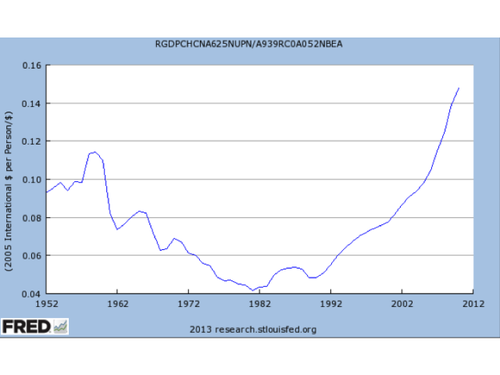
In the rest of the 21st century, America faces another grand-strategic challenge: the challenge of China. Since Deng Xiaoping’s economic reforms were introduced in December of 1978, China’s economy has been growing at a ferocious pace. As former Treasury Secretary Larry Summers put it, at Chinese growth rates, “In a decade, an individual goes from walking to having a bicycle; in another decade to a motorcycle; in another decade or two to having an automobile.” Yichuan Wang explains in “How China’s poorest regions are going to save its growth rate,” the reason the Chinese economy can grow so fast is that it is in the midst of “catch-up growth”: that is, it can copy technologies that have already been researched and developed in other countries. As shown in the graph above, China went from a per capita GDP (income per person) less than 1/50 of the US level to a per capita GDP of roughly 1/6 the US level in the 30 years from 1980 to 2010. It will not be easy for China to get all the way to the US level of income per person, but with half-decent economic policies, it should have no problem getting to half the US level of income per person.
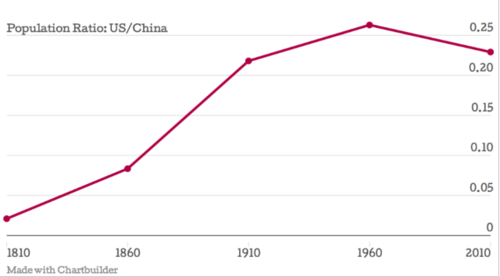
The reason China’s economic rise matters for US grand strategy is that China has a much larger population than the United States. Indeed, as the graph below shows, the US now has less than a quarter the population China has (the extreme measures China has taken to hold down its population growth since 1979 through its one-child policy have stabilized the ratio of US to Chinese population in recent years). Multiplying per capita GDP by population yields total GDP, so if China has ¼ the per capita GDP, but four times as many people, its total GDP will be the same size. More generally, if China gets to a larger fraction of US per capita GDP (see graph above) than the US population as a fraction of China’s population (see graph below), then China’s total GDP will be bigger. Although per capita GDP is what matters for people’s standard of living, total GDP is crucial for the ability of a country to wage war—or more importantly, to deter other countries from waging war against it. Power corrupts. So even though idealism has had some effect on US foreign policy (as Black details), it should surprise no one that the US has done some bad things as a superpower. Yet I am convinced that the combination of Chinese nationalism and “Communist” oligarchy—or the combination of Chinese nationalism with some tumultuous future political transition in China—would lead a dominant China to behave much worse than the US has.
What can be done to maintain US power relative to China? The worst answer would be to try to inhibit China’s economic growth. Berkeley economics professor and influential blogger Brad DeLong’s rhetorical question says it best:
Does it really improve the national security of the United States for schoolchildren in China to be taught that the United States sought to keep them as poor as possible for as long as possible?
An excellent answer is to do everything possible to foster long-run growth of per capita GDP in the US. At a minimum, this includes radical reform of our system of K-12 education, removing the barriers state governments put in the way of people getting jobs, and dramatically stepped-up support for scientific research. And it includes reform of both the US tax system and the balance in its government spending between (a) mailing people checks in direct government transfers and (b) investments in raising the productive capacity of the economy by, say, keeping roads and bridges in good repair. But when all is said and done, economic growth at the frontier of high living standards is simply harder than catch-up economic growth. So, short of some disaster for China that we should not wish on them, the ratio of China’s per capita GDP to US per capita GDP is bound to go up.
Fortunately, to add to the pro-growth policies listed above, there is another way to increase the size of the US economy that would be remarkably easy: expanding the United States economy—with all of its power to make people richer than they are in most other countries—to encompass a larger share of the world’s people. In the 19th century, many Americans felt a “manifest destiny” to expand the land that the US encompassed—westward, all the way to the Pacific. But in a modern economy, it is human beings and their skills (and the factories and machines their saving makes possible) that are the key to national wealth, not land.
So in the 21st century, we should view claiming more of the world’s people—not more of the world’s land—as the key to national wealth, and therefore, national power. And all we have to do to claim more of the world’s people for the US, is to open our doors to immigration, as the US did in the 18th and most of the 19th century. Ben Franklin knew that America would become a great nation because people from all over the world would eagerly move to America. The key to maintaining America’s preeminence in the world is to return to Ben Franklin’s visionary grand strategy of making many more of the world’s people into Americans.
Before the American Revolution, Franklin said that America “will in another century be more than the people of England, and the greatest number of Englishmen will be on this side of the water.” With a quarter-millennium of additional experience beyond what Franklin had seen, we know that America’s melting pot can make people from anywhere in the world (not just England) into Americans at heart within two generations. And we know that, together with all the other elements of this unbelievable American system, Franklin’s grand strategy for the rise of America worked once. It can work again to keep America on top.
Update: Steve Sailer has an interesting post pointing out the importance of birth rates, as well as the immigration rates I emphasize in the column. In order to keep an open mind, before reading Steve Sailer’s post, I recommend reading my post “John Stuart Mill’s Argument Against Political Correctness.” In his post Steve also points out that Ben Franklin favored English immigration over German immigration.
Ezra and Evan’s Flag. I was very pleased to see Ezra Klein and Evan Soltas flag the column, and intrigued by the way they boiled it down:
KIMBALL: The Ben Franklin strategy to a U.S. renaissance. “The reason China’s economic rise matters for US grand strategy is that China has a much larger population than the United States…An excellent answer is to do everything possible to foster long-run growth of per capita GDP in the US. At a minimum, this includes radical reform of our system of K-12 education, removing the barriers state governments put in the way of people getting jobs, and dramatically stepped-up support for scientific research…The key to maintaining America’s preeminence in the world is to return to Ben Franklin’s visionary grand strategy of making many more of the world’s people into Americans.” Miles Kimball in Quartz.

This post first appeared on Bloomberg.com on August 22, 2013. Thanks to Evan for giving me permission to reprint it here.
trong consensus on policy still eludes most branches of economics. How can poor countries best achieve rapid sustainable growth, for instance? That’s probably the most important question in all of economics. Development economists have “very little clue,” according to Lane Kenworthy, a leading scholar in the field and professor at the University of Arizona. But there’s an interesting exception. Without attracting much notice, one branch of the discipline has made a lot of progress in devising polices that command consensus: environmental economics.
Of course, recommendations aren’t necessarily followed by policy makers. The U.S. is still far away from taxing on carbon emissions, for instance, as just about every environmental economist would favor. But the field has some practical successes to boast of. At the top of the list is a program that rations the right to fish, known as “catch share.” It has proven shockingly successful in halting overfishing and ecological collapse – the point at which stocks can no longer replenish themselves.
A study of 11,135 fisheries showed that introducing catch share roughly halved the chance of collapse. The system caught on in the 1980s and 1990s after decades of other well-intentioned efforts failed. Economist H. Scott Gordon is usually credited with laying out the problem and the solution in 1954.
Modern environmental economists accuse their predecessors of forgetting about incentives. Catch-share schemes issue permits to individuals and groups to fish some portion of the grounds or keep some fraction of the total catch. If fishermen exceed their share, they can buy extra rights from others, pay a hefty fine or even lose their fishing rights, depending on theparticular arrangement. The system works because it aligns the interests of individual fishermen with the sustainability of the entire fishery. Everybody rises and falls with the fate of the total catch, eliminating destructive rivalries among fishermen.
Environmental economists have lately turned their attention to Atlantic bluefin tuna and whales. The National Marine Fisheries Service has just proposed new regulations that would for the first time establish a catch-share program for the endangered and lucrative bluefin. And a group of economists is pushing for a new international agreement on whaling.
In both cases the problem is overfishing. The bluefin tuna population has dropped by a third in the Atlantic Ocean and by an incredible 96 percent in the Pacific. And whaling, which is supposedly subject to strict international rules that ban commercial fishing and regulate scientific work, is making a sad comeback. The total worldwide annual catch has risen more than fivefold over the last 20 years.
Ben Minteer, Leah Gerber, Christopher Costello and Steven Gaines have called for a new and properly regulated market in whales. Set a sustainable worldwide quota, they say, and allow fishermen, scientists and conservationists alike to bid for catch rights. Then watch the system that saved other fish species set whaling right.
The idea outrages many environmentalists. Putting a price on whales, they argue, moves even further away from conservationist principles than the current ban, however ineffective. They’re wrong. “The arguments that whales should not be hunted, whatever their merits, have not been winning where it counts – that is, as measured by the size of the whale population,” says economist Timothy Taylor, editor of the Journal of Economic Perspectives.
I’d go further. Whale auctions would attract green donations to reduce catches below the quota. Environmental groups might find that the system was a blessing in disguise. If Japan were forced to buy permits to support its “scientific research,” the biggest loophole in the current ban on commercial whaling would be closed. Japan will resist the idea – but if it were persuaded to comply, environmental economics could score one of its greatest triumphs.

Econlolcats is now officially my favorite economics humor site since I learned about it a little over 24 hours ago. Thanks to Claudia Sahm for clueing me in with a retweet for the post you see above.
I especially like this Econlolcats post because I find the concept of low-hanging fruit very useful in discussing research strategy with students and colleagues.
One of the things I love about Japanese culture is the attention to detail in making life comfortable and pleasant. Materialism, or “Thingism” as David Zindell calls it in one of my favorite books, The Broken God, can be done right.

In his book How Music Works, David Byrne explains some of the philosophical background for this attitude toward daily live:
We should broaden our idea of what culture is. In Japan, there used to be no word for art. There, the process of making and drinking a pot of tea evolved into what we in the West might say is an art form. This ritualized performance of a fairly mundane activity embodied a heightened version of a ubiquitous attitude–that utilitarian objects and activities, made and performed with integrity, consciously and mindfully, could be art. The Zen philosopher Daisetz Suzuki said, “Who would then deny that when I am sipping tea in my tearoom, I am swallowing the whole universe with it, and that is very moment of my lifting the bowl to my lips is eternity itself transcending time and space.” That’s a lot for a cup of tea, but one can see that elevation of the mundane in a lot of areas and daily activities in the East. The poets, writers, and musicians of the Beat generation were inspired by this Eastern idea. They too saw the transcendent in the everyday and saw nobility in the activities of ordinary people. [p. 289]
This post is a rearticulation of my argument for electronic money, focusing on the negative interest rates themselves.
Cutout. An early draft had a lead paragraph that was cut for reasons of brevity and focus, but that I think will be of independent interest for many readers:
John von Neumann, who revolutionized economics by inventing game theory (before going on to help design the first atom bomb and lay out the fundamental architecture for nearly all modern computers), left an unfinished book when he died in 1957: The Computer and the Brain. In the years since, von Neumann’s analogy of the brain to a computer has become commonplace. The first modern economist, Adam Smith, was unable to make a similarly apt comparison between a market economy and a computer in his books, The Theory of Moral Sentiments or in the The Wealth of Nations, because they were published, respectively, in 1759 and 1776—more than 40 years before Charles Babbage designed his early computer in 1822. Instead, Smith wrote in The Theory of Moral Sentiments:
“Every individual … neither intends to promote the public interest, nor knows how much he is promoting it … he intends only his own security; and by directing that industry in such a manner as its produce may be of the greatest value, he intends only his own gain, and he is in this, as in many other cases, led by an invisible hand to promote an end which was no part of his intention.”
Now, writing in the 21st century, I can make the analogy between a market economy and a computer that Adam Smith could not. Instead of transistors modifying electronic signals, a market economy has individuals making countless decisions of when and how much to buy, and what jobs to take, and companies making countless decisions of what to buy and what to sell on what terms. And in place of a computer’s electronic signals, a market economy has price signals. Prices, in a market economy, are what bring everything into balance.

Shopping plaza near Japan’s Ministry of Finance where dinner conversation began to clarify the viability of both hard-money transitions and soft-money transitions as ways of dealing with the legal-tender issue.
I have continued thinking about the path to eliminating the zero lower bound by using electronic money as the unit of account in the months since I wrote “A Minimalist Implementation of Electronic Money.” In particular, as I discuss below, I think that switching legal tender status from paper currency to electronic money is less of and issue than I thought when I wrote “A Minimalist Implementation of Electronic Money.” That post was sparked by my visit to the Bank of England in May. This post is sparked by my upcoming visit to the Danmarks Nationalbank this Friday (September 6, 2013). If you have not yet read “A Minimalist Implementation of Electronic Money,” you should read that first in order to understand this post. You will also find my Powerpoint file “Breaking Through the Zero Lower Bound” helpful.
Implementing an electronic money system can look daunting politically when thinking of implementing the whole package at once, but it should be easier, and at least as effect to implement different elements in sequence. (Where I write “If possible,” it is possible to delay that step, or in some cases, do without it entirely, if necessary.) Let me lay out what I consider a reasonable order of implementation—starting with important elements of preparation that would be a good idea even apart from preparing for an electronic money system. Here is the path I currently recommend to get to electronic money as a monetary system:
In relation to both private debts and debts to the government, there are two options for dealing with preexisting debts:
A Hard-Money Transition to Electronic Money. Old debts (beyond a certain size) are only payable in electronic money. Insured bank accounts are formally given legal tender status so that there is some way to legally compel a lender to accept repayment.
A Soft-Money Transition to Electronic Money. Old debts are payable in paper currency (assuming the contract does not specify otherwise), but new contracts can specify that repayment must be made in electronic money.
To me, the soft-money transition seems unfair to lenders, but either option would preserve full freedom for the monetary authority to use substantially negative interest rates.
The key point is that the soft-money transition does the job, even though it doesn’t do it as fairly or as elegantly as the hard-money transition. As far as eliminating the zero lower bound is concerned, it is enough to allow lenders and retail establishments to distinguish between electronic money and paper currency going forward. It is only a guarantee of zero interest rates on paper currency going forward that creates a zero lower bound. So old debts can be handled either way without creating a zero lower bound.
Saying that contracts going forward can specify separately the acceptability of, or terms for, repayment in paper currency is much simpler than the possibility I raise in “A Minimalist Implementation of Electronic Money” of introducing a new, non-legal-tender paper currency. Instead of an old currency and a new currency, there would be old debts and new debts. Paper currency would be legal tender for the old debts in the ordinary way, while new debts would have new contracts, which most likely would not allow repayment in paper currency at par.
In his post “Beating the Iron Law of Public Choice: A Reply to Peter Boettke,” Lars Christensen gives this description of the supposed Iron Law of Public Choice:
… the Iron Law of Public Choice – no matter how much would-be reformers try they will be up against a wall of resistance. Reforms are doomed to end in tears and reformers are doomed to end depressed and disappointed.
Lars gives this ancestry for the Iron Law of Public Choice:
The students of Public Choice theory will learn from Bill Niskanen that bureaucrats has an informational advantage that they will use to maximizes budgets. They will learn that interest groups will lobby to increase government subsidies and special favours. Gordon Tulluck teaches us that groups will engage in wasteful rent-seeking. Mancur Olson will tell us that well-organized groups will highjack the political process. Voters will be rationally ignorant or even as Bryan Caplan claims rationally irrational.
But at the end of the day, I agree with Lars when he says
ideas – especially good and sound ideas – can beat the Iron Law of Public Choice.

Here is the full text of my 27th Quartz column, "Three big questions for Larry Summers, Janet Yellen, and anyone else who wants to head the Fed,“ now brought home to supplysideliberal.com. It was first published on July 31, 2013. Links to all my other columns can be found here.
If you want to mirror the content of this post on another site, that is possible for a limited time if you read the legal notice at this link and include both a link to the original Quartz column and the following copyright notice:
© July 31, 2013: Miles Kimball, as first published on Quartz. Used by permission according to a temporary nonexclusive license expiring June 30, 2014. All rights reserved.
The financial crisis of 2008 and the miserable performance of the US economy since then made the Federal Reserve look bad. And almost everything the Federal Reserve has done since then to try to get the economy back on track—from the role it took in the Wall Street bailouts (detailed in David Wessel’s book In Fed We Trust), to dramatically increasing the money supply, to quantitative easing—has also made the Fed look bad.
Despite how bad the Fed’s performance looks, things could have been worse—much worse—and I have argued that Ben Bernanke, who led the Fed through this difficult time, should be given a third term as head of the Fed. But as President Obama has made very clear, that is not going to happen.
Now there are rival campaigns for who will follow Bernanke as Fed chief, with former Treasury Secretary Larry Summers and Fed Vice Chairman Janet Yellen as the leading candidates. Ezra Klein has repeatedly written on Wonkblog that Obama’s inner circle favors Summers, and Senate Democrats were galvanized by the prospect to write a letter favoring Yellen, followed a few days later by a New York Times editorial board weighing in strongly for Yellen. Much of the discussion has focused on personality differences that I can verify: Larry Summers was one of my professors in economics graduate school and I had a memorable dinner talking about the economics of happiness with Janet Yellen and her Nobel-laureate-to-be husband George Akerlof when I gave a talk at Berkeley in 2006.
I distilled my own observations into tweets saying on the one hand that “Larry Summers can dominate a room full of very smart economists” while “Janet Yellen, like her husband George Akerlof, is one of the nicest economists I have ever met.” Despite that personal knowledge, and the same publicly available information as everyone else, I had to confess on a HuffPost Live segment on July 25, 2013, that my own views on the relative merits of Summers and Yellen go back and forth on an hourly basis. The source of my trouble is this: there are many questions Larry Summers has studiously avoided addressing about monetary policy (Neil Irwin in Wonkblog thinks this is a deliberate, but flawed strategy) and even Yellen, who has an extensive and laudable record on past and current monetary policy and financial stability policy, hasn’t answered all the questions I have about the future of monetary policy and policy to enhance financial stability. On financial stability, Summers has made mistakes in the past (helpfully listed by Erika Eichelberger at motherjones.com), so I especially want to know where he would go in the future in this important function of the Fed.
The questions I would like to ask Larry Summers and Janet Yellen are many, but let’s focus on three big ones:
Any serious candidate for the Fed who gives positive answers to these three questions will have my enthusiastic support, and I hope, the enthusiastic support of all those who have a deep understanding of monetary policy and financial stability. But any candidate for the Fed who gives negative answers to these three questions will be indicating a monetary policy and financial stability philosophy that would leave the economy in continued danger of slow growth (with little room for error) and high unemployment in the short run, and the virtual certainty of another serious financial crisis a decade or two down the road.
Update: I am delighted that Gerald Seib and David Wessel flagged this column in their August 2, 2013 Wall Street Journal “What We’re Reading”feature. They write
University of Michigan economist Miles Kimball says the best candidate to take over as leader of the Fed will back negative short-term interest rates, nominal GDP targeting, and high equity requirements for banks and financial firms. If a candidate is chosen who opposes any of these three, Mr. Kimball predicts another serious financial crisis in the next two decades. [Emphasis added.]
In their last sentence, they go beyond what I intend when I write
But any candidate for the Fed who gives negative answers to these three questions will be indicating a monetary policy and financial stability philosophy that would leave the economy in continued danger of slow growth (with little room for error) and high unemployment in the short run, and the virtual certainty of another serious financial crisis a decade or two down the road.
Let me clarify. First, it is not these beliefs by the Fed Chief alone that would lead to a financial crisis, but the philosophy that would answer my three questions in the negative, held more generally—by the Fed Chief and other important players around the world. But of course, the Fed Chief is a hugely important player on the world stage. Second, I write “who gives negative answers to these three questions” meaning negative answers to all three. To separate out the causality more carefully, what I have in mind with the parallel structure of my final sentence in the column (quoted just above) is
Outtakes: Here are two passages that I had to cut to tighten things up, but that you may find of some interest:
In brief, the Fed put itself in the position of getting bad results using unpopular methods. By July 2009, the Fed’s job approval rating in a Gallup poll was down to 30%, below the job approval rating for the IRS . By the time of the 2012 presidential election campaign, Republican crowds enthusiastically chanted the title of Republican candidate Ron Paul’s book End the Fed.
…in a 32-second exchange with Charlie Rose that is well worth watching for the nuances, President Obama said “He’s already stayed a lot longer than he wanted, or he was supposed to.” The praise for Bernanke in the Charlie Rose interview is so tepid and ungenerous that my interpretation is the same as US News and World Report editor-in-chief Mortimer Zuckerman’s in his July 25, 2013 Wall Street Journal op-ed “Mistreating Ben Bernanke, the Man Who Saved the Economy”: “This comment made it clear that Mr. Bernanke’s days were numbered.”