In Praise of Trolls

My usage of the word “troll” is informed by Noah Smith’s wildly popular post “Econotrolls: An Illustrated Bestiary." The current wikipedia entry on internet trolls has this note:

Application of the term troll is subjective. Some readers may characterize a post as trolling, while others may regard the same post as a legitimate contribution to the discussion, even if controversial.

The "trolls” of my title are exactly these borderline trolls whom some call “trolls” and some think are making legitimate, albeit controversial contributions. Although I will not promise to always feed the trolls myself, John Stuart Mill had some words to say in praise of trolls that I agree with. This is what he said in On Liberty, Chapter II “Of the Liberty of Thought and Discussion,” from the middle of paragraph 29 through paragraph 33:

There are many reasons, doubtless, why doctrines which are the badge of a sect retain more of their vitality than those common to all recognised sects, and why more pains are taken by teachers to keep their meaning alive; but one reason certainly is, that the peculiar doctrines are more questioned, and have to be oftener defended against open gainsayers. Both teachers and learners go to sleep at their post, as soon as there is no enemy in the field.

The same thing holds true, generally speaking, of all traditional doctrines—those of prudence and knowledge of life, as well as of morals or religion. All languages and literatures are full of general observations on life, both as to what it is, and how to conduct oneself in it; observations which everybody knows, which everybody repeats, or hears with acquiescence, which are received as truisms, yet of which most people first truly learn the meaning, when experience, generally of a painful kind, has made it a reality to them. How often, when smarting under some unforeseen misfortune or disappointment, does a person call to mind some proverb or common saying, familiar to him all his life, the meaning of which, if he had ever before felt it as he does now, would have saved him from the calamity. There are indeed reasons for this, other than the absence of discussion: there are many truths of which the full meaning cannot be realized, until personal experience has brought it home. But much more of the meaning even of these would have been understood, and what was understood would have been far more deeply impressed on the mind, if the man had been accustomed to hear it argued pro and con by people who did understand it. The fatal tendency of mankind to leave off thinking about a thing when it is no longer doubtful, is the cause of half their errors. A contemporary author has well spoken of “the deep slumber of a decided opinion.”

But what! (it may be asked) Is the absence of unanimity an indispensable condition of true knowledge? Is it necessary that some part of mankind should persist in error, to enable any to realize the truth? Does a belief cease to be real and vital as soon as it is generally received—and is a proposition never thoroughly understood and felt unless some doubt of it remains? As soon as mankind have unanimously accepted a truth, does the truth perish within them? The highest aim and best result of improved intelligence, it has hitherto been thought, is to unite mankind more and more in the acknowledgment of all important truths: and does the intelligence only last as long as it has not achieved its object? Do the fruits of conquest perish by the very completeness of the victory? 

I affirm no such thing. As mankind improve, the number of doctrines which are no longer disputed or doubted will be constantly on the increase: and the well-being of mankind may almost be measured by the number and gravity of the truths which have reached the point of being uncontested. The cessation, on one question after another, of serious controversy, is one of the necessary incidents of the consolidation of opinion; a consolidation as salutary in the case of true opinions, as it is dangerous and noxious when the opinions are erroneous. But though this gradual narrowing of the bounds of diversity of opinion is necessary in both senses of the term, being at once inevitable and indispensable, we are not therefore obliged to conclude that all its consequences must be beneficial. The loss of so important an aid to the intelligent and living apprehension of a truth, as is afforded by the necessity of explaining it to, or defending it against, opponents, though not sufficient to outweigh, is no trifling drawback from, the benefit of its universal recognition. Where this advantage can no longer be had, I confess I should like to see the teachers of mankind endeavouring to provide a substitute for it; some contrivance for making the difficulties of the question as present to the learner’s consciousness, as if they were pressed upon him by a dissentient champion, eager for his conversion.

But instead of seeking contrivances for this purpose, they have lost those they formerly had. The Socratic dialectics, so magnificently exemplified in the dialogues of Plato, were a contrivance of this description. They were essentially a negative discussion of the great questions of philosophy and life, directed with consummate skill to the purpose of convincing any one who had merely adopted the commonplaces of received opinion, that he did not understand the subject—that he as yet attached no definite meaning to the doctrines he professed; in order that, becoming aware of his ignorance, he might be put in the way to attain a stable belief, resting on a clear apprehension both of the meaning of doctrines and of their evidence. The school disputations of the middle ages had a somewhat similar object. They were intended to make sure that the pupil understood his own opinion, and (by necessary correlation) the opinion opposed to it, and could enforce the grounds of the one and confute those of the other. These last-mentioned contests had indeed the incurable defect, that the premises appealed to were taken from authority, not from reason; and, as a discipline to the mind, they were in every respect inferior to the powerful dialectics which formed the intellects of the “Socratici viri:” but the modern mind owes far more to both than it is generally willing to admit, and the present modes of education contain nothing which in the smallest degree supplies the place either of the one or of the other. A person who derives all his instruction from teachers or books, even if he escape the besetting temptation of contenting himself with cram, is under no compulsion to hear both sides; accordingly it is far from a frequent accomplishment, even among thinkers, to know both sides; and the weakest part of what everybody says in defence of his opinion, is what he intends as a reply to antagonists. It is the fashion of the present time to disparage negative logic—that which points out weaknesses in theory or errors in practice, without establishing positive truths. Such negative criticism would indeed be poor enough as an ultimate result; but as a means to attaining any positive knowledge or conviction worthy the name, it cannot be valued too highly; and until people are again systematically trained to it, there will be few great thinkers, and a low general average of intellect, in any but the mathematical and physical departments of speculation. On any other subject no one’s opinions deserve the name of knowledge, except so far as he has either had forced upon him by others, or gone through of himself, the same mental process which would have been required of him in carrying on an active controversy with opponents. That, therefore, which when absent, it is so indispensable, but so difficult, to create, how worse than absurd is it to forego, when spontaneously offering itself! If there are any persons who contest a received opinion, or who will do so if law or opinion will let them, let us thank them for it, open our minds to listen to them, and rejoice that there is some one to do for us what we otherwise ought, if we have any regard for either the certainty or the vitality of our convictions, to do with much greater labor for ourselves.

The online world has in abundance what John Stuart Mill worried might be in short supply: trolls

After Crunching Reinhart and Rogoff's Data, We Found No Evidence That High Debt Slows Growth

blog.supplysideliberal.com tumblr_inline_mnlb0fz9DP1qz4rgp.png

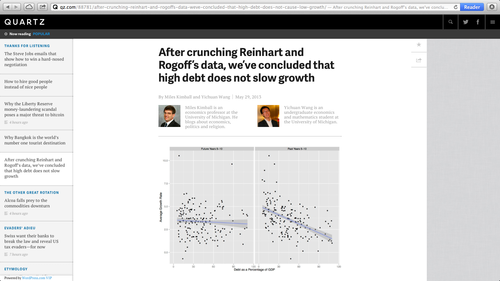
Here is a link to my 24th column on Quartz, “After crunching Reinhart and Rogoff’s data, we’ve concluded that high debt does not slow growth,” coauthored with Yichuan Wang. The title chosen by our editor is too strong, but not so much so that I objected to it; the title of this post is more accurate.

Yichuan only recently finished his first year at the University of Michigan. Yichuan’s blog is Synthenomics. You can see Yichuan on Twitter here. Let me say already that from reading Yichuan’s blog and working with him on this column, I know enough to strongly recommend Yichuan for admission to any Ph.D. program in economics in the world. He should finish has bachelor’s degree first, though. 

I genuinely went into our analysis expecting to find evidence that high debt does cause low growth, though of course, to a much smaller extent than low growth causes high debt. I was fully prepared to argue (first to Yichuan and then to the world) that even a statistically insignificant negative effect of debt on growth that was plausibly causal had to be taken seriously from a Bayesian perspective. Our analysis set out the minimal hurdles I felt had to be jumped over to convince me that there was some solid evidence that high debt causes low growth. A key jump was not completed. That shifted my views.

I hope others will try to replicate our findings. That should let me rest easier.

From a theoretical point of view, I am especially intrigued by the possibility that any effect on growth from refinancing difficulties might depend on a country’s debt to GDP ratio compared to that of other countries. What I find remarkable is that despite the likely negative effect of debt on growth from refinancing difficulties, we found no overall negative effect of debt on growth. It is as if there is some other, positive effect of debt on growth to the extent a country’s relative debt position stays the same. Besides the obvious, but uncommonly realized, possibility of very wisely deployed deficit spending, I can think of two intriguing mechanisms that could generate such an effect. First, from a supply-side point of view, lower tax rates now could make growth look higher now, perhaps at the expense of growth at some future date when taxes have to be raised to pay off the debt, with interest. Second, government debt increases the supply of liquid (and often relatively safe) assets in the economy that can serve as good collateral. Any such effect could be achieved without creating a need for higher future taxes or lower future spending by investing the money raised in corporate stocks and bonds through a sovereign wealth fund.

I have thought a little about why borrowing in a currency one can print unilaterally makes such a difference to the reactions of the bond market to debt. One might think that the danger of repudiating the implied real debt repayment promises by inflation would mean the risks to bondholders for debt in one’s own currency would be almost the same as for debt in a foreign currency or a shared currency like the euro. But it is one thing to fear actual disappointing real repayment spread over some time and another thing to have to fear that the fear of other bondholders will cause a sudden inability of a government to make the next payment at all.  

Note: Brad Delong writes:

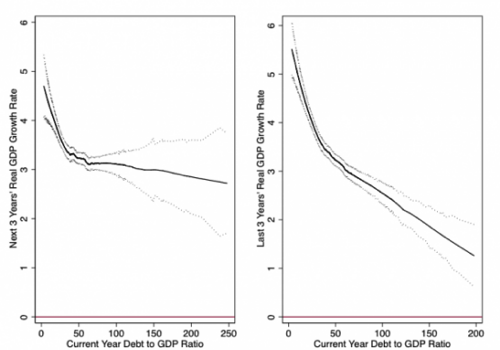
Miles Kimball and Yichuan Wang confirm Arin Dube: Guest Post: Reinhart/Rogoff and Growth in a Time Before Debt | Next New Deal:

As I tweeted,

  1. .@delong undersells our results. I would have read Arin Dube’s results alone as saying high debt *does* slow growth.
  2. *Of course* low growth causes debt in a big way. But we need to know if high debt causes low growth, too. No ev it does!

In tweeting this, I mean, if I were convinced Arin Dube’s left graph were causal, the left graph seems to suggest that higher debt causes low growth in a very important way, though of course not in as big a way as slow growth causes higher debt. If it were causal, the left graph suggests it is the first 30% on the debt to GDP ratio that has the biggest effect on growth, not any 90% threshold. Yichuan and I are saying that the seeming effect of the first 30% on the debt to GDP ratio could be due in important measure to the effect of growth on debt, plus some serial correlation in growth rates. The nonlinearity could come from the fact that it takes quite high growth rates to keep a country from have some significant amounts of debt–as indicated by Arin Dube’s right graph, which is more likely to be primarily causal.

By the way, I should say that Yichuan and I had seen the Rortybomb piece on Arin Dube’s analysis, but we were not satisfied with it. But I want to give credit for this as a starting place for Yichuan and me in our thinking.

Brad Delong’s Reply: Thanks to Brad DeLong for posting the note above as part of his post “DeLong Smackdown Watch: Miles Kimball Says That Kimball and Wang is Much Stronger than Dube.”

Brad replies:

From my perspective, I tend to say that of course high debt causes low growth–if high debt makes people fearful, and leads to low equity valuations and high interest rates. The question is: what happens in the case of high debt when it comes accompanied by low interest rates and high equity values, whether on its own or via financial repression?

Thus I find Kimball and Wang’s results a little too strong on the high-debt-doesn’t-matter side for me to be entirely comfortable…

My Thoughts about What Brad Says in the Quote Just Above: As I noted above, my reaction is to what we Yichuan and I found is similar to Brad’s. There must be a negative effective of debt on growth through the bond vigilante channel, as Yichuan and I emphasize in our interpretation. For example, in our final paragraph, Yichuan and I write:

…other than the danger from bond market vigilantes, we find no persuasive evidence from Reinhart and Rogoff’s data set to worry about anything but the higher future taxes or lower future spending needed to pay for that long-term debt.

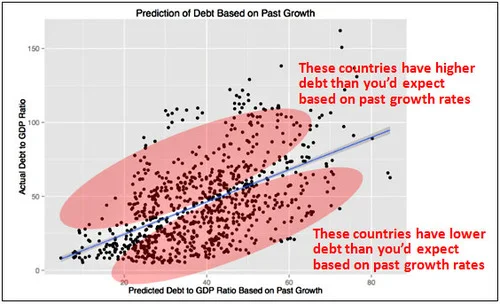
The surprise is the pattern that when countries around the world shifted toward higher debt than would be predicted by past growth, that later growth turned out to be somewhat higher than after countries around the world shifted to lower debt. It may be possible to explain why that evidence from trends in the average level of debt around the world over time should be dismissed, but if not, we should try to understand those time series patterns. It is hard to get definitive answers from the relatively small amount of evidence in macroeconomic time series, or even macroeconomic panels across countries, but given the importance of the issues, I think it is worth pondering the meaning of what limited evidence there is from trends in the average level of debt around the world over time. That is particularly true since in the current crisis, many people have, recommended precisely the kind of worldwide increase deficit spending–and therefore debt levels–that this limited evidence speaks to. 

I am perfectly comfortable with the idea that the evidence from trends in the average level of debt around the world over time is limited enough so theoretical reasoning that shifts our priors could overwhelm the signal from the data. But I want to see that theoretical reasoning. And I would like to get reactions to my theoretical speculations above, about (1) supply-side benefits of lower taxes that reverse in sign in the future when the debt is paid for and (2) liquidity effects of government debt (which may also have a price later because of financial cycle dynamics). 

Matt Yglesias’s Reaction: On MoneyBox, you can see Matthew Yglesias’s piece “After Running the Numbers Carefully There’s No Evidence that High Debt Levels Cause Slow Growth.” As I tweeted:

Don’t miss this excellent piece by @mattyglesias about my column with @yichuanw on debt and growth. Matt gets it.


In the preamble of my post bringing the full text of “An Economist’s Mea Culpa: I Relied on Reihnart and Rogoff” home to supplysideliberal.com, I write:

In terms of what Carmen Reinhart and Ken Rogoff should have done that they didn’t do, “Be very careful to double-check for mistakes” is obvious. But on consideration, I also felt dismayed that they didn’t do a bit more analysis on their data early on to make a rudimentary attempt to answer the question of causality. I wouldn’t have said it quite as strongly as Matthew Yglesias, but the sentiment is basically the same.    

Paul Krugman’s Reaction: On his blog, Paul Krugman characterized our findings this way:

There is pretty good evidence that the relationship is not, in fact, causal, that low growth mainly causes high debt rather than the other way around.

Kevin Drum’s Reaction: On the Mother Jones blog, Kevin Drum gives a good take on our findings in his post “Debt Doesn’t Cause Low Growth. Low Growth Causes Low Growth.” He notices that we are not fans of debt. I like his version of one of our graphs:

Mark Gongloff’s Reaction: On Huffington Post, Mark Gongloff’s “Reinhart and Rogoff’s Pro-Austerity Research Now Even More Thoroughly Debunked by Studies” writes:

…University of Michigan economics professor Miles Kimball and University of Michigan undergraduate student Yichuan Wang write that they have crunched Reinhart and Rogoff’s data and found “not even a shred of evidence” that high debt levels lead to slower economic growth.

And a new paper by University of Massachusetts professor Arindrajit Dube finds evidence that Reinhart and Rogoff had the relationship between growth and debt backwards: Slow growth appears to cause higher debt, if anything….

This contradicts the conclusion of Reinhart and Rogoff’s 2010 paper, “Growth in a Time of Debt,” which has been used to justify austerity programs around the world. In that paper, and in many other papers, op-ed pieces and congressional testimony over the years, Reinhart And Rogoff have warned that high debt slows down growth, making it a huge problem to be dealt with immediately. The human costs of this error have been enormous….

At the same time, they have tried to distance themselves a bit from the chicken-and-egg problem of whether debt causes slow growth, or vice-versa. “The frontier question for research is the issue of causality,” [Reinhart and Rogoff] said in their lengthy New York Times piece responding to Herndon. It looks like they should have thought a little harder about that frontier question three years ago.

There is an accompanying video by Zach Carter.

Paul Andrews Raises the Issue of Selection Bias: The most important response to our column that I have seen so far is Paul Andrews’s post “None the Wiser After Reinhart, Rogoff, et al.” This is the kind of response we were hoping for when we wrote “We look forward to further evidence and further thinking on the effects of debt.” Paul trenchantly points out the potential importance of selection bias: 

What has not been highlighted though is that the Reinhart and Rogoff correlation as it stands now is potentially massively understated. Why? Due to selection bias, and the lack of a proper treatment of the nastiest effects of high debt: debt defaults and currency crises.

The Reinhart and Rogoff correlation is potentially artificially low due to selection bias. The core of their study focuses on 20 or so of the most healthy economies the world has ever seen. A random sampling of all economies would produce a more realistic correlation. Even this would entail a significant selection bias as there is likely to be a high correlation between countries who default on their debt and countries who fail to keep proper statistics.

Furthermore Reinhart and Rogoff’s study does not contain adjustments for debt defaults or currency crises.  Any examples of debt defaults just show in the data as reductions in debt. So, if a country ran up massive debt, could’t pay it back, and defaulted, no problem!  Debt goes to a lower figure, the ruinous effects of the run-up in debt is ignored. Any low growth ensuing from the default doesn’t look like it was caused by debt, because the debt no longer exists!

I think this issue needs to be taken very seriously. It would be a great public service for someone to put together the needed data set. 

Note that Paul Andrews views are in line with our interpretation of our findings. Let me repeat our interpretation, with added emphasis:

other than the danger from bond market vigilantes, we find no persuasive evidence from Reinhart and Rogoff’s data set to worry about anything but the higher future taxes or lower future spending needed to pay for that long-term debt.

Of course, it is disruptive to have a national bankruptcy. And nationalbankruptcies are more likely to happen at high levels of debt than low levels of debt (though other things matter as well, such as the efficiency of a nation’s tax system). And the fear by bondholders of a national bankruptcy can raise interest rates on government bonds in a way that can be very costly for a country. The key question for which the existing Reinhart and Rogoff data set is reasonably appropriate is the question of whether an advanced country has anything to fear from debt even if, for that particular country, no one ever seriously doubts that country will continue to pay on its debts.

A Year in the Life of a Supply-Side Liberal

Update: Below is my 1st anniversary post. You might also be interested in  my 2d anniversary post, “Three Revolutions.”


Today it has been exactly one year since my first post, “What is a Supply-Side Liberal?” on May 28, 2012. It has been a surprising year–surprising because my hopes when I decided to start blogging have been realized.

For many years, I wanted to do something in the public domain, but couldn’t figure out how to do it. So, after talking to Noah Smith and Justin Wolfers about what it was like to be a blogger, I took on blogging as a serious career move.

For someone with my talkative personality, there is a frustration at having things to say and trying to be heard through the traditional means of in-person conversations, seminars and formal working papers or journal articles alone. (Anyone seeking roots of that talkative personality in my childhood can look to the competition for attention and airtime with six siblings.) It is a great relief to know that my readers will be able to find what I have to say online within hours after I have written it down and make it public.

In the public arena, not having a blog, Twitter account, Facebook page or similar platform felt to me a little like being one of those ghosts in the movies who try to talk to their still-living friends and family, but find that their words are inaudible. Now I can talk back when I disagree with what I read in the Wall Street Journal at the breakfast table. Or I can add my two cents to an idea that I agree with.

Though I call the transition “starting to blog,” in fact, Facebook mirroring of my blog posts, Twittercolumns on Quartz, and a few radio (1, 2), TV and Huffpost Live (1, 2), round out the picture so far. For a blogger who also wants to also keep publishing in the academic journals, I think of Milton Friedman as the model of an academic as a public intellectual. I am amazed at how persuasive Milton is in the videos I curated in “Milton Friedman: Celebrating His 100th Birthday with Videos of Milton.”

As an academic “blogger,” each medium reinforces the others. Publishing in economic journals provides an anchor of rigor and depth, and the credibility to talk to policy makers in terms they respect, Twitter invites questions and dialogue in a way anyone can join in on, Facebook gives a sense of personal connection and displays links in a beautiful way, Radio and TV satisfy a primal human curiosity about how someone looks and sounds, writing on Quartz gives me the excellent feedback of my editors Mitra Kalita and Lauren Brown to make difficult ideas more accessible than they would otherwise be, and my blog itself gives me the independence and space to say whatever I think needs to be said, unfiltered by anyone else.

This post marks the end of the “third cycle” for my blog. The first whirlwind month constituted the “first cycle.” Here is what I was thinking at the end of that first month:

The rest of the summer of 2012, my “second cycle,” was also a time of intense blogging. My thoughts at the end of that summer are recounted in

Since then, it has been hard to find time to sit back and take stock until now. The third cycle, from September 1 to now has been very different than those first months:

  • Mitra Kalita liked my post “Why My Retirement Savings Accounts are 100% in the Stock Market,” and recruited me for the Atlantic Corporation’s new international business website Quartz. She initially suggested a pace of once every other week, but I wanted to set a goal of one column a week. In the event, I have written 23 columns in the 246 days since my first Quartz column appeared on September 24, 2012, or about one every week and a half. I rank my first 22 Quartz columns (and my other top blog posts) by popularity here.    
  • Beyond my Quartz columns, my day job teaching macroeconomics and doing economic research made it hard to find time to write major posts unless I could kills two birds with one stone, by, say writing something that would help with my teaching, such as “The Deep Magic of Money and the Deeper Magic of the SupplySide.” But events sometimes inspired me to steal time to write a major post, such as when I tried to see if I could twist the words of my distant cousin Mitt Romney’s acceptance speech enough to get a supply-side liberal interpretation in “The Magic of Etch-a-Sketch: A Supply-Side Liberal Fantasy.” The most personal post I wrote was about the death of my mother.
  • For my regular readers, I have tried hard (with some lapses) to have at least one new post every day on my blog. Some are links to other posts and articles I like. Some are my favorite excerpts from books I have been reading. As I was drawn into lively Twitter discussions (with 2900 followers this morning), an increasing number were links to storified Twitter interactions on substantive issues. And I found a significant fraction of my writing effort devoted to my goal of publishing a worthy religion or philosophy post each Sunday. I view writing my Sunday religion or philosophy post as an important discipline to try to keep a broader perspective.
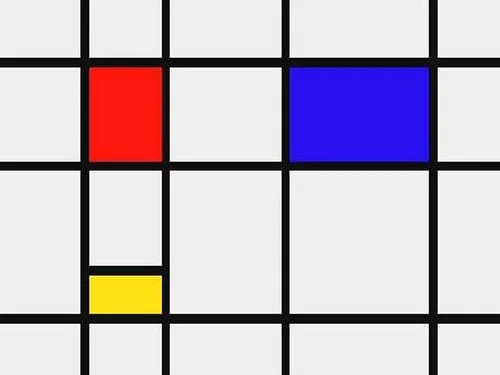
  • For me, more of the joy of blogging than I expected has come from choosing the illustrations at the top of my posts. I love trying to make my blog beautiful as well as substantive. I talk about this in “Illustration Note to ‘Leading States in the Fiscal Two-Step” and “In Praise of Tumblr.” The most recent illustration choice I am proud of is the image of a Piet Mondrian painting at the top of “A Minimalist Implementation of Electronic Money.” My daughter Diana had a lot to do with the look and feel of my blog, making that aspect much better than it would have been otherwise. She writes about the beginnings of supplysideliberal.com here.  
  • I have felt some nostalgia for those early months of true obsession with my blog and particularly for the hours I allowed myself then to write a post on the spot on idea I was inspired by. But I am glad that the blog-excitement-induced insomnia I reported in “Thoughts on Monetary and Fiscal Policy in the Wake of the Great Recession: supplysideliberal.com’s First Month” has abated to about a third or a quarter the intensity it had then. At this point my meta-self would rather get more sleep than write another blog post. But part of me doesn’t agree. 

In terms of substance on my blog and in Quartz, I am still following the agenda set out in my first post What is a Supply-Side Liberal? Because of the aftermath of the great recession, a huge fraction of my writing this past year has been devoted to backing up my claim there that

…there is no shortage of powerful tools to revive both the U.S. economy and the world economy.  This is true despite (A) short-term interest rates already being close to zero in the U.S. and many other countries and (B) most countries not being able to afford to add much to their national debt

At the time, I had in mind Federal Lines of Credit and quantitative easing (addressed in my second and third posts) as tools for stimulating the economy at the zero lower bound. It was news to me when it dawned on me that it was possible to eliminate the zero lower bound through electronic money and that the most effective form of quantitative easing,  buying corporate stocks and bonds, could be undertaken best by a sovereign wealth fund separate from the Fed or other central bank, and how such a sovereign wealth fund could aid financial stability as well. The other big revelatory moment was was reading John Cochrane’s review of Anat Admati and Martin Hellwig’s book The Banker’s New Clothes (summarized in my post here), which deconstructs the arguments bank lobbyists make against high bank equity (“capital”) requirements as a means of ensuring financial stability. For macroeconomic and financial stability, the two policies I believe would make the most difference are the combination of eliminating the zero lower bound through electronic money and high bank equity requirements, in the range of 30 to 50%, achieved gradually by prohibiting banks from paying dividends or buying back stock until they achieve that level.

Less of my writing than I would like has been devoted to exploring “the enduring dilemmas of economic policy,” among which “the most important is the conflict between efficiency and equity." This summer, I hope to write more about tax policy, and other issues that touch on the distribution of income and wealth. On issues of income distribution and tax policy, the most important posts I have written are

Let me say a few more words about my approach to blog writing. As I say in Thoughts on Monetary and Fiscal Policy in the Wake of the Great Recession: supplysideliberal.com’s First Month, my blog posts are intended to stand the test of time–and are all meant to fit together into a coherent whole. As I say in What is a Partisan Nonpartisan Blog? and in my mini-bio, I am passionate about issues, but I am neither a Republican nor a Democrat. My primary strategy for making the world a better place is not to influence politics in the short run, but to make my case on the merits for each issue to the cohort of young economists who will collectively have such a big influence on policy in decades to come, and to the economists who now staff government agencies (including the Federal Reserve System).

Some other notes on my approach can be found in 

Here is a final word to the wise. In A Guided Tour Through Meta-posts at the End of the Second Cycle, many of the "meta-posts” I mentioned were collections of links to posts on specific topics. Now, those collections of links to posts on specific topics have been replaced by the links to sub-blogs at my sidebar. And I recommend the other links on my sidebar as well. I hope you will check them out, if you haven’t already.  

Some Statistics: Part of the responsibility I feel toward my readers comes from seeing the numbers. The 249,571 pageviews recorded by Google Analytics since June 3, 2012 (which are a lower bound because they don’t count people reading columns on Quartz or people using Google Reader) come from 81,850 unique visitors, with the following distribution by the number of visits a visitor has made (there are some anomalies on divisibility, but that is the way the Google Analytics data is): 

Visits/Person      # of Visits From Category   Implied # Readers in Category

1:                                     81,913                          81,913

2:                                     16,430                           8,215

3:                                       8,393                           2,798

4:                                      5,590                           1,398

5:                                       4,167                             833

6:                                       3,296                             549

7:                                       2,774                             396

8:                                       2,365                             296

9-14:                                 9,814                             892 (dividing by 11)

15-25:                               9,656                             508 (dividing by 19)

26-50:                             10,279                             294 (dividing by 35)

51-100:                             7,909                             113 (dividing by 70)

101-200:                           5,066                               36 (dividing by 140)

201+:                                 4,503                               18 (dividing by 250)

I have hundreds of very loyal readers, for whom I am very grateful. That is a full auditorium’s worth in cyberspace.

Tyler Cowen: The Egalitarian Tradition in Economics

I find this New York Times essay by Tyler Cowen inspiring. When many felt that innate difference among human beings largely accounted for differences in social outcomes, or feel that different classes of human beings ought to be treated very differently, economists have been appropriately skeptical.

Now, when the pendulum has sometimes swung toward downplaying innate differences too much, economists (along with Steven Pinker) are appropriately skeptical about the “blank slate” view, as well, emphasizing that there are, indeed, some important innate differences–but that these differences do not justify treating people badly:

Joshua Foer on Deliberate Practice

The idea of deliberate practice is one that I have been very eager to get my students to understand. I found a nice passage in Moonwalking with Einstein: The Art and Science of Remembering Everything, explaining deliberate practice. Here it is, from pages 169-175:

When people first learn to use a keyboard, they improve very quickly from sloppy single-finger pecking to careful two-handed typing, until eventually the fingers move so effortlessly across the keys that the whole process becomes unconscious and the fingers seem to take on a mind of their own. At this point, most people’s typing skills stop progressing. They reach a plateau. If you think about it, it’s a strange phenomenon. After all, we’ve always been told that practice makes perfect, and many people sit behind a keyboard for at least several hours a day in essence practicing their typing. Why don’t they just keep getting better and better. 

In the 1960’s, the psychologists Paul Fitts and Michael Posner attempted to answer this question by describing the three stages that anyone goes through when acquiring a new skill. During the first phase, known as the “cognitive stage,” you’re intellectualizing the task and discovering new strategies to accomplish it more proficiently. During the second, “associative stage,” you’re concentrating less, making fewer major errors, and generally becoming more efficient. Finally you reach what Fitts called the “autonomous stage,” when you figure that you’ve gotten as good as you need to get at the task and you’re basically running on autopilot….

What separates the experts from the rest of us is that they tend to engage in a very directed, highly focused routine, which Ericsson has labeled “deliberate practice.” Having studied the best of the best in many different fields, he has found that top achievers tend to follow the same general pattern of development. They develop strategies for consciously keeping out of the autonomous stage while they practice by doing three things: focusing on their technique, staying goal-oriented, and getting constant and immediate feedback on their performance. 

Amateur musicians, for example, are more likely to spend their practice time playing music, whereas pros are more likely to work through tedious exercises or focus on specific, difficult parts of pieces. The best ice skaters spend more of their practice time trying jumps that they land less often, while lesser skaters work more on jumps they’ve already mastered. Deliberate practice, by its nature, must be hard….

The best way to get out of the autonomous stage and off the OK plateau, Ericsson has found, is to actually practice failing. One way to do that is to put yourself in the mind of someone far more competent at the task that you’re trying to master, and try to figure out how that person works through problems. Benjamin Franklin was apparently an early practitioner  of this technique. In his autobiography, he describes how he used to read essays by the great thinkers and try to reconstruct the the author’s arguments according to Franklin’s own logic. He’d then open up the essay and compare his reconstruction to the original words to see how his own chain of thinking stacked up against the master’s. The best chess players follow a similar strategy. They will often spend several hours a day replaying the games of grand masters one move at a time, trying to understand the expert’s thinking at each step. Indeed, the single best predictor of an individual’s chess skill is not the amount of chess he’s played against opponents, but rather the amount of time he’s spent sitting alone working through old games.

The secret to improving at a skill is to retain some degree of conscious control over it while practicing–to force oneself to stay out of autopilot. With typing, it’s relatively easy to get past the OK plateau. Psychologists have discovered that the most efficient method is to force yourself to type faster than feels comfortable, and to allow yourself to make mistakes. In one noted experiment, typists were repeatedly flashed words 10 to 15 percent faster than their fingers were able to translate them onto the keyboard. At first they weren’t able to keep up, but over a period of days they figured out the obstacles that were slowing them down, and overcame them, and then continued to type at the faster speed. By bringing typing out of the autonomous stage and back under their conscious control, they had conquered the OK plateau….

This, more than anything, is what differentiates the top memorizers from the second tier: they approach memorization like a science. They develop hypotheses about their limitations; they conduct experiments and track data. “It’s like you’re developing a piece of technology, or working on a scientific theory,” the two-time world champ Andi Bell once told me. “You have to analyze what you’re doing." 

Also see my post ”Joshua Foer on Memory.

How to Set the Exchange Rate Between Paper Currency and Electronic Money

Beginning with “How Subordinating Paper Currency to Electronic Money Can End Recessions and End Inflation,” and continuing in the many posts collected in my electronic money sub-blog, I have often written of how a crawling-peg exchange rate between paper currency and electronic money can eliminate the zero lower bound. In this post, I want to give more detail about how to determine the appropriate exchange rate.  Also, in “A Minimalist Implementation of Electronic Money,” I wrote of a “deposit charge” for paper currency deposited with the central bank. One minus the deposit charge is the effective exchange rate there. That is, $1 of paper currency would, in effect, be worth $(1-deposit charge) of electronic money, since that is what it would become once deposited. So determining the appropriate exchange rate at which paper currency can be exchanged for electronic money also determines the “deposit charge” (and ideally, the equal withdrawal discount) in the minimalist implementation of electronic money

The way to determine the appropriate exchange rate between paper currency and electronic money is to first decide what the effective interest rate on paper currency should be. The current paper currency policies all around the world amount to the choice to have the nominal interest rate on paper currency be equal to zero all the time. (In this post, I will always be talking about the effective interest rate on paper currency before storage costs.) This policy decision (or non-decision) to keep the interest rate on paper currency equal to zero is what creates the zero lower bound. 

In order to eliminate the zero lower bound as a lower bound, the interest rate on paper currency needs to be chosen somewhere below the desired policy interest rate (the fed funds rate in the US, the bank rate in the UK, the repo rate in Sweden, etc.) In an electronic money system, the monetary policy committee would decide on a paper currency interest rate at the same time it chose the policy interest rate. Once the paper currency interest rate is decided upon, that paper currency interest determines how the exchange rate between paper currency and electronic money evolves. 

The math is exactly the math needed to see what $1 turns in to if it earns at each moment the variable interest rate in the graph. Of course the graph above is only an example. What matters is the paper currency interest rate the central bank decides on.

I will give the math for compound interest with a variable interest rate below, but in this context, the basic idea is that to make the paper currency interest rate negative, the exchange rate between paper currency and electronic money has to make a paper dollar worth gradually less and less compared to an electronic dollar. On the other hand, to make the paper currency interest rate positive, the exchange rate between paper currency and electronic money has to make a paper dollar worth gradually more and more compared to an electronic dollar.  

To give the technical description of how the exchange rate is determined from the math of compound interest with a variable interest rate, start from a moment when the paper dollar (or euro, or yen or pound, …) is at par relative to the electronic dollar. An obvious moment when paper currency is at par is the moment electronic money is introduced. Draw the graph of the desired paper currency interest rate as in the graph above. Figure out the area between the x-axis and the curve of the desired paper currency interest rate, with area below the axis counting as negative and area above the axis counting as positive. In calculus, this area is called an integral. (This integral needs to be calculated with 1% per year being represented as .01/year, 2% and .02/year, and so on; or if not you will need to divide the integral by 100 to get the right number. Also, notice that -3% per year is only -0.25% per month, or -0.75% per quarter. I like to think of the % sign as just another name for .01, with a hint that some sort of proportion and maybe some kind of compounding is going on.) The integral of the paper currency interest rate from when electronic money is introduced is then the natural logarithm of the appropriate exchange rate–the value of a paper dollar in terms of electronic dollars. (I give an introduction to natural logarithms in my post  “The Logarithmic Harmony of Percent Changes and Growth Rates.”) Equivalently, if you calculate the integral (with 1% treated as another name for .01) and then use the exp key (or e to the x power key) on a calculator on that number, you will get the appropriate exchange rate. 

Another way to describe things is that, to a good approximation, for exchange rates not too far from par, the integral gives the size of the deposit charge in the minimalist implementation of electronic money that determines the effective exchange rate, except that a negative integral corresponds to a positive deposit charge. 

In the graph above, the integral is shown shaded in over a period of time when the intended interest rate on paper currency is always negative. That will yield an exchange rate in which a paper dollar is worth less than an electronic dollar. 

In the graph below, the integral is shown shaded in over a longer period of time over which the intended interest rate on paper currency is first negative, then positive. With the area below the axis counted as negative and the area above the axis counted as positive, the overall integral is getting close to zero again, so the exchange rate is quickly coming back up towards par. (The earlier moment in time when the paper currency hit zero on its way from negative territory to positive territory was the moment when the value of a paper dollar relative to an electronic dollar was the lowest. After that the exchange rate is going up again.)

The most important point is this: the zero lower bound is a policy choice. From the perspective I am taking, the zero lower bound arises when governments choose to have a paper currency interest rate equal to zero all the time, in order to keep paper currency at par. The world has suffered a great deal in the past few years from paper currency interest rates too high to allow full economic recovery. In our current environment, a paper currency interest rate of zero is too high in many countries. In countries that are still below the natural level of output, let’s lower paper currency interest rates, along with policy interest rates, the interest rate on reserves, and the discount rate at which central banks lend.

A Minimalist Implementation of Electronic Money

The Politics of Negative Nominal Interest Rates. Concerns about political reactions are an issue for negative nominal interest rates and electronic money. First, even without moving to electronic money, negative nominal interest rates raise political issues. To get a sense of how negative nominal interest rates might play, take a look at this very nice 81 second BBC clip in which reporter Giles Dilnot explains negative nominal interest rates (in the context of the BOE Deputy Governor Paul Tucker saying the Bank of England is considering them). Giles is good at emphasizing the benefits for borrowers and for the economy, as well as the blow to savers from lower interest rates. He also alludes to the fact that, once the economy recovers, interest rates naturally go up. This increase in interest rates with economic recovery means that a short period of negative nominal interest rates to kickstart the economy could be better for savers than the likely alternative of a long period of zero interest rates.  

The Politics of Electronic Money. I want to argue that once a central bank has incurred whatever political hit there is from crossing the Rubicon into negative interest rate territory (to, say 0.25% or -0.5% per year), that the additional political hit from doing what is needed prevent massive paper currency storage can be effectively managed. That is, it is possible to implement a paper currency policy that will allow interest rates as low as, say, -2%, -5% per year or below, that is not too far from the way we currently handle paper money. In this post, I will lay out my latest thinking about a minimalist approach to preventing massive paper currency storage. I think what I say here is an advance over what I say in “Getting Leeway on the Zero Lower Bound for Interest Rates by Giving the Central Bank Standby Authority Over Paper Currency Policy,” though it is very much in the same spirit.

The Downside of Penalizing or Limiting Paper Currency Withdrawals. In order to make nominal interest rates as low as -2% per year possible, the key activity that must be prevented is withdrawing paper currency from the bank, storing it for a few months or a few years and then depositing back in the bank at par with no penalty. A policy-maker might be tempted to try to prevent this by limiting or penalizing withdrawals, but that approach has the drawback of penalizing two very different types of paper currency withdrawals:

  1. withdrawals of paper currency in order to spend the money–which a country needing aggregate demand stimulus would want to encourage, and
  2. withdrawals of paper currency for the purpose of storage–which a country needing aggregate demand stimulus would want to discourage, since that interferes with lowering nominal interest rates below, say, -0.5% per year.

Moreover, in many countries, almost everyone is in the habit of regularly withdrawing paper currency from banks and ATM’s, so any penalty to paper currency withdrawals would be highly visible. And even relatively high limits on withdrawals would be a highly salient policy. People who have never in their whole lives taken out the equivalent of $1000 in paper currency within a single month’s time could reasonably worry that they might someday need to do so because of some emergency.

The Alternative of Penalizing Deposits of Paper Currency (Deposit Charges). An important insight is that returns from (a) withdrawing paper currency, (b) storing it, and then (c) depositing it again at par can be attacked at any of these three stages. I discussed the problems with penalizing or limiting withdrawals above. Storage can be made more expensive, but not easily: paper currency storage is so easy that individuals can do it without any outside help, and is easy to do secretly. So let me argue for the following three measures as a minimalist implementation of electronic money:

  • an appropriate penalty to deposits of paper currency or coins with the central bank (a proportional “deposit charge”), 
  • a corresponding discount applied to vault cash that is being used to satisfy reserve requirements, and 
  • a right for any individual or business, any government agency, and any creditor, to refuse payment in paper currency–that is, paper currency would no longer be legal tender.

The way in which this is an implementation of the electronic money policy I proposed in “How Subordinating Paper Currency to Electronic Money Can End Recessions and End Inflation” (and expounded on in many posts collected in my electronic money sub-blog) is that the penalty for depositing paper currency with the central bank would, at first, gradually increase from zero to a higher penalty over time in order to make the effective interest rate on paper currency withdrawn and then later deposited by banks negative. (See  my post “How to Set the Exchange Rate Between Paper Currency and Electronic Money.”) When economic recovery allowed other nominal interest rates to turned positive, then the penalty for deposits at the central bank could start gradually shrinking, until the penalty became zero.

Equilibrium Effects of Deposit Charges for Paper Currency. Presumably, the deposit charge for paper currency that banks face would be passed on to bank customers depositing paper currency. From the perspective of a regular household, an important aspect of this policy is that anyone who holds on to paper currency for long enough will ultimately be able to deposit it without penalty. And indeed, if the deposit penalty is structured so that the effective interest rate on paper currency is kept very close to the target interest rate (e.g., the fed funds rate for the US), then over the period of time the penalty applied for, anyone who saved in paper currency would not be disadvantaged relative to someone who saved in the bank. (“How to Set the Exchange Rate Between Paper Currency and Electronic Money” makes this clearer.)       

At the grocery store or other shops, it might be a while before merchants discouraged customers from using paper currency. As it is now, merchants accept credit cards despite the fact that must pay to accept credit-card payment. For example, in the UK, Barclay Card currently advertises that it charges businesses 1.5% on credit card transactions.

So currently, getting paid by credit card is something like 1.5% less attractive than getting paid in paper currency. If, in order to avoid alienating customers, businesses were willing to continue accepting paper currency at par even if it was 1.5% less attractive to themthan credit card payments, that might allow a 3% swing before things changed for retail customers: retail customers might be able to pay with paper currency at par even if banks had to pay a 3% penalty to the central bank for paper currency deposits. Note, however, that as the penalty for deposit of paper currency with the central bank grew, retailers might encourage customers to use their credit and debit cards more in more subtle ways than charging them more for using paper currency. (Based on self-interest, credit card companies might be very supportive of the electronic money program for this reason.)  

Withdrawal Discounts. At a point where banks faced, say, a 3% charge to deposit paper currency with the central bank, and an effective interest rate on paper currency somewhat below other safe interest rates, banks would be likely to offer paper currency to bank customers at, say, a 2% discount. (This means, for example, that withdrawing 100 paper dollars would result in only a $98 subtraction from the bank account.) There is a reasonable hope that some level of withdrawal discount would arise by the time grocery stores and other retailers began refusing to accept paper currency at par. The central bank could encourage such withdrawal discounts by levying the deposit charge on net deposits of paper currency by banks (even if net deposits are negative), thereby effectively giving banks a withdrawal discount on paper currency. But economic theory predicts that if any banks at all are depositing paper currency with the central bank, a withdrawal discount for paper currency should arise in the market even if the central bank gives no withdrawal discount.  

Removing Legal Tender Status from Paper Currency. A key advantage of a minimalist implementation of electronic money is that many independent central banks might have the legal authority for at least two of the three elements of the minimalist implementation: charging for deposits of paper currency with the central bank and discounting the contribution of vault cash to fulfilling reserve requirements. Any country that has already abolished legal tender status for paper currency is ahead of the game. Note that any ability of individuals, firms and creditors to legally refuse payment in paper currency represents a partial elimination of legal tender status for paper currency. So the details of statutory law, case law and administrative law might be important in determining the degree to which a country has economically effective legal tender status for paper currency. Some countries may have legal tender status for paper currency in name only.

For any country that currently has firm legal tender status for paper currency, other issues arise. If done in advance of the institution of a deposit charge, giving everyone, including creditors, the right to refuse payment in paper currency would not immediately change people’s lives much at all. Any country considering an electronic money program would be well-advised to remove legal tender status from paper currency well in advance of the actual decision to implement the complete minimalist program for electronic money. Indeed, if the relevant arms of the government can cooperate, it would make sense to remove legal tender status from paper currency at the moment when target interest rates are first pushed into negative territory, since then any political objection to removing legal tender status to paper currency would probably be drowned out by the much greater political furor over negative interest rates themselves–negative nominal interest rates that have immediate practical consequences. By contrast, as long as the central bank continues to accept paper currency at par (with no deposit charge), there would be little immediate effect of removing legal tender status from paper currency. Any effect from removing legal tender status should be because of an interaction with expected future deposit charges and reserve requirement discounts for paper currency. While removing legal tender status combined with an expected future deposit charge would affect medium-term interest rates, it should not immediately affect the value of paper currency relative to electronic money.

A Legal-Tender-Work-Around Implementation of Electronic Money. If a central bank decides to implement electronic money, but cannot depend on other arms of the government to remove legal tender status for paper currency, there is a work-around that might do the job in certain legal environments. The central bank might be able to switch over relatively quickly from giving out traditional paper currency in exchange for  electronic money to giving out demandable bearer bonds that paid a variable interest rate that could go negative. These bearer bonds would function in all respects like the non-legal-tender paper currency discussed above, and could be printed in similar denominations and patterns. 

If what was effectively non-legal-tender paper currency coexisted with legal-tender paper currency, by Gresham’s Law that worse money drives out better money, most transactions would soon take place in the non-legal-tender paper currency, while people might hold on to the legal-tender paper money until the moment of the maximum deposit charge, using it at that point to discharge debts that can be paid off in paper currency. In effect, while the “bearer bonds with a variable interest rate” took on the role of paper currency, the old legal-tender paper currency would become, in effect infinitely-lived bonds (that is consols) with a guaranteed zero interest rate that can be used to discharge debts at face value at any time. Except to the extent there were some chance its legal tender status would be eliminated in the future, the old legal-tender paper currency should be worth at least its face value, and could easily be worth a premium in periods when negative interest rates were expected, with the premium gradually declining as the period of negative nominal interest rates drew to a close. After the initial appreciation, that declining premium would make the expected rate of return of the old legal-tender paper currency negative, like other safe assets under the negative nominal interest rate regime with the minimal implementation of electronic money. The uncertainty in the movements of the premium would make the old legal-tender paper currency quite inconvenient as currency, but as currency they would be driven out by the new, non-legal tender paper currency anyway. The old legal-tender paper currency would become simply one more exotic portfolio asset.  

Note that from the moment people realized that the old legal-tender paper currency might soon run at a premium, it might be necessary to immediately limit withdrawals of the old legal-tender paper currency (at least from the central bank), or institute a temporary withdrawal charge on the old paper currency until the new “variable-interest bearer bonds” (also known as the new, non-legal-tender paper currency notes) were ready. But the reason this would be necessary would be to avoid unfair transfers to people who realized what was going on rather than due to any danger that the old legal-tender paper currency would prevent nominal interest rates from going down as low as needed. The fluctuating, and on average declining, premium on the old paper currency during the negative interest rate period would see to that.    

Policy for Government Banks and Other Government Agencies that Accept Paper Currency. In an electronic money regime, any option there was of paying taxes in paper currency should be discontinued.  Also, it is important that all government-owned banks, such as postal savings in Japan, apply the same penalty to deposits of paper currency as the central bank. Finally, so that their managers can think clearly about their revenues and costs, government agencies that accept paper currency for goods and services should face the same deposit charge in passing along paper currency as privately-owned banks face when they deposit paper currency with the central bank. The overarching principle is that in an electronic money regime, government agencies should, in fact, exercise the right they have to refuse payment in paper currency at par.   

The Time Trend for the Politics of Electronic Money. Although nominal illusion is significant enough that the first brush with negative nominal interest rates (for the target rate, on reserves, and for loans from the central bank) will always cause political waves, the further moves discussed above to avoid massive paper currency storage should become easier and easier for the public to accept as a larger fraction of all the transactions they conduct are conducted electronically, using credit cards, debit cards, and electronic transfers. Over the years to come, the primacy of electronic money over paper currency will come to seem more and more natural. Electronic money is an idea whose time is coming, perhaps sooner than many think.

How Freedom of Speech for Falsehood Keeps the Truth Alive

What John Stuart MIll says on how freedom of speech keeps the truth alive is brilliant. Although he couches his discussion in terms of religious debates, where it clearly applies, it isn’t about religious debates alone. It also applies to scientific, political and philosophical debates.

When you finish reading the passage below, compare the picture of “keeping the truth alive” that you have at that point with what you imagined when you first read the title of the post above.   

From On Liberty, chapter II

If, however, the mischievous operation of the absence of free discussion, when the received opinions are true, were confined to leaving men ignorant of the grounds of those opinions, it might be thought that this, if an intellectual, is no moral evil, and does not affect the worth of the opinions, regarded in their influence on the character. The fact, however, is, that not only the grounds of the opinion are forgotten in the absence of discussion, but too often the meaning of the opinion itself. The words which convey it, cease to suggest ideas, or suggest only a small portion of those they were originally employed to communicate. Instead of a vivid conception and a living belief, there remain only a few phrases retained by rote; or, if any part, the shell and husk only of the meaning is retained, the finer essence being lost. The great chapter in human history which this fact occupies and fills, cannot be too earnestly studied and meditated on.

It is illustrated in the experience of almost all ethical doctrines and religious creeds. They are all full of meaning and vitality to those who originate them, and to the direct disciples of the originators. Their meaning continues to be felt in undiminished strength, and is perhaps brought out into even fuller consciousness, so long as the struggle lasts to give the doctrine or creed an ascendancy over other creeds. At last it either prevails, and becomes the general opinion, or its progress stops; it keeps possession of the ground it has gained, but ceases to spread further. When either of these results has become apparent, controversy on the subject flags, and gradually dies away. The doctrine has taken its place, if not as a received opinion, as one of the admitted sects or divisions of opinion: those who hold it have generally inherited, not adopted it; and conversion from one of these doctrines to another, being now an exceptional fact, occupies little place in the thoughts of their professors. Instead of being, as at first, constantly on the alert either to defend themselves against the world, or to bring the world over to them, they have subsided into acquiescence, and neither listen, when they can help it, to arguments against their creed, nor trouble dissentients (if there be such) with arguments in its favour. From this time may usually be dated the decline in the living power of the doctrine. We often hear the teachers of all creeds lamenting the difficulty of keeping up in the minds of believers a lively apprehension of the truth which they nominally recognise, so that it may penetrate the feelings, and acquire a real mastery over the conduct. No such difficulty is complained of while the creed is still fighting for its existence: even the weaker combatants then know and feel what they are fighting for, and the difference between it and other doctrines; and in that period of every creed’s existence, not a few persons may be found, who have realized its fundamental principles in all the forms of thought, have weighed and considered them in all their important bearings, and have experienced the full effect on the character, which belief in that creed ought to produce in a mind thoroughly imbued with it. But when it has come to be an hereditary creed, and to be received passively, not actively—when the mind is no longer compelled, in the same degree as at first, to exercise its vital powers on the questions which its belief presents to it, there is a progressive tendency to forget all of the belief except the formularies, or to give it a dull and torpid assent, as if accepting it on trust dispensed with the necessity of realizing it in consciousness, or testing it by personal experience; until it almost ceases to connect itself at all with the inner life of the human being. Then are seen the cases, so frequent in this age of the world as almost to form the majority, in which the creed remains as it were outside the mind, incrusting and petrifying it against all other influences addressed to the higher parts of our nature; manifesting its power by not suffering any fresh and living conviction to get in, but itself doing nothing for the mind or heart, except standing sentinel over them to keep them vacant.

Pounds of Carbon Dioxide Produced Per Million British Thermal Units of Energy When Different Fuels are Burned

  • Coal (anthracite)  228.6
  • Coal (bituminous)  205.7
  • Coal (lignite)  215.4
  • Coal (subbituminous)  214.3
  • Diesel fuel & heating oil  161.3
  • Gasoline  157.2
  • Propane  139.0
  • Natural gas  117.0

Thanks to Bert Ramsay for finding this information for me. The title of this post is a link to the reference website. 

Kill coal! 

Quartz #21—>Optimal Monetary Policy: Could the Next Big Idea Come from the Blogosphere?

blog.supplysideliberal.com tumblr_inline_mme4o27lNn1qz4rgp.png

Link to the Column on Quartz

Here is the full text of my 21st Quartz column, “This economic theory was born in the blogosphere and could save markets from collapse,” now brought home to supplysideliberal.com and given my preferred title. (I am now up-to-date bringing home to supplysideliberal.com all of my columns that are past the 30-day exclusive I give Quartz by contract.)  

Even before I started blogging, Noah Smith told me I should write a post about NGDP targeting. This is that post. And it is also the post on “Optimal Monetary Policy” that I have been promising for some time. It was first published on February 22, 2013. Links to all my other columns can be found here.

If you want to mirror the content of this post on another site, that is possible for a limited time if you read the legal notice at this link and include both a link to the original Quartz column and the following copyright notice:

© February 22, 2013: Miles Kimball, as first published on Quartz. Used by permission according to a temporary nonexclusive license expiring June 30, 2014. All rights reserved.


The most important equation in economics

Much of the history of economics can be traced by the contents of its best-selling textbooks. In 1848, John Stuart Mill published the blockbuster economics textbook of the 19th century: Principles of Political Economy. A century later, in 1948, Paul Samuelson—the very first American Nobel laureate in economics, who more than anyone else made economics the mathematical subject it is today—popularized Keynesian economics in the best-selling economics textbook of all time, Economics: An Introductory Analysis. This past year, in my classroom, I taught from one of the two best and most popular introductory economics textbooks, Brief Principles of Macroeconomics authored by Greg Mankiw—chair of the economics department at Harvard, former chair of the president’s Council of Economic Advisors, and my graduate school advisor.

One constant in all of these textbooks is an equation as famous for economics as E=MC2 is for physics—an equation suitable for an economist’s vanity license plate: MV=PY.

As E=MC2 is the key to understanding nuclear weapons and nuclear power, the “equation of exchange” MV=PY is the key to understanding monetary policy. And for the first major school of economic thought born in the blogosphere, I know of no way to explain their views without invoking this equation. Nerdily charismatic, they call themselves market monetarists,”  but it is easier to identify them by their attribution of almost mystical powers to maintaining a steady growth rate of both sides of this equation. Let me try to explain why the equation MV=PY is so important.

One way to read MV=PY is: Velocity adjusted money equals nominal GDP.

  • M is the money supply.

  • V is the “velocity” of money or how hard money works.

  • So M times V is velocity-adjusted money.

  • P is the price level: think of the consumer price index, though P would include the prices of other things as well, such as equipment bought by businesses.

  • Y is real GDP, the amount of goods and services produced by the economy that really matter for our material well-being.

  • But P times Y is GDP at current prices before adjusting for inflation. GDP before adjusting for inflation is called nominal GDP. PY, that is nominal GDP, can go up either because real GDP goes up (an increase in Y) or because prices go up (an increase in P).

So what the equation of exchange says is: if there is a lot of money in the economy and that money is working hard, then either the economy will have high real GDP (=Y) or high prices (P). On the other hand, if there is not enough money or money is not working very hard, then either real GDP will be low or prices will be low.

Milton Friedman, one of the dominant economists of the 20th century, didn’t write a best-selling economics textbook, but had an enormous influence on policy as a public intellectual. (To celebrate what would have been his 100th birthday last year, I annotated links to many of his best YouTube videos here on my blog. They are still well worth watching.) Friedman played a key role in the US’s switch from a draft to a volunteer military and was the intellectual mastermind behind the school choice movement. As an adviser to president Ronald Reagan, he was the gray  eminence of Reaganomics. In monetary policy, Friedman proposed having the money supply (M) grow at a constant rate. Since he thought velocity (V) wouldn’t change much, Friedman was, in effect, advocating a constant growth rate of the velocity-adjusted money supply—and therefore a constant growth rate of nominal GDP.  The trouble with this idea is that velocity turned out in later years not to be constant—both because it is affected by interest rates and because it is affected by innovations such as ATM’s. So keeping the money supply (M) growing at a constant rate would cause erratic swings in the velocity-adjusted money supply (MV), and therefore in nominal GDP.

Enter: the market monetarists

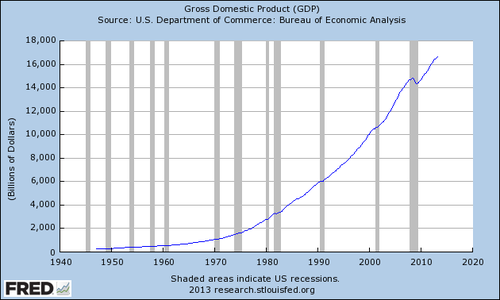
So the spirit of Milton Friedman’s proposal is the idea of keeping velocity-adjusted money, and therefore nominal GDP, growing at a constant rate. In a movement that should make Milton Friedman proud (if he can get internet access in heaven), that is exactly what the “market monetarists” advocate. The importance market monetarists put on the idea of keeping nominal GDP growing at a constant rate is readily apparent from the frequency of the abbreviation NGDP for nominal GDP in some of the posts and tweets by Scott SumnerDavid Beckworth, and Lars Christensen. One of the best ways to see the value of paying attention to nominal GDP is to look at a graph of nominal GDP over time in the US, using data from the Federal Reserve Bank of St. Louis.

In all the years since 1955, the most striking feature of the graph is the jog down in nominal GDP since the financial crisis in late 2008. Market monetarists take this jog down in GDP since the financial crisis as an indication that monetary policy has not been anywhere near stimulative enough in the aftermath of the financial crisis. In this, they are absolutely right. The reason the graph of nominal GDP shows the stance of monetary policy so well is that too-tight monetary policy drags down both prices (=P) and real GDP (=Y), which both contribute to nominal GDP (=PY) that is low relative to its trend. Conversely, too-loose monetary policy pushes up both prices and real GDP, which both contribute to nominal GDP that is high relative to its trend.

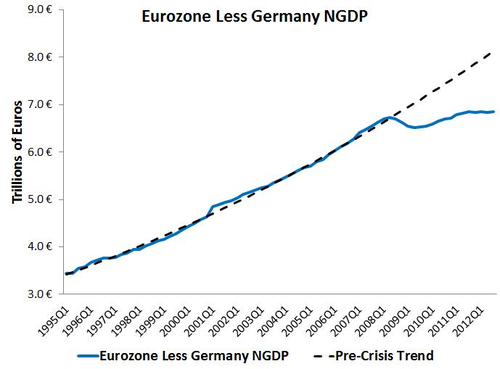
Here is a corresponding graph for the euro zone minus Germany from wunderkind and Wonkbook blogger Evan Soltas:

This graph for Europe focuses on recent years (the trend is shown by the dashed line) and indicates that, while it might have been more nearly okay for Germany, the European Central Bank’s monetary policy has been too tight for the rest of the euro zone.

The graphs show one of the big attractions of market monetarism: with graphs like these it is easy to get a handle on whether monetary policy has been too loose or too tight. Market monetarists go further to say that if the US Federal Reserve and other central banks committed to do whatever it takes to keep nominal GDP on track, then the financial markets listening to that commitment would react in a way that would help to make it happen. In Fed-speak, the market monetarists emphasize communication policy in the form of forward guidance on the track of nominal GDP the Fed or other central bank is aiming for. To know whether the financial markets are getting the message, market monetarists advocate the creation of assets that would provide a market prediction for nominal GDP much as TIPS (Treasury Inflation Protected Securities) provide a market prediction for inflation.

So far, I have emphasized the positive aspects of market monetarism, because I think market monetarism has, in fact, been an important force for good in our current economic troubles. When a crisis scares people into holding back on spending, the best remedy is monetary stimulus, and graphs of nominal GDP, interpreted as a market monetarist would, speak loudly for exactly the needed monetary stimulus.

Evaluating market monetarism

But now I want to step back and question whether market monetarism is the final answer for monetary policy. There are three things that matter for monetary policy: the temptation, the objective if a central bank can resist the temptation, and the toolkit.

The Temptation. The temptation for monetary policy is that, absent a concern about inflation, GDP is chronically too low for at least three reasons: imperfect competition, taxes, and labor market frictions. The trouble is that raising GDP beyond a certain point—a point called the natural level of GDPdoes raise inflation. And not only does raising GDP beyond a certain point raise inflation, pushing GDP above the natural level for even a year or two raises the level of inflation permanently. The one way to get rid of that extra inflation is to push GDP below the natural rate for a while. To put things starkly, after the above-natural GDP of the 1960s, we would still have the double-digit inflation of the 1970s if Americans hadn’t suffered through a big recession that put GDP below its natural level during Reagan’s first term in the early 1980’s. We have low inflation today in large measure thanks to the suffering of Americans in the early 1980s.

The objective. “Sinning” by having GDP above the natural level is no fun if it has to be coupled with “repenting” by having GDP below the natural level to avoid having inflation forever higher. There are two reasons the combination of above-natural GDP one year and below-natural GDP another year is a bad deal. First, the pleasure from higher output and employment to workers, to the taxman, and to firms, is not as big as the pain from lower employment. Second, higher output makes inflation go up more readily than lower output brings inflation back down. Put all this together, and the objective is clear: stay at the natural level of output to avoid the bad deals from any other combination of output in different years that keeps inflation from being higher in the end.

Now, let’s translate the objective of staying at the natural level of output into nominal GDP terms. (It is important in the discussion above that I am thinking of inflation primarily in terms of otherwise slow-to-adjust prices going up faster, rather than in terms of slow-to-adjust wages going up faster. My argument for doing that can be found here.) As long as the natural level of output is growing at a steady rate, keeping real GDP on that steady track will also keep inflation and so the rate of increase of prices steady. If both real GDP and prices are growing at a steady rate, then nominal GDP will be growing at a steady rate. So a steady growth rate of nominal GDP is exactly the right target as long as the natural level of output is growing steadily.

But what if new technology makes the natural level of output go up faster, as the digital revolution did from at least 1995 to 2003? Then real GDP should be going up faster to keep inflation steady. And that means that nominal GDP should also be going up faster. Historically, the Fed has not handled its response to unexpected technology improvements very well, as I discuss in another column, but that doesn’t change the fact that the Fed should have had nominal GDP go up faster after unexpectedly large improvements in technology. (Because the Fed actually let nominal GDP go below trend after technology improvements—instead of above trend as it should have—many people ended up not being able to get jobs after technology improvements.)

By the same token, if technology improves more slowly than it normally does, then both real and nominal GDP should be on a lower track to keep inflation steady and avoid the bad deals from pushing inflation up and then having to bring it back down. Some people have claimed that our current economic slump is a reflection of technology growing more slowly, but careful measures of the behavior of technology and a growing body of research by economists show that is at most a small part of what has been going on since the financial crisis that hit in late 2008. Indeed, if all of the below-trend output we have seen in the last few years were due to more slowly improving technology, we would not have seen inflation fall the way it did after the financial crisis.

The toolkit. Even if I can bring my market monetarist friends around to adjusting the nominal GDP target for what is happening with technological progress, I differ from them in thinking that the tools currently at the Fed’s disposal plus clearly communicating a nominal GDP target are not enough to get the desired result. The argument goes as follows. Interest rates are the price of getting stuff—goods and services—now instead of later. If people are out of work, we want customers to buy stuff now by having low interest rates. Thinking about short-term interest rates like the usual federal funds rate target that the Fed uses, the timing of the low interest rates matters. If everyone knows we are going to have low short-term interest rates in 2016, then it encourages buying in the whole period between now and 2016 in preference to buying after 2016. But to get the economy out of the dumps, we really want people to buy right now, not spread out their purchases over 2013, 2014, and 2015. The lower we can push short-term interest rates, the more we can focus the extra spending on 2013, so that we can have full recovery by 2014, without overshooting and having too much spending in 2015. This is an issue that economist and New York Times columnist Paul Krugman alludes to recently in a column about Japanese monetary policy.

There is only one problem with pushing the short-term interest rate down far enough to focus extra spending right now when we need it most: the way we handle paper currency. The Fed doesn’t dare try to lower the interest rate it targets below zero for fear of causing people to store massive amounts of currency (which effectively earns a zero interest rate). Indeed, most economists, like the Fed, are so convinced that massive currency storage would block the interest rate from going more than a hair below zero that they talk regularly about a zero lower bound on interest rates. The solution is to treat paper currency as a different creature than electronic money in bank accounts, as I discuss in many other columns. (“What Paul Krugman got wrong about Italy’s economy” gives links to other columns on electronic money as well.) If instead of being on a par with electronic money in bank accounts, paper currency is allowed to depreciate in value when necessary, the Fed can lower the short-term interest as far as needed, even if that means it has to push the short-term interest rate below zero.

Keeping the economy on target

In the current economic doldrums, breaking through the zero lower bound with electronic money is the first step in ensuring that monetary policy can quickly get output back to its natural level. A better paper currency policy puts the ability to lower the Fed’s target interest rate back in the toolkit. That makes it possible for the Fed to get the timing of extra spending by firms and households right to meet a nominal GDP target—hopefully one that has been appropriately adjusted for the rate of technological progress.

Despite the differences I have with the market monetarists, I am impressed with what they have gotten right in clarifying the confusing and disheartening economic situation we have faced ever since the financial crisis triggered by the collapse of Lehman Brothers on September 15, 2008. If market monetarists had been at the helm of central banks around the world at that time, we might have avoided the worst of the worldwide Great Recession. If the Fed and other central banks learn from them, but take what the market monetarists say with a grain of salt, the Fed can not only pull us out of the lingering after-effects of the Great Recession more quickly, but also better avoid or better tame future recessions as well.

QE or Not QE: Even Economists Need Lessons in Quantitative Easing, Bernanke Style

Here is a link to my 23d column on Quartz: “Even economists need lessons in quantitative easing, Bernanke style.”

As I tweeted,

My editor @mitrakalita was amazing, supporting me in doing a very serious treatment of QE on Quartz

Even so, there are many issues I raise in the column that deserve discussion, but would ideally call for a back-and-forth dialogue with Martin Feldstein himself to make the issues understandable.

Joshua Foer on Memory

After reading Joshua Foer’s book Moonwalking with Einstein: The Art and Science of Remembering EverythingI think it is too bad that ancient memory techniques are not routinely taught in our schools. 

Wikipedia currently has this to say about Joshua:

Foer sold his first book, Moonwalking with Einstein, to Penguin for publication in March 2011.[2] He received a $1.2 million advance for the book.[1] Film rights were optioned by Columbia Pictures shortly after publication.[3]

In 2006, Foer won the U.S.A. Memory Championship, and set a new USA record in the “speed cards” event by memorizing a deck of 52 cards in 1 minute and 40 seconds.[4]Moonwalking with Einstein describes Foer’s journey as a participatory journalist to becoming a national champion mnemonist, under the tutelage of British Grand Master of MemoryEd Cooke.

Here are a few passages that give you some flavor for the book, though the book is more light-hearted than these three passages fullly reveal. Let me mention that the book Ad Herrenium that Joshua mentions is available both as a nicely bound Loeb Classical Library book on Amazon, and free online here. Joshua:

I have to warn you, Ed said, as he delicately seated himself cross-legged, “you are shortly going to go from having an awed respect for people with a good memory to saying, ‘Oh, it’s all a stupid trick.’” He paused and cocked his head, as if to see if that would in fact be my response. “And you would be wrong. It’s an unfortunate phase you’re just going to have to pass through….

Much as our taste for sugar and fat may have served us well in a world of scarce nutrition, but is now maladaptive in a world of ubiquitous fast food joints, our memories aren’t perfectly adapted for our contemporary information age. The tasks we often rely on our memories for today simply weren’t relevant in the environment in which human beings evolved. Our ancestors didn’t need to recall phone numbers, or word-for-word instructions from their bosses, or the Advanced Placement U.S. history curriculum, or (because they lived in relatively small, stable groups) the names of dozens of strangers at a cocktail party.

What our early human and hominid ancestors did need to remember was where to find food and resources, and the route home, and which plants were edible and which were poisonous. This are the sorts of vital memory skills that they depended on every day, and it was–at least in part–in order to meet those demands that human memory evolved as it did.

The principle underlying all memory techniques is that our brains don’t remember all types of information equally well. As exceptional as we are at remembering visual imagery… we’re terrible at remembering other kinds of information, like lists of words or numbers….

Virtually all the nitty-gritty details we have about classical memory training–indeed, nearly all the memory tricks in the mental athlete’s arsenal–were first described in a short, anonymously authored Latin rhetoric textbook called the Rhetorica ad Herrenium, written sometime between 86 and 82 B.C….

The techniques introduced in the Ad Herrenium were widely practiced in the ancient world. In fact, in his own writings on the art of memory, Cicero says that the techniques are so well known that he felt he didn’t need to waste ink describing them in detail (hence our reliance on the Ad Herrenium). Once upon a time, every literate person was versed in the techniques Ed was about to teach me. Memory training was considered a centerpiece of classical education in the language arts, on par with grammar, logic, and rhetoric. Students were taught not just what to remember, but how to remember it. (pp. 90–95)

"Well done,” Ed said, with slow and deliberate applause. “Now I think you’re going to find that the process of recalling these memories is incredibly intuitive. See, normally memories are stored more or less at random, in semantic networks, or webs of association. But you have now stored a large number of memories in a very controlled context. Because of the way spatial cognition works, all you have to do is to retrace your steps through your memory palace, and hopefully at each point the images you laid down will pop back into your mind as you pass by them. All you’ll have to do is translate those images back into the things you were trying learn in the first place. (p. 104)

… But after having learned how to memorize poetry and numbers, cards and biographies, I’m convinced that remembering more is only the most obvious benefit of the many months I spent training my memory. What I had really trained my brain to do, as much as to memorize, was to be more mindful, and to pay attention to the world around me. Remembering an only happen if you decide to take notice….

So why bother investing in one’s memory in an age of externalized memories? The best answer I can give is the one I received unwittingly from EP, whose memory had been so completely lost that he could not place himself in time or space, or relative to other people. That is: How we perceive the world and how we act in it are products of how and what we remember. We’re all just a bundle of habits shaped by our memories. And to the extent that we control our lives, we do so by gradually altering those habits, which is to say the networks of our memories. No lasting joke, invention, insight, or work of art was ever produced by an external memory. Not yet, at least. Our ability to find humor in the world, to make connections between previously unconnected notions, to create new ideas, to share in a common culture: All these essentially human acts depend on memory.  (pp. 268-269)