Quartz #5—>How Subordinating Paper Currency to Electronic Money Can End Recessions and End Inflation
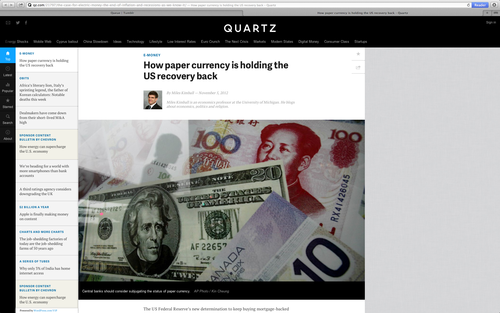
Link to the Column on Quartz

Here is the full text of my 5th Quartz column, originally published on November 5, 2012 and now brought home to supplysideliberal.com. I have restored my original title. It appeared on Quartz under the title “E-Money: How paper currency is holding the US recovery back.” I wrote at the time 

This is the most important thing I have ever said about monetary policy.

That is still true. 

I learned more about the relevant history of thought after publishing this column, as you can see in my posts “More on the History of Thought for Negative Nominal Interest Rates” and “Marvin Goodfriend on Electronic Money.”

If you want to mirror the content of this post on another site, that is possible for a limited time if you read the legal notice at this link and include both a link to the original Quartz column and the following copyright notice:

© November 5, 2012: Miles Kimball, as first published on Quartz. Used by permission according to a temporary nonexclusive license expiring June 30, 2014. All rights reserved.

Indeed, I strongly encourage any of you who are willing to do so, to mirror this particular column on your own website. 

Links to all my other columns can be found here.


The US Federal Reserve’s new determination to keep buying mortgage-backed securities until the economy gets better, better known as quantitative easing, is controversial. Although a few commentators don’t think the economy needs any more stimulus, many others are unnerved because the Fed is using untested tools. (For example, see Michael Snyder’s collection of “10 Shocking Quotes About What QE3 Is Going To Do To America.”) Normally the Fed simply lowers short-term interest rates (and in particular the federal funds rate at which banks lend to each other overnight) by purchasing three-month Treasury bills. But it has basically hit the floor on the federal funds rate. If the Fed could lower the federal funds rate as far as chairman Ben Bernanke and his colleagues wanted, it would be much less controversial. The monetary policy cognoscenti would be comfortable with a tool they know well, and those who don’t understand monetary policy as well would be more likely to trust that the Fed knew what it was doing. By contrast, buying large quantities of long-term government bonds or mortgage-backed securities is seen as exotic and threatening by monetary policy outsiders; and it gives monetary policy insiders the uneasy feeling that they don’t know their footing and could fall into some unexpected crevasse at any time.

So why can’t the Fed just lower the federal funds rate further? The problem may surprise you: it is those green pieces of paper in your wallet. Because they earn an interest rate of zero, no one is willing to lend at an interest rate more than a hair below zero. In Denmark, the central bank actually set the interest rate to negative -.2 % per year toward the end of August this year, which people might be willing to accept for the convenience of a certificate of deposit instead of a pile of currency, but it would be hard to go much lower before people did prefer a pile of currency. Let me make this concrete. In an economic situation like the one we are now in, we would like to encourage a company thinking about building a factory in a couple of years to build that factory now instead. If someone would lend to them at an interest rate of -3.33% per year, the company could borrow $1 million to build the factory now, and pay back something like $900,000 on the loan three years later. (Despite the negative interest rate, compounding makes the amount to be paid back a bit bigger, but not by much.) That would be a good enough deal that the company might move up its schedule for building the factory.  But everything runs aground on the fact that any potential lender, just by putting $1 million worth of green pieces of paper in a vault could get back $1 million three years later, which is a lot better than getting back a little over $900,000 three years later.  The fact that people could store paper money and get an interest rate of zero, minus storage costs, has deterred the Fed from bothering to lower the interest rate a bit more and forcing them to store paper money to get the best rate (as Denmark’s central bank may cause people to do).

The bottom line is that all we have to do to give the Fed (and other central banks) unlimited power to lower short-term interest rates is to demote paper currency from its role as a yardstick for prices and other economic values—what economists call the “unit of account” function of money. Paper currency could still continue to exist, but prices would be set in terms of electronic dollars (or abroad, electronic euros or yen), with paper dollars potentially being exchanged at a discount compared to electronic dollars. More and more, people use some form of electronic payment already, with debit cards and credit cards, so this wouldn’t be such a big change. It would be a little less convenient for those who insisted on continuing to use currency, but even there, it would just be a matter of figuring out with a pocket calculator how many extra paper dollars it would take to make up for the fact that each one was worth less than an electronic dollar. That’s it, and we wouldn’t have to worry about the Fed or any other central bank ever again seeming relatively powerless in the face of a long slump.

This idea for giving the Fed and other central banks unlimited firepower has an interesting history, which I will discuss below. But first let me spell out some details of how a system of electronic dollars as the key yardstick for our economy might work to clarify what I have in mind. First, following its usual procedures, every six weeks or so the Fed would choose a fed funds rate target. This fed funds rate target could be anything, positive or negative. That would be the interest rate banks would earn. In order to make sure banks can earn more than they pay depositors so that they can provide useful services such as ATM’s without having to have a fee for everything, the interest rate paid directly by the Federal Reserve on electronic dollars held by individuals would be somewhat lower, say 1% per year lower. This interest rate on electronic dollars paid directly by the Fed would be a little more likely to be negative. Finally, for paper dollars, the interest rate would be made at least another 1% per year lower by having the discount for paper dollars gradually change over time. In a recession, this would mean that the discount for paper dollars would gradually widen, but in good times (when real interest rates tend to be higher) the discount would narrow until the paper dollar was again at par with electronic dollars, where it would stay until the next recession.

Let me turn now to the intellectual history of the idea of ending the primacy of paper money, as I have tried to piece it together. Noted economist Greg Mankiw, in his April 18, 2009 New York Times opinion piece “It May Be Time for the Fed to Go Negative,” describes this idea of an unnamed graduate student:

Imagine that the Fed were to announce that, a year from today, it would pick a digit from zero to 9 out of a hat. All currency with a serial number ending in that digit would no longer be legal tender. Suddenly, the expected return to holding currency would become negative 10 percent.

That move would free the Fed to cut interest rates below zero. People would be delighted to lend money at negative 3 percent, since losing 3 percent is better than losing 10.

Whatever its technical merits, as a real world proposal this idea is clearly not ready for prime time, as indicated by Mankiw’s parenthetical remark:

(I will let the student remain anonymous. In case he ever wants to pursue a career as a central banker, having his name associated with this idea probably won’t help.)

But the basic idea of getting rid of the paper money barrier to negative interest rates didn’t die. Matthew Yglesias, in his Dec. 12, 2011 Slate article “How Eliminating Paper Money Could End Recessions” pointed out that eliminating paper money entirely would make it possible for the Fed to stimulate the economy with negative interest rates whenever it needed to. He was encouraged, no doubt, by the popularity of the idea among techies of a “cashless society,” which, according to Google’s “Ngram Viewer” began gaining appearing in books as far back as the mid-1960’s. David Wolman’s critically praised The End of Money: Counterfeiters, Preachers, Techies, Dreamers–and the Coming Cashless Society (published just this past February) continues this line of thinking.

Since Matthew Yglesias’s proposal was a serious and important one, it was attacked. Stefan Karlsson, guest blogger for the Christian Science Monitor, in “Would Electronic Money End Recessions” argues that eliminating paper money would dramatically increase government power:

Ironically, though the paper money standard that replaced the gold standard was originally meant to empower governments, it now seems that paper money is perceived as an obstacle to unlimited government power for three reasons:

1) When people make cash payments, their purchases aren’t tracked, giving them privacy from government surveillance

2) If payments are made in cash, it will enable them to make payments without paying taxes.

3) The existence of physical cash makes it impossible to lower nominal interest rates below zero because if they are below zero then people will withdraw their money from banks.

Thus, Stefan Karlsson argues that if you think it was a mistake to replace the gold standard with paper money, it is a mistake to go further to replace paper money with electronic money. His “hard money” views are made even clearer when he ends by talking about hyperinflation in 1923 Germany and 2009 Zimbabwe.

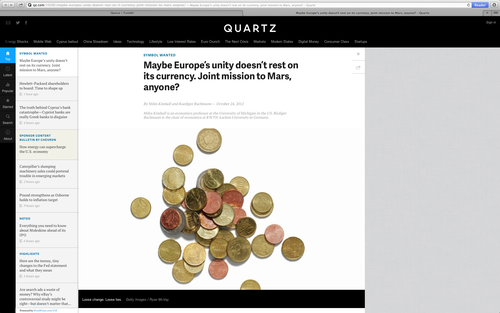
Indirectly—in their emotional appeal rather than in the arguments themselves—Karlsson’s words serve as a reminder that tangible currency has an important psychological resonance for people, as shown also by many interesting psychological experiments about the meaning of currency for people. See for example the PsyBlog post “How Does the Cleanliness of Money Affect Our Spending.” The formation of the eurozone was an attempt to harness the emotional resonance of currency in the service of European unity—something that Rudi Bachmann and I argue was a mistake in our recent Quartz article “Symbol Wanted: Maybe Europe’s unity doesn’t rest on its currency. Joint Mission to Mars, anyone?” Appreciating the psychological resonance of tangible currency, I have been careful to preserve paper currency in my reworking of Matthew Yglesias’s proposal—though in a smaller role than it currently fills. Keeping paper currency in even this reduced role limits the power of the state, which has both good aspects (privacy, as Karlsson emphasizes), bad aspects (making crime easier) and aspects that some people think are good and some people think are bad (making tax evasion easier, which Karlsson thinks is good and I think is bad). But my view is that we should take one step at a time. Subordinating paper money to electronic money as an economic yardstick is a big enough step for now; the question of whether to further demote paper currency can wait.

In a recent critique of Matthew Yglesias’s proposal, Tyler Cowen lists many reasons why it would be hard to abolish paper currency entirely, suggesting in fact that a black-market paper currency might arise (possibly of some foreign currency) if the government tried to banish paper currency entirely.  Responding to Tyler Cowen, JP Koning suggests the possibility of keeping paper money legal but restricting paper currency to small bills to make it harder to warehouse large dollar amounts. But Scott Sumner gives the most trenchant response to Tyler Cowen, pointing out that the real problem is the “unit of account” role of paper currency, not the role of paper money as a way to buy things, which is Tyler Cowen’s major concern:

Money is not special because it is a big part of wealth, or a big part of credit.  Indeed it’s not even special because it’s the medium of exchange [a way to buy things]. It’s special because it’s the medium of account [an economic yardstick].

My reworking of Matthew Yglesias’s proposal is intended as a way to preserve the function of paper money as a way to buy things while having paper money abdicate its role as an economic yardstick.

Perhaps the most serious attack on Matthew Yglesias’s idea came from a different direction, in Ryan Avent’s opinion piece in the Economist “The buck shrinks here.”Avent makes a claim that I think is a mistake, on which he bases the rest of his analysis:

… inflation and negative interest rates are basically the same. Both take an amount of money in the possession of an individual and erode its purchasing power over time.

He then goes on to argue that negative interest rates will arouse at least as much political opposition as inflation, because both mean that money loses its value. Avent’s mistake is that he focuses on the least important of money’s three functions: serving as a store of wealth. The other two, much more important functions of money are the obvious function of being something to buy things with on a daily basis—a “medium of exchange”—and the function I emphasize above: serving as a yardstick or “unit of account.” As far as money as a store of wealth goes, people already keep most of their wealth in either things, such as houses, cars and other consumer durables, or in stocks and bonds—precisely because money is not now, and has not been in the past, a very good store of wealth for any substantial period. And as a society, we shouldn’t want money to be a good store of wealth over the long haul: we need people to put their wealth to work, either directly or indirectly building companies to help the economy to grow, not burying piles of paper in the sand.  Moreover, the temporarily negative interest rates the Fed would need to forestall recessions would only worsen money as a store of wealth for short periods of time—in national economic emergencies.

What the opponents of primacy for electronic money fail to realize is that making electronic money the economic yardstick is the key to eliminating inflation and finally having honest money.The European Central Bank, the Fed, and even the Bank of Japan increasingly talk about an inflation rate like 2% as their long-run target. Why have a 2% long-run target for inflation rather than zero—no inflation at all? Most things are better with inflation at zero than at 2%. The most important benefit of zero inflation is that anything but zero inflation is inherently confusing and deceptive for anyone but the handful of true masters at mentally correcting for inflation. Eliminating inflation is first and foremost a victory for understanding, and a victory for truth.

There are only two important things that economists talk about that are worse at zero inflation than at 2% inflation. One that has attracted some interest is that a little inflation makes it easier to cut the real buying power of workers who are performing badly. But by far the biggest reason major central banks set their long-run inflation targets at 2% is so that they have room to push interest rates at least 2% below the level of inflation. With electronic dollars or euros or yen as the units of account, there is no limit to how low short-term interest rates can go regardless of how low inflation is. So inflation at zero would be no barrier at all to effective monetary policy. It might be that we would still choose inflation a bit above zero to help make it easier to cut the real (inflation-adjusted) wage of poor performers at work, but I doubt it. So I predict that making electronic dollars the unit of account would pave the way for true price stability with long-run inflation at zero instead of 2%. The main benefit of making electronic currency the centerpiece of the price system would be that central banks would never again seem powerless in the face of a long slump. But even setting that gargantuan benefit aside, the benefits of true price stability alone would easily make up for any inconvenience from the abdication of paper currency in favor of the new rulers of the monetary realm: electronic dollars, euros and yen.

John Stuart Mill on Mormonism

My great-great grandmother, Ann Alice Gheen,third wife of Heber C. Kimball

From John Stuart Mill's On Liberty (1869), Chapter 4, “Of the Limits to the Authority of Society Over the Individual”:

I cannot refrain from adding to these examples of the little account commonly made of human liberty, the language of downright persecution which breaks out from the press of this country, whenever it feels called on to notice the remarkable phenomenon of Mormonism. Much might be said on the unexpected and instructive fact, that an alleged new revelation, and a religion founded on it, the product of palpable imposture, not even supported by the prestige of extraordinary qualities in its founder, is believed by hundreds of thousands, and has been made the foundation of a society, in the age of newspapers, railways, and the electric telegraph. What here concerns us is, that this religion, like other and better religions, has its martyrs; that its prophet and founder was, for his teaching, put to death by a mob; that others of its adherents lost their lives by the same lawless violence; that they were forcibly expelled, in a body, from the country in which they first grew up; while, now that they have been chased into a solitary recess in the midst of a desert, many in this country openly declare that it would be right (only that it is not convenient) to send an expedition against them, and compel them by force to conform to the opinions of other people. The article of the Mormonite doctrine which is the chief provocative to the antipathy which thus breaks through the ordinary restraints of religious tolerance, is its sanction of polygamy; which, though permitted to Mahomedans, and Hindoos, and Chinese, seems to excite unquenchable animosity when practised by persons who speak English, and profess to be a kind of Christians. No one has a deeper disapprobation than I have of this Mormon institution; both for other reasons, and because, far from being in any way countenanced by the principle of liberty, it is a direct infraction of that principle, being a mere riveting of the chains of one-half of the community, and an emancipation of the other from reciprocity of obligation towards them. Still, it must be remembered that this relation is as much voluntary on the part of the women concerned in it, and who may be deemed the sufferers by it, as is the case with any other form of the marriage institution; and however surprising this fact may appear, it has its explanation in the common ideas and customs of the world, which teaching women to think marriage the one thing needful, make it intelligible that many a woman should prefer being one of several wives, to not being a wife at all. Other countries are not asked to recognise such unions, or release any portion of their inhabitants from their own laws on the score of Mormonite opinions. But when the dissentients have conceded to the hostile sentiments of others, far more than could justly be demanded; when they have left the countries to which their doctrines were unacceptable, and established themselves in a remote corner of the earth, which they have been the first to render habitable to human beings; it is difficult to see on what principles but those of tyranny they can be prevented from living there under what laws they please, provided they commit no aggression on other nations, and allow perfect freedom of departure to those who are dissatisfied with their ways. A recent writer, in some respects of considerable merit, proposes (to use his own words) not a crusade, but a civilizade, against this polygamous community, to put an end to what seems to him a retrograde step in civilization. It also appears so to me, but I am not aware that any community has a right to force another to be civilized. So long as the sufferers by the bad law do not invoke assistance from other communities, I cannot admit that persons entirely unconnected with them ought to step in and require that a condition of things with which all who are directly interested appear to be satisfied, should be put an end to because it is a scandal to persons some thousands of miles distant, who have no part or concern in it. Let them send missionaries, if they please, to preach against it; and let them, by any fair means (of which silencing the teachers is not one,) oppose the progress of similar doctrines among their own people. If civilization has got the better of barbarism when barbarism had the world to itself, it is too much to profess to be afraid lest barbarism, after having been fairly got under, should revive and conquer civilization. A civilization that can thus succumb to its vanquished enemy, must first have become so degenerate, that neither its appointed priests and teachers, nor anybody else, has the capacity, or will take the trouble, to stand up for it. If this be so, the sooner such a civilization receives notice to quit, the better. It can only go on from bad to worse, until destroyed and regenerated (like the Western Empire) by energetic barbarians.

Quartz #4—>Symbol Wanted: Maybe Europe's Unity Doesn't Rest on Its Currency. Joint Mission to Mars, Anyone?

Here is the full text of my 4th Quartz column, written with Rudi Bachmann. This column was first published on October 24, 2012.  It is now brought home to supplysideliberal.com. Links to all my other columns can be found here.

If you want to mirror the content of this post on another site, that is possible for a limited time if you read the legal notice at this link and include both a link to the original Quartz column and the following copyright notice:

© October 24, 2012: Rudi Bachmann and Miles Kimball, as first published on Quartz. Used by permission according to a temporary nonexclusive license expiring June 30, 2014. All rights reserved.


At the inception of the euro, many economists warned about the economic dangers of having a single currency for the entire continent. The problem they foresaw is that having a single currency means having only a single monetary policy for an economically variegated set of countries. Warning about such a problem, Harvard economist Martin Feldstein wrote in 1997 that disharmony would be “exacerbated whenever the business cycle raised unemployment in a particular country or group of countries. These economic disagreements could contribute to a more general distrust among the European nations.”

Is it time to go back to what was?

Even now, many economists note that the return of the German mark would solve many of the economic problems the eurozone now faces. Its reintroduction would make it possible to have stimulative monetary policy in the rest of the eurozone, or supportive monetary policy for the very necessary structural reforms in the south, without causing inflation in Germany. Also, as the reintroduced mark inevitably appreciated relative to the shrunken euro, the real value of the debts that are causing so much trouble would be reduced in a graceful way that would not require rewriting thousands of legal contracts. And unlike the reintroduction of the Greek drachma, for example, there would be no great incitement to financial contagion. Also, no more awkward visits and justification speeches by European Central Bank chairman Mario Draghi in Berlin.

To be sure, some adjustments would be necessary, namely in the German export sector. Maybe some German banks with lending in the south will have to recapitalized. There may be distributional issues in German pension funds that were engaged in the South. But we believe this to be manageable.

So the technical economic problem might have an easy solution. But the reintroduction of the mark would leave a political and cultural conundrum that the euro was originally supposed to solve: how to provide a symbol of European unity that binds Germany tightly into the rest of Europe, not only in the current generation, but into our great-great-grandchildren’s time. Money has too many practical ramifications to be a good symbol of unity. When the limitation of having only one monetary policy for the whole eurozone causes the economic troubles it was bound to cause, divisions between nations are highlighted and intensified, not muted. Europe needs a better symbol ofunity than the euro.

We have no foolproof idea for what an alternative symbol of European unity might be. And we doubt economists are the right people to come up with such a symbol. A European manned mission to Mars, unmanned mission to the seas of Europa, or a new supercollider surpassing CERN’s Large Hadron Collider appeal to us, but we doubt they would have enough symbolic power by themselves. We do know that all of these put together would be much less expensive than keeping the eurozone as it is now.

What we hope to accomplish is to alert those in Europe who could come up with a brilliant symbol or symbols of European unity that what Europe faces is not primarily an economic problem—it is a problem of meaning. The economic problem has a technical solution. But it is likely that non-economists will come up with the solution to the underlying need for a powerful symbol of European unity and German commitment to Europe that is less problematic than the euro.

Tomas Hirst: Beware False Equivalence Between Depositor Haircuts and Negative Interest Rates

This is a syndicated guest post from Tomas Hirst: Tomas kindly gave me permission to reprint the full text of his Pieria View post “Cyprus–Beware False Equivalence” on supplysideliberal.com.


yprus–Beware False Equivalence

Empathy: The ability to imagine oneself in another’s place and understand the other’s feelings, desires, ideas, and actions.

When faced with an example of injustice it is a common psychological trait to relate the suffering of others to our own experiences. While this can be helpful in fostering greater insight into the personal hardships they may be undergoing it can also cause people to prioritise the similarities of their situations and underplay the differences.

It is in this light that I view attempts to liken the haircuts to Cypriot depositors to ultra-low interest rates in Britain. Yet to my mind this false equivalence does a disservice to understandably panicked depositors in Cyprus and causes undue concern for savers in the UK.

I first came across this particular line of argument on twitter in a tweet from Ros Altmann, former director general of Saga and pensions expert. She wrote:

UK vs. Cyprus - Sterling devaluation +inflation +ultra-low rates have been stealth tax on savers, to help borrowers and banks

Altmann went on to point out that UK monetary policy has cost savers more than 20% in real terms since 2008 inflation peak. And she is far from alone in her concerns. Many joined her in her staunch defence of savers against the clawing hands of the Bank of England.

Now I’m not actually disputing the facts as presented. Both savings and real incomes have been clobbered since the crisis by a combination of near-zero interest rates, modest wage rises and above-target inflation. The question is whether this combination of factors can be compared with a sudden seizure of deposits by the state.

This is an important question to answer as the critics are bringing into question the legitimacy of policies brought in to address the crisis. So is the UK really taking money from savers in order to pay for the pre-crisis excesses?

It is certainly true that saving and incomes have fallen sharply in real terms over the crisis. To my mind, however, the question misframes the problem and obscures the purpose of current monetary policy.

During “normal” times when the economy is growing interest rates are certainly higher. Yet the reason for this is not simply to reward savers for their frugality but to incentivise holding back cash in bank accounts and disincentivise heavy borrowing in order to prevent the economy from overheating and driving up inflation.

As a consequence of the so-called “Great Moderation” savers got used to these higher interest rates. This was understandable with politicians unwisely boasting that they had ended boom-and-bust economics. But the fundamental truth remained that high interest rates reflected the central bank’s attempt to hold inflation around target, not to protect the purchasing power of savers.

When the Great Recession struck, therefore, central banks responded to the economic shock by dropping interest rates. This had a number of potential benefits. Initially low rates prevented a cascade of disorderly defaults by allowing struggling companies to refinance at lower rates and encouraged stronger firms to take on more debt.

However, they also caused the rate of interest paid on cash held in people’s bank accounts to fall. This is quite a deliberate aspect of the policy as it should prompt savers to move some of their money either into current spending or investments, which helps boost the velocity of money in an economy (and therefore GDP).

That it is an intentional effect of monetary policy does not make it a Machiavellian plot to steal people’s savings. Instead it should be viewed as a good reason to move money into a portfolio of financial assets that should benefit in the case of an economic recovery or to bring forward already planned spending.

In fact some academics, including Professor Miles Kimball of the University of Michigan, believe that current interest rates remain too high. Kimball has advocated negative nominal rates whereby central banks could in effect impose a charge on cash holdings.

In a recent post on her blog FT Alphaville’s Izabella Kaminska says the Cyprus bank levy represents a harsh example of a negative interest rate. She writes:

This is the ultimate negative interest rate because it shows that the privilege of having deposits (delaying spending) is associated with principal loss, from the offset.

Which is why negative interest rates, as I have long argued, are a bad omen for the banking model. They show banks have become redundant and that sound equity is more desirable than deposits or weak equity.

Deposits have always represented a store of value. Rather than spending (redeeming your money, which is national equity) on goods or assets which are consumed or depreciate or perish over time you can artificially extend the life associated with your share or the real economy’s wealth by turning your stake into deposits (loanable funds).

The fact that deposits are now depreciating more quickly than real assets only implies there is no longer any sense in delaying spending.

Better to spend now on good equity or goods than be lumped with disappearing equity.

In terms of the implications of negative rates for the banking sector, Kaminska certainly raises some fascinating points but I don’t agree on the particular charge that the Cyprus levy is representative of what the policy would look like in practice. And this goes to the heart of the debate about UK monetary policy.

With a mix of above-target inflation and ultra-low interest rates UK savers are facing an environment negative real rates. Yet unlike their Cypriot counterparts British savers have the choice of where, when and whether to move their money out of their bank accounts. That they have not been doing so on a larger scale is indicative of a failure to explain the consequences of the current policy mix to the public.

Raising rates while the economy is still weak and companies (including banks) are in the process of deleveraging could raise the spectre of disorderly defaults and an increase in bankruptcies. Those campaigning for policymakers to protect savers need to look at the systemic implications of their proposed solutions.

Of course none of this should reduce our sympathy for Cypriot depositors who have found themselves caught up in a political standoff that they have no control over.

Show Me the Money!

blog.supplysideliberal.com tumblr_inline_mjxq2wVWib1qz4rgp.png

“Here is a link to my 18th column on Quartz: "The Stanford economists are so wrong: A tighter budget won’t be accompanied by tighter monetary policy.” I honestly couldn’t think of a good working title of my own before my editor Mitra Kalita gave it the title it has on Quartz. But it finally came to me what I wanted my version of the title to be: the main theme is short-run monetary policy dominance, so my title is “Show Me the Money!”

The heart of this column is a discussion of the paper I wrote with Susanto Basu and John Fernald: “Are Technology Improvements Contractionary?”

Quartz #3—>Al Roth's Nobel Prize is in Economics, but Doctors Can Thank Him, Too

Link to the Column on Quartz

Here is the full text of my 3d Quartz column, now brought home to supplysideliberal.com. It was first published on October 15, right after Al Roth’s Nobel Prize was announced. This column describes research Dan Benjamin, Ori Heffetz and Alex Rees-Jones were conducting about trade-offs young medical doctors make in their National Resident Matching Program choices, including tradeoffs between happiness and other goods. Our paper is now finished (and submitted to a professional journal) and is available on the Social Science Research Network:

If you want to mirror the content of this post on another site, that is possible for a limited time if you read the legal notice at this link and include both a link to the original Quartz column and the following copyright notice:

© October 15, 2012: Miles Kimball, as first published on Quartz. Used by permission according to a temporary nonexclusive license expiring June 30, 2014. All rights reserved.

Links to all my other columns can be found here.


Neither of this year’s recipients of the Nobel Prizes in Economics have degrees in economics, but they certainly have the respect of economists like me. I learned Lloyd Shapley’s principles of cooperative game theory in graduate school. They have stood the test of time. And Al Roth is a very big name in microeconomic theory, whom most economists thought would someday win a Nobel Prize. Roth has a PhD in operations research, Shapley in math.

I have reason to be personally grateful to Al Roth because his redesign of the National Resident Matching Program (NRMP) for medical doctors has provided a foundation for research my coauthors, Daniel Benjamin, Ori Heffetz, and Alex Rees-Jones (all three now at Cornell) and I are conducting. We want to know to what extent young doctors are pursuing happiness or pursuing prestige and fortune instead. For our research, it is important that Al Roth designed the NRMP in a way that encourages medical students to express their true preferences.

What we did was to run our own web survey of the young doctors who had just made their choices in the NRMP. We wanted to see how much they valued happiness compared to other concerns in a real-world situation. We are after the answers to questions such as this: are the future medical residents willing to sacrifice happiness for prestige? Will they sacrifice their own happiness to go to a city their romantic partners like better? If they sacrifice happiness during their residency, is it only in order to experience greater happiness later on in life, or are they willing to make a choice they think will lower their happiness throughout their lives in order to get something else they want? The NRMP provides an ideal testbed for these questions because it makes the future medical residents think hard about their choices and what those choices mean for their lives, and provides a clear deadline for that thinking. And Al Roth’s design means that the match program should be getting the medical residents to think about what they really want rather than about some way to game the system. In a fitting tribute to Al Roth’s new home at Stanford, my coauthors gave a preliminary report of our research at the Stanford Institute for Theoretical Economics this summer. We have more work to do to analyze the data, but we can already see that there are rich rewards to this effort, thanks in important part to Al Roth’s design.


Update: Thanks to Daniel Altman’s digging, Here is a little more detail from Al Roth his efforts with the National Resident Match Program and how it works:

Click to hear a podcast about Daoism. 

isomorphismes:

Daoism

  • wú wéi 無爲 — doing by not doing
  • the water is more powerful than the rock
  • “One of Daoism’s core ideas is that we can prolong life by following The Way” (contrast to Xtianity, Buddhism)
  • In the second century AD, Laodze was seen as “the alternative philosopher” to Confucius. Confucius represented the order of the State.
  • Buddhism may be an Indian form of Daoism come back to China
  • Later in the programme this appears to be a theme: Daoists as the under-religion, the shamanic folk religion. Well that almost fits the philosophy of “a ruler who doesn’t appear to be ruling” too nicely.
  • (Exceptions at times: the Yellow Turban revolt, 30 years of Daoist-led kingdom (which they peaceably annexed to a neighbouring ruler), widespread Daoist temples and 5 Bushels of Rice/year to pay for your Daoist shamanic exorcist/priestly councillor.)
  • “Shamanism preceded Confucianism” — “We are controlled by the unseen world”
  • In Chapter 42 [of the Dao De Jing 道德經] … the Dao gives birth to the Origin: the beginning of everything, the One. The One then gives birth to the Two, which is the Yin and the Yang. (These are cosmic forces. They’re not moral forces; they’re not divine forces. They’re just forces of the Universe.) And the Two give birth to the Three, which in traditional Daoist thought, is: Heaven, Earth, and Humanity. … And all this gives birth to the myriad things.
  • Cheng Dao Ling (2nd century) teaches he has the power to forgive sins.
  • Oh, so they have sins then? “But it’s harder to sin by inaction than by action.”← Lecturer’s supposition, I found the opposite to be one of the most interesting takeaways from the economic theory of opportunity cost. Why do we privilege the refrainment of wrongdoing over the failure to rightdoing?
  • Dao 道 = power (although our word for it has political connotations that 道 does not. I also notice our words for “logic” and “bureaucracy” don’t seem to fit in this discussion, denotatively or connotatively. Our language and theirs embed assumptions; ∄ neutral.) A universal process of change that applies to almost everything. (So, the Lagrangian-mechanics and post-Lagrangian-mechanics pursuit of minimisation of difference between potential and actual energy?)
  • De 德 = our individual instantiation with the Dao . Cycles of life. Which not everyone goes through with the same vigour.
  • Rulers needed to show that the celestial bureaucracy fitted harmoniously with their own worldly order. Li family 7th cent AD claims descent from (by then) Demigod Laodze.
  • “There’s no consistency to the Dao De Jing 道德經. It’s as if someone had chalked up parts of the Bible and mixed the pieces around and we had to derive a coherent philosophy from it.” Actually this sounds exactly like the Bible. 73 books all by different authors and redacted by a series of future editors…yeah, not exactly one unified message.
  • “Gunpowder was developed by Daoists searching for the elixir of life…subdue KNO₃”
  • “Communists saw Daoism as mere superstition” — “By the Cultural Revolution ∃ ≤ 500 Daoist priests”
  • Joangdze: “Logic, rhetoric, argumentation don’t help us so much to understand The Universe” #logocentrism — Performance, experience, feelings are preferable to the (inserting my own pet peeves on economic theorists here) elaborate structures built upon fragile axioms [which then the fragile axioms defended at knifepoint since their collapse would bring down a roccocco golden palace on the theorist’s head].

Quartz #2—>Does Ben Bernanke Want to Replace GDP with a Happiness Index?

blog.supplysideliberal.com tumblr_inline_mjo2noUsGD1qz4rgp.png

Link to the Column on Quartz

Here is the full text of my 2d Quartz column, now brought home to supplysideliberal.com. This column was first published on October 8. Links to all my other columns can be found here.

If you want to mirror the content of this post on another site, that is possible for a limited time if you read the legal notice at this link and include both a link to the original Quartz column and the following copyright notice:

© October 8, 2012: Miles Kimball, as first published on Quartz. Used by permission according to a temporary nonexclusive license expiring June 30, 2014. All rights reserved.


As chairman of the Federal Reserve, it is Ben Bernanke’s job to devour data like the latest report on how more Americans have found jobs.  But he wants even more data. In a prerecorded talk for a conference this past summerBernanke said, ”…we should seek better and more-direct measurements of economic well-being, the ultimate objective of our policy decisions.”  He’s not talking about more accurate versions of regular economic indicators, though.

Rather, Bernanke suggests that survey measures of happiness and life satisfaction should take their place alongside GDP as measures of how a nation is doing. In doing so, he joined current British Prime Minister David Cameron, who said ”it’s time we focused not just on GDP but on GWB—general wellbeing” and former French Prime Minister Nicolas Sarkozy, who said he would ”fight to make all international organisations change their statistical systems by following the recommendations” of the Stiglitz report. He refers to Nobel Prize winning economist Joseph Stiglitz’s committee’s work proclaiming “the time is ripe for our measurement system to shift emphasis from measuring economic production to measuring people’s well-being.” The emphasis is in the original.

In Sarkozy’s case, historian Brian Domitrovic opines that Sarkozy was just trying to divert attention from poor GDP statistics, saying “France has excellent reason to suppress GDP statistics. Since 1982, among developed nations, France has been a clear laggard in GDP growth.” He went on: “The oldest and most pathetic trick in the book when you lose a contest is to try to move the goal posts. GDP statistics of the past quarter century have shamed France but flattered the US, Britain and East Asia. Mr. Sarkozy’s gambit to paper over this real difference will be lucky to find any takers.” Domitrovic is pointing out the very real danger of the manipulation and politicization of national statistics when the right way to measure something like “well-being” is unclear.

How can we avoid the dangers of manipulation and politicization of new indicators of national well-being? Here is a simple answer: if we are going to use survey measures of well-being such as happiness and life satisfaction alongside well-seasoned measures such as GDP as ways to assess how well a nation is doing, we need to proceed in a careful, scientific way that can stand the test of time. For example, in my research with Dan Benjamin, Ori Heffetz and Alex Rees-Jones in the August American Economic Review, people say they are willing to sacrifice happiness for money if the price is right. Without understanding how much people want money and how much they want happiness, no one should pretend to know whether GDP or happiness is a better measure of a nation’s performance.

But it isn’t just happiness vs. money. Should we be measuring anxiety or measuring stress? How much weight should we put on being satisfied with life as opposed to happiness? Without good answers to these questions, it will all degenerate into political posturing and dueling statistics. But if we do it right, the ultimate prize will be a new way to judge whether the government is doing its job. And to me there is no question what the government’s job is. It is to smooth the way so people can get what they want and lead the kind of lives they want to lead—without deciding for them what they should want.

My New Companion Blog: "Links I am Thinking About"

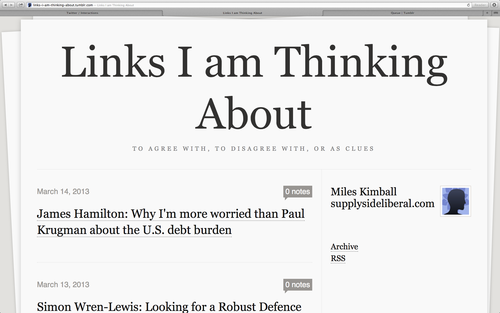
Here is a link to my new companion blog “Links I am Thinking About”

I often want to keep track of links to articles I might refer to in posts and columns of my own. It occurred to me that a companion Tumblr blog could serve that purpose, while itself being of interest to some readers. The rule I am setting myself for this new companion blog “Links I am Thinking About,” is that it will only have simple link posts, with a bare minimum of description. 

The tagline for “Links I am Thinking About” is

to agree with, to disagree with, or as clues.

Thus, while a link post on my main supplysideliberal.com blog that has no commentary signals that I have a favorable attitude toward what I am linking to at the time I link to it, a bare link on the “Links I am Thinking About” companion blog may not indicate even the mildest endorsement. Ordinarily, anything I put on “Links I am Thinking About” I will tweet as well. But “Links I am Thinking About” is meant to be a more permanent record than my Twitter feed. For economics, the importance of “clues” is evident from the Larry Summers maxim that is my drumbeat in “Dr. Smith and the Asset Bubble”:

It isn’t easy to figure out how the world works.

For religion, the importance of “clues” is evident in my post “An Agnostic Grace.”

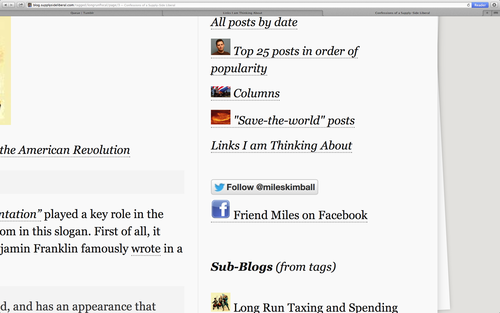
To make “Links I am Thinking About” easy to access, I have added a link to this new companion blog on my sidebar–as you can see halfway down the magnified screen shot below:  

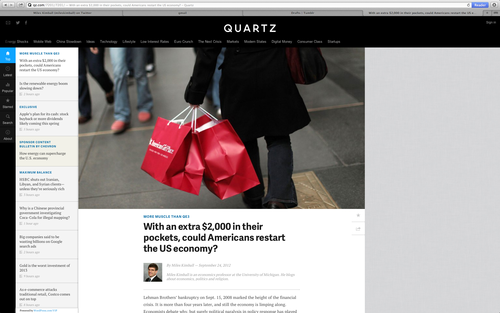
Quartz #1—>More Muscle than QE: With an Extra $2000 in Their Pockets, Could Americans Restart the US Economy?

Link to the column on Quartz

I received clarification from my editor Mitra Kalita, that, after 30 days, it is legally OK to put up the full text of my Quartz columns on my blog. So I plan to post the full text of my previous Quartz columns on supplysideliberal.com a couple of times a week until I catch up. Today, I am posting my very first Quartz column. Links to all my other columns can be found here. 

If you want to mirror the content of this post on another site, that is possible for a limited time if you read the legal notice at this link and include both a link to the original Quartz column and the following copyright notice:

© September 24, 2012: Miles Kimball, as first published on Quartz. Used by permission according to a temporary nonexclusive license expiring June 30, 2014. All rights reserved.


Lehman Brothers’ bankruptcy on Sept. 15, 2008 marked the height of the financial crisis. It is more than four years later, and still the economy is limping along. Economists debate why, but surely political paralysis in policy response has played a role. Two kinds of politics are at work: bitter politics in Congress about the long-run direction of the country—and the ballooning national debt—that have prevented a stronger fiscal policy response, and politics inside the Federal Reserve that have prevented a stronger monetary policy response.

With the Fed’s announcement last week of QE3—purchases of long-term Treasuries and mortgage-backed assets until the economy looks up—it may appear we are already set for enough stimulus, but given the low power of quantitative easing tools, the promised purchases ($85 billion per month through the end of the year and $40 billion per month thereafter) are actually small relative to the task at hand. What seems like dramatically decisive action is really a half measure that nevertheless represents a big win for the doves in the Fed given the strength of the opposition they have faced from the hawks.

To avoid these political landmines, what is needed is a new tool to get the economy moving. I propose something revolutionary:  Let’s give the American people some money. Not free money, though.

In a recent academic paper “Getting the Biggest Bang for the Buck in Fiscal Policy”and on my blog, supplysideliberal.com, I outline a proposal to provide $2,000-lines of credit to every taxpayer, accessed through a government-issued credit card.  The interest rate would be 6% per year, the money could be paid back over the course of 10 years, and the credit limit would gradually fall as the economy recovered and the stimulus from this extra borrowing power was no longer needed.

Compare these “Federal Lines of Credit” (FLOC’s) to tax rebates. Every dollar of a tax rebate is a dollar added to the national debt. But most of the funds people borrow using these government-issued credit cards would eventually be repaid—particularly since the government can enforce repayment through payroll deduction. The unemployed would have their payments deferred, but once the economy is moving again, most people would have jobs with paychecks so they could repay. A few still wouldn’t be able to repay, but the total amount of stimulus (the “bang”) for each dollar ultimately added to the national debt (“the buck”) would be much greater than with tax rebates.

One of the closest historical precedents was the veterans’ bonus of 1936, which was in part a loan to World War I veterans. This has been analyzed recently by Berkeley Ph.D. student Joshua Hausman. Hausman finds that the bonus had effects as large as those usually associated with tax rebates. The circumstances were not identical, but if the results carry over, Hausman’s analysis suggests that the stimulus effects of Federal Lines of Credit would be at worst only a little smaller than the stimulus from a $2,000 per person tax rebate. (Economic theories of how tax rebates get their oomph from the effects of ready cash suggest the same thing.) The trouble with a $2,000 per person tax rebate is that the U.S. government can’t afford it. But if 90% or more of everyone eventually repays, a $2,000 per person line of credit would ultimately cost less than $200 per person. With a good deal like that for getting the economy back in gear, maybe even Republicans and Democrats can agree on it.

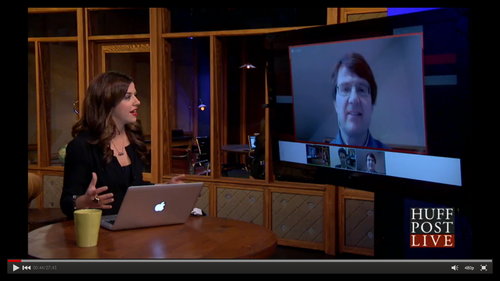
Miles on HuffPost Live: Debt, Electronic Money, Federal Lines of Credit, and a Public Contribution Program

Link to HuffPost LIve Segment “Owning Our Debt”

I am still a novice at TV and video appearances, and so stumbled over some of my words and had some trouble with my lighting, but I thought this segment of HuffPost Live went well. I had a chance to talk about debt, electronic money, Federal Lines of Credit and my idea for a Public Contribution Program.  My main goal was to get across the substance of my Quartz column “What Paul Krugman got wrong about Italy’s economy,” including my reply to Paul Krugman’s response, which you can see in my post “Noah Smith Joins My Debate with Paul Krugman: Debt, National Lines of Credit, and Politics.”

The segment was inspired by Robert Solow’s essay “Our Debt, Ourselves.”

My other appearance on HuffPost Live is here: 

I also had one TV appearance on CNBC’s Squawkbox:

Finally, I have had two radio interviews, whichj allowed me to explain electronic money and Federal Lines of Credit much better than I could on HuffPost Live: 

John Stuart Mill on the Protection of "Noble Lies" from Criticism

I have been interested in the concept of a “noble lie,” since in the course of many discussions I have had about Mormonism in my life, I have heard serious arguments advanced that Mormonism is good for people, even if it isn’t true. In wikipedia, a “noble lie” is defined as follows;

In politics a noble lie is a myth or untruth, often, but not invariably, of a religious nature, knowingly told by an elite to maintain social harmony or to advance an agenda. The noble lie is a concept originated by Plato as described in the Republic.

In the secular arena as well, “political correctness” tries to protect certain ideas from criticism and discussion because those ideas are considered necessary for social harmony and justice. In On Liberty, in Chapter 2, “Of the Liberty of Thought and Discussion,” John Stuart Mill writes this about the idea that “noble lies” should be protected from criticism–an argument that applies with full force even if one thinks a “noble lie” is better described as a “magnificent myth”

In the present age—which has been described as “destitute of faith, but terrified at scepticism"—in which people feel sure, not so much that their opinions are true, as that they should not know what to do without them—the claims of an opinion to be protected from public attack are rested not so much on its truth, as on its importance to society. There are, it is alleged, certain beliefs, so useful, not to say indispensable to well-being, that it is as much the duty of governments to uphold those beliefs, as to protect any other of the interests of society. In a case of such necessity, and so directly in the line of their duty, something less than infallibility may, it is maintained, warrant, and even bind, governments, to act on their own opinion, confirmed by the general opinion of mankind. It is also often argued, and still oftener thought, that none but bad men would desire to weaken these salutary beliefs; and there can be nothing wrong, it is thought, in restraining bad men, and prohibiting what only such men would wish to practise. This mode of thinking makes the justification of restraints on discussion not a question of the truth of doctrines, but of their usefulness; and flatters itself by that means to escape the responsibility of claiming to be an infallible judge of opinions. But those who thus satisfy themselves, do not perceive that the assumption of infallibility is merely shifted from one point to another. The usefulness of an opinion is itself matter of opinion: as disputable, as open to discussion, and requiring discussion as much, as the opinion itself. There is the same need of an infallible judge of opinions to decide an opinion to be noxious, as to decide it to be false, unless the opinion condemned has full opportunity of defending itself. And it will not do to say that the heretic may be allowed to maintain the utility or harmlessness of his opinion, though forbidden to maintain its truth. The truth of an opinion is part of its utility. If we would know whether or not it is desirable that a proposition should be believed, is it possible to exclude the consideration of whether or not it is true? In the opinion, not of bad men, but of the best men, no belief which is contrary to truth can be really useful: and can you prevent such men from urging that plea, when they are charged with culpability for denying some doctrine which they are told is useful, but which they believe to be false? Those who are on the side of received opinions, never fail to take all possible advantage of this plea; you do not find them handling the question of utility as if it could be completely abstracted from that of truth: on the contrary, it is, above all, because their doctrine is the "truth,” that the knowledge or the belief of it is held to be so indispensable. There can be no fair discussion of the question of usefulness, when an argument so vital may be employed on one side, but not on the other. And in point of fact, when law or public feeling do not permit the truth of an opinion to be disputed, they are just as little tolerant of a denial of its usefulness. The utmost they allow is an extenuation of its absolute necessity, or of the positive guilt of rejecting it.

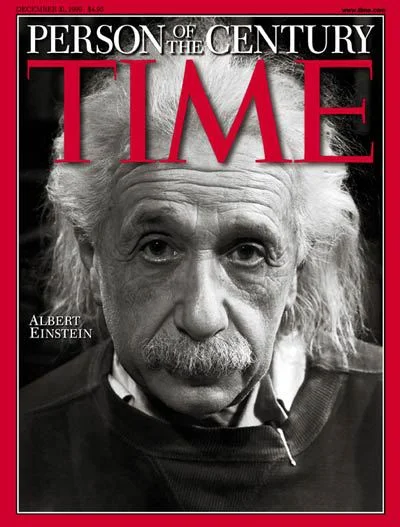
How Albert Einstein Became a Celebrity

Chrystia Freeland, on pages 124-125 of Plutocrats: The Rise of the New Global Super Rich and the Fall of Everyone Elsewrites:

The Scientist who best exemplifies the self-fulfilling power of fame is, ironically, the one most of us would immediately name as the twentieth century’s brightest example of pure intellectual genius: Albert Einstein. Einstein was indeed a groundbreaking physicist, whose theory of relativity ushered in the nuclear age and transformed the way we think about the material world. But why is he a household name, while Niels Bohr, who made important contributions to quantum mechanics and developed a model of atomic structure that remains valid today, or James Watson, one of the discoverers of the double helix structure of DNA, is not?

According to historian Marshall Missner, Einstein owes much of his power as one of the most influential men of the twentieth century less to his theoretical papers and more to the trip he made to the United States in April 1921 as part of a Zionist delegation led by Chaim Weizmann. Before the ship made landfall, Einstein was already known–and feared. His theory of relativity, first put forward in 1905, had been dramatically confirmed in 1919 by the observation of the deflection of light during the solar eclipse in May of that year. The discovery captured the American popular imagination, but not in a good way. The twenties were a fraught decade. The Bolsheviks were consolidating their power in the Soviet Union. Germany was struggling under the weight of punitive World War I reparations. The U.S. economy was still booming, but income inequality was higher than it had ever been and elites were frightened both of homegrown populist protesters and of revolutionary ideas crossing the Atlantic. It was also a time of intense xenophobia and mounting anti-Semitism.  

In that climate, America’s arbiters of public opinion decided that Dr. Einstein and his theory of relativity were sinister and subversive. It became a truth universally acknowledged that only “twelve men” in the world understood the theory of relativity. Pundits worried that this small, foreign cabal could use this knowledge to bend space and time and to enter a “fourth dimension” and thereby achieve “world domination.” Even the New York Times warned of the “anti-democratic implications” of Einstein’s discovery: “The Declaration of Independence itself is outraged by the assertion that there is  anything on earth, or in interstellar space, that can be understood by only the chosen few.”

Then came the Weizmann delegation. Zionism was growing in popularity among New York Jews, and thousands came to the pier to greet the visitors. But the press thought the crowds were Einstein groupies. The Washington Post reported there were “thousands at the pier to greet Einstein.” The New York Times wrote that “thousands wait four hours to welcome theorist and his party to American.” Its interest piqued, the press pack descended on Einstein. Instead of the “haughty, aloof European looking down on boorish Americans” they had expected, he turned out to be a modest, likable guy who “smiled when his picture was taken, and produced amusing and quotable answers to their inane questions.” No longer a threat to the Declaration of Independence, “Professor Einstein,” the New York Times editorial page declared, “improves upon acquaintance.” The scribblers loved him, and they loved the frisson of overturning their readers’ expectations, and a scientific legend was born. From that moment on, a great deal of Einstein’s power in the world, particularly outside the lab, but also within it, was derived from his celebrity.

Franklin Roosevelt: The Hard Road to Democracy

In the address he gave to the Commonwealth Club of San Francisco, not long before he was elected President of the United States for the first time, Franklin Delano Roosevelt gave this account of the history of popular government: 

When we look about us, we are likely to forget how hard people have worked to win the privilege of government. The growth of the national Governments of Europe was a struggle for the development of a centralized force in the Nation, strong enough to impose peace upon ruling barons. In many instances the victory of the central Government, the creation of a strong central Government, was a haven of refuge to the individual. The people preferred the master far away to the exploitation and cruelty of the smaller master near at hand.

But the creators of national Government were perforce ruthless men. They were often cruel in their methods, but they did strive steadily toward something that society needed and very much wanted, a strong central State able to keep the peace, to stamp out civil war, to put the unruly nobleman in his place, and to permit the bulk of individuals to live safely. The man of ruthless force had his place in developing a pioneer country, just as he did in fixing the power of the central Government in the development of Nations. Society paid him well for his services and its development. When the development among the Nations of Europe, however, had been completed, ambition and ruthlessness, having served their term, tended to overstep their mark.

There came a growing feeling that Government was conducted for the benefit of a few who thrived unduly at the expense of all. The people sought a balancing-a limiting force. There came gradually, through town councils, trade guilds, national parliaments, by constitution and by popular participation and control, limitations on arbitrary power.

Franklin Roosevelt on the Second Industrial Revolution

In her book Plutocrats: The Rise of the New Global Super-Rich and the Fall of Everyone ElseChrystia Freeland quotes this wonderful passage about the Second Industrial Revolution from Franklin Delano Roosevelt’s speech to the Commonwealth Club of San Francisco, not long before he was elected President of the United States for the first time: 

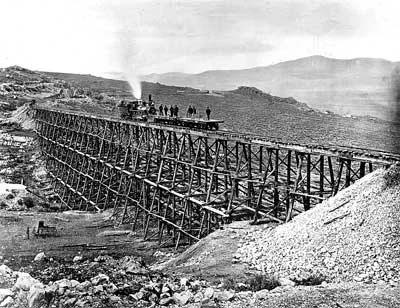
It was in the middle of the nineteenth century that a new force was released and a new dream created. The force was what is called the industrial revolution, the advance of steam and machinery and the rise of the forerunners of the modern industrial plant. The dream was the dream of an economic machine, able to raise the standard of living for everyone; to bring luxury within the reach of the humblest; to annihilate distance by steam power and later by electricity, and to release everyone from the drudgery of the heaviest manual toil. It was to be expected that this would necessarily affect Government. Heretofore, Government had merely been called upon to produce conditions within which people could live happily, labor peacefully, and rest secure. Now it was called upon to aid in the consummation of this new dream. There was, however, a shadow over the dream. To be made real, it required use of the talents of men of tremendous will and tremendous ambition, since by no other force could the problems of financing and engineering and new developments be brought to a consummation.

So manifest were the advantages of the machine age, however, that the United States fearlessly, cheerfully, and, I think, rightly, accepted the bitter with the sweet. It was thought that no price was too high to pay for the advantages which we could draw from a finished industrial system. This history of the last half century is accordingly in large measure a history of a group of financial Titans, whose methods were not scrutinized with too much care, and who were honored in proportion as they produced the results, irrespective of the means they used. The financiers who pushed the railroads to the Pacific were always ruthless, often wasteful, and frequently corrupt; but they did build railroads, and we have them today. It has been estimated that the American investor paid for the American railway system more than three times over in the process; but despite this fact the net advantage was to the United States.