Noah Smith Joins My Debate with Paul Krugman: Debt, National Lines of Credit, and Politics
Update: You can see what I have to say in the wake of Thomas Herndon, Michael Ash and Robert Pollin’s critique of Carmen Reinhart and Ken Rogoff's work on national debt and growth in my column “An economists mea culpa: I relied on Reinhart and Rogoff.” (You can see my same-day reaction here.) Also, on the substance, see Owen Zidar’s nice graph in his post “Debt to GDP & Future Economic Growth.” I sent a query to Carmen Reinhart and Ken Rogoff about whether any adjustments are needed to the two figures from the paper with Vincent Reinhart that I display below, but have not yet received a reply to that query. I think that covers most of the issues that recent revelations raise.

Note that I have revised “What Paul Krugman got wrong about Italy’s economy.” This post is now the go-to source for what I originally said there, relying on “Debt Overhangs, Past and Present” (which has Vincent Reinhart as a coauthor along with Carmen Reinhart and Ken Rogoff). My original passage is in an indented block a little above the colorful pictures your eye will be drawn to below.


In a world where people wrote frankly, Noah Smith has written the response to my Quartz column “What Paul Krugman got wrong about Italy’s economy” that Paul Krugman should have written: 

instead of what Paul actually wrote in response to my column:

(The brief summary of my column is that electronic money could help the UK and the Federal Lines of Credit could help both Italy and the UK stimulate their economies without the problems that might arise from adding substantially to their debt by a simple increase in government spending, as indicated by my original title: “How Italy and the UK Can Stimulate Their Economies Without Further Damaging Their Credit Ratings.”)

Noah follows an earlier Paul Krugman column “Debt, Spreads and Mysterious Omissions,” in using the graph above to distinguish between Italian debt and US or UK or Japanese debt by pointing out that individual euro-zone countries are not able to borrow in their own currency in the same way the US, the UK or Japan can. Paul used this distinction to minimize the danger to the US of high debt levels; here is the first sentence of “Debt, Spreads and Mysterious Omissions”

Binyamin Applebaum reports on a new paper by Greenlaw et al alleging that bad things will happen to America, because debt over 80 percent of GDP leads to high interest rates, and is skeptical – but not skeptical enough. 

Paul explains that an important argument that the US may be OK revolves around the suggestion that Japan can get away with the debt levels at the rightmost extreme of the graph above because: 

…what really matters is borrowing in your own currency – in which case the US and the UK are, in terms of borrowing costs, like Japan rather than Greece. That’s certainly what the De Grauwe (pdf) analysis suggests.

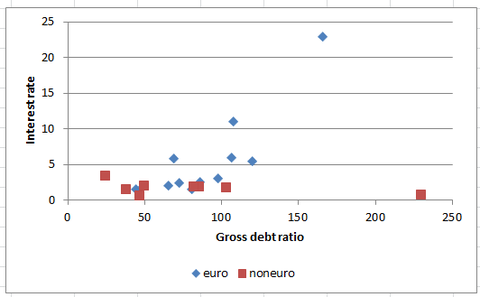
Even the quickest look at the data suggests that there’s something to this argument; for example, taking data from the paper itself, and dividing the countries into euro and non-euro, we get a scatterplot like this:

There is no hint in Paul’s earlier piece, “Debt, Spreads and Mysterious Omissions” of a claim that we should not worry about high debt levels for euro-zone countries, and even less reason to worry about US debt. A reader could be forgiven for coming away from “Debt, Spreads and Mysterious Omissions” thinking Paul thought that maybe high debt levels might be worrisome for countries that cannot borrow in their own national currency (such as Greece and Italy), but not for countries that can borrow in their own currency.  

Noah joins Paul in taking me to task for relying too much on Carmen Reinhart, Vincent Reinhart and Ken Rogoff’s paper  “Debt Overhangs, Past and Present”:

Krugman has a good point: The “90%” thing is not well established; it is obviously just Reinhart and Rogoff eyeballing some sparse uncontrolled cross-country data and throwing out an off-the-cuff figure that got big play precisely because it was simple and (to deficit scolds) appealing. The 90% number alone is not a justification for worrying about debt.

But unlike Paul, Noah notes that all I need to argue for the main point of my column is that less debt is better than more debt:

But I feel that this argument over debt levels is mostly a distraction. The important thing, which is being overlooked, is that Miles has come up with a really interesting policy tool to increase the amount of stimulus per unit of debt incurred. That tool is Federal Lines of Credit, or FLOCs - basically, the idea that government should lend people money directly.

Paul is so used to–and intent on–arguing that getting out of recessions is so important that it is worth incurring additional debt to do so, that he seems to miss my point that it is possible to stimulate economies to escape recessions while incurring much less debt than a straight increase in government spending would incur.

I am actually on record agreeing with Paul (and Noah) that the Great Recession was so serious that it was worth a massive increase in debt to escape it if that were the only available way to stimulate the economy. In “What Should the Historical Pattern of Slow Recoveries after Financial Crises Mean for Our Judgment of Barack Obama’s Economic Stewardship”:

So the fact that Barack did not push for a bigger stimulus package really is an indictment of his economic leadership. According to the reported statement by Larry Summers, it was a political judgement that a bigger stimulus was not politically feasible. I am not at all convinced that a bigger stimulus was politically impossible. It would not have been easy, I’ll grant that, but I was amazed that Barack managed to get Obamacare through. If, instead, Barack had used his political capital and the control the Democrats had over both branches of Congress during his first two years for a bigger stimulus, couldn’t he have done more? …

Notice that in all of this, I am treating a larger stimulus of a conventional kind as the best among well-discussed policy options when Barack took office in 2009. So I am backing up Paul Krugman’s criticisms of Barack’s policies at the time. However, given what we know now we could do even better, as I discuss in my post “About Paul Krugman: Having the Right Diagnosis Does Not Mean He Has the Right Cure.”

 A similar judgment might well hold for Italy, as Paul argued in “Austerity, Italian Style” (the piece that kicked off this current debate with Paul), except: 

  1. We all agree that Italy’s debt problem is worse than the debt problem for the US. 
  2. Much more importantly, a policy option (National Lines of Credit) is now on the table (at least for discussion in the op/ed pages) that could stimulate the Italian economy with much less addition to debt than a straight increase in spending–a policy option that was not on the table for the US in 2009.

Astute readers will have noticed that in “What Should the Historical Pattern of Slow Recoveries after Financial Crises Mean for Our Judgment of Barack Obama’s Economic Stewardship” I relied on a stylized fact from Carmen Reinhart and Ken Rogoff’s book This Time is Different: Eight Centuries of Financial Folly. If I am led astray, it is because of my enormous respect for Ken Rogoff’s judgment, but in this case, I would be very surprised if Paul had not at some point in his New York Times columns relied on the Reinhart and Rogoff stylized fact that recessions have tended to last a long time after financial crises in more or less the same way I did. (Though I know Ken Rogoff, I don’t think I have ever been fortunate enough to meet either Carmen or Vincent Reinhart yet.) But of course, the meaning of the Reinhart and Rogoff stylized fact that across many countries recessions have historically lasted a long time after financial crises is just as much up for grabs as the meaning of the Reinhart, Reinhart and Rogoff stylized fact that across many countries GDP growth has been low during periods when debt to GDP ratios have been high.

For the record, despite, Paul’s title “Another Attack of the 90% Zombie,” I do not think I unduly emphasized the 90% figure itself. Here is what I actually wrote: 

And national debt beyond a certain point can be very costly in terms of economic growth, as renowned economists Carmen ReinhartVincent Reinhart, and Kenneth Rogoff convincingly show in their National Bureau of Economic Research Working Paper “Debt Overhangs, Past and Present.”

Where do the United Kingdom and Italy stand in relation to the 90% debt to GDP ratio Reinhart, Reinhart and Rogoff identify as a threshold for trouble? (It is important to realize that their 90% threshold is in terms of gross government debt. That is, it does not net out holdings by other government agencies. )

In context in relation to Italy, this means “Surely, in practice, some level of the existing debt to GDP ratio for Italy should make us worry about adding to Italy’s national debt. Can we get some idea of whether we should worry about Italian debt or not?”

Let’s look at Reinhart, Reinhart and Rogoff’s stylized fact about debt to GDP ratios and realized economic growth in a little more detail to see if there is enough suggestive evidence that we should be concerned about adding to Italy’s national debt. Here is Diagram 1 from “Debt Overhangs, Past and Present”:  
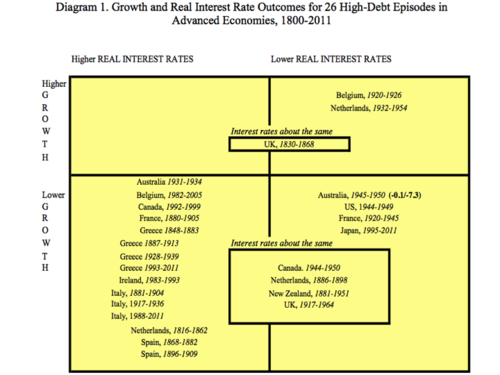
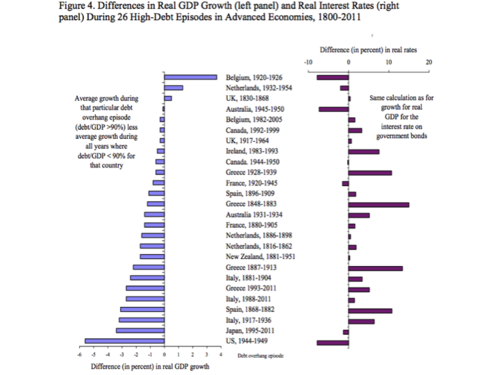
In this sample of 26 high-debt episodes, there has never been a case when a country had both a debt/GDP ratio higher than 90% and high real interest rates beat its own national GDP growth rate average during that period of time. Figure 4 gives more detail for specific episodes:
Niklas Blanchard writes this about “Debt Overhangs, Past and Present” in his post in this debate with Krugman (see this full account of my discussion with Niklas):

There is a lot not to like about the Reinhart, Reinhart, and Rogoff study, and Krugman nails much of it; it doesn’t deal with causation. I’m actually kind of confused as to why Miles mentions the study (although he may enlighten me in the comments). However; more importantly, it doesn’t specify 90% debt: GDP as a regime change to a new steady state, or as a transitory experience resulting from something like a recession, or a war. In normal times, the regime change itself is the cause of the turbulence, not the subsequent destination (like going over a waterfall). There is ample evidence that suggests that countries with high transitory debt loads are able to deal with them without incident — provided they return to robust nominal growth. Japan deals with it’s sky-high debt load through financial repression and ultra-tight monetary policy. The cost of this type of action is that the government steals wealth from households.

In retrospect, I should have avoided the word “threshold,” with its suggestion of a sudden change. I never intended to suggest there was a sudden regime shift. Of course, the 90% debt/GDP ratio is a somewhat arbitrary level that Carmen, Vincent and Ken use to cut their data. But, looking at the whole set of 26 historical episodes above that debt/GDP ratio, there seems ample grounds to be worried about the effects additional national debt might have on Italy’s situation–and I don’t think it is amiss to be worried about the effects additional national debt might have on the situation in the UK or the US. There is no evidence from a randomized controlled trial available for the effects of national debt. So I don’t know how to judge whether we should be worried about the effects of national debt for countries in various situations other than from theory–which I will leave for other posts and columns–or by trying to glean what insights we can from case studies (which is what attempts to find natural experiments would be in terms of sample size), from exercises like the one Carmen, Vincent and Ken conducted in “Debt Overhangs, Past and Present,” or from correlations such as those shown in Paul’s graph above, which suggests that we should be more worried about high debt/GDP ratios for countries that cannot borrow in their own national currency.

Unlike Paul, Noah grapples with my National Lines of Credit proposal–or “Federal Lines of Credit” for the US. (You can see my posts on Federal Lines of Credit collected in my Short-Run Fiscal Policy sub-blog: http://blog.supplysideliberal.com/tagged/shortrunfiscal.) Noah writes:

However, I do have some skepticism about FLOCs. First of all, there is the idea that much of the “deleveraging” we see in “balance sheet recessions” may be due to behavioral effects, not to rational responses to a debt-deflation situation. People may just switch between “borrow mode” and “save mode”. In that case, offering them the chance to take on extra debt is not going to do much. Second, and more importantly, I worry that FLOCs might draw money away from infrastructure spending and other government investment, which I think is an even more potent method of stimulus; govt. investment, like FLOC money, is guaranteed to be spent at least once, but unlike FLOCs it can increase public good provision, which is a supply-side benefit.

In answer to Noah’s first bit of skepticism, the main point of National Lines of Credit is to encourage more spending by that fraction of the population that will spend as a result of being able to borrow more, without adding to the national debt by sending checks to people like those in “save mode” who won’t spend any more. If people don’t draw on their lines of credit from the government, it doesn’t add to the national debt. And even if people draw on their lines of credit from the government to pay off more onerous debt, this is likely to both (a) make them better credit risks–that is, more likely to have the means to pay the government back and so not add to the national debt and (b) make them feel more secure, and so possibly get them to switch at least a little bit from “save mode” to “spend mode.”

On infrastructure spending, I should say more clearly than I have in the past that spending more on fixing roads and bridges would likely be an excellent idea for the US on its own terms, because of the supply-side benefits. But if it crowded out a Federal Lines of Credit program, one has to consider that Federal Lines of Credit can get more than a dollar’s worth of first-round addition to aggregate demand (which is then multiplied by whatever Keynesian multiplier is out there) per dollar budgeted for loan losses, while spending on infrastructure gives exactly one dollar worth of first-round addition to aggregate demand (which is then multiplied by whatever Keynesian multiplier is out there) per dollar budgeted for that spending. The spending on roads and bridges has to have enough of a positive effect on later productivity and tax revenue to outweigh its less potent stimulus per dollar budgeted. The other big problem with additional infrastructure spending is that, alas, it cannot be turned on and off quickly. The legal, administrative and regulatory process for spending on roads and bridges is just too slow to be of much help in short recessions, or if one wants to hasten a recovery that has already built up a good head of steam. So our current situation is one of the few in which spending on roads and bridges would be a fast enough mode of stimulus. Most of the time, roads and bridges should be seen primarily as a valuable supply-side measure when infrastructure is in the state of disrepair seen in the US.  

I said that Noah, unlike Paul, grapples with my National Lines of Credit proposal. Indeed, Paul shows no evidence of having read the second half of my article. One theory is that he really didn’t read the second half. Most favorably, Paul could be saving discussion of Federal Lines of Credit (and electronic money, which I also discuss in “What Paul Krugman got wrong about Italy’s economy”) for other posts. The most intriguing theory (that is not as positive as the idea that Krugman posts on FLOC’s and electronic money are coming, and one that I would not give all that high a probability to) is that Paul likes my proposals enough that he wanted to point people to those proposals, and too much to criticize them, but thinks they are too controversial to implicitly endorse by discussing them without criticizing them. If so, I am grateful to Paul for that backhanded support. Noah has a theory (that does does not preclude this theory that Paul is intentionally flagging my proposals while keeping some distance): 

That said, I think the FLOC idea is an interesting one. Why have most stimulus advocates ignored it? My guess is that this is about politics. In an ideal world, pure technocrats (like Miles) would advise politicians in an honest, forthright fashion as to what was best for the country, and the politicians would take the technocrats’ advice. In the real world, it rarely works that way. For every technocrat who just wants to increase efficiency, there’s a hundred hacks and politicos who are only thinking about distributional issues - grabbing a bigger slice of the pie. These hacks are very willing to use oversimplified narratives and dubious sound bytes to embed their ideas in the public mind. And that kind of thing really seems to be effective.

This means that politics’ response to policy is highly nonlinear - give the enemy an inch, and they take a mile. It also means the response is highly path-dependent; precedent matters.

So Krugman et al. may be ignoring FLOCs and other stimulus engineering tricks because of political concerns. If they concede for a moment that debt is scary, it will just shift the Overton Window toward Republican types who are deeply opposed to any sort of stimulus, and would oppose Miles’ FLOCs just as lustily as they opposed the ARRA.

In other words, finding optimal, first-best technocratic solutions might be far less important than simply embedding “AUSTERITY = BAD!!!” in the public consciousness.

My own politics are more centrist (to the extent they fit within the US political debate at all. (See my post “What is a Partisan Nonpartisan Blog?” as well as the mini-bio at my sidebar and Noah’s early review of my blog, “Miles Kimball, the Supply-Side Liberal.”) From that point of view, I have argued in “Preventing Recession-Fighting from Becoming a Political Football” (my response to the Mike Konczal post criticizing Federal Lines of Credit that Noah mentions) that Federal Lines of Credit have substantial political virtues in providing a way out of the current political deadlock between the Republican and Democratic parties over economic policy.

Many thanks to Noah for clarifying this debate with Paul, as well as to Niklas Blanchard, whose two bits I discussed in my post a few days ago, and to Paul himself for engaging with me in debate, at least at one level.

Update: With Noah’s permission, let me share an email exchange about the post above:

Miles: Did you like my response? 

Noah: I did! It was quite thorough.

I think the criticisms of FLOCs are still basically three:
Criticism 1 (mine): There is a limited amount of political will for increased spending. And because of the supply-side benefits of infrastructure, that finite will is better spent on infrastructure even than on the most cost-effective pure stimulus.
Criticism 2 (Mike Konczal’s): FLOCs have different distributionary consequences than other stimulus approaches, since FLOC borrowers will be responsible for repaying the stimulus borrowing, not taxpayers.
Criticism 3 (Mike Konczal’s): It will be very difficult to handle the inevitable FLOC defaults. Whether they are forgiven or collected aggressively, it will make some people very angry.
Criticism 4 (everyone else’s): FLOCs may get good “bang for the buck”, but they won’t get much bang in total, because people are in “deleveraging” (or “balance sheet rebuilding”) mode.
I think that these are not inconsiderable obstacles to the FLOC idea…
Miles: I don’t understand 4. Here is what I think it means. FLOC’s can be scaled up to get more impact, but they will have decreasing returns since people have consumption that is concave in amount of credit provision. Even though the costs are also concave in the headline amount of credit provision, this means that a FLOC program can only be so big. So ideally we want other things as well–infrastructure and electronic money.  Sounds good.  
On 1, I would be glad if the debate were between FLOC’s and infrastructure spending.  
On 2 and 3, Mike only gets one of these at a time at full force: making the amount of credit provision proportional to last-years adjusted gross income dramatically reduces the repayment problem (and the size of the program can be adjusted to compensate for the lower MPC), but this makes it distributionally less favorable.  
Noah: No, I think you may be misunderstanding 3. No matter how much FLOC lending is done, x% of people will default on their FLOC loans. What the government then does to that x% - cancels their debt, sues them, or refers them to collections agencies - is going to be a political bone of contention. It’s an image problem (evil govt. suckering people into borrowing money they can’t afford to pay back), not an efficiency problem.

Miles: I agree. That is why FLOC’s need to be paired with National Rainy Day Accounts that most likely make it unnecessary to ever use FLOC’s again after the first time.

I added the link about National Rainy Day Accounts just now. As a conceptually similar idea to FLOC’s and National Rainy Day Accounts for individuals, see what I have to say about helping the states spend more now (to stimulate the economy) and less later in “Leading States in the Fiscal Two Step.”


Anat Admati, Martin Hellwig and John Cochrane on Bank Capital Requirements

In the March 1, 2013 Wall Street Journal, John Cochrane had an eye=-opening review of The Banker’s New Clothes, summarizing the argument of authors Anat Admati and Martin Hellwig:

Running on Empty: Banks should raise more capital, carry less debt–and never need a bailout again.

It motivated me to buy the book and download it to my Kindle.

In Admati and Martin’s argument, as distilled by John, the first thing to understand is that capital requirements do not by themselves reduce the amount of funds available for lending; they are on the liability side, not the asset side: 

“Capital” is not “reserves,” and requiring more capital does not reduce funds available for lending. Capital is a source of money, not a use of money.

Moreover,

Capital is not an inherently more expensive source of funds than debt. Banks have to promise stockholders high returns only because bank stock is risky. If banks issued much more stock, the authors patiently explain, banks’ stock would be much less risky and their cost of capital lower. “Stocks” with bond-like risk need pay only bond-like returns. Investors who desire higher risk and returns can do their own leveraging—without government guarantees, thank you very much—to buy such stocks.

And yet, banks choose very high debt/equity ratios than other firms. What is going on? 

Nothing inherent in banking requires banks to borrow money rather than issue equity. Banks could also raise capital by retaining earnings and forgoing dividends,…

Why do banks and protective regulators howl so loudly at these simple suggestions? As Ms. Admati and Mr. Hellwig detail in their chapter “Sweet Subsidies,” it’s because bank debt is highly subsidized, and leverage increases the value of the subsidies to management and shareholders.

Equity is expensive to banks only because it dilutes the subsidies they get from the government. That’s exactly why increasing bank equity would be cheap for taxpayers and the economy, to say nothing of removing the costs of occasional crises.

Would high capital requirements inevitably gum up the works of banking? No:  

… it was not always thus. In the 19th century, banks funded themselves with 40% to 50% capital. 

How high should capital requirements be? Here is John Cochrane’s answer, which I second: 

How much capital should banks issue? Enough so that it doesn’t matter! Enough so that we never, ever hear again the cry that “banks need to be recapitalized” (at taxpayer expense)!

To be specific, I would say 50%. After all, equal amounts of equity and debt would not be an unusual debt/equity ratio for a non-banking firm that didn’t face a massive implicit subsidy from the likelihood of a bailout. Indeed, even the debt/equity ratios seen for non-banking firms are likely to tilt toward a higher debt/equity ratio than would be socially optimal as a result of the favorable tax treatment of debt relative to equity. (See Simon Johnson’s Congressional testimony on that point here.) And equal amounts of equity and debt did not constitute an unusual debt/equity ratio for banks in the era when the implicit bailout subsidy was not yet in place.

What to Say to the God of Death

George R. R. Martin’s fantasy novel The Game of Thrones has been adapted for HBO by George R. R. Martin himself. In the first season, Arya of House Stark is taught to fence in the Braavosi Water Dancer style by the former First Sword of Braavos Syrio Forel. During that instruction (the scene at this link) Syrio makes this unforgettable declaration:

There is only one god,
and his name is Death.
And there is only one thing we say to death:
“Not today."

Niklas Blanchard Defends Me Against the Wrath of Paul Krugman, Despite My Lack of Nuance

In response to my latest Quartz column

Paul wrote a post

taking aim at my reliance on Carmen Reinhart, Vincent Reinhart and Kenneth Rogoff’s paper “Debt Overhangs, Past and Present.” I plan to write a reply to Paul at some point. In the meanwhile,  I appreciate Niklas Blanchard coming to my defense in his post

Not surprisingly, I like Niklas’s post. But Niklas also takes me to task for my reliance on the paper “Debt Overhangs, Past and Present.” (Update: Niklas tweeted that his title about lack of nuance was directed at Paul, not me. I interpreted it as my not being careful enough in my discussion of Reinhart, Reinhart and Rogoff.) Among other discussions about the interaction with Paul, you can see my attempt to justify myself to Niklas in these storified tweets:  

For the record, here is the passage in question in my post:

And national debt beyond a certain point can be very costly in terms of economic growth, as renowned economists Carmen ReinhartVincent Reinhart, and Kenneth Rogoff convincingly show in their National Bureau of Economic Research Working Paper “Debt Overhangs, Past and Present.”

Where do the United Kingdom and Italy stand in relation to the 90% debt to GDP ratio Reinhart, Reinhart and Rogoff identify as a threshold for trouble? 

For comparison, here is the abstract for “Debt Overhangs, Past and Present”

We identify the major public debt overhang episodes in the advanced economies since the early 1800s, characterized by public debt to GDP levels exceeding 90% for at least five years. Consistent with Reinhart and Rogoff (2010) and other more recent research, we find that public debt overhang episodes are associated with growth over one percent lower than during other periods. Perhaps the most striking new finding here is the duration of the average debt overhang episode. Among the 26 episodes we identify, 20 lasted more than a decade. Five of the six shorter episodes were immediately after World Wars I and II. Across all 26 cases, the average duration in years is about 23 years. The long duration belies the view that the correlation is caused mainly by debt buildups during business cycle recessions. The long duration also implies that cumulative shortfall in output from debt overhang is potentially massive. We find that growth effects are significant even in the many episodes where debtor countries were able to secure continual access to capital markets at relatively low real interest rates. That is, growth-reducing effects of high public debt are apparently not transmitted exclusively through high real interest rates.

Postscript: In this context I love Noah Smith’s Twitter homepage illustration

Dan Benjamin, Mark Fontana and I Design an In-Depth Risk Aversion Survey

As an addendum to the title, let me mention that Michael Gideon also helped immensely with the conceptual design of this survey. Michael Gideon and Mark Fontana are both Ph.D. students in Economics at the University of Michigan. Dan Benjamin is an Assistant Professor at Cornell and a frequent coauthor of mine. 

Attitudes toward risk matter greatly for many economic decisions. Bob Barsky, Tom Juster, Matthew Shapiro and I got into the business of measuring risk aversion directly from hypothetical choices a while back:

Matthew and I continued that line of research along with Claudia Sahm:

I have several ongoing projects about risk aversion with various coauthors (including Matthew and Claudia). The one that envisions the most in-depth analysis of the nature of risk aversion is the research project Dan Benjamin, Mark Fontana and I are working on. We have a draft web survey that is in pretty good shape that we are trying to debug. Feel free to take a peek if you are curious to see what we are up to. But if any of you are willing to take this draft survey as if you were a real respondent, you could really help us in making sure the computer code is working as it should and in checking whether our procedures are working OK. Your answers will be anonymous and we will not use them directly in the research, but only as a pretest for checking our procedures.

The instructions are below, after the break. They are written as if you plan to do the whole thing. But if you are just taking a peek, still enter “miles” when it asks for “netid”. We will be able to tell you are just taking a peek from the fact that you stop part way through. However, if you make it the whole way, your answers will be much more valuable in our debugging. I am grateful for your help and your interest.

Instructions:

Thanks for agreeing to help test our investment preferences web survey. Your feedback is much appreciated. This survey is going to help us learn more about risk aversion, and how you think about your own decision making.

First, visit the following website:

https://survey.rand.org/research/hosting/risk/index.php

After clicking next on the first screen, you will be asked for your “netid”. Please enter “miles” as the answer to this question.

Next, you will be taken to the “Table of Contents” page. This section is only for purposes of receiving feedback and pilotting. The full survey will be one continuous stream of sections. It will feature several training modules, a calibration section (so the gambles you’ll face are tailored to your own risk aversion), and then the main body of the experiment, followed by a demographic survey. However, for the purposes of your feedback, we’re only asking you to go through two of the training modules and the main body. In total, this should not take more than 50 minutes or so to complete.

Select each of the following modules from the Table of Contents in the order listed; when you’ve finished one module, close out the browser, restart it, and reload the survey (again entering your “netid” as “miles), and start the next module.

1. Symbols training/quiz
2. Assumptions training/quiz
3. Phase 1 and 2 (this one is the main body)

For the first two modules, we’re curious whether everything is clear and concise.

For the main body, we’re curious if everything loads correctly. We’re also curious, once you get to "Phase 2” (which will be signaled by a slide with a sunset and a warning that the next slides might take a while to load), whether it takes too long to load slides. Our own testing has seen the longest wait time of about 4 minutes.

As you will see, the purpose of Phase 2 is to ask you how you feel about updating certain choices you made during Phase 1. We’re curious whether you end up being asked to resolve any intransitivities in your decision-making during phase 2 (i.e. cyclical preferences of the form A > B > C > A). **These slides would ask you to explicitly rank choices among three or more options.** Our guess is that our current algorithm for randomly asking these slides won’t have them appear very often. In other words, other phase 2 slides will have the effect of resolving any intransitivities in your decision-making, so you might never be explicitly asked to do so.

Thanks again, and happy choosing.

Adam Ozimek's Regional Visa Proposal

The immigration reform debate should turn in earnest to Adam Ozimek’s proposal for regional visas, which you can see at this link.

Here is a slightly tidied up version of what I had to say about his proposal when I appeared on Huffpost Live:

The United States is like a college that has everyone wanting to get in. We ought to be able to do something with that. Let me give you just one idea. I love Adam Ozimek’s idea of region-based visas. If you let states and cities and towns apply for visas for people, then you require people to buy a house and get a job in that area, then we can let the different areas decide how many immigrants to bring in. Some places don’t think they can handle immigrants, and some places think they can. I’ll tell you what will happen: those places that let in lots of immigrants will have the dynamic local economies, and pretty soon people will see just how much immigrants bring to the economy. But you don’t have to believe me. Just allow these region-based visas, and then the states and localities that are willing to try it will show the way, and show how much immigrants add to our economy.

Postscript: See my earlier post about that appearance on HuffPost Live, “Miles on Huffpost Live: The Wrong Debate and How to Change It” for the rest of what I said. In particular, I was able to make a pitch for electronic money. Here is the video itself, including also commentary by Robert Kuttner, Dan Gross, Zach Carter and Stephanie Kelton.

Jonathan Meer and Jeremy West: Effects of the Minimum Wage on Employment Dynamics

After my post “Isaac Sorkin: Don’t Be too Reassured by Small Short-Run Effects of the Minimum Wage,” I heard about Jonathan Meer and Jeremy West’s empirical paper on the same theme: “Effects of the Minimum Wage on Employment Dynamics.” They find evidence that an increase in the minimum wage doesn’t lead bosses to fire or lay off workers they already have, but does reduce the rate at which new workers are hired.   

Their abstract summarizes their results well:

The voluminous literature on minimum wages offers little consensus on the extent to which a wage floor impacts employment. For both theoretical and econometric reasons, we argue that the effect of the minimum wage should be more apparent in employment dynamics than in levels. Using administrative data in a state-year panel, we evaluate each employment margin directly. We find that the minimum wage reduces gross hiring of new employees, but that there is no effect on gross separations. Moreover, despite having an insignificant discrete effect on the employment level, increases in the legal wage floor directly reduce job growth. Neither labor force turnover nor the entry or exit rate of establishments are affected.

Taking all hires as a base for the percentage, not just hires into minimum-wage jobs, Jonathan and Jeremy’s estimates point to a 1.36% reduction in gross hiring when the minimum wage is increased by 10%. (The standard error on that number is .43%.) The percentage effect on hiring into minimum-wage jobs would be considerably higher. While there is no sudden effect on the level of employment, their estimates point to a reduction of .35% per year reduction in overall net job growth for all jobs from a 10% increase in the minimum wage. (The standard error on that number is .17% per year.) These two numbers are reasonably consistent with one another. They write about the base turnover rate that “on average about 29% of an establishment's current employment roster is filled by different employees from year-to-year.” A 1.36% reduction in the inflow to this 29% turnover should yield a .4% per year reduction in overall net job growth, which is well within the margin of error from the .35% per year they found from directly estimating effects on overall net job growth.

Based on my reading of it, Jonathan and Jeremy’s paper appears carefully done. But let me know if you see a flaw in their statistical methods. One loophole they identify themselves is that since they focus on number of jobs rather than hours, their data allow the logical possibility that an increase in the minimum wage could reduce the number of jobs, but lead to higher hours for the workers who remain. I am not aware of anyone championing the idea that minimum wages gradually reduce jobs but gradually raise hours for those remain. Does anyone want to seriously argue that case?

Update: Here is a link to Reihan Salam’s post on Jonathan and Jeremy’s work. 

How Truth Prevails

Heber C. Kimball (1801-1868)

Heber C. Kimball (1801-1868)

On September 2, 1837, after crossing the ocean to preach Mormonism in England, my great great grandfather Heber C. Kimball wrote this to his wife (not my great great grandmother, since I am descended from  another of his many wives):

MY DEAR COMPANION,

I take this opportunity to write a few lines to you, to let you know I am in the land of the living, I am a pilgrim on the earth, and a stranger in a strange land far from my home, and among those that seek my life because I preach the truth and those things that will save their lives in the day of tribulation.  On the 18th of July [1837] we landed in Liverpool in the forenoon.  I had peculiar feelings when we landed, the spirit of God burned in my breast, and at the same time I felt to covenant before God to live a new life, and to pray that the Lord would help me to do the same.  We remained there three days, resting our bodies.  On Saturday, the 22nd, we took coach for Preston, the distance 31 miles; we arrived there at four in the afternoon.

After we had unloaded our things, Brother Fielding had gone to see his brother, and Brother Goodson had gone to get lodgings.  All at once I looked up.  There was a large flag before me with large gilded letters written thereon, “TRUTH WILL PREVAIL."  We said, "amen, so let it be Lord.”

Having heard that story many times growing up, I was pleased to read John Stuart Mill’s explanation of how truth prevails. John, 1806-1873 was five years junior to Heber. In his 1867 essay On Liberty, Chapter 2, “Of the Liberty of Thought and Discussion,” he writes:

It is a piece of idle sentimentality that truth, merely as truth, has any inherent power denied to error, of prevailing against the dungeon and the stake. Men are not more zealous for truth than they often are for error, and a sufficient application of legal or even of social penalties will generally succeed in stopping the propagation of either. The real advantage which truth has, consists in this, that when an opinion is true, it may be extinguished once, twice, or many times, but in the course of ages there will generally be found persons to rediscover it, until some one of its reappearances falls on a time when from favourable circumstances it escapes persecution until it has made such head as to withstand all subsequent attempts to suppress it.

Clay Christensen, Jeffrey Flier and Vineeta Vijayaraghavan on How to Make Health Care More Cost Effective

Clay Christensen, Jeffrey Flier and Vineeta Vijaraghavan argue in their Wall Street Journal op-ed “The Coming Failure of Accountable Care” a few days ago that Obamacare’s “accountable care organizations” will have trouble changing doctors’ behavior in the dramatic ways envisioned. They will have even more trouble changing patients’ behavior, since accountable care organizations provide few incentives for patients to change their behavior.  

In the debates over health care reform, advocates of Obamacare have made a great deal of the lower per-patient costs of medical care in other advanced countries. Those lower per-patient costs of medical care in other advanced countries have a lot to do with lower pay for doctors and other medical-care providers. If something on the Obamacare model  succeeds in lowering medical costs significantly, I suspect it will be because it forces down doctors’ pay, as government budget constraints lead to tighter and tighter price controls.

Clay, Jeffrey and Vineeta’s list of recommendations would instead use market liberalization to lower the amount paid for medical services. Here is their prescription:  

• Consider opportunities to shift more care to less-expensive venues, including, for example, “Minute Clinics” where nurse practitioners can deliver excellent care and do limited prescribing. New technology has made sophisticated care possible at various sites other than acute-care, high-overhead hospitals.

• Consider regulatory and payment changes that will enable doctors and all medical providers to do everything that their license allows them to do, rather than passing on patients to more highly trained and expensive specialists.

• Going beyond current licensing, consider changing many anticompetitive regulations and licensure statutes that practitioners have used to protect their guilds. An example can be found in states like California that have revised statutes to enable highly trained nurses to substitute for anesthesiologists to administer anesthesia for some types of procedures.

• Make fuller use of technology to enable more scalable and customized ways to manage patient populations. These include home care with patient self-monitoring of blood pressure and other indexes, and far more widespread use of “telehealth,” where, for example, photos of a skin condition could be uploaded to a physician. Some leading U.S. hospitals have created such outreach tools that let them deliver care to Europe. Yet they can’t offer this same benefit in adjacent states because of U.S. regulation.

Free market advocates have been calling for such approaches for some time. Doctors have understandably lobbied for a continuation of market restrictions that boost their pay. Now that doctors face reduced pay under budget pressures created by Obamacare as well, such market liberalization in medical care may begin to seem like the lesser of two evils for doctors. And it could be a great boon to the rest of us.

For the record, here is my position on health care reform, quoted from my post “Evan Soltas on Medical Reform Federalism–in Canada”

Let’s abolish the tax exemption for employer-provided health insurance, with all of the money that would have been spent on this tax exemption going instead to block grants for each state to use for its own plan to provide universal access to medical care for its residents.

This recommendation is based on what I said in my first post about health care, “Health Economics”:

I am slow to post about health care because I don’t know the answers. But then I don’t think anyone knows the answers. There are many excellent ideas for trying to improve health care, but we just don’t know how different changes will work in practice at the level of entire health care systems.

The more the Washington encourages a diversity of approaches to health care, the more we will learn about what works. On the other hand, the more Washington does to force health care policy into the same mold in each state, the more likely it is that we will only learn one thing at the systems-level: that the first try in the one-size-fits-all approach doesn’t work very well.

Isaac Sorkin: Don't Be Too Reassured by Small Short-Run Effects of the Minimum Wage

(Note: on this topic, see also “Jonathan Meer and Jeremy West: Effects of the Minimum Wage on Employment Dynamics.”)

In light of the current debate about raising the minimum wage, I wanted to bring to your attention University of Michigan graduate student Isaac Sorkin’s work on the minimum wage. He begins his paper “Minimum Wages and the Dynamics of Labor Demand” by raising the issue of long-run versus short-run: 

Typical analyses of the employment effects of minimum wages find effects too small to easily reconcile with the short-run elasticities implied by the textbook approach. However, if many firms do not fully adjust their labor demand in the short run, then the short-run employment responses would be much smaller in magnitude than the textbook approach implies, and in line with empirical work.

Later in the introduction, Isaac explains:

The main contribution of this paper is that it revives, formalizes and quantifies an old argument about the employment response to minimum wage increases that has been curiously neglected in the modern literature. In the famous Lester (1946), Machlup (1946), and Stigler (1946) debate about minimum wages, … Lester’s argument is that in response to temporary changes in wages, employers are unlikely to make the fundamental changes in how they do business necessary to reduce labor demand simply because it is not worth it to them to pay the adjustment cost. Thus, this paper follows in that tradition by arguing that the presence of adjustment costs on labor demand provides a cohesive explanation for the small short and long-run employment effects found in the minimum wage literature. 

The relevant quotation from Lester is this:

Most industrial plants are designed and equipped for a certain output, requiring a certain work force. Often effective operation of the plant involves a work force of a given size…Under such circumstances, management does not and cannot think in terms of adding or subtracting increments of labor except perhaps when it is a question of expanding the plant and equipment, changing the equipment, or redesigning the plant…

From much of the literature the reader receives the impression that methods of manufacture readily adjust to changes in the relative cost of productive factors. But the decision to shift a manufacturing plant to a method of production requiring less or more labor per unit of output because of a variation in wages is not one that the management would make frequently or lightly.

Richard A. Lester (1946, pg. 72-73). 

If the long-run effect of minimum wages is substantial, why then don’t we see this effect? Isaac argues it is because there have been very few long-run changes in the minimum wage in the United States, so evidence on their effects is scant. The minimum wages is set in nominal terms, so it declines with inflation, is raised, declines with inflation, is raised, etc.  This yields a sawtooth pattern of the real (inflation-adjusted) minimum wage in which almost all changes in the real minimum wage are temporary. And Isaac argues that temporary changes in the minimum wage have muted effects. In Isaac’s words:

… if adjustment is slow (because it is costly), then labor demand today is a forward-looking decision and depends critically both on the realized path, and the expectations, of minimum wages. In the US, minimum wages are mostly set in nominal terms and so a given increase is not very persistent. As a result, labor demand would never fully adjust to a given minimum wage increase and the long-run consequences of a given minimum wage increase for employment might be quite small.

Isaac backs up his story about how machinery adapted to be used by a given number of workers can influence labor demand by discussing detailed micro-data of the reaction to an important set of minimum wage increases in 1938 and 1939 (pp. 4-6).  

The implementation of the Fair Labor Standards Act of 1938 in the case of the seamless hosiery industry provides a nice example of this mechanism since the Bureau of Labor Statistics collected data on both employment and the kind of capital in January of 1938 and August of 1940, which is tabulated in US Department of Labor (1941)….

The minimum wage was implemented in two stages: it was set to 25 cents an hour in October 1938 and then raised to 32.5 cents in September 1939. The minimum wage was binding in the seamless hosiery industry….

The fundamental technological choice facing the seamless hosiery industry was whether to use machines where the top of the stocking was knit on a different machine than the stocking itself, or machines where the top was knit on the same machine as the stocking. The most labor-intensive process used the hand-transfer machine, where the top of the stocking was knit on a separate machine and then carried by hand to the knitting machine. A converted hand-transfer machine included an attachment to the hand-transfer machine that “in effect converts transfer machines into automatic machines” (US Department of Labor (1941, pg. 75)), while an automatic machine performed both steps in an integrated fashion. The hand-transfer machines were roughly four times more labor-intensive than the automatic machines (Hinrichs (1940, pg. 25, n. 15))….

… five points. First, as Seltzer (1997) emphasizes, the earnings and employment numbers are consistent with the minimum wage decreasing employment. Average hourly earnings rose three times faster in the low-wage plants than the high-wage plants. And employment fell in the low- wage plants and not in the high-wage plants.

Second, the plants paying higher wages in 1938 had a significantly different mix of machines than plants paying lower wages. In particular, half of the machines in the low-wage plants were the most labor-intensive, while only a quarter of the machines in the high-wage plants were the most labor-intensive. This is consistent with long-run differences in wages leading to differences in technology choice.

Third, in the two and a half year window around the implementation of minimum wages, bothhigh and low-wage plants shifted toward more capital-intensive machines, with much stronger shifts at the lower wage plants.

Fourth, the sharp increases in usage of more capital-intensive machines implies that the quantity of capital in use adjusts at least somewhat in the short run.

Finally, the speed of substitution toward more capital-intensive machines was slow.Two years after the change in relative labor costs, the use of the most labor-intensive machines declined by less than a quarter. Even among the plants paying on average below the minimum wage before its implementation, the use of the most labor-intensive machines declined by less than a third.

This evidence is consistent with a model in which conditional on installation of a machine the capital-labor ratio is fixed. Because the capital cost is sunk, the machines that continue to function remain in use, even if they do not have the optimal capital-labor ratio. To allow for the fact that there was a reduction in use of these labor-intensive machines even two year after the wage increase, some machines have to stop working at any given point in time. To capture the rapid increase in the use of capital-intensive machines, the model has to feature free entry into operating machines. The next section develops such a model and analyzes its implications for labor demand.

The Pope and the Prophet: Letting Go

For the first time in six centuries, a Pope is resigning. I admire Pope Benedict’s willingness to face forthrightly the reality of how advancing age has affected his ability to perform his duties by handing off leadership to another Pope to be chosen soon by the College of Cardinals.

Although I have no special insight into the inner workings of the Catholic Church, I saw the last years of my grandfather, Spencer W. Kimball, who remained President and Prophet of the Mormon Church from 1974 until the day he died in 1985 at the age of 90. At the age of 83 (in 1978), he declared that he had received a revelation from God that the Mormon priesthood–and all of the ceremonies in Mormon temples–should be opened to those of African ancestry, who had previously been barred from ordination to the priesthood and full participation in Mormon temple ceremonies. But from at least age 86 on, my grandfather was seldom up to carrying on a normal conversation. His position as leader of the Mormon Church still mattered because other Mormon Church leaders tried to do what they thought he would have, but the decisions he himself made were at the level of nodding his head to something suggested by one of his lieutenants—especially the then relatively young Gordon B. Hinckley, who later went on to lead the Mormon Church in a very visible way because of his high level of comfort with the news media.

My grandfather believed it was his duty to serve as head of the Mormon Church until God released him from that position by death. Part of his reasoning was the tradition within the Mormon Church that upon the death of the Prophet, the longest-serving surviving Apostle becomes the new Prophet. Thus, he believed that the timing of his own death might be part of the way in which God chose who would become the next Prophet. For Pope Benedict, there is no such consideration, since the next Pope is chosen by the decision of the College of Cardinals rather than by life and death. But still, he had to buck six centuries worth of tradition that Popes serve until the day they die—a span of time more than three times as long as the Mormon Church has been in existence.

All of us face death, and many of us will face serious disability before death. Forthrightly admitting those possibilities to ourselves–and dealing with their actual arrival with grace, as Pope Benedict has–can both help us lead a good life and help ensure that those people and causes we love are taken care of when we are gone or fading, in body or mind.

Duncan Grant, Interior at Gordon Square, 1914-1915

I posted this originally simply because it is beautiful, but Ian Preston pointed out that the interior depicted is 46 Gordon Square, where John Maynard Keynes lived! Along with my economist dinner companions, I made a pilgrimage to see the plaque on the outside of the building after giving a seminar on the Economics of Happiness at LSE in June 2011. Here are some walking tour directions that Ian Preston tweeted.

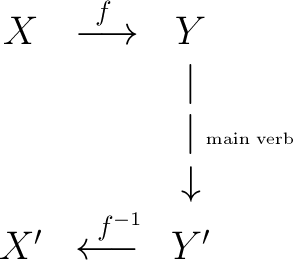
Math Post: Isomorphismes on Transforming a Problem Into Something Easier to Understand

Isomorphismes is one of my favorite Tumblogs. Here is a math post I liked. 

Going the long way: What does it mean when mathematicians talk about a bijection or homomorphism?

Imagine you want to get from X to X′ but you don’t know how. Then you find a “different way of looking at the same thing” using ƒ. (Map the stuff with ƒ to another space Y, then do something else over in image ƒ, then take a journey over there, and then return back with ƒ ⁻¹.)

The fact that a bijection can show you something in a new way that suddenly makes the answer to the question so obvious, is the basis of the jokes on www.theproofistrivial.com.

In a given category the homomorphisms Hom ∋ ƒ preserve all the interesting properties. Linear maps, for example (except when det=0) barely change anything—like if your government suddenly added another zero to the end of all currency denominations, just a rescaling—so they preserve most interesting properties and therefore any linear mapping to another domain could be inverted back so anything you discover over in the new domain (image of ƒ) can be used on the original problem.
All of these fancy-sounding maps are linear:
Fourier transform
Laplace transform
taking the derivative
Box-Müller
They sound fancy because whilst they leave things technically equivalent in an objective sense, the result looks very different to people. So then we get to use intuition or insight that only works in say the spectral domain, and still technically be working on the same original problem.
Pipe the problem somewhere else, look at it from another angle, solve it there, unpipe your answer back to the original viewpoint/space.
“Going the long way” can be easier than trying to solve a problem directly.