Top 10 Quartz Columns and Top 25 All-Time Posts as of February 12, 2013

The top 25 posts on supplysideliberal.com listed below are based on Google Analytics pageviews from June 3, 2012 through February 11, 2013. The number of pageviews is shown by each post. (There were 195,923 pageviews during this period, but, for example, 66,802 homepage views could not be categorized by post.) I have to handle my Quartz columns separately because that pageview data is proprietary. So there I am giving only the order in the Top 10 list immediately below. The list of top posts would be quite misleading without the inclusion of the Quartz columns. You might also find other posts you like in this earlier list of top posts, at this link.

Top 10 Quartz Columns, in Order of Popularity

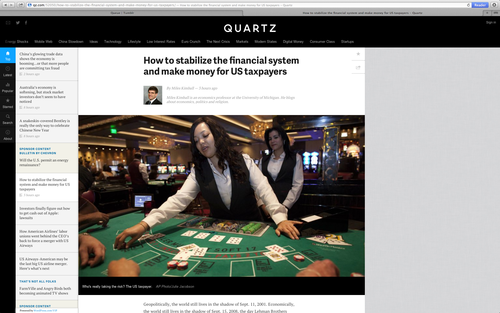
  1. Why the US Needs Its Own Sovereign Wealth Fund
  2. Could the UK be the First Country to Adopt Electronic Money?
  3. Read His Lips: Why Ben Bernanke Had to Set Firm Targets for the Economy
  4. More Muscle than QE3: With an Extra $2000 in their Pockets, Could Americans Restart the U.S. Economy?
  5. How Paper Currency is Holding the US Recovery Back (How Subordinating Paper Money to Electronic Money Can End Recessions and End Inflation)
  6. Emotional Indicator: Obama the Libertarian? Americans Say They’d be Happy if Government Got Out of Their Way (Judging the Nations: Wealth and Happiness Are Not Enough)
  7. Yes, There is an Alternative to Austerity Versus Spending: Reinvigorate America’s Nonprofits
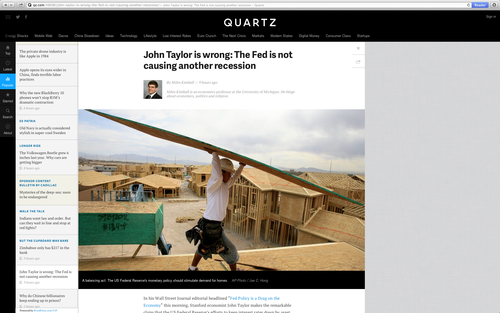
  8. John Taylor is Wrong: The Fed is Not Causing Another Recession
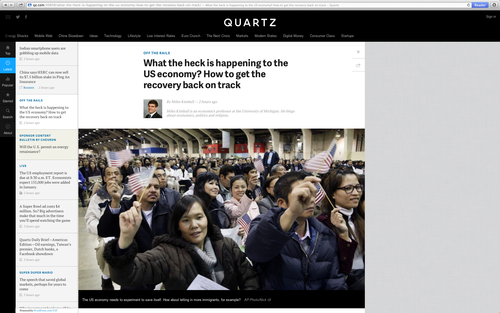
  9. Off the Rails: What the Heck is Happening to the US Economy? How to Get the Recovery Back on Track
  10. Obama Could Really Help the US Economy by Pushing for More Legal Immigration

Top 25 Posts on supplysideliberal.com:

  1.  Dr. Smith and the Asset Bubble 6054
  2.  Contra John Taylor 5266
  3.  Scott Adams’s Finest Hour: How to Tax the Rich 4043
  4.  Balance Sheet Monetary Policy: A Primer 3701
  5.  What is a Supply-Side Liberal? 2771
  6.  The Deep Magic of Money and the Deeper Magic of the Supply Side 2363
  7.  You Didn’t Build That: America Edition 2129
  8.  Trillions and Trillions: Getting Used to Balance Sheet Monetary Policy 2020 
  9.  The Egocentric Illusion 1896
  10. Two Types of Knowledge: Human Capital and Information 1839
  11. Books on Economics 1781
  12. No Tax Increase Without Recompense 1757
  13.  Why I am a Macroeconomist: Increasing Returns and Unemployment 1686
  14. Jobs 1636
  15. The Logarithmic Harmony of Percent Changes and Growth Rates 1623
  16. Getting the Biggest Bang for the Buck in Fiscal Policy 1600
  17. Scrooge and the Ethical Case for Consumption Taxation 1538
  18. Kevin Hassett, Glenn Hubbard, Greg Mankiw and John Taylor Need to Answer This Post of Brad DeLong’s Point by Point 1527
  19. The Shape of Production: Charles Cobb’s and Paul Douglas’s Boon to Economics 1522
  20. Is Taxing Capital OK? 1385
  21. Corporations are People, My Friend 1314
  22. Why Taxes are Bad 1275
  23. Avoiding Fiscal Armageddon 1274
  24. Thoughts on Monetary and Fiscal Policy in the Wake of the Great Recession: supplysideliberal.com’s First Month 1261
  25. Is Monetary Policy Thinking in Thrall to Wallace Neutrality?  1247

For those who want to find this post again, the “Top 25 posts in order of popularity” button at my sidebar will link to it until I make another post like this.

Economists' Learned Helplessness

As economists, it is important for us to pay attention to the unintended side effects of our usual initial working assumption that people are fully optimizing–doing the best they can given the situations they are in. To the extent we treat this not just as an initial working assumption, but as if it were the God’s truth, we are in danger of missing opportunities for helping people make better decisions.

Fortunately, economists don’t routinely assume that those in government are always optimizing. Instead, a routine starting point for policy analysis is to act as if those in government want to improve the general welfare (along with some more self-interested motives), but don’t always know how. In an excellent Project Syndicate essay, “The Tyranny of Political Economy,” Dani Rodrik writes about the learned helplessness that can result if one follows to a logical conclusion the assumption that those in government are already fully optimizing–often in a self-serving way–subject to their constraints. He argues that new ideas and advice can make a difference.  

Dani Rodrik worries that the logic of optimization is leading economists to doubt, on principle, whether policy advice can make any difference. I worry that the logic of optimization is leading economists to doubt, on principle, whether advice to households or firms can make any difference.  If we assume people are already optimizing, where in fact they are not, then we will be blind to opportunities to help. If individuals are optimizing 95% of the way, the approximation that they are optimizing 100% of the way could well be an appropriate simplification in building a larger model, but when focusing attention on that decision, it still leaves a 5% leeway for improvement. That 5% improvement in decision-making could correspond to a large increase in welfare–an especially important opportunity because the increase in welfare from better decision-making would require no coercive action, but only persuasion based on the hearer’s appropriate self-interest.

John Stuart Mill's Argument Against Political Correctness

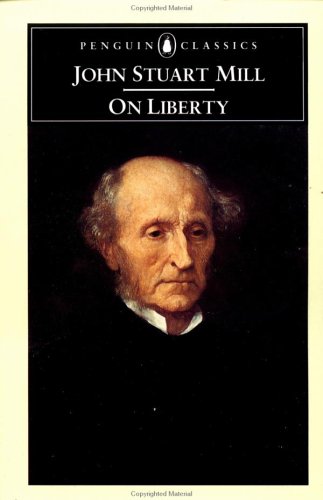
From John Stuart Mill's On Liberty, Chapter 2–“Of the Liberty of Thought and Discussion”

Our merely social intolerance kills no one, roots out no opinions, but induces men to disguise them, or to abstain from any active effort for their diffusion. With us, heretical opinions do not perceptibly gain, or even lose, ground in each decade or generation; they never blaze out far and wide, but continue to smoulder in the narrow circles of thinking and studious persons among whom they originate, without ever lighting up the general affairs of mankind with either a true or a deceptive light. And thus is kept up a state of things very satisfactory to some minds, because, without the unpleasant process of fining or imprisoning anybody, it maintains all prevailing opinions outwardly undisturbed, while it does not absolutely interdict the exercise of reason by dissentients afflicted with the malady of thought. A convenient plan for having peace in the intellectual world, and keeping all things going on therein very much as they do already. But the price paid for this sort of intellectual pacification, is the sacrifice of the entire moral courage of the human mind. A state of things in which a large portion of the most active and inquiring intellects find it advisable to keep the general principles and grounds of their convictions within their own breasts, and attempt, in what they address to the public, to fit as much as they can of their own conclusions to premises which they have internally renounced, cannot send forth the open, fearless characters, and logical, consistent intellects who once adorned the thinking world. The sort of men who can be looked for under it, are either mere conformers to commonplace, or time-servers for truth, whose arguments on all great subjects are meant for their hearers, and are not those which have convinced themselves. Those who avoid this alternative, do so by narrowing their thoughts and interest to things which can be spoken of without venturing within the region of principles, that is, to small practical matters, which would come right of themselves, if but the minds of mankind were strengthened and enlarged, and which will never be made effectually right until then: while that which would strengthen and enlarge men’s minds, free and daring speculation on the highest subjects, is abandoned.

Those in whose eyes this reticence on the part of heretics is no evil, should consider in the first place, that in consequence of it there is never any fair and thorough discussion of heretical opinions; and that such of them as could not stand such a discussion, though they may be prevented from spreading, do not disappear. But it is not the minds of heretics that are deteriorated most, by the ban placed on all inquiry which does not end in the orthodox conclusions. The greatest harm done is to those who are not heretics, and whose whole mental development is cramped, and their reason cowed, by the fear of heresy. Who can compute what the world loses in the multitude of promising intellects combined with timid characters, who dare not follow out any bold, vigorous, independent train of thought, lest it should land them in something which would admit of being considered irreligious or immoral? Among them we may occasionally see some man of deep conscientiousness, and subtle and refined understanding, who spends a life in sophisticating with an intellect which he cannot silence, and exhausts the resources of ingenuity in attempting to reconcile the promptings of his conscience and reason with orthodoxy, which yet he does not, perhaps, to the end succeed in doing. No one can be a great thinker who does not recognise, that as a thinker it is his first duty to follow his intellect to whatever conclusions it may lead. Truth gains more even by the errors of one who, with due study and preparation, thinks for himself, than by the true opinions of those who only hold them because they do not suffer themselves to think. Not that it is solely, or chiefly, to form great thinkers, that freedom of thinking is required. On the contrary, it is as much and even more indispensable, to enable average human beings to attain the mental stature which they are capable of. There have been, and may again be, great individual thinkers, in a general atmosphere of mental slavery. But there never has been, nor ever will be, in that atmosphere, an intellectually active people. When any people has made a temporary approach to such a character, it has been because the dread of heterodox speculation was for a time suspended. Where there is a tacit convention that principles are not to be disputed; where the discussion of the greatest questions which can occupy humanity is considered to be closed, we cannot hope to find that generally high scale of mental activity which has made some periods of history so remarkable. Never when controversy avoided the subjects which are large and important enough to kindle enthusiasm, was the mind of a people stirred up from its foundations, and the impulse given which raised even persons of the most ordinary intellect to something of the dignity of thinking beings.

Three Goals for Ph.D. Courses in Economics

Since I am teaching in the second-year macroeconomic field sequence this year, I have been thinking about the objectives for my teaching. I see three goals for a Ph.D. course:

  1. to teach some of the skills directly necessary to fill out the body of an economics paper, including the computations from data and from simulations (to be laid out in tables or figures), and how to write down the details of proofs.
  2. to give enough of a picture of how the world works to make it possible to begin to judge how important a potential research result might be: for one’s career, for the discipline of economics, and ultimately, in the potential contribution to overall social welfare. (On how the world works, see the recurring refrain in one of my most popular posts ever: “Dr. Smith and the Asset Bubble.”)
  3. to teach analytical tools that–with a few hours or a few days effort–can help one to predict the likely distribution of results one might get from a potential research project that might take months or even years.

a. For straight theory, the development of mathematical intuition is the key for predicting what a project might lead to.

b. For empirical work, key skills for predicting what a project might lead to are

  • understanding identification,
  • understanding the sources and characteristics of measurement errors, 
  • understanding at least rudimentary power analysis in the sense of knowing something about what goes into the standard errors one is likely to get, and
  • understanding that the data are endogenous in two very different senses: (i) data from naturally occurring situations come from a complex web of causal relationships and forces and (ii) economists can cause data to come into existence through surveys, field experiments and lab experiments to help fulfill their research objectives.

c. For computational work, such as a project using a Dynamic Stochastic General Equilibrium model, or a project simulating life-cycle consumption, labor supply and portfolio behavior, some key skills for predicting the likely behavior of a model are

  • understanding general comparative statics and comparative dynamics results;
  • understanding general principles about how models behave, such as key neutrality results that cut across large classes of models and often require intentional modeling devices in order to break (monetary neutrality, Ricardian neutrality, Modigliani-Miller, Wallace neutrality, etc.)
  • knowing how to design a set of graphs to get to the heart of what is going on in a model: graphs that serve the purpose for that advanced model that supply and demand serve for Economics 101 (see for example the graphs in my paper “Q-Theory and Real Business Cycle Analytics”); and
  • knowing how to compute quantitative results for a few simple models by hand in order to get a sense of the likely size of various effects. (You can see an example of what I mean in some of the chapters of my draft textbook “Business Cycle Analytics.”

Of course, in all of these areas, research experience and seeing what other people have done–both in published articles and in work presented in seminars–will also help one predict what a project will lead to. Unfortunately, seeing what other people have done is most helpful in understanding paths that are already well-trodden. But sound criticism of what other people have done is immensely helpful in teaching what to avoid. (Helpful hint: when reading papers, be very suspicious of what is claimed in abstracts. At least half the time, abstracts misrepresent what a paper has really accomplished.) Whether one’s own research experience ultimately leads to unique insight into the likely outcomes of various potential projects depends on the directions one strikes out in during the early days of one’s research career.

Miles on HuffPost Live: The Wrong Debate and How to Change It

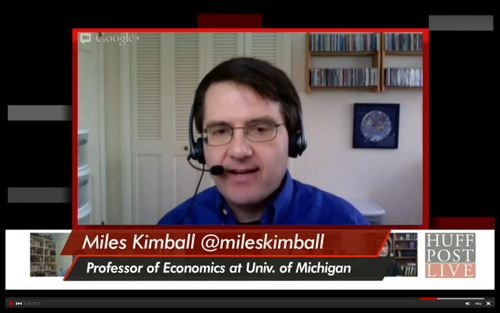
Yesterday I was on HuffPost Live for the first time. I had a chance to make the case for electronic money and for Adam Ozimek’s idea of region-based visas. Here is the link again: “The Wrong Debate." 

There were a couple of things I wanted to make sure to get in, so I wrote a couple of notes beforehand. Here are those two notes:

  • We actually have two problems: the economic slump and the long-run debt problem. We need solutions to each problem that don’t make the other one worse. For that, we need new tools in the economic toolbox. The old tools won’t cut it. In my Quart column "What the heck is happening to the US Economy?” I propose some new tools. Just to tick off the names, to get to full economic recovery without making our debt problem worse, I propose in that column electronic money, Federal Lines of Credit, and US Sovereign Wealth Fund. To Solve our long-run debt problem in a way that achieves both the core Democratic and core Republican goals [and I should have added, does not throw the economy back into recession], I propose a Public Contribution Program. These are new ideas.
  • With two big exceptions, the Federal Reserve has actually steered the economy very well for the last few decades. Greenspan ignored the warnings of my colleague Ned Gramlich about the housing bubble and [the Fed as a whole] kept underestimating the problems [the housing bubble and its collapse] would cause. But that’s water under the bridge. The big problem now is that the Fed is afraid to lower short-term interest rates for fear of causing massive storage of paper currency. The Fed should be going to Congress today to ask for the authority it needs to deter massive storage of paper currency so it can cut short-term rates and bring the economy roaring back.  Because that involves making paper money subordinate to money in bank accounts, and making money in bank accounts “the real thing,” this is called “electronic money” in the blogosphere. But for most of the people, most of the time, it wouldn’t look any different from the way things are now.

Of course, these lines mutated when I was actually on the spot, but I did get a chance to say them in my first two at-bats.

I knew the question about immigration policy (my third bit) was coming, so I didn’t need to mention it in the first instance. And I was confident I could say what I wanted to about that more extemporaneously, since I was just coming off of Immigration Tweet Day.

Immigration Tweet Day, February 4, 2013: Archive

Here are the tweets I was able to storify for Immigration Tweet Day. I tried to storify just the original tweet, rather than all the retweets, but I suspect that in various ways there is some duplication.

Immigration Tweet Day was everything I could hope for. I was especially pleased to see the strong moral dimension to many of the arguments. Like Abraham Lincoln, who was very careful in how he handled the Emancipation Proclamation, I hope we will have a clear moral compass about immigration, working to change hearts and minds, but also be smart about political strategy.

I appreciate the contribution the minority who were against open immigration made to the discussion. It really sharpened the arguments.

A Bare Bones Model of Immigration

Think of a Neoclassical model with inelastic labor supply (including inelastic retirement timing). I am going to focus on the effects that occur in the period of time before capital has had much chance to adjust. To keep the numbers simple, let’s imagine there are 100 million workers in the economy. Production is Cobb-Douglas (see my post “The Shape of Production: Charles Cobb’s and Paul Douglas’s Boon to Economics”), with the following shares:

  • 25% share for capital;
  • 50% share for skilled going to half the population
  • 25% share for unskilled labor going to half the working population.

What are the economic effects of allowing 1 million new workers: enough additional immigration to increase the population by 1%?

Case 1: All of the New Immigration is Unskilled. If all of the new immigration is unskilled, the amount of unskilled labor increases by 2% (from 50 million to 51 million). This increases output by .25 * 2% = .5 %. Unskilled labor gets ¼ of this bigger pie. With a .5% bigger pie and 2% more people to share it among, unskilled workers get a 1.5% reduction in their wage.  The skilled workers get the same share of a bigger pie, with no dilution, so they each get a .5 % increase in their wage. Capital also gets .5% more. This helps people in saving for retirement.

Case 2: All of the New Immigration is Skilled. Now the pie is .5 * 2% = 1% bigger (from 50 million to 51 million). With a 1% bigger pie and 2% more people to share it among, each skilled worker now gets 1% less. Unskilled workers get the same share of a bigger pie, with no dilution, so they each get a 1% increase in their wage. Capital also gets 1% more, which helps people in saving for retirement.

Case 3: 60% of the New Immigration is Skilled, 40% Unskilled. In this case, the amount of skilled labor increases by 1.2% (from 50,000,000 to 50,600,000), while the amount of unskilled labor increases by .8% (from 50,000,000 to 50,400,000). This increases output by (.5 * 1.2%) + (.25 * .8%) = .6% + .2% = .8%. Capital gets .8% more, which helps people in saving for retirement. Since there are .8% more unskilled workers to divide their share of the pie among, the unskilled wage is unaffected. The effect on the skilled wage is .8% - 1.2% = -.4% in this simple model.

Everything left out of this bare bones model suggests that in a richer model, output will ultimately grow more. If the skilled workers are willing to bet that the combination of higher returns to capital and the effects of capital accumulation, extra technological progress, the benefits of increasing returns to scale and diversity, and the share of the national debt and of unfunded government liabilities that immigrants will shoulder would make up for the -.4% reduction in wages they see in the bare bones model, the unskilled workers have no reason to object (except perhaps for cultural reasons), since even in the bare bones model, their wage is unaffected, and all other factors then push in the direction of doing better economically.

I suspect that something like the bare bones model of immigration lurks in the back of many brains, and is encoded as saying that immigration is good for capitalists, but not for workers. Therefore, to successfully argue their case, advocates of immigration must confront this bare bones model head on, explain what is missing, and convincingly argue what the quantitative effects of those missing pieces are.

Proclamation of Immigration Tweet Day: Monday, February 4, 2013

Tweets here and below: 

  • .@ModeledBehavior @Noahpinion and I hereby declare#ImmigrationTweetDay this Monday, February 4, 2013. Details in the next few tweets.
  • On #ImmigrationTweetDay this Monday, all bloggers with posts on immigration policy are invited to tweet links to all their immigration posts
  • Freedom of thought is a watchword of #ImmigrationTweetDay so all are encouraged to participate regardless of their views on immigration.
  • On #ImmigrationTweetDay this Monday, everyone is encouraged to tweet links to posts on immigration not yet tweeted by their authors.
  • On #ImmigrationTweetDay everyone is encouraged to make the best arguments for herhis position on immigration possible in 140 characters.
  • On #ImmigrationTweetDay everyone participating is asked to make an effort to retweet all genuinely relevant tweets they see.
  • I plan to storify the #ImmigrationTweetDay tweets, and link to that collection of tweets on my blog soon after#ImmigrationTweetDay is done.
  • Between now and Monday, please spread the word about#ImmigrationTweetDay
  • Look for #ImmigrationTweetDay this Monday, February 4, 2013

Off the Rails: How to Get the Recovery Back on Track

Here is a link to my 14th column on Quartz: “Off the Rails: What the heck is happening to the US economy? How to get the recovery back on track." 

This column gives a better overall picture of my economic policy stance than any other single post so far. From the conclusion:


Franklin Roosevelt famously said:

The country needs and, unless I mistake its temper, the country demands bold, persistent experimentation. It is common sense to take a method and try it: If it fails, admit it frankly and try another. But above all, try something.

We at such a moment again. The usual remedies have failed. It is time to try something new. Any one of these proposals could make a major difference. In combination, they would transform the world.

Reaching for Yield: The Effects of Interest Rates on Risk-Taking

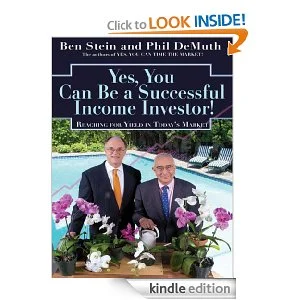
Evidence that the publisher Hay House thought that in 2006 people would be interested in “reaching for yield.” (No recommendation intended.) 

Many readers have misunderstood the following passage in my recent post “Contra John Taylor” about the effects of interest rates on risk-taking. I was responding to John Taylor’s following argument:

The Fed’s current zero interest-rate policy also creates incentives for otherwise risk-averse investors—retirees, pension funds—to take on questionable investments as they search for higher yields in an attempt to bolster their minuscule interest income.

What I wrote in response was this:

I can’t make sense of this statement without interpreting it as a behavioral economics statement about some combination of investor ignorance and irrationality and fraudulent schemes that prey on that ignorance and irrationality. The often-repeated claim that low interest rates lead to speculation cries out for formal modeling. I don’t see how such a model can work without some combination of investor ignorance and irrationality and fraudulent schemes preying on that ignorance and irrationality.

What I did not say clearly enough is that I have no problem believing that, indeed, investor ignorance and irrationality and schemes that prey on that ignorance and irrationality do indeed cause people to take on more risk as a result of low interest rates than they otherwise would. This is a genuine cost to the Fed stimulating the economy with low interest rates. But– especially once we figure out the details–it has much bigger implications for financial regulation than for monetary policy. I wanted to object to  John Taylor’s using “reaching for yield” to criticize current monetary policy without discussing the implications “reaching for yield” has for financial regulation. Regulation has serious costs, but so does tight monetary policy in the current environment. So either we need to live with the costs of “reaching for yield” or we need to consider the costs and benefits of various remedies. Let me add more investor education to the list of potential remedies. So as alternatives to living with the costs of “reaching for yield” we need to consider  

  • tighter monetary policy;
  • appropriate financial regulation;
  • more investor education.

To me, it seems clear that tighter monetary policy is the worst of these three options–not only because that would have a high change of causing another recession, but also because the effectiveness of tighter monetary policy in helping investors make better decisions is likely to be quite small. I would love to go with the third option of more investor education, but the costs of that option will only be manageable if effective educational interventions short of having everyone get a degree in finance can be found. That is not easy. (I am making no claim that a degree in finance would do the trick as an educational intervention, only that we would need something that is effective and costs less than having all investors get a degree in finance.)

I am serious in thinking it is important to develop formal models of “reaching for yield.” Let me give that explicitly as advice to Ph.D. students looking for dissertation topics. Here is tgmoe

A while back I replied to a blog on dissertation topics suggesting I was interested in topics in finance, but I never got around to providing detail. I will do so now. I am interested in the mutual fund industry and how individual households make investment decisions. The evolution of planned sponsors and other institutional investors in this environment is also intriguing and has significantly altered the manner in which households invest. Any thoughts would be greatly appreciated. Thanks, Todd

Answer: To me, modeling “reaching for yield” and testing your model and other models against data on individual investor decisions seems like a great topic for your research. I just storified a Twitter conversation that might be helpful. Here is the link:

Reaching for Yield.

In addition, let me suggest the following idea. Suppose someone wants to commit financial fraud–think Bernie Madoff. In a way that might itself be irrational, in the real world, low interest rates seem to be associated with investors expecting a low percentage of the value of an investment being paid back each year. If expectations for the percentage of the value of an investment that is paid back each year are low, it is much easier to hide financial fraud. By contrast, if after a few years start-up period, if people expect substantial dividends or other payments paid out, then it is harder to hide financial fraud. Another to put it is that in a Ponzi scheme, the rate at which one must find additional investors to defraud is lower when people don’t expect fast payback. In some models, the rate of expected payback is the real interest rate, but it is possible that in the world, it is  closer to the nominal interest rate. In any case, the details of the path over time at which investors expect to be paid back matters a lot for how long a fraudulent scheme can last. And the level of interest rates is likely to affect the payback path required by investors. 

A couple of final thoughts.  

  1. If “reaching for yield” when interest rates are low is a strong enough phenomenon, it should show up as a reduction in risk premia. But even if lower interest rates raised risk premia, it is quite possible that many individual investors could be taking on more risk as a result of low interest rates. In other words, the response of investors to low interest rates could vary a lot, and it is worth worrying about a maladaptive response to low interest rates by any substantial subgroup of investors, even if other investors react appropriately. 
  2. It is a much bigger step to say they are taking on too much risk, than just to say that they are taking on more risk as a result of low interest rates.

Update: Karl Smith just wrote a very interesting post asking the question, as I did in some of my tweets in Reaching for Yield:

By ‘Reaching for Yield,’ Do You Mean 'Demand Curves Slope Downwards’?

This is an important challenge to those arguing that low interest rates cause people to make mistakes in their decisions about which assets to invest in. Much of the evidence people point to when they talk about "reaching for yield” could be about perfectly rational responses to an increase in the risk premium. This rational response needs to be carefully distinguished from any claim that people are doing too much reaching for yield when interest rates fall–my point 2 just above. I may be more sympathetic than Karl to the idea that at least some people respond in maladaptive ways to low interest rates–enough to worry about. But the evidence is too thin to know how much of an issue this is once the rational response to higher risk premia is separated out.  

Let me explain a bit better what a fall in the safe interest rate does. Suppose there is some benchmark level of risk for which the expected average rate of return is unaffected. Then a reduction in the safe interest rate

  1. increases the reward to bearing risk, since the expected average rate of return of the benchmark level of risk is now further above the (now lowered) safe interest rate, and
  2. for anyone who chooses a level of risk below the benchmark level of risk, the expected average rate of return for their assets will be lower than before.  

The second consequence should be no surprise: in general, reductions in interest rates are a relief for borrowers but painful for savers. The pain for savers of lower interest rates is a topic for other posts. The issue for this  post is only if that pain drives some savers to make serious mistakes in their asset choices.

John Taylor is Wrong: The Fed is Not Causing Another Recession

Here is a link to my 13th column on Quartz: “John Taylor is wrong: The Fed is not causing another recession.” It is the two-paragraph précis of yesterday’s post “Contra John Taylor.”

Twitter provided some reviews of these two pieces that I liked. Here are a few:

Contra John Taylor

Having tweeted that John Taylor’s op-ed this morning, “Fed Policy is a Drag on the Economy” was “extraordinarily bad analysis,” I need to back up my view. Let me go point by point. Not all of John’s points are equally problematic.

1. Uncertainty about the effects of unwinding the Fed’s large asset positions in long-term government bonds and in mortgage-backed assets. John writes:

At the very least, the policy creates a great deal of uncertainty. People recognize that the Fed will eventually have to reverse course. When the economy begins to heat up, the Fed will have to sell the assets it has been purchasing to prevent inflation.

If its asset sales are too slow, the bank reserves used to finance the original asset purchases pour out of the banks and into the economy. But if the asset sales are too fast or abrupt, they will drive bond prices down and interest rates up too much, causing a recession. Those who say that there is no problem with the Fed’s interest rate and asset purchases because inflation has not increased so far ignore such downsides.

Unless the Fed is at the zero lower bound, its key tool is the federal funds rate that banks charge each other overnight. When it is time to raise rates above zero, the Fed can use movements in the federal funds rate–which have effects it understands from long experience. Although there is some uncertainty surrounding the exact size of the effects as the Fed unwinds its positions in long-term government bonds and mortgage-backed securities, the Fed is quickly gaining experience in that regard. More importantly, the overwhelming fact is that, when the short-term federal funds rate is held fixed the effects of balance sheet monetary policy on aggregate demand are small relative to the size of the positions involved, as I discussed in my post “Trillions and Trillions: Getting Used to Balance Sheet Monetary Policy.”

More polemically, it is worth pointing out that it is implausible for critics of Fed policy to say that (holding short-term rates fixed) changes in the holdings of long-term government bonds and mortgage-backed securities have no power to stimulate aggregate demand when the economy is in a slump, but going in the other direction, could have a dangerously powerful negative effect on aggregate demand once the economy is on the mend and asset positions are pulled back. The truth is that these effects were always likely to be modest in both directions, relative to the sizes of the assets purchases or sales involved. The power of balance sheet monetary policy is that these modest effects can be multiplied by huge movements in asset positions when necessary. But the very need to use huge movements in asset positions to get substantial effects should be reassuring when we contemplate unwinding those positions.

2. Low interest rates as fuel for speculation. Here, he says

The Fed’s current zero interest-rate policy also creates incentives for otherwise risk-averse investors—retirees, pension funds—to take on questionable investments as they search for higher yields in an attempt to bolster their minuscule interest income.

I can’t make sense of this statement without interpreting it as a behavioral economics statement about some combination of investor ignorance and irrationality and fraudulent schemes that prey on that ignorance and irrationality. The often-repeated claim that low interest rates lead to speculation cries out for formal modeling. I don’t see how such a model can work without some combination of investor ignorance and irrationality and fraudulent schemes preying on that ignorance and irrationality. (That is, I don’t see how the claim could hold in a model with rational agents and no fraud.) Whatever combination of investor ignorance and irrationality and fraudulent schemes preying on that ignorance an irrationality a successful model uses are likely to have much more powerful implications for financial regulation than for monetary policy. It is cherry-picking to point to implications of a not-fully-specified model for monetary policy and ignore the implications of that not-fully-specified model for financial regulation.

3. Low rates and zombie loans.

The low rates also make it possible for banks to roll over rather than write off bad loans, locking up unproductive assets. 

This is one of John’s best and most interesting points. It is a quirk of traditional loan contracts that the repayment rates expected by lenders are sometimes slower when nominal interest rates are low. This is a place where the free market should do its magic, with lenders making sure that the rates at which they are supposed to be repaid are adequate to help them identify badly-performing loans early on. The free market will get better at this the more experience businesses have with low nominal interest rate environments.

4. Political economy effects of low interest rates.

And extraordinarily low rates support and feed the spending appetites of Congress and the president, increasing deficits and debt.

As I wrote in “What to Do When the World Desperately Wants to Lend Us Money,” there are many ways that it is completely appropriate for the government to take low (real) interest rates into account in spending decisions. But that doesn’t mean we shouldn’t be worried about the long-run balance between taxing and spending. Bill Clinton explained the balance of short-run and long-run issues well when he said

Now, let’s talk about the debt. Today, interest rates are low, lower than the rate of inflation. People are practically paying us to borrow money, to hold their money for them.

But it will become a big problem when the economy grows and interest rates start to rise. We’ve got to deal with this big long-term debt problem or it will deal with us. It will gobble up a bigger and bigger percentage of the federal budget we’d rather spend on education and health care and science and technology. It — we’ve got to deal with it.

I actually think this point is well understood by policy makers, but I wish all of their constituents understood it better. In any case, tight monetary policy to make voters worry more about the national debt seems a strange alternative to educating the voters about the debt problem.

5. Issues of institutional design and what the scope of the Fed’s responsibilities should be.  

More broadly, the Fed’s excursion into fiscal policy and credit allocation raises questions about its institutional independence and accountability. This reduces public confidence in the central bank.

I agree with this statement. It is clear that there are important issues of institutional design for dealing with financial crises in order to preserve the public’s trust in institutions after the handling a financial crisis. I also interpret John’s statement as referring to ongoing balance sheet monetary policy, rather than just the emergency stabilization of the financial system-There I agree with this statement as well, as can be seen in my Quartz column “Why the US needs its own sovereign wealth fund.” In the absence of electronic money (on electronic money, see my post “Paper Currency Policy: A Primer”), purchases of a wide range of assets is crucial once short-term rates hit zero, but there is no reason the purchase of long-term or risky assets needs to be done by the Fed. Confidence in the Fed would be greater if unavoidably controversial assets were taken over by another agency–the US Sovereign Wealth Fund that I propose. As long as asset purchases by the US Sovereign Wealth Fund are sufficiently large, careful calibration of monetary policy can be left to the Fed, which would retain plenty of tools to avoid over-stimulation of the economy. This division of labor would allow the US Sovereign Wealth Fund to serve as a political lightning rod for the Fed, which in turn would help preserve the independence of monetary policy. 

6. Effects of US monetary policy on the monetary policy of other countries.

There is yet another downside. Foreign central banks—whether they like it or not—tend to follow other central banks’ easy-money policies to prevent their currency from appreciating sharply, which would put their exporters at a disadvantage. The recent effort of the new Japanese government to force quantitative easing on the Bank of Japan and thus resist dollar depreciation against the yen vividly makes this point. This global increase in money risks commodity booms and busts as we saw in 2011 and 2012.

Here is my perspective on this:

  • There is a global slump.
  • This calls for stimulative monetary policy globally.
  • Therefore, it is good that expansionary US monetary policy helps to inspire expansionary monetary policy by other countries. 

The effect of monetary stimulus on commodity prices is a very interesting phenomenon that deserves a better treatment at some later date, but is not a reason to avoid monetary stimulus when monetary stimulus is called for. 

7. Forward guidance as a price ceiling causing disequilibrium??? Finally, let’s turn to John’s most remarkable claim–the one that inspired my statement that his op-ed had “extraordinarily bad analysis.” John writes:

…a basic microeconomic analysis shows that the policies perversely decrease aggregate demand and increase unemployment while they repress the classic signaling and incentive effects of the price system.

Consider the “forward guidance” policy of saying that the short-term rate will be near zero for several years into the future. The purpose of this guidance is to keep longer-term interest rates down and thus encourage more borrowing. A lower future short-term interest rate reduces long-term rates today because portfolio managers can, in a form of arbitrage, easily adjust their portfolio mix between long-term bonds and a sequence of short-term bonds.

So if investors are told by the Fed that the short-term rate is going to be close to zero in the future, then they will bid down the yield on the long-term bond. The forward guidance keeps the long-term rate low and tends to prevent it from rising. Effectively the Fed is imposing an interest-rate ceiling on the longer-term market by saying it will keep the short rate unusually low.

The perverse effect comes when this ceiling is below what would be the equilibrium between borrowers and lenders who normally participate in that market. While borrowers might like a near-zero rate, there is little incentive for lenders to extend credit at that rate.

This is much like the effect of a price ceiling in a rental market where landlords reduce the supply of rental housing. Here lenders supply less credit at the lower rate. The decline in credit availability reduces aggregate demand, which tends to increase unemployment, a classic unintended consequence of the policy.

Research presented at the annual meeting of the American Economic Association this month by Eric Swanson and John Williams of the San Francisco Fed is consistent with this view of credit markets. It shows that during periods of forward guidance, the long-term interest rate does not adjust to events that shift supply or demand as it does in normal periods. In addition, while credit to corporate businesses is up 12% over the past two years, credit has declined to noncorporate businesses where the low rate is more likely to be a disincentive for lenders. Peter Fisher, head of fixed income at the global investment-management firm BlackRock and a former Fed and Treasury official, wrote in September: “[A]s they approach zero, lower rates … run the significant risk of perversely discouraging the lending and investment we need.”

This is just wrong. To the extent that forward guidance has bite, the Fed is promising to shift the demand curve for assets in the future and thereby get to a particular equilibrium interest rate. This is not at all like rent control. The right analogy is, say, New York City getting rents to come down by reducing making it easier to get a building permit, or by subsidizing the building of new apartments. The Fed is pushing asset prices up and interest rates down by a combination of  buying assets now and promising to buy them in the future. There is a world of difference between a market intervention in which the government contributes to supply and demand and a price floor or ceiling. By buying assets, and promising to buy them in the future, the Fed is lowering an equilibrium interest rate. The details of the pattern of buying assets and promising to buy them in the future tends to keep the equilibrium interest rate at a certain level.

The fact that the Fed acts by changing the equilibrium interest rate matters, because John’s claim that lowering the interest rate will reduce the quantity of investment would hold only if what the Fed is doing really did act like an interest rate ceiling that makes asset demand lower than asset supply. But what the Fed is doing is adding to asset demand; the equilibrium between the quantity supplied and the quantity demanded continues to hold.  To translate into the effect on loans for construction, the purchase of equipment and consumer durables, or to fund startups, strong asset demand contributes to the supply of loans, both because banks issue assets to raise money for loans and because loans can  be packaged into assets. Anyone issuing and selling assets to raise funds can sell them much more easily when demand for assets is strong. Currently, the Fed is contributing in important ways to the demand for assets now and the expected demand for assets in the future. This makes loans easier and stimulates investment in buildings, equipment, etc.  

The bottom line is that it leads to very bad policy analysis if Fed asset purchases and promises of future asset purchases are mischaracterized as the kind of interest rate ceiling that leads to disequilibrium. Interest rate ceilings come in two types:

  • interest rate ceilings that cause the supply of assets on the seller side (representing borrowing) to exceed the demand for assets on the buyer side (representing lending);
  • interest rate “ceilings” that come from a commitment to buy as many assets as it takes to keep the equilibrium interest rate down at a certain level.   

John Taylor confuses these two types of interest rate ceilings.


Update: Also see "Contra Randal Quarles." 

Getting Leeway on the Lower Bound for Interest Rates by Giving the Central Bank Standby Authority over Paper Currency Policy

I have been thinking about Frances Coppola’s blog post “The Problem of Cash,” and her contention, late in the collection of storified tweets “Twitter Round Table on Our Disastrous Policy of Pegging Paper Currency at Par,” or more directly, here, that taxing currency in bank vaults as well as bank reserves on deposit at the central bank might be enough to allow seriously negative nominal interest rates, even if the value of paper currency is kept at par with electronic money. Let me discuss that possibility in this post. (Before going on, I recommend reading my brief post “Paper Currency Policy: A Primer” if you haven’t already.)

Since currency is a government issued asset, except for the name (and of course names do matter) a tax on vault cash is equivalent to a government-imposed negative interest rate on vault cash. So we are talking about imposing a negative interest rate on all high-powered money within the banking system. Moreover, there should be no problem declaring that any business that stores currency for customers commercially is included in this tax (=negative interest rate) on stored currency. (One might even go so far as to require those providing safety deposit boxes that would be natural for currency storage to inspect for currency among the items for deposit and count and report and pay tax on that currency, just as if it were vault cash.) Given that policy, the only way to get a zero interest rate from currency would be to store it somewhere outside the official banking sector, hidden at home or in the backyard, in illegal cash-storage businesses (that should be paying the tax on vault cash but are not), or in businesses for general storage that escape the tax.

Large-scale cash storage at home, in illegal cash-storage businesses, or in general-storage businesses would be a change from the way people do things now. All of these would face security issues (and for the later two, trust issues) that would need to be resolved. Therefore, it might be possible to dissuade people from paying the fixed costs of resolving those issues if they knew the central bank would be able to reduce the value of that currency outside the banking system if need be.

In other words, suppose the central bank had standby authority to let paper money depreciate relative to electronic money if it saw a pattern of substantial withdrawals of currency from the banking system at the macroeconomic level. It is possible that might be enough to prevent currency from being the go-to safe asset to such an extent as to prevent the fed funds rate and Treasury bill rate (or their equivalents in other countries) from getting down to, say -3%.

Because there is some adjustment cost to people’s usual habits in breaking par in paper currency policy and letting paper currency depreciate relative to electronic money, it makes sense to hold off doing so until it is clear that it is necessary. Just knowing it had the standby authority to break par in paper currency policy if massive cash withdrawals indicated it was necessary would be enough to give the central bank confidence to lower the fed funds rate or its equivalent below zero. Though the dangers at issue are different in the two cases (massive currency storage that creates a lower bound on interest rates in one case, inflation in the other) this is not entirely dissimilar to the way in which knowing it has the authority to raise interest on excess reserves if the economy looks as if it is danger of overheating at some time in the future makes the Fed willing to pursue balance sheet monetary policy (QE) more aggressively now. And promising not to break par in the paper currency policy unless necessary makes it more likely that the central bank would be granted authority over paper currency policy in the first place.

(Note that the enabling legislation for the standby authority over paper currency policy should also declare electronic money legal tender and do whatever else is needed to encourage people to use it as the unit of account later on in the event that par is broken. Also, in the period when the central bank is trying to avoid breaking par, movement of paper currency out of the country or out of the zone in which commercially stored currency can be taxed must be restricted.)

John Stuart Mill on Freedom of Thought

In “Utilitarianism, a Sovereign Wealth Fund, and I,” I wrote: “Philosophically, I am much closer to being a Utilitarian than a Libertarian.” But I also argued that a Utilitarian should prize freedom. That is not a new line of argument. John Stuart Mill, one of the leading lights of Utilitarianism, made the case for freedom in his essay On Liberty. As I suspect is true for many economists, “The Great Books” were not the centerpiece of my formal education. So it is with a fresh eye that I read what John Stuart Mill has to say about freedom. Let me boil things down. These three passages give a key thread in his argument for freedom of thought:

But the peculiar evil of silencing the expression of an opinion is, that it is robbing the human race; posterity as well as the existing generation; those who dissent from the opinion, still more than those who hold it. If the opinion is right, they are deprived of the opportunity of exchanging error for truth: if wrong, they lose, what is almost as great a benefit, the clearer perception and livelier impression of truth, produced by its collision with error.

The objection likely to be made to this argument, would probably take some such form as the following. There is no greater assumption of infallibility in forbidding the propagation of error, than in any other thing which is done by public authority on its own judgment and responsibility. Judgment is given to men that they may use it…. Men, and governments, must act to the best of their ability. There is no such thing as absolute certainty, but there is assurance sufficient for the purposes of human life. We may, and must, assume our opinion to be true for the guidance of our own conduct: and it is assuming no more when we forbid bad men to pervert society by the propagation of opinions which we regard as false and pernicious. 

I answer, that it is assuming very much more. There is the greatest difference between presuming an opinion to be true, because, with every opportunity for contesting it, it has not been refuted, and assuming its truth for the purpose of not permitting its refutation. Complete liberty of contradicting and disproving our opinion, is the very condition which justifies us in assuming its truth for purposes of action; and on no other terms can a being with human faculties have any rational assurance of being right.

When we consider either the history of opinion, or the ordinary conduct of human life, to what is it to be ascribed that the one and the other are no worse than they are? Not certainly to the inherent force of the human understanding; for, on any matter not self-evident, there are ninety-nine persons totally incapable of judging of it, for one who is capable; and the capacity of the hundredth person is only comparative; for the majority of the eminent men of every past generation held many opinions now known to be erroneous, and did or approved numerous things which no one will now justify. Why is it, then, that there is on the whole a preponderance among mankind of rational opinions and rational conduct? If there really is this preponderance—which there must be unless human affairs are, and have always been, in an almost desperate state—it is owing to a quality of the human mind, the source of everything respectable in man either as an intellectual or as a moral being, namely, that his errors are corrigible. He is capable of rectifying his mistakes, by discussion and experience. Not by experience alone. There must be discussion, to show how experience is to be interpreted. Wrong opinions and practices gradually yield to fact and argument: but facts and arguments, to produce any effect on the mind, must be brought before it. Very few facts are able to tell their own story, without comments to bring out their meaning. The whole strength and value, then, of human judgment, depending on the one property, that it can be set right when it is wrong, reliance can be placed on it only when the means of setting it right are kept constantly at hand. In the case of any person whose judgment is really deserving of confidence, how has it become so? Because he has kept his mind open to criticism of his opinions and conduct. Because it has been his practice to listen to all that could be said against him; to profit by as much of it as was just, and expound to himself, and upon occasion to others, the fallacy of what was fallacious. Because he has felt, that the only way in which a human being can make some approach to knowing the whole of a subject, is by hearing what can be said about it by persons of every variety of opinion, and studying all modes in which it can be looked at by every character of mind. No wise man ever acquired his wisdom in any mode but this; nor is it in the nature of human intellect to become wise in any other manner. The steady habit of correcting and completing his own opinion by collating it with those of others, so far from causing doubt and hesitation in carrying it into practice, is the only stable foundation for a just reliance on it: for, being cognisant of all that can, at least obviously, be said against him, and having taken up his position against all gainsayers—knowing that he has sought for objections and difficulties, instead of avoiding them, and has shut out no light which can be thrown upon the subject from any quarter—he has a right to think his judgment better than that of any person, or any multitude, who have not gone through a similar process.

Like other tyrannies, the tyranny of the majority was at first, and is still vulgarly, held in dread, chiefly as operating through the acts of the public authorities. But reflecting persons perceived that when society is itself the tyrant—society collectively, over the separate individuals who compose it—its means of tyrannizing are not restricted to the acts which it may do by the hands of its political functionaries. Society can and does execute its own mandates: and if it issues wrong mandates instead of right, or any mandates at all in things with which it ought not to meddle, it practises a social tyranny more formidable than many kinds of political oppression, since, though not usually upheld by such extreme penalties, it leaves fewer means of escape, penetrating much more deeply into the details of life, and enslaving the soul itself. Protection, therefore, against the tyranny of the magistrate is not enough: there needs protection also against the tyranny of the prevailing opinion and feeling; against the tendency of society to impose, by other means than civil penalties, its own ideas and practices as rules of conduct on those who dissent from them; to fetter the development, and, if possible, prevent the formation, of any individuality not in harmony with its ways, and compel all characters to fashion themselves upon the model of its own.

The Marginalization of Economists at the Consumer Financial Protection Bureau

I want to make sure that I get the story straight. I would be glad to hear any information you have on this.

Update, August 6, 2014: When I was in Washington D.C. this past May, I had a chance to talk at length with Chris Carroll, who is the new Chief Economist at the Consumer Financial Protection Bureau. I am now much more optimistic that the Consumer Financial Protection Bureau will manage to strike a good balance between economists and lawyers.

How a US Sovereign Wealth Fund Can Alleviate a Scarcity of Safe Assets

In a number of recent posts, I have defended the idea of a US Sovereign Wealth Fund:

In this post, I wanted to give a different angle on a benefit of a US Sovereign Wealth Fund. A number of economists have stressed the importance of having a robust supply of assets that can easily serve as collateral. In addition to discussing electronic money in “Overcoming the Zero Bound on Interest Rate Policy,” Marvin Goodfriend has a good discussion of balance sheet monetary policy, in which he discusses the concept of “broad liquidity services”:

I define liquidity broadly as a service yield provided by assets according to how easily they can be turned into cash, either by sale or by serving as collateral for external financing. Liquidity services defined broadly are valued because they can be used to minimize one’s exposure to the external finance premium in the sense of Bernanke and Gertler (1995).

Assets considered safe are particularly valuable in this regard, so much so that Yichuan Wang argues that Federal Reserve purchases of long-term treasury bonds has not been ideal:

These purchases of treasuries have been problematic for the shadow banking sector, notably the oft maligned money market funds, as the purchases have drained the financial system of safe collateral

In his January 16, 2013 post “Safe Assets and Government Debt,” Simon Wren-Lewis makes the point especially well:

The financial system, partly as a result of the entry of emerging markets, has a large and increasing desire for safe assets. This led, before the recession, to low real interest rates (supply and demand: if the demand for an asset rises faster than its supply, the return from it will fall): this was the topic of Bernanke’s savings glut story. (In terms of monetary policy, it influences what theory calls the natural interest rate, which is the medium term reference point for policy.) In an effort to satisfy this growing demand, the private sector attempted to create its own safe assets through securitisation and the like. This failed spectacularly, and we got a financial crisis. Only governments with their own central bank can create really safe assets. So we need more, not less, government debt.

… is the distinction between net and gross debt important here? Suppose a government did reduce its long term need to raise taxes by reducing its net debt position, but did this by buying assets rather than reducing its gross debt. Obviously by holding private sector assets it increases its exposure to macro shocks, but it retains its ability to cover those through either taxation or money finance, so its gross debt may remain safe.

If the government issues more safe assets, (based on its relatively large capacity to bear risks) it must do something with the proceed. The basic options are 

  1. government spending
  2. buying other safe assets
  3. buying risky assets

The size of our net national debt argues against adding any more to government spending than we absolutely have to. Buying other safe assets does not increase the total supply of safe assets available to the private sector at all, but only changes the type of safe assets available. In my view, the standard way for the government to increase the overall supply of safe assets available to the private sector is for the government to buy risky assets. Hence, my proposal for a US Sovereign Wealth Fund.

Side note: I have had some correspondence suggesting that a US Sovereign Wealth Fund would be unavoidably corrupt. I would be very interested in learning more how well Norway’s sovereign wealth fund has done in that regard, but that proposition does not seem right to me;  I have not heard of big scandals involving portfolio managers of large endowments such as the endowments for Harvard or Yale or the University of Michigan, which seem good analogues for many aspects of a US Sovereign Wealth Fund. I am much more worried about congress meddling in the details of what the US Sovereign Wealth Fund does, which is why I think independence comparable to the Fed’s is crucial.