My Mother

Evelyn Bee Kimball, April 25, 1929–September 27, 2012

Evelyn Bee Kimball, April 25, 1929–September 27, 2012

Until this past week, I had a feeling deep in my bones that my Mother, because she was my Mother, would never die.  I was wrong, and it hurts. It leaves a hole in my life and in all of our lives to have her gone.

My Mother was an unstoppable cheerleader for me.  She always expected me to succeed and took seriously my most optimistic career hopes. When I was not good at something—as in my early days of driving and teaching–she was one of the few who thought I was good at it anyway.

By precept and example, Mother gave me two elements of toughness. The first was an ability to go back and forth at will between viewing the world in a very sentimental way and viewing the world in a very unsentimental way. She loved dolls and toys and hugs. We all saw her sentimental side in her interactions with her grandchildren and great grandchildren and in her closeness with her sisters. But she could also switch into talking like a hardbitten detective about people’s motives and strengths and weaknesses. That hardbitten detective’s perspective comes in handy in my work as an economist.

The second element of toughness my Mother bequeathed to me was stubbornness—the stubbornness not to give up when I know what I want, for either myself or for the world. When my Mother had her sights on something and wanted things a certain way, she would do a lot to get it to happen. I have an Eagle Scout badge somewhere to prove it.  The world is not always very cooperative, so stubbornness like my Mother’s is often necessary to get things to happen. People are quick to say that something is too hard to do, or even that it can’t be done, when all it takes is hard work and the kind of stubbornness my Mother gave me.

I think my Mother gave all of her children something else very important.  It was extremely hard on her when her parents divorced.  So hard on her, that she never talked about it when we were growing up and I didn’t learn about it until my late teens.  But what I did get was the picture that marriage is a permanent commitment—something that made a difference from the very first day of my own marriage. I know enough about the statistics of divorce to know that it is unusual to have seven married children, with well over a hundred years of marriage between them, and no divorces. Mother and Dad deserve a lot of credit for that.

My Mother always seemed to me like a force of nature. I didn’t expect her to be like an ordinary human being.  She was in a class of her own.  And in the end, that is why it is so sad that she is gone. Someone unique and irreplaceable is gone from the face of the earth.

My First Column on the Atlantic's New Website "Quartz": "More Muscle than QE3: With an Extra $2000 in their Pockets, Could Americans Restart the U.S. Economy?"

Screen shot of the illustration for my column “More Muscle than QE3: With an Extra $2000 in their pockets, could Americans restart the U.S. economy?” on the Quartz website.

I am one of the columnists on the Atlantic’s new world business website Quartz (qz.com). I expect to have columns appear there approximately weekly, plus some quick reactions to breaking economic events.

At Quartz, I am working with Mitra Kalita and Lauren Brown.

Holman Jenkins on the Role of Organized Labor in Blocking Policy Initiatives in the Democratic Party

Mancur Olson, an economist who studied The Rise and Decline of Nations

Last Saturday, Holman Jenkins had a very interesting op/ed in the Wall Street Journal: “Hey Mitt, Voters Aren’t the Obstacle.” What is the obstacle in Holman’s view? The political influence of organized labor.  The theory Holman bases his analysis on is from the brilliant economist Mancur Olson, who focused on the forces that change institutions over time. Holman:

Mancur Olson, the late and admired social thinker, described the lobbying incentives created by policies that concentrate benefits on the few and disperse the costs to the many. Recipients of federal entitlements aren’t highly motivated to oppose the kind of long-term reforms actually required by our fiscal dilemma. Organized labor is.

I encountered Mancur Olson through his book The Rise and Decline of Nations. Here is wikipedia’s summary of The Rise and Decline of Nations in its article on Mancur Olson:  

In 1982, [Mancur Olson] expanded the scope of his earlier work in an attempt to explain The Rise and Decline of Nations. The idea is that small distributional coalitions tend to form over time in countries. Groups like cotton-farmers, steel-producers, and labor unions will have the incentives to form lobby groups and influence policies in their favor. These policies will tend to be protectionist and anti-technology, and will therefore hurt economic growth; but since the benefits of these policies are selective incentives concentrated amongst the few coalitions members, while the costs are diffused throughout the whole population, the “Logic” dictates that there will be little public resistance to them. Hence as time goes on, and these distributional coalitions accumulate in greater and greater numbers, the nation burdened by them will fall into economic decline. 

The most interesting thing in Holman’s piece is his list of bipartisan and Democratic initiatives that were thwarted by union lobbying. I have added bullets and combined three different quotation blocks here, but the words are Holman’s:

  • When a flurry of bipartisan health-insurance proposals failed in the Nixon and Ford administrations, including a stillborn Kennedy-Nixon compromise and 1974’s promising Long-Ribicoff bill, all were defeated because labor rejected anything that wasn’t single-payer. (Ted Kennedy later called it his greatest legislative regret.)
  • When liberals like Rep. Jerrold Nadler proposed investing the 1990s Social Security surpluses in the stock market so the money wouldn’t be squandered on unrelated federal spending, labor killed the idea.
  • When Dick Gephardt, Tom Daschle and Rick Santorum voiced support for Social Security supplemental accounts, and when President Clinton said a bipartisan reform would be his No. 1 priority in 1999, labor snuffed the burgeoning consensus.
  • When Democrats gathered to nominate Al Gore in 2000, public-employee unions contributed a record number of delegates—at least 20% of the total. One of labor’s biggest aims, according to a lobbyist for the union-backed Fund for Assuring an Independent Retirement, was throwing cold water on any Democratic enthusiasm for Social Security and Medicare reform.
  • Think uninsured voters had any hand in designing ObamaCare? ObamaCare was largely designed by organized labor. Labor beat back attempts to curb the regressive tax subsidy for employer-provided insurance. Labor plumped for the incentives that will soon cause many employers to shift their health-care costs to taxpayers.
  • [Michelle Rhee, a Democrat] was the break-the-crockery D.C. schools chancellor, whose mission came to an end when Mayor Adrian Fenty was booted by a local electorate straight out of the latest Romney gaffe. To put it bluntly, voters in D.C. sided with the teachers union that Ms. Rhee was fighting over the students she was trying to help.

Holman summarizes as follows:

We don’t dismiss the power of AARP, but organized labor dominates the Democratic Party on Capitol Hill. Organized labor has been the force, decade after decade, carefully tending the creation of the many liabilities and excesses that now threaten the Republic.

Let me say this on my own behalf. No one should blithely assume that unions will support liberal policies, if by liberal policies one means policies to help the poor and the suffering. Most unions are middle-class organizations that in their political activities are ready and willing to sacrifice the interests of the poor to benefit their members and their leaders. (Here I am distinguishing the political activities of unions from the wage-and-benefit-raising and worker-voice activities of unions that I discuss in my post “Adam Ozimek on Worker Voice.”)

My Platform, as of September 24, 2012

Detroit Metro Times mockup of the card for my Federal Lines of Credit Proposal

This is an update of my post “Miles’s Best 7 “Save-the-World” Posts, as of July 7, 2012”– a title with a bit of gentle self-mockery at my own presumption. This time, inspired by the U.S. presidential campaign, I want to think of my most important policy recommendations as a kind of shadow political platform. I have neither the odd talents, the drive, nor the sheer stamina required to be a political candidate. But if I were a political candidate, this is the platform I would run on. 

Let me organize some key posts for each policy area. Within each policy area, I have arranged them in a recommended reading order. Many of the proposals are the proposals of others, but if I put a post in this list, it is something I have signed on to, with whatever caveats are in my post.

There are three areas where I don’t have as much in the way of specific proposals (with the one exception of Charter Cities), but the posts hint at an approach. I have signaled these by using the word “perspectives” in the area heading.

Until I do another update, you will be able to access this post at any time by the “‘Save the world’ posts” link at my sidebar. Or you should be able to reach it by using the searchbox further down on the sidebar.

Short Run Fiscal Policy

Long Run Fiscal Policy

Monetary Policy

Immigration Policy and Helping the Poor

Perspectives on Long Run Economic Growth and Human Progress

Global Warming

Labor Market and Education Policy

Health Care

Perspectives on Finance

Bipartisanship in Governing and Proper Conduct During Political Campaigns

Foreign Policy, etc.

General Perspectives

Let's Have an End to "End the Fed!"

Question. Professor Kimball - Former student here. Question. With QE3 recently announced, conversation about monetary policy and the Federal Reserve is picking up once again. I just got done watching one of those Institute for Humane Studies LearnLiberty videos explaining why we should end the Fed. It seems like most mainstream economists don’t take this view. Could you tell us your thoughts?

Answer. It is good to have a stable track of prices and output at its natural level. The Fed’s adjustments of the money supply make that possible. Without the Fed we would be at the mercy of other monetary winds–which could be anything from gold supply and demand to the vagaries of free banking. We would be particularly vulnerable to financial crises like the one we suffered in 2008. Without the Fed’s decisive action, the Great Recession would have been much worse. David Wessel’s book “In Fed We Trust: Ben Bernanke’s War on the Great Panic” is a good account.  Unfortunately, that decisive action had to include bailing out big banks, which is a big part of why the Fed is unpopular now.

Economists have emphasized for some time now how important it is to have an independent central bank such as the Fed when inflation is too high to be able in order to be able to do the unpopular things necessary to bring inflation down. In the last few years, we have seen how important it is to have an independent central bank such as the Fed when inflation is too low in order to be able to do the unpopular things (such as bank bailouts and quantitative easing) necessary to bring inflation up–and in particular to avoid getting too close to negative territory. The Fed doesn’t always make the right decisions, but in general it is responsive to good economics in a way that other institutions often are not.

Rodney Stark on the Status of Women in Early Christianity

From Rodney Stark’s book Discovering God: The Origins of the Great Religions and the Evolution of Belief, pp. 320-321:

In a Greco-Roman world where women were severely disadvantaged and many upper-class women even were relegated to nearly complete seclusion, Christianity (like the other “oriental” faiths) accorded women considerable status and an opportunity to lead. Beyond that, Christianity made life far more attractive for all female members. 

The advantages of Christian females began at birth. Infanticide was widely practiced by Greco-Romans, and it was especially female infants who were dispatched. A study of inscriptions at Delphi made it possible to reconstruct 600 families. Of these, only six had raised more than one daughter. As would be expected, the bias against female infants showed up dramatically in the sex ratios of the imperial population. It is estimated that there were 131 males per 100 females in the city of Rome, and 140 males per 100 females elsewhere in the Empire.  

The advantages of Christian women continued into the teens. Roman law suggested that girls not marry until age twelve, but there were no restrictions on earlier marriage (always to a far older man). A study based on inscriptions determined that about 20 percent of pagan girls married before the age of thirteen, compared with 7 percent of Christian girls. Only a third of pagan girls married at eighteen or older, compared with half of Christian girls. Once married, pagan girls had a substantially lower life expectancy, much of the difference being due to the great prevalence of abortion, which involved barbaric methods in an age without soap, let alone antibiotics.  Given the very significant threat to life and the agony of the procedure, one might wonder why pagan women took such risks. They didn’t do so voluntarily. It was men–husbands, lovers, and fathers–who made the decision to abort. It isn’t surprising that a world that gave husbands the right to demand that infant girls be done away with would also give men the right to order their wives, mistresses, or daughters to abort. Indeed, both Plato and Aristotle advocated mandatory abortions to limit family size and for various other reasons. 

Christian wives did not have abortions (nor did Jewish wives). According to the Didache, a first-century manual of Church teachings, “Thou shalt not murder a child by abortion nor kill them when born.”

Christian women also enjoyed very important advantages in terms of a secure marriage and family life. Although rules prohibiting divorce and remarriage evolved slowly, the earliest Church councils ruled that “twice-married” Christians could not hold church offices. Like pagans, early Christians prized female chastity, but unlike pagans they rejected the double standard that gave men sexual license. Christian men were urged to remain virgins until marriage, and extramarital sex was denounced as adultery. Henry Chadwick noted that Christianity “regarded unchastity in a husband as no less serious a breach of loyalty and trust than unfaithfulness in a wife.” However, this was not paired with opposition to marital sexual expression….

Standing Firmly for Freedom of Speech within Mormonism

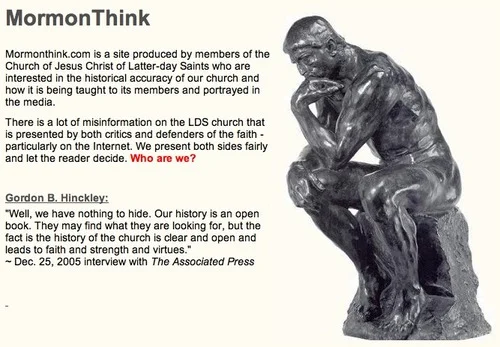
Title page of the MormonThink website that may get David Twede excommunicated

I hope you have detected in my posts the affection I have for Mormonism. You may have wondered why I left Mormonism to become a Unitarian-Universalist.  (I officially remain on the Mormon Church’s records as a member, priest and elder.) The number one thing that drove me from active participation in Mormonism was abridgement of freedom of speech by Mormon Church leaders. Individual Mormons have been punished by the Mormon Church for their exercise of free speech even when they speak and write outside of church in a private capacity. According to the New York Times, this may be happening again, this time to David Twede. Here is the article: “Web Site Editor May Face Mormon Excommunication.”

Freedom of speech bolsters truth and weakens falsehood. If a belief is really true, it should having nothing to fear from freedom of speech. Believers in the virtues of the free market–which has some imperfections, but still has brought greater prosperity to the world than any other economic system ever has–should be attracted to the virtues of free speech as well. As a species, the human race cannot afford to give up the power of free speech to help us fulfill our potential.

I recognize the need for institutions to maintain their institutional cohesion. It is inevitable that there are limitations on freedom of speech while someone is acting in an official capacity for an institution, and that there are rules of order during meetings of an institution. And it is inevitable that a wide range of information will be used when decisions are made about promotion to the leadership ranks of an institution. But rank-and-file members of an institution willing to remain rank-and-file members should never be punished for their exercise of freedom of speech on their own time and in a private capacity. As I tweeted a few minutes ago along with the New York Times link:

This is America! We should have freedom of speech so deep in our bones it’s hard to abridge it even in a church context

Update: Here is a link to a Huffington Post article about the the final outcome. (The article also has a graphic about the most and least Mormon states.)         

Noah Smith on the Demand for Japanese Government Bonds

In this post, Noah Smith argues that the price of Japanese government bonds (JGB’s) is still high (which is the same thing as saying the interest rate on Japanese government bonds is still low) despite the size of the Japanese government debt because people believe that the Japanese government will raise taxes in the future.  

Towards the end of his post, Noah raises the possibility of negative real interest rates as another way to deal with the debt. This seems quite possible to me. If confidence in the willingness of future Japanese governments to raise taxes falls, then the price of JGB’s will fall and their interest rates will rise significantly above zero. In that situation there would be more room for the Bank of Japan (BOJ) to push interest rates on JGB’s down toward zero again (and equivalently, push prices of JGB’s up) to stimulate the Japanese economy. If that stimulus raises inflation to the 2% per year rate that the Bank of Japan has said it wants, then real interest rates could easily be -2% (a nominal interest rate of 0 minus inflation of 2%) for quite some time.  

An important bit of background is that the Japanese government seems to be able to do quite a bit to twist the arms of insurance companies, regional banks and pension funds to get them to continue to hold JGB’s, as Noah argues in his earlier post “Financial Repression, Japanese Style.” And the pension funds in turn don’t give workers many choices about how to invest. That is the core of Noah’s answer to the obvious question of why anyone would ever put up with low real interest rates for JGB’s when higher real interest rates are available on foreign assets.

Another Dimension of Health Care Reform: Discouraging Soft Drink Consumption

This article by Sharon Begley, “Can it! Soda studies cite stronger link to obesity,” discusses the strongest evidence so far that discouraging the consumption of sugary soft-drinks could reduce obesity. (The studies actually look at the effects on weight of substituting diet soft drinks for sugary soft drinks.)  

Many people think of discouraging sugary soft drink consumption as something that would appeal mainly to the political left. But Modeled Behavior suggests in a tweet at least one way to discourage soft drink consumption that might appeal to the political right, saying this: 

A federal ban on using food stamps to buy non-diet soda seems like a natural policy for Romney.

Let me say something about diet soft drinks. My understanding is that there is currently not enough evidence to say definitively what the effects of diet soft drinks are, though the recent studies cited in Sharon Begley’s article suggest that it causes less weight gain than sugary soft drinks. Based on the shreds of scientific evidence and reasoning I have read, my hypothesis is this:

Sweetness itself, regardless of how the sweet taste is generated may trigger an insulin response, getting the body ready for food. If food is not forthcoming, that readiness for food will make one feel hungry. Drinking diet soft drinks with a meal is OK, since in that case getting the body prepared for food was appropriate. But drinking diet soft drinks as a snack is likely to lead to weight gain.  

Be careful. I am not saying this is known. It isn’t. As far as I know, the evidence just isn’t there. But if I were an obesity researcher, this is the hypothesis I would be investigating. I would be delighted for any references to evidence for or against this hypothesis, and encourage those who are obesity researchers to pursue it, if they are not already. Because the hypothesis involves the detailed timing of consumption diet soft drinks, it would be hard to get good evidence from non-experimental data.

Love's Review

David Love, whom I only now learn goes by “Dukes,” was a star student in my very advanced “Business Cycles” class at the University of Michigan. He went on to get a Ph.D. in Economics at Yale and become a tenured macroeconomics professor at Williams College. We have stayed in touch over the years, but had not corresponded recently. I share his email a few days ago with his permission:  

Dear Miles,

After a week of continuously visiting and reading your blog, I thought I’d let you know that you’re providing a wonderful public service. There’s a gem in nearly every entry, and I’ve found myself eagerly returning to see whether you’ve posted anything new. If you want to know how influential a good blog can be, consider that I’ve read Chetty’s article on measuring risk aversion; your recent NBER paper on the fundamental aspects of well being; and I just ordered an exam copy of Weil’s textbook on Economic Growth – and all in the week since I started visiting Confessions of a Supply Side Liberal. I was especially touched by your sermon inspired by David Foster Wallace, and I sent it along to friends and family far removed from economics.

There are many economics blogs out there, but yours contains a rare mixture of fine writing, humanity, and Feynman’s pleasure of finding things out. Thanks for putting it out there!

Sincerely,

Dukes

Pedro da Costa on Krugman's Answer to My Question "Should the Fed Promise to Do the Wrong Thing in the Future to Have the Right Effect Now?"

In Krugman’s Legacy: Fed gets over fear of commitment, Pedra da Costa gives a nice summary of Paul Krugman’s view that the Fed needs to commit to overstimulate the economy in the future in order to stimulate the economy now.  In a post back in June, I asked the question “Should the Fed Promise to Do the Wrong Thing in the Future to Have the Right Effect Now?” directing my question to Scott Sumner in particular. This was really a question about whether  "Quantitative Easing" (see my post “Balance Sheet Monetary Policy: A Primer”) has an effect independent of how it changes people’s expectations about future safe short-term interest rates such as the federal funds rate. If buying long-term and risky assets has an independent effect, then with large enough purchases, the Fed can stimulate the economy now without committing to push the economy above the natural level of output in the future, as I discussed in “Trillions and Trillions: Getting Used to Balance Sheet Monetary Policy,” where the picture of a giant fan at the top of the post symbolizes the idea that a small departure from the way things work in a frictionless model, multiplied by huge purchases of long-term and risky assets, can have a substantial effect. In my view, Krugman made an error by trusting a frictionless model too much. In other contexts, economists are suspicious of frictionless models that make extremely strong claims if applied uncritically to the real world, as I discuss in “Wallace Neutrality and Ricardian Neutrality.”

On the question of how the world works, “Wallace Neutrality and Ricardian Neutrality” links to Scott Sumner’s answer, while “Trillions and Trillions: Getting Used to Balance Sheet Monetary Policy,” links to Noah Smith’s answer. Scott, Noah and I are on record against the frictionless model behind Paul Krugman’s views. I have tried hard to convince Brad DeLong on this issues, as you can see in “Miles Kimball and Brad DeLong Discuss Wallace Neutrality and Principles of Macroeconomics Textbooks.” My sense is that Brad has come around to some degree, though that may be just wishful thinking on my part. 

There is a technical name for what I am talking about in this post–a name you can see above: “Wallace neutrality.” For some links on Wallace neutrality, see my post “‘Wallace Neutrality’ on wikipedia.”

Let me be clear that this scientific issue will become most important when the economy has recovered. At that some, I forecast that some voices will call on the Fed to “keep its commitment” to leave interest rates low even after the economy has recovered “in order to maintain credibility for stimulative promises in the more distant future.” The Fed needs to be able to point back to a clear record of statements showing that it never made such a commitment. Those most concerned about inflation (“inflation hawks”) in the FOMC  (the Federal Open Market Committee, which is the monetary policy decision-making body in the Federal Reserve System) should be particularly worried about this, and should make clear in every speech that the Fed has not made any precommitment to overstimulate the economy in the future.

If large scale asset purchases have an independent effect on the economy (not working through expectations), building up a track record of following through on promises to overstimulate the economy is unnecessary. In other words, if the real-world economy does not obey Wallace neutrality, situations in which the federal funds rate and the Treasury bill rate are close to zero can be dealt with by purchasing other assets, instead of by promises of future overstimulation.

My recommendation is that the Fed continue to insist that it is only predicting its future policy, not precommitting. Even better would be to make clear that the Fed will continue very vigorous stimulative policy until output is again fully on track to reach its natural level, but is making no commitment to push the economy above its natural level of output (unless doing so is necessary for price stability). If I understand correctly, recommendations by Market Monetarists that the Fed should announce that it is targeting nominal GDP are in this spirit.

Stephen Donnelly on How the Difference Between GDP and GNP is Crucial to Understanding Ireland's Situation

Ireland is in trouble. But outside Ireland, many economists think it is doing fine. Why? Stephen Donnelly argues that part of the answer turns on the difference between Gross Domestic Product and Gross National Product. Gross Domestic Product (GDP) is the value of goods and services produced within a country each year or quarter. Gross National Product (GNP) is the value of goods and services produced by the labor, capital and other resources owned by citizens of a country each year or quarter. For most countries, GDP and GNP are close to each other, but Ireland has attracted so much foreign investment that a large share of its capital stock in owned by foreigners. Thus, Ireland’s GNP is much lower than its GDP.

The presence of the foreign-owned capital raises wages in Ireland, so it is a good thing. But the income from the foreign-owned capital itself does not belong to Irish citizens, and so is not much help when it comes to handling the debt of the Irish government–especially since the Irish government needs to keep the promise to tax foreign-owned capital lightly that it made in order to attract foreign investment.

Energy Imports and Domestic Natural Resources as a Percentage of GDP

Much is written and said about the impact of energy imports and natural resources on output. But a basic fact makes it hard for energy imports and natural resources to matter as much as people seem to think they do: natural resources account for a small share of GDP–on the order of 1% = .01, and energy imports measured as a fraction of GDP are also on the order of 1% = .01. Even a 20% increase in the price of imported oil, for example, should make overall prices go up something like a .01 * 20% = .2%. It should take a huge increase in the price of oil to make overall prices go up by even 1%.  Am I missing something?  

It is a little dated, but here is what I found online about oil imports as a percentage of GDP. (I’ll gladly link to a more recent graph instead if there is one.) 2% of U.S. GDP is near the high end for the value of our oil imports in the past.  And here are World Bank numbers for factor payments to natural resources as a percentage of GDP.  

Cross-National Comparisons of Tax and Benefit Systems and Economic Behavior

Question from tommlu

Hi. I’m an undergraduate in my senior year, and I was wondering if you could any topics for an economic thesis, particularly in the area of taxation. Let me say that I am unconvinced that taxes has an effect on economic growth in the short run or the long run. There’s no doubt that taxes create a disincentive to work, but is that effect really so large as to decrease overall economic activity (productivity, demand, income,). If you could offer any suggestions for me, I would love to hear them. Thanks.

Answer

To me, the more interesting question is the long-run question. Here, I think there is something very useful you could do in an undergraduate thesis. Tax and benefit systems of different countries are complex enough that it is not easy to research all the details to compare how different tax and benefit systems lead to different effects. (I have seen this done more comprehensively for tax and benefit policies that would affect retirement decisions than for tax and benefit policies for younger workers).  Doing thorough case studies of the tax and benefit systems of various countries and looking for the predicted effects would be a great service. For example, do many of the French take August off because of the details of their tax and benefit system? Is there something about Germany’s tax code and benefit code that helps explain why so few German women work? Don’t forget advanced Asian economies, such as Japan.

You would have the most impact if you concentrate first and foremost on providing clear summaries of how the tax and benefit codes of different countries work and what the details are. I know I would learn a lot from that. I think most economists would.

What I am suggesting might have been impossible before Google Translate, but nowadays, your computer will give you a translation that is probably good enough to figure out most of what is going on.

Matthew O'Brien: How Much is a Good Central Banker Worth?

This is a very interesting article. In relation to what Matthew writes, let me say that Ben Bernanke is a superstar central banker in my book. It is a mistake to judge central bankers by a standard of perfection. Central banking is too hard for that. Ben has done a great job in difficult circumstances, as can be seen in David Wessel’s book In Fed We Trust. My guess is that Ben’s biggest mistakes as a central banker have come from deferring too much to other views that were less on-target than his own. Although making monetary policy decision-making less centered on the Chairman of the Fed is the right thing for the long-run future, I think we would have had better monetary policy in the last few years had Ben trusted his own judgment more and asserted himself more strongly. Ben’s mistakes of intellectual humility are the kinds of mistakes a serious seeker of the truth makes.

Books on Economics

Two questions: One, I am interested in your recommendations about a book/articles to read list for those lay-persons interested in the study of economics. I am attorney by training but love to read about differing theories on economics. I am a bit on the progressive side in my politics and so found your definition of “supply-side liberal” interesting. Second, your view on FDR and Depression-era economic policies and what it took for the U.S. economy to recover during that time. Thanks.

billythekidatheart

Answers: On what non-economists should read about economics, my first reaction is that the economics blogosphere is the place to go. For example, if you want a discussion accessible to non-economists of current economic disputes, Noahpinion.com does a good job. I have been telling Noah for some time that as part of his academic career he should become a historian of modern macroeconomic thought. You can see his talent for that in his blog.  

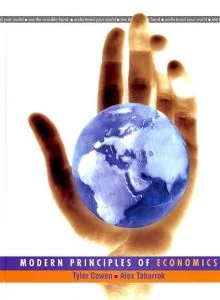
My second reaction is that some economics textbooks are truly excellent and good for anyone to read even if they are not taking a class. I am currently reading some of the macroeconomics chapters from Tyler Cowen and Alex Tabarrok’s Modern Principles of EconomicsIt is a great read. I agree with this review on Amazon: 

This is one of the most readable textbooks I have ever encountered. The writing is amazingly interesting given that it is a general, core subject. The book includes many very up-to-date samples and reads almost like a magazine in places.

I need to read a lot more to decide whether to use it for my class, but I am definitely tempted. 

At the next level up, I love David Weil’s textbook Economic Growth. This is the truly important stuff in economics. You can see what I learned from (the first edition of) this book in my post “Leveling Up: Making the Transition from Poor Country to Rich Country.”

My third reaction is to look at what I have actually read. (In conversation, economists often use the words “revealed preference” to express the idea “Watch what I do, not what I say.”) I have kept a list of books I have read since 1995. I have been planning to write posts based on that list at some point. Let me use your question as an occasion to do a basic post on the economics slice of my book list.  

Only a small fraction of the books I read are economics books. Here are the economics, economic policy and business books on the list, with the month I finished reading each. For the most part, I have linked to the most recent edition I found. I should say that I disagree with two of the books below in important respects: The Paradox of Choice by Barry Schwartz and Happiness by Richard Layard, although these are very interesting books. Let me also say that Thorstein Veblen is a terrible prose stylist, so I doubt you would enjoy reading The Theory of the Leisure Class

  1. The Unbound Prometheusby David S. Landes (4/97)
  2. The Lever of Riches by Joel Mokyr (5/97)
  3. The Wealth and Poverty of Nations by David Landes (5/98)
  4. Luxury Fever by Robert H. Frank (3/99)
  5. The Evolution of Retirement by Dora L. Costa (8/99)
  6. The Return of Depression Economics by Paul Krugman (9/01)
  7. The Wealth of Man by Peter Jay (10/01)
  8. Digital Dealing by Robert E. Hall (11/02)
  9. The New Culture of Desire by Melinda Davis (8/03)
  10. The Rise of the Creative Class by Richard Florida (8/03)
  11. The Overspent American by Juliet Schor (12/03)
  12. The Matching Law by Richard J. Herrnstein  (3/04)
  13. The Sense of Well-Being in America by Angus Campbell (4/04)
  14. Macroeconomics (5th ed.) by N. Gregory Mankiw (4/04)
  15. The Progress Paradox by Gregg Easterbrook (5/04)
  16. False Prophets: The Gurus Who Created Modern Management…by James Hoopes (5/04)
  17. The Paradox of Choice by Barry Schwartz (7/04)
  18. The Elusive Quest for Growth by William Easterly (2/05)
  19. Growth Theory by David Weil (3/05)
  20. Happiness by Richard Layard (3/05)
  21. The Joyless Economy by Tibor Scitovsky (5/05)
  22. The Winner-Take-All Society by Robert Frank and Philip Cook (8/06)
  23. The Theory of the Leisure Class by Thorstein Veblen (9/06)
  24. The 2% Solution by Matthew Miller (1/07)
  25. The World is Flat by Thomas Friedman (1/07)
  26. The Harried Leisure Class by Staffan Linder (2/07)
  27. The Age of Abundance by Brink Lindsey (12/07)
  28. Utilitarianism by John Stuart Mill (12/07)
  29. Super Crunchers by Ian Ayres (4/08)
  30. Principles of Macroeconomics by N. Gregory Mankiw (4/09)
  31. Macroeconomics by Paul Krugman and Robin Wells (11/09)
  32. In Fed We Trust by David Wessel (1/10)
  33. The White Man’s Burden by William Easterly (2/10)
  34. Sonic Boom: Globalization at Mach Speed by Gregg Easterbrook (6/10)
  35. The Quants by Scott Patterson (6/10)
  36. A Beautiful Mind by Sylvia Nasar (2/10)
  37. The Rational Optimist: How Prosperity Evolves by Matt Ridley (7/10)
  38. The Nature of Technology  by W. Brian Arthur (8/10)
  39. The Philosophical Breakfast Club by Laura J. Snyder (4/11)
  40. Thinking, Fast and Slow by Daniel Kahneman (1/12)
  41. Grand Pursuit: The Story of Economic Genius by Sylvia Nasar (2/12)
  42. The Road to Serfdom by Friedrich Hayek (4/12)
  43. Free to Choose by Milton Friedman (5/12)
  44. A Theory of Justice by John Rawls (7/12)

Outside of what I read for classes (such as

The Worldly Philosophers

by Robert Heilbroner

and the 1977 or so edition of Paul Samuelson’s textbook) I can only remember a few economics books I read before I started my book list. Three good ones are

On your second question, about the Great Depression, I agree with Milton Friedman and Anna Schwartz’s view (in a book I’m afraid I haven’t read: A Monetary History of the United States, 1867-1960) that the depth and length of the Great Depression resulted from bad monetary policy. In my view, the only reason things have been any better in the last few years is because of better monetary policy–in important measure because of Ben Bernanke, but more broadly because the economics profession has learned from its past mistakes. (Paul Krugman’s New York Times column yesterday, “Hating on Ben Bernanke,” is right to criticize the “liquidationist” view. Though one can debate whether it should have gone even further, this past week the Fed moved a long way in the right direction and deserves to be applauded. The views that Mitt Romney and Paul Ryan are expressing about monetary policy are potentially disastrous if they really mean them, and extremely unhealthy even if those expressed views are simply a matter of being willing to say anything to win an election.) 

As for FDR, based on economics seminars I have attended, my view is that as a technical economic policy matter (and leaving aside war-related decisions as a separate category) the details of what FDR did in economic policy were a mess, and mostly made things worse during the 1930’s. (The long-run virtues and vices of FDR’s policies that have lasted to the present are still at the center of our political debate.) However,despite how unimpressive FDR’s policies were from a technical point of view,FDR’s success in maintaining a modicum of confidence and so staving off political pressure for a bigger turn toward socialism was a huge contribution. And FDR’s principle of “bold, persistent, experimentation” is wonderful. (I was glad to hear Barack Obama echo those words in his acceptance speech.) I have used this principle of “bold, persistent, experimentation” as a major part of my argument in several posts: