Ross Douthat Lays Out the Best-Case Scenario for a Romney Presidency →
Ross argues (my title is a link) that Mitt is positioning himself to follow Franklin D. Roosevelt’s example of “bold, persistent experimentation” if he is elected. In my post “The Magic of Etch-a-Sketch: A Supply-Side Liberal Fantasy,” I effectively argue that–if one is willing to ignore other things Mitt has said–Mitt’s acceptance speech by and large leaves enough wiggle room for him to follow the policies I would recommend. My best guess of what Mitt will actually do can be found in my post Kevin Hassett, Glenn Hubbard, Greg Mankiw and John Taylor Need to Answer This Post of Brad DeLong’s Point by Point.
I explain why I intend to be coy about my own leanings as a voter in “What is a Partisan Nonpartisan Blog?” But I don’t mind telling you that I am genuinely undecided at this point. As you will deduce if you read “The Magic of Etch-a-Sketch: A Supply-Side Liberal Fantasy,” in the vector space of important issues, I don’t think one real-world candidate for president dominates the other. At some point in the future I will write a post expanding on the ethical case for gay rights to fill in one missing piece of the puzzle. I have already written on the ethical case for open immigration in my posts “You Didn’t Build That: America Edition” and “Adam Ozimek: What ‘You Didn’t Build That’ Tells Us About Immigration.” I take both of those issues very seriously, and they clearly favor Obama.
The most important issue favoring Mitt is the issue of restraining nuclear proliferation. Mitt’s acceptance speech convinced me he really would deal with Iran more firmly than Barack. I talk about the importance of that in the beginning of my post “Avoiding Fiscal Armageddon.” Restraining nuclear proliferation is also an ethical issue: one of the few issues that can compare in importance to the ethical weight of gay rights and open immigration–and to the ethical weight of war itself. Restraining nuclear proliferation is something we owe our descendants. We can’t afford to let our war-weariness prevent us from doing what needs to be done to stop Iran from getting nuclear weapons. Here, I want you to remember that convincing one’s adversary that one is willing to go to war can sometimes be the best way to avoid both war and outcomes that are worse than war.
On economic policy, my fantasy “The Magic of Etch-a-Sketch: A Supply-Side Liberal Fantasy” aside, things are much murkier, because–as Ross Douthat emphasizes with his FDR analogy–no coherent account of Mitt’s intended economic policies has emerged. If Mitt is elected, I will certainly hope for the best, and will be reassured if he keeps Greg Mankiw close by his side during his presidency (and appears to be listening to Greg carefully), but at this point I trust Barack’s economic policies more. If Barack is reelected, I think he needs to do much more than he has done on the economic front, starting with Federal Lines of Credit, which you can read about in “Getting the Biggest Bang for the Buck in Fiscal Policy” and the other posts I list in “Short-Run Fiscal Policy Posts through August 23, 2012.” (I promise to post many other suggestions for whoever is our president come January.) At the upper end of what is reasonably possible, I think Mitt’s economic policies look better than Barack’s. But on the downside there are great dangers in the rejection by many Republicans of the conceptual framework of aggregate supply and aggregate demand in favor of a view of macroeconomics in which only aggregate supply matters. This view by many Republicans could easily have negative effects on macroeconomic policy in a Romney presidency even if Mitt himself believes that aggregate demand matters.
Let me end by repeating here one of my tweets about my cousin Mitt:
News flash from Clive Crook: Romney NOT a heartless self-serving capitalist monster.
In the event, Mitt might be a bad president, but some of the things that have been said about him are just wrong. If you follow Clive’s link above, and this link to the testimonial of my nephew Peter Kimball’s father-in-law Grant Bennett, you will see. (Peter is my brother Chris Kimball’s son. You can see Chris’s relatively negative opinion of Mitt in my post “Big Brother Speaks: Christian Kimball on Mitt Romney.”)
Note: I list my other political posts in the index post “Posts on Politics and Political Economy through September 1, 2012.”
Evan Soltas: The Great Depression in Graphs

Evan Soltas is a freshman this Fall at Princeton. He is 19. Here is the picture he gives of the Great Depression, and here is a short bio taken from his website:
Evan Soltas is the writer of Wonkbook, the morning email newsletter of Ezra Klein’s Wonkblog at The Washington Post, and for Bloomberg View’s “The Ticker” blog. A student at Princeton University, where he intends to major in economics, Evan blogs daily on economic news, policy, and research findings – and a variety of other topics, approaching the subject as a student and not as an expert.
His research has been featured recently in The Wall Street Journal, the Financial Times, The Atlantic, Slate, the Daily Beast, the National Review, The American Conservative, The Nation, and The Globe and Mail.
His particular areas of research and blogging interest include monetary economics and macroeconomics. His blog further contains substantial discussion of labor and financial markets, development, economic history, econometrics, and public finance.
It is not as if I have a ranking worked out, so I might be understating things, but in my book, Evan is clearly one of the best 10 economics bloggers out there, without regard to age. What I especially like is Evan’s attention to facts–and his skill at making facts come alive. Evan’s attention to facts is especially valuable in an era when so many of the media, the commentariat, and those in the public sphere more generally, have left facts behind.
Principles of Macroeconomics Posts through September 3, 2012
This is a list of posts I thought I might want to find quickly during class. I bolded the first post in the month from the list.
- What is a Supply-Side Liberal?
- Getting the Biggest Bang for the Buck in Fiscal Policy
- Balance Sheet Monetary Policy: A Primer
- Can Taxes Raise GDP?
- National Rainy Day Accounts
- Trillions and Trillions: Getting Used to Balance Sheet Monetary Policy
- Noah Smith: “Miles Kimball, the Supply-Side Liberal”
- Why Taxes are Bad
- A Supply-Side Liberal Joins the Pigou Club
- “Henry George and the Carbon Tax”: A Quick Response to Noah Smith
- Leading States in the Fiscal Two-Step
- Going Negative: The Virtual Fed Funds Rate Target
- Mike Konczal: What Constrains the Federal Reserve? An Interview with Joseph Gagnon
- Leveling Up: Making the Transition from Poor Country to Rich Country
- Mark Thoma: Kenya’s Kibera Slum
- The supplysideliberal Review of the FOMC Monetary Policy Statement: June 20th, 2012
- Justin Wolfers on the 6/20/2012 FOMC Statement
- Mark Thoma: Laughing at the Laffer Curve
- Thoughts on Monetary and Fiscal Policy in the Wake of the Great Recession: supplysideliberal.com’s First Month
- Health Economics
- Future Heroes of Humanity and Heroes of Japan
- The Euro and the Mediterano
- Is Taxing Capital OK?
- Jobs
- Dissertation Topic 3: Public Savings Systems that Lift the No-Margin-Buying Constraint
- Rich, Poor and Middle-Class
- Reply to Mike Sax’s Question “But What About the Demand Side, as a Source of Revenue and of Jobs?”
- Bill Greider on Federal Lines of Credit: “A New Way to Recharge the Economy”
- Will the Health Insurance Mandate Lead People to Take Worse Care of Their Health?
- Corporations are People, My Friend
- What to Do When the World Desperately Wants to Lend Us Money
- Paul Romer on Charter Cities
- Miles Kimball and Brad DeLong Discuss Wallace Neutrality and Principles of Macroeconomics Textbooks
- Paul Romer’s Reply and a Save-the-World Tweet
- Adam Ozimek on Worker Voice
- Dr. Smith and the Asset Bubble
- Reply to Matthew Yglesias: What to Do About a House Price Boom
- Preventing Recession-Fighting from Becoming a Political Football
- Magic Ingredient 1: More K-12 School
- Matthew Yglesias: “Miles Kimball on Potential Housing Bubble Remedies”
- Ezra Klein: “Does Teacher Merit Pay Work? A New Study Says Yes”
- You Didn’t Build That: America Edition
- My First Radio Interview on Federal Lines of Credit
- The Most Conflicted Review I Have Received
- The Euro and the Mark
- Saturday Morning Breakfast Cereal
- Adam Ozimek: What “You Didn’t Build That” Tells Us About Immigration
- Charles Murray: Why Capitalism Has an Image Problem
- Adam Smith as Patron Saint of Supply-Side Liberalism?
- Things are Getting Better: 3 Videos
- Google Search Hints
- Government Purchases vs. Government Spending
- Mark Thoma on the Politicization of Stabilization Policy
- Milton Friedman: Celebrating His 100th Birthday with Videos of Milton
- Isomorphismes: A Skew Economy & the Tacking Theory of Growth
- Daniel Kuehn: Remembering Milton Friedman
- Why My Retirement Savings Accounts are Currently 100% in the Stock Market
- Grammar Girl: Speaking Reflexively
- Dismal Science Humor: 8/3/12
- Should Everyone Spend Less than He or She Earns?
- Dismal Science Humor: Econosseur
- Dismal Science Humor: Yoram Baumann, Standup Economist
- The True Story of How Economics Got Its Nickname “The Dismal Science”
- Dismal Science Humor: phdcomics.com
- Rich People Do Create Jobs: 10 Tweets
- The Paul Ryan Tweets
- Miles Kimball and Noah Smith on Balancing the Budget in the Long Run
- Joe Gagnon on the Internal Struggles of the Federal Reserve Board
- Miles Kimball and Noah Smith on Job Creation
- Matthew O'Brien on Paul Ryan’s Monetary Policy Views
- Noah Smith on the Coming Japanese Debt Crisis
- The Flat Tax, The Head Tax and the Size of Government: A Tax Parable
- The Economist on the Origin of Money
- When the Government Says “You May Not Have a Job”
- Brad DeLong’s Views on Monetary Policy and the Fed’s Internal Politics
- Persuasion
- Evan Soltas on Medical Reform Federalism–in Canada
- Private Equity Investment in Africa
- Gavyn Davies on the Political Debate about Economic Uncertainty
- Larry Summers on the Reality of Trying to Shrink Government
- James Surowiecki on Skilled Worker Immigration
- Josh Barro on a Central Issue of Political Economy: Poor vs. Old
- Matt Yglesias on How the “Stimulus Bill” was About a Lot More Than Stimulus
- Copyright
- Scott Adams’s Finest Hour: How to Tax the Rich
- My Ec 10 Teacher Mary O’Keeffe Reviews My Blog
- Occupy Wall Street Video
- Joshua Hausman on Historical Evidence for What Federal Lines of Credit Would Do
- Why George Osborne Should Give Everyone in Britain a New Credit Card
- Twitter Round Table on Federal Lines of Credit and Monetary Policy
- Matthew Yglesias on Archery and Monetary Policy
- No Tax Increase Without Recompense
- Adam Ozimek: School Choice in the Long Run
- Learning Through Deliberate Practice
- Matthew O'Brien versus the Gold Standard
- Health Economics Posts through August 26, 2012
- What is a Partisan Nonpartisan Blog?
- Two Types of Knowledge: Human Capital and Information
- The Great Recession and Per Capita GDP
- Family Income Growth by Quintile Since 1950
- Jonathan Rauch on Democracy, Capitalism and Liberal Science
- Bill Dickens on Helping the Poor
- The Magic of Etch-a-Sketch: A Supply-Side Liberal Fantasy
- Michael Woodford Endorses Monetary Policy that Targets the Level of Nominal GDP
- How Americans Spend Their Money and Time
A Market Measure of Long-Run Inflation Expectations

Brad DeLong’s graph of “breakeven inflation”: the rate of inflation at which regular (nominal) 30-year Treasury bonds would neither better nor worse than 30-year Treasury Inflation Protected Securities.
Brad DeLong explains here how the difference in interest rates between the Federal government’s 30-year nominal bonds and its 30-year real bonds (Treasury Inflation Protected Securities) can measure financial investors’ expectations about average inflation over the next 30 years.
Unlike Brad, I think the investor’s expectations are reasonable. Knowing the articles in economics journals that the folks at the Fed are reading–and that young economists whose future is at the Fed are reading–makings me confident that the commitment to controlling inflation in the long run is durable. 2% seems to have been settled on as the long-run target.
How Americans Spend Their Money and Time
Two of the most fundamental choices people make are how to spend their money and their time. Economists talk about a “budget constraint” for money and a “budget constraint” for time. Here is a set of links to well-done graphs on how Americans deal with those two budget constraints:
- Jacob Goldstein and Lam Thuy Vo: “What America Buys”
- Jacob Goldstein and Lam Thuy Vo: “How The Poor, The Rich And The Middle Class Spend Their Money”
- Lam Thuy Vo: “What Americans Actually Do All Day Long, In 2 Graphics”
- Jacob Goldstein and Lam Thuy Vo: “What America Does For Work.”
Bonus
- Lam Thuy Vo: “What America Sells to the World”
- NPR Planet Money's “Graphing America Archive”
Thanks to my brother Joseph Kimball for pointing me to this series of posts by Lam Thuy Vo and Jacob Goldstein.
Michael Woodford Endorses Monetary Policy that Targets the Level of Nominal GDP

When I want to better understand the principles of optimal monetary policy, Mike Woodford is the one I turn to. Someday I hope to finish reading his book Interest and Prices and many of his key academic journal articles. If I do, I am sure that then I will have many nuances to argue over with Mike (including the effects of departures from Wallace neutrality on optimal monetary policy)–and despite my relative ignorance in this area, I did manage a Powerpoint discussion of one of Mike’s papers with one of his coauthors, Vasco Curdia, at a Bank of Japan Conference. But until the fabled day when I can really dig into optimal monetary policy, Mike is my authority on many of the fundamental principles of how to conduct monetary policy. And I am not alone in my esteem for Mike.
So it is big news that Mike has come out in favor of nominal GDP targeting. I know this thanks to Lars Christensen, who in addition to these two recent posts about Mike
has an excellent recent post arguing that the European debt crisis is due to overly tight monetary policy.
Mike notes, as I would, that there are nuances of optimal monetary policy that a simple nominal GDP targeting rule does not capture. But the simplicity, robustness, transparency and rough-and-ready approach toward optimality of such a rule makes it a key step in improving monetary policy from the implicit rule being followed now.
A Guided Tour through Meta-posts at the End of the Second Cycle
Let me explain my title. A “meta-post” is a post about what I am trying to do and how I am approaching writing this blog, what I have actually done, and what I expect to do in the future. The end of the first cycle was heralded by my post Thoughts on Monetary and Fiscal Policy in the Wake of the Great Recession: supplysideliberal.com’s First Month. So the first cycle was one month, from May 28, 2012 to June 28, 2012, while the second cycle extended a little over two months, from June 28, 2012 to now, September 1, 2012.
In Thoughts on Monetary and Fiscal Policy in the Wake of the Great Recession: supplysideliberal.com’s First Month I explained that I think of the blog as an organic whole–comparing its structure to my favorite science fiction TV series, Babylon 5. The idea of a “cycle” is from one of my favorite print science fiction series–the Dray Prescot series. The Dray Prescot series–45 books in all–is organized into “cycles” of books, such as the “Delian cycle” and the “Havilfar cycle.”
I had intended to lay out what I did substantively in the second cycle of supplysideliberal.com in a post called “The Supply-Side Liberal Vision.” But after hearing Mitt Romney’s speech accepting the Republican nomination for president, it struck me that I could structure an account of what I did substantively in my second cycle by playing off of Mitt’s acceptance speech. Thus, for substance, my post The Magic of Etch-a-Sketch: A Supply-Side Liberal Fantasy is to the second cycle as Thoughts on Monetary and Fiscal Policy in the Wake of the Great Recession: supplysideliberal.com’s First Month is to the first cycle. I expect to use the title “The Supply-Side Liberal Vision” to wrap up some future cycle.
The timing of the end of my second cycle is governed by two considerations. First, I knew I had to write No Tax Increase Without Recompense to fill out the essentials of “The Supply-Side Liberal Vision.” And in the event, I needed No Tax Increase Without Recompense in The Magic of Etch-a-Sketch: A Supply-Side Liberal Fantasy. Second, this is a time of transition for my blog as the school year begins.
In my first cycle, relatively autonomous posts on economic policy dominated. (My persistent advocacy of Federal Lines of Credit to stimulate the economy during the first cycle has continued in the second cycle, as can be seen in Short-Run Fiscal Policy Posts through August 23, 2012.) During my second cycle, Twitter interactions with other economists and non-economists took off and generated many posts. For example, Twitter conversations led me to think more about Health Economics, as can be seen in these posts: Health Economics Posts through August 26, 2012. You can see my Twitter thread here. The other new dimension of my second cycle was the broadening to include posts on politics (see Posts on Politics and Political Economy through September 1, 2012) and religion (see Posts on Religion, Philosophy, Science, Literature and Culture through August 27, 2012)–and on the overlap between these two areas occasioned by the Mormon background I share with Mitt Romney (posts included on both lists). Tyler Cowen reviewed this area of overlap (including tweets) as a whole: Tyler Cowen’s Review of My Posts and Tweets about Mitt Romney.
In my third cycle, I expect a large share of posts to be driven by what will help me teach my “Principles of Macroeconomics” class in the next four months. (I am confident that the posts I write to help my students will be valuable to others as well.) I am sure that the news will also drive many posts. In particular, I foresee posts occasioned by the U.S. presidential election and by monetary policy events. But much of where my blog will go is impossible to foresee. I expect to declare the end of the third cycle around the end of the calendar year, when my “Principles of Macroeconomics” class is over.
My other meta-posts so far explain what I am trying to do and how I am approaching writing my blog:
- The agenda I laid out in my first post What is a Supply-Side Liberal? still drives much of what I am doing here, including many things that also result from interaction with other economists online.
- What is a Partisan Nonpartisan Blog? explains my view that–in order for human beings to be able to trust one another–our obligation to truth at the micro level has to trump our obligation to what we believe to be “Truth” at the macro level, whenever the two conflict.
- “It Isn’t Easy to Figure Out How the World Works” (Larry Summers, 1984) explains my policy on revisions of posts.
- Persuasion explains how I approach argument.
- Copyright hints at some of my personal motivation for writing this blog.
Let me end with a few blog statistics as of this moment. I will do another “My Corner of the Blogosphere” post (an update to My Corner of the Blogosphere: As of July 1, 2012) soon. Since June 3, Google Analytics reports 89,780 total pageviews, 60,731 visits, and 29,460 unique visitors. These numbers do not include the delivery of the posts to the now 867 subscribers on Google Reader. Together with 103 Tumblr subscribers, that adds up to 970 subscribers on those two platforms. Some of my Facebook friends use my Facebook wall as a way to subscribe, and there must be some subscribers on other platforms. At this moment I have 970 Twitter followers. It is only a coincidence that this exactly matches the number of Google Reader plus Tumblr subscribers, but I think I now have roughly the same number of people who follow me on Twitter but do not subscribe on Tumblr and Google Reader as vice versa.
Top 25 Posts, July-August 2012
Top 25 based on Google Analytics pageviews in July and August, 2012. The number of pageviews is shown by each post. (There were 66,419 pageviews during this period, but, for example, 20,205 homepage views could not be categorized by post.) See the Top 10 based on May and June pageviews (many quite popular) in a bonus section at the bottom.
Note: Links open in the same window. use back-arrow to return.
- Dr. Smith and the Asset Bubble 5420
- Scott Adams’s Finest Hour: How to Tax the Rich 2937
- You Didn’t Build That: America Edition 1874
- Jobs 1393
- Kevin Hassett, Glenn Hubbard, Greg Mankiw and John Taylor Need to Answer This Post of Brad DeLong’s Point by Point 1248
- The Egocentric Illusion 1209
- What is a Supply-Side Liberal? 1112
- Corporations are People, My Friend 1038
- Two Types of Knowledge: Human Capital and Information 841
- Top 10 Posts on supplysideliberal.com (May-June, 2012) 832
- When the Government Says “You May Not Have a Job” 771
- Balance Sheet Monetary Policy: A Primer 766
- Is Taxing Capital OK? 690
- Will Mitt’s Mormonism Make Him a Supply-Side Liberal? 665
- Rich, Poor and Middle-Class 659
- Teleotheism and the Purpose of Life 645
- Getting the Biggest Bang for the Buck in Fiscal Policy 644
- The Flat Tax, The Head Tax and the Size of Government: A Tax Parable 643
- Miles Kimball and Brad DeLong Discuss Wallace Neutrality and Principles of Macroeconomics Textbooks 640
- Thoughts on Monetary and Fiscal Policy in the Wake of the Great Recession: supplysideliberal.com’s First Month 638
- No Tax Increase Without Recompense 626
- Why My Retirement Savings Accounts are Currently 100% in the Stock Market 557
- The Euro and the Mark 536
- Preventing Recession-Fighting from Becoming a Political Football 533
- Miles’s Best 7 “Save-the-World” Posts, as of July 7, 2012 485
Bonus: The Top 10 based on May and June (and July 1) pageviews are copied below. The pageviews through July 1 are shown by each post. (Copied from #10 above.) The list above and the list below combined include the full set of my all-time Top 25 posts. (#1 through #8 below are in my all-time Top 25.)
- Balance Sheet Monetary Policy: A Primer: 2213
- Trillions and Trillions: Getting Used to Balance Sheet Monetary Policy: 849
- Is Monetary Policy Thinking in Thrall to Wallace Neutrality? 795
- Mark Thoma: Laughing at the Laffer Curve: 699
- What is a Supply-Side Liberal? 678
- Thoughts on Monetary and Fiscal Policy in the Wake of the Great Recession: supplysideliberal.com’s First Month: 608
- Leveling Up: Making the Transition from Poor Country to Rich Country: 564
- Avoiding Fiscal Armageddon: 526
- Wallace Neutrality and Ricardian Neutrality: 345
- Future Heroes of Humanity and Heroes of Japan: 291
Posts on Politics and Political Economy through September 1, 2012
Note: The links open in the same window. Use the back-arrow to return.
- What is a Supply-Side Liberal?
- Noah Smith: “Miles Kimball, the Supply-Side Liberal”
- Leading States in the Fiscal Two-Step
- Avoiding Fiscal Armageddon
- Leveling Up: Making the Transition from Poor Country to Rich Country
- Mark Thoma: Kenya’s Kibera Slum
- Mark Thoma: Laughing at the Laffer Curve
- The Euro and the Mediterano
- Rich, Poor and Middle-Class
- Bill Greider on Federal Lines of Credit: “A New Way to Recharge the Economy”
- Corporations are People, My Friend
- Preventing Recession-Fighting from Becoming a Political Football
- You Didn’t Build That: America Edition
- Will Mitt’s Mormonism Make Him a Supply-Side Liberal?
- The Euro and the Mark
- How the Mormons Became Largely Republican
- Adam Ozimek: What “You Didn’t Build That” Tells Us About Immigration
- Charles Murray: Why Capitalism Has an Image Problem
- Charles Hill: The Empire Strikes Back
- Adam Smith as Patron Saint of Supply-Side Liberalism?
- Things are Getting Better: 3 Videos
- Government Purchases vs. Government Spending
- Mark Thoma on the Politicization of Stabilization Policy
- Milton Friedman: Celebrating His 100th Birthday with Videos of Milton
- Isomorphismes: A Skew Economy & the Tacking Theory of Growth
- Daniel Kuehn: Remembering Milton Friedman
- Big Brother Speaks: Christian Kimball on Mitt Romney
- Fed Transparency and Obscurantism
- The True Story of How Economics Got Its Nickname “The Dismal Science”
- The Paul Ryan Tweets
- Joe Gagnon on the Internal Struggles of the Federal Reserve Board
- Matthew O'Brien on Paul Ryan’s Monetary Policy Views
- Noah Smith on the Coming Japanese Debt Crisis
- Kevin Hassett, Glenn Hubbard, Greg Mankiw and John Taylor Need to Answer This Post of Brad DeLong’s Point by Point
- When the Government Says “You May Not Have a Job”
- Brad DeLong’s Views on Monetary Policy and the Fed’s Internal Politics
- Persuasion
- Gavyn Davies on the Political Debate about Economic Uncertainty
- Larry Summers on the Reality of Trying to Shrink Government
- James Surowiecki on Skilled Worker Immigration
- Vipul Naik and Garett Jones on the Robustness of This Unbelievable American System
- Josh Barro on a Central Issue of Political Economy: Poor vs. Old
- Matt Yglesias on How the “Stimulus Bill” was About a Lot More Than Stimulus
- Scott Adams’s Finest Hour: How to Tax the Rich
- My Ec 10 Teacher Mary O’Keeffe Reviews My Blog
- Occupy Wall Street Video
- No Tax Increase Without Recompense
- Adam Davidson on Friedrich Hayek’s Miscellaneous Views
- Matthew O'Brien versus the Gold Standard
- What is a Partisan Nonpartisan Blog?
- Tyler Cowen’s Review of My Posts and Tweets about Mitt Romney
- Family Income Growth by Quintile Since 1950
- Jonathan Rauch on Democracy, Capitalism and Liberal Science
- A Book of Mormon Story Every Mormon Boy and Girl Knows
- Bill Dickens on Helping the Poor
- The Magic of Etch-a-Sketch: A Supply-Side Liberal Fantasy
The Magic of Etch-a-Sketch: A Supply-Side Liberal Fantasy
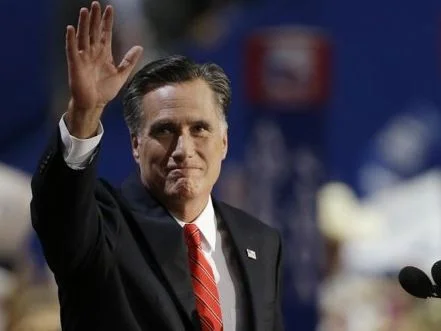
I, Mitt Romney, have been reading my cousin Miles’s new blog in the last few days instead of watching the Republican Convention, and I’ve had a political conversion experience. It’s annoying Miles didn’t start sooner. It’s a little late in the game for me to be changing my political philosophy yet again, to Supply-Side Liberalism, but I guess one more political transformation won’t hurt. I am already through the Republican primaries, which gives me room to maneuver. And although my magic Etch-a-Sketch that wipes out everything I have ever said in the past looks like it could give up the ghost of its last bit of magic charm at any time, I think if I use it right now, it will still work once more. It is also annoying that there are a lot of policies Miles hasn’t even talked about yet, but I’m getting the sense that it’s closer to where I was at when I ran for Senator and for Governor in Massachusetts than where I have been lately, so I’ll fill in the gaps that way.
The only trouble is, here I am waiting to go out there and give my acceptance speech and there is no time to work up a new speech. Maybe a little creative reinterpretation will do the trick. All right, here goes, I’m shaking the magic Etch-a-Sketch to erase everything I’ve said before, and I’ll figure out as I go along how to reinterpret the words of my acceptance speech to be consistent with Supply-Side Liberalism. OK, no more time, I have to go out there…
Mr. Chairman, delegates. I accept your nomination for President of the United States of America.
I do so with humility, deeply moved by the trust you have placed in me. It is a great honor. It is an even greater responsibility.
Tonight I am asking you to join me to walk together to a better future. By my side, I have chosen a man with a big heart from a small town. He represents the best of America, a man who will always make us proud - my friend and America’s next Vice President, Paul Ryan.
In the days ahead, you will get to know Paul and Janna better. But last night America got to see what I saw in Paul Ryan - a strong and caring leader who is down to earth and confident in the challenge this moment demands.
I love the way he lights up around his kids and how he’s not embarrassed to show the world how much he loves his mom.
But Paul, I still like the playlist on my iPod better than yours.
Not much content there I need to worry about. If I can just win this election, I’ll have four years with Paul at my side to bring him around to my new way of thinking.
Four years ago, I know that many Americans felt a fresh excitement about the possibilities of a new president. That president was not the choice of our party but Americans always come together after elections. We are a good and generous people who are united by so much more than what divides us.
When that hard fought election was over, when the yard signs came down and the television commercials finally came off the air, Americans were eager to go back to work, to live our lives the way Americans always have - optimistic and positive and confident in the future.
That very optimism is uniquely American.
It is what brought us to America. We are a nation of immigrants. We are the children and grandchildren and great-grandchildren of the ones who wanted a better life, the driven ones, the ones who woke up at night hearing that voice telling them that life in that place called America could be better.
They came not just in pursuit of the riches of this world but for the richness of this life.
Freedom.
Freedom of religion.
Freedom to speak their mind.
Freedom to build a life.
And yes, freedom to build a business. With their own hands.
This is the essence of the American experience.
We Americans have always felt a special kinship with the future.
When every new wave of immigrants looked up and saw the Statue of Liberty, or knelt down and kissed the shores of freedom just ninety miles from Castro’s tyranny, these new Americans surely had many questions. But none doubted that here in America they could build a better life, that in America their children would be more blessed than they.
Boy, what I had in this speech works great, as long as I interpret it in a way that is opposite to what I said about immigration policy before I used my magic Etch a Sketch backstage. What Miles said in “You Didn’t Build That: America Edition” works perfectly. Even the Statue of Liberty reference works great now that I am strongly pro-immigration.
But today, four years from the excitement of the last election, for the first time, the majority of Americans now doubt that our children will have a better future.
It is not what we were promised.
Every family in America wanted this to be a time when they could get ahead a little more, put aside a little more for college, do more for their elderly mom who’s living alone now or give a little more to their church or charity.
Every small business wanted these to be their best years ever, when they could hire more, do more for those who had stuck with them through the hard times, open a new store or sponsor that Little League team.
Every new college graduate thought they’d have a good job by now, a place of their own, and that they could start paying back some of their loans and build for the future.
This is when our nation was supposed to start paying down the national debt and rolling back those massive deficits.
This was the hope and change America voted for.
It’s not just what we wanted. It’s not just what we expected.
It’s what Americans deserved.
You deserved it because during these years, you worked harder than ever before. You deserved it because when it cost more to fill up your car, you cut out movie nights and put in longer hours. Or when you lost that job that paid $22.50 an hour with benefits, you took two jobs at 9 bucks an hour and fewer benefits. You did it because your family depended on you. You did it because you’re an American and you don’t quit. You did it because it was what you had to do.
But driving home late from that second job, or standing there watching the gas pump hit 50 dollars and still going, when the realtor told you that to sell your house you’d have to take a big loss, in those moments you knew that this just wasn’t right.
But what could you do? Except work harder, do with less, try to stay optimistic. Hug your kids a little longer; maybe spend a little more time praying that tomorrow would be a better day.
I wish President Obama had succeeded because I want America to succeed. But his promises gave way to disappointment and division. This isn’t something we have to accept. Now is the moment when we CAN do something. With your help we will do something.
Now is the moment when we can stand up and say, “I’m an American. I make my destiny. And we deserve better! My children deserve better! My family deserves better. My country deserves better!”
So here we stand. Americans have a choice. A decision.
I think that text about what has happened during the Obama administration still works. I liked that line “I wish President Obama had succeeded because I want America to succeed” before and I still like it now. And I still like that line “But his promises gave way to disappointment and division.” As for “division,” President Obama really has been fomenting anger at the rich, when both Miles and I agree that the rich are very important for the economy, as he wrote in “Why Taxes are Bad” and that post that really started to turn me around 180 degrees: “Rich, Poor and Middle Class.” In that post, Miles was wrong about where I was at when I started reading his blog, but now he has convinced me. I am so grateful for that magic Etch-a-Sketch.
Now for the Neil Armstrong reference and my bio. I won’t have to change any of that.
To make that choice, you need to know more about me and about where I will lead our country.
I was born in the middle of the century in the middle of the country, a classic baby boomer. It was a time when Americans were returning from war and eager to work. To be an American was to assume that all things were possible. When President Kennedy challenged Americans to go to the moon, the question wasn’t whether we’d get there, it was only when we’d get there.
The soles of Neil Armstrong’s boots on the moon made permanent impressions on OUR souls and in our national psyche. Ann and I watched those steps together on her parent’s sofa. Like all Americans we went to bed that night knowing we lived in the greatest country in the history of the world.
God bless Neil Armstrong.
Tonight that American flag is still there on the moon. And I don’t doubt for a second that Neil Armstrong’s spirit is still with us: that unique blend of optimism, humility and the utter confidence that when the world needs someone to do the really big stuff, you need an American.
That bit “when the world needs someone to do the really big stuff, you need an American” was over-the-top. How did that get in there? Shakespeare, and even Jesus, weren’t Americans! But they did big stuff indeed. At least the open immigration policy I am now committed to will guarantee that a large fraction of all the people in the world who do big things become Americans.
That’s how I was brought up.
My dad had been born in Mexico and his family had to leave during the Mexican revolution. I grew up with stories of his family being fed by the US Government as war refugees. My dad never made it through college and apprenticed as a lath and plaster carpenter. And he had big dreams. He convinced my mom, a beautiful young actress, to give up Hollywood to marry him. He moved to Detroit, led a great automobile company and became Governor of the Great State of Michigan.
My Dad’s generation really was impressive, including my Dad’s first cousin Camilla Eyring Kimball, who married Spencer W. Kimball. And Camilla’s brothers and sisters earned a lot of college degrees when that wasn’t common early in the 20th Century, including Henry Eyring, who became a world-renowned chemist. And boy am I glad Camilla’s husband Spencer W. Kimball did the hard work of praying to get that revelation from God giving the priesthood to blacks. That was one of the best days in my life when I heard about that.
We were Mormons and growing up in Michigan; that might have seemed unusual or out of place but I really don’t remember it that way. My friends cared more about what sports teams we followed than what church we went to.
Religion is one area where I am not going to go along with Miles. I still believe in Mormonism, which is a lot different from the religious views Miles expressed in “Teleotheism and the Purpose of Life.” And I’ll take my sure confidence in an afterlife over Miles’s attempts to console himself in “The Egocentric Illusion” about the absence of an afterlife any day. And I know there are miracles in the world today. What else do you call my magic Etch-a-Sketch? But religion is one area where, in America, it is OK to disagree. And if I take out the religious details, those posts had good positive views in other ways. OK, must keep going:
My mom and dad gave their kids the greatest gift of all - the gift of unconditional love. They cared deeply about who we would BE, and much less about what we would DO.
Unconditional love is a gift that Ann and I have tried to pass on to our sons and now to our grandchildren. All the laws and legislation in the world will never heal this world like the loving hearts and arms of mothers and fathers. If every child could drift to sleep feeling wrapped in the love of their family - and God’s love – this world would be a far more gentle and better place.
Mom and Dad were married 64 years. And if you wondered what their secret was, you could have asked the local florist - because every day Dad gave Mom a rose, which he put on her bedside table. That’s how she found out what happened on the day my father died - she went looking for him because that morning, there was no rose.
My mom and dad were true partners, a life lesson that shaped me by everyday example. When my mom ran for the Senate, my dad was there for her every step of the way. I can still hear her saying in her beautiful voice, “Why should women have any less say than men, about the great decisions facing our nation?”
I wish she could have been here at the convention and heard leaders like Governor Mary Fallin, Governor Nikki Haley, Governor Susana Martinez, Senator Kelly Ayotte and Secretary of State Condoleezza Rice.
As Governor of Massachusetts, I chose a woman Lt. Governor, a woman chief of staff, half of my cabinet and senior officials were women, and in business, I mentored and supported great women leaders who went on to run great companies.
I grew up in Detroit in love with cars and wanted to be a car guy, like my dad. But by the time I was out of school, I realized that I had to go out on my own, that if I stayed around Michigan in the same business, I’d never really know if I was getting a break because of my dad. I wanted to go someplace new and prove myself.
Those weren’t the easiest of days - too many long hours and weekends working, five young sons who seemed to have this need to re-enact a different world war every night. But if you ask Ann and I what we’d give, to break up just one more fight between the boys, or wake up in the morning and discover a pile of kids asleep in our room. Well, every mom and dad knows the answer to that.
Those days were toughest on Ann, of course. She was heroic. Five boys, with our families a long way away. I had to travel a lot for my job then and I’d call and try to offer support. But every mom knows that doesn’t help get the homework done or the kids out the door to school.
I knew that her job as a mom was harder than mine. And I knew without question, that her job as a mom was a lot more important than mine. And as America saw Tuesday night, Ann would have succeeded at anything she wanted to.
Like a lot of families in a new place with no family, we found kinship with a wide circle of friends through our church. When we were new to the community it was welcoming and as the years went by, it was a joy to help others who had just moved to town or just joined our church. We had remarkably vibrant and diverse congregants from all walks of life and many who were new to America. We prayed together, our kids played together and we always stood ready to help each other out in different ways.
And that’s how it is in America. We look to our communities, our faiths, our families for our joy, our support, in good times and bad. It is both how we live our lives and why we live our lives. The strength and power and goodness of America has always been based on the strength and power and goodness of our communities, our families, our faiths.
That is the bedrock of what makes America, America. In our best days, we can feel the vibrancy of America’s communities, large and small.
All of that still sounds great. I like the emphasis on community. Now I think I pivot to criticism of Obama. Let’s see here…
It’s when we see that new business opening up downtown. It’s when we go to work in the morning and see everybody else on our block doing the same.
It’s when our son or daughter calls from college to talk about which job offer they should take….and you try not to choke up when you hear that the one they like is not far from home.
It’s that good feeling when you have more time to volunteer to coach your kid’s soccer team, or help out on school trips.
But for too many Americans, these good days are harder to come by. How many days have you woken up feeling that something really special was happening in America?
Many of you felt that way on Election Day four years ago. Hope and Change had a powerful appeal. But tonight I’d ask a simple question: If you felt that excitement when you voted for Barack Obama, shouldn’t you feel that way now that he’s President Obama? You know there’s something wrong with the kind of job he’s done as president when the best feeling you had was the day you voted for him.
The President hasn’t disappointed you because he wanted to. The President has disappointed America because he hasn’t led America in the right direction. He took office without the basic qualification that most Americans have and one that was essential to his task. He had almost no experience working in a business. Jobs to him are about government.
On the size of government issue, I think Miles has a political winner in his proposal in “Avoiding Fiscal Armageddon” to call for a constitutional amendment limiting government spending to less than half of GDP. If the Democrats resist it, they’ll be admitting that they plan sometime down the road to run more than half of the economy through government. If the Democrats go along, America will have a crucial constitutional protection against encroaching government in the future–now that would be a legacy.
I learned the real lessons about how America works from experience.
When I was 37, I helped start a small company. My partners and I had been working for a company that was in the business of helping other businesses.
So some of us had this idea that if we really believed our advice was helping companies, we should invest in companies. We should bet on ourselves and on our advice.
So we started a new business called Bain Capital. The only problem was, while WE believed in ourselves, nobody else did. We were young and had never done this before and we almost didn’t get off the ground. In those days, sometimes I wondered if I had made a really big mistake. I had thought about asking my church’s pension fund to invest, but I didn’t. I figured it was bad enough that I might lose my investors’ money, but I didn’t want to go to hell too. Shows what I know. Another of my partners got the Episcopal Church pension fund to invest. Today there are a lot of happy retired priests who should thank him.
That business we started with 10 people has now grown into a great American success story. Some of the companies we helped start are names you know. An office supply company called Staples - where I’m pleased to see the Obama campaign has been shopping; The Sports Authority, which became a favorite of my sons. We started an early childhood learning center called Bright Horizons that First Lady Michelle Obama rightly praised. At a time when nobody thought we’d ever see a new steel mill built in America, we took a chance and built one in a corn field in Indiana. Today Steel Dynamics is one of the largest steel producers in the United States.
These are American success stories. And yet the centerpiece of the President’s entire re-election campaign is attacking success. Is it any wonder that someone who attacks success has led the worst economic recovery since the Great Depression? In America, we celebrate success, we don’t apologize for it.
We weren’t always successful at Bain. But no one ever is in the real world of business.
That’s what this President doesn’t seem to understand. Business and growing jobs is about taking risk, sometimes failing, sometimes succeeding, but always striving. It is about dreams. Usually, it doesn’t work out exactly as you might have imagined. Steve Jobs was fired at Apple. He came back and changed the world.
It’s the genius of the American free enterprise system - to harness the extraordinary creativity and talent and industry of the American people with a system that is dedicated to creating tomorrow’s prosperity rather than trying to redistribute today’s.
Wow, not only is this part of the speech great, after watching the videos Miles assembled in his post “Milton Friedman: Celebrating His 100th Birthday with Videos of Milton,” I realize that I am saying the sort of thing Milton would say if he were here.
That is why every president since the Great Depression who came before the American people asking for a second term could look back at the last four years and say with satisfaction: “you are better off today than you were four years ago.”Except Jimmy Carter. And except this president.
This president can ask us to be patient.
This president can tell us it was someone else’s fault.
This president can tell us that the next four years he’ll get it right.
But this president cannot tell us that YOU are better off today than when he took office.
That part of my speech was always pretty carefully worded. And it really hasn’t been fair of Obama to blame his predecessor Bush for the Great Recession. It was a collective failure on the part of many people. The kinds of experiments Miles talked about in “Dr. Smith and the Asset Bubble” make it look like human beings are naturally prone to create asset bubbles when they interact in asset markets. And the high leverage in the way we do mortgage finance made a bubble in housing so much worse for the economy. If only someone had listened to Robert Shiller and Andrew Caplin about how to do housing finance before it was too late to avoid the financial crisis. Miles’s post “Reply to Matthew Yglesias: What to Do About a House Price Boom” makes me realize that I need to bring Shiller and Caplin into my administration, if I can persuade them to come on board. There is a lot to think about there, but I have to get back to my speech:
America has been patient. Americans have supported this president in good faith.
But today, the time has come to turn the page.
Today the time has come for us to put the disappointments of the last four years behind us.
To put aside the divisiveness and the recriminations.
To forget about what might have been and to look ahead to what can be.
Now is the time to restore the Promise of America. Many Americans have given up on this president but they haven’t ever thought about giving up. Not on themselves. Not on each other. And not on America.
What is needed in our country today is not complicated or profound. It doesn’t take a special government commission to tell us what America needs.
What America needs is jobs.
Lots of jobs.
Getting more jobs is one thing I know how to do now. The problem with the Democrats’ Keynesian stimulus measures was not that they wouldn’t work, but that a big enough stimulus of that sort would explode our national debt. Miles’s idea of Federal Lines of Credit gets stimulus without much ultimate addition to the national debt. All of Miles’s posts on Federal Lines of Credit listed in “Short-Run Fiscal Policy Posts through August 23, 2012” make a pretty good case, so I think I can sell the idea. It is great that no one has any preexisting political opinion about Federal Lines of Credit because the idea is so new. And some of the other ideas for fiscal stimulus besides Federal Lines of Credit aren’t bad either, like the ideas in “Leading States in the Fiscal Two-Step” and “What to Do When the World Desperately Wants to Lend Us Money.” And if we empower the Fed to buy a wide range of assets like the Bank of Japan can, and I appoint members of the Fed who are comfortable with what Miles says in “Balance Sheet Monetary Policy: A Primer” and “Trillions and Trillions: Getting Used to Balance Sheet Monetary Policy” it looks like we can get a huge amount of stimulus from monetary policy, too. From Miles’s post “Wallace Neutrality and Ricardian Neutrality” and some of the other things I saw when I followed some of the link trails, it sounds as if it would help a lot to appoint a few Market Monetarists to the Fed when I get the chance. Ben Bernanke needs to be pulled in that direction more and pulled less in the direction of the monetary policy hawks, as I can see after having followed the link in “Brad DeLong’s Views on Monetary Policy and the Fed’s Internal Politics.” It would be pretty interesting to appoint Brad DeLong to the Fed, but my fellow Republicans will give me enough trouble just for working to give the Fed the authority to buy a wider range of assets, so I had better not try to appoint Brad. Back to my speech:
In the richest country in the history of the world, this Obama economy has crushed the middle class. Family income has fallen by $4,000, but health insurance premiums are higher, food prices are higher, utility bills are higher, and gasoline prices have doubled. Today more Americans wake up in poverty than ever before. Nearly one out of six Americans is living in poverty. Look around you. These are not strangers. These are our brothers and sisters, our fellow Americans.
His policies have not helped create jobs, they have depressed them. And this I can tell you about where President Obama would take America:
His plan to raise taxes on small business won’t add jobs, it will eliminate them;
Reading “Is Taxing Capital OK?” and “Corporations are People, My Friend” made me wish all over again that I could just eliminate the corporate tax altogether, but even if I’m elected president, that will be too hard politically.
His assault on coal and gas and oil will send energy and manufacturing jobs to China;
I wish this weren’t here in the speech! What am I going to do? Somehow Miles’s Tweets about the need to kill coal got through to me–especially that argument that coal is almost all carbon and so burns to create a huge amount of carbon dioxide. It really puts me in a bind. The magic Etch-a-Sketch wiped out my pro-coal speeches. But here I am again sounding pro-coal. Maybe if I do enough to foster nuclear energy, the fracking revolution in natural gas and research to bring down the cost of solar energy, the market will take care of killing coal for me. Oh, well, even if it is bad policy, I probably needed to sound pro-coal to have a chance in some of those swing states anyway. My conversion to Supply-Side Liberalism didn’t make me a political saint.
His trillion dollar cuts to our military will eliminate hundreds of thousands of jobs, and also put our security at greater risk;
His $716 billion cut to Medicare to finance Obamacare will both hurt today’s seniors, and depress innovation - and jobs - in medicine.
I still like having a strong military, though thinking of the military as a jobs program is a little odd. I guess that statement was OK. On the $716 billion cut to Medicare, I wonder if now that he’s my running mate, the Etch-a-Sketch magic extended far enough to wipe out Paul’s previous statements about cutting Medicare?
And his trillion-dollar deficits will slow our economy, restrain employment, and cause wages to stall.
Oh rats! That sentence sounds like bad economics to me now. Doesn’t it work mostly the other way? Low aggregate demand leading to deficits? At least most people will just hear this sentence as “deficits are bad,” which–other than technical slippage between “deficits” and “long-run effect on the national debt”–is basically true when there are plenty of ways to stimulate aggregate demand without a big increase in the national debt.
To the majority of Americans who now believe that the future will not be better than the past, I can guarantee you this: if Barack Obama is re-elected, you will be right.
It is not great to have the “Obama will be bad” statement after those weak sentences, but I do think that, since my conversion to Supply-Side Liberalism, I will be better than Obama.
I am running for president to help create a better future. A future where everyone who wants a job can find one. Where no senior fears for the security of their retirement. An America where every parent knows that their child will get an education that leads them to a good job and a bright horizon.
And unlike the President, I have a plan to create 12 million new jobs. It has 5 steps.
The main thing I am going to do in the short run for jobs is Federal Lines of Credit and empowering the Fed and appointing some Market Monetarists to the Fed, rather than the 5 steps I have written into the speech. But I don’t see any reason why I can’t create 12 million new jobs with those tools. Let me think of the 5 steps I have written into the speech as long-run economic policy.
First, by 2020, North America will be energy independent by taking full advantage of our oil and coal and gas and nuclear and renewables.
As I was thinking before, I can do a lot to foster the fracking revolution in natural gas production, the next generation of safer, largely waste-free nuclear reactors and research for cheaper and cheaper solar power. I hope that kills coal, or I am going to feel a little guilty.
Second, we will give our fellow citizens the skills they need for the jobs of today and the careers of tomorrow. When it comes to the school your child will attend, every parent should have a choice, and every child should have a chance.
I am glad I have this in my speech. Better schools are a great way to help the poor, and school choice is a great way to get better schools, as Miles said when he flagged Adam Ozimek’s post in “Adam Ozimek: School Choice in the Long Run.” For the public schools that lots of kids will still be going to, I like Miles’s ideas in Magic Ingredient 1: More K-12 School–not just lengthening the school year, but making sure that with high school graduation students can have the credentials for a wide range of jobs. The affront to freedom and harm to the poor from the excessive licensing requirements that Miles talks about in “When the Government Says ‘You May Not Have a Job’” really make me angry. And those restrictions are terrible for economic growth too.
Third, we will make trade work for America by forging new trade agreements. And when nations cheat in trade, there will be unmistakable consequences.
Freer trade will help a lot. And there is something odd about China buying so much of our national debt. Is that really even a good idea for them?
Fourth, to assure every entrepreneur and every job creator that their investments in America will not vanish as have those in Greece, we will cut the deficit and put America on track to a balanced budget.
What happens to the national debt really is an issue. Having ways to stimulate the economy without ultimately adding much to the national debt will help immensely there.
And fifth, we will champion SMALL businesses, America’s engine of job growth. That means reducing taxes on business, not raising them. It means simplifying and modernizing the regulations that hurt small business the most.
Regulations are like a hidden tax. Even if someone could persuade me that big corporations need more regulation (and I’m not stupid, I understand the “too-big-to-fail” problem), I would still think we can do with less regulation for small businesses.
And it means that we must rein in the skyrocketing cost of healthcare by repealing and replacing Obamacare.
Here I am just fine. Miles’s proposal in “Evan Soltas on Medical Reform Federalism: In Canada” to take the money from abolishing the tax exemption from employer-provided health insurance and give it to the states as block grants to provide universal coverage somehow in each state is just the ticket. We’ll have a lot of different experiments in the different states. I thought my health care reform plan in Massachusetts worked pretty well, but not so well that it should have been rolled out as a one-size-fits-all national program in Obamacare without any further experimentation. Here I can have a principled opposition to Obamacare based on humility. I had a great health care plan, but Obama made the mistake of not allowing other plans their day in court with a state-level real-world test. The posts Miles indexed in “Health Economics Posts through August 26, 2012” provide plenty of ideas to try that Miles shamelessly borrowed from other smart people.
Today, women are more likely than men to start a business. They need a president who respects and understands what they do.
And let me make this very clear - unlike President Obama, I will not raise taxes on the middle class.
Whew, on this one, I think I can just squeak by through claiming (over furious objections by some in my own party, I’ll bet) that Miles’s great proposal in “No Tax Increase Without Recompense” isn’t really a tax increase, since the extra taxes imposed can be fully cancelled out by the tax credit for public contributions to decentralized nonprofit efforts to make America better. That dodge will make impossible arithmetic possible, as the need for government spending is reduced by those decentralized efforts. I’ll have to work up to this one to get it past my fellow Republicans in Congress, but the political capital I’ll get from all the jobs created by the extra aggregate demand from Federal Lines of Credit will go a long way toward making that possible. I am not sure 10% of income over $75,000 a year per person will be enough given all of the things that need to be done, but whatever it takes, I’ll try to push it through Congress.
As president, I will protect the sanctity of life. I will honor the institution of marriage. And I will guarantee America’s first liberty: the freedom of religion.
I am glad my speech was written to talk about abortion policy in code here, using “sanctity of life.” With my magic Etch-a-Sketch wiping out all my previous statements, maybe I can go back to where I was when I was running for office in Massachusetts. And I can’t think of a better way to “honor the institution of marriage” than to do everything possible to foster marriage rights for gays. It’s good to be on the right side of that issue again. Thank you, Etch-a-Sketch! I think I’ll wait until after the election to go there, though. There are some Republicans who would stay home on election day if I came out for gay marriage between now and then. And who could be against freedom of religion? And as far as the coded meaning goes, medical reform Federalism will probably solve the issue the Catholic Church had with Obamacare.
President Obama promised to begin to slow the rise of the oceans and heal the planet. MY promise…is to help you and your family.
I have been worrying a lot about global warming ever since reading what Miles had to say about that at the beginning of “Avoiding Fiscal Armageddon,” but I think this attack on Obama is totally appropriate just as an attack on his grandiosity. (Come to think of it, Miles shows some of the same kind of grandiosity, but I’ll forgive him for that in view of the number of ideas I’ll be stealing.) That line “MY promise…is to help you and your family” is better than I thought, in view of that paper of Miles and his coauthors that I stumbled on that found that in personal choices, people value “the well-being of you and your family” more than anything else.
I will begin my presidency with a jobs tour. President Obama began with an apology tour. America, he said, had dictated to other nations. No Mr. President, America has freed other nations from dictators.
Every American was relieved the day President Obama gave the order, and Seal Team Six took out Osama bin Laden. But on another front, every American is less secure today because he has failed to slow Iran’s nuclear threat.
In his first TV interview as president, he said we should talk to Iran. We’re still talking, and Iran’s centrifuges are still spinning.
I know Miles agrees with me about the importance of keeping Iran from getting nuclear weapons from what he said at the very beginning of “Avoiding Fiscal Armageddon.” In any case, this is something I feel strongly about.
President Obama has thrown allies like Israel under the bus, even as he has relaxed sanctions on Castro’s Cuba. He abandoned our friends in Poland by walking away from our missile defense commitments, but is eager to give Russia’s President Putin the flexibility he desires, after the election. Under my administration, our friends will see more loyalty, and Mr. Putin will see a little less flexibility and more backbone.
We will honor America’s democratic ideals because a free world is a more peaceful world. This is the bipartisan foreign policy legacy of Truman and Reagan. And under my presidency we will return to it once again.
I don’t see any problem with what I had in my speech here. But Jonathan Rauch’s talk that Miles flagged in “Jonathan Rauch on Democracy, Capitalism and Liberal Science” gives me the idea that I can send a strong pro-freedom message by awarding Jonathan Rauch the Presidential Medal of Freedom if I can just get elected.
You might have asked yourself if these last years are really the America we want, the America won for us by the greatest generation.
Does the America we want borrow a trillion dollars from China? No.
Does it fail to find the jobs that are needed for 23 million people and for half the kids graduating from college? No.
Are its schools lagging behind the rest of the developed world? No.
And does the America we want succumb to resentment and division? We know the answer.
The America we all know has been a story of the many becoming one, uniting to preserve liberty, uniting to build the greatest economy in the world, uniting to save the world from unspeakable darkness.
Everywhere I go in America, there are monuments that list those who have given their lives for America. There is no mention of their race, their party affiliation, or what they did for a living. They lived and died under a single flag, fighting for a single purpose. They pledged allegiance to the UNITED States of America.
That America, that united America, can unleash an economy that will put Americans back to work, that will once again lead the world with innovation and productivity, and that will restore every father and mother’s confidence that their children’s future is brighter even than the past.
That America, that united America, will preserve a military that is so strong, no nation would ever dare to test it.
That America, that united America, will uphold the constellation of rights that were endowed by our Creator, and codified in our Constitution.
That united America will care for the poor and the sick, will honor and respect the elderly, and will give a helping hand to those in need.
No problem in that passage. It is going to be easier to afford that strong military with the public contribution program I am stealing from Miles’s post “No Tax Increase Without Recompense,” though I may have to adjust the rate from what he said. And that public contribution program will do a lot more to take care of the poor and the sick and to honor the elderly than we do now. I just need to be careful not to cut back on direct government programs until we are really confident that the decentralized efforts from the public contribution program are taking care of things in specific areas. Miles’s reminders in his post “Will Mitt’s Mormonism Make Him a Supply-Side Liberal?” of the Book of Mormon’s teachings about the duty to help the poor stiffen my resolve on that front.
That America is the best within each of us. That America we want for our children.
If I am elected President of these United States, I will work with all my energy and soul to restore that America, to lift our eyes to a better future. That future is our destiny. That future is out there. It is waiting for us. Our children deserve it, our nation depends upon it, the peace and freedom of the world require it. And with your help we will deliver it. Let us begin that future together tonight.
Bill Dickens on Helping the Poor

In my post “Rich, Poor and Middle-Class” I wrote
I am deeply concerned about the poor, because they are truly suffering, even with what safety net exists. Helping them is one of our highest ethical obligations. I am deeply concerned about the honest rich—not so much for themselves, though their welfare counts too—but because they provide goods and services that make our lives better, because they provide jobs, because they help ensure that we can get good returns for our retirement saving, and because we already depend on them so much for tax revenue. But for the middle-class, who count heavily because they make up the bulk of our society, I have a stern message. We are paying too high a price when we tax the middle class in order to give benefits to the middle-class—and taxing the rich to give benefits to the middle-class would only make things worse. The primary job of the government in relation to the middle-class has to be to help them help themselves, through education, through loans, through libertarian paternalism, and by stopping the dishonest rich from preying on the middle-class through deceit and chicanery.
In his correspondence with Bryan Caplan, Bill Dickens gives a good picture of what government efforts to help the poor currently look like. The distinction between the suffering of the poor and the struggling of the middle class is clear in Bill’s description. Bill is arguing against Bryan’s desire to reduce support for the poor. He argues persuasively that since the Clinton-era Welfare Reforms, government efforts to help the poor have been appropriate.
Note that because of the nature of the argument with Bryan, Bill does not address here the question of whether more should be done to help the poor. There are two terms in what Bill writes that may need some explanation: “memes” and “leaky bucket.” Here is a link for “memes.” I didn’t find a good link for “leaky bucket." "Leaky bucket” is a metaphor economists use for the idea that a government policy intended to help the poor often has unintended side effects: (1) the poor acting in ways that make it more likely that they will get help and (2) those who are better off acting in ways that make it more likely that they won’t be asked to help.
Since Bill’s argument is long, let me give you some of the highlights of what Bill writes to Bryan:
So this is the crux of it. You subscribe to two central right-wing memes: government coddles the poor and won’t make them face the tough choices everyone else does, and welfare recipients are overwhelmingly lazy and undeserving. Anyone with firsthand experience dealing with a wide range of the poor or those receiving government assistant (with the later being only a small subset of the former) knows these two things to be false.
Overwhelmingly those on public assistance were full of regret and/or a sense of hopelessness that they are fated to their condition. They know they should have worked harder in school, they know they should be working to support their family, they know it would be better if their children’s father was there to help support their kids. There is no shortage of hectoring from society, welfare caseworkers, family members, and the media. Consider that even before the passage of TANF most women on welfare worked at least some during every year (on or off the books). Most welfare mothers are not drug abusers or alcoholics (when they have been tested only a tiny fraction fail). A lot had their children with a husband or boyfriend they had hoped to marry. A lot of the AFDC caseload cycled on and off welfare as people made repeated attempts to return to work (attempts that were often stymied by lack of adequate child care - one of the most common reasons for returning to welfare was being fired by a low wage employer for missing work when child care arrangements fell through).
Over and over when I talk to people about government income support programs I’m told that they have no objection to giving money to the truly needy, but that they don’t like supporting lazy bums who don’t like to work. When I tell them that overwhelmingly government support goes to families (usually single women) with children they don’t believe me.
Now let’s consider the case of a bucket that was probably too leaky and needed to be replaced. As you know I was converted by my experience with Clinton’s welfare reform task force to the belief that AFDC needed to be time limited. Over and over I heard young women tell me that they didn’t think much about having a baby because that is what people in their world did. “You get to be 16, you get yourself a baby and you get yourself a check and an apartment.” AFDC as a career choice was a serious problem back then. But even as we went around preparing the welfare reform we heard over-and-over again that the word was out that welfare was going away and you were going to have to do something else now. Starting in the early 90s - long before TANF actually limited benefits to 2 years - AFDC caseloads started dropping and ultimately dropped enormously.
People know they make bad decisions. They often know when they are making them that they are bad. Telling them that they are being stupid isn’t news to them. Find ways to change the system to help them make better decisions and I’m all with you. Take money away from children because their mothers and fathers made bad choices I’m very disappointed. Overlook all the people who are receiving aid not because of bad choices, but bad luck and I’m more than disappointed - I’m angry.
… I’m not “outraged” by people who don’t want to pay taxes to support the government transfer system. A few of them may be selfish and/or racist jerks. There are few enough of them that I could care less. I believe that most people with that view are misinformed about who gets government transfers, how the programs are administered, the amount of the benefits, and how much of their taxes go to such programs. I think the vast majority of people, if they knew the facts, would not object to paying taxes for the system.
To me, given what I know, what Bill says has the ring of truth to it. But I would be interested in any evidence anyone has that contradicts what Bill says, especially anything that contradicts the passages I have quoted.
A Book of Mormon Story Every Mormon Boy and Girl Knows
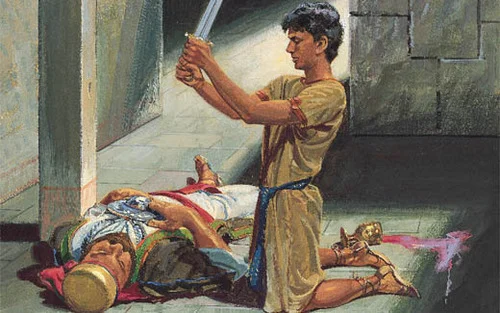
Today is a big day for Mormons. In a few hours, Mitt Romney will accept the Republican nomination for President of the United States. Mormons have come a long way from being a persecuted minority in the 19th Century to this moment. In 1838, the Mormons were driven out of Missouri: Lilburn Boggs, governor of Missouri, issued Missouri Executive Order 44, which read in part
…the Mormons must be treated as enemies, and must be exterminated or driven from the State if necessary for the public peace…
A few years later, with similar opposition brewing in Illinois, Joseph Smith, the founder of Mormonism, ran full-out for President of the United States on a third-party ticket, hoping among other things to gain Federal protection for the Mormons. But he lost that race, and a few years later, in 1844, Joseph Smith was murdered by a mob while in prison awaiting trial. Seeking safety, the main body of Mormons followed Joseph Smith’s successor Brigham Young to what would become Utah, with Brigham Young himself arriving in the Salt Lake valley on July 24, 1847. (The anniversary is a big celebration every year in Utah on July 24, rivaling the celebrations on July 4.) Ten years later, President James Buchanan sent an army out to Utah to bring the Mormons under subjection to the Federal government in what became called the “Utah War.” In 1887, Congress passed the Edmunds-Tucker Act, upheld by the Supreme Court in 1990, which disincorporated the Mormon Church and confiscated all of its property. So to have a Mormon nominated by a major party for President of the United States means a lot to Mormons. And it means a lot to me. Mormonism is no longer my religion. (See my posts “UU Visions” and “Teleotheism and the Purpose of Life.”) But the Mormons are still my people.
It is important for Americans to understand the Mormons in their midst. I hope the reports are true that say Mitt will speak more freely about his Mormonism tonight. (See for example Anna Fifield in the Financial Times: “Romney ready to reveal his Mormon soul.” and Colleen McCain Nelson and Patrick O'Connor “Mormon Faith to Take the Stage.”)
I want to add to that understanding by telling you an important Book of Mormon story–one that deserves to be pondered carefully: the story of Nephi and Laban. My telling of this story (not the story itself) is a parable, and in this is like my post “The Flat Tax, the Head Tax, and the Size of Government: A Tax Parable.”
My title “A Book of Mormon Story Every Mormon Boy and Girl Knows” is an exaggeration, but not by much. The story of Nephi and Laban is one of the most memorable stories in the Book of Mormon. And it comes in the third and fourth chapters in the entire Book of Mormon, so it is often one of the few stories read by those who begin to read the Book of Mormon and quit partway through. It is also a story alluded to obliquely many times later on in the Book of Mormon, since the “sword of Laban” that Nephi takes as a result of his confrontation with Laban becomes one of the key symbols of Nephite kingship.
The Book of Mormon is free online here.
In the third chapter of the Book of Mormon, Nephi’s father has a dream, in which God commands him to send his sons from their desert exile back to Jerusalem to ask Laban for a copy of the words of God (as they existed as of 600 B.C. or so in Israel)–a copy of the words of God that were written on “plates of brass.” (The “brass plates of Laban” should not be confused with the golden plates that Joseph Smith said he was given millenia later. Some Mormon scholars think the “brass plates” might actually have been made of bronze.) Nephi’s family needed these records of God’s word because they were soon to head on a journey across the ocean to the American continent, far away from Israel.
In response to his father’s report of this dream, Nephi responded in a way that has inspired many Mormons to obey Mormon Church leaders in the leaders’ role as “mouthpieces” of God:
And it came to pass that I, Nephi, said unto my father: I will go and do the things which the Lord hath commanded, for I know that the Lord giveth no commandments unto the children of men, save he shall prepare a way for them that they may accomplish the thing which he commandeth them. (1 Ne. 3:7)
After Nephi and his brothers traveled back to Jerusalem, Nephi’s older brother went to Laban and asked him for the brass plates recording the words of God. Laban’s response was to threaten to kill Nephi’s brother. Nephi’s brothers were then ready to give up, but Nephi was determined:
But behold I said unto them that: As the Lord liveth, and as we live, we will not go down unto our father in the wilderness until we have accomplished the thing which the Lord hath commanded us. (1 Ne. 3:15)
Nephi suggested taking all of the wealth his family had left behind in Jerusalem to try to buy the brass plates from Laban, explaining to his brothers:
Wherefore, let us be faithful in keeping the commandments of the Lord; therefore let us go down to the land of our father’sinheritance, for behold he left gold and silver, and all manner of riches. And all this he hath done because of the commandments of the Lord. For he knew that Jerusalem must be destroyed, because of the wickedness of the people. For behold, they have rejected the words of the prophets. Wherefore, if my father should dwell in the land after he hath been commanded to flee out of the land, behold, he would also perish. Wherefore, it must needs be that he flee out of the land. And behold, it is wisdom in God that we should obtain theserecords, that we may preserve unto our children the language of our fathers; and also that we may preserve unto them the words which have been spoken by the mouth of all the holy prophets, which have been delivered unto them by the Spirit and power of God, since the world began, even down unto this present time. (1 Ne. 3:16-20)
When they all went to talk to Laban with their valuables to trade for the brass plates, Laban was happy to take their valuables, but had his guards chase Nephi and his brothers off instead of giving them the brass plates. This occasioned a serious quarrel between Nephi and his brothers, in which Nephi’s brothers’ beating of Nephi was interrupted by an angel. Nephi’s brothers Laman and Lemuel were still not convinced:
And after the angel had departed, Laman and Lemuel again began to murmur, saying: How is it possible that the Lord will deliver Laban into our hands? Behold, he is a mighty man, and he can command fifty, yea, even he can slay fifty; then why not us? (1 Ne. 3:31)
Nephi gave a rousing reply:
And it came to pass that I spake unto my brethren, saying: Let us go up again unto Jerusalem, and let us be faithful in keeping the commandments of the Lord; for behold he is mightier than all the earth, then why not mightier than Laban and his fifty, yea, or even than his tens of thousands? (1 Ne. 4:1)
While his brothers hid outside of the walls of Jerusalem, Nephi sneaked into the city and toward Laban’s house, without a specific plan, but following his sense of inspiration. Near Laban’s house, he found Laban lying on the ground, drunk. Now comes the crux of the story, as Nephi faces an ethical dilemma. Nephi writes:
And I beheld his sword, and I drew it forth from the sheath thereof; and the hilt thereof was of pure gold, and the workmanship thereof was exceedingly fine, and I saw that the blade thereof was of the most precious steel. And it came to pass that I was constrained by the Spirit that I should kill Laban; but I said in my heart: Never at any time have I shed the blood of man. And I shrunk and would that I might not slay him. And the Spirit said unto me again: Behold the Lord hathdelivered him into thy hands. Yea, and I also knew that he had sought to take away mine own life; yea, and he would not hearken unto the commandments of the Lord; and he also had taken away our property. And it came to pass that the Spirit said unto me again: Slay him, for the Lord hath delivered him into thy hands; behold the Lord slayeth the wicked to bring forth his righteous purposes. It is better that one man should perish than that a nation should dwindle and perish in unbelief. And now, when I, Nephi, had heard these words, I remembered the words of the Lord which he spake unto me in the wilderness, saying that: inasmuch as thy seed shall keep mycommandments, they shall prosper in the land of promise. Yea, and I also thought that they could not keep the commandments of the Lord according to the law of Moses, save they should have the law. And I also knew that the law was engraven upon the plates of brass. And again, I knew that the Lord had delivered Laban into my hands for this cause—that I might obtain the records according to his commandments. Therefore I did obey the voice of the Spirit, and took Laban by the hair of the head, and I smote off his head with his own sword. (1 Ne. 4:9-18)
After that, by using Laban’s clothes and armor and his own acting skills, Nephi was able to get the brass plates and escape with them.
The key point I want to make about this story is that–because of God’s commandment by the Spirit when he was face to face with Laban–Nephi felt he was temporarily exempted from God’s earlier commandment “Thou shalt not kill,” without having to change his overall ethical outlook. Nephi went on to become a good king after his people arrived on the American continent with no indication that he had become more bloodthirsty as a result of killing Laban. Mormons sometimes debate among themselves whether Nephi could have gotten the brass plates by impersonating Laban without
killing
Laban–and some even ask whether Nephi, although inspired on other occasions, was really inspired on this occasion–but the majority opinion is that since God told Nephi to kill Laban, Nephi did the right thing. The story of Nephi and Laban, with its message of obedience to God and the need to sometimes break one rule for a higher purpose, while remaining a rule-abiding person in general, is a not-insignificant part of what makes believing Mormons the people they are.
Postscript
For my own views on a potential ethical dilemma in my own life that has some degree of structural similarity to the one addressed in this post, see my post
Jonathan Rauch on Democracy, Capitalism and Liberal Science
Jonathan Rauch gave a talk at a Campus Freedom Network Conference summarizing the argument in his book “Kindly Inquisitors: The New Attacks on Free Thought.” In addition to the link under the picture of Jonathan above, here is a link to a nice piece by Greg Lukianoff flagging the video:
Jonathan Rauch on Why Free Speech is Even More Important than You Thought.
I loved Jonathan’s talk. I was struck by the similarities between Jonathan’s arguments for academic freedom in this video and Milton Friedman’s arguments for capitalism in the videos I marshalled in Milton Friedman: Celebrating His 100th Birthday with Videos of Milton.
The key elements of what Jonathan calls “liberal science” are its decentralization (no one in particular is in charge) and its rules. The discipline of criticism is just as necessary for ideas floated in the academy as the discipline of the market is for enterprises. However painful systems of trial and error are, if we interfere with the systems of trial and error, we will be saddled with errors.
Although in this video Jonathan is talking mainly about liberal science and only in passing about capitalism, the parallels made me appreciate the strength of Milton’s arguments even more than I had. And Milton’s arguments in turn, by the parallels, strengthen Jonathan’s case for liberal science. Finally, the arguments for both liberal science and capitalism strengthen the case for democracy; and the arguments for democracy strengthen the case for both liberal science and capitalism.
Postscript: Speaking of decentralization, some government functions (such as taking care of the poor) might be better served if they could be decentralized to nonprofit organizations. In particular, such decentralization allows a trial and error process to work its magic as donations shift away from the least effective nonprofits to more effective nonprofits. Because people love freedom, such decentralization of certain government functions has other advantages as well, as I argue in my post “No Tax Increase Without Recompense.” In that post, I propose a way to make sure such nonprofit efforts are adequately funded.
Family Income Growth by Quintile Since 1950 →
Overall per capita GDP growth does not tell the whole story. The incomes of those in the top income categories and those in lower income categories have evolved in very different ways. Jordan Weissman lays out a graph that is very good at summarizing what has happened to the real incomes of different groups since 1950.
The Great Recession and Per Capita GDP →
Although recessions in the United States are officially determined by a committee of the independent and nonpartisan National Bureau of Economic Research (NBER)–usually long after the fact–a rough-and-ready definition of a recession is the period of time when real GDP (the actual amount of goods and services produced) is falling, if it falls for a period of at least six months. This period of time when real GDP is falling is very different from the period when real GDP is “in the hole” compared to its peak, let alone the period when real GDP per person is in the hole.
For the same level of GDP,
GDP/Population goes down when Population goes up,
and Population in the United States is growing.
Americans are used to real GDP not only growing, but keeping up with the growth of population, plus a couple of percent more each year. This link shows a graph of real GDP per capita since the beginning of the Great Recession. Since at least the beginning of 2008, real GDP has been doing quite a bit worse than Americans are used to.
Catherine Mulbrandon has made a great set of graphs on her Visualizing Economics website.
Here is a graph showing the history of the logarithm of real per capita GDP in the U.S. since 1871. With the logarithm on the vertical axis, the slope of the curve shows the percentage growth rate.
Here is a graph showing the history of real per capita GDP in the U.S. since 1871. You can see what the miracle of compound growth does.
Two Types of Knowledge: Human Capital and Information

Human Capital and Information. Knowledge can be either “human capital” or “information.” The difference is the resource cost of transferring a body of knowledge from one person to another. Here is the classification scheme I have in mind:
Human capital is knowledge that is hard to transfer.
Information is knowledge that is easy to transfer.
(This is a specific technical meaning of the word “information” for economics. I use the word “information” in a more general philosophical sense in my post “Ontology and Cosmology in 14 Tweets.”) Note that a given body of knowledge can shift from one category to another when technology changes. The words of the Iliad and the Odyssey were “human capital” when the only means of transferring this knowledge was oral transmission and memorization. When printing arose, the words of the Iliad and the Odyssey became “information." (See Albert Lord's The Singer of Tales on the original oral transmission of the Iliad and the Odyssey.)
Now comes the mid-post homework problem. Read Daniel Little’s description of the knowledge of how to fix machines or my abridged version of it just below, and classify the knowledge of how to fix machines as human capital or information. Here is Daniel Little’s opening paragraph:
There is a kind of knowledge in an advanced mechanical society that doesn’t get much attention from philosophers of science and sociologists of science, but it is critical for keeping the whole thing running. I’m thinking here of the knowledge possessed by skilled technicians and fixers – the people who show up when a complicated piece of equipment starts behaving badly. You can think of elevator technicians, millwrights, aircraft maintenance specialists, network technicians, and locksmiths.
Here is Daniel’s account of the level of difficulty of transferring this knowledge, based on his conversations with a fixer of mining machinery:
I said to him, you probably run into problems that don’t have a ready solution in the handbook. He said in some amazement, "none of the problems I deal with have textbook solutions. You have to make do with what you find on the ground and nothing is routine.” I also asked about the engineering staff back in Wisconsin. “Nice guys, but they’ve never spent any time in the field and they don’t take any feedback from us about how the equipment is failing.” He referred to the redesign of a heavy machine part a few years ago. The redesign changed the geometry and the moment arm, and it’s caused problems ever since. “I tell them what’s happening, and they say it works fine on paper. Ha! The blueprints have to be changed, but nothing ever happens.”
I would trust Tim to fix the machinery in my gold mine, if I had one. And it seems that he, and thousands of others like him, have a detailed and practical kind of knowledge about the machine and its functioning in a real environment that doesn’t get captured in an engineering curriculum. It is practical knowledge: “If you run into this kind of malfunction, try replacing the thingamajig and rebalance the whatnot.” It’s also a creative problem-solving kind of knowledge: “Given lots of experience with this kind of machine and these kinds of failures, maybe we could try X.” And it appears that it is a cryptic, non-formalized kind of knowledge. The company and the mine owners depend crucially on knowledge in Tim’s head and hands that can only be reproduced by another skilled fixer being trained by Tim.
In philosophy we have a few distinctions that seem to capture some aspects of this kind of knowledge: “knowing that” versus “knowing how”, epistime versus techne, formal knowledge versus tacit knowledge. Michael Polanyi incorporated some of these distinctions into his theory of science in Personal Knowledge: Towards a Post-Critical Philosophy sixty years ago, but I’m not aware of developments since then.
As a practical matter, Polanyi’s distinction between “knowing how” (formal knowledge) and “knowing that” (tacit knowledge) is so important for the costs of transferring knowledge from one person to another that it closely parallels the distinction between human capital and information.
Pure Technology. Let me assume that your answer to the homework problem is the same as mine: knowledge of how to fix machines has a large element of human capital. This has an important consequence: “technology” as we usually think of “technology” is not just made of the easily copied “recipes” that Paul Romer talks about in his Concise Encyclopedia of Economics article “Economic Growth.”
Suppose for the purposes of economic theory, we insist on defining “pure technology” as a recipe that can be cheaply replicated. Then “technology” in the ordinary sense has an element of human capital in it as well as “pure technology,” much as “profit” in the ordinary sense has an element of return to capital in it as well as “pure profit.” The pure technology for mining would include not only
- a plan for how the machines are used and repaired, but also
- a plan for having new operators learn how to operate the machines and for having new machine repairers learn from more experienced machine repairers.
The “technology” in the ordinary sense is human capital for using and repairing the machines–that is, already embedded knowledge produced from 1, 2 and learning time.
Economic Metaknowledge. In addition to straight ideas or recipes, Paul Romer emphasizes the importance of meta-ideas:
Perhaps the most important ideas of all are meta-ideas. These are ideas about how to support the production and transmission of other ideas. The British invented patents and copyrights in the seventeenth century. North Americans invented the agricultural extension service in the nineteenth century and peer-reviewed competitive grants for basic research in the twentieth century.
There are many meaning of the prefix “meta.” Paul is using “meta” so that “meta-X” means “things in category X to foster the production and transmission of things in category X.” When another meaning of “meta-” might otherwise intrude, let’s use “economic meta-X” for this meaning. Then with the distinction between human capital and information in hand, there are at least four types of economic metaknowledge–knowledge to foster the production and transmission of knowledge:
- Meta-human-capital: human capital to foster the production and transmission of human capital. (Teaching skill is the most important example.)
- Economic meta-information: information to foster the production and transmission of information. (Many of the most important software programs are in this category: Microsoft Office, the software behind Social Media such as Tumblr, Twitter, and Facebook, TiVo’s software, the software behind the web itself…. Also, computer science and electrical engineering journals on library shelves contain some economic meta-information. In its time, a 17th Century printer’s manual would count.)
- Human capital to foster the production and transmission of ideas. (Research skill– including the skill of writing academic papers–is a good example.)
- Information to foster the production and transmission of human capital. (The contents of Daniel Willingham’s book Why Don’t Students Like School? are an excellent example that I highly recommend. He draws his suggestions for teaching from the U.S. Department of Education’s What Works Clearinghouse)
Extra Credit: Figure out how Paul Romer’s meta-ideas listed above–patents and copyrights, agricultural extension services, and peer-reviewed competitive grants–fit into this fourfold division of economic metaknowledge.
Rumsfeldian Metaknowledge. According to Colin Powell (as excerpted in the Appendix below and given more fully at this link) we can blame Donald Rumsfeld’s unchecked insubordination in disbanding the Iraqi Army for some portion of the long hard slog we faced in the War in Iraq since 2003, but Donald did coin a memorable description of another kind of metaknowledge. Here is the 21-second video, and here is the transcript:
[T]here are known knowns; there are things we know that we know.
There are known unknowns; that is to say there are things that, we now know we don’t know. But there are also unknown unknowns–there are things we do not know, we don’t know.
Metaknowledge in this sense of knowing what one knows and knowing what one doesn’t know often has great economic value, whether in daily life, business and policy making. But metaknowledge in this Rumsfeldian sense–even economically valuable Rumsfeldian metaknowledge–should be distinguished from “economic metaknowledge” as I define it above.
Appendix.Here is what Colin Powell wrote:
When we went in, we had a plan, which the president approved. We would not break up and disband the Iraqi Army. We would use the reconstituted Army with purged leadership to help us secure and maintain order throughout the country. We would dissolve the Baath Party, the ruling political party, but we would not throw every party member out on the street. In Hussein’s day, if you wanted to be a government official, a teacher, cop, or postal worker, you had to belong to the party. We were planning to eliminate top party leaders from positions of authority. But lower-level officials and workers had the education, skills, and training needed to run the country.
The plan the president had approved was not implemented. Instead, Secretary Donald Rumsfeld and Ambassador L. Paul Bremer, our man in charge in Iraq, disbanded the Army and fired Baath Party members down to teachers. We eliminated the very officials and institutions we should have been building on, and left thousands of the most highly skilled people in the country jobless and angry—prime recruits for insurgency. These actions surprised the president, National Security Adviser Condi Rice, and me, but once they had been set in motion, the president felt he had to support Secretary Rumsfeld and Ambassador Bremer.
The Litany Against Fear
Tomorrow I am going to the dentist, and in all probability will need a root canal. One thing that has been helpful to me in the past in facing the medium-sized fear appropriate to the dentist’s chair is the Bene Gesserit litany against fear, from Frank Herbert’s Science Fiction blockbuster Dune. Here it is:
I must not fear.
Fear is the mind-killer.
Fear is the little-death that brings total obliteration.
I will face my fear.
I will permit it to pass over me and through me.
And when it has gone past I will turn the inner eye to see its path.
Where the fear has gone there will be nothing.
Only I will remain.
Posts on Religion, Philosophy, Science, Literature and Culture through August 27, 2012
- Miles’s Linguistics Master’s Thesis: The Later Wittgenstein, Roman Jakobson and Charles Saunders Peirce
- Miles’s April 9, 2006 Unitarian Universalist Sermon: “UU Visions”
- Milan Kundera on the Contribution of Novels to the Liberal Imagination
- Teleotheism and the Purpose of Life
- Will Mitt’s Mormonism Make Him a Supply-Side Liberal?
- How the Mormons Became Largely Republican
- Ontology and Cosmology in 14 Tweets
- Grammar Girl: Speaking Reflexively
- Big Brother Speaks: Christian Kimball on Mitt Romney
- Should Everyone Spend Less than He or She Earns?
- The Matrix and Other Worlds: The Videos
- Isomorphismes on Enclosures
- Diana Kimball on Reading the Reader
- Persuasion
- The Egocentric Illusion
- What is a Partisan Nonpartisan Blog?
Update: