Preparing the Ground for Mathematical Creativity

Link to the ungated article shown above
Let me share my own experience with—and advice for—mathematical creativity. Mathematical creativity is usually required in order to develop a proof, to figure out how to mathematically model something of a type that has never been mathematically modeled before, or to figure out what kins of statistical method will work in an analysis unlike previous analyses.
The first piece of advice based on my own experience—backed up by scholarly work such as that in the paper “The Characteristics of Mathematical Creativity” is that you really want to get your subsconscious in gear working on the math problem. In the workings of our brains, consciousness is a tiny window on a large mansion. Simply because the throughput in consciousness is so small, most of the activity of the brain is unconscious. So getting the rest of your brain to work on a problem is a key to mathematical creativity. (Call it the subconscious, the unconscious or the nonconscious—for this discussion it is all the same.)
But how do you get your subconscious working on a math problem? That answer: it takes a lot of hard work on a math problem before your subconscious takes the hint that it should work away at the problem. A lot of that conscious hard work may feel like banging your head against a wall, but it credibly communicates the urgency of the problem to your subconscious. This is analogous to the memory principle that it is those things which you make an effort to remember (and in large part, only those) that your brain assumes are worth storing in long-term memory—a principle I discuss in “The Most Effective Memory Methods are Difficult—and That's Why They Work.”
The second piece of advice is that it helps to develop your ability to think productively about a math problem without a piece of paper in front of you. This makes it easier for both your conscious and unconscious mind to think about the problem when you are at your most creative. Also, simply trying to keep track of a math problem without a piece of paper in front of you requires continually going back to the basics and trying to remember what the overall objective and intermediate objectives were. That is, not having a piece of paper in front of you forces you to focus on the forest, rather than on the trees.
One of the times I am most creative is when I am on a walk. That is true for at least two reasons. One is that most people are smarter during exercise. The other is that exercise and interesting surroundings can calm the mind.
In order to think about a math problem while on a walk, it is helpful to do preprocessing of the problem to strip off the fundamentally easy but distracting parts of the problem from the hard kernel of the math problem. Then thinking about a math problem on a walk requires persistence and patience. I lose my thread of thought many times as I think about a problem in this way, but every time I pick up of the thread after losing it strengthens my mathematical ability a little bit.
The third piece of advice is to strengthen one’s mental muscles for thinking about a problem in different ways. For me that often means practicing thinking geometrically. See my post “Why Thinking Geometrically and Graphically is Such a Powerful Way to Do Math.”
The third piece of advice is that after getting some picture in your head of the kernel of how to do a math problem, you then need to sit down with a piece of paper or computer screen in front of you and begin to work out the details. An alternative is to get someone to try to explain the solution idea to. However you begin working through the details, you will often discover new things in that process of working out the details.
Overall, in my experience, the path for mathematical creativity is conscious—>subconscious—>conscious. (Sometimes there are many more alternations between conscious and subconscious than that.)
The fourth and final piece of advice is to revisit math problems from time to time, even long after you originally found a solution that seemed reasonably satisfying at the time. Once you have gotten your subconscious working on a problem, it often doesn’t stop, even after you have accomplished whatever your immediate goal was in working on the problem. And the passage of months and years often leads you to bump into ideas that can help with a deeper solution to the problem. The bottom line is that, if you are like me, you will often have a deeper insight into an old problem if you think about it again months or years later.
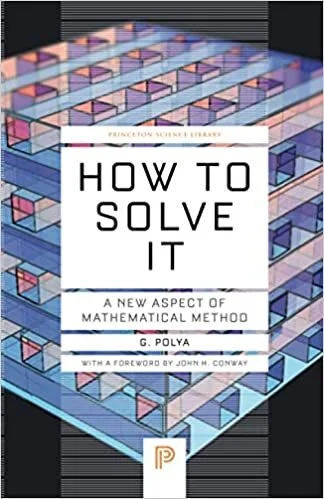
Mathematical creativity is a lot of fun. And it is more learnable than most people think. I have a favorite book to recommend for those who want to build their mathematical creativity: George Polya’s How to Solve It:
Don’t buy into the idea that mathematical ability is mostly determined by what you were born with. Instead, read “There's One Key Difference Between Kids Who Excel at Math and Those Who Don't” and “How to Turn Every Child into a 'Math Person'.”
I have links to many other posts on math in my post “Gabriela D'Souza on Failure in Learning Math”
On calming the mind, which can enhance creativity, see “Judson Brewer, Elizabeth Bernstein and Mitchell Kaplan on Finding Inner Calm” and the links at the bottom of that post.
EdX: Introduction to Biology—The Secret of Life →
Hans Taparia gives the following recommendation for the EdX course of this post’s title in his New York Times op-ed “The Future of College Is Online, and It’s Cheaper”:
Most biology professors, for instance, would find themselves hard pressed to match the pedagogical quality, production values and inspirational nature of Eric Lander’s online Introduction to Biology course at M.I.T. That free course currently has over 134,000 students enrolled this semester.
Hans also mentions Georgia Tech’s inexpensive online MBA:
Georgia Tech, a top engineering school, launched an online masters in computer science in 2014. The degree costs just $7,000 (one-sixth the cost of its in-person program), and the school now has nearly 10,000 students enrolled, making it the largest computer science program in the country. Notably, the online degree has not cannibalized its on-campus revenue stream. Instead, it has opened up a prestigious degree program to a different population, mostly midcareer applicants looking for a meaningful skills upgrade.
How to Make Ramadan Fasting—or Any Other Religious Fasting—Easier

This is the first full day of Ramadan this year. During Ramadan, Muslims are not supposed to eat or drink anything between sunrise and sunset. That includes coffee. Raja Abdulrahim’s April 7, 2021 Wall Street Journal article “Could You Go for a Month Without Coffee?” tells of the careful preparations some Muslims go to to avoid caffeine withdrawal during Ramadan with its no-coffee stretches longer than 12 hours.
What would make Ramadan fasting even easier is preparing to avoid carb withdrawal during Ramadan. If the body is adapted to sugar and other easily digested carbs, going without food for over 12 hours can be very hard. But if the body is adapted to a high-fat low-carb diet, then going without food for over 12 hours can be quite easy.
My knowledge of Islam is only second-hand, but the Ramadan meals before sunrise and after sunset seem to have important social and religious significance. For example, the Wikipedia article “Suhur” (the pre-dawn meal) reports ""The Prophet said, 'take suhur as there is a blessing in it.'" So a full fast—or eating only one meal a day during Ramadan—may not be acceptable. But it should be religiously acceptable to make one’s meals during Ramadan (and ideally for a week or two beforehand) low-carb and high fat. For example, the pre-dawn meal could be scrambled eggs and a whole avocado. Then, even if the evening meal is a big social gathering, it might be possible to eat more meat and avoid the bread, pastry, rice and sugary treats.
For other food options that should make fasting easier, look at the list of low-insulin-index foods in “Forget Calorie Counting; It's the Insulin Index, Stupid,” supplemented by the information in “Using the Glycemic Index as a Supplement to the Insulin Index.” (Also, note that both the insulin index and the glycemic index give effects per 100 calories of food consumed. For most non-starchy vegetables, 100 calories worth looks like quite a big serving.)
A similar approach could work for those celebrating the Jewish holiday of Yom Kippur and for Mormons doing their fast ending on the first Sunday of each month.
And a similar approach can work if one is making fasting a regular part of one’s health regimen. The one difference between a religiously motivated fast and a fast for health is that a fast for health should ideally allow the drinking of water, while many religious fasts require abstaining from water.
Anyone who physically suffers during fasting now would be well advised to try preparing for fasting by surrounding the fast by low-carb eating. I’d be interested to hear about people’s experiences trying this.
For annotated links to other posts on diet and health, see:
Making Lessons Fun Does Not Help Children Learn →
In this spirit, don’t miss my column “The Most Effective Memory Methods are Difficult—and That's Why They Work.”
The Federalist Papers #28: The Federal Government and States Can Check One Another’s Power, Reducing the Chance of Abuses—Alexander Hamilton

Alexander Hamilton’s key argument in the Federalist Papers #28 is in this passage:
Power being almost always the rival of power, the general government will at all times stand ready to check the usurpations of the state governments, and these will have the same disposition towards the general government. The people, by throwing themselves into either scale, will infallibly make it preponderate.
He contrasts the difficulty of dealing with an evil federal government with the difficult of dealing with an evil state government if a state was a nation unto itself. If a state was a nation unto itself, it is hard to defeat tyrants running the state:
In a single state, if the persons intrusted with supreme power become usurpers, the different parcels, subdivisions, or districts of which it consists, having no distinct government in each, can take no regular measures for defense. The citizens must rush tumultuously to arms, without concert, without system, without resource; except in their courage and despair. The usurpers, clothed with the forms of legal authority, can too often crush the opposition in embryo. The smaller the extent of the territory, the more difficult will it be for the people to form a regular or systematic plan of opposition, and the more easy will it be to defeat their early efforts. Intelligence can be more speedily obtained of their preparations and movements, and the military force in the possession of the usurpers can be more rapidly directed against the part where the opposition has begun. In this situation there must be a peculiar coincidence of circumstances to insure success to the popular resistance.
By contrast, states have many resources to deal with an evil federal government. Alexander Hamilton overstates the case somewhat in this passage, but his basic idea is sound:
State governments will, in all possible contingencies, afford complete security against invasions of the public liberty by the national authority. Projects of usurpation cannot be masked under pretenses so likely to escape the penetration of select bodies of men, as of the people at large. The legislatures will have better means of information. They can discover the danger at a distance; and possessing all the organs of civil power, and the confidence of the people, they can at once adopt a regular plan of opposition, in which they can combine all the resources of the community. They can readily communicate with each other in the different States, and unite their common forces for the protection of their common liberty.
Alexander Hamilton also argues that the geographical extent of the Union will afford an advantage to states vis a vis the federal government should it turn tyrannical:
The great extent of the country is a further security. We have already experienced its utility against the attacks of a foreign power. And it would have precisely the same effect against the enterprises of ambitious rulers in the national councils. If the federal army should be able to quell the resistance of one State, the distant States would have it in their power to make head with fresh forces. The advantages obtained in one place must be abandoned to subdue the opposition in others; and the moment the part which had been reduced to submission was left to itself, its efforts would be renewed, and its resistance revive.
I view the American Civil War as a good test of Alexander Hamilton’s claims. It was indeed easy for a group of states to organize against the federal government. Had their cause been just, they probably would have prevailed—perhaps most likely by a different result in the 1864 presidential election. The injustice of the cause Confederacy tipped the balance against it; therefore the Confederacy lost. It is not as if this equation is absolute, but democratic traditions and organized governments on both sides of a conflict tend to give an advantage to the side that has more right on its side, at least in the eyes of the majority of the people.
Much of the rest of Alexander Hamilton’s argument boils down pointing out that the arguments of critics of the power of a federal government to raise an army apply at least equally to the states. But the states did in fact raise armies to quell rebellions within themselves, and most people could see the necessity of that.
Below is the full text of the Federalist Papers #28, to give the full context. (I have put the content of the footnote in square brackets at the location where it appears.)
FEDERALIST NO. 28
The Same Subject Continued: The Idea of Restraining the Legislative Authority in Regard to the Common Defense Considered
For the Independent Journal.
Author: Alexander Hamilton
To the People of the State of New York:
THAT there may happen cases in which the national government may be necessitated to resort to force, cannot be denied. Our own experience has corroborated the lessons taught by the examples of other nations; that emergencies of this sort will sometimes arise in all societies, however constituted; that seditions and insurrections are, unhappily, maladies as inseparable from the body politic as tumors and eruptions from the natural body; that the idea of governing at all times by the simple force of law (which we have been told is the only admissible principle of republican government), has no place but in the reveries of those political doctors whose sagacity disdains the admonitions of experimental instruction.
Should such emergencies at any time happen under the national government, there could be no remedy but force. The means to be employed must be proportioned to the extent of the mischief. If it should be a slight commotion in a small part of a State, the militia of the residue would be adequate to its suppression; and the national presumption is that they would be ready to do their duty. An insurrection, whatever may be its immediate cause, eventually endangers all government. Regard to the public peace, if not to the rights of the Union, would engage the citizens to whom the contagion had not communicated itself to oppose the insurgents; and if the general government should be found in practice conducive to the prosperity and felicity of the people, it were irrational to believe that they would be disinclined to its support.
If, on the contrary, the insurrection should pervade a whole State, or a principal part of it, the employment of a different kind of force might become unavoidable. It appears that Massachusetts found it necessary to raise troops for repressing the disorders within that State; that Pennsylvania, from the mere apprehension of commotions among a part of her citizens, has thought proper to have recourse to the same measure. Suppose the State of New York had been inclined to re-establish her lost jurisdiction over the inhabitants of Vermont, could she have hoped for success in such an enterprise from the efforts of the militia alone? Would she not have been compelled to raise and to maintain a more regular force for the execution of her design? If it must then be admitted that the necessity of recurring to a force different from the militia, in cases of this extraordinary nature, is applicable to the State governments themselves, why should the possibility, that the national government might be under a like necessity, in similar extremities, be made an objection to its existence? Is it not surprising that men who declare an attachment to the Union in the abstract, should urge as an objection to the proposed Constitution what applies with tenfold weight to the plan for which they contend; and what, as far as it has any foundation in truth, is an inevitable consequence of civil society upon an enlarged scale? Who would not prefer that possibility to the unceasing agitations and frequent revolutions which are the continual scourges of petty republics?
Let us pursue this examination in another light. Suppose, in lieu of one general system, two, or three, or even four Confederacies were to be formed, would not the same difficulty oppose itself to the operations of either of these Confederacies? Would not each of them be exposed to the same casualties; and when these happened, be obliged to have recourse to the same expedients for upholding its authority which are objected to in a government for all the States? Would the militia, in this supposition, be more ready or more able to support the federal authority than in the case of a general union? All candid and intelligent men must, upon due consideration, acknowledge that the principle of the objection is equally applicable to either of the two cases; and that whether we have one government for all the States, or different governments for different parcels of them, or even if there should be an entire separation of the States, there might sometimes be a necessity to make use of a force constituted differently from the militia, to preserve the peace of the community and to maintain the just authority of the laws against those violent invasions of them which amount to insurrections and rebellions.
Independent of all other reasonings upon the subject, it is a full answer to those who require a more peremptory provision against military establishments in time of peace, to say that the whole power of the proposed government is to be in the hands of the representatives of the people. This is the essential, and, after all, only efficacious security for the rights and privileges of the people, which is attainable in civil society.[Its full efficacy will be examined hereafter.]
If the representatives of the people betray their constituents, there is then no resource left but in the exertion of that original right of self-defense which is paramount to all positive forms of government, and which against the usurpations of the national rulers, may be exerted with infinitely better prospect of success than against those of the rulers of an individual state. In a single state, if the persons intrusted with supreme power become usurpers, the different parcels, subdivisions, or districts of which it consists, having no distinct government in each, can take no regular measures for defense. The citizens must rush tumultuously to arms, without concert, without system, without resource; except in their courage and despair. The usurpers, clothed with the forms of legal authority, can too often crush the opposition in embryo. The smaller the extent of the territory, the more difficult will it be for the people to form a regular or systematic plan of opposition, and the more easy will it be to defeat their early efforts. Intelligence can be more speedily obtained of their preparations and movements, and the military force in the possession of the usurpers can be more rapidly directed against the part where the opposition has begun. In this situation there must be a peculiar coincidence of circumstances to insure success to the popular resistance.
The obstacles to usurpation and the facilities of resistance increase with the increased extent of the state, provided the citizens understand their rights and are disposed to defend them. The natural strength of the people in a large community, in proportion to the artificial strength of the government, is greater than in a small, and of course more competent to a struggle with the attempts of the government to establish a tyranny. But in a confederacy the people, without exaggeration, may be said to be entirely the masters of their own fate. Power being almost always the rival of power, the general government will at all times stand ready to check the usurpations of the state governments, and these will have the same disposition towards the general government. The people, by throwing themselves into either scale, will infallibly make it preponderate. If their rights are invaded by either, they can make use of the other as the instrument of redress. How wise will it be in them by cherishing the union to preserve to themselves an advantage which can never be too highly prized!
It may safely be received as an axiom in our political system, that the State governments will, in all possible contingencies, afford complete security against invasions of the public liberty by the national authority. Projects of usurpation cannot be masked under pretenses so likely to escape the penetration of select bodies of men, as of the people at large. The legislatures will have better means of information. They can discover the danger at a distance; and possessing all the organs of civil power, and the confidence of the people, they can at once adopt a regular plan of opposition, in which they can combine all the resources of the community. They can readily communicate with each other in the different States, and unite their common forces for the protection of their common liberty.
The great extent of the country is a further security. We have already experienced its utility against the attacks of a foreign power. And it would have precisely the same effect against the enterprises of ambitious rulers in the national councils. If the federal army should be able to quell the resistance of one State, the distant States would have it in their power to make head with fresh forces. The advantages obtained in one place must be abandoned to subdue the opposition in others; and the moment the part which had been reduced to submission was left to itself, its efforts would be renewed, and its resistance revive.
We should recollect that the extent of the military force must, at all events, be regulated by the resources of the country. For a long time to come, it will not be possible to maintain a large army; and as the means of doing this increase, the population and natural strength of the community will proportionably increase. When will the time arrive that the federal government can raise and maintain an army capable of erecting a despotism over the great body of the people of an immense empire, who are in a situation, through the medium of their State governments, to take measures for their own defense, with all the celerity, regularity, and system of independent nations? The apprehension may be considered as a disease, for which there can be found no cure in the resources of argument and reasoning.
PUBLIUS.
Links to my other posts on The Federalist Papers so far:
The Federalist Papers #1: Alexander Hamilton's Plea for Reasoned Debate
The Federalist Papers #3: United, the 13 States are Less Likely to Stumble into War
The Federalist Papers #4 B: National Defense Will Be Stronger if the States are United
The Federalist Papers #5: Unless United, the States Will Be at Each Others' Throats
The Federalist Papers #6 A: Alexander Hamilton on the Many Human Motives for War
The Federalist Papers #11 A: United, the States Can Get a Better Trade Deal—Alexander Hamilton
The Federalist Papers #12: Union Makes it Much Easier to Get Tariff Revenue—Alexander Hamilton
The Federalist Papers #13: Alexander Hamilton on Increasing Returns to Scale in National Government
The Federalist Papers #14: A Republic Can Be Geographically Large—James Madison
The Federalist Papers #21 A: Constitutions Need to be Enforced—Alexander Hamilton
The Federalist Papers #24: The United States Need a Standing Army—Alexander Hamilton
The Federalist Papers #27: People Will Get Used to the Federal Government—Alexander Hamilton
T. K. Rengarajan on the Coming Transformation of Education →
The title of the post links to T. K. Rengarajan’s Twitter thread on this. On the same topic, don’t my column “The Coming Transformation of Education: Degrees Won’t Matter Anymore, Skills Will.”
James Wells on the Evolution of the Standard Model of Physics →
Also, don’t miss James’s guest post “James Wells: The Discovery of the Higgs Boson Opens Up Other Puzzles in Particle Physics.”
Did the Pandemic Speed Up Productivity Growth?
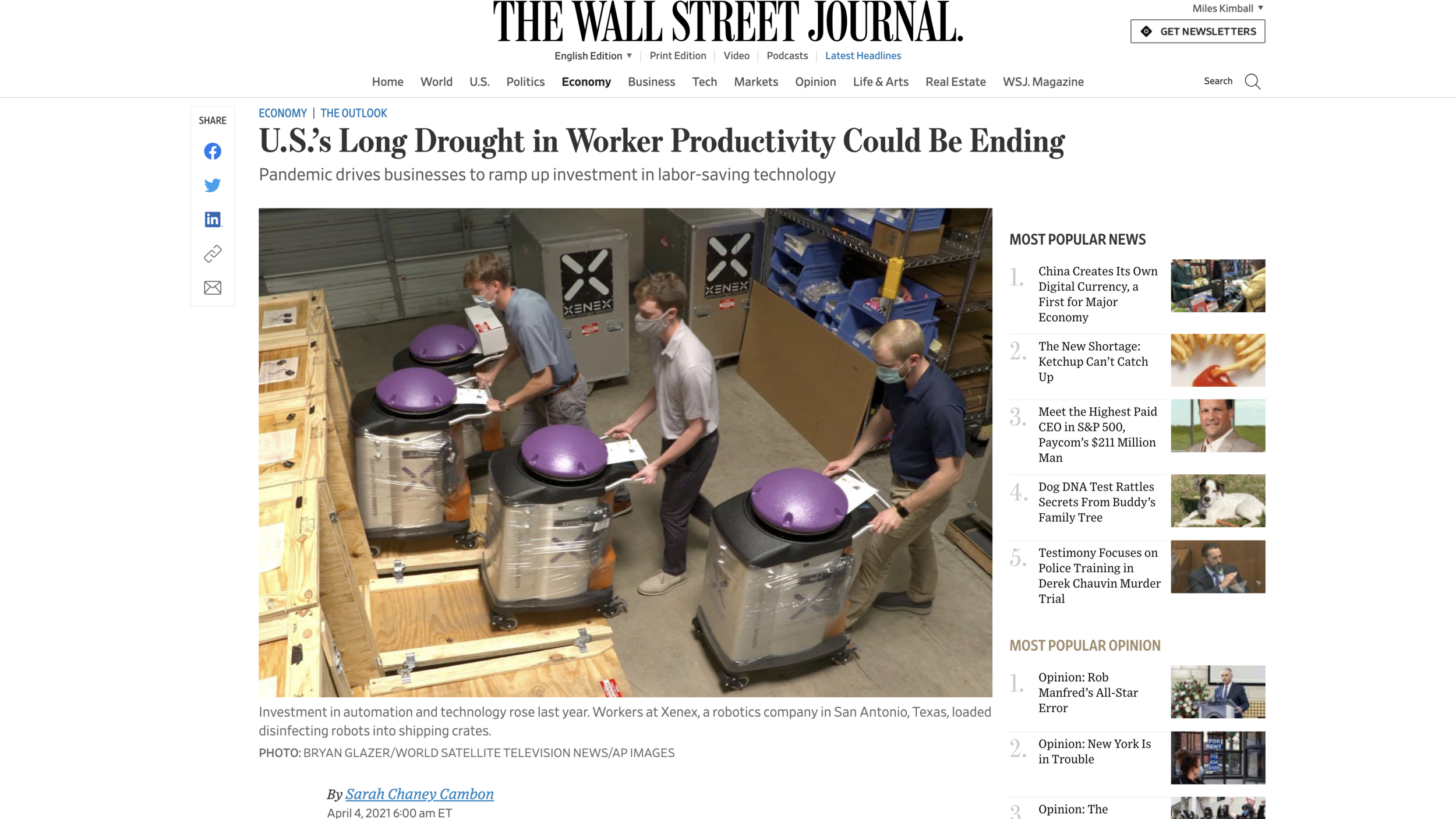
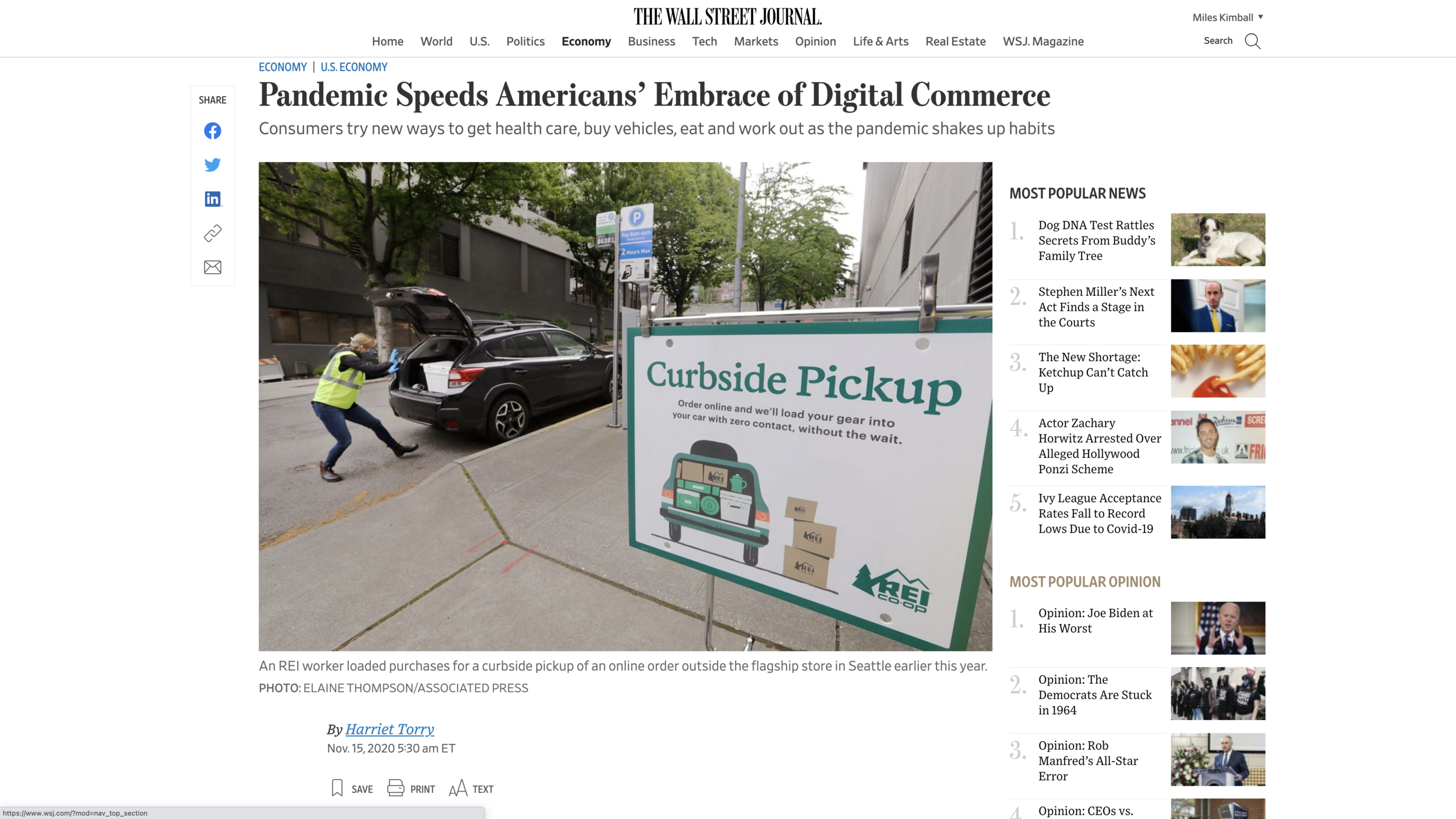

The Covid-19 Pandemic may have sped up technological progress and thereby productivity growth. In addition to the technology for vaccine discovery and production, the Pandemic seems to be speeding up the transition to a larger share of online purchases and a larger share of in-person purchases being made with credit or debit cards instead of cash. In addition, a much larger share of business meetings and doctor visits are being done by video chat. And the shift to at-home viewing of TV shows and movies has been pushed forward.
Sarah Chaney Cambon’s April 4, 2021 Wall Street Journal article “U.S.’s Long Drought in Worker Productivity Could Be Ending” explains the importance of productivity growth, gives a bit of the history of productivity growth, and gives examples of the better ways of doing things that represent technological progress that fuels productivity growth. Unless noted otherwise, all quotations below are from that article.
The Importance and History of Productivity Growth:
On the importance of productivity growth, Sarah writes:
… productivity … is defined as output per hour worked. Stronger productivity growth is key to the economy’s long-term success. Economic growth depends on the number of workers and how much they produce. …
Higher productivity growth should also put more money into people’s pockets because wages are tied to how much workers produce.
Here is Sarah’s nutshell history of productivity growth since soon after World War II:
Productivity growth tends to move in multiyear trends, reflecting shifts in the structure of the economy. Excluding farms and government, it grew 2.8% a year from 1949 until the oil shock of 1973, then slowed to 1.4% from 1974 to 1995, sped up to 3% from 1996 to 2005 with the spread of computers and the internet, then slowed again, to 1.4% between 2006 and 2019. Last year it accelerated to 2.4% in the fourth quarter of 2020 from the same period a year earlier, although that was because the coronavirus triggered steep job losses in lower-wage sectors that tend to be less productive.
Some Paths to Productivity Improvement
On how productivity is improving, one salient fact at the macroeconomic level is that technological progress—and therefore productivity growth—are just as much a matter of adoption as it is of invention. By helping to overcome resistance to adoption, the Pandemic also points out how resistance to adoption of new technologies by consumers and by businesses can slow down technological progress. Sarah quotes Constance Hunter, chief economist at KPMG as saying:
The pandemic shocked older people into using technology and has shocked the economy in general into adopting technology.
What are some key examples of doing things in a better, often more efficient way?
More Online Purchases:
Sarah refers to Robert Gordon giving the idea that:
A shift toward e-commerce should push up productivity by eliminating workers needed in bricks-and-mortar stores
Doctor Visits by Video Chat:
Healthcare could see a burst in productivity after Covid-19 subsides. At Stanford Health Care CardioClick Clinic based in Stanford, Calif., virtual consultations surged during the pandemic. Patients could hop on a video call to discuss their diet, exercise and sleep patterns with a medical expert.
Video visits at the cardio clinic last about 22 minutes, whereas in-person visits tend to last three times as long. Video consultations are also much more likely to end on time …
Reducing the Waste of Excessive Commuting and Business Travel:
With the adoption of Zoom and Microsoft Teams, videoconferencing can replace some business conferences. As a result, workers won’t lose productive work hours traveling long distances. They will also have more energy to engage because they no longer have to deal with the hassle of daily commutes. Remote work could deliver a one-time 4.7% lift to productivity after the pandemic, though a large share of the growth will stem from shortened commutes that government productivity data won’t fully capture, according to a working paper from Stanford University’s Nicholas Bloom and co-authors.
I want to highlight Nicholas Bloom’s point that although our lives could become a lot better if we can commute less, standard government statistics don’t count commuting hours as part of the cost of production. So they miss this improvement.
The More Distant Future:
Many of these trends can be considered part of what Joel Mokyr calls “dematerialization” and Alan Greenspan talked about as GDP getting lighter in weight. Greg Ip’s December 26, 2020 Wall Street Journal article “Covid-19 Propelled Businesses Into the Future. Ready or Not” has an interesting quotation from Joel Mokyr:
Mr. Mokyr cautioned dematerialization can’t continue indefinitely: “Diminishing returns works here as well. We can mimic reality, but we are not digital creatures ourselves, and..., our evolutionary background will continue to demand physical experiences.
Although Joel Mokyr is right that human beings are not now digital creatures, we may well be digital creatures in the future, opening up many more opportunities for technological progress. The possible future of humanity becoming digital beings is an emerging theme on this blog. (See the links collected in my post “Embodiment.”)
Conclusion:
The future of technology is inherently hard to see; if we could see all the details of a technology, we would already have that technology. And people have a hard time guess which kinds of progress will be easy and which kinds of progress will be hard. We don’t have a lot of flying cars, but we do have wonders of computer technology and genetic technology.
It is probably easier to guess the rate of adoption of a technology that has already been worked out. Hence, technological progress at the macroeconomic level should be somewhat predictable during the period between invention and widespread adoption.
One area of technology that is understudied is technology based on social science. There is a chance, for example, that even leaving aside drugs, improvements in psychology could make our lives a lot better. On that, see the links at the bottom of “Elizabeth Bernstein on Getting Better Sleep.” And improvements in knowledge about diet and health might do as much as hardcore medical advances to improve human health. See “Miles Kimball on Diet and Health: A Reader's Guide.”
In Praise of the Squatty Potty


Oprah Winfrey has affected my health practices in at least two ways. First, I use a neti pot. (See “Cost Benefit Analysis Applied to Neti Pot Use.”) Second, I use a Squatty Potty. My own personal experience matches the average experience of those in the study discussed (in both text and video) in Jamie Ducharme’s January 10, 2019 Time article “Scientists Say This Popular Bathroom Accessory Really Does Help You Poop Better.” The design is also well done. It scoots under the toilet out of the way when not in use. Having a Squatty Potty for each toilet in the house has made my life better. I recommend it. That is about all there is to say.
For annotated links to other posts on diet and health, see:
George Selgin Defends Nominal GDP Targeting →
The title to this post is a link to George Selgin’s Twitter thread.
I write about nominal GDP targeting in
I tell my students—based on the equation of exchange MV = PY, that nominal GDP targeting (targeting PY) can also be described equivalently as targeting the velocity-adjusted money supply MV.
Easter Skepticism
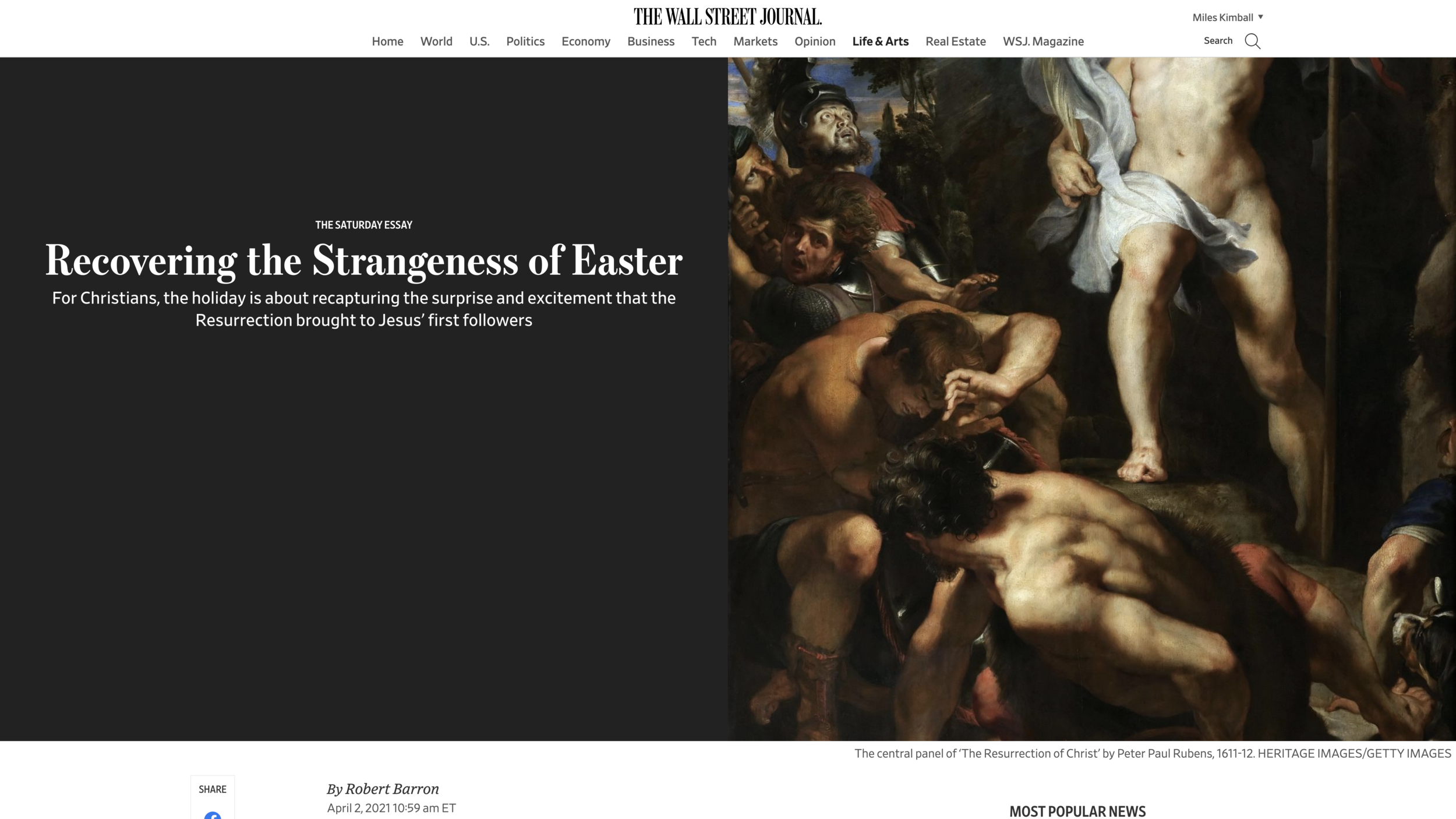
A few Easters ago, I posted “What If Jesus Was Really Resurrected?” giving the pro-resurrection case for non-supernaturalists. This Easter, I’ll give a more skeptical take.
In his April 2, 2021 essay “Recovering the Strangeness of Easter” in the Wall Street Journal, Robert Barron objects to watering down the Resurrection by treating it as a metaphor:
Especially today, it is imperative that Christians recover the sheer strangeness of the Resurrection of Jesus and stand athwart all attempts to domesticate it. There were a number of prominent theologians during the years that I was going through the seminary who watered down the Resurrection, arguing that it was a symbol for the conviction that the cause of Jesus goes on, or a metaphor for the fact that his followers, even after his horrific death, felt forgiven by their Lord.
But this is utterly incommensurate with the sheer excitement on display in the Resurrection narratives and in the preaching of the first Christians.
To understand what it means to treat the Resurrection of Jesus as literal, rather than as a metaphor, John Updike’s poem “Seven Stanzas at Easter” is eloquent:
Seven Stanzas at Easter
John Updike
“Seven Stanzas at Easter
Make no mistake: if He rose at all
it was as His body;
if the cells’ dissolution did not reverse, the molecules
reknit, the amino acids rekindle,
the Church will fall.
It was not as the flowers,
each soft Spring recurrent;
it was not as His Spirit in the mouths and fuddled
eyes of the eleven apostles;
it was as His flesh: ours.
The same hinged thumbs and toes,
the same valved heart
that—pierced—died, withered, paused, and then
regathered out of enduring Might
new strength to enclose.
Let us not mock God with metaphor,
analogy, sidestepping, transcendence;
making of the event a parable, a sign painted in the
faded credulity of earlier ages:
let us walk through the door.
The stone is rolled back, not papier-mache,
not a stone in a story,
but the vast rock of materiality that in the slow
grinding of time will eclipse for each of us
the wide light of day.
And if we will have an angel at the tomb,
make it a real angel,
weighty with Max Planck’s quanta, vivid with hair,
opaque in the dawn light, robed in real linen
spun on a definite loom.
Let us not seek to make it less monstrous,
for our own convenience, our own sense of beauty,
lest, awakened in one unthinkable hour, we are
embarrassed by the miracle,
and crushed by remonstrance.”
To those who explain the Resurrection account as myth, Robert Barron brings in C. S. Lewis’s argument that the specificity of the account of the Resurrection is not much like a myth:
The problem with these modes of explanation was well articulated by C.S. Lewis: Those who think that the New Testament is a myth just haven’t read many myths. Precisely because they have to do with timeless verities and the great natural and psychological constants, mythic narratives are situated “once upon a time,” or to bring things up to date, “a long time ago, in a galaxy far, far away.” No one wonders who was Pharaoh during Osiris’s time or during which era of Greek history Heracles performed his labors, for these tales are not historically specific.
But the Gospel writers are keen to tell us that Jesus’ birth, for instance, took place while Quirinius was governor of Syria and Augustus the Emperor of Rome—that is to say, at a definite moment of history and in reference to readily identifiable figures. The Nicene Creed, recited regularly by Catholics and Orthodox Christians as part of their Sunday worship, states that Jesus was “crucified under Pontius Pilate,” a Roman official whose image is stamped on coins that we can examine today.
My reaction to this is that the accounts of Joseph Smith, the founder of Mormonism, being directed to gold plates by an angel and then miraculously translating them are similarly specific, concrete and non-mythlike. For Mormons who believe in both the Resurrection and the Gold Plates with an account of Israelites who came to the Americas around 600 BC, that is no problem. But for those Christians who want to believe in the Resurrection but not in the Gold Plates, it demonstrates that C. S. Lewis’s argument is not fully decisive. (For more on Joseph Smith, see “Michael Coe on Joseph Smith the Shaman.”)
It matters whether claims are in principle falsifiable or not. But falsifiable claims are sometimes falsified. So having a claim be concrete and falsifiable is not enough to ensure that it is true.
Curiously, in addition to citing C. S. Lewis’s argument for the literal reality of the Resurrection that works for Mormonism as well, Robert Barron also cites the early Christian Fathers (that is, Christian writers in the first few hundred years after the crucifixion) laying out an idea that is central to Mormonism:
One of the favorite phrases in the writings of the Fathers of the Church is Deus fit homo ut homo fieret Deus, which means, God became man that man might become God. No religion or philosophy has ever proclaimed a more radical humanism than that.
As with Joseph Smith, some low-probability events occurred surrounding Jesus. But I am struck by the extent to which Christians and the world more generally benefit from aspects of Jesus’ life that didn’t require miracles. His teachings have important effects that can operate through non-miraculous means. Even belief in miracles can have whatever effects it has through non-miraculous means. A large share of the value people derive from religion comes quite apart from any miracles. Indeed, many believers that miracles are possible see relatively few laws-of-physics-defying miracles in their own lives, and yet feel that religion has made a big difference for good in their lives. Conversely, even if there were laws-of-physics-defying miracles, it is not clear that these are what would make our lives deep and rich.
Admittedly, without modern technology and wisdom, miracles would seem more important for human happiness. We desperately want healing when we are messed up physically or mentally. When miracles were the only way to hope for healing in a large share of cases, they looked crucial to the good life. But where we stand now, is it miracles we need, or is it human goodness and meaning?
Don’t miss these Unitarian-Universalist sermons by Miles:
By self-identification, I left Mormonism for Unitarian Universalism in 2000, at the age of 40. I have had the good fortune to be a lay preacher in Unitarian Universalism. I have posted many of my Unitarian-Universalist sermons on this blog.
And don't miss these posts on Mormonism:
The Message of Mormonism for Atheists Who Want to Stay Atheists
How Conservative Mormon America Avoided the Fate of Conservative White America
The Mormon Church Decides to Treat Gay Marriage as Rebellion on a Par with Polygamy
David Holland on the Mormon Church During the February 3, 2008–January 2, 2018 Monson Administration
Also see the links in "Hal Boyd: The Ignorance of Mocking Mormonism."
It's OK for the Federal Government to Provide More Competition in the Arena of Payment Systems
There are many dangers with having the government compete in markets. The biggest is that political forces will end up leading the government to subsidize the product or service it is providing. Subsidies can be quite costly, not only because society might then overconsume the good or service, but because getting the tax revenue to pay for the subsidies creates tax distortions.
If government subsidies are the big danger, then areas where welfare can be substantially increased with a small total cost to the government are places where the benefit/cost ratio of the government competing in a market are especially good. Areas in which price is far above marginal cost are places where the social welfare benefit is high compared to the cost. in this cost assessment, most of the “cost of customer acquisition” should be disregarded. What the government does tends to be reasonably well publicized by free media, and the government can be patient with word of mouth telling about low prices. So the cost of customer acquisition is likely to be lower for the government than for private firms. It is the cost of actually providing the good or service that the government should be focused on.
In my view, electronic payments are an area in which the true marginal cost at scale is quite small, while network externalities make for oligopolies with substantial fees. So this is an area ripe for the government competing. It is probably better for the government to not get involved with guaranteeing against fraud in accepting payments. Some form of digital cash with free or nearly free transfers seems fairly simple. (A property of cash is that if you pay it, no one will compensate you if someone accepted it fraudulently, unless you are able to find and sue the fraudster.) In any case, if the government provided free or almost free electronic transfers of funds, fintech (financial technology) firms could provide add-on services.
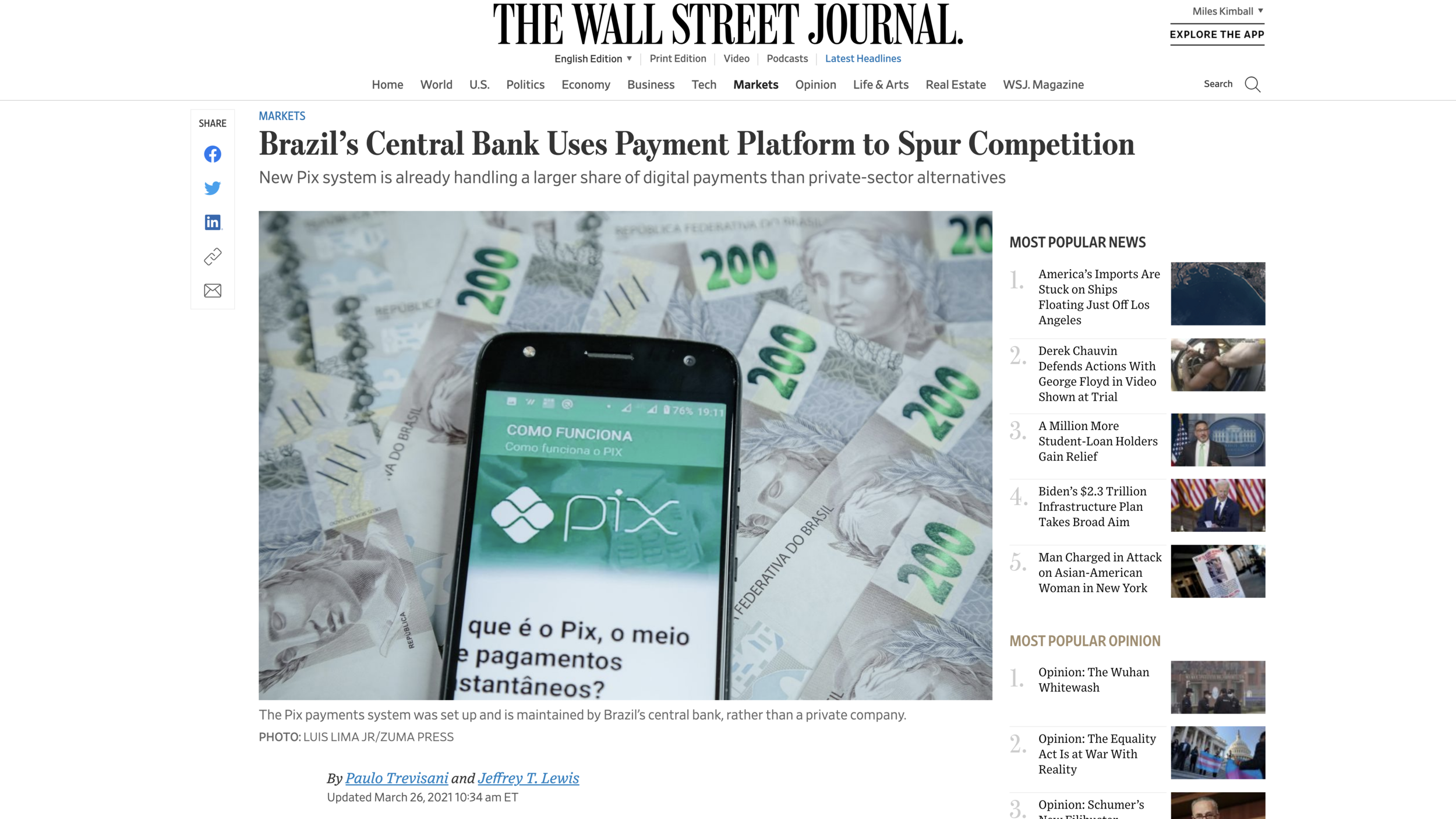
Such government competition in payments is not a pipe dream. Brazil is doing something in this area. In the March 2021 Wall Street Journal article “Brazil’s Central Bank Uses Payment Platform to Spur Competition,” Paulo Trevisani and Jeffrey T. Lewis report:
Brazil’s central bank is revving up its yearslong effort to bust up the country’s clubby banking industry, using a pandemic-driven shift toward touchless payments to launch its own digital platform.
The payment system, dubbed Pix, was set up and is maintained by the central bank instead of private payments players, unlike similar systems in other countries. Since its launch in November, Pix is already handling a larger share of digital payments than its private-sector alternatives, advancing the regulator’s goal of spurring competition and getting more Brazilians to use financial services.
…
“Our concern is how can we make the system more competitive, more efficient?” said Roberto Campos Neto, president of the Central Bank of Brazil.
Although some of the banks who belonged to the old oligopoly are no doubt losing, many other firms are benefitting:
New entrants are expanding quickly and attracting both domestic and foreign investors, said Carlos Lobo, a partner at corporate law firm Hughes, Hubbard & Reed LLP.
“All companies in this ecosystem are seeing an absurd growth in their valuation. They are attracting foreign investors, who also like the regulation the central bank has in place.”
The benefit to welfare seems substantial. Suppose that payment systems are now taking a 2% fee. Whichever side of a transaction that is levied on, it is like a 2% tax in its distortionary effects. And it is like a 2% tax on top of other marginal tax rates in the narrower sense of taxes. An extra 2% added to the marginal tax rate would be a big deal. Ergo, a 2% payment fee is a big deal. If the government can make that go away, it is like a tax cut in its benefits for the economy.
Of course, another reason I am interested in making the electronic payment landscape more competitive is that when electronic payments (including payments with credit and debit cards) are a larger fraction of payments compared to paper currency transactions, then the modifications of paper currency policy needed to enable deep negative rates carry a lower political cost and hence are more likely to be used. And I see deep negative rates as something that could have saved us from most of the hit from the Great Recession. See:
Seeing digital cash in the context of opening up more monetary policy space points to one detail of how digital cash should be implemented: digital cash should have a nonzero interest rate. If, say, the rate was even as little as +3 basis points in a situation like today, that would at least set the precedent for a nonzero interest rate that could go negative at some point in the future. That would be better than to hardwire a zero interest rate into the payment system offerings of the government.
Central banks and other parts of governments should stop running away from negative rates and beginning explaining how wonderful they are. They help avoid recessions and thereby help savers: temporarily low rates lead to recovery and hither rates. Deep negative rates for a short time are better for savers than zero rates for years and years and years. Negative rates also help borrowers because borrowers are hurt by recessions and negative rates end recessions sooner. And they give borrowers more buying power during the recession when they need it most.
Ori Heffetz: Israel Climbs High in UN's 'World Happiness Report'
In addition to the video above, here are some other posts that involve Ori:
Happiness and Satisfaction Are Not Everything: Toward Well Being Indices Based on Stated Preferences
Justin Wolfers, Matthew Adler and Ori Heffetz: Round Table on Happiness (podcast)
Does Ben Bernanke Want to Replace GDP with a Happiness Index?
Al Roth’s Nobel Prize is in Economics, but Doctors Can Thank Him, Too
Elizabeth Bernstein on Getting Better Sleep

On Insomnia
Insomnia often has psychological roots that can be addressed with a psychological approach. In her Mrch 23, 2021 Wall Street Journal article “Can’t Sleep? Here Are Some Surprising Strategies That Actually Work,” Elizabeth Bernstein gives helpful advice of both the psychological and the more straight physiological variety. All the quotations below are from that article.
Psychologically drive sleep problems often have a strong multiplier—a vicious loop. Elizabeth writes:
When we tell ourselves we “can’t sleep” or “won’t be able to function” the next day, we’re causing ourselves a lot of anxiety, which further interferes with our sleep.
As Elizabeth notes, the opposite attitude is saying to yourself something like: “A bad night of sleep is not the end of the world.”
Elizabeth also quotes Wendy Troxel talking about both the vicious loop and some of how the vicious loop might get started. Separating the quotations with added bullets, they are:
People who sleep well don’t think about sleep all the time …
Our brains have to feel like the world is safe and secure to be able to fall asleep … Sleep is a vulnerable state.
Whether part of getting the vicious loop started or part of keeping it going, brain scans show the brains of insomniacs as being more agitated even while actually asleep:
Daniel J. Buysse … conducted PET scans of people who sleep normally and people with insomnia. In people with insomnia, parts of the brain involved with self-reflection and monitoring the environment show higher levels of activity during sleep compared with normal sleepers.
Given how worrying too much about sleep can cause sleep problems, it is useful to know the diagnostic criteria for clinical insomnia. They are much worse than occasional insomnia:
insomnia … difficulty falling or staying in sleep three or more times a week, and … lasts a month or longer, leading to daytime consequences, such as fatigue, mood changes or difficulty concentrating.
And it should be reassuring that if you ever do get serious insomnia, there are fairly effective psychological treatments:
… the American Academy of Sleep Medicine … recommended a series of treatments collectively known as cognitive behavioral therapy for insomnia, or CBT-I.
…
CBT-I focuses on breaking this loop by helping us change the thoughts and behaviors that are counterproductive. Research shows it may have lasting effects—not just fixing our sleep problems in the present but helping us form a sort of sleep resilience. A study conducted by Dr. Cheng and colleagues and published online in November in the journal Sleep found that people who received CBT-I years ago have been sleeping better and have better mental health during the pandemic than those who did not.
Several psychological approaches are easy enough to try even before you are willing to consult a sleep therapist. Philip Cheng suggests this:
Sometimes we worry because our brain is telling us to not forget something,” says Philip Cheng … If you write your worries down during the day, “when worry comes at night you can tell yourself you’ve already documented it.”
Elizabeth points to cultivating gratitude as something that can help:
… think about the things you are grateful for, or savor your favorite moments from the day. This will train your brain to associate the bed with pleasant thoughts.
And Elizabeth tells the story of an app she has (which she does not name), that uses reverse psychology. The voice on the app intones:
Resist! Resist! Resist the temptation to close your eyes, even as they feel heavier and heavier! Remember your goal here is to remain awake.
My Practice
I don’t have serious sleep problems, but I do try to have good practices in relation to sleep that might be helping me to avoid problems. Here are some things I think can be helpful, but take them all with a grain of salt:
Most drugs marketed as sleep aids are quite nasty and to be avoided. The exception is melatonin, which is fairly safe—at least by comparison. The next safest might be benadryl, which is in many cold remedies.
It is a myth that everyone needs 8 hours of sleep. By experimentation, I have figured out that I need between 7 and 7 and a quarter hours. How can you determine how much you need? If you feel alert and good except for the witching hours when it is totally normal to feel sleepy: (a) right when you wake up, (b) right before it is bedtime and (c) in the mid afternoon. If those are the only times you get sleepy, you are probably getting enough sleep. If you try to sleep for more hours each day than you need, after a while you are likely to have a wakeful period in the middle of the night.
The previous bullet was about a sign you are getting enough sleep—even if you sleep less than 8 hours. On the other side, a way to tell that you are sleep-deprived, getting too little sleep, is if you fall asleep instantly when you lie down or are quite relaxed.
Keeping the lights as low as possible for several hours before bedtime can be helpful. I find the common advice of avoiding screens much too painful to follow. But I keep the room lights off for at least 4 hours before bed and only have light from screens. Blue light interferes with sleep most. Many devices now have modes that dim the screens and reduce the blue-light content of the remaining brightness. Adjustable nightlights allow me to brush my teeth without the help of the room light.

In addition to light interfering with getting to sleep, it can wake you up too early. It isn’t easy to make light-blocking curtains work in my bedroom, so I wear an eye mask except in winter, when it stays dark late enough in the morning that I don’t need to. (Some people are sensitive enough to light they’ll need lot-blocking curtains or an eye mask year round.)
I have come around to the view that getting up at close to the same time every day is helpful for sound sleep. The experts say it is even more important to standardize your wake-up time than it is to standardize the time when you go to bed.
Something I don’t have to think much about because I have a short eating window each day is that it will help you to sleep soundly to stop eating many hours before you go to bed. The reason is simple: heavy-duty digestion can disrupt sleep.
Finally, to help calm my mind I use a meditation app at night (in my case “10% Happier”) and throughout the day use the Positive Intelligence tools I talk about in these posts:
For annotated links to other posts on diet and health, see:
Don’t Miss These Other Posts Related to Positive Mental Health and Maintaining One’s Moral Compass:
Co-Active Coaching as a Tool for Maximizing Utility—Getting Where You Want in Life
How Economists Can Enhance Their Scientific Creativity, Engagement and Impact
Judson Brewer, Elizabeth Bernstein and Mitchell Kaplan on Finding Inner Calm
Recognizing Opportunity: The Case of the Golden Raspberries—Taryn Laakso
Taryn Laakso: Battery Charge Trending to 0% — Time to Recharge
Savannah Taylor: Lessons of the Labyrinth and Tapping Into Your Inner Wisdom
Judson Brewer, Elizabeth Bernstein and Mitchell Kaplan on Finding Inner Calm
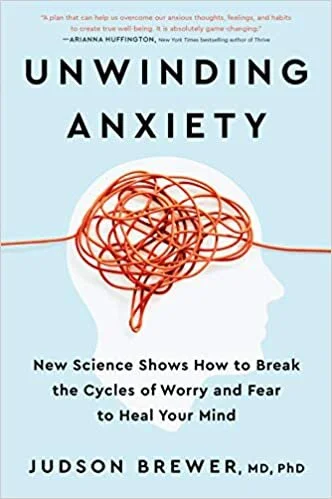


Elizabeth Bernstein has a column on positive mental health in the Wall Street Journal named “Bonds.” The two columns shown above given hints about how to get more inner calm.
“New Strategies for Calming Your Pandemic Anxiety” is an interview with Judson Brewer, author of Unwinding Anxiety. Elizabeth asked Judson “So how can we learn to stop fueling our anxiety?” Judson said this:
There’s a three-step process. The first step is to recognize anxiety habit loops. Recognize that you’re worrying. Ask yourself: “Is this helping me solve the problem?”
Step two is to … see how unrewarding worrying is. Ask yourself: “What am I getting from this? When I worry, does it keep my family safe? Or is this making me feel worse and not better?”
Step three is … to give your brain something more rewarding to do than worrying. … You can be curious about your experience. And you can be kind. Anxiety and worry feel closed and contracted. Curiosity and kindness open you up.
Judson also made these useful and non-obvious points (bullets added to separate passages):
Curiosity feels better than anxiety. It helps us focus on the moment rather than worrying about the future. And it helps us gather accurate information, which is what our brain needs to be able to think and plan.
One of my patients has a mantra she uses when she starts to feel anxious, to remind her that she is not in danger: “Oh, this is just my brain.”
When we are stressed or anxious, our shoulders tense, our jaws clench and our eyes narrow. You can bring awareness to this: “Oh, my eyes are narrowed.” Then open your eyes really wide. This helps trigger curiosity, because of the association in our mind between eyes wide open and curiosity. Wide-eyed wonder is the epitome of curiosity. It’s not called narrow-eyed wonder.
Anxiety triggers procrastination, especially for perfectionists, because we worry our solution to the problem won’t be good enough. Procrastination feels better than being anxious or trying to come up with a solution.
Habit loops have three elements: a trigger, a behavior and a reward. Anxiety … becomes a habit when the feeling of anxiety triggers us to worry and that worry results in us feeling like we are in control …
In “The Therapeutic Value of Reading,” Elizabeth says this:
Books are good for the brain. And their benefits are particularly vital now. Books expand our world, providing an escape and offering novelty, surprise and excitement, which boost dopamine. They broaden our perspective and help us empathize with others. And they can improve our social life, giving us something to connect over.
Books can also distract us and help reduce our mental chatter.
She also quotes bookstore owner Mitchell Kaplan saying this:
There’s so much noise in the world right now and the very act of reading is a kind of meditation. You disconnect from the chaos around you. You reconnect with yourself when you are reading. And there’s no more noise.
These are all excellent insights. Beyond these insights, what has been working for me to find inner calm is mindfulness meditations apps such as 10% Happier and the Positive Intelligence tools I talk about in these posts:
Both mindfulness and the other tools of Positive Intelligence is that your inner critic and other chatter fueled by the survival part of your brain are constantly saying things that aren’t very helpful. It is possible to recognize this chatter for what it is and get it to quiet down by exercises such as getting into your body more by focusing on bodily sensations. Methods for awakening power such as empathy, curiosity, and a can-do attitude can also help.
Here is what I think is going on from an evolutionary perspective. The abilities to talk garrulously to both ourselves and other humans and to think at length about the past and the future are very recent in our evolutionary history. We know that because our abilities in those regards go far beyond all the extant species we know of on earth. Even aside from the issue that what is good for our genes may not alway be what makes us happy, genetic evolution hasn’t had time to work out all the kinks in what talking to ourselves and thinking about the past and future does to our psychology.
Fortunately, the ability to talk to one another—and the later invention of writing—kicked off the much speedier process of memetic evolution as useful or otherwise catchy ideas spread and evolve in a soup of minds. (On memetics, see my posts “How Did Evolution Give Us Religion?” and “Jonah Berger: Going Viral.”) A few thousand years is the blink of an eye relative to genetic evolution, but it is a long time in the arena of memetic evolution once we had writing and a large human population size. We are finally homing in on best practice for being happy. But within your lifetime, you will still have to be an early adopter in order to get the benefits for your own happiness.
Don’t Miss These Other Posts Related to Positive Mental Health and Maintaining One’s Moral Compass:
Co-Active Coaching as a Tool for Maximizing Utility—Getting Where You Want in Life
How Economists Can Enhance Their Scientific Creativity, Engagement and Impact
Recognizing Opportunity: The Case of the Golden Raspberries—Taryn Laakso
Taryn Laakso: Battery Charge Trending to 0% — Time to Recharge
Savannah Taylor: Lessons of the Labyrinth and Tapping Into Your Inner Wisdom