Quartz #30—>How to Avoid Another Nasdaq Meltdown: Slow Down Trading (to Only 20 Times Per Second)

Link to the Column on Quartz

Here is the full text of my 30th Quartz column, ”How to avoid another Nasdaq meltdown: Slow down trading” now brought home to supplysideliberal.com. It was first published on August 23, 2013. Links to all my other columns can be found here.

If you want to mirror the content of this post on another site, that is possible for a limited time if you read the legal notice at this link and include both a link to the original Quartz column and the following copyright notice:

© August 23, 2013: Miles Kimball, as first published on Quartz. Used by permission according to a temporary nonexclusive license expiring June 30, 2014. All rights reserved.

The last paragraph of this column is especially heartfelt. 


Whatever the exact trigger that brought Nasdaq down today, it is likely that a contributing cause is the huge increase in lightning-fast high-frequency computer trading in recent years. Nathaniel Popper wrote in the New York Times in October 2012 that the profits from high-frequency-trading have started to fall because the volume of stock-trading has fallen in the wake of the Great Recession, but that

Many market experts have argued that the technical glitches that have recently hit the market have been a result of a broader trend of the market splintering into dozens of automated trading services and a lack of human oversight.

High-frequency trading has been controversial because of the idea that it takes advantage of slower human investors. Back in 2009, the New York Times’s Charles Duhigg detailed an insider account of one case of computers besting humans:

The slower traders began issuing buy orders [for Broadcom]. But rather than being shown to all potential sellers at the same time, some of those orders were most likely routed to a collection of high-frequency traders for just 30 milliseconds—0.03 seconds—in what are known as flash orders. While markets are supposed to ensure transparency by showing orders to everyone simultaneously, a loophole in regulations allows marketplaces like Nasdaq to show traders some orders ahead of everyone else in exchange for a fee.

In less than half a second, high-frequency traders gained a valuable insight: the hunger for Broadcom was growing.

In terms of fairness, this seems worse than the controversial two-second advance notice subscribers could get for the University of Michigan’s Index of Consumer Sentiment. At least in that case, subscribers’ fees for the advance notice pay for the collection of scientifically valuable survey data. But what social benefit flows from letting high-frequency traders peek at market supply and demand 30 milliseconds before everyone else? It could be that giving high-frequency traders that kind of advantage entices them to provide liquidity in the market, selling to those who want to buy and buying from those who want to sell. But the magnitude of this supposed benefit is unproven. As Popper writes: “Regulators are still grappling with whether the rise of high-speed firms has been a net benefit or loss for investors.”

If letting high-frequency traders have an advantage measured in milliseconds doesn’t provide enough benefits to be worth the seeming unfairness, what can be done? One simple approach would be to have the market only clear 20 times per second, and insisting that all orders received by, say, 11:05:02.05 a.m., be treated in a totally even-handed way in that moment of market clearing (as buy and sell orders are matched). Further, it should be insisted that orders be absolutely secret from other traders until the moment of market clearing when that order is supposed to be revealed and executed. It is possible that having the market clear only 20 times per second would reduce the total amount of information processing done by the market every day, but discouraging high-frequency traders and their advantageous zero-sum game off sheer speed of execution might lead the traders to focus on more socially valuable forms of information processing.

In academic finance, concerns about high-frequency trading go under the heading of “market microstructure” issues. There are other bigger problems in finance at the macroeconomic level that I have talked about more than once. The best reason to fix unfairness—or even perceived unfairness—in market microstructure is so people aren’t distracted from noticing how those in the financial industry use low levels of equity financing (often misleadingly called capital) to shift risks onto the backs of taxpayers and rewards into their own pockets. In quantum mechanics, electrons can “tunnel” from one side of a barrier to another. Using massive borrowing to ensure later government bailouts, the financial industry has perfected an even more amazing form of tunneling: the art of tunneling money from the government so that the profits appear on their balance sheets and in their pockets long before the money disappears from the US Treasury in bailouts. By comparison with this financial quantum tunneling of money from the US taxpayer that has been a mainstay of the financial industry, high-frequency trading profits of a few billion dollars a year are small change.

Ragnarok

When I was 14 or 15 (circa 1975), I wrote the only science fiction story I have written of any length. I revised it a few years later, and then, at the urging of my son, again in early 2002, but without changing that much from what I wrote as a teenager. Having some sense of its many imperfections, I set it out here in case some of you find it entertaining. 


Act 1

Beta Hydri had set on the horizon of Minas Tirith.  In his palatial garden, Patrick Austen looked up at the stars.  The Universe still awed him after all his years of traversing it.  Man had hardly scratched the surface of God’s Creation.  Man had visited one hundred odd systems in a Galaxy of two hundred billion suns, and a universe of millions of galaxies.  Thinking of the almost limitless possibilities filled him with impatience, with a feeling of futility that he could not realize his dreams that moment.  In a galaxy to conquer, Patrick Austen had but on lifetime.

Patrick found Ursa Minor, and there, a drop falling into the dipper, found Sol, center of the Terran Empire.  He felt a quiet pride at his role in the formation of that empire, as commodore of a Squadron in subjugating the Cetian League, and as a Fleet Admiral in freeing Atlantis and Eriador from the Jacobites. 

Only three years ago he had entered Minas Tirith in triumph.  The people of Eriador, joyful of their freedom from Jacob Hamilton’s religion with its tithes and enforced observances had staged a fantastic celebration, fireworks, mock space battles and all the gimmickry of twenty-third century science.

After the loss of Eriador the Jacobites had disappeared.  He had made an attempt at search but had found nothing.  Nine months ago, the Jacobites had made a raid on Mordor, destroying all its installations.  The empire had renewed the search and had kept the entire Hydnan and Pavonian systems well protected.

Patrick broke his reverie and began walking back to his palace.  Theta projections surrounded the palace.  Any imaginable scene could be projected by variation of the theta beams, reactivity, resoundance, and strength.  Now, the computer projected a continuously changing, iridescent wall.  From time to time a recognizable form emerged to dissolve a moment later.  “In an empire of billions of people, its leaders are able to live well without undue strain on the populace”, Patrick thought wryly.

As he passed through the projected wall, the communicator implanted in his skull spoke.  “Emperor David Briant has been assassinated.  Imperialists under Andrei Petrovich now control the government.  Malcolm Johns – Emperor’s counselor, March 5, 2216.” 

A wave of despair coursed through him.  Then grief overcame him.  For the first time, Patrick realized the full extent of David Briant’s greatness.  David Briant, who had raised Terra from an anarchic wilderness, ravaged by intra-systemic war, to the seat of an empire of forty systems, David Briant, who had unified Terra in the face of an attack by Thor, who had shown that a united Earth was still a match for any other world.  David Briant, who for seventeen years had governed an empire for the benefit of all, and David Briant, who had recognized the talent of an obscure flotilla commander.

Now, he was dead.  Not just dead; murdered.  Suddenly a terrible anger and hatred of Petrovich and his imperialists consumed Patrick.  They had undoubtedly killed Briant because he was fair to the outsystems, treating all alike, and not, as the Imperialists wished, taxing away their strength to create greater megalithic monuments to adorn each Terran’s backyard, replacing oppression with oppression.  The hatred left Patrick as swiftly as it came, leaving only the grief.

In the midst of his mourning, his communicator again spoke.  Administrator Heath requests an immediate conference in his offices.”  Transforming his emotion into physical energy, Patrick sprinted into his palace, a castle taken straight from the Lord of the Rings.  As he passed through the entrance, two dragons swooped down, shot up again, executed a few aerial maneuvers, and gradually faded away.  Inside the entrance to the left, a door slid open at the touch of his hand.  He entered a small cubical, sitting on the chair within.  “Administrator’s offices” he intoned.  The transporter dropped down a few feet, then accelerated forward.  Twenty five seconds later, the chair turned around to prepare for deceleration.  The transporter came to a stop, then shot upward.  Patrick hung a few seconds in weightlessness as the transporter came to a halt.  The door opened to reveal the office of the administrator of Eriador with Heath, Lugano, the planetary defense chief, and Patrick’s four Squadron commanders seated around a mahogany table.  As Patrick took his place, Halladay, the Vice-Administrator, entered from another transporter. 

The Administrator began to speak.  He had a look of sadness in his eyes, but he spoke forcefully.  “A coup has overthrown the emperor and his government.  I called this conference to decide whether we should accept this new government or oppose it.”  His eyes swept over the conferees.

Black, one of the commodores, spoke.  “Recognizing Petrovich’s government after he caused the murder of the Emperor would exemplify the highest cowardice, bestowing on all the Universe the right to kill our leaders whenever they wish.  We must avenge this outrage.”

“Vengeance, oh sweet vengeance!  Poisoner of souls, destroyer of Men!”  Patrick derided.  “Enough have died, without our vengeance.”  Realizing how distraught he was, he paused for a moment, then continued in a quieter tone, “We cannot raise the dead with blooded swords.  I, too, favor opposition to Petrovich.  I fear he will destroy the Empire with his Regionalism.”

Deliberately, Heath proffered, “It is distasteful to me to submit to Petrovich.  But have we any chance of defeating him?  He has the might of Terra behind him.”

Thoughtfully Patrick answered, “Because of the razing of Mordor, we have fourteen capital ships, Atlantis has eleven.  In the entire empire, there are sixty-four.  I believe we have more popular support; the Imperialists will have to garrison everything.  They’d be on the defensive; if they lose Terra it would hurt them much more than our loss of Eriador…

The lines creasing the administrator’s face softened as he heard this.  He interrupted Patrick, “Does anyone else have objections to armed opposition?”  All shook their heads, except the Planetary Defense Chief.  After a slight hesitation, he also shook his head.  “We should have no trouble convincing the Assembly.  You can lift off as soon as they approve.” Heath instructed Patrick.

The council began to make some tentative plans.  When they began to disperse, Patrick and his commodores went to the Admiralty offices where they worked late into the night organizing the expedition.

Act 2

Eighteen days later, the Hydrian fleet approached Delta Pavonis.  In one second, each ship executed sextillions of microscopic quantum jumps.  Each jump displaced every particle in the vessel a fraction of a milli-micron without passing through any of the intervening space, just as electrons jump from one energy level to another without experiencing any intermediate states.

At normal cruising speed, the fleet covered about a light-year every two days.  Nevertheless, the true velocity remained exactly the same, unaffected by the quantum drive quasi-velocity.

The quantum drive magnifies the effect of tidal strain.  In each jump, gravity affects the ship as if it had moved that distance.  Otherwise, the quantum drive would break the law of conservation of energy.  Thus, at normal drive speeds, gravity and tidal strain are multiplied a millionfold.  In addition, the quantum drive unavoidably weakens nuclear cohesion.  As a result, starships must slow down in the vicinity of a star or planet, and, within a certain distance, totally refrain from using the quantum drive.

About 250 million kilometers from Delta Pavonis, the Hydrian fleet reached this boundary.  Its true velocity was already directed toward Atlantis.  The fleet decelerated at about 170 meters per second squared. 

Thirteen hours later, the fleet orbited Atlantis.  Obtaining permission to land, Patrick descended to New Berlin, the capital.  Ships of every type covered the spaceport, intra-systemic vessels, interstellar merchant ships, mapping shipsand warships.  Patrick easily picked out the warships by their mirror surfaces.  Each warship burned with reflected sunlight.  The mirror coating reflected most of the force of laser beams in battle.

Wilhelm Koenig, the Admiral of the Pavonian fleet, met Patrick at the foot of the ramp which had extended itself from the ship.  They entered an aircar.  As the computer controlled vehicle flew to the administrative offices of Atlantis, Patrick observed the city.  It was rather mundane compared to some cities.  It exhibited little of the elaborate domes and spires and fairy arches supported by strengthening energies.  To many people, these things were a sign of decadence, especially to those who cannot afford them. 

Their vehicle landed on the roof of the Administration building, a skyscraper in the center of the city.  A door slid open at Admiral Koenig’s touch.  The door responded to his unique cell frequency pattern.  They entered another executive council similar to the one Patrick had attended eighteen days earlier. 

Six hours later found the council still debating whether to join the venture.  Patrick became slowly desperate.  Without the help of Pavonis and its fleet, the counter-revolution had little chance of succeeding.  Patrick was once again enumerating the possible benefits and attempting to belittle the resks of the expedition.  The implanted communicators spoke.  “An incoming group of ships has been detected at 152/197/109.”  This threw the council into a furor.  This threw the council into a furor.  This resolved doubts of the extent of Imperialist ambition swayed the council into deciding to support the counter-revolution.

Patrick had no time to celebrate.  The two admirals returned to Patrick’s flagship Alexander the Great and began to formulate an operational plan. 

Lloyd Zumbrennen, newly elevated Admiral of the First Expeditionary Fleet of Sol, considered the situation.  The Atlanteans had given no answer to his demand of surrender.  With his nineteen capital ships he could easily defeat the eleven-capitalship fleet that had garrisoned Atlantis before the revolution.  However, the strength of that fleet could have been augmented.  On a planet’s surface, ships are undetectable at all but the closest ranges.  A thousand ships could be on the ground on Atlantis without knowing knowledge. The mundane emissions of Atlantis would even hamper detection of ships in the surrounding space.  “Would Atlantis dare ignore his broadcast if it did not have enough strength to defend itself?” “Yes,” he answered himself, “if they thought they could bluff.”

When he actually attacked they could claim they had been attempting to compose a suitable reply.  “I have little choice in any case.  If I withdrew now, Petrovich would inevitably sack me on my return.” 

His fingers flashed over the communicator keys.  Automatically, he remembered the code formula transforming the binary digits of the message.  An arbitrarily chosen function of time and the message, the code was easy enough to remember but essentially impossible to break.  Because of the time argument, the same message was coded differently each time.

Glancing at the projected representation of local space, Zumbrennen noticed a light cruiser confrontation flare up.  He could do little about it.  Tactical conflicts cannot be effectively controlled across speed of light communication gap, which signals require seconds or even minutes to bridge.  Beyond a few million kilometers, ships must operate self-sufficiently.  Indeed, the main failing of battle computers is their inability to make decisions with the lack of data caused by the communication lag.

Zumbrennen ordered the light ships of his fleet to contract toward the flagship to avoid such contact, in which the enemy would have the advantage by concentration and dispersing before the rest of his fleet could be brought to bear.  He noted with pleasure that the Pavonians also drew their screen of light ships back.

As the Expeditionary fleet pressed forward, the Hydrian fleet, now formed up between Atlantis and the Imperialists, began to fall back towards Atlantis.  The Solarian fleet followed.  Suddenly, the atmosphere of Atlantis swarmed with Ships.  The Solarian fleet was committed by its momentum. The Hydrian fleet engaged it, making retreat even more difficult.  Within minutes, the Pavonian fleet came within range and the confrontation began in earnest.  In the center of the conflict, the battleships hammered each other with laser cannons.  Cruisers, without the elaborate shielding and reradiation laser defenses of a battleship, used their greater acceleration and maneuverability to converge on selected battleships, or battled enemy cruisers attempting to accomplish the same thing.  Destroyer flotillas performed caracoles; charging in to loose their missiles, then swerving off to avoid annihilation by laser.

Patrick remembered well the development of these tactics in the last three wars.  The foremost problem had been to strike a balance between propulsion, defense, and the two weapon systems of missiles and lasers.  This had been accomplished by specialized ship types.  To hurl missiles, which have a shorter range than lasers, the destroyers had speed and expendability.  Cruisers were designed according to the dictum that swiftness increases effective strength since it allows a ship’s influence to be felt over a wider region in a given time period.  And finally, the battleship, a flying powerhouse, efficiently utilized the immense range and instantaneity of laser cannon.  This differentiation between ships and its associated tactics had a crucial role in the wars that had formed the empire.  But in the battle of Atlantis, both combatants had fleets of the same type, with the same composition and doctrine. Thus, the numerical advantage of the Hydrian-Pavonian force prevailed.

A squadron comprising two capital ships, ten cruisers and twenty-two destroyers swept in from its station at Mu, the next planet out from Atlantis, to administer the coup de grace. Admiral Zumbrennen ordered withdrawal, the Expeditionary fleet commenced to acceleration out of the system.  The Hydrian and Pavonian fleets followed.  With the photon engines devouring the power produced by the battle, ships of both factions, the fighting slackened off.  The lighter ships, with their greater power to mass ratios, continued to fight.  When the two forces neared the edge of the quantum drive forbidden zone, Patrick ordered a halt.  A fleet in quantum drive cannot be effectively followed.  Detection instruments limited by the speed of light are inadequate when dealing with velocities hundreds of times that of light.  The counter-revolutionary fleet dealt a parting barrage.  The retreating fleet, still expending energy for acceleration, could not retaliate.  In hopes of avoiding giving this advantage, Admiral Zumbrennen had waited longer to order a retreat than he otherwise would have. 

When it had passed the limit, the remnant of the first Solarian Expeditionary fleet vanished, moving too swiftly to create an image.  It had lost six capital ships destroyed, one damaged, fourteen cruisers destroyed, three damaged and twenty-six destroyers destroyed, four damaged; more than an entire flotilla.  The Hydrian and Pavonian fleets had lost only one battleship, three cruisers and six destroyers to vaporization.  None of the damaged ships were lost as they now controlled the battlefield. 

The two fleets returned to Atlantis to celebrate a triumph.  “When it requires weeks to travel between stars, a day or two makes little difference,” mused Patrick. 

Despite the gratification of victory, he did not sleep well that night.  Visions of nameless men asphyxiated or laser burned troubled his dreams.

Act 3

Admiral Koenig relinquished his fleet to Patrick in the interests of a unified command.  He declined to accompany the expedition, preferring to remain on Atlantis.  Patrick christened the combined fleet the First Tartarian Fleet, referring to the unofficial name used for the area once held by the Jacobites.  The name had more significance than just that this region occupied the lowest portion of most star maps.  The Jacobites had professed to a hell in the hereafter while providing one in the here-and-now.

Two days later, on the seventeenth of April, Terran Standard Time, the Tartarian fleet lifted from Atlantis.  It began cruising towards Epsilon Indi.  With one Imperialist fleet in retreat, Patrick had decided on a direct advance.  In his maproom, Patrick touched a few buttons to bring forth a projection of space.  Instantly, hundreds of tiny lights appeared, suspended in mid-air.  Beside each one glowed a label, a concise exposition of the most important data on that system.  Whichever direction he looked, the labels all faced him.  A light blue haze indicated the part of the empire still under Petrovich’s control.  The region loyal to Patrick, the legitimate continuation of the Solar Empire, was indicated by red.  To nadir, below the empire, yellow marked the suspected original domain of the Jacobites.  To zenith in green, lay the ambitious Sivan realm centered at Eta Cassiopeiae.  Patrick touched another button.  All but the empire vanished, and the unimportant systems dimmed.  The Empire contained nine planets with conditions suitable to unprotected men.  Patrick thoughtfully regarded each one of the corresponding lights.  To the west, eighteen hours right ascension, somewhat below the equatorial plane, Camelot and Olympus orbited 36 and 70 Ophiuchi, respectively.  Petrovich had undoubtedly already commandeered their meager fleets.  Above Sol, because of that regions dearth of sol-type stars, only Osiris circling 61 Cygni was habitable.  Four light years to nadir from Sol, Thor of Alpha Centauri, once second in only to Terra, now attempted to recover from Terra’s destruction of its industrial network.  Situated almost as far nadirward as Atlantis, to the southeast, way 82 Eridani and its satellite Korosh, which had voluntarily associated itself with the empire two years ago.  Patrick had sent a courier to Korash to enlist some little aid.  Since couriers travel about twice as fast as other ships or more than one light year each day it had reached Eridani a few days before. 

Patrick reviewed the strategic situation.  The fleet’s present destination, Quetzalcoatl in the Indian system, roughly equidistand from Terra and Asgard of Tau Ceti, the second most important planet of the empire, threatened both.  However, with the slow pace of communications and the inability to detect ships in quantum drive, he would not know which had been left more unprotected until he attacked one of the planets.  Even if he succeeded in capturing Terra or Asgard, as long as petrovich retained a larger fleet, recapture would easily follow capture.  Patrick needed a decisive battle. 

On the sixth of May, the counter-revolutionary fleet landed on Quetzalcoatl.  The counter-revolutionary fleet found the system entirely undefended.  The planet’s government readily surrendered, having no great sympathy for the Imperialists.  Zumbrennen’s retreating had left a day and a half before, taking the Imperialist garrison with it. 

After refueling and reprovisioning, the Tartarian fleet lifted from Quetzalcoatl.  Each squadron accelerated out in a somewhat different direction to attain a different true velocity vector, each according to Patrick’s strategy.  Once in interstellar space, a squadron of five capital ships and a proportionate number of lighter ships separated from the remainder of the fleet, heading toward Sol.

The rest of the fleet had to delay twelve days.  Patrick wanted news of Commodore black’s squadron’s appearance in the Solar System to reach Tau Ceti before he attacked there. 

Fifteen days later, the fleet entered the system of CD-360, only four light years from Epsilon Indi.  The system claimed one planet, Thoeris.  Thoeris is a small, frigid world, lit only by the wan light of a red dwarf.  It derived its only importance from its closeness to the route between Epsilon Indi and Tau Ceti.  It had little more than an anti-matter planet, producing the universal spaceship fuel from the fusion energy of the water extracted from the planet’s crust, and the facilities to sustain the operators of the anti-matter planet. 

Thousands of worlds are extimated to wander the galaxy without a sun which would serve refueling centers as the progeny of red dwarfs, but the immensity of interstellar space conceals them better than a thousand kilometers of rock.  Starships can cross interstellar space, but to search it, the distance they must cover is cubed.  So while CD-360 does not give Thoeris a livable temperature, it has great value in providing a beacon to guide man to it. 

Patrick’s main purpose in stopping at Thoeris was not refueling.  His ships had a range of at least fifteen light years.  The day after his fleet’s arrival there, a Korashan contingent of two ships equivalent to battleships and a number of accompanying lighter ships joined the Tartarian fleet as Patrick had requested.  Patrick was jubilant.  He had doubted that the Korashans would send anything.

Act 4

The twelfth of June found the counter-revolutionary fleet some forty billion kilometers from Tau Ceti.  The reception of a message indicating the Black’s arrival in the Solar System commenced flight towards Tau Ceti.  Less than an hour later, three fifths of the Tartarian fleet, twelve capital ships, descended upon Niflheim, the main interstellar transshipment point for the Cetian system, outside the systemic forbidden zone and too small to create much of one itself.

Two hours later, Patrick miled with satisfaction as he added an outgoing fleet from Asgard to his systemic map.  It seemed the Imperialist commander was not too enthused at the prospect of leaving Patrick in control of Miflheim.  Patrick had executed a double feint to both Terra and Niflheim, to draw off forces from his real target—Asgard.  The second feint was not crucial.  If the Imperialists had remained entrenched near Asgard, Patrick would still have attacked. 

When the Imperialist fleet neared the edge of the forbidden region, it became possible for the force holding Niflheim, with an essentially stationary true velocity, to reach Asgard, before the outward bound fleet, which would have to decelerate and regress.  In addition, the three squadrons still in quantum drive, which had high inward velocity, could arrive at Asgard even sooner, to take it if it were unprotected.

The Imperialist fleet maintained a cautiously low velocity.  When it began decelerating, Patrick set his fleets in motion.  The journey to the edge of the forbidden zone took twenty minutes.  Four squadrons, of three capital ships each, accelerated toward Asgard.  Three squadrons, already with a velocity of over seven thousand kilometers per second, decelerated in their mad rush towards Asgard.  The seventeen capital ship Imperialist fleet hastened its deceleration.

As the foremost Tartarian force approached Asgard, eight battleships, twenty-four cruisers, and thirty-seven destroyers appeared above the clouds.  The Tartarian vanguard hung back, waiting for the other force.  Its slight numerical advantage did not warrant an attack, when the Imperialists had the assistance of Asgard’s planetary and orbital defenses. 

The counter-revolutionary fleet recombined.  The inrushing Imperialist fleet allotted two hours to disperse Asgard’s defending fleet.

As the Tartarian fleet moved in for the assault, another force of six capital ships rose from Asgard.  Patrick groaned in dismay.  “Petrovich’s entire fleet is here in the Cetian system!”  Patrick still considered his position relatively good, but two more enemy squadrons certainly did not further his cause. 

Adrenalin began rising in his veins.  After the hours long systemic level duel of wits, he would now direct a tactical conflict, furious strife, often decided within minutes.  The battle computer actually handled the details of command.  His orders were only general directives to the computer.  Even so, short-range confrontations taxed his endurance.

Outnumbered by fifty percent, the Imperialist force began to retreat towards Asgard.  It made a stand for a while by Asgard’s orbital defenses, but finally dropped to the surface of the planet. 

Only then did Patrick realize the strength of Asgard’s orbital defenses.  In the three months since his coup, Petrovich had more than doubled their strength.  These defenses, relatively cheap non-motile weapon systems, were relatively easy to destroy, but, left intact, could wreak havoc on anything passing.  If the Tartarian fleet attempted to cross the defended region to attack the vulnerable grounded ships, any advantage it now had would be lost. 

Patrick ordered the clearing of the defended region.  He saw that it could not be completed in time.  Could he retreat now?  The fleet now on Asgard would hamper his fleet’s movement and the incoming fleet directly blocked his path.  Half despairing, his mind worked with feverish haste.  There was a way.  Even grounded ships could halt anything that could trickle through the defensive region, if it were directed at them.  But the horizon limited their ability to stop missiles aimed away from them.  In an atmosphere, the effects of an antimatter warhead extend for hundreds of kilometers.  The Imperialist fleet on Asgard could be destroyed.  But it would mean the decimation of Asgard, a literal Ragnarok. 

Savagely, as though possessed by the devil, his fingers flew over the keys to give the order.  Asgard must die, that an empire would not be ruined under the Imperialist heel.

In half an hour, it was done.  The fleet from Tartarus turned to meet the oncoming Imperialist force.  The battle began.  Patrick seemed to have inhuman discernment. Added to his numerical advantage, he still had nineteen capital ships, it began to overcome the Imperialists.  Then, the clear voice of a courier’s computer came over the communicator.  “Terra is captured—Black.”  Soon after, the Imperialists received the same message.  The Imperialist fleet surrendered. 

With the tension gone, Patrick collapsed with exhaustion.  With disconcerting clarity, his mind’s eye saw a gutted planet and seven hundred million corpses.  He remembered this scripture: “For what is a man profited if he shall gain the whole world, and lose his own soul?”…Matt. 16:26.

He thrust it out of his mind.  “I have much to do if I am to make Asgard’s destruction meaningful.” 

Postscript: Austen, Parick James—2177-2221—Patrick Austen was the third Terran Emperor.  Too often remembered only for his annihilation of Asgard in 2216, in his short eight-year rein he put the empire on a firm footing, accomplishing more than most of the emperors did in a lifetime…Encyclopedia of Terra interstellar copyright 2839.


David Beckworth and Miles Kimball: The Padding on Top of the Zero Lower Bound

David Beckworth and I had an email exchange we thought worth sharing. (We did some light editing and I added some links.) David is publishing this simultaneously on his blog Macro and Other Market Musings under the title “Further Ossification of the Zero Lower Bound.”


David: I have been meaning to contact you.  I am about to start blogging again and one of the issues I want to raise is the implication of the Fed introducing its fixed rate, full allotment, reverse repo.  I understand the point that it will help with the collateral shortage problem in repo markets—though I think this point ignores the counterfactual of what would happened to repo markets had their been no QE—but I also see it as further cementing the ZLB.  It, along with the IOR, will effectively create a floor on short-term interest rates given the Fed’s preferences to shore up money markets.  While this may be a nice short-term palliative, I see it as creating problems in future recessions if Fed preferences for money markets do not change.  This particularly seems problematic in light of what you have written about creating negative interest rates with e-money.  Here is a twitter exchange with the folks at FTAlphaville on this issue. 

Does this critique make sense? If I am missing something here please let me know.

Miles: Thanks for your kind tweet today!

I confess I don’t see the issue. If the Fed has a reverse repo rate, the Fed can lower that too, when needed. The key is that when the repo rate is introduced, it should be made clear that it might potentially go negative, and have the machinery for that in place.   

In seminars on electronic money, I say that the Fed should move 4 interest rates in tandem:

  1. fed funds rate
  2. discount rate
  3. interest rate on reserves (no longer on just excess reserves when it is negative) 
  4. paper currency interest rate

This would add a 5th:

5. reverse repo rate

I also emphasize in seminars that lowering 1–3 while keeping 4 the same leads to unnatural spreads, and these unnatural spreads could, in fact, be worrisome for financial markets. On the other hand, I wouldn’t want to discourage lowering 1–3, since I think it is a big step towards lowering 1–4.  (Politically, the negative rates are the biggest deal, and the technical stuff to let the paper currency interest rate decline is more manageable politically once one has already taken the political hit from 1–3 going negative.)  If all four interest rates–or now all five–are lowered in tandem, spreads are normal, and only nominal illusion and troubles lowering nominal wages are of concern.  

In sum, if a reverse repo rate is introduced AND it is explicitly said at the time that it could go negative, that seems to me a good thing rather than a bad thing. But even if it is not explicitly said that it could go negative, I don’t see why that would be hard in the context of making 1–3 go negative, say. It is not like Japanese postal saving giving zero interest rates, where another institution is involved; all the rates are set by the Fed and it would only seem natural to lower the reverse repo rate if the others are lowered.   

Am I missing something?  

One side note: I confess that in a blog post about this, I would value highly a very detailed explanation of how the repo markets work, and what was going on with the negative interest rates in the repo market that you talked about here. What would be ideal would be an explanation understandable by a bright undergraduate with no experience in financial markets. Then maybe I can understand it, too! 

In that context, the main thing to say is that the Fed should not be using the reverse repo rate to raise interest rates, when it is trying to keep other interest rates as low as possible. If the current repo rate is negative, the Fed should not raise that rate to zero. If the strains caused by abnormal spreads tempt them to do so, that is actually an argument for lowering the paper currency interest rate instead. Note the very important point that a modest lowering of the paper currency interest rate operative for financial firms can be achieved by a modest time-varying paper currency deposit charge when banks want to deposit paper currency with the Fed, without any other institutional change. (Because of the substantial transactions costs involved in taking someone to court, legal tender issues shouldn’t arise until paper currencies are several hundred basis points below zero, and in any case are manageable. Adjustments in how vault cash applies to reserve requirements are easy to make, if needed.) It would be great if this could be done in a somewhat quiet, technical-seeming way at this point. With that in place, it would be clearer that the interest rate on reserves (IOR) could be lowered.     

David: Thanks Miles. No, I agree that introducing the IOR and the reverse repo in principle does not prevent the Fed from making rates go negative. (It may even make it easier to push rates negative since it has now has greater influence over more markets.)  My concern is that the reason—at least what I have seen—for doing IOR and now the reverse repo is to help the interbank and repo markets.  And in practice that means keeping these rates in these markets positive. For example, the reverse repo seems geared toward helping the collateral-starved repo market by reselling to it the much desired treasuries.  But this would keep the repo rate up, or least keep it from falling.  

So it is not the technical capability of the IOR and reverse repo that concerns me, but how it is being used.  If this pattern continues, it seems the Fed will be further cementing the ZLB.

Miles: I think this is the unnatural spreads problem. As long as the paper currency interest rate is kept at zero, I think there is a genuine tension between wanting to keep normal spreads and wanting to keep interest rates down. Of course, QE is making other spreads unnaturally small. So it is a matter of being concerned about certain spreads. My image is not of cementing the zero lower bound, but adding a cushion to the zero lower bound to keep spreads from getting too thin. To the extent it is felt that that cushion is necessary to keep certain spreads from getting too thin, it makes the zero lower bound tighter than it otherwise would be. But the tension is all coming from the fixed paper currency interest rate. 

I feel there can be legitimate disagreements about how much to worry about making certain spreads that are critical for certain financial institutions extra-thin and wanting to keep interest rates low. But what there should be no legitimate disagreement about (but of course, in fact there is plenty of disagreement about) is about the virtues of lowering all interest rates in tandem, including the paper currency interest rate. My UK friends Tomas Hirst and Frances Coppola have not fully come around to my view that with normal spreads, financial institutions will be fine even with negative interest rates. (See the links on their names, and my many discussions with them chronicled on my electronic money sub-blog.) But I think that is basically right, at least given a little advance warning of negative rates in order to adjust the nominal illusion bits of their business models. The strains on financial institutions from lowering all interest rates but the paper currency interest rate should not be extrapolated to a situation where all interest rates are lowered, including the paper currency interest rate. 

David: Great point. If all interest rates are lowered in tandem so that spreads are relatively stable, then negative interest rates should not be a problem for financial firms.  Their net interest margins will be stable too and financial intermediation should continue.  That is a neat way to frame this issue.

Quartz #29—>The Complete Guide to Getting into an Economics PhD Program

blog.supplysideliberal.com tumblr_inline_mtjpcaqMZA1r57lmx.png

Link to the Column on Quartz

Here is the full text of my 29th Quartz column, ”The Complete Guide to Getting into an Economics PhD Program.” I am glad to now bring it home to supplysideliberal.com, and I expect Noah to post it on his blog Noahpinion, as well.  It was first published on August 16, 2013. Links to all my other columns can be found here.

Up to this point, this is by far my most popular Quartz column. In addition to great interest in the topic, I attribute the popularity of this column to Noah’s magic touch. Personally, I would rather read Noah’s blog than any other blog in cyberspace. That brilliant style shows through here; I think I managed not to spoil things too much in this column.   

This column generated many reactions, two of which you can see as guest posts on supplysideliberal.com: 

Jeff Smith is my colleague at the University of Michigan. He amplifies many of the things we say.  For a complete guide, be sure to see what Jeff has to say, too. What Bruce Bartlett had to say is worth reading simply because of his interesting career path.  

If you want to mirror the content of this post on another site, that is possible for a limited time if you read the legal notice at this link and include both a link to the original Quartz column and the following copyright notice:

© August 16, 2013: Miles Kimball and Noah Smith, as first published on Quartz. Used by permission according to a temporary nonexclusive license expiring June 30, 2014. All rights reserved.

Noah has agreed to give permission on the same terms as I do. 


Back in May, Noah wrote about the amazingly good deal that is the PhD in economics. Why? Because:

  1. You get a job.
  2. You get autonomy.
  3. You get intellectual fulfillment.
  4. The risk is low.
  5. Unlike an MBA, law, or medical degree, you don’t have to worry about paying the sticker price for an econ PhD:  After the first year, most schools will give you teaching assistant positions that will pay for the next several years of graduate study, and some schools will take care of your tuition and expenses even in the first year. (See what is written at the end of this post, after the column proper, for more about costs of graduate study and how econ PhD’s future earnings makes it worthwhile, even if you can’t get a full ride.)

Of course, such a good deal won’t last long now that the story is out, so you need to act fast! Since he wrote his post, Noah has received a large number of emails asking the obvious follow-up question: “How do I get into an econ PhD program?” And Miles has been asked the same thing many times by undergraduates and other students at the University of Michigan. So here, we present together our guide for how to break into the academic Elysium called Econ PhD Land:

(Note: This guide is mainly directed toward native English speakers, or those from countries whose graduate students are typically fluent in English, such as India and most European countries. Almost all highly-ranked graduate programs teach economics in English, and we find that students learn the subtle non-mathematical skills in economics better if English is second nature. If your nationality will make admissions committees wonder about your English skills, you can either get your bachelor’s degree at a—possibly foreign—college or university where almost all classes are taught in English, or you will have to compensate by being better on other dimensions. On the bright side, if you are a native English speaker, or from a country whose graduate students are typically fluent in English, you are already ahead in your quest to get into an economics PhD.)

Here is the not-very-surprising list of things that will help you get into a good econ PhD program:

  • good grades, especially in whatever math and economics classes you take,
  • a good score on the math GRE,
  • some math classes and a statistics class on your transcript,
  • research experience, and definitely at least one letter of recommendation from a researcher,
  • a demonstrable interest in the field of economics.

Chances are, if you’re asking for advice, you probably feel unprepared in one of two ways. Either you don’t have a sterling math background, or you have quantitative skills but are new to the field of econ. Fortunately, we have advice for both types of applicant.

If you’re weak in math…

Fortunately, if you’re weak in math, we have good news: Math is something you can learn. That may sound like a crazy claim to most Americans, who are raised to believe that math ability is in the genes. It may even sound like arrogance coming from two people who have never had to struggle with math. But we’ve both taught people math for many years, and we really believe that it’s true. Genes help a bit, but math is like a foreign language or a sport: effort will result in skill.

Here are the math classes you absolutely should take to get into a good econ program:

  • Linear algebra
  • Multivariable calculus
  • Statistics

Here are the classes you should take, but can probably get away with studying on your own:

  • Ordinary differential equations
  • Real analysis

Linear algebra (matrices, vectors, and all that) is something that you’ll use all the time in econ, especially when doing work on a computer. Multivariable calculus also will be used a lot. And stats of course is absolutely key to almost everything economists do. Differential equations are something you will use once in a while. And real analysis—by far the hardest subject of the five—is something that you will probably never use in real econ research, but which the economics field has decided to use as a sort of general intelligence signaling device.

If you took some math classes but didn’t do very well, don’t worry. Retake the classes. If you are worried about how that will look on your transcript, take the class the first time “off the books” at a different college (many community colleges have calculus classes) or online. Or if you have already gotten a bad grade, take it a second time off the books and then a third time for your transcript. If you work hard, every time you take the class you’ll do better. You will learn the math and be able to prove it by the grade you get. Not only will this help you get into an econ PhD program, once you get in, you’ll breeze through parts of grad school that would otherwise be agony.

Here’s another useful tip: Get a book and study math on your own before taking the corresponding class for a grade. Reading math on your own is something you’re going to have to get used to doing in grad school anyway (especially during your dissertation!), so it’s good to get used to it now. Beyond course-related books, you can either pick up a subject-specific book (Miles learned much of his math from studying books in the Schaum’s outline series), or get a “math for economists” book; regarding the latter, Miles recommends Mathematics for Economists by Simon and Blume, while Noah swears by Mathematical Methods and Models for Economists by de la Fuente. When you study on your own, the most important thing is to work through a bunch of problems. That will give you practice for test-taking, and will be more interesting than just reading through derivations.

This will take some time, of course. That’s OK. That’s what summer is for (right?). If you’re late in your college career, you can always take a fifth year, do a gap year, etc.

When you get to grad school, you will have to take an intensive math course called “math camp” that will take up a good part of your summer. For how to get through math camp itself, see this guide by Jérémie Cohen-Setton.

One more piece of advice for the math-challenged: Be a research assistant on something non-mathy. There are lots of economists doing relatively simple empirical work that requires only some basic statistics knowledge and the ability to use software like Stata. There are more and more experimental economists around, who are always looking for research assistants. Go find a prof and get involved! (If you are still in high school or otherwise haven’t yet chosen a college, you might want to choose one where some of the professors do experiments and so need research assistants—something that is easy to figure out by studying professors’ websites carefully, or by asking about it when you visit the college.)

If you’re new to econ…

If you’re a disillusioned physicist, a bored biostatistician, or a neuroscientist looking to escape that evilPrincipal Investigator, don’t worry: An econ background is not necessary. A lot of the best economists started out in other fields, while a lot of undergrad econ majors are headed for MBAs or jobs in banks. Econ PhD programs know this. They will probably not mind if you have never taken an econ class.

That said, you may still want to take an econ class, just to verify that you actually like the subject, to start thinking about econ, and to prepare yourself for the concepts you’ll encounter. If you feel like doing this, you can probably skip Econ 101 and 102, and head straight for an Intermediate Micro or Intermediate Macro class.

Another good thing is to read through an econ textbook. Although economics at the PhD level is mostly about the math and statistics and computer modeling (hopefully getting back to the real world somewhere along the way when you do your own research), you may also want to get the flavor of the less mathy parts of economics from one of the well-written lower-level textbooks (either one by Paul Krugman and Robin WellsGreg Mankiw, or Tyler Cowen and Alex Tabarrok) and maybe one at a bit higher level as well, such as David Weil’s excellent book on economic growth) or Varian’s Intermediate Microeconomics.

Remember to take a statistics class, if you haven’t already. Some technical fields don’t require statistics, so you may have missed this one. But to econ PhD programs, this will be a gaping hole in your resume. Go take stats!

One more thing you can do is research with an economist. Fortunately, economists are generally extremely welcoming to undergrad RAs from outside econ, who often bring extra skills. You’ll get great experience working with data if you don’t have it already. It’ll help you come up with some research ideas to put in your application essays. And of course you’ll get another all-important letter of recommendation.

And now for…

General tips for everyone

Here is the most important tip for everyone: Don’t just apply to “top” schools. For some degrees—an MBA for example—people question whether it’s worthwhile to go to a non-top school. But for econ departments, there’s no question. Both Miles and Noah have marveled at the number of smart people working at non-top schools. That includes some well-known bloggers, by the way—Tyler Cowen teaches at George Mason University (ranked 64th), Mark Thoma teaches at the University of Oregon (ranked 56th), and Scott Sumner teaches at Bentley, for example. Additionally, a flood of new international students is expanding the supply of quality students. That means that the number of high-quality schools is increasing; tomorrow’s top 20 will be like today’s top 10, and tomorrow’s top 100 will be like today’s top 50.

Apply to schools outside of the top 20—any school in the top 100 is worth considering, especially if it is strong in areas you are interested in. If your classmates aren’t as elite as you would like, that just means that you will get more attention from the professors, who almost all came out of top programs themselves. When Noah said in his earlier post that econ PhD students are virtually guaranteed to get jobs in an econ-related field, that applied to schools far down in the ranking. Everyone participates in the legendary centrally managed econ job market. Very few people ever fall through the cracks.

Next—and this should go without saying—don’t be afraid to retake the GRE. If you want to get into a top 10 school, you probably need a perfect or near-perfect score on the math portion of the GRE. For schools lower down the rankings, a good GRE math score is still important. Fortunately, the GRE math section is relatively simple to study for—there are only a finite number of topics covered, and with a little work you can “overlearn” all of them, so you can do them even under time pressure and when you are nervous. In any case, you can keep retaking the test until you get a good score (especially if the early tries are practice tests from the GRE prep books and prep software), and then you’re OK!

Here’s one thing that may surprise you: Getting an econ master’s degree alone won’t help. Although master’s degrees in economics are common among international students who apply to econ PhD programs, American applicants do just fine without a master’s degree on their record. If you want that extra diploma, realize that once you are in a PhD program, you will get a master’s degree automatically after two years. And if you end up dropping out of the PhD program, that master’s degree will be worth more than a stand-alone master’s would. The one reason to get a master’s degree is if it can help you remedy a big deficiency in your record, say not having taken enough math or stats classes, not having taken any econ classes, or not having been able to get anyone whose name admissions committees would recognize to write you a letter of recommendation.

For getting into grad school, much more valuable than a master’s is a stint as a research assistant in the Federal Reserve System or at a think tank—though these days, such positions can often be as hard to get into as a PhD program!

Finally—and if you’re reading this, chances are you’re already doing this—read some econ blogs. (See Miles’s speculations about the future of the econ blogosphere here.) Econ blogs are no substitute for econ classes, but they’re a great complement. Blogs are good for picking up the lingo of academic economists, and learning to think like an economist. Don’t be afraid to write a blog either, even if no one ever reads it (you don’t have to be writing at the same level as Evan Soltas orYichuan Wang);  you can still put it on your CV, or just practice writing down your thoughts. And when you write your dissertation, and do research later on in your career, you are going to have to think for yourself outside the context of a class. One way to practice thinking critically is by critiquing others’ blog posts, at least in your head.

Anyway, if you want to have intellectual stimulation and good work-life balance, and a near-guarantee of a well-paying job in your field of interest, an econ PhD could be just the thing for you. Don’t be scared of the math and the jargon. We’d love to have you.


In case you are curious, let me say a little about the financial costs and benefits of an economics PhD.  At Michigan and other top places, PhD students are fully funded. Here, that means that the first year’s tuition and costs are covered (including a stipend for your living expenses). In years 2 through 5 (which is enough time to finish your PhD if you work hard to stay on track), as long as you are in good standing in the program, the costs of a PhD are just the work you do as a teaching assistant. So there are no out-of-pocket costs as long as you finish within five years, which is tough but doable if you work hard to stay on track. Tuition is relatively low in year 6 (and 7) if you can’t finish in 5 years. Plus, graduate students in economics who have had that much teaching experience often find they can make about as much money by tutoring struggling undergraduates as they could have by being a teaching assistant.

When a school can’t manage full funding, the first place it adds a charge is in charging the bottom-half of the applicant pool for the first year, when a student can’t realistically teach because the courses the grad students are taking are too heavy. That might add up to a one-time expense of $40,000 or so in tuition, plus living expenses.

On pay, the market price for a brand-new assistant professor at a top department seems to be at least $115,000 for 9 months, with the opportunity to earn more during the summer months. If you don’t quite make it to that level, University of Michigan PhD’s I have asked seem to get at least $80,000 starting salary, and Louis Johnston tweets that below-top liberal arts colleges pay a starting salary in the $55,000 to $60,000 range. But remember that all of these numbers are for 9-month salaries that allow for the possibility (though not the regularity) of earning more in the summer. Government jobs tend to pay 12-month salaries that are about 12/9 of 9-month academic salaries at a comparable level.

There is definitely the possibility of being paid very well in academic economics, though not as well as the upside potential if you go to Wall Street. For example, with summer pay included, quite a few of the full economics professors at the University of Michigan make more than $250,000 a year. (Because we are at a state university, our salaries are public.)

The bottom line is that the financial returns are good enough that you should have no hesitation begging or borrowing to finance your Economics PhD. (Please don’t steal to finance it.)

What about the costs of the extra year it might take to study math the way we recommend? If you have been developing self-discipline like a champion, but are short on money and summers aren’t enough, you could spend a gap year right after high school just studying math, living in your parents’ house at very low cost; most colleges will let you defer admission for a year after they have let you in.    

Update: 

I liked this comment that Kevin C. Smith (an MD) sent to Quartz:

Great advice!
I almost flunked Grade 8 because my math was so bad [back in the day they would flunk you for that, at least in Alberta.]
I wound up heading for medicine. A friend who was a few years ahead of me warned: “You’ll never make it if you are not good at math!”
I hired a math tutor in August [before University started], and did every question at the end of every chapter in every one of my text books. I could call my tutor when I got stuck [God bless her, wherever she is in the world today!] Math got to be fun after a while [like being really good at solving puzzles.]
You might add to you list of suggestions: hire a tutor do all the questions in all your textbooks
Long story short, I won the Gold Medal for Science, and have found that a really good grasp of math has helped my enjoyment of the world and of my work a lot.

Steven Pinker: Science Is Not the Enemy of the Humanities

In his New Republic article “Science Is Not Your Enemy: An impassioned plea to neglected novelists, embattled professors, and tenure-less historians,” Steven Pinker proposes to redeem the term “Scientism” from the critics of science by identifying “Scientism” with these two ideas: 

  1. The world is intelligible.
  2. The acquisition of knowledge is hard.

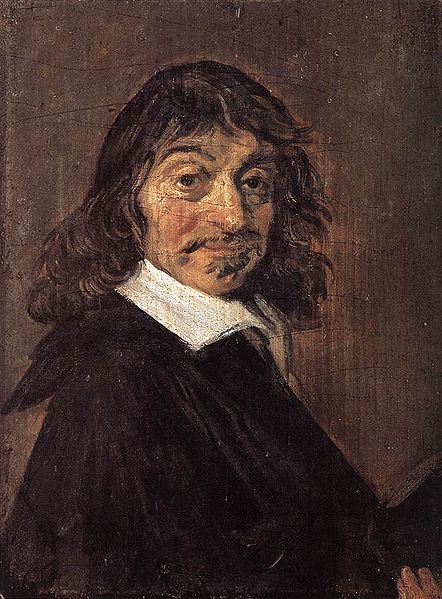
I take inspiration from Steven Pinker’s challenge to us to follow in the footsteps of Descartes, Spinoza, Hobbes, Lock, Hume, Rousseau, Kant, and Smith, but now with scientific evidence in hand that they were deprived of by their location in history:

The great thinkers of the Age of Reason and the Enlightenment were scientists. Not only did many of them contribute to mathematics, physics, and physiology, but all of them were avid theorists in the sciences of human nature. They were cognitive neuroscientists, who tried to explain thought and emotion in terms of physical mechanisms of the nervous system. They were evolutionary psychologists, who speculated on life in a state of nature and on animal instincts that are “infused into our bosoms.” And they were social psychologists, who wrote of the moral sentiments that draw us together, the selfish passions that inflame us, and the foibles of shortsightedness that frustrate our best-laid plans.

These thinkers—Descartes, Spinoza, Hobbes, Locke, Hume, Rousseau, Leibniz, Kant, Smith—are all the more remarkable for having crafted their ideas in the absence of formal theory and empirical data. 

Here are some of Steven Pinker’s recommendations for how science can strengthen the humanities:

… Archeology has grown from a branch of art history to a high-tech science. Linguistics and the philosophy of mind shade into cognitive science and neuroscience.

Similar opportunities are there for the exploring. The visual arts could avail themselves of the explosion of knowledge in vision science, including the perception of color, shape, texture, and lighting, and the evolutionary aesthetics of faces and landscapes. Music scholars have much to discuss with the scientists who study the perception of speech and the brain’s analysis of the auditory world.

As for literary scholarship, where to begin? John Dryden wrote that a work of fiction is “a just and lively image of human nature, representing its passions and humours, and the changes of fortune to which it is subject, for the delight and instruction of mankind.” Linguistics can illuminate the resources of grammar and discourse that allow authors to manipulate a reader’s imaginary experience. Cognitive psychology can provide insight about readers’ ability to reconcile their own consciousness with those of the author and characters. Behavioral genetics can update folk theories of parental influence with discoveries about the effects of genes, peers, and chance, which have profound implications for the interpretation of biography and memoir—an endeavor that also has much to learn from the cognitive psychology of memory and the social psychology of self-presentation. Evolutionary psychologists can distinguish the obsessions that are universal from those that are exaggerated by a particular culture and can lay out the inherent conflicts and confluences of interest within families, couples, friendships, and rivalries that are the drivers of plot….

And in political science, Steven Pinker argues that data analysis has provided reasonably persuasive evidence (“on average, and all things being equal”) for the following questions:

  • Do democracies fight each other? [no]
  • What about trading partners? [no]
  • Do neighboring ethnic groups inevitably play out ancient hatreds in bloody conflict? [no]
  • Do peacekeeping forces really keep the peace? [yes]
  • Do terrorist organizations get what they want? [no]
  • How about Gandhian nonviolent movements? [yes]
  • Are post-conflict reconciliation rituals effective at preventing the renewal of conflict? [yes]

An Experiment with Equality of Outcome: The Case of Jamestown

This passage is from Michael Huemer’s wonderful book The Problem of Political Authority, pages 192-194. 


Take the case of a social theory proposing that all citizens should work for the benefit of society, while receiving equal pay. A simple theoretical prediction is that, in such a system, productivity will decline. Individuals have a high degree of control over their own productivity, and greater productivity usually demands greater effort….

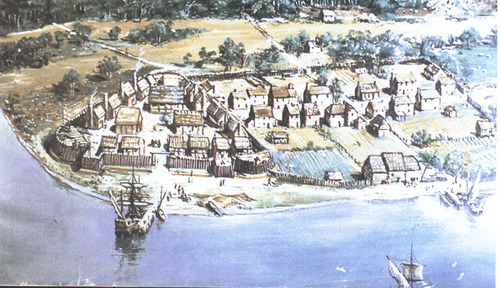
This prediction is in fact correct. The twentieth century’s experiments with social systems in this vicinity are well-known, so I shall not dwell on them. An interesting, but little-known illustration is provided by America’s first experiment with communism, which took place at Jamestown, the first permanent English settlement in America. When the colony was established in 1607, its founding charter stipulated that each colonist would be entitled to an equal share of the colony’s product, regardless of how much that individual personally produced. The result: the colonists did little work, and little food was produced. Of the 104 founding colonists, two-thirds died in the first year–partly due to unclean water, but mostly due to starvation. More colonists arrived from England, so that in 1609 there were 500 colonists. Of those, only 60 survived the winter of 1609-10. In 1611, England sent a new governor, Sir Thomas Dale, who found the skeletal colonists bowling in the streets instead of working. Their main source of food was wild plants and animals, which they gathered secretely at night so as to evade the obligation to share with their neighbors. Dale later converted the colony to a system based on private property, granting every colonist a three-acre plot to tend for his own individual benefit. The result was a dramatic increase in production. According to Captain John Smith’s contemporaneous history,

When our people were fed out of the common store and labored jointly together, glad was he [who] could slip from his labor or slumber over his task, he care not how; nay, the most honest among them would hardly take so much true pains in a week as now for themselves they will do in a day … so that we reaped not so much corn from the labors of thirty, as now three or four do provide themselves.

One lesson from this episode is that, simple as the account of human nature I have advanced is, it can yield very useful predictions. If the company that created the Jamestown charter had known a little economics, hundreds of lives might have been spared. Another is that the impact of human selfishness depends greatly on the social system in which people are embedded: in one kind of system, selfishness may have disastrous consequences, while in another, it promotes prosperity.

Expert Performance and Deliberate Practice

I wanted to back up some of what I have been writing about deliberate practice with more academic references. It matters because the evidence indicates that human capital accumulation can be dramatically improved by getting to best practice about practicing skills. K. Anders Ericsson is one of the foremost academic experts about deliberate practice. Here is an excerpt from his “Expert Performance and Deliberate Practice”:

The recent advances in our understanding of the complex representations, knowledge and skills that mediate the superior performance of experts derive primarily from studies where experts are instructed to think aloud while completing representative tasks in their domains, such as chess, music, physics, sports and medicine (Chi, Glaser & Farr, 1988; Ericsson & Smith, 1991; Starkes & Allard, 1993). For appropriate challenging problems experts don’t just automatically extract patterns and retrieve their response directly from memory. Instead they select the relevant information and encode it in special representations in working memory that allow planning, evaluation and reasoning about alternative courses of action (Ericsson & Lehmann, 1996). Hence, the difference between experts and less skilled subjects is not merely a matter of the amount and complexity of the accumulated knowledge; it also reflects qualitative differences in the organization of knowledge and its representation (Chi, Glaser & Rees, 1982).  Experts’ knowledge is encoded around key domain-related concepts and solution procedures that allow rapid and reliable retrieval whenever stored information is relevant. Less skilled subjects’ knowledge, in contrast, is encoded using everyday concepts that make the retrieval of even their limited relevant knowledge difficult and unreliable. Furthermore, experts have acquired domain-specific memory skills that allow them to rely on long-term memory (Long-Term Working Memory, Ericsson & Kintsch, 1995) to dramatically expand the amount of information that can be kept accessible during planning and during reasoning about alternative courses of action.  The superior quality of the experts’ mental representations allow them to adapt rapidly to changing circumstances and anticipate future events in advance.  The same acquired representations appear to be essential for experts’ ability to monitor and evaluate their own performance (Ericsson, 1996; Glaser, 1996) so they can keep improving their own performance by designing their own training and assimilating new knowledge.

Below are some references. You can find a lot more by googling “Ericsson deliberate practice." 

References:

Bolger, F., and G. Wright, 1992, ‘Reliability and validity in expert judgment.’ In *Expertise and Decision Support*, G. Wright and F. Bolger, eds. New York: Plenum, pp. 47-76.

Camerer, C. F., and E. J. Johnson, 1991,  ‘The process-performance paradox in expert judgment: How can the experts know so much and predict so badly?’ In *Towards a General Theory of Expertise: Prospects and Limits*, K. A. Ericsson and J. Smith, eds. Cambridge: Cambridge University Press, pp. 195-217.

Charness, N., R. Th. Krampe, and U. Mayr, 1996, ‘The role of practice and coaching in entrepreneurial skill domains: An international comparison of life-span chess skill acquisition.’ In *The Road to Excellence: The Acquisition of Expert Performance in the Arts and Sciences, Sports, and Games*, K. A. Ericsson, ed. Mahwah, NJ: Erlbaum, pp. 51-80.

Chase, W. G., and H. A. Simon, 1973, ‘The mind’s eye in chess.’ In *Visual Information Processing*, W. G. Chase, ed. New York: Academic Press, pp. 215-281.

Chi, M. T. H., R. Glaser, and M. J. Farr, eds., 1988,  *The nature of expertise*. Hillsdale, NJ:  Erlbaum.

Chi, M. T. H., R. Glaser, and E. Rees, 1982,  ‘Expertise in problem solving.’  In *Advances in the Psychology of Human Intelligence*, R. S. Sternberg, ed. Hillsdale , NJ Erlbaum, Vol. 1, pp. 1-75.

Dawes, R. M., 1994, *House of Cards: Psychology and Psychotherapy Built on Myth*. New York: Free Press.

Djakow, Petrowski, and Rudik, 1927, *Psychologie des Schachspiels [Psychology of Chess]*. Berlin: Walter de Gruyter

Doll, J., and U. Mayr, 1987,  ‘Intelligenz und Schachleistung - eine Untersuchung an Schachexperten.  [Intelligence and achievement in chess - a study of chess masters].’  *Psychologische Beiträge*, 29: 270-289.

de Groot, A., 1978,  *Thought and Choice in Chess*.  The Hague:  Mouton. (Original work published 1946).

Ericsson, K. A., 1996,  ‘The acquisition of expert performance: An introduction to some of the issues.’ In *The Road to Excellence: The Acquisition of Expert Performance in the Arts and Sciences, Sports, and Games*, K. A. Ericsson, ed. Mahwah, NJ: Erlbaum, pp. 1-50.

Ericsson, K. A., and W. Kintsch, 1995,  ‘Long-term working memory.’ *Psychological Review*, 102: 211-245.

Ericsson, K. A., R. Th. Krampe, and C. Tesch-Römer, 1993,  ‘The role of deliberate practice in the acquisition of expert performance.’ *Psychological Review*, 100: 363-406.

Ericsson, K. A., and A. C. Lehmann, 1996,  ‘Expert and exceptional performance: Evidence on maximal adaptations on task constraints.’  *Annual Review of Psychology*, 47: 273-305.

Ericsson, K. A., and J. Smith, eds., 1991,  *Toward a General Theory of Expertise:  Prospects and Limits*.  Cambridge, England:  Cambridge University Press.

Glaser, R., 1996, ‘Changing the agency for learning: Acquiring expert performance.’ In *The Road to Excellence: The Acquisition of Expert Performance in the Arts and Sciences, Sports, and Games*, K. A. Ericsson, ed. Mahwah, NJ: Erlbaum, pp. 303-311.

Hoffman, R. R. ed., 1992,  *The Psychology of Expertise: Cognitive Research and Empirical AI*. New York: Springer-Verlag.

Proctor, R. W., and A. Dutta, 1995, *Skill Acquisition and Human Performance*. Thousand Oaks, CA: Sage

Richman, H. B., F. Gobet, J. J. Staszewski, and H. A. Simon, 1996,‘Perceptual and memory processes in the acquisition of expert performance: The EPAM model.’ In *The Road to Excellence: The Acquisition of Expert Performance in the Arts and Sciences, Sports, and Games*, K. A. Ericsson, ed. Mahwah, NJ: Erlbaum, pp. 167-187.

Simon, H. A., and W. G. Chase, 1973,  ‘Skill in chess.’  *American Scientist*, 61: 394-403.

Sloboda, J. A., J. W. Davidson, M. J. A.  Howe,  and D. G. Moore, 1996, ‘The role of practice in the development of performing musicians.’ *British Journal of Psychology*,  87: 287-309.

Starkes, J. L., and F. Allard,  eds., 1993, *Cognitive Issues in Motor Expertise*. Amsterdam: North Holland.

Starkes, J. L.,  J. Deakin, F. Allard, N. J. Hodges, and A. Hayes, 1996,  ‘Deliberate practice in sports: What is it anyway?’ In *The Road to Excellence: The Acquisition of Expert Performance in the Arts and Sciences, Sports, and Games*, K. A. Ericsson, ed. Mahwah, NJ: Erlbaum, pp. 81-106

Taylor, I. A., 1975,  ‘A retrospective view of creativity investigation.’ In *Perspectives in creativity*, I. A. Taylor and J. W. Getzels, eds. Chicago, IL: Aldine Publishing Co, pp. 1-36.

VanLehn, K., 1996,  ‘Cognitive skill acquisition.’ *Annual Review of Psychology*, 47: 513-539.

*Webster’s third new international dictionary*, 1976. Springfield, MA: Merriam

Jeff Smith on Reinhart and Rogoff

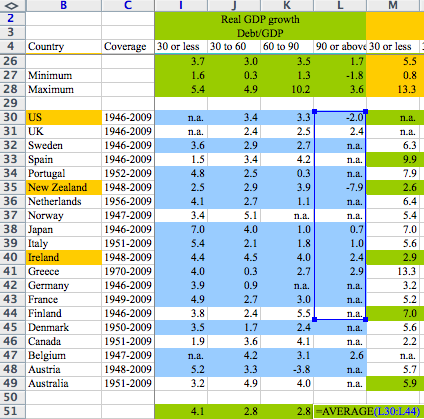
Ace labor economist Jeff Smith’s office is only a few doors down from mine. Hearing what he had to say about Reinhart and Rogoff in a hallway conversation, I suggested it would make a good blog post on his blog Econjeff. I was right: Jeff’s May 1, 2013 post about Reinhart and Rogoff is excellent. (That was aftermy April 20 mea culpa about relying on Reinhart and Rogoff, but well before my two columns with Yichuan Wang about Reinhart and Rogoff on May 29 and June 12.) Jeff kindly gave me permission to reprint that post here. 


My thoughts on the Reinhart and Rogoff coding error:

  1. I liked the piece by Greg Mankiw.
  2. I liked the piece by cyniconomics, which was linked to on MR.
  3. I liked the piece by my colleagues  Betsey Stevenson and Justin Wolfers 
  4. Journalists and other economists need to have a reasonable prior here. The Journal of Money, Credit and Banking replication exercise, summarized in this (gated) American Economic Review article and now more than two decades old, probably provides the best evidence. The authors of the summary article conclude “our findings suggest that inadvertent errors in published empirical articles are a commonplace rather than a rare occurrence.”  Some enterprising journal should repeat the exercise so that priors can be updated.
  5. It seems to me professional courtesy that if you replicate someone’s paper that has gotten a lot of media attention, and you find something that is likely to draw more media attention, you should send your findings to the authors first and give them a week or two to digest and respond before going to the media yourself. My understanding is that the UMass-Amherst folks did not do this. In my view, they should have.
  6. My final (and quite serious) suggestion is that Dan Hamermesh write one of his famous, and very useful, advice papers on the topic of the professional etiquette of replication. Economists do not replicate as much as they should. Part of that is too-low rewards, but part of it is also, I think, that things may go sour in a very public way, as they have in several high profile replications in recent years. Perhaps a formal statement of norms of good behavior in this domain would clarify expectations all around and also encourage more social pressure on both the replicators and the replicated to behave in ways that enhances the scientific credibility of the discipline.

Thanks to Miles Kimball for some encouragement.

John Stuart Mill on the Balance between Imitation and Originality

From John Stuart Mill's On LibertyChapter 3 “Of Individuality, as One of the Elements of Well-Being,” paragraph 3:

No one’s idea of excellence in conduct is that people should do absolutely nothing but copy one another. No one would assert that people ought not to put into their mode of life, and into the conduct of their concerns, any impress whatever of their own judgment, or of their own individual character. On the other hand, it would be absurd to pretend that people ought to live as if nothing whatever had been known in the world before they came into it; as if experience had as yet done nothing towards showing that one mode of existence, or of conduct, is preferable to another.

The Floating Temple: The Provo Tabernacle

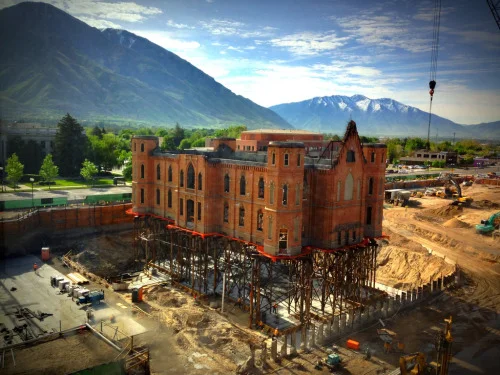
One of the Tumblr blogs I follow, thekhooll, featured the repair and transformation of a historic building in one of my hometowns, Provo, Utah, into a Mormon Temple.

How to Lift a Seven Million Pound, 112-year-old Building. Engineers first gutted the damaged interior and then supported the exterior walls with special scaffolding as they dug down to create space for a two story basement, so in actuality the building hasn’t even moved. The entire structure is now on stilts some 40 feet in the air and from some angles appears to be floating above ground. Photo By by Brian Hansen

How to Introduce the Next Generation to Literature

In his Wall Street Journal essay “Who Ruined the Humanities,” Lee Siegel makes a powerful case that the rising generation needs an introduction to literature through high school survey courses, simply to know what wonderful books exist, much more than it needs any special tools to understand literature.

It does seem to me that any aspect of the study of literature that is not effective at opening students’ eyes to the wonders of literature should be seen and judged either (a) as instruction in how to achieve similar effects in creative writing, or (b) as some combination of linguistics, history, philosophy, psychology, anthropology, sociology, geography, political science, or the like. Indeed, Lee writes that early in the 20th Cenutry, many literature departments “consisted mostly of philologists who examined etymology and the history of a text,” which could be considered a combination of linguistics and history.

Here is the heart of Lee’s argument: 

Literature changed my life long before I began to study it in college and then, in a hapless trance, in graduate school. Born into modest circumstances, I plunged with wonder into the turbulent emotions of Julien Sorel, the young romantic striver of Stendhal’s “The Red and the Black.” My parents might have fought as their marital troubles crashed into divorce, but Chekhov’s stories sustained me with words that captured my sadness, and Keats’s language filled me with a beauty that repelled the forces that were making me sad.

Books took me far from myself into experiences that had nothing to do with my life, yet spoke to my life. Reading Homer’s “Iliad,” I could feel the uncanny power of recognizing the emotional universe of radically alien people. Yeats gave me a special language for a desire that defined me even as I had never known it was mine: “And pluck till time and times are done/The silver apples of the moon/The golden apples of the sun.”

But once in the college classroom, this precious, alternate life inside me got thrown back into that dimension of my existence that vexed or bored me. Homer, Chekhov and Yeats were reduced to right and wrong answers, clear-cut themes, a welter of clever and more clever interpretations. Books that transformed the facts were taught like science and social science and themselves reduced to mere facts. Novels, poems and plays that had been fonts of empathy, and incitements to curiosity, were now occasions of drudgery and toil….

… I am not making a brief against reading the classics of Western literature. Far from it. I am against taking these startling epiphanies of the irrational, unspoken, unthought-of side of human life into the college classroom and turning them into the bland exercises in competition, hierarchy and information-accumulation that are these works’ mortal enemies….

The literary classics are a haven for that part of us that broods over mortal bewilderments, over suffering and death and fleeting happiness. They are a refuge for our secret self that wishes to contemplate the precious singularity of our physical world, that seeks out the expression of feelings too prismatic for rational articulation. They are places of quiet, useless stillness in a world that despises any activity that is not profitable or productive.

Literary art’s sudden, startling truth and beauty make us feel, in the most solitary part of us, that we are not alone, and that there are meanings that cannot be bought, sold or traded, that do not decay and die. This socially and economically worthless experience is called transcendence, and you cannot assign a paper, or a grade, or an academic rank, on that. Literature is too sacred to be taught. It needs only to be read….

If there is any hand-wringing to do, it should be over the disappearance of what used to be a staple of every high-school education: the literature survey course, where books were not academically taught but intimately introduced—an experience impervious to inane commentary and sterile testing. Restore and strengthen that ground-shifting encounter and the newly graduated pilgrims will continue to read and seek out the transfiguring literary works of the past the way they will be drawn to love.

Quartz #28—>Benjamin Franklin's Strategy to Make the US a Superpower Worked Once, Why Not Try It Again?

Link to the Column on Quartz

Here is the full text of my 28th Quartz column, ”Benjamin Franklin’s strategy to make the US a superpower worked once, why not try it again?” now brought home to supplysideliberal.com. It was first published on August 12, 2013. Links to all my other columns can be found here.

If you want to mirror the content of this post on another site, that is possible for a limited time if you read the legal notice at this link and include both a link to the original Quartz column and the following copyright notice:

© August 12, 2013: Miles Kimball, as first published on Quartz. Used by permission according to a temporary nonexclusive license expiring June 30, 2014. All rights reserved.


Ben Franklin was one of the greatest grand strategists in American history. He “had the vision of the Great Power of the New World” as refugees from the Old World poured in, writes Conrad Black in his page-turning, tour-de-force Flight of the Eagle: The Grand Strategies That Brought America from Colonial Dependence to World Leadership. Franklin then followed up that vision with brilliant diplomacy and sponsoring, along with George Washington, the constitutional efforts of Madison, Hamilton and Jay. 

The flow of immigrants to America was crucial not only in the initial rise of America as a credible power in the world, but also in dealing with the stain of slavery: the North would have been unable to defeat the South in the Civil War if the North had not had a three to one advantage in population because of its greater ability to attract immigrants.

Ratio of Per Capita GDP: China/US

In the rest of the 21st century, America faces another grand-strategic challenge: the challenge of China. Since Deng Xiaoping’s economic reforms were introduced in December of 1978, China’s economy has been growing at a ferocious pace. As former Treasury Secretary Larry Summers put it, at Chinese growth rates, “In a decade, an individual goes from walking to having a bicycle; in another decade to a motorcycle; in another decade or two to having an automobile.” Yichuan Wang explains in “How China’s poorest regions are going to save its growth rate,” the reason the Chinese economy can grow so fast is that it is in the midst of “catch-up growth”: that is, it can copy technologies that have already been researched and developed in other countries. As shown in the graph above, China went from a per capita GDP (income per person) less than 1/50 of the US level to a per capita GDP of roughly 1/6 the US level in the 30 years from 1980 to 2010. It will not be easy for China to get all the way to the US level of income per person, but with half-decent economic policies, it should have no problem getting to half the US level of income per person.

The reason China’s economic rise matters for US grand strategy is that China has a much larger population than the United States. Indeed, as the graph below shows, the US now has less than a quarter the population China has (the extreme measures China has taken to hold down its population growth since 1979 through its one-child policy have stabilized the ratio of US to Chinese population in recent years). Multiplying per capita GDP by population yields total GDP, so if China has ¼ the per capita GDP, but four times as many people, its total GDP will be the same size. More generally, if China gets to a larger fraction of US per capita GDP (see graph above) than the US population as a fraction of China’s population (see graph below), then China’s total GDP will be bigger. Although per capita GDP is what matters for people’s standard of living, total GDP is crucial for the ability of a country to wage war—or more importantly, to deter other countries from waging war against it. Power corrupts. So even though idealism has had some effect on US foreign policy (as Black details), it should surprise no one that the US has done some bad things as a superpower. Yet I am convinced that the combination of Chinese nationalism and “Communist” oligarchy—or the combination of Chinese nationalism with some tumultuous future political transition in China—would lead a dominant China to behave much worse than the US has.

Data source: Populstat and Census

Data source: Populstat and Census

What can be done to maintain US power relative to China? The worst answer would be to try to inhibit China’s economic growth. Berkeley economics professor and influential blogger Brad DeLong’s rhetorical question says it best:

Does it really improve the national security of the United States for schoolchildren in China to be taught that the United States sought to keep them as poor as possible for as long as possible?

An excellent answer is to do everything possible to foster long-run growth of per capita GDP in the US. At a minimum, this includes radical reform of our system of K-12 education, removing the barriers state governments put in the way of people getting jobs, and dramatically stepped-up support for scientific research. And it includes reform of both the US tax system and the balance in its government spending between (a) mailing people checks in direct government transfers and (b) investments in raising the productive capacity of the economy by, say, keeping roads and bridges in good repair. But when all is said and done, economic growth at the frontier of high living standards is simply harder than catch-up economic growth. So, short of some disaster for China that we should not wish on them, the ratio of China’s per capita GDP to US per capita GDP is bound to go up.

Fortunately, to add to the pro-growth policies listed above, there is another way to increase the size of the US economy that would be remarkably easy: expanding the United States economy—with all of its power to make people richer than they are in most other countries—to encompass a larger share of the world’s people. In the 19th century, many Americans felt a “manifest destiny” to expand the land that the US encompassed—westward, all the way to the Pacific. But in a modern economy, it is human beings and their skills (and the factories and machines their saving makes possible) that are the key to national wealth, not land.

So in the 21st century, we should view claiming more of the world’s people—not more of the world’s land—as the key to national wealth, and therefore, national power. And all we have to do to claim more of the world’s people for the US, is to open our doors to immigration, as the US did in the 18th and most of the 19th century. Ben Franklin knew that America would become a great nation because people from all over the world would eagerly move to America. The key to maintaining America’s preeminence in the world is to return to Ben Franklin’s visionary grand strategy of making many more of the world’s people into Americans.

Before the American Revolution, Franklin said that America “will in another century be more than the people of England, and the greatest number of Englishmen will be on this side of the water.” With a quarter-millennium of additional experience beyond what Franklin had seen, we know that America’s melting pot can make people from anywhere in the world (not just England) into Americans at heart within two generations. And we know that, together with all the other elements of this unbelievable American system, Franklin’s grand strategy for the rise of America worked once. It can work again to keep America on top.


Update: Steve Sailer has an interesting post pointing out the importance of birth rates, as well as the immigration rates I emphasize in the column. In order to keep an open mind, before reading Steve Sailer’s post, I recommend reading my post “John Stuart Mill’s Argument Against Political Correctness.” In his post Steve also points out that Ben Franklin favored English immigration over German immigration. 

Ezra and Evan’s Flag. I was very pleased to see Ezra Klein and Evan Soltas flag the column, and intrigued by the way they boiled it down:

KIMBALL: The Ben Franklin strategy to a U.S. renaissance. “The reason China’s economic rise matters for US grand strategy is that China has a much larger population than the United States…An excellent answer is to do everything possible to foster long-run growth of per capita GDP in the US. At a minimum, this includes radical reform of our system of K-12 education, removing the barriers state governments put in the way of people getting jobs, and dramatically stepped-up support for scientific research…The key to maintaining America’s preeminence in the world is to return to Ben Franklin’s visionary grand strategy of making many more of the world’s people into Americans.” Miles Kimball in Quartz.

Evan Soltas: How Economics Can Save the Whales

This post first appeared on Bloomberg.com on August 22, 2013. Thanks to Evan for giving me permission to reprint it here. 


trong consensus on policy still eludes most branches of economics. How can poor countries best achieve rapid sustainable growth, for instance? That’s probably the most important question in all of economics. Development economists have “very little clue,” according to Lane Kenworthy, a leading scholar in the field and professor at the University of Arizona. But there’s an interesting exception. Without attracting much notice, one branch of the discipline has made a lot of progress in devising polices that command consensus: environmental economics.

Of course, recommendations aren’t necessarily followed by policy makers. The U.S. is still far away from taxing on carbon emissions, for instance, as just about every environmental economist would favor. But the field has some practical successes to boast of. At the top of the list is a program that rations the right to fish, known as “catch share.” It has proven shockingly successful in halting overfishing and ecological collapse – the point at which stocks can no longer replenish themselves.

A study of 11,135 fisheries showed that introducing catch share roughly halved the chance of collapse. The system caught on in the 1980s and 1990s after decades of other well-intentioned efforts failed. Economist H. Scott Gordon is usually credited with laying out the problem and the solution in 1954.

Modern environmental economists accuse their predecessors of forgetting about incentives. Catch-share schemes issue permits to individuals and groups to fish some portion of the grounds or keep some fraction of the total catch. If fishermen exceed their share, they can buy extra rights from others, pay a hefty fine or even lose their fishing rights, depending on theparticular arrangement. The system works because it aligns the interests of individual fishermen with the sustainability of the entire fishery. Everybody rises and falls with the fate of the total catch, eliminating destructive rivalries among fishermen.

Environmental economists have lately turned their attention to Atlantic bluefin tuna and whales. The National Marine Fisheries Service has just proposed new regulations that would for the first time establish a catch-share program for the endangered and lucrative bluefin. And a group of economists is pushing for a new international agreement on whaling.

In both cases the problem is overfishing. The bluefin tuna population has dropped by a third in the Atlantic Ocean and by an incredible 96 percent in the Pacific. And whaling, which is supposedly subject to strict international rules that ban commercial fishing and regulate scientific work, is making a sad comeback. The total worldwide annual catch has risen more than fivefold over the last 20 years.

Ben Minteer, Leah Gerber, Christopher Costello and Steven Gaines have called for a new and properly regulated market in whales. Set a sustainable worldwide quota, they say, and allow fishermen, scientists and conservationists alike to bid for catch rights. Then watch the system that saved other fish species set whaling right.

The idea outrages many environmentalists. Putting a price on whales, they argue, moves even further away from conservationist principles than the current ban, however ineffective. They’re wrong. “The arguments that whales should not be hunted, whatever their merits, have not been winning where it counts – that is, as measured by the size of the whale population,” says economist Timothy Taylor, editor of the Journal of Economic Perspectives.

I’d go further. Whale auctions would attract green donations to reduce catches below the quota. Environmental groups might find that the system was a blessing in disguise. If Japan were forced to buy permits to support its “scientific research,” the biggest loophole in the current ban on commercial whaling would be closed. Japan will resist the idea – but if it were persuaded to comply, environmental economics could score one of its greatest triumphs.

David Byrne on the Japanese Way of Art

One of the things I love about Japanese culture is the attention to detail in making life comfortable and pleasant. Materialism, or “Thingism” as David Zindell calls it in one of my favorite books, The Broken God, can be done right.

In his book How Music Works, David Byrne explains some of the philosophical background for this attitude toward daily live:

We should broaden our idea of what culture is. In Japan, there used to be no word for art. There, the process of making and drinking a pot of tea evolved into what we in the West might say is an art form. This ritualized performance of a fairly mundane activity embodied a heightened version of a ubiquitous attitude–that utilitarian objects and activities, made and performed with integrity, consciously and mindfully, could be art. The Zen philosopher Daisetz Suzuki said, “Who would then deny that when I am sipping tea in my tearoom, I am swallowing the whole universe with it, and that is very moment of my lifting the bowl to my lips is eternity itself transcending time and space.” That’s a lot for a cup of tea, but one can see that elevation of the mundane in a lot of areas and daily activities in the East. The poets, writers, and musicians of the Beat generation were inspired by this Eastern idea. They too saw the transcendent in the everyday and saw nobility in the activities of ordinary people.  [p. 289]