John Stuart Mill on the Balance between Imitation and Originality

From John Stuart Mill's On LibertyChapter 3 “Of Individuality, as One of the Elements of Well-Being,” paragraph 3:

No one’s idea of excellence in conduct is that people should do absolutely nothing but copy one another. No one would assert that people ought not to put into their mode of life, and into the conduct of their concerns, any impress whatever of their own judgment, or of their own individual character. On the other hand, it would be absurd to pretend that people ought to live as if nothing whatever had been known in the world before they came into it; as if experience had as yet done nothing towards showing that one mode of existence, or of conduct, is preferable to another.

The Floating Temple: The Provo Tabernacle

One of the Tumblr blogs I follow, thekhooll, featured the repair and transformation of a historic building in one of my hometowns, Provo, Utah, into a Mormon Temple.

How to Lift a Seven Million Pound, 112-year-old Building. Engineers first gutted the damaged interior and then supported the exterior walls with special scaffolding as they dug down to create space for a two story basement, so in actuality the building hasn’t even moved. The entire structure is now on stilts some 40 feet in the air and from some angles appears to be floating above ground. Photo By by Brian Hansen

How to Introduce the Next Generation to Literature

In his Wall Street Journal essay “Who Ruined the Humanities,” Lee Siegel makes a powerful case that the rising generation needs an introduction to literature through high school survey courses, simply to know what wonderful books exist, much more than it needs any special tools to understand literature.

It does seem to me that any aspect of the study of literature that is not effective at opening students’ eyes to the wonders of literature should be seen and judged either (a) as instruction in how to achieve similar effects in creative writing, or (b) as some combination of linguistics, history, philosophy, psychology, anthropology, sociology, geography, political science, or the like. Indeed, Lee writes that early in the 20th Cenutry, many literature departments “consisted mostly of philologists who examined etymology and the history of a text,” which could be considered a combination of linguistics and history.

Here is the heart of Lee’s argument: 

Literature changed my life long before I began to study it in college and then, in a hapless trance, in graduate school. Born into modest circumstances, I plunged with wonder into the turbulent emotions of Julien Sorel, the young romantic striver of Stendhal’s “The Red and the Black.” My parents might have fought as their marital troubles crashed into divorce, but Chekhov’s stories sustained me with words that captured my sadness, and Keats’s language filled me with a beauty that repelled the forces that were making me sad.

Books took me far from myself into experiences that had nothing to do with my life, yet spoke to my life. Reading Homer’s “Iliad,” I could feel the uncanny power of recognizing the emotional universe of radically alien people. Yeats gave me a special language for a desire that defined me even as I had never known it was mine: “And pluck till time and times are done/The silver apples of the moon/The golden apples of the sun.”

But once in the college classroom, this precious, alternate life inside me got thrown back into that dimension of my existence that vexed or bored me. Homer, Chekhov and Yeats were reduced to right and wrong answers, clear-cut themes, a welter of clever and more clever interpretations. Books that transformed the facts were taught like science and social science and themselves reduced to mere facts. Novels, poems and plays that had been fonts of empathy, and incitements to curiosity, were now occasions of drudgery and toil….

… I am not making a brief against reading the classics of Western literature. Far from it. I am against taking these startling epiphanies of the irrational, unspoken, unthought-of side of human life into the college classroom and turning them into the bland exercises in competition, hierarchy and information-accumulation that are these works’ mortal enemies….

The literary classics are a haven for that part of us that broods over mortal bewilderments, over suffering and death and fleeting happiness. They are a refuge for our secret self that wishes to contemplate the precious singularity of our physical world, that seeks out the expression of feelings too prismatic for rational articulation. They are places of quiet, useless stillness in a world that despises any activity that is not profitable or productive.

Literary art’s sudden, startling truth and beauty make us feel, in the most solitary part of us, that we are not alone, and that there are meanings that cannot be bought, sold or traded, that do not decay and die. This socially and economically worthless experience is called transcendence, and you cannot assign a paper, or a grade, or an academic rank, on that. Literature is too sacred to be taught. It needs only to be read….

If there is any hand-wringing to do, it should be over the disappearance of what used to be a staple of every high-school education: the literature survey course, where books were not academically taught but intimately introduced—an experience impervious to inane commentary and sterile testing. Restore and strengthen that ground-shifting encounter and the newly graduated pilgrims will continue to read and seek out the transfiguring literary works of the past the way they will be drawn to love.

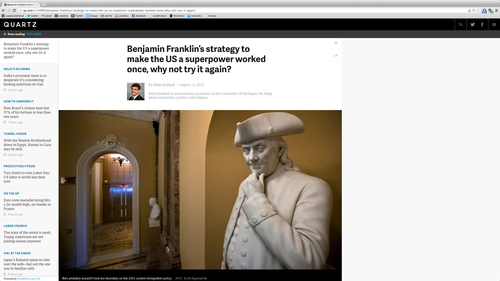
Quartz #28—>Benjamin Franklin's Strategy to Make the US a Superpower Worked Once, Why Not Try It Again?

Link to the Column on Quartz

Here is the full text of my 28th Quartz column, ”Benjamin Franklin’s strategy to make the US a superpower worked once, why not try it again?” now brought home to supplysideliberal.com. It was first published on August 12, 2013. Links to all my other columns can be found here.

If you want to mirror the content of this post on another site, that is possible for a limited time if you read the legal notice at this link and include both a link to the original Quartz column and the following copyright notice:

© August 12, 2013: Miles Kimball, as first published on Quartz. Used by permission according to a temporary nonexclusive license expiring June 30, 2014. All rights reserved.


Ben Franklin was one of the greatest grand strategists in American history. He “had the vision of the Great Power of the New World” as refugees from the Old World poured in, writes Conrad Black in his page-turning, tour-de-force Flight of the Eagle: The Grand Strategies That Brought America from Colonial Dependence to World Leadership. Franklin then followed up that vision with brilliant diplomacy and sponsoring, along with George Washington, the constitutional efforts of Madison, Hamilton and Jay. 

The flow of immigrants to America was crucial not only in the initial rise of America as a credible power in the world, but also in dealing with the stain of slavery: the North would have been unable to defeat the South in the Civil War if the North had not had a three to one advantage in population because of its greater ability to attract immigrants.

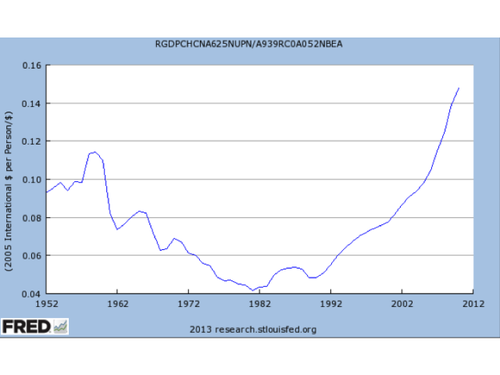
Ratio of Per Capita GDP: China/US

In the rest of the 21st century, America faces another grand-strategic challenge: the challenge of China. Since Deng Xiaoping’s economic reforms were introduced in December of 1978, China’s economy has been growing at a ferocious pace. As former Treasury Secretary Larry Summers put it, at Chinese growth rates, “In a decade, an individual goes from walking to having a bicycle; in another decade to a motorcycle; in another decade or two to having an automobile.” Yichuan Wang explains in “How China’s poorest regions are going to save its growth rate,” the reason the Chinese economy can grow so fast is that it is in the midst of “catch-up growth”: that is, it can copy technologies that have already been researched and developed in other countries. As shown in the graph above, China went from a per capita GDP (income per person) less than 1/50 of the US level to a per capita GDP of roughly 1/6 the US level in the 30 years from 1980 to 2010. It will not be easy for China to get all the way to the US level of income per person, but with half-decent economic policies, it should have no problem getting to half the US level of income per person.

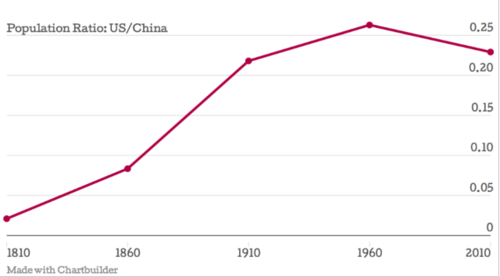
The reason China’s economic rise matters for US grand strategy is that China has a much larger population than the United States. Indeed, as the graph below shows, the US now has less than a quarter the population China has (the extreme measures China has taken to hold down its population growth since 1979 through its one-child policy have stabilized the ratio of US to Chinese population in recent years). Multiplying per capita GDP by population yields total GDP, so if China has ¼ the per capita GDP, but four times as many people, its total GDP will be the same size. More generally, if China gets to a larger fraction of US per capita GDP (see graph above) than the US population as a fraction of China’s population (see graph below), then China’s total GDP will be bigger. Although per capita GDP is what matters for people’s standard of living, total GDP is crucial for the ability of a country to wage war—or more importantly, to deter other countries from waging war against it. Power corrupts. So even though idealism has had some effect on US foreign policy (as Black details), it should surprise no one that the US has done some bad things as a superpower. Yet I am convinced that the combination of Chinese nationalism and “Communist” oligarchy—or the combination of Chinese nationalism with some tumultuous future political transition in China—would lead a dominant China to behave much worse than the US has.

Data source: Populstat and Census

Data source: Populstat and Census

What can be done to maintain US power relative to China? The worst answer would be to try to inhibit China’s economic growth. Berkeley economics professor and influential blogger Brad DeLong’s rhetorical question says it best:

Does it really improve the national security of the United States for schoolchildren in China to be taught that the United States sought to keep them as poor as possible for as long as possible?

An excellent answer is to do everything possible to foster long-run growth of per capita GDP in the US. At a minimum, this includes radical reform of our system of K-12 education, removing the barriers state governments put in the way of people getting jobs, and dramatically stepped-up support for scientific research. And it includes reform of both the US tax system and the balance in its government spending between (a) mailing people checks in direct government transfers and (b) investments in raising the productive capacity of the economy by, say, keeping roads and bridges in good repair. But when all is said and done, economic growth at the frontier of high living standards is simply harder than catch-up economic growth. So, short of some disaster for China that we should not wish on them, the ratio of China’s per capita GDP to US per capita GDP is bound to go up.

Fortunately, to add to the pro-growth policies listed above, there is another way to increase the size of the US economy that would be remarkably easy: expanding the United States economy—with all of its power to make people richer than they are in most other countries—to encompass a larger share of the world’s people. In the 19th century, many Americans felt a “manifest destiny” to expand the land that the US encompassed—westward, all the way to the Pacific. But in a modern economy, it is human beings and their skills (and the factories and machines their saving makes possible) that are the key to national wealth, not land.

So in the 21st century, we should view claiming more of the world’s people—not more of the world’s land—as the key to national wealth, and therefore, national power. And all we have to do to claim more of the world’s people for the US, is to open our doors to immigration, as the US did in the 18th and most of the 19th century. Ben Franklin knew that America would become a great nation because people from all over the world would eagerly move to America. The key to maintaining America’s preeminence in the world is to return to Ben Franklin’s visionary grand strategy of making many more of the world’s people into Americans.

Before the American Revolution, Franklin said that America “will in another century be more than the people of England, and the greatest number of Englishmen will be on this side of the water.” With a quarter-millennium of additional experience beyond what Franklin had seen, we know that America’s melting pot can make people from anywhere in the world (not just England) into Americans at heart within two generations. And we know that, together with all the other elements of this unbelievable American system, Franklin’s grand strategy for the rise of America worked once. It can work again to keep America on top.


Update: Steve Sailer has an interesting post pointing out the importance of birth rates, as well as the immigration rates I emphasize in the column. In order to keep an open mind, before reading Steve Sailer’s post, I recommend reading my post “John Stuart Mill’s Argument Against Political Correctness.” In his post Steve also points out that Ben Franklin favored English immigration over German immigration. 

Ezra and Evan’s Flag. I was very pleased to see Ezra Klein and Evan Soltas flag the column, and intrigued by the way they boiled it down:

KIMBALL: The Ben Franklin strategy to a U.S. renaissance. “The reason China’s economic rise matters for US grand strategy is that China has a much larger population than the United States…An excellent answer is to do everything possible to foster long-run growth of per capita GDP in the US. At a minimum, this includes radical reform of our system of K-12 education, removing the barriers state governments put in the way of people getting jobs, and dramatically stepped-up support for scientific research…The key to maintaining America’s preeminence in the world is to return to Ben Franklin’s visionary grand strategy of making many more of the world’s people into Americans.” Miles Kimball in Quartz.

Evan Soltas: How Economics Can Save the Whales

This post first appeared on Bloomberg.com on August 22, 2013. Thanks to Evan for giving me permission to reprint it here. 


trong consensus on policy still eludes most branches of economics. How can poor countries best achieve rapid sustainable growth, for instance? That’s probably the most important question in all of economics. Development economists have “very little clue,” according to Lane Kenworthy, a leading scholar in the field and professor at the University of Arizona. But there’s an interesting exception. Without attracting much notice, one branch of the discipline has made a lot of progress in devising polices that command consensus: environmental economics.

Of course, recommendations aren’t necessarily followed by policy makers. The U.S. is still far away from taxing on carbon emissions, for instance, as just about every environmental economist would favor. But the field has some practical successes to boast of. At the top of the list is a program that rations the right to fish, known as “catch share.” It has proven shockingly successful in halting overfishing and ecological collapse – the point at which stocks can no longer replenish themselves.

A study of 11,135 fisheries showed that introducing catch share roughly halved the chance of collapse. The system caught on in the 1980s and 1990s after decades of other well-intentioned efforts failed. Economist H. Scott Gordon is usually credited with laying out the problem and the solution in 1954.

Modern environmental economists accuse their predecessors of forgetting about incentives. Catch-share schemes issue permits to individuals and groups to fish some portion of the grounds or keep some fraction of the total catch. If fishermen exceed their share, they can buy extra rights from others, pay a hefty fine or even lose their fishing rights, depending on theparticular arrangement. The system works because it aligns the interests of individual fishermen with the sustainability of the entire fishery. Everybody rises and falls with the fate of the total catch, eliminating destructive rivalries among fishermen.

Environmental economists have lately turned their attention to Atlantic bluefin tuna and whales. The National Marine Fisheries Service has just proposed new regulations that would for the first time establish a catch-share program for the endangered and lucrative bluefin. And a group of economists is pushing for a new international agreement on whaling.

In both cases the problem is overfishing. The bluefin tuna population has dropped by a third in the Atlantic Ocean and by an incredible 96 percent in the Pacific. And whaling, which is supposedly subject to strict international rules that ban commercial fishing and regulate scientific work, is making a sad comeback. The total worldwide annual catch has risen more than fivefold over the last 20 years.

Ben Minteer, Leah Gerber, Christopher Costello and Steven Gaines have called for a new and properly regulated market in whales. Set a sustainable worldwide quota, they say, and allow fishermen, scientists and conservationists alike to bid for catch rights. Then watch the system that saved other fish species set whaling right.

The idea outrages many environmentalists. Putting a price on whales, they argue, moves even further away from conservationist principles than the current ban, however ineffective. They’re wrong. “The arguments that whales should not be hunted, whatever their merits, have not been winning where it counts – that is, as measured by the size of the whale population,” says economist Timothy Taylor, editor of the Journal of Economic Perspectives.

I’d go further. Whale auctions would attract green donations to reduce catches below the quota. Environmental groups might find that the system was a blessing in disguise. If Japan were forced to buy permits to support its “scientific research,” the biggest loophole in the current ban on commercial whaling would be closed. Japan will resist the idea – but if it were persuaded to comply, environmental economics could score one of its greatest triumphs.


David Byrne on the Japanese Way of Art

One of the things I love about Japanese culture is the attention to detail in making life comfortable and pleasant. Materialism, or “Thingism” as David Zindell calls it in one of my favorite books, The Broken God, can be done right.

In his book How Music Works, David Byrne explains some of the philosophical background for this attitude toward daily live:

We should broaden our idea of what culture is. In Japan, there used to be no word for art. There, the process of making and drinking a pot of tea evolved into what we in the West might say is an art form. This ritualized performance of a fairly mundane activity embodied a heightened version of a ubiquitous attitude–that utilitarian objects and activities, made and performed with integrity, consciously and mindfully, could be art. The Zen philosopher Daisetz Suzuki said, “Who would then deny that when I am sipping tea in my tearoom, I am swallowing the whole universe with it, and that is very moment of my lifting the bowl to my lips is eternity itself transcending time and space.” That’s a lot for a cup of tea, but one can see that elevation of the mundane in a lot of areas and daily activities in the East. The poets, writers, and musicians of the Beat generation were inspired by this Eastern idea. They too saw the transcendent in the everyday and saw nobility in the activities of ordinary people.  [p. 289]

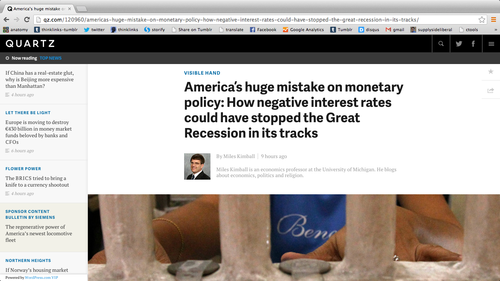
America's Big Monetary Policy Mistake: How Negative Interest Rates Could Have Stopped the Great Recession in Its Tracks

Here is a link to my 31st Quartz column, “America’s huge mistake on monetary policy: How negative interest rates could have stopped the Great Recession in its tracks.”

This post is a rearticulation of my argument for electronic money, focusing on the negative interest rates themselves.

Cutout. An early draft had a lead paragraph that was cut for reasons of brevity and focus, but that I think will be of independent interest for many readers:

John von Neumann, who revolutionized economics by inventing game theory (before going on to help design the first atom bomb and lay out the fundamental architecture for nearly all modern computers), left an unfinished book when he died in 1957: The Computer and the Brain. In the years since, von Neumann’s analogy of the brain to a computer has become commonplace. The first modern economist, Adam Smith, was unable to make a similarly apt comparison between a market economy and a computer in his books, The Theory of Moral Sentiments or in the The Wealth of Nations, because they were published, respectively, in 1759 and 1776—more than 40 years before Charles Babbage designed his early computer in 1822. Instead, Smith wrote in The Theory of Moral Sentiments:

“Every individual … neither intends to promote the public interest, nor knows how much he is promoting it … he intends only his own security; and by directing that industry in such a manner as its produce may be of the greatest value, he intends only his own gain, and he is in this, as in many other cases, led by an invisible hand to promote an end which was no part of his intention.”

Now, writing in the 21st century, I can make the analogy between a market economy and a computer that Adam Smith could not. Instead of transistors modifying electronic signals, a market economy has individuals making countless decisions of when and how much to buy, and what jobs to take, and companies making countless decisions of what to buy and what to sell on what terms. And in place of a computer’s electronic signals, a market economy has price signals. Prices, in a market economy, are what bring everything into balance.

The Path to Electronic Money as a Monetary System

Shopping plaza near Japan’s Ministry of Finance where dinner conversation began to clarify the viability of both hard-money transitions and soft-money transitions as ways of dealing with the legal-tender issue.

Shopping plaza near Japan’s Ministry of Finance where dinner conversation began to clarify the viability of both hard-money transitions and soft-money transitions as ways of dealing with the legal-tender issue.

I have continued thinking about the path to eliminating the zero lower bound by using electronic money as the unit of account in the months since I wrote “A Minimalist Implementation of Electronic Money.” In particular, as I discuss below, I think that switching legal tender status from paper currency to electronic money is less of and issue than I thought when I wrote “A Minimalist Implementation of Electronic Money.”  That post was sparked by my visit to the Bank of England in May. This post is sparked by my upcoming visit to the Danmarks Nationalbank this Friday (September 6, 2013). If you have not yet read “A Minimalist Implementation of Electronic Money,” you should read that first in order to understand this post. You will also find my Powerpoint file “Breaking Through the Zero Lower Bound” helpful. 

Implementing an electronic money system can look daunting politically when thinking of implementing the whole package at once, but it should be easier, and at least as effect to implement different elements in sequence. (Where I write “If possible,” it is possible to delay that step, or in some cases, do without it entirely, if necessary.) Let me lay out what I consider a reasonable order of implementation—starting with important elements of preparation that would be a good idea even apart from preparing for an electronic money system. Here is the path I currently recommend to get to electronic money as a monetary system:

  1. Have one or more members of the monetary policy committee give speeches explaining that substantially negative nominal interest rates are technically feasible, so that the central bank has as much ammunition as necessary to achieve monetary policy goals. The analogy I would make is to Ben Bernanke’s 2002 speech “Deflation: Making Sure “It” Doesn’t Happen Here,” which he gave shortly after being appointed one of the Governors of the Federal Reserve Board, arguing that the Fed had many tools at its disposal, that it could turn to if needed. This step can and should be taken long before a central bank actually makes the decision to pursue an electronic money system for monetary policy. At central banks that have a tradition of some independence for individual monetary policy committee members, this step could be taken by an individual member of the monetary policy committee, before there is a consensus for electronic money in the committee as a whole. 
  2. Strengthen macroprudential regulation—in particular, dramatically raise equity (“capital”) requirements for banks and other financial firms. Here are some of my key posts on the importance of raising bank equity requirements:What to Do About a House Price Boom," ”Anat Admati, Martin Hellwig and John Cochrane on Bank Capital Requirements,“ ”High Bank Capital Requirements Defended,“ ”Canadians as the Voice of Reason on Financial Regulation,“ ”When Honest House Appraisers Tried to Save the World,“ ”Cetier the First: Convertible Capital Hurdles,“ ”How to Avoid Another NASDAQ Meltdown: Slow Down Trading,“
  3. Anat Admati’s Words of Encouragement for People Trying to Save the World from Another Devastating Financial Crisis,“ and Three Big Questions for Larry Summers, Janet Yellen, and Anyone Else Who Wants to Head the Fed. Here is the key passage from Three Big Questions for Larry Summers, Janet Yellen, and Anyone Else Who Wants to Head the Fed: ”… despite all of the efforts of bankers and the rest of the financial industry to obscure the issues, it all comes down to making sure banks are taking risks with their own money—that is, funds provided by stockholders—rather than with taxpayers’ or depositors’ money. For that purpose, there is no good substitute to requiring that a large share of the funds banks and other financial firms work with come from stockholders.“)
  4. Have the central bank and other financial regulators ask banks and other financial firms to prepare documents explaining how they would adjust their business model (and computer systems if necessary) to accommodate negative interest rates. These contingency plans should address how customers can be acclimated to negative interest rates in ways that do not cause banks’ and financial firms’ profits to suffer unduly from negative rates. In particular, banks and other financial firms should be asked to create plans that do not try to shield depositors (or money-market mutual fund holders) from negative rates in a way that could ultimately be unsustainable.
  5. Develop accounting standards for possible future situations in which some interest rates are negative and there is an exchange rate between paper currency and electronic money.
  6. Recommend that government agencies prepare contingency plans for how they would deal with negative interest rates and cash accounting when there is an effective exchange rate between electronic money and paper currency.
  7. If possible, use the government agency contingency planning exercise as an opportunity to prod government regulatory clarification or legislation that those who owe the government money (including taxpayers) are not allowed to pay large debts to the government in paper currency. It is advantageous to make this clear during a period of time before anyone has any reason to want to pay off large debts to the government in paper currency.
  8. If possible, put a limit on the size of private debts that can be paid off in paper currency. If this can be done, it will help a lot later on. I discuss below what to do if this cannot be done at this early stage. Again, it is advantageous to make it clear that large debts cannot be paid in cash before there is a reason why most people would want to do so.   
  9. If possible, formally make insured bank accounts legal tender.
  10. Announce the intent to introduce an electronic money system, and the remaining steps for doing so.Note that everything before this point is a good idea even if the decision to introduce electronic money has not yet been made. This step is the one to take at the moment that decision has been made.
  11. Make sure the interest rate on reserves or on excess reserves is brought down to zero or slightly below zero. Note that if interest on reserves is negative, that negative rate should probably be applied to all reserves, not just excess reserves. If for urgent financial stability reasons the central bank must contribute to bank equity (“capital”) through positive interest on reserves, or by applying negative rates only to excess reserves, limit these effective contributions to bank equity from the central bank to banks that are not dissipating their bank equity by paying dividends or doing stock buybacks. That is, it makes no sense to pay positive interest on reserves to help bank equity (“capital”) when banks are just sending the funds on immediately to their shareholders.
  12. Lower the target interest rate, interest rate on reserves and the rate at which the central bank lends (the “discount rate” in the US) to substantially negative levels. (If very slightly negative levels would suffice, an electronic money system would not be necessary, since there is some storage cost to paper currency. However, even with slightly negative interest rates an electronic money system might work more smoothly by maintaining normal spreads between the paper currency interest rate and other interest rates. Slight negative interest rates for electronic money combined with a zero paper currency interest rate has the potential to create unwanted side effects.)
  13. Having announced this intention in advance, if there is any sign that large amounts of paper currency are being withdrawn, institute a tim-varying deposit charge for paper currency deposited with the central bank, as discussed in "A Minimalist Implementation of Electronic Money” and “How to Set the Exchange Rate Between Paper Currency and Electronic Money.” Note that waiting until there are substantial excess paper currency withdrawals will make it clear that this step is well-justified. If possible, make the deposit charge apply to net deposits so that, in effect, there is a time-varying withdrawal discount for withdrawals of paper currency from the central bank that balances out and is equivalent to the time-varying deposit charge.
  14. At the same time the time-varying deposit charge is instituted, discount vault cash in accordance with the effective time-varying exchange rate between paper currency and electronic money.
  15. At the same time the time-varying deposit charge is instituted, put in place the accounting standards developed for situations with negative interest rates and an exchange rate between electronic money and paper currency.
  16. Make it clear that taxes and other large debts to the government must be paid in electronic money, if this has not been done already. In addition to avoiding a reduction in effective government revenue, this is important for establishing electronic money as the unit of account.
  17. Implement the government agency contingency plans for dealing with negative interest rates and an exchange rate between electronic money and paper currency. 
  18. Ask all firms that post prices to post electronic money prices. It is fine if they want to post both electronic money prices and paper currency prices, but they should be discouraged from posting only paper currency prices. Firms will probably do this on their own, but if not, a regulation to that effect may be needed to help establish electronic money as the unit of account. 
  19. Make sure that firms are allowed to specify in contract and in retail sale the terms on which they will or won’t accept paper currency.

Hard-Money Transitions vs. Soft-Money Transitions

In relation to both private debts and debts to the government, there are two options for dealing with preexisting debts:

A Hard-Money Transition to Electronic Money. Old debts (beyond a certain size) are only payable in electronic money. Insured bank accounts are formally given legal tender status so that there is some way to legally compel a lender to accept repayment. 

A Soft-Money Transition to Electronic Money. Old debts are payable in paper currency (assuming the contract does not specify otherwise), but new contracts can specify that repayment must be made in electronic money. 

To me, the soft-money transition seems unfair to lenders, but either option would preserve full freedom for the monetary authority to use substantially negative interest rates. 

The key point is that the soft-money transition does the job, even though it doesn’t do it as fairly or as elegantly as the hard-money transition. As far as eliminating the zero lower bound is concerned, it is enough to allow lenders and retail establishments to distinguish between electronic money and paper currency going forward.  It is only a guarantee of zero interest rates on paper currency going forward that creates a zero lower bound. So old debts can be handled either way without creating a zero lower bound. 

Saying that contracts going forward can specify separately the acceptability of, or terms for, repayment in paper currency is much simpler than the possibility I raise in “A Minimalist Implementation of Electronic Money” of introducing a new, non-legal-tender paper currency. Instead of an old currency and a new currency, there would be old debts and new debts. Paper currency would be legal tender for the old debts in the ordinary way, while new debts would have new contracts, which most likely would not allow repayment in paper currency at par. 

Lars Christensen: Beating the Iron Law of Public Choice

In his post “Beating the Iron Law of Public Choice: A Reply to Peter Boettke,” Lars Christensen gives this description of the supposed Iron Law of Public Choice

the Iron Law of Public Choice – no matter how much would-be reformers try they will be up against a wall of resistance. Reforms are doomed to end in tears and reformers are doomed to end depressed and disappointed.

Lars gives this ancestry for the Iron Law of Public Choice: 

The students of Public Choice theory will learn from Bill Niskanen that bureaucrats has an informational advantage that they will use to maximizes budgets. They will learn that interest groups will lobby to increase government subsidies and special favours. Gordon Tulluck teaches us that groups will engage in wasteful rent-seeking. Mancur Olson will tell us that well-organized groups will highjack the political process. Voters will be rationally ignorant or even as Bryan Caplan claims rationally irrational.

 But at the end of the day, I agree with Lars when he says

ideas – especially good and sound ideas – can beat the Iron Law of Public Choice.

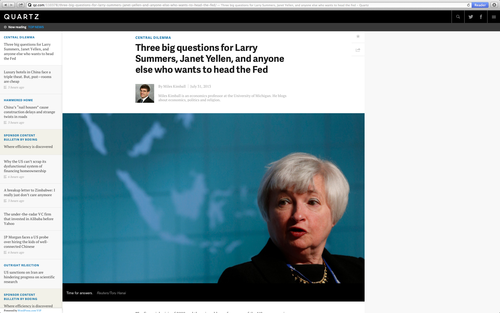
Quartz #27—>Three Big Questions for Larry Summers, Janet Yellen, and Anyone Else Who Wants to Head the Fed

Link to the Column on Quartz

Here is the full text of my 27th Quartz column, "Three big questions for Larry Summers, Janet Yellen, and anyone else who wants to head the Fed,“ now brought home to supplysideliberal.com. It was first published on July 31, 2013. Links to all my other columns can be found here.

If you want to mirror the content of this post on another site, that is possible for a limited time if you read the legal notice at this link and include both a link to the original Quartz column and the following copyright notice:

© July 31, 2013: Miles Kimball, as first published on Quartz. Used by permission according to a temporary nonexclusive license expiring June 30, 2014. All rights reserved.


The financial crisis of 2008 and the miserable performance of the US economy since then made the Federal Reserve look bad. And almost everything the Federal Reserve has done since then to try to get the economy back on track—from the role it took in the Wall Street bailouts (detailed in David Wessel’s book In Fed We Trust), to dramatically increasing the money supply, to quantitative easing—has also made the Fed look bad.

Despite how bad the Fed’s performance looks, things could have been worsemuch worse—and I have argued that Ben Bernanke, who led the Fed through this difficult time, should be given a third term as head of the Fed. But as President Obama has made very clear, that is not going to happen.

Now there are rival campaigns for who will follow Bernanke as Fed chief, with former Treasury Secretary Larry Summers and Fed Vice Chairman Janet Yellen as the leading candidates. Ezra Klein has repeatedly written on Wonkblog that Obama’s inner circle favors Summers, and Senate Democrats were galvanized by the prospect to write a letter favoring Yellen, followed a few days later by a New York Times editorial board weighing in strongly for Yellen. Much of the discussion has focused on personality differences that I can verify: Larry Summers was one of my professors in economics graduate school and I had a memorable dinner talking about the economics of happiness with Janet Yellen and her Nobel-laureate-to-be husband George Akerlof when I gave a talk at Berkeley in 2006.

I distilled my own observations into tweets saying on the one hand that “Larry Summers can dominate a room full of very smart economists” while “Janet Yellen, like her husband George Akerlof, is one of the nicest economists I have ever met.” Despite that personal knowledge, and the same publicly available information as everyone else, I had to confess on a HuffPost Live segment on July 25, 2013, that my own views on the relative merits of Summers and Yellen go back and forth on an hourly basis. The source of my trouble is this: there are many questions Larry Summers has studiously avoided addressing about monetary policy (Neil Irwin in Wonkblog thinks this is a deliberate, but flawed strategy) and even Yellen, who has an extensive and laudable record on past and current monetary policy and financial stability policy, hasn’t answered all the questions I have about the future of monetary policy and policy to enhance financial stability. On financial stability, Summers has made mistakes in the past (helpfully listed by Erika Eichelberger at motherjones.com), so I especially want to know where he would go in the future in this important function of the Fed.

The questions I would like to ask Larry Summers and Janet Yellen are many, but let’s focus on three big ones:

  1. Eliminating the “Zero Lower Bound” on Interest Rates. Given all of the problems that a floor of zero on short-term interest rates causes for monetary policy, what do you think of going to negative short-term interest rates, as I have argued for here and here and here? If we repealed the “zero lower bound” that prevents interest rates from going below zero, there would be no need to rely on the large scale purchases of long-term government debt that are a mainstay of “quantitative easing,” the quasi-promises of zero interest rates for years and years that go by the name of “forward guidance,” or inflation to make those zero rates more potent. Repealing the “zero lower bound” would require  dramatic changes in monetary policy (and in particular, a dramatic change in the way we handle paper currency), but wouldn’t that be worth it?
  2. Nominal GDP Targeting. What do you think of clarifying monetary policy by guiding short-term interest rates by the velocity-adjusted-money-supply (nominal GDP) targets recommended by the Market Monetarists, combined with regular, explicit forecasts for how high GDP can go without raising inflation?  (See “This Economic Theory was Born in the Blogosphere and Could Save the Markets from Collapse.”) In hindsight, it is clear that the Fed should have acted more quickly, and done more, to get the US economy out of the slump the financial crisis put it in. During that time, the behavior of the velocity-adjusted money supply clearly indicated that more monetary stimulus was needed. Wouldn’t it make sense to pay more attention to an indicator that does well both in ordinary times and when the economy faces a crisis the likes of which we haven’t seen since the Great Depression—and move away from the faulty reliance some of those who vote in the Fed’s monetary policy committee put on non-velocity-adjusted money supply numbers?
  3. High Equity Requirements for Banks and Other Financial Firms.What do you think of what Anat Admati and Martin Hellwig have to say about financial regulation in their book The Bankers’ New Clothes: What’s Wrong with Banking and What to Do About ItTheir argument comes down to this: despite all of the efforts of bankers and the rest of the financial industry to obscure the issues, it all comes down to making sure banks are taking risks with their own money—that is, funds provided by stockholders—rather than with taxpayers’ or depositors’ money. For that purpose, there is no good substitute to requiring that a large share of the funds banks and other financial firms work with come from stockholders. (For follow-up questions on financial regulation, Admati and Hellwig have an invaluable cheatsheet.)

Any serious candidate for the Fed who gives positive answers to these three questions will have my enthusiastic support, and I hope, the enthusiastic support of all those who have a deep understanding of monetary policy and financial stability. But any candidate for the Fed who gives negative answers to these three questions will be indicating a monetary policy and financial stability philosophy that would leave the economy in continued danger of slow growth (with little room for error) and high unemployment in the short run, and the virtual certainty of another serious financial crisis a decade or two down the road.


Update: I am delighted that Gerald Seib and David Wessel flagged this column in their August 2, 2013 Wall Street Journal “What We’re Reading”feature. They write

University of Michigan economist Miles Kimball says the best candidate to take over as leader of the Fed will back negative short-term interest rates, nominal GDP targeting, and high equity requirements for banks and financial firms. If a candidate is chosen who opposes any of these three, Mr. Kimball predicts another serious financial crisis in the next two decades. [Emphasis added.]

In their last sentence, they go beyond what I intend when I write

But any candidate for the Fed who gives negative answers to these three questions will be indicating a monetary policy and financial stability philosophy that would leave the economy in continued danger of slow growth (with little room for error) and high unemployment in the short run, and the virtual certainty of another serious financial crisis a decade or two down the road.

Let me clarify. First, it is not these beliefs by the Fed Chief alone that would lead to a financial crisis, but the philosophy that would answer my three questions in the negative, held more generally—by the Fed Chief and other important players around the world. But of course, the Fed Chief is a hugely important player on the world stage.  Second, I write “who gives negative answers to these three questions” meaning negative answers to all three. To separate out the causality more carefully, what I have in mind with the parallel structure of my final sentence in the column (quoted just above) is 

  1. Rejection of both negative interest rates and nominal GDP targeting—and perhaps rejection of negative interest rates alone—“would leave the economy in continued danger of slow growth (with little room for error) and high unemployment in the short run.”  
  2. Rejection of high equity requirements for banks and other financial firms would lead to “the virtual certainty of another serious financial crisis a decade or two down the road.” 

Outtakes: Here are two passages that I had to cut to tighten things up, but that you may find of some interest:

In brief, the Fed put itself in the position of getting bad results using unpopular methods. By July 2009, the Fed’s job approval rating in a Gallup poll was down to 30%, below the job approval rating for the IRS . By the time of the 2012 presidential election campaign, Republican crowds enthusiastically chanted the title of Republican candidate Ron Paul’s book End the Fed.

…in a 32-second exchange with Charlie Rose that is well worth watching for the nuances, President Obama said “He’s already stayed a lot longer than he wanted, or he was supposed to.” The praise for Bernanke in the Charlie Rose interview is so tepid and ungenerous that my interpretation is the same as US News and World Report editor-in-chief Mortimer Zuckerman’s in his July 25, 2013 Wall Street Journal op-ed “Mistreating Ben Bernanke, the Man Who Saved the Economy”: “This comment made it clear that Mr. Bernanke’s days were numbered.” 

General Freedom as a Way to Get Others to Gather Experimental Evidence for Me about Different Ways of Living

In Chapter 3 of On LibertyJohn Stuart Mill pivots from arguing for freedom of speech to arguing for arguing for freedom of action. He begins the chapter by arguing that finding truth requires experimentation as well as discussion. So people who do unusual things with their lives are doing me a favor, by their experimentation:

SUCH being the reasons which make it imperative that human beings should be free to form opinions, and to express their opinions without reserve; and such the baneful consequences to the intellectual, and through that to the moral nature of man, unless this liberty is either conceded, or asserted in spite of prohibition; let us next examine whether the same reasons do not require that men should be free to act upon their opinions—to carry these out in their lives, without hindrance, either physical or moral, from their fellow-men, so long as it is at their own risk and peril…. if he refrains from molesting others in what concerns them, and merely acts according to his own inclination and judgment in things which concern himself, the same reasons which show that opinion should be free, prove also that he should be allowed, without molestation, to carry his opinions into practice at his own cost. That mankind are not infallible; that their truths, for the most part, are only half-truths; that unity of opinion, unless resulting from the fullest and freest comparison of opposite opinions, is not desirable, and diversity not an evil, but a good, until mankind are much more capable than at present of recognizing all sides of the truth, are principles applicable to men’s modes of action, not less than to their opinions. As it is useful that while mankind are imperfect there should be different opinions, so is it that there should be different experiments of living; that free scope should be given to varieties of character, short of injury to others; and that the worth of different modes of life should be proved practically, when any one thinks fit to try them. It is desirable, in short, that in things which do not primarily concern others, individuality should assert itself. Where, not the person’s own character, but the traditions of customs of other people are the rule of conduct, there is wanting one of the principal ingredients of human happiness, and quite the chief ingredient of individual and social progress.

Top 200 Influential Economics Blogs: Aug 2013 | Onalytica Indexes

Confession of a Supply-Side Liberal is ranked 61st in this list of influential economics blogs. That seem pretty good to me, since the readership of my columns on Quartz itself would not be counted. On that score, note that at the end of June 2012, just a month after I started blogging, Confessions of a Supply-Side Liberal was ranked 31st. 

On the decline in ranking since the last list, Andreea Moldovan makes this note:

We have recently added some very well-known and influential blogs such as EconomixFT Alphaville and Vox, causing most blogs to go down in ranking.

Bruce Bartlett on Careers in Economics and Related Fields

Having read Bruce Bartlett’s op-eds for many years, I was pleased to have him send me directly a comment on the column Noah Smith and I wrote: “The complete guide to getting into an economics PhD program.” He kindly gave me permission to reprint what he wrote here. His main point is that there are many good careers in economics that do not require a PhD. I agree. Indeed, one of the reasons I feel good about Noah’s and my advice about working toward an economics PhD is that along that highway, there are many wonderful exits along the way, should you choose not to go all the way to an economics PhD. And if you do get a PhD, there are many careers outside of economics, as well as in, that you will be well prepared for. 

Here is what Bruce wrote to me:

I realize your column was specifically about getting a Ph.D. in economics, but you might have also discussed the options for working in economics with no degrees in economics at all. I don’t have any and I did pretty well and landed some high level government economics positions. My career path is probably not very transferable, but I would mention journalism as one place one can write about economics without a degree in the subject. Catherine Rampell, a NYT business reporter, for example, has only a BA in English and she’s very good. Another option is law. Many areas of law intersect with economics—tax law, antitrust, many areas of economic regulation etc. The law reviews are filled with articles about economics that would never be accepted by any actual economics journal, but that will get you tenure at a law school, where all you need is a law degree. Political scientists and sociologists also do a lot of quasi-economics work. So if you are just interested in being an economist without wanting to jump through the hoops to get a Ph.D. in the subject and teach it at the university level, I would suggest there are other options.

I would also mention that there are a lot of jobs for those who only have a master’s degree in the subject. That is often good enough for government work or a job in a think tank or as a business economist or at an international financial institution such as the World Bank.

Anat Admati's Words of Encouragement for People Trying to Save the World from Another Devastating Financial Crisis

I was privileged to be copied on an email exchange between Anat Admati and someone who had worked hard to make the financial system more stable, but had gotten discouraged by the politics one runs into in such an effort. I loved Anat’s words of encouragement, which I think are apt for anyone who is trying to make a difference for greater financial stability in the real world. Anat kindly gave me permission to reprint a passage from that message here, after some very light editing:

…“policy makers’ indifference to reality” resonates. I had no idea just how bad it can be. First I was shocked at confusions and misunderstanding. Naively I thought that is mostly what it is, never mind why, if folks don’t understand, maybe they can’t be blamed. Then you come across the political issues and the capture and the picture becomes much uglier. I read a book recently and met the author called “Willful Blindness” – http://www.amazon.com/Willful-Blindness-Ignore-Obvious-Peril/dp/0802777961 – part of the evidence is from experiments. It becomes about what people WANT to know, and then of course they have to be ABLE to do something about it, and they also have, again, to WANT to do something. By the time you get to actually doing something, well, the numbers are very few and far between. 
So I may have stirred the pot, but serious progress, maybe a little bit, reluctantly, hard to tell… it depends on expectations..
Anyway, I can understand the bruised feelings. In my case, especially since I am up against a lot of money, I also get bruised a lot and it’s hard to take. It’s easy to give up, but I get annoyed about the wrong side winning so I dust myself off and think of something else to do. Fortunately, I/we do have paying jobs and I feel by now that under the circumstances, it is virtually our duty to lobby on behalf of the public. The political economy of money and influence ends up messing up democracies, see Olsen etc…