Quartz #3—>Al Roth's Nobel Prize is in Economics, but Doctors Can Thank Him, Too

Link to the Column on Quartz

Here is the full text of my 3d Quartz column, now brought home to supplysideliberal.com. It was first published on October 15, right after Al Roth’s Nobel Prize was announced. This column describes research Dan Benjamin, Ori Heffetz and Alex Rees-Jones were conducting about trade-offs young medical doctors make in their National Resident Matching Program choices, including tradeoffs between happiness and other goods. Our paper is now finished (and submitted to a professional journal) and is available on the Social Science Research Network:

If you want to mirror the content of this post on another site, that is possible for a limited time if you read the legal notice at this link and include both a link to the original Quartz column and the following copyright notice:

© October 15, 2012: Miles Kimball, as first published on Quartz. Used by permission according to a temporary nonexclusive license expiring June 30, 2014. All rights reserved.

Links to all my other columns can be found here.


Neither of this year’s recipients of the Nobel Prizes in Economics have degrees in economics, but they certainly have the respect of economists like me. I learned Lloyd Shapley’s principles of cooperative game theory in graduate school. They have stood the test of time. And Al Roth is a very big name in microeconomic theory, whom most economists thought would someday win a Nobel Prize. Roth has a PhD in operations research, Shapley in math.

I have reason to be personally grateful to Al Roth because his redesign of the National Resident Matching Program (NRMP) for medical doctors has provided a foundation for research my coauthors, Daniel Benjamin, Ori Heffetz, and Alex Rees-Jones (all three now at Cornell) and I are conducting. We want to know to what extent young doctors are pursuing happiness or pursuing prestige and fortune instead. For our research, it is important that Al Roth designed the NRMP in a way that encourages medical students to express their true preferences.

What we did was to run our own web survey of the young doctors who had just made their choices in the NRMP. We wanted to see how much they valued happiness compared to other concerns in a real-world situation. We are after the answers to questions such as this: are the future medical residents willing to sacrifice happiness for prestige? Will they sacrifice their own happiness to go to a city their romantic partners like better? If they sacrifice happiness during their residency, is it only in order to experience greater happiness later on in life, or are they willing to make a choice they think will lower their happiness throughout their lives in order to get something else they want? The NRMP provides an ideal testbed for these questions because it makes the future medical residents think hard about their choices and what those choices mean for their lives, and provides a clear deadline for that thinking. And Al Roth’s design means that the match program should be getting the medical residents to think about what they really want rather than about some way to game the system. In a fitting tribute to Al Roth’s new home at Stanford, my coauthors gave a preliminary report of our research at the Stanford Institute for Theoretical Economics this summer. We have more work to do to analyze the data, but we can already see that there are rich rewards to this effort, thanks in important part to Al Roth’s design.


Update: Thanks to Daniel Altman’s digging, Here is a little more detail from Al Roth his efforts with the National Resident Match Program and how it works:

Click to hear a podcast about Daoism. 

isomorphismes:

Daoism

  • wú wéi 無爲 — doing by not doing
  • the water is more powerful than the rock
  • “One of Daoism’s core ideas is that we can prolong life by following The Way” (contrast to Xtianity, Buddhism)
  • In the second century AD, Laodze was seen as “the alternative philosopher” to Confucius. Confucius represented the order of the State.
  • Buddhism may be an Indian form of Daoism come back to China
  • Later in the programme this appears to be a theme: Daoists as the under-religion, the shamanic folk religion. Well that almost fits the philosophy of “a ruler who doesn’t appear to be ruling” too nicely.
  • (Exceptions at times: the Yellow Turban revolt, 30 years of Daoist-led kingdom (which they peaceably annexed to a neighbouring ruler), widespread Daoist temples and 5 Bushels of Rice/year to pay for your Daoist shamanic exorcist/priestly councillor.)
  • “Shamanism preceded Confucianism” — “We are controlled by the unseen world”
  • In Chapter 42 [of the Dao De Jing 道德經] … the Dao gives birth to the Origin: the beginning of everything, the One. The One then gives birth to the Two, which is the Yin and the Yang. (These are cosmic forces. They’re not moral forces; they’re not divine forces. They’re just forces of the Universe.) And the Two give birth to the Three, which in traditional Daoist thought, is: Heaven, Earth, and Humanity. … And all this gives birth to the myriad things.
  • Cheng Dao Ling (2nd century) teaches he has the power to forgive sins.
  • Oh, so they have sins then? “But it’s harder to sin by inaction than by action.”← Lecturer’s supposition, I found the opposite to be one of the most interesting takeaways from the economic theory of opportunity cost. Why do we privilege the refrainment of wrongdoing over the failure to rightdoing?
  • Dao 道 = power (although our word for it has political connotations that 道 does not. I also notice our words for “logic” and “bureaucracy” don’t seem to fit in this discussion, denotatively or connotatively. Our language and theirs embed assumptions; ∄ neutral.) A universal process of change that applies to almost everything. (So, the Lagrangian-mechanics and post-Lagrangian-mechanics pursuit of minimisation of difference between potential and actual energy?)
  • De 德 = our individual instantiation with the Dao . Cycles of life. Which not everyone goes through with the same vigour.
  • Rulers needed to show that the celestial bureaucracy fitted harmoniously with their own worldly order. Li family 7th cent AD claims descent from (by then) Demigod Laodze.
  • “There’s no consistency to the Dao De Jing 道德經. It’s as if someone had chalked up parts of the Bible and mixed the pieces around and we had to derive a coherent philosophy from it.” Actually this sounds exactly like the Bible. 73 books all by different authors and redacted by a series of future editors…yeah, not exactly one unified message.
  • “Gunpowder was developed by Daoists searching for the elixir of life…subdue KNO₃”
  • “Communists saw Daoism as mere superstition” — “By the Cultural Revolution ∃ ≤ 500 Daoist priests”
  • Joangdze: “Logic, rhetoric, argumentation don’t help us so much to understand The Universe” #logocentrism — Performance, experience, feelings are preferable to the (inserting my own pet peeves on economic theorists here) elaborate structures built upon fragile axioms [which then the fragile axioms defended at knifepoint since their collapse would bring down a roccocco golden palace on the theorist’s head].

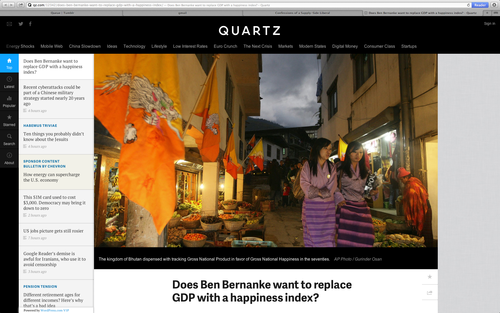
Quartz #2—>Does Ben Bernanke Want to Replace GDP with a Happiness Index?

blog.supplysideliberal.com tumblr_inline_mjo2noUsGD1qz4rgp.png

Link to the Column on Quartz

Here is the full text of my 2d Quartz column, now brought home to supplysideliberal.com. This column was first published on October 8. Links to all my other columns can be found here.

If you want to mirror the content of this post on another site, that is possible for a limited time if you read the legal notice at this link and include both a link to the original Quartz column and the following copyright notice:

© October 8, 2012: Miles Kimball, as first published on Quartz. Used by permission according to a temporary nonexclusive license expiring June 30, 2014. All rights reserved.


As chairman of the Federal Reserve, it is Ben Bernanke’s job to devour data like the latest report on how more Americans have found jobs.  But he wants even more data. In a prerecorded talk for a conference this past summerBernanke said, ”…we should seek better and more-direct measurements of economic well-being, the ultimate objective of our policy decisions.”  He’s not talking about more accurate versions of regular economic indicators, though.

Rather, Bernanke suggests that survey measures of happiness and life satisfaction should take their place alongside GDP as measures of how a nation is doing. In doing so, he joined current British Prime Minister David Cameron, who said ”it’s time we focused not just on GDP but on GWB—general wellbeing” and former French Prime Minister Nicolas Sarkozy, who said he would ”fight to make all international organisations change their statistical systems by following the recommendations” of the Stiglitz report. He refers to Nobel Prize winning economist Joseph Stiglitz’s committee’s work proclaiming “the time is ripe for our measurement system to shift emphasis from measuring economic production to measuring people’s well-being.” The emphasis is in the original.

In Sarkozy’s case, historian Brian Domitrovic opines that Sarkozy was just trying to divert attention from poor GDP statistics, saying “France has excellent reason to suppress GDP statistics. Since 1982, among developed nations, France has been a clear laggard in GDP growth.” He went on: “The oldest and most pathetic trick in the book when you lose a contest is to try to move the goal posts. GDP statistics of the past quarter century have shamed France but flattered the US, Britain and East Asia. Mr. Sarkozy’s gambit to paper over this real difference will be lucky to find any takers.” Domitrovic is pointing out the very real danger of the manipulation and politicization of national statistics when the right way to measure something like “well-being” is unclear.

How can we avoid the dangers of manipulation and politicization of new indicators of national well-being? Here is a simple answer: if we are going to use survey measures of well-being such as happiness and life satisfaction alongside well-seasoned measures such as GDP as ways to assess how well a nation is doing, we need to proceed in a careful, scientific way that can stand the test of time. For example, in my research with Dan Benjamin, Ori Heffetz and Alex Rees-Jones in the August American Economic Review, people say they are willing to sacrifice happiness for money if the price is right. Without understanding how much people want money and how much they want happiness, no one should pretend to know whether GDP or happiness is a better measure of a nation’s performance.

But it isn’t just happiness vs. money. Should we be measuring anxiety or measuring stress? How much weight should we put on being satisfied with life as opposed to happiness? Without good answers to these questions, it will all degenerate into political posturing and dueling statistics. But if we do it right, the ultimate prize will be a new way to judge whether the government is doing its job. And to me there is no question what the government’s job is. It is to smooth the way so people can get what they want and lead the kind of lives they want to lead—without deciding for them what they should want.

My New Companion Blog: "Links I am Thinking About"

Here is a link to my new companion blog “Links I am Thinking About”

I often want to keep track of links to articles I might refer to in posts and columns of my own. It occurred to me that a companion Tumblr blog could serve that purpose, while itself being of interest to some readers. The rule I am setting myself for this new companion blog “Links I am Thinking About,” is that it will only have simple link posts, with a bare minimum of description. 

The tagline for “Links I am Thinking About” is

to agree with, to disagree with, or as clues.

Thus, while a link post on my main supplysideliberal.com blog that has no commentary signals that I have a favorable attitude toward what I am linking to at the time I link to it, a bare link on the “Links I am Thinking About” companion blog may not indicate even the mildest endorsement. Ordinarily, anything I put on “Links I am Thinking About” I will tweet as well. But “Links I am Thinking About” is meant to be a more permanent record than my Twitter feed. For economics, the importance of “clues” is evident from the Larry Summers maxim that is my drumbeat in “Dr. Smith and the Asset Bubble”:

It isn’t easy to figure out how the world works.

For religion, the importance of “clues” is evident in my post “An Agnostic Grace.”

To make “Links I am Thinking About” easy to access, I have added a link to this new companion blog on my sidebar–as you can see halfway down the magnified screen shot below:  

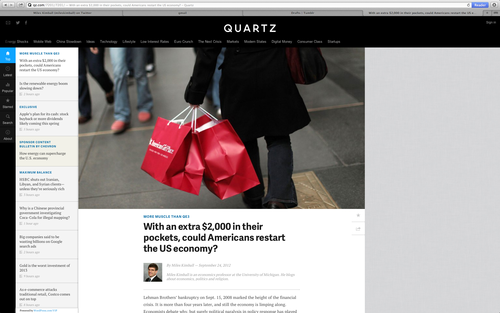
Quartz #1—>More Muscle than QE: With an Extra $2000 in Their Pockets, Could Americans Restart the US Economy?

Link to the column on Quartz

I received clarification from my editor Mitra Kalita, that, after 30 days, it is legally OK to put up the full text of my Quartz columns on my blog. So I plan to post the full text of my previous Quartz columns on supplysideliberal.com a couple of times a week until I catch up. Today, I am posting my very first Quartz column. Links to all my other columns can be found here. 

If you want to mirror the content of this post on another site, that is possible for a limited time if you read the legal notice at this link and include both a link to the original Quartz column and the following copyright notice:

© September 24, 2012: Miles Kimball, as first published on Quartz. Used by permission according to a temporary nonexclusive license expiring June 30, 2014. All rights reserved.


Lehman Brothers’ bankruptcy on Sept. 15, 2008 marked the height of the financial crisis. It is more than four years later, and still the economy is limping along. Economists debate why, but surely political paralysis in policy response has played a role. Two kinds of politics are at work: bitter politics in Congress about the long-run direction of the country—and the ballooning national debt—that have prevented a stronger fiscal policy response, and politics inside the Federal Reserve that have prevented a stronger monetary policy response.

With the Fed’s announcement last week of QE3—purchases of long-term Treasuries and mortgage-backed assets until the economy looks up—it may appear we are already set for enough stimulus, but given the low power of quantitative easing tools, the promised purchases ($85 billion per month through the end of the year and $40 billion per month thereafter) are actually small relative to the task at hand. What seems like dramatically decisive action is really a half measure that nevertheless represents a big win for the doves in the Fed given the strength of the opposition they have faced from the hawks.

To avoid these political landmines, what is needed is a new tool to get the economy moving. I propose something revolutionary:  Let’s give the American people some money. Not free money, though.

In a recent academic paper “Getting the Biggest Bang for the Buck in Fiscal Policy”and on my blog, supplysideliberal.com, I outline a proposal to provide $2,000-lines of credit to every taxpayer, accessed through a government-issued credit card.  The interest rate would be 6% per year, the money could be paid back over the course of 10 years, and the credit limit would gradually fall as the economy recovered and the stimulus from this extra borrowing power was no longer needed.

Compare these “Federal Lines of Credit” (FLOC’s) to tax rebates. Every dollar of a tax rebate is a dollar added to the national debt. But most of the funds people borrow using these government-issued credit cards would eventually be repaid—particularly since the government can enforce repayment through payroll deduction. The unemployed would have their payments deferred, but once the economy is moving again, most people would have jobs with paychecks so they could repay. A few still wouldn’t be able to repay, but the total amount of stimulus (the “bang”) for each dollar ultimately added to the national debt (“the buck”) would be much greater than with tax rebates.

One of the closest historical precedents was the veterans’ bonus of 1936, which was in part a loan to World War I veterans. This has been analyzed recently by Berkeley Ph.D. student Joshua Hausman. Hausman finds that the bonus had effects as large as those usually associated with tax rebates. The circumstances were not identical, but if the results carry over, Hausman’s analysis suggests that the stimulus effects of Federal Lines of Credit would be at worst only a little smaller than the stimulus from a $2,000 per person tax rebate. (Economic theories of how tax rebates get their oomph from the effects of ready cash suggest the same thing.) The trouble with a $2,000 per person tax rebate is that the U.S. government can’t afford it. But if 90% or more of everyone eventually repays, a $2,000 per person line of credit would ultimately cost less than $200 per person. With a good deal like that for getting the economy back in gear, maybe even Republicans and Democrats can agree on it.

Miles on HuffPost Live: Debt, Electronic Money, Federal Lines of Credit, and a Public Contribution Program

Link to HuffPost LIve Segment “Owning Our Debt”

I am still a novice at TV and video appearances, and so stumbled over some of my words and had some trouble with my lighting, but I thought this segment of HuffPost Live went well. I had a chance to talk about debt, electronic money, Federal Lines of Credit and my idea for a Public Contribution Program.  My main goal was to get across the substance of my Quartz column “What Paul Krugman got wrong about Italy’s economy,” including my reply to Paul Krugman’s response, which you can see in my post “Noah Smith Joins My Debate with Paul Krugman: Debt, National Lines of Credit, and Politics.”

The segment was inspired by Robert Solow’s essay “Our Debt, Ourselves.”

My other appearance on HuffPost Live is here: 

I also had one TV appearance on CNBC’s Squawkbox:

Finally, I have had two radio interviews, whichj allowed me to explain electronic money and Federal Lines of Credit much better than I could on HuffPost Live: 

John Stuart Mill on the Protection of "Noble Lies" from Criticism

I have been interested in the concept of a “noble lie,” since in the course of many discussions I have had about Mormonism in my life, I have heard serious arguments advanced that Mormonism is good for people, even if it isn’t true. In wikipedia, a “noble lie” is defined as follows;

In politics a noble lie is a myth or untruth, often, but not invariably, of a religious nature, knowingly told by an elite to maintain social harmony or to advance an agenda. The noble lie is a concept originated by Plato as described in the Republic.

In the secular arena as well, “political correctness” tries to protect certain ideas from criticism and discussion because those ideas are considered necessary for social harmony and justice. In On Liberty, in Chapter 2, “Of the Liberty of Thought and Discussion,” John Stuart Mill writes this about the idea that “noble lies” should be protected from criticism–an argument that applies with full force even if one thinks a “noble lie” is better described as a “magnificent myth”

In the present age—which has been described as “destitute of faith, but terrified at scepticism"—in which people feel sure, not so much that their opinions are true, as that they should not know what to do without them—the claims of an opinion to be protected from public attack are rested not so much on its truth, as on its importance to society. There are, it is alleged, certain beliefs, so useful, not to say indispensable to well-being, that it is as much the duty of governments to uphold those beliefs, as to protect any other of the interests of society. In a case of such necessity, and so directly in the line of their duty, something less than infallibility may, it is maintained, warrant, and even bind, governments, to act on their own opinion, confirmed by the general opinion of mankind. It is also often argued, and still oftener thought, that none but bad men would desire to weaken these salutary beliefs; and there can be nothing wrong, it is thought, in restraining bad men, and prohibiting what only such men would wish to practise. This mode of thinking makes the justification of restraints on discussion not a question of the truth of doctrines, but of their usefulness; and flatters itself by that means to escape the responsibility of claiming to be an infallible judge of opinions. But those who thus satisfy themselves, do not perceive that the assumption of infallibility is merely shifted from one point to another. The usefulness of an opinion is itself matter of opinion: as disputable, as open to discussion, and requiring discussion as much, as the opinion itself. There is the same need of an infallible judge of opinions to decide an opinion to be noxious, as to decide it to be false, unless the opinion condemned has full opportunity of defending itself. And it will not do to say that the heretic may be allowed to maintain the utility or harmlessness of his opinion, though forbidden to maintain its truth. The truth of an opinion is part of its utility. If we would know whether or not it is desirable that a proposition should be believed, is it possible to exclude the consideration of whether or not it is true? In the opinion, not of bad men, but of the best men, no belief which is contrary to truth can be really useful: and can you prevent such men from urging that plea, when they are charged with culpability for denying some doctrine which they are told is useful, but which they believe to be false? Those who are on the side of received opinions, never fail to take all possible advantage of this plea; you do not find them handling the question of utility as if it could be completely abstracted from that of truth: on the contrary, it is, above all, because their doctrine is the "truth,” that the knowledge or the belief of it is held to be so indispensable. There can be no fair discussion of the question of usefulness, when an argument so vital may be employed on one side, but not on the other. And in point of fact, when law or public feeling do not permit the truth of an opinion to be disputed, they are just as little tolerant of a denial of its usefulness. The utmost they allow is an extenuation of its absolute necessity, or of the positive guilt of rejecting it.

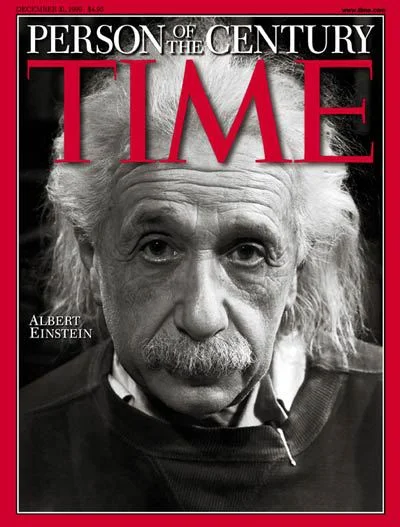
How Albert Einstein Became a Celebrity

Chrystia Freeland, on pages 124-125 of Plutocrats: The Rise of the New Global Super Rich and the Fall of Everyone Elsewrites:

The Scientist who best exemplifies the self-fulfilling power of fame is, ironically, the one most of us would immediately name as the twentieth century’s brightest example of pure intellectual genius: Albert Einstein. Einstein was indeed a groundbreaking physicist, whose theory of relativity ushered in the nuclear age and transformed the way we think about the material world. But why is he a household name, while Niels Bohr, who made important contributions to quantum mechanics and developed a model of atomic structure that remains valid today, or James Watson, one of the discoverers of the double helix structure of DNA, is not?

According to historian Marshall Missner, Einstein owes much of his power as one of the most influential men of the twentieth century less to his theoretical papers and more to the trip he made to the United States in April 1921 as part of a Zionist delegation led by Chaim Weizmann. Before the ship made landfall, Einstein was already known–and feared. His theory of relativity, first put forward in 1905, had been dramatically confirmed in 1919 by the observation of the deflection of light during the solar eclipse in May of that year. The discovery captured the American popular imagination, but not in a good way. The twenties were a fraught decade. The Bolsheviks were consolidating their power in the Soviet Union. Germany was struggling under the weight of punitive World War I reparations. The U.S. economy was still booming, but income inequality was higher than it had ever been and elites were frightened both of homegrown populist protesters and of revolutionary ideas crossing the Atlantic. It was also a time of intense xenophobia and mounting anti-Semitism.  

In that climate, America’s arbiters of public opinion decided that Dr. Einstein and his theory of relativity were sinister and subversive. It became a truth universally acknowledged that only “twelve men” in the world understood the theory of relativity. Pundits worried that this small, foreign cabal could use this knowledge to bend space and time and to enter a “fourth dimension” and thereby achieve “world domination.” Even the New York Times warned of the “anti-democratic implications” of Einstein’s discovery: “The Declaration of Independence itself is outraged by the assertion that there is  anything on earth, or in interstellar space, that can be understood by only the chosen few.”

Then came the Weizmann delegation. Zionism was growing in popularity among New York Jews, and thousands came to the pier to greet the visitors. But the press thought the crowds were Einstein groupies. The Washington Post reported there were “thousands at the pier to greet Einstein.” The New York Times wrote that “thousands wait four hours to welcome theorist and his party to American.” Its interest piqued, the press pack descended on Einstein. Instead of the “haughty, aloof European looking down on boorish Americans” they had expected, he turned out to be a modest, likable guy who “smiled when his picture was taken, and produced amusing and quotable answers to their inane questions.” No longer a threat to the Declaration of Independence, “Professor Einstein,” the New York Times editorial page declared, “improves upon acquaintance.” The scribblers loved him, and they loved the frisson of overturning their readers’ expectations, and a scientific legend was born. From that moment on, a great deal of Einstein’s power in the world, particularly outside the lab, but also within it, was derived from his celebrity.

Franklin Roosevelt: The Hard Road to Democracy

In the address he gave to the Commonwealth Club of San Francisco, not long before he was elected President of the United States for the first time, Franklin Delano Roosevelt gave this account of the history of popular government: 

When we look about us, we are likely to forget how hard people have worked to win the privilege of government. The growth of the national Governments of Europe was a struggle for the development of a centralized force in the Nation, strong enough to impose peace upon ruling barons. In many instances the victory of the central Government, the creation of a strong central Government, was a haven of refuge to the individual. The people preferred the master far away to the exploitation and cruelty of the smaller master near at hand.

But the creators of national Government were perforce ruthless men. They were often cruel in their methods, but they did strive steadily toward something that society needed and very much wanted, a strong central State able to keep the peace, to stamp out civil war, to put the unruly nobleman in his place, and to permit the bulk of individuals to live safely. The man of ruthless force had his place in developing a pioneer country, just as he did in fixing the power of the central Government in the development of Nations. Society paid him well for his services and its development. When the development among the Nations of Europe, however, had been completed, ambition and ruthlessness, having served their term, tended to overstep their mark.

There came a growing feeling that Government was conducted for the benefit of a few who thrived unduly at the expense of all. The people sought a balancing-a limiting force. There came gradually, through town councils, trade guilds, national parliaments, by constitution and by popular participation and control, limitations on arbitrary power.

Franklin Roosevelt on the Second Industrial Revolution

In her book Plutocrats: The Rise of the New Global Super-Rich and the Fall of Everyone ElseChrystia Freeland quotes this wonderful passage about the Second Industrial Revolution from Franklin Delano Roosevelt’s speech to the Commonwealth Club of San Francisco, not long before he was elected President of the United States for the first time: 

It was in the middle of the nineteenth century that a new force was released and a new dream created. The force was what is called the industrial revolution, the advance of steam and machinery and the rise of the forerunners of the modern industrial plant. The dream was the dream of an economic machine, able to raise the standard of living for everyone; to bring luxury within the reach of the humblest; to annihilate distance by steam power and later by electricity, and to release everyone from the drudgery of the heaviest manual toil. It was to be expected that this would necessarily affect Government. Heretofore, Government had merely been called upon to produce conditions within which people could live happily, labor peacefully, and rest secure. Now it was called upon to aid in the consummation of this new dream. There was, however, a shadow over the dream. To be made real, it required use of the talents of men of tremendous will and tremendous ambition, since by no other force could the problems of financing and engineering and new developments be brought to a consummation.

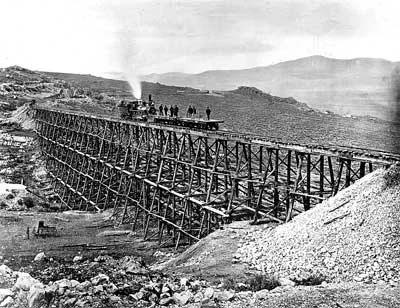
So manifest were the advantages of the machine age, however, that the United States fearlessly, cheerfully, and, I think, rightly, accepted the bitter with the sweet. It was thought that no price was too high to pay for the advantages which we could draw from a finished industrial system. This history of the last half century is accordingly in large measure a history of a group of financial Titans, whose methods were not scrutinized with too much care, and who were honored in proportion as they produced the results, irrespective of the means they used. The financiers who pushed the railroads to the Pacific were always ruthless, often wasteful, and frequently corrupt; but they did build railroads, and we have them today. It has been estimated that the American investor paid for the American railway system more than three times over in the process; but despite this fact the net advantage was to the United States.

Noah Smith Joins My Debate with Paul Krugman: Debt, National Lines of Credit, and Politics

Update: You can see what I have to say in the wake of Thomas Herndon, Michael Ash and Robert Pollin’s critique of Carmen Reinhart and Ken Rogoff's work on national debt and growth in my column “An economists mea culpa: I relied on Reinhart and Rogoff.” (You can see my same-day reaction here.) Also, on the substance, see Owen Zidar’s nice graph in his post “Debt to GDP & Future Economic Growth.” I sent a query to Carmen Reinhart and Ken Rogoff about whether any adjustments are needed to the two figures from the paper with Vincent Reinhart that I display below, but have not yet received a reply to that query. I think that covers most of the issues that recent revelations raise.

Note that I have revised “What Paul Krugman got wrong about Italy’s economy.” This post is now the go-to source for what I originally said there, relying on “Debt Overhangs, Past and Present” (which has Vincent Reinhart as a coauthor along with Carmen Reinhart and Ken Rogoff). My original passage is in an indented block a little above the colorful pictures your eye will be drawn to below.


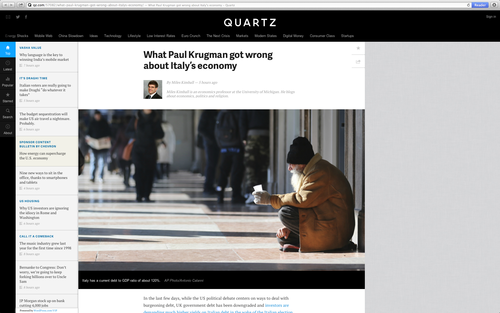
In a world where people wrote frankly, Noah Smith has written the response to my Quartz column “What Paul Krugman got wrong about Italy’s economy” that Paul Krugman should have written: 

instead of what Paul actually wrote in response to my column:

(The brief summary of my column is that electronic money could help the UK and the Federal Lines of Credit could help both Italy and the UK stimulate their economies without the problems that might arise from adding substantially to their debt by a simple increase in government spending, as indicated by my original title: “How Italy and the UK Can Stimulate Their Economies Without Further Damaging Their Credit Ratings.”)

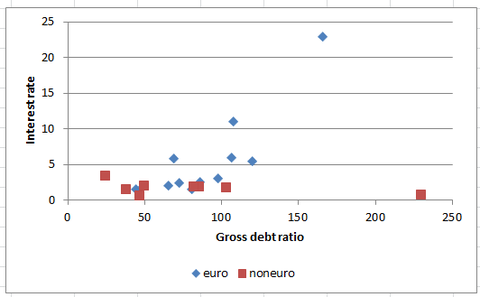
Noah follows an earlier Paul Krugman column “Debt, Spreads and Mysterious Omissions,” in using the graph above to distinguish between Italian debt and US or UK or Japanese debt by pointing out that individual euro-zone countries are not able to borrow in their own currency in the same way the US, the UK or Japan can. Paul used this distinction to minimize the danger to the US of high debt levels; here is the first sentence of “Debt, Spreads and Mysterious Omissions”

Binyamin Applebaum reports on a new paper by Greenlaw et al alleging that bad things will happen to America, because debt over 80 percent of GDP leads to high interest rates, and is skeptical – but not skeptical enough. 

Paul explains that an important argument that the US may be OK revolves around the suggestion that Japan can get away with the debt levels at the rightmost extreme of the graph above because: 

…what really matters is borrowing in your own currency – in which case the US and the UK are, in terms of borrowing costs, like Japan rather than Greece. That’s certainly what the De Grauwe (pdf) analysis suggests.

Even the quickest look at the data suggests that there’s something to this argument; for example, taking data from the paper itself, and dividing the countries into euro and non-euro, we get a scatterplot like this:

There is no hint in Paul’s earlier piece, “Debt, Spreads and Mysterious Omissions” of a claim that we should not worry about high debt levels for euro-zone countries, and even less reason to worry about US debt. A reader could be forgiven for coming away from “Debt, Spreads and Mysterious Omissions” thinking Paul thought that maybe high debt levels might be worrisome for countries that cannot borrow in their own national currency (such as Greece and Italy), but not for countries that can borrow in their own currency.  

Noah joins Paul in taking me to task for relying too much on Carmen Reinhart, Vincent Reinhart and Ken Rogoff’s paper  “Debt Overhangs, Past and Present”:

Krugman has a good point: The “90%” thing is not well established; it is obviously just Reinhart and Rogoff eyeballing some sparse uncontrolled cross-country data and throwing out an off-the-cuff figure that got big play precisely because it was simple and (to deficit scolds) appealing. The 90% number alone is not a justification for worrying about debt.

But unlike Paul, Noah notes that all I need to argue for the main point of my column is that less debt is better than more debt:

But I feel that this argument over debt levels is mostly a distraction. The important thing, which is being overlooked, is that Miles has come up with a really interesting policy tool to increase the amount of stimulus per unit of debt incurred. That tool is Federal Lines of Credit, or FLOCs - basically, the idea that government should lend people money directly.

Paul is so used to–and intent on–arguing that getting out of recessions is so important that it is worth incurring additional debt to do so, that he seems to miss my point that it is possible to stimulate economies to escape recessions while incurring much less debt than a straight increase in government spending would incur.

I am actually on record agreeing with Paul (and Noah) that the Great Recession was so serious that it was worth a massive increase in debt to escape it if that were the only available way to stimulate the economy. In “What Should the Historical Pattern of Slow Recoveries after Financial Crises Mean for Our Judgment of Barack Obama’s Economic Stewardship”:

So the fact that Barack did not push for a bigger stimulus package really is an indictment of his economic leadership. According to the reported statement by Larry Summers, it was a political judgement that a bigger stimulus was not politically feasible. I am not at all convinced that a bigger stimulus was politically impossible. It would not have been easy, I’ll grant that, but I was amazed that Barack managed to get Obamacare through. If, instead, Barack had used his political capital and the control the Democrats had over both branches of Congress during his first two years for a bigger stimulus, couldn’t he have done more? …

Notice that in all of this, I am treating a larger stimulus of a conventional kind as the best among well-discussed policy options when Barack took office in 2009. So I am backing up Paul Krugman’s criticisms of Barack’s policies at the time. However, given what we know now we could do even better, as I discuss in my post “About Paul Krugman: Having the Right Diagnosis Does Not Mean He Has the Right Cure.”

 A similar judgment might well hold for Italy, as Paul argued in “Austerity, Italian Style” (the piece that kicked off this current debate with Paul), except: 

  1. We all agree that Italy’s debt problem is worse than the debt problem for the US. 
  2. Much more importantly, a policy option (National Lines of Credit) is now on the table (at least for discussion in the op/ed pages) that could stimulate the Italian economy with much less addition to debt than a straight increase in spending–a policy option that was not on the table for the US in 2009.

Astute readers will have noticed that in “What Should the Historical Pattern of Slow Recoveries after Financial Crises Mean for Our Judgment of Barack Obama’s Economic Stewardship” I relied on a stylized fact from Carmen Reinhart and Ken Rogoff’s book This Time is Different: Eight Centuries of Financial Folly. If I am led astray, it is because of my enormous respect for Ken Rogoff’s judgment, but in this case, I would be very surprised if Paul had not at some point in his New York Times columns relied on the Reinhart and Rogoff stylized fact that recessions have tended to last a long time after financial crises in more or less the same way I did. (Though I know Ken Rogoff, I don’t think I have ever been fortunate enough to meet either Carmen or Vincent Reinhart yet.) But of course, the meaning of the Reinhart and Rogoff stylized fact that across many countries recessions have historically lasted a long time after financial crises is just as much up for grabs as the meaning of the Reinhart, Reinhart and Rogoff stylized fact that across many countries GDP growth has been low during periods when debt to GDP ratios have been high.

For the record, despite, Paul’s title “Another Attack of the 90% Zombie,” I do not think I unduly emphasized the 90% figure itself. Here is what I actually wrote: 

And national debt beyond a certain point can be very costly in terms of economic growth, as renowned economists Carmen ReinhartVincent Reinhart, and Kenneth Rogoff convincingly show in their National Bureau of Economic Research Working Paper “Debt Overhangs, Past and Present.”

Where do the United Kingdom and Italy stand in relation to the 90% debt to GDP ratio Reinhart, Reinhart and Rogoff identify as a threshold for trouble? (It is important to realize that their 90% threshold is in terms of gross government debt. That is, it does not net out holdings by other government agencies. )

In context in relation to Italy, this means “Surely, in practice, some level of the existing debt to GDP ratio for Italy should make us worry about adding to Italy’s national debt. Can we get some idea of whether we should worry about Italian debt or not?”

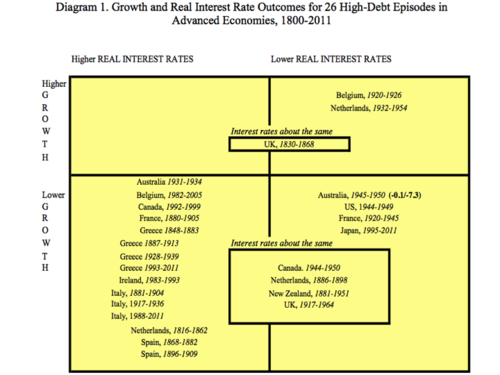
Let’s look at Reinhart, Reinhart and Rogoff’s stylized fact about debt to GDP ratios and realized economic growth in a little more detail to see if there is enough suggestive evidence that we should be concerned about adding to Italy’s national debt. Here is Diagram 1 from “Debt Overhangs, Past and Present”:  

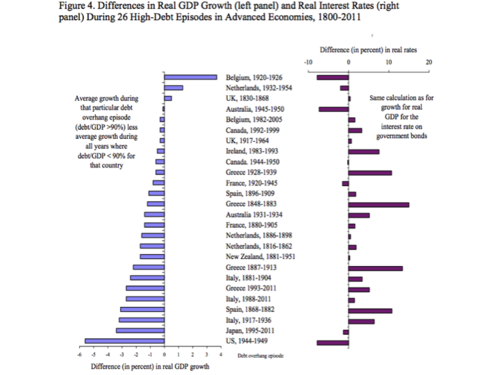
In this sample of 26 high-debt episodes, there has never been a case when a country had both a debt/GDP ratio higher than 90% and high real interest rates beat its own national GDP growth rate average during that period of time. Figure 4 gives more detail for specific episodes:

Niklas Blanchard writes this about “Debt Overhangs, Past and Present” in his post in this debate with Krugman (see this full account of my discussion with Niklas):

There is a lot not to like about the Reinhart, Reinhart, and Rogoff study, and Krugman nails much of it; it doesn’t deal with causation. I’m actually kind of confused as to why Miles mentions the study (although he may enlighten me in the comments). However; more importantly, it doesn’t specify 90% debt: GDP as a regime change to a new steady state, or as a transitory experience resulting from something like a recession, or a war. In normal times, the regime change itself is the cause of the turbulence, not the subsequent destination (like going over a waterfall). There is ample evidence that suggests that countries with high transitory debt loads are able to deal with them without incident — provided they return to robust nominal growth. Japan deals with it’s sky-high debt load through financial repression and ultra-tight monetary policy. The cost of this type of action is that the government steals wealth from households.

In retrospect, I should have avoided the word “threshold,” with its suggestion of a sudden change. I never intended to suggest there was a sudden regime shift. Of course, the 90% debt/GDP ratio is a somewhat arbitrary level that Carmen, Vincent and Ken use to cut their data. But, looking at the whole set of 26 historical episodes above that debt/GDP ratio, there seems ample grounds to be worried about the effects additional national debt might have on Italy’s situation–and I don’t think it is amiss to be worried about the effects additional national debt might have on the situation in the UK or the US. There is no evidence from a randomized controlled trial available for the effects of national debt. So I don’t know how to judge whether we should be worried about the effects of national debt for countries in various situations other than from theory–which I will leave for other posts and columns–or by trying to glean what insights we can from case studies (which is what attempts to find natural experiments would be in terms of sample size), from exercises like the one Carmen, Vincent and Ken conducted in “Debt Overhangs, Past and Present,” or from correlations such as those shown in Paul’s graph above, which suggests that we should be more worried about high debt/GDP ratios for countries that cannot borrow in their own national currency.

Unlike Paul, Noah grapples with my National Lines of Credit proposal–or “Federal Lines of Credit” for the US. (You can see my posts on Federal Lines of Credit collected in my Short-Run Fiscal Policy sub-blog: http://blog.supplysideliberal.com/tagged/shortrunfiscal.) Noah writes:

However, I do have some skepticism about FLOCs. First of all, there is the idea that much of the “deleveraging” we see in “balance sheet recessions” may be due to behavioral effects, not to rational responses to a debt-deflation situation. People may just switch between “borrow mode” and “save mode”. In that case, offering them the chance to take on extra debt is not going to do much. Second, and more importantly, I worry that FLOCs might draw money away from infrastructure spending and other government investment, which I think is an even more potent method of stimulus; govt. investment, like FLOC money, is guaranteed to be spent at least once, but unlike FLOCs it can increase public good provision, which is a supply-side benefit.

In answer to Noah’s first bit of skepticism, the main point of National Lines of Credit is to encourage more spending by that fraction of the population that will spend as a result of being able to borrow more, without adding to the national debt by sending checks to people like those in “save mode” who won’t spend any more. If people don’t draw on their lines of credit from the government, it doesn’t add to the national debt. And even if people draw on their lines of credit from the government to pay off more onerous debt, this is likely to both (a) make them better credit risks–that is, more likely to have the means to pay the government back and so not add to the national debt and (b) make them feel more secure, and so possibly get them to switch at least a little bit from “save mode” to “spend mode.”

On infrastructure spending, I should say more clearly than I have in the past that spending more on fixing roads and bridges would likely be an excellent idea for the US on its own terms, because of the supply-side benefits. But if it crowded out a Federal Lines of Credit program, one has to consider that Federal Lines of Credit can get more than a dollar’s worth of first-round addition to aggregate demand (which is then multiplied by whatever Keynesian multiplier is out there) per dollar budgeted for loan losses, while spending on infrastructure gives exactly one dollar worth of first-round addition to aggregate demand (which is then multiplied by whatever Keynesian multiplier is out there) per dollar budgeted for that spending. The spending on roads and bridges has to have enough of a positive effect on later productivity and tax revenue to outweigh its less potent stimulus per dollar budgeted. The other big problem with additional infrastructure spending is that, alas, it cannot be turned on and off quickly. The legal, administrative and regulatory process for spending on roads and bridges is just too slow to be of much help in short recessions, or if one wants to hasten a recovery that has already built up a good head of steam. So our current situation is one of the few in which spending on roads and bridges would be a fast enough mode of stimulus. Most of the time, roads and bridges should be seen primarily as a valuable supply-side measure when infrastructure is in the state of disrepair seen in the US.  

I said that Noah, unlike Paul, grapples with my National Lines of Credit proposal. Indeed, Paul shows no evidence of having read the second half of my article. One theory is that he really didn’t read the second half. Most favorably, Paul could be saving discussion of Federal Lines of Credit (and electronic money, which I also discuss in “What Paul Krugman got wrong about Italy’s economy”) for other posts. The most intriguing theory (that is not as positive as the idea that Krugman posts on FLOC’s and electronic money are coming, and one that I would not give all that high a probability to) is that Paul likes my proposals enough that he wanted to point people to those proposals, and too much to criticize them, but thinks they are too controversial to implicitly endorse by discussing them without criticizing them. If so, I am grateful to Paul for that backhanded support. Noah has a theory (that does does not preclude this theory that Paul is intentionally flagging my proposals while keeping some distance): 

That said, I think the FLOC idea is an interesting one. Why have most stimulus advocates ignored it? My guess is that this is about politics. In an ideal world, pure technocrats (like Miles) would advise politicians in an honest, forthright fashion as to what was best for the country, and the politicians would take the technocrats’ advice. In the real world, it rarely works that way. For every technocrat who just wants to increase efficiency, there’s a hundred hacks and politicos who are only thinking about distributional issues - grabbing a bigger slice of the pie. These hacks are very willing to use oversimplified narratives and dubious sound bytes to embed their ideas in the public mind. And that kind of thing really seems to be effective.

This means that politics’ response to policy is highly nonlinear - give the enemy an inch, and they take a mile. It also means the response is highly path-dependent; precedent matters.

So Krugman et al. may be ignoring FLOCs and other stimulus engineering tricks because of political concerns. If they concede for a moment that debt is scary, it will just shift the Overton Window toward Republican types who are deeply opposed to any sort of stimulus, and would oppose Miles’ FLOCs just as lustily as they opposed the ARRA.

In other words, finding optimal, first-best technocratic solutions might be far less important than simply embedding “AUSTERITY = BAD!!!” in the public consciousness.

My own politics are more centrist (to the extent they fit within the US political debate at all. (See my post “What is a Partisan Nonpartisan Blog?” as well as the mini-bio at my sidebar and Noah’s early review of my blog, “Miles Kimball, the Supply-Side Liberal.”) From that point of view, I have argued in “Preventing Recession-Fighting from Becoming a Political Football” (my response to the Mike Konczal post criticizing Federal Lines of Credit that Noah mentions) that Federal Lines of Credit have substantial political virtues in providing a way out of the current political deadlock between the Republican and Democratic parties over economic policy.

Many thanks to Noah for clarifying this debate with Paul, as well as to Niklas Blanchard, whose two bits I discussed in my post a few days ago, and to Paul himself for engaging with me in debate, at least at one level.

Update: With Noah’s permission, let me share an email exchange about the post above:

Miles: Did you like my response? 

Noah: I did! It was quite thorough.

I think the criticisms of FLOCs are still basically three:
Criticism 1 (mine): There is a limited amount of political will for increased spending. And because of the supply-side benefits of infrastructure, that finite will is better spent on infrastructure even than on the most cost-effective pure stimulus.
Criticism 2 (Mike Konczal’s): FLOCs have different distributionary consequences than other stimulus approaches, since FLOC borrowers will be responsible for repaying the stimulus borrowing, not taxpayers.
Criticism 3 (Mike Konczal’s): It will be very difficult to handle the inevitable FLOC defaults. Whether they are forgiven or collected aggressively, it will make some people very angry.
Criticism 4 (everyone else’s): FLOCs may get good “bang for the buck”, but they won’t get much bang in total, because people are in “deleveraging” (or “balance sheet rebuilding”) mode.
I think that these are not inconsiderable obstacles to the FLOC idea…
Miles: I don’t understand 4. Here is what I think it means. FLOC’s can be scaled up to get more impact, but they will have decreasing returns since people have consumption that is concave in amount of credit provision. Even though the costs are also concave in the headline amount of credit provision, this means that a FLOC program can only be so big. So ideally we want other things as well–infrastructure and electronic money.  Sounds good.  
On 1, I would be glad if the debate were between FLOC’s and infrastructure spending.  
On 2 and 3, Mike only gets one of these at a time at full force: making the amount of credit provision proportional to last-years adjusted gross income dramatically reduces the repayment problem (and the size of the program can be adjusted to compensate for the lower MPC), but this makes it distributionally less favorable.  
Noah: No, I think you may be misunderstanding 3. No matter how much FLOC lending is done, x% of people will default on their FLOC loans. What the government then does to that x% - cancels their debt, sues them, or refers them to collections agencies - is going to be a political bone of contention. It’s an image problem (evil govt. suckering people into borrowing money they can’t afford to pay back), not an efficiency problem.

Miles: I agree. That is why FLOC’s need to be paired with National Rainy Day Accounts that most likely make it unnecessary to ever use FLOC’s again after the first time.

I added the link about National Rainy Day Accounts just now. As a conceptually similar idea to FLOC’s and National Rainy Day Accounts for individuals, see what I have to say about helping the states spend more now (to stimulate the economy) and less later in “Leading States in the Fiscal Two Step.”

Anat Admati, Martin Hellwig and John Cochrane on Bank Capital Requirements

In the March 1, 2013 Wall Street Journal, John Cochrane had an eye=-opening review of The Banker’s New Clothes, summarizing the argument of authors Anat Admati and Martin Hellwig:

Running on Empty: Banks should raise more capital, carry less debt–and never need a bailout again.

It motivated me to buy the book and download it to my Kindle.

In Admati and Martin’s argument, as distilled by John, the first thing to understand is that capital requirements do not by themselves reduce the amount of funds available for lending; they are on the liability side, not the asset side: 

“Capital” is not “reserves,” and requiring more capital does not reduce funds available for lending. Capital is a source of money, not a use of money.

Moreover,

Capital is not an inherently more expensive source of funds than debt. Banks have to promise stockholders high returns only because bank stock is risky. If banks issued much more stock, the authors patiently explain, banks’ stock would be much less risky and their cost of capital lower. “Stocks” with bond-like risk need pay only bond-like returns. Investors who desire higher risk and returns can do their own leveraging—without government guarantees, thank you very much—to buy such stocks.

And yet, banks choose very high debt/equity ratios than other firms. What is going on? 

Nothing inherent in banking requires banks to borrow money rather than issue equity. Banks could also raise capital by retaining earnings and forgoing dividends,…

Why do banks and protective regulators howl so loudly at these simple suggestions? As Ms. Admati and Mr. Hellwig detail in their chapter “Sweet Subsidies,” it’s because bank debt is highly subsidized, and leverage increases the value of the subsidies to management and shareholders.

Equity is expensive to banks only because it dilutes the subsidies they get from the government. That’s exactly why increasing bank equity would be cheap for taxpayers and the economy, to say nothing of removing the costs of occasional crises.

Would high capital requirements inevitably gum up the works of banking? No:  

… it was not always thus. In the 19th century, banks funded themselves with 40% to 50% capital. 

How high should capital requirements be? Here is John Cochrane’s answer, which I second: 

How much capital should banks issue? Enough so that it doesn’t matter! Enough so that we never, ever hear again the cry that “banks need to be recapitalized” (at taxpayer expense)!

To be specific, I would say 50%. After all, equal amounts of equity and debt would not be an unusual debt/equity ratio for a non-banking firm that didn’t face a massive implicit subsidy from the likelihood of a bailout. Indeed, even the debt/equity ratios seen for non-banking firms are likely to tilt toward a higher debt/equity ratio than would be socially optimal as a result of the favorable tax treatment of debt relative to equity. (See Simon Johnson’s Congressional testimony on that point here.) And equal amounts of equity and debt did not constitute an unusual debt/equity ratio for banks in the era when the implicit bailout subsidy was not yet in place.

What to Say to the God of Death

George R. R. Martin’s fantasy novel The Game of Thrones has been adapted for HBO by George R. R. Martin himself. In the first season, Arya of House Stark is taught to fence in the Braavosi Water Dancer style by the former First Sword of Braavos Syrio Forel. During that instruction (the scene at this link) Syrio makes this unforgettable declaration:

There is only one god,
and his name is Death.
And there is only one thing we say to death:
“Not today."

Niklas Blanchard Defends Me Against the Wrath of Paul Krugman, Despite My Lack of Nuance

In response to my latest Quartz column

Paul wrote a post

taking aim at my reliance on Carmen Reinhart, Vincent Reinhart and Kenneth Rogoff’s paper “Debt Overhangs, Past and Present.” I plan to write a reply to Paul at some point. In the meanwhile,  I appreciate Niklas Blanchard coming to my defense in his post

Not surprisingly, I like Niklas’s post. But Niklas also takes me to task for my reliance on the paper “Debt Overhangs, Past and Present.” (Update: Niklas tweeted that his title about lack of nuance was directed at Paul, not me. I interpreted it as my not being careful enough in my discussion of Reinhart, Reinhart and Rogoff.) Among other discussions about the interaction with Paul, you can see my attempt to justify myself to Niklas in these storified tweets:  

For the record, here is the passage in question in my post:

And national debt beyond a certain point can be very costly in terms of economic growth, as renowned economists Carmen ReinhartVincent Reinhart, and Kenneth Rogoff convincingly show in their National Bureau of Economic Research Working Paper “Debt Overhangs, Past and Present.”

Where do the United Kingdom and Italy stand in relation to the 90% debt to GDP ratio Reinhart, Reinhart and Rogoff identify as a threshold for trouble? 

For comparison, here is the abstract for “Debt Overhangs, Past and Present”

We identify the major public debt overhang episodes in the advanced economies since the early 1800s, characterized by public debt to GDP levels exceeding 90% for at least five years. Consistent with Reinhart and Rogoff (2010) and other more recent research, we find that public debt overhang episodes are associated with growth over one percent lower than during other periods. Perhaps the most striking new finding here is the duration of the average debt overhang episode. Among the 26 episodes we identify, 20 lasted more than a decade. Five of the six shorter episodes were immediately after World Wars I and II. Across all 26 cases, the average duration in years is about 23 years. The long duration belies the view that the correlation is caused mainly by debt buildups during business cycle recessions. The long duration also implies that cumulative shortfall in output from debt overhang is potentially massive. We find that growth effects are significant even in the many episodes where debtor countries were able to secure continual access to capital markets at relatively low real interest rates. That is, growth-reducing effects of high public debt are apparently not transmitted exclusively through high real interest rates.

Postscript: In this context I love Noah Smith’s Twitter homepage illustration

Dan Benjamin, Mark Fontana and I Design an In-Depth Risk Aversion Survey

As an addendum to the title, let me mention that Michael Gideon also helped immensely with the conceptual design of this survey. Michael Gideon and Mark Fontana are both Ph.D. students in Economics at the University of Michigan. Dan Benjamin is an Assistant Professor at Cornell and a frequent coauthor of mine. 

Attitudes toward risk matter greatly for many economic decisions. Bob Barsky, Tom Juster, Matthew Shapiro and I got into the business of measuring risk aversion directly from hypothetical choices a while back:

Matthew and I continued that line of research along with Claudia Sahm:

I have several ongoing projects about risk aversion with various coauthors (including Matthew and Claudia). The one that envisions the most in-depth analysis of the nature of risk aversion is the research project Dan Benjamin, Mark Fontana and I are working on. We have a draft web survey that is in pretty good shape that we are trying to debug. Feel free to take a peek if you are curious to see what we are up to. But if any of you are willing to take this draft survey as if you were a real respondent, you could really help us in making sure the computer code is working as it should and in checking whether our procedures are working OK. Your answers will be anonymous and we will not use them directly in the research, but only as a pretest for checking our procedures.

The instructions are below, after the break. They are written as if you plan to do the whole thing. But if you are just taking a peek, still enter “miles” when it asks for “netid”. We will be able to tell you are just taking a peek from the fact that you stop part way through. However, if you make it the whole way, your answers will be much more valuable in our debugging. I am grateful for your help and your interest.

Instructions:

Thanks for agreeing to help test our investment preferences web survey. Your feedback is much appreciated. This survey is going to help us learn more about risk aversion, and how you think about your own decision making.

First, visit the following website:

https://survey.rand.org/research/hosting/risk/index.php

After clicking next on the first screen, you will be asked for your “netid”. Please enter “miles” as the answer to this question.

Next, you will be taken to the “Table of Contents” page. This section is only for purposes of receiving feedback and pilotting. The full survey will be one continuous stream of sections. It will feature several training modules, a calibration section (so the gambles you’ll face are tailored to your own risk aversion), and then the main body of the experiment, followed by a demographic survey. However, for the purposes of your feedback, we’re only asking you to go through two of the training modules and the main body. In total, this should not take more than 50 minutes or so to complete.

Select each of the following modules from the Table of Contents in the order listed; when you’ve finished one module, close out the browser, restart it, and reload the survey (again entering your “netid” as “miles), and start the next module.

1. Symbols training/quiz
2. Assumptions training/quiz
3. Phase 1 and 2 (this one is the main body)

For the first two modules, we’re curious whether everything is clear and concise.

For the main body, we’re curious if everything loads correctly. We’re also curious, once you get to "Phase 2” (which will be signaled by a slide with a sunset and a warning that the next slides might take a while to load), whether it takes too long to load slides. Our own testing has seen the longest wait time of about 4 minutes.

As you will see, the purpose of Phase 2 is to ask you how you feel about updating certain choices you made during Phase 1. We’re curious whether you end up being asked to resolve any intransitivities in your decision-making during phase 2 (i.e. cyclical preferences of the form A > B > C > A). **These slides would ask you to explicitly rank choices among three or more options.** Our guess is that our current algorithm for randomly asking these slides won’t have them appear very often. In other words, other phase 2 slides will have the effect of resolving any intransitivities in your decision-making, so you might never be explicitly asked to do so.

Thanks again, and happy choosing.