Why I am a Macroeconomist: Increasing Returns and Unemployment

During my first year in Harvard’s Economic Ph.D. program (1983-1984),  I thought to myself I could never be a macroeconomist, because I couldn’t figure out where the equations came from in the macro papers we were studying. In my second year, I focused on microeconomic theory, with Andreu Mas-Colell as my main role model. Then, during the first few months of calendar 1985, I stumbled across Martin Weitzman’s paper “Increasing Returns and the Foundations of Unemployment Theory” in the Economics Department library. Marty’s paper made me decide to be a macroeconomist. (I took the macroeconomics field courses and began working on writing some macroeconomics papers the following year, my third year–the year Greg Mankiw joined the Harvard faculty–and went on the job market in my fourth year.) I want to give you some of the highlights from “Increasing Returns and the Foundations of Unemployment Theory”, not only so you can see what affected me so strongly, but also because it includes ideas that every serious economist should have in his or her mental arsenal. Marty’s paper is a “big-think” paper. It has a lot to say, even after all of the equations were stripped out of it.

There is one important piece of background before turning to Marty’s paper: Say’s Law. In Say’s own words, organized by the wikipedia article on Say’s Law:

In Say’s language, “products are paid for with products” (1803: p. 153) or “a glut can take place only when there are too many means of production applied to one kind of product and not enough to another” (1803: p. 178-9). Explaining his point at length, he wrote that:

It is worthwhile to remark that a product is no sooner created than it, from that instant, affords a market for other products to the full extent of its own value. When the producer has put the finishing hand to his product, he is most anxious to sell it immediately, lest its value should diminish in his hands. Nor is he less anxious to dispose of the money he may get for it; for the value of money is also perishable. But the only way of getting rid of money is in the purchase of some product or other. Thus the mere circumstance of creation of one product immediately opens a vent for other products. (J. B. Say, 1803: pp.138–9)

Say’s Law is sometimes expressed as “Supply creates its own demand.”  Say’s law seems to deny the possibility of Keynesian unemployment–unemployed workers who are identical in their productivity to workers who have jobs, and are willing to work for the same wages, but cannot find a job in a reasonable amount of time. The argument of Say’s law needs to be countered in some way in order to argue for the existence of Keynesian unemployment. Marty paints of picture of Keynesian unemployment in this way:

In a modern economy, many different goods are produced and consumed. Each firm is a specialist in production, while its workers are generalists in consumption. Workers receive a wage from the firm they work for, but they spend it almost entirely on the products of other firms. To obtain a wage, the unemployed worker must first succeed in being hired. However, when demand is depressed because of unemployment, each firm sees no indication it can profitably market the increased output of an extra worker. The inability of the unemployed to communicate effective demand results in a vicious circle of self-sustaining involuntary unemployment. There is an atmosphere of frustration because the problem is beyond the power of any single firm to correct, yet would go away if only all firms would simultaneously expand output. It is difficult to describe this kind of ‘prisoner’s dilemma’ unemployment rigorously, much less explain it, in an artificially aggregated economy that produces essentially one good.

Marty mentions one economic fact that has big implications even outside of business cycle theory. A remarkable fact about the political economy of trade is that trade policy often favors the interests of producers over the interests of consumers. Why are producer lobbies more powerful than consumer lobbies? The key underlying fact is that “Each firm is a specialist in production, while its workers are generalists in consumption.” So particular firms and the workers of those firms care a huge amount about trade policy for the good that they make, while the many consumers who would each benefit a little from a lower price with free imports are not focused on the issue of that particular good, since it is only a small share of their overall consumption. The exceptions, where consumer interests take the front seat in policy making, are typically where the good in question is a very large share of the consumption bundle (such as wheat or rice in poor countries) or where trade policy for many different goods has been combined into an overall trade package that could make a noticeable difference for an individual consumer. Other political actions that depart from the free market often follow a similar principle–either favoring a producer or favoring households interests in relation to a good that is a large share of the household’s budget, such as rent, or a very salient good such as gasoline, which seems to consumers as if it is even more important for their budgets than it really is.  

After painting the picture of the world that he wants to provide a foundation for, Marty dives into his main argument–that increasing returns is essential if one wants to explain unemployment. 

In this paper I want to argue that the ultimate source of unemployment equilibrium is increasing returns. When compared at the same level of aggregation, the fundamental differences between classical and unemployment versions of general equilibrium theory trace back to the issue of returns to scale.

More formally, I hope to show that the very logic of strict constant returns to scale (plus symmetric information) must imply full employment, whereas unemployment can occur quite naturally with increasing returns

He argues that much the same issues would arise from increasing returns to scale from a wide variety of difference causes:  

The reasons for increasing returns are anything that makes average productivity increase with scale - such as physical economies of area or volume, the internalisation of positive externalities, economising on information or transactions, use of inanimate power, division of labour, specialisation of roles or functions, standardisation of parts, the law of large numbers, access to financial capital, etc., etc.

Marty lays out a sequence of three models. Here are the first two models or “stages”:

III. STAGE I: SELF SUFFICIENCY    

Suppose each labourer can produce α units of any commodity. In such a world the economic problem has a trivial Robinson Crusoe solution. A person of attribute type i simply produces and consumes α units of commodity i.

IV. STAGE II: SMALL SCALE SPECIALISATION    

Now suppose a person of type (i,j) prefers to consume i but has a comparative advantage in producing j.

In such an economy there can be no true unemployment because there are no true firms. If anyone is declared 'unemployed’ by a firm, he can just announce his own miniature firm, hire himself, and sell the product directly on a perfectly competitive market.

In the context of the “Stage II” model, Marty points to increasing returns to scale not only as the explanation for unemployment, but also as what makes plants discrete entities (in this paper he does not distinguish between plants and firms):  

In a constant returns economy the firm is an artificial entity. It does not matter how the boundary of a firm is drawn or even if it is drawn at all. There is no operational distinction between the size of a firm and the number of firms.

Also, increasing returns to scale is the reason it is typical for a firm, defined in important measure by its capital, to hire workers, rather than the other way around. With constant returns to scale, workers could easily hire capital and there would be less unemployment: 

When unemployed factor units are all going about their business spontaneously employing themselves or being employed, the economy will automatically break out of unemployment.

One reason increasing returns to scale is so powerful in its effects is that it is closely linked to imperfect competition–as constant returns to scale is closely linked to perfect competition. 

The seemingly institution-free or purely technological question of the extent of increasing returns is a loaded issue precisely because the existence of pure competition is at stake.

To emphasise a basic truth dramatically, let the case be overstated here. Increasing returns, understood in its broadest sense, is the natural enemy of pure competition and the primary cause of imperfect competition. (Leave aside such rarities as the monopoly ownership of a particular factor.) 

After laying out a particular macroeconomic model with increasing returns to scale, Marty directly addresses Say’s law, writing this: 

Behind a mathematical veneer, the arguments used in the new classical macroeconomics to discredit steady state involuntary unemployment are implicitly based on some version or other of Say’s Law. It is true that under strict constant returns to scale and perfect competition, Say’s Law will operate to ensure that involuntary unemployment is automatically eliminated by the self interested actions of economic agents. Each existing or potential firm knows that irrespective of what the other firms do it cannot glut its own market by unilaterally expanding production, hence a balanced expansion of the entire underemployed econorny in fact takes place. But increasing returns prevents supply from creating its own demand because the unemployed workers are essentially blocked from producing. Either the existing firms will not hire them given the current state of demand, or, even if a group of unemployed workers can be coalesced effectively into a discrete lump of new supply, it will spoil the market price before ever giving Say’s Law a chance to start operating. When each firm is afraid of glutting its own local market by unilaterally increasing output, the economy can get trapped in a low level equilibrium simply because there is insufficient pressure for the balanced simultaneous expansion of all markets. Correcting this 'externality’, if that is how it is viewed, requires nothing less than economy-wide coordination or stimulation. The usual invisible hand stories about the corrective powers of arbitrage do not apply to effective demand failures of the type considered here.

To this day–more than 27 years later–I stand convinced that increasing returns to scale are essential to understanding macroeconomics in the real world. Much of what we see around us stems from the inability of half a factory, staffed with half as many workers, to produce half the output. Despite the difficulty of explaining Marty’s logic for why increasing returns to scale matters and what its detailed consequences are, I believe Intermediate Macroeconomics textbooks–and even Principles of Macroeconomics textbooks–need to try. Anyone who learns much macroeconomics at all should not be denied a chance to hear some of Marty’s logic.

Rodney Stark on a Major Academic Pitfall

Rodney Stark writes of an unfortunate side-effect of academic incentives in his book Discovering God: The Origins of the Great Religions and the Evolution of Belief. Although his specific context is New Testament scholarship, the incentives he points to operate in all areas of academia:

In order to enjoy academic success one must innovate; novelty at almost any cost is the key to a big reputation. This rule holds across the board and has often inflicted remarkably foolish new approaches on many fields. (pp. 294-295.)

In my experience, the only truly effective defenses against the danger Rodney points to are to have research disciplined by either abundant data or by rigorous logic like that used in mathematics.

My Proudest Moment as a Student in Ph.D. Classes

Is it a watermelon or is it an ellipsoid?

Ellipsoids, which are more or less a watermelon shape, are important in econometrics. In my Ph.D. Econometrics class at Harvard, Dale Jorgenson explained the effect of linear constraints by saying that slicing a plane through an ellipsoid would be like slicing a watermelon. Slices of a 3-dimensional ellipse–a watermelon–are in the shape of a 2-dimensional ellipse–a watermelon slice. Dale’s analogy of watermelons and watermelon slices inspired me to exclaim that slicing a 4-dimensional ellipsoid with a hyperplane would get you a whole watermelon!

Another Reminiscence from My Ec 10 Teacher, Mary O'Keeffe

In 1977-78, I taught my first very class as a section-leader for Ec 10 (intro economics) at Harvard. There were 30 sections of Ec 10, but I taught one of the two “math sections” of that class, designed for students taking the minimum co-requisite of multivariable calculus or higher levels classes. (The other math section was taught by Larry Summers. Random chance divided which students each of us got since virtually all sections of the class met at noon M-W-F.)

Two very memorable students stand out in my head from that first class. One is now a very famous journalist, a writer and TV media pundit/personality, who shall remain nameless, because back then he was comping for the Crimson (i.e. Harvard-speak for freshmen competing to prove themselves as reporters for the student newspaper so they would be accepted as a member of their permanent staff)–this meant he spent many late nights in the Crimson offices. As a result, he was primarily memorable for frequently falling asleep in the back of my classroom, despite the noon meeting hour of the class. One day I had requested a Harvard videographer to tape my class (so I could improve my teaching) and I remember greeting this student at the door jokingly asking that–at least today–he attempt to stay awake in the class–so he would not be captured for posterity sleeping through the class. What I did not realize until seconds later was that it was “Parents Day,” a time when parents could visit and attend classes with their Harvard freshmen, and his horror-stricken parents were right behind him. Anyway, aforesaid student later made the Crimson staff, graduated, and went on to distinction in law school and journalism.

The other student who stands out in my head was the polar opposite of the aforementioned nameless student. He always arrived very bright-eyed and eager to absorb all he could of what little I had to offer at the time. He sat in the front row of the classroom, right under my nose, wearing a brightly colored jacket (my memory says it was royal blue with his name in vivid gold embroidery: Miles Kimball, but Christopher Chabris has taught me enough about the tricks that memory plays that I could be wrong. Maybe it was a red jacket with white embroidery? Anyway, it was distinctive and I can still see it in my mind’s eye today, as well as his sparkling engaged eyes.) 

I was Miles’ teacher then, but reading this last post on his blog makes me wish that I myself had had the good fortune to have a professor like him early in my own development–one who blended math so beautifully with economics as well as music. I teach public finance, not macroeconomics, but logarithms are important everywhere in economics, yet the word all too frequently makes the eyes glaze over (especially if one has been up late comping for the Crimson–or partying–or working on assignments for other classes.)

This post [“The Logarithmic Harmony of Percent Changes and Growth Rates”] from Miles’ blog is so awesome that I am tagging it to share with my students in Eco 339 Public Finance as well as my mathy students in Albany Area Math Circle and Math Prize for Girls.

[Note: Mary’s memory is good: my brother Chris had that royal blue running jacket made in Korea, where he served as a Mormon missionary. You may remember Chris from the post “Big Brother Speaks: Christian Kimball on Mitt Romney,”]

The Shape of Production: Charles Cobb's and Paul Douglas's Boon to Economics

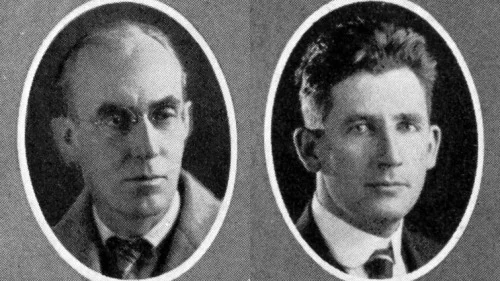
Paul Douglas, Economist and Senator from Illinois Paul Douglas was not only an economist, but one of the most admirable politicians I have ever read about. See what you think: here is the wikipedia article on Paul. I would be interested in whether there are any skeletons in his closet that this article is silent on. If the Devil’s Advocate’s case is weak, he may qualify as a Supply-Side Liberal saint. (He was divorced, so a Devil’s Advocate might have something to work with. See my discussion of saints and heroes in “Adam Smith as Patron Saint of Supply-Side Liberalism?”) Paul was one of Barack’s predecessors as senator of Illinois, serving from 1949-1967, but chose not to run for president when he was given the chance.

In 1927, before he dove fully into politics, Paul teamed up with mathematician and economist Charles Cobb to develop and apply what has come to be called the “Cobb-Douglas” production function. (The wikipedia article on Charles Cobb is just a stub, so I don’t know much about him.) Here is the equation:

A very famous economist, Knut Wicksell, had used this equation before, but it was the work of Charles Cobb and Paul Douglas that gave this equation currency in economics. Because of their work, Paul Samuelson–a towering giant of economics–and his fellow Nobel laureate Robert Solow, picked up on this functional form. (Paul Samuelson did more than any other single person to transform economics from a subject with many words and a little mathematics, to a subject dominated by mathematics.)

In the equation, the letter A represents the level of technology, which will be a constant in this post. (If you want to think more about technology, you might be interested in my post “Two Types of Knowledge: Human Capital and Information.”) The Greek letter alpha, which looks like a fish (α), represents a number between 0 and 1 that shows how important physical capital, K–such as machines, factories or office buildings–is in producing output, Y. The complementary expression (1-α) represents a number between 0 and 1 that shows how important labor, L, is in producing output, Y. For now, think of α as being 1/3 and (1-α) as being 2/3:

  • α= 1/3;
  • (1-α) = 2/3.

As long at the production function has constant returns to scale so that doubling both capital and labor would double output as here, the formal names for α and 1-α are

  • α = the elasticity of output with respect to capital
  • 1-α = the elasticity of output with respect to labor.

What Makes Cobb-Douglas Functions So Great. The Cobb-Douglas function has a key property that both makes it convenient in theoretical models and makes it relatively easy to judge when it is the right functional form to model real-world situations: the constant-share property. My goal in this post is to explain what the constant-share property is and why it holds, using the logarithmic percent change tools I laid out in my post “The Logarithmic Harmony of Percent Changes and Growth Rates.” If any of the math below seems hard or unclear, please try reading that post and then coming back to this one.

The Logarithmic Form of the Cobb-Douglas Equation. By taking the natural logarithm of both sides of the defining equation for the Cobb-Douglas production function above, that equation can be rewritten this way:

log(Y) = log(A) + α log(K) + (1-α) log(L)

This is an equation that holds all the time, as long as the production engineers and other organizers of production are doing a good job. If two things are equal all the time, then changes in those two things must also be equal. Thus, 

Δ log(Y) = Δ log(A) + Δ {α log(K)} + Δ {(1-α) log(L)}.

Remember that, for now, α= 1/3. The change in 1/3 of log(K) is 1/3 of the change in log(K). Also, the change in 2/3 of log(L) is 2/3 of the change in log(L). And quite generally, constants can be moved in front of the change operator Δ in equations. (Δ is also called a “difference operator” or “first difference operator.”) So

Δ log(Y) = Δ log(A) + α Δ log(K) + (1-α) Δ log(L).

As defined in “The Logarithmic Harmony of Percent Changes and Growth Rates,”the change in the logarithm of X is the Platonic percent change in X. In that statement X can be anything, including Y, A, K or L. So as long as we interpret %Δ in the Platonic way, 

%ΔY = %ΔA + α %ΔK + (1-α) %ΔL

is an exact equation, given the assumption of a Cobb-Douglas production function.

Percent Changes of Sums: An Approximation. Now let me turn to an approximate equation, but one that is very close to being exact for small changes. Economists call small changes marginal changes, so what I am about to do is marginal analysis. (By the way, the name of Tyler Cowen and Alex Tabarrok’s popular blog Marginal Revolutionis a pun on the “Marginal Revolution” in economics in the 19th century when many economists realized that focusing on small changes added a great deal of analytic power.)

For small changes,

%Δ (X+Z) ≈ [X/(X+Z)] %ΔX + [Z/(X+Z)] %ΔZ,

where X and Z can be anything. (Those of you who know differential calculus can see where this approximation comes from by showing that d log(X+Z) = [X/(X+Z)] d log(X) + [Z/(X+Z)] d log(Z)], which says that the approximation gets extremely good when the changes are very small. But as long as you are willing to trust me on this approximate equation for percent changes of sums, you won’t need any calculus to understand the rest of this post.)

The ratios X/(X+Z) and Z/(X+Z) are very important. Think of X/(X+Z) as the fraction of X+Z accounted for by X; and think of Z/(X+Z) as the fraction of X+Z accounted for by Z.  Economists use this terminology:

  • X/(X+Z) is the “share of X in X+Z.”
  • Z/(X+Z) is the “share of Z in X+Z." 

By the way they are defined, the shares of X and Z in X+Z add up to 1. 

The main reason the rule for the percent changes of sums is only an approximation is that the shares of X and Z don’t stay fixed at their starting values. The shares of X and Z change as X and Z change. Indeed, if one changed X and Z gradually (avoiding any point where X+Z=0), the approximate rule for the percent change of sums would have to hold exactly for some pair of values of the shares of X and Z passed through along the way. 

The Cost Shares of Capital and Labor. Remember that in the approximate rule for the Platonic percent change of sums, X and Z can be anything. In thinking about the production decision of firms, it is especially useful to think of X as the amount of money that a firm spends on capital and Z as the amount of money the firm spends on labor. If we write R for the price of capital (the "Rental price” of capital) and W for the price of labor (the “Wage” of labor), this yields

  • X = RK 
  • Z = WL.

For the issues at hand, it doesn’t matter whether the amount R that it costs to rent a machine or an office and the amount W it costs to hire an hour of labor is real (adjusted for inflation) or nominal. It does matter, though, that nothing the firm can do will change R or W. The kind of analysis done here would work if what the firm does affects R and W, but the results, including the constant-share property, would be altered. I am going to analyze the case when the firm cannot affect R and W–that is, I am assuming the firm faces competitive markets for physical capital and labor. Substituting RK in for X and WL in for Z, the approximate equation for percent changes of sums becomes

%Δ (RK+WL) ≈ [RK/(RK+WL)] %Δ(RK) + [WL/(RK+WL)] %Δ(WL)

Economically, this approximate equation is important because RK+WL is the total cost of production. RK+WL is the total cost because the only costs are total rentals for capital RK and total wages WL. In this approximate equation

  • s_K = share_K = RK/(RK+WL) is the cost share of capital (the share of the cost of capital rentals in total cost.)
  • s_L = share_L = WL/(RK+WL) is the cost share of labor (the share of the cost of the wages of labor in total cost.) 

The two shares always add up to 1 (as can be confirmed with a little algebra), so

s_L = 1 - s_K. 

Using this notation for the shares, the approximation for the percent change of total costs is 

%Δ (RK+WL) ≈ {s_K} %Δ(RK) + {s_L} %Δ(WL).

The Product Rule for Percent Changes. In order to expand the approximation above, I am going to need the rule for percent changes of products. Let me spell out the rule, along with its justification twice, using RK and WL as examples:

%Δ (RK) = Δ log(RK) = Δ {log( R ) + log(K)} = Δ log( R )  + Δ log(K) = %ΔR + %ΔK

%Δ (WL) = Δ log(WL) = Δ {log(W) + log(L)} = Δ log(W) + Δ log(L) = %ΔW + %ΔL

These equations, reflecting the rule for percent changes of products, hold exactly for Platonic percent changes. Aside from the definition of Platonic percent changes as the change in the natural logarithm, what I need to back up these equations is the fact that the change in one thing plus another, say log( R ) + log(K), is equal to the change in one plus the change in the other, so that Δ {log( R ) + log(K)} = Δ log( R ) + Δ log(K). Using the product rule,

%Δ (RK+WL) ≈ {s_K} (%ΔR + %ΔK) + {s_L} (%ΔW+ %ΔL).

Cost-Minimization. Let’s focus now on the firm’s aim of producing a given amount of output Y at least cost. We can think of the firm exploring different values of capital K and labor L that produce the same amount of output Y. An important reason to focus on changes that keep the amount of output the same is that it sidesteps the whole question of how much control the firm has over how much it sells, and what the costs and benefits are of changing the amount it sells. Therefore, focusing on different values of capital and labor that produce the same amount of output yields results that apply to many different possible selling situations (=marketing situations=industrial organization situations=competitive situations) a firm may be in. That is, I am going to rely on the firm facing a simple situation for buying the time of capital and labor, but I am going to try not to make too many assumptions about the details of the firm’s selling, marketing, industrial organization, and competitive situation. (The biggest way I can think of in which a firm’s competitive situation could mess things up for me is if a firm needs to own a large factory to scare off potential rivals, or a small one to reassure its competitors it won’t start a price war. I am going to assume that the firm I am talking about is only renting capital, so that it has no power to credibly signal its intentions with its capital stock.) 

The Isoquant. Economists call changes in capital and labor that keep output the same “moving along an isoquant,” since an “isoquant” is the set of points implying the same (“iso”) quantity (“quant”). To keep the amount of output the same, both sides of the percent change version of the Cobb-Douglas equation should be zero:

0 = %ΔY = %ΔA + α %ΔK + (1-α) %ΔL

Since I am treating the level of technology as constant in this post, %ΔA=0. So the equation defining how the Platonic percent changes of capital and labor behave along the isoquant is 

0 = α %ΔK + (1-α) %ΔL.

Equivalently,

%ΔL = -[α/(1-α)] %ΔK.

With the realistic value of α=1/3, this would boil down to %ΔL = -.5 %ΔK. So in that case, %ΔK= 1% (a 1 % increase in capital) and %ΔL = -.5 % (a one-half percent decrease in labor) would be a movement along the isoquant–an adjustment in the quantities of capital and labor that would leave output unchanged.

Moving Toward the Least-Cost Way of Producing Output. To find the least-cost or cost-minimizing way of producing output, think of what happens to costs as the firm changes capital and labor in a way that leaves output unchanged. This is a matter of transforming the approximation for the percent change of total costs by 

  1. replacing %ΔR and %ΔW with 0, since nothing the firm does changes the rental price of capital or the wage of labor that it faces;
  2. replacing %ΔL with -[α/(1-α)] %ΔK in the approximate equation for the percent change of total costs; and
  3. replacing s_L with 1-s_K. 

After Step 1, the result is  

%Δ (RK+WL) ≈ {s_K} %ΔK + {s_L} %ΔL.

After doing Step 2 as well, 

%Δ (RK+WL) ≈ {s_K} %ΔK - {s_L} {[α/(1-α)] %ΔK}.

Then after Step 3, and collecting terms, 

%Δ (RK+WL) ≈ {s_K - (1-s_K) [α/(1-α)]} %ΔK

                   = { [s_K/(1-s_K)] - [α/(1-α)] }  [(1-s_K) %ΔK].

Notice that since the

1-s_K = s_L = the cost share of labor

is positive, the sign of (1-s_K) %ΔK is the same as the sign of %ΔK. To make costs go down (that is, to make %Δ (RK+WL) < 0), the firm should follow this operating rule: 

1. Substitute capital for labor (making %ΔK > 0) 

     if  [s_K/(1-s_K)] - [α/(1-α)] < 0. 

2. Substitute labor for capital (making %ΔK < 0)

     if  [s_K/(1-s_K)] - [α/(1-α)] > 0.

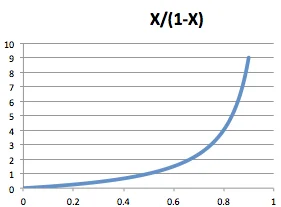
Thus, the key question is whether s_K/(1-s_K) is bigger or smaller than α/(1-α). If it is smaller, the firm should substitute capital for labor. If s_K/(1-s_K) is bigger, the firm should do the opposite: substitute labor for capital. Note that the function X/(1-X) is an increasing function, as can be seen from the graph below:

&nbsp; &nbsp; &nbsp; &nbsp; &nbsp; &nbsp; &nbsp; &nbsp; &nbsp; &nbsp; &nbsp; &nbsp; &nbsp; &nbsp; &nbsp; &nbsp; &nbsp; &nbsp; &nbsp; &nbsp; &nbsp; &nbsp; &nbsp; &nbsp; &nbsp; &nbsp; &nbsp; &nbsp; &nbsp; &nbsp; &nbsp; &nbsp; &nbsp; &nbsp; &nbsp; X

                                                                      X

Since X/(1-X) gets bigger whenever X gets bigger (at least in the range from 0 to 1 (which is what matters here), 

  • s_K/(1-s_K) is bigger than α/(1-α) precisely when s_K > α
  • s_K/(1-s_K) is smaller than α/(1-α) precisely when s_K < α.

So the firm’s operating rule can be rephrased as follows:

1. Substitute capital for labor (making %ΔK > 0) 

     if  s_K <  α. 

2. Substitute labor for capital (making %ΔK < 0)

     if  s_K > α.

This operating rule is quite intuitive. In Case 1, the importance of capital for the production of output (α) is greater than the importance of capital for costs (s_K). So it makes sense to use more capital. In Case 2, the importance of capital for the production of output (α) is less than the importance of capital for costs (s_K), so it makes sense to use less capital.  

Proof of the Constant-Share Property of Cobb-Douglas. So what should the firm do in the end? For fixed R and W, the more capital a firm uses, the bigger effect a 1% increase in capital has on costs. So if the firm is using a lot of capital, the cost share of capital will be greater than the importance of capital in production α and the firm should reduce its use of capital, substituting labor in place of capital. If the firm is using only a little capital, the cost share of capital will be smaller than the importance of capital in production α, and it will be a good deal for the firm to increase its use of capital, allowing it to reduce its use of labor. At some intermediate level of capital, the cost share of capital will be exactly equal to the importance of capital in production α, and there will be no reason for the firm to either increase or reduce its use of capital once it reaches that point. So a firm that is minimizing its costs–a first step toward optimizing overall–will produce a given level of output with a mix of capital and labor that makes the cost share of capital equal to the importance of capital in production:

cost-minimization ⇒     s_K = α.

Concordantly, one can say 

cost-minimization ⇒     1-s_K = 1-α.

That is, the firm will use a mix of capital and labor that makes the cost share of labor equal to the importance of labor in production as well. Since the Cobb-Douglas functional form makes the importance of capital in production α a constant, a cost-minimizing firm will continually adjust its mix of capital and labor to keep the cost share of capital equal to that constant level α, and the cost share of labor equal to another constant, 1-α. This is the constant-share property of Cobb-Douglas. The constant-share property is something that can be tested in the data, and often seems to hold surprisingly well in the real world. So economists often use Cobb-Douglas production functions.  

Another Application of the Cobb-Douglas Idea: Achieving a Given Level of Cobb-Douglas Utility at Least Cost. Note that similar logic will work for utility functions as well. For example, in my post “The Flat Tax, The Head Tax and the Size of Government: A Tax Parable,” since the importance of consumption and leisure for utility is equal (both equal to 1/3), adjusting consumption C and leisure L so that %ΔC = - %ΔL will leave utility unchanged. Then,

  1. if the share of spending on consumption is lower than the share of spending on leisure,
  2. which is equivalent to the total spending on consumption being lower than total spending on leisure, 
  3. then increasing consumption (by reducing leisure and working harder) will make sense. 

On the other hand, 

  1. if the share of spending on consumption is higher than the share of spending on leisure,
  2. which is equivalent to total spending on consumption being higher, 
  3. then reducing consumption (and increasing leisure by working less) will make sense. 

This means that if consumption is too high, it should be reduced, while if consumption is too low, it should be increased, until the amount of spending on consumption equals the amount of spending on leisure.

Is Nuclear Energy Safe? Well, Which One?

Liquid-fluoride-thorium reactors are very different from the kinds of nuclear reactors you have heard of. Anyone who wants to say something for or against nuclear energy should watch at least the first few minutes of this video first. My title is a quotation from Kirk Sorenson in the first few minutes of the video. Kirk is amazing at explaining nuclear reactor technology. Kirk also has a much shorter TED talk as well, here

Casey Thormahlen suggested this video, and this book by Robert Hargraves: Thorium: Energy Cheaper than Coal. Here are Casey’s tweets.

Smaller, Cheaper, Faster: Does Moore's Law Apply to Solar Cells? by Ramez Naam

The way the future looks depends on the rate of decline in the cost of solar power. In this article (my title is a link), Ramez Naam says that solar power is getting cheaper at the rate of 7% per year. Notice how his graph with a logarithmic scale compares to his graph with a regular scale. By the rule of 70, how many years to cut the cost of solar power in half?

The Logarithmic Harmony of Percent Changes and Growth Rates

Logarithms. On Thursday, I let students in my Principles of Macroeconomics class in on the secret that logarithms are the central mathematical tool of macroeconomics. If my memory isn’t playing tricks on me, I can say that in both papers that examine real world data and at least half of macroeconomic theory papers, a logarithm makes an appearance, often in a starring role.  Why are natural logarithms so important?

  1. Lesser reason: logarithms can often model how a household or firm makes choices in a particularly simple, convenient way.

  2. Greater reason: multiplication and powers appear all the time in macroeconomics. For a price in initial difficulty, logarithms make multiplication and powers and exponential growth look easy.

Among other aspects of making multiplication and powers and exponential growth look easy, logarithms provide a very clean, elegant way of thinking about percent changes.

I am determined to have very few equations in this post, so you will have to depend on your math training for the basic rules of logarithms: how they turn multiplication into addition and powers into multiplication. What I want to accomplish in this post is to give you a better intuitive feel for logarithms–an intuitive feel that math textbooks often don’t provide. I also hope to make a strong connection in your mind between natural logarithms and percent changes.  

One of the most basic uses of logarithms in economics is the logarithmic scale. On a logarithmic scale, the distance between each power of 10 is the same. So the distance from 1 to 10 on the graph is the same as the distance from 10 to 100, which is the same as the distance from 100 to 1000. Here is a link to an example of a graph with a logarithmic scale on the vertical axis I have used before from Catherine Mulbrandon in Visualizing Economics:

Contrast that growth line for US GDP to the curve Catherine gets when not using a logarithmic scale on the vertical axis. Here is the link: 

The idea of the logarithmic scale–which can be boiled down to the idea of always representing multiplication by a given number as the same distance–shows up in two concrete objects, one familiar and one no-longer familiar: pianos and slide rules.

A Piano Keyboard as a Logarithmic Scale. You may not have thought of a piano keyboard as a logarithmic scale, but it is. Including all of the black keys on an equal footing with the white keys, going up one key on the piano is called going up a "semitone.” Going up an octave (say from Low C to Middle C) is going up 12 semitones. And each octave doubles the frequency of the vibrations in a piano string. As explained in the wikipedia article “Piano key frequencies,” at Middle C, the piano string vibrates 261.626 times per second. Each semitone higher on the piano keyboard makes the vibration of the string 1.0594631… times faster. And multiplying by 1.0594631… twelve times is the same as multiplying by 2. The reason our Western musical scale has been designed to have 12 semitones in an octave is interesting. To begin with, two notes whose frequencies have a ratio that is an easy fraction such as 3/2, 5/4 or 6/5 make a pleasing interval. (The Pythagoreans made mathematics part of their religion thousands of years ago partly because of this fact.) Then, it turns out that various powers of 1.0594631… come pretty close to many easy fractions. Here is a table showing the frequencies of various notes relative to the frequency of Middle C, showing some of the easy fractions that come close to various powers of 1.0594631…. A distance of three semitones yields a ratio close to 6/5; a distance of four semitones yields a ratio close to 5/4; a distance of five semitones yields a ratio close to 4/3; and a distance of seven semitones yields a ratio close to 3/2. None of this is exact, but it is all close enough to sound good when the piano is tuned according to this scheme:

Let me bring the discussion back to economics by pointing out that, although interest rates are lower right now, it is not uncommon for the returns on financial investments to multiply savings by something averaging close to 1.059 every year. At typical rates of return for investments bearing some risk, one can think of each year of returns as raising the pitch of one’s funds on average by about one semitone. Starting from Middle C, one can hope to get quite a ways up the piano keyboard by retirement. And savings early in life get raised in pitch a lot more than savings late in life.

Slide Rules. Slide rules, like the one in the picture right above, are designed first and foremost to use two logarithmic scales that slide along each other to do multiplication. The distances are logarithmic and adding logarithms multiplies the underlying numbers. For example, to multiply 2 times 3,  put the 1 of the sliding piece right at the 3 of the stationary piece. Then look at the 2 on the sliding piece and see what number is next to it on the stationary piece. You could buy a physical slide rule on ebay, but you might instead want to play with a virtual slide rule for free. Playing with this virtual slide rule is one of the best ways to get some intuition for logarithms. (Remember that the distances on a slide rule are all logarithms.) If you like this slide rule and want to go further, here are some much better instructions for using a slide rule than I just gave: Illustrated Self-Guided Course on How to Use the Slide Rule.

Percent Changes (%ΔX). Let me preface what I have to say about percent changes by saying that–other than being a clue that a percent change or a ratio expressed as a percentage lurks somewhere close–I view the % sign as being equivalent to 1/100. So, for example, 23% is just another name for .23, and 100% is just another name for 1. Indeed, economists are just as likely to say “with probability 1” as they are to say “with a 100% probability.”   

It turns out that natural logarithms (“ln” or “log”) are the perfect way to think about percent changes. Suppose a variable X has a “before” and an “after” value.

  • I want to take the point of view that the change in the natural logarithm is the pure, Platonic percent change between before and after. It is calculated as the natural logarithm of Xafter minus the natural logarithm of Xbefore.

  • I will call the ordinary notion of percent change the earthly percent change. It is calculated as the change divided by the starting value, (Xafter - Xbefore)/Xbefore.

  • In between these two concepts is the midpoint percent change. It is calculated as the change divided by the average of the starting and ending values:

(Xafter-Xbefore) / { (Xafter + Xbefore)/2 }

Below is a table showing the relationship between Platonic percent changes, midpoint percent changes and earthly percent changes. In financial terms, one can think of earthly percentage changes as “continuously compounded” versions of Platonic percent changes. Here is the Excel file I used to construct this table that will give you the formulas I used if you want to see them.  

There are at least two things to point out in this table:

  1. When the percent changes are small, all three concepts are fairly close, but the midpoint percent change is much closer to the Platonic (logarithmic) percent change.

  2. A 70% Platonic percent change is very close to being a doubling–which would be a 100% earthly percent change. This is where the “rule of 70” comes from. (Greg Mankiw talks about the rule of 70 on page 180 of Brief Principles of Macroeconomics.) The rule of 70 is a reflection of the natural logarithm of 2 being equal to approximately .7 = 70%. Similarly, a 140% Platonic percent change is basically two doublings–that is, it is close to multiplying X by a factor of 4; and a 210% Platonic percent change is basically three doublings–that is, it is close to multiplying X by a factor of 8.

Let’s look at negative percent changes as well. Here is the table for how the different concepts of negative percent changes compare:

A key point to make is that with both Platonic (logarithmic) percent changes and midpoint percent changes, equal sized changes of opposite direction cancel each other out. For example, a +50% Platonic percent change, followed by a -50% Platonic percent change, would leave things back where they started. This is true for a +50% midpoint percent change, followed by a -50% midpoint percent change. But, starting from X, a 50% earthly percent change leads to 1.5 X. Following that by a -50% earthly percent change leads to a result of .75 X, which is not at all where things started. This is a very ugly feature of earthly percent changes. That ugliness is one good reason to rise up to the Platonic level, or at least the midpoint level.

Continuous-Time Growth Rates. There are many wonderful things about Platonic percent changes that I can’t go into without breaking my resolve to keep the equation count down. But one of the most wonderful is that to find a growth rate one only has to divide by the time that has elapsed between Xbefore and Xafter. That is, as long as one is using the Platonic percent change %ΔX=log(Xafter)-log(Xbefore),

%ΔX / [time elapsed] = growth rate.

The growth rate here is technically called a “continuous-time growth rate.” The continuous-time growth rate is not only very useful, it is a thing of great beauty.

Update on How the Different Concepts of Percent Change Relate to Each Other.  One of my students asked about how the different percent change concepts relate to each other. For that, I need some equations. And I need “exp” which is the opposite of the natural logarithm “log.” Taking the function exp(X) is the same as taking e, (a number that is famous among mathematicians and equal to 2.718…) to the power X. For the equations below, it is crucial to treat % as another name for 1/100, so that, for example, 5% is the same thing as .05.  

Earthly percent changes are the most familiar. Almost anyone other than an economist who talks about percent changes is talking about earthly percent changes. Most of you learned about earthly percent changes in elementary school. So let me first write down how to get from the earthly percent change to the Platonic and midpoint percent changes. (I won’t try to prove these equations here, just state them.) 

Platonic = log(1 + earthly)

midpoint = 2 earthly/(2 + earthly)

 If you are trying to figure out the effects of continuously compounded interest, or the effects of some other continuous-time growth rate, you will want to be able go from Platonic percent changes–which come straight from multiplying the growth rate by the amount of elapsed time–to earthly percent changes. For good measure, I will include the formula for midpoint percent changes as well:

earthly = exp(Platonic) - 1 

midpoint = 2 {exp(Platonic) - 1}/{exp(Platonic) + 1}

I found the function giving the midpoint percent change as a function of the Platonic percent change quite intriguing. For one thing, when I changed signs and put “-Platonic” in the place where you see “Platonic” on the right-hand side of the equation the result equal to -midpoint. When switching the sign of the argument (the inside thing: Platonic) just switches the sign of the overall expression, mathematicians call it an “odd” function (“odd” as in “odd and even” not “odd” as in “strange”). The meaning of this function being odd is that Platonic and midpoint percent changes map into each other the same way for negative changes as for positive changes.  (That isn’t true at all for the earthly percent changes.) The other intriguing thing about the function giving the midpoint percent change as a function of the Platonic percent change is how close it is to giving back the same number. To a fourth-order (the squared term and the fourth power term are zero), the approximation for the function is this:

midpoint=Platonic - (Platonic cubed/12) + (5th power and higher terms) 

Finally, let me give the equations to go from the midpoint percent change to the Platonic and the     

earthly = 2 midpoint/(2-midpoint)

Platonic = log(2+midpoint) - log(2-midpoint)

             = log(1+{midpoint/2} ) - log(1-{midpoint/2})

The expression for Platonic percent changes in terms of midpoint percent changes has such a beautiful symmetry that its “oddness” is clear. Since I know the way to approximate natural logarithms to as high an order as I want (and I am not special in this), I can give the approximation for Platonic percent changes in terms of powers of midpoint percent changes as follows:

Platonic = midpoint + (midpoint cubed)/12

                   + (midpoint to the fifth power)/80

                   + (midpoint to the seventh power)/448

                   + (9th and higher order terms).

The bottom line is that for even medium-sized percent changes (say 30%), the Platonic percent change is quite close to the midpoint percent change–something the tables above show. By the time the Platonic percent changes and midpoint percent changes start to diverge from each other in any worrisome way, the rule of 70 that makes a 70% Platonic percent change close to equivalent to a doubling starts to kick in to help out.

The Best Kind of Review

Not a Q, just wanted to share my feelings. Feel free to post publicly. As I think you know, I am a finance PhD student. For past 2 years I have suffered from a severe lack of confidence, especially in my ability to research. My task this summer was to complete a 2nd year paper. It was a rough slog, but thanks in part to reading your blog & interacting with you I got through it (& impressed faculty!). Your upbeat attitude is infectious & your positive feedback to my comments most welcome. Thanks! – docstocks

Thanks for the kind words, and thanks for reading. Good luck in the rest of your studies! –Miles

By the way, DocStocks is the alias for Matt Stambaugh. This is Matt’s Twitter thread. Matt has a tweet as nice as the note above here.

Rodney Stark, the Rig Veda Hymn of Creation and the Cult of Bacchus

image

I want to share with you some beautiful scriptures from two religious traditions many of you will not know much about. My title above is a link to the full text of Rig Veda Hymn of Creation 129. Here is an excerpt from this Hymn of Creation in the translation Rodney Stark uses in his book “Discovering God: The Origins of the Great Religions and the Evolution of Belief” that I am currently reading:

But after all, who knows, and who can say whence it all came, and how creation happened? The gods themselves are later than creation, so who knows truly whence it had arisen? 

Whence all creation had its origin, he, whether he fashioned it or whether he did not, he who surveys it all from the highest heaven, he knows–or maybe even he does not know.

Rodney Stark is a sociologist who has written a trenchant set of books on the history of religion. I got hooked on Rodney Stark by reading The Rise of Christianity: A Sociologist Looks at History–which has the paperback title “The Rise of Christianity: How the Obscure, Marginal Jesus Movement Became the Dominant Religious Force in the Western World in a Few Centuries.”

Aside from what I have already mentioned, I have also read and recommend Rodney’s

One True God: Historical Consequences of Monotheism

For the Glory of God: How Monotheism Led to Reformations, Science, Witch Hunts and the End of Slavery

The Victory of Reason: How Christianity Led to Freedom, Capitalism and Western Success

Now let me prepare you for two beautiful texts from the cult of Bacchus in ancient Rome. Rodney argues that what we think of when we hear the word “Bacchanalia” has a lot to do with Roman slanders against the cult of Bacchus. The reality was different. On page 135 of “Discovering God” Rodney discusses the Senatus consultum de Bacchanalibus in 186 B.C.:

The Senate decree began by prohibiting Bacchic shrines …. that they no longer meet in groups larger than five … that they could hold no funds in common, and that they not swear oaths of mutual obligation. In addition, they were forbidden to celebrate  rites in secret and men were not permitted to be priests. And that was it! Nothing was said about refraining from rape, drunkenness, group sex, or human sacrifice, which makes it obvious that these claims were “fantasies” knowlingly invoked by at least some senators “to provide legitimation for … [their] very controversial decision.”

On the next page, Rodney writes:

Drawing on this literature allows insight into two fundamental questions. What was the movement really like? Why did it provoke such a violent, yet limited, response from the Senate?

Specifically, the cult of Bacchus (or Dionysos) promised the initiated that they would be welcomed into a blissful life after death, enjoying the company of their fellow initiates. A recently discovered gold plate in the form of an ivy leaf instructed the dead to “Tell Persephone that Bacchus himself has set you free.” The ordinary person need only become an initiated and committed Bacchanalian in order to escape the dreary afterlife envisioned by the traditional religions of Rome, and to gain everlasting joy: “Now you have died, and now you have been born, thrice blest, on this day.” This was a remarkable innovation and gave everyone, rich or poor, a substantial reason to join.

I find myself moved by these two Bacchic fragments:

Tell Persephone that Bacchus himself has set you free.

Now you have died, and now you have been born, thrice blest, on this day.

My other “Posts on Religion, Philosophy, Science and Culture” are listed here

My post “Teleotheism and the Purpose of Life” is the best statement of my current religious beliefs.

A Search Box for supplysideliberal.com, Thanks to Diana

My daughter, Diana Kimball, has programmed an elegant searchbox for supplysideliberal,com :) Try it out. It will always be the very last thing on the sidebar–until you type something in and hit return. Then, it will show all the relevant posts on supplysideliberal.com as thumbnails below it on the sidebar. You can click on a thumbnail to get to the post itself.  

A few words and phrases Diana and I tried are “Mitt Romney,” “taxes,” “monetary policy,” “truth,” “lies” and “God.” Anything you think I should write about, try the phrase out on the search box and see if I have written something about it already. And on a slow day, choose a word or phrase and random and see what appears when you search.

Ross Douthat Lays Out the Best-Case Scenario for a Romney Presidency

Ross argues (my title is a link) that Mitt is positioning himself to follow Franklin D. Roosevelt’s example of “bold, persistent experimentation” if he is elected. In my post “The Magic of Etch-a-Sketch: A Supply-Side Liberal Fantasy,” I effectively argue that–if one is willing to ignore other things Mitt has said–Mitt’s acceptance speech by and large leaves enough wiggle room for him to follow the policies I would recommend. My best guess of what Mitt will actually do can be found in my post Kevin Hassett, Glenn Hubbard, Greg Mankiw and John Taylor Need to Answer This Post of Brad DeLong’s Point by Point.

I explain why I intend to be coy about my own leanings as a voter in “What is a Partisan Nonpartisan Blog?” But I don’t mind telling you that I am genuinely undecided at this point. As you will deduce if you read “The Magic of Etch-a-Sketch: A Supply-Side Liberal Fantasy,” in the vector space of important issues, I don’t think one real-world candidate for president dominates the other. At some point in the future I will write a post expanding on the ethical case for gay rights to fill in one missing piece of the puzzle. I have already written on the ethical case for open immigration in my posts “You Didn’t Build That: America Edition” and “Adam Ozimek: What ‘You Didn’t Build That’ Tells Us About Immigration.” I take both of those issues very seriously, and they clearly favor Obama. 

The most important issue favoring Mitt is the issue of restraining nuclear proliferation. Mitt’s acceptance speech convinced me he really would deal with Iran more firmly than Barack. I talk about the importance of that in the beginning of my post “Avoiding Fiscal Armageddon.” Restraining nuclear proliferation is also an ethical issue: one of the few issues that can compare in importance to the ethical weight of gay rights and open immigration–and to the ethical weight of war itself. Restraining nuclear proliferation is something we owe our descendants. We can’t afford to let our war-weariness prevent us from doing what needs to be done to stop Iran from getting nuclear weapons. Here, I want you to remember that convincing one’s adversary that one is willing to go to war can sometimes be the best way to avoid both war and outcomes that are worse than war.

On economic policy, my fantasy “The Magic of Etch-a-Sketch: A Supply-Side Liberal Fantasy” aside, things are much murkier, because–as Ross Douthat emphasizes with his FDR analogy–no coherent account of Mitt’s intended economic policies has emerged. If Mitt is elected, I will certainly hope for the best, and will be reassured if he keeps Greg Mankiw close by his side during his presidency (and appears to be listening to Greg carefully), but at this point I trust Barack’s economic policies more. If Barack is reelected, I think he needs to do much more than he has done on the economic front, starting with Federal Lines of Credit, which you can read about in “Getting the Biggest Bang for the Buck in Fiscal Policy” and the other posts I list in “Short-Run Fiscal Policy Posts through August 23, 2012.” (I promise to post many other suggestions for whoever is our president come January.) At the upper end of what is reasonably possible, I think Mitt’s economic policies look better than Barack’s. But on the downside there are great dangers in the rejection by many Republicans of the conceptual framework of aggregate supply and aggregate demand in favor of a view of macroeconomics in which only aggregate supply matters. This view by many Republicans could easily have negative effects on macroeconomic policy in a Romney presidency even if Mitt himself believes that aggregate demand matters. 

Let me end by repeating here one of my tweets about my cousin Mitt:

News flash from Clive Crook: Romney NOT a heartless self-serving capitalist monster. 

http://www.theatlantic.com/politics/archive/2012/08/the-gops-clever-plan-to-position-rubio-for-2016/261852/ …

In the event, Mitt might be a bad president, but some of the things that have been said about him are just wrong. If you follow Clive’s link above, and this link to the testimonial of my nephew Peter Kimball’s father-in-law Grant Bennett, you will see. (Peter is my brother Chris Kimball’s son. You can see Chris’s relatively negative opinion of Mitt in my post “Big Brother Speaks: Christian Kimball on Mitt Romney.”)

Note: I list my other political posts in the index post “Posts on Politics and Political Economy through September 1, 2012.”

Evan Soltas: The Great Depression in Graphs

Evan Soltas is a freshman this Fall at Princeton. He is 19. Here is the picture he gives of the Great Depression, and here is a short bio taken from his website:

Evan Soltas is the writer of Wonkbook, the morning email newsletter of Ezra Klein’s Wonkblog at The Washington Post, and for Bloomberg View’s “The Ticker” blog. A student at Princeton University, where he intends to major in economics, Evan blogs daily on economic news, policy, and research findings – and a variety of other topics, approaching the subject as a student and not as an expert.

His research has been featured recently in The Wall Street Journal, the Financial Times, The Atlantic, Slate, the Daily Beast, the National Review, The American Conservative, The Nation, and The Globe and Mail.

His particular areas of research and blogging interest include monetary economics and macroeconomics. His blog further contains substantial discussion of labor and financial markets, development, economic history, econometrics, and public finance.

It is not as if I have a ranking worked out, so I might be understating things, but in my book, Evan is clearly one of the best 10 economics bloggers out there, without regard to age. What I especially like is Evan’s attention to facts–and his skill at making facts come alive. Evan’s attention to facts is especially valuable in an era when so many of the media, the commentariat, and those in the public sphere more generally, have left facts behind.

Principles of Macroeconomics Posts through September 3, 2012

This is a list of posts I thought I might want to find quickly during class. I bolded the first post in the month from the list.

  1. What is a Supply-Side Liberal?
  2. Getting the Biggest Bang for the Buck in Fiscal Policy
  3. Balance Sheet Monetary Policy: A Primer
  4. Can Taxes Raise GDP?
  5. National Rainy Day Accounts
  6. Trillions and Trillions: Getting Used to Balance Sheet Monetary Policy
  7. Noah Smith: “Miles Kimball, the Supply-Side Liberal”
  8. Why Taxes are Bad
  9. A Supply-Side Liberal Joins the Pigou Club
  10. “Henry George and the Carbon Tax”: A Quick Response to Noah Smith
  11. Leading States in the Fiscal Two-Step
  12. Going Negative: The Virtual Fed Funds Rate Target
  13. Mike Konczal: What Constrains the Federal Reserve? An Interview with Joseph Gagnon
  14. Leveling Up: Making the Transition from Poor Country to Rich Country
  15. Mark Thoma: Kenya’s Kibera Slum
  16. The supplysideliberal Review of the FOMC Monetary Policy Statement: June 20th, 2012
  17. Justin Wolfers on the 6/20/2012 FOMC Statement
  18. Mark Thoma: Laughing at the Laffer Curve
  19. Thoughts on Monetary and Fiscal Policy in the Wake of the Great Recession: supplysideliberal.com’s First Month
  20. Health Economics
  21. Future Heroes of Humanity and Heroes of Japan
  22. The Euro and the Mediterano
  23. Is Taxing Capital OK?
  24. Jobs
  25. Dissertation Topic 3: Public Savings Systems that Lift the No-Margin-Buying Constraint
  26. Rich, Poor and Middle-Class
  27. Reply to Mike Sax’s Question “But What About the Demand Side, as a Source of Revenue and of Jobs?”
  28. Bill Greider on Federal Lines of Credit: “A New Way to Recharge the Economy”
  29. Will the Health Insurance Mandate Lead People to Take Worse Care of Their Health?
  30. Corporations are People, My Friend
  31. What to Do When the World Desperately Wants to Lend Us Money
  32. Paul Romer on Charter Cities
  33. Miles Kimball and Brad DeLong Discuss Wallace Neutrality and Principles of Macroeconomics Textbooks
  34. Paul Romer’s Reply and a Save-the-World Tweet
  35. Adam Ozimek on Worker Voice
  36. Dr. Smith and the Asset Bubble
  37. Reply to Matthew Yglesias: What to Do About a House Price Boom
  38. Preventing Recession-Fighting from Becoming a Political Football
  39. Magic Ingredient 1: More K-12 School
  40. Matthew Yglesias: “Miles Kimball on Potential Housing Bubble Remedies”
  41. Ezra Klein: “Does Teacher Merit Pay Work? A New Study Says Yes”
  42. You Didn’t Build That: America Edition
  43. My First Radio Interview on Federal Lines of Credit
  44. The Most Conflicted Review I Have Received
  45. The Euro and the Mark
  46. Saturday Morning Breakfast Cereal
  47. Adam Ozimek: What “You Didn’t Build That” Tells Us About Immigration
  48. Charles Murray: Why Capitalism Has an Image Problem
  49. Adam Smith as Patron Saint of Supply-Side Liberalism?
  50. Things are Getting Better: 3 Videos
  51. Google Search Hints
  52. Government Purchases vs. Government Spending
  53. Mark Thoma on the Politicization of Stabilization Policy
  54. Milton Friedman: Celebrating His 100th Birthday with Videos of Milton
  55. Isomorphismes: A Skew Economy & the Tacking Theory of Growth
  56. Daniel Kuehn: Remembering Milton Friedman
  57. Why My Retirement Savings Accounts are Currently 100% in the Stock Market
  58. Grammar Girl: Speaking Reflexively
  59. Dismal Science Humor: 8/3/12
  60. Should Everyone Spend Less than He or She Earns?
  61. Dismal Science Humor: Econosseur
  62. Dismal Science Humor: Yoram Baumann, Standup Economist
  63. The True Story of How Economics Got Its Nickname “The Dismal Science”
  64. Dismal Science Humor: phdcomics.com
  65. Rich People Do Create Jobs: 10 Tweets
  66. The Paul Ryan Tweets
  67. Miles Kimball and Noah Smith on Balancing the Budget in the Long Run
  68. Joe Gagnon on the Internal Struggles of the Federal Reserve Board
  69. Miles Kimball and Noah Smith on Job Creation
  70. Matthew O'Brien on Paul Ryan’s Monetary Policy Views
  71. Noah Smith on the Coming Japanese Debt Crisis
  72. The Flat Tax, The Head Tax and the Size of Government: A Tax Parable
  73. The Economist on the Origin of Money
  74. When the Government Says “You May Not Have a Job”
  75. Brad DeLong’s Views on Monetary Policy and the Fed’s Internal Politics
  76. Persuasion
  77. Evan Soltas on Medical Reform Federalism–in Canada
  78. Private Equity Investment in Africa
  79. Gavyn Davies on the Political Debate about Economic Uncertainty
  80. Larry Summers on the Reality of Trying to Shrink Government
  81. James Surowiecki on Skilled Worker Immigration
  82. Josh Barro on a Central Issue of Political Economy: Poor vs. Old
  83. Matt Yglesias on How the “Stimulus Bill” was About a Lot More Than Stimulus
  84. Copyright
  85. Scott Adams’s Finest Hour: How to Tax the Rich
  86. My Ec 10 Teacher Mary O’Keeffe Reviews My Blog
  87. Occupy Wall Street Video
  88. Joshua Hausman on Historical Evidence for What Federal Lines of Credit Would Do
  89. Why George Osborne Should Give Everyone in Britain a New Credit Card
  90. Twitter Round Table on Federal Lines of Credit and Monetary Policy
  91. Matthew Yglesias on Archery and Monetary Policy
  92. No Tax Increase Without Recompense
  93. Adam Ozimek: School Choice in the Long Run
  94. Learning Through Deliberate Practice
  95. Matthew O'Brien versus the Gold Standard
  96. Health Economics Posts through August 26, 2012
  97. What is a Partisan Nonpartisan Blog?
  98. Two Types of Knowledge: Human Capital and Information
  99. The Great Recession and Per Capita GDP
  100. Family Income Growth by Quintile Since 1950
  101. Jonathan Rauch on Democracy, Capitalism and Liberal Science
  102. Bill Dickens on Helping the Poor
  103. The Magic of Etch-a-Sketch: A Supply-Side Liberal Fantasy
  104. Michael Woodford Endorses Monetary Policy that Targets the Level of Nominal GDP
  105. How Americans Spend Their Money and Time

A Market Measure of Long-Run Inflation Expectations

Brad DeLong’s graph of “breakeven inflation”:&nbsp;the rate of inflation at which regular (nominal) 30-year Treasury bonds would neither better nor worse than 30-year Treasury Inflation Protected Securities.

Brad DeLong’s graph of “breakeven inflation”: the rate of inflation at which regular (nominal) 30-year Treasury bonds would neither better nor worse than 30-year Treasury Inflation Protected Securities.

Brad DeLong explains here how the difference in interest rates between the Federal government’s 30-year nominal bonds and its 30-year real bonds (Treasury Inflation Protected Securities) can measure financial investors’ expectations about average inflation over the next 30 years.  

Unlike Brad, I think the investor’s expectations are reasonable. Knowing the articles in economics journals that the folks at the Fed are reading–and that young economists whose future is at the Fed are reading–makings me confident that the commitment to controlling inflation in the long run is durable. 2% seems to have been settled on as the long-run target.

How Americans Spend Their Money and Time

Two of the most fundamental choices people make are how to spend their money and their time. Economists talk about a “budget constraint” for money and a “budget constraint” for time. Here is a set of links to well-done graphs on how Americans deal with those two budget constraints: 

  1. Jacob Goldstein and Lam Thuy Vo: “What America Buys”
  2. Jacob Goldstein and Lam Thuy Vo: “How The Poor, The Rich And The Middle Class Spend Their Money”
  3. Lam Thuy Vo: “What Americans Actually Do All Day Long, In 2 Graphics”
  4. Jacob Goldstein and Lam Thuy Vo: “What America Does For Work.” 

Bonus

Thanks to my brother Joseph Kimball for pointing me to this series of posts by Lam Thuy Vo and Jacob Goldstein.

Michael Woodford Endorses Monetary Policy that Targets the Level of Nominal GDP

When I want to better understand the principles of optimal monetary policy, Mike Woodford is the one I turn to. Someday I hope to finish reading his book Interest and Prices and many of his key academic journal articles. If I do, I am sure that then I will have many nuances to argue over with Mike (including the effects of departures from Wallace neutrality on optimal monetary policy)–and despite my relative ignorance in this area, I did manage a Powerpoint discussion of one of Mike’s papers with one of his coauthors, Vasco Curdia, at a Bank of Japan Conference. But until the fabled day when I can really dig into optimal monetary policy, Mike is my authority on many of the fundamental principles of how to conduct monetary policy. And I am not alone in my esteem for Mike.  

So it is big news that Mike has come out in favor of nominal GDP targeting. I know this thanks to Lars Christensen, who in addition to these two recent posts about Mike

“Michael Woodford endorses NGDP level targeting”

“Michael Woodford on NGDP targeting and Friedman”

has an excellent recent post arguing that the European debt crisis is due to overly tight monetary policy.

Mike notes, as I would, that there are nuances of optimal monetary policy that a simple nominal GDP targeting rule does not capture. But the simplicity, robustness, transparency and rough-and-ready approach toward optimality of such a rule makes it a key step in improving monetary policy from the implicit rule being followed now.  

A Guided Tour through Meta-posts at the End of the Second Cycle

Let me explain my title. A “meta-post” is a post about what I am trying to do and how I am approaching writing this blog, what I have actually done, and what I expect to do in the future. The end of the first cycle was heralded by my post Thoughts on Monetary and Fiscal Policy in the Wake of the Great Recession: supplysideliberal.com’s First Month. So the first cycle was one month, from May 28, 2012 to June 28, 2012, while the second cycle extended a little over two months, from June 28, 2012 to now, September 1, 2012.

In Thoughts on Monetary and Fiscal Policy in the Wake of the Great Recession: supplysideliberal.com’s First Month I explained that I think of the blog as an organic whole–comparing its structure to my favorite science fiction TV series, Babylon 5. The idea of a “cycle” is from one of my favorite print science fiction series–the Dray Prescot series. The Dray Prescot series–45 books in all–is organized into “cycles” of books, such as the “Delian cycle” and the “Havilfar cycle.”

I had intended to lay out what I did substantively in the second cycle of supplysideliberal.com in a post called “The Supply-Side Liberal Vision.” But after hearing Mitt Romney’s speech accepting the Republican nomination for president, it struck me that I could structure an account of what I did substantively in my second cycle by playing off of Mitt’s acceptance speech. Thus, for substance, my post The Magic of Etch-a-Sketch: A Supply-Side Liberal Fantasy is to the second cycle as Thoughts on Monetary and Fiscal Policy in the Wake of the Great Recession: supplysideliberal.com’s First Month is to the first cycle. I expect to use the title “The Supply-Side Liberal Vision” to wrap up some future cycle.   

The timing of the end of my second cycle is governed by two considerations. First, I knew I had to write No Tax Increase Without Recompense to fill out the essentials of “The Supply-Side Liberal Vision.” And in the event, I needed No Tax Increase Without Recompense in The Magic of Etch-a-Sketch: A Supply-Side Liberal Fantasy. Second, this is a time of transition for my blog as the school year begins. 

In my first cycle, relatively autonomous posts on economic policy dominated. (My persistent advocacy of Federal Lines of Credit to stimulate the economy during the first cycle has continued in the second cycle, as can be seen in Short-Run Fiscal Policy Posts through August 23, 2012.) During my second cycle, Twitter interactions with other economists and non-economists took off and generated many posts. For example, Twitter conversations led me to think more about Health Economics, as can be seen in these posts: Health Economics Posts through August 26, 2012. You can see my Twitter thread here. The other new dimension of my second cycle was the broadening to include posts on politics (see Posts on Politics and Political Economy through September 1, 2012) and religion (see Posts on Religion, Philosophy, Science, Literature and Culture through August 27, 2012)–and on the overlap between these two areas occasioned by the Mormon background I share with Mitt Romney (posts included on both lists). Tyler Cowen reviewed this area of overlap (including tweets) as a whole: Tyler Cowen’s Review of My Posts and Tweets about Mitt Romney.

In my third cycle, I expect a large share of posts to be driven by what will help me teach my “Principles of Macroeconomics” class in the next four months. (I am confident that the posts I write to help my students will be valuable to others as well.) I am sure that the news will also drive many posts. In particular, I foresee posts occasioned by the U.S. presidential election and by monetary policy events. But much of where my blog will go is impossible to foresee. I expect to declare the end of the third cycle around the end of the calendar year, when my “Principles of Macroeconomics” class is over.  

My other meta-posts so far explain what I am trying to do and how I am approaching writing my blog:

  1. The agenda I laid out in my first post What is a Supply-Side Liberal? still drives much of what I am doing here, including many things that also result from interaction with other economists online. 
  2. What is a Partisan Nonpartisan Blog? explains my view that–in order for human beings to be able to trust one another–our obligation to truth at the micro level has to trump our obligation to what we believe to be “Truth” at the macro level, whenever the two conflict. 
  3. “It Isn’t Easy to Figure Out How the World Works” (Larry Summers, 1984) explains my policy on revisions of posts. 
  4. Persuasion explains how I approach argument.
  5. Copyright hints at some of my personal motivation for writing this blog.

Let me end with a few blog statistics as of this moment. I will do another “My Corner of the Blogosphere” post (an update to My Corner of the Blogosphere: As of July 1, 2012) soon. Since June 3, Google Analytics reports 89,780 total pageviews, 60,731 visits, and 29,460 unique visitors. These numbers do not include the delivery of the posts to the now 867 subscribers on Google Reader. Together with 103 Tumblr subscribers, that adds up to 970 subscribers on those two platforms. Some of my Facebook friends use my Facebook wall as a way to subscribe, and there must be some subscribers on other platforms. At this moment I have 970 Twitter followers. It is only a coincidence that this exactly matches the number of Google Reader plus Tumblr subscribers, but I think I now have roughly the same number of people who follow me on Twitter but do not subscribe on Tumblr and Google Reader as vice versa.