Miles's April 9, 2006 Unitarian Universalist Sermon: "UU Visions"

If you have been reading this blog, it won’t surprise you to learn that I am a preacher. I grew up a Mormon. (Indeed, my grandfather, Spencer Woolley Kimball, was the 12th President of the Mormon Church, from 1973 to his death in 1985. That puts him in a line of Mormon Prophets that begins with Joseph Smith and Brigham Young.) In the middle of my undergraduate years, I served a Mormon mission, preaching Mormonism in the Tokyo North Mission in Japan from 1979 to 1981. And it is hard to count how many Mormon sermons and lessons I gave both before and after my missionary service in Japan.

But I am a Unitarian Universalist now. For all practical purposes, I left Mormonism early in 2000, though I am still technically a Mormon Priest and Elder. Since the Fall of 2000, I have been a member of the First Unitarian Universalist Congregation of Ann Arbor, Michigan. Every Spring since 2005, by invitation, I have given a sermon as a lay preacher at a nearby congregation: the Community Unitarian Universalists in Brighton (CUUB). This is my second sermon at CUUB, which is the one most relevant to what I have been trying to do so far with this blog: present a vision of how the world could be. 

This post jumped the gun a little. I intended to just put the text of the sermon in a Tumblr draft to edit later. Doing that as I was packing for my trip to an economics of risk and uncertainty conference in Toulouse, I published it. In any case, this was the introduction it needed. You can see in it some of the beginnings of themes I have pursued in this blog. And I will use this concept of a “vision” in future posts. 

UU Visions

One of the scriptures that Bill Clinton quoted on the campaign trail was from Proverbs, chapter 29, verse 18: “Where there is no vision, the people perish.”He was using the word “vision” not in the sense of a divine revelation, but in the sense of an ideal—an image of how the world could be and should be, and some ideas of how to work toward that goal.Each one of us, in our personal lives, is guided by visions of how our own lives could be and should be and how to work toward those goals; and in our public lives, we are each guided by visions of how the world could be and should be and our ideas of how to work toward those goals.These visions are every bit as much a part of who we are as our beliefs about the origin of mankind, God, heaven, hell, and the reason evil exists.

Unitarian Universalists have the tradition of credos: personal statements of belief.This sermon advocates a corresponding Unitarian-Universalist tradition of sharing “visions”: personal statements of the kind of world we would each like to work towards creating.Just as there are now classes on “Building Your Own Theology” there could be classes on “Creating Your Own Vision,” culminating in the sharing of those visions with the congregation.In the meantime, before such classes exist, we can struggle on our own to write down our individual visions and share those with each other.

Professionally, one of the big mysteries I struggle with is the fact that rich nations like the United States and Japan have been getting much richer, but not any happier.[Scientific note: Betsey Stevenson and Justin Wolfers have argued persuasively that this is not true for Japan.I had not yet read their paper at the time I gave the sermon.] The fact that we [the U.S.] are not getting any happier does not necessarily mean that we are making a mistake in our way of life.For example, some of our riches are spent on medical care that lengthens our lifespans, which is surely, other things being equal, a good thing.And there are many other worthy goals one might have besides happiness.But the fact that we are getting richer does mean that we have more and more choices (at least as a society), and we need to be ever more thoughtful about the choices that we do make.If, as a society, we are not managing to turn our greater riches into greater happiness, we should either figure out how to be more effective at adding to national happiness, or make sure that we are on the way to achieving some other goal that we value as much or more.

As the set of choices we have increases, one of the most precious resources we can have is a knowledge of our own deepest desires.What is truly important? What is it that I really want most of all? Why do I want it? Is there something deeper that stands behind that desire? If I had to choose, which would I choose? We deal with these questions of what we really want every day.For example, setting priorities often means deciding what you don’t have time to do, because there are more important things to do.

One clue to our deepest desires is what lights us up and gives us an inner glow just to think about it.This kind of enthusiasm is especially valuable when one of the things that lights us up and gives us an inner glow is getting in touch with a desire for the welfare of others as well as ourselves.

Today is Palm Sunday.Two of the things we know most solidly about Jesus are that he came to Jerusalem at this season to meet his death and that he taught as a central principle the Golden Rule: “Love your neighbor as yourself” and “Do unto others as you would have others do to you.”As my friend and fellow UU economist Chris Carroll said to me two weeks ago when I saw him at a conference in Madrid, “Love your neighbor as yourself” was a big shift from the Roman quest for “undying fame.”Jesus was a magnet who permanently shifted the ethical compass of Europe and every place in the world influenced by the descendants of the Roman World, however often people ignore that compass.

Kant translated the Golden Rule into his Categorical Imperative, which I think of as having two parts:First, think of how you would like the world to be.Then, act in a way that would bring about that world if everyone else also acted that way.In other words, Kant was saying that we need to create a vision of the world as it should be, then act according to that vision.

Desire and love generate the image of a world as we want it to be, not only for ourselves, but for all people and for the whole web of life.Once we have an image of where we want to go, a crucial ingredient for making our plans before we pour our hope and faith into action is to ground ourselves in reality.I feel that Science is a sacred calling because it helps us to build a better world on a foundation of the truth about physical nature and the truth about human nature.Of course, any sacredness Science has comes from the sacredness of truth.Scientific truth, however hard to hear, however hard to bear, must never be sacrificed for the sake of politics, or we will not be able to see our way clearly to get where we want to go.In particular, a lack of devotion to the truth about what won’t work can leave us tilting at windmills like Don Quixote.But our knowledge will always be imperfect.Once we have learned as much and thought as hard as we can, we have to make a choice about what we will do.This is where hope and faith come in.Hope lights our way a little beyond the edge of our knowledge, and faith gives us the courage and energy for the ongoing struggle to help move the world toward the ideal we have chosen.

How would a tradition of UU Visions work in practice?

Visions, like credos, will be idiosyncratic.No two people will have exactly the same vision of how the world should be or of how to get there.Although our common humanity will generate many common threads in different people’s visions, these common threads may be obscured behind different political views, different modes of expression, and different beliefs about how the world works.

The key to making a tradition of UU Visions work is to take our hard won tradition of tolerance for different beliefs about the origin of mankind, God, heaven, hell, and the reason evil exists and practice tolerance toward different visions.On the part of the one sharing a vision, the more personal the presentation, making clear the autobiographical and human wellsprings of one’s vision, the easier it will be on the listeners.But it would be sad indeed if people felt they could not share deeply felt aspects of their visions because they did not accord with the reigning political fashions.

Indeed, in America as a whole it is sad that people find it harder and harder to talk calmly and productively about their political differences.Surely, we for whom tolerance is a birthright can do better—honoring that tradition of tolerance which was bought for us by the blood of martyrs for religious freedom.

I think the reward for the hard work of sharing and listening and the even harder work of tolerance, would we would find common ground we had not realized, identify new directions for social action, and harness a greater fraction of our collective emotional energy toward doing good in the world.Collectively, we would be better able to lead the way toward prescriptions that will work in the 21st century, rather than relying on prescriptions developed in the 19th and 20th centuries.By bridging—or at least understanding—the differences in opinionamong ourselves, we will gain some morsels of wisdom that will help us to heal this divided land.

Having proposed this explicit tradition of UU Visions, it would not be unreasonable for you to think that I had thereby volunteered to go first.So here goes.I hope what I have said up to now draws general approval, but from here on, I will get more idiosyncratic, and I am sure you will find something to disagree with.But that is the nature of visions.

When I was a child growing up in Madison, Wisconsin, my father instilled in me a confidence that the world was a reasonable place, while my mother drove me to a high level of ambition.I was a miser, seldom spending much money except when I had a chance to go downtown to bookstores where I could by used Science Fiction books.I read many Science Fiction novels with heroes who, while human, possessed an amazing range of special skills, abilities and insights. They regularly saved the world, or more often, the galaxy.In the absence of videogames, I loved boardgames, especially wargames with little cardboard pieces on hexagonal grids.

When I was 13, my family moved to Provo, Utah, where my father took a position as a professor at Brigham Young University’s new law school.Provo is in the heart of Mormon country, where every group of ten square blocks or so constitutes its own Mormon congregation.As a teenager, I appreciated having the neighbors know who I was and stop to talk to me as I made my way through the neighborhood.Growing up in a liberal Mormon household, at that time in my life Mormonism seemed open-ended.Indeed, the idea that esoteric wisdom could be found in a treasure trove of ancient documents and 19th century church doctrines fired my mind with the promise of intellectual discovery.I also found that praying hard led to subjective spiritual experiences that I valued highly.

I went East to college, and decided to become an economist, since I thought it would be too hard to make my mark among aspiring physicists, and Sociology didn’t have a wide enough choice of classes.One thing I learned was that the objective of economics was not to make people rich but to help people in general to get what they want, whatever it was that they wanted.Every week I attended the University Branch of the Mormon Church in Cambridge, Massachusetts, where I heard very interesting lessons about psychological or spiritual virtues such as faith, hope and love and became more aware that the Book of Mormon put taking care of the poor as one of the highest religious duties, while the revelations of Joseph Smith taught that one should devote all of one’s money, time and other resources to the building of “Zion,” where “Zion” was a word referring to the ideal society, imagined as a society with the Mormon Church at its center, centered on families, extended families, and community.

In addition to marrying and raising a family, and beginning my career as an economist, the next two decades led to my estrangement from the Mormon Church, as you heard last time.This process led me to a greater appreciation for freedom, especially freedom of thought.I remember being deeply moved by one of my children’s patriotic school plays, filled with gratitude for this country that could produce the Bill of Rights.I also learned something of the trials of fire people often go through to champion the truth in the simple sense of “just the facts.”I learned that someone has to work hard to generate every bit of justice there is in the world.Finally, I realized to my dismay how inegalitarian I had been in my marriage, despite being what I had thought was a very enlightened Mormon male.

Bereft of the particular world-changing plans of Mormonism, I find myself trying to recover a sense of mission by trying to figure out how I can make a difference in the world.I find myself studying happiness in hopes there is a way to help people be happier.I do think it is important whether as a nation, fifty years from now we are a rich and happy country or a rich and unhappy country.

As an economist, I also find myself trying to identify more precisely what people want the most so that public policy can make appropriate tradeoffs.Among other things, identifying what people want tells how they will respond to incentives, and some of the research I have been involved in suggests that people are likely to respond quite strongly to tax incentives.My graduate school advisor, Greg Mankiw, recently stepped down as the head of the President’s council of Economic Advisors.I told him that I was one of the few supply-side liberals.

There are so many important things for the government to do: make sure people have good medical care, and that burgeoning epidemics are stopped in their tracks, control crime, support scientific research andmanage the complexities of foreign affairs, including promoting democracy and economic development around the world.But every bit of taxation has the potential to distort the economy and thereby hurt people’s welfare.Some tax revenue can be raised by penalizing things that should be penalized anyway, such as carbon dioxide emissions, legal drug usage and purchases of goods for which displaying social status is a big part of the motivation.But we will still need more revenue to do all of the things that need to be done, and I worry about where we can get that tax revenue without causing the kind of relative economic stagnation I see in France and some of the other European countries.If we can find a way to do that, what it will look like is an arrangement in which we are all caused to work very hard in order to help those in need and otherwise make sure that the things that need to get done get done.

Even if tax revenue can be raised in a way that does not do too much damage, social programs to help people can also have bad incentives.One big exception is that as far as I can tell, giving all children a good education has only positive incentives.I feel that the fact that we fail many children in this duty of giving them a good education is one of our biggest moral failings as a nation, and anyone who stands in the way of achieving that goal of a good education for all children should feel very bad.We should do whatever it takes.In particular, we should experiment with many different approaches, with no holds barred, until we find the one that works.

Many things that need to be done to make a Great Society are not the work of government at all, but the proper work of companies, families and churches.In the coming century, besides managing technological progress and the integration of the world economy so that all people in the world can be rich, one of the key tasks of employers is to figure out how to make jobs more challenging, rewarding and fun.I believe that making jobs fun will be one of the key sources of competitive advantage in the coming years, so I am hopeful that companies will rise to this challenge.If they do manage to make jobs more challenging, rewarding and fun, many people may want to retire later, perhaps rescuing Social Security from insolvency.

Strong marriages, parent-child relationships, sibling relationships and extended families that love and support one another are important for people’s health and well-being.Life seems a lot more meaningful when someone close to you cares about you as an individual.I am deeply moved when I see many places in the world and some places even in our country extending the benefits of marriage to gays and lesbians, as well as heterosexuals.Beyond the family, churches serve many functions, providing a sense of community, friendships, inspiration, ideas, comfort and a place to celebrate life’s transitions.I see agnostic religions, such as Unitarian-Universalism as important because they provide the benefits of religion without requiring people to believe things they simply cannot believe.I have a hope that Plato was wrong about the necessity of a “noble lie” to make a community work.If we are skillful enough, can’t we build a wonderful tight-knit community on a foundation of truth and freedom?

Besides a legacy of political and economic freedom, policies that do not bankrupt the nation, and the countless instances of individual mentoring of the next generations, the greatest gift we can give to the 22nd century is the scientific and technological research that we do and the enduring literature, art, movies and games that we create.I have not lost my enthusiasm for the Science Fiction goals of exploring and colonizing the Solar System and ultimately the Galaxy.I love the notion of my Planetary Scientist friend John Lewis in his book Mining the Sky that colonizing the Solar System will make it possible to support many more artists, writers and directors, so that we will have more works that can thrill as many people as the Harry Potter series, or rise to the level of Lost.

In the even more distant future, truly amazing things may happen.I hesitate to spell out all my hopes and dreams for that more distant future, lest I sound as if I am off my rocker, but I do think we should forge ahead laying the foundation for future wonders.Perhaps some day human beings will overcome death itself.Unfortunately, I believe that all of us here today will die, but perhaps we will be part of one of the last few generations of human beings to die.Like all human beings since the beginning of history a few thousand years ago, we belong to the critical years of the Dawn of Humanity.Let us rise to the challenge of envisioning a good future for humanity.I believe that Unitarian-Universalism in particular can make a big contribution to such a future, since as a religion, we have faced up to our own responsibility for the future of our world and of our species.

Brad DeLong and Joshua Hausman on Federal Lines of Credit

World War I veterans in 1920, who later had the chance to borrow against their bonus

Brad Delong not only praises Federal Lines of Credit, he managed to identify some empirical evidence that suggests they should indeed be more powerful than tax rebates! Here is what he says:

The interesting thing is that we have done this before. In 1931 and 1936 the Congress (over the objections of President Hoover in the first case and President Roosevelt in the second) gave World War I veterans the option to borrow against the WWI Veterans’ Bonus that they were going to be paid in the future:

Then Brad cites a study of letting veterans back then borrow against their bonus by Berkeley graduate student Joshua Hausman. Here is Brad’s summary of the results:

Because the bonus was paid to veterans and only veterans, Josh has substantial cross-section identification off of the different proportions of veterans in the several states. The (preliminary) figures and regression results are, to my eye, awesome: a cash-flow multiplier that looks to be 0.8 or so.

Federal Lines of Credit are an extraordinarily effective recession-fighting policy when mental accounts or liquidity constraints are important, and it looks as though they were very important in the 1930s.

Rich, Poor and Middle-Class

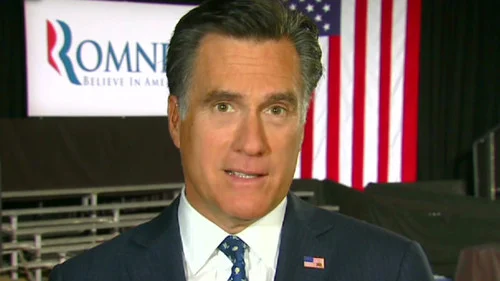
Today I want to react to my friend Karl Smith, to my cousin Mitt Romney, and to the part of the American electorate Mitt was trying to pander to when he said:

I’m not concerned about the very poor — we have a safety net there. If it needs repair, I’ll fix it. I’m not concerned about the very rich — they’re doing just fine. I’m concerned about the very heart of America, the 90-95 percent of Americans who right now are struggling.

I think Mitt has things exactly backward here. Fortunately, I have high hopes that he said it precisely because it isn’t true: that he is concerned about the very poor and the very rich, but has a lot of trouble connecting emotionally with the middle-class. So, since he might be our next president, oh may it be true that Mitt, in his heart of hearts, agrees with me when I say this:

I am deeply concerned about the poor, because they are truly suffering, even with what safety net exists. Helping them is one of our highest ethical obligations. I am deeply concerned about the honest rich–not so much for themselves, though their welfare counts too–but because they provide goods and services that make our lives better, because they provide jobs, because they help ensure that we can get good returns for our retirement saving, and because we already depend on them so much for tax revenue. But for the middle-class, who count heavily because they make up the bulk of our society, I have a stern message. We are paying too high a price when we tax the middle class in order to give benefits to the middle-class–and taxing the rich to give benefits to the middle-class would only make things worse. The primary job of the government in relation to the middle-class has to be to help them help themselves, through education, through loans, through libertarian paternalism, and by stopping the dishonest rich from preying on the middle-class through deceit and chicanery. 

With that statement in hand, it is easy to answer Karl Smith, whowrites this in response to my post “Why Taxes are Bad”:

If we agree that benefits reduce work effort, while taxes reduce utility then basic tax transfer mechanisms seem to offer us exactly the tradeoff we want.

Welfare benefits discourage the poor from working. However, the poor have a low marginal productivity of labor.  So, society loses little when poor people work less.

On the other hand rich people have a low marginal utility of income. So if we extract their utility by extracting their income society loses little.

However, when we redistribute money to the poor society gains a lot because the poor have a high marginal utility of income.

Isn’t this exactly the trade we are looking for?

On the part of the poor, my answer is “Of course we should help the poor more, and should not worry much about any resulting lost output by the poor.” However, we do need to be concerned that for many, a job is an important contributor to self-esteem, in a way that the poor do not always fully take into account when they let tax and benefit incentives influence whether or not they work.

As for the rich, as I write above, it is not so much their welfare I am concerned about, though that counts too, but getting incentives right to encourage them to work hard for the benefit of the rest of society. Among other things, the best of the rich provide a crucial decentralized guiding role for our economy.

But Karl’s point that benefits reduce work effort is a big problem when those benefits go to the middle class. The middle class make up the bulk of our society and produce the bulk of GDP. So if government benefits cause them to work less–for example, to retire earlier than they otherwise would–we all end up poorer.

Two last points: First, it will take me at least a hundred posts to develop, clarify and defend my views about taxation and related aspects of public policy. Second, many readers will be surprised that I think Romney might care about the poor (though not so much about the middle class) in his heart of hearts. This could be my familial bias talking, but I try to back up this view in my post “Will Mitt’s Mormonism Make Him a Supply-Side Liberal?”

Also inspired by a saying of Mitt’s:                  

“Corporations are People, My Friend”

Inspired by a saying of Barack’s:

“You Didn’t Build That: America Edition”

Miles's Best 7 "Save-the-World" Posts, as of July 7, 2012

There is a hint of gentle self-mockery in my title above, since I am not blind to my station in the world, which makes it hard for me to sway the policies of governments, central banks, or even economics departments. Indeed, one of my first papers, “Optimal Advice for Monetary Policy” (with Susanto Basu, Greg Mankiw and David Weil) was sparked by an early recognition that advice is not always heeded. But it seems more honest to admit to the hope of making the world a better place even beyond my immediate circle than to hide behind a tamer phrase such as “Posts relevant to important policy concerns.”

Moreover, the phrasal adjective “save-the world” gives better guidance for deciding what makes the list. I will use six criteria. The top ten list is decided by you, my loyal readers,  together with highly-appreciated newcomers, based on Google Analytics data. But I get to decide the list of best “save-the-world” posts giving policy proposals or advice, based on my judgment of 

  1. how certain I currently am of the value of the proposal,
  2. expected total benefit to world welfare, added up over time,
  3. urgency, 
  4. importance of having many people know about the idea,  
  5. avoiding duplication with other posts on the list in the policy proposal it addresses, and
  6. avoiding duplication with proposals that already have many other people pushing them hard, unless I have at least a slightly new angle on the argument for the proposal.  

For example, my post “Jobs” has an important policy proposal in it, but doesn’t make the list because the proposal there is too new to my thinking for me to be fully confident of it, and so it fails according to criterion 1. But it or a future post developing the idea further might make the list someday if I become more confident of that proposal. Also, the complexity and subtlety of monetary policy issues in the United States is great enough, and–relative to the sweep of history–the Bernanke Fed has been impressive enough, that a shred of remaining modesty has prevented me from having any suggestion about U.S. monetary policy of sufficient magnitude to belong on the list at this point. That is so even at a time when my undergraduate classmate Joe Gagnon has very strong words for the Fed in his post “The Fed Shirks Its Duty.” I take Joe’s views (and similar views from others) very seriously, but I am not there yet.    

For now, if a post makes the list, I will just put it in chronological order of when I posted it. Here is the list:

  1. Getting the Biggest Bang for the Buck in Fiscal Policy.
  2. National Rainy Day Accounts
  3. “Henry George and the Carbon Tax”: A Quick Response to Noah Smith
  4. Leading States in the Fiscal Two-Step
  5. Avoiding Fiscal Armageddon
  6. Health Economics
  7. Future Heroes of Humanity and Heroes of Japan

A few notes:

First, the Federal Lines of Credit (FLOC’s) proposal in “Getting the Biggest Bang for the Buck in Fiscal Policy” is a very simple, but powerful, idea that macroeconomists and policy makers seem to have missed–one that could be of enormous help to both the United States and to Europe in their current economic troubles. I should not have been the one to come up with this proposal: someone could easily have come up with it 40 years ago, but as far as I know, no one did. And it is unfortunate that no one did. “Leading States in the Fiscal Two-Step” is in a similar spirit.

Second, “Avoiding Fiscal Armageddon” really has three proposals, with the proposal referred to in the title the least important of the three.

Third, I mean what I say in the title of “Future Heroes of Humanity and Heroes of Japan.” No monetary policy move would mean more for the world, given the powerful demonstration value this move would have.

Dissertation Topic 3: Public Savings Systems that Lift the No-Margin-Buying Constraint

QUESTION: Miles, I am a 2nd year Phd student at the University of Athens,Greece and i would like to write a strong proposal to continue the Phd abroad (I don’t think you need details about why, just read the headlines!). I was reading your papers about precautionary savings and i was thinking to study the impact of social security on savings and investment behavior of the households. What do you think and where should I focus my attention? Thank you in advance!

I find this subject intriguing because I believe that the relation between healthcare systems, saving and macro performance is strong. The first two have been investigated extensively, but not for Europe despite the fact that the “experiment” is interesting due to the diversity between countries with respect to healthcare systems since data are relatively recent (thanks to S.H.A.R.E.). For the second pair I think that distorted saving affect the economy severely. Households savings are substituted by government and this could potentially affect the structure of the economy. For example some countries regulate the investing decisions of public institution and constrain to invest nationally and safely (usually national bonds!). Ideally i would like to focus in the most fruitful research topic and construct a theoretical model with heterogeneous agents and test it empirically.I understand that my questions are very broad and i need to narrow them.

ANSWER: In this area, I think there is a very interesting contrarian research project. Given even a modest positive equity premium (expected returns of stocks higher than expected returns of bonds), models of optimal life-cycle saving and portfolio choice suggest that–if only they could freely do margin-buying at the Treasury-bill rate and with no extra investment fees–young people should typically have what seem like very large investments in the stock market because the present value (total asset value) of their many years of future labor earnings is in the hundreds of thousands, or even millions of dollars, making substantial stock-holdings reasonable. Even at my age, if I knew how to do margin-buying conveniently at the Treasury-bill rate with no fees in order to effectively borrow to hold more stock than the total value of my retirement savings plan, I would do it, but I can’t. But government retirement savings programs could make this possible. Moreover, if the political flak could be survived, a public program is a way to overcome the fact that most people don’t understand the principle that they should integrate future labor earnings into their financial investment decisions.  (There is a lot of evidence to back up the fact that in the real world most people don’t understand this, even though in standard economic models, all of the “agents” serving are theoretical stand-ins for human beings understand this principle with perfection.)

As someone writing an economics dissertation, the political flak that such a program would entail is not your problem. Showing that it would substantially raise welfare if it ever happened would be very interesting. I think this is a research project that would intrigue people because it sounds so counter-intuitive, especially in the context of the current economic troubles, yet is so firmly founded in sound economic theory.

By the way, the idea that people ought to have large stock holdings even if the expected returns on stocks are only modestly above the expected returns for bonds is dramatically reinforced if one is willing to follow Raj Chetty in estimating risk aversion using labor supply behavior. I love this paper:

Raj Chetty, “A New Method of Estimating Risk Aversion”

American Economic Review, 96(5), 1821-1834, December

Using Raj’s numbers for risk aversion amounts to saying that only declining marginal utility is a sound reason for avoiding risk and that any aspect of apparent risk aversion that comes from departures from the standard expected utility theory does not deserve respect in thinking about the normative (prescriptive) question of how much risk people should take on in order to get higher expected returns.

I personally would find a job market paper that pursued this idea seriously and well quite exciting, and I don’t think I would be alone.  

This project would be computationally intensive. For style of paper, you might want to consider something like my paper “Portfolio Rebalancing in General Equilibrium” with Matthew Shapiro, Tyler Shumway and Jing Zhang or the partial equilibrium counterpart to that paper.

Miles's Linguistics Master's Thesis: The Later Wittgenstein, Roman Jakobson and Charles Saunders Peirce

In between receiving a 1982 bachelor’s degree and a 1987 Ph.D. in Economics from Harvard, I received a 1984 Master’s degree in Linguistics from Brigham Young University (completed in the Summer after I had already done a year towards an Economics Ph.D.) Here is a download of my Master’s thesis (advised by John Robertson), which has a title longer than some of my posts:

Language, Linguistics and Philosophy: A Comparison of the Work of Roman Jakobson and the Later Wittgenstein, with Some Attention to the Philosophy of Charles Saunders Peirce.

With the emphasis in my thesis on the Later Wittgenstein and Charles Saunders Peirce, I felt I had earned by junior philosopher’s wings when I finished this thesis. 

More generally, my Linguistics degree made me feel I could make my own decisions about English usage with an eye toward effective communication. And it has given me an interest in carefully delineating terminology to describe new ideas in Economics.

I had already been accepted to the Economics Ph.D. program at Harvard when I started the Linguistics Master’s program and had no intention of pursuing Linguistics professionally. Among other personal motivations, my much-less-expensive Linguistics degree was my answer to Harvard’s attempt to get me to forgo the benefits of Advanced Placement and pay for a fourth year as an undergraduate at Harvard. My interest in Linguistics in the first place is due to the influence of my Biblical Hebrew and Historical Linguistics professor Thomas Lambdin, author of a widely used Biblical Hebrew textbook

Update: I found out that my favorite teacher from my K-12 years, Joyce Nelson (photo below), died on July 3, 2012. When I asked her advice about whether it made sense to do a Master’s degree in Linguistics, she encouraged me, saying that knowledge always becomes valuable in one way or another.  

Joyce Nelson

Joyce Nelson

Miles's Presentation at the Federal Reserve Board on May 14, 2012 (pptx)

Here is a download of the Powerpoint file for the presentation I gave at the Federal Reserve Board on May 14, 2012, as recounted in my second post “Getting the Biggest Bang for the Buck in Fiscal Policy.” It had an element of discussing Stefan Nagel’s longer presentation immediately before, a presentation based in part on his paper with Ulrike Malmendier “Depression Babies: Do Macroeconomic Experiences Affect Risk-Taking,” but ranges beyond that to a wider discussion. My most important idea in this presentation is Federal Lines of Credit (FLOC’s) as a way to provide fiscal stimulus without adding much to the national debt–an idea laid out in full detail in my academic paper about Federal Lines of Credit: “Getting the Biggest Bang for the Buck in Fiscal Policy.” As academic papers go, this one is quite accessible to non-economists.

Dissertation Topic 2: Multisector Models

QUESTION:

Hi Miles. I am a PhD student just commencing the thesis writing process. I have been focussing on the literature that has evolved from your paper ‘Sticky Price Models and Durable Goods’. Much of the work following this paper focusses on solving the co-movement problem between durable and non-durable consumption with sticky prices, sticky wages and/or credit frictions. I would like to ask your opinion on interesting research directions in this area.  –chrisp1979

ANSWER:

Not everything the economy produces is alike in how it affects the economy as a whole. So in my view, considerably more research effort should be devoted to macroeconomic models of the economy that treat different sectors of the economy as different in important ways. And how goods relate to the time-dimension (durable like cars or nondurable like fast food) is one of the most important differences between different categories of things the economy is producing.

In giving more specific advice, I worry a little about whether my taste conflicts with the taste of those you need to appeal to. You should keep in mind that I am, in the first instance, a macro theorist.  (Indeed, early on in graduate school I thought I would grow up to be a micro theorist.) In any case, I feel we know so little about the behavior of multisector models that it is premature to try to get a particularly result.  In this area where we don’t even know very basic things from a theoretical point of view, I have thought it too bad that so many researchers rush so fast to try to get a model that has a particular result–in this case comovement of the sort you are mentioning. What I think we need is much more understanding of multisector models in general. 

I would much rather have someone study a range of multisector models that seem reasonable based on first principles and see what they do rather than just contrive something with no particular plausibility that gets this particular comovement. If you set out to understand what multisector models want to do without coercion, I think that is a valuable addition to knowledge. Better to find that a reasonable, plausible model doesn’t seem to match what is happening in the world–and so have an interesting question to mull over about what is going on in the real world that makes it act differently than the model–than to search through model space to find an unreasonable, implausible model that can match one particular fact.

In other words, I think many papers written these days (particularly in this topic area) misunderstand the task, which is to find plausible reasons that are likely to be true for why some aspect of the world is the way it is rather than some reason that could possibly explain a fact about the world.

Judgments about plausibility of assumptions are key. That is why I would rather have someone pursue a model with good assumptions (some combination of plausibility and simplicity), study it carefully to see what it does, and help the economics profession gradually learn about the mapping between various attractive assumptions and the implications that flow from those assumptions.

But given an open mind, trying to understand how the models work, multisector models are a great area, and many different models would be very interesting, worthy dissertation topics. As long as you start with what you think is a good multisector model that you study to see where it leads rather than starting with a particular result you want to get, I think I would personally find it interesting. 

An example of some good research in this area is the work of the Bank of Japan’s Nao Sudo that has focused on the input-output structure of the economy, which is a very plausible, non-forced mechanism for generating comovement between sectors. Nao’s paper is slated to come out in the JMCB.

Jobs

Jobs and the nature of work are central to the issues I laid out in my first post “What is a Supply-Side Liberal?” I am prompted to write about jobs and the nature of work today by the interesting debate about giving up freedom to get and keep a job kicked off by Chris Bertram, Corey Robin and Alex Gourevitch at Crooked Timber, answered by Alex Tabarrok and Tyler Cowen at Marginal Revolution, who in turn are answered by John Holbo. Adam Ozimek at Modeled Behavior provides clarity to the debate.  And the hive mind of Karl Smith and Adam Ozimek at Modeled Behavior asked me by tweet to weigh in. I won’t try to do a blow-by-blow, but I have some things to say. If you don’t have the energy to read the whole debate, everything I say below can be understood from just reading this litany of limitations on employee freedom from the post that started it all: Chris Bertram, Corey Robin and Alex Gourevitch at Crooked Timber.

1. Abridgments of freedom inside the workplace:

On pain of being fired, workers in most parts of the United States can be commanded to pee or forbidden to pee. They can be watched on camera by their boss while they pee. They can be forbidden to wear what they wantsay what they want (and at what decibel), and associate with whom they want. They can be punished for doing or not doing any of these things—punished legally or illegally (as many as 1 in 17 workers who try to join a union is illegally fired or suspended). But what’s remarkable is just how many of these punishments are legal, and even when they’re illegal, how toothless the law can be. Outside the usual protections (against race and gender discrimination, for example), employees can be fired for good reasons, bad reasons, or no reason at all. They can be fired for donating a kidney to their boss (fired by the same boss, that is), refusing to have their person and effects searchedcalling the boss a “cheapskate” in a personal letter, and more. They have few rights on the job—certainly none of the First, Fourth, Fifth, Sixth, and Seventh Amendment liberties that constitute the bare minimum of a free society; thus, no free speech or assembly, no due process, no right to a fair hearing before a panel of their peers—and what rights they do have employers will fight tooth and nail to make sure aren’t made known to them or will simply require them to waive as a condition of employment. Outside the prison or the military—which actually provide, at least on paper, some guarantee of due process—it’s difficult to conceive of a less free institution for adults than the average workplace.

2. Abridgements of freedom outside the workplace

In addition to abridging freedoms on the job, employers abridge their employees’ freedoms off the job. Employers invade employees’ privacy, demanding that they hand over passwords to their Facebook accounts, and fire them for resisting such invasions. Employers secretly film their employees at home. Workers are fired for supporting the wrong political candidates(“work for John Kerry or work for me”), failing to donate to employer-approved candidates,challenging government officialswriting critiques of religion on their personal blogs (IBM instructs employees to “show proper consideration…for topics that may be considered objectionable or inflammatory—such as politics and religion”), carrying on extramarital affairs, participating in group sex at home, cross-dressing, and more. Workers are punished for smoking or drinking in the privacy of their own homes. (How many nanny states have tried that?) They can be fired for merely thinking about having an abortion, for reporting information that might have averted the Challenger disaster, for being raped by an estranged husband. Again, this is all legal in many states, and in the states where it is illegal, the laws are often weak.

To me the ethical question of whether work requirements are morally justified is very closely tied to the economic question of whether or not those requirements are necessary for the effective production of the goods and services the job is intended to produce. To make this ethical point, let me give the example of our volunteer military–a comparison that Chris Bertram, Corey Robin and Alex Gourevitch allude to.

In my view, our volunteer military system is one of the glories of our republic. I cannot see how the drastic governmental coercion of a military draft could ever be justified if a volunteer military can do the job of protecting our country and policing the world as well as our volunteer U.S. Military has. (In this post let’s leave aside questions about the morality of decisions by our Commanders in Chief–here I am only talking about the overall effectiveness of the U.S. Military.) But as it is, men and women voluntarily choose to join the the U.S. Military. Once they join, many are sent far away from home into the face of hostile attacks. Moreover, they are all subject to a wide range of commands from superior officers and to military discipline. If they are fired–that is, dishonorably discharged–there is a due process procedure, but one that respects the needs of the military to do what it takes to be an effective fighting force. As long as the effects (both intended and collateral) of what the U.S. Military is doing on those outside the U.S. Military itself are on net positive, I don’t see an ethical problem with allowing people to choose to become soldiers and subject themselves to military orders and discipline.

On the ethical question of unfreedom at work, the only difference between the volunteer U.S. Military and other employment is (1) the high level of importance of the U.S. Military’s task, and (2) what the U.S. Military needs from its employees to be effective at its task. In my view, in jobs that are voluntarily taken, and can be voluntarily left, job strictures that are necessary for a firm to be effective at producing the goods and services it specializes in are ethically OK.

I am troubled, however, when a firm takes freedom away from its employees unnecessarily. This can easily happen, for example, when the owners of a firm are not easily able to monitor the underbosses they employ, and these underbosses use their power over the employees under them at least in part for personal gain rather than for the sake of the firm’s mission. A firm may also take freedom away from its employees out of ignorance. In our paper “The Decline of Drudgery and the Paradox of Hard Work,” which is not yet ready to circulate, Brendan Epstein and I argue that figuring out how to make jobs more pleasant without using too many resources to do so is an important dimension of technological progress. At the cutting edge, this kind of technological progress can give a firm a competitive advantage. And once any bit of technological progress has happened, the ignorance of the way things were done before becomes apparent. But many firms are nowhere near the cutting edge of the on-the-job-utility/productivity frontier; many operate far below the level of current best practice.

Since organizations involve many people, they do not always coherently pursue their declared mission. (And indeed, even individuals do not always behave coherently.) In judging unfreedom at work, I think we should judge according to an organization’s declared mission or missions. This is a little like the legal principle that things the government does should have a rational basis. An organization could declare that its mission is making profits, protecting endangered species from extinction, fostering a particular religion or political point of view, seeking truth or raising economic welfare. Whatever it declares its mission to be, it should only ask its employees to sacrifice their freedom for the sake of furthering that mission. Now if an organization declared that its mission was to make life miserable for its employees, within limits that might be allowable too, but only if the organization clearly declared that to be its mission in advance.

What is a good set of institutions to prevent organizations from taking freedom away from their employees unnecessarily? The key is to have the judgment made by others who are sympathetic to the organization’s general type of mission, and who will have appropriate deference to the organization’s specialized knowledge about what works and what doesn’t, but without ties to the organization itself. For organizations whose mission is to make a profit, I think it is important to have the judgment made by a panel of others who have met a payroll and worried about their firms going under. This may seem overly favorable to firms, but remember that it represents a higher level of due process for workers than current law in most states.   

The reason I don’t think a regular jury can adequately judge job dismissals is that it would be hard for most people to ignore the fact that something very valuable has been taken from someone who is fired from a job. It is not easy to remember that the person hired to replace the one fired gains something equally valuable. And it is not that easy for most people to appreciate how necessary is the threat of firing (or where firing is impossible, how important is the threat of some sort of demotion) at a systems level to undergird those dimensions of workplace discipline that are necessary for a firm to fulfill its missions of making a profit and effectively producing goods and services that improve people’s lives. 

Let end with a point that ties into the concerns I raised in my first post “What is a Supply-Side Liberal?” The fact that employees are willing to put up with so much for the sake of keeping their jobs indicates just how valuable jobs are to the typical employee. Economists tend to use simple models with no preexisting distortions to illustrate the benefits of low taxes. In simple models with no preexisting distortions, workers actually don't value their existing jobs much at all–they can always get another job. The fact that, in the real world, jobs are very valuable to people makes the destruction of jobs by taxes and unwise regulations much worse than if people didn’t value jobs.

The simple models are nice because what happens in the absence of taxes is clean and neat and attractive.  But the benefits of low marginal tax rates are actually much greater in more advanced models where, in ways I will discuss down the road, (a) imperfect competition is already leading firms to underproduce and (b) minimum wages, union power, occupational licensing, and the need to obtain worker cooperation lead to jobs being valuable to people, as jobs are valuable to people in the real world.

Dissertation Topic 1: Federal Lines of Credit (FLOC's)

blog.supplysideliberal.com tumblr_m6lp8aO09K1r57lmx.jpg

A Depiction of “The Miracle of the Seagulls” from Mormon History

QUESTION

Miles, I greatly enjoy your blog. I am 3rd year econ phd with a burgeoning interest in the impact of fiscal policy and government expenditure during recessions. Much of the literature simply attempts to calculate a jobs or GDP multiplier, but there are many other impacts of fiscal policy. What are important costs and benefits of fiscal policy that you feel are understudied? Who are the winners and losers from stimulus expenditure? I have a particular interest in firm and worker outcomes. Thanks! – markcurti

ANSWER

The answer here is easy for me. There has been no formal modeling of my Federal Lines of Credit proposal in my second post

“Getting the Biggest Bang for the Buck in Fiscal Policy.”

 This is a serious proposal–and in my view an extremely important proposal–that deserves formal modeling, but I am not going to do that formal modeling myself. (Why don’t I do this myself? See on my CV at the sidebar the number of other research projects I have in progress–many more than the number of my publications!) So it definitely counts as understudied. Here again is the link to the full article that I have submitted to a professional economics journal laying out the proposal in some detail. I even have an NBER Working Paper by the same name that you can cite, though I recommend reading the one I link to rather than the NBER Working Paper. 

When I say “formal modeling,” I am thinking this is one place where a Dynamic Stochastic General Equilibrium (DSGE) model would be quite appropriate in order to get some sense of likely magnitudes. Since analyzing Federal Lines of Credit requires modeling borrowing constraints and heterogeneity, as well as modeling sticky prices so that aggregate demand matters for output, there would be plenty of chances to develop and show off technical skills. I would be truly delighted to have someone do this analysis. 

Since I think the corresponding National Lines of Credit are even more important for Europe than Federal Lines of Credit are for the United States, if you want to do something empirical, to me the key issue is measuring the degree of spillover in fiscal stimulus from one country in the Eurozone to another. Similarly, you could look at the degree of spillover in fiscal stimulus from one U.S. state to another given a state-level fiscal stimulus. However, in general, the amount of empirical precision available for empirical studies of fiscal policy is not great, so this may not be that promising in the end. In either case, DSGE modeling of fiscal spillovers from one Eurozone country to another or from one state to another could be useful. 

July 8, 2012 Update

For other readers, let me translate my statement “the amount of empirical precision available for empirical studies of fiscal policy is not great”:

Despite many claims, aside from military spending, there is not much evidence about the overall effects of short-run fiscal policy on the economy one way or another.  

I would be glad to have this claim contested, but I can say that I have seen a lot of economics seminars lately with empirical estimates of the effects of short-run fiscal policy that are all over the map. Valerie Ramey (who has done work on fiscal policy with my colleague Matthew Shapiro) is one of the experts on what evidence exists. Here again is what she had to say about a recent short-run fiscal policy paper by Brad Delong and Larry Summers:

Valerie’s Powerpoint file and Valerie’s writeup of her discussion. There is an active thread on Twitter from my tweeting the link to Valerie’s writeup and calling it devastating.

Now I am not so sure. There are many objections being voiced to Valerie’s discussion. Anyway, the twitter thread backs up the idea that it is hard to get definitive empirical evidence in this area. 

By the way, Mark, please leave a comment below giving some indication of your likelihood of pursuing this. If you definitely aren’t pursuing it, letting us know will reassure others that there isn’t too much competition on this research topic.

A Note for Graduate Students in Economics Looking for Ph.D. Dissertation Topics

In addition to using the “Ask me anything” button for substantive economic questions, I encourage any of you who are graduate students looking for Ph.D. dissertation topics to send me a detailed description of what kinds of things you are interested in (research preferences), and I will try to think of research topics that I think are important within the range of things you are interested in doing research about. Three warnings:
  1. I will almost always suggest a different topic than the one you are already working on. For this to be helpful to you, you have to be open to the possibility of a new topic. This is easiest psychologically if you are near the beginning of the process of choosing a research topic. 
  2. I am likely to want to publish my reply, so in the unlikely event that many are eager to follow my advice on research topics, you may have competition on the research topic I suggest.
  3. I can’t actually supervise the research long distance, only suggest a topic. And there is some chance I can’t think of anything in your area of interest. But I have many opinions in many areas.
  4. When you write in, please tell me how many different tools you are prepared to use for your dissertation: mathematical analysis, empirical analysis, or computations.
  5. Also, make sure you tell me something about why you were attracted to the area you mention, so I can understand your preferences better.    
Please use the “Ask me anything” button for such questions about potential research topics. You can do more than one message with the button if the length restriction binds. (Don’t use the comment section below to ask about a dissertation topic; it is for comments about the general process.)
If I write a post to answer you, please write in the comment section how likely you are to pursue the dissertation topic I suggest so that others won’t be worried about too much competition if you aren’t going to do it. In general, the comments section of one of the “Dissertation Topic n” posts is an appropriate place for economists to coordinate on doing research in the area I suggest, including economists who already have their Ph.D.

Is Taxing Capital OK?

The “Dark Satanic Mills” that Made England Rich

QUESTION

Hi Miles. As an English Literature Graduate with wider interests and intro Economics Classes, I wanted to ask you about something I read recently. Ostensibly, Joseph Stiglitz in his new book talked of a world where movement of labour was unimpeded, and cities and countries competed for the best workers; something that would be financed by taxing capital. This is deeply attractive to me, but I don’t know if it is possible, economically/demographically, even if political issues,permit. Thoughts? – workedspace

ANSWER

I haven’t read the Stiglitz book, so I will have to answer from general principles. Let me know if Stiglitz somehow has a way around the problems I will point out.

In simple economic models taxing capital has one of the biggest long-run negative effects on the economy of any tax. It looks OK in the short run, but with lower investment, the capital stock gradually declines. In this spirit you would be better off taxing land a la Henry George, since the amount of land won’t decline even if you tax it. But taxing the buildings on top of the land is like taxing any other kind of capital. (However, right now we tax houses very lightly compared to factories, so if it weren’t for the housing bubble’s aftermath, we would be better off taxing houses more and factories—which employ people—less.)

One way to tax capital some in a way that won’t hurt capital formation is to shift from labor taxation (such as Social Security taxes) to consumption taxation, since in the long run the shift to consumption taxation increases taxes on people who have the wealth to consume more than they earn. But in the shorter run, the shift to consumption taxation hits people who are temporarily having to consume more than they earn. Also, consumption taxation has a big life-cycle element. The biggest category of people who have the wealth to consume more than they earn is senior citizens. 

To return to the negative effects of capital taxation, the short-run temptation is much like the short-run temptation to have rent control. In the short run, the supply of apartments is inelastic, so rent control looks like a pure transfer from landlords to tenants, but in the long run rent control is a disaster because it makes it unattractive to build new apartments or even keep the old apartments in good repair. The stories of evil landlords not taking care of apartments that pop up under rent control are oh so predictable from economic theory.

At the beginning I said that in simple economic models, taxing capital has one of the most negative effects of any tax. That is true if the tax on capital is constant. If the government taxes capital now and promises never to tax it again, the story gets more interesting. In theory, forcing all companies to issue non-voting stock to the government worth 90% of a firm’s value would have no distorting effects, and so would be the perfect tax as long as people believed the government would never do it again. But if the government will do this once, what is to stop it from using the same logic to do it again? This is called the “dynamic inconsistency” problem.

Getting government institutions set up to block the recurrence of this ultimately self-contradictory logic behind taxing capital a lot now and promising never to do it again is actually one of the trickiest problems implicit in “Leveling Up: Making the Transition from Poor Country to Rich Country.” I think often here of the history of England. Confiscating accumulated wealth was always attractive to the king. Only the evolution of limitations on the King’s power to take accumulated wealth (the essence of the “one-time” capital tax) in the end allowed England to get the development of factories that helped it to become rich.

Note

This is the first published answer to a question using the “Ask me anything” button.

Update

There is a further Twitter discussion of this issue in this thread

Miles's University of Michigan Website

With the help of the free html editor Blue Griffin on my Mac, I did some very basic improvements to my University of Michigan website. Most importantly, I put so many links leading to this blog at the top that anyone who happens upon my University of Michigan website can’t miss them!

In any case, some of you may be interested in one or more of the academic working papers on my University of Michigan website. A warning: some papers there are quite preliminary, but the key ideas should be there. Also, at this moment I am far behind in the task of putting up links to my recent working papers.  

Some of the best material on my University of Michigan website is accessible through the class links Economics 611 (“Business Cycle Theory”) and Economics 609 (“Advanced Mathematical Methods for Macroeconomics,” which focuses on mathematically characterizing value functions in stochastic dynamic programming problems).  

In other blog mechanics news, if you are at supplysideliberal.com itself, you can see that I am continuing to make improvements to the sidebar. I added a “Top 10 Posts” link and in a minute, I will change the “Miles’s CV” link at the sidebar to a link to my U of Michigan website.

My Corner of the Blogosphere: As of July 1, 2012

I find it interesting to see how the blogosphere is interconnected. Not counting RSS feed subscribers, there were 14,956 total visits to my blog between when I first had Google Analytics set up on June 3 and June 30th. Of those 9,174 were referrals from a link on some other site. I have listed the top 30 sources of referrals. I also listed the 65th, since like the 17th, it illustrates that some blogs are so big that even a comment on them can be a noticeable source of referrals. In the caption for “Mark Thoma on Rainy Day Funds for States” I wrote that Mark’s Economist’s View blog is the center of the economics blogosphere. It is indeed the largest source of referrals to my blog, followed by Greg Mankiw, Google, Twitter, and Noah Smith.

Number of Visits from Each Referral Source

1. Mark Thoma: 1558

2. Greg Mankiw (US): 1213

3. Google: 850

4. Twitter: 844

5. Noah Smith (US):  803

6. Mike Konczal (Rortybomb at nextnewdeal):   313

7. Ezra Klein (washington post): 300

8. Tyler Cowen (Marginal Revolution): 233

9. Facebook: 212

10. Scott Sumner (The Money Illusion): 202

11. Stephen Williamson: 143

12. Brad DeLong: 119

13. Karl Smith and Adam Ozimek (Modeled Behavior): 92

14. Clive Crook (theatlantic.com): 83

15. David Andolfatto: 75

16. Noah Smith (UK):  75

17. Comment on a Matthew Yglesias slate.com article: 68

Adam: Yup. Miles Kimball has an excellent post on this topic too: http://blog.supplysideliberal.com/post/25423469963…

18. Greg Mankiw (Germany): 62

19. Evilsax (DiaryofaRepublicanHater): 57

20. Real Clear Policy: 57

21. Stephen Williamson (Spain):  56

22. Greg Mankiw (UK): 52

23. Tumblr: 50

24. Greg Mankiw (Australia): 43

25. Greg Mankiw (India): 41

26. Stephen Williamson (Germany): 39

27. Greg Mankiw (Italy): 38

28. Greg Mankiw (Canada): 37

29. Noah Smith (Germany):  37

30. Noah Smith (Canada): 35

65. Comment on Mark Shea (patheos.com): 14

So, I as a “progressive” and a Catholic have always had a lot of suspicion of free-market Economics, be it Austrian or Chicago school. My first Economics class came as a sophomore in college after some snobby Republican sniffed at me “You just don’t understand Economics.” My plan was to make sure no-one could tell me that with a straight face again. So I took an Economics class with an extreme libertarian professor (who currently writes at this blog:

http://www.thebigquestions.com/blog/.

I couldn’t help it, I liked him (still do). He would indulge me after class in long conversations about trade, taxation, redistribution, utility theory, etc. I also discovered that I really liked Economics. One Economics class became two, two became a double major, and a double major in Math and Economics became a three year stint in a PhD program in another “conservative” Economics department. Now I would call myself a “supply-side liberal.”

http://blog.supplysideliberal.com/post/23959666073/what-is-a-supply-side-liberal

I still believe strongly that our society has a basic responsibility to minister to the poor, provide health care for the sick, educate the young (all of them!), and so on. However, I now believe (and the evidence for this appears overwhelming) that taxation and regulation have real manifest costs to economic growth, which is necessary for social welfare for rich and poor alike. I think it’s irresponsible to consider a policy without considering those costs.

I am also quite irritated with the self-entitled attitude so many wealthy people appear to have. Accusations of “class war” from the wealthy to the poor are absurd. The wealthy in this country have it great. They will continue to have it great no matter who runs our government. Their concerns have no relevance to me, it’s how our policies impact their actions that I consider relevant. As one more link (and beware of profanity), I think this video sums up their point of view quite well.

The physical geography of visitors to supplysideliberal.com is also interesting. It shows how international the blogosphere is. Here is the breakdown of visits by city:

  1. New York: 936
  2. Ann Arbor: 667
  3. Washington: 650
  4. London: 313
  5. Chicago: 293
  6. Toronto: 154
  7. Seattle: 149
  8. Los Angeles: 142
  9. San Francisco: 142
  10. Boston: 134
  11. Sydney: 118
  12. Houston: 114
  13. Cambridge: 111
  14. Borlange, Sweden: 101
  15. Philadelphia: 100
  16. Minneapolis: 98
  17. Singapore: 94
  18. Arlington: 93
  19. Bonn: 92
  20. Columbia, MD: 92
  21. Tucson: 91
  22. Montreal: 90
  23. Berlin: 89
  24. Austin: 87
  25. Miami: 83
  26. Paris: 75
  27. Melbourne: 74
  28. San Diego: 71
  29. Atlanta: 71
  30. Canberra: 67
  31. Nei-Hu (near Taipei): 63
  32. Ottawa: 60
  33. Berkeley: 59
  34. Dunn Loring: 58
  35. Brisbane: 57
  36. Oakland: 55
  37. Buenos Aires: 54
  38. Goteborg: 54
  39. Portland: 53
  40. Bethesda: 52
  41. Jakarta: 51
  42. Barcelona: 49
  43. Hong Kong: 49
  44. Vienna: 45
  45. Copenhagen: 45
  46. Madrid: 43
  47. Amsterdam: 43
  48. Munich: 42
  49. Staten Island: 42
  50. Dallas: 42

An Upgraded Sidebar for supplysideliberal.com

My daughter Diana Kimball and I have upgraded the sidebar. Those of you who read supplysideliberal.com on an RSS feed might want to go to supplysideliberal.com’s actual website once to see what is available on the sidebar.  Here are some changes:

  1. We put the “Archive” link near the top, since I use it a lot to get the links needed to reference earlier posts. The “Archive” link is also the only easy way to get links for old link posts whose title leads to a reference rather than my post itself.  (I have vowed to avoid link posts from now on.)
  2. I added a link to “A More Personal Bio: My Early Tweets.” This includes some very early tweets about my personal objective function as well as about some early family background and background relevant to my blogging. You can also see a few pictures of my hobby of using Magnetix to do three-dimensional geometry.  
  3. There is a link to the June 2012 Table of Contents, a post that also includes a retrospective of my blog’s first month.
  4. As an experiment, I have enabled Tumblr’s “Ask me anything” button. The rules are that you can ask me anything, but I will choose whether or not to answer. (For example, I am not going to answer tumblrbot’s question about “my favorite inanimate object” since that is too extraneous to the purposes of this blog.) I especially welcome questions about real world economic issues that might get me thinking of possible future posts.

The Euro and the Mediterano

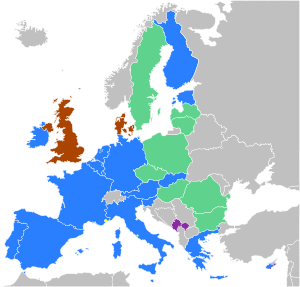
Before the Eurozone was formed, many economists warned that it would cause problems because it is impossible to have one monetary policy that is right for all the economies of a diverse set of countries. And having one currency means having one monetary policy. But the symbolism of a common currency for the project of binding Europe together politically seemed too valuable to give up. So the varied countries in the Eurozone (the blue countries in the map below), have had a one-size-fits-all monetary policy–eleven of them since January 1, 1999, and others since they joined the Eurozone later on. (The last to join was Estonia, in January 1, 2011.)

blog.supplysideliberal.com tumblr_m6ffb1FpqA1r57lmx.png

Now, in 2012, countries such as Portugal, Spain, Italy and Greece could use more expansionary monetary policy than what is right for Germany and some other countries in the North of the Eurozone. Getting back an independent monetary policy requires getting back one’s own currency and so requires exiting the Eurozone. But it is hard to exit the Eurozone in an orderly way–and exiting in a disorderly way risks causing another financial crisis. The aim of this post is to propose an orderly way to restore some degree of monetary policy independence to the different parts of the Eurozone. It might roil financial markets too, so I am not necessarily advocating it, but I see it is preferable to any country simply exiting the Eurozone.

So my objective here is to design a minimum-distance modification to the Eurozone that adds some ability to adjust monetary policy independently for different parts of the Eurozone. The basic idea is “one central bank, two currencies.” In this plan, the Eurozone remains together and the European Central Bank (ECB) continues to determine monetary policy for the entire Eurozone. But the ECB now decides monetary policy for both a “North Euro” and a “South Euro.” The North Euro and the South Euro start out with an exchange rate of 1 to 1, but ultimately are allowed to drift apart in value.

One could easily go further by having one central bank for the North Euro and another central bank for the South Euro, but the policy of “one central bank, two currencies” would help assure the markets that the monetary policy of the South Euro wouldn’t go wild. In the ECB, there could be an informal understanding that the views of those from the relevant countries had a greater weight in setting the monetary policy for those countries, but the official voting rules would be as now: votes from the entire Governing Council of the ECB would apply to both the monetary policy for the North Euro and the monetary policy for the South Euro. In this context, we are in the realm of the second, third or fourth best.  One can’t expect a perfect setup given the original economic sin (which might have been an original political virtue) of setting up the Eurozone as it is in the first place.

The official names of “North Euro” and “South Euro” are helpful to make clear that legally they are both “Euros” (which, of course, doesn’t really solve the legal mess that dividing currencies creates). But I am imagining that the press and the public would soon use a different naming convention: that the “North Euro” would end up being called just the “Euro” by almost everyone, while the “South Euro” would end up being called the “Mediterano.”

Future Heroes of Humanity and Heroes of Japan

Noah Smith has a new post, “‘Science’ Without Falsification is No Science,” that questions whether macroeconomics is an empirical science based on solid data. Noah’s post is attracting attention. For example, Mark Thoma comments on it in his own post “'Science’ Without Falsification.

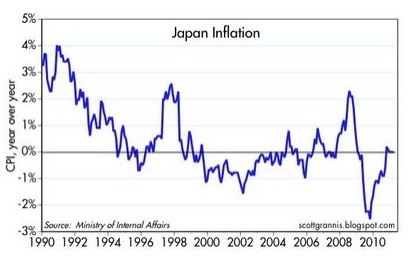
Noah points out that macroeconomists have been arguing over the same things for a long time with no resolution; only decisive central bank actions have provided "experimental” evidence strong enough to convince most macroeconomists of something they didn’t already believe. Just so, massive balance sheet monetary policy on the part of the Bank of Japan could put to rest the idea that balance sheet monetary policy doesn’t work. The Bank of Japan has amazing legal authority to print money and buy a wide range of assets, and has the rest of the government actually pushing for easier monetary policy. So they could do it. They just need to buy assets chosen to have nominal interest rates as far as possible above zero in quantities something like 30% or more of annual Japanese GDP. Japan needs monetary expansion, particularly if it is going to raise its consumption tax, and would be doing the world a huge service by settling the scientific question of whether Wallace neutrality applies to the real world.

I spent two weeks at the Bank of Japan in each of May 2008 and May 2009 precisely because I think there is no central bank in the world that could do more to help the world economy as a whole, as well as Japan’s, by improving its monetary policy. I know that some on the Bank of Japan’s monetary policy committee do not think that printing money and buying massive quantities of assets will work. But the value of experimentation in economic policy is vastly underrated: trying a policy of “print money and buy assets” on a massive scale such as 30% or more of the value of annual GDP is the way to find out. And there is no country in the world for which the possible side effect of permanently higher inflation would be more harmless.  The Bank of Japan has officially set an inflation target at 1%, which is 1% higher than where Japan is at, and there would be nothing terrible about having a 2% inflation target, like the inflation targets for the Fed and the European Central Bank. So the Bank of Japan should do it. If the Bank of Japan shifts to such a decisive policy, those pushing for this approach on its monetary policy committee will ultimately go down in history as heroes of humanity as well as heroes of Japan. That statement is written with every ounce of seriousness and passion I am capable of. 

Health Economics

I am slow to post about health care because I don’t know the answers. But then I don’t think anyone knows the answers. There are many excellent ideas for trying to improve health care, but we just don’t know how different changes will work in practice at the level of entire health care systems.

Much of the political heat over health care reform has to do with the perception on both sides that the Affordable Care Act (Obamacare) is a move in the direction of redistribution. As a mode of redistribution it has many of the same issues as other modes of redistribution.  Redistribution is good, but when financed on a massive scale by the government, it can also be a budget buster. The extent to which this budget-busting aspect of a large amount of additional redistribution can be muted by extra efficiencies wrung out of the health care system is simply unknown.

An aspect of our public policy even before the affordable care act has been favoring health care expenditures relative to other forms of consumption.  In particular, people have long been able to pay for health insurance–but not most other forms of consumption–with pre-tax dollars. I think this can be justified by the fact that most of us are seriously bothered by thinking of others suffering without adequate medical care much more than we are bothered by thinking of others not being able to take family trips or having a small house or car. So it is worth something to us if others tilt their spending toward health care more than they would without any push toward health care spending in the tax system. As an example of a less subjective externality from health care, I think people’s psychological problems often cause them to act in ways harmful to their friends, extended families and coworkers, so I think it is appropriate for policy to tilt people’s spending toward any form of psychological care that can be shown to be effective at improving how people treat others around them along with whatever other effects it has. (Tilting should not be allowed to totally suppress price signals that indicate that some forms of psychological care require many more resources to provide than others.)

This principle of subsidizing what benefits others besides the one choosing how much health care to use is helpful in showing what forms of health care should not be favored. For example, plastic surgery for people who already look OK has at best mixed effects on how others feel. Am I misremembering the former Italian Prime Minister Silvio Berlusconi wanting to subsidize plastic surgery for the benefit of his own viewing pleasure? But those who are in social competition may feel worse off, and I think this externality is stronger than the Berlusconi externality. So, depending on the strength of different externalities, it may make sense for public policy to discourage plastic surgery for people who already look OK rather than encourage it. The ethical status of envy of others’ plastic-surgery enhanced looks–let alone the Berlusconi externality–is not an easy question, but at least one can say that the argument for using policy to tilt people towards spending on plastic surgery is muddy at best, and the default should be no tilt.

On wringing efficiencies out of the health care system so that we can hope to afford the large amount of additional redistribution in the Affordable Care Act, to me it seems crucial to have a great deal of experimentation rather than a one-size-fits-all approach. On the constitutional question of what the Federal Government can do and what States should be left to decide, Greg Mankiw refers to a previous Mankiw post saying that from an economic point of view taxes, subsidies and fines can all be equivalent. The 16th amendment to the constitution gives the Federal Government breathtaking power:

The Congress shall have power to lay and collect taxes on incomes, from whatever source derived, without apportionment among the several States, and without regard to any census or enumeration.

But what the Federal Government can do in relation to the States is not the same as what is should do.  Supreme Court Justice Louis Brandeis, in a dissenting opinion in 1932 said: 

It is one of the happy incidents of the federal system that a single courageous State may, if its citizens choose, serve as a laboratory; and try novel social and economic experiments without risk to the rest of the country.

This has come to be known as the “laboratories of democracy” principle, which I have always found very attractive. In the case of the Affordable Care Act, I believe that whether we are ultimately able to wring efficiencies out of the health care system depends on how much state-level experimentation is allowed. And that in turn is largely a matter of how the next President (whoever that turns out to be) interprets the Affordable Care Act. So even though I think it unlikely that the Affordable Care Act can be repealed, given the difficult designed in by our founders of getting any new legislation through Congress, it matters whether a President is elected who will give many waivers to states to try different experiments with health care. I hope that journalists–and others who get the chance to ask questions of the two major candidates–press them on this question of how freely they would give waivers for states to try various experiments if, as is most likely, the Affordable Care Act is not repealed.    

There is an obvious role for the economics profession in such state-level experimentation on how to deliver health-care. The government needs to ensure that there is adequate data collection in relation to these various experiments, and economists need to analyze that data. More generally, with health care spending at 17.4% of US GDP and rising, we need more economists working on health care issues than ever. In addition to current health economists redoubling their efforts, it is high time for economics departments around the country to give more prominence to health economics in graduate training than they have, so that there will be more health economists in the future. And I hope that where they reasonably can, empirical economists (and theorists) who do not now think of themselves as health economists tilt their research agendas toward figuring out health care. I stand by my statement that no one knows the answers for health care. But I hope someday that will no longer be true.