Thoughts on Monetary and Fiscal Policy in the Wake of the Great Recession: supplysideliberal.com's First Month


This post will serve as the Table of Contents for the first month of supplysideliberal.com.  But it is more than that. It is a chance to reflect on questions such as

Where have I been coming from in the posts so far?

Why am I here writing a blog?

Where am I going from here?

Only the most important reflections come before the Table of Contents proper. Lesser musings come after the Table of Contents.  

The most important thing to say about where I have been coming from is that all the posts are meant to last. I try to make each major post and most minor posts count as parts of overarching arguments that  extend over many posts. And I hope that the whole is greater than the sum of the parts, so that anyone who reads the entire thread of posts in a given topic area will learn something they wouldn’t have learned from reading each post in isolation.

I think of blogging as an art form that I am undertaking seriously as a beginning novice.  My lodestone for literary structure here is my favorite television series Babylon 5.  In Babylon 5, the first season seems episodic, but in fact each episode lays part of the foundation for the narrative arc that picks up in earnest with the second season.  Some of the charm of a blog is in its unexpected turns as a blogger interacts with others online.  I want to have that and an overall progression.  

As to my motivations for beginning a blog, there are many personal motivations that I will talk about in due course. But I know that the one thing that has given me some sense of urgency to start now rather than wait until later is seeing the world economy flounder in the wake of the Great Recession. It is galling to see the world suffering below the world’s natural level of output when, in my contrarian view, getting sufficient aggregate demand is fundamentally an easy problem compared to the long-run challenge of balancing concerns about tax distortions against the value of redistribution and other government spending.

On where I am going from here in this blog, let me say that I have the titles of many potential posts kicking around in my head, each potential post struggling for primacy so it can be the next one written. They can’t all win at any given moment, and I don’t think I can maintain the pace I have kept so far, let alone increase that pace. And responding to other things currently going on in the blogosophere and in the news takes a certain degree of precedence. But there is a lot coming. 

The Table of Contents below is organized by topic area. Monetary Policy comes first because responding to other bloggers and to events has led to the most posts in that area. Monetary policy is one way I believe we have plenty of tools to get sufficient aggregate demand. The other way to get sufficient aggregate demand is through Short-Run Fiscal Policy. But in everything I say about short-run fiscal policy, I worry a lot about the effects on the national debt and work to find novel ways to minimize those effects.  The third topic area heading is Long-Run Fiscal Policy–the issues that motivate the title of my blog.

The last substantive heading is Long Run Economic Growth. I am not a growth theorist or a growth empiricist, and so am not qualified to say as much as I would like to be able to say about Long Run Economic Growth. But Long Run Economic Growth is arguably the most important subject in all of Economics. I have often thought that if I had started graduate school just a few years later, I would have focused on studying economic growth in my career, as my fellow Greg Mankiw advisee David Weil has to such good effect.  

Under the last two headings in the Table of Contents, I organize posts on Blog Mechanics and Columnists, Guest Posts and Miscellaneous Reviews. (I put many reviews under the relevant substantive heading because they help to understand the thread of the argument.) I will talk more about these aspects of the blog and about blog statistics after the Table of Contents.  

TABLE OF CONTENTS: FIRST MONTH

Monetary Policy

Balance Sheet Monetary Policy: A Primer

Stephen Williamson: “Quantitative Easing: The Conventional View”

Trillions and Trillions: Getting Used to Balance Sheet Monetary Policy

Karl Smith of Forbes: “Miles Kimball on QE”

Scott Sumner: “‘What Should the Fed Do?’ is the Wrong Question”

Is Monetary Policy Thinking in Thrall to Wallace Neutrality?

A Proposal for the supplysideliberal Community’s First Public Service Project: a wikipedia Entry on “Wallace Neutrality”

Mike Konczal: What Constrains the Federal Reserve? An Interview with Joseph Gagnon

Going Negative: The Virtual Fed Funds Rate Target

The supplysideliberal Review of the FOMC Monetary Policy Statement: June 20th, 2012

Justin Wolfers on the 6/20/2012 FOMC Statement

Should the Fed Promise to Do the Wrong Thing in the Future to Have the Right Effect Now?

Wallace Neutrality and Ricardian Neutrality

Future Heroes of Humanity and Heroes of Japan

The Euro and the Mediterano

Short-Run Fiscal Policy

Getting the Biggest Bang for the Buck in Fiscal Policy

Reihan Salam: “Miles Kimball of Federal Lines of Credit”

National Rainy Day Accounts

Leading States in the Fiscal Two-Step

Mark Thoma on Rainy Day Funds for States

Long-Run Fiscal Policy

What is a Supply-Side Liberal?

Can Taxes Raise GDP?

Clive Crook: Supply-Side Liberals

Why Taxes are Bad

A Supply-Side Liberal Joins the Pigou Club

“Henry George and the Carbon Tax”: A Quick Response to Noah Smith

Avoiding Fiscal Armageddon

Mark Thoma: Laughing at the Laffer Curve

Health Economics

Long-Run Economic Growth

Leveling Up: Making the Transition from Poor Country to Rich Country

Mark Thoma: Kenya’s Kibera Slum

Blog Mechanics

Miles’s Tweets

Miles’s Curriculum Vitae

Comments on supplysideliberal.com

Notice of Revocable Permission to Reproduce Content from this Blog with Appropriate Attribution to this Blog and Notice of Miles Spencer Kimball’s Copyright

@mileskimball on twitter

suppysideliberal.com on Facebook

Columnists, Guest Posts, and Miscellaneous Reviews

An Early-Bird Tweet from Justin Wolfers

Noah Smith: “Miles Kimball, the Supply-Side Liberal”

Gary Cornell on Andrew Wiles

Diana Kimball on the Beginnings of supplysideliberal.com

Gary Cornell on Intergenerational Mobility

supplysideliberal.com Takes on a Math Columnist: Gary Cornell on the Financial Crisis

Diana Kimball: Recording Skype Conversations on a Mac

Mike Sax: Review of (Some) Economics Blogs

Let me say a few words about blog mechanics, columnists, reviews and blog statistics.   The most important blog mechanics are indicated by links at the sidebar. But the posts under Blog Mechanics provide a little more detail. On all the blog mechanics, I owe a great debt to my daughter Diana Kimball

I have already said it in several posts, but let me say again that those who are not following my tweets are missing a lot. I have been having a lot of fun engaging with the news of the day and with other people’s tweets. And I routinely tweet announcements of new posts appearing on the blog itself.

Among the Miscellaneous Reviews, the one I recommend most highly is Noah Smith’s.  I owe a lot to Noah’s encouragement and help with this blog. I see this blog as part of the Noahpinion universe.  

On blog statistics, I will do a separate post a little later on traffic sources, which is interesting because it helps show the shape of my corner of the blogosphere.  My first post was on Memorial Day, May 28, 2012, exactly one month ago. I didn’t get Google Analytics set up until a few days later, so those statistics are from Sunday, June 3 on (and end at midnight last night). Google Analytics reports 20,386 total pageviews, 13,392 visits, and 7,411 unique visitors. I got some help “grep"ing to verify that the Google Analytics statistics do not include the now 593 subscribers receiving the posts on Google Reader unless they also click separately from Google Reader. Together with the 62 Tumblr subscribers, that adds up to 655 subscribers, plus some number of subscribers on Facebook that I can’t separate out from other Friends and however many subscribers I have on other platforms I don’t know about. Finally, I have 353 Twitter followers. The mismatch between that and the number of subscribers to the blog itself is why I have been making a point of recommending following my tweets.

To me, this past month has been a heady time. The excitement of starting a new blog that has been so generously welcomed has caused me some of the most pleasant insomnia that I have ever experienced. One of the reasons I expect to slow my pace somewhat is that once that enthusiastic insomnia wears off, I will have less time to blog.   

Update: I added posts from the rest of June, 2012 to the Table of Contents above so that from now on monthly tables of contents can be based squarely on calendar months.  

Mike Sax: Review of (Some) Economics Blogs

It is always interesting to read reviews. Google Analytics helped me find Mike Sax’s very interesting review as a significant source of referrals. I thought I would share this with you. Let me give a disclaimer: the opinions about other blogs are Mike’s, not mine.  Consider my level of endorsement the same as if I had approved it as a comment. Also, the title of Mike’s blog, “Diary of a Republican Hater” does not apply to me. I like Republicans very much and I like Democrats very much. I hope that each side feels I agree with them on those views that they think can most clearly be defended by rational argument. Thanks to Mike for permission to reprint this review:

NGDPLT, ‘Wallace Neutrality" and Related Matters

I can now stand out of a limb and say that the start of Miles Kimbal’s Supply Side Liberal blog is a very positive development for all of us who want a better and deeper understanding of all matters Econ. Since the crisis one positive has been a veritable flowering of Econ blogs along the lines of what the French Salons were back in the 18th century for intellectual discourse on the news of the day. 

Many as I do read Sumner’s Money Illusion and other MMers like Nick Rowe, Lars Christensen, et al as well of course as the “Saltwater” guys like Krugman and Delong. Then of course you have the MMTers-today’s Post Keynesians-at places like Economic Perspectives and the Center of the Universe-Walter Mosler’s blog. Another good one is Cullen Roch who is even within MMT heretical breaking up into yet another school-MMR. There are many others I’m not mentioning that are tremendous-Noahpinion, Bill Woolsely…

Through all of it what I’ve personally sought certainly is for true teachable moments-I want to learn and understand the marcro and monetary system better. Of course whether you are reading an MM blog, an MMT or a New Keynesian blog of course the author usually has a strongly advocated point of view. This is not a problem as far as I’m concerned-I too have a point of view. I’m basically I’d say a Post Keynesian though I’m not sure I’m ready to embrace the MMT tag-it seems somewhat cultish too me.

I think it can’t be denied that if any one person comes closet to epitiomizing the flowering of Econ since 2009 it may be Sumner himself. Certainly no one doubts his point of view but I don’t see how you can deny he’s been a “tree shaker.” I use that phrase thinking of what Jesse Jackson used to say-“I’m a tree shaker not a jelly maker!”

This doesn’t mean Sumner’s right. I think it’s still very open to question whether he’s right about NGDP level targeting working exactly the way he assures us it will. But no doubt he has captured the imagination of many Econ bloggers no doubt. 

What NGDPT has going for it is for one thing the “vaccuum effect.” No other theory in the Macro world right now is so suggestive, intuitive, and has such reach in terms of explanatory power. It does remind in me in some way of Chomsky’s linguistic revolution in the 60s. Whether he was right or not, Chomksy couldn’t be beaten because no one else could suggest a system that seemed to explain so much. Here I can’t but think of Kuhn's Structure of Scientific Recvolutions

In this way Sumner is very much like his hero-he is Friedman 2.0 in the sense that his NGDPLT idea is probably the most intuitive and trendy single monetary idea since Friedman’s 3% money supply growth rule. 

Still as Noah Smith has suggested, intuitiveness is not in itself proof of truth. Friedman’s Rule was also highly intuitive and yet it was a disaster. That doesn’t mean I can tell you right now what might be the hole in NGDPLT. I’m not certain there is one that it will go as badly askew as Friedman’s Rule just that it could. 

As I understand Noah, this is the problem with going by intuition alone and why models are also helpful. They offer us a way to check ideas without the trial and error of seeing whether or not it fails empirically. David Andolfatto recently dida post that used the OLG model to test NGDPLT that-depending on which assumptions are used, doesn’t get it done. As to whether or not OLG is an acceptable model, well that’s of course another discussion but Andolfatto suggests that those who have a problem should read a Woodford piece that shows its soundness. 

“Even though the model delivers a plausible interpretation of some recent macroeconomic developments, a NGDP target is not an obvious solution. But of course, as I said, the model is highly abstract. It is likely missing some features of the real world that NGDP target proponents think are important. If this is the case, then I’d like to hear what they are, and how these elements might be embedded in the model above. If nothing else, it would be a contribution to the debate if we could just get straight what assumptions we are making when stating strong propositions concerning the desirability of this or that policy.”

http://andolfatto.blogspot.com/2012/06/ngdp-targeting-in-olg-model.html?showComment=1338923968907#c1452928314545044264

My reservations of NGDP come more on the side of MMTers like Dan Kervick. What I can’t help but noitce is that Sumner insists on the idea that the fiscal multiplier is zero if the central bank does it’s job. This certainly makes it reasonable to ask if he has a political agenda. But what Kervick and company argue is that what is considered “monetary” vs. “fiscal” operations is itself a political question on the level of definitions. You could say that it’s the Morgan Warstler version of NGDPLT-what it offers is simply backdoor austerity. In addition I think there’s a case to be made that monetary and fiscal policy refer to different parts of the body so to speak. You could argue that monetary policy pertains largely to the financial system-the stability of banking-while fiscal policy relates to the real economy. 

His big question right now is “Wallace Neutrality” a term quite honestly that I’m not too familiar with but seems based on its use to be related to the liquidity trap:

“Although I plan to keep tight editorial—and for the most part, authorial—control over this blog itself, in a broader sense I view supplysideliberal as a collective enterprise. I hope readers of this blog will gel into an online community that goes beyond this blog. This will be a community of thoughtful people who do not all think alike; they need not be “Supply-Side Liberals” by the definition given in my first post “What is a Supply-Side Liberal? Anyone who comes to this website frequently belongs to the supplysideliberal community (which means, for example, that the 535 people who have put this blog on their RSS feeds automatically qualify)." 

"It is my hope that in some way, the supplysideliberal community becomes something more than just this blog. But it is good to take things in small steps, even if the small steps follow each other in quick succession. So I have a proposal for a medium-sized undertaking as our first collective project outside of this blog: bringing into existence a wikipedia entry on “Wallace Neutrality.”

"If you think this is a good idea, the key step will be to get the entry started, which I think can be done based on Noah Smith´s post “Does Steve Williamson Think Printing Money Can´t Cause Inflation?” and the comments on my post “Is Monetary Policy Thinking in Thrall to Wallace Neutrality?”Once the entry is started, it can be revised in the light of further comments on this blog, reading of one or more of Wallace´s papers, etc. Because of the importance of highlighting the assumption of Wallace Neutrality behind much of the discussion of monetary policy during our current economic troubles, I believe this would be a great service to the world.”

“Could one of you take the lead on this?”

“I definitely can´t do it all myself. In terms of my personal priorities in relation to monetary policy, in the next while I will be writing about how people’s views on Wallace neutrality inform their views on current monetary policy debates, and what I think should be done given my belief in departures from Wallace neutrality. In setting out the nature of Wallace neutrality itself, I need help. I think a wikipedia entry would be a great way to collate our collective wisdom on this. And I think it would be a great start toward our becoming something more than just this blog”

So Wallace Neutrality evidently informs an answer to Noah’s question about Stephen Williamson not thinking monetary policy can cause inflation among others. So if so it would seem to offer some pretty high stakes. 

I myself don’t know much about starting a Wiki paper-it isn’t hard but hopefully this will give us a real opportunity for a meeting of the minds. I probably could start a Wiki paper-it’s easy. We’ll see if others have an interest. 

Mark Thoma: Laughing at the Laffer Curve

In my first post “What is a Supply-Side Liberal?” I wrote

I believe the harm to the productive performance of the economy caused by taxes and regulations is serious (though seldom serious enough that a reduction in taxes would raise revenue).

Mark Thoma’s post (title above is a link) shows that the weight of informed opinion is behind my parenthetical remark. I can verify that since I started econ grad school in 1982, having attended many economics seminars and having had many informal discussions with economists, I have never in person heard an academic economist argue that tax cuts raise revenue, with the possible exception of Larry Lindsey (Greg Mankiw’s and my boss when we were both section-leaders in Harvard’s Ec 10). Larry Lindsey argued that cuts in capital gains tax rates would cause investors to change the timing of capital gains realizations enough that cutting capital gains tax rates would raise revenue now–implicitly at the expense of revenue later, though he didn’t emphasize that.  

One reason that tax cuts don’t raise revenues is that the effect of taxes on GDP is itself complex, and can go either way. See my posts “Can Taxes Raise GDP?” and “Why Taxes are Bad.” If marginal tax rates can be cut both now and in the future it raises efficiency (a good thing) but it will typically make people feel richer as well, so that work hours won’t go up much, if at all (also a good thing).  

Update: Scott Sumner pointed out to me that the disagreement of economists with the statement

A cut in federal income tax rates in the US right now would raise taxable income enough so that the annual total tax revenue would be higher within five years than without the tax cut.

indicates that the overwhelming majority of economists don’t believe that tax cuts can raise revenue for Keynesian reasons either.  (And actually, disagreeing with this statement means not believing that the combination of supply-side and demand-side effects of tax cuts is enough to lead to an increase in tax revenue.) On the question of whether tax cuts can raise revenue for Keynesian reasons, see Valerie Ramey’s Powerpoint discussion of a recent paper by Brad Delong and Larry Summers.

supplysideliberal.com on Facebook

Thanks to Diana Kimball’s technical assistance, Facebook is now another way to subscribe to this blog and my twitter activity at the same time.  Almost all my Facebook activity will consist of whatever is forwarded from my blog and my twitter activity, so you won’t have many extraneous things to wade through.  

There are some photos posted by others, which I think is a plus, especially right now when you can see pictures of me and my son Jordan in front of architecture by the amazing Gaudi in Barcelona. (Jordan is an undergraduate studying Economics at Ohio State University. Jordan is 19 and Diana is 25.)

If you want to subscribe to this blog and my twitter activity on Facebook, just search for Miles Kimball and request me as a friend.  I will routinely approve friend requests as soon as I get a chance.

Mark Thoma on Rainy Day Funds for States

I have to apologize to many in the blogosphere for not having been a regular blog reader in the past and so not being aware of posts preceding mine that are clearly relevant to my posts and so deserve acknowledgement.  Unfortunately, writing this blog on top of all my other duties as an economics professor and in my private life also doesn’t leave me a lot of time for reading everything out there that I ideally should be reading.  So please do let me know of things out there that are highly relevant to my posts and I will make an effort to acknowledge them–assuming I agree that they are highly relevant.  This post is an acknowledgement of an article by Mark Thoma that is extremely relevant to one of my posts.  Mark let me know by tweeting about his prior article with @mileskimball included in the tweet. 

Back in October 26, 2010, Mark Thoma suggested in the Fiscal Times that the Federal Government help states out financially in return for states setting up rainy day funds.  (I have to apologize to many in the blogosphere for not having been a regular blog reader in the past and so not being aware of many things that people have said.)  This is very similar to my proposal in “Leading States in the Fiscal Two-Step."  So (assuming that, like Ben Bernanke, Mark thinks more fiscal stimulus is in order at this point) both Mark and I are calling for this kind of action.  One difference in our proposals is that I am suggesting that the Federal Government effectively require the states to repay the money given them now, and then go beyond that to accumulate positive balances in their rainy day fund.  Thus, my proposal will not add to the Federal Government’s debt in the end, while Mark’s will. 

Also, note that since my proposal works through changing the timing of Federal Medicaid Contributions, the Federal Government can easily do it unilaterally, and the effective rainy day fund requires no state legislative or executive action in order to come into existence. 

Wallace Neutrality and Ricardian Neutrality

Neil WallaceDiscoverer of Wallace NeutralityRobert BarroRicardian Neutrality Revivalist

Scott Sumner posted a speedy reply to the question I posed for him in “Should the Fed Promise to Do the Wrong Thing in the Future to Have the Right Effect Now?  His answer, like mine, is "No!”

On the whole, it turns out that the two of us are in relatively close sympathy. On my side, I certainly think that the Fed should be clear about its medium-term objective, in the spirit of nominal GDP targeting, though there are some details to come in my upcoming post “Optimal Monetary Policy: A Primer” that will diverge from overly simple versions of nominal GDP targeting. As for shorter-run targets to get to a medium-run target in the spirit of nominal GDP, near Wallace neutrality means that the changes in quantities needed to be on target for a given effect on nominal GDP can change dramatically as key assets reach the zero lower bound.  (See my post“Trillions and Trillions: Getting Used to Balance Sheet Monetary Policy.”)  So especially when the zero lower bound is an issue, I think stating things in interest rate terms (despite the complexities that entails) has some advantage over stating things in terms of asset quantities.

On Scott’s side, he clearly states he does not believe that Wallace neutrality is an accurate description of the real world:

In theory Wallace is right and Kimball is wrong, but in practice Kimball is right, because the conditions for Wallace neutrality to hold would probably never occur in the real world.  This will take some explanation, so bear with me.

I wouldn’t quite say I am wrong in theory, but it is true that simple theoretical models definitely “want” to have Wallace neutrality.  It takes some doing–on the research frontier–to theoretically model departures from Wallace neutrality like those that I believe exist in the world.  This is a great research area for graduate students looking for a research topic.  It is worth many dissertations because it is not good enough to have a departure from Wallace neutrality in your model, it needs to be plausible as a description of why the real world departs from Wallace neutrality.  Since different economists will have different judgments about how realistic various alternative mechanisms are, it will be good to have many different models of departures from Wallace neutrality, using different mechanisms. 

In terms of how economic theory works, let me draw a history-of-economic-thought analogy between Wallace neutrality and Ricardian neutrality.  Ricardian neutrality is the proposition that for a given path of government purchases, tax rebates won’t have any important effect on the economy because the tax rebates lead to higher government debt, which unavoidably leads to higher future taxes to pay for that debt, which in turn leads, according to the theory, to enough extra private saving to pay for those extra taxes, which is exactly enough extra saving to satisfy the government’s extra borrowing needs.  Despite the complexity of this story, simple macroeconomic models very much “want” to have Ricardian neutrality.  But in the history of 20th century economic thought, most economists immediately disbelieved Ricardian neutrality as a description of the real world when Robert Barro revived interest in Ricardian neutrality.  These disbelievers were very successful when they set out to find cogent reasons why Ricardian neutrality might not hold in more realistic models.  (However, the tendency of simple models to exhibit Ricardian neutrality has ensured that an important minority of economists still believe to this day that it is an accurate description of the real world.) 

The difference in the theoretical status of Wallace neutrality as compared to Ricardian neutrality is that we are earlier in the process of putting together good models of why the real world departs from Wallace neutrality.  Studying theoretical reasons why the world might not obey Ricardian neutrality was frontier research 25 years ago.  Showing theoretical reasons why the world might not obey Wallace neutrality is frontier research now

Let me make one last point.  Scott mentions various ways to stimulate the economy when the fed funds rate is already at zero:

Consider all the “foolproof” escapes from the liquidity trap.  My NGDP targeting idea, Svensson’s currency depreciation, Friedman/Kimball’s massive QE, etc.

It turns out that every single one of these require a departure from Wallace neutrality.  I will talk about the purchases of foreign assets that make Svensson’s proposal work in a future post about international finance.  Here I want to point out that NGDP targeting to work also needs either (a) implicit promises to overstimulate the economy in the future to get stimulus now OR (b) departures from Wallace neutrality.  In particular, it seems to me that if nominal GDP targeting were combined with a rule that the Fed would only purchase short-term Treasury bills that it would indeed work through (a) implicit promises to overstimulate the economy in the future.  (I will explain how I am defining “overstimulating” in my upcoming post “Optimal Monetary Policy: A Primer.”)  But if the Fed is willing to contemplate purchases of other assets that still have a positive interest rate, then nominal GDP targeting would work by (b) implicitly committing to buy enough of those other assets to head toward the nominal GDP target, even if it take trillions and trillions of dollars worth of asset purchases.  That is very close in spirit to the kind of thing I am recommending.

Should the Fed Promise to Do the Wrong Thing in the Future to Have the Right Effect Now?

Scott Sumner: Professor of Economics at Bentley University and Author of the Blog TheMoneyIllusion

Scott Sumner: Professor of Economics at Bentley University and Author of the Blog TheMoneyIllusion

The question of the title is a question for Scott Sumner in particular.  A few months ago, Scott Sumner used a phrase very similar to what I used in my post “Going Negative: The Virtual Fed Funds Rate Target” in his post “What Ben Bernanke Can Learn from Humpty Dumpty.”  Scott talks about a “shadow fed funds rate target.”  I considered that phrase for my proposal, but set it aside because I thought it sounded too much like the fed funds rate target of the Shadow Open Market Committee, an organization of prominent economists of a certain viewpointwho critique the Fed’s actions.  (Once upon a time the Shadow Open Market Committee was Monetarist and relatively hawkish in its monetary policy recommendations–that is, leaning toward recommending tight monetary policy–but the current membership seems pretty mainstream to me.)  The word “virtual” not only evokes the “virtual reality” of computers that allows the impossible, but also the “virtual particles” of quantum mechanics which can arise even in empty space, stealing the energy for a ghostly existence using the opening provided by the Heisenberg uncertainty principle. 

In addition to using “shadow” instead of “virtual,” there is a crucial difference between Scott Sumner’s proposal and mine.  I am envisioning the Fed as using the virtual fed funds rate target to communicate what it intends to do in the near future with balance sheet monetary policy.  Scott wants the Fed to use a shadow fed funds rate to communicate what it will do in the more distant future.  Aside from “doing whatever it takes” to reach a nominal GDP goal, I am not clear about exactly what the Fed is communicating it will do in the future. 

One possible meaning of a shadow fed funds rate target that may or may not be what Scott has in mind is as follows.  I hope that Scott will clarify his position, either by saying that the following interpretation is consistent with what he intends, even if he thinks the emphasis is off, or by distancing himself from the following view.  Believers in Wallace neutrality as applied to the real world think that the only way the Fed can do more stimulus once the fed funds rate is at zero is to promise to overstimulate the economy in the future once the fed funds rate has lifted off from zero.  For example, even with Wallace neutrality, the Fed can stimulate the economy now by promising to keep the fed funds rate at zero so long that the economy will get overheated in the future.  This would be very different from what I recommend.  The great virtue of balance sheet monetary policy (which works by taking advantage of departures from Wallace neutrality)–and therefore with the virtual fed funds rate target that communicates the stance of balance sheet monetary policy–is that it avoids making promises to do the wrong thing in the future in order to have the right effect now.

Justin Wolfers on the 6/20/2012 FOMC Statement

Justin catches one very important thing that my recent post on the FOMC statement neglected to zero in on:

Fed admits it failed: “inflation over the medium term will run at or below the rate that it judges most consistent with its dual mandate.”

For reasons I will explain in my upcoming post “Optimal Monetary Policy: A Primer,” the translation of the Fed’s phrase that Justin highlights is:

It turns out we had monetary policy too tight in the last while.  If only we had known earlier where we see the economy is headed now, we should have been more expansionary, using balance sheet monetary policy.

The supplysideliberal Review of the FOMC Monetary Policy Statement: June 20th, 2012

The Fed–or, technically, the Federal Open Market Committee, abbreviated FOMC–came out with its June 20, 2012 monetary policy statement an hour and a half ago.  I want to offer a review of the statement.  This will be as much about parsing what the FOMC means as it is a critique.  This review should be read in the context of my monetary policy post “Going Negative: The Virtual Fed Funds Rate Target,” and the rest of my monetary policy thread.  (See the previous and first buttons at the bottom of this and other posts for the rest of my monetary policy thread.)  There are three things I noticed in the FOMC statement.  

First, the FOMC thinks the economy needs more monetary stimulus:

To support a stronger economic recovery and to help ensure that inflation, over time, is at the rate most consistent with its dual mandate, the Committee expects to maintain a highly accommodative stance for monetary policy.

The key words for that interpretation are “To support a stronger economic recovery …” where I have added the italics.  If they want a stronger recovery, they must think it is not strong enough.  The FOMC particularly mentions jobs and housing (earlier in the statement) as areas where the economy is not strong:

However, growth in employment has slowed in recent months, and the unemployment rate remains elevated…. Despite some signs of improvement, the housing sector remains depressed.

In addition to wanting a “stronger economic recovery,” the FOMC thinks the economy needs more monetary stimulus because of the European debt crisis.  This is how they say it:

Furthermore, strains in global financial markets continue to pose significant downside risks to the economic outlook.

Since monetary policy only affects the economy with about a six to nine month lag, steering the economy with monetary policy is like steering a giant ocean liner.  The FOMC needs to look not only at where the economy is now, but where it might be during the next six to nine months.  And one place the economy might be in the next six months is reeling from the European debt crisis.  Extra monetary stimulus now is an insurance policy. 

Second, the FOMC has not yet heeded my warning against appearing (at least to some audiences) to be promising to keep interest rates lower in the future than they otherwise would think was best, in order to stimulate the economy now.  (See “Going Negative: The Virtual Fed Funds Rate Target,” which also offers an alternative communications strategy.)  Again, let me emphasize that I do not think they are saying that.  I am only saying that they will be interpreted by many observers to be saying that.  Fortunately, as long as they are not really saying that, and remember in the future that they were not saying that, the harm will be quite contained.  Just below are the words at issue.  See if you think the (mis)interpretation I am worrying about is a danger:

In particular, the Committee decided today to keep the target range for the federal funds rate at 0 to ¼ percent and currently anticipates that economic conditions–including low rates of resource utilization and a subdued outlook for inflation over the medium run–are likely to warrant exceptionally low levels for the federal funds rate at least through late 2014.

Third, the FOMC declares that it does not believe in Wallace neutrality.  (See “Is Monetary Policy Thinking in Thrall to Wallace Neutrality?” and the rest of my monetary policy thread.)  Here is what they say:

The Committee also decided to continue through the end of the year its program to extend the average maturity of its holdings of securities. Specifically, the Committee intends to purchase Treasury securities with remaining maturities of 6 years to 30 years at the current pace and to sell or redeem an equal amount of Treasury securities with remaining maturities of approximately 3 years or less. This continuation of the maturity extension program should put downward pressure on longer-term interest rates and help to make broader financial conditions more accommodative.

I have italicized the key sentence that implies that the FOMC as a body does not believe in Wallace neutrality, as applied to the real world.  Wallace neutrality would imply that changing the maturity structure of Treasury securities (selling relatively short-term government bonds and buying relatively long-term government bonds) could not affect interest rates or “make broader financial conditions more accomodative."  Note that it is not easy to interpret the FOMC statement as changing the maturity of Treasury securities in order to signal a lower path of the fed funds rate in the future, since it already talked about the future path of the fed funds rate earlier in its statement (as quoted above).  I applaud the FOMC’s clear rejection of Wallace neutrality as a good description of the real world.

Illustration Note Added to "Leading States in the Fiscal Two-Step"

[Note on the cartoon:  My technical and blog etiquette expert Diana Kimball tells me it is proper etiquette to acknowledge the origin of photos by linking to the source.  I won’t go back and do that on all of my earlier posts, but I wanted to give you the link to this one because I found it early on, and then was frustrated that I couldn’t find it when it came time to post “Leading States in the Fiscal Two-Step."  I love this cartoon.  It is much better than the cartoon I previously had of Uncle Sam dancing with Lady Liberty.  Here is the link.  From the site, it looks as if you can ask people online to draw pictures for you pro bono–something useful for every blogger to know.  Has anyone had any experience with this?]

For the post "Leading States in the Fiscal Two-Step” itself, click on the title.  This is a tumblr link post.  (You can always tell a link post because if you hover over the title, a rightarrow appears.) 

Mark Thoma: Kenya's Kibera Slum

This is another tumblr link post.  The title links to a post by Mark Thoma, who does the excellent economics blog aggregator Economist’s View.  Mark writes about his personal observations in Kenya.  He is struck by the importance of corruption in understanding the experience of Kenyans.  This is consistent with one of the emphases in my last post “Leveling Up: Making the Transition from Poor Country to Rich Country.”

Leveling Up: Making the Transition from Poor Country to Rich Country

A Home in Jakarta, Indonesia (at the intermediate levels of development)

A Home in Jakarta, Indonesia (at the intermediate levels of development)

Deirdre McCloskey posted her wonderful essay “Factual Free-Market Fairness” on bleedingheartlibertarians.com a few days ago.  In it, she focuses on the follies of government.  Her essay has generated a huge debate: 193 comments so far.  These are central issues being debated. For example,  here are Noah Smith’s comments.  Noah points out that governments have also done good things and that some of the most successful economies in the world have high tax rates and high levels of government spending. 

I have several reactions (which I will put here rather than in Deirdre’s comment thread where you would have trouble finding them in the thick forest of surrounding comments). First, regulation is much like distortionary taxation in its costs, only worse.  In particular, by mandating a particular way of doing things, regulation often tends to stifle innovation in a way that distortionary taxation doesn’t.  But regulation, like distortionary taxation, typically has benefits as well as (often fearsome) costs.  One of Deirdre’s key points is that the costs can often outweigh the benefits even for the intended beneficiaries of a regulation.

One of the biggest questions in all of the social sciences is why some countries are rich and some countries are poor, with per capita incomes differing by more than a 100 times from poorest to richest.  (The richest countries have per capita incomes above $40,000 per year; the poorest countries have per capita incomes below $400 per year.)  Let me give you my view on that question in a nutshell. 

The entry levels in the quest to become a rich country are the hardest.  The basic problem is that any government strong enough to stop people from stealing from each other, deceiving each other, and threatening each other with violence, is itself strong enough to steal, deceive, and threaten with violence.  Designing strong but limited government that will prevent theft, deceipt, and threats of violence, without perpetrating theft, deceipt, and threats of violence at a horrific level is quite a difficult trick that most countries throughout history have not managed to perform.  To see how difficult this is, think of how strong a temptation it is for a sovereign to simply take someone’s accumulated wealth. As long as the rulers of a country regularly succumb to this temptation, no one in that country will work very hard to accumulate wealth unless he or she has some form of special protection from such takings.  Also think of how difficult it is to have a strong enough military to avoid falling prey to the next country over, without having the military take over and run one’s country for its own benefit.

The intermediate levels in the quest to become a rich country are somewhat easier: establishing the rule of law and stamping out corruption.  If unchecked, corruption and the arbitrary decisions that are the antithesis of the rule of law act like huge tax distortions that discourage commerce and industry. 

In comparison to the earlier levels, the advanced levels in the quest to become a rich country are a piece of cake: keeping tax rates reasonable while providing key public goods such as roads and other public works, getting monetary policy right, encouraging education and science, and fostering the environmental amenities that are part of what should be counted as “being rich” even though environmental amenities don’t happen to be counted in GDP.  Most of the economic policy issues I am addressing on this blog are at this advanced level.  Even governments of countries at these advanced levels that get the balance of taxing and spending wrong are still doing very well by having in place the basics of preventingtheft, deception and threats of violence; perpetrating only a little theft, deception and threats of violence (except perhaps internationally); maintaining the rule of law and keeping down corruption.  When looking at an advanced country that has very high tax rates, the right question is not “Is it still rich even with high tax rates?” but “Would it be even richer if it had lower marginal tax rates and less regulation?"  There are some European countries that might have what it takes to be much richer countries than the United States if only they liberalized their economies by cutting marginal tax rates and loosened regulations that make it hard for new firms to get started. 

Note: Much of what I am saying here comes from my reading of my favorite economics textbook: David Weil’s book Economic Growth.  Any reader of this blog would learn a lot by sitting down to read this book.

Mike Konczal: What Constrains the Federal Reserve? An Interview with Joseph Gagnon

Thayer Hall at Harvard

Thayer Hall at Harvard

Anyone who has been following the monetary policy debates on this blog will be interested in this interview with Joseph Gagnon. Joseph was an insider at the Fed, but now works at the Peterson Institute for International Economics: thus he can speak freely. 

Here is one exchange in the interview:

Mike Konczal: Let’s start with the basics. Does a random person – not at the highest levels, but among those who make up most of the researchers and workers – at the Federal Reserve think that the Fed is “out of ammo”? What are their opinions on how well previous expansionary monetary policy at the zero bound, like QE2 and Operation Twist, have worked to bolster the economy?
Joseph Gagnon: Let me start by linking to a blog post from a former classmate at his new blog, Miles Kimball’s Balance Sheet Monetary Policy: A Primer, that spells out what the Fed could do and why it would work. However, he ignores some of the legal restrictions on what the Fed can do. (See below.)

Joseph goes on to detail exactly what legal restrictions the Fed faces on what assets it is allowed to purchase.  Though there may be some legal interpretation here, I can tell you that it matches the view of legal restrictions facing the Fed that I heard from Fed staffers when I visited the Fed as detailed in my second post, Getting the Biggest Bang for the Buck in Fiscal Policy.“ I will refer to this interview in the future as a source for understanding the legal restrictions facing the Fed. 

Joseph was my undergraduate classmate: our dorm rooms were only a few steps away from each other freshman year in Thayer Hall on the Yard.  I am delighted to be in contact with him again through the blogosphere.

Going Negative: The Virtual Fed Funds Rate Target

Note: This post is about quantitative easing (QE). Don’t miss my posts on negative interest rate policy proper. I have the links to those posts and to my related academic papers in “How and Why to Eliminate the Zero Lower Bound: A Reader’s Guide.


Balance sheet monetary policy presents what the folks at the Fed call a “communications” problem.

This “communications” problem matters because balance sheet monetary policy is, as it should be, the Fed’s primary tool once the fed funds rate (

the very short-term interest rate at which banks lend to each other overnight

) has already been brought down to essentially zero.

Take what the press called QE2 (Quantitative Easing, Round 2) for example: the Fed announced in November 2010 that it would buy $600 billion dollars worth of long-term government bonds.Because many (though not all) of the households and firms from whom the Fed bought these long-term government bonds were reasonably content to switch into holding short-term government bonds or close substitutes to cash instead, much of the effect of the $600 billion dollar purchase was neutralized and QE2 had more or less the modest positive effect that the Fed had expected it to have.As I discussed in my post “Trillions and Trillions: Getting Used to Balance Sheet Monetary Policy,” large headline numbers for asset purchases, associated with modest effects, are typical of balance sheet monetary policy.Aside from“communications,” this is not a serious difficulty for monetary policy, since the Fed is perfectly capable of printing money and purchasing trillions of dollars worth of assets if it needs to.And it is perfectly capable of focusing its purchases on assets with interest rates that are still above zero and can be pulled down closer to zero. But the public can be forgiven for getting scared when it sees massive asset purchases and only modest effects.

So what should the Fed do?I know this is an area where the Fed will carefully listen to and at least consider advice, so I feel a duty to do my best to come up with a constructive suggestion before tomorrow’s monetary policy setting meeting of the Federal Open Market Committee (FOMC).  Because my suggestion is very specific, in the rest of this post, I will use the more precise “FOMC” instead of its approximate synonym “the Fed” that I have used when talking about monetary policy in other posts.  Let me first say what I think the FOMC shouldn’t do in communicating balance sheet monetary policy intentions.  Here is what the FOMC said in its official statement in November 2010:

To promote a stronger pace of economic recovery and to help ensure that inflation, over time, is at levels consistent with its mandate, the Committee decided today to expand its holdings of securities. The Committee will maintain its existing policy of reinvesting principal payments from its securities holdings. In addition, the Committee intends to purchase a further $600 billion of longer-term Treasury securities by the end of the second quarter of 2011, a pace of about $75 billion per month.

This FOMC statement led to front page newspaper articles prominently featuring the $600 billion figure. Later on, newspaper articles appeared saying that the Fed had done this large amount of asset purchases with little subsequent effect.  So I worry that having the large dollar figure in people’s minds causes many to doubt the efficacy of balance sheet monetary policy–something that I think is dangerous given the importance of expectations and confidence.  Highlighting the large dollar figure for asset purchases also causes others, including those in high places, to think that the Fed is doing too much, despite the action having only modest aggregate demand effects. I worry that facing such ill-informed criticism could lead the FOMC to do less than it would otherwise judge that it should. 

So what can be done instead to accurately convey the FOMC’s intentions?  Since balance sheet monetary policy leads to relatively modest interest rate movements for a given amount of asset purchases, my argument is that it would give the public a more accurate idea of the Fed’s intended effects if the FOMC’s decision could be stated in interest rate terms rather than in terms of asset quantities.  That is what the FOMC usually does in normal times when the fed funds rate is above zero: it announces how much it is going to raise or lower the fed funds rate. The way the fed funds rate is raised or lowered in normal times is primarily by having the New York Federal Reserve Bank sell or buy some quantity of 3-month Treasury bills.  But the quantity of 3-month Treasury bills the New York Fed is going to sell or buy is not emphasized.   

One could imagine having the FOMC statement focus on some other particular interest rate, say the rate on 2-year Treasury notes.  But this faces two related objections.   As I pointed out in my post “Balance Sheet Monetary Policy: A Primer”:

It is logically possible that sellers might sell all of a particular asset to   the Fed before its interest rate gets down to zero.

This logical possibility is most likely to actually occur for something such as 2-year Treasury notes that have many very close substitutes.  (For example, among the many close substitutes for the newly issued 2-year Treasury notes that define the 2-year interest rate are the 2-year Treasury notes issued last month, which now have a remaining maturity of 23 months.)  This presents two problems.  First, since people are worried about the Fed “monetizing the debt”–that is, taking on the inherently inflationary role of trying to fund the Federal Government–it creates another type of “communications” problem if the Fed owns all of the Federal Government’s debt, even if only at one specific maturity.  The second problem is that the New York Fed may not be able to meet a specific interest rate target on that particular asset, since it may have purchased all of the asset before that interest rate target is reached.  And it is a very big communications problem if the New York Fed can’t do what the FOMC says it is going to do.  This would hurt the credibility of the FOMC, which is its most precious asset. 

What I propose is that the FOMC say something like this when it feels that monetary policy should be more expansionary than a fed funds rate of zero alone will provide:

In addition to keeping the federal funds rate at 0 to ¼ percent, the Committee will undertake purchases of other securities in amounts estimated to provide an effect on aggregate demand equivalent to what a reduction in the federal funds rate target of 2 percent would normally provide.  

(Of course, they should substitute the correct number where I have put “2%.”) This could be followed by some guidance about what mix of asset purchases would be involved–say 50% long-term government bonds, 50% Fannie Mae securities–without saying exactly what quantities would be purchased.  The financial markets and the press would eventually figure out what kinds of quantities were involved, but these numbers would be more likely to be reported in the middle of a newspaper article, and might not even make it to the front page. 

The “virtual fed funds rate target” of my title is my suggestion for how the press could report this action by the FOMC:

The Federal Reserve today set a virtual fed funds rate target of -2%.  Since the fed funds rate is already close to zero, the Fed is slated to buy various assets (including long-term government bonds and mortgage-backed securities from Fannie Mae) in order to achieve the same stimulus that reducing the fed funds rate by 2% normally would accomplish. 

And here is the headline:

FED SETS VIRTUAL FUNDS TARGET AT -2%

To me, this sounds much less inflammatory than

FED SET TO BUY $600 BILLION OF BONDS

Another plus. In addition to the advantages I have emphasized of avoiding misunderstanding by the public, the virtual fed funds rate target will also help avoid another type of misunderstanding by those who watch monetary policy closely.  In its most recent statement, the FOMC said 

In particular, the Committee decided today to keep the target range for the federal funds rate at 0 to ¼ percent and currently anticipates that economic conditions–including low rates of resource utilization and a subdued outlook for inflation over the medium run–are likely to warrant exceptionally low levels for the federal funds rate at least through late 2014.

In saying that the federal funds rate is likely to stay low through late 2014, I think the FOMC is simply informing people about its thinking by making a prediction about what it is going to do in the future, emphasizing that what it will actually do depends on future conditions.  But despite the clarity of its words, some people read into this something more: they think the FOMC is saying that it is promising to keep the fed funds rate in the future lower than it otherwise would in order to stimulate the economy now.  The reason they think this is that in formal models that exhibit Wallace neutrality,  the only way to get more oomph from monetary policy once the fed funds rate is at zero is by promising to overstimulate the economy in the future when the fed funds rate will no longer be at zero. (On Wallace neutrality, see my crowd-sourcing post “Is Monetary Policy Thinking in Thrall to Wallace Neutrality?” and its comment thread, as well as “Trillions and Trillions: Getting Used to Balance Sheet Monetary Policy,” and Noah Smith’s post “Does Steve Williamson Think Printing Money Can’t Cause Inflation?”)  I will save for another post a rundown of some of those (especially those in the blogosphere) who believe in the implication of Wallace neutrality that I have bolded and italicized above.  For now I simply want to recommend that the FOMC distance itself from this view.  If the FOMC believes that balance sheet monetary policy works, as I think it does, there is no need to promise to overstimulate the economy in the future (when the fed funds rate is above zero) in order to stimulate it now (when the fed funds rate is zero).  And even more, I hope that the FOMC doesn’t in the future feel that it has made such a promise to overstimulate the economy that it must then follow through on.

The beauty of the virtual fed funds rate target is that it communicates the idea that it is likely to be a while before the FOMC raises the fed funds rate above zero without any danger of being misconstrued as a promise.  It is natural for the fed funds rate target–including the virtual fed funds rate target–to evolve gradually over time as information about the state of the economy comes in.  (More on that in a future post.)  If, say, the virtual fed funds rate target were currently at -2%, it would be a reasonable inference that the fed funds rate target was not likely to get above zero for some time, unless there was dramatic new information about economic activity or inflation.  So the virtual funds rate target communicates the likelihood that a near-zero fed funds rate is likely to continue for some time, without any appearance of tying the FOMC’s hands. 

Of all the policy proposals I have made so far in this blog, this is the only one that I think can be implemented immediately.  There is no reason the FOMC couldn’t use this idea in its statement tomorrow or Wednesday.  I strongly urge any of the Federal Reserve System’s staff economists who read this post and agree with this idea, or who simply think it deserves consideration, to forward a link to others in the Federal Reserve System–and of course to take advantage of opportunities to communicate this idea to members of the FOMC itself.

Avoiding Fiscal Armageddon

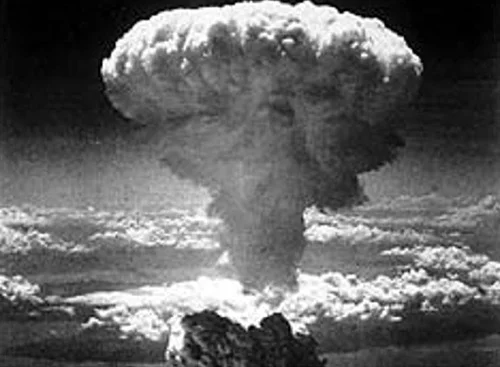
I believe the continued existence of our species is of great value.  Therefore it is worth paying a great price to reduce the chances of a nuclear Armageddon by even a little bit.  There is reason to believe that if Iran gets nuclear weapons, it will significantly raise the chances of further nuclear proliferation–which in turn will raise the chances of nuclear war further down the road.  Thus, to my mind, preventing Iran from getting nuclear weapons trumps any other foreign policy or economic goal right now.  Though we should fervently hope that through diplomacy the price is lower, we should be willing to pay whatever price is required, even if that price includes literal battle deaths as well as the figurative body blow of higher oil prices to an already ailing world economy. 

The surface of what was once called “our sister planet” Venus is not a pleasant place for human beings.  Scientists believe that Venus became so hot because of a runaway greenhouse effect.  We don´t know how likely it is that the Earth will go down this road, but the possibility is terrifying.  All of the other possible harms from increasing the atmospheric concentration of carbon dioxide–such as floods, hurricanes, famines, extinctions of many plant and animal species–pale in insignificance compared to even small increases in the chances of a runaway greenhouse effect that would truly transform Earth into Venus´s sister planet.  To my mind, the scientific and popular discussion about global warming should focus more on what we know about the possibility of a climate change Armageddon in the form of going down the Venus road and how we can know more, thanon the lesser horsemen of floods, hurricanes, famines, extinctions of plants and animals, and so on.

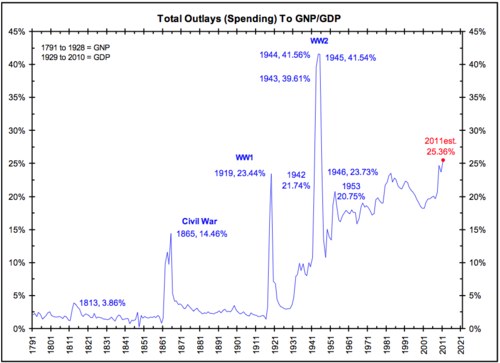
This graph of government spending as a percentage of GDP (from Jim Bianco) isn´t as scary as the other two pictures, but it only includes Federal spending, and absent decisive action, the worst is yet to come.  The reason the worst is yet to come is simple: the U.S. population is getting older as birth rates drop and the Baby Boomers (from an earlier era of high birth rates) reach retirement age.  Other than defending our country and acting as the world´s policeman, the big expenses of the Federal government are the programs intended to take care of older Americans: Social Security, Medicare, and the part of Medicaid that goes to pay for nursing-home costs of people who have used up their own resources.  Everything else the Federal government does pales in comparison to Defense and taking care of older Americans (although Obamacare could add a large enough government responsibility for the medical care of younger Americans to compete in this contest).  Thus, more older Americans means more expenses of the Federal Government.

As I have only begun to explain in my posts “What is a Supply-Side Liberal?”“Can Taxes Raise GDP?” and my current favorite post “Why Taxes are Bad,” the taxes needed to support high levels of government spending come at serious cost.  This is likely to continue to be true even if we try to be very clever (as we should try to be) at raising revenue with the least possible distortion.   (On one way to raise some revenue while actually reducing distortion, see “A Supply-Side Liberal Joins the Pigou Club” and “Henry George and the Carbon Tax.”)  So at the end of the day, after all our efforts to raise revenues in ways that are not too harmful to the many important objectives we put under the label “the economy,” there will be a limit to how large a fraction of GDP should be devoted to government spending.  

For the sake of argument, let´s suppose we decide that–except in temporary emergencies–that Federal, State and Local governments combined should spend no more than half of GDP.  How can we set up constitutional limits to achieve such a goal?  It won´t be easy.  As I wrote in “Leading States in the Fiscal Two-Step”:

… fiscal discipline is hard for governments—so hard that most governments are not capable of fiscal discipline without balanced budget requirements that are so inflexible they cannot easily handle economic emergencies.Given the unpredictability of real-world events, it is not possible to fully define what constitutes an economic emergency in advance as flexibly as would be desirable, but in the absence of hard and fast, but inflexible rules, governments have a temptation to chronically declare economic emergencies.

It´s hard, and maybe impossible.  But let´s try.  A balanced budget amendment won´t do it, since it would still be possible to tax and spend a large fraction of the (possibly smaller) GDP pie.   A limit on taxes won´t do it, since the Federal Government is good at deficit spending.   What we need is a rule that goes directly toward the goal: a direct limit on the fraction of GDP that is allowed to go to government spending. 

There are complications.  In particular, we need to (1) be able to get the rule passed, (2) make it hard to wiggle around the rule once it is in place, (3) be able to deal with emergencies and (4) avoid tempting the government to skimp on investing for the future.

(1) Getting the spending ceiling passed.  The Republicans have been successful at making a big deal of the periodic need to raise the ceiling on the national debt.  Suppose that the next time the debt ceiling needs to be raised, they said “We are willing to make increases in the debt ceiling automatic.  All we want in return is immediate legislation and passage by Congress of a matching constitutional amendment that limits government spending by all levels of government to less than half of GDP."  I think that the Democrats would lose politically by opposing this; if they opposed it, they would be admitting that in the future they planned to take more than half of GDP for government purposes.

(2) Making the spending ceiling stick.  My idea here is simple.  If government spending at all levels (Federal, State and Local) is more than 49% of GDP (according to a modified formula discussed below), the President of the United States has full power to cut Federal spending of any type in any way that he or she chooses down to the level that makes total government spending 49% of GDP.  If government spending at all levels is more than 50% of GDP, the President of the United States is required to cut Federal spending to bring total government spending down to less than 50% of GDP–and of course is allowed to go further down to 49% if he or she chooses. Since the members of Congress value their own power, they would be unlikely to actually pass a spending bill that went above the 49% level, since that gives away a lot of their power to the President.  So the likely outcome is that budget negotiations would proceed much as they do now, but Congress would never propose anything that pushed total government spending above 49% of GDP according to the formula.  The one exception is if they thought they didn´t have the self-discipline to do what needed to be done and wanted the President to take the political burden from them.  One reason to leave the President full flexibility on how to cut is that he or she would only be in that situation if Congress had given up on trying to control spending even though not trying to control spending themselves meant giving away a big chunk of their power to the President. 

3. Designing a formula that allows for emergencies.  Designing a rule that can deal with recessions, wars and other emergencies is complicated, but I think can be done.  The first step is to use five-year averages for a number of quantities that tend to go up and down with the business cycle.  I am going to give a list of things I would use five-year averages for.  These are going to be things that can move around even if Congress hasn´t done anything in terms of regular budget legislation.  The list: GDP, government spending on unemployment insurance and welfare, spending by state and local governments, interest payments on the debt (which are counted as spending), and military spending.  The five-year average for military spending would include only a cobbling-together of the most recent 60 months that were not during a period of declared war.  The five-year average for unemployment insurance and welfare and state and local spending would include only a cobbling-together of the most recent 60 months that were not during a period when the 3-month Treasury bill rate was below a .25% annual rate, which is meant to leave out periods of such great economic emergency that the Fed has already gone to its limit on reducing short-term government interest rates.   The five-year average for GDP would be the greater of (a) the average over the last five years and (b) a cobbling-together of the most recent 60 months when the 3-month T-bill rate was above .25%.   

There are several points to make about this formula.  In a recession (according to a standard story) having unemployment insurance payments and welfare payments go up somewhat helps to stabilize the economy.  These increases in spending are given some leeway by not being counted fully right away.  Also, I am hoping that previously putting in place a Federal Medicaid Contribution Prepayment and Escrowing program–as proposed in my post "Leading States in the Fiscal Two-Step”–would make state government spending go up in recessions.  This too would be given extra leeway by not being counted fully right away.  And unemployment insurance spending, welfare spending, and state and local spending during periods when the Fed had already brought interest rates down to near zero would be fully exempted from the calculation.  Similarly, a military spending spike in a given year would only be partially counted in that year, and not counted at all in the formula if during a period of declared war.  And the spending limit would be in relation to GDP as it was before a serious recession.  Finally, using the five-year average for interest payments on the Federal debt cushions the effect of any change in interest rates on how tight the spending ceiling is. 

Looking at the other side of the ledger–the possibility of having the purpose of the rule subverted–there are several points to make:

  • It is not that easy to wiggle around the rule in the long run using the 5-year average since spending more in one year then tightens the effective limits in each of the following 4 years. 
  • A period of economic emergency is effectively determined by the Fed (by having interest rates very low), not Congress or the President, so that does not present too much temptation.
  • I think formal declarations of war are taken very seriously.  

There is one other feature that may not be obvious but is also important in providing discipline.  I am proposing to have the GDP numbers and the spending numbers be nominal amounts, which means that there is no inflation adjustment that Congress could tinker with.  Doing the five-year moving averages for all of GDP but for only some types of spending means that the spending ceiling would effectively be tighter if inflation is higher.  So this spending ceiling actually provides some discipline against Congress pushing the Fed toward too much inflation.  (I don´t think the Fed acting on its own would try to cause extra inflation just to tighten the spending ceiling.)   

One last issue with the formula is that one might worry that State and Local government spending will trend up so much that the Federal government can´t do its job.  The answer to that is simple: if that becomes a big problem, the Federal Government has the power under its authority to regulate interstate commerce to limit State and Local spending to some reasonable maximum. 

4. Capital Budgeting.  Having roads and bridges in key places is important for economic growth.  I don´t see a big problem with allowing the Federal Government to do the same kind of thing as local governments do with millages.  If a ten-year bond is issued to pay for a road that lasts longer than that, it is OK to count just the annual payments on that ten-year bond as government spending for the purposes of the spending ceiling.  The reason to go to the trouble to set up capital budgeting rules is to avoid giving Congress an incentive to neglect important investments.  But note that the spending ceiling still bites.  In each of ten years the money being paid for the road would mean the Federal Government is required to spend less on other things.  To avoid chicanery, I would make ten years the longest payment period allowed for capital budgeting, even for things that might last longer.  

Something that doesn´t require explicit capital budgeting, but is somewhat similar, is the way that Federal Lines of Credit (as proposed in my post “Getting the Biggest Bang for the Buck in Fiscal Policy”) would interact with the spending.  The key is to make clear in the rule that Federal loans (which Federal Lines of Credit provide to individuals in order to stimulate the economy) are only counted as spending when repayment of those loans is behind schedule.  Any loan that was being paid off on schedule would not be counted as government spending.  And a loan that fell behind in a previous year but got back on schedule this year would be netted out against other loans that fell behind.  

Though I know the word “bailout” has a bad odor these days, if bailing out banks ever again became necessary to stabilize the financial system, bail-out loans could be treated similarly: only counting loans in actual arrears on payments as having been government spending.  The risk that loans might not pay off in the future would not be counted as government spending. Even if the loans are ultimately going to go bad, the key here is to spread out when the government´s losses are counted as government spending, so that the government can do the bailouts if absolutely necessary.  There should be a big debate about bailouts, but I don´t want to tie the governments hands in a true emergency, so the spending ceiling I am proposing does not attempt to stop bailouts. 

Without decisive action, I fear that we will end up with government spending more than half of GDP.  I think it will be much easier to get a spending ceiling like this enacted while it still seems shocking to think of running more than half of our economy in one way or another through the government.  Avoiding fiscal Armageddon will not be easy in any case, but it will be easier if we set up good rules now to limit a possible torrent of spending in the future.

@mileskimball on Twitter

I consider my activity on Twitter to be an integral part of this blog.  I strongly encourage everyone who subscribes with an RSS feed or on Tumblr, or who comes to this website frequently, to follow @mileskimball on Twitter as well.  For those of you who are already Twitter users, just click the “Follow” button at the sidebar.  If you are not yet a Twitter user, you might find it easier to start by clicking the link labeled

On Twitter: @mileskimball

This link makes it easy to follow my tweets from a regular computer without needing to use the full power of Twitter.  Try it and see!  

My only objective with my tweets is to enhance the experience readers have with this blog—and to reinforce and extend the points I am trying to make on this blog. It will be quite unusual for me to do more than a few tweets a day, so I won’t overwhelm you with tweets.  Here are some of the things I will do with my tweets:

  1. Advertise when I have published an important post (including posts that are important despite being brief).
  2. Give insight into which articles I think are especially interesting in my reading of the Wall Street Journal and other newspapers and periodicals.  
  3. Tell in qualitative terms about the blog schedule.
  4. Describe topics I have in mind for upcoming posts.  
  5. Periodically report blog statistics. 
  6. Recommend books, articles, blog posts and tweets by others.
  7. Give more biographical background that will help you understand where I am coming from.
  8. Do the equivalent of a blog post if what I have to say is so short that it can fit into a tweet or two.

Notice of Revocable Permission to Reproduce Content from this Blog—SUPERSEDED BY THE NOTICE THIS TITLE LINKS TO

Update: this legal notice has been superseded by the later legal notice dated 8/3/2012 linked at my sidebar and here.  What you see below is null and void after November 1, 2012. Because I allowed 90 days for people to see the link to the updated legal notice at my sidebar, what you see has some legal effect until then, but its meaning is already greatly limited by the later, superseding legal notice dated 8/3/2012.  On August 3, 2012, I hereby invoke the following clauses:

I reserve the right to revoke this blanket permission at any time

Anyone wishing to continue relying on this permission for additional reproductions or uses is required to check this blog at least once every ninety days and carefully read all legal notices linked to at the sidebar, even if they have previously read one or more of these notices.  

Everything below the row of asterisks remains unaltered from the way this notice has appeared since June 15, 2012, two days after the post was originally published.  


Joe Bruns says this in a comment about my post “Balance Sheet Monetary Policy: A Primer”:

Great article.  May I use this in my economics class?  The concept of creating money from nothing is foreign to freshmen in HS.  This completes the circle explaining why this concept is important.

I would be delighted to have any of my posts used to teach economics classes. 

More generally:

Though I reserve the right to revoke this blanket permission at any time, until further notice on this blog, with two exceptions noted below, I (Miles Spencer Kimball) hereby give anyone the right to freely reproduce and use any of the material on this blog to which I hold copyright as long as he or she properly credits this blog (including noting the web address of this blog) and properly recognizes my copyright on any and all reproductions and uses.  Anyone wishing to continue relying on this permission for additional reproductions or uses is required to check this blog at least once every ninety days and carefully read all legal notices linked to at the sidebar, even if they have previously read one or more of these notices.

EXCEPTION 1: This permission does NOT extend to anything I write or otherwise create that appears on any other website. It only applies to content taken directly from this website. That is, you must be able to see the content you want to reproduce or use at a web address that begins with the characters     http://blog.supplysideliberal.com   in order for the permission above to apply.

EXCEPTION 2: This permission does NOT extend to any post appearing on this website (including any content in the comments to that post to which I hold copyright) if the post has a notice of exception at the top of the post (above other content but below the title). 

Several notes:

  1. For students, I think it would be especially valuable to send them to this blog itself, because they might click on some economics beyond what is assigned and learn even more!
  2. The situation in which I can imagine revoking this blanket permission is if some part of the content of this blog is packaged for sale at some point.  I don´t currently have any plans along those lines, but I want to be legally careful. 
  3. Anyone can freely link to anything in the blog and make “fair use” even apart from this permission.
  4. Exception 1 means that if I take something down from the website, this permission no longer applies, since you have to be able to take it directly from the most recent version of the website.  Also, in the much more common case of a post that has had some revisions, it means that you need to use the most recent, updated version of a post, taken directly from the current version of the website at the time you need to download.     
  5. A link to this notice appears on the sidebar.  If you are using this permission, you should click on that link at least every ninety days to see if the text of this permission has been changed in any material way.  For example, I just added the two exceptions and changed “quarterly” to “ninety days."  These modifications are included under the revocation clause.  The latest version of this notice applies.  The sidebar is currently on the right. 

Diana Kimball: Recording Skype Conversations on a Mac

My daughter Diana spent two years working in Silicon Valley before starting business school and has been very helpful with information technology issues I have faced.  For the cognoscenti, as further warrant of her tech-cred, it is also worth noting that Diana was co-founder of ROFLCon and has been on the program of major tech conferences. 

So by the wonders of reblogging, I am going to conscript her as the occasional IT columnist for this blog when I think one of her posts would be useful to readers. This post seemed useful since coauthors collaborating by Skype (as I do frequently with my coauthors) might find it valuable to record their Skype conversations.

Diana Kimball on the Beginnings of supplysideliberal.com


My dad’s an Economics professor, and Confessions of a Supply-Side Liberal is his new blog—and I’m crazy about it. Not just because I’m crazy about him (I am), and not just because I helped him set it up (I did…on Tumblr, even!), but because I truly believe he’s found his medium. ”I think I’ve always thought in hypertext,” he told me a few days in. Read his first post and check out his Twitter account at @mileskimball, and see what you think. I’m beyond happy he’s doing this.

First shared in the latest letter.

Leading States in the Fiscal Two-Step

[Note on the cartoon:  My technical and blog etiquette expert Diana Kimball tells me it is proper etiquette to acknowledge the origin of photos by linking to the source.  I won’t go back and do that on all of my earlier posts, but I wanted to give you the link to this one because I found it early on, and then was frustrated that I couldn’t find it when it came time to post “Leading States in the Fiscal Two-Step."  I love this cartoon.  It is much better than the cartoon I previously had of Uncle Sam dancing with Lady Liberty.  Here is the link.  From the site, it looks as if you can ask people online to draw pictures for you pro bono–something useful for every blogger to know.  Has anyone had any experience with this?]

In his article "The Federal Reserve Turns Left,” Bill Greider tells how the Fed is currently one of the institutions arguing most strongly that the Federal Government should spend more now.  Since the Fed has not departed from its long-term recommendation that the Federal Government spend less in the future, this amounts to recommending that the U.S. Federal Government execute what I will call a “fiscal two-step”: spending more now, while promising to spend less later.

I have serious misgivings about this recommendation.First and foremost, I think it is politically very hard for a sovereign nation to do this:temporarily higher spending is likely to get built into the baseline.Second, even if such a fiscal two-step as usually envisioned is executed as intended, it will lead to a path for the national debt that is considerably higher over a substantial length of time (with all the risks that entails) than an alternative policy I have put forward on this blog of Federal Lines of Credit (FLOC’s) now combined with National Rainy Day Accounts (NRDA’s) down the road.

The combination of FLOC’s and NRDA’s effectively encourages people to do the individual version of the fiscal two-step.By providing lines of credit, people are encouraged to spend now if spending now is attractive to them.Later as part of the FLOC program they are required to repay this debt, and later still, they are required to save a modest amount each month by payroll deduction (or for the self-employed, in their quarterly estimated taxes) to go into their National Rainy Day Accounts–money that they are only allowed touse in the wake of a recession or other declared economic emergency or in case of a bona fide, documentable personal financial emergency of high order.With the combination of FLOC’s now and NRDA’s later, the FLOC’s now would provide stimulus now; while later on, in recessions down the road, stimulus would be provided by releasing some of the accumulated funds in the National Rainy Day Accounts.(If this combination of policies is followed, and it is a long time before the next recession, FLOC’s might only be needed once, since releasing funds from National Rainy Day Accounts could provide the needed stimulus in the future.But an additional round of FLOC’s would always be available as a backup policy.)

To give an idea of the possible magnitudes in National Rainy Day Accounts, suppose each adult were required to set aside $20 per month in NRDA’s.Then if it was five years between the institution of NRDA’s and the next recession, compound interest would mean that each adult would then have a warchest of more than $1200 in their NRDA , minus the amount that went to take care ofdocumentable personal financial emergencies.That amount would be available for release to fight that future recession.

Why am I repeating all of this, when I said it already?I am recapping all of this as background for a corresponding policy proposal for the states, which has a non-obvious name: Federal Medicaid Contribution Prepayment and Escrowing. The idea is to have the Federal Governmentgive the states more money now, while in effect requiring them to repay it later, then to build up a balance that would legally belong to the states, but remain in escrow until a recession, when some or all of the funds would be released.(Also, in situations where under current policies, a state might be bailed out–or otherwise rescued–with Federal money, the money in a state’s Medicaid Escrow Account could be released, so that at least the state was being bailed out or rescued with its own money.)

Interest would be assessed on the prepaid amount and earned by a state on the escrowed amount at the 3-month Treasury bill rate.Up to some target maximum for the Medicaid Escrow Accounts (specified in the original legislation), the interest would be paid as an addition to escrowed funds, but if a state’s account reached its target maximum, the interest would be paid to that state as unencumbered funds that the state could spend at will.The reason for insisting that the Federal Government pay the states interest in an unencumbered way once some predefined target maximumis reached is to reaffirm the states’ property rights in their Medicaid Escrow Accounts.Without ongoing reaffirmation of the states’ property rights in these Medicaid Escrow Accounts, the Federal Government would be very strongly tempted to confiscate the money at some future time in order to deal with its own fiscal problems.The Federal Government could always unilaterally cut its transfers to the states, but it is important that it be discouraged from penalizing a state for being especially thrifty with its Medicaid Escrow Account or for being slow to beg for a bailout or rescue.

Let me say with the utmost clarity that there is no real connection between this program and the purposes of Medicaid itself.I am imagining the rules of the Medicaid program itself to be totally unchanged.The only thing that would change is the timing of when the Federal Government pays its share, as defined under current law.

The main reason I am envisioning this program happening as a modification to the existing flows of Medicaid money from the Federal government to the state governments is simply for the sake of political plausibility.I think it is much more likely, politically, that the Federal Government would change the timing of its Medicaid contributions than that the Federal Government would explicitly set up the equivalent of FLOC’s and NRDA’s for the states.

The second reason for working through a modification of the existing system of Federal Medicaid Contributions is that this approach makes it easier to work around the balanced budget requirements in state constitutions.I do believe that macroeconomic stabilization is an appropriate use of the Federal Government’s power to regulate interstate commerce, and the Supremacy clause in the Constitution of the United States should allow the Federal government to override balanced budget requirements in state constitutions in any case.But with a policy of Federal Medicaid Contribution Prepayment and Escrowing, this can be handled simply by saying in the legislation

“This change in the timing of Federal contributions for Medicaid shall not be construed as borrowing or as saving when any State or Federal court interprets balanced budget requirements that states impose upon themselves.”

Thus, the policy would actually have the effect of tightening existing state balanced budget requirements in non-recessionary times, while loosening those requirements during recessions.

Along these lines, let me emphasize one more time the importance of the Federal Medicaid Contribution Escrowing down the line, as well as the Federal Medicaid Contribution Prepayment now.It is important for states to have the funds in those Medicaid Escrow Accounts to fight future recessions.And it is just as important to keep the states from overspending in good years as it is to encourage them to spend in bad years.

Why do I think the fiscal two-step will work for states, when I don’t think it will work for the Federal Government? Because fiscal discipline is hard for governments—so hard that most governments are not capable of fiscal discipline without balanced budget requirements that are so inflexible they cannot easily handle economic emergencies.Given the unpredictability of real-world events, it is not possible to fully define what constitutes an economic emergency in advance as flexibly as would be desirable, but in the absence of hard and fast, but inflexible rules, governments have a temptation to chronically declare economic emergencies.

The solution I am proposing here is to let a higher government(facing different political incentives) enforce the fiscal discipline in a way flexible enough to deal with recessions or other genuine economic emergencies. I think a government can lead in a fiscal two-step, and I think a government can follow in a fiscal two-step.  (Though they may do so clumsily, stepping on each other’s toes.)  But it takes two to tango, and two to dance the fiscal two-step.Almost no government can lead itself in such an intricate dance.