Elizabeth Bernstein on Getting Better Sleep

On Insomnia

Insomnia often has psychological roots that can be addressed with a psychological approach. In her Mrch 23, 2021 Wall Street Journal article “Can’t Sleep? Here Are Some Surprising Strategies That Actually Work,” Elizabeth Bernstein gives helpful advice of both the psychological and the more straight physiological variety. All the quotations below are from that article.

Psychologically drive sleep problems often have a strong multiplier—a vicious loop. Elizabeth writes:

When we tell ourselves we “can’t sleep” or “won’t be able to function” the next day, we’re causing ourselves a lot of anxiety, which further interferes with our sleep.

As Elizabeth notes, the opposite attitude is saying to yourself something like: “A bad night of sleep is not the end of the world.”

Elizabeth also quotes Wendy Troxel talking about both the vicious loop and some of how the vicious loop might get started. Separating the quotations with added bullets, they are:

  • People who sleep well don’t think about sleep all the time …

  • Our brains have to feel like the world is safe and secure to be able to fall asleep … Sleep is a vulnerable state.

Whether part of getting the vicious loop started or part of keeping it going, brain scans show the brains of insomniacs as being more agitated even while actually asleep:

Daniel J. Buysse … conducted PET scans of people who sleep normally and people with insomnia. In people with insomnia, parts of the brain involved with self-reflection and monitoring the environment show higher levels of activity during sleep compared with normal sleepers.

Given how worrying too much about sleep can cause sleep problems, it is useful to know the diagnostic criteria for clinical insomnia. They are much worse than occasional insomnia:

insomnia … difficulty falling or staying in sleep three or more times a week, and … lasts a month or longer, leading to daytime consequences, such as fatigue, mood changes or difficulty concentrating.

And it should be reassuring that if you ever do get serious insomnia, there are fairly effective psychological treatments:

… the American Academy of Sleep Medicine … recommended a series of treatments collectively known as cognitive behavioral therapy for insomnia, or CBT-I.

CBT-I focuses on breaking this loop by helping us change the thoughts and behaviors that are counterproductive. Research shows it may have lasting effects—not just fixing our sleep problems in the present but helping us form a sort of sleep resilience. A study conducted by Dr. Cheng and colleagues and published online in November in the journal Sleep found that people who received CBT-I years ago have been sleeping better and have better mental health during the pandemic than those who did not.

Several psychological approaches are easy enough to try even before you are willing to consult a sleep therapist. Philip Cheng suggests this:

Sometimes we worry because our brain is telling us to not forget something,” says Philip Cheng … If you write your worries down during the day, “when worry comes at night you can tell yourself you’ve already documented it.”

Elizabeth points to cultivating gratitude as something that can help:

… think about the things you are grateful for, or savor your favorite moments from the day. This will train your brain to associate the bed with pleasant thoughts.

And Elizabeth tells the story of an app she has (which she does not name), that uses reverse psychology. The voice on the app intones:

Resist! Resist! Resist the temptation to close your eyes, even as they feel heavier and heavier! Remember your goal here is to remain awake.

My Practice

I don’t have serious sleep problems, but I do try to have good practices in relation to sleep that might be helping me to avoid problems. Here are some things I think can be helpful, but take them all with a grain of salt:

  • Most drugs marketed as sleep aids are quite nasty and to be avoided. The exception is melatonin, which is fairly safe—at least by comparison. The next safest might be benadryl, which is in many cold remedies.

  • It is a myth that everyone needs 8 hours of sleep. By experimentation, I have figured out that I need between 7 and 7 and a quarter hours. How can you determine how much you need? If you feel alert and good except for the witching hours when it is totally normal to feel sleepy: (a) right when you wake up, (b) right before it is bedtime and (c) in the mid afternoon. If those are the only times you get sleepy, you are probably getting enough sleep. If you try to sleep for more hours each day than you need, after a while you are likely to have a wakeful period in the middle of the night.

  • The previous bullet was about a sign you are getting enough sleep—even if you sleep less than 8 hours. On the other side, a way to tell that you are sleep-deprived, getting too little sleep, is if you fall asleep instantly when you lie down or are quite relaxed.

  • Keeping the lights as low as possible for several hours before bedtime can be helpful. I find the common advice of avoiding screens much too painful to follow. But I keep the room lights off for at least 4 hours before bed and only have light from screens. Blue light interferes with sleep most. Many devices now have modes that dim the screens and reduce the blue-light content of the remaining brightness. Adjustable nightlights allow me to brush my teeth without the help of the room light.

  • In addition to light interfering with getting to sleep, it can wake you up too early. It isn’t easy to make light-blocking curtains work in my bedroom, so I wear an eye mask except in winter, when it stays dark late enough in the morning that I don’t need to. (Some people are sensitive enough to light they’ll need lot-blocking curtains or an eye mask year round.)

  • I have come around to the view that getting up at close to the same time every day is helpful for sound sleep. The experts say it is even more important to standardize your wake-up time than it is to standardize the time when you go to bed.

  • Something I don’t have to think much about because I have a short eating window each day is that it will help you to sleep soundly to stop eating many hours before you go to bed. The reason is simple: heavy-duty digestion can disrupt sleep.

  • Finally, to help calm my mind I use a meditation app at night (in my case “10% Happier”) and throughout the day use the Positive Intelligence tools I talk about in these posts:


For annotated links to other posts on diet and health, see:

Don’t Miss These Other Posts Related to Positive Mental Health and Maintaining One’s Moral Compass:

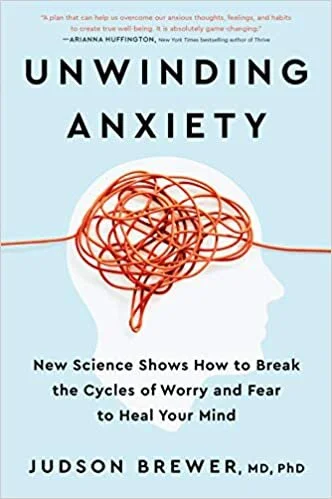
Judson Brewer, Elizabeth Bernstein and Mitchell Kaplan on Finding Inner Calm

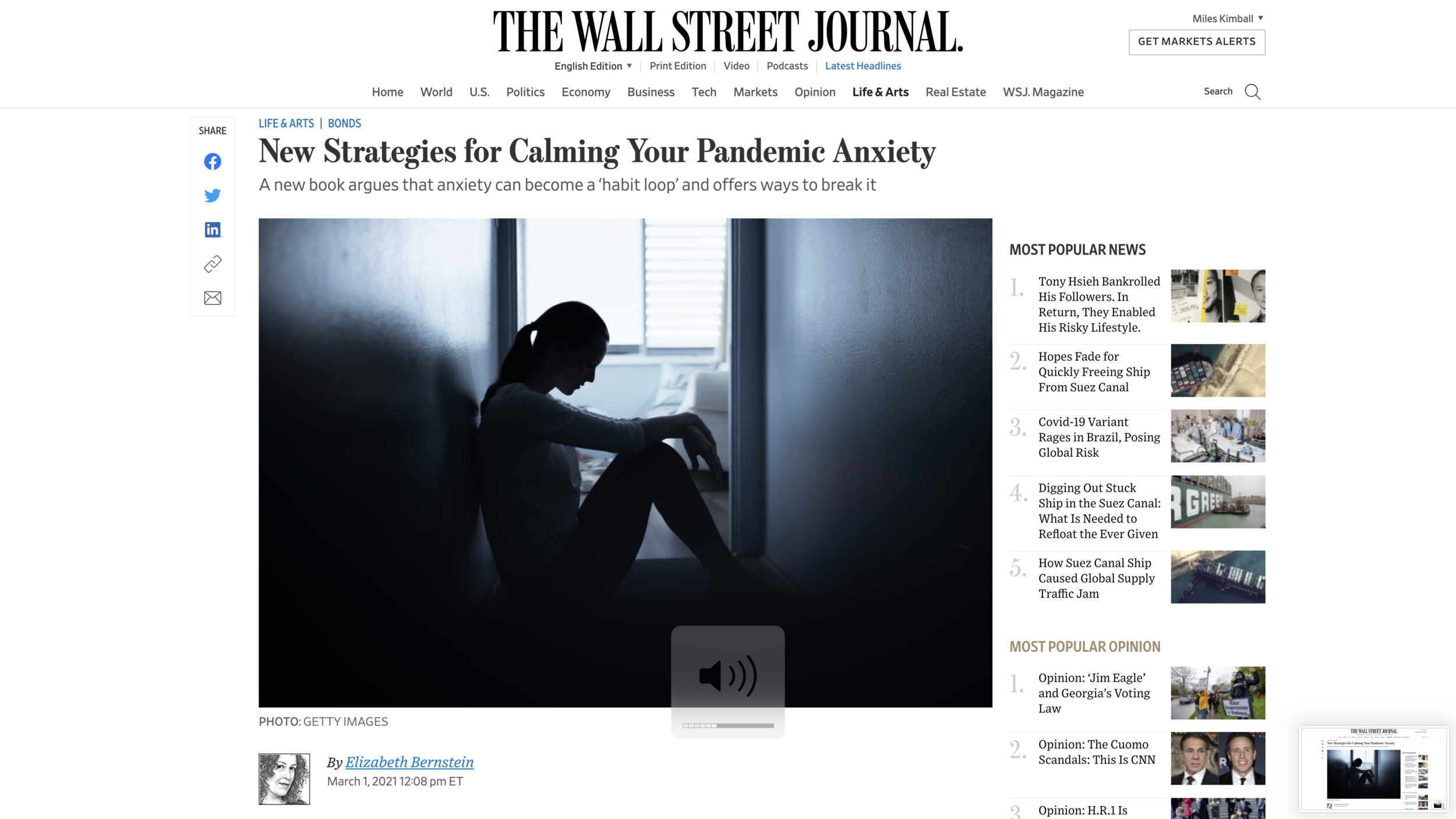
Elizabeth Bernstein has a column on positive mental health in the Wall Street Journal named “Bonds.” The two columns shown above given hints about how to get more inner calm.

“New Strategies for Calming Your Pandemic Anxiety” is an interview with Judson Brewer, author of Unwinding Anxiety. Elizabeth asked Judson “So how can we learn to stop fueling our anxiety?” Judson said this:

There’s a three-step process. The first step is to recognize anxiety habit loops. Recognize that you’re worrying. Ask yourself: “Is this helping me solve the problem?”

Step two is to … see how unrewarding worrying is. Ask yourself: “What am I getting from this? When I worry, does it keep my family safe? Or is this making me feel worse and not better?”

Step three is … to give your brain something more rewarding to do than worrying. … You can be curious about your experience. And you can be kind. Anxiety and worry feel closed and contracted. Curiosity and kindness open you up.

Judson also made these useful and non-obvious points (bullets added to separate passages):

  • Curiosity feels better than anxiety. It helps us focus on the moment rather than worrying about the future. And it helps us gather accurate information, which is what our brain needs to be able to think and plan.

  • One of my patients has a mantra she uses when she starts to feel anxious, to remind her that she is not in danger: “Oh, this is just my brain.”

  • When we are stressed or anxious, our shoulders tense, our jaws clench and our eyes narrow. You can bring awareness to this: “Oh, my eyes are narrowed.” Then open your eyes really wide. This helps trigger curiosity, because of the association in our mind between eyes wide open and curiosity. Wide-eyed wonder is the epitome of curiosity. It’s not called narrow-eyed wonder.

  • Anxiety triggers procrastination, especially for perfectionists, because we worry our solution to the problem won’t be good enough. Procrastination feels better than being anxious or trying to come up with a solution.

  • Habit loops have three elements: a trigger, a behavior and a reward. Anxiety … becomes a habit when the feeling of anxiety triggers us to worry and that worry results in us feeling like we are in control …

In “The Therapeutic Value of Reading,” Elizabeth says this:

Books are good for the brain. And their benefits are particularly vital now. Books expand our world, providing an escape and offering novelty, surprise and excitement, which boost dopamine. They broaden our perspective and help us empathize with others. And they can improve our social life, giving us something to connect over.

Books can also distract us and help reduce our mental chatter.

She also quotes bookstore owner Mitchell Kaplan saying this:

There’s so much noise in the world right now and the very act of reading is a kind of meditation. You disconnect from the chaos around you. You reconnect with yourself when you are reading. And there’s no more noise.

These are all excellent insights. Beyond these insights, what has been working for me to find inner calm is mindfulness meditations apps such as 10% Happier and the Positive Intelligence tools I talk about in these posts:

Both mindfulness and the other tools of Positive Intelligence is that your inner critic and other chatter fueled by the survival part of your brain are constantly saying things that aren’t very helpful. It is possible to recognize this chatter for what it is and get it to quiet down by exercises such as getting into your body more by focusing on bodily sensations. Methods for awakening power such as empathy, curiosity, and a can-do attitude can also help.

Here is what I think is going on from an evolutionary perspective. The abilities to talk garrulously to both ourselves and other humans and to think at length about the past and the future are very recent in our evolutionary history. We know that because our abilities in those regards go far beyond all the extant species we know of on earth. Even aside from the issue that what is good for our genes may not alway be what makes us happy, genetic evolution hasn’t had time to work out all the kinks in what talking to ourselves and thinking about the past and future does to our psychology.

Fortunately, the ability to talk to one another—and the later invention of writing—kicked off the much speedier process of memetic evolution as useful or otherwise catchy ideas spread and evolve in a soup of minds. (On memetics, see my posts “How Did Evolution Give Us Religion?” and “Jonah Berger: Going Viral.”) A few thousand years is the blink of an eye relative to genetic evolution, but it is a long time in the arena of memetic evolution once we had writing and a large human population size. We are finally homing in on best practice for being happy. But within your lifetime, you will still have to be an early adopter in order to get the benefits for your own happiness.


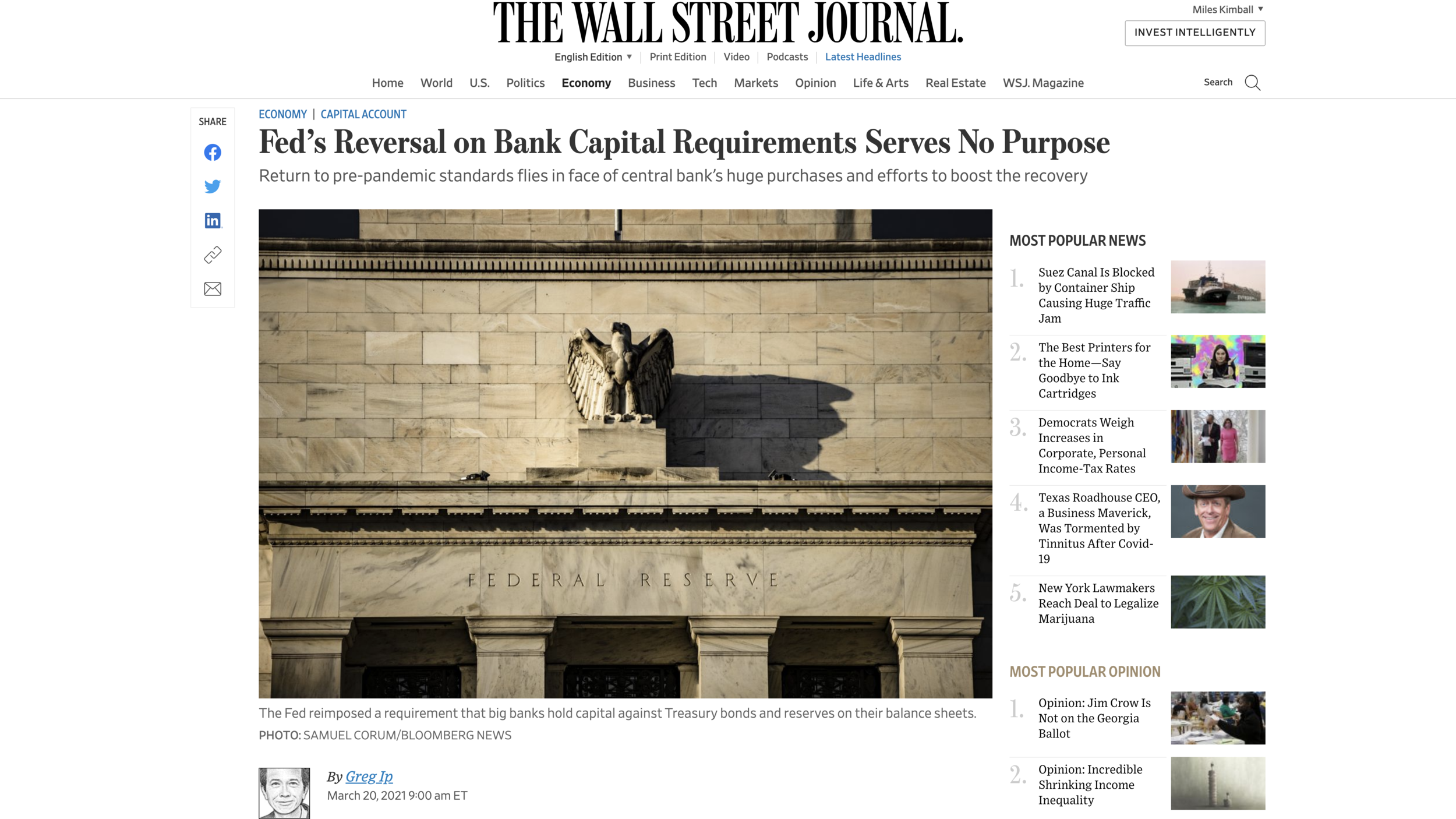
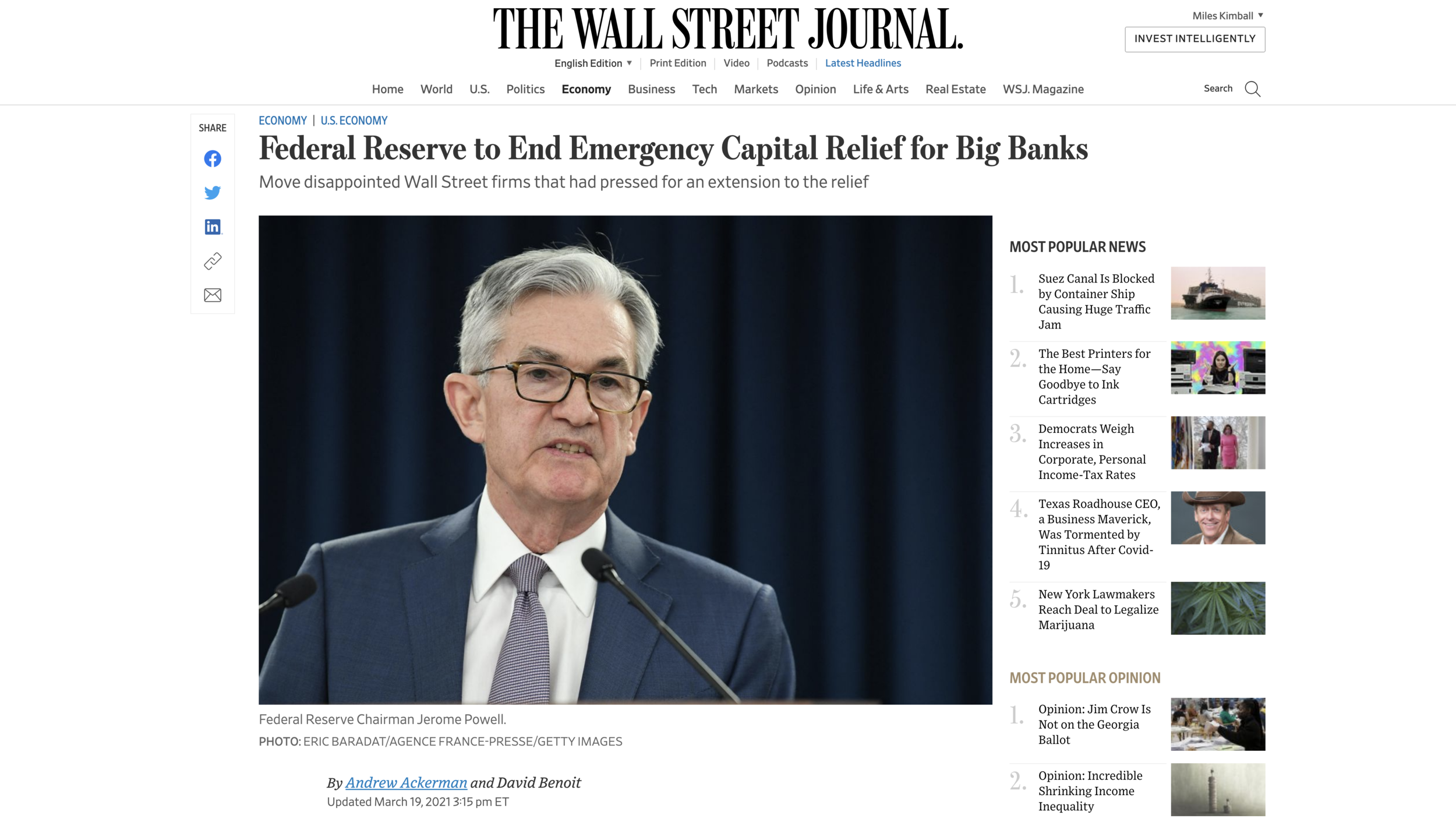
Higher Capital Requirement May Be Privately Costly to Banks, But Their Financial Stability Benefits Come at a Near Zero Cost to Society

In general, I am a fan of Greg Ip. So I was disappointed to see him falling into accepting the bank lobbyists’ line that higher capital requirements are bad for the economy. In fact, higher capital requirements cut into bank profits but improve financial stability at no cost to society as a whole. The cost to bank profits is made up for by less chance of taxpayers being left holding the bag on large losses.

Banks see debt as a less expensive way to raise funds than equity, but the costs of raising funds by equity better reflects the true risks the banks are engaging in and so gives the right incentives. Raising funds by “equity” means not only issuing stock but also retaining earnings that a bank can then lend out. The advantage of pushing banks toward raising funds by raising equity is that when things go badly, equity starting from a high value can drop quite a bit without causing any trouble for the smooth operation of the bank. The value of stock goes down, but the bank doesn’t go bankrupt. Just as importantly, others dealing with the bank— “counterparties”—don’t worry that they will be stiffed if the bank goes bankrupt. Without a bankruptcy, stock prices going down cause zero problems for counterparties.

Bank debt can be too cheap for banks for three reasons. First, there is an unjustified tax advantage to debt because interest payments are more tax deductible than dividend payments are. Second, when banks go bankrupt there is always the chance that the government will bail them out. From the bank’s perspective, having a shot at bailout money depends on having enough debt to go bankrupt when things go bad instead of just having stock prices go down. The government almost never bails banks out simply because their stock price has gone down without bankruptcy. Third, some households and institutions may pay a premium for the illusion of safety even if the supposed safety isn’t real. (Institutions don’t necessarily have to be fooled to want the illusion of safety; regulations sometimes ask them to obtain the illusion of safety.)

On the third point of the demand for the illusion of safety, there is a very interesting paper by Robin Greenwood, Samuel Hanson and Jeremy Stein that was presented at Jackson Hole, “The Federal Reserve's Balance Sheet as a Financial-Stability Tool,” that basically argues that the Fed or the Treasury needs to offer plenty of very safe short-term assets so that the strong demand for such assets doesn’t cause the private market to create the illusion of very safe short-term assets. In addition to the importance of this for financial stability benefits, this also indicates that the social cost of discouraging banks from issuing these illusions is low because any advantage banks could get from issuing such assets at low interest rates points to the benefits to the government budget from the government issuing the genuinely safe short-term assets at low interest rates.

In Greg Ip’s Wall Street Journal article shown above, “Fed’s Reversal on Bank Capital Requirements Serves No Purpose,” there is a red herring. Greg talks as if bank equity is a cushion against losses asset by asset and therefore serves no purpose when a formula makes a bank get more total funds from equity when it has more assets even if the extra assets are all government promises that are quite safe. But bank equity is a cushion for all of a bank’s assets put together and few banks have 100% safe assets. If a formula makes a bank get more funds from equity to back more assets even if those assets are safe, then that equity is available to cushion losses from the risky assets the bank has along with the safe assets. It is perfectly reasonable to say that the formula should have required more equity for each unit of risky assets because that would be better targeted. But when bank lobbyists have made capital (=equity) requirements mandated directly for risky assets too low, the extra capital (=equity) forced by the formula based on total assets (including safe assets) may get capital (=equity) a little closer to where it should have been for the typical bank.

But the more powerful argument is that there is no harm done from requiring banks to have a lot of capital. Any hit to their profits is made up for by the taxpayers doing better, and the incentives of the banks become better aligned with the true risks to society. If there is any tendency toward too little aggregate demand in the economy, the right answer is monetary stimulus. (See “Why Financial Stability Concerns Are Not a Reason to Shy Away from a Robust Negative Interest Rate Policy.”) If there is any tendency toward too little risky investment even when unemployment is low, the right answer is sovereign wealth fund investing in exchange-traded funds financed by issuing Treasury bills to narrow the risk premium. (See “Alexander Trentin Interviews Miles Kimball about Macroeconomic Stabilization: Negative Rates and Sovereign Wealth Funds” along with the links it features.)

One other red herring is banks’ claims that capital requirements like the ones the Fed is restoring prevent them from lending out money. But capital requirements only say where the money comes from, not where it goes. Once a bank has gotten money from issuing stock, it can lend it out as much as it wants. Risk-weighted capital requirements do more to discourage lending (which is risky) than capital requirements based simply on total assets. Also, if banks were that worried about having funds to lend out, they shouldn’t be so eager to pay dividends to shareholders when retained earnings that keep their capital (=equity) levels strong give them more total funds to lend out. In any case, banks having too little money to loan out sounds like an aggregate demand problem. Aggregate demand is not scarce for a central bank willing to use negative interest rates as central banks should. (See “How and Why to Eliminate the Zero Lower Bound: A Reader’s Guide.”)

Related Posts:

Amanda Fronk on the Gut Microbiome

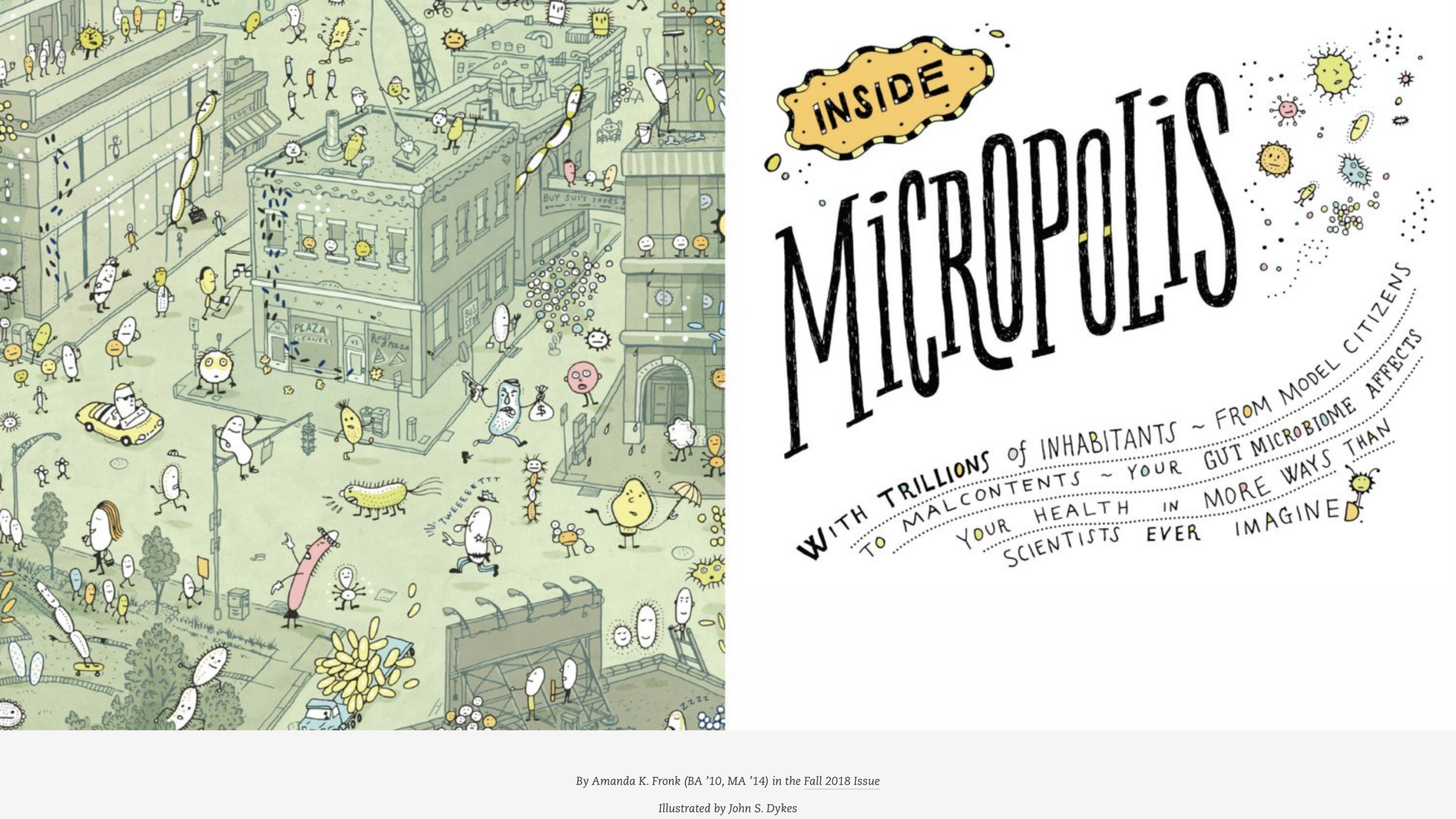
The gut microbiome is a complex subject. Amanda Fronk’s article “Inside Micropolis” in the Fall 2018 issue of BYU Magazine is a nice distillation of some of the basics. All quotations in this post are from that article, with bullets to separate different passages.

First, just to persuade you of the importance of gut bacteria, consider the effects of transplanting gut bacteria from one creature to another by transplanting poop:

  • Consider this: Five years ago, Chinese researcher Liping Zhao and his team at Shanghai Jiao Tong University caused some mice in their lab to transform from healthy to obese in a matter of weeks, putting on four times the grams as their cage mates on a similar diet. How did they do it? By transplanting bacteria from the gut of a 385-pound, morbidly obese human.

  • … Clostridium difficile is a pathogenic bacteria that causes severe diarrhea and can lead to death. It often occurs after intense courses of antibiotics, which leaves the intestines susceptible to infection. “It’s hard to get rid of. There aren’t good [traditional] treatments,” says Chaston. He calls its cure—a fecal microbiota transplant—“the hallmark of microbiome treatment.” The transplant involves giving “an unhealthy person a healthy person’s poop,” Chaston explains. “We don’t know what’s in it. We just know that they get better.” Some 90 percent of transplant recipients recover, often within mere hours of the transplant.

Here are some theories about how gut bacteria could affect health:

  • Researchers aren’t sure exactly how Enterobacter cloacae B29 or any other bacterium causes obesity, but there are theories. One is that certain bacteria are masterful at squeezing calories from food.

  • Another idea is connected to the endotoxins that some bacteria release into the bloodstream. At high levels, these endotoxins can cause septicemia and often death, but at very low levels, it could lead to chronic inflammation throughout the body. What does that have to do with obesity? “Inflammation affects insulin signaling,” says Bridgewater. “And if insulin response isn’t working right, then people can be storing fuel that they should be burning.”

  • Bacteria also appear to play a part in mental illnesses like anxiety and depression. How can your intestines have anything to do with mental illness? First off, “90 percent of the serotonin in our body is actually made in the gut,” says Bridgewater. Serotonin is one of the key neurotransmitters our body uses to keep us emotionally balanced. And second, the vagus nerve, one of the biggest in the body, runs from the brain to the gut’s 100 million neurons.

The article has some reasonable advice for improving the health of gut microbiomes: let kids eat dirt (literally), eat greens consistently, reduce stress, and be careful in using antibiotics that could kill good gut bacteria. It also has a table listing characteristics of some important types of gut bacteria that I won’t try to retail.

Besides trying to identify antibiotics that kill bad gut bacteria but leave good gut bacteria unharmed, there are bacteria-killing viruses called “phages” that might be able to target bad gut bacteria while sparing good gut bacteria.

Overall, although there is plenty of evidence that the gut microbiome matters a lot, we are only beginning to understand what the gut microbiome does and all the interventions that might improve it. One thing that will make progress slower is that there are a huge number of different types of bacteria that can live in the human gut and the portfolio of different bacteria in given individuals vary enormously. Stay tuned for many more scientific results about the human gut microbiome in the coming years.


For annotated links to other posts on diet and health, see:

The Federalist Papers #27: People Will Get Used to the Federal Government—Alexander Hamilton

In the Federalist Papers #27, Alexander Hamilton argues that the federal government is likely to be acceptable enough to the people that it will seldom need to resort to full-out military force to establish its authority. In hindsight, the US Civil War and the Utah War (see “The Federalist Papers #17: Three Levels of Federal Power”) demonstrated that the federal government did, sometimes, take up war against a part of the United States. Nevertheless, there is a lot of merit to Alexander Hamilton’s arguments. Here is the Federalist Papers #27 in outline form:

  1. Why should the attitude toward the federal government be much different than to a state government? Won’t it depend on the quality of government?

  2. The federal government is likely to be of higher quality than state government because it can draw on a larger talent pool. Also, it is easier for a truly corrupt faction to take control of a smaller unit of government than a larger unit of government.

  3. The federal government is an important guarantor that state governments will follow their own constitutions.

  4. If the federal government interacts directly with all the people, rather than just with the state governments, the people will get used to it through those interactions.

  5. The federal government will be so powerful it will seldom need to actually use force against a part of the United States; the threat of force alone will typically be enough.

  6. People will see state government and federal government as being on par. And the power of state government and federal government will often be employed jointly, further impressing upon people the legitimacy of federal power.

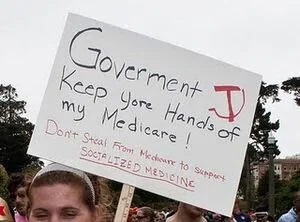
I find the 4th point especially interesting. In 2021, people have one image of the federal government from news reports of decision-making in Washington, and another image from the parts of the federal government they directly interact or watch fictional enactments of: the FBI, the post office, the national parks, the Social Security Administration, the local Federal court, etc. I sense a lot of respect for the majority of those parts of the federal government people directly interact with. (The Internal Revenue Service—IRS—and Immigration and Customs Enforcement—ICE—are exceptions.) One of the more entertaining evidences of the gap between the perception of Washington DC decision-making and the perception of another arm of the federal government has been the signs saying “Government, keep your hands of my Medicare!”

All of this, in practice, increases deference to Federal government authority. We do not, in fact, see the federal government as one monolith (even if we think we do). We get used to the authority of different pieces of the federal government separately.

Despite the times when the federal government has had to take up arms against a part of the US, I think Alexander Hamilton could rightly feel vindicated in the how solid the perception of—and deference to—federal authority is in the United States.

To see how Alexander Hamilton lays out his argument in detail, below is the full text of the Federalist Papers #27, with my outline interspersed as headings in bold italics (and one footnote included where it appears in the text within square brackets).


FEDERALIST NO. 27

The Same Subject Continued: The Idea of Restraining the Legislative Authority in Regard to the Common Defense Considered

From the New York Packet
Tuesday, December 25, 1787.

Author: Alexander Hamilton

To the People of the State of New York:

1. Why should the attitude toward the federal government be much different than to a state government? Won’t it depend on the quality of government?

IT HAS been urged, in different shapes, that a Constitution of the kind proposed by the convention cannot operate without the aid of a military force to execute its laws. This, however, like most other things that have been alleged on that side, rests on mere general assertion, unsupported by any precise or intelligible designation of the reasons upon which it is founded. As far as I have been able to divine the latent meaning of the objectors, it seems to originate in a presupposition that the people will be disinclined to the exercise of federal authority in any matter of an internal nature. Waiving any exception that might be taken to the inaccuracy or inexplicitness of the distinction between internal and external, let us inquire what ground there is to presuppose that disinclination in the people. Unless we presume at the same time that the powers of the general government will be worse administered than those of the State government, there seems to be no room for the presumption of ill-will, disaffection, or opposition in the people. I believe it may be laid down as a general rule that their confidence in and obedience to a government will commonly be proportioned to the goodness or badness of its administration. It must be admitted that there are exceptions to this rule; but these exceptions depend so entirely on accidental causes, that they cannot be considered as having any relation to the intrinsic merits or demerits of a constitution. These can only be judged of by general principles and maxims.

2. The federal government is likely to be of higher quality than state government because it can draw on a larger talent pool. Also, it is easier for a truly corrupt faction to take control of a smaller unit of government than a larger unit of government.

Various reasons have been suggested, in the course of these papers, to induce a probability that the general government will be better administered than the particular governments; the principal of which reasons are that the extension of the spheres of election will present a greater option, or latitude of choice, to the people; that through the medium of the State legislatures which are select bodies of men, and which are to appoint the members of the national Senate there is reason to expect that this branch will generally be composed with peculiar care and judgment; that these circumstances promise greater knowledge and more extensive information in the national councils, and that they will be less apt to be tainted by the spirit of faction, and more out of the reach of those occasional ill-humors, or temporary prejudices and propensities, which, in smaller societies, frequently contaminate the public councils, beget injustice and oppression of a part of the community, and engender schemes which, though they gratify a momentary inclination or desire, terminate in general distress, dissatisfaction, and disgust. Several additional reasons of considerable force, to fortify that probability, will occur when we come to survey, with a more critical eye, the interior structure of the edifice which we are invited to erect. It will be sufficient here to remark, that until satisfactory reasons can be assigned to justify an opinion, that the federal government is likely to be administered in such a manner as to render it odious or contemptible to the people, there can be no reasonable foundation for the supposition that the laws of the Union will meet with any greater obstruction from them, or will stand in need of any other methods to enforce their execution, than the laws of the particular members.

3. The federal government is an important guarantor that state governments will follow their own constitutions.

The hope of impunity is a strong incitement to sedition; the dread of punishment, a proportionably strong discouragement to it. Will not the government of the Union, which, if possessed of a due degree of power, can call to its aid the collective resources of the whole Confederacy, be more likely to repress the FORMER sentiment and to inspire the LATTER, than that of a single State, which can only command the resources within itself? A turbulent faction in a State may easily suppose itself able to contend with the friends to the government in that State; but it can hardly be so infatuated as to imagine itself a match for the combined efforts of the Union. If this reflection be just, there is less danger of resistance from irregular combinations of individuals to the authority of the Confederacy than to that of a single member.

4. If the federal government interacts directly with all the people, rather than just with the state governments, the people will get used to it through those interactions.

I will, in this place, hazard an observation, which will not be the less just because to some it may appear new; which is, that the more the operations of the national authority are intermingled in the ordinary exercise of government, the more the citizens are accustomed to meet with it in the common occurrences of their political life, the more it is familiarized to their sight and to their feelings, the further it enters into those objects which touch the most sensible chords and put in motion the most active springs of the human heart, the greater will be the probability that it will conciliate the respect and attachment of the community. Man is very much a creature of habit. A thing that rarely strikes his senses will generally have but little influence upon his mind. A government continually at a distance and out of sight can hardly be expected to interest the sensations of the people. The inference is, that the authority of the Union, and the affections of the citizens towards it, will be strengthened, rather than weakened, by its extension to what are called matters of internal concern; and will have less occasion to recur to force, in proportion to the familiarity and comprehensiveness of its agency. The more it circulates through those channls and currents in which the passions of mankind naturally flow, the less will it require the aid of the violent and perilous expedients of compulsion.

5. The federal government will be so powerful it will seldom need to actually use force against a part of the United States; the threat of force alone will typically be enough.

One thing, at all events, must be evident, that a government like the one proposed would bid much fairer to avoid the necessity of using force, than that species of league contend for by most of its opponents; the authority of which should only operate upon the States in their political or collective capacities. It has been shown that in such a Confederacy there can be no sanction for the laws but force; that frequent delinquencies in the members are the natural offspring of the very frame of the government; and that as often as these happen, they can only be redressed, if at all, by war and violence.

6. People will see state government and federal government as being on par. And the power of state government and federal government will often be employed jointly, further impressing upon people the legitimacy of federal power.

The plan reported by the convention, by extending the authority of the federal head to the individual citizens of the several States, will enable the government to employ the ordinary magistracy of each, in the execution of its laws. It is easy to perceive that this will tend to destroy, in the common apprehension, all distinction between the sources from which they might proceed; and will give the federal government the same advantage for securing a due obedience to its authority which is enjoyed by the government of each State, in addition to the influence on public opinion which will result from the important consideration of its having power to call to its assistance and support the resources of the whole Union. It merits particular attention in this place, that the laws of the Confederacy, as to the ENUMERATED and LEGITIMATE objects of its jurisdiction, will become the SUPREME LAW of the land; to the observance of which all officers, legislative, executive, and judicial, in each State, will be bound by the sanctity of an oath. Thus the legislatures, courts, and magistrates, of the respective members, will be incorporated into the operations of the national government AS FAR AS ITS JUST AND CONSTITUTIONAL AUTHORITY EXTENDS; and will be rendered auxiliary to the enforcement of its laws.[The sophistry which has been employed to show that this will tend to the destruction of the State governments, will, in its will, in its proper place, be fully detected.] Any man who will pursue, by his own reflections, the consequences of this situation, will perceive that there is good ground to calculate upon a regular and peaceable execution of the laws of the Union, if its powers are administered with a common share of prudence. If we will arbitrarily suppose the contrary, we may deduce any inferences we please from the supposition; for it is certainly possible, by an injudicious exercise of the authorities of the best government that ever was, or ever can be instituted, to provoke and precipitate the people into the wildest excesses. But though the adversaries of the proposed Constitution should presume that the national rulers would be insensible to the motives of public good, or to the obligations of duty, I would still ask them how the interests of ambition, or the views of encroachment, can be promoted by such a conduct?

PUBLIUS.


Links to my other posts on The Federalist Papers so far:

Why Thinking Geometrically and Graphically is Such a Powerful Way to Do Math

I am currently teaching my favorite course: “The Economics of Risk and Time.” I love the challenge of making math that could have been very difficult easier. To do that, I use geometry, graphs and diagrams as much as possible. I not only find trying to use pictures helpful for myself, I recommend it to my students when they are working on problems.

Why are pictures (geometry, graphs and diagrams) so helpful in doing math—at least for those who have developed their skill in using pictures to do math? I think brain science and evolutionary psychology together give a good answer. Because our ancestors a few million years back lived in the trees, there was a great survival advantage to visual processing to see a branch to catch and to see fruit to grab. As a consequence, those of us who remain inherited genes for a large visual processing region in our brains. If you can bring that visual processing region to bear on math problems, you will be bringing a lot more brain-power to bear. That will make you smarter at math.

For me, a big side-benefit of taking a geometric and pictorial approach to math is the enjoyment I get from the images in my head as I consider the math. It is remarkably similar to the enjoyment I get from looking at great visual art, which is a big deal for me, as you can tell from half of my tweets being retweets of great art.


I have links to many other posts on math in my post “Gabriela D'Souza on Failure in Learning Math

Why Leptin Isn't a Blockbuster Weight-Loss Drug

As I have said before, I want to point all of my readers interested in diet and health to Peter Attia’s podcasts (“The Drive”). Peter and I have similar perspectives, and where we differ, I agree with him rather than myself.

One way in which I can contribute, even given what Peter has done with his podcast is by shining a spotlight on a few key things in the wealth of information Peter and his guests provide.

In #33, Peter’s interview with Rudy Leibel, I was fascinated by their discussion of why Leptin did not turn out to be the blockbuster weight-loss drug that Pharma hoped it would be. There is a mechanistic reason and an evolutionary reason.

Mechanistically, very low levels of leptin make people want to eat more. But above-normal levels of leptin don’t make people want to eat less. (The same is true for rodents, where this was first discovered.)

Evolutionarily, Peter Attia and Rudy Leibel agreed that signaling when an individual has too little body fat is a much more pressing evolutionary problem than signaling when an individual has too much. So it isn’t terribly surprising that leptin is designed to signal when there is too little body fat by low leptin levels and doesn’t do much of anything to signal when there is too much body fat—especially high leptin levels aren’t treated is much of a signal at all.

In order to signal that there is enough body fat, leptin is a hormone for fat cells to call out “I’m here.” As long as the roll call of fat cells is adequate, the body doesn’t do much with even higher leptin levels.

For those rare individuals who have leptin deficiency, administering leptin can indeed cure obesity. But for most people who are overweight or obese, leptin deficiency is not the problem. There are examples of things which can be the cure of a problem even if they have little to do with the cause. (For example, deep negative interest rates can cure aggregate demand problems caused by deleveraging.) Leptin is not one of them: it only cures obesity if lack of leptin is the cause of that obesity.

Update March 16, 2021: Later on in the podcast, there is a hint that leptin might be helpful in maintaining weight loss. The muscles of those who had lost weight seemed to become more metabolically efficient, thereby burning fewer calories. Leptin injections, presumably by creating the illusion to the body of more body fat than was actually there, resulted in less increase in the metabolic efficiency of the muscles.

But even if this is, in fact, helpful in maintaining weight loss, I have wondered if greater metabolic efficiency of healthy cells combined with regular fasting might be an important cancer preventative, since greater metabolic efficiency of healthy cells increases their metabolic advantage over cancer cells, which are typically metabolically handicapped.


For annotated links to other posts on diet and health, see:

There is a section of links on anti-cancer eating that are relevant to the March 16, 2021 update above.

On the Oppression of Women

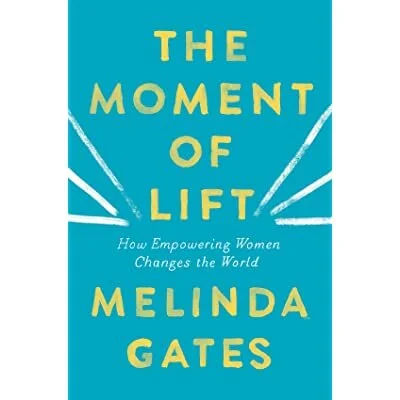
Melinda Gates’s book The Moment of Lift comes under criticism from Lily Meyer in her NPR blog post “'The Moment Of Lift' Is More Of A Whisper Than A Call To Action” for not being strident enough—and for focusing on other dimensions of women’s empowerment than abortion rights. But I, for one, am glad to have a book that tries to speak to those with a wide range of different political and religious views.

And, in addition to her message that women need to be treated better (the stories about the horrors of child marriage are especially powerful), Melinda Gates has another crucial message that should not be missed: individuals and communities have to be deeply understood in order to be deeply helped. Let me illustrate with a few quotations from The Moment of Lift.

I’ll start with two simple examples of a cultural fact that those from European-derived cultures might not guess: in many cultures, work that requires a lot of brute force and physical strength is women’s work. Here is Hans Rosling’s story:

Hans Rosling once told me [Melinda] a story that helps make the point. He was working with several women in a village in the Congo to test the nutritional value of cassava roots. They were harvesting the roots, marking them with a number, and putting them into baskets to take them down to the pond to soak. They filled three baskets. One woman carried off the first basket, another woman carried the second basket, and Hans carried the third. They walked single file down the path, and a minute later, as they all put down their baskets, one of the women turned around, saw Hans’s basket, and shrieked as if she’d seen a ghost. “How did this get here?!”

“I carried it,” Hans said.

“You can’t carry it!” she shouted. “You’re a man!”

Congolese men don’t carry baskets.

Importantly, in many extremely poor countries, a large share of the farming is done by women, who are hobbled in that endeavor by their cultures:

A landmark 2011 study from the UN’s Food and Agriculture Organization showed that women farmers in developing countries achieve 20–30 percent lower yields than men even though they are just as good at farming. The women underproduce because they do not have the access to the resources and information that men do. If they had the same resources, they would have the same yields.

Melinda tells the story of how a careful program of community discussion and persuasion did more to end genital cutting of young women in one region than coming from a stance of outrage would have done:

Molly Melching has spent her life proving that point. Molly is another one of my teachers. I told you about her earlier. We met in the summer of 2012, and she showed me one of the best approaches I’ve ever seen for challenging long-standing cultural practices.

I joined Molly in a town in Senegal, and we drove out together to a rural area to see the community empowerment program she runs there. As we spent an hour or so on the drive, Molly told me about coming to Senegal as an exchange student to refine her French in the 1970s. She quickly fell in love with the Senegalese people and culture—so much so that she decided to learn the local language, Wolof, as well.

Even while she loved the country, though, she noticed how difficult it was to be a girl there. Many girls in Senegal have their genitals cut very young—usually between 3 and 5 years of age. Many are married very young and are encouraged to have children quickly and often. Outside groups had tried to change these practices, but no one succeeded, and Molly found herself in a position to see why.

She became a translator for development programs, serving as the link between villagers and outsiders who wanted to help. She quickly saw that there was more than a language barrier dividing these two groups. There was an empathy barrier. The outsiders showed little skill in projecting themselves into the lives of the people they wanted to help, and they had little interest in trying to understand why something was being done in a certain way. They didn’t even have the patience to explain to villagers why they thought something should change.

On our drive out, Molly explained to me that the empathy barrier stymies all efforts in development. Agricultural equipment that had been donated was rusting out, health clinics were sitting empty, and customs like female genital cutting and child marriage continued unchanged. Molly told me that people often get outraged by certain practices in developing countries and want to rush in and say, “This is harmful! Stop it!’” But that’s the wrong approach. Outrage can save one girl or two, she told me. Only empathy can change the system.

Also, those being helped often have a different—and because it is their lives, more authoritative—ranking of priorities than those who want to help. The Gates foundation began by wanting to get sex workers in India to use condoms in order to slow the spread of AIDS. Here is the reaction they received:

“We don’t need your help with condoms,” they said, almost laughing. “We’ll teach you about condoms. We need help preventing violence.”

“But that’s not what we do,” our people said. And the sex workers answered, “Well, then you don’t have anything interesting to tell us, because that’s what we need.”

So our team held debates about what to do. Some said, “Either we rethink our approach or we shut this down.” Others said, “No, this is mission creep—we have no expertise in this area, and we shouldn’t get involved.”

Eventually, our team met again with the sex workers and listened intently as they talked about their lives, and the sex workers emphasized two things: One, preventing violence is their first and most urgent concern; two, fear of violence keeps them from using condoms.

Clients would beat up the women if they insisted on condoms. The police would beat them up if they were carrying condoms—because it proved they were sex workers. So to avoid getting beaten up, they wouldn’t carry condoms. Finally we saw the connection between preventing violence and preventing HIV. The sex workers couldn’t address the long-term threat of dying from AIDS unless they could address the near-term threat of being beaten, robbed, and raped.

So instead of saying, “It’s beyond our mandate,” we said, “We want to help protect you from violence. How can we do that?”

They said, “Today or tomorrow, one of us is going to get raped or beaten up by the police. It happens all the time. If we can get a dozen women to come running whenever this happens, the police will stop doing it.” So our team and the sex workers set up a system. If a woman is attacked by the police, she dials a three-digit code, the code rings on a central phone, and twelve to fifteen women come to the police station yelling and shouting. And they come with a pro bono lawyer and a media person. If a dozen women show up shouting, “We want her out now or there’s going to be a story in the news tomorrow!” the police will back down. They will say, “We didn’t know. We’re sorry.”

That was the plan, and that’s what the sex workers did. They set up a speed-dial network, and when it was triggered, the women came running. It worked brilliantly. One sex worker reported that she had been beaten up and raped in a police station a year before. After the new system was in place, she went back to the same police station and the policeman offered her a chair and a cup of tea. Once word of this program got out, sex workers in the next town came and said, “We want to join that violence prevention program, not the HIV thing,” and soon the program spread all over India.

Unlike Lily Meyer, I think Melinda’s book uses the quiet statement of horrific facts to powerful effect. The truth about the oppression of women is so stark that it doesn’t have to be shouted if someone is reading the book. And more of the people whose eyes would be opened by reading it are likely to read the book because it isn’t strident.


Miles Confronts a Freedom-of-Speech Issue; The Roots of Anti-Semitism

Teaching Assistant: The student clearly meant no harm, but this post has me worried that significant offense could be taken since it treads on an uber-touchy topic with at least some degree of clumsiness. I wonder if we should hide this one just to make sure no hackles unintentionally get raised. 

Miles: I am torn between the sensibleness of your suggestion and a commitment to freedom of speech. I think I come down on the side of freedom of speech.  How about this for a solution? What if both you and I add in public comments pointing out how to say the content with more grace? Then rather than smushing speech, we are helping teach how to talk about sensitive subjects while giving a minimum of offense consistent with being able to talk about issues. By the way, I assume that this was an MLK day post? Otherwise it is rather distant from economics.

Miles: Whenever writing about hatred of a broad group and its sources, it is important to go the extra mile to make clear, repeatedly, that the hatred is not justified. (I don’t have any problem saying that, without exception, I can’t think of any case when hatred of a broad group *is* justified. That is a view I could defend in detail.)

To me, it seems to me a big fallacy that hatred of groups comes from what they actually did. Hatred of an individual one has dealt with directly may come from what that person actually did, but hatred of large groups almost never does. It comes from the stories that are told about that group.

I agree with Ed Glaeser, who wrote:

“What determines the intensity and objects of hatred? Hatred forms when people believe that out-groups are responsible for past and future crimes, but the reality of past crimes has little to do with the level of hatred. Instead, hatred is the result of an equilibrium where politicians supply stories of past atrocities in order to discredit the opposition and consumers listen to them.”

This is from my post “John Stuart Mill on Being Offended at Other People’s Opinions or Private Conduct.” http://blog.supplysideliberal.com/post/105750762661/john-stuart-mill-on-being-offended-at-other

The example Ed Glaeser gives is that in the South after the civil war, there were many stories of African-American men raping Caucasian women that were meant to stir up hatred against African Americans. But what was the reality? In fact, Caucasian men in that era often raped African-American women with impunity, and certainly had done so while slavery was still supported by law. Rape of Caucasian women by African-American men was quite rare in comparison. So the hatred based on these stories was not based on reality. It was based on the stories that politicians and others propagated–precisely with the aim of making people hate African-Americans for the sake of political gain.

Similarly, for thousands of years, there has been political gain to be had from fomenting hatred of Jewish people. I think it is to this political gain from fomenting hatred of Jewish people that one can turn for the explanation of anti-Semitism. A careful analysis could identify easily exactly why there has been political gain to be had from fostering hatred of Jewish people. To me, that would be the most powerful kind of explanation for anti-Semitism.