Starving Cancer Cells: We Need Metabolic Oncology, Stat!

I write about Thomas Seyfried’s work in “How Fasting Can Starve Cancer Cells, While Leaving Normal Cells Unharmed.” I wanted to also highlight Peter Attia’s podcast interview of Thomas Seyfried.
What is most exciting beyond what I say in “How Fasting Can Starve Cancer Cells, While Leaving Normal Cells Unharmed” is that Thomas Seyfried’s recommendations are, albeit very slowly, making their way into clinical practice, most fully in Turkey.
Here is the summary of what Thomas Seyfried recommends and why. Most cancer cells are metabolically handicapped, typically with quite clear damage to their mitochondria. One can argue about whether the mitochondrial damage came first, leading to inaccurate gene preservation and replication, or whether errant genes came first leading to mitochondrial damage. But whatever the reason cancer cells have mitochondrial damage, it opens the door to metabolic therapies that disadvantage cancer cells relative to normal cells. These metabolic therapies can often be better targeted toward harming cancer cells and leaving normal cells unharmed than the typical chemotherapy.
The technical terms are confusing, but there are two categories of reactions that provide energy to a cell: “fermentation” reactions that don’t need oxygen and “respiration” reactions that do need oxygen. Cancer cells rely heavily (and often almost exclusively) on “fermentation” reactions, even when oxygen is available.
The key “fermentation” reactions take glucose (blood sugar) and glutamine (a common amino acid contained in many proteins and one that the human body itself can make).
Fasting and a ketogenic diet can do a lot to reduce blood sugar and thereby starve cancer cells. Drug treatment can push blood sugar down further and starve cancer cells more. Normal cells don’t need blood sugar since they can live off of ketones.
Pushing glutamine down has to be done by drug treatment, and needs to be done intermittently, since the normal cells need glutamine, too, though not as much as cancer cells do.
Ideally, Thomas Seyfried argues,
metabolic treatment should be pursued for a few weeks before surgery in order to shrink the tumor and give it less fuzzy boundaries, making surgery easier and more effective.
He argues that radiation can exacerbate cancer and should be avoided.
Instead of radiation, he recommends treatment with hyperbaric oxygen at 2.5 times atmospheric pressure, which stresses out cancer cells and cleans up the bad blood vessels feeding the cancer cells, and isn’t too hard on normal cells.
Steroids, often used to treat cancer, have the unfortunate effect of raising blood sugar, making more nutrients available for the sugar-hungry cancer cells.
Chemotherapy does not directly conflict with metabolic therapy, but can be quite harsh in its side effects.
I hope that many doctors listen to this podcast so that metabolic cancer therapies will begin to become more available. As I mentioned in “How Fasting Can Starve Cancer Cells, While Leaving Normal Cells Unharmed,” there are many clinical trial investigating types of metabolic cancer therapies, though there aren’t yet clinical trials of exactly what Thomas Seyfried recommends. The idea that it is unethical not to do surgery, radiation and chemotherapy right away stands in the way of trying out metabolic therapy as the primary approach. Two cases seem especially favorable for trying out metabolic therapy as the primary approach:
cancers that have been almost certain death sentences even when treated with surgery, radiation and chemotherapy and
cancers detected very early or quite slow growing, so that an acceptable option of “watchful waiting” can be traded in for metabolic therapy.
In the interview, Peter Attia identifies that Thomas Seyfried, while excellent on the science, is not the ideal advocate for this extremely promising but also quite radical new approach to cancer. The cause of metabolic oncology (cancer medicine) could really use additional talented advocates with the right credentials.
I find Thomas Seyfried’s basic argument quite convincing. It could make a big difference to how many people die of cancer if borne out. It deserves a real chance to prove itself.
For annotated links to other posts on diet and health, see:
The Federalist Papers #26: Some Part of the Government Must Be Able to Authorize an Army Whenever Necessary, after Being Forced to Fully Debate the Issue—Alexander Hamilton
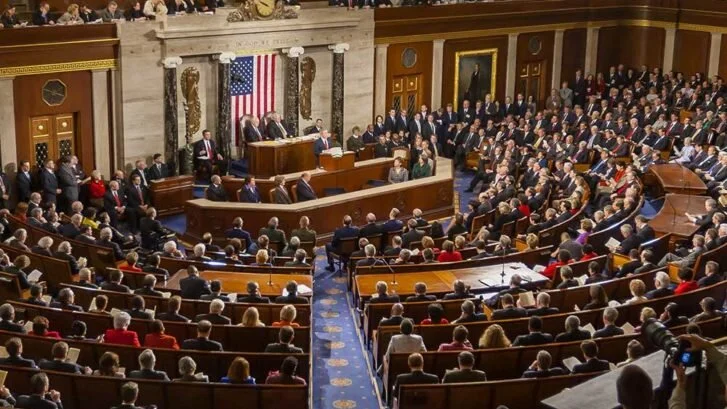
In the Federalist Papers #26, Alexander Hamilton argues there is little precedent for limiting a legislature’s authority to raise an army whenever it sees a necessity to do that. There is indeed good precedent for not allowing the executive to authorize an army; that is very different from not allowing the legislature to authorize an army whenever necessary.
Alexander Hamilton also goes a bit overboard in arguing for the constitutional provision that the legislature must reauthorize funding for an army at least every two years as a protection against an army designed to overthrow the legitimate order of government. Here is the passage where Alexander Hamilton makes a claim that does not ring true with modern experience:
It has been said that the provision which limits the appropriation of money for the support of an army to the period of two years would be unavailing, because the Executive, when once possessed of a force large enough to awe the people into submission, would find resources in that very force sufficient to enable him to dispense with supplies from the acts of the legislature. But the question again recurs, upon what pretense could he be put in possession of a force of that magnitude in time of peace?
Even if the US had a period with no active wars, it would have a large military given all the potential dangers in the world and the vast responsibilities it has taken upon itself in the world. And unless the US military were much smaller than it is now, it could easily “awe the people into submission.” The key safeguard of our constitutional order now is not a small miliitary, but inculcating in the members of our military a loyalty to the US Constitution above their loyalty to their commander in chief. (I also talk about this in “The Federalist Papers #22 C: Pillars of Democracy—The Judicial System, Military Loyal to the Constitution, and Police Loyal to the Constitution.”)
Here is the full text of the Federalist Papers #26:
FEDERALIST NO. 26
The Idea of Restraining the Legislative Authority in Regard to the Common Defense Considered
For the Independent Journal.
Author: Alexander Hamilton
To the People of the State of New York:
IT WAS a thing hardly to be expected that in a popular revolution the minds of men should stop at that happy mean which marks the salutary boundary between POWER and PRIVILEGE, and combines the energy of government with the security of private rights. A failure in this delicate and important point is the great source of the inconveniences we experience, and if we are not cautious to avoid a repetition of the error, in our future attempts to rectify and ameliorate our system, we may travel from one chimerical project to another; we may try change after change; but we shall never be likely to make any material change for the better.
The idea of restraining the legislative authority, in the means of providing for the national defense, is one of those refinements which owe their origin to a zeal for liberty more ardent than enlightened. We have seen, however, that it has not had thus far an extensive prevalency; that even in this country, where it made its first appearance, Pennsylvania and North Carolina are the only two States by which it has been in any degree patronized; and that all the others have refused to give it the least countenance; wisely judging that confidence must be placed somewhere; that the necessity of doing it, is implied in the very act of delegating power; and that it is better to hazard the abuse of that confidence than to embarrass the government and endanger the public safety by impolitic restrictions on the legislative authority. The opponents of the proposed Constitution combat, in this respect, the general decision of America; and instead of being taught by experience the propriety of correcting any extremes into which we may have heretofore run, they appear disposed to conduct us into others still more dangerous, and more extravagant. As if the tone of government had been found too high, or too rigid, the doctrines they teach are calculated to induce us to depress or to relax it, by expedients which, upon other occasions, have been condemned or forborne. It may be affirmed without the imputation of invective, that if the principles they inculcate, on various points, could so far obtain as to become the popular creed, they would utterly unfit the people of this country for any species of government whatever. But a danger of this kind is not to be apprehended. The citizens of America have too much discernment to be argued into anarchy. And I am much mistaken, if experience has not wrought a deep and solemn conviction in the public mind, that greater energy of government is essential to the welfare and prosperity of the community.
It may not be amiss in this place concisely to remark the origin and progress of the idea, which aims at the exclusion of military establishments in time of peace. Though in speculative minds it may arise from a contemplation of the nature and tendency of such institutions, fortified by the events that have happened in other ages and countries, yet as a national sentiment, it must be traced to those habits of thinking which we derive from the nation from whom the inhabitants of these States have in general sprung.
In England, for a long time after the Norman Conquest, the authority of the monarch was almost unlimited. Inroads were gradually made upon the prerogative, in favor of liberty, first by the barons, and afterwards by the people, till the greatest part of its most formidable pretensions became extinct. But it was not till the revolution in 1688, which elevated the Prince of Orange to the throne of Great Britain, that English liberty was completely triumphant. As incident to the undefined power of making war, an acknowledged prerogative of the crown, Charles II. had, by his own authority, kept on foot in time of peace a body of 5,000 regular troops. And this number James II. increased to 30,000; who were paid out of his civil list. At the revolution, to abolish the exercise of so dangerous an authority, it became an article of the Bill of Rights then framed, that "the raising or keeping a standing army within the kingdom in time of peace, UNLESS WITH THE CONSENT OF PARLIAMENT, was against law."
In that kingdom, when the pulse of liberty was at its highest pitch, no security against the danger of standing armies was thought requisite, beyond a prohibition of their being raised or kept up by the mere authority of the executive magistrate. The patriots, who effected that memorable revolution, were too temperate, too wellinformed, to think of any restraint on the legislative discretion. They were aware that a certain number of troops for guards and garrisons were indispensable; that no precise bounds could be set to the national exigencies; that a power equal to every possible contingency must exist somewhere in the government: and that when they referred the exercise of that power to the judgment of the legislature, they had arrived at the ultimate point of precaution which was reconcilable with the safety of the community.
From the same source, the people of America may be said to have derived an hereditary impression of danger to liberty, from standing armies in time of peace. The circumstances of a revolution quickened the public sensibility on every point connected with the security of popular rights, and in some instances raise the warmth of our zeal beyond the degree which consisted with the due temperature of the body politic. The attempts of two of the States to restrict the authority of the legislature in the article of military establishments, are of the number of these instances. The principles which had taught us to be jealous of the power of an hereditary monarch were by an injudicious excess extended to the representatives of the people in their popular assemblies. Even in some of the States, where this error was not adopted, we find unnecessary declarations that standing armies ought not to be kept up, in time of peace, WITHOUT THE CONSENT OF THE LEGISLATURE. I call them unnecessary, because the reason which had introduced a similar provision into the English Bill of Rights is not applicable to any of the State constitutions. The power of raising armies at all, under those constitutions, can by no construction be deemed to reside anywhere else, than in the legislatures themselves; and it was superfluous, if not absurd, to declare that a matter should not be done without the consent of a body, which alone had the power of doing it. Accordingly, in some of these constitutions, and among others, in that of this State of New York, which has been justly celebrated, both in Europe and America, as one of the best of the forms of government established in this country, there is a total silence upon the subject.
It is remarkable, that even in the two States which seem to have meditated an interdiction of military establishments in time of peace, the mode of expression made use of is rather cautionary than prohibitory. It is not said, that standing armies SHALL NOT BE kept up, but that they OUGHT NOT to be kept up, in time of peace. This ambiguity of terms appears to have been the result of a conflict between jealousy and conviction; between the desire of excluding such establishments at all events, and the persuasion that an absolute exclusion would be unwise and unsafe.
Can it be doubted that such a provision, whenever the situation of public affairs was understood to require a departure from it, would be interpreted by the legislature into a mere admonition, and would be made to yield to the necessities or supposed necessities of the State? Let the fact already mentioned, with respect to Pennsylvania, decide. What then (it may be asked) is the use of such a provision, if it cease to operate the moment there is an inclination to disregard it?
Let us examine whether there be any comparison, in point of efficacy, between the provision alluded to and that which is contained in the new Constitution, for restraining the appropriations of money for military purposes to the period of two years. The former, by aiming at too much, is calculated to effect nothing; the latter, by steering clear of an imprudent extreme, and by being perfectly compatible with a proper provision for the exigencies of the nation, will have a salutary and powerful operation.
The legislature of the United States will be OBLIGED, by this provision, once at least in every two years, to deliberate upon the propriety of keeping a military force on foot; to come to a new resolution on the point; and to declare their sense of the matter, by a formal vote in the face of their constituents. They are not AT LIBERTY to vest in the executive department permanent funds for the support of an army, if they were even incautious enough to be willing to repose in it so improper a confidence. As the spirit of party, in different degrees, must be expected to infect all political bodies, there will be, no doubt, persons in the national legislature willing enough to arraign the measures and criminate the views of the majority. The provision for the support of a military force will always be a favorable topic for declamation. As often as the question comes forward, the public attention will be roused and attracted to the subject, by the party in opposition; and if the majority should be really disposed to exceed the proper limits, the community will be warned of the danger, and will have an opportunity of taking measures to guard against it. Independent of parties in the national legislature itself, as often as the period of discussion arrived, the State legislatures, who will always be not only vigilant but suspicious and jealous guardians of the rights of the citizens against encroachments from the federal government, will constantly have their attention awake to the conduct of the national rulers, and will be ready enough, if any thing improper appears, to sound the alarm to the people, and not only to be the VOICE, but, if necessary, the ARM of their discontent.
Schemes to subvert the liberties of a great community REQUIRE TIME to mature them for execution. An army, so large as seriously to menace those liberties, could only be formed by progressive augmentations; which would suppose, not merely a temporary combination between the legislature and executive, but a continued conspiracy for a series of time. Is it probable that such a combination would exist at all? Is it probable that it would be persevered in, and transmitted along through all the successive variations in a representative body, which biennial elections would naturally produce in both houses? Is it presumable, that every man, the instant he took his seat in the national Senate or House of Representatives, would commence a traitor to his constituents and to his country? Can it be supposed that there would not be found one man, discerning enough to detect so atrocious a conspiracy, or bold or honest enough to apprise his constituents of their danger? If such presumptions can fairly be made, there ought at once to be an end of all delegated authority. The people should resolve to recall all the powers they have heretofore parted with out of their own hands, and to divide themselves into as many States as there are counties, in order that they may be able to manage their own concerns in person.
If such suppositions could even be reasonably made, still the concealment of the design, for any duration, would be impracticable. It would be announced, by the very circumstance of augmenting the army to so great an extent in time of profound peace. What colorable reason could be assigned, in a country so situated, for such vast augmentations of the military force? It is impossible that the people could be long deceived; and the destruction of the project, and of the projectors, would quickly follow the discovery.
It has been said that the provision which limits the appropriation of money for the support of an army to the period of two years would be unavailing, because the Executive, when once possessed of a force large enough to awe the people into submission, would find resources in that very force sufficient to enable him to dispense with supplies from the acts of the legislature. But the question again recurs, upon what pretense could he be put in possession of a force of that magnitude in time of peace? If we suppose it to have been created in consequence of some domestic insurrection or foreign war, then it becomes a case not within the principles of the objection; for this is levelled against the power of keeping up troops in time of peace. Few persons will be so visionary as seriously to contend that military forces ought not to be raised to quell a rebellion or resist an invasion; and if the defense of the community under such circumstances should make it necessary to have an army so numerous as to hazard its liberty, this is one of those calamaties for which there is neither preventative nor cure. It cannot be provided against by any possible form of government; it might even result from a simple league offensive and defensive, if it should ever be necessary for the confederates or allies to form an army for common defense.
But it is an evil infinitely less likely to attend us in a united than in a disunited state; nay, it may be safely asserted that it is an evil altogether unlikely to attend us in the latter situation. It is not easy to conceive a possibility that dangers so formidable can assail the whole Union, as to demand a force considerable enough to place our liberties in the least jeopardy, especially if we take into our view the aid to be derived from the militia, which ought always to be counted upon as a valuable and powerful auxiliary. But in a state of disunion (as has been fully shown in another place), the contrary of this supposition would become not only probable, but almost unavoidable.
PUBLIUS.
Links to my other posts on The Federalist Papers so far:
The Federalist Papers #1: Alexander Hamilton's Plea for Reasoned Debate
The Federalist Papers #3: United, the 13 States are Less Likely to Stumble into War
The Federalist Papers #4 B: National Defense Will Be Stronger if the States are United
The Federalist Papers #5: Unless United, the States Will Be at Each Others' Throats
The Federalist Papers #6 A: Alexander Hamilton on the Many Human Motives for War
The Federalist Papers #11 A: United, the States Can Get a Better Trade Deal—Alexander Hamilton
The Federalist Papers #12: Union Makes it Much Easier to Get Tariff Revenue—Alexander Hamilton
The Federalist Papers #13: Alexander Hamilton on Increasing Returns to Scale in National Government
The Federalist Papers #14: A Republic Can Be Geographically Large—James Madison
The Federalist Papers #21 A: Constitutions Need to be Enforced—Alexander Hamilton
The Federalist Papers #24: The United States Need a Standing Army—Alexander Hamilton
Critiquing the Wall Street Journal Editorial Pages on Fiscal Policy
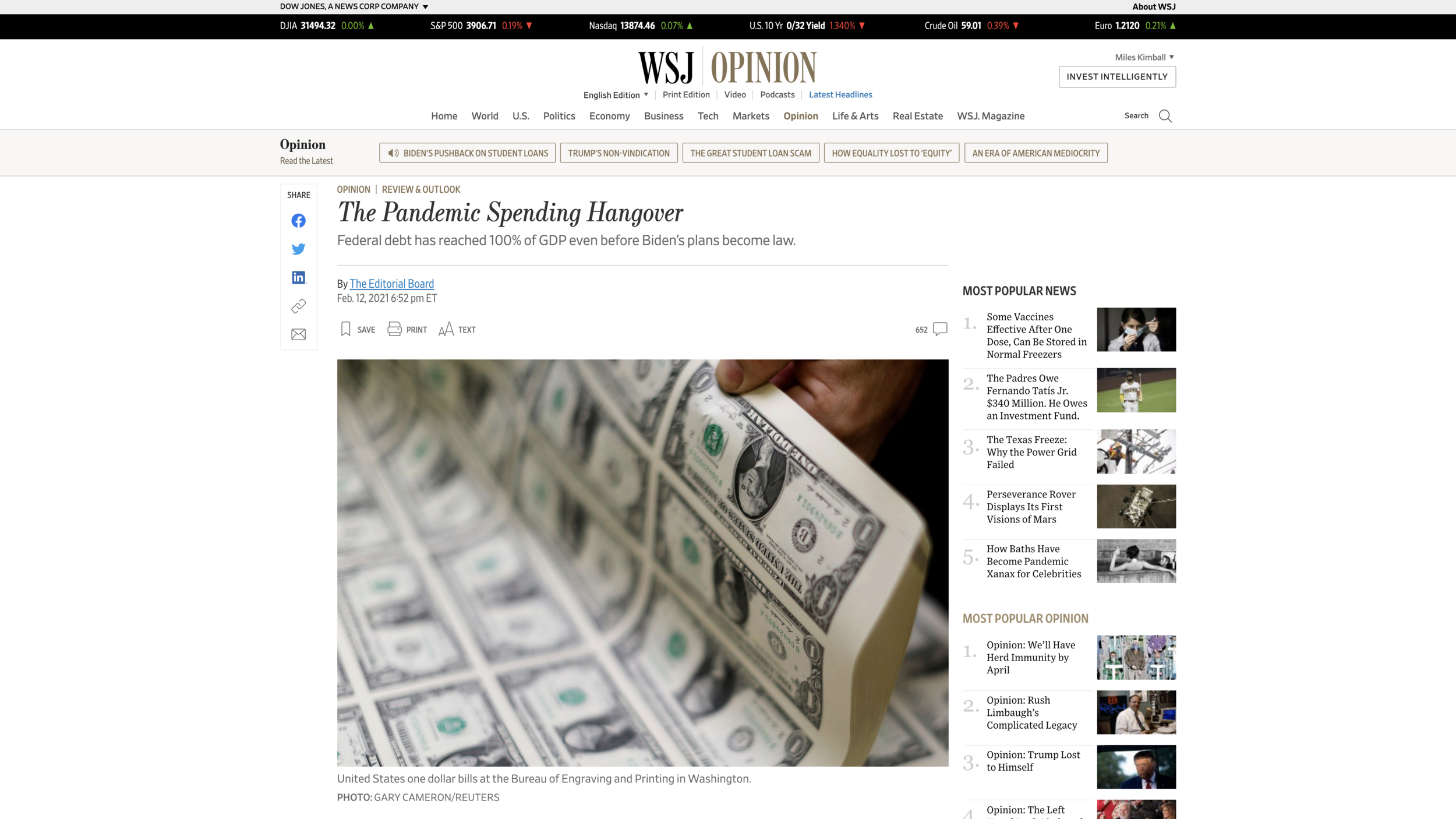
The Wall Street Journal Editorial Board demonstrates a lack of clarity on fiscal policy in its February 12, 2021 op-ed “The Pandemic Spending Hangover.” Consider the following passages from this op-ed. First:
CBO says federal spending reached $6.55 trillion in fiscal 2020, as Congress addressed the damage from Covid-19 and the government shutdowns. That’s about a $2.1 trillion increase in a single year, and understandably so given the uncertainty of the threat as it emerged in the spring. Notably, and in a pleasant surprise, revenue fell a mere 1.2% to $3.42 trillion as the economy held up better than expected. The deficit came in at a staggering $3.13 trillion, or a record 14.9% of GDP.
The Editorial Board expresses surprise that revenue didn’t fall that much. What they don’t mention is that the fiscal stimulus probably had a lot to do with keeping revenue up by keeping GDP from cratering worse than it did.
Second:
Debt held by the public—the kind the government has to pay back—broke above 100% of the economy in fiscal 2020. Even without new Biden spending, CBO says it will reach 102.3% in fiscal 2021.
…
How much debt is too much, and when does it begin to have corrosive economic consequences? No one knows, but one economic benchmark for harm has been 90% of GDP. We’ve never been preoccupied with debt, since the main focus of economic policy should be growth and broad prosperity.
This idea that above 90% of GDP is known to be dangerous is a zombie myth. (I disagree with Paul Krugman on many things, but he has been right in calling this a zombie myth.) This myth comes from Carmen Reinhart and Ken Rogoff’s badly flawed analysis, and hasn’t been updated in the Wall Street Journal Editorial Board’s minds since it came into question. To see how badly flawed, read my two columns coauthored with Yichuan Wang:
I have no doubt that there is some level of the debt-to-GDP ratio that will lead to bad outcomes but the fact that Japan has had a debt-to-GDP ratio of about 200% for some time without being able to get inflation up when they want to get inflation up should give one pause in thinking that a bit above a 100% debt-to-GDP ratio will be highly inflationary in the US.
(I should also mention that the appropriate measure of the debt-to-GDP should be higher, including the debt held by the Fed. Why? When interest rates finally do go back up, the Fed will either have to sell that debt or it will have to pay interest on that debt. Either way, some arm of the government ends up paying interest on that debt held by the Fed. This is an interesting case where the Wall Street Journal Editorial Board doesn’t understand something that would help their argument.)
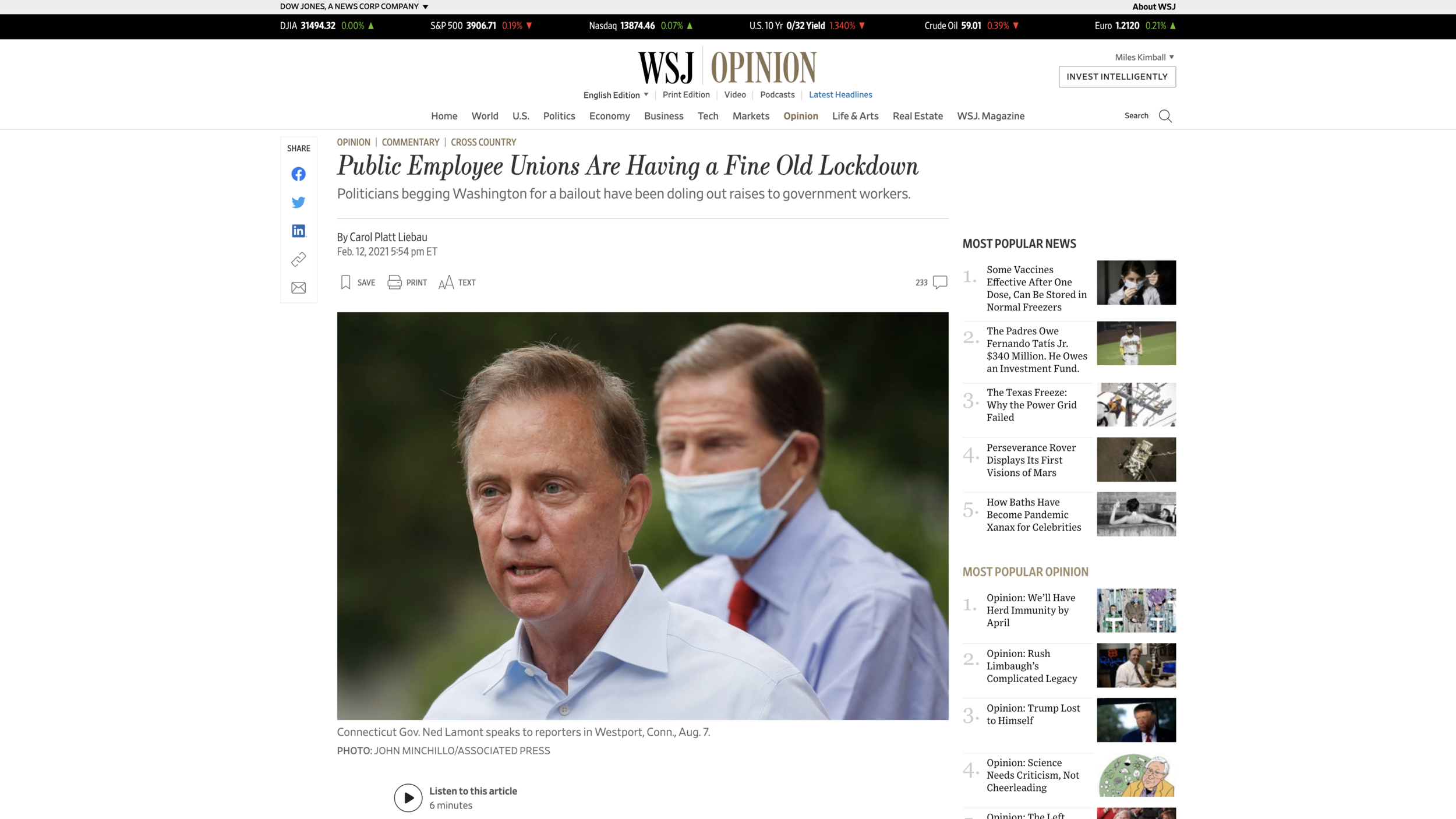
Another February 12, 2021 op-ed, “Public Employee Unions Are Having a Fine Old Lockdown” by Carol Platt Liebau, makes a different mistake about fiscal policy. It seems to have the idea that it is a good thing for states to cut their spending during a recession. No: it is a bad thing for states to cut their spending during a recession. If the federal government can help them avoid cutting their spending, that is to be applauded. Here is what she says:
As part of his proposed $1.9 trillion relief bill, President Biden wants to send $350 billion in unrestricted cash to state and local governments to fill their budget holes. But while Covid-19 has depressed state tax revenue, the prospect of federal aid has encouraged many of these supposedly blameless states to keep piling on costs.
Much of the rest of Carol Platt Liebau’s op-ed is lamenting paying state employees too much. Suppose we give her the benefit of the doubt on that. In that case, it may be a good idea to use the crisis to cut back on raises for state employees, especially if there is more legal leeway to modify contracts to pay state employees less. But states shouldn’t cut salaries in order to spend less overall in a recession; if they cut salaries in a recession it ought to be in order to spend more on something else during the recession and then less later on. The timing of spending matters.
There is a way for the federal government to encourage states to spend more than they otherwise would during a recession and less later on. I talk about that in this post:
Part of what is going on in is that Carol Platt Liebau is confusing long-run fiscal policy and short-run fiscal policy. The appropriate considerations for these two dimensions of fiscal policy are very, very different.
Unleashing the Potential of Antabuse
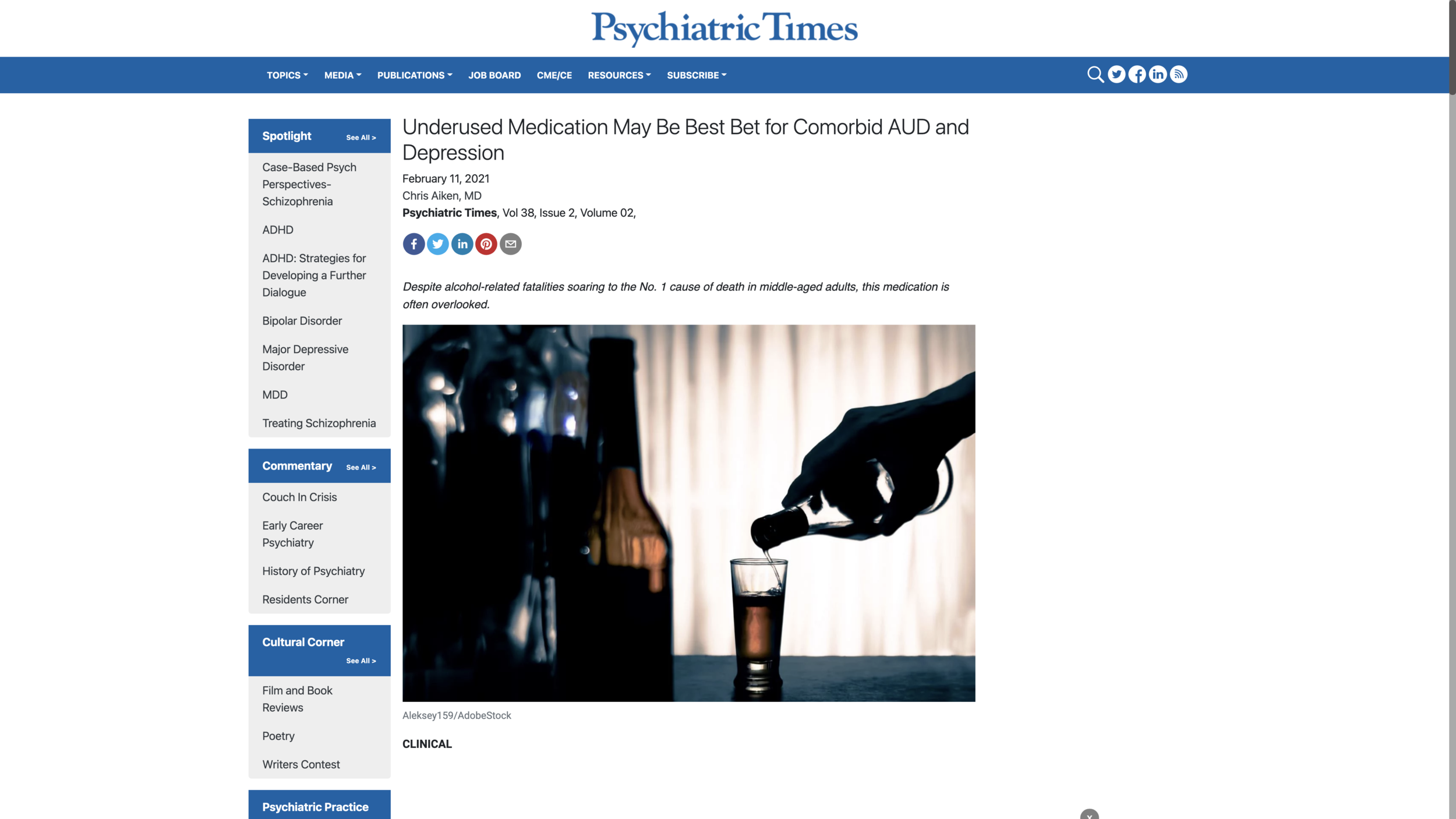
Link to the full text of the article shown above
Link to the Wikipedia article “Disulfiram”
Alcohol abuse is a huge problem. The health benefits of avoiding alcohol entirely are convincingly shown by the beneficial effects of Asian genes that make drinking quite unpleasant, as you can read in “Data on Asian Genes that Discourage Alcohol Consumption Explode the Myth that a Little Alcohol is Good for your Health.” But those who are tempted to drink too much and are not blessed with such a genetic brake on their alcohol consumption can get a similar effect from the drug disulfiram, which goes by the trade name Antabuse.
All the quotations in this post are from Chris Aiken’s February 11, 2021 Psychiatric Times article “Underused Medication May Be Best Bet for Comorbid AUD and Depression” shown above. Here is how disulfiram works to fight alcohol abuse:
Disulfiram induces an immediate hangover reaction when combined with alcohol. It blocks the enzyme that metabolizes acetaldehyde, the toxin responsible for alcohol’s hangover effect.
The odds of being able to escape alcohol abuse are many times higher with the help of disulfiram. Here is a key diagram from “Underused Medication May Be Best Bet for Comorbid AUD and Depression”:
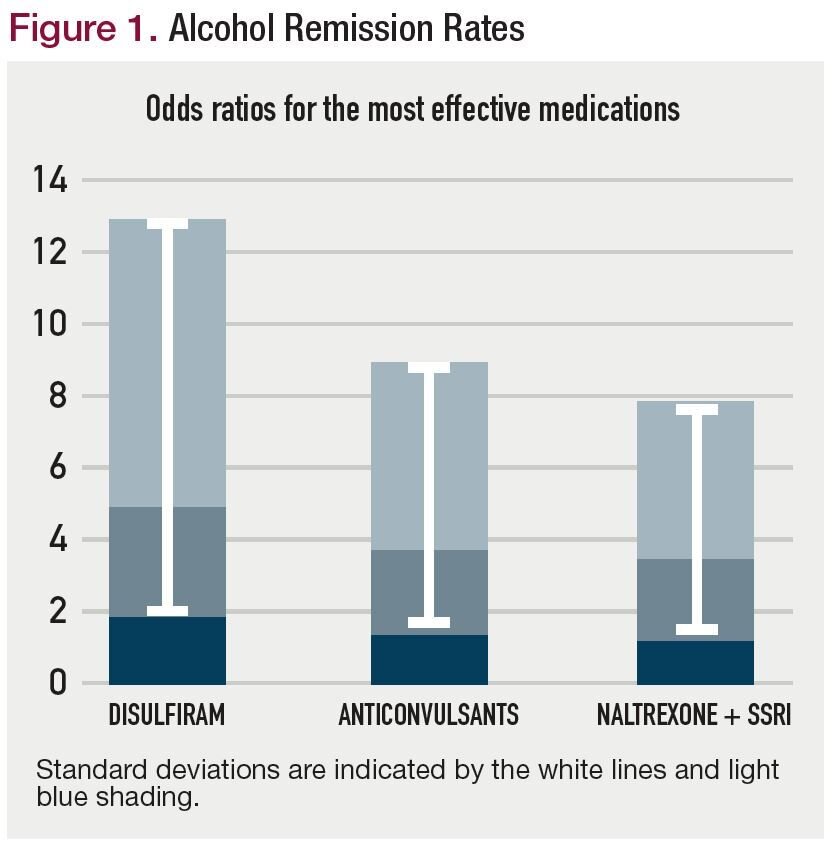
Hangovers are not healthy. So it is not only unpleasant to drink when using disulfiram, it is bad for your health. That wasn’t fully understood in the early days of disulfiram, which tarnished its reputation somewhat. Such alcohol-disulfiram interactions are no longer a real problem:
Deaths from the disulfiram-alcohol (ethanol) interaction have not been reported in recent years, possibly because the dosages used are lower than those used 40 years ago and patients with cardiac disease are now excluded from treatment.
Alcohol abuse and depression often go together. Chris Aiken speculates as follows on why disulfiram helps reduce depression as well as reducing alcohol abuse:
Although these studies cannot explain why disulfiram works well in depression, I will venture a guess from clinical experience. Patients with depression are often unable to take action on the things that are good for them, ie, bathing, eating healthy, and achieving sobriety. Although they want to stop drinking, they struggle with ruminative thoughts and never arrive at an executable plan. Disulfiram halts indecision, relieving them of the struggle.
Many people worry too much about the small- to modest-sized dangers from a treatment and too little about the huge dangers of the disorder treated. Alcohol abuse should be taken very, very seriously. Disulfiram can help.
I also wonder if some people think of alcohol abuse as a character flaw that should be treated with character improvements. Character improvements are something to be pursued in any case, but alcohol abuse is so deadly that chemical help to fight it should also be sought. (Similarly, tobacco is so deadly that chemical help—which is often available—should be sought in quitting smoking as well. Self-discipline is great, but shouldn’t be the only tool one turns to.)
For annotated links to other posts on diet and health, see:
My Sister-in-Law Becky Porter Kimball

Joseph Kimball and Becky Porter Kimball
My sister Sarah died a little over a month ago from complications from a car accident. (See “My Sister Sarah.”) Now my sister-in-law Becky has died after a long battle with cancer. (Here is a link to her obituary.) My brother Chris expresses my feelings better than I could. Below are Chris’s words:
My sister-in-law Becky died Friday morning. The day and time is always a surprise, but the event was not. Becky was on palliative care already, having reached the end of all possible treatments for a cancer she fought for several years.
We were 14. Seven children of Ed and Bee Kimball and seven spouses. With my youngest sister Sarah's death a month ago, and now Becky today, we are 12. The youngest two of the 14 were the first to go.
Jana Riess posted an article the other day about grief at a child's death, referring to Joy Jones' lack of outward grief or mourning in her Mormon General Conference talk in October 2017. I saw some thoughtful push-back to Jana's piece, arguing that we should be slow to judge and should allow everybody their own space and time to mourn. And that cuts both ways. Both about Jana's piece, and about Joy Jones in a position of authority suggesting a right way.
Here I am with my own:
First, I am deeply sorrowing. I feel a loss. Most of all, I am weighed down by a sense of finality. The last time. No more ever. I know all the "wonderful reunion in the hereafter" thoughts and meant-to-be-comforting statements. But at the moment, all issues of doctrine and belief aside, those thoughts are meaningless. They fall like a stone at my feet. The never again, final and forever, it's over, feeling is where I sit right now and I will not be comforted.
Second, I feel almost rage about "work it out in the eternities" move the Mormon Church has made. I don't want to hear about maybe someday. Instead, I have a bright awareness of the importance of now, here, this life.
As often happens, the poet-prophets say it best. Here, from Mary Oliver:
WHEN DEATH COMES
When death comes
like the hungry bear in autumn;
when death comes and takes all the bright coins from his purse
to buy me, and snaps the purse shut;
when death comes
like the measle-pox
when death comes
like an iceberg between the shoulder blades,
I want to step through the door full of curiosity, wondering:
what is it going to be like, that cottage of darkness?
And therefore I look upon everything
as a brotherhood and a sisterhood,
and I look upon time as no more than an idea,
and I consider eternity as another possibility,
and I think of each life as a flower, as common
as a field daisy, and as singular,
and each name a comfortable music in the mouth,
tending, as all music does, toward silence,
and each body a lion of courage, and something
precious to the earth.
When it's over, I want to say all my life
I was a bride married to amazement.
I was the bridegroom, taking the world into my arms.
When it's over, I don't want to wonder
if I have made of my life something particular, and real.
I don't want to find myself sighing and frightened,
or full of argument.
I don't want to end up simply having visited this world.
--Mary Oliver
The Avett brothers speak to some of the same in their "No Hard Feelings," imagining ways a person could make peace with dying. About the popularity of the song, Scott is recorded as saying "It's weird to be congratulated on the mining of the soul." I echo the sentiment, as I put these thoughts of mine out in the public.
I have tributes for my Mother and my Dad and my sister Sarah here:
Here is my wife Gail’s tribute for my son Spencer:
And here is my niece Emily’s take on Sarah’s and Becky’s deaths
Max Roser's Chart: 600 Years of War and Peace →
Hat tip to Patrick Neal Russell Julius, who wrote this on Facebook:
The post-WW2 era is an unprecedented time of peace worldwide. It is often referred to by experts as 'The Long Peace or 'The Pax Americana'.
I think the reason why it seems like our military causes more problems than it solves is that most of the problems it solves are via deterrence, not intervention. The fights you *really* win are the ones that never happen.
Should Challenge Trials Have a Placebo Arm?
I have done my share of complaining about human subjects review by “Institutional Review Boards.” They can sometimes get worried about things that pose no real danger to experimental subjects or survey respondents. But if I were on a human subjects review board myself, I would be skeptical about a challenge trial with a placebo arm. Given the benefits of getting vaccines vetted quickly, I think challenge trials that expose volunteers to a virus after they have been vaccinated can be justified, but exposing volunteers to a virus without vaccinating them seems a bad idea to me. The statistical purity of having the placebo arm where someone randomly doesn’t get the vaccination and then is exposed to the virus is of some value, but to me doesn’t have enough value to warrant exposing unprotected people to the virus.
In “What Fraction of Participants in a Randomized Controlled Trial Should Be Treated?” I look at how a greater cost of treatment as compared to having someone be in the placebo arm could make it optimal to treat less than 50% of the subjects in a double-blind placebo-controlled trial. In a challenge trial, after including the danger to the subject, having someone in the placebo arm is much more costly than giving someone the treatment. As a result, the roles of the treatment arm and the placebo arm in the equation shift. It would be optimal to have far more than 50% of the experimental subjects and have much less than 50% in the dangerous placebo arm.
But even that calculation pretends that only those randomized to the placebo before being exposed to the virus provide information about what happens when someone is not vaccinated. What is happening “in the wild” in the pandemic provides some information about what happens when someone unvaccinated is exposed to the virus. And what happens in vaccine trials that do not involve deliberate exposure to the virus also provides evidence about the placebo. The most crucial input for vaccine development is to know what happens when someone is vaccinated and then exposed to the virus.
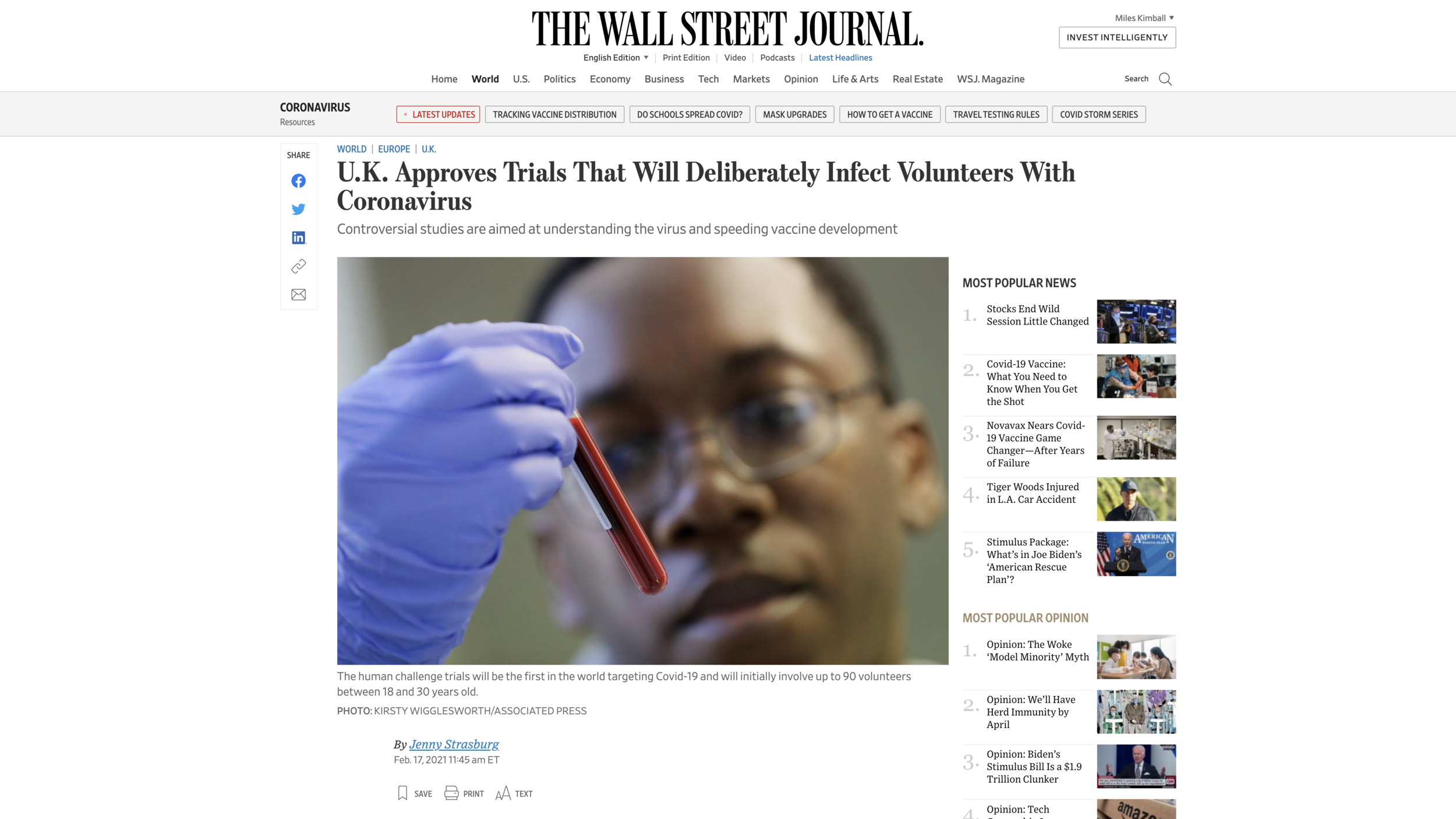
In the UK a human subjects review panel is allowing something of a placebo arm, but the amount of the virus the volunteers are exposed to is to be kept very small. Here is the description in the Wall Street Journal news article “U.K. Approves Trials That Will Deliberately Infect Volunteers With Coronavirus”:
With medics and scientists standing by 24 hours a day, researchers will inject closely controlled doses of coronavirus into the noses of quarantined volunteers. This set of volunteers won’t have received vaccines. The idea is to start with the smallest possible amount that allows researchers to gauge infection levels, symptoms and transmission methods while trying to ensure the volunteers’ safety.
If that goes well, a second stage of the trials is planned to include the use of vaccines—researchers haven’t specified which ones—to test how well they protect against symptoms and possibly transmission. Vaccines would be administered to healthy volunteers, who would then be purposely infected with coronavirus, again in closed-off quarters to contain the virus.
One thing I have learned from this pandemic is the importance of the quantity of viral particles one is exposed to. So there may be a quantity of viral particles low enough that a placebo arm for a challenge trial is reasonable, but it would be easy to get that quantity wrong. And if you have to start at very low levels and then go to higher levels, you are using up some of the speed advantages challenge trials. Still, it may make sense.
Are Nuts Inflammatory?
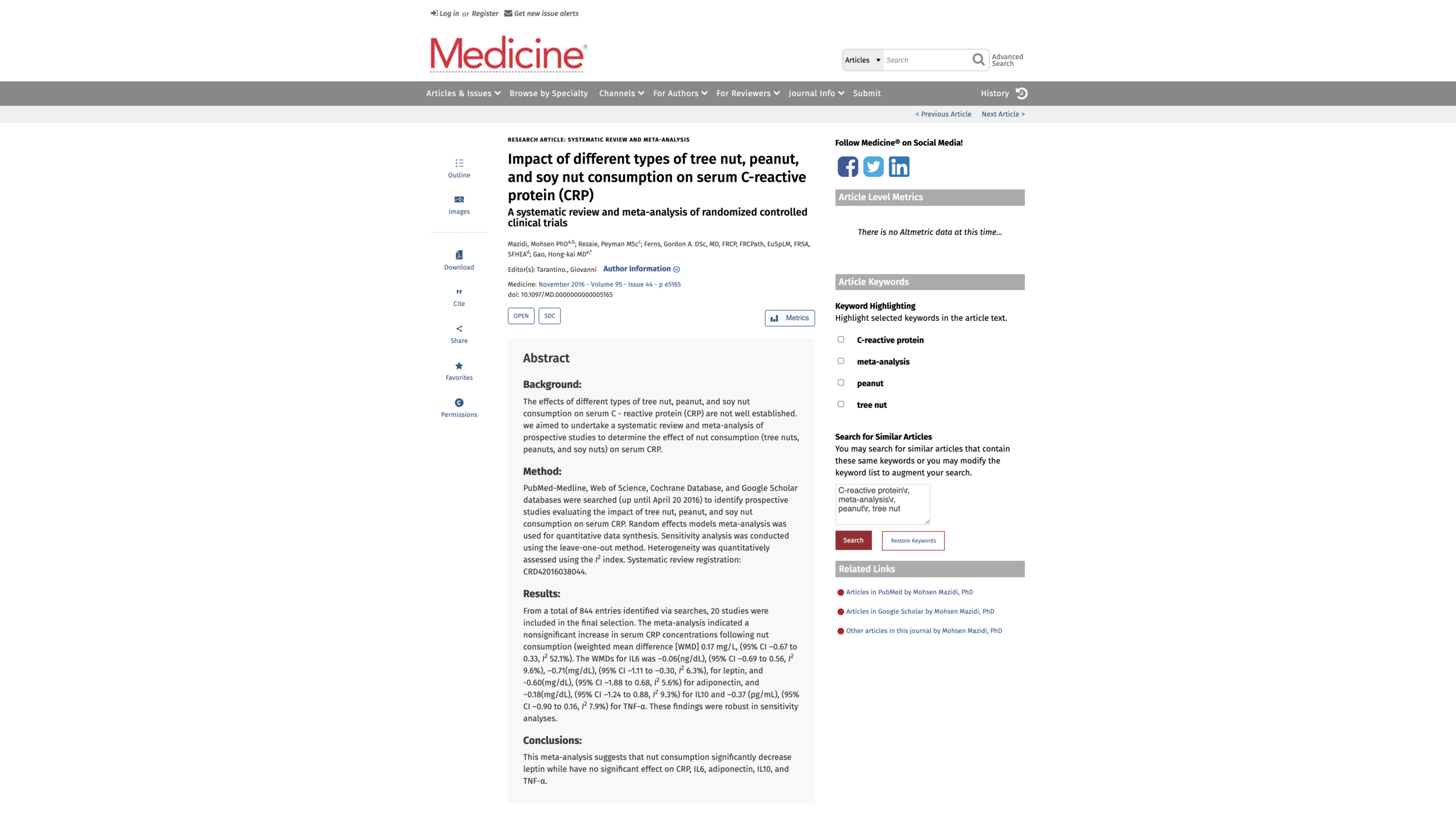

I heard it claimed that nuts were inflammatory. It is not easy to google up any evidence to back that idea up; conversely, it is easy to google up evidence that nuts are either anti-inflammatory or have no substantial effect on inflammation.
The article shown at the very top of this post is a meta-analysis looking at a number of studies on nuts, finding little overall effect on inflammation. There is, however, an intriguing drop in leptin from eating nuts, which suggests that nuts may be less satiating than one would otherwise expect, making it easy to eat a lot of them. The current version of the Wikipedia article “Leptin” says “Leptin (from Greek λεπτός leptos, "thin") is a hormone predominantly made by adipose cells and enterocytes in the small intestine that helps to regulate energy balance by inhibiting hunger …”
The second article shown above suggests that nuts are anti-inflammatory. Part of the difference may be the emphasis in this second article on nuts crowding out less healthy foods. Often, the question “Is food X healthy?” should be the questions “Compared to what?” Many, many things are quite unhealthy compared to nuts, making nuts healthy compared to them.
A comparison of nuts to eating nothing might give a different answer about whether nuts are inflammatory. That is, compared to a water fast—eating nothing, but still continuing to drink water—nuts could cause some inflammation. This would not at all contradict the idea that eating nuts instead of, say, eating potato chips, was anti-inflammatory. Not that the comparison to something like potato chips is a very relevant comparison for daily eating habits. (See “Our Delusions about 'Healthy' Snacks—Nuts to That!”)
In any case, if nuts were strongly inflammatory, this would probably be quite visible in experiments that have been done. So the available evidence does provide some confidence that they are not strongly inflammatory for the average person who does not have a specific nut allergy. And it isn’t just nuts in general: no particular type of nuts seems to show up as strongly inflammatory in prominent studies.
What I was looking for as evidence of an inflammatory effect was the short-term response of inflammation immediately after eating nuts along the lines of evidence about the insulin-response to food and the glycemic response to food, but with a short-run inflammatory outcome measure. (On this type of measure for insulin response and glycemic response, see “Forget Calorie Counting; It's the Insulin Index, Stupid” and Using the Glycemic Index as a Supplement to the Insulin Index.) I did not immediately find evidence like that on short-run inflammatory responses soon after eating nuts or other foods.
I’d be glad to hear more opinions on the question of whether nuts are inflammatory and on other questions about how healthy nuts are in general and whether some nuts are healthier than others.
For annotated links to other posts on diet and health, see:
The Federalist Papers #25: Prohibiting a Standing Army in Time of Peace Would Be a Mistake—Alexander Hamilton
Before its ratification, one of the big objections to the proposed Constitution of the United States was that it allowed a standing army in time of peace. Superficially, the idea of prohibiting a standing army in time of peace was attractive. Having begun to address the issue in previous numbers of the Federalist Papers, Alexander Hamilton continues the argument against such a prohibition in the Federalist Papers #25. There are two main parts to his argument in #25, with subparts:
State militias are not an adequate substitute for a national military
Some states would provide inadequately for defense
Some states would maintain large enough militias to scare the other states—with reason
States are less likely to put adequate political safeguards on their militias than the Union is to put adequate political safeguards on the national army
A prohibition against a standing army would be unenforceable; it is a bad idea to have unenforceable provisions
The definition of something like “imminent danger” is quite elastic, but any prohibition of maintaining an army that did not allow an exception like this would be foolhardy
Not having a national army is a big military disadvantage
Even when legal provisions are clear, they tend to be flouted when survival is at stake
Having provisions likely to be flouted encourages disrespect for a constitution
Below is the full text of the Federalist Papers #25, with my headings added in bold italics, and the main two heading centered:
FEDERALIST NO. 25
The Same Subject Continued: The Powers Necessary to the Common Defense Further Considered
From the New York Packet
Friday, December 21, 1787.
Author: Alexander Hamilton
To the People of the State of New York:
1. State militias are not an adequate substitute for a national military.
IT MAY perhaps be urged that the objects enumerated in the preceding number ought to be provided for by the State governments, under the direction of the Union. But this would be, in reality, an inversion of the primary principle of our political association, as it would in practice transfer the care of the common defense from the federal head to the individual members: a project oppressive to some States, dangerous to all, and baneful to the Confederacy.
Some states would provide inadequately for defense. The territories of Britain, Spain, and of the Indian nations in our neighborhood do not border on particular States, but encircle the Union from Maine to Georgia. The danger, though in different degrees, is therefore common. And the means of guarding against it ought, in like manner, to be the objects of common councils and of a common treasury. It happens that some States, from local situation, are more directly exposed. New York is of this class. Upon the plan of separate provisions, New York would have to sustain the whole weight of the establishments requisite to her immediate safety, and to the mediate or ultimate protection of her neighbors. This would neither be equitable as it respected New York nor safe as it respected the other States. Various inconveniences would attend such a system. The States, to whose lot it might fall to support the necessary establishments, would be as little able as willing, for a considerable time to come, to bear the burden of competent provisions. The security of all would thus be subjected to the parsimony, improvidence, or inability of a part. Some states would maintain large enough militias to scare the other states—with reason. If the resources of such part becoming more abundant and extensive, its provisions should be proportionally enlarged, the other States would quickly take the alarm at seeing the whole military force of the Union in the hands of two or three of its members, and those probably amongst the most powerful. They would each choose to have some counterpoise, and pretenses could easily be contrived. In this situation, military establishments, nourished by mutual jealousy, would be apt to swell beyond their natural or proper size; and being at the separate disposal of the members, they would be engines for the abridgment or demolition of the national authcrity.
Reasons have been already given to induce a supposition that the State governments will too naturally be prone to a rivalship with that of the Union, the foundation of which will be the love of power; and that in any contest between the federal head and one of its members the people will be most apt to unite with their local government. If, in addition to this immense advantage, the ambition of the members should be stimulated by the separate and independent possession of military forces, it would afford too strong a temptation and too great a facility to them to make enterprises upon, and finally to subvert, the constitutional authority of the Union. States are less likely to put adequate political safeguards on their militias than the Union is to put adequate political safeguards on the national army. On the other hand, the liberty of the people would be less safe in this state of things than in that which left the national forces in the hands of the national government. As far as an army may be considered as a dangerous weapon of power, it had better be in those hands of which the people are most likely to be jealous than in those of which they are least likely to be jealous. For it is a truth, which the experience of ages has attested, that the people are always most in danger when the means of injuring their rights are in the possession of those of whom they entertain the least suspicion.
Some states would maintain large enough militias to scare the other states—with reason (reprise). The framers of the existing Confederation, fully aware of the danger to the Union from the separate possession of military forces by the States, have, in express terms, prohibited them from having either ships or troops, unless with the consent of Congress. The truth is, that the existence of a federal government and military establishments under State authority are not less at variance with each other than a due supply of the federal treasury and the system of quotas and requisitions.
2. A prohibition against a standing army would be unenforceable; it is a bad idea to have unenforceable provisions
There are other lights besides those already taken notice of, in which the impropriety of restraints on the discretion of the national legislature will be equally manifest. The definition of something like “imminent danger” is quite elastic, but any prohibition of maintaining an army that did not allow an exception like this would be foolhardy. The design of the objection, which has been mentioned, is to preclude standing armies in time of peace, though we have never been informed how far it is designed the prohibition should extend; whether to raising armies as well as to KEEPING THEM UP in a season of tranquillity or not. If it be confined to the latter it will have no precise signification, and it will be ineffectual for the purpose intended. When armies are once raised what shall be denominated "keeping them up," contrary to the sense of the Constitution? What time shall be requisite to ascertain the violation? Shall it be a week, a month, a year? Or shall we say they may be continued as long as the danger which occasioned their being raised continues? This would be to admit that they might be kept up IN TIME OF PEACE, against threatening or impending danger, which would be at once to deviate from the literal meaning of the prohibition, and to introduce an extensive latitude of construction. Who shall judge of the continuance of the danger? This must undoubtedly be submitted to the national government, and the matter would then be brought to this issue, that the national government, to provide against apprehended danger, might in the first instance raise troops, and might afterwards keep them on foot as long as they supposed the peace or safety of the community was in any degree of jeopardy. It is easy to perceive that a discretion so latitudinary as this would afford ample room for eluding the force of the provision.
The supposed utility of a provision of this kind can only be founded on the supposed probability, or at least possibility, of a combination between the executive and the legislative, in some scheme of usurpation. Should this at any time happen, how easy would it be to fabricate pretenses of approaching danger! Indian hostilities, instigated by Spain or Britain, would always be at hand. Provocations to produce the desired appearances might even be given to some foreign power, and appeased again by timely concessions. If we can reasonably presume such a combination to have been formed, and that the enterprise is warranted by a sufficient prospect of success, the army, when once raised, from whatever cause, or on whatever pretext, may be applied to the execution of the project.
If, to obviate this consequence, it should be resolved to extend the prohibition to the RAISING of armies in time of peace, the United States would then exhibit the most extraordinary spectacle which the world has yet seen, that of a nation incapacitated by its Constitution to prepare for defense, before it was actually invaded. As the ceremony of a formal denunciation of war has of late fallen into disuse, the presence of an enemy within our territories must be waited for, as the legal warrant to the government to begin its levies of men for the protection of the State. We must receive the blow, before we could even prepare to return it. All that kind of policy by which nations anticipate distant danger, and meet the gathering storm, must be abstained from, as contrary to the genuine maxims of a free government. We must expose our property and liberty to the mercy of foreign invaders, and invite them by our weakness to seize the naked and defenseless prey, because we are afraid that rulers, created by our choice, dependent on our will, might endanger that liberty, by an abuse of the means necessary to its preservation.
Not having a national army is a big military disadvantage. Here I expect we shall be told that the militia of the country is its natural bulwark, and would be at all times equal to the national defense. This doctrine, in substance, had like to have lost us our independence. It cost millions to the United States that might have been saved. The facts which, from our own experience, forbid a reliance of this kind, are too recent to permit us to be the dupes of such a suggestion. The steady operations of war against a regular and disciplined army can only be successfully conducted by a force of the same kind. Considerations of economy, not less than of stability and vigor, confirm this position. The American militia, in the course of the late war, have, by their valor on numerous occasions, erected eternal monuments to their fame; but the bravest of them feel and know that the liberty of their country could not have been established by their efforts alone, however great and valuable they were. War, like most other things, is a science to be acquired and perfected by diligence, by perserverance, by time, and by practice.
Even when legal provisions are clear, they tend to be flouted when survival is at stake. All violent policy, as it is contrary to the natural and experienced course of human affairs, defeats itself. Pennsylvania, at this instant, affords an example of the truth of this remark. The Bill of Rights of that State declares that standing armies are dangerous to liberty, and ought not to be kept up in time of peace. Pennsylvania, nevertheless, in a time of profound peace, from the existence of partial disorders in one or two of her counties, has resolved to raise a body of troops; and in all probability will keep them up as long as there is any appearance of danger to the public peace. The conduct of Massachusetts affords a lesson on the same subject, though on different ground. That State (without waiting for the sanction of Congress, as the articles of the Confederation require) was compelled to raise troops to quell a domestic insurrection, and still keeps a corps in pay to prevent a revival of the spirit of revolt. The particular constitution of Massachusetts opposed no obstacle to the measure; but the instance is still of use to instruct us that cases are likely to occur under our government, as well as under those of other nations, which will sometimes render a military force in time of peace essential to the security of the society, and that it is therefore improper in this respect to control the legislative discretion. It also teaches us, in its application to the United States, how little the rights of a feeble government are likely to be respected, even by its own constituents. And it teaches us, in addition to the rest, how unequal parchment provisions are to a struggle with public necessity.
It was a fundamental maxim of the Lacedaemonian commonwealth, that the post of admiral should not be conferred twice on the same person. The Peloponnesian confederates, having suffered a severe defeat at sea from the Athenians, demanded Lysander, who had before served with success in that capacity, to command the combined fleets. The Lacedaemonians, to gratify their allies, and yet preserve the semblance of an adherence to their ancient institutions, had recourse to the flimsy subterfuge of investing Lysander with the real power of admiral, under the nominal title of vice-admiral. This instance is selected from among a multitude that might be cited to confirm the truth already advanced and illustrated by domestic examples; which is, that nations pay little regard to rules and maxims calculated in their very nature to run counter to the necessities of society. Having provisions likely to be flouted encourages disrespect for a constitution. Wise politicians will be cautious about fettering the government with restrictions that cannot be observed, because they know that every breach of the fundamental laws, though dictated by necessity, impairs that sacred reverence which ought to be maintained in the breast of rulers towards the constitution of a country, and forms a precedent for other breaches where the same plea of necessity does not exist at all, or is less urgent and palpable.
PUBLIUS.
Links to my other posts on The Federalist Papers so far:
The Federalist Papers #1: Alexander Hamilton's Plea for Reasoned Debate
The Federalist Papers #3: United, the 13 States are Less Likely to Stumble into War
The Federalist Papers #4 B: National Defense Will Be Stronger if the States are United
The Federalist Papers #5: Unless United, the States Will Be at Each Others' Throats
The Federalist Papers #6 A: Alexander Hamilton on the Many Human Motives for War
The Federalist Papers #11 A: United, the States Can Get a Better Trade Deal—Alexander Hamilton
The Federalist Papers #12: Union Makes it Much Easier to Get Tariff Revenue—Alexander Hamilton
The Federalist Papers #13: Alexander Hamilton on Increasing Returns to Scale in National Government
The Federalist Papers #14: A Republic Can Be Geographically Large—James Madison
The Federalist Papers #21 A: Constitutions Need to be Enforced—Alexander Hamilton
The Federalist Papers #24: The United States Need a Standing Army—Alexander Hamilton
Twitter Convo on Eurocentrism →
Click on the Tweet to see the rest of the thread.