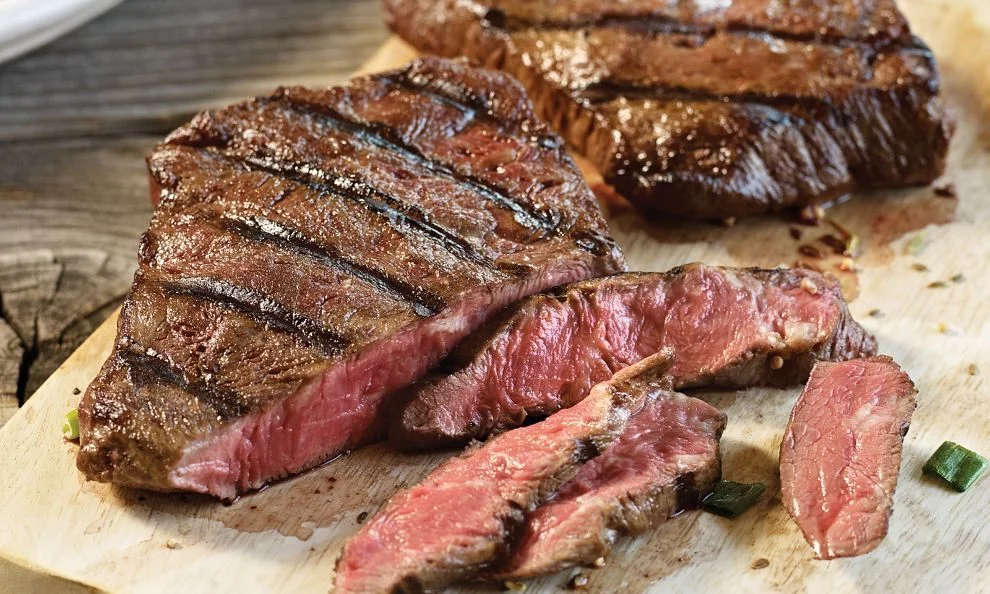
The idea that red meat is unhealthy has been drilled into the American public for at least half a century. For those of us who have high standards for causal inference throughout the causal chain all the way from eating meat to death or morbidity, there is surprisingly little evidence for this view, though I will talk about some. How well the Inuit and Masai fared on a traditional diet of meat should give one pause in asserting too strongly the harms of red meat.
Let me give two bits of evidence, one positive for meat, suggesting it is very nutritious for the human body; another negative, suggesting it is highly nutritious for cancer cells as well.
First, let's turn to meat being very nutritious for the human body. In Chapter 19 of his excellent history of nutritional thought, "Good Calories, Bad Calories: Fats, Carbs, and the Controversial Science of Diet and Health," Gary Taubes tells about an early 20th Century scientific dispute over whether meat is enough to keep someone alive and in robust health:
The notion of a carbohydrate-restricted diet based exclusively on fatty meat was publicized after World War I by the Harvard anthropologist-turned-Arctic-explorer Vilhjalmur Stefansson, who was concerned with the overall healthfulness of the diet, rather than its potential for weight loss. Stefansson had spent a decade eating nothing but meat among the Inuit of northern Canada and Alaska. The Inuit, he insisted, as well as the visiting explorers and traders who lived on this diet, were among the healthiest if not the most vigorous populations imaginable.
Among the tribes with whom Stefansson lived and traveled, the diet was primarily caribou meat, “with perhaps 30 percent fish, 10 percent seal meat, and 5 or 10 percent made up of polar bear, rabbits, birds and eggs.”
The Inuit considered vegetables and fruit “not proper human food,” Stefansson wrote, but they occasionally ate the roots of the knotweed plant in times of dire necessity. The Inuit paid little attention to the plants in their environment “because they added nothing to their food supply,” noted the Canadian anthropologist Diamond Jenness, who spent the years 1914–16 living in the Coronation Gulf region of Canada’s Arctic coast. Jenness described their typical diet during one three-month stretch as “no fruit, no vegetables; morning and night nothing but seal meat washed down with ice-cold water or hot broth.” (The ability to thrive on such a vegetable-and fruit-free diet was also noted by the lawyer and abolitionist Richard Henry Dana, Jr., in his 1840 memoirs of life on a sailing ship, Two Years Before the Mast. For sixteen months, Dana wrote, “we lived upon almost nothing but fresh beef; fried beefsteaks, three times a day…[in] perfect health, and without ailings and failings.” ...
... If the Inuit thrived in the harshest of environments without eating carbohydrates and whatever nutrients exist in fruits and vegetables, they, by definition, were consuming a balanced, healthy diet. If they did so solely because they had become evolutionarily adapted to such a diet, which was a typical rejoinder to Stefansson’s argument, then how can one explain those traders and explorers, like Stefansson himself and the members of his expeditions, who also lived happily and healthfully for years at a time on this diet?
Nutritionists of the era assumed that all-meat diets were unhealthy because (1) excessive meat consumption was alleged to raise blood pressure and cause gout; (2) the monotony of eating only meat—or any other single food—was said to induce a physical sense of revulsion; (3) the absence of fresh fruit and vegetables in these diets would cause scurvy and other deficiency diseases, and (4) protein-rich diets were thought to induce chronic kidney damage, a belief based largely on early research by Louis Newburgh.
The nutritionists back then were Vilhjalmur Stefansson's opponents in this scientific dispute:
... Francis Benedict, as Stefansson told it, claimed that it was “easier to believe” that Stefansson and all the various members of his expeditions “were lying, than to concede that [they] had remained in good health for several years on an exclusive meat regimen.”
In the winter of 1928, Stefansson and Karsten Anderson, a thirty-eight-year-old Danish explorer, became the subjects in a yearlong experiment that was intended to settle the meat-diet controversy. The experiment was planned and supervised by a committee of a dozen respected nutritionists, anthropologists, and physicians.*
Eugene Du Bois and ten of his colleagues from Cornell and the Russell Sage Institute of Pathology would oversee the day-to-day details of the experiment.
... they began living exclusively on meat, at which point they moved into Bellevue Hospital in New York and were put under twenty-four-hour observation. Stefansson remained at Bellevue for three weeks, Anderson for thirteen weeks. After they were released, they continued to eat only meat for the remainder of one year. If they cheated on the diet, according to Du Bois, the experimenters would know it from regular examinations of Stefansson’s and Anderson’s urine. “In every individual specimen of urine which was tested during the intervals when they were living at home,” Du Bois wrote, “acetone [ketone] bodies were present in amounts so constant that fluctuations in the carbohydrate intake were practically ruled out.”
Du Bois was convinced:
Du Bois, who supervised the experiments, wrote an introduction to Stefansson’s book. After Stefansson and Anderson were living exclusively on meat, he said, “a great many dire predictions and brilliant theories faded into nothingness.” A diet that should have left Stefansson and Anderson deathly ill from scurvy had left them as healthy as or healthier than the balanced diet they had been eating in the years immediately preceding the study. “Quite evidently we must revise some of our text book statements,” Du Bois concluded.
To me, the most surprising thing was that no vitamin deficiencies resulted. Gary Taubes explains:
meat has a full set of amino acids;
meat has all the vitamins except vitamin C; and
the need for vitamin C is much lower when eating meat than when eating a lot of carbs.
There are arguments over whether our distant ancestors, in the environment of evolutionary adaptation ate mostly plants or mostly meat. I suspect that the recurrent ice ages back then made things tough enough that for us to be here today, our distant ancestors had to do OK on a wide variety of different diets. Sometimes, very little meat would have been available. At other times, meat might have been almost all that was available. I don't think it strange that we should be adapted to do well as almost total carnivores, even though we also have the capability to deal well with plant food in its natural form.
Now, to rain on the parade of pro-meat ideas above, let me turn to some interesting evidence suggesting that meat is very nutritious for cancer cells as well. The evidence comes from research by T. Colin Campbell and coauthors, recounted in his book, "The China Study: Revised and Expanded Edition: The Most Comprehensive Study of Nutrition Ever Conducted and the Startling Implications for Diet, Weight Loss, and Long-Term Health."