Whole Milk Is Healthy; Skim Milk Less So

Update October 30, 2018: Make sure to also read “Exorcising the Devil in the Milk,” How Important is A1 Milk Protein as a Public Health Issue? “Is Milk OK?” and “'Is Milk Ok?' Revisited.” The post below is not my final word on milk.
My maternal grandfather was a proud dairy farmer. In his honor, let me devote a post to the virtues of milk.
Some people have lactose intolerance. But as the descendant of a long line of milk drinkers who evolved the ability to digest milk well in adulthood, I have no such problem.
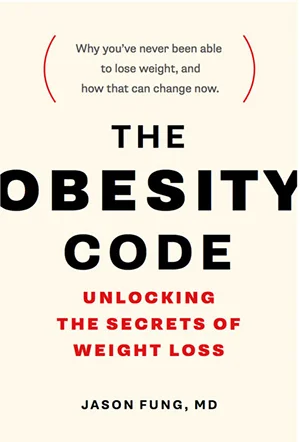
The dietary effects of milk are complex. Drinking milk causes a rise in insulin, which among other things is a hormonal instruction for the body to take sugar out of the blood and turn it into stored fat. On the other hand, through the hormone incretin, milk slows down stomach emptying and makes people feel full or satiated for longer, so they eat less of other things. On balance whole milk is good for weight loss, skim milk is less helpful. Jason Fung carefully reviews the academic literature on milk in his excellent book The Obesity Code (in chapter 17, "Protein"). All the quotations below are fromThe Obesity Code
Whey Stimulates Insulin ...
The hormonally powerful part of milk is not the fat or the milk sugar (lactose), but the whey:
Dairy, meat and the insulin index proteins differ greatly in their capacity to stimulate insulin, with dairy products in particular being potent stimuli. Dairy also shows the largest discrepancy between the blood glucose and insulin effect. It scores extremely low on the glycemic index (15 to 30), but very high on the insulin index (90 to 98). Milk does contain sugars, predominantly in the form of lactose. However, when tested, pure lactose has minimal effect on either the glycemic or insulin indexes. Milk contains two main types of dairy protein: casein (80 percent) and whey (20 percent). Cheese contains mostly casein. Whey is the byproduct left over from the curds in cheese making. Bodybuilders frequently use whey protein supplements because it is high in branched-chain amino acids, felt to be important in muscle formation. Dairy protein, particularly whey, is responsible for raising insulin levels even higher than whole-wheat bread, due largely to the incretin effect.
... But Whey's Stimulation of Incretin Is Also Very Satiating
Like many people, I find whole milk very satisfying, and crave other food a lot less after a glass of milk. There is a hormonal reason for this. Jason Fung explains:
But are dairy and meat are fattening? That question is complicated. The incretin hormones have multiple effects, only one of which is to stimulate insulin. Incretins also have a major effect on satiety. ... Incretin hormones play an important role in the control of gastric emptying. The stomach normally holds food and mixes it with stomach acid before slowly discharging the contents. GLP-1 causes stomach emptying to significantly slow. Absorption of nutrients also slows, resulting in lower blood glucose and insulin levels. Furthermore, this effect creates a sensation of satiety that we experience as “being full.” A 2010 study compared the effect of four different proteins: eggs, turkey, tuna and whey protein—on participants’ insulin levels. As expected, whey resulted in the highest insulin levels. Four hours afterward, participants were treated to a buffet lunch. The whey group ate substantially less than the other groups. The whey protein suppressed their appetites and increased their satiety. In other words, those subjects were “full.” ...
So the incretin hormones produce two opposing effects. Increased insulin promotes weight gain, but increased satiety suppresses it—which is consistent with personal experience.
On Net, Whole Milk Aids Weight Control. Low-Fat Milk is Neutral
Airtight experimental evidence on the net effect of milk is not available, but there is some associational evidence suggesting that whole milk aids in weight control:
These two opposing effects—insulin promotes weight gain, but satiety promotes weight loss—cause a maddening debate about meat and dairy. The important question is this: Which effect is more powerful? ...
The story with dairy is entirely different. Despite the fact that its consumption causes big increases in insulin levels, large observation studies do not link dairy to weight gain. If anything, dairy protects against weight gain, as found in the Swedish Mammography Cohort. In particular, whole milk, sour milk, cheese and butter were associated with less weight gain, but not low-fat milk. The ten-year prospective CARDIA Study found that the highest intake of dairy is associated with the lowest incidence of obesity and type 2 diabetes. Other large population studies confirmed this association. The data from the Nurses’ Health Studies and the Health Professionals Follow-up Study shows that overall, average weight gain over any four-year period was 3.35 pounds (1.5 kilograms)—pretty close to 1 pound per year. Milk and cheese were essentially weight neutral.
Yogurt is an important case to talk about because so many people think that yogurt is a health food. Plain full-fat yogurt should be just as good for weight loss as whole milk if not a bit better, but the low-fat, high-sugar yogurt many people eat is bad stuff. It is unlikely that the good effects of the yogurt content are able to overcome the bad effects of the added sugar.
Reigning Dietary Theories as Reflected in the Supermarket May Be Off Target
Going down the aisles of grocery stores, I notice first all the aisles that are temples to refined carbohydrates. Then when I look closer at things that claim to be especially healthy foods, I notice many low-fat products (see "Jason Fung: Dietary Fat is Innocent of the Charges Leveled Against It") and dairy-free products. These may not be the most important directions to go (except for those with lactose intolerance or another specific milk intolerance).
Zero added sugar of any type and no artificial sweeteners is likely to be a more helpful direction to go for health. (See Sugar as a Slow Poison.) Of course, ruling out added sugar and artificial sweeteners rules out a large share of all processed foods, which may be helpful in its own right given the incentives manufactures have to maximize taste and shelf-life with little regard for health other than doing the minimum to be able to pretend something is healthy.
Milk may be only a few thousand years old as a common food for adult humans, and then only in some ancestries. But a few thousand years in some ancestries is a lot longer and more broadly tested than many of the processed foods advertised today have been tested. I recommend worrying more about new types of processed foods that are less than 200 years old in widespread consumption than about whole milk.
For annotated links to other posts on diet and health, see:
For example, here is what the first section looks like:
I. The Basics
Eivar x Lithuania: World's Largest Metropolitan Areas Populations Compared to US States →
This is an amazing map. Click on the title of this post.
Daron Acemoglu and Simon Johnson's Plan to Save Our Republic
Daron Acemoglu and Simon Johnson's recent Foreign Policy article has the grand title "It's Time to Found a New Republic." Let's take a look at what they propose. I'll give my reactions.
Avoiding Internet Monopolies
Daron and Simon worry that big tech firms will establish long-lasting monopolies by their control of data. The suggestion of having users own their own data seems a good one:
The conventional commercial doctrine is that data are proprietary to the companies that collect them. This needs to change profoundly and completely since the playing field can only be leveled by making data available to all potential competitors. One way of achieving this is to ensure data belong to the people who generate the information, i.e., to individuals who drive cars, surf the internet, and buy goods.
I briefly worried that it would be hard to pay for free services if users weren't giving up data. But users giving companies the use of their data for the period of time they use the services should still be a substantial inducement to provide internet services. In other words, the internet companies would be renting the data rather than owning it. Or at a minimum, they would get non-exclusive access to the information. The user would have the right to share the information with another company. There are two possible rules: the website the user was using must erase the information if it stops providing the service, or the website the user was using may stop providing the service if the user shares the information with the new company. There are many possibilities that could work.
Free Higher Education
Daron and Simon have a view of higher education similar to the one I lay out in "The Coming Transformation of Education: Degrees Won’t Matter Anymore, Skills Will." They write:
Making high-quality education free for everyone would be a step in the right direction in this context. Technology can help with this, including through all kinds of on-line instruction. Loading up on student debt does not really help anyone — or our nation — prepare for what comes next in the world economy.
My take in "The Coming Transformation of Education: Degrees Won’t Matter Anymore, Skills Will" is this:
The road ahead is clear: the potential in each student can be unlocked by combining the power of computers, software, and the internet with the human touch of a teacher-as-coach to motivate that student to work hard at learning. Technology brings several elements to the equation:
customized lessons adapted to each student’s individual learning style at a cost that won’t break the bank
lectures from some of the most talented instructors in the world (such as this course in financial asset pricing by the impressive John Cochrane and many other economics classes by Tyler Cowen and Alex Tabarrok)
the kind of software motivational tricks that make it so hard for kids to pull away from video games
flexibility for students to learn at their own pace.
But since motivation—the desire to learn—is so important, a human teacher to act as coach is also crucial. In particular, without a coach, the flexibility for students to learn at their own pace can be a two-edged sword, because it makes it easy to procrastinate.
In the end, none of this will be hard. The technology and content for that technology are already good and rapidly improving. And although it is a bit much to expect someone to be both a great and inspirational coach and to be at the cutting edge of an academic field, the number of great athletic coaches and trainers at all levels indicates that, on its own, being an inspirational coach is not that rare. Being an inspirational coach in an academic setting is not quite the same thing, but I am willing to bet that it, too, is blessedly common. By having the cutting-edge knowledge from the best scientists and savants in the world built into software and delivered in online lectures, all a community college has to do to deliver a world-class education is to hire teachers who know how to motivate students.
As long as a community college education costs only as much to provide as it does now, it is not a big stretch to think that a community college education could be subsidized enough to be effectively free in the future. With the combination of technology and community college instructors as coaches, students will be able to learn a lot from free higher education. There would continue to be many elite, expensive schools that students would attend for reasons that go beyond academic and professional learning, but for those willing to settle for an excellent education academically and professionally, college would be free.
Reducing Labor Taxation
Daron and Simon want to shift taxation from labor to capital:
The economy needs a fundamental restructuring of the tax code to lower the taxation on labor and remove all of the subsidies to machines so that the playing field is leveled for labor.
I don't see capital as undertaxed. But it would be good to shift labor taxation more toward situations in which people tend to have low labor supply elasticities and to have some wage subsidies at the bottom. Prime-age first-earners in a family can be taxed more heavily. Those old enough to think about retiring, secondary earners in a family, and those who just might be able to make it onto the disability roles should have their labor income taxed more lightly. And we should either get rid of cash, or tax very lightly those at the bottom of the income distribution who might be tempted to get paid in cash and not report the income.
Monitoring Government Officials
Corruption and semi-corruption are big problems. Technology can help. Daron and Simon write:
Money calls the shots in Washington not just because of campaign financing, but because of lobbying and the broader influence industry. Lobbies have traditionally been much harder to regulate, because much of their work is performed behind closed doors (as opposed to campaign financing, which is more clearly visible). The only way of neutralizing the effects of lobbies is by creating greater transparency.
In this, technology can help. Artificial intelligence and big data analytics can be used to track everything that happens in the political sphere — automatically raising flags when they detect frequent meetings with certain networks of individuals or excessive amount of resources being expended relative to what is normal or regarded as acceptable. Crucially, this information will not be collected and guarded by a government agency, but will be made available to the entire public.
All elected politicians and their aides will need to agree to forgo a substantial amount of privacy in their public lives in order for this system to work. Some people may, as a result, choose not to subject themselves to this transparency and decline to go into the realm of public policy. But do you really want shadowy characters controlling the nation’s future?
For some time, I have been thinking along similar lines, as you can see from this Twitter discussion with Matt Stambaugh. Here is the way I am thinking about dealing with lobbying now:
- Draw a sharp line between government officials and those who are not government officials.
- Strict conflict-of-interest rules apply to government officials as now.
- Government officials can talk freely to other government officials about policy, including discussions behind closed doors, but ...
- ... any communication between government officials and those who are not government officials about policy must be totally public. If in person, video must be recorded and immediately posted to a public, searchable website. If by phone, audio must be recorded and immediately posted to a public, searchable website. If by email, the email must be immediately posted to a public, searchable website.
- Mechanisms are provided to keep the identities of those outside government anonymous, but only to the extent their identities are also anonymous to the government official. Ideally, there would be some way to verify the truth of whatever partial identification is given—for example, "I am a constituent in your district."
- Government officials are not even allowed to talk about policy with family members who are not government official without recording that conversation and making it public.
- Diplomatic discussions with government officials in other countries would count as a discussion among government officials.
Certain accommodations would have to be made. There would need to be scope for government information gathering that did not count as a policy discussion. Some policy discussion between government officials and those who are not government officials might be classified; these would not be made fully public, but only public to those (including journalists) who could qualify for the necessary level of clearance. Systems would need to be set up to insure that enough people had the necessary level of clearance that these contacts between government officials and those outside of government could be appropriately monitored. Former government officials might be especially valuable monitors in such cases.
I hope others are trying to think how to better monitor lobbying along these lines. I don't doubt that the details can be improved over what I am suggesting above. But it is important to not allow huge loopholes through which something like the lobbying status quo can be continued.
Nonpartisan Redistricting
Daron and Simon share my view that nonpartisan redistricting is crucial to improve US politics. They write:
Gerrymandering — changing the boundaries around congressional districts to ensure a particular outcome — makes a mockery of democracy. It reduces representativeness and thus exacerbates the political fault lines. Technology can help here as well. A constitutional amendment could easily require a fair and automatic redrawing of boundaries as population shifts, where the parameters of how such redistricting will take place are specified in advance and transparently to avoid the temptation for political manipulation.
I have three posts that touch on nonpartisan redistricting:
I am less optimistic than Daron and Simon that a purely technical solution is possible, though formal mathematical and statistical tests to judge proposals are a key part of nonpartisan redistricting. The key is to take redistricting decisions out of the hands of the politicians themselves.
Overall, working toward nonpartisan redistricting is a worthy area for activism for people who want to make a difference.
Fine-Tuning the Degree of Independence of the Civil Service and Judiciary
I favor more accountability of the civil service and judiciary to the political arms of government than do Daron and Simon. I don't disagree with this passage:
Another important step for strengthening our democracy is a constitutional amendment to increase the independence of the judiciary and the civil service, removing the power of the president to appoint judges (except Supreme Court justices) and prosecutors, and strengthening the role of career civil servants.
But there should be a continued inquiry into exactly how much independence is right for each agency and each type of situation. This is an important area of institutional design. Daron and Simon point to several specific types of situations where a greater degree of independence is needed than now:
For example, not only can the president remove prosecutors who may be investigating those close to the administration, but the political appointment process often paves the way to secret settlements agreements with powerful people and organizations — and judges bless these deals. Elections for judges and prosecutors is not a better solution either.
Like Daron and Simon, I worry about the effects of elections for judges and prosecutors.
Conclusion
Daron and Simon's suggestions are mostly reasonable. See if you can do even better!
John Locke: Rivalry in Consumption Makes Private Property Unavoidable
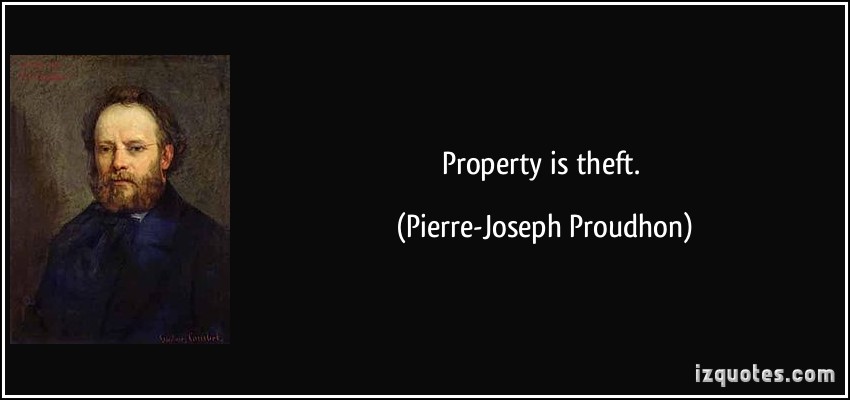
The French anarchist Pierre-Joseph Proudhon famously wrote in his 1840 book Or, an Inquiry into the Principle of Right and of Government "Property is Theft!" John Locke countered in advance in sections 25 and 26 of his 2d Treatise on Government: “Of Civil Government” (Chapter V "Of Property") with this argument:
- For many goods, consuming them makes them unavailable for anyone else. Economists call this "rivalry in consumption."
- For the many goods that are rivalrous in consumption, the moment of consumption necessarily makes them private property.
- If everyone was prevented from consuming a good that is rivalrous in consumption, it does noone any good.
- Hence, private property is unavoidable if we are to enjoy the benefits of consuming rivalrous goods.
Here are the words John Locke uses:
Whether we consider natural reason, which tells us, that men, being once born, have a right to their preservation, and consequently to meat and drink, and such other things as nature affords for their subsistence: or revelation, which gives us an account of those grants God made of the world to Adam, and to Noah, and his sons, it is very clear, that God, as king David says, Psal. cxv. 16. has given the earth to the children of men; given it to mankind in common. But this being supposed, it seems to some a very great difficulty, how any one should ever come to have a property in any thing: I will not content myself to answer, that if it be difficult to make out property upon a supposition that God gave the world to Adam, and his posterity in common, it is impossible that any man, but one universal monarch, should have any property upon a supposition, that God gave the world to Adam, and his heirs in succession, exclusive of all the rest of his posterity. But I shall endeavour to shew, how men might come to have a property in several parts of that which God gave to mankind in common, and that without any express compact of all the commoners.
God, who hath given the world to men in common, hath also given them reason to make use of it to the best advantage of life, and convenience. The earth, and all that is therein, is given to men for the support and comfort of their being. And though all the fruits it naturally produces, and beasts it feeds, belong to mankind in common, as they are produced by the spontaneous hand of nature; and nobody has originally a private dominion, exclusive of the rest of mankind, in any of them, as they are thus in their natural state: yet being given for the use of men, there must of necessity be a means to appropriate them some way or other, before they can be of any use, or at all beneficial to any particular man. The fruit, or venison, which nourishes the wild Indian, who knows no inclosure, and is still a tenant in common, must be his, and so his, i. e. a part of him, that another can no longer have any right to it, before it can do him any good for the support of his life.
Sometimes when people wish there were no private property, they are wishing that there were no scarcity—or even imagining that there wouldn't be any scarcity if evil people were not withholding the earth's bounty. This is a fantasy.
In other cases, when people wish there were no private property, they are really saying that private property—including the distribution of rights to use the "commons"—should be more equally distributed. This is a reasonable thing to think. (Nobel prize winner Elinor Ostrom persuasively argued the use of common pool resources is almost always regulated by the community. Hence, there are private property rights involved in the use of common pool resources.)
But literally wishing there were no private property makes little sense given the fact that for so many goods, consuming them effectively makes them private property even if they weren't before. Indeed, in the case of eating, consumption literally makes the food part of one's own body, which is private property as long as slavery is banned.
Don't miss other John Locke posts. Links at "John Locke's State of Nature and State of War."
Daniel Patrick Moynihan and Kurt Andersen on the Importance of Getting the Facts Right
“You are entitled to your own opinion, but you are not entitled to your own facts.”
"If you have children or grandchildren, teach them to distinguish between true and untrue as fiercely as you do between right and wrong and between wise and foolish."
Making Collective Choices: Quadratic Voting and the Normalized Gradient Addition Mechanism
Link to the video on the Becker-Friedman Institute site, with paths to related videos
This is a talk I gave April 7, 2016, at a conference on Quadratic Voting spearheaded by Glen Weyl. Just click on the picture. You can also see the other presentations at the conference by clicking on the link below the picture. Seeing the other presentations in the conference that you can access made me more interested in Quadratic Voting.
Here is a link to the paper corresponding to this talk. Here is the official website of the published paper in the journal Public Choice. Below is the abstract of the published paper.
Abstract:
Quadratic voting and the normalized gradient addition mechanism are both social choice mechanisms that confront individuals with quadratic budget constraints, but they are applicable in different contexts. Adapting one or both to apply to the same context, this paper explores the relationship between these two mechanisms in three contexts: marginal adjustments of continuous policies, simultaneous voting on many public choices, and voting on a single public choice accompanied by private monetary consequences. In the process, we provide some formal analysis of quadratic voting when (instead of money) votes are paid for with abstract tokens that are equally distributed by the mechanism designer.
Janet Adamy and Paul Overberg on Immobility in America
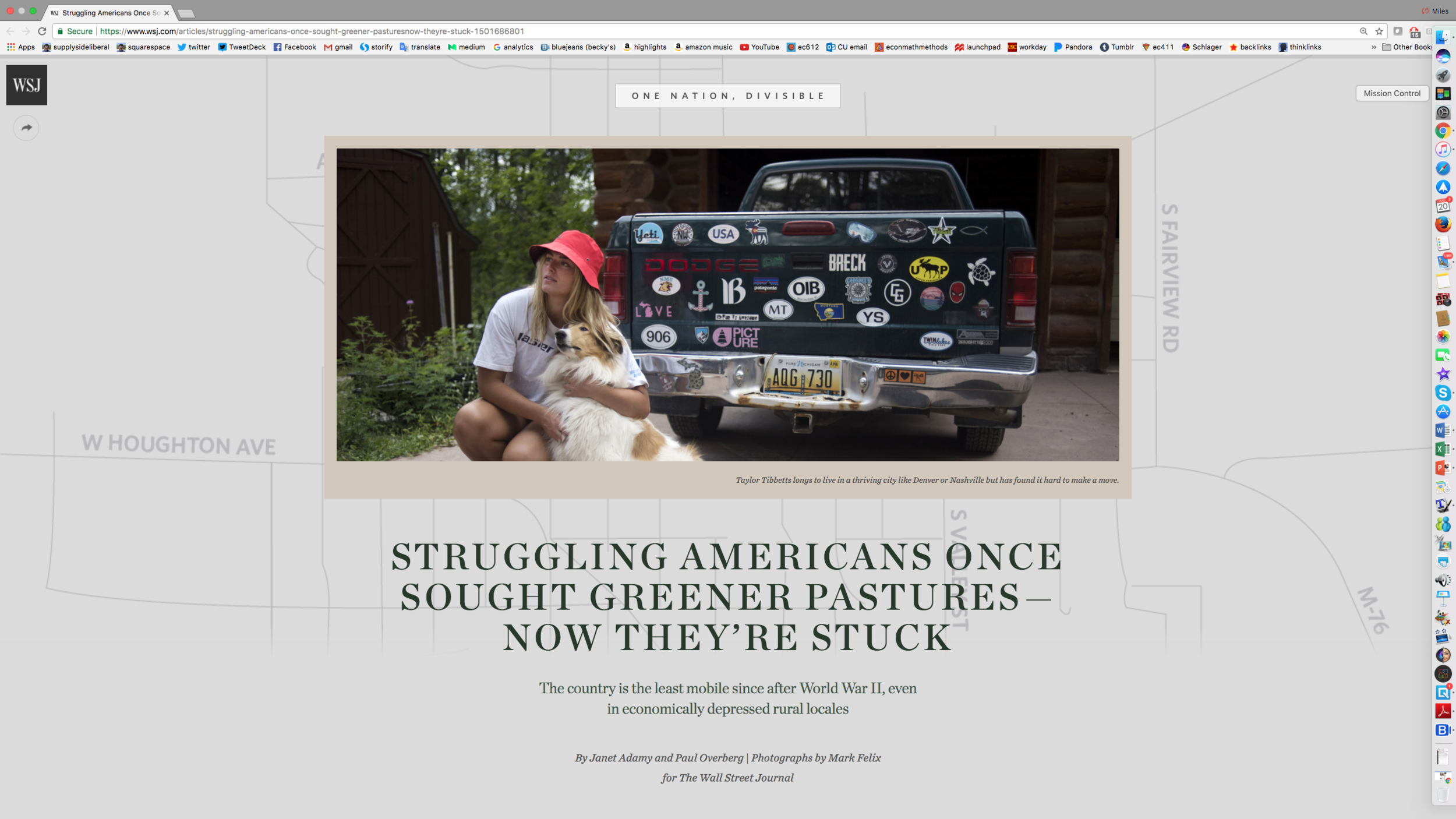
Americans are moving less than they used to. This is preventing rural wages from recovering as more and more of the good jobs move to the cities. Janet Adamy and Paul Overberg wrote a great article about why. All of the quotations are from that article, "Struggling Americans Once Sought Greener Pastures—Now They're Stuck," which was published in the August 2, 2017 Wall Street Journal.
First, they lay out the magnitude of the issues:
In rural America, which is coping with the onset of socioeconomic problems that were once reserved for inner cities, the rate of people who moved across a county line in 2015 was just 4.1%, according to a Wall Street Journal analysis. That’s down from 7.7% in the late 1970s.
Most of the rest of the article is about the reasons why. To preview, they are
- High Home Prices in the City Because of Restrictive Land-Use Regulations
- Occupational Licensing
- Aid for the Down-and-Out that Is Tied to a Locality
- Cultural Divides
1. High Home Prices in the City Because of Restrictive Land-Use Regulations
I have been struck more and more by the importance of land-use regulations in maintaining the class divide in America. I have written about that issue in these posts:
- "Keep the Riffraff Out!"
- The Wrong Side of Cobb-Douglas: Matt Rognlie’s Smackdown of Thomas Piketty Gains Traction
- With a Regulatory Regime That Freely Accomodates Housing Construction, Lower Interest Rates Drive Down Rents Instead of Driving Up the Price of Homes
- Rick Perry’s New Look
- Density is Destiny
- Building Up With Grace
- Steve Durlauf on Legally Encouraged Residential Segregation as a Perpetuator of Inequality
(Also see Emily Badger: There Is No Such Thing as a City that Has Run Out of Room.)
Here is what Janet and Paul have to report on this issue:
Economists say there are several practical reasons for the declining rural mobility—the first being the cost of housing. While small-town home prices have only modestly recovered from the housing market meltdown, years of restrictive land-use regulations have driven up prices in metropolitan areas to the point where it is difficult for all but the most highly educated professionals to move.
Even more pointedly, they quote Peter Ganong as follows:
“We’re locking people out from the most productive cities. ... This is a force that widens the urban-rural divide.”
2. Occupational Licensing
I have repeatedly attacked occupational licensing as both an unwarranted infringement on liberty and as a way for the haves to keep down the have-nots. See for example:
- When the Government Says "You May Not Have a Job"
- John Stuart Mill: Certification, Not Licensing
- The Free Market and Collective Liberty
- Uwe Reinhardt: Does Occupational Licensing Deserve Our Approval? A Review of Work by Morris Kleiner
In addition to those harms, occupational licensing requirements that differ by state can make it harder for people to move. Janet and Paul write:
Another obstacle to mobility is the growth of state-level job-licensing requirements, which now cover a range of professions from bartenders and florists to turtle farmers and scrap-metal recyclers. A 2015 White House report found that more than one-quarter of U.S. workers now require a license to do their jobs, with the share licensed at the state level rising fivefold since the 1950s.
Janna E. Johnson and Morris M. Kleiner of the University of Minnesota found in a nationwide study that barbers and cosmetologists—occupations that tend to require people to obtain new state licenses when they relocate—are 22% less likely to move between states than workers whose blue-collar occupations don’t require them.
3. Aid for the Down-and-Out that Is Tied to a Locality
In general, it is probably a good thing that America has a wealth of non-governmental forms of aid for people (see "How and Why to Expand the Nonprofit Sector as a Partial Alternative to Government: A Reader’s Guide"). But when the non-governmental aid is tied to a locality, it can inhibit mobility. Governmental aid tied to a locality can do the same thing. Janet and Paul write:
For many rural residents across the country with low incomes, government aid programs such as Medicaid, which has benefits that vary by state, can provide a disincentive to leave. ... Civic leaders here say extended networks of friends and family and a tradition of church groups that will cover heating bills, car repairs and septic services—often with no questions asked—also dissuade the jobless and underemployed from leaving. ...
Cody Zimmer, 29, of Ogemaw County toyed with moving to work for an uncle in New Jersey or closer to Detroit after a decadelong career in skilled manufacturing periodically left him unemployed. But student debt and a divorce damaged his finances, and he says his best option ended up being renting his mom’s house outside West Branch. “If anything happened there, I’d be right back out on my own,” Mr. Zimmer says of these other places. ...
Many West Branch residents say that the town’s economic woes aren’t enough to make them leave. They point to the safety net the community provides—a helping hand to pay bills, or the way people come together when a neighbor is diagnosed with cancer.
It is not impossible to have non-governmental aid that is not tied to a locality. Mormons can move anywhere and immediately have the kind of social support and practical aid from their new congregation that others feel they can only get in their hometown. Every Mormon is effectively assigned several social workers from the congregation, called "home teachers" and "visiting teachers," who come into the home and try to identify if they need help as well as giving a religious lesson. You can read about this system and other aspects of Mormon social support in Megan McArdle's Bloomberg essay "How Utah Keeps the American Dream Alive" (discussed in the storify "Taking Care of the Poor and Troubled Without Getting Tied Up in Knots About Race") and these posts:
- How Conservative Mormon America Avoided the Fate of Conservative White America
- The Message of Mormonism for Atheists Who Want to Stay Atheists
- Inside Mormonism: The Home Teachers Come Over
Besides practical aid, Mormon congregations buffer culture shock when people move from one place to another. More than one observer has described a Mormon congregation as an ersatz small town. Mormons themselves are not ashamed to glory in the relatively high degree of standardization of Mormonism from place to place, even sometimes comparing it to McDonald's in that regard.
4. Cultural Divides
For those who do not belong to a religion that provides an ersatz small-town and a degree of cultural homogeneity wherever they go, awareness of the cultural differences between rural areas and the big city can be a powerful force reducing the willingness to move. Janet and Paul write:
Beyond the practical difficulties, rural residents and experts say there is another impediment to mobility that is often more difficult to overcome—the growing cultural divide.
Tom W. Smith, who runs the University of Chicago’s General Social Survey, says that cities’ welcoming attitudes toward immigrants from abroad, same-sex marriage and secularism heighten distrust among small-town residents with different values. ...
“One of the big cultural divides when people move from small towns to cities is this feeling that you can’t be involved in your community,” says David J. Peters, associate professor of sociology at Iowa State University. “You feel powerless to change large cities.”
Europe has understandably low mobility between different countries that have different languages and cultures. America is becoming more like Europe in that regard.
Politics itself has become a bigger and bigger cultural divide. I was surprised and disheartened by the pushback I got online when I decried political prejudice. Here is my opening salvo criticizing "politicism" and then the tweeted defenses of political prejudice that I received:
- Economics Is Unemotional—And That's Why It Could Help Bridge America's Partisan Divide
- Twitter Debate on "Politicism" (Political Prejudice)
I wish people would make a bigger effort to understand the political views of their fellow Americans instead of demonizing those who think differently. Even views that deserve to be fought vigorously need to be understood first in order to fight them effectively. My single most popular post, "John Stuart Mill's Brief for Freedom of Speech," has a useful set of resources for thinking about that.
Conclusion
Each of these four factors that reduces mobility is a problem in its own right. Trying to remove these obstacles to mobility would also reduce obstacles to opportunity and comity more generally. If you want to see me wrestling with these kinds of issues, try "Restoring American Growth: The Video."
The Unmaking
Link to the video above on Youtube
Although I am a Nonsupernaturalist, I like listening to Contemporary Christian Music because it covers a wide range of themes in human life that go beyond the important and moving, but not-wide-ranging-enough themes of the ups and downs of romantic relationships that animate the bulk of popular music. Growing up, I liked the political songs of the 60s for a similar reason: they added political themes to the romantic themes of most popular music. (You can tell that I pay a lot of attention to lyrics; I know many people focus almost entirely on the music itself in what they listen to, apart from lyrics.)
A common human experience is to have something one has worked hard for fall apart. Nichole Nordeman's song "The Unmaking," (see the videos and links above) points to the deep truth that rebuilding after everything seems to have fallen down sometimes leads to something better than what fell. This has certainly been the case in many instances in my own life. For example, the professional disappointment I wrote about in "Believe in Yourself" led me through a long road to even better research projects. And the crumbling of my belief in Mormonism led me to a better place, religiously.
To explain why "Demolition Day" can lead to something even better than what came crashing down, Nichole Nordeman suggests that the new creation was God's doing, while what came crashing down was one's own doing, even if done while invoking God's name. Even if no God currently exists, there is a lot of truth to this view.
Most of us, in our first attempts to build follow the lead of society's current notions of how to proceed. Often that means engaging in "tournaments" in the broad sense in which economists use the word: competitions in which, by design, only a few can reach the top. It is only after failing in a tournament or several tournaments that one begins to question whether the things all the many other people also engaged in tournaments are after are really the most important things.
In my own belief, asking the question of what is most important and what is really worth doing is the first step toward God—even if God does not yet exist. This is the message of my sermon "Teleotheism and the Purpose of Life." This past year, I have tried to dig into how to begin answering that question in a series of posts that are often framed as advice to young economists, but I hope are helpful to others as well. These three are about not getting caught in the rat race, aiming to do good, and thinking big:
And these three are about questioning the narrow views other people might have about how one should proceed (here the translation from my attacks on narrow views in economics and academia to attacks on narrow views in other fields may take some extra work):
- Economics Needs to Tackle All of the Big Questions in the Social Sciences
- Defining Economics
- Does the Journal System Distort Scientific Research?
Finally,
talks about the importance of love in getting to where we want to go.
Despite all that I have written so far, I feel there are other deep insights in Nichole Nordeman's lyrics about the experience of seeing things one has built fall down and then rebuilding that I can't fully articulate. There is much that we Nonsupernaturalists can learn from Supernaturalists, even without giving up our disbelief.
Binyamin Appelbaum on Anat Admati: When She Talks, Banks Shudder →
Anat Admati is one of my heroes. The link above is to a profile of her.
When the Output Gap is Zero, But Inflation is Below Target

More and more central banks are facing a situation in which the output gap they are looking at looks close to zero, but inflation is below their target. This is arguably the case for Japan, Sweden and the US, for example. Even the eurozone is getting close to this situation. Sometimes journalists discuss a zero output gap combined with too-low inflation as if such a situation were strange, but a range of different macroeconomic theories all have the property that a zero output gap is consistent with any constant inflation rate. (This is an aspect of "monetary superneutrality.")
Older "sacrifice ratio" models predict that a positive output gap will tend to make inflation gradually rise, while a negative output gap will tend to make inflation gradually fall. Newer models that have a simple Calvo pricing mechanism predict that that an increase in expected future output gaps will make inflation jump up, while a current positive output gap is associated with inflation gradually falling, with the direction reversed for negative output gaps.
I think recent history is easiest to understand by thinking in terms of one of the older "sacrifice ratio" models combined with the idea that the output gap has some immediate effect on inflation has some immediate effect on inflation. I don't have a good microfoundation, but suppose that
gap = log(GDP) - log(natural GDP)
d inflation/dt = a d(gap)/dt + b gap
where both a and b are positive. With this equation, if the output gap is constant at zero, inflation remains unchanged. So the economy can be completely recovered in terms of the output gap without any tendency at all for inflation to go back to target. The term "b gap" that relates the level of the gap to the rate of change of inflation would have dragged down inflation during persistent negative output gaps during the Great Recession and the slow recovery from the great recession. To bring inflation back up to target would require a period of time with a positive output gap.
Since positive output gaps are pleasant given all the distortions that make the natural level of output lower than the level at which (other than the effects on inflation) the marginal benefit of output equals the marginal cost, why don't central banks shoot for a positive output gap until inflation returns to the target of 2% per year? I think the answer is:
- Central bankers are not used to trying to have positive output gaps. The low unemployment rates associated with positive output gaps seem dangerous.
- Central bankers don't really like having an inflation target above zero. They feel in their bones that their job is to keep inflation down, close to zero, not to push it up.
When there is a clear need to raise inflation (say in a situation where inflation is negative), I don't have much sympathy for an aversion to temporarily positive output gaps. But I have a lot of sympathy for the idea that a 2% inflation target is too high. As I argued in "The Costs and Benefits of Repealing the Zero Lower Bound...and Then Lowering the Long-Run Inflation Target," in the absence of any lower bound on interest rates, the inflation target can be lower than if there is a lower bound on interest rates.
Any central bank that is genuinely committed to eliminating lower bounds on interest rates should reevaluate its inflation target accordingly. Even a willingness to use mildly negative rates should bring down the appropriate inflation target. Both the Bank of Canada and Ben Bernanke have taken the position that planning to use negative interest rates when necessary is better than raising the inflation target above 2%. (See "Bank of Canada would consider setting interest rate below zero: Poloz," "Renewing Canada’s Inflation-Control Agreement," and "Ben Bernanke: Negative Interest Rates are Better than a Higher Inflation Target.") To the extent that position envisions only mildly negative rates, a commitment to use deep negative rates when called for might well reduce the optimal inflation target below 2%. If the optimal inflation target fell, say, as far as 1.5%, the current concern for raising the inflation rate—a goal central bankers feel half-hearted about—would go away.
If monetary policy were being designed from scratch, I doubt that central bankers would design in a lower bound on interest rates. The tradition of a lower bound on interest rates is simply a bad historical carryover, much like the gold standard was. (Good riddance!) At the moment, that tradition of a lower bound on interest rates is pushing inflation higher than it would otherwise have to be. Or maybe the tradition of a lower bound on interest rates is simply making central bankers who can't bear to have a higher inflation rate feel guilty about not being willing to raise inflation, without actually getting them to raise inflation.
Further Reading: "How and Why to Eliminate the Zero Lower Bound: A Reader’s Guide."