Presidential Q&A: Is a Strong Dollar or a Weak Dollar Good for the Economy?

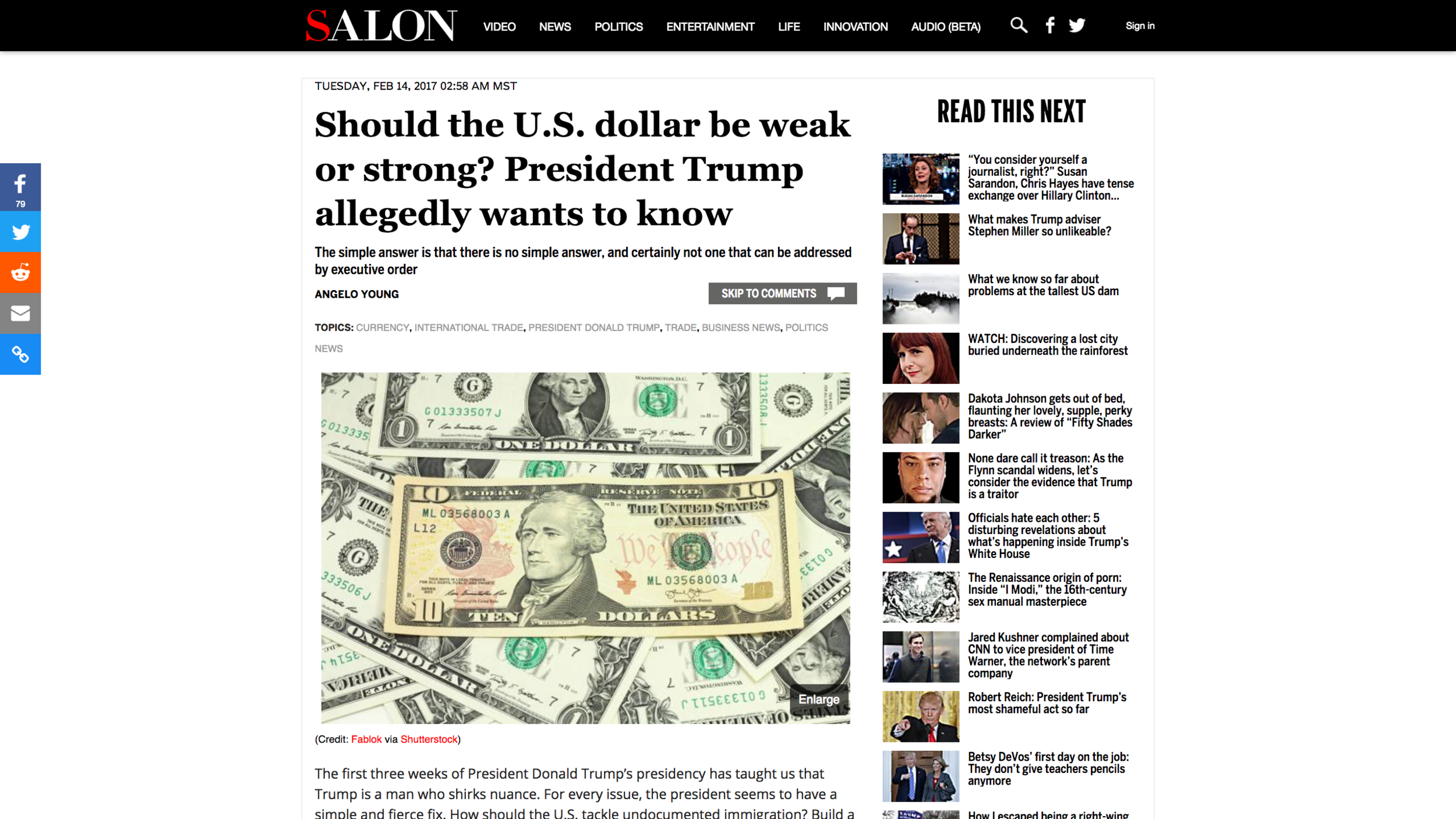
Link to Angelo Young's February 14, 2017 Salon explainer "Should the U.S. dollar be weak or strong? President Trump allegedly wants to know." 

Link to Angelo Young's February 14, 2017 Salon explainer "Should the U.S. dollar be weak or strong? President Trump allegedly wants to know." 

In his Salon article shown above, "Should the U.S. dollar be weak or strong? President Trump allegedly wants to know," Angelo Young reports: 

According to two anonymous White House insiders, Trump recently called National Security Adviser retired Lt. Gen. Mike Flynn at around 3 a.m. to ask whether a strong or weak dollar is good for the economy.

Angelo invited me to answer the President's question. Here is the answer I gave in full, an answer you can see reflected in several ways in Angelo's article:


It is not right to say in an unqualified way that a "strong" dollar is good or to say that a "weak" dollar is good. It depends on why the dollar is strong or weak. The dollar tends to be stronger

a. if opportunities for investing in the US are good

b. if demand for US products is high

c. if US saving is low

d. if trade barriers make it hard to import things into the US

Simplifying a bit, the first two (a & b) are good. The last two (c & d) are bad. 

The best way to "improve" the US trade balance (that is, to reduce the trade deficit) is to encourage additional saving. (This will lead to a weaker dollar in a good way.) Encouraging more saving is surprisingly easy to do. And the extra saving has an especially big effect on the trade balance if people are encouraged to be diversified by including international mutual funds among their investments. I explain all of that in my Quartz column "How Increasing Retirement Saving Could Give America More Balanced Trade." (This column gives my recommendation to the President. I am explicit about that in my more recent post "Border Adjustment vs. Dollar Depreciation.")

By the way, one of the reasons a strong dollar caused by trade barriers against imports is bad is that it defeats the intended benefit of improving the trade balance, but leaves the harms of the trade barriers. (There are other effects of trade barriers that create some winners among American citizens and some losers. Making some Americans lose to benefit other Americans may sometimes be part of the purpose of trade barriers. Trade barriers can rob Peter to pay Paul in this way despite the strengthening of the dollar.)

On who benefits and who is hurt, again it depends on why. The strengthening of the dollar defeats most of the effect of trade barriers and border adjustment on the dollar. By contrast, increasing the saving rate works through the fundamental forces affecting the value of the dollar, and so succeeds. Such a policy would benefit most Americans--some by enhancing retirement security, others by increasing net exports and therefore the number of attractive jobs, others by the increase in the dollar value of their foreign investments. However, imports would become somewhat more expensive, hurting those who import foreign goods for a living and those who consume a lot of foreign goods. 

(Trade barriers, unlike border adjustment, significantly hurts exporters and helps those who compete with imports.) 


Jordan Andrew Kimball on Edward Lawrence Kimball


My brother Jordan Andrew Kimball is three years younger than I am. (My wife and I named our son Jordan after my brother.) Together with my sister Mary, Jordan and I made up the amiable middle trio of the seven children in my family growing up. Jordan appeared in this blog before in "Tyler Cowen on My Little Brother Jordan's Wisdom." Below is Jordan's tribute for my Dad, which completes the set of seven tributes that my siblings and I gave at the Memorial Service for my Dad on December 3, 2016. You can see my own tribute here tribute and in other posts those of my brothers Chris and Joseph and of my sisters Paula, Mary and Sarah. My Dad's colleague Jack Welch also gave a tribute that you can see here.

Here are Jordan's words:


Growing up I thought my father was a righteous man, but not a pious one.
I remember, as a boy, working with my father in his workroom, building a pinewood derby car together. He hit his thumb with a hammer and exclaimed "Damn!!" After sucking his thumb for a moment, he looked me in the eye and said, "You know, "Damn" is a perfectly good swear word.”

I grew up admiring my father and wanting to be just like him. But when I was 13 I started to fear I would never measure up. I remember reading an essay in a Junior High class which described "the platinum professions" as medicine and the law and I took it as a binary choice, so I become a doctor. But this was my own anxiety, because I don't ever remember my father placing any burden of expectation on me, other than to simply be good.

When I was 15, I tried my father's patience. A few days after my father's Aunt Mary died, the family was getting ready to attend her funeral. I was standing at the top of the stairs, in shorts, and my father, in a towel, having just showered, asked if I was getting ready. I told him "No", and added that I didn't want to waste my time driving to a funeral in Salt Lake. My father said we were going as a family and that attending funerals matters to those close to us. He asked me to get ready even if I didn't feel like it. Then I said something with teenage indignation that I've regretted, "Well, she won't care, she's dead!” In response to this outburst my father, only sounding a little exasperated, said, "We don't attend funerals for those who have died. We attend funerals for those who are still living.” The 15 year old me continued resisting, not seeing how my attendance made any difference.

Then my dad calmly said, "Son, it would make a difference to me. Would you please get dressed, and go for me?" I looked at his face and saw love in his intelligent eyes, and I quietly went down to my room and got ready. When I took my seat in the car, he said simply, "Thank you." I have marveled at his patience and gentle persuasion.

My father was an enthusiastic sports fan, especially when his own kids participated. I ended up playing several sports and it seemed to me that my dad was always there when we competed. He could be counted on to be reading, and underlining a law journal in the between times. He could also be counted on to cheer unreservedly from the stands, "Go, Kimball!!", "Atta boy!

Jordan!". Although my father’s polio had limited him athletically, the father I grew up with had an awesomely powerful upper body he always said was from miking cows. We still all marvel at the size of the metal bracelet he wore as a teen. It may have been one of the reasons he seemed to particularly enjoy that his sons wrestled in high school.

I remember exploring the items in the top desk drawer of my dad's home office. One item in particular, a bunch of pencil stubs in a rubber band, is memorable. When I told him they looked useless and asked why he didn't just throw them away, he said that they were not his, they belonged to the law school. Occasionally he took a bundle of them back to school. It always makes me smile to think of this quiet gesture of frugality and honesty.

The father I knew didn't like travel, but my mother loved to travel. Early in his career, my father became involved in writing multi-state bar exam questions. The diverse group of lawyers and professors had to meet someplace, and this became the vehicle for a twice yearly, paid trip, allowing my parents to travel all over the country together, big cities, vacation spots, working and socializing, and as their kids got older, they would extend the trips a few days and drive all over the local countryside, just the two of them. It is one of the most romantic memories I have of my parents, together, being able to find a way to combine their interests and enjoy each others company.

You may have noticed my bow tie, and others. Bow ties became my father's preference. My last interaction with my father was shortly after he died at home last week. I helped dress his body.
I sat him up, and leaned his back against my chest and tied on his white bow tie. I am not used to tieing a bow tie on someone else and I fumbled a number of times before even getting close to getting it right, eventually tugging and pulling it gently into an acceptable shape. This may be a metaphor. Even in death I could feel my father's love and patience. 

Eric Schwitzgebel: A Theory of Jerks

Here are two tidbits from this excellent essay: 


1. I submit that the unifying core, the essence of jerkitude in the moral sense, is this: the jerk culpably fails to appreciate the perspectives of others around him, treating them as tools to be manipulated or idiots to be dealt with rather than as moral and epistemic peers.

2. To discover one’s degree of jerkitude, the best approach might be neither (first-person) direct reflection upon yourself nor (second-person) conversation with intimate critics, but rather something more third-person: looking in general at other people. Everywhere you turn, are you surrounded by fools, by boring nonentities, by faceless masses and foes and suckers and, indeed, jerks? Are you the only competent, reasonable person to be found?

How Strong is the Economics Guild?

I had two contrasting experiences this week. First, I had a student come to office hours saying it was hard to figure which of all the cacophony of economy ideas put forward in the news to take seriously. I pointed out that unlike climate science, where good journalists usually feel that for a quotation meant to be taken seriously (as plausibly true) they need to quote people who are PhD's in appropriate disciplines and are also usually professors or government employees, they will quote as plausibly true the economic opinion of a much wider set of people, including at least business people and politicians in addition to PhD economists. The picture one gets from the news about the economy and economic policy is much different if one focuses primarily on what the PhD economists are saying.

On Twitter as well, I notice the large number of people who are not pedigreed members of the economics guild who are happy to disagree vigorously with me and with other economics professors there. So my experience has not been one of the economics guild having a monopoly on public discourse about economics.  

The second experience was reading Cameron Murray's blog post about the book Econocracy linked above. Here is Cameron's summary of the books main points: 

  1. Economics is now the default method of analysis in serious social and political debate, undermining the legitimacy of other modes of analysis, making anyone who doesn’t understand economics and its jargon unable to participate in the major political debates of our time.
  2. Despite the great power granted to economists, the discipline has become nothing more than a narrow ideology, with that last defining theoretical battles happening back in the 1970s, and little openness to criticism or new ideas since.
  3. Changes in how economists and their discipline function could benefit democracy. These changes are a) economists training their next generation in a more pluralist way, giving them exposure to many methods of analysis to avoid the ideological indoctrination that is economics education and b) economists being less insular by reaching out to the public to promote a culture of “citizen economists”, who have sufficient understanding and confidence to bring their groups to the table and participate effectively in policy debate.

To take point 3b first, I see a thriving economics blogosphere and Twittersphere effectively reaching out to the public in exactly this way. (I especially admire how George Mason University has supported and encouraged its economists in this kind of public outreach.) And the economics blogosphere/Twittersphere includes quite a few strong heterodox voices, both inside and outside the guild. Let me give as examples my Twitter friends TakingHayekSeriously inside the guild and John L. Davidson outside the guild. 

On point 3a, economic training can often be so narrow that even someone like me—who doesn't think of himself as heterodox at all, but makes some effort to be broad-minded—can count as "training [the] next generation in a more pluralist way." The narrowness I see and lament in subfields of economics can be quite severe: often a limitation to a tiny slice of all possible ways of working in that subfield. But at least the narrowness within subfields of economics periodically shifts from narrowness in one direction to narrowness in another direction. There are often very detailed rules about what one is allowed to do and what one is not allowed to do that shift only when someone with enough prestige within the guild decides to break those rules. (For a particular broadening of the rules, see my post and paper "Cognitive Economics.")

On point 2, it is worth noting that while economics tends to pull people trained in it in what is conventionally thought of as a "conservative direction," the median economist working in the US remains left of center politically relative to the average US citizen. This is evidenced by the deep bench of top guild economists that Democratic administrations have to choose from, and the relatively limited bench of top guild economists that Republican administrations have to choose from. The combination of the bulk of economists being left of center nationally and the important minority of economists who are much more right-wing gives the lie to the idea that economics is a "narrow ideology," unless one considers 90% of the US political spectrum a "narrow ideology." 

On point 1, I for one hunger for new modes of analysis. But I want the other modes of analysis to have clearly articulated, fairly general theories and careful statistical analysis. But clearly articulated general theories and careful statistical analysis are hard to do without the kind of hard-core training that economists get. (One group of scientists who get similar training are the evolutionary theorists. If you ever get the chance to hang out with evolutionary theorists as I have been luck to be able to do, you will notice that they think remarkably like economists.) This is why I wrote that "Economics Needs to Tackle All of the Big Questions in the Social Sciences." Trying to answer a wider range of questions will inevitably lead to an economics that is not just richer in the topics it covers, but methodologically richer. Even Gary Becker, whom I think of as trying to approach a wide range of topics in a relatively traditional, neoclassical way, stretched economic methodology a great deal.

Cameron makes one other key point, less closely connected to his summary of the book. He writes:

Making policy in order to nurture a thing called an economy is bizarre, bordering on meaningless. The slightest scrutiny reveals that the economy is whatever economists assume it to be.

When we think of Gross Domestic Product, probably the main measure of the ethereal thing we call the economy, we are actually thinking of a measure whose definition has changed dozens of times.

I agree that one of the things that sometimes makes economics seem illiberal is our failure so far to develop and establish official (and therefore prestigious) measures of a broader social objective function than GDP. Dan Benjamin, Kristen Cooper, Ori Heffetz and I write about what I believe to be surmountable challenges in creating such a measure in  "Challenges in Constructing a Survey-Based Well-Being Index" (ungated pdf), that should be coming out in the American Economic Review "Papers and Proceedings" issue this year. It matters what we measure and treat as our objective function for policy. (By the way, Gary Becker had an important role in the economics of happiness this effort is based upon. See "My Experiences with Gary Becker.")

But once we have a reasonably comprehensive measure of national well-being, or of the well-being of various groups, the kind of theoretical and empirical analysis needed to advance the objective of increased national well-being will be the kind of excellent theoretical and empirical work that economists already admire. Indeed, my standard joke about the weak point in the overall program of evidence-based government is that we need to "assume the existence of an abundance of brilliant econometricians." If all goes well with our part of the effort, we will be able to provide those hoped-for brilliant econometricians the data they want, or at least all they can reasonably ask for.  

Marriage 102

For Valentine's Day, 2014, I wrote "Marriage 101." This is the sequel. In "Marriage 101" I recommended books by John Gottman and coauthors:

John Gottman and his research team are famous for using observations in their "Love Lab" to predict long in advance which marriages are more likely to succeed and which are more likely to fail.

Recently, I read another book by John Gottman and coauthors with an embarrassing pop-psychology title, but excellent content:

Upon reading, I kicked myself for things I had been stupidly doing or not doing, even after almost a third of a century of marriage to my wife Gail. And for many of the insights, I had to remind myself of my standing resolution to face the truth, even if to get myself to face the truth I have to promise myself I don't have to do anything about it. But it was worth it, despite those feelings of distress.

Except where I note otherwise, all quotations below are from this book by John, Julie, Doug and Rachel. There is some good advice in the book that I don't feel comfortable talking about here. But below are some insights and bits of advice I do feel comfortable writing about.

Attunement

The first insight is about attunement. Here is the lead-in: 

In our Love Lab, we found that women have two major complaints about men. The first complaint is: “He is never there for me.” The second complaint is: “There isn’t enough intimacy and connection.” These women feel alone even when they are in a relationship. In many ways, these are related complaints. These women cannot trust their men to be there for them when they need them. Most of the time, this is about being there for them emotionally: listening to them, caring for them, and safeguarding their hearts.

In contrast, men have two major complaints about women: “There’s too much fighting, and there’s not enough sex.” Sound familiar? These men are also lonely even when they are in a relationship. We found that men actually want intimacy just as much as women, but they feel that intimacy when there’s less fighting and more sex.

These separate complaints from men and women are, in fact, causally related and can be addressed through a simple skill we like to call attunement. When men “attune” to their women, there is less fighting, more frequent (and better) sex, and both men and women no longer feel so alone. It is also the skill that leads to genuine emotional connection, which in turn leads to trust, which in turn leads to you giving women the number one thing they need and want. In other words, this is a big deal.

How does one attune?

ATTEND. Give your undivided attention when it’s needed. ...

TURN TOWARD. This is not a metaphor or a new age expression. Physically. Turn. Toward. Your. Partner. ...

UNDERSTAND. No matter what she is saying, the goal is understanding. And how you get to understanding is by asking questions. If the woman in your life is complaining about her best friend, don’t offer a solution, don’t try to distract her, don’t think of how you can “fix” the problem, don’t make jokes, and don’t minimize the problem. Ask questions about what she is feeling and what it all means to her. This part of attuning is not about saying “I understand”; it’s about showing genuine interest and attempting to understand why this is important to her. Whether she is complaining about her mother, frustrated with her boss, or pissed off at you—let understanding be your goal.

NONDEFENSIVELY LISTEN. If you are paying attention, turning toward her, and seeking understanding, you are well on your way down the path of nondefensive listening. This is especially important if what a woman is talking about or is upset about is you. Don’t react. No one likes to be criticized or feel like they are under attack. But the tricky thing is, if you counterattack, make excuses, justify, or argue, you are only going to be criticized more. Don’t interrupt and don’t forget that any feeling is fact to the person feeling it. Whether or not you agree with her reactions or how she sees reality, her feelings are real to her in that moment. You only need to listen to her express them. ... The men who were able to “downregulate” their anger (in other words, calm themselves down and not overreact), were the men with great relationships.

EMPATHIZE. For you Trekkies out there, think of empathy as a Vulcan mind meld. For those of you thinking you’ve already covered this with the whole “understanding” thing, think again. Understanding is an intellectual pursuit, while empathy is an emotional pursuit. ... Clue in to the emotions she’s expressing. How do you do this? You can ask her how she feels (genius). You can also read her body language. ...

If some part of you is screaming, “If I do this, she will roll right over me—she’ll win!” remember that attuning with how she feels doesn’t mean that you agree with everything that she says, just that you hear her—that you “get it.”

Fear

The second insight is how real physical fear is for most women. Here is the story from the book illustrating that:

Both Lynn and Mike were frustrated by a marriage that seemed to have turned more into a weird form of competitive living than a partnership. In desperation, Lynn grabbed Mike and brought him to a workshop about understanding women. ...

The woman who was leading the workshop began by asking one question: “This is for the men, first. How many of you have ever feared for your life or your physical well-being?” After a long pause, a few of the 50 men in the room raised a hand. “When was the last time you feared for your life or your physical well-being?” There was an awkward silence for a bit, but eventually the men started raising their hands to answer.

“Well, there was this one time way back in high school when I got into a fist fight,” one man explained.

Another said, “Once, about 10 years ago, when I had too much to drink and ended up in a really bad neighborhood in Los Angeles. It was just for a moment.”

“In Vietnam,” said a third, who was a veteran.

As each of the men answered, it became clear that the awkward silence wasn’t about feeling uncomfortable answering the question, it was because they were struggling to remember a time when they felt fear for their safety. All of the examples the men gave were from 10, 20, 30, or more years in the past.

Next she asked the women. “How many of you have ever been afraid for your life?” Every female hand in the room went into the air. “How many of you have been afraid in the last 6 months?” Again, every hand went in the air. “How about in the last month?” “The last week?” Every hand was raised. Finally she asked the question, “How many of you were nervous or fearful walking through the hotel parking garage to come to this workshop?” Again, every hand was raised, including Lynn’s.

One day recently, I forgot to close the garage door and it was open all night. Because I think of us as living in a relatively safe neighborhood, this didn't seem like a big deal to me. But reading the passage above helped me understand how it was a bigger deal to my wife. 

It's Hard to Like One's Own Body

In a good relationship, the two partners are attracted to one another's bodies. So it can be hard to understand how they don't always feel this way about their own bodies. Here was an interesting story to back up the authors' claim that "most women have a painful relationship with the image they see in the mirror," and not just women: 

When John was a young assistant professor at Indiana University, he wanted to take a summer workshop offered by the Kinsey Institute. They agreed to let him in for free if he would run one group session consisting of six men and six women. Most of them were sex therapists. The group discussion was to be stimulated by an initial exercise the Kinsey Institute designed. Each person had to describe how he or she felt about his or her body overall, and then they each had to choose a specific body part and tell the group how they felt about it.

Now John thought this would be a pretty easy group to run, but as he looked at the 12 participants it struck him that this was an unusually attractive group of people. The women were quite beautiful and the men all very handsome. Apparently sex therapists are an attractive bunch. John thought the exercise would end up being a dud, since he imagined each of these attractive people would say, “Look at me, look at how sexy I am, how great I look. I need to pick some part of my body? Well, I love every part of my body. What’s not to love?”

It turned out John was wrong—really, really wrong. Every one of these men and women hated their bodies. A woman would say, “I don’t like my body. I’m too fat. These are my breasts. I hate them the most. They’re too small and they droop too much.” The men were just as bad. It seems men are not immune to having painful relationships with their bodies, too.

I have always been grateful that economics is a discipline in which it is OK to be ugly. Indeed, to my eye, many Nobel prize winners in economics are well below the population average in good looks. This is as one would predict as talented people who are also good looking are preferentially drawn into other fields where the payoff for good looks is greater, leaving an enriched group of talented but ugly people within economics. But while basking in the relative lack of need for good looks in economics, empathy requires remembering that there are many other contexts where good looks matter more, and people can reasonably get anxious about their looks. 

Differences in Approaching Sex

Although men and women are alike in many ways, their attitudes towards when to have sex are on average quite different. One of the clearest evidences of this is the much higher frequency of sex among gay men than among lesbian women. I appreciated the careful way the authors described this difference:

The difference between men and women is often expressed this way: Women need to feel emotionally connected to have sex, and men need to have sex to feel emotionally connected. But we think the statement that men have fewer prerequisites than women fits the data better. ...

The prerequisites women have aren’t always about emotional closeness. Sometimes they are about being exhausted, or distracted, or not feeling well, or a host of other considerations. The evidence is pretty clear that despite all of these confounding factors, men are usually willing to overlook them and have sex anyway. Sexual desire for women is a barometer. If she’s not happy, or rested, or healthy, or feeling supported and loved, she’s not going to feel a whole lot of sexual desire.

Assuming the prerequisites are in order, the authors give an important secret for more frequent sex if that is what you desire:

Interestingly, women agree to sex at the same rate that men do. Psychologists Sandra Byers, PhD, and Larry Heinlein, PhD, conducted a study in which 22 men and 55 women were asked to keep records of their sexual encounters. The research found that males initiated and considered initiating sex more often than women, with cohabiting men initiating more than married. However, there were no differences between men and women in their responses to initiations. Both men and women responded positively to initiations or bids for sex about 75 percent of the time. Mostly these initiations were nonverbal. They started with emotional connection, romance, then affection, kissing, caressing, and, if the signals were right, moved on to erotic touch. The bottom line of this research is, ask her for sex. You have a 75 percent chance that she’ll say yes, assuming all else is going well—she is rested, connected, unstressed, and feeling safe.

Most importantly, don’t take it personally if she says no. 

Of course, this success rate of 75 percent is in an endogenous equilibrium; asking more often may cause the success rate to decline somewhat. But even a little bit lower success rate can make an attempt well worth it. 

Handling Arguments

Every couple will have arguments; or at least any couple that doesn't is so abnormal, I would worry about them. In my post "Marriage 101," I made this point: 

In an argument, if each partner comes back with 101% of the irate heat the other just gave, things will explode. But if each partner ratchets down the intensity to 99% of the intensity of the last remark, things will eventually calm down.* So a small difference in reaction pattern can be the difference between an explosion and something that simmers down.

Let's pursue the details of how to damp down one's reaction. First, what kinds of anger is one likely to face?

Sandra Thomas from the University of Tennessee led the Women’s Anger Study, the first “large-scale, comprehensive, empirical study of the everyday anger of ordinary women.” Her research found that the causes of women’s anger could be rooted in one or more of three categories: powerlessness, injustice, and the irresponsibility of other people.

Second, what are the ways of responding most likely to cause trouble, and where does the temptation to respond that way come from?

We’re going to let you in on two secrets we discovered in the Love Lab. First, men get more emotionally flooded and overwhelmed than women do in a conflict situation. And second, once flooded, only men who are able to reduce their heart rates are able to decrease the amount of criticism, defensiveness, contempt, and stonewalling they contribute to the conflict. These four things are what we call the Four Horsemen of the Apocalypse in a relationship. ...

Does any of this sound familiar? These are all ways of escalating conflict. If your goal is to have less conflict with the woman [or man] in your life, avoid responding to her with stonewalling, defensiveness, criticism, or contempt. It’s self-defeating and a recipe for disaster. Yet this is what men do naturally when they get emotionally flooded.

Third, the origins and nature of the physiological state of being "flooded" follow a recognizable pattern: 

Flooding is the real enemy of constructive dialogue and productive conflict. While flooding has been described before, we now understand it much better because of recent research from the Love Lab. Flooding has three major components: (1) the shock of attack and the need to defend, (2) emotional shutdown, and (3) the inability to self-soothe. We also now know that flooding is the key variable in low-level domestic violence (fights that get out of control and turn into physical aggression). ...

Fourth, there are three tools to counteract flooding: 

... three simple strategies ... have been scientifically proven to reduce their heart rate. The first is to breathe and the second is to count to 10. Breathing and counting to 10 are ways of downregulating or self-soothing. When you take a deep breath you stimulate the vagus nerve, which in turn reduces your heart rate and lowers your blood pressure. If you still feel no noticeable decrease in your desire to attack your woman verbally (or even physically), then the third strategy is to take a break. There is a difference, however, between taking a break and taking flight. You can’t just abandon your [partner] in the middle of a heated conversation. You have to say something to the effect of, “You know what, I’m having a hard time listening to you right now, and I will come back in 30 minutes so we can continue to talk.” ...

The third strategy of taking a break only works if it’s a break where you are not thinking about getting even or thinking about being an innocent victim of the alleged spear throwing. If you take a break but spend it thinking about either of these things, you are going to stay physically aroused and emotionally flooded. You need to totally distract yourself. The break needs to be at least 20 minutes long because it takes that long to diffuse the flooding hormones. If after 20 minutes you are still not calm, then come back to your partner and tell her you need a little more time before responding. In our research, we showed that after conflict a man’s heart rate did not lower when he thought about his wife’s negative qualities. Surprisingly, it also didn’t lower when he spent 20 minutes thinking about his wife’s positive qualities. Guess what lowered the heart rate of our participants: reading a magazine. What you need when you’re emotionally flooded is a distraction.

Finally, a productive approach to an attack is to always treat the action as being over there in the desires of your partner, instead of feeling it as a wound where you are. So information-gathering about one's partner's desires is what is called for:

It may feel like a personal attack, but the men who are great at being in relationships will try and find out what is going on underneath the complaint, or the issue, or the criticism. A Hero tries to find out where it hurts, and he does so by asking one or more of the following three important questions:

1. What do you need?

2. What are you concerned about?

3. What are you feeling?

Final Advice

Good authors make the final words of a book pack a punch. The authors give this warning:

What makes a relationship most vulnerable to betrayal is avoiding conflict and hiding parts of yourself so you don’t “rock the boat.” You may think it’s just easier to not say anything when either one of you is upset, but research shows that when there is a gradual pattern of conflict avoidance, there is increased emotional distance in the relationship.

And here are some of the final recommendations:

  • The 6-second kiss
  • Keep making time for dates
  • Keep getting to know your partner
  • Appreciate your partner
  • Honor your partner's dreams

It Matters

I have no doubt that as our measurement tools improve that the value for social welfare of strong, happy marriages and other romantic relationships will be shown to be immense. Valued by how much money it would take to compensate someone for a bad marriage, say—or even how much money one would have to lose to be as painful as a bad marriage—the cost of bad relationships around the world would be equal to many trillions of dollars every year.  As I wrote in "Economics Needs to Tackle All of the Big Questions in the Social Sciences," 

... economics should encompass every important social science question that those with training in economics are well suited to study. If economists have a comparative advantage in investigating an issue, that issue should be part of economics.

I wouldn't be surprised if there are some aspects of the question of improving marriages and other romantic relationships that economists are well-suited to address with the tools they are used to using in research. If so, that is well worth doing. And in the meanwhile, for both economists and non-economists, it is well worth applying in one's own life what sound scientific knowledge is available about making relationships better.  


John Locke: Law Is Only Legitimate When It Is Founded on the Law of Nature

Link to the video above on YouTube of Gilbert and Sullivan's Mikado singing about making the punishment fit the crime

In section 12 of his 2d Treatise on Government: On Civil Government," John Locke makes two key points. The first is that a punishment should be just severe enough "as will suffice to make it an ill bargain to the offender, give him cause to repent, and terrify others from doing the like":

By the same reason may a man in the state of nature punish the lesser breaches of that law. It will perhaps be demanded, with death? I answer, each transgression may be punished to that degree, and with so much severity, as will suffice to make it an ill bargain to the offender, give him cause to repent, and terrify others from doing the like.

I wrote about how this principle of a punishment just severe enough to deter applies could apply to civil law in "Reparation and Deterrence."

The second key point is that to be legitimate, laws must be founded on the underlying morality of the law of nature.

Every offence, that can be committed in the state of nature, may in the state of nature be also punished equally, and as far forth as it may, in a commonwealth: for though it would be besides my present purpose, to enter here into the particulars of the law of nature, or its measures of punishment; yet, it is certain there is such a law, and that too, as intelligible and plain to a rational creature, and a studier of that law, as the positive laws of commonwealths; nay, possibly plainer; as much as reason is easier to be understood, than the fancies and intricate contrivances of men, following contrary and hidden interests put into words; for so truly are a great part of the municipal laws of countries, which are only so far right, as they are founded on the law of nature, by which they are to be regulated and interpreted.

I marvel at the number of people I run across who think there is some magic in democracy that makes everything that 51% of people vote for good and right—or in any case legitimate to impose on everyone else. Some people are more circumspect and argue that the large supermajorities needed to pass a constitutional amendment are necessary to make something good and right—or at least legitimate to impose on everyone else. But it is not so. Something can be wrong to impose on people even if a large supermajority wants to.

I do not mean to claim that it is always clear what the law of nature allows and what it doesn't. Where some freedom is compromised to raise overall social welfare or where overall social welfare is compromised for the sake of freedom, I don't always know what is legitimate and what isn't, let alone what is the right thing to do. But there is one case where I know something is illegitimate and contrary to Locke's law of nature: when it both compromises freedom and lowers overall social welfare in order to benefit some at the expense of others. 

There are many such laws that both compromise freedom and lower overall social welfare in order to benefit some people at the expense of others. I mention a few in 'Keep the Riffraff Out!'" but attentive readers will notice how this is a theme throughout this entire blog. 

On the underlying principle that democracy doesn't necessarily make things right, see "Democracy is Not Freedom" and "John Locke: The Right to Enforce the Law of Nature Does Not Depend on Any Social Contract." Also, I remember being inspired by the Milton Friedman video below on "The Proper Role of Government" to write the gloss "Legally formalizing ethical rules is different from other, more arbitrary legislation" in my post "Milton Friedman: Celebrating His 100th Birthday with Videos of Milton."

Economics Needs to Tackle All of the Big Questions in the Social Sciences

The Economist's Free Exchange column on January 14, 2017, reporting on the American Social Science Association meetings that month argues "To be relevant, economists need to take politics into account." For example:

Their theories had always shown that globalisation would produce losers as well as winners. But too many economists worried that emphasising these costs might undermine support for liberal policies. A “circle the wagons” approach to criticism of globalisation weakened the case for mitigating policies that might have protected it from a Trumpian backlash. Perhaps the greatest omissions were the questions not asked at all. Most dismal scientists exclude politics from their models altogether. As Joseph Stiglitz, a Nobel laureate, put it on one star-studded AEA panel, economists need to pay attention not just to what is theoretically feasible but also to “what is likely to happen given how the political system works”.

But I worry that people reading this will think a bandaid is enough. Indeed, the author advises halfway measures:

Political and social institutions are much harder to model and quantify than commodity or labour markets. But a qualitative approach might actually be far more scientific than equations offering little guide to how the future will unfold.

What is needed is a full-fledged research program that does the hard work of modeling and quantifying. In order for economics to influence policy in the way I believe it should, we need to take all of social science as our area of concern, not a limited slice of the social sciences.

What is economics? In my view, economics should encompass every important social science question that those with training in economics are well suited to study. If economists have a comparative advantage in investigating an issue, that issue should be part of economics. 

That doesn't mean the economists should ignore the work done by other social scientists, but neither should they be overly deferential to that work. Social scientists outside of economics have turned over many stones and know many things. Economists need to absorb the key bits of that knowledge. And the best scholars in any social science field are smarter than mediocre economists. But in many cases, economists who are not dogmatic can learn about social science questions outside their normal purview and see theoretical and statistical angles to studying those questions that others have not. 

Because of the great practical need for a deep understanding of the social sciences, I consider it a cardinal sin for any economist to discourage another economist from trying to tackle an important social science questions because it is "not economics." No! If it is an important social science question, and the economist who wants to study it can make a real contribution, it is economics.  

That is, for practical reasons of saving the world, social science understanding outside the traditional domain of economics is so desperately needed that we should not hold fellow economists back. In addition, concerns in the traditional domains of different social sciences interact with one another, so it makes sense for economists to go there.

Linguistics is the social science that seems the furthest from traditional economist to me. But even the border between Linguistics and the humanities is of great relevance to core economic questions, as the description in the column of Robert Shiller's talk indicates: 

In a keynote address, Robert Shiller—a Nobel prizewinner, habitual freethinker and outgoing AEA president—suggested that economists should think more broadly about the factors that affect human behaviour. Narratives matter, he argued. Powerful ideas, captured in memorable stories, can spread like epidemics, wreaking economic havoc as they go.

If we understood what makes narratives striking and memorable, and what makes people accept them as a basis for making decisions, we would understand both politics and movements in the stock market better.

George Lakoff in particular has done a good job of applying linguistics to understanding politics. The psychologist Jonathan Haidt is operating in similar territory in his book The Righteous Mind. Economists who want to be more politically relevant would do well to read their work. 

The model I am putting forward is one in which the different social science disciplines act as different schools of thought for addressing social science questions rather than any social science claiming a monopoly on a particular question. This goes both ways. On questions within the traditional domain of economics, the group that with a different perspective that must be taken quite seriously are business school professors and business practicioners. For example, economists should know the work of Clay Christensen. I have written these posts about his work:

  1. Clay Christensen, Jeffrey Flier and Vineeta Vijayaraghavan on How to Make Health Care More Cost Effective
  2. Saint Clay
  3. Clay Christensen, Jerome Grossman and Jason Hwang on the Agenda for the Transformation of Health Care
  4. Clay Christensen, Jerome Grossman and Jason Hwang on How the History of Other Industries Gives Hope for Health Care
  5. Clay Christensen, Jerome Grossman and Jason Hwang on Intuitive Medicine vs. Precision Medicine
  6. Clay Christensen, Jerome Grossman and Jason Hwang on the Personal Computer Revolution
  7. Clay Christensen, Jerome Grossman and Jason Hwang on the Three Basic Types of Business Models
  8. Clay Christensen, Jerome Grossman and Jason Hwang: How to Divide and Conquer Our Health Care Problems
  9. In Defense of Clay Christensen: Even the ‘Nicest Man Ever to Lecture’ at Harvard Can’t Innovate without Upsetting a Few People

Despite the efforts of all the human social scientists that have ever lived put together, we don't understand politics all that well. But we will. And free-range minds will ultimately bring us to a better understanding of many other social-science questions as well. 

Update: This New York Times essay by Neil Irwin (and flagged by Justin Wolfers) talks about some of the questions and concerns of sociologists that economists need to bring into their work:

What if Sociologists Had as Much Influence as Economists?

Neil Irwin talks about sociologists becoming more influential. But it is much easier for economists to incorporate insights from sociology into their work than for sociologists to become as influential as economists. For one thing, there are probably about 10 times as many economists in the world as sociologists, judging from association membership and so on that I had to look up once for a Templeton Foundation grant proposal I did with three sociologists. (I have two unpublished papers coauthored with sociologists.) 

Don't miss the follow-up post "Defining Economics."


The Volcker Shock

"October 6, 1979, was a chilly Saturday in Washington. The coming Monday was a government holiday, Columbus Day, and much of official Washington had scattered for the long weekend. Many of those who remained, along with the news media, were keeping an eye on Pope John Paul II, who was paying the first-ever papal visit to the White House to meet with President Carter; he would lead an open-air mass at the foot of the US Capitol the following day. With almost everyone’s attention elsewhere, it was a good day for a secret meeting at the Federal Reserve. ...

After a full day of discussion, the central bankers agreed on a plan. As Chairman Paul Volcker told reporters at an unusual press conference that night, the Federal Reserve would stop trying to stabilize prices by adjusting short-term interest rates. Instead, it would target the total amount of reserves held by the thousands of banks in the Federal Reserve system. 'By emphasizing the supply of reserves and constraining the growth of the money supply through the reserve mechanism, we think we can get firmer control over the growth in money supply in a shorter period of time,' Volcker intoned. Not one in a thousand Americans could explain what that meant. But the message got through to Wall Street, where traders dissect every word of every utterance by every Fed official. Adding up banks’ nonborrowed reserves was one of many ways to measure the nation’s money supply. By making reserves its main gauge, the Federal Reserve, like the Bank of England four months earlier, was embracing monetarism.

Neither Volcker nor any other policymaker at the US central bank was a committed believer in mechanically regulating the money supply as the monetarists counseled. Their responsibility, as all of them saw it, was to receive a stream of data and anecdotal reports, evaluate them to assess the state of the economy, and then adjust monetary policy accordingly. The October 6 announcement, known forever after as the 'Volcker shock,' seemed to eliminate the Fed’s discretion to make those month-to-month adjustments. Henceforth the central bank would be bound by an ironclad rule governing how fast the money supply should grow.

But that was not really Volcker’s intention. By appearing to put monetary policy on autopilot, the Fed was trying to sweep away two political obstacles to its goal of lowering inflation. It hoped to blunt the ceaseless attacks of its most vociferous critics, the influential monetarist economists and their allies at places like The Wall Street Journal, who harped constantly on the Fed’s erratic policies. If perchance their Fed-bashing turned to praise, perhaps the financial markets would believe that inflation would be coming down. If that occurred, interest rates would fall, and lower interest rates on mortgages and business loans might in fact help bring inflation down. The Fed also hoped its new stance would shield it from the political assaults that were sure to come. Quelling inflation, which was running at a 12 percent rate, previously experienced only when wartime price controls were removed, seemed likely to require much higher interest rates than the United States had ever known.

If the Fed openly made interest rates the target of its policy, announcing that it was raising short-term rates to 15 or 20 percent, then auto dealers, construction workers, and corporate executives would cry foul and enraged members of Congress might strip the central bank of its independence. If, however, high interest rates were merely the byproduct of its much-praised shift to the monetary policy rules the monetarists were demanding, the Fed would have some protection from its critics. As Volcker put it to his colleagues at that Saturday meeting, 'It’s an easier political sale.'”

—Marc Levinson, An Extraordinary Time: The End of the Postwar Boom and the Return of the Ordinary Economy, chapter 13. 

One for All: John Woodland "Jack" Welch on Edward Lawrence Kimball

Jack Welch was one of my Dad's colleagues at Brigham Young University's J. Reuben Clark Law School. Jack combined his work as a law professor with very interesting apologetics of Mormonism's historical claims--especially Mormonism's claims about ancient history. Indeed, Jack Welch's Foundation for Ancient Research and Mormon Studies brought about one of the most notable cases of the views of Mormon officialdom being changed by intellectual inquiry: a shift from and emphasis on the Book of Mormon as an ancient history of the Americas as a whole to an acceptance of the idea that the action in the Book of Mormon might be primarily confined to ancient Mesoamerica.

My Dad always greatly respected Jack. Recognizing that, my siblings and I chose Jack to talk about my Dad's professional activities at the memorial service on December 3, 2016. Jack was good enough to give me permission to post a revised version of his tribute to my Dad. (Also see my own tribute and those of my brothers Chris and Joseph and of my sisters Paula, Mary and Sarah.) 

From more than one discussion with my Dad, I know that an important part of my Dad's belief that the Book of Mormon is what it claims to be was based on Jack's work on Chiasmus in the Book of Mormon, which you can find here. Jack's work on "The Legal Cases in the Book of Mormon" is also very interesting.

Here is Jack's tribute to my Dad:  


I am humbled to add my sincere words of love and commendation at this service for Ed. I am so glad I knew Edward L. Kimball, a valued colleague and a happy friend. 

All of us old-timers at the Law School remember Ed with great respect and appreciation as a voice of profound wisdom in dealing with hard rules and difficult cases, as a powerful minute-taker in faculty meetings, as a joyous singer at law school Christmas parties, and a meticulous legal scholar, a very effective teacher, and a pioneer on the new Multi-State Bar Examination Committee of the National Conference of Bar Examiners. In 1973, Ed was the first faculty member to commit to Rex Lee to join the newly emerging J. Reuben Clark Law School. Gordon Smith, now Dean of the BYU Law School, who came to BYU from the same University of Wisconsin Law School where Ed had taught for ten years, remembers how Ed’s great legacy was still felt there 30 years after Ed had left for Provo.

I, like so many other people, always found much to admire in Ed. I wish I had written a monthly letter to each of my ward missionaries, as Ed did as a bishop. One of his students described Ed well: “Professor Kimball is a scholarly man and an extremely good man . . . motivated by a desire to serve others through the Church and the law.” Who else would have—or could have—served for over a decade on the Utah Board of Pardons at Point of the Mountain?  

As the editor of BYU Studies, where Ed had served for five years on the editorial board, I worked closely with him on three of his major publications. He was always sensitive, well informed, careful, precise, and punctual. Ed will be best known for the well-documented 2-volume biography of his father and also the one volume on Camilla, his mother. But let me mention another important but overlooked contribution, namely his lengthy article on confession (published in BYU Studies, vol. 36, no. 2), an essential step for all of us in repentance. I recommend this article to everyone in the Church. Typical of Ed’s work, it is scripturally grounded and enriched by comparing LDS confessional teachings with the confessional practices of those of other faiths. It is seasoned by Ed's own growth as one who heard confessions and took those sincere opportunities to aid, encourage, and restore the lost confidence of the penitent. For Ed, scholarship was never just academic. Indeed, his article on confession grew out of his legal interest in the laws of evidence relating to the priest-penitent privilege, especially as that privilege of non-disclosure might relate to confessions made to a bishop or cleric in cases involving child abuse.

While Ed always laid a rigorous foundation for his wise and truth-loving statements, he also sensitively sought to make his academic wisdom useful in strengthening the lives of his family, friends and fellow saints. This desire came naturally for Ed. For him, the reconciliation of faith and intellect traveled across the bridge of usefulness. Ed never allowed faith to diminish his rigor. Rather, his faith drove him to be sure that that knowledge was thoroughly developed and flawlessly well-grounded, as rigorously reliable as possible.

Now I wish to say something to the children here and also to the young in heart. You probably know the thirteen Articles of Faith of the Church of Jesus Christ of Latter-Day Saints:

  1. We believe in God, the Eternal Father, and in His Son, Jesus Christ, and in the Holy Ghost.
  2. We believe that men will be punished for their own sins, and not for Adam's transgression.
  3. We believe that through the Atonement of Christ, all mankind may be saved, by obedience to the laws and ordinances of the Gospel.
  4. We believe that the first principles and ordinances of the Gospel are: first, Faith in the Lord Jesus Christ; second, Repentance; third, Baptism by immersion for the remission of sins; fourth, Laying on of hands for the gift of the Holy Ghost.
  5. We believe that a man must be called of God, by "prophecy, and by the laying on of hands" by those who are in authority, to preach the Gospel and administer in the ordinances thereof.
  6. We believe in the same organization that existed in the Primitive Church, namely, apostles, prophets, pastors, teachers, evangelists,  and so forth.
  7. We believe in the gift of tongues, prophecy, revelation, visions, healing, interpretation of tongues, and so forth.
  8. We believe the Bible to be the word of God as far as it is translated correctly; we also believe the Book of Mormon to be the word of God.
  9. We believe all that God has revealed, all that He does now reveal, and we believe that He will yet reveal many great and important things pertaining to the Kingdom of God.
  10. We believe in the literal gathering of Israel and in the restoration of the Ten Tribes; that Zion (the New Jerusalem) will be built upon this, the American continent; that Christ will reign personally upon the earth; and, that the earth will be renewed and receive its paradisiacal glory.
  11. We claim the privilege of worshiping Almighty God according to the dictates of our own conscience, and allow all men the same privilege, let them worship how, where, or what they may.
  12. We believe in being subject to kings, presidents, rulers, and magistrates, in obeying, honoring, and sustaining the law.
  13. We believe in being honest, true, chaste, benevolent, virtuous, and in doing good to all men; indeed, we may say that we follow the admonition of Paul—"We believe all things, we hope all things," we have endured many things, and hope to be able to endure all things. If there is anything virtuous, lovely, or of good report or praise worthy praiseworthy, we seek after these things.

But did you know that the word “all” appears eight times in the Articles of Faith? Let’s look at these and see how they describe Ed’s faith, as well as your own.

1. Ed believed that “through the Atonement of Jesus Christ all mankind may be saved by obedience to the laws and ordinances of the Gospel” (Articles of Faith 3). And thus Ed embraced all mankind, from every nation, tongue and people. He empathized with anyone who felt awkward or inadequate in any way. He served very effectively at the Law School on the Faculty-Student Diversity committee. 

2. Next, “We believe all that God has revealed” (A of F 9), and Ed did too. His testimony about the Book of Mormon is printed at the end of today’s program. The Book of Mormon itself stood for him as a persuasive artifact. He and I talked often about the evidences of the miraculously short time in which Joseph Smith translated the Book of Mormon and how it contains such elegant chiastic literary patterns. The power this book spoke to his soul led him to believe the Book of Mormon as something God has revealed.

3. Ed also believed “all that God does now reveal” (A of F 9), through continuing revelation. His monumental chapters and article on his father’s 1978 priesthood revelation (BYU Studies, vol. 47, no. 2) takes readers into the struggle and joy of real revelation. Ed believed that revelation happens, that it needs to be sought diligently, that it does not always come easily, and thus should never be taken lightly. 

4. Ed claimed “the privilege of worshiping God according to the dictates of his own conscience and allowed all men the same” (A of F 11). Ed was passionate about freedom of religion, free agency, consequences, and accountability, knowing that God will be just and merciful to all. 

5. He believed, as we believe, “in being honest and in doing good to all men” (A of F 13). Ed mastered the art of doing acts of kindness to each life he touched.

The 6th and 7th “alls” state: “We believe all things. We hope all things” (A of F 13). With his open, inquisitive mind, Ed believed all things. Filled with the love of Christ, one can hope that all things are possible with God. As Ed often said, the words in Ether 12:6, “dispute not because ye see not, for ye receive no witness until after the trial of your faith,” gave him the brightness of hope that he and we would someday hear and see the unimaginable things which God has prepared for all who love him (1 Cor. 2:9). It was that belief and hope that allowed Ed to keep putting one foot ahead of the other.

And finally, number 8, Ed successfully endured many things, and because of that he hoped “to endure all things” (A of F 13). He sought after everything that was of good report or praiseworthy. He wanted all: all the truth, and nothing but the truth, and he endured faithfully to the end.

So, as you repeat these and all the Articles of Faith, I hope they will always remind all of you of your father, your grandfather, and your friend Ed.

And now to you seven family members who have spoken today, thank you. Your words stand as seven seals on Ed’s book of life. And because Ed and Bee were sealed by virtue of the holy priesthood in the Temple, you are all sealed to them and with each other. What a blessing. I hope you all appreciate all that it means to be born in the covenant.  

I have the privilege of sealing children to parents. As I was performing sealings a month ago, I was moved to tell the following to one of the couples there, who was expecting to welcome a baby into their family soon: Be sure to teach that child what it means to be born in the covenant, to come into this life with a pure gift of self-worth and purpose, given by heavenly parents at the instant of mortal birth. It entitles you to possess and receive as equal heirs with all the children every blessing afforded by God’s everlasting covenant.

Because you are gratefully and forever the posterity of Ed and Bee Kimball, please know, and I testify, that this generously given privilege is eternally yours, through God’s unfailing plan and the effulgent grace of our Lord Jesus Christ. All this I witness in his holy name, and in the memory and honor of Ed Kimball, amen.


The Economist: The Coexistence of Pinyin and Chinese Characters Highlights the Role of Emotion in Language Decisions

I found this very interesting, even though I knew some of it already. Pinyin the system for using Roman letters to write Chinese, which is also used to telling computers what Chinese character to put down. The key passage is this:

Why don’t the Chinese just adopt pinyin? One is the many homophones (though these are not usually a problem in context). Another is that Chinese characters are used throughout the Chinese-speaking world, not just by Mandarin-speakers but also speakers of Cantonese, Shanghainese and other varieties. These are as different from each other as the big Romance languages are, but the writing system unifies the Chinese world. In fact, character-based writing is, in effect, written Mandarin. This is not obvious from looking at the characters, but it is obvious if you look at pinyin. If China adopted it wholesale, the linguistic divisions in China would be far more apparent.

But there is another reason for attachment to the characters. They represent tradition, history, literature, scholarship and even art on an emotional level ...

Next Generation Monetary Policy

Link to Wikipedia article on Star Trek: The Next Generation

Link to Wikipedia article on Star Trek: The Next Generation

On September 7, 2016, I gave a talk at the Mercatus Center conference on “Monetary Rules in a Post-Crisis World.” You can see it here:  Next Generation Monetary Policy: The Video. (And here is a recently revised version of the Powerpoint file.) I have written those ideas out more carefully in a paper I have submitted to the Journal of Macroeconomics (Update: now published in the Journal of Macroeconomics), which co-sponsored the conference. Here is a link to the paper as published that you can download. Below is an earlier version of the text of that working paper as a blog post. 

Abstract: This paper argues there is still a great deal of room for improvement in monetary policy. Sticking to interest rate rules, potential improvements include (1) eliminating any effective lower bound on interest rates, (2) tripling the coefficients in the Taylor rule, (3) reducing the penalty for changing directions, (4) reducing interest rate smoothing, (5) more attention to the output gap relative to the inflation gap, (6) more attention to durables prices, (7) mechanically adjusting for risk premia, (8) strengthening macroprudential measures to reduce the financial stability burden on interest rate policy, (9) providing more of a nominal anchor.


Monetary policy is far inside the production possibility frontier. We can do better. That is what I want to convince you of with this paper.

The worst danger we face in monetary policy during the next five years is complacency. I worry that central banks are patting themselves on the back because the world is finally crawling out of its business cycle hole. It is right to be grateful that things were not even worse in the aftermath of the Financial Crisis of 2008. But dangers abound, including (a) the likelihood that lesson that higher capital requirements are needed to avoid financial crises will be forgotten by key policy-makers, (b) the possibility of a dramatic collapse of Chinese real estate prices, and (c) the not-so-remote chance of a serious trade war.

A longer-term danger is that the rate of improvement in monetary policy will slow down as monetary policy researchers are drawn into simply justifying what central banks already happen to be doing. The assumption that people know what they are doing and are already following the best possible strategy may have an appropriate place in some areas of economics, but is especially inapt when applied to central banks. For one thing, the field of optimal monetary policy is very young, and its influence on central banks even more younger. For another, it is not easy to optimize in the face of complex political pressures and many self-interested actors eager to cloud one’s understanding with false worldviews. 

Advances in monetary policy cannot come from armchair theorizing alone. trying ideas out is the only way to make a fully convincing case that they work—or don’t. But in general, the value of experimentation in public policy is underrated. Because central banks are usually in a good position to reverse something they try that doesn’t work, they are in an especially good position to do policy experiments for which a good argument can be made even if it is not 100 percent certain the experiment will be successful. 

The Value of Interest Rate Rules

Because optimal monetary policy is still a work in progress, legislation that tied monetary policy to a specific rule would be a bad idea. But legislation requiring a central bank to choose some rule and to explain actions that deviate from that rule could be useful. To be precise, being required to choose a rule and explain deviations from it would be very helpful if the central bank did not hesitate to depart from the rule. Under this type of a rule, the emphasis is on the central bank explaining its actions. The point is not to directly constrain policy, but to force the central bank to approach monetary policy scientifically by noticing when it is departing from the rule it set itself and why.

So far, even without legislation, the Taylor Rule—essentially a description of the policy of the Fed under Volcker and Greenspan—has served this kind of useful function. Economists notice when the Fed departs from the Taylor Rule and talk about why.

The Taylor Rule has served another function: as a scaffolding for describing other words. Many important alternatives to the Taylor rule can readily be described as a modification of one of the Taylor Rule’s parameters or as the addition of an additional variable to the Taylor Rule.

In recent years, a shift toward purchasing assets other than short-term Treasury bills has complicated the specification of monetary policy. But Ricardo Reis, in his 2016 Jackson Hole presentation, argues that once the balance sheet is sufficiently large (about $1 trillion), it is again interest rates that matter after that. That is the perspective I take here.

What follows is, in effect, a research agenda for interest rate rules—a research agenda that will take many people to complete. The following sections discuss the following:

  1. eliminating the zero lower bound or any effective lower bound on interest rates
  2. tripling the coefficients in the Taylor rule
  3. reducing the penalty for changing directions
  4. reducing the presumption against moving more than 25 basis points at any given meeting
  5. a more equal balance between worrying about the output gap and worrying about fluctuations in inflation
  6. focusing on a price index that gives a greater weight to durables
  7. adjusting for risk premia
  8. pushing for strict enough leverage limits for financial firms that interest rate policy is freed up to focus on issues other than financial stability.
  9. having a nominal anchor.

Considering these possible developments in monetary policy is indeed only a research program, not a done deal. For each item individually, I have enough confidence research will ultimately vindicate it to be willing to state my views assertively. But though I don’t know which, it is likely that I have made some significant error in my thinking about at least one of the nine.

1.     Eliminating the Zero Lower Bound and Any Effective Lower Bound for Nominal Rates

Eliminating any lower bound on interest rates is important for making sure that interest rate rules can get the job done in monetary policy. In “Negative Interest Rate Policy as Conventional Monetary Policy,” in the posts I flag in “How and Why to Eliminate the Zero Lower Bound: A Reader’s Guide” and with Ruchir Agarwal, in “Breaking Through the Zero Lower Bound,” I arguethat eliminating any lower bound on interest rates is quite feasible, both technically and politically. Although this has not happened yet, the attitude of central bankers and economists toward negative interest rates and towards the paper currency policies needed to eliminate any lower bound on interest rates have shifted remarkably in the last five years. “Negative Interest Rate Policy as Conventional Monetary Policy” gave this list of milestones for negative interest rate policy up to November 2015:

1.     …. mild negative interest rates in the euro zone, Switzerland, Denmark and Sweden (see, for example, Randow, 2015).

2.     The boldly titled 18 May, 2015 London conference on ‘Removing the Zero Lower Bound on Interest Rates’, cosponsored by Imperial College Business School, the Brevan Howard Centre for Financial Analysis, the Centre for Economic Policy Research and the Swiss National Bank.

3.     The 19 May, 2015 Chief Economist’s Workshop at the Bank of England, which included keynote speeches by Ken Rogoff, presenting ‘Costs and Benefits to Phasing Out Paper Currency’ (Rogoff, 2014) and my presentation ‘18 Misconceptions about Eliminating the Zero Lower Bound’ (Kimball, 2015). …

4.     Bank of England Chief Economist Andrew Haldane’s 18 September, 2015 speech, ‘How low can you go?’ (Haldane, 2015).

5.     Ben Bernanke’s discussion of negative interest rate policy on his book tour (for Bernanke, 2015), ably reported by journalist Greg Robb in his Market Watch article ‘Fed officials seem ready to deploy negative rates in next crisis’ (Robb, 2015).

There have been at least four important milestones since then:

6.     Narayana Kocherlakota’s advocacy of a robust negative interest rate policy. (See Kocherlakota, February 1, February 9, June 9 and September 1, 2016.)

7.     The Brookings Institution’s June 6, 2016 conference “Negative interest rates: Lessons learned…so far(video available at https://www.brookings.edu/events/negative-interest-rates-lessons-learned-so-far/ )

8.     The publication of Ken Rogoff’s book, The Curse of Cash.

9.     Marvin Goodfriend’s 2016 Jackson Hole talk “The Case for Unencumbering Interest Rate Policy at the Zero Bound” and other discussion of negative interest rate policy at that conference.

10.  Ben Bernanke’s embrace of negative interest rates as a better alternative than raising the inflation target in his blog post “Modifying the Fed’s policy framework: Does a higher inflation target beat negative interest rates?”

In addition, I can testify to important shifts in attitudes based on the feedback from central bankers in presenting these ideas at central banks around the world since May 2013 and as recently as December 2016.[1] One objective indicator of this has been increased access by proponents of a robust negative interest rate policy to high-ranking central bank officials.

2.     The Value of Large Movements in Interest Rates

Intuitively, the speed with which output gaps are closed and inflation fluctuations are stabilized depends is likely to depend on how dramatically a central bank is willing to move interest rates. It is notable that in explaining their monetary policy objectives, most central banks emphasize stabilizing inflation and unemployment, or stabilizing inflation alone.[2] But implicitly, many central banks act as if interest rate stabilization was also part of their mandates. This may be a mistake. The paper in this volume “The Yellen Rules” by Alex Nikolsko-Rzhevskyy, David H. Papell and Ruxandra Prodan provides suggestive evidence that increasing the size of the coefficients in the Taylor rule yields good outcomes; increasing the size of all the coefficients in the Taylor rule corresponds to increasing the size of interest rate movements. This is an idea that deserves much additional research.

For concreteness, let me talk about this as tripling the coefficients in the Taylor rule. Note that tripling the size of the coefficients in the Taylor rule only works on the downside if the lower bound on interest rates has been eliminated by changes in paper currency policy. Once the lower bound on interest rates has been eliminated, tripling the coefficients in the Taylor rule is likely to be a relatively safe experiment for a central bank to try. 

3.     Data Dependence in Both Directions

“Data dependence” has deservedly gained prominence as a central banking phrase. But in its current usage, “data dependence” of the action of a central bank at a given meeting almost always refers to incoming data determining either (a) whether the target interest rate will stay the same or go up in one part of the cycle, or (b) whether the target interest rate will stay the same or go down in another part of the cycle. Seldom does it refer to incoming data determining (c) whether the target interest rate stays the same, goes up or goes down. This is not the way formal models of optimal monetary policy work. If the target rate is where it should be at one meeting, there will be some optimal expected drift of the rate between that meeting and the next, but if meetings are relatively close together it would be strange if incoming news weren’t sometimes large enough to outweigh any such expected drift in the optimal policy. Indeed, if relevant news drove a diffusion process, the standard deviation of news would be proportional to the square root of the time gap between meetings, while the drift would be directly proportional to the time gap between meetings. Thus, when meetings are as close together as they are for most central banks (often as little as six weeks or one month), it would take quite large drift terms in the optimal policy to overcome the implications of news with such regularity that graphs of the target rate would take on the familiar stair-step pattern (going up the stairs, plateauing, then going down the stairs, and so on).

Indeed, I remember well a discussion with an economist at a foreign central bank in charge of calculating the implications of a formal optimal monetary policy rule. The rule had exactly the two-way character I am talking about, requiring the economist to add a fudge factor in order to get a one-way recommendation acceptable to the higher-ups.

One of the most important benefits of data dependence in both directions is that it allows more decisive movements in rates since it is considered easy to reverse course if later data suggests that move was too large. Indeed, the benchmark of optimal instrument theory with a quadratic loss function indicates that additive uncertainty does not affect the optimal level of the instrument. Thus, there is no need for a central bank that embraces “data dependence in both directions” to water down its reaction to a shock simply because it does not know what the future will bring. Staying put is more likely to be a big mistake than ignoring the uncertainty and going with the central bank’s best guess of the situation.

It is only when the effect size of the instrument itself is uncertain that movements in the instrument should be damped down. But one of the big advantages of interest rate policy—even negative interest rate policy—as compared to quantitative easing is that the size of the effect of a given movement in interest rates is much easier to judge given theory and experience than the effect of a given amount of long-term or risky asset purchases. Simple formal models predict that selling Treasury bills to buy long-term assets will have no effect, so any effect of quantitative easing is due to a nonstandard effect. Thus, any effect of such actions is due to one or more of many, many candidate nonstandard mechanisms. Theory then gives less guidance about the effects of quantitative easing than one might wish. And since the quantity of large scale asset purchases since 2008 was not enough to get economies quickly back on track, the relevant size of large scale asset purchases if one were to rely primarily on them in the next big recession is larger than anything for which we have experience. By contrast, in simple formal models, it is the real interest rate that matters for monetary policy. Monetary history provides a surprisingly large amount of experience with deep negative real rates. Other than paper currency problems that can be neutralized, only nonstandard mechanisms—such as institutional rigidities—would make low real rates coming from low nominal rates significantly different from low real rates coming from higher inflation.

One objection often made to “data dependence in both directions” is that reversing directions will make the central bank look bad—as if it doesn’t know what it is doing. A good way to deal with this communications problem is to spell out a formula in advance for how incoming data will determine the starting point for the monetary policy committee’s discussion of interest rates. Then it will be clear that it is the data itself that is reversing directions, not some central banker whim.

4. Stepping Away from Interest Rate Smoothing. The stair-step pattern of the target rate over time reflects not only an aversion to changing directions, but also an aversion to changing the interest rate too many basis points at any one meeting, where in the US the definition of “too many” is that traditionally, there is a substantial presumption against a movement of more than 25 basis points. The theoretical analogue of this behavior is often called “interest rate smoothing.” 

There is a myth among many macroeconomists that commitment issues make it sensible to tie the current level of the target rate to the past level of the target rate with interest rate smoothing. Commitment issues can make the drift term in the optimal monetary policy rule stronger and thereby tilt things somewhat toward a predominant direction of movement, but it is hard to see how they would penalize large movements in the target rate at a given meeting of the monetary policy committee. 

For “data dependence in both directions” and “stepping away from interest rate smoothing,” one need not embrace perfectly optimal monetary policy to get substantial improvements in monetary policy. Simply reducing the implicit penalty on changing directions or making a large movement in the target rate at a given meeting would bring benefits. 

5.     A More Equal Balance Between Output Stabilization and Inflation Stabilization

The Classical Dichotomy between real and nominal is akin to Descartes’ dichotomy between matter and mind. To break the mind-matter dichotomy, Descartes imagined that mind affected the body through the pineal gland (because it is one of the few parts of brain that does not come in a left-right pair). Where is the location analogous to the pineal gland where the Classical Dichotomy is broken in sticky price models? The actual markup of price over marginal cost (P/MC). For many sticky-price models, all the real part of the model needs to know is communicated by the actual markup (P/MC) acting as a sufficient statistic.[3] That is, if one takes as given the path of P/MC, one can often determine the behavior of all the relative prices and real quantities without knowing anything else about the monetary side of the model.

In cases where only one aggregate value for P/MC matters, the monetary model will differ from the real model it is built on top only in one dimension corresponding to the consequences of different values of P/MC. Thus, when duplicating the behavior of the underlying real model is attractive from the standpoint of welfare, all that is needed for excellent monetary policy is to choose the level of stimulus or reining in that yields the value of P/MC the underlying real model would have. Even when firm-level heterogeneity also matters for welfare, duplicating the aggregate behavior of the underlying real model is often an excellent monetary policy.

This logic is a big part of what lies behind the “divine coincidence” (Olivier Blanchard and Jordi Gali, 2007). That is, having, for many sticky-price models, only one dimension in which the vector of aggregate variables of the model can depart the vector of aggregate variables that would prevail in the underlying real model is a big part of the reason that the monetary policy that makes the output gap zero in those models also stabilizes inflation.

There are two main reasons the divine coincidence might fail. First, staying at the natural level of output generated by the underlying real model may not be the best feasible policy if there are fluctuations in the gap between the natural level of output and the ideal level of output (that would equate the social marginal benefit and social marginal cost of additional output).

Second, there may be more than one sectoral actual markup ratio P/MC that matters. Labor can be considered an intermediate good produced by its own sector far upstream, so sticky wages count as an additional sectoral price. But having sticky prices in the durables sector that follow a different path from sticky prices in the nondurables sector will also give the model more than one dimension in which it can depart from the underlying real model. The key to this second type of failure of the divine coincidence is fluctuations in the ratio between two different sticky-price aggregates.

When two aggregate markup ratios matter, it can be difficult for monetary policy to duplicate the behavior of the underlying real model. For monetary policy to keep the actual markups in two sectors simultaneously at the levels that would duplicate the behavior of the underlying real model even in the face of frequent shocks, monetary policy would have to be based on two instruments different enough in their effects that they could have a two-dimensional effect on the economy.

When the divine coincidence fails, there is a tradeoff between stabilizing output and stabilizing inflation. Then it becomes important to know how bad output gaps are compared to aggregate price fluctuations. Much of the cost of output gaps is quite intuitive: less smoothing of labor hours. The cost of departures from steady inflation are a little less intuitive: in formal models the main cost of price fluctuations is intensified leapfrogging of various firms’ prices over each other that can lead people to go to stores or to products that make no sense from an efficiency point of view. This cost of leapfrogging prices causing inefficient purchasing patterns is proportional to how responsive people are to prices. The higher the price elasticity of demand, the bigger the misallocations from the microeconomic price disturbances caused by leapfrogging prices when macroeconomic forces make aggregate prices to fluctuate.

It is common in optimal monetary policy models to calibrate the price elasticity of demand at the firm level to a quite high value—often as high as 11. Where does this relatively high number come from? I have a suspicion. Susanto Basu and John Fernald (1996, 2002) and Basu (1997) estimate average returns to scale in the US economy of 1.1. Given free entry and exit of monopolistically competitive firms, in steady state average cost (AC) should equal price (P): if P > AC, there should be entry, while if P < AC there should be exit, leading to P=AC in steady state. Price adjustment makes marginal cost equal to marginal revenue in steady state. Thus, with free entry, in steady state,

where by a useful identity[4] γ is equal to the degree of returns to scale and μ is a bit of notation for the desired markup ratio P/MR. The desired markup ratio is equal in turn to the price elasticity of demand epsilon divided by epsilon minus one: 

Thus, a returns-to-scale estimate of γ=1.1 implies a price elasticity of demand ε11.

There are several holes in this logic. First, the average returns-to-scale estimate of 1.1 is suspect. Disaggregating by sectors in Basu, Fernald and Kimball (2006), the returns to scale estimate for nondurable manufactures was .87, and within durables production, lumber was .51. This is implausible. Tjalling Koopmans argued persuasively that if all factors are accounted for, and plenty of each factor is available, a production process can always be replicated, guaranteeing that constant returns to scale are possible. That is, if all factor prices are held constant, twice as much output can always be produced at twice the cost by doubling all inputs and doing the same thing all over again. It may be possible to do better—increasing returns to scale—but the firm will never have to do worse than replicating its production process. Therefore, returns to scale are at least constant when defined by what happens to costs with increases in scale when factor prices are held fixed.

Why might the estimate of returns to scale for nondurables come in at .87, and for lumber .51? There is more than one possible answer, but an obvious possibility is that in the boom, firms need to employ worse quality inputs, while in the bust, firms only hang onto the best quality inputs. It is not possibly to fully adjust for input quality using the available indicators of quality. So what looks like 1% increase in inputs might be only a .87% increase in quality-adjusted inputs or less if one could only adjust for unmeasured quality. If the quality profile of hiring and layoffs remains similar in many different circumstances, the false returns-to-scale estimate of .87 for nondurables might still be useful for isolating movements in productivity from these regular patterns of expansion and contraction of scale with accompanying changes in quality, but the false returns-to-scale estimate is not appropriate as part of the average for estimating the  that should be equal to the desired markup ratio  in the long run if there is free entry and exit.

Moreover, given the logic of using only the very best inputs in the bust, but worse inputs in the boom, the bias that affects nondurables manufacturing is likely to affect other sectors as well. Thus, true returns to scale and therefore the markup ratio could be much bigger than 1.1. The bigger the markup ratio, the lower the implied price elasticity of demand and the lower the costs from leapfrogging prices causing inefficient purchases.

Another reason the desired markup ratio may be underestimated—and therefore the price elasticity of demand therefore overestimated—is that firms face substantial sunk costs in entering a market. For example, John Laitner and Dmitriy Stolyarov (2011) emphasize the high failure rate in the first few years of a new business. This high failure rate is likely to deter entry in a way that will not show up in any observed flow fixed cost once the business is a solidly going concern. Therefore, one can expect that price will be above the observed average cost. Yet the observed average cost is what is relevant for estimates of returns to scale from looking at what happens to going concerns in booms and busts. Thus, P > AC implies that mu>gamma even for the true gamma when the true gamma is interpreted in this way as what happens when going concerns vary their scale.

Finally, the price elasticity of demand that bears a long-run relationship to the degree of returns to scale is the long-run price elasticity of demand. But the price elasticity of demand that matters for leapfrogging prices causing inefficient purchases is the short-run price elasticity of demand. The short-run price elasticity of demand is likely to be much smaller than the long-run price elasticity of demand. This gives one more reason why optimal monetary policy models with common calibrations might overestimate the welfare cost of inefficient purchases caused by the leapfrogging prices accompanying aggregate price fluctuations. Thus, it is possible that the cost of output gaps is of roughly the same size as the cost of price fluctuations rather than being significantly smaller as common calibrations imply.

6.     The Importance of Durables

In “Sticky Price Models and Durable Goods,” Robert Barky, Chris House and I show that as soon as a sticky price model has a durable goods sector (which many do not) it is sticky prices for durable goods that give monetary policy its power. Sticky prices in nondurables only reduce the power of monetary policy greatly, and lead to negative comovement durables and aggregate output. This importance of durables prices for sticky-price models suggests that durables prices ought to also be important for monetary policy. Indeed, Barsky, Christoph Boehm, House and Kimball (2016) argue that the price index a central bank tries to stabilize should have a weight on durables larger than the weight of durables in GDP. By contrast, some central banks pay most attention to the consumption deflator, which has a much smaller weight on durable goods prices than the weight of durables in GDP.

The importance of this for monetary policy can be illustrated by the impulse responses in Basu, Fernald, Jonas Fisher and Kimball (2013). There, technology improvements in the nondurables and services sector are estimated to expand employment, while technology improvement in the durable goods sector lead to lower employment. Why might this be? A simple story is that the Fed is staring at the consumption deflator. When there is an improvement in nondurables and services technology, this shows up in a lower consumption deflator, and the Fed provides some stimulus to restore the consumption deflator to it target growth rate. When there is an improvement in durables technology, particularly for business equipment, the consumption deflator is affected much less. Therefore, the Fed does not accommodate as much, and the ability to produce more output with the same inputs instead leads to something closer to producing the same output with fewer inputs. If this is true, it points to a serious problem with focusing primarily on a price index that has a low weight on durables.

There is another message for research on monetary policy. Including a durable goods sector in monetary policy models is crucial. Too much of the literature does not do this. Adding durables goods sectors to monetary policy models should be a big part of the research agenda in the coming decade. Moreover, models with a durable goods sector should explore a variety of parameter values: parameter values that make the durable goods sector more important for the results as well as parameter values that keep the durable goods sector relatively tame so that it does not affect results much.

7.     Adjusting for the Risk Premium

Vasco Curdia and Michael Woodford (2010) argue that the usual target rate—assumed to be a safe short-term interest rate—should drop by about 80% of the rise in the risk premium—say as measured by the spread between the T-bill repo rate and the commercial paper rate. If borrowers have a much higher elasticity of intertemporal substitution than savers, the recommended percentage of compensation for a rise in the risk premium could get even higher, getting close to what is effectively a commercial paper rate target. It would be very helpful for central banks to bring this kind of thinking explicitly into policy-making.

There are two other points to make here. First, note that having something close to an effective commercial paper rate target would do much of what people saying interest rate policy should respond to financial stability concerns want in practice, but for a different reason that does not depend on any fear of disaster. Second, when the risk premium rises dramatically, following such a policy requires having eliminated the lower bound on interest rates—one more way in which eliminating the lower bound on interest rates is foundational for next generation monetary policy.

8.     Coordination with Financial Stability

Beyond the compensation for movements in the risk premium discussed above, let me argue that if financial stability concerns are significantly affecting interest rate policy, other tools to enhance financial stability are being underused. Here, my perspective is strongly influenced by Anat Admati and Martin Hellwig’s The Banker’s New Clothes. They make the case that there is very little social cost to strict leverage limits on financial firms. John Cochrane (2013), in his review of The Banker’s New Clothes, writes memorably:

Capital is not an inherently more expensive source of funds than debt. Banks have to promise stockholders high returns only because bank stock is risky. If banks issued much more stock, the authors patiently explain, banks' stock would be much less risky and their cost of capital lower. "Stocks" with bond-like risk need pay only bond-like returns. Investors who desire higher risk and returns can do their own leveraging—without government guarantees, thank you very much—to buy such stocks. …

Why do banks and protective regulators howl so loudly at these simple suggestions? As Ms. Admati and Mr. Hellwig detail in their chapter "Sweet Subsidies," it's because bank debt is highly subsidized, and leverage increases the value of the subsidies to management and shareholders. To borrow without the government guarantees and expected bailouts, a bank with 3% capital would have to offer very high interest rates—rates that would make equity look cheap. Equity is expensive to banks only because it dilutes the subsidies they get from the government. That's exactly why increasing bank equity would be cheap for taxpayers and the economy, to say nothing of removing the costs of occasional crises. …

How much capital should banks issue? Enough so that it doesn't matter! Enough so that we never, ever hear again the cry that "banks need to be recapitalized" (at taxpayer expense)!

I have yet to hear a persuasive argument that the social as opposed to the private cost of strict leverage limits are anything to be concerned about. There are only two concerns that come close. First, it may be important to cut capital taxation in other ways to compensate for the higher effective tax rates when firms have more equity. But this is a plausible political tradeoff to make as part of a legislative package that dramatically raises capital requirements. Second, the reduced subsidy to financial firms could reduce aggregate demand. But eliminating the zero lower bound guarantees that there will longer be any shortage of aggregate demand.

But what if the interest rate cuts that bring aggregate demand back up themselves hurt financial stability? The answer is that if leverage limits are strict enough, this is unlikely to be a problem. One hears arguments (a) that interest rates can’t be cut because it will hurt financial stability, and (b) that capital (equity-finance) requirements can’t be raised because they will hurt aggregate demand. However, as long as, in absolute values, the ratio of aggregate demand to financial stability effects of interest rate cuts is larger than the ratio of aggregate demand to financial stability effects of higher capital requirements. This can be seen from the following diagram, taken from my blog post “Why Financial Stability Concerns Are Not a Reason to Shy Away from a Robust Negative Interest Rate Policy.”

The diagram above shows that, as long as interest rate cuts—which are primarily intended to effect aggregate demand—and higher equity requirements—which are primarily intended to affect financial stability—each have intended effects that are bigger than their side effects, then a combination of interest rate cuts with increases in equity requirements will both increase aggregate demand and improve financial stability. Careful study of the diagram indicates that what is crucial is that the vector of effects from interest rate cuts have a smaller negative slope than the vector of effects from higher equity requirements; if that condition is satisfied, getting the relative dosages of lower rates and higher equity requirements will both increase aggregate demand and improve financial stability.

Though they do not act alone, the Fed and other central banks have significant influence over the level of capital requirements. They should use their influence in this area vigorously to push for higher capital requirements, both for the direct benefits of higher financial stability and to free up interest rate policy to close output gaps and stabilize inflation.

9.     A Nominal Anchor

My understanding of the importance of nominal anchors is more second-hand and impressionistic than I would like. But it seems that many who study monetary policy have argued for targeting a path for prices as opposed to a level for inflation. Others have argued for targeting the velocity-adjusted money supply, also known as nominal GDP. Both ideas involve having a nominal anchor for monetary policy. During the Great Recession, either type of nominal anchor would have led to a rule that recommended more monetary stimulus than major economies in fact received—a recommendation that looks good in hindsight.

It is also my impression that nominal anchors make monetary policy rules “stable” in the theoretical sense to a wider set of shocks and under a wider range of solution concepts than monetary policy rules that do not have nominal anchors. Our ignorance about the future shocks economies and which solution concepts are appropriate make that kind of robust theoretical stability valuable.

If price-level targets are explained in terms of their implications for inflation, they seem unintuitive and even dangerous to many people, since viewed through that lens they call for “catch-up” inflation if inflation has been below the growth rate of the price-level target. Someday, after the lower bound on interest rates has been eliminated, it may be possible to deal with this communications problem by having a target of absolute price stability, in which the price level target does not change at all (within the limits of how well aggregate prices can be measured). An unchanging price-level target is much easier to explain to the public than a moving price-level target.

Advocates of a nominal GDP target have demonstrated that a nominal GDP target can be explained reasonably well. I do not think a nominal GDP target faces any insuperable communications difficulties.

An Example of an Interest Rate Rule Along the Lines of These Principles

Primarily as a way of illustrating the ideas above, let me set down the following interest-rate rule:

where

and g is a periodically revised estimate of the current trend growth rate of potential (natural) real GDP, determined as the median of all the values put forward by each member of the monetary policy committee.

Note that the coefficient of 1.5 on log nominal GDP is equivalent to a coefficient of 1.5 on log real GDP and a coefficient of 1.5 on the log GDP deflator. Thus, it includes both a tripling of the regular Taylor rule coefficient on log real GDP and a coefficient of 1.5 on the log price level in order to provide a nominal anchor. One way in which the nominal anchor here provides additional stability is that if the estimate of the natural level of output is off, the movement of the price level will still eventually restore a reasonable interest rate rule. If g is wrong as an estimate of the growth rate of natural output, it should be possible to eventually discover and correct that. If not, a persistent error in g could lead to inflation persistently away from the target of zero. But things still would not spiral out of control: the inflation rate would simply be away from target by the amount of the persistent error in g.

The Potential of Interest Rate Policy

The picture I want to paint is of the possibility of a monetary policy rule that would be much better than the monetary policy rules we have become used to. Much is uncertain. Research that hasn’t been done yet must be followed by trial runs yet to be conducted on the most promising ideas. But it seems possible interest rate policy could close output gaps and stabilize inflation within about a year—that is, with the speed of getting the economy back on track limited only by the well-known 9- to 18-month lag in the effect of monetary policy. And for shocks that have some forewarning, that 9- to 18-month clock can start from the moment of that forewarning.

With no effective lower bound on interest rates, there will be no need to conduct open market operations in anything but T-bills. There will be no need for fiscal stabilization beyond automatic stabilizers and possibly “national lines of credit” to households a la Kimball (2012) to stimulate the economy in the period before monetary policy stimulus kicks in given its lag.

One level of success would be to return to the Great Moderation. A higher level of success would be stay at the natural level of output all the time, except for the period between the arrival of a shock and when the effects of monetary policy kick in. A bit higher level of success would be to essentially solve the monetary policy problem.

Of course, solving the monetary policy problem does not mean all our problems are solved! The long-run Classical Dichotomy means that long-run economic growth depends on other policies. And although it might help, economic growth alone cannot solve the problems of war and peace, nor answer the question of what our highest human objectives should be.

However, for those of us who have spent or are spending an important part of our individual careers in trying to improve monetary policy, helping to understand and implement the principles of next generation monetary policy is a worthy endeavor indeed.

[1] See https://blog.supplysideliberal.com/post/53171609818/electronic-money-the-powerpoint-file for a list of these seminars.

[2] The Fed’s mandate is “to promote effectively the goals of maximum employment, stable prices, and moderate long-term interest rates.” Moderate long-term interest rates come from low inflation. And term-structure relationships make stable long-term interest rates consistent with sharp movements in short-term interest rates for short periods of time.

[3] The actual markup P/MC should be distinguished from the desired markup: price over marginal revenue P/MR. The desired markup mainly matters for price-setting, and is one of the ingredients that determines the actual markup P/MC.

References

Agarwal, Ruchir, and Miles Kimball, 2015. “Breaking Through the Zero Lower Bound,” IMF Working Paper 15/224.

Admati, Anat, and Martin Hellwig, 2013. The Banker’s New Clothes: What’s Wrong with Banking and What to Do about It, Princeton University Press.

Barsky, Robert, Christoph Boehm, Chris House and Miles Kimball, 2016. “Monetary Policy and Durable Goods,” Federal Reserve Bank of Chicago Working Paper No. WP-2016-18.

Barsky, Robert, Chris House, and Miles Kimball, 2007: “Sticky-Price Models and Durable Goods,” American Economic Review, 97 (June), 984-998.

Basu, Susanto, 1997. “Returns to Scale in U.S. Production: Estimates and Implications.” Journal of Political Economy 105 (April), pp. 249-83.

Basu, Susanto, and John Fernald, 1996. “Procyclical Productivity: Increasing Returns or Cyclical Utilization?” Quarterly Journal of Economics 111 (August), pp. 719-51.

Basu, Susanto, and John Fernald, 2002. “Aggregate Productivity and Aggregate Technology.” European Economic Review 46 (June), pp. 963-991.

Basu, Susanto, John Fernald and Miles Kimball, 2006. “Are Technology Improvements Contractionary?” American Economic Review 96 (December), pp. 1418-1448.

Basu, Susanto, John Fernald, Jonas Fisher, and Miles Kimball, 2013. “Sector-Specific Technical Change.” Federal Reserve Bank of San Francisco mimeo.

Bernanke, Ben, September 2016. “Modifying the Fed’s policy framework: Does a higher inflation target beat negative interest rates?” Ben Bernanke’s blog https://www.brookings.edu/blog/ben-bernanke/2016/09/13/modifying-the-feds-policy-framework-does-a-higher-inflation-target-beat-negative-interest-rates/#cancel

Blanchard, Olivier and Jordi Gali, 2007. “Real Wage Rigidities and the New Keynesian Model”
Journal of Money, Credit, and Banking, supplement to vol. 39 (1), 2007, 35-66

Cochrane, John, March 1, 2013. “Running on Empty: Banks should raise more capital, carry less debt—and never need a bailout again,” Wall Street Journal op-ed.

Curdia, Vasco, and Michael Woodford, 2010. "Credit Spreads and Monetary Policy," Journal of Money, Credit and Banking, Blackwell Publishing, vol. 42 (1), 3-35

Kimball, Miles, (2012). “Getting the Biggest Bang for the Buck in Fiscal Policy,” pdf available at https://blog.supplysideliberal.com/post/24014550541/getting-the-biggest-bang-for-the-buck-in-fiscal recommended over the NBER Working Paper 18142 version.

Kimball, Miles, originally 2013, regularly updated. “How and Why to Eliminate the Zero Lower Bound,” https://blog.supplysideliberal.com/post/62693219358/how-and-why-to-eliminate-the-zero-lower-bound-a

Kimball, Miles, 2015. “Negative Interest Rate Policy as Conventional Monetary Policy,” National Institute Economic Review, 234:1, R5-R14.

Kimball, Miles, 2016. “Why Financial Stability Concerns Are Not a Reason to Shy Away from a Robust Negative Interest Rate Policy,” Confessions of a Supply-Side Liberal blog, https://blog.supplysideliberal.com/post/144132627184/why-financial-stability-concerns-are-not-a-reason

Kocherlakota, Narayana, February 1, 2016. “The Potential Power of Negative Nominal Interest Rates” https://sites.google.com/site/kocherlakota009/home/policy/thoughts-on-policy/2-1-16

Kocherlakota, Narayana, February 9, 2016. “Negative Rates: A Gigantic Fiscal Policy Failure” https://sites.google.com/site/kocherlakota009/home/policy/thoughts-on-policy/2-9-16

Kocherlakota, Narayana, June 9, 2016. “Negative Interest Rates Are Nothing to Fear,” Bloomberg View https://www.bloomberg.com/view/articles/2016-06-09/negative-interest-rates-are-nothing-to-fear

Kocherlakota, Narayana, September 1, 2016. “Want a Free Market? Abolish Cash,” Bloomberg View https://www.bloomberg.com/view/articles/2016-09-01/want-a-free-market-abolish-cash

Laitner, John and Dmitriy Stolyarov, 2011. “Entry Conditions and the Market Value of Businesses,” University of Michigan mimeo.

Reis, Ricardo (2017) “Funding Quantitative Easing to Target Inflation” in Designing Resilient Monetary Policy Frameworks for the Future, Federal Reserve Bank of Kansas City.

Rogoff, Kenneth, August 2016. The Curse of Cash, Princeton University Press.