Jonathan Zimmermann: Making College Rankings More Useful
One way in which my own industry of higher education is corrupt is in resisting the data collection and sharing that would allow full evaluation of how well each college or university is doing its teaching job. A special report by the March 28-April 3 2015 issue of the Economist emphasizes the importance of better data for evaluating colleges and universities in order to put the higher education system on a path for significant improvement in performance. Within the special report, the article “A flagging model” is especially worth reading. Here are three of my favorite passages:

1. In most markets, the combination of technological progress and competition pushes price down and quality up. But the technological revolution that has upended other parts of the information industry (see article) has left most of the higher-education business unmoved. Why?

For one thing, while research impact is easy to gauge, educational impact is not. There are no reliable national measures of what different universities’ graduates have learned, nor data on what they earn, so there is no way of assessing which universities are doing the educational side of their job well.

2. The peculiar way in which universities are managed contributes to their failure to respond to market pressures. “Shared governance”, which gives power to faculty, limits managers’ ability to manage. “It was thought an affront to academic freedom when I suggested all departments should have the same computer vendor,” says Larry Summers, a former Harvard president. Universities “have the characteristics of a workers’ co-op. They expand slowly, they are not especially focused on those they serve, and they are run for the comfort of the faculty.”

3. Better information about the returns to education would make heavy-handed regulation unnecessary. There is a bit more around, these days, but it is patchy. The CLA has been used by around 700 colleges to test what students have learned; some institutions are taking it up because, at a time of grade inflation, it offers employers an externally verified assessment of students’ brainpower. Payscale publishes data on graduates’ average income levels, but they are based on self-reporting and limited samples. Several states have applied to the IRS to get data on earnings, but have been turned down. The government is developing a “scorecard” of universities, but it seems unlikely to include earnings data. “A combined effort by the White House, the Council of Economic Advisers and the Office of Management and Budget is needed,” says Mark Schneider, a former commissioner of the National Centre for Education Statistics. It is unlikely to be forthcoming. Republicans object on privacy grounds (even though no personal information would be published); Democrats, who rely on the educational establishment for support, resist publication of the data because the universities do.

Jonathan Zimmermann, from my “Monetary and Financial Theory” class this past Winter 2015 semester discusses very well the need for different college rankings for different purposes. This is the 20th student guest post from this past semester. You can see the rest here, including two by Jonathan himself. Here is Jonathan’s latest:


For every student who has been through the process of college admission, university rankings is something that should look familiar. But university rankings are not only used by prospective students, they are also consulted by employers to screen job candidates.

Increasingly, it becomes a trend for every well recognized newspaper to publish its own ranking. Currently, universities and colleges are mostly ranked with some positive weight on how good the students are at the end of college and some weight on how good the students are at the beginning of college before they have started any classes. This is not what students need to know. What students need to know is how much they will learn – that is how good they will be at the end of college minus how good they are at the beginning. And if students really learn a lot, i.e. if they are much better at the end of college than they were at the beginning, they really need the college or university to document how good they are at the end in a way that is persuasive to employers.

This is very different from the way things are done now. The cost of the program, for example, is only relevant to the prospective student: the potential employer should not care about how much the student paid but only about the quality of the formation, even if the costs were totally disproportionate (which would, in the other hand, reduce the ranking of the university in a ranking designed for students). In the contrary, a university that is well known to only accept already very clever and experienced students (students with already a good GPA, a previous degree in another top ranked college, etc.) should have a lower ranking on student-oriented rankings since they don’t bring much to the students they admit, but should have a good ranking on employer-oriented rankings because they tend to do a pretty good job at screening candidates. Of course, graduating from a program well ranked in employer-oriented rankings is also an advantage for students since it will ease their job search (like purchasing a “certificate of competence” would), but it is far from as valuable to them as it is to employers, and represents only a small fraction of the advantages of college education, compared notably to the “learning component”.

Rankings such as those of the Financial Times tend to generate that kind of negative incentives for the universities by giving a lot of weight to the salary and the employment rate after graduation: if you know that this is how your program is going to be ranked, as the admission director you might decide to only take students who already have a job secured, or at least strong connections in the professional world, instead of a bit more risky profiles who could really use the knowledge and experience your program would bring them.

In general, everything that increases the predictive value of the degree is important to the recruiters. And this doesn’t only include the binary fact of having the degree or not having the degree, but also the predictive value of the GPA associated with the degree. And this is an extremely important element that is neglected by almost every ranking, but that also hurts some countries much more than others.

The United States for example are very well known for having a very rigorous admission process. But once you made your way into an Ivy League, the GPA you get is of secondary importance (a problem aggravated by the severe trend of grade inflation). This should factor in the employer-oriented rankings, since they cannot efficiently use elements such as the GPA to screen their candidates. On the other hand, countries like Switzerland which are much more generous in admitting students (even the best universities of the country, such as ETH Zurich which is consistently ranked among the top 20 universities in the world, accept almost 100% of their candidates, sometimes even without a high-school degree) and giving degrees (even though the failure rate during the first year is extremely high to compensate for the eased admission) rely much more on the grades that they attribute to indicate to the market who are the good students and who aren’t. This should indeed be reflected negatively in the rankings designed to help students decide where to go once admitted (since being admitted in that kind of university is not even one tenth of the way), but very positively into employer-oriented rankings since they can easily identify good students by looking at their grades.

The problem with current rankings is that they are used indifferently. Some are more prospective students oriented, some are more employers oriented, many are research oriented (which creates other forms of negative incentives), but the distinction is generally not made and, frequently, both criteria are mixed. Each ranking should not only be designed with a clear purpose in mind, but should also clearly communicate that purpose to its readers. Clearly, simply stating the methodology used is insufficient: not only it generally uses complex math that most readers don’t have the time (or the ability) to understand, but it also doesn’t indicate when it is appropriate to use it. Instead, the rankings should be accompanied with qualitative advices to interpret the results as well as a list of contexts in which the ranking is considered relevant or not, their strengths and its limitations, and especially who the target audience is.

The college ranking currently designed by the Obama administration, for example, does an exemplary job in clearly stating the objectives of its methodology from the very beginning: helping prospective students with medium to low income to identify colleges with the best quality-to-price ratio. Nothing more, nothing less; it doesn’t have the ambition to become the next universal university ranking, and therefore doesn’t mix its primary goal with other contradictory considerations.

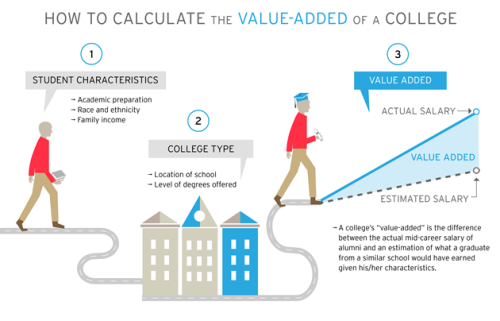
In general, most rankings designed for students should switch to a “value-added” approach, which measures the causal impact of college on students given their pre-education characteristics. One of the most up-to-date and accurate study using this method is the recently published “Beyond College Rankings” report; the methodology they use could serve as a model for further rankings. However, the problem with “value-added” rankings is that they are of limited use when they are not “dynamic”. Traditional rankings are “static” in the sense that every university in the same ranking will always have the same rank independently from the person reading it. A “static value-added” ranking is useful to governments and charities seeking to allocate their funds to the most efficient institution, but generally not adequate for individuals since the essence of a “value-added” ranking is to provide a list of best colleges given a specific student’s characteristics. A clever value-added ranking designed for students would allow them to input their personal characteristics before providing them with a personalized result; the best choice of college might not be the same for two distinct students with a different profile.


Dylan Matthews: Think the poor don’t pay taxes? This chart proves you very wrong.

This is a very nice chart showing that taxes overall are remarkably close to proportional. One of the things that suggests to me is that a much simpler tax system that had people paying a proportional tax such as a VAT tax, coupled with a lump-sum transfer to the poor, would not be such a big change after all. We probably cause a lot of distortions by pretending to have a progressive tax system instead of admitting that we have a mostly proportional tax system and optimizing it. 

Beacons

At the end of my third year of blogging, and the beginning of my fourth, I am in Oslo, completing my tour of Nordic central banks. That is fitting, because so big a part of my efforts this past year, both on my blog, on Quartz, and in my travels, has been devoted to campaigning for the end of the zero lower bound that stands in the way of good monetary policy.  

On this journey, which also included two high-level conferences in London, I have begun to see the foundations of the paper standard begin to crack. What a few years ago was a fringe idea–eliminating the zero lower bound by using a time-varying paper currency deposit fee at the cash window of the central bank–is now being taken very seriously by powerful central bankers. 

To keep myself going in efforts to end the zero lower bound, I often remind myself of all the people who have suffered from its effects in the last few years–often without realizing what the source of their economic troubles has been. I imagine these people saying to one another “Why doesn’t somebody do something about this?” and combine it with the knowledge that we economists are the somebodies who need to do that something. 

Though I would not trade away my travels and writing in opposition to the zero lower bound for anything I could reasonably have hoped to accomplish with that time and effort instead, those efforts–and in particular, the travels–have not been without opportunity cost. There are many things I would have liked to write about on other topics, but ran out of time. 

So what I have done in the past year besides oppose the zero lower bound? The answer tells what beacons I look toward to guide my actions. I hope I have managed to be a decent human being most of the time–a difficult goal with many facets. I hope I have mostly taken care of myself and my relationships to those closest to me. And I hope I have been a reasonably good colleague, coauthor and teacher.  

On this blog, I have had a few guiding lights I have looked to. I try to answer most of the questions that people pose to me. I try to give honest opinions. I try to have something new on this blog every day, even if it is only a link to an article I found interesting and important. I have been consistent in doing a religion post or a philosophy post (currently on John Stuart Mill’s On Liberty) every Sunday. I try to have at least a couple of other more substantial posts each week. And I try not to let too long a time pass without writing a more polished piece for Quartz that I feature here as well. 

I look for opportunities to double-task, such as teaching my students to write by having them write many blog posts and then using some of the best of those as guest posts here. I post interesting documents here that I have created for other purposes. And I use blog posts to clarify ideas that I can later pursue as research topics.     

Some days it is hard just to keep up with email, tweet a link to the day’s blog post, already stored up in the queue from before, and post the link on Facebook. But other days I feel a fire inside of something that wants to be said. And when I look back through my blog archives, I feel proud of what I have been able to do. To me, this blog is not just a collection of posts, but a single, coherent hypertext object. I hope the whole is greater than the sum of the parts. 

One thing I notice in the blog statistics I get from Google Analytics is how much of my traffic is for posts in my back catalog. I like that: having some posts that seem useful enough to people that there is continuing traffic for them even in the long run.

I feel bad sometimes that I am not able to do more, but I don’t seriously regret the choices I have made, only that the time budget constraint is not more expansive than it is. 

Thanks to all of you–the readers who have made this blog a social act instead of an exercise in solipsism. I appreciate all of your feedback and your words of encouragement.  

You might be interested in my first blog post and my first and second anniversary posts as well as this third anniversary post you just read:

0. What is a Supply-Side Liberal?

1. A Year in the Life of a Supply-Side Liberal

2. Three Revolutions

3. Beacons

John Stuart Mill on Registration of the Tools of Crime

When some kind of regulation is necessary, every effort should be made to make the regulation as consistent with freedom as possible while still doing the job. In On Liberty “Chapter V: Applications,” paragraph 5, John Stuart Mill points out that required disclosure and registration always need to be considered as alternatives to more onerous regulations. He addresses this in an interesting case where one might be tempted by more onerous regulations: the sale of poisons:

One of these examples, that of the sale of poisons, opens a new question; the proper limits of what may be called the functions of police; how far liberty may legitimately be invaded for the prevention of crime, or of accident. It is one of the undisputed functions of government to take precautions against crime before it has been committed, as well as to detect and punish it afterwards. The preventive function of government, however, is far more liable to be abused, to the prejudice of liberty, than the punitory function; for there is hardly any part of the legitimate freedom of action of a human being which would not admit of being represented, and fairly too, as increasing the facilities for some form or other of delinquency. Nevertheless, if a public authority, or even a private person, sees any one evidently preparing to commit a crime, they are not bound to look on inactive until the crime is committed, but may interfere to prevent it. If poisons were never bought or used for any purpose except the commission of murder, it would be right to prohibit their manufacture and sale. They may, however, be wanted not only for innocent but for useful purposes, and restrictions cannot be imposed in the one case without operating in the other. Again, it is a proper office of public authority to guard against accidents. If either a public officer or any one else saw a person attempting to cross a bridge which had been ascertained to be unsafe, and there were no time to warn him of his danger, they might seize him and turn him back, without any real infringement of his liberty; for liberty consists in doing what one desires, and he does not desire to fall into the river. Nevertheless, when there is not a certainty, but only a danger of mischief, no one but the person himself can judge of the sufficiency of the motive which may prompt him to incur the risk: in this case, therefore, (unless he is a child, or delirious, or in some state of excitement or absorption incompatible with the full use of the reflecting faculty) he ought, I conceive, to be only warned of the danger; not forcibly prevented from exposing himself to it. Similar considerations, applied to such a question as the sale of poisons, may enable us to decide which among the possible modes of regulation are or are not contrary to principle. Such a precaution, for example, as that of labelling the drug with some word expressive of its dangerous character, may be enforced without violation of liberty: the buyer cannot wish not to know that the thing he possesses has poisonous qualities. But to require in all cases the certificate of a medical practitioner, would make it sometimes impossible, always expensive, to obtain the article for legitimate uses. The only mode apparent to me, in which difficulties may be thrown in the way of crime committed through this means, without any infringement, worth taking into account, upon the liberty of those who desire the poisonous substance for other purposes, consists in providing what, in the apt language of Bentham, is called “preappointed evidence.” This provision is familiar to every one in the case of contracts. It is usual and right that the law, when a contract is entered into, should require as the condition of its enforcing performance, that certain formalities should be observed, such as signatures, attestation of witnesses, and the like, in order that in case of subsequent dispute, there may be evidence to prove that the contract was really entered into, and that there was nothing in the circumstances to render it legally invalid: the effect being, to throw great obstacles in the way of fictitious contracts, or contracts made in circumstances which, if known, would destroy their validity. Precautions of a similar nature might be enforced in the sale of articles adapted to be instruments of crime. The seller, for example, might be required to enter in a register the exact time of the transaction, the name and address of the buyer, the precise quality and quantity sold; to ask the purpose for which it was wanted, and record the answer he received. When there was no medical prescription, the presence of some third person might be required, to bring home the fact to the purchaser, in case there should afterwards be reason to believe that the article had been applied to criminal purposes. Such regulations would in general be no material impediment to obtaining the article, but a very considerable one to making an improper use of it without detection.

Ezra Klein: This is my best advice to young journalists

I found this fascinating. It sounds like great advice to me. Here is one interesting example: 

Don’t just write for your editor. … In particular, your editor will often want something “new.” That is to say, they will want something that they, a highly educated hyper-consumer of news products, hasn’t seen before. … Sometimes, your editor will say that your outlet, or some other outlet, ran that story last June. But your reader likely did not read that story, and if they did read it, they don’t remember it. 

Jordan Anderson: Fixing the Tech Gender Disparity

Link to Jordan Anderson’s LinkedIn Page

Jordan has been a student in my “Monetary and Financial Theory” class this past semester. Here he addresses the issue of gender-bias in tech. This is the 19th student guest post from the semester. You can see the rest here.


The socially constructed archetype of the technology industry employee needs to be dissolved, along with the removal of the stigma surrounding women in the technology industry, in order for the gender disparity to be eliminated.

There are two objectives that I am going to be focusing on with this blog post. First, I am going to try to discover the root of gender discrimination in the technology sector. Second, I am going to try to develop a solution to the problem, and if that is not possible at least figure out how to move the industry in the right direction.

There is a deeply entrenched male culture in the technology sector. One of the theories that I stumbled upon to explain the disparity in males holding tech jobs at technology companies (for example, at Google women only fill 17 percent of the software engineering, database analysis, and other technology based jobs) was described as the ‘Geek Bro Culture,’ which credits the disparity to traditionally nerdy activities, hobbies like comic books, video games, and the technology sector. This mentality encourages the treatment of women as sexual objects, regularly exposes them to inappropriate behavior, and causes them to miss out on promotions that they would have received if they were men. Since boys typically grow up playing computer games they would more likely be interested in computer games and technology causing them to dominate the technology industry. The proportion of males versus females that take the Advanced Placement Computer Science exam acts as further evidence that the gender problem in technology starts at an early age. Out of the 30,000 students that took the exam, less than 6,000 of these students were female. There seems to be a socially constructed persona of a technology industry employee, which is constantly reaffirmed in practice, primarily socially awkward white males who love computers. Women would then have to be constantly combating this culture, trying to demonstrate that although they do not fit this persona they are equally qualified to do this work.

Some people claim that the lack of promotions and job placement for women is warranted because men lead better and therefore do these jobs better. However, the statistics suggest the exact opposite really. Companies with the highest proportion of women board directors actually outperform those with the lowest proportion of women board directors. Economic reason would lead us to believe that this alone would be enough to change the tech industry. If companies want to succeed and outperform their counterparts in order to remain competitive, diversifying their workplace would one of the ways to do that. This alone does not seem to be enough to drive significant change, as the proportion of women in technological based roles at tech companies has been declining over the past 25 years according the U.S. Census.

So, what can be done regarding gender discrimination in the workplace?

One practice undertaken by Harvey Mudd College has been very successful thus far resulting in 40% of its computer science students being women. They split their introductory computer science course into three separate courses. The goal was not overwhelm students by having to compete against students who have been coding since elementary school, which are typically males. Making women feel more comfortable with technology and computer science when they are young seems to be a good approach to fixing the issue since gender disparity starts at an early age. This could remove the deeply entrenched idea in our society that technology and technology based work is more suited for men.

Another approach to the problem is Girls in Tech’s “Raise Awareness” campaign: companies work on practical measures to make the work environment more welcoming to women along with women learning how to effectively ask for a raise. The company could do this with negotiation workshops as well as other policy changes. One of the important aspects of this campaign is that companies that join the movement will be published on the campaign’s website and other media outlets. As more women are made aware that companies in the tech industry are trying to address the problem they would most likely feel more comfortable pursuing this industry, which I feel will help fix the gender gap.

18 Misconceptions about Eliminating the Zero Lower Bound

Update: Link to “21 Misconceptions about Eliminating the Zero Lower Bound” as revised for my November 2018 presentations at Harvard, Brown, MIT and Boston University

Yesterday I spoke on a panel about practical details of negative interest rates at an amazing conference in London entitled “Removing the Zero Lower Bound on Interest Rates,” sponsored by the Imperial College Business School, the Brevan Howard Centre for Financial Analysis, the Centre for Economic Policy Research (CEPR) and the Swiss National Bank.  

Today, I am giving one of several keynote speeches at the Bank of England’s Chief Economists’ Workshop, subtitled “The Future of Money.” It is entitled “18 Misconceptions about Eliminating the Zero Lower Bound (or Any Effective Lower Bound).” Here is the link to the Powerpoint file (in 16:9 aspect ratio). This presentation supplements, rather than replacing, my Powerpoint file “Breaking Through the Zero Lower Bound,” which you can see here, along with all of the places I have given it or the presentation above.

Let me also point you to my bibliographic post 

which has a full set of links to posts and columns I have written about negative interest rates, eliminating the zero lower bound, and electronic money.

Some of my more recent additions to work on eliminating the zero lower bound are 

The last three are based on interviews with the Zurich-based online magazine Finanz und Wirtschaft (which can be translated and Finance and Economics), and give many details about implementation.

Alexander Trentin: Negative Interest Rates and the Swan Song of Cash

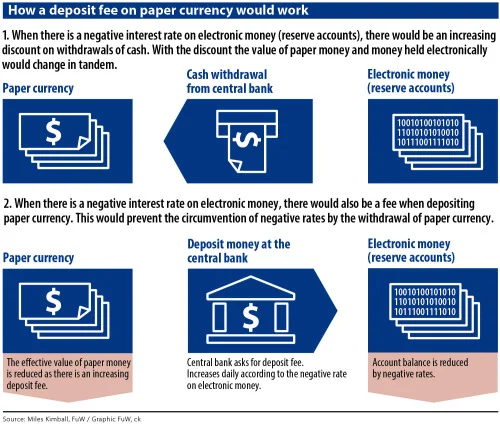
The graphic above is a translation (in consultation with Miles Kimball) of the corresponding German language graphic in Alexander Trentin’s original article, in Finanz und Wirtschaft: “Negativzinsen und der Abgesang auf das Bargeld.” Used by pe…

The graphic above is a translation (in consultation with Miles Kimball) of the corresponding German language graphic in Alexander Trentin’s original article, in Finanz und Wirtschaft: “Negativzinsen und der Abgesang auf das Bargeld.” Used by permission.

I am grateful for permission to publish this translation of Alexander Trentin’s companion article to his interview of me, along with Sandro Rosa:

I translated with the help of Google Translate, my college German, and my knowledge of the subject matter. I have also translated two other articles in which Alexander discusses my proposal for eliminating the zero lower bound:


When interest rates in general are negative, paper money becomes a high-rate safe asset. This hinders Swiss monetary policy. An exchange rate between cash and money in bank accounts can help. 

In the strange new world of negative interest rates, Swiss savers have to wonder if they are ultimately going to face negative interest rates on their personal bank accounts, even though so far, Swiss banks are cross-subsidizing regular bank accounts   with revenue from high mortgage rates.

As soon as someone sees his or her account balance fall because of a negative interest rate applied to a regular bank account, paper currency will begin to look very interesting as an investment. Among safe, liquid assets, franc notes earning an interest rate of zero would be the high-yield alternative.

If investors flee from bank accounts into paper money, the monetary policy objectives of the Swiss National Bank will be defeated. The SNB wants negative interest rates to make francs unattractive and therefore to weaken the Swiss franc against the euro. But if negative interest rates for individual investors are pushed down far enough, storing massive amounts of paper currency to circumvent negative interest rates could be made into a profitable business. 

Storage Costs and the Effective Lower Bound on Interest Rates

Nobel laureate economist Paul Krugman argues that negative interest rates can’t go any deeper than is allowed by the “the storage cost of cash.” According to Paul Krugman, there is an effective lower bound on interest rates slightly below zero. University of Michigan Professor Miles Kimball sees no effective lower bound on interest rates. His idea is to extend negative interest rates to cash. He has argued for some time now for resolute action through deep negative interest rates to fight recessions (which might also involve some exchange rate depreciation).  

According to Kimball, the best way to implement a negative interest rate on cash is through a gradually increasing paper currency deposit fee at the cash window of the central bank, where private banks come to turn their cash into funds in the accounts that they hold at the central bank (called “reserve accounts” at the Fed and “sight accounts” at the Swiss National Bank). The private bank would owe a fee when it deposited its cash into its account at the central bank. The fee would need to gradually increase in order to generate a negative interest rate on paper currency. For example, to generate a -2% interest rate on paper currency, the paper currency deposit fee would need to rise at a rate of 2% per year. This fee would reduce the value of cash relative to the value of money in the bank (“electronic money”). In the accompanying interview, Kimball compares the implications of this fee to an exchange rate. 

The graphic at the top shows more details of how Kimball’s proposal would work. 

Last year Miles Kimball visited the Swiss National Bank to present a seminar about his idea. Kimball is now “hopeful” that in Switzerland or Sweden, the deposit fee will be implemented quickly. He emphasizes that it would be possible to introduce such a deposit fee "tomorrow”–and thereby gain leeway to lower key interest rates further. For the Swiss National Bank, SNB such an interest rate adjustment would be an effective way to finally weaken the franc.

Because cash is an obstacle to monetary policy, many economists would see it as progress to make electronic money the unit of account and the sole legal tender. The transition from a paper money standard to an electronic money standard would be similar to the transition from the gold standard to a paper standard. With electronic money as the unit of account and cash taken off of its pedestal, the implementation of negative interest rates would no longer be a problem–numbers in the computer can be revised downward as needed, and cash can be handled by changing its value relative to electronic money as discussed above. But cash need not be abolished–and maybe shouldn’t be. Some people like cash. And William Buiter, chief economist of Citigroup points to the value of cash in protecting privacy. And those who don’t have bank accounts would be disadvantaged by the total abolition of cash.  

No Easy Alternatives to a Fee on Paper Currency

Whether the discussion about cash intensifies or goes in reverse depends

on whether central banks are forced to reduce interest rates further below zero. It is possible that the Swiss National Bank might aim for a further cut in interest rates rein in the overly strong franc.

In one study, Beat Siegenthaler, an analyst at UBS comes to the conclusion that going forward, the Swiss National Bank will probably leave interest rates unchanged this year. But forces tending to strengthen the Swiss franc could

lead to further interest rate cuts. Siegenthaler writes: “More negative interest rates would probably draw broader government involvement, since it would require a change in the law to allow the taxation of cash.” Without alternatives, this possibility can’t be ruled out of hand. 

For many Swiss, the idea that fees could ever be charged on cash in liberal Switzerland would have been unthinkable only a few years ago. But that is where the logic of current monetary policy ultimately points. In a time of negative interest rates, paper money with a safe return of zero is like a relic from another time.

Quartz #61—>However Low Interest Rates Might Go, the IRS Will Never Act Like a Bank

Link to the Column on Quartz

Here is the full text of my 61st Quartz column, coauthored with my brother Christian Kimball: “However low interest rates might go, the IRS will never act like a bank.” It is now brought home to supplysideliberal.com. It was first published on April 15, 2015. Links to all my other columns can be found here.

Chris has appeared before on supplysideliberal.com. For example, see

If you want to mirror the content of this post on another site, that is possible for a limited time if you read the legal notice at this link and include both a link to the original Quartz column and the following copyright notice:

© April 15, 2015: Christian Kimball and Miles Kimball, as first published on Quartz. Used by permission according to a temporary nonexclusive license expiring June 30, 2017. All rights reserved.


A revolution has come to Europe–the revolution of negative interest rates. 10-year Swiss government bonds now have a negative yield. Short-term funds kept at the Swiss National Bank now pay -.75%: that is, private banks have to pay .75% per year to the Swiss National Bank to tend their Swiss francs. Denmark now pays -.75% for short-term funds while Sweden is at -.25% and the Eurozone is at -.2%. How low can interest rates go?

Ben Bernanke has started a blog, now that (in his words) he is free from “being put under the microscope by Fed watchers.” In the first few posts, he got into a debate with Larry Summers about what it means that interest rates are so low. Paul Krugman joined in with his own post “Liquidity Traps, Local and Global.” These three—a former Fed Chairman, a brilliant former Treasury Secretary, and a prolific Nobel laureate New York Times columnist, and without question three of the most famous economists in the world—are unanimous in writing that interest rates cannot go much lower than where Europe is now. Ben Bernanke writes:

The Fed cannot reduce market (nominal) interest rates below zero, and consequently—assuming it maintains its current 2% target for inflation—cannot reduce real interest rates (the market interest rate less inflation) below -2%. (I’ll ignore here the possibility that monetary tools like quantitative easing or slightly negative official interest rates might allow the Fed to get the real rate a bit below -2%.)

Larry Summers similarly writes as if there were some law of nature preventing interest rates from falling very far below zero: “The most obvious answer is that short term interest rates can’t fall below zero (or some bound close to zero) and this inhibits full adjustment.” And Paul Krugman stipulates the same presumption in technical jargon, speaking of a “liquidity trap” and a “zero lower bound.”

Every one of them knows better.

Interest rates can go as low as needed

What prevents interest rates from falling much below zero is not an immutable law of nature but an artifact of the way we handle paper currency. If we change our paper currency policy, interest rates can go as low as needed to bring economic recovery after an adverse shock throws the economy into a serious recession. Under our current paper currency policy, paper currency earns an interest rate of zero. As long as that is the case, it is hard to get any lender to accept an interest rate much below zero. But having paper currency earn an interest rate of zero is a policy choice, not a law of nature. As long as the paper currency interest rate is lowered along with other interest rates, the only limit to how low interest rates can go is the economic expansion that low interest rates would stimulate—an expansion that would then raise interest rates by increasing the demand for loans.

The reason that Ben Bernanke, Larry Summers and Paul Krugman talk as if the paper currency policy is immutable is that economists have known for over a century how to make interest rates on paper currency, but no nation has yet implemented negative interest rates on paper currency. Thus, many economists have become discouraged, thinking that the policy will never be broken. Ben Bernanke, Larry Summer and Paul Krugman all have written at length about the damage that this zero lower bound on paper currency can cause—most recently in making recovery from the Great Recession such an agonizingly slow process. But they have given up too easily in accepting zero as a limit.

Other economists, now notably including Harvard economist Kenneth Rogoff (who has become famous in part for his now controversial work with Carmen Reinhart on the effects of national debt on growth) see an eventual victory over the zero lower bound when paper currency is entirely supplanted by credit cards, debit cards and other forms of electronic transactions.

What many don’t realize is that a plan due to Willem Buiter, Chief Economist of Citigroup (and foreshadowed by Robert Eisler in 1932) to generate negative interest rates on paper currency can be implemented in a matter of weeks rather than decades. Miles, on his blog and in presentations to central banks around the world, has explained the nuts and bolts of how to implement this plan. The key is to charge private banks a paper currency deposit fee when they bring paper currency to the cash window of the central bank (returning that fee at the current going rate when a bank takes paper currency back out). The fee needs to gradually increase during the time when interest rates are negative, but can gradually shrink back to zero when interest rates are positive again. During the period the fee is gradually increasing, this effectively gives a negative interest rate on paper currency to any bank or other financial firm that withdraws paper currency, stores it and then redeposits that cash.

Among the economists who take a paper currency deposit fee seriously as a way to break through the zero lower bound are many in central banks around the world. Of the many indications of this, one that we have permission to talk about publicly is that the Bank of England, which was the first to host Miles for a seminar on “Breaking Through the Zero Lower Bound” in May 2013, has invited him back to give a keynote speech on that topic to the Chief Economists’ Workshop on the future of money, on May 19.

Another important mark of how seriously economists are taking this possibility of a change in the current paper currency policy are the arguments by University of Chicago Finance Professor John Cochrane that a change in paper currency policy alone is not enough to allow deep negative interest rates, in his blog post “Cancel currency?” (followed up by “More Cash and Zero Bound.”)

Cochrane was inspired to blog on this topic by Rogoff’s discussion of the possibility of eliminating paper currency entirely. His discussion of the disadvantages of eliminating paper currency entirely is only directly relevant to that extreme proposal, but much of what he says about our current paper currency policy is also relevant to the policy of generating a negative interest rate on paper currency through a paper currency deposit fee that gradually changes over time.

Cochrane gives this list of ways to effectively earn an interest rate of zero even if paper currency, along with money in the bank is earning a negative interest rate. His examples are:

  • Prepay taxes. The IRS allows you to pay as much as you want now, against future taxes.
  • Gift cards. At a negative 10% rate, I can invest in about $10,000 of Peets’ coffee cards alone. There is now apparently a hot secondary market in gift cards, so large values and resale could take off.
  • Likewise, stored value cards, subway cards, stamps. Subway cards are anonymous so you could resell them.
  • Prepay bills. Send $10,000 to the gas company, electric company, phone company.
  • Prepay rent or mortgage payments.
  • Businesses: prepay suppliers and leases. Prepay wages, or at least pre-fund benefits that workers must stay employed to earn.

It’s not easy to get a guaranteed zero interest rate

Of this list, we take the first—prepaying taxes—very seriously; more on that below. But for all the rest, the counterargument to Cochrane is simple: although private firms are happy to offer a zero interest rate while interest rates in general are higher than zero, they would stop giving that kind of deal if interest rates in general were negative. They would have to carry the freight of the negative interest rate every time they let a customer put in a given dollar value of money now, to get back the same dollar value later. If they did give someone a zero interest rate when interest rates in general were negative, we predict it would typically be some sort of promotion to get people to do something else that added to the businesses’ bottom line. People who had already purchased gift cards, or had a contract that implicitly specified a zero interest rate before the business knew interest rates would turn negative would benefit from those favorable preexisting arrangements, but the businesses wouldn’t give them that deal again.

JP Koning is one of the best bloggers out there on the nature and workings of money. In his post “Does the Zero Lower Bound Exist Thanks to the Government’s Paper Currency Monopoly?” he argues along these lines, in effect, that the zero lower bound is a creation of government, because no other organization but government has both the deep pockets and the willingness to run a loss. JP also chimes in in the comment section of Cochrane’s post explaining why gold doesn’t provide a way to escape negative interest rates, and pointing out that business customs can adapt to new situations. He writes:

No, gold won’t allow a zero riskless nominal return. The moment negative rates are put into place the price of gold will spike to level at which it would be expected to decline at a rate equal to the negative interest rate. You’re still penalized.

I’m also underwhelmed by your claim that our legal and financial system deeply enshrines the right to pay early. It also enshrines the right for contracts to require people to pay penalties for early payment. Take for instance prepayment penalties on mortgages or auto loans. A ‘legal revolution’ as you refer to it isn’t required… the laws already exist.

What JP Koning says about gold is true for any asset that can change in price according to market pressures. The only reason that paper currency as it is handled now creates a zero lower bound floor under interest rates is because central banks currently guarantee that a paper dollar will stay at par relative to dollars in the bank. Take away or modify that guarantee through a paper currency deposit fee that changes over time, and interest rates can go as low as needed.

In general, the place to look for things that could put an effective floor under interest rates is the same place one would look for something that could put an effective floor under, say, milk prices: some kind of government guarantee. In Japan, for example, the post office acts as a bank, and a zero interest rate on funds in this government-run bank could act as a floor under interest rates.

The question that Cochrane raises is whether a tax authority like the IRS can be used if it were a government bank offering a zero interest rate on deposits.

The IRS is not a bank

In confronting the question of whether to IRS in particular can be used as if it were a government bank offering a zero interest rate, it helps to be a US tax lawyer used to dealing with complex tax questions, as Chris is. There are two key points:

  1. The tax code actually has several interest rates, including an overpayment rate, an underpayment rate, and zero. The non-zero rates are a function of Federal short-term borrowing rates and while it has never happened, there is no obvious reason that they could not be negative.
  2. The IRS is not a bank with in-and-out privileges. Paying taxes is easy. Getting money back is possible but complicated and uncertain as to time and interest rate.

Underpayment and overpayment rates are defined as the “Federal short-term rate” rounded plus an adjustment (3 percentage points in general, but more or less in specific circumstances, including 0.5 percentage point for large corporate overpayments and 5 percentage points for large corporate underpayments). The Federal short-term rate is determined month by month, and is defined by statute as:

[T]he rate determined by the Secretary based on the average market yield (during any 1-month period selected by the Secretary and ending in the calendar month in which the determination is made) on outstanding marketable obligations of the United States with remaining periods to maturity of 3 years or less.

Translated, this says that if the 3-month Treasury bill rate were negative, the Secretary of the Treasury could declare a negative Federal short-term rate. While an effective zero interest rate would apply to prepayments of taxes, overpayments of taxes could be returned after application of the overpayment rate—which could be negative. Alternatively, an overpayment might be characterized as a deposit. When a deposit is returned, it can be returned dollar for dollar, or with interest, depending on the circumstances. Although it is hard to predict what the IRS would do, in a negative interest rate environment it would be reasonable to expect the IRS to apply a negative interest rate to deposits related to disputed taxes, and to return other amounts quickly, effectively rejecting any deposit not related to a dispute.

In a negative interest rate environment, a taxpayer might want a zero interest rate through a dollar-for-dollar refund or return. The problem is that a taxpayer cannot confidently control how a prepayment or deposit is characterized, and cannot confidently control the timing of a refund or return. To the extent of an actual tax liability, or an actively disputed tax liability, and arguably even a near-term predictable tax liability, money sent to the IRS that is ultimately returned will probably be returned subject to the (possibly negative) overpayment rate. On the other hand, amounts in excess of tax liability (current, disputed, near-term predictable) don’t have an obvious category.

In a positive interest rate environment, taxpayers and the IRS may treat such amounts as zero-rated deposits (and so taxpayers generally are disinclined to make them). In a negative interest rate environment the IRS may simply reject such amounts as not having anything to do with taxes (and so taxpayers generally should be disinclined to make them).

The IRS also largely controls the timing of when a taxpayer gets the money from an overpayment or a deposit. The IRS could decide to return funds immediately upon request, or to return funds significantly later, and could make that decision differently depending on the applicable interest rate. In all this uncertainty, if the IRS takes a position that the taxpayer doesn’t like, e.g., that a negative rate applies, or that the remittance is rejected, or that a deposit will be returned immediately or will be delayed, there may be arguments in some particular cases that the IRS is wrong. However, that probably gets sorted out in court, in a case that could take years to resolve. If the negative interest rate situation only lasts a year or two, even a taxpayer victorious in court (something far from guaranteed) might not get the money back at a zero interest rate until interest rates had been positive again for long enough that a zero interest rate still wouldn’t be as good as what the taxpayer could have earned in the bank.

In short, the IRS is not bank. There are circumstances where money comes back from the IRS, but the effective interest rate might be positive or negative or zero, the taxpayer cannot strictly control or predict the interest rate, and the taxpayer cannot strictly control the timing of refund or repayment. The IRS would be a formidable adversary to someone trying to force it to be a bank when it didn’t want to be. This amount of uncertainty makes it very difficult to arbitrage interest rates against the government through the IRS.

The one concession that is clearly available in the tax law is that prepayment of taxes does have the effect of a zero interest rate. Formally, this may be as much as a one-year opportunity, but after taking account of payroll withholding and estimated tax payment requirements, the most a typical taxpayer could shift the timing of tax payments is only a quarter or two. Because that option is limited in quantity, and not available for unlimited arbitrage, it cannot put a floor under market interest rates. What it does do is provide a welcome shield against negative interest rates up to a reasonable amount of savings for people who are willing to save by paying their taxes early in the year.

We view this as a positive thing for the politics of negative interest rates; the option of prepaying taxes can help protect the diligent small-time savers who would be distressed by negative interest rates. Earlier payment of taxes in a recession combatted by negative interest rates would also partially smooth out the usual effect recessions have of temporarily worsening the government budget deficit.

As for long-term savers, they can always guard against the possibility of negative interest rates by buying long-term bonds that lock-in interest rates at current market levels, which at worst are currently only a little negative. And the monetary stimulus of negative interest rates is likely to soon bring even short-term interest rates back up once an economy is fully back on its feet.

Where do we go from here?

Right now, Europe is leading the charge toward lower interest rates. With the knowledge of how to prevent paper currency from putting a floor under interest rates in hand, there is no limit to how low their interest rates can go other than the self-limiting effect of low interest rates in spurring economic growth.

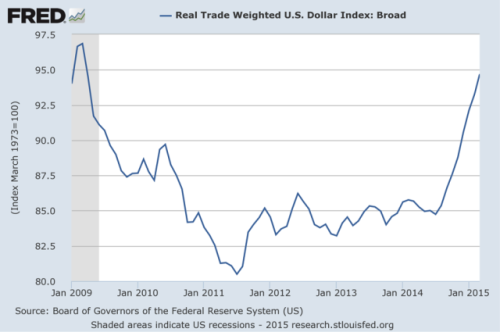
What about the US? Currently, the talk is all about when the Fed will raise interest rates above zero, not when it will go negative. But one thing could change that: the effect of Europe’s negative interest rates on value of the US dollar. The dollar has been appreciating in the last few months, as low interest rates in Europe encourage investors to send their funds to the US. The higher dollar is seen as one of the key things that slowed down the US economy in the first three months of this year by making it more expensive for people in other countries to buy US goods. If Europe pushes its interest rates further down, the Fed may need to do more than just delay when it raises interest rates—it may need to cut rates below zero to keep the US economy on an even keel.

Even if interest rates at the bank become negative, regular taxpayers may be able to keep a portion of their money from shrinking by prepaying fixed obligations, including taxes. But that won’t keep negative interest rates from prevailing in the economy generally, so long as the Fed changes its paper currency policy so that an effective negative interest rate on paper currency opens the way for the Fed to lower other rates (especially its target rate and the interest rate it pays banks).

The fact that the tax system does not allow unlimited interest-rate arbitrage to block negative interest rates across the board is a good thing: low and even negative interest rates and the stimulus they provide are one of the best defenses the US has against falling back into recession when we have so recently escaped the after-effects of the last recession.

How Increasing Retirement Saving Could Give America More Balanced Trade

Here is a link to my 62d column on Quartz, “The TPP would be great for America if Americans had been saving for retirement.”

“TPP” stands for the “Trans-Pacific Partnership,” the free trade deal currently very much in the news. The working title for this column was “Free Trade; Balanced Trade.” I tried to reflect that and to more accurately reflect my views in the title of this post. In taking the screen shot, I consciously cut off the kicker “Whoops” at the top of the column on Quartz, since I tend to think most free trade deals are a good idea in any case. But I think they would be a better deal if we had more balanced trade–something that is possible with a surprisingly simple and interesting policy change.

In the column, I write: 

Using back-of-the-envelope calculations based on the effects estimated in this research, they agreed that requiring all firms to automatically enroll all employees in a 401(k) with a default contribution rate of 8% could increase the national saving rate on the order of 2 or 3 percent of GDP.

Here is a rough idea of the kind of simple calculation that could back that claim up:

  • Suppose current 401(k)’s give only one-quarter or less of the amount of saving if everyone had an 8% contribution rate–partly because many people aren’t covered at all. Then if no one opted out, the new regulation would add 6% to saving as a fraction of labor income. Multiply that by 2/3 for labor’s share, that is 4% more of GDP if no one opted out. Then the opt-out assumption is that 25% to 50% of people opt out.