Warren Henning: A Software Engineer’s Adventures In Learning Mathematics →
What we hope ever to do with ease, we must first learn to do with diligence. — Samuel Johnson
A Partisan Nonpartisan Blog: Cutting Through Confusion Since 2012
What we hope ever to do with ease, we must first learn to do with diligence. — Samuel Johnson
I am grateful to Alexander Trentin, Sandro Rosa, and Finanz und Wirtschaft (Zurich’s “Finance and Economy” online periodical) for permission to publish a translation of the corresponding article here. I translated with the help of Google Translate, my college German, the partial translation Finanz und Wirtschaft posted here, and my knowledge of the subject matter and what I had said in the interview. I posted two earlier articles by Alexander Trentin along with my reactions (and there is more coming):
Negative interest rates can only have their full effect when people can’t flee into paper money. Miles Kimball argues that the holding of paper currency can be discouraged by a time-varying paper currency deposit fee.
Miles Kimball, an economist at the University of Michigan, is a pioneer on the issue of negative interest rates. He is fighting against the so-called Zero Lower Bound, the lower limit for interest rates near zero. On his blog, he argues that if interest rates fall deep enough into negative territory any recession would be quickly resolved. He estimates that after the financial crisis in 2008, the US economy would have made a robust recovery by the end of 2009 if the Fed had maintained interest rates at -4% throughout 2009.
He sees negative interest rates as a better tool than the purchase of trillions of dollars worth of long-term and mortgage-backed bonds that goes by the name of quantitative easing (QE). For one thing, he argues that economists understand the effect of negative interest rates better than they understand the effects of quantitative easing. The main obstacle to deep enough negative interest rates is cash, because that would continue to provide a zero interest rate. In order to make the holding of banknotes unattractive, he has urged the Swiss National Bank to contemplate a deposit fee for paper money.
Mr. Kimball, your idea is to introduce a fee for depositing paper currency during periods of time when bank accounts face negative interest rates. Withdrawing money would face no fee, but deposits would. This would discourage people from trying to circumvent negative interest rates through paper currency. Do you realize that some people would rebel at this idea?
It is all about how to present it. People don’t like the word fee. Since there is also a discount when withdrawing money it is analytically equivalent to an exchange rate between electronic money – money on reserve accounts – and paper money. I use the phrase “paper currency deposit fee” to indicate a possible basis for the legal authority of the central bank to create such an effective exchange rate. The fee would be de facto a tightly controlled crawling peg exchange rate policy.
Why do you prefer a deposit fee to a withdrawal fee for paper currency?
At every central bank I visit, I warn about a withdrawal fee. Having to pay an extra fee to get cash out of the bank would alarm people much more than a slowly increasing deposit fee.
If the central bank does not want to use paper money, couldn’t it just stop printing money?
That could be a fallback position, if that were the only legal authority a central bank had. Paper currency would become an exotic security with a zero interest rate. The price of bank notes would then run at a premium to electronic money, because of the scarcity of cash. There would a big jump in the price of paper currency, which would be quite disruptive to the economy. By contrast, the paper currency deposit fee starts at zero and increases only very gradually over time during the period when there is a negative interest rate. There would never be a big jump.
You propose to introduce electronic money as a legal tender instead of banknotes. In Switzerland, the Vollgeld movement rallies for a monetary reform in which electronic money would be created by the Swiss National Bank, rather than by commercial bank money creation at the moment of making a loan. It is similar to the idea of full-reserve banking. What is your opinion on this?
Anything that raises the prestige of electronic money–such as making electronic money legal tender–is helpful in making people comfortable with electronic money as the unit of account and putting paper money in a subsidiary role. To make electronic money legal tender, it is important to have accounts for which the central bank certifies that this money is really there.
I don’t see a 100% reserve requirement as a problem. In the olden days, people worried that a higher reserve requirement would reduce the money supply. But we know how to deal with that: the central bank can just increase the amount of the monetary base through open market operations enough to cancel out any effects changes in the reserve requirement on the money supply. In any case, it is possible to have some accounts which are 100% covered by reserves. Fractional reserve banking is mainly a way to let commercial banks have some of the seignorage revenue that would otherwise go to the government through the central bank.
Could electronic money be legal tender in the current world of fractional reserve banking?
Electronic money is all money that is just numbers in a computer. To make it legal tender might take some time. The important thing is that the Swiss National Bank could introduce the paper currency deposit fee I propose tomorrow. There is no reason to wait until we can do everything perfectly. If the Swiss economy is being hurt by overly high interest rates and a Franc that is too strong, then you should institute this fee tomorrow. This is what I advised the Swiss National Bank. I think they are seriously considering it.
Wouldn’t a transition to electronic money and a fee on paper money cause people to lose faith in currency?
They would know that the government can do whatever it wanted with their cash, devaluing it with a single keystroke.It matters how you explain it to people. I don’t think people would be that alarmed if you explained how gradual everything is. If the interest rate on bank deposits was -2% per year, the corresponding fall in the value of paper money each day would be tiny. It would take three months for the paper currency deposit fee to get as big as .5%. Moreover, retail shops would probably continue to accept paper currency at par for quite some time, they already pay a much bigger fee to credit card companies on credit and debit card transactions than the likely size of the paper currency deposit fee. The only exception would be in the case of a recession or secular stagnation so severe that deeper, more persistent negative interest rates were needed than what I believe would have been sufficient to cut short the Great Recession.
But how would you deal with the strong emotional attachment to paper currency?
Our societies have been through this before. There was a strong attachment to gold and silver. We went off the gold standard; that was a big deal for people. It is worth remembering that making paper money legal tender was hugely controversial. This was done to raise the prestige of paper money vis-à-vis gold. In that longer historical perspective, paper money was only a way station towards electronic money. If you want to be very traditional, you can use gold; but that will mess up your economy even more than paper money. When people cling to paper money it is like clinging to gold.
In Switzerland and Germany the attachment to paper money seems to be especially strong. Wouldn’t that make your proposal especially controversial there?
It is precisely because of the feelings of the Germans that the Swiss National Bank needs to blaze the trail rather than the ECB. Once Switzerland does it–and I am hopeful also that Sweden might have that kind of courage–there is a huge benefit to other countries by showing the way. One advantage of having Switzerland lead the way is its sophisticated level of banking. There are many practical questions for commercial practices in a negative interest rate environment; Switzerland would be an excellent place to work out such details. Fpr example, in a positive interest rate environment you want people to pay you as soon as possible; in a negative rate environment, you want people to pay you slowly. If negative interest rates are used elsewhere, people around the world would take standard practice from what is done in Switzerland.
As you mentioned, commercial details of doing transactions in a negative interest rate environment would still need to be worked out. Isn’t there a point where there is a structural transformation of how the economy works after introducing deep negative rates?
The funny thing is that for economists it is not a big deal whether interest rates are positive or negative. In terms of real interest rates–that is, interest rates adjusted for inflation–we have had negative rates before. For the most part, negative real rates due to high inflation have the same effect as explicitly negative rates when inflation is zero. We understand the effects of negative rates much better than the effects of Quantitative Easing. And as for the effects on business practices, firms have to adapt their business practices even when interest rates change within the positive range. Even with positive interest rates, investment decisions need to be made in a much different way when a quick payback is needed because of high interest rates than when a firm can afford to wait a long time for a payback because interest rates are low.
I was surprised to see how tepid John Stuart Mill was in championing the free market as a contribution to liberty. To understand the following passage from On Liberty “Chapter V: Applications,” paragraph 4, remember that according to 19th century custom, he used the phrase “free trade” to mean not just free international trade, but all of what we would call the free market. Indeed, in the justifiably replace the phrase “free trade” by “the free market” and the word “trade” in every other instance by “the market”:
Again, trade is a social act. Whoever undertakes to sell any description of goods to the public, does what affects the interest of other persons, and of society in general; and thus his conduct, in principle, comes within the jurisdiction of society: accordingly, it was once held to be the duty of governments, in all cases which were considered of importance, to fix prices, and regulate the processes of manufacture. But it is now recognised, though not till after a long struggle, that both the cheapness and the good quality of commodities are most effectually provided for by leaving the producers and sellers perfectly free, under the sole check of equal freedom to the buyers for supplying themselves elsewhere. This is the so-called doctrine of Free Trade, which rests on grounds different from, though equally solid with, the principle of individual liberty asserted in this Essay. Restrictions on trade, or on production for purposes of trade, are indeed restraints; and all restraint, quâ restraint, is an evil: but the restraints in question affect only that part of conduct which society is competent to restrain, and are wrong solely because they do not really produce the results which it is desired to produce by them. As the principle of individual liberty is not involved in the doctrine of Free Trade, so neither is it in most of the questions which arise respecting the limits of that doctrine; as for example, what amount of public control is admissible for the prevention of fraud by adulteration; how far sanitary precautions, or arrangements to protect workpeople employed in dangerous occupations, should be enforced on employers. Such questions involve considerations of liberty, only in so far as leaving people to themselves is always better, cæteris paribus, than controlling them: but that they may be legitimately controlled for these ends, is in principle undeniable. On the other hand, there are questions relating to interference with trade, which are essentially questions of liberty; such as the Maine Law, already touched upon; the prohibition of the importation of opium into China; the restriction of the sale of poisons; all cases, in short, where the object of the interference is to make it impossible or difficult to obtain a particular commodity. These interferences are objectionable, not as infringements on the liberty of the producer or seller, but on that of the buyer.
Whenever a market exchange is fully voluntary and well-informed on the part of all parties involved in the transaction, it seems to me an abridgment of the collective liberty of that group of people involved to interfere with that exchange. And I think this abridgment of liberty rises above the level of John Stuart Mill’s concession “all restraint, quâ restraint, is an evil.” In sexual matters we recognize the importance of the liberty of two people eager to engage in an activity together to be able to engage in that activity. Why should the liberty of two people eager to engage in a market transaction be any different?
Just as there is sometimes sufficient reason to limit an individual’s liberty in order to prevent that individual from harming someone else, there may sometimes be sufficient reason to interfere in a fully voluntary, well-informed market transaction (including other selves or time slices of the individuals involved viewed as a special case of “someone else”). But it makes no sense to me to deny that this is done at the cost of the collective liberty of the group of individuals who want to engage in a market transaction.
Let me go further and say that the collective liberty argument for economic freedom should often trump Federalism. The “interstate commerce” clause of the constitution has been used to justify a great deal of interference in the free market. A much more appropriate use of the interstate commerce clause would be federal laws limiting how much states can interfere in the free market. I have written many times and hosted many guest posts about the evil (and I choose that word carefully) of excessive licensing requirement:
I have heard many people say “But occupational licensing is a state issue–the federal government can’t do much about it.” The federal government can do many things with its interstate commerce power; stopping lobbyists at the state level from convincing state legislators to unduly restrict the free market is an excellent way to foster interstate commerce.
Similarly, federal laws to restrain the use of rent control and to prevent undue limitations on residential construction could do a lot of good in ways that can legitimately be seen as fostering interstate commerce. When federalism or “states’ rights” and the most central free market principles come in conflict, I choose the free market. And in choosing the free market, I am choosing an important dimension of liberty.
Israel Diego is a student in my “Monetary and Financial Theory” class. Here he reports on some interesting research he did. This is the 18th student guest post this semester. You can see the rest here.
Following up from a previous blog post, I made an effort to contrast Michigan’s survey of inflation expectations, the Survey of Professional Forecasters (SPF), and a RW no-change forecast, all forecasting one-year ahead, and I was unable to conclude beyond a reasonable doubt which forecast model would be the best for predicting inflation, however this post revisits this ideology by considering differing levels of income and education of the Michigan survey participants.
As we consider a consumer’s level of income and education, what should we expect to happen to their predictive power of inflation? Some intuition would tell us that as a consumer’s level of income rises, she may have a higher propensity to save relative to consumers with lower income, because she will have more excess funds at her disposal. Naturally, she may invest these funds, and hold a portfolio comprised of stocks, bonds, and other securities, in order to grow her nest egg for retirement, or set money aside to cushion against economic downturns. Thus it would be important for her to frequently keep track of the inflation rate, to make sure that her investment is not eroded by price increases.

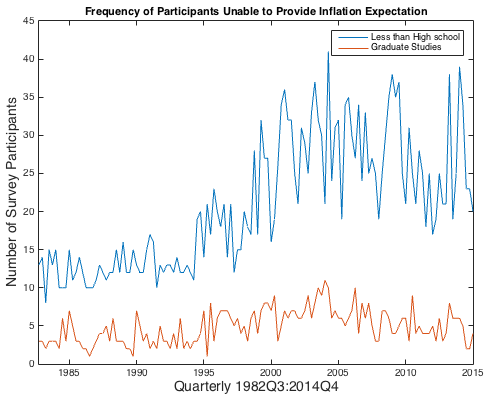
Given education, it is plausible that higher education on average leads to higher income for the consumer, so inflation expectations would improve based on the theory I motivated above. However we can also infer that more educated consumers are more likely to read the newspaper and be more informed about fluctuations in the inflation rate, a claim made by Christopher Carroll. Lastly it may be the case that less educated consumers fail to muster up an estimate for the inflation rate, relative to higher educated consumers, as uneducated consumers would rather not predict the inflation rate, for fear of embarrassingly overshooting the actual rate. To test this claim, we can sum up the number of survey participants according to their income group, from the Michigan Survey, who did not know what to say when asked about their inflation expectation. We see there is evidence that indeed people with lower education were not able to provide an answer more frequently than individuals with a graduate degree. This is looking at the far ends of the education spectrum, but the relationship holds nonetheless, as we increase education, people less frequently fail to give an answer for their inflation prediction. Interestingly it seems that consumers with less than a high school education know less, on average, about inflation now than they did back in the 80s.
My claims above would have no ‘oomph’ to them if I didn’t back them up with any evidence. So are we right in assuming that higher education and income lead to better inflation predictions? Intuitively yes, and I provide evidence that this is actually the case.
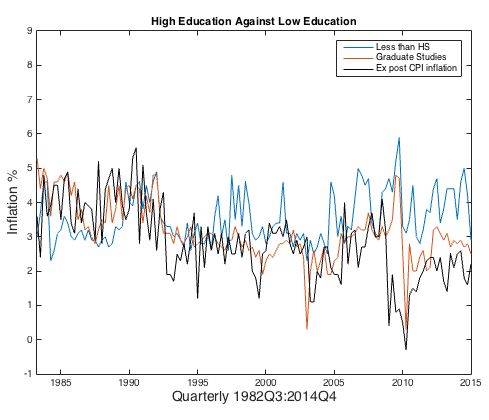
Let’s take different education and income subgroups, using the Michigan Survey one more time, and lets take the median inflation expectation at each quarter for each subgroup. I choose the median over mean expectations because, this measure is more robust against outliers in the data, and the differences between income and education subgroups are more stark when I use the mean. Finally lets compare each subgroup against one another and see how well they do in comparison at predicting the median-CPI in our experiment. (Reason for this specific inflation measure is explained on last week’s blog). I also use the same Diebold-Mariano test used on my previous post, to test for statistical significance of predictive superiority amongst subgroups. The time period I analyze is 1982-2014, because 1981Q3 is when the SPF began.
Here is a graph comparing graduate level education vs less than high school, and the top 25% income group against the bottom 25%. What we see is that higher education and income tend to move more closely with the Median-CPI. One thing to note is that inflation expectations for low education and income groups are higher than their counterparts on average for most of the time period analyzed (1982-2014), which provides further intuition that lower educated and poorer consumers not only fail to predict the inflation better than their counter parts, but constantly over predict the rate.
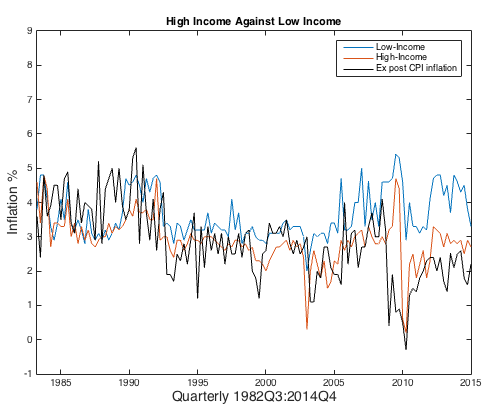
So let’s look at the results! Below I report values for income, as the probability that the highest income group performs better than the alternative income groups. Likewise for education, I display the probability that those with graduate level education do better than their counterparts. Finally we put the highest education and income groups against the SPF, and settle the forecasting battle once and for all. In all of the following results, we should interpret them as probabilities in repeated trials.
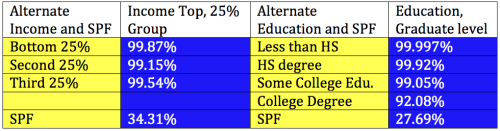
The above table demonstrates that survey participants grouped in the top 25% bracket, consistently beat their counterparts with about 99% probability. However when the predictions of the top income group were tested against those from the SPF, there was only a 34.31% probability that the high income group would predict better. Similarly, there is large evidence that the group with graduate school education beats every other education group’s predictions with a 99% probability, except for those with a college Bachelor’s degree, but still beating them with a 92.08% probability. The high education group also lost miserably to the SPF, with a probably of fairing better than the SPF of 27.69%. We get very similar, statistically significant results, when we compare the alternative income groups against a lower levels of income and education against the lowest income and education levels. From this we gain two conclusions:
One final note: I find out conclusively that the SPF can do better than all income groups, although the top 25% group comes closest to the SPF. This result would satisfy the claim in the beginning of the post that those with higher incomes may have a higher predisposition to know the inflation rate because they would be more likely to have an investment portfolio, and it is only those in the top 25% income bracket are able to make predictions somewhat as close to the SPF’s. This claim would be consistent with the fact that about half of Americans hold any assets, hence only individuals in the highest income groups would have any interest in the inflation rate.
I very much enjoyed having Hal Varian as a colleague at the University of Michigan for my first years at Michigan. Linked above is a nice summary of his career on the occasion of his being named and AEA Distinguished Fellow.

Robbie Strom’s Twitter homepage @robbiestrom
Dan Benjamin, Ori Heffetz and I have a team of research assistants to help us in our efforts to develop and demonstrate sound techniques for constructing national well-being indices of the kind discussed in our VoxEu article with Samantha Cunningham and Nichole Szembrot: “Happiness and Satisfaction Are Not Everything: Toward Well Being Indices Based on Stated Preferences.” Robbie Strom is a key member of that team. He shared with me these thought about Nepal, which I suggested he make a guest post on supplysideliberal.com. Here it is:
In the terrible wake of a 7.9 magnitude earthquake, India and the international community have an opportunity to help Nepal rebuild and grow. If we do not act, the economic consequences could reverberate for years to come.
The focus of the media’s intense, often short attention has spurred citizens around the world to contribute to relief efforts in Nepal. If you are reading this, and you haven’t already, please consider donating to an organization such as Educate the Children that will help respond to the immediate medical needs of disaster victims and the long term rebuilding effort in remote villages as well as larger cities and communities.
These relief efforts are crucial to ensuring disaster victims receive proper medical attention, clean water, shelter and nutrition. They are also crucial to preventing economic calamity.
The Nepal central bank has a fixed exchange rate with the Indian rupee that has hampered its economic growth for years and pushed workers abroad, creating a remittance economy that in 2013 constituted 29% of GDP . This exchange rate policy prevents Nepal from instituting the independent monetary and fiscal policy necessary for economic growth.
The earthquake has disrupted tourism and commerce in Nepal, dwindling inventory and spiking prices, for now. With the disruption of normal economic activity potentially slowing money velocity, and without the capability to enact necessary economic policies, Nepal faces a real danger of deflation, the deadly force at root of economic depression. Because of the fixed exchange rate, only the capital inflow of dollars, euros, yen and renminbi converting into Nepali rupees through foreign aid will prevent a shrinking monetary supply .
When the rate of foreign aid decreases Nepal will have to defend its exchange rate and sell its stockpile of foreign currency reserves. As this scenario unfolds, Nepal will have to request more foreign aid, borrow money from the IMF with historically unscrupulous terms, partner with other governments to transition away from it’s fixed exchange rate policy or face a run on its currency.
In the long run, sustained foreign aid will exacerbate a vicious cycle that increases agricultural imports and pushes workers abroad. More capital inflow can’t increase the nominal exchange rate so it will increase the real exchange rate. Money has to go somewhere when it flows in, and when it does will raise the cost of land and other inputs.
This cycle explains a striking paradox in Nepal: even as large swathes of fields lay fallow within the country, thousands of workers migrate every year to work in fields in India. When they return, they use their earnings to purchase imported Indian rice. Although agriculture remains the primary economic activity of Nepal, as a country it imports over twice as much agricultural product as it exports. In fact, it imports over forty times as much cereal as it exports.
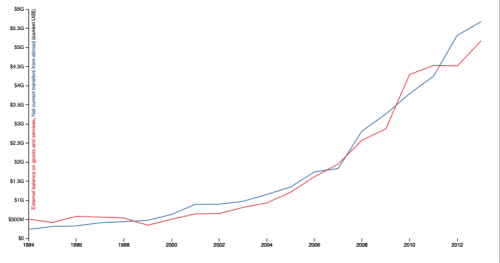
We can observe this cycle empirically in the uncanny relationship between current transfers from abroad into Nepal (i.e. foreign aid and remittance) illustrated with the blue line and the Nepal trade deficit illustrated with the red line in Figure 1 . With each increase in current transfers the trade deficit increases in lock step, one for one, because imports are cheaper than domestic goods. In other words, say a migrant worker sends back money to his family to purchase rice. That money will flow right back out of the country because Indian rice is cheaper than Nepali rice, almost as if the migrant worker had worked abroad and imported the rice himself.
The absolute worst option Nepal could consider is to kick the can down the road and subsequently borrow money in a foreign currency from an international organization like the IMF or World Bank to support its exchange rate. Such a loan would come with strings attached. An IMF loan might force Nepal to undergo structural adjustment, restricting Nepal’s public services while servicing the interests of Western governments, corporations and financial institutions.
The only viable option is for Nepal is to make a smooth transition away from its fixed exchange rate by partnering with India. To do so properly could require significant political capital, and the politicians that represent the over 100 peoples, cultures and languages of Nepal must unite to form an effective constitutional government.
The people of Nepal have been rightfully wary of trusting their own government, let alone the governments of their neighboring giants China and India. Yet they have essentially adopted a foreign currency, ceding economic self-efficacy for a sense of false security and trading short-run stability for long-run fragility. The influence of foreign capital has shaped and corrupted this country for too long.
The Reserve Bank of India must allow the Nepal Rastra Bank to set mutually beneficial terms which the IMF, World Bank or another international organization might appropriately oversee and underwrite. These terms should allow a gradual transition away from the fixed exchange rate to a natural, floating exchange rate that facilitates trade and partnership and, most importantly, allows Nepal to institute independent economic policy.
Nepal’s exchange rate with India is, after all, India’s exchange rate with Nepal. It is also in India’s best interest for the exchange rate to gradually adjust toward its natural rate, and for the rate to naturally fluctuate as trade between the two countries grows.
If there is any hope for growth in the aftermath of this calamity, that growth must come through partnership. At the roots of all sustainable economic growth are democratic institutions and governments that represent the interests of smaller communities and citizens. And the fruits of economic growth are only realized through the cross-pollination of countries, organizations and workers.
Congratulations to my former University of Michigan colleague Ted Bergstrom on being named an AEA distinguished fellow. I think you will find the description of his work linked above very interesting. His theoretical work is exactly in the area of public goods, public choice and altruism that I think lies at the heart of many key public policy questions.
This is a video of my sermon at the Universalist Unitarian Church of Farmington on April 12, 2015. I gave “Teleotheism and the Purpose of Life” earlier at the Community Unitarian Universalists in Brighton. The video works really well directly on Tumblr above, but if you want to see it on YouTube, it is here.
After the “keep reading” line and its associated row of stars is the text of the sermon from my post “Teleotheism and the Purpose of Life,” which was my starting point for the Farmington sermon. If you click the video to get it going and follow along, you will notice my ad libs. This sermon is the centerpiece of my theological views, which I also explore in these religion posts
and in these full sermons (that will be joined by more in the future):
I began my post “Teleotheism and the Purpose of Life,” with this introduction:
I am a lay Unitarian-Universalist preacher. Since 2005 I have given a sermon every year at the Community Unitarian-Universalists of Brighton congregation. This is a sermon I gave on March 30, 2008. Please give this sermon a try. I think it has much in it that will be of interest to a wide range of readers: philosophy, cosmology, evolutionary theory, and science fiction, as well as theology. And nothing in it depends on believing in God at all.
I hope you like this sermon.
Many recent books advocating atheism have made the bestseller lists. I have enjoyed reading many of these books, including The God Delusion by Richard Dawkins, Breaking the Spell: Religion as a Natural Phenomenon by Dennett, Daniel, The End of Faith by Sam Harris, God is Not Great by Christopher Hitchens and God: The Failed Hypothesis by Victor Stenger. So I was intrigued when I saw that Dinesh D’Souza had written a book attempting to defend Christianity against my favorite authors. Instead of talking past each other, a believer in the Biblical God and nonbelievers were in a real dialogue! I was not disappointed. Though, as you will see, I disagree with much of what D’Souza writes in What is So Great About Christianity, D’Souza has understood and digested the recent spate of atheist books well enough that his summary of the arguments of the atheists persuaded me all over again to doubt the existence of God. So he is fair in representing the arguments of his opposition.
As an aside, let me say that real dialogue, and real attempts to understand those who think differently are especially important in a political season like this one. In my own view, we are lucky this time to have three potential presidents [Hilary Clinton, Barack Obama and John McCain], each of whom would be a credit to our republic as its leader. But in the heat of political competition, many of us will be tempted to recoil in disgust from the sincerely held political views of some of our acquaintances. I hope that instead we can try to understand and appreciate the things these people care about that lead them to support one candidate or another. Although we may disagree on political choices, I think it is usually possible to understand and even learn from the concerns that lead people to a particular choice.
In the debate over God, there are many voices that are less temperate than D’Souza. Every time I see Ann Coulter’s book “Godless” on a bookstore display I have to laugh because she uses the word “Godless” as if it is a bad thing. She attacks liberalism by calling it a “godless religion,” but I stood up here a year ago saying that “godless religion” is exactly what we need so that those who don’t believe in God can also get the benefits of religion. But I feel we need to constantly improve godless religion and agnostic religion beyond the current level. If godless religion and agnostic religion are to be fully competitive in the religious market place, they must have deep theology and a profound power to propel people to goodness, build strong religious communities, and provide experiences of transcendence.
Because Unitarian-Universalism combines a respect for its religious heritage with a firm commitment to freedom of thought, I believe there is a better chance of creating an agnostic religion that lives up to this standard with Unitarian-Universalism than anywhere else. But I do not think we are yet up to the standard the world needs us to reach for the sake of future history.
Today, I am going to talk first about theology and science, then about precious things. Propelling people to goodness, building strong religious communities and providing experiences of transcendence fall under the heading of “precious things” at the end.
Since “theology” is Greek for words about god, it might seem strange to talk about the need for a deeper theology for godless religion. But I think it is important for those in a godless religion to talk about God. Let me explain why.
Let me start with Pascal’s wager, which Dinesh D’Souza thinks is a good reason to believe in God. Blaise Pascal was a 17th century French mathematician and philosopher who did some of the early work on probability theory that is the foundation of statistics. He argued that one should bet on the existence of God because if there is a God, believing in God makes the difference between heaven and hell, while if there is no God, it is not so bad to be wrong. One may have wasted some time and money on a false belief in God, but nothing approaching the danger of hell and the prospect of heaven on the other side. When I was a Mormon, before I went too far toward unbelief, I considered carefully whether God would punish me for not believing in him. I decided that despite my imperfections, I would not punish one of my children harshly for not believing in me. Therefore, a perfect, loving Father in Heaven would not punish me if—doing my very best to figure things out—I came to doubt that he existed. Deciding that God—if he existed—would not punish me for my honest beliefs was and is a key ingredient to my being an atheist.
In general, even aside from Pascal’s wager, deciding whether or not to believe in God depends heavily on what one thinks God would be like if he did exist. This is one reason I can see that thoughtful atheists still need to think about God. Later I will talk about other reasons thoughtful atheists need to think about God, even if God doesn’t exist.
The definition of God is often squishy. I remember vividly attending a Reform Judaism Yom Kippur service as a college student, just to see what it would be like. The rabbi said “Many people think they don’t believe in God, but God is just the idea of goodness. So they believe in God without realizing it.” By that standard, I am certainly a believer in God. At the other extreme, there are enough details in the Bible about the Biblical god for me to feel quite confident that the god described in the Bible, taken literally, does not exist.
One of the biggest gaps in the arguments for the existence of God given by people like D’Souza is the leap from the existence of some superbeing, which the arguments have some force for, to the existence of the specific god described in the Bible. For example, invoking Kant and Hume on the limits of knowledge, D’Souza argues that we can’t really know there isn’t a god, so why not believe? Let me run with this argument, and even lean in the direction of the existence of a superbeing, and I can easily get to a totally reasonable place that D’Souza would not be happy with because the superbeing is not the god of the Bible.
There are at least two ways in which the standard scientific worldview is consistent with the possibility of a superbeing. These possibilities are both common themes in hard science fiction. Hard science fiction is science fiction that focuses on things that are genuinely possible given what science we know. One of these hard science fiction themes is reminiscent of traditional Christian theology, while the other is reminiscent of Mormon theology.
Traditional Christian theology, put into a hard science fiction straightjacket, is like the idea that we are all software programs inside a superbeing’s computer. There is no way to know this is not true. If it is true, miracles would just be a special case in the programming. The normal laws of nature could be as simple and regular as they are simply because that was easier than programming more complex laws for the default case.
Mormon theology, put into a hard science fiction straightjacket, is reminiscent of the idea that we are watched over by benevolent aliens from an advanced civilization. Not only is this plausible, it is even possible to argue that it is likely. There are a lot of stars in the Galaxy, but even at a fraction of the speed of light, it would take only a small fraction of the time since the Big Bang to get from one end of the Galaxy to another. If evolution often favors intelligence, why couldn’t intelligent life arise several times in our galaxy? If any intelligent life has arisen before us, chances are it arose many, many millions of years before us, simply because it has been billions of years since the Big Bang. So it is not a big stretch to have aliens from an advanced civilization reach Earth. The big issue would be Fermi’s paradox: “Where are they?” “If they are here, why they are hiding themselves from us?” and whether they are benevolent or not. If they are here, they don’t seem to have destroyed us, which is something.
To me these are important religious questions, but science fiction is not always recognized for the serious theological speculation that it often is. A truly open-minded search for God would consider as many possibilities like this as possible, but instead, the focus is usually the much narrower one of whether certain ancient religious texts are true or not. Looked at without preconceptions, and without regard to which will get you laughed at in polite company, which is harder to believe? The possibilities laid out in hard science fiction, or the god of the Bible? By all means, let’s be open-minded about whether God exists or not, but not just about the God of the Bible.
Let me leave aside for now the possibility that there are superbeings that are relevant to our choices of what to do. Indeed, even if there are powerful superbeings in existence who are aware of us, one of the simplest reasons for them to be hidden is that they want us to act as if they don’t exist. If so, it would be the will of the gods that we be atheists or at least agnostic in relation to them.
In the absence of God, our creator would be the laws of physics and the principle of evolution. Dinesh D’Souza argues that the Big Bang is evidence for God. I thought his science was outdated. In order to explain why distant galaxies are so uniformly distributed across the sky, cosmologists rely on the theory of cosmic inflation, in which a small patch of false vacuum can grow to a region trillions of light-years across in a tiny fraction of a second. This patch of false vacuum keeps growing, but islands within decay into matter and energy in what we locally call the Big Bang. Once the Big Bang is embedded in this larger picture of cosmic inflation, the universe is big enough that almost anything that can happen will happen somewhere. But one must be careful to remember that the universe is vastly bigger than the tiny piece that we can see with our telescopes. Almost everywhere in the universe is so far away that light has not had a chance to reach us from there yet. Given the vastness of the universe, it is almost a certainty that life would arise somewhere, even if the beginning of life is a very improbable event on any given planet.
To his credit, D’Souza accepts evolution, but he underestimates it. Contrary to what he argues, it is straightforward to explain the evolution of morality. For at least a million years, our ancestors have been choosing who they want to hang out with, ally with and have children with. Those who are trustworthy, loyal, helpful, friendly, curteous, kind, obedient, cheerful, thrifty, brave, clean and reverent are often chosen as allies and mates, helping these traits to survive and prosper in the population. My friend Randy Nesse has worked out some of the details of this story of the origin of morality. Darwin began his argument for evolution by pointing out the power of the selective breeding that farmers use to domesticate animals. Randy pointed out that in many ways human beings seem more like domesticated animals than like wild animals—and with good reason: we have been domesticated by the choices other proto-human beings made about whether to hang out with our ancestors.
The key difference between evolution as our creator and the god of the Bible is that with evolution the best comes at the end, not at the beginning. There was no Garden of Eden—only primordial soup in a warm pond. But heaven is still possible; we and our descendants just need to build it.
The first task is to decide what we want. The medieval theologian Anselm defined God as “that than which no greater can be thought” and proceeded to argue that God must exist since something that exists is greater than something that doesn’t exist. Therefore, the greatest of all things must exist. It is my understanding that modern philosophers reject Anselm’s argument on the basis that “existence” is not an ordinary attribute like being massive or being photosynthetic. Existence has a special status in logic. So let me do a riff on Anselm by defining God as “the greatest of all things that can come true.” God is the heaven—or in Mormon terms, the Zion, the ideal society—that we and our descendants can build, and god is a reasonable description of the kind of people who make up that society. But what does a heavenly society look like?
Let’s start with the easier question of what an ideal human being looks like. Here I look to Jesus. Not the historical Jesus, but the imagined Jesus who is the projection of every good human trait, as valued by our culture. It makes all the sense in the world to ask “what would Jesus do” even if one believes that the historical Jesus was only a man, since “what would Jesus do” is a good shorthand for what our culture thinks a good person would do. This is an example of the way in which many of the highest ideas of goodness in Western Culture are embedded in religious language.
Just as our culture’s ideas of the ideal human being have been embedded in the image of Jesus, many of our culture’s ideas of the ideal society have been embedded in the image of heaven or of the holy city. D’Souza’s book is at its best when it is listing the good things that may have come from Christianity: separation of church and state, limited government, the rule of law, the free market, the affirmation of ordinary life, valuing the relief of suffering, the idea of limiting war, a higher level of respect for women than among the Romans, the idea that all humans are of equal value and equal before the law, emphasis on individual freedom, and even the idea that nature can be understood because of the divine spark within us. D’Souza writes: “The life of the West, Nietzsche said, is based on Christianity. The values of the West are based on Christianity. Some of these values seem to have taken on a life of their own, and this gives us the illusion that we can get rid of Christianity and keep the values. This, Nietsche says, is an illusion. Our Western values are what Nietzsche terms ‘shadows of gods.’ Remove the Christian foundation, and the values must go too.” I agree that many of our values come from Christianity, but I believe that we can honor the best of those values without thinking that God exists.
The key to understanding our religious heritage and the clues it provides for the greatest things that might be possible is to realize that wonderful things are truly wonderful, whatever they are made of. There is something wonderful about a tight-knit religious community, whether it is based on a belief in God or not. A rose can be just as beautiful when one knows it is made of evolved molecular machinery. Consciousness is just as amazing even after one realizes that is made of the interactions of quarks, electrons, and photons. So much the better for the quarks, electrons and photons. Spiritual experiences that break down the barriers between self and nature can still be transcendent, even when we realize they involve the suppression of the part of the brain that deals with the self-other distinction. In general,information, whatever substrate it is embedded in, and however well science can explain its transmission and processing, seems to have something of the divine to it.
Teleotheism is the idea that God comes at the end rather than at the beginning. If God is the greatest of all things that can come true, then we and our descendants can build God and Heaven. The first step is to envision the greatest good that we can imagine. Next, we need to assemble relevant knowledge, so we can build on a solid foundation of the truths about human nature and the Universe. Finally, we have to step out into the unknown, exerting the faith to act when we know something might be possible but don’t know for sure that it is. I agree with the Existentialists that having been thrown into existence by physics and evolution, we have to choose our own purpose to life. Can there be any greater purpose to life than working toward that day, that fine day, when God and Heaven do exist?
Here is a link to another of Miles’s UU Sermons: “UU Visions”

Jake is a student in my “Monetary and Financial Theory” class. This is the 17th student guest post this semester. You can see the rest here.
The transition to an electronic currency is coming sooner rather than later and will allow the Fed to use more policy tools and exercise greater flexibility.
The debate over dollar bill or dollar coin is over. Dollar coins are heavier and have a higher cost of manufacturing but have a significantly longer lifespan. For that reason many countries like Canada use dollar coins. Once upon a time it made sense for U.S. treasury to use dollar coins instead of the familiar dollar bill. However, this is no longer the case. According to the Wall Street Journal columnist Jo Craven Mcginty “Now, the lifespan of paper money has increased, the bulk of the potential savings has been forfeited and the U.S. Federal Reserve, which once supported the change, is against it.” Any potential gains from transitioning to a coin are lost. The longer lifespan of a dollar is reflective of the changes in technology and consumer preferences. The transition to an electronic currency is coming sooner rather than later and will allow the Fed to use more policy tools and exercise greater flexibility.
The opportunity cost of currency is very high. There are tons of electronic wallets and payment systems available. The movement away from cash is complex and it is not fully explained when one says American’s just plain do not like cash. There is an abundance of options to carrying money in your wallet. It seems like almost every day a new startup releases a new wallet or payment system. Applications and credit cards have been making carrying and empty wallet convenient for years and now applications take it a step further. For example taxis have credit card scanners or come from applications like Uber and if you owe your friend money just use Venmo. People like the convenience of quickly swiping a card or hitting a few buttons on their phone. It is an argument of tastes and preferences and cash is losing.
Governments stand to gain substantially from an electronic currency as well. Electronic money is easier to track allowing the government to better understand the velocity of money, spending patterns and the effectiveness of monetary policy. This increased knowledge and understanding will help guide monetary policy on multiple fronts.
The Fed does not use all the tools at their disposal for a few reasons. In the case of quantitative easing the implications of the policy are not fully understood but with negative interest rates the limiting factor is policy structure. Negative interest rates at this point in time have been largely theoretical, but have the possibility of substantial policy implications. Once the zero lower bound is removed Obama and Janet Yellen can fully utilize the powers of the Federal Reserve and negative interest rates. Applications and credit cards are not going away any time soon but cash could be.
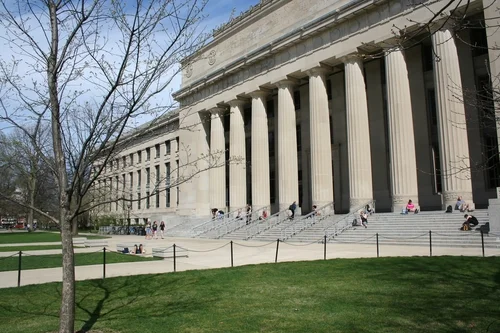
I am very proud of the University of Michigan for the strong statement in favor of free speech in university events sent out by the Provost Martha Pollack late last night. (Arguably, this policy has been on the books for a while, but this new statement is more powerful.) Here is the full text of the email (which can be considered public), other than the request at the top to forward it widely:
Each year, the University of Michigan is host to thousands of presentations, activities, performances, and exhibitions (“events”). Occasionally, some of these events may have to be cancelled, moved, or changed for legitimate reasons-but the expressive views associated with the events are not legitimate reasons.
Because the University is so deeply committed to principles of robust colloquy, free speech, and artistic expression, SPG 601.01 urges University constituents to resist pressure to curtail speech and expression because of how others will react to it:
It is inconsistent with full respect for freedom of speech and expression-though itself a form of protected speech-for members of the University community to exert pressure to revoke an invitation for a speaker to appear at the University because of the potential for a violent reaction to the speech, or the threat of disruption of the speech, and such pressure should be resisted. Likewise, refusal to invite an individual to speak solely because his or her presence may invite violence and disruption is contrary to the intellectual ideals of the University.
As a public institution, the University may only change events for viewpoint-neutral reasons. Such reasons include the inclement weather, the appropriateness of the venue (e.g., capacity, acoustics, etc.), unavailability of the speaker/artist, or the like. Such reasons do not include that the event will be controversial, provocative, inviting of protest, or the like.
Because the University is resolute in its adherence to law and to these principles, University units must contact an executive officer in their reporting line before cancelling, moving, or changing an event, if the decision is based on-or likely to be perceived as being based on-the content of speech or expression. Units may reach out to the Office of the Vice President and General Counsel to consult on legal issues associated with changes to events.
For contrast, see these other posts:
And for basic principles, see
This is a valuable article in the Economist about a topic that many Americans (including me) often find it a bit awkward to talk about: birth control. Implants and IUDs (intrauterine devices) have moved far beyond the Dalkon shield that hurt their reputation in the 1970s. Standard guidelines say that “providers should mention them first, before the less effective options,” but many doctors and other providers don’t realize this.
Exploiting the underused technology of implants and IUDs can do a lot to reduce the teen pregnancy rate. From the article:
In Colorado in 2009 a private foundation started paying both for IUDs and implants in public clinics and for training the staff who provide them. Within two years teenage births fell by 26% and abortions by 34% (both were down in other age groups, too).
Because many of these teenagers can’t support kids without help from the state, doing this saves a lot more public money than the money put in.
Identifying an externality that merits a corrective intervention is much trickier than many people recognize. Three previous posts on supplysideliberal.com give examples of ways in which one person’s actions can hurt someone else, but in a legitimate, laudable way:
John Stuart Mill, in On Liberty “Chapter V: Applications,” paragraph 3, addresses this issue of distinguishing between externalities that deserve correction and ways of hurting other people that should be allowed unhindered:
In the first place, it must by no means be supposed, because damage, or probability of damage, to the interests of others, can alone justify the interference of society, that therefore it always does justify such interference. In many cases, an individual, in pursuing a legitimate object, necessarily and therefore legitimately causes pain or loss to others, or intercepts a good which they had a reasonable hope of obtaining. Such oppositions of interest between individuals often arise from bad social institutions, but are unavoidable while those institutions last; and some would be unavoidable under any institutions. Whoever succeeds in an overcrowded profession, or in a competitive examination; whoever is preferred to another in any contest for an object which both desire, reaps benefit from the loss of others, from their wasted exertion and their disappointment. But it is, by common admission, better for the general interest of mankind, that persons should pursue their objects undeterred by this sort of consequences. In other words, society admits no right, either legal or moral, in the disappointed competitors, to immunity from this kind of suffering; and feels called on to interfere, only when means of success have been employed which it is contrary to the general interest to permit—namely, fraud or treachery, and force.
Note that John Stuart Mill is careful not to say that competitive setups are always efficient, saying instead that “Such oppositions of interest between individuals often arise from bad social institutions.” Bad social institutions are definitely worth correction, but one should be careful to blame the designer of the institution rather than those who participate in it. Also, in such cases, one should be careful not to cross the line from correction of incentives to punitive action.
For economists and others involved in making public policy, the distinction between externalities that should be corrected and legitimate ways of hurting other people such as
Making the distinction is tough. I wrestle with it in these other John Stuart Mill posts:

link to syndicated version on Quartz
I am proud that, for one of the first times I am aware of, something first published on supplysideliberal.com, that I didn’t write myself, has been syndicated to an online magazine. Laura Overdeck’s post appeared first as “Math for Pleasure” on this blog. Now it has been syndicated to Quartz. If you haven’t read it, here is a second chance.
Note: In reaction to the link I posted above, Pavel Malik points out the potential downside of something like “Moving to Opportunity” indicated by this interesting but disturbing piece from the Atlantic back in 2008.

I am embarrassed by the mistake I made yesterday in my post “She’s a Hurricane: Evidence That Gender Bias Is Not All Fully Rational Statistical Discrimination” by accepting at face value statistical claims made about how gender of hurricane affects people’s judgment at face value. In both tweets and comments and by private communications, you set me straight–but not before quite a few people “liked” and reblogged my flawed post.
My embarrassment makes me realize again how useful it is to talk about interesting statistical mistakes. When I was young, I enjoyed the puzzle of trying to figure out the mapping of letters to digits in the addition problem
SEND
+MORE
_______
MONEY
You are welcome to send me money if you insist, but what I actually want to ask for is instead to send me more statistical mistakes that you find notable. Interesting and instructive mistakes that have actually sent people off in the wrong direction are especially valuable. What are your favorite stories of statistical mistakes?
Note: With rare exceptions, I routinely whitelist everyone who posts a comment. While you have to wait for me to click the right button to have your first comment on this blog appear, after being whitelisted, new comments will appear immediately.