Live: Teleotheism and the Purpose of Life

This is a video of my sermon at the Universalist Unitarian Church of Farmington on April 12, 2015. I gave “Teleotheism and the Purpose of Life” earlier at the Community Unitarian Universalists in Brighton. The video works really well directly on Tumblr above, but if you want to see it on YouTube, it is here

After the “keep reading” line and its associated row of stars is the text of the sermon from my post “Teleotheism and the Purpose of Life,” which was my starting point for the Farmington sermon. If you click the video to get it going and follow along, you will notice my ad libs. This sermon is the centerpiece of my theological views, which I also explore in these religion posts

and in these full sermons (that will be joined by more in the future): 

I began my post “Teleotheism and the Purpose of Life,” with this introduction:

I am a lay Unitarian-Universalist preacher. Since 2005 I have given a sermon every year at the Community Unitarian-Universalists of Brighton congregation. This is a sermon I gave on March 30, 2008. Please give this sermon a try. I think it has much in it that will be of interest to a wide range of readers: philosophy, cosmology, evolutionary theory, and science fiction, as well as theology. And nothing in it depends on believing in God at all.

I hope you like this sermon.


Many recent books advocating atheism have made the bestseller lists.    I have enjoyed reading many of these books, including The God Delusion by Richard Dawkins, Breaking the Spell: Religion as a Natural Phenomenon by Dennett, Daniel, The End of Faith by Sam Harris, God is Not Great by Christopher Hitchens and God: The Failed Hypothesis by Victor Stenger.  So I was intrigued when I saw that Dinesh D’Souza had written a book attempting to defend Christianity against my favorite authors.  Instead of talking past each other, a believer in the Biblical God and nonbelievers were in a real dialogue!  I was not disappointed.  Though, as you will see, I disagree with much of what D’Souza writes in What is So Great About Christianity, D’Souza has understood and digested the recent spate of atheist books well enough that his summary of the arguments of the atheists persuaded me all over again to doubt the existence of God.   So he is fair in representing the arguments of his opposition.

As an aside, let me say that real dialogue, and real attempts to understand those who think differently are especially important in a political season like this one.  In my own view, we are lucky this time to have three potential presidents [Hilary Clinton, Barack Obama and John McCain], each of whom would be a credit to our republic as its leader.  But in the heat of political competition, many of us will be tempted to recoil in disgust from the sincerely held political views of some of our acquaintances.  I hope that instead we can try to understand and appreciate the things these people care about that lead them to support one candidate or another.  Although we may disagree on political choices, I think it is usually possible to understand and even learn from the concerns that lead people to a particular choice.

In the debate over God, there are many voices that are less temperate than D’Souza.   Every time I see Ann Coulter’s book “Godless” on a bookstore display I have to laugh because she uses the word “Godless” as if it is a bad thing.  She attacks liberalism by calling it a “godless religion,” but I stood up here a year ago saying that “godless religion” is exactly what we need so that those who don’t believe in God can also get the benefits of religion.  But I feel we need to constantly improve godless religion and agnostic religion beyond the current level.   If godless religion and agnostic religion are to be fully competitive in the religious market place, they must have deep theology and a profound power to propel people to goodness, build strong religious communities, and provide experiences of transcendence.

Because Unitarian-Universalism combines a respect for its religious heritage with a firm commitment to freedom of thought, I believe there is a better chance of creating an agnostic religion that lives up to this standard with Unitarian-Universalism than anywhere else.  But I do not think we are yet up to the standard the world needs us to reach for the sake of future history.

Today, I am going to talk first about theology and science, then about precious things.  Propelling people to goodness, building strong religious communities and providing experiences of transcendence fall under the heading of “precious things” at the end.

Since “theology” is Greek for words about god, it might seem strange to talk about the need for a deeper theology for godless religion.  But I think it is important for those in a godless religion to talk about God.  Let me explain why.  

Let me start with Pascal’s wager, which Dinesh D’Souza thinks is a good reason to believe in God.  Blaise Pascal was a 17th century French mathematician and philosopher who did some of the early work on probability theory that is the foundation of statistics.   He argued that one should bet on the existence of God because if there is a God, believing in God makes the difference between heaven and hell, while if there is no God, it is not so bad to be wrong.  One may have wasted some time and money on a false belief in God, but nothing approaching the danger of hell and the prospect of heaven on the other side.   When I was a Mormon, before I went too far toward unbelief, I considered carefully whether God would punish me for not believing in him.  I decided that despite my imperfections, I would not punish one of my children harshly for not believing in me.  Therefore, a perfect, loving Father in Heaven would not punish me if—doing my very best to figure things out—I came to doubt that he existed.  Deciding that God—if he existed—would not punish me for my honest beliefs was and is a key ingredient to my being an atheist.

In general, even aside from Pascal’s wager, deciding whether or not to believe in God depends heavily on what one thinks God would be like if he did exist.  This is one reason I can see that thoughtful atheists still need to think about God.  Later I will talk about other reasons thoughtful atheists need to think about God, even if God doesn’t exist.

The definition of God is often squishy.  I remember vividly attending a Reform Judaism Yom Kippur service as a college student, just to see what it would be like.  The rabbi said “Many people think they don’t believe in God, but God is just the idea of goodness.  So they believe in God without realizing it.”  By that standard, I am certainly a believer in God.  At the other extreme, there are enough details in the Bible about the Biblical god for me to feel quite confident that the god described in the Bible, taken literally, does not exist.

One of the biggest gaps in the arguments for the existence of God given by people like D’Souza is the leap from the existence of some superbeing, which the arguments have some force for, to the existence of the specific god described in the Bible.  For example, invoking Kant and Hume on the limits of knowledge, D’Souza argues that we can’t really know there isn’t a god, so why not believe?  Let me run with this argument, and even lean in the direction of the existence of a superbeing, and I can easily get to a totally reasonable place that D’Souza would not be happy with because the superbeing is not the god of the Bible.  

There are at least two ways in which the standard scientific worldview is consistent with the possibility of a superbeing.   These possibilities are both common themes in hard science fiction.  Hard science fiction is science fiction that focuses on things that are genuinely possible given what science we know.  One of these hard science fiction themes is reminiscent of traditional Christian theology, while the other is reminiscent of Mormon theology.  

Traditional Christian theology, put into a hard science fiction straightjacket, is like the idea that we are all software programs inside a superbeing’s computer.  There is no way to know this is not true.  If it is true, miracles would just be a special case in the programming.  The normal laws of nature could be as simple and regular as they are simply because that was easier than programming more complex laws for the default case.

Mormon theology, put into a hard science fiction straightjacket, is reminiscent of the idea that we are watched over by benevolent aliens from an advanced civilization.  Not only is this plausible, it is even possible to argue that it is likely.  There are a lot of stars in the Galaxy, but even at a fraction of the speed of light, it would take only a small fraction of the time since the Big Bang to get from one end of the Galaxy to another.   If evolution often favors intelligence, why couldn’t intelligent life arise several times in our galaxy?  If any intelligent life has arisen before us, chances are it arose many, many millions of years before us, simply because it has been billions of years since the Big Bang.  So it is not a big stretch to have aliens from an advanced civilization reach Earth.  The big issue would be Fermi’s paradox:  “Where are they?”  “If they are here, why they are hiding themselves from us?”  and whether they are benevolent or not.   If they are here, they don’t seem to have destroyed us, which is something.

To me these are important religious questions, but science fiction is not always recognized for the serious theological speculation that it often is.   A truly open-minded search for God would consider as many possibilities like this as possible, but instead, the focus is usually the much narrower one of whether certain ancient religious texts are true or not.  Looked at without preconceptions, and without regard to which will get you laughed at in polite company, which is harder to believe?  The possibilities laid out in hard science fiction, or the god of the Bible?  By all means, let’s be open-minded about whether God exists or not, but not just about the God of the Bible.

Let me leave aside for now the possibility that there are superbeings that are relevant to our choices of what to do.  Indeed, even if there are powerful superbeings in existence who are aware of us, one of the simplest reasons for them to be hidden is that they want us to act as if they don’t exist.  If so, it would be the will of the gods that we be atheists or at least agnostic in relation to them.

In the absence of God, our creator would be the laws of physics and the principle of evolution.  Dinesh D’Souza argues that the Big Bang is evidence for God.  I thought his science was outdated.  In order to explain why distant galaxies are so uniformly distributed across the sky, cosmologists rely on the theory of cosmic inflation, in which a small patch of false vacuum can grow to a region trillions of light-years across in a tiny fraction of a second.  This patch of false vacuum keeps growing, but islands within decay into matter and energy in what we locally call the Big Bang.  Once the Big Bang is embedded in this larger picture of cosmic inflation, the universe is big enough that almost anything that can happen will happen somewhere.  But one must be careful to remember that the universe is vastly bigger than the tiny piece that we can see with our telescopes.  Almost everywhere in the universe is so far away that light has not had a chance to reach us from there yet.  Given the vastness of the universe, it is almost a certainty that life would arise somewhere, even if the beginning of life is a very improbable event on any given planet.

To his credit, D’Souza accepts evolution, but he underestimates it.  Contrary to what he argues, it is straightforward to explain the evolution of morality.  For at least a million years, our ancestors have been choosing who they want to hang out with, ally with and have children with.  Those who are trustworthy, loyal, helpful, friendly, curteous, kind, obedient, cheerful, thrifty, brave, clean and reverent are often chosen as allies and mates, helping these traits to survive and prosper in the population.   My friend Randy Nesse has worked out some of the details of this story of the origin of morality.  Darwin began his argument for evolution by pointing out the power of the selective breeding that farmers use to domesticate animals.  Randy pointed out that in many ways human beings seem more like domesticated animals than like wild animals—and with good reason: we have been domesticated by the choices other proto-human beings made about whether to hang out with our ancestors.  

The key difference between evolution as our creator and the god of the Bible is that with evolution the best comes at the end, not at the beginning.  There was no Garden of Eden—only primordial soup in a warm pond.   But heaven is still possible; we and our descendants just need to build it.  

The first task is to decide what we want.  The medieval theologian Anselm defined God as “that than which no greater can be thought” and proceeded to argue that God must exist since something that exists is greater than something that doesn’t exist.  Therefore, the greatest of all things must exist.   It is my understanding that modern philosophers reject Anselm’s argument on the basis that “existence” is not an ordinary attribute like being massive or being photosynthetic.  Existence has a special status in logic.  So let me do a riff on Anselm by defining God as “the greatest of all things that can come true.”  God is the heaven—or in Mormon terms, the Zion, the ideal society—that we and our descendants can build, and god is a reasonable description of the kind of people who make up that society.   But what does a heavenly society look like?

Let’s start with the easier question of what an ideal human being looks like.   Here I look to Jesus.  Not the historical Jesus, but the imagined Jesus who is the projection of every good human trait, as valued by our culture.  It makes all the sense in the world to ask “what would Jesus do” even if one believes that the historical Jesus was only a man, since “what would Jesus do” is a good shorthand for what our culture thinks a good person would do.  This is an example of the way in which many of the highest ideas of goodness in Western Culture are embedded in religious language.

Just as our culture’s ideas of the ideal human being have been embedded in the image of Jesus, many of our culture’s ideas of the ideal society have been embedded in the image of heaven or of the holy city.  D’Souza’s book is at its best when it is listing the good things that may have come from Christianity: separation of church and state, limited government, the rule of law, the free market, the affirmation of ordinary life, valuing the relief of suffering, the idea of limiting war, a higher level of respect for women than among the Romans, the idea that all humans are of equal value and equal before the law, emphasis on individual freedom, and even the idea that nature can be understood because of the divine spark within us.  D’Souza writes: “The life of the West, Nietzsche said, is based on Christianity.  The values of the West are based on Christianity.  Some of these values seem to have taken on a life of their own, and this gives us the illusion that we can get rid of Christianity and keep the values.  This, Nietsche says, is an illusion.  Our Western values are what Nietzsche terms ‘shadows of gods.’  Remove the Christian foundation, and the values must go too.”   I agree that many of our values come from Christianity, but I believe that we can honor the best of those values without thinking that God exists.

The key to understanding our religious heritage and the clues it provides for the greatest things that might be possible is to realize that wonderful things are truly wonderful, whatever they are made of.  There is something wonderful about a tight-knit religious community, whether it is based on a belief in God or not.  A rose can be just as beautiful when one knows it is made of evolved molecular machinery.  Consciousness is just as amazing even after one realizes that is made of the interactions of quarks, electrons, and photons.  So much the better for the quarks, electrons and photons.  Spiritual experiences that break down the barriers between self and nature can still be transcendent, even when we realize they involve the suppression of the part of the brain that deals with  the self-other distinction.  In general,information, whatever substrate it is embedded in, and however well science can explain its transmission and processing, seems to have something of the divine to it.  

Teleotheism is the idea that God comes at the end rather than at the beginning.  If God is the greatest of all things that can come true, then we and our descendants can build God and Heaven.  The first step is to envision the greatest good that we can imagine.  Next, we need to assemble relevant knowledge, so we can build on a solid foundation of the truths about human nature and the Universe.  Finally, we have to step out into the unknown, exerting the faith to act when we know something might be possible but don’t know for sure that it is.  I agree with the Existentialists that having been thrown into existence by physics and evolution, we have to choose our own purpose to life.  Can there be any greater purpose to life than working toward that day, that fine day, when God and Heaven do exist?

Here is a link to another of Miles’s UU Sermons: “UU Visions”

Books

  • Dawkins, Richard.  The God Delusion
  • Dennett, Daniel.  Breaking the Spell: Religion as a Natural Phenomenon
  • D'Souza, Dinesh.  What’s So Great About Christianity?
  • Harris, Sam. The End of Faith
  • Hitchens Christopher. God is Not Great
  • Stark, Rodney.  The Victory of Reason: How Christianity Led to Freedom, Capitalism, and Western Success
  • Stenger, Victor. God: The Failed Hypothesis

Jake Weimar’s Rallying Cry for Electronic Money

Jake Weimar’s LinkedIn Page

Jake is a student in my “Monetary and Financial Theory” class. This is the 17th student guest post this semester. You can see the rest here.


The transition to an electronic currency is coming sooner rather than later and will allow the Fed to use more policy tools and exercise greater flexibility.

The debate over dollar bill or dollar coin is over. Dollar coins are heavier and have a higher cost of manufacturing but have a significantly longer lifespan.  For that reason many countries like Canada use dollar coins. Once upon a time it made sense for U.S. treasury to use dollar coins instead of the familiar dollar bill. However, this is no longer the case. According to the Wall Street Journal columnist Jo Craven Mcginty “Now, the lifespan of paper money has increased, the bulk of the potential savings has been forfeited and the U.S. Federal Reserve, which once supported the change, is against it.” Any potential gains from transitioning to a coin are lost. The longer lifespan of a dollar is reflective of the changes in technology and consumer preferences. The transition to an electronic currency is coming sooner rather than later and will allow the Fed to use more policy tools and exercise greater flexibility.

The opportunity cost of currency is very high. There are tons of electronic wallets and payment systems available. The movement away from cash is complex and it is not fully explained when one says American’s just plain do not like cash. There is an abundance of options to carrying money in your wallet. It seems like almost every day a new startup releases a new wallet or payment system.  Applications and credit cards have been making carrying and empty wallet convenient for years and now applications take it a step further.  For example taxis have credit card scanners or come from applications like Uber and if you owe your friend money just use Venmo. People like the convenience of quickly swiping a card or hitting a few buttons on their phone. It is an argument of tastes and preferences and cash is losing.

Governments stand to gain substantially from an electronic currency as well. Electronic money is easier to track allowing the government to better understand the velocity of money, spending patterns and the effectiveness of monetary policy. This increased knowledge and understanding will help guide monetary policy on multiple fronts.

The Fed does not use all the tools at their disposal for a few reasons. In the case of quantitative easing the implications of the policy are not fully understood but with negative interest rates the limiting factor is policy structure. Negative interest rates at this point in time have been largely theoretical, but have the possibility of substantial policy implications. Once the zero lower bound is removed Obama and Janet Yellen can fully utilize the powers of the Federal Reserve and negative interest rates. Applications and credit cards are not going away any time soon but cash could be.

The University of Michigan Stands Up for Freedom of Speech

I am very proud of the University of Michigan for the strong statement in favor of free speech in university events sent out by the Provost Martha Pollack late last night. (Arguably, this policy has been on the books for a while, but this new statement is more powerful.) Here is the full text of the email (which can be considered public), other than the request at the top to forward it widely: 

Each year, the University of Michigan is host to thousands of presentations, activities, performances, and exhibitions (“events”). Occasionally, some of these events may have to be cancelled, moved, or changed for legitimate reasons-but the expressive views associated with the events are not legitimate reasons.
Because the University is so deeply committed to principles of robust colloquy, free speech, and artistic expression, SPG 601.01 urges University constituents to resist pressure to curtail speech and expression because of how others will react to it:
It is inconsistent with full respect for freedom of speech and expression-though itself a form of protected speech-for members of the University community to exert pressure to revoke an invitation for a speaker to appear at the University because of the potential for a violent reaction to the speech, or the threat of disruption of the speech, and such pressure should be resisted. Likewise, refusal to invite an individual to speak solely because his or her presence may invite violence and disruption is contrary to the intellectual ideals of the University.
As a public institution, the University may only change events for viewpoint-neutral reasons. Such reasons include the inclement weather, the appropriateness of the venue (e.g., capacity, acoustics, etc.), unavailability of the speaker/artist, or the like. Such reasons do not include that the event will be controversial, provocative, inviting of protest, or the like.
Because the University is resolute in its adherence to law and to these principles, University units must contact an executive officer in their reporting line before cancelling, moving, or changing an event, if the decision is based on-or likely to be perceived as being based on-the content of speech or expression.  Units may reach out to the Office of the Vice President and General Counsel to consult on legal issues associated with changes to events.

For contrast, see these other posts:

And for basic principles, see

The Economist: Taking the Bother Out of Birth Control

This is a valuable article in the Economist about a topic that many Americans (including me) often find it a bit awkward to talk about: birth control. Implants and IUDs (intrauterine devices) have moved far beyond the Dalkon shield that hurt their reputation in the 1970s. Standard guidelines say that “providers should mention them first, before the less effective options,” but many doctors and other providers don’t realize this. 

Exploiting the underused technology of implants and IUDs can do a lot to reduce the teen pregnancy rate. From the article: 

In Colorado in 2009 a private foundation started paying both for IUDs and implants in public clinics and for training the staff who provide them. Within two years teenage births fell by 26% and abortions by 34% (both were down in other age groups, too). 

Because many of these teenagers can’t support kids without help from the state, doing this saves a lot more public money than the money put in.

John Stuart Mill on Legitimate Ways to Hurt Other People

Identifying an externality that merits a corrective intervention is much trickier than many people recognize. Three previous posts on supplysideliberal.com give examples of ways in which one person’s actions can hurt someone else, but in a legitimate, laudable way:

  1. In “The Wrong Side of Cobb-Douglas: Matt Rognlie’s Smackdown of Thomas Piketty Gains Traction” I argue that building more housing should encouraged, even though it hurts other property owners by reducing the scarcity value of the buildings they own. (Such effects are sometimes called “pecuniary externalities” to distinguish them from the kind of externalities that deserve correction.) This point was initially hard for me to see. 
  2. In “Don’t Recognize Racist Externalities with a Pigou Tax,” Robin Green argues that law-abiding and reasonable-rule-abiding individuals whom other people don’t want to live near have the right to move into a neighborhood anyway.
  3. In “The Case for Gay Marriage is Made in the Freedom of Religion” I talk about the right to marry someone of the same sex even though it offends others’ religious sensibility as itself an aspect of freedom of religion.   

John Stuart Mill, in On Liberty “Chapter V: Applications,” paragraph 3, addresses this issue of distinguishing between externalities that deserve correction and ways of hurting other people that should be allowed unhindered:

In the first place, it must by no means be supposed, because damage, or probability of damage, to the interests of others, can alone justify the interference of society, that therefore it always does justify such interference. In many cases, an individual, in pursuing a legitimate object, necessarily and therefore legitimately causes pain or loss to others, or intercepts a good which they had a reasonable hope of obtaining. Such oppositions of interest between individuals often arise from bad social institutions, but are unavoidable while those institutions last; and some would be unavoidable under any institutions. Whoever succeeds in an overcrowded profession, or in a competitive examination; whoever is preferred to another in any contest for an object which both desire, reaps benefit from the loss of others, from their wasted exertion and their disappointment. But it is, by common admission, better for the general interest of mankind, that persons should pursue their objects undeterred by this sort of consequences. In other words, society admits no right, either legal or moral, in the disappointed competitors, to immunity from this kind of suffering; and feels called on to interfere, only when means of success have been employed which it is contrary to the general interest to permit—namely, fraud or treachery, and force.

Note that John Stuart Mill is careful not to say that competitive setups are always efficient, saying instead that “Such oppositions of interest between individuals often arise from bad social institutions.” Bad social institutions are definitely worth correction, but one should be careful to blame the designer of the institution rather than those who participate in it. Also, in such cases, one should be careful not to cross the line from correction of incentives to punitive action. 

For economists and others involved in making public policy, the distinction between externalities that should be corrected and legitimate ways of hurting other people such as 

  1. pecuniary externalities from providing market competition  
  2. moving into the neighborhood of people who are prejudiced  
  3. offending religious sensibilities by marrying someone of the same sex.

Making the distinction is tough. I wrestle with it in these other John Stuart Mill posts:

Laura Overdeck Syndicated from supplysideliberal.com to Quartz: Don't Just Read to Your Kids at Night, Do Math with Them, Too. They'll Thank You Later

link to syndicated version on Quartz

I am proud that, for one of the first times I am aware of, something first published on supplysideliberal.com, that I didn’t write myself, has been syndicated to an online magazine. Laura Overdeck’s post appeared first as “Math for Pleasure” on this blog. Now it has been syndicated to Quartz. If you haven’t read it, here is a second chance.

Send More Statistical Mistakes

I am embarrassed by the mistake I made yesterday in my post “She’s a Hurricane: Evidence That Gender Bias Is Not All Fully Rational Statistical Discrimination” by accepting at face value statistical claims made about how gender of hurricane affects people’s judgment at face value. In both tweets and comments and by private communications, you set me straight–but not before quite a few people “liked” and reblogged my flawed post. 

My embarrassment makes me realize again how useful it is to talk about interesting statistical mistakes. When I was young, I enjoyed the puzzle of trying to figure out the mapping of letters to digits in the addition problem

SEND
+MORE
_______
MONEY

You are welcome to send me money if you insist, but what I actually want to ask for is instead to send me more statistical mistakes that you find notable. Interesting and instructive mistakes that have actually sent people off in the wrong direction are especially valuable. What are your favorite stories of statistical mistakes?

Note: With rare exceptions, I routinely whitelist everyone who posts a comment. While you have to wait for me to click the right button to have your first comment on this blog appear, after being whitelisted, new comments will appear immediately.

She’s a Hurricane: Evidence That Gender Bias Is Not All Fully Rational Statistical Discrimination

I have gotten much more interested in the issue of gender-bias since working with my (still anonymous) coauthor on our column “How Big is the Sexism Problem in Economics?”  It is often devilishly hard to tell whether discrimination is statistical discrimination that would be rational for an unbiased individual based on genuine differences between groups or evidence of actually being willing to pay a price to discriminate. Sometimes it is possible to identify directly the price someone is paying to discriminate by the higher profits or otherwise better deal to be had by dealing with disfavored groups. But there is another type of evidence for gender bias: situations in which everyone ought to know there is no genuine difference by gender in which people treat males differently than females. Such is the case with hurricanes. I was pointed to a report by Nicholas Kristof in the New York Times on the following research:

Researchers find that female-named hurricanes kill about twice as many people as similar male-named hurricanes because some people underestimate them. Americans expect male hurricanes to be violent and deadly, but they mistake female hurricanes as dainty or wimpish and don’t take adequate precautions.
The study, published in the Proceedings of the National Academy of Sciences, underscored how unconscious biases shape our behavior — even when we’re unaware of them.

The article should have completed the logic by stating that male and female names are in fact assigned to hurricanes in a way unrelated to severity, but I assume that is the case, since meteorologists on their own would not want to deal with the criticism from discriminatory naming of hurricanes. 

Update: Of course, everything I say above depends on the names of hurricanes being randomly assigned. One reader pointed out that all hurricanes used to have female names, so if they didn’t correct for that, the conclusion I make above is not warranted. But in that case, the data should be reanalyzed for the later time period when hurricane names were randomly assigned. 

Make sure to read the comments below, which cast doubt on the care of the analysis in the paper behind Nicholas Kristof’s article. In the light of the criticisms, I have to apologize for relying too much on Nicholas Kristof’s vetting of the empirical paper, just as I had to apologize for relying too much on Carmen Reinhart and Ken Rogoff in “An Economist’s Mea Culpa: I Relied on Reinhart and Rogoff.” 

…for most country X year observations in the Piketty and Zucman (2013) [data], aggregate Tobin’s q is less than 1—the book value of wealth exceeds the market value. …if corporate market equity value is lower than properly measured book equity value, it may be that assets are less valuable in corporate hands—due, perhaps, to poor shareholder control. (Piketty and Zucman (2013) discuss this hypothesis, which seems plausible in light of the cross-country pattern in Tobin’s q.)

– Matthew Rognlie, in “A note on Piketty and diminishing returns to capital” June 15, 2014, which I discuss and link to in “The Wrong Side of Cobb-Douglas: Matt Rognlie’s Smackdown of Thomas Piketty Gains Traction.” Piketty and Zucman (2013) can be found here

The Arbitrage Pricing Theory as a Noise Trader Model

The Arbitrage Pricing Theory or APT is not only one of the most basic theories of finance, it is one of the theories that is closest to being true. The theory itself gives a reason the APT is so close to being true: because it depends primarily on the principles of arbitrage and diversification being applied by some investors. So the APT is robust to large numbers of investors with a huge amount of investable wealth behind them being irrational–the “noise traders” of the post’s title–as long as there is a remnant of rational investors who also command a significant amount of investable wealth. 

In this post, I want to explain what I see in the APT at the level I do finance in my undergraduate “Monetary and Financial Theory” class. In particular, I am assuming the level of knowledge in my handout “Notes on the Capital Asset Pricing Model.” You can see another take on the APT in the Wikipedia article on Arbitrage Pricing Theory, and I would be glad for recommendations for other links to especially accessible and well-written treatments of the APT. 

To simplify, I am thinking about real returns over a short period of time, coming out of the usual jagged path of prices without sudden jumps. And I am leaving aside issues of intertemporal hedging so that everyone’s objective boils down to a function of only the mean and variance of the overall portfolio returns over that short span of time. (Key issues this leaves out are intertemporal hedging, which Matthew Shapiro, Tyler Shumway and Jing Zhang talk about as the issue of appropriate numeraire for each age by risk tolerance group by which to evaluate returns in our paper “Portfolio Rebalancing in General Equilibrium” and integration of human capital into portfolios.)   

The returns for different assets often covary, either positively or negatively. Some of this return variation and covariation might be due to the actions of the noise traders. Indeed, the returns due to variation in the required return for risky assets are a good candidate for noise-trader-induced return variation and covariation. 

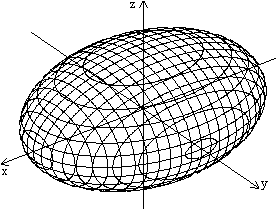
If the way the return of each asset varies is thought of as a vector, then two assets that covary positively–that is, move together to some extent–can be thought of as vectors with an acute angle (of less then 90 degrees) between them. Two assets that covary negatively can be thought of as two vectors with an obtuse angle (of greater than 90 degrees) between them. Two assets that are uncorrelated can be thought of as two vectors that are orthogonal to one another–that is, two vectors that have a right angle of 90 degrees between them. From this point of view, all the variation and covariation of all of the assets out there can be thought of as an ellipsoid with many, many dimensions. 

To give you a little of the picture of what an ellipsoid in many dimensions is like, let me quote in full the text of my post “My Proudest Moment as a Student in Ph.D. Classes”: 

Ellipsoids, which are more or less a watermelon shape, are important in econometrics. In my Ph.D. Econometrics class at Harvard, Dale Jorgenson explained the effect of linear constraints by saying that slicing a plane through an ellipsoid would be like slicing a watermelon. Slices of a 3-dimensional ellipse–a watermelon–are in the shape of a 2-dimensional ellipse–a watermelon slice. Dale’s analogy of watermelons and watermelon slices inspired me to exclaim that slicing a 4-dimensional ellipsoid with a hyperplane would get you a whole watermelon! 

No matter how many dimensions are in play, except in rare cases of equal lengths, there will be one major axis (usually at a slant) along which the ellipsoid representing all the asset returns is the longest. In the APT, this represents the “first factor” or most important way in which the universe of assets covaries. Then, among all the directions at right angles to that, the longest axis is the “second factor” and so on. When the covariances of the returns are analyzed, it turns out that after a few factors (each at right angles to all the previous factors), the ellipsoid is pretty thin in all the directions at right angles to the first few factors.

Suppose that each of these factors is made into a hedge fund or mutual fund. If we go through all the factors, even the minor ones, and make them each into a hedge fund or mutual fund, these hedge funds and mutual funds (hereafter “hedge funds”) will cover all the bases and make any position possible that was possible with the full set of assets.

Imagine that there is a set of rational investors who all agree on these covariances and on the mean excess returns that each asset earns above the safe rate. These investors may differ in their risk aversion. I am going to leave aside any rational investors who are ever limited from short-selling or from borrowing to take a more than 100% position in risky assets overall, and focus on a core group of rational investors who are never limited in those ways.

Asset Demand by the Unconstrained Rational Investors 

Each unconstrained rational investor k will want to choose a share in each of the factor funds obeying the following equation:

share of wealth in factor fund i 
= risk tolerance of k * mean excess return of i / variance of i 

Here, risk tolerance is just a name for 1/relative risk aversion. Risk tolerance turns out to be a very useful concept because risk tolerance averages across people as a simple wealth-weighted mean, while risk aversion correspondingly averages across people as a more complex harmonic average. To see this note that 

total holdings of factor fund i by all unconstrained rational investors =
sum over unconstrained rational k of wealth of k * risk tolerance of k 
* mean excess return of i / variance of i.

It is convenient to define aggregate risk tolerance of unconstrained rational investors by 

aggregate risk tolerance of unconstrained rational investors
= sum over unconstrained rational k of 
(wealth of k / total wealth of core rational investors) * risk tolerance of k.

Then dividing the equation just before that by the total wealth of all unconstrained rational investors, 

share of the wealth of all unconstrained rational investor in factor fund i 
= aggregate risk tolerance of unconstrained rational investors  
* (mean excess return of i / variance of i). 

Setting Supply Equal to Demand

Think of the supply of each asset left over for the unconstrained rational investors as if it were exogenous. At any rate, however endogenous that is, since someone must hold all the assets that exist, whatever assets are left over for the unconstrained rational investors must be held by them as a group. I will represent the key aspects of the supply of assets left over for the unconstrained rational investors by the shares of the various factor funds in the total pile of wealth that the unconstrained rational investors as a group hold. 

It is natural to define the aggregate risk aversion of the unconstrained rational investors as 1 / aggregate risk tolerance of unconstrained rational investors. Given that definition, after setting the shares in the supply left over for the unconstrained rational investors to the share on the demand side for the unconstrained rational investors, a little algebra gives a formula for the mean excess return of factor fund i when the 

mean excess return of i 
= aggregate risk tolerance of unconstrained rational investors 
* variance of i 
* share of i in what is left over for unconstrained rational investors.

The interesting thing about this equation is that it has the key asset pricing prediction for the APT: that the mean excess return is almost zero for a minor factor (e.g. the 23d factor) for which the factor fund has almost no variance after the diversification implicit in forming the i-th factor fund. 

Among factors that have some variance even after diversification, the mean excess return will be higher when the unconstrained rational investors are asked to hold a lot of it–as well as, of course, factors that have a high variance. 

The Covariance with the Unconstrained Rational Investors’ Portfolio

Consider an unconstrained rational investor k. Let the risk aversion of investor k be Ak. Call the excess return of this investor’s whole chosen portfolio (including whatever safe assets it contains) yk. Let h be the amount of any asset with excess return x more or less than what investor k actually chooses. By the definition of h as a perturbation, the optimal level of h is 0. That is:

h* = 0.

Because of the simplifying assumptions (including continuous time), the investor maximizes a mean-variance expression:

{max over h} E ( yk + hx) - (Ak/2) Var( yk+ hx).

Using a little statistical algebra, including expanding the variance as one would the square of a sum, this optimization problem becomes

{max over h} E (yk) + h E(x) - (Ak/2) Var( yk) - h Ak Cov(yk,x) - (h2/2) Ak Var(x).

(h2 here is just h squared.) As a function of h, this is a smooth parabolic hill. The easiest way to find the top of the hill–the optimal value of h or h*–is to use the fact that the top of a smooth hill has a zero slope. Taking the derivative with respect to h and writing that it is zero at h*, 

E(x) - Ak Cov(yk,x) - h* Ak Var(x) = 0.

But because h* was a disturbance or perturbation away from what the rational investor chose to do, h*=0. Thus, after a tiny bit of rearrangement: 

E(x) = Ak Cov(yk,x)

or

( E(x) / Ak ) = Cov(yk,x).

If zk is the fraction of all the wealth of unconstrained rational investors held by investor k, then 

sum over unconstrained rational k of [zk ( E(x) / Ak )]
= sum over unconstrained rational k of [zk Cov(yk,x)].

This boils down to the very interesting equation

aggregate risk tolerance of unconstrained rational investors * E(x)
= Cov(y,x),

where y is the excess return of the aggregate portfolio (including any safe assets) of all unconstrained rational investors put together. Equivalently, for any asset with excess return x,

E(x) = aggregate risk aversion of unconstrained rational investors * Cov(y,x).

That is, with supply equated to demand, the excess return of any asset must be proportional to the covariance of that asset with excess return of the pile of assets that have been left over for the unconstrained rational investors. This is true even if most investors are noise traders, as long as there is a core group of unconstrained rational investors. The constant of proportionality is the aggregate risk aversion of those rational investors. 

The Capital Asset Pricing Model

The Capital Asset Pricing Model–or CAPM–is the special case of the APT in which all investors are unconstrained rational investors. Then the assets left over for the unconstrained rational investors is simply the universe of all assets (including any safe assets), and the mean excess return of any asset is proportional to the covariance of that asset with the portfolio composed of the universe of all assets. And the constant of proportionality is equal to the aggregate risk aversion of all investors. 

One nice thing about this proposition is that if there are some households that avoid risky assets, but all investors who do invest in risky assets are rational, then all risky investors are rational, and the logic above implies that the CAPM will still hold (since the covariances only depend on the risky assets), except that the constant of proportionality is their aggregate risk tolerance only if the safe assets held by the households that (perhaps irrationally) do not invest in risky assets are excluded.

Note that if investors cannot see through the government veil so that Ricardian equivalence and Wallace equivalence totally fail, then the unconstrained rational investors would be simply the private investors and the covariance that matters is with the portfolio of private investors and the aggregate risk tolerance is that of the private investors. 

Note on the Integration of Human Capital and Houses into the Rational Investors’ Portfolio

If the unconstrained rational investors integrate human capital into their portfolio decisions, that complicates things. One simple way to modify the propositions above to finesse that issue is to focus on unconstrained, rational, retired investors and to treat their social security wealth as a safe asset.

Their houses should be included in the aggregate portfolio of these investors, however, with the caveat that because of the frictions making it difficult to get a little more or a little less house, the covariance condition may not apply to the houses themselves, though it should apply to other more easily variable assets with the covariance including, in part, the covariance with those houses.

Intertemporal hedging is then one of the biggest remaining issues.

Note that even if everyone is rational, focusing on the covariance of an asset with the aggregate portfolio of retired investors could be helpful in order to avoid concerns about human capital.

Noah Smith: You With the Fro

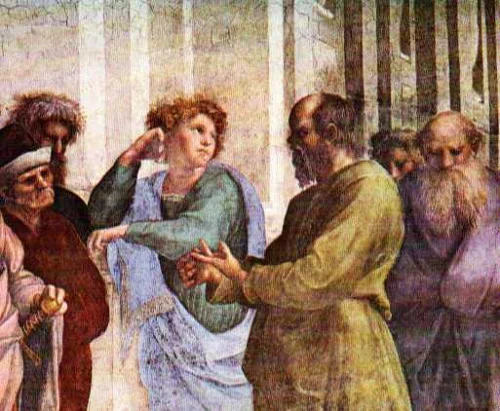
image source: Plato talking to Euthyphro

image source: Plato talking to Euthyphro


“All right, then, I’ll go to hell”- Huckleberry Finn

My hair is naturally curly. When I was in high school, I grew it out, and a few of my friends took to calling me “you with the ‘fro.” So you can imagine how happy I was to find that a character in one of Plato’s dialogues had almost that exact same name.

I was not, however, a big fan of the moral and epistemological theory espoused by Euthyphro, the eponymous character. In a classic line, Socrates presents Euthyphro with a question “Is the pious loved by the gods because it is pious, or is it pious because it is loved by the gods?” In other words, is something good simply because the gods (or, to our modern monotheistic sensibilities, God) like it?

Euthyphro says yes. “Piety is what is dear to the gods and impiety is that which is not dear to them,” he tells Socrates. In other words, goodness is something the gods assign. Socrates asks about the case when the gods disagree, and Euthyphro amends his statement to require unanimity - if all the gods think something is good, then it’s good. To a monotheist, the question is simpler. Are good and bad properties of the Universe that God assigns to things, like length, mass, and temperature? If there’s only one God, He can’t disagree with Himself.

But Socrates’ question still nags at us, because we, humans, can disagree with God.

As an example, take a recent moral issue: homosexuality. Lots of people think that gay sexuality is immoral. As justification, they often cite the Bible, which clearly says that homosexual sex is evil. Proponents of this viewpoint have become increasingly alarmed as homosexuality has rapidly become more and more accepted in American society. 

Now suppose I wanted to argue that homosexuality is morally OK (which I do). I could argue with the standard interpretation of the Bible. I could point out a lot of other things that the Bible condemns that we ignore in the modern era. I could even start a new religious faith that says that the Bible is not the exact, perfect word of God. In past eras, I probably would have done one of these things.

But instead, I’m just going to say: No. Homosexuality is not evil, even if God says it is. If God thinks homosexuality is evil, well, I disagree. And lots of other people disagree.

Preposterous, right? How can a mere mortal disagree with a being who is both omnipotent and omniscient? Well, suppose that instead of “Homosexuality is evil,” God said “Radiohead is the best band.” Well, you can bet I’d disagree. No matter how much evidence God brought to bear, no matter what arguments he made, I wouldn’t agree that Radiohead is the best band. Even if God blasted me with a thunderbolt, I wouldn’t agree. Even if He slaughtered my whole family and threw me into a pit of fiery agony for all eternity (things that God actually does to people in the Bible!), I would not agree that Radiohead is the best band.

And even if I did - even if my mind broke under the pain and convinced itself that Radiohead was the best band - so what? Since God is omnipotent, He could have just reached into my brain, switched around a few circuits, and made me have whatever opinion He wanted me to have. But the point is this: it hasn’t happened yet. I am not yet convinced that Radiohead is the best band, and I’m not yet convinced that homosexuality is evil. In fact, I am convinced that homosexuality is just fine. God could mind-control me into having a different opinion, but He couldn’t convince me simply by giving me information.

See, morality is different than length, mass, or temperature. Knowing those things is just a matter of information. Knowing right from wrong is not. To know right and wrong, you need to have an opinion. David Hume made this point in his 1739 book A Treatise of Human Nature. You can’t get from facts to opinions without some kind of moral intuition or emotion. People don’t discover right and wrong from observing the Universe - they feel right and wrong by observing their own emotions.

Philosophers since Hume’s day have tried to overturn Hume’s conclusion, without (as I see it) much success. Yes, there are some moral propositions on which almost all humans agree. But there are obviously others - homosexuality, for example - where we don’t all agree. Disagreements exist. And God weighing in on one side or the other isn’t going to change that.

Detractors of the Humean point of view sometimes denigrate it as “relativism,” or even “nihilism.” But it is neither. Just because my idea of right and wrong comes from my own moral intuition doesn’t mean I think your intuition is OK for you, and we all have our own little pocket universes of right and wrong, and they’re all equally acceptable. My moral intuition often brooks no disagreement.

For example, take homosexuality. The other day I watched this video of fan reactions to the airing of the last episode of The Legend of Korra, a cartoon show whose final moments depict the beginning of a homosexual relationship between the two female protagonists. I never watched the show, but the video of crying, cheering fans provokes an unequivocal emotional reaction in me. These kids are beautiful. Seeing their happiness makes me happy (note especially the reaction at 6:30, where a girl breaks into Christian prayer at the anticipation of seeing two women enter a romantic relationship). To me, there is no question that this is good and moral and right. If you tell me it’s evil or filthy or immoral, yes I know that your opinion comes from your own moral intuition, but so what? My own moral intuition says you’re totally wrong. Even if you have an army behind you, with nukes and rocket artillery. Even if you torture me and everyone I know. 

Even if you’re God. Even infinite might doesn’t make right.

In fact, the recent acceptance of homosexuality in American society - which is quickly spreading to other countries, like Japan - seems like it represents a watershed in the moral evolution of human society. In the old days, those of us who believe homosexuality is OK would have tried to enlist religion and God on our side, as abolitionists did in the fight against slavery. But this time, we didn’t have to do that. This time, when traditionalists told us that God condemned homosexuality, we shrugged and said “So what?”

To me, this seems like the democratization of morality. The democratization of politics was a grand experiment, a test of the radical idea that humans are mature enough to govern themselves without having order imposed by a higher power. The democratization of morality is the realization that we are mature enough to know what’s right and wrong, without having our morality imposed by a higher power. 

So humanists should be happy. But at the same time, theists shouldn’t despair. After all, human moral intuition had to come from somewhere, right? My sympathy with the fans in the Korra reaction video didn’t just come from nowhere - nor did their sympathy with the imaginary cartoon characters. Humans are built a certain way, and if you believe in God, you (probably) believe that God made us the way we are - that God created us to watch two cartoon women kiss and think “This is good.” (As for why He would create us to have that reaction and then tell us the opposite in the Bible - well, I leave that one to you to figure out!)

Oh, and in case you were wondering, the best band is The Flaming Lips. You can’t beat the 'fro.

Jaewon Lee: Lobbying vs. Bribery

blog.supplysideliberal.com tumblr_inline_nmr02xc4uy1r57lmx_500.jpg

Link to Jaewon Lee’s Facebook page

I am pleased to host this guest post by Jaewon Lee, a student in my “Monetary and Financial Theory” class. This is the 15th student guest post this semester. You can see the rest here. Jaewon’s thesis is this: 

Lobbying is an effective tool to reduce corruption and expand public involvement across economic and political sectors.

I found his contrast between the US and South Korea especially interesting. This post also reminds me of Matt Stambaugh’s very interesting proposal to restrict lobbying by having every meeting with a government official videotaped and posted on YouTube. Although at the end of the day, I felt this hampered free speech too much, it could be just right for convincing South Koreans to allow lobbying at all. 

Here is Jaewon:


In the United States, there are many complaints about the influence of lobbyists. Lobbying is defined as a legalized activity in which special interest groups hire professional advocates to argue for specific legislation in decision-making bodies (Wikipedia). Lobbying activity is controversial. Lobbying is often perceived to be a symptomatic problem that has corrupting influence. The concern is that only wealthy companies and interest group will be able to influence lawmakers and government officials. However, the proponents of lobbying argue that the process of lobbying provides legislators and other government officials with necessary information to convey the viewpoints of constituents.

In South Korea, lobbying is illegal. On March 3, 2015, South Korea’s legislative approved a new anti-corruption law that reinforces stricter regulations and restrictions on lobbying. The bill punishes government officials and lawmakers for accepting any form of funding from private interests even without conditions attached. It will be the a very restrictive set of regulations for blocking any form of lobbying or favor in the political area. Moreover, the legislation “sets a maximum penalty of up to three years in prison as well as 30 million won ($27,300) in fines for bribery involving public officials.” The public believes that corruption in business and government remains a major problem. So when I came to the U.S. from South Korea and found out that lobbying was legal, I was surprised. The very different perspectives on lobbying in the United States and South Korea raise the question of whether lobbying is an effective tool to reduce corruption.

Is it a good idea to make lobbying illegal? If lobbying were banned, bribery might take its place. According to Giovannoni’s academic article on “Lobbying, corruption and political influence,”lobbying and corruption are substitutes and lobbying is a more effective instrument for political influence than corruption, even in poorer, less developed countries. Lobbying often occurs in a system that enjoys high levels of political stability. Because lobbying and corruption are substitutes, eliminating lobbying to fix the unequal influence of money is not an optimal choice. What eliminating lobbying does is to drive efforts to influence the government underground. In countries where lobbying activity is illegal, legalizing lobbying might be seen as legalizing corruption. However, it is not right to equate lobbying with bribery. A responsive government needs to hear various viewpoints to inform the legislative process. In the absence of lobbying, the public would lose an importance channel to influence policies. As for concerns about the influence of wealth on politics, if lobbying is made illegal, policies might favor wealthier individuals even more because rich and powerful people can afford to spend money on even more costly bribery activities. As I have wrote in my previous blog post about big Korean conglomerates (the chaebols), these conglomerates that dominate the wide spectrum of Korean society are expanding to the point where they are too big to fail. A failure to democratize the business environment and an effort to ban lobbying minimizes the access and contribution of the public to the debate about what to do with these conglomerates.

Of course, lobbying has its own flaws it is unrestricted. Unlimited contributions from lobbyists, along with the preferential access that leads to may disrupt access by others to political influence and can tilt things toward wealthy groups even if not so badly as out-and-out bribery. To the extent democracy is defined by equal participation and influence by individuals, unregulated lobbying will not meet such goals. According to Mullin’s article in the Wall Street Journal, Comcast Corps engaged in massive lobbying activities when they heard that President Obama was preparing to call for tough new Internet regulation. The sight of companies exerting that kind of influence through lobbying is why most Koreans oppose lobbying. But strong enough restrictions may alleviate such concerns. If Korea legalized lobbying, it could address this issue by granting making lobbying easier for non-profit organizations than for profit-making corporations. For instance, by disallowing lobbying as a business expense in the tax code, the government can make it more expensive for for-profit firms to lobby. Moreover, transparency in the flow of money used in lobbying can minimize negative consequences. The rules could also require lobbyists to report all meetings with government officials.

Lobbying activities, under the right restrictions can improve the participation of the people in influencing government policy. Money previously spent on bribery can come into the light of lobbying reporting requirements. And in Korea, properly managed lobbying might provide a countervailing influence for the power of the big conglomerates–the chaebols.

Citi Economist Willem Buiter Says It Might Be Time to Abolish Cash

It is nice to see Willem Buiter’s insights in the news. From an academic perspective, my work on eliminating the zero lower bound is all footnotes on what Willem Buiter laid out. As my brother and I said in our column yesterday, my role is to work out the nuts and bolts of how central banks can do it, so that it is possible to eliminate the zero lower bound next month rather than a few decades from now. 

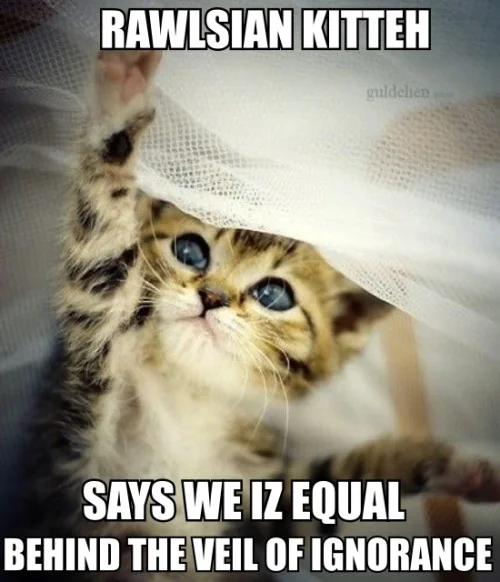
Although I differ with John Rawls on details, I like John Rawls’s perspective very much. And this is a very cute kitten. So I love this econlolcats post by Ishita! 

When uncertainty and randomness form the basis of your philosophy… This econlolcats…

Although I differ with John Rawls on details, I like John Rawls’s perspective very much. And this is a very cute kitten. So I love this econlolcats post by Ishita! 

When uncertainty and randomness form the basis of your philosophy… 

This econlolcats post is a harbinger of a Quartz column with the working title “How Low Can Interest Rates Go?” It is coauthored with my brother Christian Kimball, who as a top-flight tax lawyer is well equipped to help take down John Cochrane’s claim that tax arbitrage is enough by itself to create a lower bound on interest rates