Tor Martinsen: The Hyperloop is Coming

Link to Tor Martinsens’s LinkedIn profile

I am pleased to host a guest post by Tor Martinsen, a student in my “Monetary and Financial Theory” class. This is the 14th student guest post this semester. You can see the rest here. Tor’s thesis is this:

The Hyperloop will have long-term economic effects as it disrupts many industries, the first being the container shipping industry.

Elon Musk’s vision for the hyperloop is finally coming to fruition. This innovation will disrupt the transportation industry as soon as it is implemented, and help clear up traffic immediately.

The Hyperloop is described as:

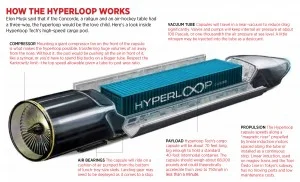
That far-out idea billionaire industrialist Elon Musk proposed in a 58-page white paper in August 2013 for a vacuum-tube transport network that could hurtle passengers from San Francisco to Los Angeles at 760 miles an hour. Laughed off as science fiction, it is as of today an actual industry with three legitimate groups pushing it forward, including Hyperloop Technologies, the team in Harry Reid’s office. They emerge from “stealth” mode with this article, armed with an $8.5 million war chest and plans for a $80 million round later this year. “We have the team, the tools and the technology,” says Bam Brogan. “We can do this.” The 21st-century space race is on.

This vacuum tube has been compared to sci-fi fantasies, but it is finally becoming a reality, “Fortunately for futurists and people who enjoy picking apart complicated plans, an El Segundo, California-based startup has taken Musk up on his challenge to develop and build the Hyperloop.” This innovation will immediately change the dynamics of transportation. As the channels to utilize this form of transportation expand between major hubs, it will allow cargo to be shipped at high speeds throughout these hubs. This will allow a car made in Detroit to be shipped to its buyer in Los Angeles in a matter of just a few hours. This will also clear up some of the hated traffic on highways. Companies will be able to utilize the hyperloop for long distance shipping, for much faster delivery.

One potential problem I see with implementing this technology (assuming first that some firm develops the technological and economic capabilities to build the hyperloop) is that truck drivers will oppose this with ferocity, but it could actually be good for them. Due to the large expensive infrastructure necessary for the hyperloop, it will only be installed between major cities initially, meaning there will still be a need for truck drivers to then make the delivery from these transportation hubs to their final destination.

The reason that high-speed travel like this has not been previously invented is simply because of the problems related to air. A simple example of this problem is “At walking speed, air is ephemeral stuff. But, as any child who has stuck his hand out of a car window at speed knows, the faster you go the more obvious its effects become. In fact, the grunt needed to counteract air resistance rises with the cube of speed.” Elon Musk proposes to counteract this problem air causes by keeping the tunnels at a much lower atmospheric pressure than sea level cutting the air resistance dramatically. The next problem then becomes that “Hyperloop capsules are designed to sit snugly within their tubes. At high speeds, they would act like a plunger in a syringe, compressing the air ahead of them. That would require large amounts of power to overcome, undoing many of the advantages of a vac-train in the first place. Mr Musk’s proposed solution is to fit each pod with a fan designed to blow what little air is present through a pipe in the capsule and out of the back—essentially drilling a hole in the plunger.” This proposal has all the theoretical support to make it work and sounds like a plausible solution, however it remains to be seen whether this proposal can be turned into a reality, and a financially viable one at that!

The hyperloop will change entirely the container shipping industry immediately by increasing the speed at which goods can be delivered to their final destination. It also has large-scale implications for human travel one day too, as Bruce Upbin wrote in his article, “The hyperloop, which Musk dubs “the fifth mode,” would be as fast as a plane, cheaper than a train and continuously available in any weather while emitting no carbon from the tailpipe. If people could get from Los Angeles to Las Vegas in 20 minutes, or New York to Philly in 10, cities become metro stops and borders evaporate, along with housing price imbalances and overcrowding.” While this may be a long ways in the future, it at least now has the chance to become a reality, rather than just a dream of some sci-fi author.

Yichuan Wang: Stocks for the Long Run—Still a Wild Ride

I am delighted to be able to host another guest post by Yichuan Wang. Yichuan has appeared on “Confessions of a Supply-Side Liberal” in many capacities (as you can see by typing “Yichuan” into the search box down low on my sidebar), but this time it is as a student in my “Monetary and Financial Theory” class. This is the 13th student guest post this semester.You can see the rest here.


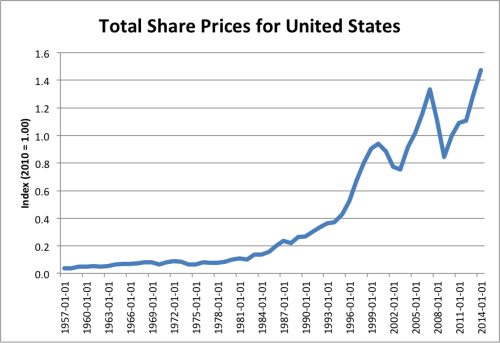
I use simulations of stock market histories to show how long run investing is much more risky than is commonly believed. I show that:Long run average stock returns are a poor judge of how safe stocks are over longer runsReasonable levels of risk aversion can generate scenarios in which stocks deliver the same long run expected utility.Let’s first set up the simulation. Below is a stock price index for the United States from FRED. Stocks tend to trend upwards in the long run, and even when things go down in say 2002, they tend to go back up afterwards. This history makes it look like in the long run, you’re guaranteed to make money.

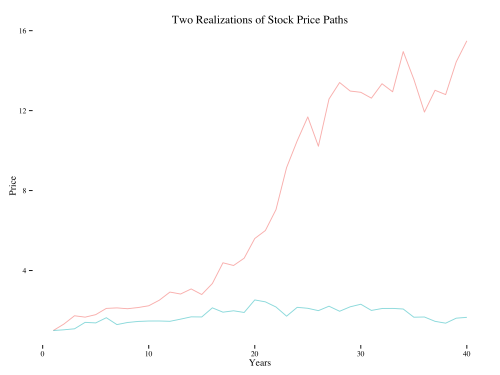
But as a first approximation, returns in one year should tell you nothing about returns in the next. After all, if you knew returns next year were going to be all of a sudden higher, you would have bought today! Formally, this means that returns can be approximated as being independent over time. So let’s try an experiment. In the data above, the average return in a given year was 7.5% with a standard deviation of 13 percent. Let’s generate returns that follow independent normal distributions with those properties, run it for 40 years, multiply all the returns, and see what stock prices look like:

And so even when returns from year to year are random, you still see “trends”. After the fast run up in the red line, there’s a “natural” pop of a bubble around year 34! But after a few years, you recover again. Hence this model of independent returns is plausible both from an economic theory perspective, and the graphs also look reasonable.

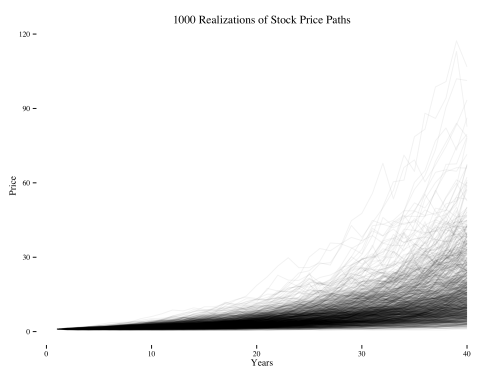
I generate 1000 such paths, and then they start looking like the plot below. Each black line represents some alternative history of the world in which returns every year had a mean of 7.5% and a standard deviation of 13%.

blog.supplysideliberal.com tumblr_inline_nltkguhBj11r57lmx_500.png

Now that we’ve run the simulation, we can see some interesting phenomenon:

  1. Cumulated stock returns can be huge! In some of the best histories, you’ve increased your wealth by a factor of 100 over the course of 40 years. On the other hand, a 2% annually compounded bond would have only put you at a factor of 2.
  2. But most of the final returns aren’t that high. Hence when we say that you can expect to earn a lot from holding stocks for 40 years, much of that expectation is being driven by the extreme right tail of extremely high returns.
  3. In contrast to the Malkiel graph on the variance of average returns declining over time, it’s clear that the variance of total returns increases over time — the graphs get farther apart! And when you retire, you care about how much wealth you have left over at the end, not some accounting number about how much on average you earned over the past 40 years. In other words, it’s the variance in total returns, not average returns, that matters. Therefore long run average returns are a poor judge of the riskiness of long term investing.

Let’s turn to the second claim. Stocks usually beat bonds handily. But what happens in the nightmare scenarios in which they underperform?

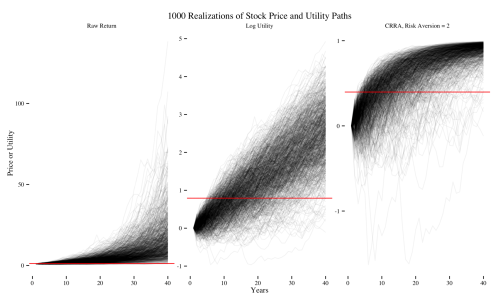
To evaluate these scenarios, we need to plug in the cumulated returns into some kind of utility function. To make it easy, I consider two utility functions — CRRA utility with a risk aversion of 2† and log utility — and then as a comparison I plot just the raw total return. The key part about the utility functions is that there is diminishing marginal utility — a 1 million dollar loss hurts a lot, whereas a million dollar gain isn’t nearly as salient. This means that people are averse to risky gambles such as the stock market, but are still willing to make the bets if they think it will raise expected utility.

Below are the 1000 paths of utility and cumulated returns. The leftmost panel is just the plot of raw cumulated returns from above. The middle plot is what those returns would mean for log utility, and then the right plot is what utility looks like with a risk aversion coefficient of 2. The red line in each plot is a benchmark for what final total return or utility would look like if you instead invested at a risk free rate of 2%.

These charts show two things:

  1. No matter your utility function, the probability of stocks outperforming bonds is the same. Roughly the same number of black lines are below the red line in each plot.
  2. But when the black lines go below the red line when risk aversion is higher (see far right), the results are catastrophic.

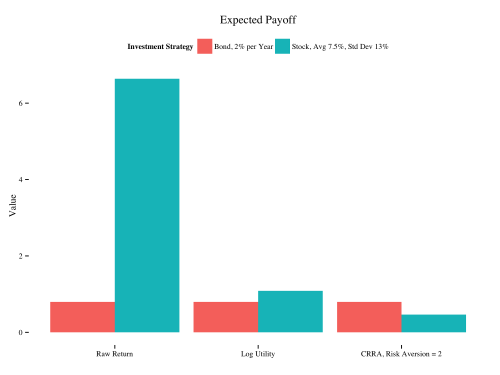
Any measure of risk needs to both take into account the probability of losses and the magnitude of those losses. So as a benchmark risk measure, let’s compare the expected utility of investing in stocks relative to bonds:

Average stock returns trounce bond returns. But once you raise the risk aversion coefficient to 2, the expected utility from bonds is higher than expected utility from stocks. This is because stocks sometimes do really bad, and those scenarios hurt a lot.

Risk adjusted stock returns in this simple model are no safer than a 2% bond yield, and looking at average annual returns tells you little about how much risk there is in stock investing. The motivation for long run investing must be deeper than the higher returns to stocks, but that will have to be saved for a future post.

† I use risk aversion of two because it’s considered as an upper bound based on labor supply data, and although more extreme values come from the asset pricing literature, the more extreme values just reinforce the point that risk aversion matters.

John Stuart Mill: Two Maxims for Liberty

The first two paragraphs of John Stuart Mill’s On Liberty “Chapter V: Applications” speak for themselves, but I changed the formatting and capitalized “First” to highlight the two maxims. He writes:

I offer, not so much applications, as specimens of application; which may serve to bring into greater clearness the meaning and limits of the two maxims which together form the entire doctrine of this Essay, and to assist the judgment in holding the balance between them, in the cases where it appears doubtful which of them is applicable to the case.
The maxims are, 
  1. First, that the individual is not accountable to society for his actions, in so far as these concern the interests of no person but himself. Advice, instruction, persuasion, and avoidance by other people if thought necessary by them for their own good, are the only measures by which society can justifiably express its dislike or disapprobation of his conduct. 
  2. Secondly, that for such actions as are prejudicial to the interests of others, the individual is accountable, and may be subjected either to social or to legal punishment, if society is of opinion that the one or the other is requisite for its protection.

Will Wilkinson: Belief and the Atomism Of Social Change

For a long time, I have thought that changing the mind of the public is a more reliable way to bring change than political tactics. One of the best examples I know is the invention and focus on the idea of second-hand smoke, which ultimately transformed tobacco policy in the US. Another great example was the decision to emphasize gay marriage in the effort to advance gay rights–which highlighted the commonalities between gays and lesbians and everyone else. This was combined with the powerful influence of popular TV shows such as “Will and Grace” in getting people to see gays and lesbians in their full humanity.

The link above is to a nice essay by Will Wilkinson on this process of changing the minds of people in general as a way to effect social change.

Robin Green: Don’t Recognize Racist Externalities with a Pigou Tax

Robin Green had a very interesting comment in reaction to my post “The Wrong Side of Cobb-Douglas: Matt Rognlie’s Smackdown of Thomas Piketty Gains Traction” that he made into a Tumblr post of his own. I am grateful for his permission to make it a guest post here. 

Robin was reaction to this idea:

Above, I wrote that developers should have to pay some of the costs of reductions in the quality of life nearby when higher density is unpleasant to live nearby—say by blocking out the sun. In an earlier version of this post, I actually made the serious mistake of saying they should pay for the reduction in “land values” from development nearby. But that is wrong by a cost-benefit test. Suppose a particular housing development is neutral for the quality of life nearby. Then it would still reduce the values of land nearby by providing more housing competition. This is not a social loss but rather a shift in wealth from landowners renters and future buyers of land, which reduces inequality. So a key conceptual issue for appropriate land policy is to not think of everything that reduces neighboring land values as a bad thing, but to distinguish when (and how much) it brings down land prices by reducing the quality of life nearby from when (and how much) it brings down land prices by providing additional housing competition. 

Here is his reaction: 


While the idea of taxing externalities is broadly popular when it comes to pollution that causes clear harm to others (and in fact I would argue pollution should be taxed punitively, due to the precautionary principle and humility about what science does not yet know about harms of pollution), we very quickly get into seriously morally problematic territory if we consider all factors that might affect local property values.

For example, some people consider that proximity to poor people, or unemployed people, makes a property less desirable. So people could be taxed for being poor or unemployed! Some people are explicitly ethnically biased, and would prefer not to live near gypsies, or black people, or Muslims, or Jews, etc. etc. So people could in theory end up being taxed for being anything other than white anglo-saxon protestant! This is obviously morally unconscionable, as well as politically unthinkable.

So in addition to your point about new housing bringing down (residential) land prices, we would need to be able to reliably exclude factors such as ethnicity- and class-based discrimination to make some sort of generalised externality tax-and-subsidy system viable. I am not sure how we would go about doing that.

Moreover, it’s worse than this. There are innumerable factors that some people might object to, but which some would argue - at least in some cases - should be ignored on the grounds of personal freedom. Examples include playing certain genres of music loudly during the daytime, having a front garden, not having a front garden, having a front garden but leaving it untended, garish Christmas lights displays, political signs, religious signs, playing ball games in the street, etc. (Many of these are currently restricted in various ways by landlords and/or certain homeowners associations.)

Then there are subcultures that some people don’t like, but unlike ethnicity are more a matter of choice, such as: goths, emos, people who dye their hair in “unnatural” colours such as pink or green, environmental activists, members of religious cults, members of intentional communities.

Even a neighbourhood which includes a high proportion of teenagers, regardless of how well those teenagers behave, could be viewed negatively by some people.

It’s a minefield.

On the National Research Council’s Geoengineering Report

The National Research Council recently put out a report on geoengineering as a way to moderate climate change. This report was sponsored by the National Academy of Sciences, U.S. intelligence community, National Aeronautics and Space Administration, National Oceanic and Atmospheric Administration, and U.S. Department of Energy. Thus, there is a lot of heft behind this report.

The University of Michigan’s Atmospheric Science Professor Joyce Penner served on the committee, so I saw an article on it in the UM University Record by Nicole Casal Moore that I thought was very well done. Here are some key excerpts, which I made into bullet points:

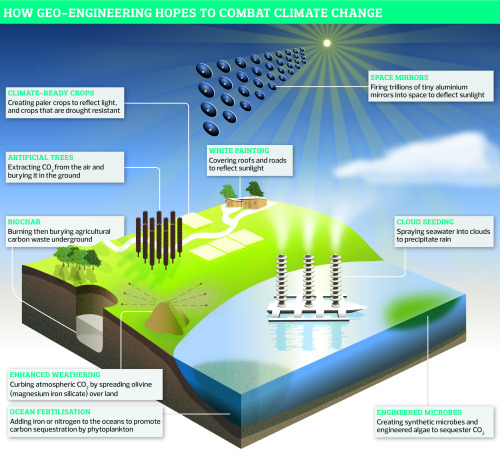
  • Techniques to remove CO2 include restoring forests and adopting low-till farming—both of which trap carbon in plants and soils. Oceans could be seeded with iron to promote growth of CO2-consuming organisms. And carbon could be be sucked directly out of the air and injected underground.
  • Methods to reflect sunlight include pumping sulfuric compounds into the stratosphere to, in essence, simulate a volcanic eruption; and spraying sea water mist or other finer-than-usual particles over the ocean.
  • The scientists caution against dumping iron in the oceans, as the technical and environmental risks currently outweigh the benefits. Similarly, they warned against sunlight-reflecting approaches, also known as “albedo modification.”
  • Even in its opposition to sunlight reflecting tactics, the committee still recommended more research into them, as it urged more study of all climate intervention possibilities. Penner was struck by this call to action.
  • “U.S. agencies may have been reluctant to fund this area because of the sense of what we call ‘moral hazard'—that if you start down the road of doing this research you may end up relying on this or condoning this as a way of saving the planet from the cost of decreasing CO2 emissions,” Penner said. “But we’ve stated that decreasing emissions must go hand in hand with any climate intervention efforts.
  • "We need to develop the knowledge base to allow informed decisions before these dangerous effects are upon us,” she said.

Comments: The big news is that the scientists on the committee reject the idea that we should avoid research into geoengineering for fear that such research is part of a slippery slope. However great the problems and disadvantages of certain techniques geoengineering, there are possible futures in which we might need them very badly. So we must risk knowing what we can about them rather than trying to keep ourselves in ignorance to prevent such techniques from being used. 

Among the techniques, anything done on land–such as low-till farming and sequestration–hold no terrors. Human beings have modified the land for many centuries; and any reduction in carbon dioxide from such efforts just slows down our move into uncharted territory. But modifying the oceans or the clouds would take us into uncharted territory in yet other directions, and so is something we should go slow on.

Much of the harm of climate change may not be about global warming per se but about the fact that global warming will make the climate different in the future than it has been in the past. Entropically, to the extent that the places people live are adapted to the current climate, different tends to be worse until very substantial adjustment costs have been incurred. Modifying the clouds along the lines of some geoengineering proposals may make the Earth cooler, but is almost certain to cause the climate to be different from what it has been in the past, creating costs of climate change even if it arrests global warming.  

As for seeding the oceans with iron, this might have little effect on the climate other than through the desired reduction in carbon dioxide in the atmosphere, but it could easily have unforeseen effects on the ecology of the oceans. However, the acidification of the oceans from higher carbon dioxide concentrations is also taking us into uncharted territory for ocean ecologies. So seeding the ocean with iron to increase carbon dioxide takeup by ocean life could at some point be the safer course even for ocean ecologies. We may need to know how to make this judgment sooner than we would like. Hence the urgency of research. 

Update: Nichol Brummer tweeted to say that he has a new website in beta on enhanced Olivine weathering to chemically combine carbon dioxide to form carbonate. This is a promising approach.  

Congyi Liu: America Should Join the Asian Infrastructure Investment Bank

I am pleased to host this guest post by Congyi Liu, a student in my“Monetary and Financial Theory” class. This is the 12th student guest post this semester. You can see the rest here.

I was impressed with how well Congyi persuaded me of something I didn’t want to be persuaded of, since my instinct, like that of the US government, is to wish the AIIB away as a tool of China’s power. Here is Congyi:


“’China is playing the long game effectively,’ said Cornell University economist Eswar Prasad, a former senior China official at the IMF. ‘They are in absolutely no rush. They know other countries will come to them.’”

This long game’s name is called AIIB (Asian Infrastructure Investment Bank), which was proposed by Beijing in 2013 initially. From the name, we can infer that this is an investing bank mainly for developing infrastructures in Asian countries. However, the members are not limited only for Asian countries, while British, Germany, France have announced to join in. Chinese government injected 49 percent of initial capital to the new bank. Till now, the collected funds have been almost prepared. “Meanwhile, the bank is on track to reach its target of $100 billion in registered capital, up from the $50 billion initially announced and that China is providing, according to Chinese and Western officials.” The start-up capital was only $10 billion of the World Bank, though we should consider about the time cost and inflation rate. But, without doubt, AIIB will definitely not only be an Asian but a worldly economic and financial center.

For such a big game, will America be a role paler? I think so whereas American government officials do not. Admittedly, at the first glance, we may consider that America should set tremendous barriers for China to form AIIB to firm its dominant status of the world’s economy. However, what is the really wise choice for America? Join in!

America’s join will provide a positive influence to form a valid and qualified regulation within AIIB. “Over the past year, however, the U.S. has urged its allies not to sign up for the bank, saying it would be an instrument of Beijing’s foreign policy and that without proper governing rules it could contribute to debt and corruption in borrowing nations.” America expressed that they did not frown to form AIIB, but could not nod to China’s regulatory policies. They worry that China is not qualified to govern and lead such a huge organization successfully. They doubt China is not capable to provide rules and regulations scientifically and efficiently. If America join AIIB, they can bring many matured rules and regulations by their various former experiences from leading the World Bank and IMF. After all, global economic chaos will also present negative effects on America. As AIIB has such a magnificent scale, if this organization expose essential problems, it is hard to image America will not suffer any harm.

Joining in AIIB also help America lessen China’s dominant power. “Another pending issue is how to structure the board of directors at the new bank. In the World Bank and the IMF, countries are represented by resident directors who are actively involved in the institutions and vote on new projects, programs and policies. Those representatives act as a check on management. The U.S. has been pushing the Chinese to adopt the same structure, according to those involved in the discussions, but Beijing is resisting. Instead, it wants the bank’s management, which will likely mean Chinese officials, to have a more powerful position.” Without America’s joining, China will absolutely be the sole dominator of AIIB. Then, China will readily and legitimately introduce some foreign policies that benefit itself. That is definitely what America did not want to see. “Still, Mr. Jin, interim chief of the new bank, said over the weekend that more than 35 countries will join as the bank’s founding members by the end of this month. South Korea and Australia, key U.S. allies in the Asia-Pacific region, are also expected to come on board by then, according to Chinese officials involved in the effort.” Moreover, as some America’s allies joined AIIB for their own profits, America could draw them on the same side to against China and balance the authority in the AIIB.

Till now, 46 countries have applied to join in AIIB and this number will continue goes up seemingly. China successively introduced “One Belt and One Road” and AIIB, the goal is so clear—forming and consolidating the Eurasian Economic Community. After setting down the deep fraternity between African countries, China is ready to lobby Europe with its strong power. If America cannot propose some effective strategy back, the day of China’s dominance will come soon. Actually, Joining AIIB is an indispensable move for America.

Linda Sun: Change Airbags to Axes to Save Lives

blog.supplysideliberal.com tumblr_inline_nmexwoekTB1r57lmx_500.jpg

Link to Linda Sun’s LinkedIn page

I am pleased to host a guest post by Linda Sun, a student in my “Monetary and Financial Theory” class. This is the 11th student guest post this semester. You can see the rest here. Linda’s post is a work of economic analysis satire.

Update: Like Mike Smitka in a comment below, Paulo Mauro tweets that Linda was not the first to come up the essential idea: 

Great economist Mike Mussa used same analogy (he would say a “spike in steering wheel”) to dismiss concerns about moral hazard.

But I think Linda makes the point in a memorable way: 


The effect of seat belts and air bags on car crash outcomes has a long debated history. On the one hand, seat belt keeps driver and passengers in their seats and airbags make them much safer when a car crash happens, which decreases traffic fatalities. On the other hand, it has been suggested that due to compensating behavior, drivers drive faster and closer to the vehicle in front when they have security precautions, which increase the probability of an accident and therefore put non-occupants, namely pedestrians, bicyclists and motorcyclists at greater risk (Peltzman, 1975).

But what is the ultimate overall effect of seat belt and airbags on traffic fatalities in practice? There is many paper examining the effect of mandatory seat belt law and airbags, reaching different conclusions. In Alma Cohen and Liran Einav’s paper(2001), they control the endogeneity of seat belt usage and find that it decreases overall traffic fatalities. In their paper, the compensating behavior theory (which suggests that seat belt use also has an adverse effect on fatalities by encouraging careless driving) is not supported by the data. Bhattacharyya and Layton(1979) similarly find that seat belt law have significant negative effect on traffic fatalities overall. On the other hand, McCarthy (1999) finds that a mandatory seat belt law increases the number of fatal accidents. 

Though there is no common conclusion on the overall effect of seat belt and airbags on traffic fatalities, in the spirit of the compensating behavior theory, I think there is a surefire way to force drivers to drive more carefully, and reduce traffic accidents: changing all  cars’ front airbags to axes.

Just imagine, what would you do if you know that your car has an axe installed in front of you, which would pop out if there were a harsh impact? You would drive as carefully as possible and try to avoid any potential car accident. In fact, installing an axe is like having a police car right beside you, only more effective because the penalties imposed by the axe are so much more sever than a ticket. By making the cost of careless driving almost infinitely large, no one will drive carelessly.

Second, unlike airbags–which save occupants’ lives but increase the risk on non-occupants by compensating behavior theory–an axe concentrates the cost on the person whose behavior controls the risk. Threatened by the axe, drivers will drive more consciously and cautiously, and they will not compete with pedestrians, bicyclists or motorcyclists any more. (Drivers are the “disadvantaged” group under this plan.) Thus this change saves the lives of non-occupants of a car. 

Third, installing an axe helps by discouraging bad drivers from driving at all–positive selection. If someone is a rookie, will he dare to risk his life in traffic before practicing on low-traffic roads? No! The total number of miles driven by rookie drivers in tough situations would decrease significantly, leading to increases in traffic safety. Indeed, many people who know they would be bad drivers will simply choose to use public transportation instead. Riding the bus can look awfully good compared to facing a threatening axe.

Installing airbags and seatbelts is a way to try to minimize the damage after a car accident has already happened. But an axe can prevent an accident from happening in the first place.

What If Jesus Was Really Resurrected?

Musings of a Non-Supernaturalist

Although I sometimes say I am an atheist, of course I am technically an agnostic: there is no way to fully know if there is already a God or Gods now, or if it is up to us to build God. Since it is Easter, I wanted to think aloud about what I think it would mean if Jesus was, in fact, resurrected. 

Nichole Nordeman has a song on exactly this topic. As background music for these musings, I recomend that you click on the video above of her song “What If?” and continue reading. The video shows the lyrics, but if you want to see the lyrics all at once, they are here. And if you want to see Nichole singing the song live, you can see that here

A Plausible Miracle. Let me say first that if any of the miracles in the Bible are real, the resurrection of Jesus seems to me one of the most likely. Many of the other miracles mentioned in the Bible are the sort of thing someone might have written in as a matter of literary license. But the resurrection of Jesus seems to have been quite shocking and jarring to those who attested to it, and not something they understood the meaning of at first, even afterwards. And there seems to have been quite a broad consensus in the Christian community–say around 50 AD or 70 AD–that many people then still living claimed to have seen Jesus after he returned from death. 

Going a different direction, a return of Jesus from death need not be supernatural. Barring an apocalyptic disaster, it would be surprising indeed if human technology 1000 years from now could not bring someone back from the dead as Jesus was claimed to have done. (Remember that I am leaving aside most of the other claimed miracles, and sticking with Jesus’ resurrection itself, which is what there seems to have been the most witnesses for.) In “Teleotheism and the Purpose of Life” I write

Mormon theology, put into a hard science fiction straightjacket, is reminiscent of the idea that we are watched over by benevolent aliens from an advanced civilization.  Not only is this plausible, it is even possible to argue that it is likely.  There are a lot of stars in the Galaxy, but even at a fraction of the speed of light, it would take only a small fraction of the time since the Big Bang to get from one end of the Galaxy to another.   If evolution often favors intelligence, why couldn’t intelligent life arise several times in our galaxy?  If any intelligent life has arisen before us, chances are it arose many, many millions of years before us, simply because it has been billions of years since the Big Bang.  So it is not a big stretch to have aliens from an advanced civilization reach Earth.  The big issue would be Fermi’s paradox: “Where are they?”  “If they are here, why are they hiding themselves from us?”  and whether they are benevolent or not.   If they are here, they don’t seem to have destroyed us, which is something.
To me these are important religious questions, but science fiction is not always recognized for the serious theological speculation that it often is.   A truly open-minded search for God would consider as many possibilities like this as possible, but instead, the focus is usually the much narrower one of whether certain ancient religious texts are true or not.  Looked at without preconceptions, and without regard to which will get you laughed at in polite company, which is harder to believe?  The possibilities laid out in hard science fiction, or the god of the Bible?  By all means, let’s be open-minded about whether God exists or not, but not just about the God of the Bible.

I want to pursue this line of thought, being clear that I am going far afield from orthodox Mormon theology, which sticks much closer to the Bible than I will. 

The Story of the Sages. To give the members of the posited advanced alien civilization a name, let me call them the Sages. I want to spin a story–one that is possible, but most likely not to be true, even in outline–simply because of the large number of possibilities that exist given our current ignorance. 

The original Sages in this story evolved on a planet circling a star within the Milky Way, and gradually spread through the galaxy at sublight speeds over the course of hundreds of millions of years. As part of an almost universal precondition for being a long-lasting advanced civilization (with a few exceptions scattered here and there in the universe, far, far away), the original Sages have developed profound principles of nonviolence and love among themselves. What is more, by human lights, they are mostly what we would call “good,” though they have certain motivations that would seem quite alien to humans–so alien that I personally do not have the eloquence to describe those alien motivations.    

The original Sages put a great value on other intelligent species. When they encounter another intelligent species, it is their practice to bring a critical mass of members of that species immediately into their galactic civilization–so much so that the designation “Sages” has been extended to members of many species who have taken on the values of this galactic civilization.

Although a critical mass of members of each intelligent species is brought into full knowledge of the galactic civilization of the Sages, most of those on a planet such as Earth are left in place because the development of a genuinely native high-level culture for that species is seen as precious. (Of course, there is a limit to how long those on a species’ home planet can effectively be kept in the dark about the galactic civilization, and humans in the 21st century are beginning to approach that limit.) Waiting for native cultural development requires enormous patience on the part of the Sages, but the need for patience is nothing new for a galactic civilization limited to sublight speeds, and there are many other interesting pursuits for the Sages besides their dealings with the home planets of intelligent species. It is not as if this is the main thing they are doing, but many of their other pursuits are difficult to describe.   

To the Sages, within their interest in native cultural development, one of the most important aspects of high-level culture is religion. But here the Sages face a dilemma. On the one hand the Sages want those members of each species who were reserved in ignorance on that species’ home planet to develop religions that are (a) genuinely native to the extent possible, since that will serve that species’ needs and foster that species’ potential best. But on the other hand, at the end of the day, the Sages want the species to come to a set of religions that (b) are in accord with the truth of how the Universe works (which from the standpoint of the vast knowledge of the Sages is nonsupernatural) and © promote nonviolence and love (since a species that had not embraced nonviolence and love would be a danger to the galactic civilization).  

Given the objective of encouraging the development of religions that are as close as possibly to being genuinely native to a species, while being in accord with truth, peace and love, the Sages typically end up intervening in the religious development of a species, but sparingly. They do not routinely do anything in the open that is so technologically advanced that it would be viewed as a miracle, but they do so when necessary for the appropriate intervention in the religious development of that species. The interaction of the Sages with Jesus, including his resurrection, was in this story one of the few times the Sages intervened in an openly technologically advanced way that would be viewed as miraculous by humans on their home world, Earth. 

As I wrote in “The Teleotheistic Achievement of the New Testament,” the overall effect of Jesus and those he is said to have interacted with after his resurrection (including Saul of Tarsus) did a lot to push the development of religion on Earth toward a greater emphasis on nonviolence and love. And Rodney Stark argues in a series of excellent books that Christianity has helped to foster rationality and science as well. Other religions have also contributed a great deal to the positive arc of human history, but few of them required a seeming miracle as big as the resurrection of Jesus to accomplish what they did. (Here I am leaving aside miracles from earlier times that are less convincingly attested than Jesus’ resurrection, which itself is uncertain.) 

Making Our Own Story of the Sages. Let me step back now from the story of the Sages. I want to argue that if the story of the Sages is not true, that we should strive to make our own version of it true. If we are the first advanced civilization to arise in our galaxy, we can strive to be exactly like the Sages in the story. If other advanced civilizations hem us in some way, we should do the best we can. One way or another, we should try to make our home planet, Earth, and the galaxy beyond, a place of peace, wonder, truth, brilliance and love. 

In the words of her song, Nichole Nordeman contrasts a miraculous resurrection to the best that can be said if there were no miracles for Jesus. But if Jesus did not come back from the dead–either through supernatural means or through the intervention of alien Sages–I see a far greater accomplishment than Nichole sees in Jesus being “another nice guy,” in the deepest sense. And to the song’s question 

What if he takes his place in history
With all the prophets and the kings
Who taught us love and came in peace
But then the story ends [without his rising from the dead]
What then?

I say I see grandeur, since Jesus helped to put us on the path to a future for our species that can change the galaxy for the better–if we keep onward and upward in our embrace of all that is good.

Virginia Postrel on Ideals

Every culture, [Grant McCracken] observes, maintains ideals that can never be fully realized in everyday life, from Christian charity to economic equality. These ideals may uphold incompatible principles, deny the relation of cause and effect, require impossible knowledge, or demand more consistent or emotionally contradictory behavior than human beings can sustain. Yet for all their empirical failings, such cultural ideals supply essential purpose and meaning, offering identity and hope. To preserve and transmit them, cultures develop images and stories that portray a world in which their ideals are realized–a paradise, a utopia, a golden age, a promised land, a world to come (whether after death, the Messiah, the Second Coming, the Revolution, or the Singularity).

– Virginia Postrel, The Power of Glamour, p. 41

Ezra Klein: Social Media is Threatening to Kill the Conversational Web

In his post “What Andrew Sullivan’s exit says about the future of blogging,” 
back in January, Ezra Klein has this interesting analysis of what is happening to blogging:

… at this moment in the media, scale means social traffic. Links from other bloggers — the original currency of the blogosphere, and the one that drove its collaborative, conversational nature — just don’t deliver the numbers that Facebook does. But blogging is a conversation, and conversations don’t go viral. People share things their friends will understand, not things that you need to have read six other posts to understand.
Blogging encourages interjections into conversations, and it thrives off of familiarity. Social media encourages content that can travel all on its own.

What Ezra says here makes me ponder how I deal with this issue. First, I think that conversation among bloggers is alive and well on Twitter. Second, for me, Quartz columns that each need to stand on their own are balanced out by blog posts that presume readers who are likely to have read more previous posts. 

The place I feel I fall down is in not finding time to read all the other economics and non-economics blogs out there that I would like to. There are many, many conversations I would love to have, but don’t for lack of time.

The Wrong Side of Cobb-Douglas: Matt Rognlie’s Smackdown of Thomas Piketty Gains Traction

I have been impressed with Matt Rognlie ever since our discussion in “Sticky Prices vs. Sticky Wages: A Debate Between Miles Kimball and Matthew Rognlie.” Matt also had a guest post here: “Matt Rognlie on Misdiagnosis of Difficulties and the Fear of Looking Foolish as Barriers to Learning.” 

I posted a link to Matt’s paper “A note on Piketty and diminishing returns to capital” when I say Tyler Cowen’s post on it. Now I am glad to see it making its way into the consciousness of journalists with “Wealth inequalityNIMBYs in the twenty-first century” in The Economist, and Greg Ferenstein’s piece “A 26-year-old MIT graduate is turning heads over his theory that income inequality is actually about housing (in 1 graph).”

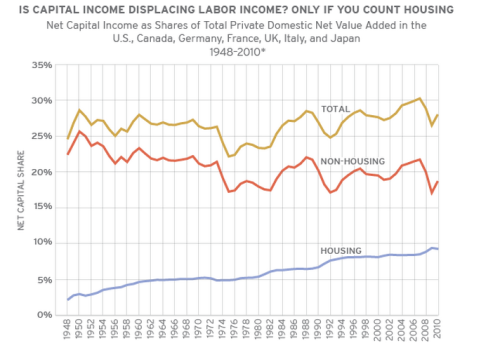
The key graph is shown above: there is no upward trend in capital’s share once housing rents are accounted for. The production of housing services is, of course, mostly provided by the house itself, which is counted as capital. So housing services have a capital’s share close to 1. So if the weight of housing goes up, it will drive up the overall share of capital, including the production of housing services. But there is no reason from the graph above to believe that the production function for goods and services other than housing services is on the side of Cobb-Douglas that Thomas Piketty needs–a direction in which a much higher amount of capital would be associated with only a slightly lower rate of return. (See my post “The Shape of Production: Charles Cobb’s and Paul Douglas’s Boon to Economics” for my effort at an intuitive treatment of the logic for why Cobb-Douglas leads to a constant share for capital and for labor.) Matt cites a large body of micro-empirical work suggesting that the elasticity of capital-labor substitution is quite a bit below the Cobb-Douglas level of 1, so that things are on the wrong side of Cobb-Douglas for what Thomas Piketty wants. There are some subtle arguments involving other adjustments that mimic a higher elasticity of capital-labor substitution that could make things look closer to Cobb-Douglas in the aggregate. But it still looks as if in the aggregate, when the real interest rate goes down, it goes down fast enough that the overall gross rental rate of capital goes down proportionally faster than the amount of capital relative to output goes up.   

The title of Greg Ferenstein’s piece is a bit misleading. Capital’s share is an important issue and capital overall is certainly central to Thomas Piketty’s story, but as for inequality, as Matt says in his conclusion, “Inequality of labor income, for instance, is a very different issue–one that remains valid and important.”    

It is good news if a lot of wealth and inequality is about housing, because we have known for a long time how to deal with wealth inequality from at least the land component of the value of housing: Henry George’s idea of a tax on land values that Noah Smith talks about, for example, in his Quartz column “This 100-year-old idea could end San Francisco’s class war.” Land taxes are typically much less distortionary than taxes on any other form of capital. So to the extent that inequality is about high land values, it doesn’t run into the issues I talked about in my post “Is Taxing Capital OK?” 

It does make sense, however, to have provisions in land tax policies to give to developers some of the increase in the value of land engendered by their activities when others want to be near some new development–just as we would want to make sure that developers pay some of the costs of the reductions in the quality of life nearby when others don’t want to be near some new development. The post “Charles Lane on Thomas Piketty and Henry George” discusses some of these issues. “Henry George and the Carbon Tax: A Quick Response to Noah Smith” discusses how some of the logic of a land tax extends to natural resources.

Land-price-based inequality can also be addressed by loosening restrictions on building. C.R. in the Economist writes in the article about Matt: “Policy-makers should deal with the planning regulations and NIMBYism that inhibit housebuilding and which allow homeowners to capture super-normal returns on their investments.” Let me explore the logic behind this. Land prices are pushed up when regulations require that land be used in a high ratio to construction in creating housing. That is zoning and other regulations that limit housing density enrich landowners. 

Above, I wrote that developers should have to pay some of the costs of reductions in the quality of life nearby when higher density is unpleasant to live nearby–say by blocking out the sun. In an earlier version of this post, I actually made the serious mistake of saying they should pay for the reduction in “land values” from development nearby. But that is wrong by a cost-benefit test. Suppose a particular housing development is neutral for the quality of life nearby. Then it would still reduce the values of land nearby by providing more housing competition. This is not a social loss but rather a shift in wealth from landowners renters and future buyers of land, which reduces inequality. So a key conceptual issue for appropriate land policy is to not think of everything that reduces neighboring land values as a bad thing, but to distinguish when (and how much) it brings down land prices by reducing the quality of life nearby from when (and how much) it brings down land prices by providing additional housing competition.

Paul Krugman: Wall Street’s Revenge

Paul Krugman’s piece linked above is nice bit of political economy, both for its succinct description of the layout of interest groups in our politics and for its warning about how the financial industry is trying to weaken the guardrails against the financial instability that could lead to future bailouts. Given its recent track record, the financial industry should not be trusted to write its own regulations, but it has enough money to buy many legislators. 

On this theme, in “Odious Wealth: The Outrage is Not So Much Over Inequality but All the Dubious Ways the Rich Got Richer” I write in praise of vulture capitalism, but what the financial industry wants is another matter:

Among excessive rewards caused by the government, bailouts without increases in equity requirements big enough to prevent future bailouts are especially unfair. But actions by the government to protect the profits and business models of firms already in place by standing in the way of firms doing new things in new ways can in the long run be just as damaging.  And in the digital age, copyright law is long overdue for reevaluation.

In “How to Avoid Another Nasdaq Meltdown: Slow Down Trading (to Only 20 Times Per Second)” I write:

In academic finance, concerns about high-frequency trading go under the heading of “market microstructure” issues. There are other bigger problems in finance at the macroeconomic level that I have talked about more than once. The best reason to fix unfairness—or even perceived unfairness—in market microstructure is so people aren’t distracted from noticing how those in the financial industry use low levels of equity financing (often misleadingly called capital) to shift risks onto the backs of taxpayers and rewards into their own pockets. In quantum mechanics, electrons can “tunnel” from one side of a barrier to another. Using massive borrowing to ensure later government bailouts, the financial industry has perfected an even more amazing form of tunneling: the art of tunneling money from the government so that the profits appear on their balance sheets and in their pockets long before the money disappears from the US Treasury in bailouts. By comparison with this financial quantum tunneling of money from the US taxpayer that has been a mainstay of the financial industry, high-frequency trading profits of a few billion dollars a year are small change.

Of course, the real authorities on these issues are Anat Admati and Martin Hellwig, who wrote The Bankers’ New Clothes. They are the ones who should be writing regulations for the financial industry, not the industry itself. You can see a brief summary of their argument in “Anat Admati, Martin Hellwig and John Cochrane on Bank Capital Requirements.”

Oliver Davies and Miles Kimball on a Method for Nominal GDP Targeting

Picture of Oliver Davies. Links to the original post on Oliver Davies’s blog and to One-Month Money on Amazon.

Picture of Oliver Davies. Links to the original post on Oliver Davies’s blog and to One-Month Money on Amazon.

I enjoyed reading Oliver Davies’s book with Ruggero Bozotti: One-Month Money: Why money ruins our economy - and how reinventing it could end unemployment and inflation forever…The book’s diagnosis of the problem and argument for the importance of reinventing money are very much on target. Unlike my own proposal, the “Neutral Money” policy Oliver and Ruggero advocate does not depreciate paper money within the month, but then depreciates it 100% at the end of the month. In addition, the same rules apply to all media of exchange, which also can only be used once in a month (at least to purchase final goods and services). Furthermore, the media of exchange have a quantity that is fully controlled by the central bank; private banks can no longer create media of exchange. (The central bank makes sure to create enough to make up for the reduction in privately created money with the 100% reserve requirements.) 

Beyond being one of the many possible ways to eliminate the zero lower bound, I think of this as designed to put a straightjacket on velocity so that it is exactly once per month or 12 times per year. This then helps guarantee that one can hit one’s nominal GDP target, since MV = PY, and M is tightly controlled through 100% reserve requirements. 

My view is that, once one eliminates the zero lower bound, central banks that are consciously targeting nominal GDP could probably do a pretty good job of hitting those nominal GDP level targets without such draconian measures, so that “one-month money” is probably not necessary to stabilize the economy. But it is always good to have a backup plan (in what I consider the unlikely case) that it is very hard to hit nominal GDP targets even after the zero lower bound is eliminated in the way I have advocated.

One place where Oliver and Ruggero oversell their system a bit is that appropriate adjustments to the nominal GDP target to allow for changes in the natural level of real output are nontrivial. (I wrote about this in “Optimal Monetary Policy: Could the Next Big Idea Come from the Blogosphere?” and “Why the Nominal GDP Target Should Go Up about 1% after a 1% Improvement in Technology.”) With the zero inflation target I would advocate, the nominal GDP level target adjustment need are exactly the changes in the natural level of real output. (With a 2% inflation target, which I have argued is too high in the absence of the zero lower bound, there is an additional 2% addition to a trend in the nominal GDP level target.) 

After reading One Month Money, I had a very interesting conversation with Oliver on the phone. Here is his account of that conversation and his reactions to it:


Two weeks ago, I had the pleasure of speaking with Miles Kimball. For those unversed in the who’s who of the economics world, Miles is a Professor of Economics and Survey Research at the University of Michigan and blogs at Confessions of a Supply-Side Liberal and Quartz. As one of the few professional economists who believe our monetary system is in dire need of an overhaul, he has developed a proposal for removing the Zero Lower Bound (ZLB) without outlawing cash. In a gist, Miles’ proposal would allow the central bank to implement a deposit fee on its cash window, thereby creating a negative rate on physical currency. Miles is also the first person with academic credibility to read my book, and his feedback, delivered over a marathon phone call that lasted nearly three hours, was very positive.

Let’s start with Miles’ elegant reframing of how a neutral monetary system would work. Neutral money affects two variables: the Money Supply (M) and the Velocity of Money (V), which, crudely speaking, means the amount of times the money supply is spent during a given time period. As anyone with exposure to introductory macroeconomics will know, the Money Supply (M) multiplied by the Velocity of Money (V) is equal to Prices (P) multiplied by Quantities (Q), which is also known as “nominal GDP. ” The equation looks like this: M*V = P*Q = nominal GDP.

So how does neutral money work? It’s pretty simple. Step 2 of neutral money (expiration) fixes V at a constant, since every dollar in circulation (M) is guaranteed to be spent exactly once each month. Simultaneously, Step 1 (100% reserve banking) gives the central bank direct control over M. With V fixed, a 10% increase to M will also boost M*V, and hence nominal GDP, by 10%. In other words, under neutral money, the central bank has direct control over nominal GDP, or aggregate demand. If the central bank doesn’t want demand to fall, then demand won’t fall. No ifs or buts or maybes.

As I have enormous respect for Miles’ work, I was greatly encouraged by his acknowledgement that neutral money would achieve its stated goal of ending the business cycle. Does this make Miles a neutral money convert? Not quite. Or not yet. As someone who has pitched his plan to eliminate the ZLB to a number of central banks, he understands the importance of politics. And as far as monetary overhauls go, neutral money is undeniably radical, more so than his ZLB proposal. Miles therefore concluded that a system like his would need to demonstrably fail before consensus could be reached on adopting neutral money.

Quite frankly, I couldn’t agree more. While a chapter in my book explains why neutral money is superior to negative cash interest rates, my thinking has evolved slightly since publication. The choice shouldn’t be between neutral money or negative cash interest rates. Rather, we should first try to eliminate the ZLB, which is easier to implement, and then, if that falls short, we should adopt neutral money.

Does this conclusion mean we should shelve neutral money until a negative cash rate system fails? Not at all. Neutral money, although the most radical, is also the most soundproof. As Miles’ mathematical reframing proves, neutral money is guaranteed to work. We should therefore think of neutral money as the last stage on the road to a more perfect monetary system, with these other proposals as important milestones along the way. Each proposal, whether Kimball’s, or Buiter’s (who proposes abolishing cash altogether), or even 100% reserve banking, will dramatically reduce the political hurdles blocking the adoption of neutral money.

So how might it all play out? Obviously this is highly speculative, but it could look something like this. In stage one we might adopt Miles’ system, which removes the ZLB. In a second stage we might implement 100% reserve banking, which would improve the stability of a monetary system where rates can turn negative. At this point, with fractional reserve banking removed, and with the public accustomed to negative rates, the only remaining political hurdle would be expiration — an inconvenience which, by that time, should be considerably diminished by technology.

So like all explorers setting out on an expedition, we should be prepared not just for the first, second, or third leg, but also the last. And that means we start thinking about practical implementation of neutral money today.

My conversation with Miles ended on a rather flattering note. He asked if I would be interested in writing a sequel (of sorts) to One-Month Money. In it I would focus on all the problems that would still remain in an economy free of business cycles. Miles has spent a lot of his time thinking about these supply-side problems, and wants a platform on which to properly express his ideas.

Food for thought…

Dan Miller: Penny Wise and Pound Foolish

I am pleased to host another guest post by Dan Miller, a student in my “Monetary and Financial Theory” class. (His previous guest post was “Sleep as a Strategic Resource.”) This is the 10th student guest post this semester. You can see the rest here.

I argued in “How Subordinating Paper Currency to Electronic Money Can End Recessions and End Inflation” and since for bringing paper currency off of its pedestal in order to eliminate the zero lower bound. Some of the emotional attachment to paper currency that makes my campaign to eliminate the zero lower bound more difficult shows up in people’s attachment to the penny. So it provides a good case study. 


The time has come to abolish the almost worthless, bothersome and wasteful penny.

You can’t buy anything with a penny anymore. A vending machine? Put a penny in and it will spit it right back out. Penny candy? Not for sale in my lifetime. Sometimes it pays to take a look at history: a dime today is worth less than what a penny was worth in 1950, and according to the US Mint’s 2013 annual report, every penny costs 1.8 cents to make. The U.S. military itself has already decided they’re essentially useless with Army and Air Force Exchange Service stores on bases rounding all cash purchases up or down to the nearest nickel. Despite this, the U.S. Mint keeps producing a billion pennies a month.

Where do the pennies go?

Two-thirds of them immediately drop out of circulation, into coin jars or behind chair cushions.  While quarters and dimes circulate just fine; pennies disappear because they are literally more trouble than they are worth. President Obama has stated his willingness to abolish the penny on February 15th, 2013.  Saying, “Anytime we are spending money on something people do not use, its something that we should change.”

The remaining 300 million or so–that’s 10 million shiny, useless items punched out every single day by government workers who could be more usefully employed–go toward driving retailers and consumers crazy. They cost more in employee-hours, waiting for buyers to fumble around for them, count them, pack them up and take them to the bank, than it would cost to toss them in the garbage. And as Greg Mankiw stated in his argument to abolish the penny, time is our economies’ most valuable resource. That’s why you see penny cups next to every cash register. When looking at the costs and benefits in aggregated terms, there have been studies that have shown that the penny results in an annual loss of $900 million in the US economy each year. How did they come by this number? The economist Robert Whaples stated that every cash transaction that involves pennies takes two extra seconds because people are fishing them out of their purses and pockets.  He also argues that eliminating the penny could make people keen on using $1 coins, which would save the US an additional $500 million a year because coins are more durable than bills which are torn and lost easily.

What purpose does the penny currently serve?

The penny pinchers argue that those $9.99 price tags save the consumer cents because if the penny was abolished, merchants would round up to the nearest dollar. That’s just foolish: the idea behind the 99 cent price is taking advantage of the psychological phenomenon that, “its less than 10 dollars.” In general, we cannot predict what merchants would do because they could just as often round down to $9.95, saving consumers billions of dollars over time. Indeed, it could become an even more obsolete of a fear if we were to increase our use of electronic currency.

What’s really behind America’s clinging to the penny?

The answer has to do with zinc, which composes approximately 98% of each penny minted since the early 1980s. The powerful zinc lobby has enough of a foothold in congress to persuade the senators and representatives to swat the “Penny Abolition” legislation away, as they have done twice in the last decade.

In addition, popular support for the penny is still high, at 67%, and national inertia does not seem to be moving in the direction of the tossing the penny. Sentimentality could be playing a major role in this phenomena.  “A penny saved is a penny earned,” and “A penny for your thoughts” are iconic phrases that Americans love to use and they most certainly do not want them to become obsolete.

Finally, abolishing the penny is a symbol of inflation and would be criticized as such. “The Obama administration is so inflationary that they abolished the penny!” Even though, in fact, a big failing of the Obama administration is that it let inflation be below target by not stimulating the economy enough.

Can the penny be eliminated?

The zinc lobby is powerful, but if more and more transactions are done electronically, the penny, along with other forms of cash, will become less and less relevant, and people’s emotional attachment to it will weaken. Already, the younger generation is less attached to the penny than older generations. So there is hope that someday we will be free of the curse of pennies. Perhaps if we threw every penny we get into a wishing well, wishing for the end of the pennies …

John Stuart Mill’s Brief for the Limits of the Authority of Society over the Individual

I have been publishing a post based on John Stuart Mill’s On Liberty every other Sunday since January 27, 2013. I have now completed blogging my way through On Liberty, Chapter IV, “Of the Limits to the Authority of Society over the Individual. As when I completed the previous chapters, I wanted to do a bibliographic post collecting all of my posts on Chapter IV, as well as giving you the links for the previous chapters’ bibliographic posts. 

“Of the Limits to the Authority of Society over the Individual” is by far the most challenging chapter so far. I had to think hard to figure out what I believed and could add to John Stuart Mill’s discussion. As a result, the posts for Chapter IV have more of my own writing and thinking in them than the posts for the previous chapters. I hope some of you take the time to work your way through these posts. On Liberty is worthy of this level of attention. Below is the detailed set of links for Chapter IV and links to chapter aggregator posts for the other chapters. 

Chapter I: John Stuart Mill’s Defense of Freedom

Chapter II: John Stuart Mill’s Brief for Freedom of Speech

Chapter III: John Stuart Mill’s Brief for Individuality

Chapter IV: John Stuart Mill’s Brief for the Limits of the Authority of Society over the Individual:

Chapter V: John Stuart Mill Applies the Principles of Liberty

Virgina Postrel: Glamour Reveals Nonsatiation

Even in its most apparently superficial and entertaining forms, glamour reveals inner truths. It exposes our vulnerabilities, to ourselves and perhaps to the world. We feel lonely, frustrated, and unappreciated; we long for fellowship, for meaningful work, for true love. We are social and biological creatures. We want to be looked at and admired, to be rich and powerful, to be painlessly heroic and effortlessly beautiful. We long to be sexually desired and recognized as special. Glamour defies demands for humility or modesty, self-denial or patient resignation. It is ambitious and self-involved. Above all, glamour reveals that we want to be something we are not. It demonstrates that we are not wholly content with life as it is. Glamour is pleasurable, but it is also disquieting.

– Virgina Postrel, The Power of Glamour, p, 221

Nina Easton: Class Reimagined

Link to the article in Fortune

For those who think about education, as I do, it is important to have a thumbnail description of what kinds of things work. As Nina Easton writes in Fortune

[Eva] Moskowitz’s 32 Success Academy Charter Schools rank in the top 1% of all the state’s programs in math—and in the top 3% for English. … On a tour of Success Academy’s flagship school in Harlem, Moskowitz shared her philosophy on disrupting education.

Here are the basics, which I have quoted with elisions at the end of each point. See the article itself for more details: 

Kids should struggle. “There’s this sense in public education that kids are fragile, that their self-esteem will be hurt,” she says. “We believe self-esteem comes from mastery.” 
Chess is key to building agile minds.
Assume all your students are going to college.
Extend the same college expectations to special-ed students.
No coddling for teachers either. They are expected to work long days and longer school years and attend far more training sessions than regular city teachers. 
Principals, not just teachers, have to know their students.

What this Teaches about Teachers as Coaches: Several elements of this approach illustrate what I mean when I write about a teacher as “coach.” By “coach” I mean someone who motivates extraordinary effort on the part of students, as I see athletic coaches routinely doing in motivating extraordinary effort by those on a sports team. It doesn’t count as “coaching” in this sense if a teacher just gives the student a few helpful hints and recommendations. 

My sports coaches and my debate coach talked a lot about the glory of winning–so that we could almost taste it. Similarly, an effective strategy for academic coaching is to talk about winning in life, in part by going to college and having a great career. 

Also, notice that sports coaches are themselves typically quite enamored of the idea of winning. Someone is likely to be a much better teacher-as-coach if they are excited about the idea of helping their students win in life, and thirst for succeeding at this more than the run-of-the-mill teacher. With enough of a positive competitive spirit like this, with each trying to do better than average, average won’t be the same anymore.

Yichuan Wang on Narayana Kocherlakota and coauthors’ “Market-Based Probabilities: A Tool for Policymakers”

Narayana Kocherlakota is planning to step down from his job as President of the Minneapolis Federal Reserve Bank. I know this because he came to a job talk at the University of Michigan yesterday. (Michigan is only one of the many job talks he is doing lately.) From 11:40 to 1:00 PM yesterday, Narayana presented his paper with Ron Feldman, Ken Heinecke, Sam Schulhofer-Wohl and Tom Tallarini: “Market-Based Probabilities: A Tool for Policymakers.” It was an excellent presentation. 

Narayana explained that given their intended audience, he and his coauthors had felt the need to coin a more accessible term–“market-based probabilities.” for what financial economists call a “risk-neutral probability measure” or “stochastic discount factor.” One alternative description would be “market-importance-weighted probabilities.” The contention of the paper is that these weights are more relevant for many policy purposes than the raw statistical probabilities.  

Right after the talk I mentioned it to Yichuan Wang when I saw him in my 1:00-2:30 PM “Monetary and Financial Theory” class and gave him a copy of the paper. Because Yichuan had already written and thought deeply about this issue, he turned around a post by 3:13 PM (well before I talked to Narayana about my proposal for eliminating the zero lower bound and the interaction of monetary policy and supply-side reforms in Japan during a 4 PM office visit). I am grateful for Yichuan’s permission to mirror it here as a guest post–the 9th student guest post this semester. (You can see the other student guest posts here.)


The gap between market forecasts of inflation based on securities prices and where inflation actually goes is a feature, not a bug. This gap is a risk premia that can be informative about what scenarios are worrisome to investors, and as such may be useful for policy makers deciding on how to weight the relative costs of inflation and deflation.

Justin Wolfers’ NYT article on market based inflation expectations explains how to derive inflation expectations from asset prices. In the article, he walks through an academic asset pricing paper that estimates a probability distribution for future inflation based on the prices of bets on inflation. The basic idea is that there is a betting market in which people can place bets on where they think inflation will be going. Just like how a bookie’s prices say something about the probability of certain horses winning a race, the prices on this inflation betting market make statements about the probability inflation ends up in certain zones.

Justin summarizes the findings:

While traders view inflation of roughly 2 percent as the most likely outcome, the market is also telling us the probability of other levels of inflation — or deflation. And it is saying that the risks of missing the 2 percent target are extremely unbalanced: It is twice as likely that inflation will come in below the Fed’s target as above it.

But there’s another aspect to asset prices that doesn’t show up for horse betting: risk premia. Whether inflation is high or low is related to the strength of the economy as a whole. In particular, if I were to tell you that there was going to be deflation in two years, your best bet would be that we were going through a double dip recession in which aggregate demand fell. You should then be willing to pay a premium to buy insurance against that scenario. In other words, you should be willing to pay better than fair odds that there will be deflation. Sure you might lose the bet on average, but when deflation hits and you lose your job, at least you got your racetrack winnings to cushion the blow.

Therefore the market forecast is equal to the true future expected inflation plus a risk premium that reflects whether low inflation or high inflation scenarios are scarier. If people are scared of a Japan style deflation, then the market forecast will underestimate true inflation. If on the other hand people are worried about 1970’s style stagflation, the market forecast will overestimate true inflation.

While this can be a nuisance if you want to get the best physical forecast of actual inflation, it can actually be tremendously valuable for central bankers who need to decide on whether to be more worried about the costs of high inflation or low inflation scenarios. For example, negative risk premia on inflation expectations tell policy makers that low inflation scenarios are much worse than high inflation scenarios. If this is the case, then the inflation target should be asymmetric — better to avoid scary deflation than deal with temporarily higher inflation.

Narayana Kocherlakota* made this argument in a recent macro seminar at the University of Michigan. (I’m borrowing the post title from his paper). In the context of a theoretical model he showed that the central bank’s objective function should focus on maximizing household welfare, not minimizing its own forecast errors. But based on the analysis above, the different levels of household welfare across different states of the world are embedded into the market forecast based on prices. So with some caveats about the financial constraints facing households, the central bank should try and make the market forecast equal the target.

As a more general point, this risk premium analysis shows how asset pricing is a form of quantitative psychology. Estimating risk premia helps answer the question “what do these asset prices say about the events that scare people”? And once policy makers know about these feared scenarios, they can adjust policy to make sure they don’t happen.

*As Narayana was quick to remind us, these are implications of a model from his own research, and not meant to represent the views of others in the Federal Reserve System.