Ezra Klein: Social Media is Threatening to Kill the Conversational Web

In his post “What Andrew Sullivan’s exit says about the future of blogging,” 
back in January, Ezra Klein has this interesting analysis of what is happening to blogging:

… at this moment in the media, scale means social traffic. Links from other bloggers — the original currency of the blogosphere, and the one that drove its collaborative, conversational nature — just don’t deliver the numbers that Facebook does. But blogging is a conversation, and conversations don’t go viral. People share things their friends will understand, not things that you need to have read six other posts to understand.
Blogging encourages interjections into conversations, and it thrives off of familiarity. Social media encourages content that can travel all on its own.

What Ezra says here makes me ponder how I deal with this issue. First, I think that conversation among bloggers is alive and well on Twitter. Second, for me, Quartz columns that each need to stand on their own are balanced out by blog posts that presume readers who are likely to have read more previous posts. 

The place I feel I fall down is in not finding time to read all the other economics and non-economics blogs out there that I would like to. There are many, many conversations I would love to have, but don’t for lack of time.

The Wrong Side of Cobb-Douglas: Matt Rognlie’s Smackdown of Thomas Piketty Gains Traction

I have been impressed with Matt Rognlie ever since our discussion in “Sticky Prices vs. Sticky Wages: A Debate Between Miles Kimball and Matthew Rognlie.” Matt also had a guest post here: “Matt Rognlie on Misdiagnosis of Difficulties and the Fear of Looking Foolish as Barriers to Learning.” 

I posted a link to Matt’s paper “A note on Piketty and diminishing returns to capital” when I say Tyler Cowen’s post on it. Now I am glad to see it making its way into the consciousness of journalists with “Wealth inequalityNIMBYs in the twenty-first century” in The Economist, and Greg Ferenstein’s piece “A 26-year-old MIT graduate is turning heads over his theory that income inequality is actually about housing (in 1 graph).”

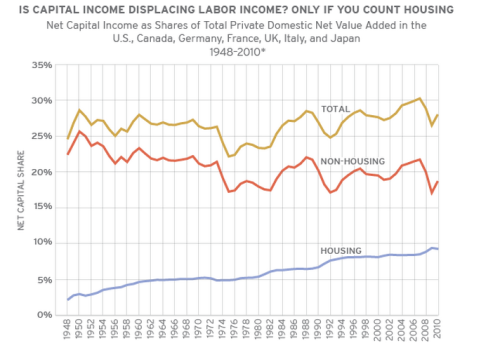
The key graph is shown above: there is no upward trend in capital’s share once housing rents are accounted for. The production of housing services is, of course, mostly provided by the house itself, which is counted as capital. So housing services have a capital’s share close to 1. So if the weight of housing goes up, it will drive up the overall share of capital, including the production of housing services. But there is no reason from the graph above to believe that the production function for goods and services other than housing services is on the side of Cobb-Douglas that Thomas Piketty needs–a direction in which a much higher amount of capital would be associated with only a slightly lower rate of return. (See my post “The Shape of Production: Charles Cobb’s and Paul Douglas’s Boon to Economics” for my effort at an intuitive treatment of the logic for why Cobb-Douglas leads to a constant share for capital and for labor.) Matt cites a large body of micro-empirical work suggesting that the elasticity of capital-labor substitution is quite a bit below the Cobb-Douglas level of 1, so that things are on the wrong side of Cobb-Douglas for what Thomas Piketty wants. There are some subtle arguments involving other adjustments that mimic a higher elasticity of capital-labor substitution that could make things look closer to Cobb-Douglas in the aggregate. But it still looks as if in the aggregate, when the real interest rate goes down, it goes down fast enough that the overall gross rental rate of capital goes down proportionally faster than the amount of capital relative to output goes up.   

The title of Greg Ferenstein’s piece is a bit misleading. Capital’s share is an important issue and capital overall is certainly central to Thomas Piketty’s story, but as for inequality, as Matt says in his conclusion, “Inequality of labor income, for instance, is a very different issue–one that remains valid and important.”    

It is good news if a lot of wealth and inequality is about housing, because we have known for a long time how to deal with wealth inequality from at least the land component of the value of housing: Henry George’s idea of a tax on land values that Noah Smith talks about, for example, in his Quartz column “This 100-year-old idea could end San Francisco’s class war.” Land taxes are typically much less distortionary than taxes on any other form of capital. So to the extent that inequality is about high land values, it doesn’t run into the issues I talked about in my post “Is Taxing Capital OK?” 

It does make sense, however, to have provisions in land tax policies to give to developers some of the increase in the value of land engendered by their activities when others want to be near some new development–just as we would want to make sure that developers pay some of the costs of the reductions in the quality of life nearby when others don’t want to be near some new development. The post “Charles Lane on Thomas Piketty and Henry George” discusses some of these issues. “Henry George and the Carbon Tax: A Quick Response to Noah Smith” discusses how some of the logic of a land tax extends to natural resources.

Land-price-based inequality can also be addressed by loosening restrictions on building. C.R. in the Economist writes in the article about Matt: “Policy-makers should deal with the planning regulations and NIMBYism that inhibit housebuilding and which allow homeowners to capture super-normal returns on their investments.” Let me explore the logic behind this. Land prices are pushed up when regulations require that land be used in a high ratio to construction in creating housing. That is zoning and other regulations that limit housing density enrich landowners. 

Above, I wrote that developers should have to pay some of the costs of reductions in the quality of life nearby when higher density is unpleasant to live nearby–say by blocking out the sun. In an earlier version of this post, I actually made the serious mistake of saying they should pay for the reduction in “land values” from development nearby. But that is wrong by a cost-benefit test. Suppose a particular housing development is neutral for the quality of life nearby. Then it would still reduce the values of land nearby by providing more housing competition. This is not a social loss but rather a shift in wealth from landowners renters and future buyers of land, which reduces inequality. So a key conceptual issue for appropriate land policy is to not think of everything that reduces neighboring land values as a bad thing, but to distinguish when (and how much) it brings down land prices by reducing the quality of life nearby from when (and how much) it brings down land prices by providing additional housing competition.

Paul Krugman: Wall Street’s Revenge

Paul Krugman’s piece linked above is nice bit of political economy, both for its succinct description of the layout of interest groups in our politics and for its warning about how the financial industry is trying to weaken the guardrails against the financial instability that could lead to future bailouts. Given its recent track record, the financial industry should not be trusted to write its own regulations, but it has enough money to buy many legislators. 

On this theme, in “Odious Wealth: The Outrage is Not So Much Over Inequality but All the Dubious Ways the Rich Got Richer” I write in praise of vulture capitalism, but what the financial industry wants is another matter:

Among excessive rewards caused by the government, bailouts without increases in equity requirements big enough to prevent future bailouts are especially unfair. But actions by the government to protect the profits and business models of firms already in place by standing in the way of firms doing new things in new ways can in the long run be just as damaging.  And in the digital age, copyright law is long overdue for reevaluation.

In “How to Avoid Another Nasdaq Meltdown: Slow Down Trading (to Only 20 Times Per Second)” I write:

In academic finance, concerns about high-frequency trading go under the heading of “market microstructure” issues. There are other bigger problems in finance at the macroeconomic level that I have talked about more than once. The best reason to fix unfairness—or even perceived unfairness—in market microstructure is so people aren’t distracted from noticing how those in the financial industry use low levels of equity financing (often misleadingly called capital) to shift risks onto the backs of taxpayers and rewards into their own pockets. In quantum mechanics, electrons can “tunnel” from one side of a barrier to another. Using massive borrowing to ensure later government bailouts, the financial industry has perfected an even more amazing form of tunneling: the art of tunneling money from the government so that the profits appear on their balance sheets and in their pockets long before the money disappears from the US Treasury in bailouts. By comparison with this financial quantum tunneling of money from the US taxpayer that has been a mainstay of the financial industry, high-frequency trading profits of a few billion dollars a year are small change.

Of course, the real authorities on these issues are Anat Admati and Martin Hellwig, who wrote The Bankers’ New Clothes. They are the ones who should be writing regulations for the financial industry, not the industry itself. You can see a brief summary of their argument in “Anat Admati, Martin Hellwig and John Cochrane on Bank Capital Requirements.”

Oliver Davies and Miles Kimball on a Method for Nominal GDP Targeting

Picture of Oliver Davies. Links to the original post on Oliver Davies’s blog and to One-Month Money on Amazon.

Picture of Oliver Davies. Links to the original post on Oliver Davies’s blog and to One-Month Money on Amazon.

I enjoyed reading Oliver Davies’s book with Ruggero Bozotti: One-Month Money: Why money ruins our economy - and how reinventing it could end unemployment and inflation forever…The book’s diagnosis of the problem and argument for the importance of reinventing money are very much on target. Unlike my own proposal, the “Neutral Money” policy Oliver and Ruggero advocate does not depreciate paper money within the month, but then depreciates it 100% at the end of the month. In addition, the same rules apply to all media of exchange, which also can only be used once in a month (at least to purchase final goods and services). Furthermore, the media of exchange have a quantity that is fully controlled by the central bank; private banks can no longer create media of exchange. (The central bank makes sure to create enough to make up for the reduction in privately created money with the 100% reserve requirements.) 

Beyond being one of the many possible ways to eliminate the zero lower bound, I think of this as designed to put a straightjacket on velocity so that it is exactly once per month or 12 times per year. This then helps guarantee that one can hit one’s nominal GDP target, since MV = PY, and M is tightly controlled through 100% reserve requirements. 

My view is that, once one eliminates the zero lower bound, central banks that are consciously targeting nominal GDP could probably do a pretty good job of hitting those nominal GDP level targets without such draconian measures, so that “one-month money” is probably not necessary to stabilize the economy. But it is always good to have a backup plan (in what I consider the unlikely case) that it is very hard to hit nominal GDP targets even after the zero lower bound is eliminated in the way I have advocated.

One place where Oliver and Ruggero oversell their system a bit is that appropriate adjustments to the nominal GDP target to allow for changes in the natural level of real output are nontrivial. (I wrote about this in “Optimal Monetary Policy: Could the Next Big Idea Come from the Blogosphere?” and “Why the Nominal GDP Target Should Go Up about 1% after a 1% Improvement in Technology.”) With the zero inflation target I would advocate, the nominal GDP level target adjustment need are exactly the changes in the natural level of real output. (With a 2% inflation target, which I have argued is too high in the absence of the zero lower bound, there is an additional 2% addition to a trend in the nominal GDP level target.) 

After reading One Month Money, I had a very interesting conversation with Oliver on the phone. Here is his account of that conversation and his reactions to it:


Two weeks ago, I had the pleasure of speaking with Miles Kimball. For those unversed in the who’s who of the economics world, Miles is a Professor of Economics and Survey Research at the University of Michigan and blogs at Confessions of a Supply-Side Liberal and Quartz. As one of the few professional economists who believe our monetary system is in dire need of an overhaul, he has developed a proposal for removing the Zero Lower Bound (ZLB) without outlawing cash. In a gist, Miles’ proposal would allow the central bank to implement a deposit fee on its cash window, thereby creating a negative rate on physical currency. Miles is also the first person with academic credibility to read my book, and his feedback, delivered over a marathon phone call that lasted nearly three hours, was very positive.

Let’s start with Miles’ elegant reframing of how a neutral monetary system would work. Neutral money affects two variables: the Money Supply (M) and the Velocity of Money (V), which, crudely speaking, means the amount of times the money supply is spent during a given time period. As anyone with exposure to introductory macroeconomics will know, the Money Supply (M) multiplied by the Velocity of Money (V) is equal to Prices (P) multiplied by Quantities (Q), which is also known as “nominal GDP. ” The equation looks like this: M*V = P*Q = nominal GDP.

So how does neutral money work? It’s pretty simple. Step 2 of neutral money (expiration) fixes V at a constant, since every dollar in circulation (M) is guaranteed to be spent exactly once each month. Simultaneously, Step 1 (100% reserve banking) gives the central bank direct control over M. With V fixed, a 10% increase to M will also boost M*V, and hence nominal GDP, by 10%. In other words, under neutral money, the central bank has direct control over nominal GDP, or aggregate demand. If the central bank doesn’t want demand to fall, then demand won’t fall. No ifs or buts or maybes.

As I have enormous respect for Miles’ work, I was greatly encouraged by his acknowledgement that neutral money would achieve its stated goal of ending the business cycle. Does this make Miles a neutral money convert? Not quite. Or not yet. As someone who has pitched his plan to eliminate the ZLB to a number of central banks, he understands the importance of politics. And as far as monetary overhauls go, neutral money is undeniably radical, more so than his ZLB proposal. Miles therefore concluded that a system like his would need to demonstrably fail before consensus could be reached on adopting neutral money.

Quite frankly, I couldn’t agree more. While a chapter in my book explains why neutral money is superior to negative cash interest rates, my thinking has evolved slightly since publication. The choice shouldn’t be between neutral money or negative cash interest rates. Rather, we should first try to eliminate the ZLB, which is easier to implement, and then, if that falls short, we should adopt neutral money.

Does this conclusion mean we should shelve neutral money until a negative cash rate system fails? Not at all. Neutral money, although the most radical, is also the most soundproof. As Miles’ mathematical reframing proves, neutral money is guaranteed to work. We should therefore think of neutral money as the last stage on the road to a more perfect monetary system, with these other proposals as important milestones along the way. Each proposal, whether Kimball’s, or Buiter’s (who proposes abolishing cash altogether), or even 100% reserve banking, will dramatically reduce the political hurdles blocking the adoption of neutral money.

So how might it all play out? Obviously this is highly speculative, but it could look something like this. In stage one we might adopt Miles’ system, which removes the ZLB. In a second stage we might implement 100% reserve banking, which would improve the stability of a monetary system where rates can turn negative. At this point, with fractional reserve banking removed, and with the public accustomed to negative rates, the only remaining political hurdle would be expiration — an inconvenience which, by that time, should be considerably diminished by technology.

So like all explorers setting out on an expedition, we should be prepared not just for the first, second, or third leg, but also the last. And that means we start thinking about practical implementation of neutral money today.

My conversation with Miles ended on a rather flattering note. He asked if I would be interested in writing a sequel (of sorts) to One-Month Money. In it I would focus on all the problems that would still remain in an economy free of business cycles. Miles has spent a lot of his time thinking about these supply-side problems, and wants a platform on which to properly express his ideas.

Food for thought…

Dan Miller: Penny Wise and Pound Foolish

I am pleased to host another guest post by Dan Miller, a student in my “Monetary and Financial Theory” class. (His previous guest post was “Sleep as a Strategic Resource.”) This is the 10th student guest post this semester. You can see the rest here.

I argued in “How Subordinating Paper Currency to Electronic Money Can End Recessions and End Inflation” and since for bringing paper currency off of its pedestal in order to eliminate the zero lower bound. Some of the emotional attachment to paper currency that makes my campaign to eliminate the zero lower bound more difficult shows up in people’s attachment to the penny. So it provides a good case study. 


The time has come to abolish the almost worthless, bothersome and wasteful penny.

You can’t buy anything with a penny anymore. A vending machine? Put a penny in and it will spit it right back out. Penny candy? Not for sale in my lifetime. Sometimes it pays to take a look at history: a dime today is worth less than what a penny was worth in 1950, and according to the US Mint’s 2013 annual report, every penny costs 1.8 cents to make. The U.S. military itself has already decided they’re essentially useless with Army and Air Force Exchange Service stores on bases rounding all cash purchases up or down to the nearest nickel. Despite this, the U.S. Mint keeps producing a billion pennies a month.

Where do the pennies go?

Two-thirds of them immediately drop out of circulation, into coin jars or behind chair cushions.  While quarters and dimes circulate just fine; pennies disappear because they are literally more trouble than they are worth. President Obama has stated his willingness to abolish the penny on February 15th, 2013.  Saying, “Anytime we are spending money on something people do not use, its something that we should change.”

The remaining 300 million or so–that’s 10 million shiny, useless items punched out every single day by government workers who could be more usefully employed–go toward driving retailers and consumers crazy. They cost more in employee-hours, waiting for buyers to fumble around for them, count them, pack them up and take them to the bank, than it would cost to toss them in the garbage. And as Greg Mankiw stated in his argument to abolish the penny, time is our economies’ most valuable resource. That’s why you see penny cups next to every cash register. When looking at the costs and benefits in aggregated terms, there have been studies that have shown that the penny results in an annual loss of $900 million in the US economy each year. How did they come by this number? The economist Robert Whaples stated that every cash transaction that involves pennies takes two extra seconds because people are fishing them out of their purses and pockets.  He also argues that eliminating the penny could make people keen on using $1 coins, which would save the US an additional $500 million a year because coins are more durable than bills which are torn and lost easily.

What purpose does the penny currently serve?

The penny pinchers argue that those $9.99 price tags save the consumer cents because if the penny was abolished, merchants would round up to the nearest dollar. That’s just foolish: the idea behind the 99 cent price is taking advantage of the psychological phenomenon that, “its less than 10 dollars.” In general, we cannot predict what merchants would do because they could just as often round down to $9.95, saving consumers billions of dollars over time. Indeed, it could become an even more obsolete of a fear if we were to increase our use of electronic currency.

What’s really behind America’s clinging to the penny?

The answer has to do with zinc, which composes approximately 98% of each penny minted since the early 1980s. The powerful zinc lobby has enough of a foothold in congress to persuade the senators and representatives to swat the “Penny Abolition” legislation away, as they have done twice in the last decade.

In addition, popular support for the penny is still high, at 67%, and national inertia does not seem to be moving in the direction of the tossing the penny. Sentimentality could be playing a major role in this phenomena.  “A penny saved is a penny earned,” and “A penny for your thoughts” are iconic phrases that Americans love to use and they most certainly do not want them to become obsolete.

Finally, abolishing the penny is a symbol of inflation and would be criticized as such. “The Obama administration is so inflationary that they abolished the penny!” Even though, in fact, a big failing of the Obama administration is that it let inflation be below target by not stimulating the economy enough.

Can the penny be eliminated?

The zinc lobby is powerful, but if more and more transactions are done electronically, the penny, along with other forms of cash, will become less and less relevant, and people’s emotional attachment to it will weaken. Already, the younger generation is less attached to the penny than older generations. So there is hope that someday we will be free of the curse of pennies. Perhaps if we threw every penny we get into a wishing well, wishing for the end of the pennies …

John Stuart Mill’s Brief for the Limits of the Authority of Society over the Individual

I have been publishing a post based on John Stuart Mill’s On Liberty every other Sunday since January 27, 2013. I have now completed blogging my way through On Liberty, Chapter IV, “Of the Limits to the Authority of Society over the Individual. As when I completed the previous chapters, I wanted to do a bibliographic post collecting all of my posts on Chapter IV, as well as giving you the links for the previous chapters’ bibliographic posts. 

“Of the Limits to the Authority of Society over the Individual” is by far the most challenging chapter so far. I had to think hard to figure out what I believed and could add to John Stuart Mill’s discussion. As a result, the posts for Chapter IV have more of my own writing and thinking in them than the posts for the previous chapters. I hope some of you take the time to work your way through these posts. On Liberty is worthy of this level of attention. Below is the detailed set of links for Chapter IV and links to chapter aggregator posts for the other chapters. 

Chapter I: John Stuart Mill’s Defense of Freedom

Chapter II: John Stuart Mill’s Brief for Freedom of Speech

Chapter III: John Stuart Mill’s Brief for Individuality

Chapter IV: John Stuart Mill’s Brief for the Limits of the Authority of Society over the Individual:

Chapter V: John Stuart Mill Applies the Principles of Liberty

Virgina Postrel: Glamour Reveals Nonsatiation

Even in its most apparently superficial and entertaining forms, glamour reveals inner truths. It exposes our vulnerabilities, to ourselves and perhaps to the world. We feel lonely, frustrated, and unappreciated; we long for fellowship, for meaningful work, for true love. We are social and biological creatures. We want to be looked at and admired, to be rich and powerful, to be painlessly heroic and effortlessly beautiful. We long to be sexually desired and recognized as special. Glamour defies demands for humility or modesty, self-denial or patient resignation. It is ambitious and self-involved. Above all, glamour reveals that we want to be something we are not. It demonstrates that we are not wholly content with life as it is. Glamour is pleasurable, but it is also disquieting.

– Virgina Postrel, The Power of Glamour, p, 221

Nina Easton: Class Reimagined

Link to the article in Fortune

For those who think about education, as I do, it is important to have a thumbnail description of what kinds of things work. As Nina Easton writes in Fortune

[Eva] Moskowitz’s 32 Success Academy Charter Schools rank in the top 1% of all the state’s programs in math—and in the top 3% for English. … On a tour of Success Academy’s flagship school in Harlem, Moskowitz shared her philosophy on disrupting education.

Here are the basics, which I have quoted with elisions at the end of each point. See the article itself for more details: 

Kids should struggle. “There’s this sense in public education that kids are fragile, that their self-esteem will be hurt,” she says. “We believe self-esteem comes from mastery.” 
Chess is key to building agile minds.
Assume all your students are going to college.
Extend the same college expectations to special-ed students.
No coddling for teachers either. They are expected to work long days and longer school years and attend far more training sessions than regular city teachers. 
Principals, not just teachers, have to know their students.

What this Teaches about Teachers as Coaches: Several elements of this approach illustrate what I mean when I write about a teacher as “coach.” By “coach” I mean someone who motivates extraordinary effort on the part of students, as I see athletic coaches routinely doing in motivating extraordinary effort by those on a sports team. It doesn’t count as “coaching” in this sense if a teacher just gives the student a few helpful hints and recommendations. 

My sports coaches and my debate coach talked a lot about the glory of winning–so that we could almost taste it. Similarly, an effective strategy for academic coaching is to talk about winning in life, in part by going to college and having a great career. 

Also, notice that sports coaches are themselves typically quite enamored of the idea of winning. Someone is likely to be a much better teacher-as-coach if they are excited about the idea of helping their students win in life, and thirst for succeeding at this more than the run-of-the-mill teacher. With enough of a positive competitive spirit like this, with each trying to do better than average, average won’t be the same anymore.

Yichuan Wang on Narayana Kocherlakota and coauthors’ “Market-Based Probabilities: A Tool for Policymakers”

Narayana Kocherlakota is planning to step down from his job as President of the Minneapolis Federal Reserve Bank. I know this because he came to a job talk at the University of Michigan yesterday. (Michigan is only one of the many job talks he is doing lately.) From 11:40 to 1:00 PM yesterday, Narayana presented his paper with Ron Feldman, Ken Heinecke, Sam Schulhofer-Wohl and Tom Tallarini: “Market-Based Probabilities: A Tool for Policymakers.” It was an excellent presentation. 

Narayana explained that given their intended audience, he and his coauthors had felt the need to coin a more accessible term–“market-based probabilities.” for what financial economists call a “risk-neutral probability measure” or “stochastic discount factor.” One alternative description would be “market-importance-weighted probabilities.” The contention of the paper is that these weights are more relevant for many policy purposes than the raw statistical probabilities.  

Right after the talk I mentioned it to Yichuan Wang when I saw him in my 1:00-2:30 PM “Monetary and Financial Theory” class and gave him a copy of the paper. Because Yichuan had already written and thought deeply about this issue, he turned around a post by 3:13 PM (well before I talked to Narayana about my proposal for eliminating the zero lower bound and the interaction of monetary policy and supply-side reforms in Japan during a 4 PM office visit). I am grateful for Yichuan’s permission to mirror it here as a guest post–the 9th student guest post this semester. (You can see the other student guest posts here.)


The gap between market forecasts of inflation based on securities prices and where inflation actually goes is a feature, not a bug. This gap is a risk premia that can be informative about what scenarios are worrisome to investors, and as such may be useful for policy makers deciding on how to weight the relative costs of inflation and deflation.

Justin Wolfers’ NYT article on market based inflation expectations explains how to derive inflation expectations from asset prices. In the article, he walks through an academic asset pricing paper that estimates a probability distribution for future inflation based on the prices of bets on inflation. The basic idea is that there is a betting market in which people can place bets on where they think inflation will be going. Just like how a bookie’s prices say something about the probability of certain horses winning a race, the prices on this inflation betting market make statements about the probability inflation ends up in certain zones.

Justin summarizes the findings:

While traders view inflation of roughly 2 percent as the most likely outcome, the market is also telling us the probability of other levels of inflation — or deflation. And it is saying that the risks of missing the 2 percent target are extremely unbalanced: It is twice as likely that inflation will come in below the Fed’s target as above it.

But there’s another aspect to asset prices that doesn’t show up for horse betting: risk premia. Whether inflation is high or low is related to the strength of the economy as a whole. In particular, if I were to tell you that there was going to be deflation in two years, your best bet would be that we were going through a double dip recession in which aggregate demand fell. You should then be willing to pay a premium to buy insurance against that scenario. In other words, you should be willing to pay better than fair odds that there will be deflation. Sure you might lose the bet on average, but when deflation hits and you lose your job, at least you got your racetrack winnings to cushion the blow.

Therefore the market forecast is equal to the true future expected inflation plus a risk premium that reflects whether low inflation or high inflation scenarios are scarier. If people are scared of a Japan style deflation, then the market forecast will underestimate true inflation. If on the other hand people are worried about 1970’s style stagflation, the market forecast will overestimate true inflation.

While this can be a nuisance if you want to get the best physical forecast of actual inflation, it can actually be tremendously valuable for central bankers who need to decide on whether to be more worried about the costs of high inflation or low inflation scenarios. For example, negative risk premia on inflation expectations tell policy makers that low inflation scenarios are much worse than high inflation scenarios. If this is the case, then the inflation target should be asymmetric — better to avoid scary deflation than deal with temporarily higher inflation.

Narayana Kocherlakota* made this argument in a recent macro seminar at the University of Michigan. (I’m borrowing the post title from his paper). In the context of a theoretical model he showed that the central bank’s objective function should focus on maximizing household welfare, not minimizing its own forecast errors. But based on the analysis above, the different levels of household welfare across different states of the world are embedded into the market forecast based on prices. So with some caveats about the financial constraints facing households, the central bank should try and make the market forecast equal the target.

As a more general point, this risk premium analysis shows how asset pricing is a form of quantitative psychology. Estimating risk premia helps answer the question “what do these asset prices say about the events that scare people”? And once policy makers know about these feared scenarios, they can adjust policy to make sure they don’t happen.

*As Narayana was quick to remind us, these are implications of a model from his own research, and not meant to represent the views of others in the Federal Reserve System.

Yichuan Wang: Did Dish Distort the Auction?

Links to Yichuan’s LinkedIn Page, his Medium page and to his blog Synthenomics.

Yichuan Wang is my coauthor on two very popular Quartz columns, “After Crunching Reinhart and Rogoff’s Data, We Found No Evidence High Debt Slows Growth” and “Examining the Entrails: Is There Any Evidence for an Effect of Debt on Growth in the Reinhart and Rogoff Data?” along with other posts about Reinhart and Rogoff’s data linked there. Along with Fumio Hayashi and Yoshiro Tsutsui, he is also my coauthor on a (not yet completed) academic paper on the dynamics of happiness. And he is a Quartz columnist in his own right. As an undergraduate at the University of Michigan, he is taking my “Monetary and Financial Theory” class this semester, and has been writing three blog posts a week in that capacity. Yichuan has his own blog, Synthenomics, but I asked him if I could publish this very interesting and sophisticated post as a guest post–the 8th student guest post this semester. Here is Yichuan: 


Critics of Dish’s bidding strategies during the most recent AWS auction need to distinguish the difference between distorting prices and distorting taxpayer intent. While exploiting “small-business” tax breaks is distasteful because it violates the original intent of promoting business by minorities, such a payment subsidy likely increased the revenues from an auction which would have otherwise been dominated by AT&T and Verizon.

First, some background. The Advanced Wireless Services — 3 auction was an FCC auction for wireless spectrum. “Spectrum works like lanes on a highway, and wireless carriers have to buy more of it as they add subscribers and traffic increases.” As such, obtaining spectrum during these auctions is critical for companies who may wish to expand their wireless offerings.

AT&T and Verizon are obvious examples of such companies. But the real surprise was that Dish, a satellite TV company, won $13.3 bn. in spectrum in the auctions. Dish’s strategy relied on coordinating with three other “small business” entities. This had two benefits. First, it allowed a more complex bidding strategy. Because bids were anonymous, this created an illusion of more competition and drove prices higher. Second, it allowed Dish to benefit from a small business subsidy that took $3.3 billion dollars off of the sticker price.

I sympathize with comments from FCC Commissioner Ajit Pai that Dish’s bidding strategy “makes a mockery” of the “small business” part of the tax break. But is this a “distortion”?

In standard auction theory, we are typically concerned about two measures of efficiency. First, is the auction allocatively efficient? Second, does the auction maximize revenue? The first criterion is concerned with whether the spectrum is allocated to the firms who most value the spectrum. The second is concerned with whether the government is extorting — err, raising — the maximum amount of revenue from the bidders.

These two goals are often at odds. For example, suppose you have an auction system that is allocatively efficient, but the firm who values the spectrum the highest has much more wealth than all the other bidders. Think of this firm as AT&T. If AT&T is aware of this, then their optimal bid is much less than their true valuation of the spectrum — why pay more when they don’t have to? This, of course, screws over the FCC. So one possibility is to put in a minimum bid. But if you put this minimum bid too high, then nobody will bid and you lose allocative efficiency. But so long as you’re reasonable, you can raise much more revenue this way.

So did Dish make the auctions less allocatively efficient? On face, the answer seems to be yes. If Dish had a special price advantage due to tax benefits that could have unfairly given it spectrum that it didn’t deserve, then that could mean the spectrum wasn’t given to those who value it most.

But this doesn’t hold if Dish plans on monetizing its spectrum by selling it to other firms. T-Mobile has criticized Dish for hoarding spectrum and treating it more like a trade-able financial security. But if Dish sells its spectrum to another firm, then in the end the spectrum still ends up with a firm that values it most. Admittedly, Dish is engaging in tax-arbitrage — buying spectrum at tax advantaged prices and turning around to sell it to other less subsidy endowed firms. But this is a criticism of how Dish flaunts taxpayer intent, not of how Dish reduces allocative efficiency.

While the effect on efficiency is a wash, it’s clear that giving Dish a tax + strategic benefit in the bidding process dramatically raised revenues for the government. One estimate is that Dish’s actions raised the value of the auction by $20 bn. AT&T and Verizon could not just put in bids that were “big enough” — Dish and its subsidiaries made sure that AT&T and Verizon paid their valuations. In this light, Dish’s tax break could instead be seen as a tool to prevent Verizon and AT&T from dominating the auction.

Given this, it’s natural that AT&T and T-Mobile are crying foul. But in an auction with asymmetric bidders, tax subsidies that seem “unfair” may still be efficient and even revenue increasing.

Chris Rockwell: Has  a Master’s Degree Become a Negative Job Market Signal?

Chris Rockwell’s LinkedIn Homepage

I wrote positively about Master’s degrees in economics in “On Master’s Programs in Economics.” In the 7th student guest post this semester, Chris Rockwell effectively expresses skepticism about the value of most master’s degrees. There is some resonance with what I say in my column “The Coming Transformation of Education: Degrees Won’t Matter Anymore, Skills Will.” Here is Chris:


Why a masters degree can make candidates less desirable to employers

Traditionally further education was associated with higher intelligence, increased income and higher social status. However, these correlations have changed drastically and now many of the most talented, qualified undergrads actually do not immediately enter graduate school. Because of this, I believe having a masters degree can actually make candidates appear less valuable to employers.

To estimate the average talent of those who get a masters degree, I will consider the option of obtaining this degree from a few different perspectives. As stated earlier, I believe some groups may choose not to get one, even if they could. This is due to graduate school being very expensive and requiring key time out of the work force. Additionally, getting a masters degree can be risky given upon graduation given there is no guarantee of a high quality job. I think masters candidates break nicely into three pools; all of them having different costs and benefits. Note I will examine the effect of a masters degree from a purely financial perspective, but I assert this is reasonable given people who are less interested in money would be more likely to get a PHD anyway.

First, I will consider an undergrad from the US with some competence, relatively good grades and solid test scores (for example, Michigan grad from random major with 3.5, little work experience, and a 80th percentile GRE). I assume this student might get some job offers, but they will probably not be stellar and might be closer to the $40-50k / year range. This student is basically faced with two options: school or work. Suppose if this student were to attain a masters degree it would be in business — the best performing grad school financially. In this case, after 2 years of missing work and $200k more debt, they would probably be looking at a salary closer to $80,000. All in all, Forbes calculated this is better than the alternative for this student. (A 10 year back-of-the-envelope calculation supports this: $80k * 10 – $200k = $600k > $50k * 10 = $500k).

The next group of students are international and talented — good enough to get into a comparable graduate university. However, these candidates often do not have the opportunity to pursue a job out of undergrad because of work visa restrictions or lack of English fluency. Hence, for them graduate school can be a must.

The final group of students I am considering are those who are excellent undergraduates and have the ability to land top offers. These offers can pay very well, often including base salaries ranging from $60,000 – $120,000. For students with such strong job offers, attending graduate school will generally not raise wage in any meaningful way in the near future. For example, at many top firms employees fresh out of graduate school with no work experience are paid the same wage or only a slightly higher wage than their undergraduate peers. Hence, for these top undergraduates, attending grad school right away makes no sense: doing so could in fact put them in a worse job market than the one they face upon graduation (not to mention cost and lost time).

So, under the assumption students maximize income, undergrads who attend grad school are often less talented than those who go straight into the work force. It follows that for recruiters at top firms, who only consider these three pools of people anyway (nobody with below a 3.5 for example), candidates who have received a graduate degree actually appear less attractive than those who have not. The clear exception to this is jobs requiring a masters degree, however many employers hiring for technical roles will teach undergrads on the job anyway.

Considering having a masters degree could be a negative job market signal, it might be surprising to note grad school attendance continues to climb. However, this actually makes sense because for most employees having a masters degree is still probably a positive signal. The group of less talented undergrads who get a masters are in general more desirable than their peers who do not. Hence it seems reasonable to conclude students with masters degrees are likely to be somewhat talented but probably not the best hires possible for employers.

In conclusion, modern graduate schools attract talented workers, but often not the best. The opportunity and monetary cost associated make these schools obsolete for the most talented individuals. In 2015, top firms should focus on undergrads when recruiting.

Noah Smith—Jews: The Parting of the Ways


What is Judaism? Is it a religion, an ethnicity, a culture, or a nation? It’s been all of these things, but what it really is, is a fellowship - a group of people who feel a connection to each other across time and space. More has probably been written about Jews, relative to their population size, than about any other fellowship of people on Earth. Many people can rattle off a list of Jewish accomplishments, either individual (polio vaccine, relativity, Facebook), or collective (ethical monotheism, Hollywood). 

But the fellowship is coming to an end. Judaism is breaking up into (at least) four groups, which increasingly feel no common bond with each other.

The first group are the Israelis. Actually, this group is far from homogeneous, since that nation is divided between secular/leftist and Orthodox religious groups, as well as national ancestries. But in general, Israelis have a culture that noticeably sets them apart from Jews elsewhere. Universal military service, constant conflict with surrounding peoples, and the experience of nation-building has forged a new culture in Israel that seems foreign to many Jews in America and elsewhere.

The second group are the secular American Jews (yours truly included). We’re mostly liberal, educated, and secular. Culturally, we’re not very much different at all from lapsed Catholics, Unitarians, weekend Buddhists, or atheists. We mostly marry non-Jews. Most of us grew up without experiencing anti-Semitism. We are very assimilated into the general culture of the United States, and soon we will cease to exist as a distinct group at all. 

The third group are the Ultra-Orthodox or Hasidic Jews, who have reacted to the modern world by retreating into ever more drastic medievalism. Hasidic communities are, to modern sensibilities, a parade of horrors. Sex abuse is rampant. Racism is endemic. Women are second-class citizens. There are herpes outbreaks from rabbis sucking the blood off of circumcision wounds. I wish I were exaggerating, but I’m not.

The fourth group are European Jews. Having survived the Holocaust, they live mostly as their ancestors did–as a distinct, mostly isolated religious minority, facing a slow steady assault of anti-Semitism.

These four groups are diverging from each other culturally, religiously, politically, and ethically. American Jews are slowly losing their emotional connection to Israel, and diverge sharply from Israelis on issues like Iran and Palestine. (On this, don’t miss Daniel Gordis’s Bloomberg View piece “American Jews Finding It Harder to Like Israel.”) As for the Hasids, their values are about as alien to other American Jews as those of ISIS - even my grandmother, a fluent Yiddish speaker and someone with a very strong Jewish identity, reviled the Hasidic culture and often told stories about its barbarism. As for European Jews, no one even hears very much about them anymore - the Holocaust severed a lot of family ties, and language barriers are hard to overcome.

So we have come to a parting of the ways. The fellowship of the Jews is broken, never to be reforged.

Actually, this shift was probably underway well before the modern age. The Industrial Revolution and the era of nationalism opened up sleepy Jewish communities throughout Europe. Jews began to assimilate into mainstream life in places like France, Germany, and the UK. Conflicts began between Zionists and anti-Zionists, religious and secular. The breakup of Judaism was interrupted by the Holocaust, which united Jews in suffering. But that interruption was temporary - eventually, the forces of globalization, secularization, and nationalism were destined to put an end to the strange little European subculture of yesteryear.

Is the end of the Jewish fellowship something to lament? I don’t think so. Cultures are adaptations to the demands of the age, and the age we live in now is just a very different one than the age that created the old European Jewish culture. As a character once said in Cory Doctorow’s Down and Out in the Magic Kingdom, “It’s not a museum, it’s a ride.” There are plenty of new identities and fellowships to be formed in the modern world. I would feel much more in common with the average science fiction fan, or Flaming Lips fan, or Stanford graduate than I would with the average Jewish person in France. If I have dual loyalties, they lie with Japan, not Israel.

Anyway, there will always be Jews out there - someone to wear the silly hats, to keep all the old rules. The Hasidic have very high birth rates. But as for the rest of us, we’re on to the next thing.

My Former Quartz Editor, Mitra Kalita Becomes Managing Editor for Editorial Strategy at the Los Angeles Times

Mitra Kalita is the one who noticed my blog very early on back in Summer 2012 and recruited me to write for Quartz. (In particular, she noticed my post “Why My Retirement Savings Accounts are Currently 100% in the Stock Market,” which appeared on August 1, 2012.) Having not only worked with her as an editor, but having had several fascinating phone conversations about the strategy for Quartz and other online publications, I am not surprised that the Los Angeles Times has recruited her as Managing Editor for Editorial Strategy. The article linked above gives more details.

My best wishes and congratulations!

JP Koning and Miles Kimball Discuss Negative Interest Rate Alternatives

I had a very interesting email discussion with JP Koning about negative interest rate alternatives. I appreciate his having given permission to make this public.

JP Koning: Let’s say central banks adopt your crawling peg idea and drop rates to -5%. However, retailers continue to set almost all prices in terms of paper dollar rather than switching to the electronic dollar. Why is this a bad thing? Why does the success of a crawling peg hinge on retailers make the switch to the electronic dollar as unit of account?

One way I have been trying to puzzle this out is by thinking about Marvin Goodfriend’s idea of a suspension of payment in paper, which you refer to in your paper ‘Breaking though the zero lower bound’. Under Goodfriend’s scheme, if retailers continue to set prices in terms of paper currency rather than electronic dollars, each ratcheting down in interest rates below 0% by a central bank will cause a one- time jump in the value of paper dollars, or deflation, which would be a dangerous thing. If retailers had already been encouraged to switch the unit of account to electronic dollars, the problem would be fixed. However, I’m not sure if this particular justification for the necessity of retail adoption of electronic dollars as the unit of account transfers over to your crawling peg scheme.

So why is it so necessary that retailers make the unit of account switch?

Miles Kimball: This is a deep question that I have not yet fully plumbed, but here are the considerations that make me go around saying that the electronic unit of account is important. 

1. If inflation is sticky in relation to a paper unit of account, then there is still an effective zero lower bound, since the paper currency earns a zero interest rate in the unit of account, which with (let’s say) low sticky inflation leads to a high real interest rate.

2. (This is a post I have been planning to write for a long time:) The changing exchange rate with electronic money does lead to a large increase in the money supply relative to the paper dollar numeraire that will credibly not be reversed, since ultimately the central bank expects people to switch to the electronic dollar numeraire. Suppose that does create inflation relative to the electronic dollar numeraire. Until people do switch to the new electronic dollar numeraire, that inflation relative to the paper dollar numeraire causes the usual costs: distortions of relative prices, menu cost expenditure, confusions, variance. 

Thus, it is much better if people can be encouraged to use the electronic dollar numeraire. As I say in my presentations, I think the government can make that happen. After all, for all we know, we are already on an electronic dollar standard. It is hard to know what the private markets would do without a nudge if the paper dollar goes off par. With nudges such as tax accounting in electronic dollars, other accounting standards in electronic dollars–and if needed–a requirement that firms (whether they have a paper price or not) affirmatively post prices in electronic dollars, I have every confidence that the electronic dollar can be made the unit of account.

Of course, it helps if a large fraction of transactions is done in electronic dollar terms before the transition.  

JP: Miles, when you get the chance can you critique my recent post? I’m trying to work out some “lite” techniques for breaking below the the zero lower bound. I believe they would work, but the devil’s in the details.

A lazy central banker’s guide to escaping liquidity traps.

Miles: Ken Rogoff suggests getting rid of the highest denomination notes first as the path toward eliminating paper currency entirely.

Ruchir Agarwal (my coauthor on the nascent academic paper on eliminating the zero lower bound) and I think that eliminating high denomination notes is a nice way to lower the fraction of transactions in paper currency in order to ease the transition into a crawling peg.

I think even the hardest-core version of eliminating high denomination notes (say $100s and above, then $50s–ordinary people mostly use $20s and below) of saying people have to turn them in is not all that radical. But if something less radical is needed, I like the idea of just not printing more.  

One important thing in favor of the “not printing more” option that you might mention is that it just might be within the legal authority of the Fed + Executive branch (without new legislation) even if the crawling peg is not. But I need Greg Shill’s upcoming series of guest posts before I know things like that.

I had some responses to your paragraph here:

7) There are a few drawbacks to a crawling peg. Driving a wedge between paper and electronic currency creates two different sets of prices at the till, one for deposits and the other for cash. A chocolate bar, for instance, might have a sticker price of $1.00 in electronic money, but require a cash payment of $1.05. This will be confusing and inconvenient for shoppers, necessitating an expensive and costly education campaign by our central banker. According to Kimball, instituting a crawling peg requires that a nation enact a unit of account switch. Prices must be set in terms of electronic currency, not paper currency, otherwise the central bank will lose control over the price level. While a switch in standards is by no means impossible, it does require time and effort.

1. First of all, we may well be on an e-dollar standard already. It is not easy to tell when paper dollars are at par. So I don’t count this as necessarily a switch in the unit of account. Rather it is resolving an ambiguity in what the unit of account will be in favor of the e-dollar. That, I think is much easier than a switch in the unit of account.

2. I routinely argue (as you can see in my Powerpoint file and in my interview with Alexander Trentin

SNB should introduce a fee on paper currency

that up to something like a 4% paper currency deposit fee (which could easily be all that is ever needed, since -4% rates for 1 year are powerful enough to get a robust recovery in many countries), paper currency would probably be accepted at par at most retailers that deal in cash, since those retailers are now only getting about 96 cents on the dollar when people pay with American Express cards. Paper that yielded 96 cents on the dollar would look just as good.

But also, it really isn’t that big a deal if, say, paper is running at a 7% discount so that retailers no longer accept it at par at the cash register. That is no more complicated than a 7% sales tax at the cash register, which people don’t blink an eye at. 

Notice that the front end of the crawling peg (a discount of, say, 0 to 4 or 5%) is most important for initial acceptance of the program. In the region where lite programs could go, the crawling peg is also very light, since cash would almost surely be at par at retailers. So I would argue that where a lite program will work, the crawling peg is also easy, and because it has the potential to go further, will have the advantage of creating stimulative expectations to a much greater degree than an approach that is limited to the lite region.   

Miles: On further thought, although it is great for crime-fighting, making everyone turn in their $100 and $50 bills by a given date may be seen as somewhat draconian. Saying that after a certain date the Fed will accept them only at a discount, that will gradually increase, then pick up speed is a nice way to both (a) do the elimination of high-denomination bills in a less draconian way and (b) get people used to the idea of exchange rates for paper currency. 

JP: Miles, here’s the first bit of my response, the rest later this week!

1. First of all, we may well be on an e-dollar standard already. It is not easy to tell when paper dollars are at par. So I don’t count this as necessarily a switch in the unit of account. Rather it is resolving an ambiguity in what the unit of account will be in favor of the e-dollar. That, I think is much easier than a switch in the unit of account.

While I agree that e-dollars are important, I think that we are probably on some sort of odd mixed e-standard/cash standard. I see it as being very similar to bimetallism; one unit, two different definitions that vary be retailer. I’ve written before about a Visa/MasterCard standard (see these two posts [1][2]).

Things get even more complicated if we factor in debit transactions: they are more expensive than cash from the perspective of a retailer, but less expensive than credit card transactions, and may provide a third potential definition for the unit of account. 

It will be interesting to see if new rules allowing US retailers to put surcharges on credit card payments will result in a shift back to using paper dollars as the unit of account. 

Merchant Surcharging – Understanding Payment Card Changes

One of the reasons I touched on the unit of account switch in my post is because of Scott Sumner. He recently wrote:

Nonetheless, it is probably impossible to pay negative interest rate on currency. Nor do I think it is feasible to make it so that currency is no longer a medium of account (as Miles Kimball proposed.) 
Central banking in a negative seignorage world

I don’t know how common Sumner’s criticism is, but for those like him who don’t think that removing currency as the “medium of account” is feasible, then lite alternatives may be an alternative that convinces them. Personally, I think a switch (or a resolution of ambiguity as you call it) would probably be easy to execute and not cost too much.

JP:  …Miles, here are the remainder of my thoughts.

On further thought, although it is great for crime-fighting, making everyone turn in their $100 and $50 bills by a given date may be seen as somewhat draconian. Saying that after a certain date the Fed will accept them only at a discount, that will gradually increase, then pick up speed is a nice way to both (a) do the elimination of high-denomination bills in a less draconian way and (b) get people used to the idea of exchange rates for paper currency.

I agree.

I routinely argue that up to something like a 4% paper currency deposit fee (which could easily be all that is ever needed, since -4% rates for 1 year are powerful enough to get a robust recovery in many countries), paper currency would probably be accepted at par at most retailers that deal in cash, since those retailers are now only getting about 96 cents on the dollar when people pay with American Express cards. Paper that yielded 96 cents on the dollar would look just as good.

That’s a good point. Are fees on Amex really that high? Wow! Since Mastercard and Visa are so much more ubiquitous than American Express – many won’t accept Amex – shouldn’t we be using MasterCard/Visa as the standard? Interestingly, Australia imposes maximum credit card fees that are quite low. They also allow retailers to apply surcharges, which looks something like this:

There is rumbling up in Canada that we might do the same. In any case, depending on its laws concerning credit card interchange fees, each nation could have its own peculiar negative interest rate trigger point at which paper currency prices will start to diverge from electronic prices.

There’s also the production, distribution, and wholesale side of the economy to consider, which doesn’t transact using credit cards. They use things like cheques or wire transfers, with very low handling fees relative to the size of the transaction. The e-money price and cash price could diverge quite quickly as a crawling peg is implemented.

But also, it really isn’t that big a deal if, say, paper is running at a 7% discount so that retailers no longer accept it at par at the cash register. That is no more complicated than a 7% sales tax at the cash register, which people don’t blink an eye at.

At 7% the lite programs wouldn’t work anymore. And if a -7% rate is what it takes to ensure the central bank is hitting its targets, then two different prices is the least of our concerns! In any case, from a purely tactical perspective, if you run into someone who disagrees with the crawling peg idea because it creates dual prices, and you can change their mind, that’s great – but if you can’t change their mind no matter how hard you try, the lite options provide a fall back.

Greg Shill: Does the Fed Have the Legal Authority to Buy Equities?

blog.supplysideliberal.com tumblr_inline_nlyiadbjeo1r57lmx_500.png

This is the second guest post by Greg Shill, a lawyer and fellow at NYU School of Law, on the legal scope of the Fed’s powers in the area of unconventional monetary policy.  His work focuses on financial regulation, corporate law, contracts, and cross-border transactions and disputes, and his most recent article, “Boilerplate Shock: Sovereign Debt Contracts as Incubators of Systemic Risk,” examines the role of financial contracts in the Eurozone sovereign debt crisis. (His first guest post was “So What Are the Federal Reserve’s Legal Constraints, Anyway?”)

As a longtime follower of Miles’ work, it’s an honor and privilege to write for his blog and to put my ideas in front of his diverse and sophisticated audience.  So, thank you, Miles, and your devoted readers.

I. For the past several years, the Federal Reserve has used many levers to stabilize and stimulate the economy.  One of its most controversial has been the use of so-called unconventional monetary policy, chiefly three rounds of quantitative easing (or QE, beautifully explained in this clip) from 2008 to 2014. Although the wisdom of these policies has been widely debated, the Fed’s legal range of action largely has not.  In fact, as I have noted previously, policymakers and observers have been remarkably quiet about the scope of the Fed’s legal authority to conduct unconventional policy, and when they do describe it they often offer timid visions of the Fed’s powers.

Economists and other observers have often urged the Fed to do more to juice a recovery that was, until recently, broadly disappointing.  These proposals have included not only calls to cut interest rates and launch quantitative easing in the first place (both of which the Fed did), but to target higher inflation, introduce electronic money, conduct direct monetary transfers to the public, extend QE beyond its wind-down in October 2014, and expand the range of assets eligible for purchase under QE.  The Fed of course did none of those more ambitious things, and today, with QE finished and policy normalizing, defining the legal limits on the Fed’s monetary policy arsenal may feel less urgent.  Yet it is a startlingly important question to leave open, given the strong likelihood that the Fed will need to consider aggressive and creative measures in the future combined with the persistent overall weakness in the global economy.

The general question is: in a future recession or crisis, does the Fed have the tools it needs to go beyond what it’s done in the past?  This is one of the most important open legal questions in public policy today.

II. Although it is not one of the sexier proposals mentioned above, in this post I will focus on the classes of assets the Fed can buy via quantitative easing.  I start there because it’s an area where the scope of the Fed’s legal authority is unsettled, we are getting new data (foreign central banks are experimenting right now), and it seems like a somewhat politically plausible extension of the Fed’s recently retired QE campaign.

Under the Fed’s now-concluded QE program, the bank only bought U.S. treasuries and Fannie and Freddie mortgage-backed securities (“agency MBS”). Several of the Fed’s major overseas counterparts—including the European Central Bank and the Bank of Japan—have embarked on their own QE programs, however, and in some ways they are already looking more ambitious. Japan is buying equities and the Europeans, who launched a massive QE program on Monday, have reportedly considered buying “all assets but gold.” If successful, broader asset-purchase programs like these could make it easier to contemplate an expanded purchase campaign by the Fed down the road.

Except for one minor detail: they are widely perceived as illegal under U.S. law. Former Fed official Joseph Gagnon has lamented that the Fed’s asset purchase authority “is limited by law to the Treasury, agency, and agency MBS markets plus foreign exchange” (emphasis added), and others agree.  Gagnon would like the Fed to be able to “buy a broad basket of U.S. equities” (a view to which I am sympathetic), but he and others say that that idea lies beyond the Fed’s legal authority, namely the Federal Reserve Act of 1913.

Is it?

III. The argument that the Fed has the authority today to buy equities is not definitive, but is stronger than is currently acknowledged.  Gagnon, an expert on monetary policy, maintains that “the Fed is not authorized to buy equities,” but to a lawyer, this statement is fraught with ambiguity.

True, the Federal Reserve Act does not expressly authorize the Fed to buy equities.  Section 14 of the Act, titled “Open-Market Operations,” enumerates several categories of assets the Fed “shall have power” to buy—they actually extend beyond U.S. treasuries and agencies to include assets like gold, state and local government bonds, and foreign exchange—and equities is not among them.

Yet this does not really establish the outer bounds of the Fed’s authority to buy assets.  The mere fact that a government agency lacks express statutory authorization to pursue a given policy does not necessarily render that policy illegal.  Assuming no other provision of law forecloses that policy (and here, none does), it just means that to be legal, the Fed’s action would have to find a footing on another source—statutory interpretation, case law, a regulation—rather than the text of the statute itself.

The law provides a doctrine for navigating this type of uncertain administrative agency terrain.  Known for the eponymous Supreme Court case, the Chevron doctrine gives us a two-part test for figuring out how much freedom of action federal agencies like the Fed enjoy where their governing statutes are unclear. Although the Federal Reserve Act has never been tested in this way, Chevron would provide some support for a decision by the Fed to buy equities (or, for that matter, private-label MBS).

Under Chevron “Step One,” a court asks whether the statute in question clearly circumscribes the agency’s discretion in a given area.  If it does, then there is little analysis for the court to do (the agency either crossed the line or it didn’t), but if it does not, then Chevron “Step Two” applies.

Step Two: where the statute is unclear—in other words, the operative provisions are “silent or ambiguous with respect to the specific issue” at hand—the court asks whether the agency’s action “is based on a permissible construction of the statute.”  Chevron v. NRDC, 467 U.S. 837, 843 (1984) (emphasis added).

In the 31 years since Chevron was decided, the case has been interpreted thousands of times and has spawned an entire area of jurisprudence, but the essential question remains the same: was the agency’s interpretation of its own powers “permissible”?

IV. Note that the key question in the Chevron analysis is not whether the agency’s interpretation is the most legally sound or reflects the wisest policy choice.  The court treats the ambiguity in the statute as a delegation of discretion by Congress to the agency to interpret the agency’s own powers; the court is only supposed to ensure that the agency reach an interpretation of those powers that is “permissible” (not even “reasonable,” let alone “best”).

Here, the operative statutory provisions are in the Fed’s legal mandate (Section 2A, “Monetary policy objectives”) as well as the open-market operations provision (Section 14).  The mandate, which requires the bank to pursue full employment and price stability, is written at a high level; the bank is obligated to “maintain long run growth of the monetary and credit aggregates commensurate with the economy’s long run potential to increase production, so as to promote effectively the goals of maximum employment, stable prices, and moderate long-term interest rates” (emphasis added).  These terms are nowhere defined in the statute.

Assuming the Fed wished to begin buying equities, the basic interpretive exercise under Chevron would proceed as follows.  We have here two provisions, Sections 2A and 14, that address monetary policy.  Section 2A frames the overall objectives of the bank.  Section 14 lists several types of assets the Fed can buy in open-market operations to pursue those objectives, but does not purport to restrict purchases to those types.  Thus, there is a good argument that the scope of the Fed’s discretion to buy assets under Sections 2A and 14 is unclear, which satisfies Chevron Step One.

Under Step Two, the question would be whether the Fed’s equity buys were conducted pursuant to a “permissible” interpretation of the statute.  This turns on questions of statutory interpretation that make even lawyers’ eyes glaze over, but the basic argument is straightforward: Section 2A is worded in such a way as to give the bank considerable discretion to pursue its goals, and Section 14 provides an illustrative, not exhaustive, list of the types of assets the Fed can buy.  The Fed could argue that, under the circumstances, fulfilling the purpose of Section 14 requires adding equities to that list, or at least that doing so constitutes a “permissible” interpretation of the statute.

Such an interpretation doesn’t give the Fed carte blanche to buy whatever it wants, only those assets that it realistically thinks are consistent with the statute.  So, for example, it could not buy California 10-year bonds, because Section 14(2)(b) expressly restricts the bank’s purchases of state government bonds to maturities not exceeding six months.  But a regulation the Fed adopted long ago seems to contemplate the need for wiggle room beyond buying the assets enumerated in Section 14.  It provides that the bank may “engage in such other operations as the [Federal Open Market] Committee may from time to time determine to be reasonably necessary to the effective conduct of open market operations and the effectuation of open market policies” (12 C.F.R. 270.4(d)).

This argument is not bulletproof.  A second legal doctrine, this one from the area of statutory interpretation, seems to disfavor it: when one or more things in a class are mentioned by name, other members of the same class are implicitly excluded (this is known as expressio unius est exclusio alterius).  However, the expressio unius canon does not yield a definitive interpretation either.  It should be viewed as a way of getting at the underlying intent of the legislature rather than as a trump card wherever a law contains a list.  For example, a sign stating that cars, trucks, and buses are allowed on a given bridge would not be read to preclude motorcycles from using the bridge.  In fact, the bar on buying longer-maturity state government bonds suggests that Congress knew how to cabin the scope of the Fed’s authority and intended to specifically restrict the purchase of certain assets, but chose to leave the door open to buying other assets—not only, say, U.S. treasuries of longer maturities, but other classes of assets entirely.  And of course if Congress had intended the Fed’s purchase authority to be limited to the assets specified in Section 14, it could have so limited that power.  It didn’t.

So, it’s true that the Fed lacks affirmative authorization in the statute to buy equities, but the bank might have that power anyway.

V. Where does this leave us?  

Substantively, the Fed probably enjoys greater discretion in unconventional monetary policy—possibly extending to the purchase of equities—than is commonly assumed.  But an “equity QE” policy would benefit from an additional legal bulwark: the procedural maze our legal system subjects all litigants to.

A doctrine called standing would make it hard for a private citizen to mount an effective challenge to an equity QE program.  This doctrine bars critics from bringing suit unless they can demonstrate a concrete, personal injury that is particular to them and that goes beyond ideological objections or the policy’s social effects.  This is hard to impossible to demonstrate in the context of monetary policy.  Specifically, a plaintiff seeking to challenge an equity QE program would have to show that he had been injured in some personal and tangible way, not merely that the value of his portfolio had declined (which presumably would also have happened to others pursuing a similar investment strategy). No investor has been able to show this type of injury with respect to the Fed’s aggressive bond-buying QE to date, and there’s no reason to think it would be easier to demonstrate such an injury from an equities purchase program. Combined with a stronger-than-recognized substantive legal justification, this bar on nettlesome litigation should make the likelihood of a successful legal challenge sufficiently dubious to give markets confidence that a Fed program to buy equities could proceed.  That said, it would be preferable if the Fed had affirmative statutory authorization, but government frequently must act in a legal gray area.

Politics, of course, is one of the Fed’s most powerful constraints, and in the current political environment, monetary policy doves no doubt see reasons to downplay talk of the bank’s powers.  However, hawks and other critics of the current Fed already seem very adept at using the bank as a political piñata without much regard for details like the precise scope of the Fed’s asset purchase authority (see, e.g., Rand Paul’s “Audit the Fed” campaign and legislation).  Acknowledging that the bank probably has a wider legitimate range of action than it has used may help underscore the restraint the bank has observed to date.  Regardless, it is important that the debate over Fed policymaking be conducted on the plane of policy rather than law.  A better understanding of the scope of legal restrictions on the Fed will help facilitate and focus that conversation.

David Farnum: The Real (Estate) Cost of Student Debt

David Farnum’s LinkedIn Page

Many economic effects are complex. In the 6th student guest post this semester, David Farnum points out one of the more subtle costs of student debt:

The increase in student loans has lead students to increasingly make sub-optimal real estate investment and are forced to take relatively more expensive rentals.

The sentence above is actually an example of the requirement that my writing teaching assistant Adam Larson and I recently instituted that students write an explicit thesis statement at the top of their posts, in accordance with my dictum in “On Having a Thesis”  

The thesis statement does not always have to actually appear in your post or essay, but it needs to exist and you need to know what it is.

Here is David’s argument for that thesis: 


While the repayment of principal and interest on student loans themselves can be expensive, one of the hidden expenses is the opportunity cost of having this student debt amount, namely sub-optimal investment choices. One area of investment choices that are distorted due to accumulating student debt is in the real estate market: increased debt levels force recent graduates to forgo purchasing real estate assets. This impacts them on two fronts, first it limits their portfolio exposure to potentially lucrative investment returns and causes them to pay for relatively more expensive rentals.

As pointed out in A Random Walk Down Wall Street, an investment into hard real estate assets such as houses can provide excellent returns into a well diversified portfolio. Burton Malkiel explains:

As long as the world’s population continues to grow, the demand for real estate will be among the most dependable inflation hedges available. Although the calculation is tricky, it appears that the long-run returns on residential real estate have been quite generous…In sum, real estate has proved to be a good investment providing generous returns and excellent inflation-hedging characteristics.

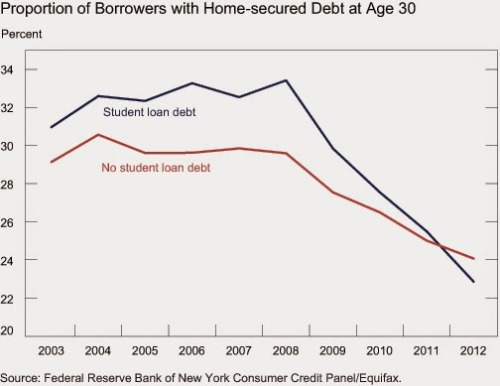
It makes sense that recent graduates would want to invest into such an asset class to better ensure they are able to take advantage of the long run returns that Malkiel describes. However, as more and more students are graduating with expanding college debt levels, they are increasingly unable to afford the purchase of a house. A 2013 post by Liberty Street Economistson the New York Fed blog analyzed the impact of student loans on home ownership. They explain their findings from the graph (below):

By 2012, the homeownership rate for student debtors was almost 2 percentage points lower than that of nonstudent debtors. Now, for the first time in at least ten years, thirty-year-olds with no history of student loans are more likely to have home-secured debt that those with a history of student loans.

In the past, those aged 30 with college debt were more likely to purchase a home due to their greater propensity to acquire higher paying jobs and thus be able to afford home ownership. However, this relationship has changed starting in 2012, possibly due to the higher overall levels of debt precluding mortgage approvals and reducing already debt burdened individuals ability to make home payments. The advent of this increasing proportion of students with debt and higher overall debt levels has been a contributing factor in the fall of home ownership, potentially leaving a large portion of recent graduates investment portfolios underexposed to the real estate sectors.

Not only are debt-burdened students under-investing in home ownership, they face increased relative prices for renting. A WSJ article entitled A Tough Time for Renters, outlines the rapid rise in rental prices:

The cost to rent an apartment jumped in 2014 for the fifth consecutive year as strong demand and short supply left vacancies at historically low levels. Nationwide, apartment rents rose an average 3.6% last year…the average monthly lease rate to $1,124.38, the highest since Reis started tracking the market in 1980.

A calculator provided by the New York Times allows one to compare the relative costs of renting vs home ownership based on a variety of input factors. Using the settings given, the equivalent home price to the national average monthly lease rate would be roughly $311,000. Given this is higher than the $199,600 national median sales price of existing homes, clearly the cost of renting currently greatly outpaced the cost of purchasing a home nationally.

However, the national data can skew the renting data, as rental rates will be especially high in areas of high populations such as large cities. Using a similar process to the NYT, online residential real estate company Trulia estimates the percentage difference in the cost of renting vs. buying a house in populous metropolitan areas. Their interactive map indicates that even in heavy populated areas, the cost of home is significantly less than that of renting, including a 21% difference in New York and Los Angeles, a 29% difference in Boston, and a 42% difference in Chicago.

All else being equal, this relative cost increase should tip the scales toward home ownership; however, as discussed above, the increased student debt levels have precluded individuals from home ownership. Not only are they missing out on the investment opportunity of real estate, they are throwing away relatively more money into the rental market.

Jonathan Zimmermann: The Quest for Uselessness

A large share of all the things that human beings want are things that are experienced in the mind. So it should not be too surprising that people will sometimes spend money or time on an idea that they find entertaining or humorous. Such was the pet rock craze a few years back. I was intrigued to learn that my student Jonathan Zimmermann accomplished such a feat of marketing an entertaining idea in a smaller way. His report on that is the 5th student guest post this semester. (Jonathan had another guest post a few weeks back that you might be interested in: “Swiss Franc Shock: Time to Take Advantage of Return Policies.”)


or the first time, Google Play (the Android app store) has surpassed the Apple app Store for the total number of published apps. Of course, among the almost one and a half million available applications, a lot of them, if not a majority, are of relatively little use. But usefulness is not a requirement for a successful app, as we saw for example many “fake razors” encounter a huge fame in the earliest days of the Apple app store.  So what exactly is the limit of “uselessness”? How far could a developer go, and especially, do people need to at least believe that the app will be useful to want to download it? In this post I want to share my experience on an interesting experiment I conducted a few years ago.

It was a few years ago and I had just started to learn how to develop Android app. But coding wasn’t the part that interested me; I wanted to create, to publish. So I asked myself “What is the most simple, the most elementary app that I could develop and publish with my very limited newly acquired coding skills?”. The answer was easy: an app that doesn’t do anything. How would I call that app? “Useless”, because it has no features and is of no use. How to market it? Well, what is the only way to market nothing? Simply being honest and telling people not to expect anything from a nothing.

I published the app (still available with its description on Google play). I didn’t advertise it, and just waited for some organic traffic to come. In a few days, hundreds of people downloaded it. After a few months it had tens of thousands of downloads, for a total of more than 120 000 users today! Did I produce value? It seems like it: the average rating, by more than 4000 users, is 4.5/5, a very high rating for an Android app! But there is more: the ratio of review per download and the ratio of comment per review were extremely high!

Not only did the app satisfy its customers, but the average user seemed to be a relatively highly educated person. In one comment, a high school teacher even said he shared this app with his whole class.

Most positive comments looked something like that:

I love it, great job android market. This app has changed my life for the better. I used to wake up every morning crying, but now I have hope again. Finally something real, consistent, reliable, trustworthy. This app has shown me that there are things in the world that are truly what they claim to be. Simple, humble yet sophisticated. A Monk in the app, a world leader among its kind for having integrity. This app is a masterpiece. It is what it says, does what it’s supposed to do and comes with a 10×1 return policy.

by savage santana (edited)

So what about the people that didn’t like it? The only reason why it has a score of only 4.5/5 is that most users would either put the best rating (5) or the worst (1). Only a few would put an average rating, like 2, 3 or 4. And what were the reasons behind most of those 1-star ratings? Most of the time, they were written by unsatisfied customers that found some use in an app that what supposed to be useless:

I downloaded this app, with hope of finding no usefulness whatsoever, that hope was lost when I found it had many. I noticed the moment I opened the application, I had something to read. I enjoyed reading about how the creator of this app did not like how the Android Market had it’s name changed and the purpose of the apps creation. I also found how useful this would be for people who found it difficult to spell (Apart from some spelling mistakes). It also had enough light to see objects in the dark.

by Carl-Michael Hammon (unedited)

So think absurd, and don’t be afraid to be absurd. Downloading this app was perhaps, for some people, a right to be irrational for a few minutes. Sometimes, it feels good to not make sense. And this feeling is more logical than it seems.

And on a final note, for the capitalist skeptics who think that doing art is great but making money is better: do not worry, I didn’t lose my business acumen and carefully placed a discrete ad inside the app. It generated a few thousand dollars of revenues. Not too bad for a few hours of “programming”.

Christopher Skehan: Everyone Needs a Vacation

Link to Christopher Skehan’s LinkedIn Home Page

I am pleased to host this guest post by Christopher Skehan on the importance of vacations—even as compared to other business concerns (obviously related to Dan Miller’s case for the importance of sleep). It is the fourth guest post this semester from students in my Monetary and Financial Theory class. You can see links to all of the other student guest posts here. Here is Chris:


It’s no secret that everybody loves time off from work to go on vacation. It seems pretty simple that people should work to live, and therefore use all of their vacation time. Yet, American business culture produces employees imagining industriousness that includes first-in and last-out workers, all nighters, and long work sessions for consecutive weeks. For many there is no room for vacation in this industrious image. “More than forty percent of American workers who received paid time off did not take all of their allotted time last year, according to “An Assessment of Paid Time Off in the U.S.” commissioned by the U.S. Travel Association, a trade group, and completed by Oxford Economics” (Forbes). The U.S., one of the few developed countries that doesn’t require companies to provide vacation time, needs to change because taking a vacation is good for production and in some cases can even prevent crime.

This productivity science seems like a justification for laziness in the workplace. However, several scientific observations have proved that taking small breaks during long study sessions not only dramatically improves your productivity but also your mental ability. The theory is simple, the brain is a muscle, and every muscle tires from repeated stress. “In the mid-1920s, an executive in Michigan studying the productivity of his factory workers realized that his employees’ efficiency was plummeting when they worked too many hours in a day or too many days in a week” (The Atlantic). So if this is true on a micro level then it must be true on a macro level.

So far it is clear that taking breaks and by extension vacation are essential for employees, but does it hurt the employer? Quite the contrary, it has several advantageous for employers according to Forbes. First, when one employee leaves it forces an additional employee to learn the functions of a new job. This system creates an unintentional education system, and prevents the risk of crisis when a key employee is lost. Secondly, it cuts cost through reductions in health insurance payments. “The American Psychological Association has documented several potentially stress-induced health threats, such as increased cardiovascular risks and aggravation of existing conditions” (WSJ). Reducing health issues from your employees in not only the moral thing to do, but can now be justified in your balance sheets as well. Thirdly, mandatory vacation prevents fraud and embezzlement. “In 2007, Jérôme Kerviel, a trader at Société Générale, lost over $7 billion of the bank’s money. He later admitted hadn’t take one single day of vacation that year because he did not want anyone else to look at his books” (Forbes). For situations like this the FDIC has mandatory two-week vacation for certain industries.

The FDIC has the right idea but it needs to be implemented to every industry. During my time in Italy this last summer everything closed from one to three in the afternoon for people to go home and eat lunch with their family. When I explained to my host family that Americans didn’t do this they thought it was insane and called us robots. Now I think they are right, and think it is essential to implement mandatory vacation time for all employees. It reduces the cost of health insurance, increases productivity, produces a more trained workforce, and stops fraud.

John Stuart Mill’s Defense of Freedom of Religion for Mormons as an Argument for Chartering Libertarian Enclaves

Brigham Young’s family. Link to an overview of Mormon polygamy.

Brigham Young’s family. Link to an overview of Mormon polygamy.

John Stuart Mill was no fan of Mormonism. But he defended the right of Mormons to practice plural marriage–something the US Constitution as interpreted by the Supreme Court in Reynolds v. United Statesdid not do. The argument he makes is that when a group has fled for refuge to an out-of-the-way corner of the Earth, freely allows outside missionaries to come preach against its barbarism, and freely lets people leave the group, then it should not be molested even in customs that seem barbaric. Here is his argument, from On Liberty, Chapter IV, “Of the Limits to the Authority of Society over the Individual” paragraphs 21:

I cannot refrain from adding to these examples of the little account commonly made of human liberty, the language of downright persecution which breaks out from the press of this country, whenever it feels called on to notice the remarkable phenomenon of Mormonism. Much might be said on the unexpected and instructive fact, that an alleged new revelation, and a religion founded on it, the product of palpable imposture, not even supported by the prestige of extraordinary qualities in its founder, is believed by hundreds of thousands, and has been made the foundation of a society, in the age of newspapers, railways, and the electric telegraph. What here concerns us is, that this religion, like other and better religions, has its martyrs; that its prophet and founder was, for his teaching, put to death by a mob; that others of its adherents lost their lives by the same lawless violence; that they were forcibly expelled, in a body, from the country in which they first grew up; while, now that they have been chased into a solitary recess in the midst of a desert, many in this country openly declare that it would be right (only that it is not convenient) to send an expedition against them, and compel them by force to conform to the opinions of other people. The article of the Mormonite doctrine which is the chief provocative to the antipathy which thus breaks through the ordinary restraints of religious tolerance, is its sanction of polygamy; which, though permitted to Mahomedans, and Hindoos, and Chinese, seems to excite unquenchable animosity when practised by persons who speak English, and profess to be a kind of Christians. No one has a deeper disapprobation than I have of this Mormon institution; both for other reasons, and because, far from being in any way countenanced by the principle of liberty, it is a direct infraction of that principle, being a mere riveting of the chains of one-half of the community, and an emancipation of the other from reciprocity of obligation towards them. Still, it must be remembered that this relation is as much voluntary on the part of the women concerned in it, and who may be deemed the sufferers by it, as is the case with any other form of the marriage institution; and however surprising this fact may appear, it has its explanation in the common ideas and customs of the world, which teaching women to think marriage the one thing needful, make it intelligible that many a woman should prefer being one of several wives, to not being a wife at all. Other countries are not asked to recognise such unions, or release any portion of their inhabitants from their own laws on the score of Mormonite opinions. But when the dissentients have conceded to the hostile sentiments of others, far more than could justly be demanded; when they have left the countries to which their doctrines were unacceptable, and established themselves in a remote corner of the earth, which they have been the first to render habitable to human beings; it is difficult to see on what principles but those of tyranny they can be prevented from living there under what laws they please, provided they commit no aggression on other nations, and allow perfect freedom of departure to those who are dissatisfied with their ways. A recent writer, in some respects of considerable merit, proposes (to use his own words) not a crusade, but a civilizade, against this polygamous community, to put an end to what seems to him a retrograde step in civilization. It also appears so to me, but I am not aware that any community has a right to force another to be civilized. So long as the sufferers by the bad law do not invoke assistance from other communities, I cannot admit that persons entirely unconnected with them ought to step in and require that a condition of things with which all who are directly interested appear to be satisfied, should be put an end to because it is a scandal to persons some thousands of miles distant, who have no part or concern in it. Let them send missionaries, if they please, to preach against it; and let them, by any fair means (of which silencing the teachers is not one,) oppose the progress of similar doctrines among their own people. If civilization has got the better of barbarism when barbarism had the world to itself, it is too much to profess to be afraid lest barbarism, after having been fairly got under, should revive and conquer civilization. A civilization that can thus succumb to its vanquished enemy, must first have become so degenerate, that neither its appointed priests and teachers, nor anybody else, has the capacity, or will take the trouble, to stand up for it. If this be so, the sooner such a civilization receives notice to quit, the better. It can only go on from bad to worse, until destroyed and regenerated (like the Western Empire) by energetic barbarians.

By this logic, the world should definitely allow some hard-core Libertarian enclaves to exist, somewhere. It seems unfair to me that there is no city in the world that people can go to and live under totally Libertarian rules. There isn’t even a city in the world where people can go and live under otherwise totally libertarian rules with the one compromise that they must continue to pay the taxes that they would otherwise have had to pay where they came from. One can question whether hard-core Libertarianism would work well as a governing principle for society, but it is a crime that people can’t try it out somewhere on earth.