David A. Garvin and Joshua D. Margolis on Misjudging the Quality of Advice

Most seekers who accept advice have trouble distinguishing the good from the bad. Research shows that they value advice more if it comes from a confident source, even though confidence doesn’t signal validity. Conversely, seekers tend to assume that advice is off-base when it veers from the norm or comes from people with whom they’ve had frequent discord. (Experimental studies show that neither indicates poor quality.) Seekers also don’t embrace advice when advisers disagree among themselves. And they fail to compensate sufficiently for distorted advice that stems from conflicts of interest, even when their advisers have acknowledged the conflicts and the potential for self-serving motives.

– David A. Garvin and Joshua D. Margolis, subsection on “Misjudging the quality of advice” in “The Art of Giving and Receiving Advice,” Harvard Business Review, January-February 2015, p. 64

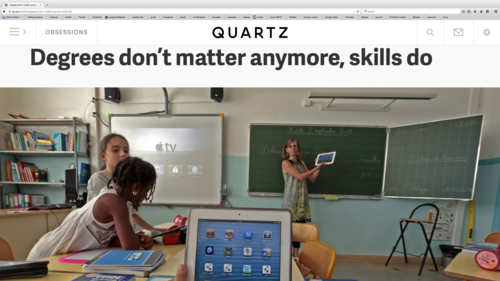
Quartz #60—>The Coming Transformation of Education: Degrees Won’t Matter Anymore, Skills Will

blog.supplysideliberal.com tumblr_inline_nl2qutMaRo1r57lmx.png

Link to the Column on Quartz

Here is the full text of my 60th Quartz column, “Degrees don’t matter anymore: skills do,” now brought home to supplysideliberal.com. It was first published on February 9, 2015. Links to all my other columns can be found here.

Although I think the provocative title on Quartz helped get people to notice the column, I have what I think is a more accurate title above. This is my 2d most popular column ever. You can see the full list in order of popularity here.

If you want to mirror the content of this post on another site, that is possible for a limited time if you read the legal notice at this link and include both a link to the original Quartz column and the following copyright notice:

© February 9, 2015: Miles Kimball, as first published on Quartz. Used by permission according to a temporary nonexclusive license expiring June 30, 2017. All rights reserved.


If I were to make a nomination for the most destructive belief in our culture, it would be the belief that some people are born smart and others are born dumb. This belief is not only badly off target as a shorthand description of reality, it is the source of many social pathologies and lost opportunities. For example:

Too much of our educational system, both at the K-12 level and in higher education, is built around the idea that some students are smart and others are dumb. One shining exception are the “Knowledge is Power Program” or KIPP schools. In my blog post “Magic Ingredient 1: More K-12 School” I gave this simple description of the main strategy behind KIPP schools, which do a brilliant job, even for kids from very poor backgrounds:

  1. They motivate students by convincing them they can succeed and have a better life through working hard in school.
  2. They keep order, so the students are not distracted from learning.
  3. They have the students study hard for many long hours, with a long school day, a long school week (some school on Saturdays), and a long school year (school during the summer).

A famous experiment by Harvard psychology professor Robert Rosenthal back in 1964 told teachers that certain students, chosen at random, were about to have a growth spurt—in their IQ. These kids did wind up having their IQ grow faster than the other kids. If we had an educational system that expected all kids to succeed, and gave them the kind of extra encouragement that those teachers unconsciously gave the kids they expected to do well, then kids in general would learn more.

Kids whose teachers had low expectations can expect more typecasting in college. Too many majors fall into one of two categories: (a) majors in which there is no easy way to tell whether a student has mastered any skills that will help get a job or make life richer, or (b) majors designed to weed out all the slow learners and only try to teach the students who catch on quickly. Behind the practice of weeding out slow learners is the misconception that a slow learner is a bad learner, when in fact a slow learner who puts in the time necessary to learn often ends up with a deeper understanding than the fast learner.

The good news is that a total transformation of education is coming, whether the educational establishment likes it or not. I draw my account of this transformation of education from two prophetic books by Harvard Business School professor Clay Christensen and his co-authors:

  • Disrupting Class: How Disruptive Innovation Will Change the Way the World Learns by Clay Christensen, Curtis Johnson and Michael Horn
  • The Innovative University: Changing the DNA of Higher Education from the Inside Out by Clay Christensen and Henry J. Eyring.

The road ahead is clear: the potential in each student can be unlocked by combining the power of computers, software, and the internet with the human touch of a teacher-as-coach to motivate that student to work hard at learning. Technology brings several elements to the equation:

But since motivation—the desire to learn—is so important, a human teacher to act as coach is also crucial. In particular, without a coach, the flexibility for students to learn at their own pace can be a two-edged sword, because it makes it easy to procrastinate.

In the end, none of this will be hard. The technology and content for that technology are already good and rapidly improving. And although it is a bit much to expect someone to be both a great and inspirational coach and to be at the cutting edge of an academic field, the number of great athletic coaches and trainers at all levels indicates that, on its own, being an inspirational coach is not that rare. Being an inspirational coach in an academic setting is not quite the same thing, but I am willing to bet that it, too, is blessedly common. By having the cutting-edge knowledge from the best scientists and savants in the world built into software and delivered in online lectures, all a community college has to do to deliver a world-class education is to hire teachers who know how to motivate students.

Similarly, at the K-12 level, it is easier to find teachers who will be inspirational if those teachers can connect each student with expertly designed software customized for each student’s learning style. And teachers will be able to encourage each student to dig deeper into some particular interest that student has—well beyond the teacher’s own knowledge. Yet the teachers themselves will end up knowing a lot—much more than they learned in college themselves, simply from working alongside the students.

But what about all the forces arrayed against educational reform? Though they have won over and over in the past, those reactionary forces will be overwhelmed by these new possibilities. They will be like the corporate information technology department trying to stop workers from downloading unapproved, but inexpensive software on their own to get the job done.

The day is not far off (some would argue it is already here), when any parent who has the inclination to be a learning coach can team up with inexpensive online tools to give his or her child an education that is 20% better (say as measured by standardized test scores achieved) than what that child would get in the regular schools. It is hard to start a new charter school, and harder still to change a whole school district. But when an individual family can opt out, it is no longer David vs. Goliath in a duel to the death, but David leaving Goliath behind in the dust in a foot race. In the end, I think organized institutions can do a better job at teaching than parents on their own—but only if those institutions do things right. The ability of individual families to opt out will force most schools to get with the program, or lose a large share of their students.

None of this will happen instantly. In K-12, some states already have a strong tradition of educational reform, and will jump-start these changes. In other states, the forces arrayed against reform will be able to hold back progress for quite some time, by fighting tooth and nail against it. Rich, educated parents may help their kids tap into the new educational possibilities more quickly than poor parents who aren’t as attuned to education. But when performance gaps open wide enough, education in the laggard states will come around, by popular demand. And the scandal of ever more substandard education for the poor will encourage efforts by concerned citizens toward solutions empowered by the new learning technologies.

In higher education, students voting with their feet will make schools at the bottom of the heap change or die. Many of the most prestigious colleges and universities will resist change much longer, but some will embrace the “flipped classroom” model of doing everything online that can effectively be done online, and doing in the classroom only those things for which face-to-face interaction is crucial. And when some of the prestigious colleges and universities embrace the new methods, those colleges and universities will move ahead in the rankings as a result. The rest will ultimately follow.

There is one other force that will propel the transformation of education: a shift from credentials to certification. In most of the current system, the emphasis is diplomas and degrees—credentials saying a student has been sitting in class so many hours, while paying enough attention and cramming enough not to do too much worse than the other students on the exams. More and more, employers are going to want to see some proof that a potential employee has actually gained particular skills. So certificates that can credibly attest to someone’s ability to write computer code, write a decent essay, use a spreadsheet, or give a persuasive speech are going to be worth more and more. And any training program that takes the need to maintain its own credibility seriously can help students gain those skills and certify them for employers in a way that bypasses the existing educational establishment. Just witness the current popularity of “coding bootcamps.” That model can work for many other skills as well. For many students, that kind of certification of specific skills is a very attractive alternative to a two-year degree.

When this transformation of education is complete, K-12 education will cost about the same as it does now, but will be two or three times as effective. College education will not only be much more effective than it is now, it will also be much cheaper. There will still be a few expensive elite colleges and universities–these schools are not just providing an education, they are selling social status, and the opportunity to rub shoulders with celebrity professors. But less elite colleges and universities will find it hard to compete with the cheaper alternative of community college professor as coach for computerized learning. So the problem of college costs will be a thing of the past for anyone focused on learning, as opposed to social status.  (Of course, if lower college costs are one side of the coin, lower college revenue is the other side. College professors as a whole are likely to have a lower position in the income distribution in the future than in the recent past, with premium salaries limited to a shrinking group of well-paid academic stars.)

Florida State University Psychology Professor K. Anders Ericsson studies expert performance, whether in sports, art, or academic pursuits. His research shows that ordinary people with extraordinary motivation can achieve remarkable performance through a pattern of arduous work and study called deliberate practice. By bringing computers and computer networks in to help with the other aspects of teaching, our society will be able to afford to focus on instilling in students that kind of extraordinary motivation. When that happens, the world will never be the same again.

Steven Landsburg: Big Price Fluctuations are Evidence of Competition

A monopolist always has price-sensitive customers—because if they’re not price-sensitive, he’ll keep raising his prices until they are. Therefore, even when market conditions change, a monopolist can rarely afford to raise prices very much. Big price fluctuations are evidence of competition.

– Steven E. Landsburg, More Sex is Safer Sex, p. 137. This is a fun piece of economics. Draw the supply and demand pictures and monopoly optimization pictures to see the logic here. There is wiggle room for this claim to not always be true, but Steven’s generalization has a lot of merit.  

Negative Interest Rates and When Robots Will Set Monetary Policy: George Samman Interviews Miles Kimball

Link to the Article on cointelegraph.com. Mirrored by permission

Miles Kimball, who is a Professor of Economics and Survey Research at the University of Michigan tells CoinTelegraph about negative interest rates, the future of paper and electronic money, and how cryptocurrrency fits in.

Negative interest rates are a recent topic garnering much attention in the economic world. In no particular order, Denmark, Switzerland, Germany, Netherlands, Germany, Austria, and Sweden have or have recently had negative interest rates. On top of that some corporate bonds have had negative interest rates as well like Nestle and Shell.

What are Negative Interest Rates?

Negative interest rates are when you give the bank or government some form of money, and over time that bank or government will give you back less money than you initially deposited.

Essentially, you are paying a bank or government to take care of your money. This is the result of a flight to safety for people who are extremely risk averse, and it generally happens coming out of a massive recession in places where there is little to no growth (e.g. the EU).

CoinTelegraph: Why is it easier to have negative interest rates with electronic money vs paper? Also can you explain how this would work with a currency like bitcoin vs. “electronic dollars”?

Miles Kimball: It is easy to have negative interest rates for money in the bank: the number for the balance in the account gradually goes down if nothing is put in or taken out. Because paper money has a particular number written on it, getting a negative or positive interest rate for paper currency requires a little more engineering. And that engineering involves having the e-dollar be the unit of account.

If the paper dollar were the unit of account, then the interest rate for paper currency is always zero (unless you have a system of directly taxing paper currency, which is administratively burdensome and politically much more difficult than an electronic money system). So to have negative interest rates on paper currency as well as in other assets, the e-dollar needs to be the unit of account.

With the e-dollar as the unit of account, everything the central bank needs to do to have a nonzero paper currency interest rate can be done at the central bank’s cash window where banks come to deposit or withdraw paper currency from the central bank.

For good monetary policy, it is important that the central bank have control over the unit of account. And this e-dollar unit of account might have many of the aspects of a cryptocurrency–perhaps enough that it can be considered a cryptocurrency.

As far as private cryptocurrencies (like bitcoin) go, it is fine to have private cryptocurrencies perform the medium-of-exchange and store-of-value functions of money, but monetary policy requires control over the unit of account. So central banks need to retain control over the type of money that defines the unit of account–in this case the e-dollar.

Under an electronic money policy, 3 key things will insure that the e-dollar (or e-euro or e-yen or e-pound etc.) is the unit of account:

  • a requirement that taxes be calculated in e-dollars.
  • accounting standards that require accounting to be done in e-dollars.
  • the kind of need for coordination between businesses and between businesses and households that leads people to do daylight savings time (without any intrusive inspections of someone coming to look at your clocks).  

CT: How can you have negative interest rates in a cryptocurrency system?

MK: To have negative interest rates in a cryptocurrency system that uses bitcoin, say, for most transactions, there should be a separation between the unit of account and the medium of exchange.

Having an e-dollar that is distinct from a bitcoin is the way to do this. (Also, it is good to have many different stores of value. But that always happens.)

Currently, robots cannot do monetary policy as well as central banks can. Someday maybe they will be able to. Then a robot can be put in charge of the e-dollar. But there would still need to be a separation between the e-dollar unit of account (controlled by a robot) and anything that mechanically has a zero interest rate stated in terms of itself (as bitcoin now does).

CT: What are your thoughts on bitcoins ability to be a currency?  What are its limits from your perspective?

MK: Bitcoin is a currency already. But it would not be good to try to use it as a “full-service” currency. A good unit of account needs to have a constant value relative to goods and services. Bitcoin does not do this. And it cannot keep a constant value relative to goods and services without a much, much, more sophisticated algorithm for controlling the supply of bitcoins that would rival in complexity (and exceed in quality) what central banks now do. Good monetary policy is not easy.

The unit of account should be under the control of the institution that does the best job at keeping the value of the unit account constantly relative to goods and services–and in the process, keeps the economy at its natural level of output.

Currently, that is central banks. Bitcoin’s value fluctuates wildly relative to goods and services. Central banks (which are humans assisted by computers) still do a much, much better job at monetary policy than the bitcoin algorithm would.

CT: Also if you could talk more about blockchain technology and central banks? What type of tools/operations would be best suited for a blockchain?

MK: I am not a technical expert on blockchains, but I think blockchains or technical advances inspired by blockchains will be important in making e-dollars work as well as possible. Electronic dollars include money in the bank, but its being done in a very inefficient way, and transaction costs are huge, banks need to go the way of bitcoin. Blockchain technology is a great advance because it can do it much more cheaply than how the current banking system handles transactions now. It will make electronic transactions will be much more meaningful.

CT: Do you have any thoughts on the “currency wars” and their impact on central bank policies? Do negative interest rates have anything to do with this?

MK: Talk of “currency wars” is mostly silly. If all countries do expansionary monetary policy, that is not a currency war, that is a global monetary expansion not a currency war. If every time you read about a “currency war,” you substituted the words "global monetary expansion,” you would not go far wrong.

The only case when the word “currency war” is justified is when countries are each doing currency interventions by selling their own assets and buying equivalent foreign assets. If all countries do this, it all cancels out, and things are back to square one.  

As long as each country or its central bank is purchasing assets that have a higher interest rate or rate of return than the assets they are selling, it is a monetary expansion, not a salvo in a currency war.

Of course, monetary expansions have an effect on exchange rates, but if another country is not happy with that effect on its exchange rate, it should just match with its own, appropriately calibrated monetary expansion. That response is not a response in a “currency war,” it is normal monetary policy.

CT: Can you say what incentivizes central banks to have negative interest rates?

MK: The job of central banks is to keep keep prices stable and to keep the economy on an even keel by keeping output at the natural level. Doing both of these jobs well requires at least occasional use of negative interest rates.

As it is, the Fed, the ECB, the Bank of England, and now the Bank of Japan have a long-run inflation target of 2% because they haven’t yet put negative paper currency interest rates in their toolkit. Being prepared to do negative interest rates allows the inflation target to be reduced to 0–true price stability.

And being able to do negative interest rates makes it possible to nip recessions in the bud. These are big enough advantages that I think the eventually most central banks will indeed put negative (and positive) paper currency interest rates in their toolkit.  

Miles Kimball is an expert on negative interest rates as well as paper money vs. electronic money, and is a major proponent of electronic money. He writes on his own blog discussing e-money as well as other economic themes.

Steven Landsburg: The Immorality of Protectionism

If you support protectionism [in general, not just in your industry] because you think it’s good for you, you’ve probably just got your economics wrong. But if you support protectionism because you think it’s good for your fellow Americans, at the expense of foreigners, then it seems to me you’ve got your morals wrong too.

…if it’s okay to enrich ourselves by denying foreigners the right to earn a living, why shouldn’t we enrich ourselves by invading peaceful countries and seizing their assets? Most of us don’t think that’s a good idea, and not just because it might backfire. We don’t think it’s a good idea because we believe human beings have human rights, whatever their color and wherever they live. Stealing assets is wrong, and so is stealing the right to earn a living, no matter where the victim was born.

Inside Mormonism: The Home Teachers Come Over

In “An Agnostic Grace” I wrote:

Religion is the “everything else” category in our existence in human societies and as individuals after parceling out the things people understand fairly well about human life—just as “natural philosophy” used to be the “everything else” category after parceling out as natural sciences the things people were beginning to understand fairly well about the natural world.

Thus, it is important to understand religion. One reason is the project of constructing effective religions that do not require belief in the supernatural that I talked about in “Godless Religion.” Another reason is the project of understanding make things better for those who are poor or struggling without expanding government that I address in “No Tax Increase Without Recompense,” “Yes, There is an Alternative to Austerity Versus Spending: Reinvigorate America’s Nonprofits,” and “Why You Should Care about Other People’s Children as Much as Your Own.”

In addition to organizations labeling themselves as religions, I think 12-step programs that organize people to help one another in fighting addiction are a very important model to study. But my knowledge of 12-step programs is limited to what I have read and fictional portrayals. So let me focus for now religion, and specifically Mormonism, which I know well. 

Because of its distinctive features, Mormonism has a lot to teach in these regards. In particular, Mormonism organizes its members to provide many services to one another in ways that are not mediated by the market–something that could be emulated by community organizers if they focused on getting the bottom half of the population in income to help one another–with a sprinkling of help from volunteers from the richer half of the population with key skills–rather than pressuring for more help from the government.

I pursued this investigation previously in “How Conservative Mormon America Avoided the Fate of Conservative White America” and “The Message of Mormonism for Atheists Who Want to Stay Atheists.” In this post, I want to talk about home teaching. 

This past week, I have been visiting my Dad, who lives in Provo, Utah. (If you type Edward Kimball into the search box at my sidebar without quotations you can see more about my Dad. And unlike me, he has his own Wikipedia page.) On March 1, the home teachers came over.  Home Teaching is a microcosm of Mormonism. First, it is part of the emphasis on a lay ministry, in which every Mormon willing to do so is asked to take on a church service role or “calling.” Second, home teaching is an important part of the effort in Mormonism to take care of every Mormon. Home Teaching teaches the home teachers that no one is “riffraff.” Third, home-teaching illustrates the structural legacies of sexism that litter Mormonism’s structure and practices. (See “Will Women Ever Get the Mormon Priesthood?”) There is a parallel “Visiting Teaching” program in which women visit and teach on another, but home teachers teach the whole family, thus treating things as if men have things to say that everyone should hear, but woman have things that mainly other women should hear.

Home teachers and visiting teachers work in pairs–just as Mormon missionaries do. This makes possible an apprenticeship system for home teachers, although often both home teachers are experienced. All willing and well-behaved adult Mormons–plus male teenagers at least 14 years old–are asked to serve as either a home teacher or visiting teacher. Since about half of Mormons in a typical congregation are marginal members of the Mormon Church who do not always attend church meetings and are not willing to be home teachers or visiting teachers, each pair of home teachers usually has about four families to visit, and each pair of visiting teachers has about four women to visit each month. Getting all of this home teaching and visiting teaching done within the month is a tall order; most home teachers and visiting teachers fall short of the goal and feel some guilt about that. 

(Although I consider myself a Unitarian-Universalist, the Mormon Church officially considers me an “inactive” Mormon. I have specifically asked not to have any home teachers, and am grateful that this wish is respected. Some years ago, our family received regular letters from someone who was called as our home teacher, which did not bother us too much.) 

Mount Timpanogos as viewed from my Dad’s deck

Mount Timpanogos as viewed from my Dad’s deck

When the two home teachers arrived at my Dad’s house, my sister Sarah and brother-in-law Kevin greeted them at the door. Then everyone, including me, gathered in my Dad’s study, which has a picture window looking out on Mount Timpanogos. We had a very pleasant chat about things going on in our lives and in the home teachers’ lives. That kind of chat is actually one of the most important parts of home teaching; if a family is having troubles, then the home teachers will try to help themselves or call on additional resources of the Mormon Church if needed–volunteer time in abundance and money from the Church’s Welfare Program if necessary. After that chat it was time for the lesson: one I really liked. The home teachers gave us each paper copies of a document labelde “Lesson of the Bees” by Elder Russell Ballard. I am using my copy of that document to give the account that follows. 

We read out loud in turn. The first two paragraph went like this:

Honey bees, by instinct spend their life pollinating, gathering nectar and condensing that nectar into honey. It is estimated that to produce just one pound of honey, the average hive of over 20,000 bees must collectively visit millions of flowers and travel the equivalent of two times around the world. Over its short lifetime of just a few weeks to four months a single honeybee’s contribuition of honey to its hive is a mere one-twelfth of one teaspoon. Yet the small contribution is vital to the hive of the honey bees. They rely on each other. The lesson of the bees is profound: When many people each do something small, together they accomplish something large. 

Then the current president of the Mormon Church, Thomas S. Monson, was quoted as saying (amont other things) “Often small acts of service are all that are required to lift and bless one another; a question concerning a person’s family, quick words of encouragement, a sincere compliment, a small note of thanks, a brief telephone call.”

There was then a quotation within a quotation of a Mormon hymn, “Have I Done Any Good”:

Have I done any good in the world today? Have I helped any one in need? Have I cheered up the sad and made someone feel glad? If not I have failed indeed. Has anyone’s burden been lighter today because I was willing to share? Have the sick and the weary been helped on their way? When they needed my help was I there? 
There are chances for work all around just now, opportunities right in our way. Do not let them pass by, saying “Sometime I’ll try,” but go and do something today. ‘Tis noble of man to work and to give: love’s labor has merit alone. Only he who does something helps others to live. To God each good work will be known.   

When I was young, instead of “Only he who does something helps others to live. To God each good work will be known” it went “Only he who does something is worthy to live. The world has no use for the drone.” This was amended because it was felt to be too harsh. (The biology is bad, too, but I doubt that played any role in the amendment. And notice that there has been no amendment to the gender-biased language.) The amendment came too late for me: I still feel in my bones "Only he who does something is worthy to live. The world has no use for the drone.“

The last paragraph of the document simply repeated the message of the first paragraph. But before that what was evidently a talk by Mormon apostle Russell Ballard talked about the significiance of the symbol of the beehive for Mormonism:  

The Beehive was a symbol of harmony, cooperation and work for the early pioneers of the Church. Brigham Young used the symbol to inspire early Church members to work together to transform the barren Salt Lake Valley into a beautiful and thriving community. The Beehive symbol was imprinted on the doors of the Salt Lake Temple and the Beehive House, Brigham Young’s Official residence, was adorned and named after a beehive sculpture atop the house. 

To this day, Utah is known as "the Beehive state” and a beehive is at the center of Utah’s state seal:

To me, the beehive is a fitting symbol of efforts to make the world a better place, even for those who, like me, do not believe in the supernatural. Saving the world takes the efforts of many, many people. It cannot be done alone. And beyond the goal of saving the world is the goal I talk about in “Teleotheism and the Purpose of Life” of bringing to pass “that day, that fine day, when God and Heaven do exist."

Virginia Postrel: The Glamour of Harmony

… [the 1939 New York World’s Fair’s] merchandising sold both political planning and commercial products—and packaged both in glamour. It encouraged visitors to project themselves into a future not only of abundant goods and impressive technology but of effortless harmony and order. The fair did not acknowledge any contradiction between individual choices in the marketplace and ‘cooperative’ political planning. In its glamorous depictions of the future, all groups worked together in harmony, and individual and collective plans exactly coincided. By editing out conflicts, the fair heightened the allure of both its commercial exhibits and the politically directed future. It sold a world where everyone wanted the same thing, a world without trade-offs or losers.

– Virgina Postrel, The Power of Glamour, pp. 191-192

Tina Rosenberg: A Psychological Depression-Fighting Strategy That Could Go Viral

I love to see technological progress. Technological progress in mental health care is especially welcome. Tina Rosenberg discusses an approach that seems to be both effective and affordable. 

To lower the cost of treating depression in the US, the key policy issue is to make sure that certification and licensing for this kind of counseling is kept inexpensive. We need to keep psychologists from erecting barriers to entry just to protect their market position.

Q&A: Is Electronic Money the Mark of the Beast?

Simon: My name is Simon Hauser. I write for a german media outlet (Godmode-Trader.de) and occasionally I address your fascinating thoughts about monetary policy and in particularly e-money.

I appreciate that your “confessions” not only gravitate around the quantifiable sphere, but also around deeper and (by economists) often neglected issues like religion and the like.

To my knowledge the bible is the only sacred book that talks about E-Money - or to be more accurate - the abolishment of cash:

And he causes all, the small and the great, and the rich and the poor, and the free men and the slaves, to be given a mark on their right hand or on their forehead, and he provides that no one will be able to buy or to sell, except the one who has the mark, either the name ofthe beast or the number of his name. (Revelation 13:16)

What is you opinion about the potential dangers emanating from a unholy alliance between E-Money and a „beast“ for the concept of liberty? Wouldn’t E-Money – besides all positive effects it offers – be the ultimate tool of subjugation in the hands of a future system, which might lurk in the fat tail of probability distribution?

Best regards from an avid reader.

Miles: At first I was excited to read in your email that e-money was in the Bible. But as you point out, only as the work of the devil!

As far as liberty goes, it is important that my system is one that keeps paper currency around. It does not try to disadvantage paper currency, only to keep the interest rates on paper currency in line with the interest rates available electronically.  

Also, as a critique of the idea of just abolishing paper money, I always argue that it is hard to stop people from using paper currency completely because for some transactions there is a high demand for secrecy. If a government tried to abolish paper currency completely, people would start using foreign paper currency. A government could effectively tax paper currency to a substantial degree before people switched to a foreign paper currency, but there is a limit. (For the graphs in my Powerpoint file, I took a -20% interest rate on paper currency as my very rough guess for about how low the interest rate on domestic paper currency could be before people switched to using a foreign paper currency–in a context where the government was doing the usual things to discourage people from using foreign paper currency.) I don’t think it is that easy to take away people’s ability to do transactions in secret.

Miles’s Addendum: A famous economist (whose identity I will protect) made to me the following very interesting point: for those who worry about oppression by a future government worse than the government we have now, it is a mistake to put any faith in paper money. It is very easy for a government that sees paper money as subversive to make paper money worthless by issuing huge amounts of it. A technically cutting-edge country willing to annoy foreign countries, can even make foreign paper money worthless by issuing large amounts of high-quality counterfeit bills. Rather than putting faith in paper currency, a much better check on the power of a future government would be for the current government to issue convenient gold and silver coins of specified weight that could be used as money in dire future circumstances. As long as these gold and silver coins were not given a dollar value in non-apocalyptic times, but rather were labeled by weight, and were not used as a unit of account, they would not interfere with monetary policy in pre-apocalyptic dimes. (Their dollar values would fluctuate in value relative to electronic dollars according to supply and demand for gold and silver.) Of course in an apocalyptic situation, these coins would become a unit of account among those fighting the oppressive government–and that is as it should be. 

Notice that having had a gold standard means nothing in an apolacyptic situation because the government can simply go off that gold standard; what is needed in an apocalyptic situation is actual gold coins of known weight, or something else that can easily be used as a commodity currency. Those gold coins or other things that can serve as a standby commodity currency don’t cause any trouble in the non-apocalyptic situation as long as they have a fluctuating price relative to the unit of account in the non-apocalyptic times.    

Brad DeLong: Try Everything

I very much like Brad DeLong’s message here. 

Brad is happy to include my proposals within the scope of “Try everything.” Here is my Twitter interaction with him on that. 

Negative Interest Rates and Financial Stability: Alexander Trentin Interviews Miles Kimball

Link to the original English version “SNB should introduce a fee on paper currency” and link to the German version “SNB sollte Gebühr auf Bargeld einführen.”

After Alexander Trentin wrote about my electronic money proposal in “Japan, It’s Time to Finally Overthrow Cash!” in a post on the Zurich web magazine Finanz und Wirtschaft (which translates as “Finance and Economics”), he arranged an interview with me. This is his distillation of that interview. I appreciate his permission to mirror it here, after a reasonable delay. What I like most about this interview is the chance it gave me to talk about how follow up an electronic money policy that makes deep negative interest rates possible with measures to enhance financial stability. 

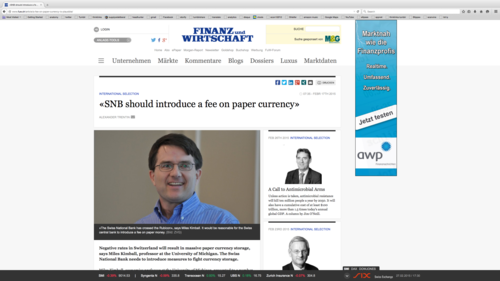
The caption for the picture at the top is 

«The Swiss National Bank has crossed the Rubicon», says Miles Kimball. It would be reasonable for the Swiss central bank to introduce a fee on paper money.

and the summary at the top is 

Negative rates in Switzerland will result in massive paper currency storage, says Miles Kimball, professor at the University of Michigan. The Swiss National Bank needs to introduce measures to fight currency storage.

Miles Kimball, economics professor at the University of Michigan, presented to a number of central banks his idea of a fee on paper currency. In his opinion it is crucial to inhibit the storage of cash to ensure the effectiveness of negative rates. Kimball writes about his idea at «Confessions of a Supply-side Liberal».

Mr Kimball, the president of the Swiss National Bank (SNB), Thomas Jordan, said that the current deposit rate in Switzerland of –0.75 percent could be even more negative. But how low can negative rates go?

If people know that the value of paper currency could go below par, the only limit to how low interest rates can go is full-scale economic recovery. Such an expansion – including in Switzerland’s case a competitive exchange rate – would make further low interest rates unnecessary.

But how low can interest rates go when people can earn a zero interest rate by storing cash?

People disagree about that. But even with a negative rate of –0.75 percent – given some time, let’s say five years – there would be massive paper currency storage. It might take a while until business models are set up to store paper currency. But if people knew the current situation would continue, this would happen at current negative rates. But if I were going to set up a paper currency storage business, I would be afraid that the SNB would disrupt my business – as it should. If people become confident that the SNB won’t do anything to get in the way of their profit by paper currency storage then the ability to set negative rates will be severely compromised. The SNB has already crossed the Rubicon into the territory where they need to do additional things to inhibit massive paper currency storage.

Last year you had a presentation to SNB staff. What did you advise them to do?

I proposed a deposit fee on paper currency. The path that the SNB followed makes it quite plausible. I know that they are open to new approaches. The fact that they went down to –0.75 percent tells you that they are open to try new policies. In the current context it is fairly straightforward and would sound reasonable to say: we start to see signs of a buildup of paper Swiss francs, so we want to inhibit that. We will cut off the arbitrage between paper currency storage and negative rate deposits by introducing a gradually increasing paper currency deposit fee. If banks want to deposit the paper currency with the SNB, they have to pay this fee. I don’t see any reason why the SNB could not defend this. Giving up the currency peg to the Euro was much more controversial.

So, if I would like to deposit bank notes on my account, the bank would charge me, because they have to pay a fee with the SNB. Is this correct?

Yes, if the deposit fee started at zero, but was going to increase every year by 1.25 percent, then even at interest rates of –1.25 percent there would be no temptation to pile up paper currency because there would be no way to profit from such cash storage any more. Notice that at that rate it would take years before the fee would be more than a few percent. With such a small deposit fee, most retailers would still accept cash at par. So the deposit fee should not create problems for regular households who just get paper currency to pay for goods. And hopefully the economy can recover before the deposit fee has to increase further.

You argue for large swings in interest rates to stabilize the economy. To fight a recession, you propose rates could go quickly to negative rates. What kind of level of interest rates would you have advised for the great recession in 2008/2009?

I wrote in “America’s Big Monetary Policy Mistake: How Negative Interest Rates Could Have Stopped the Great Recession in Its Tracks” that if we had a rate of –4 percent in the US in 2009, we would have a robust economic recovery by the end of 2009. In fact, I think a rate of –3 percent would probably have done the trick. To people who doubt that even –4 percent would have been low enough, I answer that you can go as low as you need to. At some point the economy takes off at very fast speed. That brings interest rates up. If measures are taken to avoid massive paper currency storage, then the only limitation on how low you can go on interest rates is that at some point you get an economic recovery.

You advocate negative rates instead of Quantitative Easing, QE. How do these instruments work differently?

QE operates with risk and term premia. With negative interest rates you lower all four interest rates: the central bank target rate, the lending rate, the rate on bank reserves, and the paper currency interest rate. Negative rates bring the whole term and risk structure down. If the risk premium is too high than QE works great. But it becomes harder: If you squeeze term and risk premia more and more, you need larger and larger amounts of QE to have an effect. And if you try to squeeze the risk premium below what it should be, there are probably some bad side effects. In contrast, if you use negative rates to pull the whole term and risk structure down, the economy can still function in a normal way. Banks operate on spreads: if they can lend at a higher interest rate than they borrow, they are fine. I don’t want to be too negative about QE, because during the financial crisis risk premia were elevated, so it was good to bring them down then. And there is a good argument to be made that risk premia have typically been too high even in normal times, so it is good to bring them down some. But there is a limit to how much QE can do.

Not all parts of the economy are evenly stimulated by low interest rates. What would you say about worries that, due to low rates, real estate prices and other asset prices could end up in a bubble?

According to standard economic theory, asset prices in general should be high when interest rates are low. If real estate prices in particular are an issue, you could have property taxes. But the big issue is not that property prices get really high, but the high degree of leverage in real estate. The right policy is to require banks to have 50% equity financing, in addition the individual mortgages should having 50% equity requirements. Only some of the equity financing of mortgages needs to come from the homeowner. Banks could effectively put up the rest by taking a portion of the capital gain or loss on a house when it is sold. The idea of high equity financing is to let the people who are putting up the equity sign up in advance that if prices fall, they will take the hit.

Are there other effects of low interest rates on asset prices?

The equilibrium real interest rates might tend to be low in the future. The transformation from manufacturing to services in many countries like Germany and in the future China could be one reason for that. The future interest rates could be positive, but maybe fairly low. Such a low interest rate in the long run would mean that predictions and expectations about what will happen in the more distant future are much more important for asset prices. The debates about such expectations could make asset prices fluctuate more.

Why is the distant future more influential when rates are low?

If interest rates are high, then companies only care about projects that pay out very fast,  because otherwise they can’t pay back that interest. On the other hand, if interest rates are very low, companies and people also make investments that may take quite some time to pay off, because the interest burden is modest. If you can wait a long time for the pay-off, people’s ideas of what will happen ten or twenty years from now will become crucial for buying companies or valuing projects. If you have low interest rates, asset prices will not only be high, they will fluctuate more. So we need to have structures in place to deal with that. A higher equity requirement for banks and mortgages will make explicit who is taking the risks. If the risk-bearing is not made explicit through equity requirements, it will be the government and taxpayer who will have to pay for losses to stop a financial crisis.

But would higher equity requirements not outweigh the positive effect of negative rates?

As there is an implicit government subsidy for debt, higher equity requirements are taking away some government subsidy for debt-financed investment. To compensate for that you may need to lower rates further. In a speech Larry Summers said that as aggregate demand is too low, we might need bubbles to increase demand when at the Zero Lower Bound. But having negative rates allow us restrain bubbles with higher equity requirements without worrying about having enough aggregate demand. Negative rates are powerful enough you don’t have to depend on asset bubbles any more to stimulate aggregate demand.

In one article, you argued that Switzerland offers insurance to the world through the safe assets it provides. But how can the country benefit from offering this insurance?

Switzerland should consider establishing a Sovereign Wealth Fund, separated from the central bank. This is now standard when a government has more financial wealth than debt. With negative interest rates large sums could be borrowed, maybe four or five trillion Francs, and they could be invested in exchange traded funds, to avoid get involved in individual companies. The business would be that of a bank: borrow cheaply, invest with a higher return. One reason for the criticism of the large foreign exchange reserves of the SNB was the low returns. I think higher returns would lead to greater acceptance of a large fund.


Bio of Miles from the German version:

Miles Kimball has taught at the University of Michigan in Ann Arbor since 1987.  He is Professor of Economics. Before completing his doctorate in economics at Harvard, he studied linguistics with a thesis on the philosophy of language. Kimball has presented his proposals on negative interest rates and the introduction of an electronic currency to many experts, including the Fed, the ECB and the Swiss National Bank. He also presents his ideas on his blog "Confessions of a Supply-Side Liberal.“
I remember my own first grade teacher and how stirring she found the words of John F. Kennedy, as he took the reins of the country and challenged his fellow citizens to—and here I paraphrase only slightly—‘Ask not what I can do for you; ask what you can do for me’ Ever since, I’ve been alert to pro-government prejudice among teachers and other opinions leaders.

John Stuart Mill on Having a Day of Rest and Recreation

It is not surprising that John Stuart Mill argues against the imposition of one’s religious strictures on other people–including one’s beliefs about a day of rest from regular work. What I find surprising is that he has so much sympathy for some sort of social rules to encourage people to take a day of rest. He does recommend that people not all synchronize their day of rest, since recreation often requires the help of someone doing herhis job. In On Liberty, Chapter IV, “Of the Limits to the Authority of Society over the Individual” paragraphs 20, he writes:

Another important example of illegitimate interference with the rightful liberty of the individual, not simply threatened, but long since carried into triumphant effect, is Sabbatarian legislation. Without doubt, abstinence on one day in the week, so far as the exigencies of life permit, from the usual daily occupation, though in no respect religiously binding on any except Jews, is a highly beneficial custom. And inasmuch as this custom cannot be observed without a general consent to that effect among the industrious classes, therefore, in so far as some persons by working may impose the same necessity on others, it may be allowable and right that the law should guarantee to each the observance by others of the custom, by suspending the greater operations of industry on a particular day. But this justification, grounded on the direct interest which others have in each individual’s observance of the practice, does not apply to the self-chosen occupations in which a person may think fit to employ his leisure; nor does it hold good, in the smallest degree, for legal restrictions on amusements. It is true that the amusement of some is the day’s work of others; but the pleasure, not to say the useful recreation, of many, is worth the labour of a few, provided the occupation is freely chosen, and can be freely resigned. The operatives are perfectly right in thinking that if all worked on Sunday, seven days’ work would have to be given for six days’ wages: but so long as the great mass of employments are suspended, the small number who for the enjoyment of others must still work, obtain a proportional increase of earnings; and they are not obliged to follow those occupations, if they prefer leisure to emolument. If a further remedy is sought, it might be found in the establishment by custom of a holiday on some other day of the week for those particular classes of persons. The only ground, therefore, on which restrictions on Sunday amusements can be defended, must be that they are religiously wrong; a motive of legislation which never can be too earnestly protested against. “Deorum injuriæ Diis curæ.” It remains to be proved that society or any of its officers holds a commission from on high to avenge any supposed offence to Omnipotence, which is not also a wrong to our fellow creatures. The notion that it is one man’s duty that another should be religious, was the foundation of all the religious persecutions ever perpetrated, and if admitted, would fully justify them. Though the feeling which breaks out in the repeated attempts to stop railway travelling on Sunday, in the resistance to the opening of Museums, and the like, has not the cruelty of the old persecutors, the state of mind indicated by it is fundamentally the same. It is a determination not to tolerate others in doing what is permitted by their religion, because it is not permitted by the persecutor’s religion. It is a belief that God not only abominates the act of the misbeliever, but will not hold us guiltless if we leave him unmolested.

I heartily agree with John Stuart Mill that “abstinence on one day in the week, so far as the exigencies of life permit, from the usual daily occupation, … is a highly beneficial custom.” It can be a hard custom to maintain for those of us who feel ourselves to be in some kind of contest (or what economists often call a “tournament”) against others whom we imagine as not taking any time off. For some of us in competitions we feel to be tight, even sleep seems like a luxury that is hard to afford. (I was glad to host the guest post “Dan Miller: Sleep as a Strategic Resource,” but look at the gainsaying comment to see how negative the attitude toward sleep can be among competitive types.)

Perhaps the best way we could shift the culture toward giving highly competitive folks like many of us a bit of a break would be to make our ability to keep up with everything despite taking time off something to brag about. I am thinking about something like the story I told in “How the Idea that Intelligence is Genetic Distorted My Life—Even Though I Worked Hard Trying to Get Smarter Anyway:

Once I actually got to college, with many other smart competitors, I knew I would have to work hard in ways more directly related to classes. But the desire to impress my classmates with the appearance of little input for high performance was still there. I still get a frisson of joy remembering the time one of my classmates expressed awe that I managed to survive in college despite not studying on Sunday.

In that vein, one of the things I have always been impressed with about William F. Buckley is that he managed to do everything he did to change the world while still pursuing his favorite recreations (such as sailing) vigorously. 

The following story is told about Joseph Smith, the founder of Mormonism:

That Joseph Smith liked to pull sticks, wrestle, play baseball, swim, and hunt is generally well known. William Allred, who played ball with Joseph many times, recalled an instance when someone criticized the Prophet for indulging in play. To answer the criticism Joseph told a parable about a prophet and a hunter—clearly explaining his own philosophy about the relationship of play to work. As the story goes, a certain prophet sat under a tree “amusing himself in some way.” Along came a hunter and reproved him. The prophet asked the hunter if he always kept his hunting bow strung up.
 “Oh no,” said he.
“Why not?”
“Because it would lose its elasticity.”
“It is just so with my mind,” stated the prophet; “I do not want it strung up all the time.”5

Except in genuine emergencies (which are frequent enough), let us try not to act like workaholics, especially since it tilts things toward everyone else feeling they need to act like a workaholic. There is plenty of trouble in the world, and a lot to do to save it. But maybe a little fun (and sleep) along the way will improve our productivity enough that it won’t put us too far behind in that endeavor.

And in fact, thinking only about "productivity” dramatically understates the benefit of taking some time off now and then. There is always a big danger of finding that one has worked very hard to take the world in the wrong direction. A balanced life gives one a fighting chance to gain the extra perspective needed to lessen that danger.

Virginia Postrel: The Glamour of Terrorism

Jihadi terrorism combines two ancient forms of glamour, the martial and the religious, with the modern allure of media celebrity. It promises to fulfill a host of desires: for purity and meaning, union with God, historical significance, attention and fame, a sense of belonging, even (posthumous) riches and beautiful women. The jihadi’s ultimate goal of a restored caliphate exemplifies the glamorous utopia, while the terrorist plot recalls the synchronization of heist movies, with a secret and intricate plan in which every team member is important and the goal is to outwit authorities and commit a crime. It’s not hard to imagine how appealing all this might be to a bored, alienated, and impressionable person.

– Virgina Postrel, The Power of Glamour, pp. 220-221

Noah Smith: These are the Econ Blogs You Need to Read

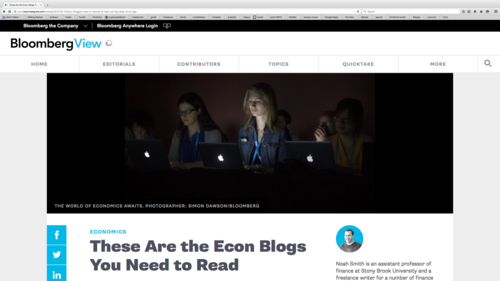
blog.supplysideliberal.com tumblr_inline_njzxa37r491r57lmx.png

Link to Noah’s article on Bloomberg View

In his article “These are the Econ Blogs You Need to Read,” Noah Smith has some kind words to say about me and this blog:

The Dreamers
Confessions of a Supply-Side Liberal, by Miles Kimball: My doctoral adviser has recently become one of the most interesting and original occupants of the blogosphere. His favorite topics include monetary policy – where he champions unconventional ideas such as electronic money, federal lines of credit, and a U.S. sovereign-wealth fund – and education, where he urges a rethink of our basic values and approaches. As the grandson of a prophet of the Mormon church, he also has a deep interest in religion.

Leaving this aside, Noah gives a very useful tour of the economics blogosphere. This is an article I will send my students to help them find their way in the econ blogosphere.

Owen Nie: Playing Card Currency in French Canada

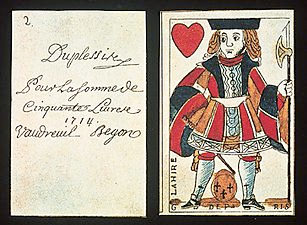
The proposal I have made for a shift to an electronic money standard. Leaving the paper standard is comparable in magnitude to the earlier departure from the gold standard. But over the centuries there have been many monetary systems. I think it is useful to realize that monetary systems come and go. So I was glad when Owen Nie, a PhD student at the University of Michigan, volunteered to conduct a summer research project looking into alternative historical monetary systems. Owen will report what he learned in a series of guest posts. This is the first. This is a distillation from a chapter “Playing Card Currency of French Canada” from Richard Lester’s book Monetary Experiments: Early American and Recent Scandinavian. (Also see the Wikipedia article on “Card money in New France.”) Here is Owen’s summary:


The North American colonies were a great laboratory for monetary economics. In 1685 the French Canadian authorities were forced by an emergency (the yearly allotment didn’t arrive in a timely way and left the troops and officials unpaid) to issue paper money made of ordinary playing card, made a legal tender and redeemable in cash or bills of exchange (later in silver coin in France, which is effectively a silver exchange standards) as the King’s vessel’s next arrival with the colonies’ yearly appropriation. The practice was repeated a number of times and considered a success in the early 18th century except for the period of Queen Anne’s War. The King, previously opposed to the monetary experiment, started issuing playing card money in 1730. However, the afterwards excessive supply of this currency, issued to defray mounting military expenditures, together with a relative scarcity of goods as manpower were directed towards wartime efforts and a deterioration of French finances caused inflation and delayed redemption at a large discount of face value by the time Canada was ceded to England in 1763. In its sixty-five years of existence, the system collapsed only twice, both because warfare money in excess of government funds destined for the colony.

On Having a Thesis

My main strategy for helping the students in my Monetary and Financial Theory class is to have them write a lot. They write 3 blog posts a week on an internal class blog. I have showcased some of the best of these blog posts on this blog, “Confessions of a Supply-Side Liberal.” You can see links to all these student guest posts here. The magic of having students write many, many short pieces is something that can be implemented easily by any instructor anywhere who has the good fortune to have a teaching assistant to make brief comments on them all, as I have.* And there is a bit of magic to the blog post format, which tends to disinhibit students. (I know with some degree of confidence, because there was a point at which I switched from having students do short essays that were printed out in one semester of a Principles of Macro class to doing blog posts the next semester. The blog posts were better.) 

In this post, I wanted to give a few other tips for writing blog posts in addition to pointing to the magic of writing a lot. The first is that the wind-up in the introduction shouldn’t be too long. Indeed, the most common request from my editors at Quartz when I send them a first draft of a column is that I should shorten the introduction. I often need the lengthy introduction as I write in order to get into the topic, but once the rest of the piece is written, the introduction can be slashed to something much shorter.  

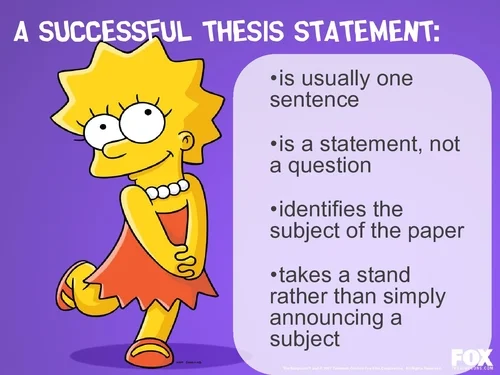
The second tip is that it is important to have a thesis: something that you want to say and are willing to try to back up. If you want some examples of thesis statements, about half the time the titles my editors choose for my Quartz columns are their take on what a thesis statement would be. (You can see a list of titles of my Quartz columns here.) Lisa Simpson above gives some excellent guidance on what a thesis statement should be like; I am afraid the other half of my titles don’t obey these rules for thesis statements.

How can you come up with a thesis statement, and arguments to back it up? There may be other harder ways to come up with a thesis statement, but the easiest way is to think of something you want to say that you actually believe. For most people this is definitely the way to go if you are allowed to choose from a broad range of topics. 

To come up with the thesis statement itself, read the newspaper, read other people’s blogs, read books, talk to people, and constantly keep a look-out for any reaction you have that makes you want to say something to the world or at least to some other people. Figure out how to say the gist quickly, so that it can fit in one sentence. It might have to be only an approximation to what you really want to say to fit into one sentence, but that is OK. If that kind of brevity is hard for you, get a Twitter account and practice saying things in 140 characters or less on Twitter. (You can see my tweets here. I think they provide many examples of thesis statements, though not always the supporting arguments!) 

The thesis statement does not always have to actually appear in your post or essay, but it needs to exist and you need to know what it is. And I recommend that beginning writers actually put the thesis statement into the post or essay. 

In addition to the question “What am I trying to say here?” the question “What am I trying to accomplish in this piece?” is also helpful in identifying a thesis statement. But once you answer “What am I trying to accomplish in this piece?” you need to go back to the question “What am I trying to say here?” in order to come up with the thesis statement itself.   

Trying to support your thesis statement can seem daunting. But anything that would make someone a little more likely to agree with your thesis statement counts as supporting it. Even “preaching to the choir”—that is, making someone who already agreed with you more energized to spread the word or to do something about it—counts.

To come up with arguments to back up your thesis statement, ask yourself why you believe it. (Remember, I am only telling you the easy way to come up with thesis statements and back them up. Learning how to argue for something you don’t believe is an advanced writing skill for folks like lawyers.) If you ask yourself why you believe it and can’t come up with anything, maybe you should choose another topic. If you can answer that question, write down the answer, and you are on your way. 

There are different levels of arguments you can have for a thesis statement. The upper level is when you have arguments that might convince someone else even if they start out a bit skeptical. In other words, if you can take on the burden of proof and meet that with your arguments, that is impressive. 

The lower level of supporting a thesis statement is to explain why you believe it and to lay out what someone else would have to do to convince you otherwise. That is, if you can defend your thesis statement against an attack when the attacker has the burden of proof, that definitely counts for something.  

The point is to have a clear thesis statement, and support it as well as you can. Admitting where you might be wrong and where there are weaknesses in your line of argument can be nice, too, although it doesn’t work as the substance of the whole post! If you actually think you might be wrong, that itself can make a good thesis statement: “I used to think X, but now I realize that I just might be wrong, because ….”  

That leads into my last tip. An essay is more memorable if there is a bit of conflict or drama in it. For example, “So and so says X, but they are wrong”; or “The conventional wisdom is X, but …”; or “Here is an issue that is extremely important that needs to be addressed; here is what needs to be done”; or “Here is something that will change the world in a big way.” To get that drama you need to have an opposition between two things: for example, two different ways of looking at things; how things are and how they should be; the way things are now and the way things used to be; how things are now and how they will be in the future. 

Everything that I am suggesting gets a lot easier with practice. If you keep writing many, many short pieces and keep these tips in mind, you will find your writing getting better and better. Have confidence and just keep going. Being a good writer will give you a huge advantage in your career. And there is a decent chance that, say, around the 25th short piece you write, writing will start to become fun for you.   

* To keep the grading burden down, we have a simple check, check+, check- grading system in which there is a strong default toward students getting a check; of the 1/8 of all posts that are revised and sent on to me, I only give a check+ to posts that are at a level worthy of being guest posts on my blog, and we only give check-’s to blog posts that exhibit either obvious low effort or a disregard of instructions.    

In addition to making the grading effort reasonable for a teaching assistant (in a 40 student class) despite the large number of blog post writing assignments, giving most posts a check helps to avoid premature perfectionism, which is one of the biggest dangers in learning to write. The blog post format also helps to reduce the danger of premature perfectionism, since the traditions for the blogosphere allow for a certain rate of typos, grammatical errors and awkward phrasing. This makes gaining fluency in writing blog posts in English quite doable even for students for whom English is a second language. 

It is easy to continue to polish blog posts after their initial posting. But even if initial posting is delayed until after polishing, it is possible to keep the polishing from creating writers block if the polishing is separated from writing the first draft of a post. 

It is hard enough getting ideas down in any form. Don’t burden your writing by requiring too much polish on a first draft. With experience, your first drafts will start looking more polished, but if you want to be a fluent writer, difficult polishing must always be delayed until after getting the first draft down.

Update: Since I wrote this, I have instituted in my class a requirement that students put an explicit thesis statement at the top of their posts. (I do not require that the thesis statement be made part of body of the post itself, in accordance with what I said above: “The thesis statement does not always have to actually appear in your post or essay, but it needs to exist and you need to know what it is.”) I think this is helping a lot in making the posts more focused.

Electronic Money: The Quiz

As part of the midterm exam in my “Monetary and Financial Theory” class, I wrote a set of multiple-choice questions based on my Powerpoint file “Breaking Through the Zero Lower Bound.” It occurred to me that those of you who have been following the electronic money theme on my blog might want to try your hand at the quiz generated by extracting those questions from the exam. I think your understanding will be deepened by doing this quiz and then looking at the answers. (Do try it in that order!) 

A. Suppose that a time-varying paper currency deposit fee is used to keep the paper currency interest rate below the target rate in Japan. Which of the following things could create a zero lower bound even with paper currency out of the way? 

  1. Gold
  2. Bitcoin
  3. Foreign Currency
  4. An interest rate of zero on the balances of money in (government-run) postal savings accounts.
  5. Being able to pay off debts with paper currency at its face value.

B. Filling in a bit what he meant, when Ben Bernanke came to the University of Michigan, what did he say about the unconventional monetary policies of quantitative easing and forward guidance? 

  1. Forward guidance has failed; that is why the Fed has abandoned forward guidance and turned to quantitative easing as its primary tool of monetary policy.
  2. Forward guidance is an absolute commitment. The Fed uses quantitative easing primarily to convince the markets of that.
  3. Because the Fed is worried about the side effects of unconventional policies such as quantitative easing, the Fed has stimulated the economy less than it would have if it could have just lowered interest rates.
  4. Quantitative easing and forward guidance can work when the inflation rate is 1% or above, but when inflation is below zero as in Japan, they won’t work. So the Fed is deeply worried about Japan.
  5. None of the above.

C. Which of the following does Miles point to as an advantage of monetary policy over fiscal policy for economic stabilization (that is, for keeping the economy at the natural level of output)?

I. Monetary policy does not raise the budget deficit

II. Monetary policy can push the costs of economic stabilization onto other countries

III. There is a strong tradition of technocratic monetary policy, but no institutional framework for technocratic fiscal policy (other than automatic stabilizers, which aren’t enough). 

  1. I
  2. II
  3. III
  4. I and II
  5. I and III

D. From earlier to later, which of the following is a correct order of events for the US?

  1. The Great Moderation, the Great Recession, the Great Inflation (ended by the Volcker disinflation)
  2. The Great Recession, the Great Moderation, the Great Inflation (ended by the Volcker disinflation)
  3. The Great Moderation, the Great Inflation (ended by the Volcker disinflation), the Great Recession
  4. The Great Inflation (ended by the Volcker disinflation), the Great Depression, The Great Recession
  5. The Great Inflation (ended by the Volcker disinflation), the Great Moderation, the Great Recession

E. Suppose the electronic dollar is used by everyone (including all units of the government) as the unit of account (and unit of price setting) and the inflation rate relative to that unit of account is zero. If an exchange rate between paper currency and electronic money makes the “inflation rate” relative to the paper dollar positive, which of the following would be costs of that “inflation rate” relative to the paper dollar?  

  1. Messing up price signals
  2. Menu costs
  3. Messing up the tax code in unintended ways
  4. Unpredictability of inflation messing up contracts
  5. None of the above.

F. Eliminating the zero lower bound with a paper currency interest rate that can go negative is likely to lead governments (in particular central banks) to lower inflation in both rich, basically well-run countries, and poor, not-so-well-run countries, for two different reasons:  

  1. There would no longer be any need to push down price cost markups with inflation in order to make the economy more efficient, and there would no longer be any need for inflation to make it easier to lower real wages for some workers.
  2. There would no longer be any need to push down price cost markups with inflation in order to make the economy more efficient, and it would be possible to earn substantial seignorage without any inflation relative to the unit of account.
  3. There would no longer be any need to steer away from the zero lower bound with inflation, and there would no longer be any need for inflation to make it easier to lower real wages for some workers.
  4. There would no longer be any need to steer away from the zero lower bound with inflation, and there would no longer be any need to push down price cost markups with inflation in order to make the economy more efficient.
  5. There would no longer be any need to steer away from the zero lower bound with inflation, and it would be possible to earn substantial seignorage without any inflation relative to the unit of account.

G. “On the Need for Large Movements in Interest Rates to Stabilize the Economy with Monetary Policy." Which of the following could increase aggregate demand as a result of the Fed lowering interest rates to deep negative rates?

I. Purchases of durable goods for storage

II. Purchases of foreign assets

III. Higher asset prices

  1. I
  2. I and II
  3. I and III
  4. II and III
  5. I, II and III

H. Treating the electronic dollar as the unit of account, what is the paper currency interest rate for 2019 if at the beginning of the year a paper dollar is worth $0.96 electronic dollars, while at the end of the year, a paper dollar is worth $0.98 electronic dollars? Closest to:  

  1. -4%
  2. 2%
  3. 0
  4. +2%
  5. +4%

J. Treating the electronic dollar as the unit of account, what is the paper currency interest rate for 2019 if at the beginning of the year a paper dollar is worth $0.90 electronic dollars, while at the end of the year, a paper dollar is worth $0.90 electronic dollars? Closest to: 

  1. -10%
  2. -9%
  3. 0
  4. +9%
  5. +10%

K. Which of the following is false

  1. It is possible to get a 1.5% rebate on all purchases with a Capital One Quicksilver Visa card and a 2% rebate on all purchases with a Fidelity Investment Rewards American Express card  
  2. The fees retailers pay when people use American Express cards are generally higher than the fees retailers pay when people use Visa cards.  
  3. If the paper currency deposit fee that banks paid at the cash window of the Fed was 1%, retailers would still be better off getting paid in cash than being paid by credit card even though paper currency would be below par.
  4. With rare exceptions, retailers always refuse to accept credit cards when they would net less money (after fees) from a credit card purchase than from a cash purchase.
  5. All of the above are true  

L. Think of a situation like that in late 2008. Inflation is fairly sticky. (Note that inflation being sticky is a stronger statement than prices being sticky.) Imagine that there are only 3 monetary zones in the world: A, B and C. To begin with, A has inflation of -1%, B has inflation of 0%, and C has inflation of +2%. After a serious financial crisis that makes all three countries want to do a major monetary expansion, Countries B and C keep their paper currency at par, but Country A uses a time-varying paper currency deposit fee to keep the paper currency interest rate below its target rate. What would be a good prediction for what would happen to net exports (NX) in these countries? 

  1. NX is likely to decrease for A, but increase for C.
  2. NX is likely to increase for B, but decrease for C.
  3. NX is likely to increase for A, but decrease for B.
  4. NX is likely to decrease for A, but increase for B.
  5. NX is likely to increase for all three because all three have a monetary expansion to deal with the effects of the financial crisis.

Answers

The single source that covers the most ground, though a bit cryptically, is my "Breaking Through the Zero Lower Bound” Powerpoint file. Someday, I hope to get a video made of one of these talks. 

A. 4

Guaranteeing an interest rate of zero over all horizons and in unlimited quantities in government-run banks is very similar to guaranteeing an interest rate of zero over all horizons and in unlimited quantities on government issued pieces of paper. It would also make people unwilling to lend at a rate significantly below zero.  

Gold, Bitcoin and foreign currencies all have prices that fluctuate relative to the electronic dollar unit of account. Other things equal, they are all likely to go up quite a bit in price relative to the e-yen unit of account when interest rates are cut and then to have expected capital losses as those prices gradually come back to earth. That expected capital loss brings their expected rate of return of these assets down. In any case, there is no riskless arbitrage to be had. 

Also, purchasing foreign currencies tends to put yen (electronic or paper) in the hands of people who don’t want the yen, so that the exchange rate adjusts until those dollars are absorbed by an increase in net exports from Japan. (See International Finance: A Primer.) 

If people increase gold production, that actually looks like an increase in consumption or investment and raises aggregate demand. It is not the kind of increase in aggregate demand I would wish, but it is an increase in aggregate demand. (If the gold is bought from abroad, that tends to cause a depreciation which stimulates production of other things domestically to export or to replace imports that won’t be imported because gold is being imported.)  

As far as debt contracts go, the value of the old debt contracts may be changed by the option to pay them off in below-par paper currency, but since the old debt contracts are in fixed supply, they just adjust in price. Paper dollars that can be used to pay off old debts don’t go up in value as a result–their value is pegged by the central bank. Instead, the old debt goes down in value, making the debtor less in debt

B. 3. 

See my post “Ben Bernanke: The Fed Does Less Monetary Stimulus Than It Thinks Is Warranted Because It Is Afraid of the Side Effects of Unconventional Tools.”

C. 5.

See “Monetary vs. Fiscal Policy: Expansionary Monetary Policy Does Not Raise the Budget Deficit” and “On the Need for Large Movements in Interest Rates to Stabilize the Economy with Monetary Policy.”

D. 5. The Great Recession was in the 1930’s. The Great Inflation was in the 1970s and the Volcker disinflation that ended it was in the early 80’s. The Great Moderation was from the mid 1980’s until the Financial Crisis in late 2008. The Great Recession began in earnest with that Financial Crisis. Its aftereffects have dragged on until now.   

E. 5.  See “The Costs and Benefits of Repealing the Zero Lower Bound … and Then Lowering the Long-Run Inflation Target." 

F. 5. For rich, basically well-run countries, the primary reason for inflation is the desire of central banks to steer away from the zero lower bound. For countries with weak tax systems, earning seignorage has sometimes been an important motivation for inflation. Both the zero lower bound and seignorage have to do with "inflation” relative to paper currency rather than inflation relative to the unit of account when the unit of account is electronic. So once a country goes off the paper standard, there is much less reason or temptation for inflation. (There is still the temptation to overstimulate the economy to go above the natural level of output, which can cause inflation.)

G. 5. All three. Durables purchases count as investment or consumption. Higher asset prices should have a wealth effect on consumption and a Q-theory-type effect on investment, as I discuss in “Monetary Policy and Financial Stability." Foreign asset purchases lead to higher net exports according to the logic I explain in ”International Finance: A Primer“ and my international finance Powerpoint file that I use in teaching. 

H. 4. Since the electronic dollar would be the unit of account (and is the numeraire for the analysis), the paper currency interest rate is equal to the capital gain rate on paper currency. Since the value of a paper dollar is increasing at (very close to) 2% in a year, the paper currency interest rate is equal to that capital gain of 2%. (An additional year at that rate would bring paper currency back to par.)

J. 3. Even though paper currency is away from par, if the effective exchange rate with unit-of-account electronic money is constant, there is no capital gain or loss, and the paper currency interest rate is 0. 

K. 4. This question is relevant to my argument that retailers are likely to accept paper currency at par up to about a 4% paper currency deposit fee. In ”A Minimalist Implementation of Electronic Money“ I make this argument as follows:

At the grocery store or other shops, it might be a while before merchants discouraged customers from using paper currency. As it is now, merchants accept credit cards despite the fact that must pay to accept credit-card payment. For example, in the UK, Barclay Card currently advertises that it charges businesses 1.5% on credit card transactions. 
So currently, getting paid by credit card is something like 1.5% less attractive than getting paid in paper currency. If, in order to avoid alienating customers, businesses were willing to continue accepting paper currency at par even if it was 1.5% less attractive to them than credit card payments, that might allow a 3% swing before things changed for retail customers: retail customers might be able to pay with paper currency at par even if banks had to pay a 3% penalty to the central bank for paper currency deposits.

Since then, I have read things that suggest that typical charges for credit cards are higher than this. In particular, it seems unlikely that credit card companies would give me an across-the-board rebate bigger than the fees they receive. You can see at these links that the Fidelity Investment Rewards American Express card gives a 2% rebate for everything and the Quicksilver Visa gives a 1.5% rebate for everything. I have both of these in my wallet (the Visa card for places that don’t accept American Express). 

Besides providing evidence about how much less retailers are now willing to accept from credit card payments than cash payments, the other reason these rebates are interesting is that they will encourage the use of electronic money, as more and more people get bigger and bigger discounts by paying with their credit cards. I now think that at least in the near term, increases in competition will make the effective fees that credit card companies charge narrow more by bigger and bigger rebates than by a reduction in the direct fee paid by retailers.

The fact that retailers now put up with getting so much less from credit card payments is an important fact that deserves more economic modeling. 

L. 3. The real interest rate is the nominal interest rate minus inflation. Since Country A can push its nominal interest rate as low as needed, it can also push its real interest rate very low. Country B can only get its real interest rate down to 0. Country C can only get its real interest rate down to -2% (a zero nominal rate minus inflation of 2%). I take the statement that they all want a vigorous monetary expansion to mean that Country A pushes its real interest rate significantly below -2%. So there will be substantial extra capital outflow from Country A, fleeing the low real interest rates. Extra capital outflow puts domestic currency in the hands of people outside the currency zone for whom it is a hot potato. Exchange rate adjustments recycle that currency to its home area through encouraging more net exports. The opposite happens for country B: because of its high real interest rate of 0 (compared to -2% for country C and below that for country A), foreign funds flow into country B. To do that, investors in Country B must buy up Country B currency that is available abroad, which prevents other people outside Country B from using that currency to buy exports from Country B. So Country B’s exports fall. Alternatively, Country B’s imports could rise to put more of Country B’s currency in the hands of foreigners. Country B’s residents are unlikely to put much currency in the hands of foreigners by buying foreign assets because they can get a zero real interest rate domestically, but face negative real interest rates abroad.